Market Minds Advisory
Digital Phase Shifters Market Share Analysis

Digital Phase Shifters Market Share Analysis: Digital Phase Shifters Market Share Analysis: Beamforming Components for Radar, Satellite and Wireless Arrays, 2026 to 2036

The circuit is well understood and the array still misses. What defeats phased array programmes is calibration and thermal drift across thousands of channels, and no component datasheet describes either of them.

Lead Analyst

Published

September 2026

Make Smarter Decisions with Customized Research Insights

Request a free sample report and evaluate market opportunities, growth trends, and competitive dynamics relevant to your business needs.

2025 MARKET VALUE$0.9BMarket Size 2025
2036 FORECAST VALUE$3.1BBase Case , 2026 to 2036
CAGR 2026 TO 203611.8 %Bull 13.0% / Bear 10.6%
INCREMENTAL OPPORTUNITY$2.1BNet 10- year value creation
EXPANSION MULTIPLE3.10x2036 value over 2026 base
Strategic Levers
M&A Pipeline
Regional Outlook
Country Rankings
Competitive Intelligence
Segmental Deep-dive
Call-Us : 91 93563 13602

Executive Snapshot and Market Trajectory.

Buyers specify phase shifters on bit resolution and insertion loss, then discover their array cannot hold beam pointing across temperature. Residual error near 5.4 degrees over the operating range is common, and it is a calibration problem rather than a component one. The component passes and the system fails.
The suppliers doing well have stopped selling parts. Silicon germanium and CMOS beamformer phase shifters grow at 17.7%, half again the market rate of 11.8%, because integrating many channels with on-chip calibration removes the problem the customer could not solve alone. Integrated devices now carry 38% of shipments. East Asia holds 31% of value, on defence electronics volume and millimetre wave array manufacture together.
Export control shapes this market more than technology does. Around 61% of volume requires defence trade licensing, which means a programme cannot second-source across jurisdictions and a qualified supplier effectively holds the socket for the life of that platform. Five suppliers hold 47% of merchant shipment value, and qualification running 26 months keeps challengers out of any programme already underway. Design stage selection therefore decides revenue for a decade or more. Nobody reopens it.
Market Definition
This market covers merchant digital phase shifter devices that alter signal phase in discrete steps for electronically scanned arrays, including gallium arsenide monolithic microwave integrated circuits, silicon germanium and CMOS beamformer channels, gallium nitride integrated devices, ferrite phase shifters, microelectromechanical switched devices, and discrete switched-line modules. It excludes complete antenna apertures, transmit receive modules sold as assemblies, analogue beamforming networks, and captive production consumed internally by system integrators.
Base Year Value
$0.9B in 2025 (MMA Primary Research Dataset, September 2026)
Forecast Period
2026 to 2036, eleven discrete annual values
CAGR
11.8% base case. Bull 13.0%. Bear 10.6%.
Fastest Growth Segment
Silicon Germanium And CMOS Beamformer Phase Shifters: 17.7% CAGR
Fastest Growth Country
India: 16.4% CAGR
Fastest Growth Region
South Asia and Pacific: 13.9% CAGR
Largest Region
East Asia: 31% of 2025 global value
Market Leaders
Analog Devices, Qorvo, MACOM, Mitsubishi Electric, and United Monolithic Semiconductors lead the field. Source: MMA Primary Research Dataset, July 2026.
Primary Survey
n=3,800 procurement and R&D decision-makers, Q4 2025, six countries
Methodology
Demand-side build-up, cross-validated against public data, 47 expert interviews

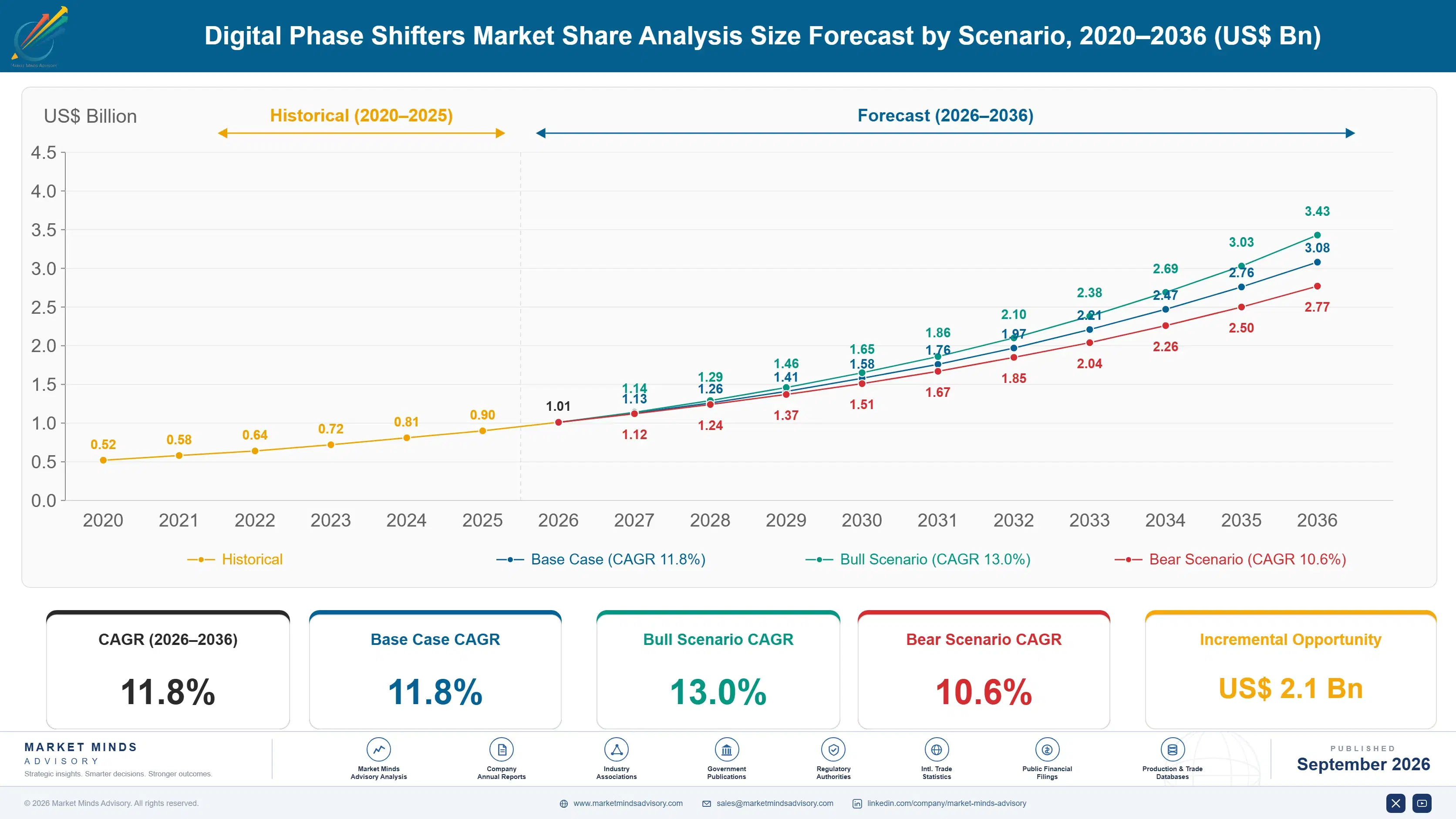
Digital Phase Shifters Market Forecast Scenarios

digital-phase-shifters-market-share-analysis-size-forecast-scenario-1790006538118
Between 2020 and 2025 demand moved from a small defence base toward something broader. Active electronically scanned radar replaced mechanically steered systems across successive platform generations, and low earth orbit satellite programmes began ordering array components at volumes no defence programme had ever required. Historical growth of 10.4% reflects that widening, tempered by defence cycles delivering revenue in irregular blocks.
The base case at 11.8% rests on three mechanisms. Satellite constellation user terminals and gateway arrays consume channel counts far beyond defence volumes, which pulls the category toward semiconductor-scale manufacturing. Defence radar modernisation continues across allied and non-aligned programmes alike, with element counts rising per aperture. And indigenisation requirements in several countries oblige domestic sourcing of array components, creating demand that would not otherwise exist at national supplier level. Element counts keep rising per aperture.
The bull case at 13.0% depends on millimetre wave fixed access deploying at genuine scale, which would attach consumer-volume manufacturing to a category that has never seen it. The bear case at 10.6% is defence budget rephasing: array programmes are long, individually large, and easily deferred, and two or three slipped procurements would remove visible forecast volume within a year.

The Array Fails Before The Component Does

The component specification and the system problem are not the same thing, and a great many programmes have learned this the hard way. A phase shifter can meet every datasheet parameter and still leave an array with residual pointing error near 5.4 degrees over temperature, because error accumulates across thousands of channels in ways no single-device measurement predicts. Procurement almost never tests for accumulated behaviour across a full aperture.
TOP FIVE CONCENTRATION47%Share of merchant shipment value held by leading suppliers
ELEMENTS PER ARRAY2,048Radiating channels in a typical modern radar aperture
PHASE ERROR OVER TEMPERATURE5.4 degreesResidual pointing error across the specified operating range
QUALIFICATION LEAD TIME26 monthsPeriod from supplier selection to programme production release
BEAMFORMER INTEGRATION SHARE38%Shipments delivered as multichannel devices rather than discrete parts
EXPORT CONTROLLED SHIPMENTS61%Volume subject to defence trade licensing before delivery
That is why integration has moved so quickly. Multichannel beamformer devices with on-chip calibration now carry 38% of shipments, and they sell against a problem the customer could not solve with discrete parts however good those parts were. The supplier absorbs the calibration burden and prices accordingly, which is a different commercial proposition entirely. Price is compared against programme risk instead of component cost.
Export control then determines who can supply whom. About 61% of volume requires defence trade licensing, and a programme cannot maintain qualified alternatives across jurisdictions in any practical way. Combined with qualification running 26 months, this means the supplier selected at design stage generally ships for the entire production life of the platform. That is a decade or more of shipments from one decision.
"We have reviewed programmes where the phase shifters met specification perfectly and the radar still could not point where it was told. Nobody buys a component that fails on paper. They buy components that pass individually and then fail together, and almost no procurement process tests for that."
Practice Director, Radio Frequency and Microwave Components · MMA Technology Practice · September 2026

Market Trends

Integrated Beamformer Channels Absorb The Calibration Burden

Discrete phase shifters push calibration onto the array builder, who must characterise thousands of channels across temperature and then hold that correction through service life. Multichannel devices with on-chip amplitude and phase correction move that work to the component supplier, which is where the measurement capability actually sits. Integrated devices now carry 38% of shipments, up sharply across three years. The commercial effect is that suppliers sell a characterised channel rather than a part, which supports pricing that discrete component comparison never permitted and makes second sourcing considerably harder. Second sourcing becomes considerably harder afterwards.
Market Impact: Requires 2,048 channels typically

Constellation Terminals Pull Category Toward Semiconductor Volumes

Low earth orbit satellite programmes order array components in quantities defence never approached, since every user terminal and gateway needs its own aperture. That changes what suppliers must build: yield, test cost per channel, and packaging throughput start to matter more than absolute radio frequency performance. Silicon processes win on those terms even where compound semiconductors perform better. Roughly 29% of merchant volume now serves satellite communication applications, and the manufacturing discipline arriving with it is unfamiliar to a supply base built around defence quantities. Defence-scale manufacturing discipline does not transfer to these volumes.
Market Impact: Drives 16.4% Indian growth

Market Opportunities and Growth Drivers

Radar Modernisation Raises Element Count Per Aperture

Each generation of electronically scanned radar carries more radiating elements than the one it replaces, because finer beams and better clutter rejection both demand aperture resolution. A typical modern array now runs about 2,048 channels against several hundred a generation earlier. Every one of those channels needs phase control, so component demand grows faster than platform numbers do. That decoupling matters commercially: a flat defence procurement budget can still deliver rising component volume, which is unusual among defence supply categories. Component demand therefore grows faster than platform procurement does, which is unusual across defence supply categories generally.
Market Impact: Delays production by 26 months

Indigenisation Rules Create National Supplier Requirements

Several countries now require domestic sourcing of array components for defence programmes, which creates demand at national supplier level that would not exist under open procurement. Indian growth of 16.4% leads every country covered, driven by indigenous radar programmes with domestic content obligations attached. The commercial consequence is that international suppliers increasingly license technology or establish local manufacturing rather than exporting finished devices, and the resulting arrangements are slow to negotiate and difficult to reverse once established. Arrangements are slow to negotiate and difficult to reverse once they exist, and they generally transfer real manufacturing capability.
Market Impact: Licensing covers 61% of volume

Market Restraints and Challenges

Qualification Runs Twenty-Six Months Before Any Production

Median time from supplier selection to production release is 26 months, and the root cause is that array components must be characterised across temperature, vibration, and radiation environments before a programme will commit. A supplier missing the design window waits for the next platform generation, which may be a decade away. Commercially this produces long unfunded development, revenue concentrated in few programmes, and severe consequences from any single loss. Mitigation runs through early engagement at concept stage, reference array designs supplied ahead of any purchase, and qualification data reused across related programmes.
Market Impact: Carries 38% of shipments

Export Licensing Prevents Cross-Jurisdiction Second Sourcing

About 61% of volume requires defence trade licensing, and the root cause is regulatory rather than technical: a programme in one jurisdiction cannot maintain a qualified alternative in another without duplicating approvals nobody will fund. This locks incumbency in place for the platform's production life and denies challengers any realistic entry once a design is frozen. It also concentrates risk, since a licensing change can interrupt supply to a programme with no substitute available. Participants respond through local manufacturing arrangements, technology licensing, and jurisdiction-specific product variants. Jurisdiction has become a product attribute.
Market Impact: Serves 29% of merchant volume
3 additional market trends, 4 additional growth drivers, and 2 additional restraints and challenges are covered in the full report. Contact sales@marketmindsadvisory.com to access the complete intelligence.

Segment CAGR and Growth Architecture

Segmentation follows device technology. Six categories cover the merchant market: gallium arsenide monolithic microwave integrated circuits, silicon germanium and CMOS beamformer channels, gallium nitride integrated devices, ferrite phase shifters, microelectromechanical switched devices, and discrete switched-line modules. Silicon integration is taking share from every one of the others. Ferrite devices are in genuine decline. Silicon integration keeps advancing.
digital-phase-shifters-market-share-analysis-market-share-analysis-1790006538666

Silicon Germanium And CMOS Beamformer Phase Shifters

Silicon beamformers grow at 17.7%, half again the market rate of 11.8%, and they are winning on manufacturing economics rather than on radio frequency performance. Compound semiconductor devices remain better on noise figure and power handling, and it increasingly does not decide the award, because satellite terminal volumes make yield, test cost per channel, and packaging throughput the binding constraints instead. On-chip calibration is the second advantage: integrating amplitude and phase correction alongside many channels absorbs work the array builder previously carried alone. Roughly 29% of merchant volume now serves satellite applications, and that is where this technology has taken the most share. Manufacturing discipline decides these awards now. Performance alone no longer wins.
CAGR 17.7%

Gallium Nitride Integrated Phase Shifters

Gallium nitride devices grow at 14.2% on defence radar where transmit power and survivability under high signal levels genuinely matter and silicon cannot substitute. Integrating phase control with the power stage reduces losses between them, which improves aperture efficiency in a way system engineers can measure directly. Adoption is limited by cost and by wafer supply rather than by any doubt about performance. Programmes specifying this technology are generally large, long, and export controlled, which means the supplier qualified at design stage ships for the platform's production life and faces no realistic competitive review afterward. Wafer supply, not performance doubt, limits how quickly adoption spreads. Competitive review effectively never happens.
CAGR 14.2%
Full segment breakdown across 6 segments available in the complete report.

Regional Architecture and Country Demand Map

Regional shares record where merchant phase shifter devices are consumed by array manufacture, which follows defence programme location and terminal production rather than any pattern of general electronics demand. Export licensing constrains which flows between these regions are even possible. Read the table as a programme map.

East Asia

At 31% East Asia sits just above the standard band, and the justification is that two large demand sources coincide here. Chinese defence electronics production consumes array components at volumes comparable with any Western programme, supplied almost entirely by domestic manufacturers under an arrangement export licensing would prevent in any case. Japanese and Korean radar and satellite programmes add genuine merchant demand, and millimetre wave array manufacture for wireless infrastructure is concentrated here as well. Growth of 12.7% runs above the world rate because defence and commercial demand expand together, which happens in no other region covered. Domestic supply covers domestic demand almost entirely, which licensing would require regardless. Both demand sources expand together.
Share: 31% | CAGR: 12.7% (2026 to 2036)

North America

Defence radar modernisation and satellite constellation manufacture both sit here, and between them they account for the largest merchant component consumption outside Asia. Constellation terminal and gateway production has pulled volumes toward semiconductor-scale quantities that the domestic supply base was not originally built for, and several suppliers have restructured manufacturing accordingly. Export licensing covering roughly 61% of volume originates largely from this jurisdiction. Growth of 11.2% tracks the world rate closely, held steady by defence programmes that deliver revenue in irregular blocks while satellite demand grows more smoothly across the forecast period. Several suppliers have restructured manufacturing to serve constellation quantities properly. Licensing originates largely in this jurisdiction and constrains flows outward considerably.
Share: 27% | CAGR: 11.2% (2026 to 2036)
Regional intelligence for 5 additional markets available in the complete report: Western Europe, South Asia and Pacific, Latin America, Middle East and Africa, Eastern Europe. Contact sales@marketmindsadvisory.com.
digital-phase-shifters-market-share-analysis-country-cagr-analysis-1790006539202

How Suppliers Win Array Sockets

Four commercial moves separate suppliers that hold programme sockets from those competing on datasheet parameters. Each responds to the same reality: qualification takes 26 months, export licensing prevents second sourcing, and the supplier chosen at design stage generally ships for the platform's entire production life. Datasheet competition arrives far too late to matter. Timing decides everything.

Sell Characterised Channels Not Discrete Components

An array builder buying discrete parts inherits the calibration problem across thousands of channels, which is where programmes actually fail. Supplying multichannel devices with on-chip amplitude and phase correction moves that work to the party with the measurement capability. Integrated devices now carry 38% of shipments and command price premiums of 45% to 70% over the discrete equivalents they replace, because the comparison is against programme risk rather than against component cost. Second sourcing also becomes considerably harder once calibration behaviour is embedded in the device. Calibration behaviour becomes embedded in the device itself.
Market Impact: Commands 45% to 70% price premiums per device

Engage At Array Concept Rather Than Component Selection

By the time a programme issues a component specification, the aperture architecture is fixed and the specification frequently reflects a competitor's device. Suppliers engaged at concept stage, supplying reference array designs and thermal models before any purchase exists, win 3.4 times more sockets than those responding to issued requirements. The engagement is unfunded and lasts years. Against a 26 month qualification and a production life measured in decades, it remains the cheapest business development available in this category by a wide margin. Nothing else in this category returns as reliably.
Market Impact: Wins 3.4 times more programme sockets than rivals

Establish Jurisdiction Specific Manufacturing Arrangements Locally

Export licensing covering roughly 61% of volume makes direct supply impossible into several growing programmes, and indigenisation rules close others entirely. Local manufacture, technology licensing, or joint production arrangements convert a blocked market into an addressable one. Suppliers with arrangements in three or more jurisdictions address roughly 2.2 times the programme population of those exporting from a single base. Negotiation is slow and the terms usually transfer more capability than the supplier would prefer, and the alternative is exclusion. Exclusion from the fastest growing programmes is the alternative on offer.
Market Impact: Addresses 2.2 times more of the programme population

Reuse Qualification Evidence Across Related Programmes

Characterisation across temperature, vibration, and radiation is the expensive part of the 26 month qualification, and much of that evidence is transferable between programmes with comparable environments. Suppliers maintaining structured qualification data libraries shorten subsequent programme entry by 8 to 11 months, which frequently decides whether they can enter a design window at all. The discipline is administrative rather than technical, requiring evidence to be captured in reusable form from the outset, and most suppliers only realise its value after losing a programme on timing. Most suppliers learn this after losing on timing.
Market Impact: Shortens programme entry by 8 to 11 months

Who Controls the Margin Pool

Concentration is moderate and unusually stable. Five suppliers hold 47% of merchant shipment value, measured consistently on that basis across all participants, and positions move slowly because export licensing and 26 month qualification both work against displacement. The gap between the leader and the fifth is narrow in silicon beamformers and much wider in compound semiconductor devices, where fewer participants hold credible process capability. Positions here change over decades rather than quarters.
Competition currently turns on three things: whether the supplier delivers calibrated multichannel devices or discrete parts, jurisdiction coverage that makes supply legally possible, and early engagement before array architecture is frozen. Radio frequency performance still matters, and it decides fewer awards than it did, because integration and manufacturability now determine whether a large array programme succeeds. Manufacturability decides whether a large programme succeeds at all.

Pressure comes from two directions. Silicon suppliers with semiconductor manufacturing discipline are taking satellite volume that compound semiconductor participants cannot serve economically. Meanwhile domestic suppliers in indigenising countries are capturing programmes that were previously export markets. Rankings will shift toward whoever holds calibrated beamformer positions in constellation programmes, where the volumes are largest. Volumes there exceed anything defence procurement has ever required.
digital-phase-shifters-market-share-analysis-company-positioning-matrix-1790006539731

Competitive Moat and Risk Dimensions

ANALOG DEVICES

Moat: Integrated Beamformer Channel Depth

A wide portfolio of multichannel beamformer devices with on-chip calibration addresses the array-level problem directly rather than supplying components that leave it with the customer. That positioning matches where the category is moving, and the accumulated characterisation data behind those products is not something a competitor assembles quickly at any price.
ANALOG DEVICES

Risk: Compound Semiconductor Power Gap

High power defence radar apertures still require compound semiconductor devices where silicon cannot substitute, and those programmes are long, large, and export controlled once awarded. Competing there means process capability the company does not hold internally, in applications where incumbency lasts for a platform's entire production life.
QORVO

Moat: Compound Process And Defence Qualification

Gallium arsenide and gallium nitride process capability combined with an extensive defence qualification history gives access to high power radar programmes that silicon suppliers cannot address at all. Qualification evidence accumulated across many programmes shortens entry into related ones, which compounds the advantage over successive procurement cycles.
QORVO

Risk: Satellite Volume Economics Unfamiliar

Constellation terminal production demands yield, test cost per channel, and packaging throughput on a scale defence quantities never required, and the economics favour silicon processes even where compound performance is superior. Competing for that volume means manufacturing discipline built for a different industry entirely and margins well below defence norms.

Players Tracked

Prominent Players

Analog Devices
Qorvo
MACOM
Mitsubishi Electric
United Monolithic Semiconductors

Other Key Players

Infineon Technologies
NXP Semiconductors
Texas Instruments
Renesas Electronics
Murata Manufacturing
Teledyne
Mercury Systems
Guerrilla RF
pSemi
Skyworks Solutions
Broadcom
Marki Microwave
Mini-Circuits
API Technologies
Ducommun

Recent Developments

MARCH 2026

Analog Devices Releases Beamformer With On-Chip Thermal Correction

Analog Devices released a multichannel beamformer integrating amplitude and phase correction against temperature, addressing the residual pointing error that accumulates across large apertures and that discrete component specifications have never described adequately. Correction coefficients are stored per channel and applied continuously during operation. Array builders retain override control.
Signal: Suppliers are absorbing calibration work that array builders previously carried alone across many thousands of channels.
SEPTEMBER 2025

MACOM Secures Design Win For Satellite Gateway Array Programme

MACOM was selected to supply beamformer channels for a satellite constellation gateway array, on selection criteria weighted toward test cost per channel and packaging throughput rather than toward absolute radio frequency performance figures. Volumes committed exceed anything the supplier had previously delivered into defence. Delivery runs across several years.
Signal: Constellation programmes now select on manufacturing economics, which favours silicon processes over any compound semiconductor alternative.
MAY 2025

United Monolithic Semiconductors Expands Compound Wafer Capacity

United Monolithic Semiconductors completed an organic expansion of compound semiconductor wafer capacity aimed at European radar and electronic warfare programmes, where jurisdiction of manufacture has become a procurement criterion alongside device performance itself. Capacity is dedicated to programmes requiring manufacture within the region. Qualification support is included.
Signal: Jurisdiction of manufacture is now a competitive attribute, which is genuinely unusual for a semiconductor business.

What These Devices Cost To Make

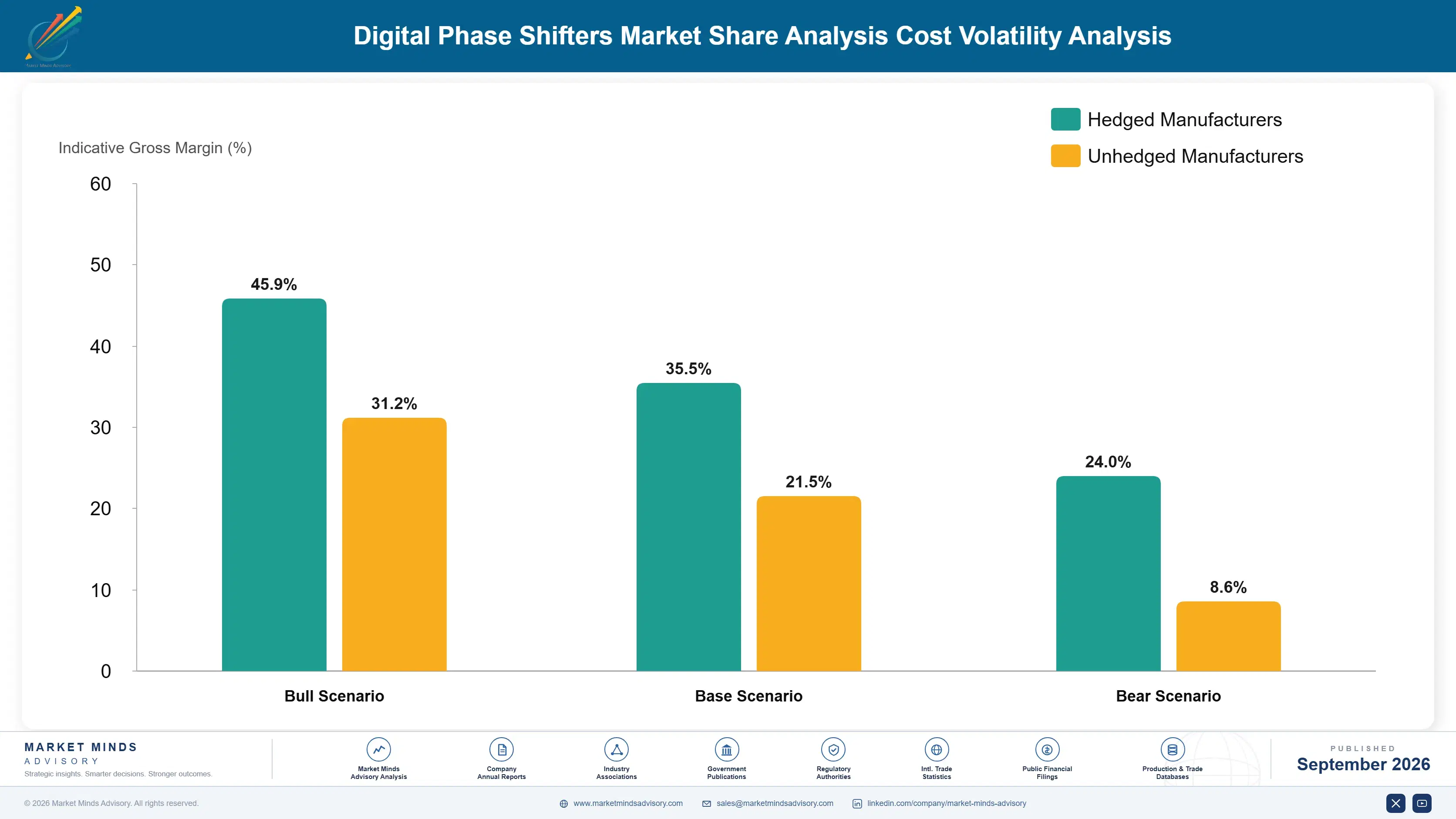
Three inputs dominate. Compound semiconductor or silicon wafer fabrication runs 28% to 35% of cost of goods sold, packaging with radio frequency test at temperature takes 24% to 31%, and qualification with export compliance administration adds a further 8% to 13%. Compound substrate supply concentrates among few qualified producers, and switching between them is a multi-year exercise.
Compound semiconductor substrate pricing tightened through 2024 and 2025 as defence and satellite demand competed for constrained capacity, and SEMI materials data documents the underlying supply position. Several suppliers described the resulting margin pressure in their annual reports for those years, with fixed-price defence contracts absorbing the movement entirely because programme pricing is agreed years ahead of delivery. Escalation clauses stay uncommon. Programme pricing is agreed years ahead of any delivery.

The competitive disadvantage mechanism runs through radio frequency test rather than through wafer cost. Testing every channel across temperature is slow, and a supplier without parallel test capability carries cost per channel that a better-equipped competitor does not, which matters enormously at constellation volumes. Exposure varies by player type. Silicon suppliers amortise test development across large runs. Compound specialists carry it per programme.
digital-phase-shifters-market-share-analysis-cost-volatility-analysis-1790006539926

Build Parallel Channel Test At Temperature

Testing channels sequentially across temperature is the single largest throughput constraint at satellite volumes, and parallel test capability changes the cost structure rather than improving it marginally. Suppliers who invested report test cost per channel falling by more than half, which is frequently the difference between winning and losing a constellation programme on price.

Qualify Second Compound Substrate Sources Early

Substrate supply concentrates among few qualified producers, and requalifying mid-programme is a multi-year exercise nobody will fund. Carrying a second qualified source from the outset costs money against no immediate return, and it is the only protection available when constrained capacity is allocated to whoever committed earliest. Constrained capacity goes to whoever committed earliest.

Standardise Export Compliance Documentation Across Programmes

Licensing administration covering roughly three in five shipments is largely repetitive, and suppliers treating each programme separately carry cost that standardised documentation removes. The saving is modest per programme and considerable in aggregate, and the discipline also shortens the licensing delays that periodically interrupt delivery schedules. Licensing delays that interrupt delivery also shorten materially.

Portfolio Architecture for Margin Defence

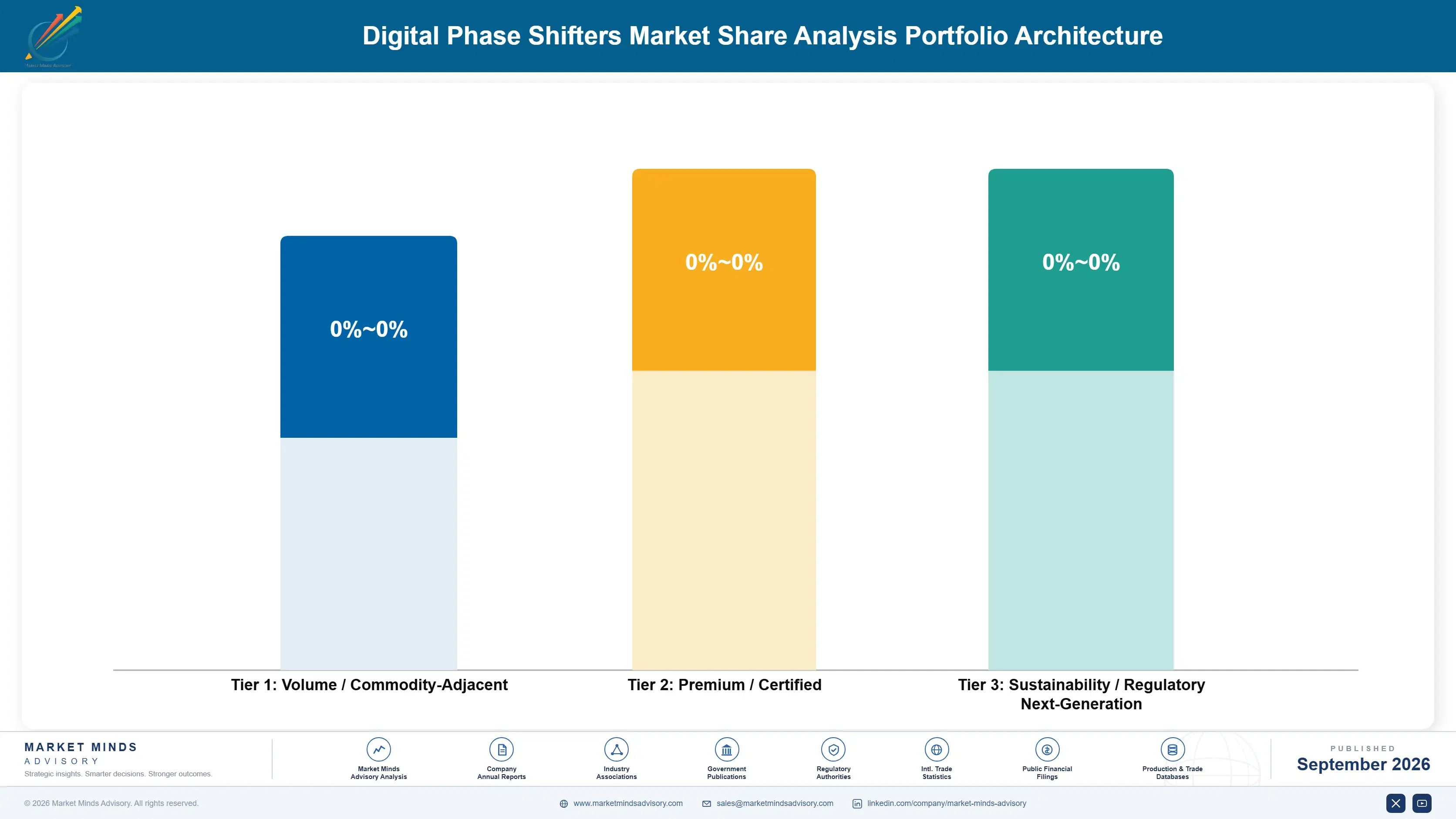
Margin follows how much system risk the supplier absorbs. Discrete switched-line and ferrite devices are close to commodity, competing on published parameters with several credible alternatives available. Integrated silicon beamformers earn considerably more, because they take on calibration the customer could not manage. Compound semiconductor devices in export controlled high power programmes earn most, since incumbency lasts a platform lifetime and no realistic alternative exists. Absorbed risk sets the entire margin ladder here.
The tension between volume and premium is unusually stark. Constellation programmes deliver quantities no defence application approaches, at prices that only work with parallel test and high yield, so a supplier without semiconductor manufacturing discipline loses money on every wafer. Defence programmes deliver excellent margin on volumes too small to justify that same investment, which pulls suppliers in opposite directions. Very few suppliers serve both properly.

High-value pools concentrate where substitution is legally or practically blocked: export controlled radar programmes, indigenised national supply arrangements, and calibrated beamformer positions embedded in constellation designs. What these share is that a competitor cannot simply match a datasheet and undercut. In discrete devices, that is precisely what happens, and pricing reflects it accordingly.

Volume / Commodity-Adjacent

Discrete switched-line modules, loaded-line devices, and ferrite phase shifters. Published parameters permit direct comparison and several credible alternatives exist for most applications. The nine-point range reflects wide variation in test throughput and packaging cost between suppliers serving similar programmes.
Gross Margin: 27% to 36%

Premium / Certified

Integrated silicon beamformer channels with on-chip calibration, sold into satellite and commercial array programmes. The supplier absorbs calibration risk the customer cannot manage. The nine-point range separates suppliers with parallel channel test from those testing sequentially at constellation volumes.
Gross Margin: 44% to 53%

Sustainability / Regulatory / Next-Generation

Compound semiconductor devices in export controlled high power radar and indigenised national supply arrangements. Licensing and qualification make substitution impossible for the platform's production life. The eleven-point range reflects how differently programmes price sole qualified supply positions.
Gross Margin: 56% to 67%
digital-phase-shifters-market-share-analysis-portfolio-architecture-1790006540437

High-value Sub-segments and Strategic Watch-out

Calibrated Beamformer Constellation Supply

Fastest growth at 17.7% and the largest volumes in the category, selling against a calibration problem customers could not solve alone. Success depends on parallel test and yield rather than on radio frequency performance. The nine-point range reflects manufacturing capability differences between suppliers. Yield decides the economics.
Gross Margin: 48% to 57%

Export Controlled High Power Radar

Highest value, growing at 14.2%, where compound semiconductor performance is genuinely required and licensing prevents any cross-jurisdiction alternative. The qualified supplier ships for the platform's production life. The ten-point range reflects how differently national programmes price sole source positions. No alternative exists legally. Incumbency lasts decades.
Gross Margin: 58% to 68%

Indigenised National Supply Arrangements

High value with strong growth, created by domestic content obligations rather than by open competition. Participation requires local manufacture or technology licensing on terms that transfer real capability. The ten-point range reflects how much capability different arrangements oblige the supplier to hand over. Negotiation is slow throughout.
Gross Margin: 50% to 60%

Discrete Component Merchant Supply

The strategic watch-out. Published parameters invite direct comparison, several alternatives exist, and the calibration burden the customer inherits produces programme failures the component supplier gets blamed for. The fourteen-point range reflects the gap between suppliers with efficient test and those without. Blame lands on the component.
Gross Margin: 24% to 38%

How Sockets Become Long Revenue

Revenue here is programme-bound rather than contractual, and the binding is exceptionally tight. A device qualified into an array ships for the production life of that platform, which in defence commonly means fifteen years or more, because requalifying a component mid-programme costs money and schedule that no programme office will approve without a supply failure forcing it. Nobody reopens a qualified socket voluntarily.
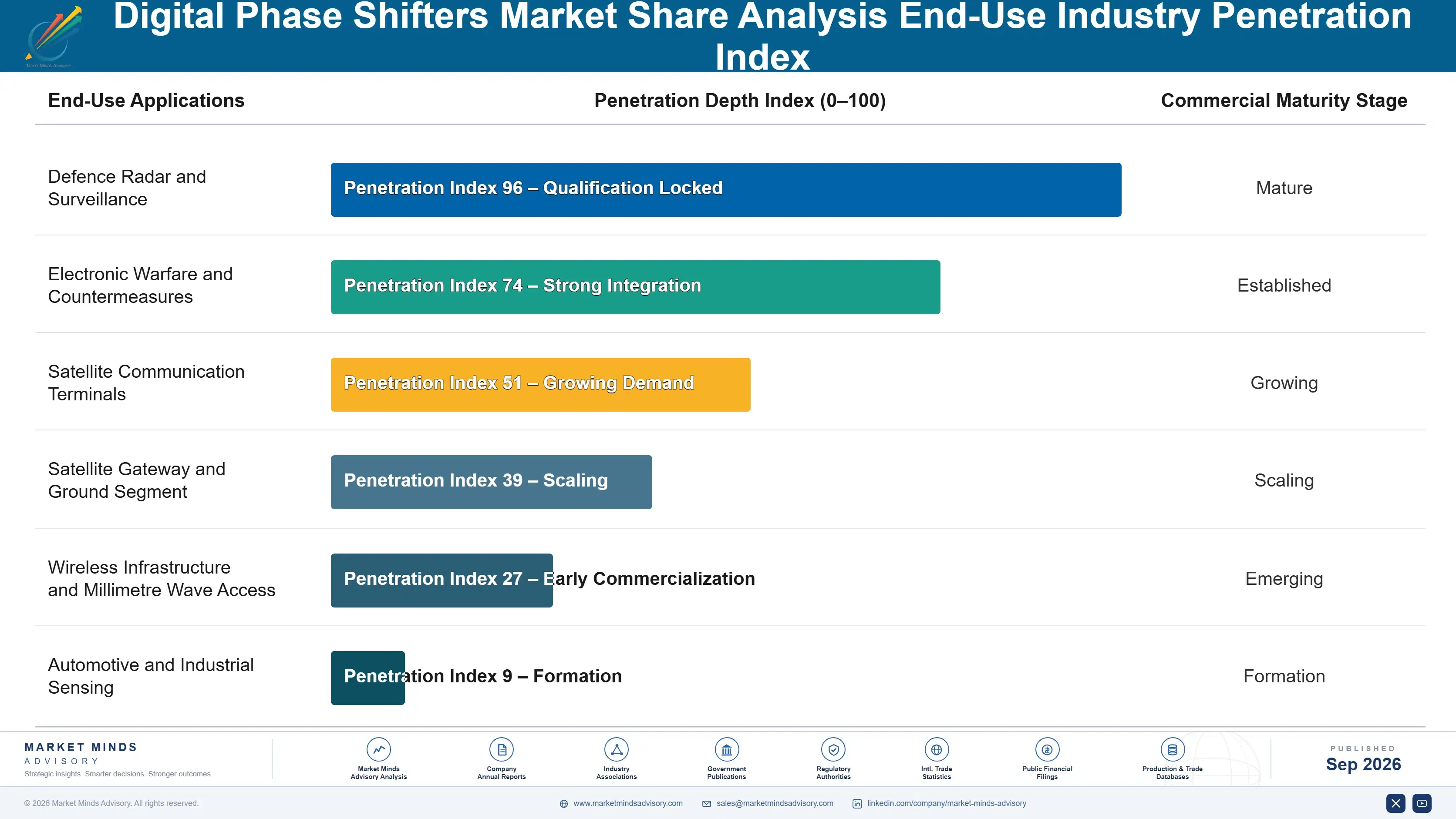
Stickiness varies by application in a way that surprises new entrants. Defence radar sockets are effectively permanent once qualified, protected by licensing and by the 26 month requalification anybody would face. Satellite constellation positions are firmer than expected too, since calibration behaviour becomes embedded in array software. Commercial wireless sockets are the least durable, reviewed at each product generation on price like any other component.

The buyer profile has changed as arrays have grown. Radio frequency engineers once selected phase shifters against measured parameters, and they still participate. System architects and programme risk owners now shape the decision, and they ask about aperture-level pointing error, thermal behaviour across a full array, and what happens when the supplier's process node moves. Datasheet comparison answers none of those questions.
digital-phase-shifters-market-share-analysis-end-use-penetration-index-1790006540929

Where This Market Rewards

These are among the four positions where our research anticipates prominent divergence between winners and laggards over the coming forecast period. Each is grounded in the demand model, the regulatory perimeter, and the announced capacity pipeline.
01 / CALIBRATION RISK TRANSFER

Sell a characterised channel, not a specified part

Arrays fail on residual pointing error near 5.4 degrees across temperature while every individual component meets its datasheet, because error accumulates across thousands of channels in ways single-device measurement never predicts. Multichannel devices with on-chip correction now carry 38% of shipments and command 45% to 70% premiums over the discrete parts they replace. The comparison the buyer makes is against programme risk rather than against component cost, which changes the pricing conversation entirely, and it is the only durable defence against datasheet comparison.
02 / DESIGN WINDOW TIMING

Specifications are written before anyone issues them

By the time a component requirement is published, the aperture architecture is frozen and the specification frequently describes a competitor's device rather than an open need. Suppliers engaged at concept stage with reference designs and thermal models win 3.4 times more sockets than those responding to issued requirements. Against a 26 month qualification and production life measured in decades, that unfunded early engagement is the cheapest business development available in this category, and almost nobody budgets for it properly in advance.
03 / JURISDICTION COVERAGE STRATEGY

Licensing decides addressable market before technology does

Defence trade licensing covers roughly 61% of volume and prevents any programme from maintaining qualified alternatives across jurisdictions, while indigenisation rules close further markets to direct export entirely. Suppliers with local manufacture or licensing arrangements in three or more jurisdictions address about 2.2 times the programme population of single-base exporters. The arrangements transfer more capability than any supplier would choose, and exclusion is the alternative, and most suppliers accept the terms because exclusion costs more than the capability transferred does.
04 / TEST THROUGHPUT ECONOMICS

Constellation volumes are won on test cost

Satellite terminal and gateway production demands quantities defence never approached, and selection criteria weight test cost per channel and packaging throughput above absolute radio frequency performance for exactly that reason. Suppliers with parallel channel test at temperature report cost per channel falling by more than half, which frequently decides these awards outright. Compound semiconductor participants competing here carry manufacturing economics built for an entirely different industry, with margins well below what defence programmes have taught them to expect over many years.

Engagement Snapshot From the Field

A live engagement with an industry participant carrying material or product regulatory and market exposure ahead of a defining policy shift, showing how our research translates into a defensible multi-year portfolio strategy.
MARKET MINDS ADVISORY · CLIENT ENGAGEMENT SUMMARY
Digital Phase Shifters Share Analysis Producer Strategic Portfolio Review and Transition Roadmap 2026·Investment Scenario on Digital Phase Shifters Share Analysis Exposure Evaluation 2025-26
CLIENT PROFILE
A defence prime contractor developing a next-generation surveillance radar with an aperture of roughly 2,300 elements, under a national programme valued above USD 1.9 billion across its production run (client-reported, unverified by MMA). Component selection had been made two years earlier on radio frequency parameters, and integration testing had begun revealing beam pointing behaviour the models had not predicted.
STRATEGIC CHALLENGE
Measured pointing error across the operating temperature range exceeded the specification by a wide margin, and the cause could not be attributed to any individual component, all of which met their datasheets. Redesign at this stage would delay the programme by at least two years. Nobody could establish whether the fault lay with components, calibration, or thermal design.
MMA APPROACH
MMA characterised phase and amplitude behaviour across a representative channel sample at temperature, modelled accumulated array error against measured device variation, and compared the result with integrated beamformer alternatives. Supplier capability was assessed on calibration support and qualification data transferability rather than on device parameters alone. Qualification timelines were tested against evidence already held.
KEY FINDINGS
  1. Individual device performance was within specification throughout, while accumulated array error across temperature exceeded the programme requirement by roughly a factor of three.
  2. Device-to-device phase variation, unspecified in the datasheet and never requested during supplier selection, accounted for the clear majority of accumulated error observed.
  3. An integrated beamformer alternative with on-chip correction would meet the requirement without thermal redesign, at roughly 58% higher component cost across the programme.
  4. Requalifying the alternative would take an estimated 19 months, against the 26 month category median, because much of the environmental evidence was transferable from a related programme.
CLIENT PROFILE
A defence prime contractor developing a next-generation surveillance radar with an aperture of roughly 2,300 elements, under a national programme valued above USD 1.9 billion across its production run (client-reported, unverified by MMA). Component selection had been made two years earlier on radio frequency parameters, and integration testing had begun revealing beam pointing behaviour the models had not predicted.
STRATEGIC CHALLENGE
Measured pointing error across the operating temperature range exceeded the specification by a wide margin, and the cause could not be attributed to any individual component, all of which met their datasheets. Redesign at this stage would delay the programme by at least two years. Nobody could establish whether the fault lay with components, calibration, or thermal design.
MMA APPROACH
MMA characterised phase and amplitude behaviour across a representative channel sample at temperature, modelled accumulated array error against measured device variation, and compared the result with integrated beamformer alternatives. Supplier capability was assessed on calibration support and qualification data transferability rather than on device parameters alone. Qualification timelines were tested against evidence already held.
KEY FINDINGS
  1. Individual device performance was within specification throughout, while accumulated array error across temperature exceeded the programme requirement by roughly a factor of three.
  2. Device-to-device phase variation, unspecified in the datasheet and never requested during supplier selection, accounted for the clear majority of accumulated error observed.
  3. An integrated beamformer alternative with on-chip correction would meet the requirement without thermal redesign, at roughly 58% higher component cost across the programme.
  4. Requalifying the alternative would take an estimated 19 months, against the 26 month category median, because much of the environmental evidence was transferable from a related programme.
RECOMMENDED STRATEGY
Phase 1: Phase one: specify device-to-device phase variation across temperature as a procurement requirement, which the original selection process had never captured at all. Phase 2: Phase two: begin qualification of the integrated beamformer alternative immediately, reusing environmental evidence from the related programme to compress the timeline. Phase 3: Phase three: retain the incumbent supplier for lower-element-count variants where accumulated error remains within specification, avoiding an unnecessary single-source position.
OUTCOME
Requalification completed in 21 months and the array met its pointing specification without thermal redesign (client-reported, unverified by MMA). Programme delay was limited to eleven months against a two year redesign alternative. Component cost rose 58% while total programme cost fell, once avoided redesign and schedule recovery were counted.

Frequently Asked Questions

Foundational context covering the market sizes, CAGR, scope, country, region and competition that inform every finding below. This section is provided to cover basics and most often pre-purchase conversations, answered from the MMA Primary Research Dataset.

What is the current size of the Digital Phase Shifters Market Share Analysis?

The market was worth USD 0.9 billion in 2025 and reaches USD 1.0 billion in 2026. Value covers merchant device shipments, excluding captive production by system integrators.

How large will the Digital Phase Shifters Market Share Analysis be by 2036?

MMA forecasts USD 3.1 billion by 2036, an increase of USD 2.1 billion across the forecast period. That represents 3.10 times the 2026 base of USD 1.0 billion.

What is the CAGR for the Digital Phase Shifters Market Share Analysis 2026 to 2036?

The base case compound annual growth rate is 11.8%, with a bull case at 13.0% and a bear case at 10.6%. Historical growth from 2020 to 2025 ran at 10.4%.

Which segment is growing fastest?

Silicon germanium and CMOS beamformer phase shifters grow at 17.7%, half again the market rate of 11.8%. They win on manufacturing economics rather than radio frequency performance.

Who are the major companies in the Digital Phase Shifters Market Share Analysis?

Analog Devices, Qorvo, MACOM, Mitsubishi Electric, and United Monolithic Semiconductors lead, holding 47% of merchant shipment value between them. Positions move slowly under export licensing.

Which country is growing fastest?

India grows at 16.4%, driven by indigenous radar programmes carrying domestic content obligations. International suppliers license technology or manufacture locally rather than exporting finished devices.

Report Segmentation Architecture

The full report scope spans multiple orthogonal segmentation dimensions, with cross-tabulated demand data provided for each dimension pair. Coverage extends further to regional breakdowns, trend trajectories, and the competitive detail needed to support segment-level decision-making.

By Device Technology

  • Gallium Arsenide Monolithic Microwave Integrated Circuits
  • Silicon Germanium and CMOS Beamformer Channels
  • Gallium Nitride Integrated Devices
  • Ferrite Phase Shifters
  • Microelectromechanical Switched Devices
  • Discrete Switched-Line and Loaded-Line Modules

By End-Use Industry

  • Defence Radar and Surveillance
  • Electronic Warfare and Countermeasures
  • Satellite Communication Terminals
  • Satellite Gateway and Ground Segment
  • Wireless Infrastructure and Millimetre Wave Access
  • Automotive and Industrial Sensing

By Commercial Dimension

  • Programme Design Win Supply
  • Merchant Catalogue Sales
  • Technology Licensed Local Manufacture
  • Government Funded Development Contract
  • Distribution and Broker Channel
  • Foundry Supplied Custom Device

By Region

  • East Asia
  • North America
  • Western Europe
  • South Asia and Pacific
  • Latin America
  • Middle East and Africa
  • Eastern Europe

Scope, Methodology, and Coverage

Every figure in this report is reproducible from documented input assumptions. The scope below maps the historical period, the forecast horizon, the segmentation dimensions, and the countries covered, alongside the underlying primary and qualitative methodology.
Historical Period
2020 to 2025
Forecast Period
2026 to 2036
Base Year
2025 (USD billions; MMA Primary Research Dataset, September 2026)
Market Definition
This market covers merchant digital phase shifter devices altering signal phase in discrete steps for electronically scanned arrays, including gallium arsenide monolithic microwave integrated circuits, silicon germanium and CMOS beamformer channels, gallium nitride integrated devices, ferrite phase shifters, microelectromechanical switched devices, and discrete switched-line modules. It excludes complete antenna apertures, transmit receive module assemblies, analogue beamforming networks, and captive production consumed internally by system integrators.
Quantitative Units
USD billions, merchant device shipment value
Segmentation Dimensions
Device technology, end-use industry, commercial dimension, region
Regions Covered
East Asia, North America, Western Europe, South Asia and Pacific, Latin America, Middle East and Africa, Eastern Europe
Countries Covered
China, Japan, South Korea, Taiwan, United States, Canada, France, Germany, Italy, Sweden, Norway, Netherlands, United Kingdom, Spain, India, Australia, Singapore, Brazil, Chile, Colombia, Israel, Saudi Arabia, United Arab Emirates, South Africa, Poland, Romania
Key Companies Profiled
Analog Devices, Qorvo, MACOM, Mitsubishi Electric, United Monolithic Semiconductors, Infineon Technologies, NXP Semiconductors, Texas Instruments, Renesas Electronics, Murata Manufacturing, Teledyne, Mercury Systems, Guerrilla RF, pSemi, Skyworks Solutions, Broadcom, Marki Microwave, Mini-Circuits, API Technologies, Ducommun
Quantitative Methodology
Primary survey, n=3,800 respondents, Q4 2025, six countries; demand-side model with trade association cross-validation
Qualitative Methodology
47 expert interviews, Q4 2025; applied to validate demand model assumptions, identify emerging dynamics, and assess competitive positioning
Report Format
PDF and XLSX data workbook (Word format preview document)
Publisher
Market Minds Advisory
Report Code
MMA-2026-TEC-451
Published
September 2026
Contact
sales@marketmindsadvisory.com | www.marketmindsadvisory.com

Purchase the full Digital Phase Shifters Market Share Analysis Report (2026 to 2036).

The full report sizes the merchant digital phase shifter market across six device technologies, seven regions, and twenty-six countries, with forecasts to 2036 under base, bull, and bear cases. It examines why arrays fail on accumulated calibration error while every component meets specification, and what integrated beamformers change commercially. Competitive analysis covers twenty participants evaluated consistently on merchant shipment value, with detailed treatment of export licensing, indigenisation requirements, and the design window that decides programme sockets. Cost structure, margin architecture by technology, and regional programme drivers are analysed in full. Primary research includes 3,800 survey responses and 47 expert interviews.
Six device technologies sized and forecast separately
Twenty participants evaluated on merchant shipment value
Regional programme and licensing drivers across seven geographies
Margin architecture by technology and control status
Accumulated array error analysis with measured channel data
Qualification timeline benchmarks by application and environment

Built For The People Who Decide

From boardroom strategy to bench-side execution, this report is read cover-to-cover by leaders shaping the next decade of their industry, turning demand scenarios, market dynamics and valuation benchmarks into decisions.
CXOs/ Presidents/ VPs/ Managers
M&A and Corporate Development
Strategy Teams and R&D Heads
Procurement and Product Directors
Regulatory and Compliance Leaders
Investor Relations and Equity Analysts