Market Minds Advisory
Digital Lending Platform Market

Digital Lending Platform Market: Digital Lending Platform Market. AI Underwriting Reshapes Credit Decisioning

Banks and non-bank lenders are replacing legacy loan origination systems with AI-driven underwriting platforms, as faster credit decisioning becomes a competitive necessity against fintech challengers offering near-instant approval on comparable consumer and small business loans.

Lead Analyst

Published

September 2026

Make Smarter Decisions with Customized Research Insights

Request a free sample report and evaluate market opportunities, growth trends, and competitive dynamics relevant to your business needs.

2025 MARKET VALUE$14.5BMarket Size 2025
2036 FORECAST VALUE$55.6BBase Case , 2026 to 2036
CAGR 2026 TO 203613.0 %Bull 14.2% / Bear 11.8%
INCREMENTAL OPPORTUNITY$39.2BNet 10- year value creation
EXPANSION MULTIPLE3.39x2036 value over 2026 base
Strategic Levers
M&A Pipeline
Regional Outlook
Country Rankings
Competitive Intelligence
Segmental Deep-dive
Call-Us : 91 93563 13602

Executive Snapshot and Market Trajectory.

Lenders are abandoning decades-old core banking loan modules for cloud-native platforms, since underwriting speed now determines whether a borrower closes with them or a faster fintech competitor entirely, often within the very same afternoon a loan application first gets submitted.
Banks and credit unions facing customer attrition to fintech lenders offering same-day approval are the primary commercial force behind platform modernization, since losing loan volume to faster competitors directly threatens core interest income that community lenders depend on heavily. AI-based credit underwriting and risk scoring software has become the fastest-growing product category as lenders move beyond rule-based decisioning toward models incorporating alternative data, while adoption concentrates among mid-sized banks racing to match large bank investment.
Competition centers on a small group of established loan origination system vendors expanding into AI underwriting alongside a growing group of specialized fintech infrastructure startups selling modular decisioning tools. Southeast Asian digital lenders are adopting platforms fastest as smartphone-based credit access expands into previously underbanked populations across the region. Embedded lending, where non-financial companies offer credit at the point of sale, is broadening the addressable customer base considerably beyond traditional banks.
Market Definition
This market covers software platforms used by banks, credit unions, and non-bank lenders to originate, underwrite, and service consumer and commercial loans, including application processing, credit decisioning, and loan lifecycle management systems. It excludes core banking deposit systems and payment processing infrastructure not directly tied to loan origination or servicing functions.
Base Year Value
$14.5B in 2025 (MMA Primary Research Dataset, September 2026)
Forecast Period
2026 to 2036, eleven discrete annual values
CAGR
13.0% base case. Bull 14.2%. Bear 11.8%.
Fastest Growth Segment
AI-Based Credit Underwriting and Risk Scoring Software: 18.5% CAGR
Fastest Growth Country
Indonesia: 19.0% CAGR
Fastest Growth Region
South Asia and Pacific: 15.0% CAGR
Largest Region
North America: 31% of 2025 global value
Market Leaders
nCino, Blend, Temenos, FIS, Finastra
Primary Survey
n=3,800 procurement and R&D decision-makers, Q4 2025, six countries
Methodology
Demand-side build-up, cross-validated against public data, 47 expert interviews

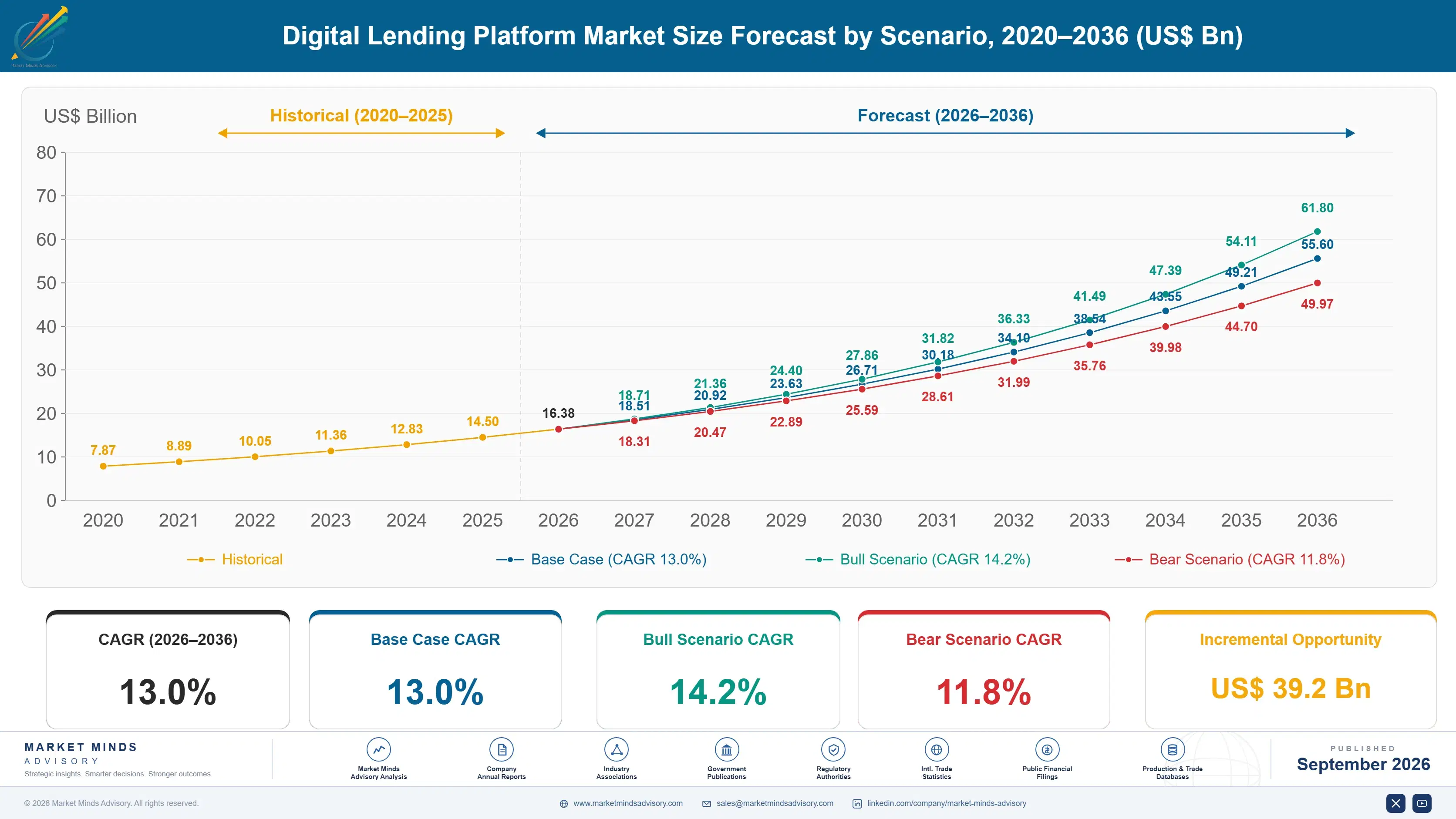
Digital Lending Platform Market Forecast Scenarios

digital-lending-platforms-market-size-forecast-scenario-1789980606015
Digital lending platform demand grew steadily from 2020 through 2025 as pandemic-era branch closures accelerated digital origination adoption, a shift that proved durable rather than temporary once customers experienced faster approval processes than traditional in-branch applications ever offered across nearly every consumer and commercial lending category tracked in this report and across most lender segments broadly.
The base case assumes continued displacement of legacy origination systems, expanding AI underwriting capability incorporating alternative data sources beyond traditional credit bureau scores, and growing embedded lending adoption as non-financial companies integrate credit offerings directly into their existing customer purchase experiences across many different industries, channels, and geographies. Vendors combining origination, underwriting, and servicing into one platform capture disproportionate new contract value as lenders consolidate their technology vendor relationships into fewer platforms overall.
A bull scenario assumes accelerating embedded lending adoption and regulatory approval of alternative underwriting data sources forces broader platform investment across previously conservative lenders facing rising competitive pressure; a bear scenario assumes credit cycle deterioration causes lenders to freeze technology spending, confining growth mostly to mandatory compliance and risk management upgrades rather than genuine platform expansion.

Where Underwriting Speed Meets Credit Risk

Digital lending platforms have shifted from back-office efficiency tools into genuine competitive differentiators as borrowers increasingly choose lenders based on approval speed rather than interest rate alone. The economics favor lenders who modernized early, since customer acquisition cost keeps rising for lenders still relying on legacy paper-heavy origination processes that frustrate borrowers accustomed to instant digital experiences elsewhere in daily modern life.
MARKET CONCENTRATION (CR5)36%Fragmented market split among core banking vendors and fintechs
AVERAGE LOAN APPROVAL TIME4 hoursTypical decisioning time using modern AI underwriting platforms today
TOP PRODUCING COUNTRY SHARE29%United States dominates global lending software vendor headquarters concentration
AI UNDERWRITING ADOPTION RATE34%Share of large lenders using AI-based credit decisioning currently
PLATFORM IMPLEMENTATION TIMELINE7 monthsTypical time required to fully deploy a new lending platform
LOAN DEFAULT REDUCTION12%Typical improvement in default rates using alternative data models
AI underwriting adoption is expanding fastest among mid-sized banks racing to close the technology gap with both large banks and fintech challengers, since alternative data incorporation directly improves approval rates for thin-file borrowers that traditional credit bureau scoring underserves considerably today. Manufacturing concentration among established vendors keeps platform costs falling as implementation experience accumulates across the broader industry each successive year.
Competitive dynamics increasingly favor vendors who combine origination, underwriting, and servicing under one unified platform, since lenders prefer consolidating vendor relationships rather than integrating separate point solutions built by different companies with incompatible data models and reporting formats. Established core banking vendors increasingly acquire specialized underwriting startups to expand capability, squeezing standalone niche vendors on new lender account opportunities specifically each year.
"A bank that still takes two weeks to approve a personal loan is not competing on rate anymore. It has already lost the customer to whoever answers in an hour."
Practice Lead, Financial Technology and Lending Infrastructure · MMA Digital Loan Origination Practice · September 2026

Market Trends

AI Underwriting Displaces Traditional Rule-Based Decisioning

Lenders are moving beyond rigid rule-based credit decisioning toward machine learning models that incorporate alternative data sources including cash flow patterns, utility payment history, and employment verification data, reflecting a documented 12 percent improvement in default prediction accuracy compared to traditional credit bureau scoring alone according to industry lending benchmarking studies. Vendors that can demonstrate measurable underwriting accuracy improvement rather than simple processing speed are winning larger, longer contracts as lender risk committees demand evidence before committing capital. This shift toward outcomes-based underwriting is reshaping vendor selection criteria across the entire lending industry.
Market Impact: Fintechs originate over $10 billion yearly

Embedded Lending Expands Beyond Traditional Bank Channels

Non-financial companies, including e-commerce platforms and software vendors, increasingly embed lending directly into their existing customer purchase experiences, creating an entirely new distribution channel for credit that did not meaningfully exist a decade ago in most consumer markets. This embedded lending model requires specialized platform infrastructure distinct from traditional bank origination systems, since the credit decision must happen instantly within an existing non-financial checkout flow rather than a dedicated loan application process. This expanding channel broadens the addressable market for lending software well beyond traditional bank and credit union customers.
Market Impact: Expands pool of thin-file borrowers 3x

Market Opportunities and Growth Drivers

Fintech Competition Forces Legacy Bank Modernization

Fintech lenders offering same-day loan approval have captured meaningful market share from traditional banks, with several major fintech lenders originating billions in annual loan volume that increasingly comes directly at the expense of community bank and credit union customer relationships built over many long decades. This competitive pressure creates urgent modernization demand among traditional lenders who previously treated digital transformation as a multi-year strategic initiative rather than an immediate competitive necessity. Banks increasingly measure technology investment success against fintech benchmark approval times rather than internal historical baselines from prior years.
Market Impact: Adds 6 to 12 months review

Alternative Data Access Expands Addressable Borrower Base

Expanding access to alternative data sources, including bank transaction data accessible through open banking application programming interfaces, allows lenders to underwrite thin-file borrowers who lack sufficient traditional credit bureau history to qualify under conventional scoring models used previously by nearly every lender. This addressable borrower base expansion represents genuine incremental loan volume opportunity rather than simply redistributing existing lending activity among competing lenders in a zero-sum fashion. Several major lenders report meaningful loan volume growth specifically attributable to alternative data underwriting capability that did not exist in their platforms five years earlier.
Market Impact: Adds 12 to 18 months integration

Market Restraints and Challenges

Regulatory Uncertainty Around Alternative Data Underwriting

Regulators in several jurisdictions have not fully clarified how alternative data underwriting models must be validated for fair lending compliance, creating genuine legal exposure risk for lenders adopting these models before regulatory guidance fully catches up with the underlying technology and its real-world deployment. The root cause is that fair lending regulation was designed around traditional credit bureau scoring decades before alternative data models existed as a practical underwriting option. Some lenders now maintain parallel traditional scoring models specifically to validate alternative data model outputs and demonstrate fair lending compliance during regulatory examination.
Market Impact: Improves default prediction 12 percent

Legacy Core Banking Integration Complexity Slows Adoption

Banks with deep existing investment in legacy core banking systems, some running technology decades old, face genuine technical integration complexity when deploying modern lending platforms that must interface with those legacy systems reliably. The root cause is that most legacy core banking systems were never designed with modern application programming interfaces in mind, requiring costly custom integration work that newer digital-native lenders never had to build in the first place. Some banks now pursue phased core banking replacement specifically to eliminate this integration burden entirely over a multi-year modernization roadmap.
Market Impact: Creates 1 entirely new credit channel
3 additional market trends, 4 additional growth drivers, and 2 additional restraints and challenges are covered in the full report. Contact sales@marketmindsadvisory.com to access the complete intelligence.

Segment CAGR and Growth Architecture

Digital lending platforms segment by core software function, spanning AI-based credit underwriting and risk scoring software, embedded lending infrastructure, loan origination systems, loan servicing and collections platforms, digital identity verification tools, and loan portfolio analytics software, each addressing a genuinely distinct stage of the overall lending lifecycle and customer application experience currently underway today.
digital-lending-platforms-market-market-share-analysis-1789980606582

AI-Based Credit Underwriting and Risk Scoring Software

AI-based credit underwriting and risk scoring software applies machine learning models to alternative data sources, including cash flow patterns and utility payment history, to assess borrower creditworthiness with meaningfully greater accuracy than traditional rule-based scoring systems that most lenders relied upon for many decades before this technology fully matured and became widely available. Growth reflects lender recognition that underwriting accuracy directly reduces default losses, alongside expanding regulatory acceptance of alternative data sources in fair lending frameworks across multiple jurisdictions and states nationwide today. Blend and nCino have both expanded machine learning underwriting capability specifically to compete against specialized fintech underwriting startups entering the space with venture-backed capital and narrower product focus.
CAGR 18.5%

Embedded Lending Infrastructure

Embedded lending infrastructure allows non-financial companies, including e-commerce platforms and software vendors, to offer credit directly at the point of sale without building their own lending operation or holding a banking license themselves and its associated regulatory compliance burden entirely on their own accord. Growth reflects rapid expansion of this distribution model as consumer expectations shift toward financing options embedded smoothly within an existing purchase flow rather than a separate loan application process handled entirely elsewhere online. Affirm and several specialized infrastructure providers have expanded embedded lending capability specifically to serve retailers and software platforms entering consumer and small business credit for the first time without dedicated internal lending expertise.
CAGR 16.5%
Full segment breakdown across 6 segments available in the complete report.

Regional Architecture and Country Demand Map

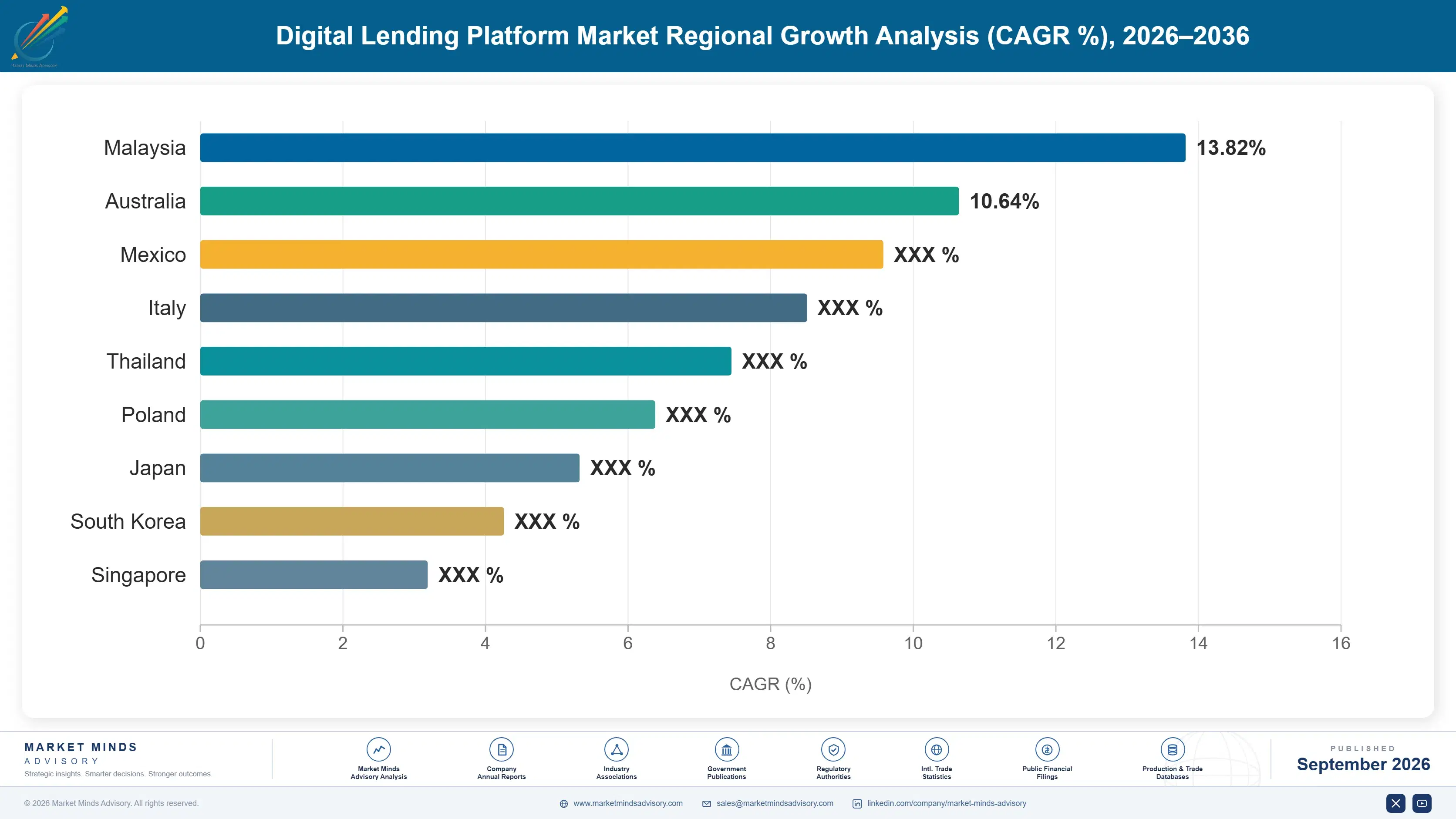
North America leads given the maturity of its fintech lending sector and large addressable consumer credit market, while South Asia and Pacific posts the fastest regional growth as smartphone-based credit access expands rapidly into underbanked Southeast Asian populations across the entire region each passing year.

North America

The United States hosts the world's largest concentration of digital lending platform vendors, reflecting both a mature fintech lending sector built over more than a decade and a massive addressable consumer and small business credit market that dwarfs comparable markets elsewhere in the world. Community banks and credit unions facing fintech competitive pressure represent a large and growing customer segment for platform vendors, since these smaller institutions previously lacked internal technology resources to modernize independently. Canadian lenders follow similar adoption patterns given closely integrated North American financial services regulation and shared vendor relationships. Open banking regulation, though less advanced than in Europe, is gradually expanding alternative data availability for underwriting purposes nationwide.
Share: 31% | CAGR: 12.5% (2026 to 2036)

Western Europe

European lenders benefit from more advanced open banking regulation than the United States, since the EU's revised Payment Services Directive mandated bank data sharing years before comparable US requirements existed, giving European lenders earlier access to transaction data for alternative underwriting purposes nationwide across the bloc. UK fintech lenders, operating within one of the world's most developed open banking frameworks, lead regional platform innovation and adoption considerably ahead of peers. German and French banks show more conservative adoption patterns, reflecting generally more cautious regulatory environments around automated credit decisioning and algorithmic transparency requirements. Nordic countries show notably high digital lending adoption tied to broader digital banking penetration across their entire national populations.
Share: 22% | CAGR: 11.5% (2026 to 2036)
Regional intelligence for 5 additional markets available in the complete report: East Asia, South Asia and Pacific, Latin America, Middle East and Africa, Eastern Europe. Contact sales@marketmindsadvisory.com.
digital-lending-platforms-market-country-cagr-analysis-1789980607125

Underwriting Accuracy Margin Expansion Paths

Digital lending platform vendors capture disproportionate margin not from origination software sales alone but from underwriting accuracy, alternative data integration, and multi-product platform consolidation layered directly on top, since lenders increasingly value measurable default reduction over faster application processing speed alone as their primary purchase criterion today and increasingly going forward each budget cycle.

Pricing Contracts Against Demonstrated Default Reduction

Vendors offering outcomes-based pricing, where a portion of contract value ties directly to measured default rate reduction, now command 18 to 25 percent higher total contract value than flat licensing fees alone across most enterprise lender accounts. This requires vendors to maintain genuine confidence in their own underwriting model accuracy, favoring established players with substantial deployment history over newer entrants lacking comparable track records across diverse lender portfolios and loan types. Blend and nCino have both introduced outcomes-based pricing pilots specifically to capture this growing segment of risk-conscious lender demand.
Market Impact: Adds 18 to 25 percent to contract value

Bundling Alternative Data Sources With Underwriting Software

Vendors that bundle direct access to alternative data sources, including open banking transaction feeds and utility payment history, alongside underwriting software capture budget that would otherwise require separate data vendor contracts entirely, adding 15 to 22 percent to average contract value across the entire account relationship and lifetime. Lenders increasingly prefer a single vendor covering both data access and decisioning logic, rather than managing multiple separate vendor relationships and data integration pipelines built independently over time and budget cycles. Several vendors have expanded data partnership networks specifically to capture this bundled opportunity.
Market Impact: Adds 15 to 22 percent to contract value

Expanding Into Multi-Product Lending Platform Coverage

Vendors that extend beyond single-product origination into multi-product coverage spanning consumer, small business, and mortgage lending capture consolidated contract value rather than competing separately for each product-specific engagement individually and repeatedly, typically adding 20 to 30 percent to total account revenue once multi-product coverage is fully established across the account. This cross-product expansion applies existing lender relationships and shared underwriting infrastructure rather than requiring entirely new customer acquisition efforts from scratch each cycle. Temenos has pursued this expansion aggressively across its core banking customer base each fiscal year and budget cycle.
Market Impact: Adds 20 to 30 percent to account revenue

Providing Embedded Lending Infrastructure to Non-Bank Partners

Vendors offering embedded lending infrastructure to non-financial companies entering consumer credit for the first time capture entirely new customer relationships beyond traditional bank and credit union accounts, typically adding 25 to 35 percent to total partner-channel revenue, typically generating per-transaction revenue that scales directly with partner transaction volume rather than flat licensing fees alone across every account served. This model requires vendors to manage regulatory compliance on behalf of partners lacking internal lending expertise, a capability few pure software vendors maintain in-house today or plan to build. Affirm has expanded this partnership model specifically to capture retailer and platform demand.
Market Impact: Generates 25 to 35 percent partner-channel revenue growth

Who Controls the Margin Pool

Digital lending platform software shows moderate concentration at a cr5 of 36 percent, reflecting a market split between established core banking vendors extending into lending and specialized fintech infrastructure providers. nCino and Blend lead on combined origination and underwriting capability, while the gap to challengers like Temenos and FIS has narrowed as AI underwriting becomes the primary competitive battleground rather than origination workflow features alone.
Current competitive activity centers on expanding AI underwriting capability incorporating alternative data sources, since lenders increasingly demand measurable default reduction rather than simple processing speed improvements. Several vendors have expanded embedded lending infrastructure to capture non-bank partner demand entering consumer credit for the first time. Consolidation activity continues as larger vendors acquire specialized underwriting startups to expand capability and reduce lender vendor management complexity.

Emerging pressure comes from digital-native fintech infrastructure startups offering modular, API-first architecture that legacy core banking vendors retrofitting older systems struggle to match on integration speed and flexibility. Smaller specialists focused narrowly on specific loan types could still defend niche positions where regulatory expertise matters more than platform breadth. Rankings among the top five look reasonably durable through 2030, but the mid-tier challenger segment faces genuine consolidation pressure.
digital-lending-platforms-market-company-positioning-matrix-1789980607663

Competitive Moat and Risk Dimensions

NCINO

Moat: Deep Bank Customer Relationships

nCino holds extensive integration relationships with hundreds of banks and credit unions built on the Salesforce platform over more than a decade, giving it customer switching costs and platform lock-in that newer entrants attempting comparable integration depth would need years and considerable capital to replicate.
NCINO

Risk: Platform Dependency on Salesforce

nCino's architecture built on the Salesforce platform creates dependency risk on a third-party technology provider's pricing and product roadmap decisions, potentially limiting nCino's flexibility relative to competitors building fully independent, purpose-built lending infrastructure without external platform constraints, licensing fees, or roadmap dependency risk of any kind.
BLEND

Moat: Mortgage Origination Market Leadership

Blend holds a leading position in digital mortgage origination specifically, built through deep integration with major mortgage lenders and a product experience widely regarded as superior for complex mortgage application workflows that competitors have struggled to match in usability, speed, reliability, and overall interface design.
BLEND

Risk: Mortgage Market Cyclicality Exposure

Blend's revenue concentration in mortgage origination exposes it directly to interest rate cycles and mortgage origination volume swings that more diversified competitors serving multiple loan types simultaneously do not experience to nearly the same degree during housing market downturns, rate spikes, or refinancing slowdowns nationwide.

Players Tracked

Prominent Players

nCino
Blend
Temenos
FIS
Finastra

Other Key Players

Ellie Mae
Sagent
Roostify
Zest AI
Upstart
LendingClub
Sofi Technologies
Provenir
Lendflow
Baker Hill
Abrigo
Turnkey Lender
MeridianLink
Newgen Software
Tavant

Recent Developments

MARCH 2026

nCino Launches AI-Based Alternative Data Underwriting Module

nCino introduced a new AI-based underwriting module incorporating open banking transaction data and alternative credit signals, extending its platform capability beyond traditional credit bureau scoring into genuine alternative data decisioning for banks seeking to serve thin-file borrowers more effectively, accurately, profitably, and at greater scale.
Signal: Signals incumbent investment in alternative data underwriting capability beyond traditional credit scoring methods today and going forward.
OCTOBER 2025

Blend Acquires Small Business Lending Startup

Blend acquired a specialized small business lending origination startup to diversify beyond its core mortgage origination business, extending its platform capability into commercial lending workflows that carry meaningfully different underwriting requirements and documentation standards than residential mortgage applications typically require of individual applicants nationwide today.
Signal: Signals incumbent diversification beyond core mortgage origination into adjacent commercial lending market segments today and tomorrow.
JUNE 2025

Temenos Signs Embedded Lending Partnership With Retailer

Temenos signed a multi-year embedded lending infrastructure partnership with a major e-commerce retailer, providing point-of-sale credit decisioning and loan servicing capability that allows the retailer to offer consumer financing without building internal lending operations or obtaining its own dedicated banking license and full regulatory approval.
Signal: Signals growing vendor expansion into embedded lending partnerships beyond traditional bank customers today and well into tomorrow.

Data Science Talent and Cloud Costs

Data science and machine learning engineering talent together account for roughly 40 to 50 percent of vendor cost of goods sold, reflecting the model-development-intensive nature of AI underwriting platforms rather than a standard software licensing cost structure built around commodity cloud infrastructure, shared hosting, and generic customer support staffing arrangements common elsewhere in the industry.
Demand for machine learning engineers with financial services domain expertise spiked sharply during 2022 and 2023 as most major lenders and fintech vendors simultaneously pursued AI underwriting initiatives, competing for a talent pool that traditional banking technology teams had never needed to build at this scale before. This talent shortage forced vendors to pay meaningfully higher compensation to retain specialists capable of building compliant, explainable underwriting models under active regulatory scrutiny.

Smaller lending software startups face more acute talent cost pressure than larger vendors like FIS, which can redeploy existing data science talent from adjacent financial services product lines rather than hiring entirely new specialized talent from a thin external market. This gives larger vendors a durable cost and hiring advantage during the current talent shortage, even though smaller specialists often maintain deeper focus on specific underwriting niches.
digital-lending-platforms-market-cost-volatility-analysis-1789980607860

Building Internal Machine Learning Training Programs

Larger vendors are building internal training programs to develop machine learning engineers from existing software engineering staff members already employed at the firm long-term, reducing dependence on hiring scarce external talent directly from a thin competitive market and building institutional domain expertise steadily over time across every internal engineering, product, and delivery team involved.

Using Pre-Trained Model Foundations to Reduce Development Cost

Vendors increasingly build underwriting models atop pre-trained foundation models rather than developing entirely custom architectures from scratch each time a brand new product launches, reducing the specialized machine learning engineering hours required per model and lowering overall development cost meaningfully across every single product line supported and every lender customer served directly and reliably.

Partnering With Universities for Talent Pipeline Development

Vendors increasingly partner with university data science programs to build talent pipelines specifically tailored to financial services underwriting applications and other closely related use cases relevant to lending broadly across the industry, reducing reliance on the highly competitive general technology hiring market where compensation continues climbing steadily each year without any meaningful pause whatsoever occurring.

Portfolio Architecture for Margin Defence

Digital lending vendors operate across three margin tiers, from standardized origination workflow software sold at volume with thin margin to premium AI underwriting and embedded lending infrastructure commanding substantially better economics. Tier separation reflects model sophistication and regulatory compliance depth rather than raw software feature differences alone, since a basic application intake form and a fully validated underwriting model can share similar underlying cloud infrastructure at the technical level.
Volume tension is sharpest in standardized origination workflow software, where price-sensitive smaller lenders push toward commodity pricing while vendors would prefer premium underwriting add-ons. Large lenders and embedded lending partners behave oppositely, valuing underwriting accuracy and regulatory compliance depth over unit price, which is why the highest-value revenue pools concentrate in AI underwriting and embedded infrastructure rather than basic origination workflow tools.

Loan servicing and collections software sits between these extremes: growing steadily but priced closer to standard origination tiers than premium underwriting, since servicing-focused buyers remain more cost-conscious than lenders evaluating underwriting accuracy claims directly. Vendors positioned across all three tiers simultaneously capture the broadest addressable revenue base, though few manage the operational complexity of serving such differently motivated lender segments well.

Volume / Commodity-Adjacent

Standardized loan origination workflow software sold at volume to smaller lenders with minimal underwriting customization or regulatory compliance depth included in the base subscription package at initial purchase time itself.
Gross Margin: 20 to 28%

Premium / Certified

AI-based underwriting and embedded lending infrastructure requiring extensive model development and regulatory validation justifying substantially higher enterprise pricing than commodity origination software alone could ever command in this broader market today.
Gross Margin: 38 to 48%

Sustainability / Regulatory / Next-Generation

Loan servicing and portfolio analytics software serving evolving lender demand at margins between commodity origination and premium underwriting tiers, growing steadily as lender technology needs continue expanding across most categories.
Gross Margin: 30 to 40%
digital-lending-platforms-market-portfolio-architecture-1789980608359

High-value Sub-segments and Strategic Watch-out

AI-Based Credit Underwriting Software

AI-based credit underwriting software combines high growth with premium accuracy-driven pricing, representing the clearest high-value high-growth opportunity as lenders move steadily beyond rule-based decisioning toward genuine predictive underwriting capability and improved default outcomes across every loan portfolio, borrower segment, lending channel, and covered geography served worldwide.
Gross Margin: high

Embedded Lending Infrastructure Platforms

Embedded lending infrastructure platforms combine strong margins with steady growth tied to non-bank partner expansion, representing a high-value moderate-growth pool anchored by transaction-based recurring revenue rather than flat licensing fees paid entirely upfront each individual contract term negotiated between the involved parties directly each time.
Gross Margin: high

Standardized Loan Origination Software

Standardized origination workflow software forms the volume core of the market, generating steady revenue at compressed margins as smaller lenders negotiate aggressively on price given tight technology budgets and limited available capital resources overall each successive fiscal year and full annual budget planning cycle ahead.
Gross Margin: moderate

Digital-Native Fintech Infrastructure Startups

Digital-native fintech infrastructure startups offering modular API-first architecture represent the clearest strategic watch-out, since their integration speed threatens to compress legacy core banking vendor market share considerably over the coming years and entire decade still further ahead than most currently expect or even forecast today.
Gross Margin: uncertain

Multi-Year Lending Platform Economics

Digital lending platforms generate durable recurring revenue through multi-year lender contracts, since switching origination and underwriting infrastructure mid-relationship requires costly retraining of underwriting models on new historical loan performance data and staff retraining across the entire lending operation. Vendors that demonstrate measurable default reduction within the first renewal cycle convert this into multi-year relationships worth considerably more than any single contract term alone.
Adoption stickiness varies sharply by end-use vertical. Large banks show the deepest engagement, integrating lending platforms into broader core banking and risk management infrastructure that makes switching costly and operationally disruptive across multiple departments. Community banks and credit unions show comparable stickiness once onboarded, though initial adoption often lags given smaller technology budgets and staff. Fintech lenders, being digital-native, show the shallowest platform loyalty, frequently switching vendors as better technology emerges.

Buyer profiles are shifting generationally as data-focused risk officers, rather than traditional loan operations staff, increasingly drive vendor selection decisions, prioritizing underwriting model accuracy and explainability over the simple workflow efficiency features that dominated lending technology sales a decade ago. This generational shift favors vendors offering genuine machine learning capability over vendors whose value proposition rests primarily on faster paperwork processing and basic digital application forms.
digital-lending-platforms-market-end-use-penetration-index-1789980608848

Where MMA Sees the Opportunity

These are among the four positions where our research anticipates prominent divergence between winners and laggards over the coming forecast period. Each is grounded in the demand model, the regulatory perimeter, and the announced capacity pipeline.
01 / AI UNDERWRITING INVESTMENT

Build measurable underwriting accuracy ahead of workflow-only rivals

AI-based underwriting software is growing at 18.5 percent versus the market's 13.0 percent overall rate, and lenders increasingly refuse to purchase origination software without accompanying underwriting intelligence built directly into the platform itself from day one. Vendors still built primarily around workflow efficiency risk losing contracts to competitors offering genuine predictive default reduction that finance and risk committees can quantify concretely against actual loan performance data. Building this capability now, before competitors close the gap, protects long-term program relevance and negotiating leverage.
02 / EMBEDDED LENDING EXPANSION

Pursue embedded lending partnerships beyond traditional bank customers

Embedded lending infrastructure is capturing an entirely new customer base of non-financial companies entering consumer credit for the first time, a distribution channel that barely existed a decade ago and continues expanding rapidly across industries. Vendors that build regulatory compliance capability on behalf of these inexperienced partners capture transaction-based recurring revenue that scales directly with partner volume rather than flat licensing fees alone charged upfront. This channel requires specialized infrastructure that pure bank-focused vendors have not yet built at comparable depth or maturity.
03 / SOUTHEAST ASIAN MARKET ENTRY

Expand into Indonesia ahead of full-scale global competition

Indonesia is growing at 19.0 percent annually as smartphone penetration and underbanked populations create genuine new lending demand, yet most established vendors remain concentrated in North America and Europe with minimal regional presence or local expertise. Vendors that establish local partnerships and regulatory expertise now secure preferred positioning before international competitors recognize the scale of this opportunity and arrive with comparable resources and ambition. This window will not stay open indefinitely as global vendors increasingly look toward Southeast Asian growth opportunities.
04 / FINTECH INFRASTRUCTURE COMPETITIVE RESPONSE

Match API-first architecture speed or risk losing modernizing lenders

Digital-native fintech infrastructure startups offering modular, API-first architecture are winning modernization contracts specifically because legacy vendors retrofitting older systems cannot match their integration speed and flexibility at any comparable cost or timeline. Established vendors should invest in genuine architectural modernization rather than incremental feature additions layered onto existing codebases, since lenders increasingly evaluate integration timeline as a primary selection criterion alongside underwriting capability and accuracy. Waiting to modernize architecture until losing meaningful market share will already be too late to reverse.

Engagement Snapshot From the Field

A live engagement with an industry participant carrying material or product regulatory and market exposure ahead of a defining policy shift, showing how our research translates into a defensible multi-year portfolio strategy.
MARKET MINDS ADVISORY · CLIENT ENGAGEMENT SUMMARY
Digital Lending Platform Producer Strategic Portfolio Review and Transition Roadmap 2026·Investment Scenario on Digital Lending Platform Exposure Evaluation 2025-26
CLIENT PROFILE
The client is a mid-sized US regional bank operating approximately 60 branches, with annual consumer and small business loan origination volume in the range of 800 million to 1 billion dollars (client-reported, unverified by MMA). The bank had experienced steady customer attrition to fintech lenders offering same-day approval and needed to evaluate platform modernization options.
STRATEGIC CHALLENGE
Leadership needed an independent assessment of which lending platform vendors could realistically deliver faster approval times while maintaining the bank's existing risk appetite, given internal uncertainty about how much of the customer attrition was actually driven by approval speed versus interest rate competition across the broader local banking market entirely.
MMA APPROACH
MMA conducted a comparative assessment of four lending platform vendors, evaluating underwriting accuracy, integration complexity with the bank's existing core banking system, and realistic implementation timelines under each vendor option. The engagement included interviews with the bank's risk committee and an analysis of two years of lost loan application data.
KEY FINDINGS
  1. Roughly 60 percent of lost loan applications cited approval speed as the primary reason for choosing a competitor, more than rate differences (client-reported, unverified by MMA).
  2. Only two of four evaluated vendors could integrate with the bank's specific core banking system without requiring a separate multi-year replacement project.
  3. Projected approval time reduction from four days to under six hours was achievable within the first full year of platform deployment and rollout.
  4. The bank's existing risk models contained enough historical data to train an effective alternative underwriting model without any external data purchases needed.
CLIENT PROFILE
The client is a mid-sized US regional bank operating approximately 60 branches, with annual consumer and small business loan origination volume in the range of 800 million to 1 billion dollars (client-reported, unverified by MMA). The bank had experienced steady customer attrition to fintech lenders offering same-day approval and needed to evaluate platform modernization options.
STRATEGIC CHALLENGE
Leadership needed an independent assessment of which lending platform vendors could realistically deliver faster approval times while maintaining the bank's existing risk appetite, given internal uncertainty about how much of the customer attrition was actually driven by approval speed versus interest rate competition across the broader local banking market entirely.
MMA APPROACH
MMA conducted a comparative assessment of four lending platform vendors, evaluating underwriting accuracy, integration complexity with the bank's existing core banking system, and realistic implementation timelines under each vendor option. The engagement included interviews with the bank's risk committee and an analysis of two years of lost loan application data.
KEY FINDINGS
  1. Roughly 60 percent of lost loan applications cited approval speed as the primary reason for choosing a competitor, more than rate differences (client-reported, unverified by MMA).
  2. Only two of four evaluated vendors could integrate with the bank's specific core banking system without requiring a separate multi-year replacement project.
  3. Projected approval time reduction from four days to under six hours was achievable within the first full year of platform deployment and rollout.
  4. The bank's existing risk models contained enough historical data to train an effective alternative underwriting model without any external data purchases needed.
RECOMMENDED STRATEGY
Phase 1: Phase one: select a vendor compatible with existing core banking infrastructure and begin integration work within the first four months. Phase 2: Phase two: train and validate the alternative underwriting model using the bank's existing historical loan performance data available internally today. Phase 3: Phase three: launch the modernized platform to a pilot branch group before expanding it bank-wide over the following twelve months.
OUTCOME
The bank selected a vendor and began integration work within one month of the engagement's conclusion (client-reported, unverified by MMA). Approval time reduction and customer retention results from the rollout were not yet available for independent verification at the time of this report's original publication.

Frequently Asked Questions

Foundational context covering the market sizes, CAGR, scope, country, region and competition that inform every finding below. This section is provided to cover basics and most often pre-purchase conversations, answered from the MMA Primary Research Dataset.

What is the current size of the Digital Lending Platform Market?

The global digital lending platform market is valued at 14.5 billion dollars in 2025, the report's base year. This reflects spending on origination, underwriting, and servicing software combined across banks, credit unions, and fintech lenders.

How large will the Digital Lending Platform Market be by 2036?

MMA projects the market will reach 55.6 billion dollars by 2036, a 3.39 times expansion from 2026's forecast value. Growth is driven mainly by AI underwriting adoption and embedded lending expansion.

What is the CAGR for the Digital Lending Platform Market 2026 to 2036?

The market is forecast to grow at a 13.0 percent compound annual rate between 2026 and 2036. Bull and bear scenarios range from 14.2 percent to 11.8 percent depending on credit cycle conditions.

Which segment is growing fastest?

AI-based credit underwriting and risk scoring software leads at an 18.5 percent CAGR, roughly 1.42 times the overall market rate. Demand is driven by lenders moving beyond rule-based decisioning toward predictive models.

Who are the major companies in the Digital Lending Platform Market?

nCino, Blend, Temenos, FIS, and Finastra lead the market on combined origination and underwriting capability across many lenders. Together they hold a combined cr5 of 36 percent.

Which country is growing fastest?

Indonesia leads at a 19.0 percent forecast CAGR, driven by rapid smartphone penetration reaching historically underbanked populations. This outpaces the broader South Asia and Pacific regional average.

Report Segmentation Architecture

The full report scope spans multiple orthogonal segmentation dimensions, with cross-tabulated demand data provided for each dimension pair. Coverage extends further to regional breakdowns, trend trajectories, and the competitive detail needed to support segment-level decision-making.

By Software Function

  • AI-Based Credit Underwriting and Risk Scoring Software
  • Embedded Lending Infrastructure
  • Loan Origination Systems
  • Loan Servicing and Collections Platforms
  • Digital Identity Verification Tools
  • Loan Portfolio Analytics Software

By End-Use Lender Type

  • Large Commercial Banks
  • Community Banks and Credit Unions
  • Non-Bank Fintech Lenders
  • Non-Financial Embedded Lending Partners
  • Government and Development Finance Institutions

By Commercial Dimension

  • Direct Lender Purchase
  • Embedded Lending Partnership Channel
  • System Integrator Channel
  • Managed Service Provider Channel

By Region

  • North America
  • Western Europe
  • East Asia
  • South Asia and Pacific
  • Latin America
  • Middle East and Africa
  • Eastern Europe

Scope, Methodology, and Coverage

Every figure in this report is reproducible from documented input assumptions. The scope below maps the historical period, the forecast horizon, the segmentation dimensions, and the countries covered, alongside the underlying primary and qualitative methodology.
Historical Period
2020 to 2025
Forecast Period
2026 to 2036
Base Year
2025 (USD billions; MMA Primary Research Dataset, September 2026)
Market Definition
This market covers software platforms used by banks, credit unions, and non-bank lenders to originate, underwrite, and service consumer and commercial loans, including application processing, credit decisioning, and loan lifecycle management systems. It excludes core banking deposit systems and payment processing infrastructure not directly tied to loan origination or servicing functions.
Quantitative Units
USD billions (current prices); per-lender implementation cost where applicable
Segmentation Dimensions
By Software Function; By End-Use Lender Type; By Commercial Dimension; By Region
Regions Covered
North America, Western Europe, East Asia, South Asia and Pacific, Latin America, Middle East and Africa, Eastern Europe
Countries Covered
USA, China, Germany, France, UK, Japan, South Korea, India, Australia, Canada, Brazil, Mexico, Indonesia, Vietnam, Thailand, Malaysia, UAE, Saudi Arabia, South Africa, Nigeria, Turkey, Poland, Netherlands, Italy, Spain, Sweden, Switzerland, Argentina, Colombia, Singapore, and additional markets relevant to this sector
Key Companies Profiled
nCino, Blend, Temenos, FIS, Finastra, Ellie Mae, Sagent, Roostify, Zest AI, Upstart, LendingClub, Sofi Technologies, Provenir, Lendflow, Baker Hill, Abrigo, Turnkey Lender, MeridianLink, Newgen Software, Tavant
Quantitative Methodology
Primary survey, n=3,800 respondents, Q4 2025, six countries; demand-side model with trade association cross-validation
Qualitative Methodology
47 expert interviews, Q4 2025; applied to validate demand model assumptions, identify emerging dynamics, and assess competitive positioning
Report Format
PDF and XLSX data workbook (Word format preview document)
Publisher
Market Minds Advisory
Report Code
MMA-2026-TEC-173
Published
September 2026
Contact
sales@marketmindsadvisory.com | www.marketmindsadvisory.com

Purchase the full Digital Lending Platform Market Report (2026 to 2036).

The full report delivers a comprehensive assessment of the global digital lending platform market across software function, end-use lender type, and commercial channel dimensions through 2036. It includes detailed competitive profiles of twenty companies, seven regional demand analyses, and input cost risk modeling tied to data science talent and cloud infrastructure costs. Analysts receive segment-level CAGR forecasts, portfolio margin benchmarking, and a strategic verdict section identifying where near-term investment should concentrate. The report also includes an anonymized client case study illustrating real-world platform modernization decisions.
Seven-region demand and CAGR growth forecasts
Twenty-company competitive profiling and moat analysis
Six-dimension segmentation with detailed growth rates
Data science talent input cost risk modeling
Portfolio margin tier benchmarking analysis framework
Anonymized client platform modernization case study

Built For The People Who Decide

From boardroom strategy to bench-side execution, this report is read cover-to-cover by leaders shaping the next decade of their industry, turning demand scenarios, market dynamics and valuation benchmarks into decisions.
CXOs/ Presidents/ VPs/ Managers
M&A and Corporate Development
Strategy Teams and R&D Heads
Procurement and Product Directors
Regulatory and Compliance Leaders
Investor Relations and Equity Analysts