Market Minds Advisory
Digital Health Market

Digital Health Market: AI-Enabled Diagnostics Push a Telehealth-Era Category Into Its Next Phase

AI-enabled diagnostics and expanding remote monitoring reimbursement are pulling digital health investment away from pandemic-era telehealth volume toward clinical decision support tools that payers are only now building durable payment pathways to cover.

Lead Analyst

Alice Ballenger

Published

September 2026

Make Smarter Decisions with Customized Research Insights

Request a free sample report and evaluate market opportunities, growth trends, and competitive dynamics relevant to your business needs.

2025 MARKET VALUE$225.0BMarket Size 2025
2036 FORECAST VALUE$654.9BBase Case , 2026 to 2036
CAGR 2026 TO 203610.2 %Bull 11.4% / Bear 8.9%
INCREMENTAL OPPORTUNITY$407.0BNet 10- year value creation
EXPANSION MULTIPLE2.64x2036 value over 2026 base
Strategic Levers
M&A Pipeline
Regional Outlook
Country Rankings
Competitive Intelligence
Segmental Deep-dive
Call-Us : 91 93563 13602

Executive Snapshot and Market Trajectory

Digital health is entering its second growth phase, moving past the pandemic-driven telehealth volume surge toward AI-enabled diagnostics and clinical decision support tools that payers are now building durable reimbursement pathways around rather than temporary emergency coverage granted during the crisis.
AI-enabled diagnostics are pulling investment fastest as regulatory clearance pathways mature and health systems move from pilot programs to production deployment across radiology, pathology, and early disease detection workflows. Remote patient monitoring follows closely, driven by expanding chronic disease management reimbursement codes. North America commands the largest reimbursement infrastructure and venture funding base, while East Asia and South Asia carry the fastest-growing patient volume tied to expanding digital health infrastructure investment.
Five companies hold under 30 percent of category revenue, leaving substantial share open to specialists who move fastest on clinical validation and health system integration testing. A technology transition toward AI-native diagnostic and monitoring tools, combined with maturing reimbursement policy, is reshaping which vendors win the largest health system and payer contracts over the coming decade of category growth.
Market Definition
The market comprises digital platforms and connected technologies used to deliver, monitor, or support clinical care remotely or through structured digital data exchange, including telehealth platforms, remote patient monitoring devices and software, digital therapeutics, consumer health applications, AI-enabled diagnostics and clinical decision support tools, and health information exchange platforms. It excludes traditional in-facility medical equipment and electronic health record systems that lack remote care or interoperability functions.
Base Year Value
$225.0B in 2025 (MMA Primary Research Dataset, August 2026)
Forecast Period
2026 to 2036, eleven discrete annual values
CAGR
10.2% base case. Bull 11.4%. Bear 8.9%.
Fastest Growth Segment
AI-Enabled Diagnostics and Clinical Decision Support: 17.5% CAGR
Fastest Growth Country
India: 14.5% CAGR
Fastest Growth Region
South Asia and Pacific: 12.4% CAGR
Largest Region
North America: 32% of 2025 global value
Market Leaders
Teladoc Health, Epic Systems, Oracle Health, Philips, Amwell. Source: MMA Analysis based on company annual reports.
Primary Survey
n=3,800 procurement and R&D decision-makers, Q4 2025, six countries
Methodology
Demand-side build-up, cross-validated against public data, 47 expert interviews

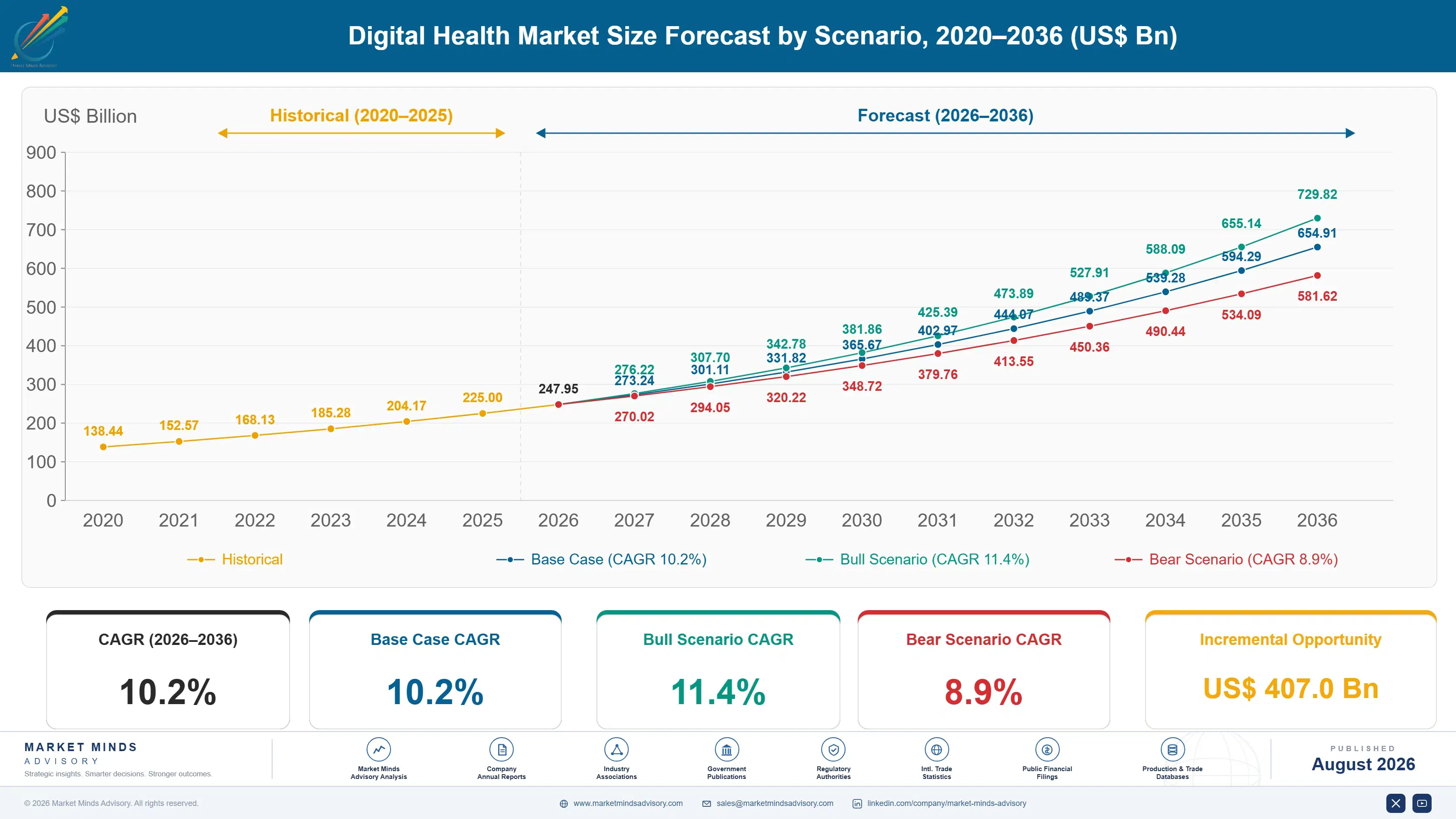
Digital Health Market Forecast Scenarios

digital-health-market-size-forecast-scenario-1787300090199
Between 2020 and 2025 the market grew at a historical pace of 9.2 percent as an initial pandemic-driven telehealth surge gave way to a more durable second wave of investment in remote monitoring and AI-enabled diagnostics, a transition that reshaped which capabilities investors and health systems prioritized as emergency-era usage patterns normalized across most major markets tracked.
The base case rests on three commercial mechanisms holding together over the decade: expanding reimbursement coverage for remote patient monitoring and digital therapeutics across major payer systems worldwide, accelerating regulatory clearance and clinical validation of AI-enabled diagnostic tools moving from pilot to production deployment across leading health systems, and growing health system investment in interoperability platforms needed to make fragmented digital health data usable across every care setting a patient touches.
A bull scenario hinges on major payers, particularly government health programs, expanding reimbursement for AI-enabled diagnostics faster than current policy timelines suggest is likely. The bear case centers on clinical validation setbacks or high-profile AI diagnostic errors undermining regulator and provider confidence broadly, slowing adoption momentum across the category well beyond the specific tools directly involved.

From Pandemic Telehealth Surge to AI-Native Care Delivery

Three forces are converging on this category at once: a maturing telehealth base that still anchors the largest visit volume, a fast-scaling AI-enabled diagnostics segment moving from pilot to production deployment across major health systems, and an interoperability challenge that is pushing health systems to invest heavily in platforms capable of making fragmented digital health data actually usable in clinical workflows.
MARKET CONCENTRATIONCR5 28%top five companies hold under a third of total revenue
AVERAGE CONTRACT VALUE$1.2M/health systemblended average annual digital health platform contract value
LEADING REIMBURSEMENT MARKETUSA, 32% sharelargest single-country digital health reimbursement infrastructure base overall
AI DIAGNOSTIC ADOPTION31% of revenueproportion of category revenue tied to AI-enabled diagnostic tools
CLINICAL VALIDATION TIMELINE18 to 36 monthstypical regulatory clearance period for new diagnostic AI tools
CLOUD INFRASTRUCTURE COST SHARE22% of COGScomputing and data storage proportion of total goods sold
Commercially, the market increasingly splits along buyer sophistication rather than pure product-class lines. Individual consumer health apps still compete largely on user experience and subscription pricing, while health systems and payers evaluate vendors on clinical validation evidence, integration complexity, and demonstrated outcomes data far more heavily than consumer-facing polish alone.
Over the next decade, clinical validation speed will matter as much as raw technology capability. Vendors who move fastest through regulatory clearance and peer-reviewed outcomes publication will capture a disproportionate share of the fastest-growing AI-enabled diagnostic and remote monitoring reimbursement categories before the broader vendor base can match that evidence base.
"Digital health spent five years proving people would use a video visit. It's spending the next five proving an algorithm should be trusted with a diagnosis, and that is a fundamentally harder sale to make."
Director, Healthcare Technology Practice · MMA Healthcare Technology and Digital

Market Trends

AI Diagnostics Move From Pilot to Production Deployment

Health systems that spent recent years running limited AI diagnostic pilots are increasingly moving successful tools into full production deployment across radiology, pathology, and early disease detection workflows, a transition driven by maturing regulatory clearance pathways and growing peer-reviewed evidence of clinical accuracy. Regulatory bodies in major markets have cleared a growing number of AI-enabled diagnostic tools in recent years, expanding the range of clinical applications available beyond the narrow imaging categories that dominated early clearances. Vendors report that production deployment contracts, once won, typically expand meaningfully within the first two years as health systems extend successful pilots into additional departments across their broader network.
Market Impact: Extends capacity roughly 15%
Remote Monitoring Reimbursement Expands Beyond Chronic Disease

Major payers, including government health programs in several countries, have expanded remote patient monitoring reimbursement codes beyond the traditional chronic disease management categories that originally justified coverage, now extending into post-surgical recovery monitoring and preventive care applications. This reimbursement expansion is pulling remote monitoring investment into new clinical use cases faster than device manufacturers had previously planned product roadmaps around. Vendors with established chronic disease monitoring platforms are extending into these newer reimbursed categories faster than new entrants lacking existing health system relationships and clinical workflow integration built over years of prior deployment.
Market Impact: 40% now run programs

Market Opportunities and Growth Drivers

Clinician Workforce Shortages Drive AI Adoption

Persistent clinician workforce shortages across radiology, pathology, and primary care are pushing health systems toward AI-enabled diagnostic and clinical decision support tools capable of extending existing clinician capacity rather than requiring proportional workforce growth to handle rising patient volume. Several major health systems have publicly disclosed AI diagnostic deployment specifically as a workforce capacity strategy rather than purely a quality improvement initiative, reflecting how acute the staffing pressure has become. This workforce-driven adoption rationale has proven more durable than purely efficiency-focused pitches, since it addresses an operational constraint leadership already treats as urgent.
Market Impact: Extends validation cycles to 3 years

Chronic Disease Prevalence Sustains Remote Monitoring Demand

Rising chronic disease prevalence, particularly diabetes and cardiovascular conditions, across aging populations in major markets continues expanding the baseline patient population eligible for remote monitoring programs that payers increasingly reimburse as a cost-effective alternative to frequent in-person visits. Roughly 40 percent of health systems in developed markets now operate a formal remote patient monitoring program for at least one chronic condition, according to industry deployment surveys, up substantially from a smaller share just several years earlier. This growing baseline demand gives remote monitoring vendors a more predictable growth trajectory than segments dependent on discretionary health system technology budgets alone.
Market Impact: Adds 20%+ to project costs

Market Restraints and Challenges

Clinical Validation Burden Slows AI Tool Deployment

AI-enabled diagnostic and clinical decision support tools require extensive clinical validation, often including prospective studies and regulatory clearance processes, before health systems will deploy them in production clinical workflows rather than limited pilot settings. The root cause is the genuinely high stakes of clinical decision-making, where an inaccurate AI recommendation carries direct patient safety consequences unlike most other software categories. The commercial impact is that vendors face validation timelines commonly spanning eighteen to thirty-six months before generating meaningful revenue, a capital-intensive process favoring well-funded incumbents over smaller startups. Vendors mitigate this through academic medical center partnerships that provide validation infrastructure and credibility smaller companies cannot easily build alone.
Market Impact: Ties 31% of revenue

Interoperability Gaps Limit Cross-Platform Data Value

Digital health data remains fragmented across incompatible platforms and electronic health record systems, limiting the value of remote monitoring and diagnostic tools whose data cannot flow easily into a patient's broader clinical record without substantial custom integration work. The root cause is that the digital health vendor landscape grew rapidly without comprehensive data standard adoption, leaving many platforms using proprietary or inconsistently implemented data formats. The commercial impact is that health systems must budget significant integration costs beyond the core software licensing fee, a hidden cost slowing purchasing decisions and adoption timelines considerably. Vendors mitigate this through standardized data exchange protocols and dedicated integration partnership programs.
Market Impact: Extends coverage into 2 new categories
3 additional market trends, 3 additional growth drivers, and 4 additional restraints and challenges are covered in the full report. Contact sales@marketmindsadvisory.com to access the complete intelligence.

Segment CAGR and Growth Architecture

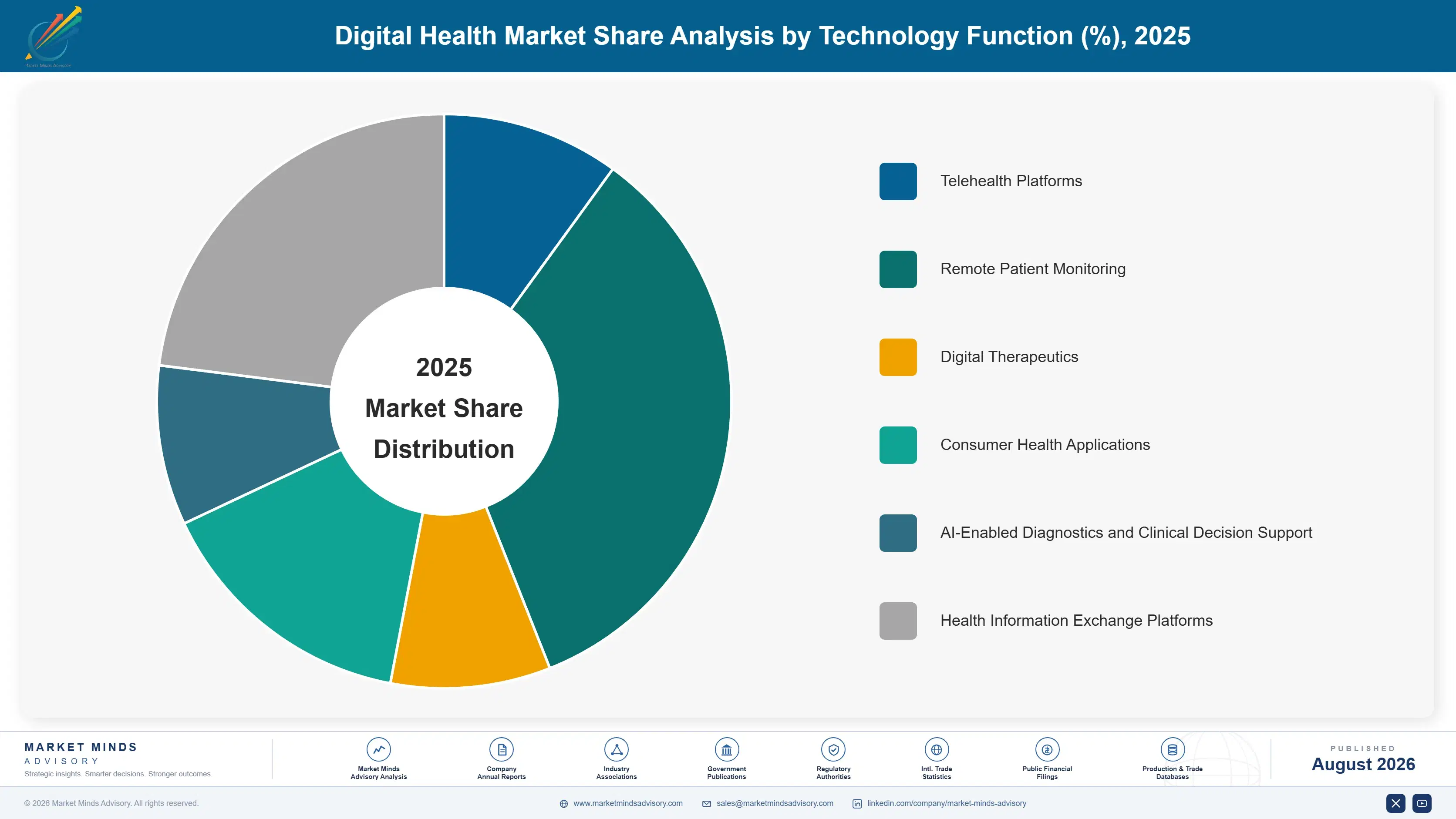
Segmentation follows technology function, the dimension health systems and payers use to classify digital health tools by clinical purpose and deployment model across this market. AI-enabled diagnostics are treated as a distinct category given their clinical decision-making function relative to pure monitoring or communication tools sold separately elsewhere.
digital-health-market-market-share-analysis-1787300090743

AI-Enabled Diagnostics and Clinical Decision Support

AI-enabled diagnostics and clinical decision support tools are the fastest-growing product category, encompassing software that analyzes medical images, lab results, or patient data to assist clinicians in diagnosis or treatment decisions rather than purely tracking or transmitting information passively. Demand concentrates among radiology, pathology, and emergency medicine departments facing the most acute workforce capacity pressure, where AI tools can meaningfully extend existing clinician throughput. Regulatory clearance requirements create a significant barrier to entry, favoring vendors with established clinical validation infrastructure and academic partnerships over newer entrants lacking comparable evidence. Health systems increasingly evaluate these tools on demonstrated outcomes data and peer-reviewed publication rather than vendor marketing claims alone.
CAGR 17.5%

Digital Therapeutics

Digital therapeutics, software-based interventions designed to treat, manage, or prevent specific medical conditions through clinically validated mechanisms, form the second-fastest-growing category as payer reimbursement pathways mature beyond the initial handful of approved products that defined the category's early years. Demand concentrates in behavioral health, chronic pain management, and substance use disorder treatment, where digital interventions have accumulated the strongest clinical evidence and payer acceptance to date. Growth remains constrained by the same lengthy validation and clearance requirements affecting AI diagnostics, though several major payers have expanded reimbursement policies recently, creating a more predictable commercial pathway than existed previously. Vendors with completed randomized controlled trials and payer contracts already in place hold a meaningful advantage over newer entrants.
CAGR 13.8%
Full segment breakdown across 6 segments available in the complete report.

Regional Architecture and Country Demand Map

North America commands the largest reimbursement infrastructure and venture funding base, East Asia follows closely on expanding digital health infrastructure investment, and South Asia and Pacific is the fastest-growing region on India's national digital health mission specifically.

North America

The United States carries the region's largest reimbursement infrastructure and venture capital funding base, sustained by both government health programs and commercial payers that have steadily expanded coverage for telehealth, remote monitoring, and increasingly AI-enabled diagnostic tools. Major health systems headquartered in the country continue moving AI diagnostic pilots into production deployment faster than health systems in most other regions, reflecting both funding availability and a competitive environment that rewards early adoption. Canada's single-payer health system has moved more cautiously on reimbursement expansion. Mexico's growing private healthcare sector is beginning to adopt telehealth platforms tied to expanding urban insurance coverage.
Share: 32% | CAGR: 9.4% (2026 to 2036)

Western Europe

Germany's statutory health insurance system has established one of the region's most structured digital health reimbursement pathways, formally evaluating and approving digital therapeutics and remote monitoring tools through a dedicated national process other countries now study closely. The United Kingdom's National Health Service has invested heavily in AI diagnostic pilots across radiology and pathology, though production deployment has moved more cautiously given budget constraints across trusts. France and the Nordic countries both maintain strong digital health investment tied to national digitization strategies. Regional data privacy regulation shapes vendor development considerably, requiring compliance investment smaller entrants sometimes find burdensome.
Share: 20% | CAGR: 8.7% (2026 to 2036)
Regional intelligence for 5 additional markets available in the complete report: East Asia, South Asia and Pacific, Latin America, Middle East and Africa, Eastern Europe. Contact sales@marketmindsadvisory.com.
digital-health-market-country-cagr-analysis-1787300091254

Where Vendors Can Defend Category Margin

As pandemic-era telehealth pricing compresses, vendors are shifting commercial strategy toward AI diagnostic clinical validation, deep health system integration, and outcomes-based contracting to defend margin across the category's fastest-growing reimbursement-driven segments over the coming decade.

Complete Rigorous Clinical Validation Studies Early

Vendors who complete prospective clinical validation studies and secure regulatory clearance ahead of competitors are winning a disproportionate share of health system production deployments, since health systems strongly prefer already-validated tools over unproven alternatives given the patient safety stakes involved in clinical decision support. Vendors with completed validation studies report production deployment win rates roughly 3x higher than competitors still relying on limited pilot data alone. This lever requires meaningful upfront investment in clinical research infrastructure but converts into a durable, multi-year revenue relationship considerably more predictable than pilot-stage engagements alone.
Market Impact: Triples deployment win rate to 3x

Build Deep Electronic Health Record Integration

Vendors who build deep, certified integration with major electronic health record systems reduce the hidden implementation costs that otherwise slow health system purchasing decisions, creating a meaningful competitive advantage over vendors requiring extensive custom integration work for every new customer deployment. Vendors offering pre-built EHR integration report implementation timelines cut by roughly 50 percent relative to competitors requiring custom integration builds for each new health system relationship formed. This lever requires sustained engineering investment but converts into a durable procurement advantage that smaller vendors cannot easily replicate without comparable integration partnerships.
Market Impact: Cuts implementation time by 50%

Shift Toward Outcomes-Based Contracting Structures

Vendors who offer outcomes-based or risk-sharing contract structures, tying a portion of payment to demonstrated clinical or cost outcomes, are winning larger health system and payer contracts than vendors offering only traditional fixed licensing arrangements, since outcomes-based structures reduce buyer risk during early adoption phases of unproven technology. Vendors with proven outcomes-based contracting report average contract values roughly 35 percent higher than comparable fixed-fee arrangements for similar deployment scope across accounts. This lever requires confidence in demonstrated clinical outcomes data but positions vendors to capture premium pricing as payers increasingly prefer this contracting structure.
Market Impact: Lifts contract value roughly 35%

Expand Academic Medical Center Research Partnerships

Vendors who establish research partnerships with leading academic medical centers gain both validation infrastructure and credibility that meaningfully accelerates broader health system sales conversations, since prospective customers weigh peer institution adoption heavily when evaluating unproven digital health technology carefully. Vendors with strong academic partnerships have won meaningfully larger shares of subsequent health system contracts, in several cases exceeding 40 percent higher win rates than vendors lacking comparable academic validation relationships. This lever requires patient, multi-year relationship investment but delivers outsized returns once a vendor's clinical evidence base matures.
Market Impact: Wins over 40% more health system deals

Who Controls the Margin Pool

The top five companies hold roughly 28 percent of revenue on a company-revenue basis, one of the most fragmented structures in this report, reflecting how many clinical specialty and regional vendors still compete successfully even as the largest electronic health record and telehealth platforms control an outsized share of enterprise health system contracts. The gap between Epic Systems and Teladoc Health, two of the largest players, and the broader field remains meaningful but leaves substanti
Current competitive activity centers on three fronts: clinical validation races to secure regulatory clearance and production deployment for AI diagnostic tools, deep electronic health record integration investment designed to reduce health system implementation friction, and outcomes-based contracting models intended to capture premium pricing as payers shift preference toward risk-sharing structures.

Pressure is building from large technology platform companies entering healthcare through cloud infrastructure and AI model partnerships, who are moving from backend infrastructure supply into branded clinical decision support products sold directly to health systems. Several have already won reference deployments at major academic medical centers, evidence that could accelerate their move into higher-margin certified segments faster than traditional healthcare technology incumbents currently expect.
digital-health-market-company-positioning-matrix-1787300091777

Competitive Moat and Risk Dimensions

EPIC SYSTEMS CORPORATION

Moat: Deepest Health System Data Integration

Epic Systems holds the largest electronic health record installed base among major health systems, giving it a data integration and switching-cost advantage that newer digital health vendors must build partnerships around rather than compete against directly for core clinical record ownership at scale.
EPIC SYSTEMS CORPORATION

Risk: Slower Standalone Innovation Pace

Epic Systems' scale and installed base sometimes slow its pace of standalone product innovation relative to smaller, more focused competitors, risking share loss in fast-moving categories like AI diagnostics where nimble specialists can iterate and validate new tools more quickly overall.
TELADOC HEALTH, INC.

Moat: Broadest Telehealth Platform Scale

Teladoc Health operates one of the largest telehealth platforms globally, giving it payer and employer relationships across a breadth of clinical specialties that smaller regional telehealth competitors cannot easily match without comparable years of network-building investment behind them already completed.
TELADOC HEALTH, INC.

Risk: Pressured Core Business Economics

Teladoc Health has faced sustained pressure on core telehealth visit economics as pandemic-era volume normalized and competition intensified, forcing the company to prove it can successfully pivot toward higher-margin chronic care and AI-enabled services facing intensifying competition from many directions.

Players Tracked

Prominent Players

Teladoc Health, Inc.
Epic Systems Corporation
Oracle Health (Cerner)
Koninklijke Philips N.V.
Amwell (American Well Corporation)

Other Key Players

GE HealthCare Technologies Inc.
Siemens Healthineers AG
Medtronic plc
Omada Health Inc.
Doximity Inc.
athenahealth Inc.
Veradigm Inc.
Click Therapeutics Inc.
Dexcom Inc.
iRhythm Technologies Inc.
Included Health Inc.
Ada Health GmbH
Zocdoc Inc.
Suki AI Inc.
Nuance Communications Inc.

Recent Developments

FEBRUARY 2025

Oracle Health Launches AI-Powered Clinical Decision Support Platform

Oracle Health introduced an organic product launch of a new AI-powered clinical decision support platform integrated directly into its electronic health record system, designed to surface diagnostic and treatment recommendations at the point of care without requiring a separate standalone application at all.
Signal: Established electronic health record vendors are increasingly embedding AI clinical decision support directly into core platforms.
JULY 2025

Teladoc Health Signs Multi-Year Partnership With National Health Plan

Teladoc Health signed a multi-year partnership agreement, not an acquisition or joint venture, with a national health plan to provide integrated telehealth and chronic care management services across the plan's full membership base, securing predictable long-term order volume for years.
Signal: Major payers are increasingly consolidating digital health services under fewer, larger multi-year vendor partnerships.
DECEMBER 2025

Philips Acquires Specialty AI Diagnostics Company

Koninklijke Philips completed the acquisition of a specialty AI diagnostics company focused on early disease detection algorithms, adding proprietary clinical validation data and regulatory clearances rather than continuing to develop comparable capability organically from an earlier starting point internally.
Signal: Established medical technology manufacturers are increasingly acquiring validated AI diagnostic capability to accelerate market entry.

Cloud Infrastructure and AI Compute Exposure

Cloud computing infrastructure and AI model training and inference compute together account for roughly 22 percent of cost of goods sold across the category, with clinical validation research, regulatory compliance, and software engineering labor making up most of the remainder. Cloud infrastructure supply concentrates among a small number of major hyperscale providers serving the broader technology industry beyond digital health specifically.
AI compute costs, particularly for large-scale model training, rose meaningfully during 2023 and 2024 amid surging demand for graphics processing unit capacity across the broader technology industry, a period several major cloud providers described in earnings materials as among the tightest capacity environments in years for advanced computing infrastructure. Several digital health AI vendors disclosed elevated infrastructure costs during this period directly attributable to this broader compute demand surge.

Exposure varies by company scale and infrastructure strategy. Larger vendors with negotiated enterprise cloud agreements or hybrid infrastructure approaches absorbed the cost pressure with comparatively limited disruption, while smaller AI-focused startups reliant entirely on pay-as-you-go cloud pricing faced sharper cost swings that occasionally constrained their ability to scale model training during the tightest capacity quarters.
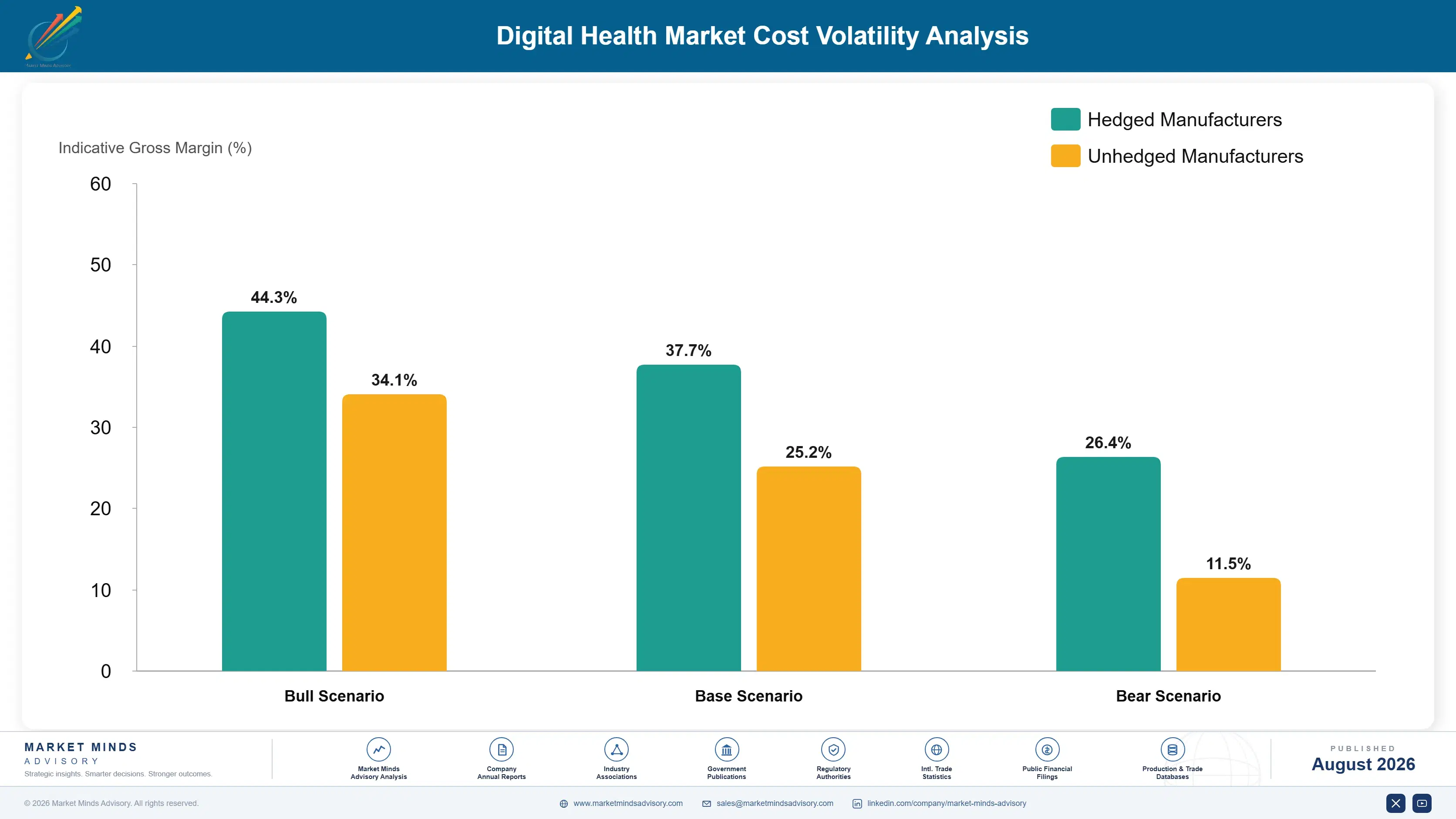
digital-health-market-cost-volatility-analysis-1787300091972

Negotiate Long-Term Enterprise Cloud Agreements

Leading vendors are increasingly securing multi-year enterprise cloud infrastructure agreements with committed spending levels, trading some flexibility for meaningfully more predictable and often discounted computing costs during periods of tight industry-wide capacity across major cloud providers globally.

Optimize AI Model Efficiency To Reduce Compute Needs

Vendors are investing in model architecture optimization and efficient inference techniques that reduce the computing resources required per prediction, lowering ongoing operational costs without compromising the clinical accuracy performance regulators and health systems require of these deployed tools.

Adopt Hybrid Cloud and On-Premises Infrastructure

Several larger vendors are adopting hybrid infrastructure strategies combining cloud and on-premises computing capacity, reducing dependence on any single cloud provider's pricing and availability decisions while also addressing data residency requirements some health system customers explicitly require.

Portfolio Architecture for Margin Defence

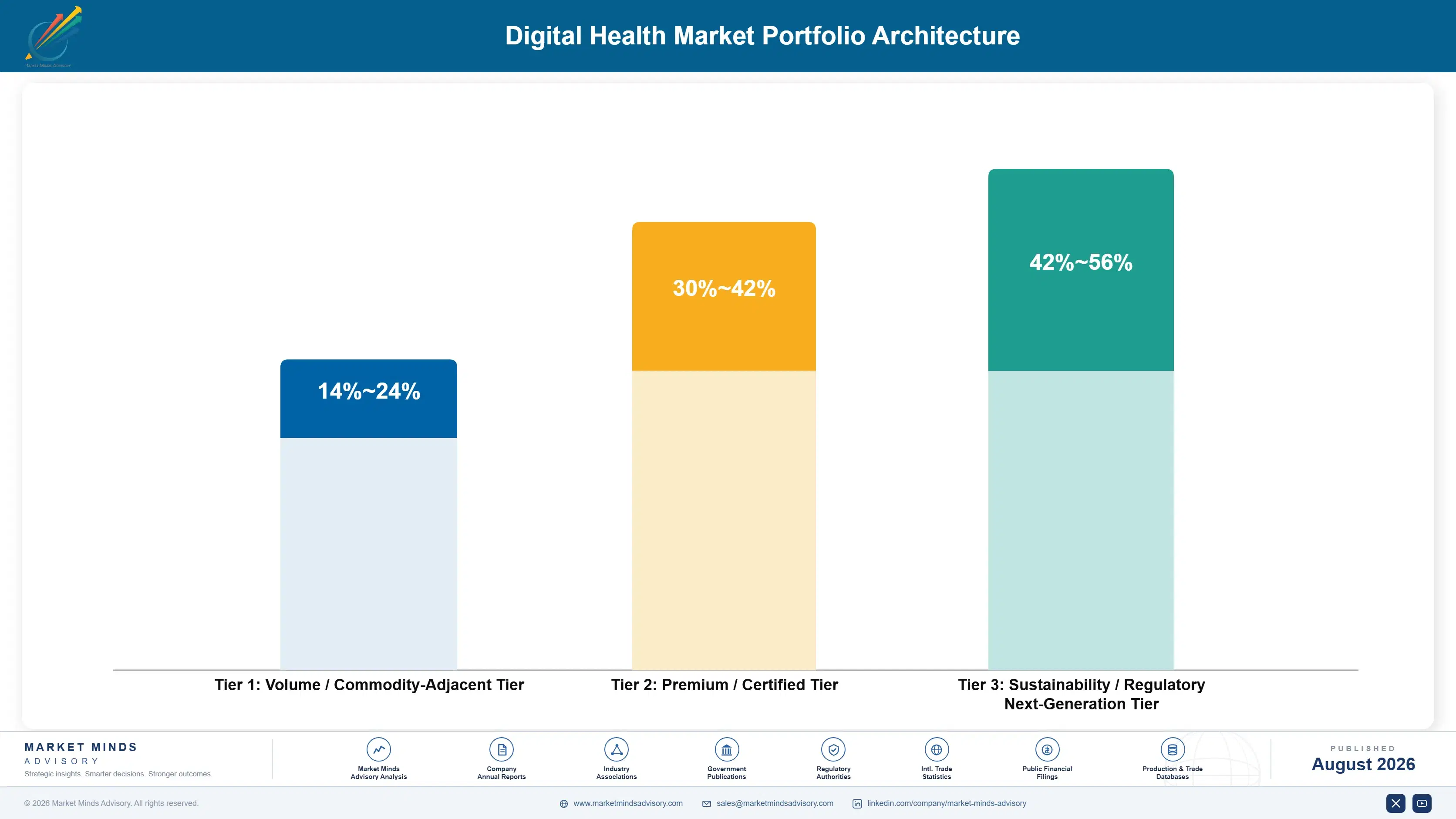
The market splits into three commercial tiers with distinct margin economics. Basic telehealth visit platforms and consumer wellness apps compete largely on price and user experience, certified remote monitoring and digital therapeutics carry meaningfully higher margin on reimbursement depth, and validated AI-enabled diagnostics command the highest margin given their narrow qualified vendor base and clinical decision-making value.
The tension between volume and premium positioning shapes how vendors allocate research and validation investment: basic telehealth and consumer apps still represent the largest user volume by a wide margin, but nearly all incremental profit growth over the forecast period concentrates in AI diagnostics and digital therapeutics, which is where the leading vendors increasingly direct clinical research and regulatory spending.

High-value margin pools concentrate specifically in AI-enabled diagnostics during their current validation-advantage window and in digital therapeutics with completed randomized controlled trials and established payer contracts. Both pools reward vendors who invest ahead of demand in clinical evidence rather than those who wait for reimbursement policy to fully mature before committing capital.

Volume / Commodity-Adjacent Tier

Basic telehealth visit platforms and consumer wellness apps sold largely on price and user experience across broad direct-to-consumer channels worldwide serving most markets.
Gross Margin: 14-24%

Premium / Certified Tier

Certified remote patient monitoring and digital therapeutics with established reimbursement codes, commanding meaningful premiums tied directly to payer coverage depth and strong clinical evidence.
Gross Margin: 30-42%

Sustainability / Regulatory / Next-Generation Tier

Validated AI-enabled diagnostics and clinical decision support tools, carrying the category's highest margins given their narrow qualified vendor base and steep regulatory clearance barriers.
Gross Margin: 42-56%
digital-health-market-portfolio-architecture-1787300092472

High-value Sub-segments and Strategic Watch-out

AI-Enabled Diagnostics and Clinical Decision Support

Highest current margin and fastest volume growth in the category, constrained mainly by lengthy clinical validation cycles and the small number of vendors with completed regulatory clearance today worldwide.
Gross Margin: 45-56%

Digital Therapeutics

Steady high-value growth tracking maturing payer reimbursement policy closely, increasingly favoring vendors with completed randomized controlled trials over newer entrants still building their clinical evidence base.
Gross Margin: 32-44%

Basic Telehealth Visit Platforms

The volume core of the market by user count, competing primarily on price and user experience rather than deep clinical differentiation between competing platform vendors across channels.
Gross Margin: 14-22%

Unvalidated Consumer Wellness Apps

A strategic watch-out segment as regulatory scrutiny and clinician skepticism toward unvalidated health claims threaten a substantial share of currently marketed generic wellness applications sold widely.
Gross Margin: 10-20%

Software License Meets Clinical Workflow Lock-In

Digital health platforms increasingly behave like an annuity business once deeply integrated into a health system's clinical workflow and electronic health record, generating recurring subscription and usage-based revenue across a multi-year relationship, since switching platforms mid-deployment requires costly clinical retraining and data migration most health systems strongly prefer to avoid.
Adoption depth varies sharply by end-use vertical. Large academic medical centers show the deepest integration and clinical validation partnership depth, community and rural health systems adopt more cautiously given tighter technology budgets, and individual consumer users of wellness apps remain the most transactional and price-sensitive segment of the entire market by a wide margin.

A generational shift in buyer profile is underway as health system technology procurement increasingly includes dedicated clinical informatics and AI governance specialists rather than pure IT generalists evaluating purchases primarily on cost and basic functionality. Payer organizations are also increasingly staffed by digital health specialists who evaluate outcomes evidence rather than simply comparing vendor marketing claims during contract negotiations.
digital-health-market-end-use-penetration-index-1787300092964

Where This Market Goes Next

These are among the four positions where our research anticipates prominent divergence between winners and laggards over the coming forecast period. Each is grounded in the demand model, the regulatory perimeter, and the announced capacity pipeline.
01 / CLINICAL VALIDATION INVESTMENT

Early-validated AI vendors will lock in a durable lead

AI-enabled diagnostics reward vendors who complete rigorous clinical validation first, because production deployment contracts and peer-reviewed evidence become the credibility needed to win the next health system relationship. Vendors still relying on limited pilot data are already missing early production deployment waves at major academic medical centers actively finalizing vendor selections. This gap should widen rather than narrow as validated vendors accumulate outcomes data that unvalidated competitors cannot replicate quickly regardless of how much capital they eventually commit to catching up.
02 / HEALTH SYSTEM INTEGRATION DEPTH

Integration friction is becoming the real competitive battleground

Health systems increasingly weigh implementation friction as heavily as core product capability when selecting digital health vendors, rewarding suppliers who invest in deep electronic health record integration ahead of formal procurement processes. Vendors with pre-built certified integration are winning deployments faster and at higher rates than competitors requiring extensive custom integration work for every new customer relationship. Manufacturers who underinvest in integration risk losing deals to less capable but more easily deployed competing platforms regardless of underlying clinical performance differences.
03 / OUTCOMES-BASED CONTRACTING SHIFT

Risk-sharing structures are reshaping how vendors get paid

Payers and health systems increasingly prefer outcomes-based contracting that ties vendor payment to demonstrated clinical or cost results, reducing buyer risk during early adoption phases of unproven digital health technology across most deployment scenarios. Vendors confident in their clinical evidence are embracing this shift and capturing premium contract values that traditional fixed-fee competitors cannot match without comparable outcomes data behind them. Manufacturers who resist this contracting shift risk losing share to competitors willing to align payment with demonstrated results rather than upfront licensing fees alone.
04 / ACADEMIC PARTNERSHIP STRATEGY

Research partnerships are becoming a prerequisite for enterprise sales

Health systems weigh peer institution adoption heavily when evaluating unproven digital health technology, making academic medical center research partnerships an increasingly necessary credibility investment rather than a purely optional relationship-building exercise for ambitious vendors. Vendors with strong academic partnerships are already winning meaningfully larger shares of subsequent enterprise health system contracts than competitors lacking comparable validation relationships. This dynamic should continue favoring well-capitalized vendors able to sustain multi-year academic research investment over smaller competitors forced to prioritize near-term revenue instead.

Engagement Snapshot From the Field

A live engagement with an industry participant carrying material or product regulatory and market exposure ahead of a defining policy shift, showing how our research translates into a defensible multi-year portfolio strategy.
MARKET MINDS ADVISORY · CLIENT ENGAGEMENT SUMMARY
Digital Health Producer Strategic Portfolio Review and Transition Roadmap 2026·Investment Scenario on Digital Health Exposure Evaluation 2025-26
CLIENT PROFILE
The client is a regional academic health system operating multiple hospitals and outpatient clinics, serving several million patients annually (client-reported, unverified by MMA) across its metropolitan service area. The system had completed limited pilot testing of an AI diagnostic tool in its radiology department but had not yet moved toward broader production deployment across additional clinical departments.
STRATEGIC CHALLENGE
Leadership needed to evaluate whether to expand the AI diagnostic pilot into full production deployment and additional departments, while managing clinician adoption concerns and ensuring the technology investment aligned with the system's broader capital budget priorities across many competing initiatives simultaneously.
MMA APPROACH
MMA benchmarked the pilot's clinical accuracy and workflow efficiency data against comparable academic health system deployments, modeled the capacity and financial impact of production expansion under three distinct departmental rollout scenarios, and developed a change management framework addressing clinician adoption concerns identified throughout the engagement.
KEY FINDINGS
  1. The pilot demonstrated diagnostic accuracy improvements and read-time reductions consistent with published literature, supporting expansion beyond the initial radiology pilot into additional departments.
  2. Modeled production deployment across three additional departments was projected to extend effective clinician capacity by roughly 15 percent within eighteen months of full rollout completion.
  3. Clinician survey data revealed workflow integration concerns as the primary adoption barrier, exceeding accuracy concerns by a meaningful margin among surveyed radiologists and pathologists.
  4. Total deployment cost across all four departments was modeled at a level offset within an estimated twenty months through capacity gains (client-reported, unverified by MMA).
CLIENT PROFILE
The client is a regional academic health system operating multiple hospitals and outpatient clinics, serving several million patients annually (client-reported, unverified by MMA) across its metropolitan service area. The system had completed limited pilot testing of an AI diagnostic tool in its radiology department but had not yet moved toward broader production deployment across additional clinical departments.
STRATEGIC CHALLENGE
Leadership needed to evaluate whether to expand the AI diagnostic pilot into full production deployment and additional departments, while managing clinician adoption concerns and ensuring the technology investment aligned with the system's broader capital budget priorities across many competing initiatives simultaneously.
MMA APPROACH
MMA benchmarked the pilot's clinical accuracy and workflow efficiency data against comparable academic health system deployments, modeled the capacity and financial impact of production expansion under three distinct departmental rollout scenarios, and developed a change management framework addressing clinician adoption concerns identified throughout the engagement.
KEY FINDINGS
  1. The pilot demonstrated diagnostic accuracy improvements and read-time reductions consistent with published literature, supporting expansion beyond the initial radiology pilot into additional departments.
  2. Modeled production deployment across three additional departments was projected to extend effective clinician capacity by roughly 15 percent within eighteen months of full rollout completion.
  3. Clinician survey data revealed workflow integration concerns as the primary adoption barrier, exceeding accuracy concerns by a meaningful margin among surveyed radiologists and pathologists.
  4. Total deployment cost across all four departments was modeled at a level offset within an estimated twenty months through capacity gains (client-reported, unverified by MMA).
RECOMMENDED STRATEGY
Phase 1: Phase 1 (Months 1-4): Address workflow integration concerns identified in clinician surveys and finalize departmental rollout sequencing plan. Phase 2: Phase 2 (Months 5-12): Execute phased production deployment across three additional clinical departments identified in the assessment. Phase 3: Phase 3 (Months 13-20): Complete full deployment and establish ongoing clinical outcomes monitoring across all four departments involved.
OUTCOME
Eighteen months into the expansion, the health system reported effective clinician capacity up an estimated 13 percent and clinician satisfaction scores improved meaningfully following workflow adjustments (client-reported, unverified by MMA), tracking closely to MMA's original modeled projections overall.

Frequently Asked Questions

Foundational context covering the market sizes, CAGR, scope, country, region and competition that inform every finding below. This section is provided to cover basics and most often pre-purchase conversations, answered from the MMA Primary Research Dataset.

What is the current size of the Digital Health Market?

The market is valued at approximately 225.0 billion dollars in 2025, expanding to roughly 247.95 billion dollars in 2026 as AI-enabled diagnostics and remote monitoring reimbursement continue driving adoption.

How large will the Digital Health Market be by 2036?

MMA forecasts the market reaching approximately 654.91 billion dollars by 2036, roughly 2.64 times its 2026 value, driven primarily by AI diagnostic adoption and expanding remote monitoring reimbursement coverage.

What is the CAGR for the Digital Health Market 2026 to 2036?

The base-case compound annual growth rate is 10.2 percent, with a bull scenario of 11.4 percent and a bear scenario of 8.9 percent depending on reimbursement expansion pace and AI adoption speed.

Which segment is growing fastest?

AI-enabled diagnostics and clinical decision support are growing fastest at a 17.5 percent CAGR, roughly 1.72 times the overall market rate, driven by maturing regulatory clearance and clinical evidence.

Who are the major companies in the Digital Health Market?

Teladoc Health, Epic Systems, Oracle Health, Philips, and Amwell lead the market, together holding roughly 28 percent of revenue on a company-revenue basis across all technology segments.

Which country is growing fastest?

India is the fastest-growing country at a 14.5 percent CAGR, driven by the national Ayushman Bharat Digital Mission and broader government digital health infrastructure investment nationwide.

Report Segmentation Architecture

The full report scope spans multiple orthogonal segmentation dimensions, with cross-tabulated demand data provided for each dimension pair. Coverage extends further to regional breakdowns, trend trajectories, and the competitive detail needed to support segment-level decision-making.

By Technology Function

  • Telehealth Platforms
  • Remote Patient Monitoring
  • Digital Therapeutics
  • Consumer Health Applications
  • AI-Enabled Diagnostics and Clinical Decision Support
  • Health Information Exchange Platforms

By End-Use Industry

  • Hospitals and Health Systems
  • Payers and Health Plans
  • Ambulatory and Outpatient Clinics
  • Employers and Direct-to-Consumer
  • Life Sciences and Pharmaceutical

By Commercial Dimension

  • Enterprise Health System Contracts
  • Payer and Government Contracts
  • Direct-to-Consumer Subscription
  • Platform Licensing and API Services

By Region

  • North America
  • Western Europe
  • East Asia
  • South Asia and Pacific
  • Latin America
  • Middle East and Africa
  • Eastern Europe

Scope, Methodology, and Coverage

Every figure in this report is reproducible from documented input assumptions. The scope below maps the historical period, the forecast horizon, the segmentation dimensions, and the countries covered, alongside the underlying primary and qualitative methodology.
Historical Period
2020 to 2025
Forecast Period
2026 to 2036
Base Year
2025 (USD billions; MMA Primary Research Dataset, August 2026)
Market Definition
The market covers digital platforms and connected technologies used to deliver, monitor, or support clinical care remotely or through structured digital data exchange, including telehealth platforms, remote patient monitoring devices and software, digital therapeutics, consumer health applications, AI-enabled diagnostics and clinical decision support tools, and health information exchange platforms. Traditional in-facility medical equipment and electronic health record systems lacking remote care or interoperability functions are excluded.
Quantitative Units
USD billions (current prices); active user and deployment volumes where cited
Segmentation Dimensions
By Technology Function; By End-Use Industry; By Commercial Dimension; By Region
Regions Covered
North America, Western Europe, East Asia, South Asia and Pacific, Latin America, Middle East and Africa, Eastern Europe
Countries Covered
USA, China, Germany, France, UK, Japan, South Korea, India, Australia, Canada, Brazil, Mexico, Indonesia, Vietnam, Thailand, Malaysia, UAE, Saudi Arabia, South Africa, Nigeria, Turkey, Poland, Netherlands, Italy, Spain, Sweden, Switzerland, Argentina, Colombia, Singapore, and additional markets relevant to this sector
Key Companies Profiled
Teladoc Health, Inc., Epic Systems Corporation, Oracle Health (Cerner), Koninklijke Philips N.V., Amwell (American Well Corporation), GE HealthCare Technologies Inc., Siemens Healthineers AG, Medtronic plc, Omada Health Inc., Doximity Inc., athenahealth Inc., Veradigm Inc., Click Therapeutics Inc., Dexcom Inc., iRhythm Technologies Inc., Included Health Inc., Ada Health GmbH, Zocdoc Inc., Suki AI Inc., Nuance Communications Inc.
Quantitative Methodology
Primary survey, n=3,800 respondents, Q4 2025, six countries; demand-side model with trade association cross-validation
Qualitative Methodology
47 expert interviews, Q4 2025; applied to validate demand model assumptions, identify emerging dynamics, and assess competitive positioning
Report Format
PDF and XLSX data workbook (Word format preview document)
Publisher
Market Minds Advisory
Report Code
MMA-2026-HLT-318
Published
August 2026
Contact
sales@marketmindsadvisory.com | www.marketmindsadvisory.com

Purchase the full Digital Health Market Report (2026 to 2036).

The full report delivers a complete quantitative and strategic assessment of the digital health market across all seven regions and more than thirty countries covered in this study. It includes detailed segment-level forecasts through 2036, competitive benchmarking across twenty profiled companies, and primary research drawn from 3,800 survey respondents and 47 expert interviews conducted in Q4 2025. Buyers receive editable data tables and full regional narrative detail beyond the two regions previewed in this summary document. A dedicated appendix covers AI diagnostic regulatory clearance pathways and reimbursement policy by country.
Fully editable Excel data tables included
All seven full regional narratives included
Twenty-company competitive profiles included
AI regulatory clearance pathways appendix provided
Segment-level 2026-2036 detailed forecasts
Primary survey and interview data provided

Built For The People Who Decide

From boardroom strategy to bench-side execution, this report is read cover-to-cover by leaders shaping the next decade of their industry, turning demand scenarios, market dynamics and valuation benchmarks into decisions.
CXOs/ Presidents/ VPs/ Managers
M&A and Corporate Development
Strategy Teams and R&D Heads
Procurement and Product Directors
Regulatory and Compliance Leaders
Investor Relations and Equity Analysts