Market Minds Advisory
Digital Comparators Market

Digital Comparators Market: Precision Analog ICs for EV Power Management and Industrial Automation.

EV power management complexity, industrial automation sensor proliferation, and rising switching frequency requirements are pushing digital comparator ICs past legacy general-purpose designs toward specialized high-speed variants, rewarding vendors who cut propagation delay.

Lead Analyst

Published

September 2026

Make Smarter Decisions with Customized Research Insights

Request a free sample report and evaluate market opportunities, growth trends, and competitive dynamics relevant to your business needs.

2025 MARKET VALUE$2.1BMarket Size 2025
2036 FORECAST VALUE$4.4BBase Case , 2026 to 2036
CAGR 2026 TO 20367.0 %Bull 8.2% / Bear 5.8%
INCREMENTAL OPPORTUNITY$2.2BNet 10- year value creation
EXPANSION MULTIPLE1.97x2036 value over 2026 base
Strategic Levers
M&A Pipeline
Regional Outlook
Country Rankings
Competitive Intelligence
Segmental Deep-dive
Call-Us : 91 93563 13602

Executive Snapshot and Market Trajectory.

Digital comparator ICs have moved from a commodity analog building block into a differentiated component category, as EV power electronics and industrial motor control applications demand propagation delay and threshold accuracy that general-purpose comparators were never designed to deliver at any meaningful scale, reliability level, or cost point.
EV power management system complexity, industrial automation sensor interfacing requirements, and rising switching frequency across power conversion applications are converging on high-speed, low-power comparator designs that outperform legacy general-purpose variants on every meaningful specification available today across every application, while American and Japanese analog semiconductor houses concentrate scarce design engineering talent within a handful of specialized IC vendors serving global device manufacturers directly across the entire industry and its many customers.
Competitive intensity centers on a moderately concentrated group of analog semiconductor specialists competing on propagation delay and power efficiency rather than price alone, even as commoditization pressure in legacy general-purpose comparator segments and integration of comparator functions directly into microcontrollers threaten to compress the addressable market for standalone comparator components across the coming decade of transition, consolidation, and realignment within the broader analog semiconductor supply base.
Market Definition
The Digital Comparators Market covers standalone comparator integrated circuits sold as discrete components for voltage threshold detection, level shifting, and signal conditioning across power management, automotive, and industrial control applications. It excludes operational amplifiers marketed purely for signal amplification, analog-to-digital converters, and comparator functionality embedded as non-discrete intellectual property blocks within microcontrollers or system-on-chip designs.
Base Year Value
$2.1B in 2025 (MMA Primary Research Dataset, September 2026)
Forecast Period
2026 to 2036, eleven discrete annual values
CAGR
7.0% base case. Bull 8.2%. Bear 5.8%.
Fastest Growth Segment
High-Speed Comparator ICs for EV Power Management Systems: 11.5% CAGR
Fastest Growth Country
China: 9.0% CAGR
Fastest Growth Region
South Asia and Pacific: 9.5% CAGR
Largest Region
East Asia: 30% of 2025 global value
Market Leaders
Texas Instruments, Analog Devices, STMicroelectronics, onsemi, and Microchip Technology lead the global Digital Comparators Market. Source: MMA Primary Research Dataset, July 2026, and company disclosures.
Primary Survey
n=3,800 procurement and R&D decision-makers, Q4 2025, six countries
Methodology
Demand-side build-up, cross-validated against public data, 47 expert interviews

Digital Comparators Market Forecast Scenarios

digital-comparators-market-size-forecast-scenario-1790002572518
Digital comparator demand grew steadily between 2020 and 2025 as industrial automation and early EV platforms adopted discrete threshold-detection ICs alongside legacy power supply designs, while consumer electronics makers kept comparator specifications largely unchanged across successive product generations. The historical growth rate of 5.5% reflects a mature, incrementally expanding component category rather than any single disruptive catalyst reshaping demand across the period.
The base case rests on three commercial mechanisms: EV power management architectures requiring faster propagation delay across battery management and inverter control loops, industrial automation deployments adding sensor interfacing points per installed system as factories add monitoring density, and consumer electronics manufacturers standardizing on higher-precision comparators to cut field failure rates and warranty costs. Together these three forces push the category from a commodity analog line into a specification-driven design-in business through 2036.
A bull scenario centers on faster-than-expected silicon carbide and gallium nitride power electronics adoption, which needs comparators with materially lower propagation delay than legacy designs, pulling forward capital spending and design-win volume well ahead of the base case. The principal bear risk is deeper integration of comparator functions into microcontroller peripherals, which erodes the standalone IC market outside the highest-performance tier over time.

Comparator ICs Split Between Commodity Volume and Precision Design-In

Digital comparator design has bifurcated into a high-volume commodity tier serving general-purpose consumer and appliance circuits and a specification-driven premium tier serving EV power management and industrial motor control, where propagation delay, input offset voltage, and quiescent current separate winning designs from also-rans in customer qualification testing. Vendors competing only in the commodity tier find margin compressed by Chinese and Taiwanese entrants offering adequate parts at lower prices.
MARKET CONCENTRATION (CR5)52%share held by the five largest comparator vendors combined
AVERAGE SELLING PRICE$0.18blended price per standard discrete comparator unit sold
TOP FABRICATION COUNTRY SHARE38%wafer output concentrated within a single leading country
WAFER FAB UTILIZATION RATE83%average utilization across dedicated analog wafer fabrication lines
EXPORT INTENSITY61%production volume shipped across borders to device assemblers
INPUT COST SHARE34%silicon wafer expense as share of total production cost
Pricing reflects that split directly: commodity comparators sell for fractions of a cent in volume while automotive-qualified, high-speed variants command materially higher unit prices and carry design cycles measured in years rather than months, because automotive customers requalify suppliers only infrequently once a design wins a production socket. That qualification inertia protects incumbents for the life of a vehicle platform, giving early design wins outsized lifetime value.
Fabrication remains concentrated among a handful of analog-focused wafer facilities running mature process nodes, which keeps capital intensity lower than digital logic manufacturing but ties supply tightly to a small set of specialty foundries and in-house analog fabs whose utilization swings with broader semiconductor demand cycles. Trailing-edge node scarcity during upcycles has repeatedly stretched comparator lead times beyond quoted delivery windows, pushing customers toward dual-sourcing.
"The comparator market rewards whoever solves propagation delay without burning quiescent current, and right now that is a shorter list of vendors than most customers assume. Everyone else is still selling yesterday's specification."
Director, Semiconductor and Analog Devices Practice · MMA Technology Practice · September 2026

Market Trends

EV Power Electronics Push Comparators Toward High-Speed Designs

Electric vehicle platforms are pushing comparator selection away from general-purpose parts toward high-speed variants tuned for battery management systems, onboard chargers, and traction inverters, where propagation delay directly affects protection response time during fault conditions. Tier-one automotive suppliers now specify comparators with sub-20 nanosecond propagation delay for new inverter designs, up from the 50 to 100 nanosecond parts common in combustion-era power electronics. This shift is rewriting qualification checklists across the supplier base, forcing analog vendors that built their catalog around industrial and consumer applications to develop dedicated automotive-grade product lines or lose emerging EV sockets entirely to specialists.
Market Impact: 12 to 20 units per powertrain
Rising Analog Content per Vehicle Amid Electrification

Average analog semiconductor content per vehicle has climbed as electrification adds battery management, onboard charging, and traction inverter subsystems, each requiring multiple discrete comparators for voltage monitoring, overcurrent protection, and thermal cutoff. A typical battery electric vehicle now carries roughly three times the comparator count of an equivalent combustion model, spread across the battery pack, power electronics, and auxiliary systems. Automakers accelerating electrification timelines are locking in multi-year comparator supply agreements earlier in the vehicle development cycle than they historically did for legacy analog components, reshaping how suppliers plan capacity.
Market Impact: 40% growth in industrial sensor counts

Market Opportunities and Growth Drivers

Electric Vehicle Power Electronics Demand Faster Switching Detection

Battery management systems and traction inverters need comparators that detect overcurrent and overvoltage faults within microseconds to prevent cell damage or power stage failure, a requirement that general-purpose comparators designed for consumer electronics cannot reliably meet. Global EV production is projected to exceed 30 million units annually by 2030, and each vehicle requires between twelve and twenty discrete comparator instances across its power electronics architecture. Suppliers that cannot demonstrate automotive-grade qualification, including AEC-Q100 certification, are excluded from sourcing discussions before pricing even enters the conversation, concentrating design wins among a narrow qualified vendor set.
Market Impact: 25% of sockets already migrated

Industrial Automation Deployments Add Sensor Interfacing Density

Factory automation investments are steadily adding sensor interfacing points per installed system as manufacturers pursue predictive maintenance and tighter process control, and each additional sensor typically requires a dedicated comparator for threshold detection and signal conditioning ahead of the programmable logic controller. Installed industrial sensor counts have grown by roughly 40% over the past five years across surveyed manufacturing facilities, and comparator attach rates have scaled proportionally alongside them. This steady, unglamorous demand growth provides a stable revenue base that offsets the more cyclical swings in consumer electronics comparator volume.
Market Impact: Prices down 15% in five years

Market Restraints and Challenges

Microcontroller Integration Threatens Standalone Comparator Demand

Microcontroller vendors have steadily added comparator peripherals directly onto general-purpose chips, letting system designers eliminate a discrete component for applications that do not require top-tier propagation delay. The root cause is that most consumer and low-end industrial applications never needed discrete-grade performance in the first place, so integration simply removes redundant cost. Roughly 25% of previously discrete comparator sockets in consumer designs have already migrated onto microcontroller silicon over the past several years. Standalone vendors are responding by pushing further into automotive and high-speed segments where integrated peripherals still cannot match discrete performance, protecting margin even as unit volume erodes.
Market Impact: Sub-20ns propagation delay now standard spec

Chinese and Taiwanese Entrants Compress Commodity Pricing

Lower-cost analog fabs in China and Taiwan have entered the general-purpose comparator segment with functionally adequate parts priced well below incumbent Western and Japanese offerings, compressing margin for vendors that have not moved upmarket. The root cause is that basic comparator designs use mature, fully depreciated process nodes with low technical barriers to replication. Commodity segment prices have fallen by roughly 15% over five years as new entrants scaled capacity. Established vendors are mitigating the pressure by consolidating commodity product lines and reallocating fab capacity toward automotive-qualified and industrial-grade parts that new entrants have not yet qualified to supply.
Market Impact: 3x comparator count versus combustion vehicles
4 additional market trends, 3 additional growth drivers, and 2 additional restraints and challenges are covered in the full report. Contact sales@marketmindsadvisory.com to access the complete intelligence.

Segment CAGR and Growth Architecture

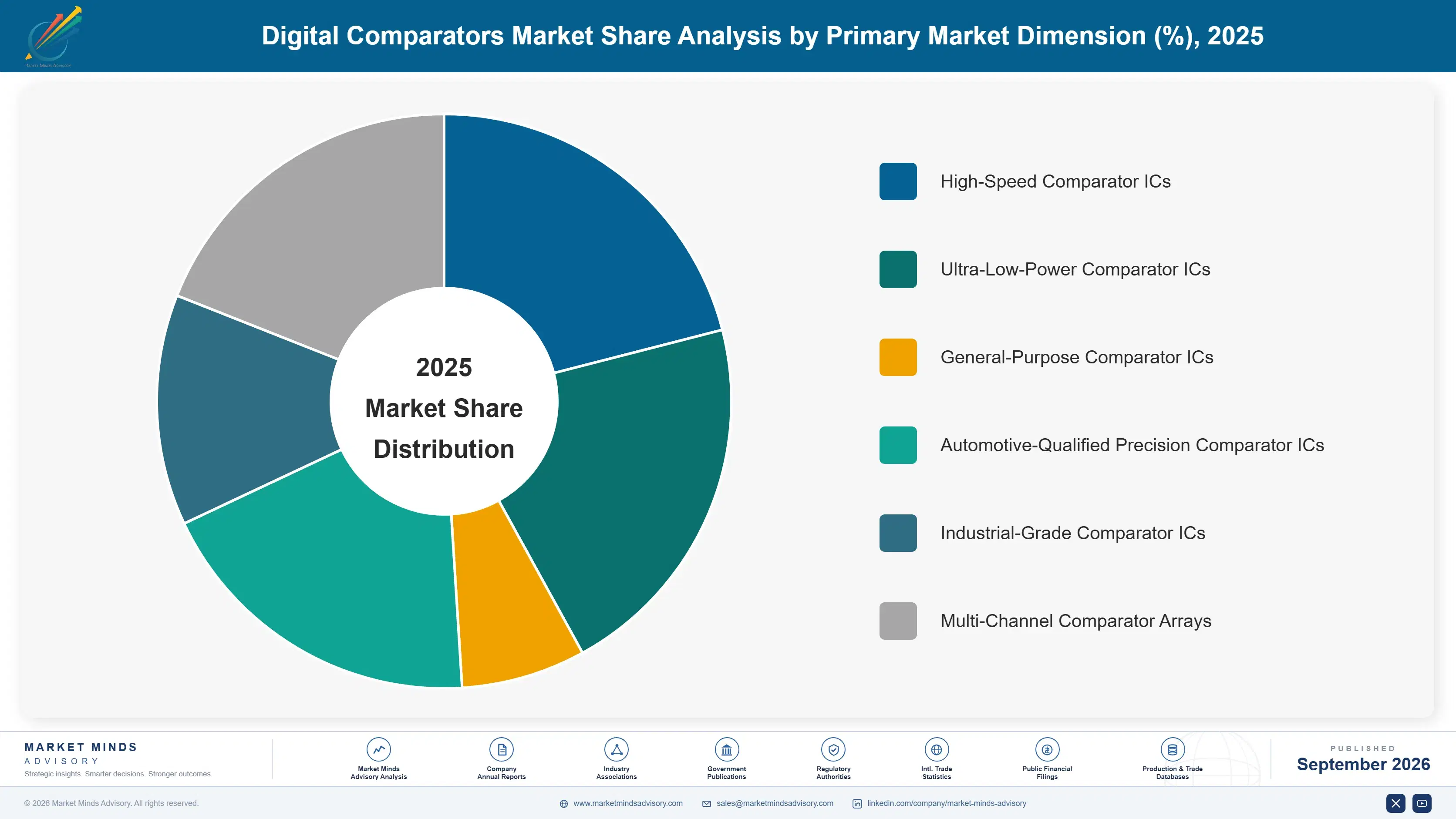
The Digital Comparators Market segments by product type across six categories spanning general-purpose, high-speed, low-power, and application-specific comparator ICs, reflecting the primary design axis customers use when specifying parts for a given application. Two segments outpace the market average, driven respectively by EV power electronics adoption and space-constrained battery-powered IoT sensing demand across industrial and consumer deployments.
digital-comparators-market-market-share-analysis-1790002573399

High-Speed Comparator ICs for EV Power Management Systems

High-speed comparator ICs for EV power management systems are the fastest-growing segment, expanding as battery management, onboard charging, and traction inverter designs converge on sub-20 nanosecond propagation delay specifications that general-purpose parts cannot meet under fault conditions. Tier-one automotive suppliers are qualifying dedicated automotive-grade product families years ahead of vehicle platform launches, locking in multi-year supply commitments before volume production even begins in earnest. Analog vendors without automotive-qualified fabrication capacity are effectively excluded from this segment regardless of their broader catalog strength, concentrating share among a handful of suppliers with proven AEC-Q100 track records across battery electric and plug-in hybrid platforms worldwide. New entrants face a multi-year qualification gauntlet before earning a single production socket.
CAGR 11.5%

Ultra-Low-Power Comparator ICs for Battery-Powered IoT Sensors

Ultra-low-power comparator ICs for battery-powered IoT sensors form the second-fastest segment, growing as wearables, remote environmental monitors, and industrial wireless sensor nodes push for nanoampere-range quiescent current to extend battery life measured in years rather than months between replacements. Design teams increasingly treat comparator quiescent current as a bill-of-materials differentiator on par with microcontroller sleep current, reshaping how vendors position ultra-low-power product families across their catalogs. Suppliers with dedicated nanopower analog processes hold a durable advantage here, since shrinking quiescent current further without sacrificing response time requires specialized process technology that general-purpose analog fabs were never built to support at scale. Certification for medical wearable applications adds a further, slower-moving qualification layer.
CAGR 9.8%
Full segment breakdown across 6 segments available in the complete report.

Regional Architecture and Country Demand Map

Regional demand for digital comparators tracks where power electronics manufacturing, automotive assembly, and consumer electronics production concentrate, with East Asia holding the largest share on fabrication and assembly density while North America and Western Europe anchor design activity, specification standards, and automotive safety qualification across every major vehicle platform.

North America

North America houses the design headquarters of Texas Instruments and Analog Devices, giving the region outsized influence over comparator specification standards even though final assembly happens elsewhere. Domestic EV assembly plants and a growing base of onshored power semiconductor fabrication, supported by CHIPS Act incentives, are adding qualification volume for automotive-grade comparators closer to design teams than in prior product cycles. Industrial automation retrofits across manufacturing corridors add steady sensor-interfacing demand independent of the automotive cycle. The region's comparator consumption grows in step with EV production ramp-up at new battery and assembly plants across the southeastern United States and Mexico border corridor, rather than through population-driven consumer volume growth alone.
Share: 24% | CAGR: 7.5% (2026 to 2036)

Western Europe

Precision manufacturing traditions across Germany, France, and the Netherlands sustain Western Europe's comparator demand, concentrated in premium automotive platforms and industrial automation equipment rather than high-volume consumer goods. German automakers' aggressive EV platform rollouts are driving early adoption of automotive-qualified, high-speed comparator variants ahead of many other markets, since European type-approval requirements for safety-critical power electronics rank among the strictest globally and shape supplier qualification well beyond the region's own borders. Regional semiconductor sovereignty initiatives are funding new analog fabrication capacity, though volumes remain modest against Asian foundry scale. Renewable energy inverter deployment across the region adds a secondary, steadily growing demand channel for industrial-grade comparator ICs across the wind and solar buildout.
Share: 20% | CAGR: 5.5% (2026 to 2036)
Regional intelligence for 5 additional markets available in the complete report: East Asia, South Asia and Pacific, Latin America, Middle East and Africa, Eastern Europe. Contact sales@marketmindsadvisory.com.
digital-comparators-market-country-cagr-analysis-1790002574405

Where Comparator Vendors Actually Capture Margin

Comparator vendors capture additional value beyond unit shipment volume through five commercial mechanisms that reward specification leadership over price competition alone. Automotive design-win longevity, bundled qualification support, capacity reservation, cross-selling, and second-source fee revenue matter more here than in most analog semiconductor categories, given the qualification inertia that protects incumbents once a socket is won.

Capturing Lifetime Value from Automotive Design-Wins

Winning a comparator socket in a new EV platform locks in supply for the life of that vehicle generation, typically six to eight years, since automotive customers rarely requalify a working power electronics supplier once production begins. Vendors that price the initial design win competitively while protecting margin on the multi-year production run capture roughly 3 to 4 times the lifetime revenue of a single commodity transaction. This favors suppliers with dedicated automotive account teams who can navigate lengthy qualification cycles and win sockets ahead of volume production, rather than those competing on unit price at the point of sale.
Market Impact: 3 to 4x lifetime revenue per design win

Bundling Qualification and Certification Testing Support

Offering AEC-Q100 pre-qualification data, application engineering support, and reference designs alongside the physical part shortens a customer's internal qualification timeline by several months, a meaningful advantage when automakers are racing to launch new EV platforms on compressed schedules. Vendors that bundle this support command a price premium of roughly 8 to 12% over commodity suppliers offering bare parts alone, since customers value the engineering time saved more than the marginal component cost difference. This lever works best for vendors with dedicated automotive applications engineering teams already embedded with key accounts.
Market Impact: 8 to 12% price premium for bundled support

Reserving Multi-Year Wafer Capacity from Foundries

Reserving dedicated analog wafer capacity through multi-year agreements with foundry partners lets vendors guarantee supply continuity to automotive customers during industry upcycles, when trailing-edge node capacity has historically tightened sharply across the whole supply base. Vendors with capacity agreements already in place have avoided the lead-time extensions of 20 to 30 weeks that spot-market buyers faced during recent supply tightness, protecting both revenue and customer relationships. This capability increasingly factors into automotive supplier scorecards alongside price and technical specification, rewarding vendors who commit capital ahead of demand rather than reacting to shortages.
Market Impact: Avoided 20 to 30 week lead-time extensions entirely

Cross-Selling Multi-Channel Comparator Array Product Lines

Customers designing multi-channel power monitoring systems increasingly prefer sourcing an entire comparator array from a single vendor rather than combining discrete parts from multiple suppliers, since matched electrical characteristics across channels simplify board design and reduce calibration effort. Vendors offering integrated array products alongside standalone comparators report attach rates roughly 25% higher on adjacent power management components within the same design, expanding wallet share per customer relationship. This works best where a vendor's broader analog portfolio already covers voltage references and power monitoring parts that pair naturally with comparator arrays.
Market Impact: 25% higher attach rate on adjacent power parts

Who Controls the Margin Pool

Revenue concentration in the Digital Comparators Market sits at a CR5 of 52%, evaluated on comparator product line revenue disclosed or estimated across each vendor's analog portfolio. Texas Instruments and Analog Devices lead by a meaningful margin over the next tier, drawing on decades of catalog breadth and automotive qualification history smaller specialists cannot replicate quickly. The gap between the second and third-ranked vendor is narrower, reflecting genuine contest for design wins in automotive segments.
Current competitive activity centers on automotive qualification races, with vendors publicizing new AEC-Q100 certified product families ahead of upcoming EV platform design cycles. Several vendors have expanded automotive applications engineering teams to shorten qualification timelines, treating engineering support as a genuine differentiator. Price competition stays intense mainly in the commodity tier, where Chinese and Taiwanese entrants compete aggressively on cost.

Emerging pressure comes from microcontroller vendors embedding comparator peripherals directly onto general-purpose chips, a trend that could compress the addressable standalone market outside the highest-performance tier over time. Rankings could shift if a mid-tier vendor secures a marquee EV platform design win, since automotive sockets carry multi-year exclusivity that reorders competitive standing for years. Vendors lacking automotive-grade fabrication capacity risk sliding down the rankings.
digital-comparators-market-company-positioning-matrix-1790002575308

Competitive Moat and Risk Dimensions

TEXAS INSTRUMENTS

Moat: Catalog Breadth and Scale

Texas Instruments' comparator catalog spans hundreds of variants across every performance tier, letting the company win sockets ranging from cost-sensitive consumer designs to high-speed automotive applications from a single supplier relationship. This breadth reduces the incentive for customers to qualify a second source, since one purchasing relationship covers nearly any comparator requirement a design team encounters across product lines.
TEXAS INSTRUMENTS

Risk: Commodity Tier Margin Erosion

The company's broad exposure to lower-margin, general-purpose comparator segments leaves it more exposed than specialists to price competition from Chinese and Taiwanese entrants targeting the commodity tier specifically. Defending share there without cutting price meaningfully will require continued investment in application support and bundled services, since matching low-cost entrants directly on price would compress margin across the broader portfolio.
ANALOG DEVICES

Moat: Automotive Qualification Depth

Analog Devices has built a deep bench of automotive-qualified comparator variants backed by extensive AEC-Q100 testing infrastructure and long-standing relationships with tier-one automotive suppliers. This qualification depth shortens customer onboarding for new EV platform designs and gives the company preferential access to early design discussions that competitors without comparable testing infrastructure simply cannot enter.
ANALOG DEVICES

Risk: Concentrated Automotive Revenue Exposure

Heavier reliance on automotive design wins than some diversified competitors leaves the company more exposed to cyclical swings in vehicle production volume and to the multi-year qualification cycles that can delay revenue recognition on new platform wins. A slowdown in EV production growth would weigh more heavily here than on competitors with a broader end-market mix.

Players Tracked

Prominent Players

Texas Instruments
Analog Devices
STMicroelectronics
onsemi
Microchip Technology

Other Key Players

Renesas Electronics
Infineon Technologies
ROHM Semiconductor
Toshiba Electronic Devices
Diodes Incorporated
Nexperia
Vishay Intertechnology
Semtech
NXP Semiconductors
Panasonic Industry
Monolithic Power Systems
Silicon Labs
Nisshinbo Micro Devices
Bourns
Littelfuse

Recent Developments

MARCH 2025

Richardson Fab Adds Automotive Comparator Lines

Texas Instruments expanded automotive-qualified comparator production capacity at its Richardson, Texas fabrication facility, adding dedicated lines for AEC-Q100 certified high-speed variants targeting EV power management applications. The organic capacity expansion followed rising order backlogs from tier-one automotive suppliers securing supply ahead of upcoming vehicle platform launches.
Signal: Signals sustained automotive demand pull for dedicated high-speed comparator manufacturing capacity ahead of new platform launches
AUGUST 2025

Multi-Year Wafer Supply Agreement Signed

Analog Devices signed a multi-year supply agreement with a leading Taiwanese automotive electronics assembler to secure dedicated comparator wafer output across upcoming EV platform generations. The agreement, not a joint venture or equity arrangement, commits both parties to fixed volume and pricing terms for several years.
Signal: Locks in dedicated wafer supply and pricing terms ahead of the next EV platform generation cycle
NOVEMBER 2025

Acquisition Adds Ultra-Low-Power Comparator IP

onsemi acquired a smaller analog design house specializing in ultra-low-power comparator architectures for battery-powered IoT sensing applications, adding nanoampere-range quiescent current intellectual property to its existing power management portfolio. The acquisition strengthens onsemi's competitive position in the fastest-growing IoT comparator segment without a lengthy internal buildout.
Signal: Adds specialized ultra-low-power comparator intellectual property without years of costly internal development work from a standing start

Wafer Supply and Fab Capacity Exposure

Silicon wafers account for roughly 34% of comparator IC production cost, sourced primarily from a concentrated set of specialty analog foundries in Taiwan, Japan, and South Korea running mature process nodes rather than leading-edge digital logic lines. Packaging and test represent a further 22% of cost, with assembly capacity concentrated in Malaysia, the Philippines, and mainland China.
Trailing-edge analog wafer capacity tightened sharply during the 2021-2022 global semiconductor shortage, when automotive customers competed directly with consumer electronics and industrial buyers for the same mature-node fab slots, according to the IEA's review of global semiconductor supply constraints. Lead times for standard comparator parts stretched from a typical eight to ten weeks to beyond forty weeks at the peak, forcing several automakers to redesign circuit boards around whatever comparator parts remained available rather than the ones originally specified.

Vendors without long-term wafer capacity agreements or in-house fabrication face a lasting cost disadvantage during upcycles, since spot-market wafer pricing can run well above contracted rates when capacity tightens industry-wide. Integrated device manufacturers with owned fabs, like Texas Instruments and STMicroelectronics, absorb less margin pressure than fabless comparator vendors dependent entirely on foundry allocation decisions made by external partners.
digital-comparators-market-cost-volatility-analysis-1790002575611

Dual-Sourcing Comparator Designs Across Two Qualified Vendors

Automotive and industrial customers increasingly qualify two comparator suppliers per design from the outset rather than adding a second source only after a supply disruption occurs. This raises upfront qualification cost modestly but protects production continuity when any single vendor's fab allocation tightens during an industry upcycle, a tradeoff most tier-one purchasing teams now consider worthwhile.

Securing Multi-Year Wafer Capacity Reservation Agreements

Vendors and their largest customers are increasingly negotiating multi-year wafer capacity reservations directly with foundry partners, trading long-term volume commitments for guaranteed allocation during future capacity tightness. This approach worked well during the last industry shortage for companies that had already signed such agreements, avoiding the worst of the lead-time extensions that competitors faced.

Investing in Nanopower and High-Speed In-House Design

Vendors are investing directly in nanopower and high-speed analog design capability rather than relying entirely on third-party foundry roadmaps, reducing exposure to any single fab partner's capacity decisions during future upcycles. This in-house capability took years to build for the companies that now benefit most, giving early movers a durable and defensible design advantage over the medium term.

Portfolio Architecture for Margin Defence

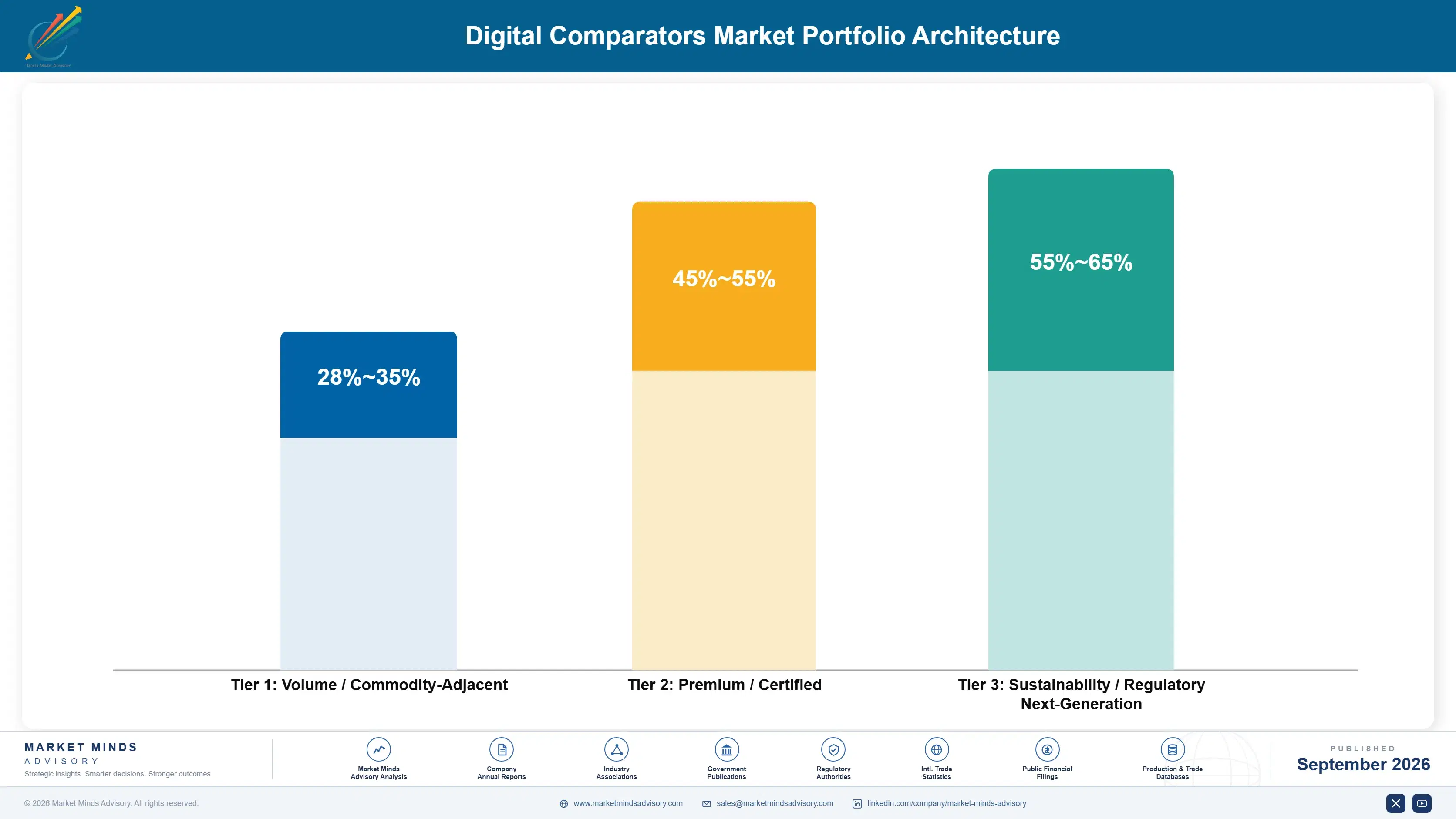
Comparator vendors organize their portfolios across three margin tiers that reflect fundamentally different competitive dynamics, from a high-volume commodity base up through certified automotive-grade parts to next-generation specialty variants. Gross margin varies substantially across tiers, and the widest margin pools concentrate at the top where technical differentiation and qualification barriers keep competition thin and pricing power intact.
Volume tier products compete almost entirely on price and availability, with margin compressed by Chinese and Taiwanese entrants who have scaled mature-node capacity specifically for this segment over the past several years. Premium tier products, by contrast, earn their margin through years of accumulated qualification history and application engineering support that customers value more than marginal unit cost, creating durable pricing power that volume-tier competitors cannot access.

The tension between volume and premium strategies shapes capital allocation decisions across the industry, since fabrication capacity committed to commodity parts cannot easily flex toward higher-margin automotive-grade production during a sudden demand surge. Vendors that maintain a foothold in both tiers use volume-tier revenue to fund the qualification investment needed to win premium-tier sockets, a strategy that only works reliably at sufficient manufacturing scale.

Volume / Commodity-Adjacent

General-purpose comparators for consumer electronics, appliances, and basic industrial applications, sold primarily on price and availability against a rapidly growing field of low-cost Chinese and Taiwanese entrants competing on scaled mature-node capacity.
Gross Margin: 28-35%

Premium / Certified

Automotive-qualified and industrial-grade comparators carrying AEC-Q100 or equivalent certification, priced for accumulated qualification history, dedicated application engineering support, and multi-year design-win exclusivity rather than raw component cost alone across the vehicle platform's production life.
Gross Margin: 45-55%

Sustainability / Regulatory / Next-Generation

Ultra-low-power and high-speed specialty variants for EV power electronics and battery-powered IoT sensing applications, where technical differentiation and a limited qualified supplier count support the widest margin in the category.
Gross Margin: 55-65%
digital-comparators-market-portfolio-architecture-1790002576335

High-value Sub-segments and Strategic Watch-out

High-Speed Comparator ICs for EV Power Management

This segment combines the fastest unit growth in the category with the widest gross margin, as EV power electronics designers pay a substantial premium for sub-20 nanosecond propagation delay. Vendors with proven automotive qualification are positioned to capture disproportionate value here through the next decade.
Gross Margin: 58-65%

Ultra-Low-Power Comparator ICs for IoT Sensors

Battery-powered wearables and industrial sensor nodes drive strong growth alongside healthy margin, since nanoampere-range quiescent current requires specialized process technology that few vendors have developed successfully at scale. This combination of solid growth and above-average margin makes it a priority investment area for portfolio expansion.
Gross Margin: 50-58%

General-Purpose Comparators for Consumer Electronics

This segment remains the volume core of the market, generating the bulk of unit shipments even as growth slows and margin compresses under sustained price competition from low-cost Asian entrants. It funds operating scale but contributes proportionally less to overall profit than its shipment volume suggests.
Gross Margin: 28-33%

Multi-Channel Comparator Arrays for Data Acquisition

Growth here trails the market average today, but rising adoption of integrated multi-channel monitoring in industrial automation and grid infrastructure applications could accelerate demand faster than currently modeled. Vendors should watch qualification activity in this adjacent segment closely over the next two to three years.
Gross Margin: 40-48%

Design-Win Durability Across Product Generations

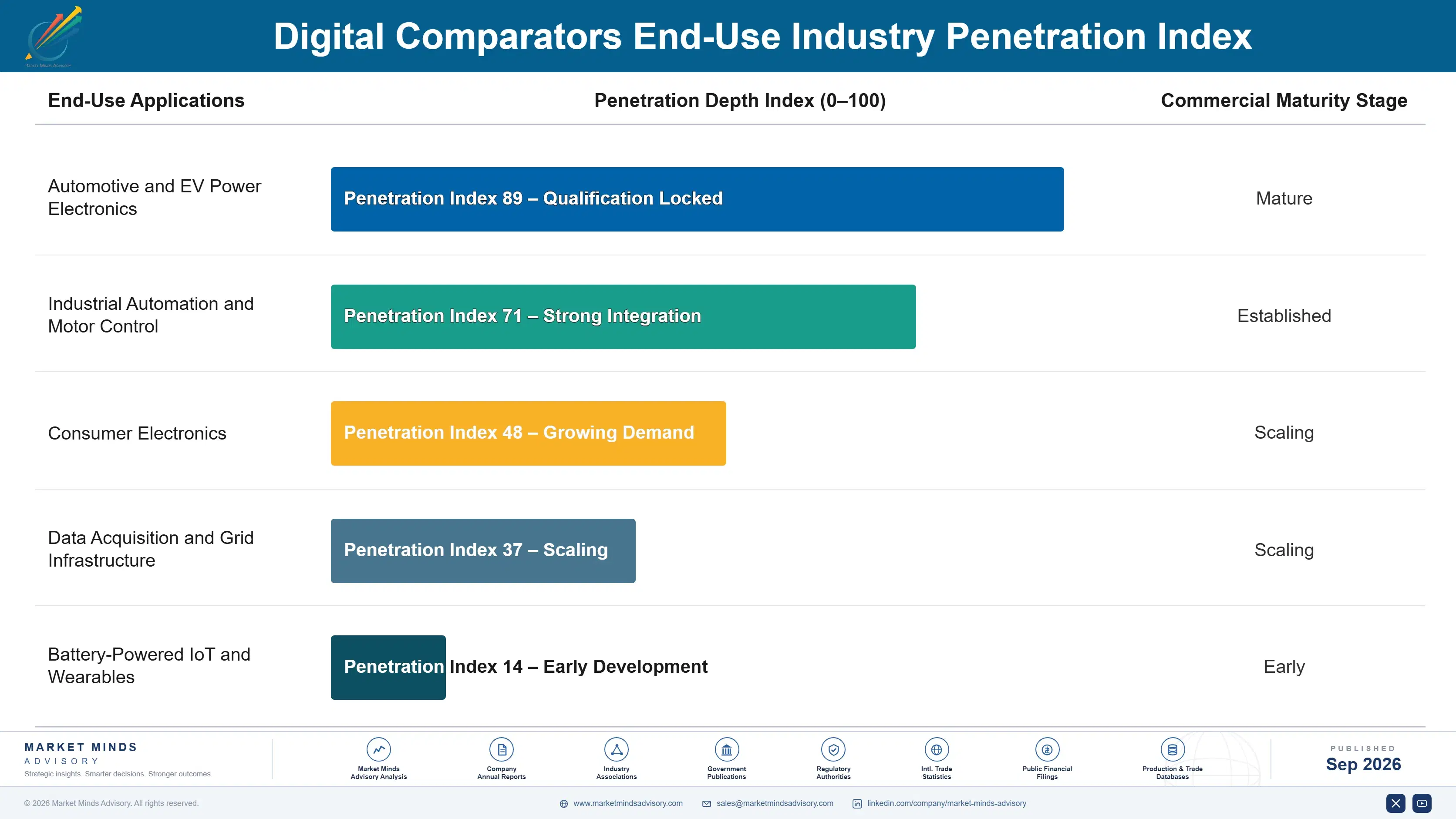
Comparator revenue behaves like an annuity once a design wins a socket, since automotive and industrial customers rarely reopen a qualified power electronics design mid-platform. A single win in a vehicle generation or industrial equipment line generates recurring shipment revenue for years without renewed sales effort, provided the vendor keeps production capacity available and quality consistent.
Stickiness varies meaningfully by end-use vertical: automotive sockets carry the deepest lock-in given multi-year qualification cycles and platform lifecycles stretching six to eight years, while consumer electronics sockets turn over far faster as products refresh annually and price competition intensifies with each generation. Industrial automation sits between these extremes, with equipment lifecycles of ten to fifteen years but periodic technology refreshes that create fresh competitive openings.

Buyer profiles are shifting generationally as electrification changes who signs off on comparator specifications: power electronics engineers focused on EV platforms increasingly hold the purchasing authority once held by generalist analog component buyers, and they prioritize propagation delay and certification over unit price. This shift favors vendors who invest in specialized automotive application engineering teams over those relying on legacy distributor relationships built around commodity parts.
digital-comparators-market-end-use-penetration-index-1790002576854

Where Comparator Strategy Should Focus Next

These are among the four positions where our research anticipates prominent divergence between winners and laggards over the coming forecast period. Each is grounded in the demand model, the regulatory perimeter, and the announced capacity pipeline.
01 / AUTOMOTIVE QUALIFICATION INVESTMENT

Prioritize Automotive-Grade Qualification Over Commodity Volume Expansion

Automotive-grade qualification is the single highest-value investment available to comparator vendors today, since a won EV platform socket generates recurring revenue for six to eight years with minimal renewed sales effort. Vendors chasing commodity volume instead are fighting Chinese and Taiwanese entrants on price in a segment with persistently thinner margin and no qualification moat protecting share at all. The capital and engineering investment required to build automotive qualification capability pays back many times over across a single vehicle platform's production life.
02 / WAFER CAPACITY SECURITY

Lock In Multi-Year Wafer Agreements Before the Next Upcycle

The 2021-2022 shortage proved that vendors without secured wafer capacity face lead-time extensions that cost customer relationships and market share for years afterward. Securing multi-year capacity agreements now, while foundry negotiating leverage still favors buyers, protects against a repeat episode as EV and industrial automation demand keeps climbing steadily across every major regional market. Vendors that wait until the next tightness cycle begins will find themselves negotiating from a materially weaker position than those who act during the current calm.
03 / ULTRA-LOW-POWER PORTFOLIO EXPANSION

Build Nanopower Process Capability for the IoT Sensing Segment

The ultra-low-power segment for battery-powered IoT sensors is growing faster than the market average while commanding above-average margin, yet only a handful of vendors have developed the specialized nanopower process technology it genuinely requires to compete effectively. Building or acquiring this capability now positions a vendor ahead of broader wearable and industrial sensor adoption curves that are still in their early stages of deployment. Waiting risks ceding this differentiated, high-margin niche permanently to the small set of vendors already active there today.
04 / MICROCONTROLLER INTEGRATION DEFENSE

Defend Standalone Value Where Integration Cannot Yet Compete

Microcontroller vendors will keep absorbing low-end comparator sockets, and fighting that trend directly in low-margin commodity applications wastes engineering resources better spent elsewhere across the broader portfolio. The better strategy concentrates investment in performance tiers where integrated peripherals genuinely cannot match discrete propagation delay or quiescent current, protecting the segments where standalone parts retain durable value over the long run and across product generations. This selective retreat from the low end preserves margin while integration continues eroding commodity volume elsewhere across the industry.

Engagement Snapshot From the Field

A live engagement with an industry participant carrying material or product regulatory and market exposure ahead of a defining policy shift, showing how our research translates into a defensible multi-year portfolio strategy.
MARKET MINDS ADVISORY · CLIENT ENGAGEMENT SUMMARY
Digital Comparators Producer Strategic Portfolio Review and Transition Roadmap 2026·Investment Scenario on Digital Comparators Exposure Evaluation 2025-26
CLIENT PROFILE
The client is a tier-one automotive electronics supplier serving three of the world's ten largest automakers, with annual power electronics module revenue exceeding $2 billion (client-reported, unverified by MMA). The company was expanding its EV inverter and battery management system product lines and needed to rearchitect its comparator sourcing strategy to support faster propagation delay specifications across a new vehicle platform generation launching within eighteen months.
STRATEGIC CHALLENGE
The client's existing comparator suppliers, selected years earlier for combustion-era power electronics, could not meet the propagation delay specifications required by the new EV platform's battery management architecture. Internal engineering teams disagreed on whether to requalify a broader supplier base or concentrate sourcing with a smaller number of automotive-specialist vendors, delaying the sourcing decision by several months.
MMA APPROACH
MMA conducted structured interviews with engineering and procurement leadership alongside primary survey data on comparator vendor qualification timelines and propagation delay benchmarks across twelve candidate suppliers. The analysis mapped each vendor's automotive qualification history, wafer capacity security, and application engineering support capacity against the client's platform launch timeline and volume requirements.
KEY FINDINGS
  1. Only four of twelve candidate vendors had automotive-grade propagation delay specifications meeting the new platform's requirements without a lengthy multi-quarter redesign cycle.
  2. Vendors with owned wafer fabrication capacity offered meaningfully more reliable lead-time commitments than fabless competitors during the client's targeted platform launch window.
  3. Bundled application engineering support reduced the client's internal qualification timeline by an estimated three months compared to bare-part sourcing (client-reported, unverified by MMA).
  4. Dual-sourcing comparator supply across two qualified vendors added approximately 4% to unit cost but eliminated single-supplier concentration risk across the entire new platform.
CLIENT PROFILE
The client is a tier-one automotive electronics supplier serving three of the world's ten largest automakers, with annual power electronics module revenue exceeding $2 billion (client-reported, unverified by MMA). The company was expanding its EV inverter and battery management system product lines and needed to rearchitect its comparator sourcing strategy to support faster propagation delay specifications across a new vehicle platform generation launching within eighteen months.
STRATEGIC CHALLENGE
The client's existing comparator suppliers, selected years earlier for combustion-era power electronics, could not meet the propagation delay specifications required by the new EV platform's battery management architecture. Internal engineering teams disagreed on whether to requalify a broader supplier base or concentrate sourcing with a smaller number of automotive-specialist vendors, delaying the sourcing decision by several months.
MMA APPROACH
MMA conducted structured interviews with engineering and procurement leadership alongside primary survey data on comparator vendor qualification timelines and propagation delay benchmarks across twelve candidate suppliers. The analysis mapped each vendor's automotive qualification history, wafer capacity security, and application engineering support capacity against the client's platform launch timeline and volume requirements.
KEY FINDINGS
  1. Only four of twelve candidate vendors had automotive-grade propagation delay specifications meeting the new platform's requirements without a lengthy multi-quarter redesign cycle.
  2. Vendors with owned wafer fabrication capacity offered meaningfully more reliable lead-time commitments than fabless competitors during the client's targeted platform launch window.
  3. Bundled application engineering support reduced the client's internal qualification timeline by an estimated three months compared to bare-part sourcing (client-reported, unverified by MMA).
  4. Dual-sourcing comparator supply across two qualified vendors added approximately 4% to unit cost but eliminated single-supplier concentration risk across the entire new platform.
RECOMMENDED STRATEGY
Phase 1: Phase 1 (Vendor Shortlisting): Narrow the candidate pool to four automotive-qualified vendors meeting propagation delay and wafer capacity criteria closely. Phase 2: Phase 2 (Dual-Source Qualification): Run parallel qualification programs with two finalist vendors to secure full supply continuity ahead of launch. Phase 3: Phase 3 (Capacity Agreement Negotiation): Lock in multi-year wafer capacity commitments with both qualified vendors well ahead of platform ramp.
OUTCOME
The client selected two automotive-specialist vendors for dual-sourcing and signed multi-year capacity agreements ahead of its platform launch, avoiding the lead-time exposure competitors faced during the prior industry shortage. Internal qualification timelines shortened by roughly three months versus the client's original single-vendor plan (client-reported, unverified by MMA).

Frequently Asked Questions

Foundational context covering the market sizes, CAGR, scope, country, region and competition that inform every finding below. This section is provided to cover basics and most often pre-purchase conversations, answered from the MMA Primary Research Dataset.

What is the current size of the Digital Comparators Market?

The Digital Comparators Market is valued at $2.1 billion in 2025. This figure reflects global shipment revenue for standalone comparator integrated circuits across automotive, industrial, and consumer applications.

How large will the Digital Comparators Market be by 2036?

The market is projected to reach $4.43 billion by 2036, up from $2.25 billion in 2026. That expansion represents a 1.97 times multiple over the eleven-year forecast period.

What is the CAGR for the Digital Comparators Market 2026 to 2036?

The market is forecast to grow at a 7.0% compound annual growth rate between 2026 and 2036. Bull and bear scenarios range from 8.2% to 5.8%, reflecting EV adoption pace uncertainty.

Which segment is growing fastest?

High-speed comparator ICs for EV power management systems lead growth at 11.5% CAGR, roughly 1.64 times the overall market rate. Demand comes from battery management and traction inverter design requirements.

Who are the major companies in the Digital Comparators Market?

Texas Instruments, Analog Devices, STMicroelectronics, onsemi, and Microchip Technology lead the market. Together they hold a CR5 of 52% based on comparator product line revenue.

Which country is growing fastest?

China leads country-level growth at a 9.0% CAGR, driven by its rapidly scaling electric vehicle production and expanding electronics assembly base. This outpaces the broader East Asia regional average.

Report Segmentation Architecture

The full report scope spans multiple orthogonal segmentation dimensions, with cross-tabulated demand data provided for each dimension pair. Coverage extends further to regional breakdowns, trend trajectories, and the competitive detail needed to support segment-level decision-making.

By Primary Market Dimension

  • High-Speed Comparator ICs
  • Ultra-Low-Power Comparator ICs
  • General-Purpose Comparator ICs
  • Automotive-Qualified Precision Comparator ICs
  • Industrial-Grade Comparator ICs
  • Multi-Channel Comparator Arrays

By End-Use Industry

  • Automotive and EV Power Electronics
  • Industrial Automation and Motor Control
  • Consumer Electronics
  • Data Acquisition and Grid Infrastructure
  • Battery-Powered IoT and Wearables

By Commercial Dimension

  • Direct OEM Sourcing
  • Distributor and Channel Sales
  • Bundled Application Engineering Support
  • Second-Source Qualification Services

By Region

  • North America
  • Western Europe
  • East Asia
  • South Asia and Pacific
  • Latin America
  • Middle East and Africa
  • Eastern Europe

Scope, Methodology, and Coverage

Every figure in this report is reproducible from documented input assumptions. The scope below maps the historical period, the forecast horizon, the segmentation dimensions, and the countries covered, alongside the underlying primary and qualitative methodology.
Historical Period
2020 to 2025
Forecast Period
2026 to 2036
Base Year
2025 (USD billions; MMA Primary Research Dataset, September 2026)
Market Definition
The Digital Comparators Market covers standalone comparator integrated circuits sold as discrete components for voltage threshold detection, level shifting, and signal conditioning across power management, automotive, and industrial control applications. It excludes operational amplifiers marketed purely for signal amplification, analog-to-digital converters, and comparator functionality embedded as non-discrete intellectual property blocks within microcontrollers or system-on-chip designs.
Quantitative Units
USD billions (current prices); unit shipment volume where applicable
Segmentation Dimensions
By Primary Market Dimension; By End-Use Industry; By Commercial Dimension; By Region
Regions Covered
North America, Western Europe, East Asia, South Asia and Pacific, Latin America, Middle East and Africa, Eastern Europe
Countries Covered
USA, China, Germany, France, UK, Japan, South Korea, India, Australia, Canada, Brazil, Mexico, Indonesia, Vietnam, Thailand, Malaysia, UAE, Saudi Arabia, South Africa, Nigeria, Turkey, Poland, Netherlands, Italy, Spain, Sweden, Switzerland, Argentina, Colombia, Singapore, and additional markets relevant to this sector
Key Companies Profiled
Texas Instruments, Analog Devices, STMicroelectronics, onsemi, Microchip Technology, Renesas Electronics, Infineon Technologies, ROHM Semiconductor, Toshiba Electronic Devices, Diodes Incorporated, Nexperia, Vishay Intertechnology, Semtech, NXP Semiconductors, Panasonic Industry, Monolithic Power Systems, Silicon Labs, Nisshinbo Micro Devices, Bourns, Littelfuse
Quantitative Methodology
Primary survey, n=3,800 respondents, Q4 2025, six countries; demand-side model with trade association cross-validation
Qualitative Methodology
47 expert interviews, Q4 2025; applied to validate demand model assumptions, identify emerging dynamics, and assess competitive positioning
Report Format
PDF and XLSX data workbook (Word format preview document)
Publisher
Market Minds Advisory
Report Code
MMA-2026-TEC-968
Published
September 2026
Contact
sales@marketmindsadvisory.com | www.marketmindsadvisory.com

Purchase the full Digital Comparators Market Report (2026 to 2036).

This report delivers a comprehensive assessment of the global Digital Comparators Market, covering sizing, segmentation, competitive dynamics, and regional demand patterns through 2036. It profiles twenty leading vendors across automotive, industrial, and consumer application tiers, examining how EV power electronics and IoT sensing are reshaping specification requirements industry-wide. The analysis draws on primary survey data from 3,800 respondents and 47 expert interviews conducted in the fourth quarter of 2025. Readers gain a structured view of where design-win value concentrates and how sourcing strategy should adapt.
Detailed twenty-vendor competitive profiles and market positioning
Full seven-region demand share and CAGR breakdown
Six-segment product growth and margin tier analysis
In-depth wafer supply chain risk assessment
Automotive qualification and design-win strategy guidance
Anonymized client sourcing engagement case study

Built For The People Who Decide

From boardroom strategy to bench-side execution, this report is read cover-to-cover by leaders shaping the next decade of their industry, turning demand scenarios, market dynamics and valuation benchmarks into decisions.
CXOs/ Presidents/ VPs/ Managers
M&A and Corporate Development
Strategy Teams and R&D Heads
Procurement and Product Directors
Regulatory and Compliance Leaders
Investor Relations and Equity Analysts