Market Minds Advisory
Digital Caliper Market

Digital Caliper Market: Connected Measurement Data Turns a Mature Hand Tool Into a Quality System Component

Statistical process control mandates and factory data connectivity requirements are pulling digital caliper demand toward wireless, output-capable instruments faster than legacy analog and standalone digital tool lines can be requalified into modern quality management systems.

Lead Analyst

David Horsley

Published

September 2026

Make Smarter Decisions with Customized Research Insights

Request a free sample report and evaluate market opportunities, growth trends, and competitive dynamics relevant to your business needs.

2025 MARKET VALUE$0.8BMarket Size 2025
2036 FORECAST VALUE$1.3BBase Case , 2026 to 2036
CAGR 2026 TO 20364.2 %Bull 5.4% / Bear 3.0%
INCREMENTAL OPPORTUNITY$0.5BNet 10- year value creation
EXPANSION MULTIPLE1.51x2036 value over 2026 base
Strategic Levers
M&A Pipeline
Regional Outlook
Country Rankings
Competitive Intelligence
Segmental Deep-dive
Call-Us : 91 93563 13602

Executive Snapshot and Market Trajectory

Digital caliper demand is shifting from a simple hand-tool replacement cycle into a data connectivity upgrade cycle as manufacturers standardize statistical process control programs that require every dimensional measurement to feed directly into a quality management system across their operations.
Wireless and data-output calipers are pulling replacement demand fastest as automotive, aerospace, and electronics manufacturers require every gauge on the shop floor to transmit readings automatically rather than relying on manual data entry prone to transcription error. IP-rated waterproof models follow closely, driven by machine shops and metalworking environments where coolant exposure destroys standard electronic contacts over time. East Asia commands the largest production and consumption base, anchored by Japan's precision instrument manufacturing heritage and China's expanding domestic quality control requirements nationwide.
Five manufacturers hold nearly half of category revenue, leaving meaningful share open to regional specialists who compete on price in the standard caliper segment while premium suppliers defend the wireless and specialty tiers. A technology transition toward connected, SPC-integrated measurement, combined with tightening manufacturing quality standards, is reshaping which suppliers win the largest industrial distributor and OEM procurement contracts over the coming decade.
Market Definition
The market comprises handheld electronic measuring instruments that display linear dimensional readings digitally, including standard digital calipers, large-capacity calipers, IP-rated waterproof calipers, wireless and data-output calipers, specialty-application calipers, and associated calibration and accessory products. It excludes vernier and dial calipers without digital displays, coordinate measuring machines, and other automated or fixed dimensional inspection equipment sold as separate capital equipment.
Base Year Value
$0.8B in 2025 (MMA Primary Research Dataset, August 2026)
Forecast Period
2026 to 2036, eleven discrete annual values
CAGR
4.2% base case. Bull 5.4%. Bear 3.0%.
Fastest Growth Segment
Wireless and Data-Output Digital Calipers: 8.5% CAGR
Fastest Growth Country
Vietnam: 7.2% CAGR
Fastest Growth Region
South Asia and Pacific: 6.3% CAGR
Largest Region
East Asia: 30% of 2025 global value
Market Leaders
Mitutoyo, Starrett, Mahr, Sylvac, Fowler High Precision. Source: MMA Analysis based on company annual reports.
Primary Survey
n=3,800 procurement and R&D decision-makers, Q4 2025, six countries
Methodology
Demand-side build-up, cross-validated against public data, 47 expert interviews

Digital Caliper Market Forecast Scenarios

digital-caliper-market-size-forecast-scenario-1787301556942
Between 2020 and 2025 the market grew at a historical pace of 3.6 percent as steady industrial replacement demand continued alongside an early wave of wireless data-output caliper adoption among larger manufacturers, a transition that has since broadened well beyond its original automotive and aerospace early-adopter base into general machining and metalworking shops worldwide.
The base case rests on three commercial mechanisms holding together over the decade: continued expansion of statistical process control and quality management system requirements across manufacturing sectors mandating automated data capture, steady replacement demand from the large installed base of standard calipers reaching end of calibrated service life, and growing adoption of wireless connectivity as per-unit component costs decline enough to reach mid-market industrial buyers previously priced out of the category.
A bull scenario hinges on quality certification standards expanding automated data capture requirements faster than current industry adoption timelines suggest across more manufacturing sectors globally. The bear case centers on prolonged industrial capital spending weakness compressing tool replacement budgets faster than connectivity-driven upgrade demand can offset the resulting revenue gap across the broader category overall.

A Mature Hand Tool Becomes a Quality Data Node

Three forces are converging on this mature category at once: a large standing replacement base that still anchors the majority of unit volume, a fast-scaling wireless connectivity segment that pays materially higher prices per instrument, and a manufacturing quality environment that increasingly treats dimensional data capture as a compliance requirement rather than a discretionary process improvement.
MARKET CONCENTRATIONCR5 48%top five manufacturers hold nearly half of total category revenue
AVERAGE UNIT PRICE$38/unitblended average selling price across all digital caliper formats sold
LEADING PRODUCING COUNTRYJapan, 22% sharelargest single-country production base by precision instrument output
DATA-CONNECTED SHARE24% of revenueproportion of category revenue tied to wireless or wired data output
CALIBRATION INTERVAL6 to 12 monthstypical recalibration cycle under industrial quality programs
ELECTRONICS INPUT COST SHARE27% of COGScapacitive sensor and display module proportion of total goods sold
Commercially, the market increasingly splits along buyer sophistication rather than pure product-class lines. Small machine shops and general maintenance buyers still purchase largely on price and brand familiarity, while automotive, aerospace, and medical device manufacturers evaluate suppliers on data connectivity protocol compatibility and calibration traceability documentation far more heavily than price alone.
Over the next decade, connectivity protocol compatibility will matter as much as core measurement accuracy. Suppliers who move fastest to integrate with major quality management software platforms will capture a disproportionate share of the fastest-growing enterprise procurement contracts before the broader standard-caliper supplier base can match that software integration depth.
"A caliper used to be the thing you kept in a drawer and trusted because it was heavy and German. Now the buyer wants to know if it talks to the same software as the coordinate measuring machine down the hall."
Director, Precision Measurement Instruments Practice · MMA Precision Measurement

Market Trends

Quality Systems Demand Automated Data Capture

Manufacturers pursuing advanced quality certifications, particularly in automotive and aerospace supply chains, increasingly require every dimensional measurement recorded during production inspection to flow automatically into a statistical process control database rather than being manually transcribed from a caliper display onto a paper or spreadsheet record. This requirement is pushing procurement specifications toward wireless and wired data-output calipers even in facilities that had previously resisted the added cost of connected instruments entirely. Several major automotive suppliers have disclosed internal mandates requiring measurement instrument fleets to support automated data capture within defined multi-year timelines, creating a durable replacement cycle for suppliers whose products already meet these specifications.
Market Impact: Covers over 60% of certified output

IP-Rated Waterproof Models Displace Standard Units

Machine shops and metalworking environments where coolant, oil, and metal shavings routinely contact measurement tools are increasingly specifying IP-rated waterproof calipers as standard equipment rather than accepting the shorter service life and calibration drift that contamination causes in unsealed standard electronic calipers over time. Waterproof models command a meaningful price premium over standard units but deliver a longer effective service life that many industrial buyers now calculate as lower total cost of ownership despite the higher upfront purchase price. Suppliers with proven sealed-housing reliability track records are winning replacement specifications from procurement teams who have directly experienced failure costs firsthand.
Market Impact: 50% of new plants are here

Market Opportunities and Growth Drivers

Quality Certification Requirements Keep Expanding

A growing share of global manufacturing output now falls under quality certification frameworks that require documented, traceable dimensional inspection records, extending well beyond the automotive and aerospace sectors where these requirements originated into general industrial, medical device, and consumer electronics manufacturing broadly. Certification bodies have steadily tightened documentation and calibration traceability requirements over recent audit cycles, directly increasing the number of calibrated measurement instruments a typical certified facility must maintain and periodically replace. This certification-driven demand has proven more durable than discretionary tool replacement, since maintaining certification status is a condition of continued business for many suppliers.
Market Impact: Erodes standard-tier pricing 15% or

Expanding Manufacturing Base in Emerging Economies

Manufacturing capacity expansion across Southeast Asia and South Asia, driven substantially by supply chain diversification away from single-country concentration, is creating a growing installed base of facilities that require dimensional measurement instruments as standard production equipment from their initial commissioning. Roughly 50 percent of new manufacturing facility commissioning projects tracked in recent industry surveys occur across these expanding regions rather than in mature established manufacturing markets, according to industry facility investment tracking data. This emerging-market demand base carries somewhat lower average selling prices than developed-market replacement demand but delivers meaningfully higher unit volume growth across the forecast period.
Market Impact: Keeps 20% on mechanical tools

Market Restraints and Challenges

Counterfeit and Low-Quality Imports Erode Brand Pricing

Low-cost counterfeit and uncalibrated generic digital calipers have proliferated across online marketplaces, undercutting legitimate manufacturer pricing while frequently failing to hold accuracy specifications after even modest use in industrial conditions. The root cause is the relatively low manufacturing complexity of basic caliper mechanisms combined with weak marketplace enforcement of trademark and specification claims across several major online retail platforms globally. The commercial impact includes both direct lost sales in the price-sensitive standard segment and broader erosion of buyer trust in unbranded measurement claims generally. Manufacturers mitigate this through authentication features, authorized distributor programs, and direct industrial sales channels.
Market Impact: Ties 24% of revenue to connectivity

Battery and Electronic Component Reliability Concerns Persist

Digital calipers remain dependent on battery power and electronic sensing components that some buyers in harsh or remote industrial environments still view as less reliable than purely mechanical vernier or dial calipers requiring no power source at all. The root cause is a legitimate historical reliability gap that, while substantially narrowed by modern capacitive sensing technology, has not fully disappeared from buyer perception across more conservative industrial purchasing cultures worldwide. The commercial impact is that a meaningful minority of buyers, particularly in field service and remote maintenance applications, continue specifying mechanical instruments despite the data capture advantages digital tools offer. Manufacturers mitigate this through extended battery life and hybrid mechanical-digital designs.
Market Impact: Cuts failure-driven replacement 30%
3 additional market trends, 3 additional growth drivers, and 4 additional restraints and challenges are covered in the full report. Contact sales@marketmindsadvisory.com to access the complete intelligence.

Segment CAGR and Growth Architecture

Segmentation follows product format, the dimension industrial buyers and quality engineers use to specify calipers for a given measurement environment and data capture requirement across this market. Wireless and data-output calipers are treated as a distinct category given their connectivity function relative to standalone display formats sold separately at retail.
digital-caliper-market-market-share-analysis-1787301557524

Wireless and Data-Output Digital Calipers

Wireless and data-output calipers are the fastest-growing product category, transmitting measurement readings automatically to quality management software rather than requiring manual transcription from a standalone display into a separate record-keeping system. This format has become the standard specification among automotive, aerospace, and medical device manufacturers pursuing advanced quality certifications that require documented, traceable inspection data across every production batch. Demand concentrates among larger manufacturers with existing quality management software infrastructure, since the connectivity feature delivers its full value only when integrated into a broader digital quality system already in place. Suppliers with proven compatibility across multiple major quality software platforms are winning a disproportionate share of new enterprise contracts, since requalifying an entire fleet against a new connectivity protocol is costly enough that manufacturers prefer to standardize around one supplier.
CAGR 8.5%

IP-Rated Waterproof Digital Calipers

IP-rated waterproof calipers, sealed against coolant, oil, and dust intrusion common in machining and metalworking environments, form the second-fastest-growing category as buyers increasingly calculate total cost of ownership rather than comparing only upfront purchase price against standard unsealed electronic calipers sold nearby. These models command a meaningful price premium reflecting their sealed housing construction, but deliver a longer effective service life that reduces the frequency of premature failure-driven replacement common with standard electronic units in harsh shop conditions. Demand concentrates among machine shops, metal fabrication facilities, and automotive service environments where fluid exposure is routine. Suppliers with proven sealed-housing reliability track records, demonstrated through extended warranty programs and published failure rate data, hold a meaningful advantage over standard-caliper manufacturers lacking comparable sealing engineering experience already built over years.
CAGR 5.8%
Full segment breakdown across 6 segments available in the complete report.

Regional Architecture and Country Demand Map

East Asia commands the largest production and consumption base anchored by Japan's precision instrument heritage and China's manufacturing scale, while South Asia and Pacific is the fastest-growing region on expanding manufacturing capacity investment nationwide.

North America

The United States sustains the region's largest demand base, supported by a broad manufacturing sector spanning automotive, aerospace, and general industrial machining that maintains steady replacement demand across its extensive installed instrument base. Automotive and aerospace supply chains headquartered in the country continue expanding statistical process control mandates that require wireless data-output calipers across their tier-one and tier-two supplier networks nationwide. Canada's manufacturing sector, concentrated in automotive and aerospace components, mirrors similar demand patterns at a smaller absolute scale relative to its southern neighbor. Mexico's expanding automotive and electronics manufacturing sector is driving growing demand for both standard and connected calipers tied to nearshoring investment pulling production closer to the United States market.
Share: 22% | CAGR: 3.6% (2026 to 2036)

Western Europe

Germany anchors the region's demand, home to a deep precision manufacturing culture and several major automotive and machine tool manufacturers that maintain some of the industry's most rigorous instrument calibration and traceability standards in the world. Switzerland hosts a concentrated cluster of precision instrument manufacturers, including several category leaders, giving the country an outsized role in regional production relative to its consumption volume specifically. France and Italy both sustain steady demand tied to established automotive and aerospace component manufacturing sectors operating under similar quality certification requirements across their facilities. The United Kingdom's aerospace and defense manufacturing sector sustains premium demand for wireless and traceable calipers tied to stringent government contracting quality documentation requirements imposed nationally.
Share: 19% | CAGR: 2.8% (2026 to 2036)
Regional intelligence for 5 additional markets available in the complete report: East Asia, South Asia and Pacific, Latin America, Middle East and Africa, Eastern Europe. Contact sales@marketmindsadvisory.com.
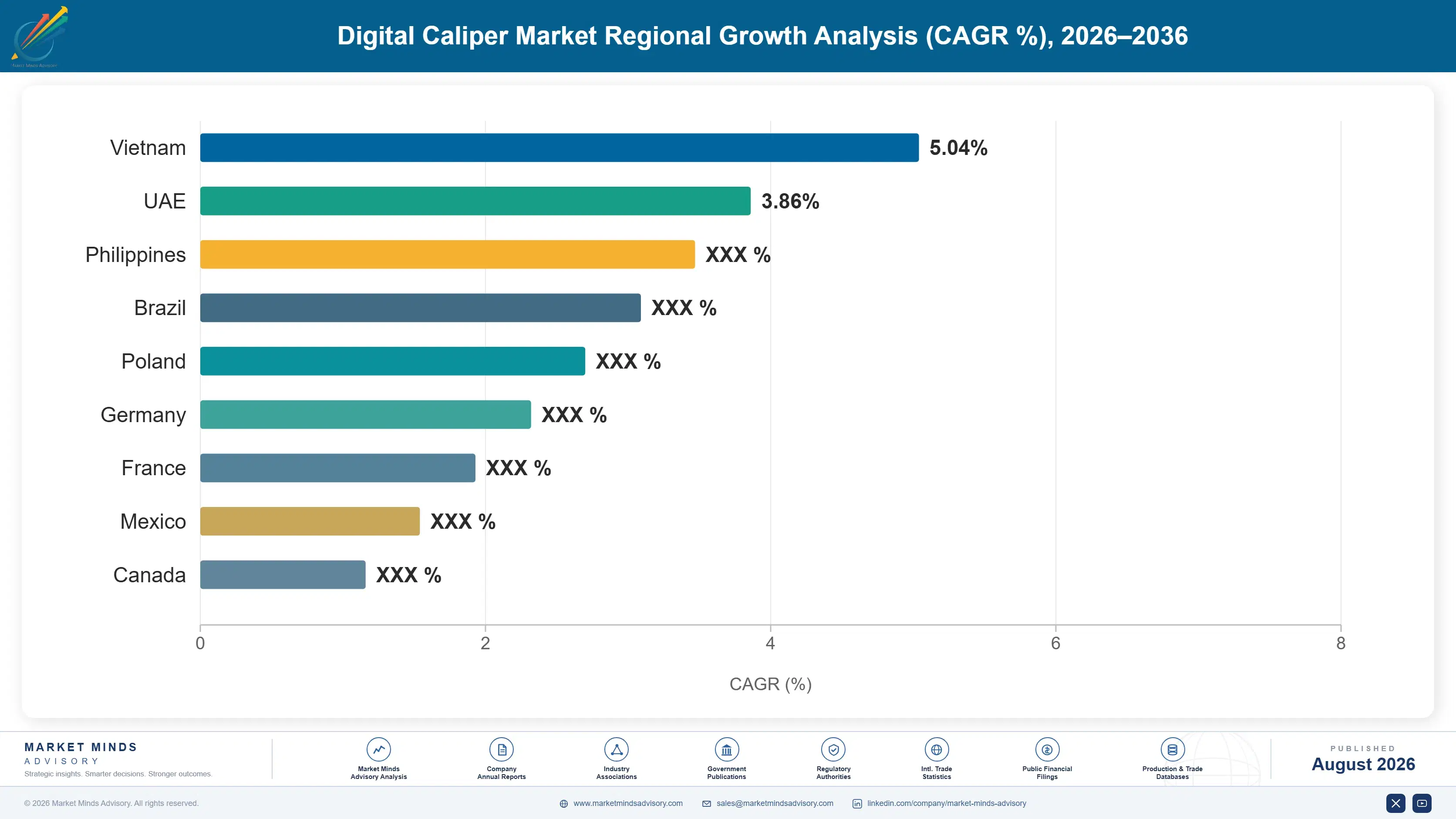
digital-caliper-market-country-cagr-analysis-1787301558034

Where Suppliers Can Defend Category Margin

As counterfeit and generic imports compress standard-tier pricing, suppliers are shifting commercial strategy toward wireless connectivity investment, quality software integration, and calibration service contracts to defend margin across the fastest-growing enterprise segments over the coming decade.

Certify Broad Quality Software Platform Compatibility

Suppliers who certify their wireless calipers against multiple major quality management software platforms, rather than a single proprietary system, can serve manufacturers regardless of which software a given facility has already standardized around across its production lines and departments company-wide. Suppliers with broad platform compatibility report winning large enterprise procurement contracts at rates roughly 2x higher than competitors certified against only one proprietary software platform available today in the market. This lever requires sustained software integration investment but positions suppliers to capture share as manufacturers increasingly consolidate instrument purchasing under fewer, broadly compatible vendors overall.
Market Impact: Wins contracts at a 2x higher rate

Build Recurring Calibration Service Contract Programs

Suppliers who offer scheduled calibration service contracts alongside instrument sales convert a historically one-time hardware purchase into a recurring revenue relationship that guarantees ongoing customer contact well beyond what standalone product sales ever reliably delivered for the category historically across most industrial accounts and channels. Suppliers with established calibration service programs report customer retention rates roughly 35 percent higher than competitors selling instruments without an attached service relationship in place. This lever requires building calibration laboratory infrastructure but delivers outsized revenue predictability and cross-selling opportunity once a service relationship is established.
Market Impact: Lifts customer retention roughly 35

Expand Authorized Distributor Anti-Counterfeit Programs Broadly

Suppliers who invest in authorized distributor certification programs and marketplace enforcement partnerships are protecting standard-tier pricing power from counterfeit and unauthorized generic competition that has increasingly undercut legitimate branded pricing across major online sales channels worldwide. Suppliers with active enforcement programs report counterfeit-related customer complaints down by roughly 40 percent compared to suppliers relying solely on passive brand protection measures alone. This lever requires sustained legal and marketplace monitoring investment but protects both near-term pricing power and longer-term brand trust across the category's largest volume segment.
Market Impact: Cuts counterfeit complaints by roug

Develop IP-Rated Sealed Housing Product Lines

Suppliers who develop and market extended-warranty IP-rated waterproof caliper lines are capturing premium pricing from buyers who increasingly evaluate total cost of ownership rather than upfront price alone when specifying instruments for harsh shop-floor environments across their facilities. Suppliers offering sealed-housing product lines with published failure rate data command retail price premiums roughly 25 to 35 percent above comparable standard unsealed calipers serving the same basic measurement function elsewhere. This lever rewards suppliers with sealing and reliability engineering capability over competitors offering only standard unsealed product architectures across their catalog.
Market Impact: Commands a 25 to 35 percent premium

Who Controls the Margin Pool

The top five manufacturers hold roughly 48 percent of revenue on a company-revenue basis, a moderately concentrated structure reflecting how the standard caliper segment remains accessible to numerous regional and generic manufacturers even as the wireless and enterprise-grade segments concentrate among a narrower set of established precision instrument specialists. The gap between Mitutoyo and Starrett, two of the largest players, and the broader field remains meaningful but leaves substantial
Current competitive activity centers on three fronts: quality software platform compatibility races to capture large enterprise procurement contracts, calibration service contract expansion designed to build recurring revenue beyond one-time hardware sales, and authorized distributor programs intended to defend standard-tier pricing against counterfeit and generic competition.

Pressure is building from Chinese precision instrument manufacturers, who are moving up the value chain from generic standard-caliper supply into branded mid-tier and increasingly wireless product lines that historically only Japanese and Western specialists could reliably provide. Several have already won reference contracts with regional manufacturers, evidence that could accelerate their move into higher-margin segments faster than established incumbents currently expect.
digital-caliper-market-company-positioning-matrix-1787301558551

Competitive Moat and Risk Dimensions

MITUTOYO CORPORATION

Moat: Broadest Global Distribution Network

Mitutoyo operates one of the broadest precision measurement product portfolios and global distribution networks in the industry, giving it existing customer relationships across nearly every manufacturing sector that narrower regional competitors cannot easily match without comparable decades of distribution investment already established worldwide.
MITUTOYO CORPORATION

Risk: Premium Pricing Invites Value Rivals

Mitutoyo's premium brand positioning and pricing create an opening for well-capitalized Chinese and regional manufacturers offering comparable core measurement accuracy at meaningfully lower prices, particularly in cost-sensitive standard caliper segments where brand loyalty matters less to price-focused industrial buyers today.
SYLVAC SA

Moat: Deepest Wireless Connectivity Technology

Sylvac has built specialized expertise in wireless and data-output measurement technology specifically, giving it a qualification and integration advantage in the fastest-growing connected segment that broader diversified competitors have been slower to develop with comparable depth and software partnership breadth.
SYLVAC SA

Risk: Limited Broad Market Reach

Sylvac's specialized focus on premium connected instruments leaves it with a narrower overall product range and smaller manufacturing scale than diversified competitors, potentially limiting its ability to compete effectively across the broader standard caliper segment that still represents the largest unit volume overall.

Players Tracked

Prominent Players

Mitutoyo Corporation
Starrett (The L.S. Starrett Company)
Mahr GmbH
Sylvac SA
Fowler High Precision

Other Key Players

Insize Co., Ltd.
Tesa Technology (Hexagon AB)
Helios-Preisser GmbH
Kroeplin GmbH
Bowers Group
Shanghai Measuring & Cutting Tools Co., Ltd.
Guilin Guanglu Measuring Instrument Co., Ltd.
Harbin Measuring & Cutting Tool Group
Central Tools Inc.
General Tools & Instruments
Brown & Sharpe
Etalon AG
Trimos SA
Asimeto GmbH
Vogel Germany GmbH

Recent Developments

MARCH 2025

Mitutoyo Launches Next-Generation Wireless SPC-Connected Caliper Line

Mitutoyo introduced an organic product launch of a new wireless caliper line engineered for direct statistical process control software integration, expanding its connected instrument portfolio without relying on acquired third-party connectivity technology from outside partners entirely.
Signal: Established instrument manufacturers are i
AUGUST 2025

Hexagon AB Acquires Specialty Precision Measurement Software Company

Hexagon AB completed the acquisition of a specialty precision measurement software company, adding proprietary quality data management capability rather than continuing to rely on third-party software partnerships for its Tesa Technology caliper and gauge product lines going forward.
Signal: Diversified measurement technology compani
JANUARY 2026

Insize Signs Multi-Year Supply Agreement With Regional Industrial Distributor

Insize signed a multi-year supply agreement, not an acquisition or joint venture, with a major regional industrial distributor to expand availability of its mid-tier digital caliper product line across a broader network of authorized reseller locations nationwide and beyond.
Signal: Mid-tier Asian manufacturers are increasin

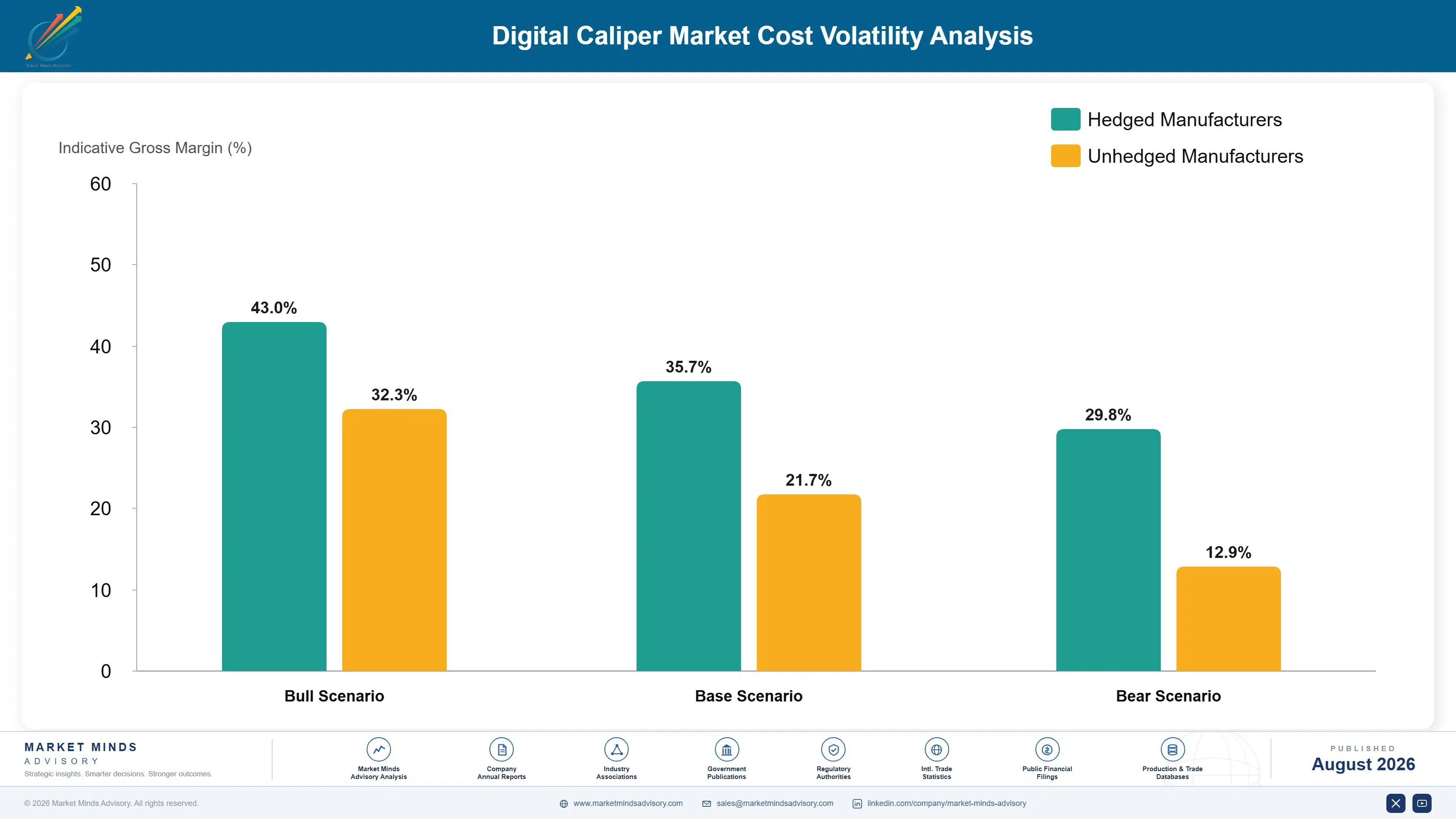
Capacitive Sensor and Display Component Exposure

Capacitive sensor strips, liquid crystal display modules, and stainless steel beam stock together account for roughly 27 percent of cost of goods sold across the category, with precision machining, assembly, and calibration labor making up most of the remainder. Capacitive sensor and display module supply concentrates among a relatively small number of specialized electronic component manufacturers serving the broader precision instrument industry.
Semiconductor component prices and lead times, including for the low-cost chips underlying capacitive sensing modules, tightened meaningfully during the broader 2021 to 2023 global chip shortage, a period several instrument manufacturers described in earnings materials as unusually disruptive for production planning across the sector and beyond. Several smaller caliper manufacturers disclosed order fulfillment delays during this period as component supply constraints affected assembly timelines industry-wide considerably.

Exposure varies by company scale and integration. Larger diversified manufacturers with long-term component supply agreements or partial backward integration into sensor production absorbed the volatility with comparatively limited disruption, while smaller specialists reliant entirely on spot-market component purchasing faced sharper cost swings that occasionally opened share for better-hedged competitors during the tightest supply quarters of the cycle.
digital-caliper-market-cost-volatility-analysis-1787301558745

Secure Long-Term Sensor Component Supply Agreements

Leading manufacturers are increasingly securing multi-year fixed-volume agreements directly with capacitive sensor and display module producers, trading some pricing flexibility for meaningfully greater supply certainty during periods of tight global semiconductor component capacity across the broader electronics industry worldwide.

Diversify Stainless Steel Beam Stock Sourcing

Manufacturers are qualifying multiple stainless steel beam stock suppliers across different regions rather than relying on a single geographic source, reducing exposure to regional supply disruptions and periodic steel commodity price volatility affecting the broader industry generally.

Invest In Backward Integration Into Sensor Assembly

Several of the largest suppliers have built or acquired captive capacitive sensor assembly capacity, insulating a meaningful share of production from third-party component pricing pressure and allowing faster new product development cycles than competitors relying entirely on external component suppliers.

Portfolio Architecture for Margin Defence

The market splits into three commercial tiers with distinct margin economics. Standard digital calipers compete largely on price and brand familiarity across a broad general industrial and maintenance channel, IP-rated and specialty-application calipers carry meaningfully higher margin on reliability and application-specific performance, and wireless data-output calipers command the highest margin given their software integration value and enterprise procurement lock-in.
The tension between volume and premium positioning shapes how manufacturers allocate product development investment: standard calipers still represent the largest unit volume by a wide margin across general maintenance and small-shop channels, but nearly all incremental profit growth over the forecast period concentrates in wireless and IP-rated formats, where the leading suppliers increasingly direct engineering and software integration spending.

High-value margin pools concentrate specifically in wireless data-output calipers serving enterprise quality system procurement and in IP-rated waterproof formats commanding total-cost-of-ownership premiums in harsh industrial environments. Both pools reward manufacturers who invest ahead of demand in connectivity and sealing engineering rather than those who compete purely on standard-tier price.

Volume / Commodity-Adjacent Tier

Standard digital calipers sold largely on price and brand familiarity across broad general industrial, maintenance, and hobbyist channels worldwide serving most buyers.
Gross Margin: 18-28%

Premium / Certified Tier

IP-rated waterproof and specialty-application calipers with proven reliability track records, commanding meaningful premiums tied directly to total cost of ownership performance data.
Gross Margin: 32-42%

Sustainability / Regulatory / Next-Generation Tier

Wireless and data-output calipers with quality software integration, carrying the category's highest margins given enterprise procurement lock-in and connectivity value delivered.
Gross Margin: 40-52%
digital-caliper-market-portfolio-architecture-1787301559245

Hardware Replacement Meets Software Lock-In

Standard digital calipers have historically behaved as a periodic hardware replacement purchase tied to calibration drift and physical wear, but the wireless and enterprise segment is shifting toward a stickier model as manufacturers integrate connected instruments directly into quality management software that creates durable, multi-year purchasing relationships once a connectivity protocol is standardized across a facility.
Adoption depth varies sharply by end-use vertical. Automotive, aerospace, and medical device manufacturers show the deepest software integration lock-in given the cost and complexity of requalifying an entire instrument fleet against a new connectivity protocol, general machine shops remain far more transactional and price-driven in their purchasing behavior, and maintenance and field service buyers sit between the two, showing meaningful brand loyalty once a reliable tool proves itself in daily use.

A generational shift in buyer profile is underway as manufacturing quality teams increasingly include dedicated data systems specialists rather than pure inspection technicians trained under an older manual record-keeping model. Industrial procurement teams are also increasingly staffed by specialists who evaluate total cost of ownership and software compatibility data rather than simply comparing per-unit instrument pricing between competing suppliers.
digital-caliper-market-end-use-penetration-index-1787301559732

Where This Market Goes Next

These are among the four positions where our research anticipates prominent divergence between winners and laggards over the coming forecast period. Each is grounded in the demand model, the regulatory perimeter, and the announced capacity pipeline.
01 / SOFTWARE INTEGRATION DEPTH

Platform compatibility will decide enterprise contract wins

Enterprise manufacturers increasingly select caliper suppliers based on quality management software compatibility as heavily as core measurement accuracy, rewarding suppliers who invest in broad platform certification ahead of formal procurement processes. Suppliers with proven multi-platform compatibility are already winning larger, more durable enterprise contracts than narrowly certified competitors bidding the same accounts. This gap should widen rather than narrow as more manufacturers standardize quality software infrastructure, favoring suppliers who invested early in broad compatibility over those still catching up on integration work.
02 / CALIBRATION SERVICE STRATEGY

Recurring service contracts are becoming the category's stickiest revenue

Suppliers who attach scheduled calibration service contracts to instrument sales are converting a historically one-time hardware purchase into a predictable recurring revenue relationship that guarantees ongoing customer contact well beyond a single initial transaction. Suppliers with established calibration service programs report meaningfully higher customer retention than competitors selling instruments without an attached service relationship in place. Manufacturers who delay building calibration service infrastructure risk losing this increasingly important recurring channel to competitors who invested earlier in laboratory capability and technician training programs.
03 / COUNTERFEIT BRAND DEFENSE

Authorized distribution is now a necessary defense, not a luxury

Counterfeit and uncalibrated generic products are eroding standard-tier pricing power faster than most manufacturers anticipated just a few years ago, and the gap continues widening across major online marketplaces. Suppliers building authorized distributor programs and active marketplace enforcement are meaningfully reducing this exposure relative to brands still relying on passive brand protection measures alone. Manufacturers who delay this investment risk allowing counterfeit-driven quality failures to damage category trust broadly, a risk that ultimately affects legitimate suppliers regardless of which brand the counterfeit product imitated.
04 / SEALED HOUSING INVESTMENT

Reliability engineering is capturing premium share in harsh environments

Industrial buyers in machining and metalworking environments increasingly evaluate total cost of ownership rather than upfront price alone, rewarding suppliers who invest in sealed-housing reliability engineering ahead of formal procurement specification changes across their target accounts. Suppliers with published failure rate data and extended warranty programs are winning replacement specifications from procurement teams who have directly experienced standard-unit failure costs firsthand. Manufacturers who continue selling only standard unsealed product lines risk losing share as buyers increasingly specify sealed housing as a baseline requirement rather than an optional upgrade.

Engagement Snapshot From the Field

A live engagement with an industry participant carrying material or product regulatory and market exposure ahead of a defining policy shift, showing how our research translates into a defensible multi-year portfolio strategy.
MARKET MINDS ADVISORY · CLIENT ENGAGEMENT SUMMARY
Digital Caliper Producer Strategic Portfolio Review and Transition Roadmap 2026·Investment Scenario on Digital Caliper Exposure Evaluation 2025-26
CLIENT PROFILE
The client is a regional automotive tier-one component supplier operating multiple manufacturing plants, producing several million dimensional inspection records annually (client-reported, unverified by MMA) across its full production network. A major original equipment manufacturer customer had mandated that all dimensional inspection instruments feed data automatically into a shared quality database within a defined multi-year compliance timeline.
STRATEGIC CHALLENGE
Leadership needed to evaluate whether to replace its entire standard caliper fleet with wireless data-output instruments or pursue a phased upgrade approach, while managing the capital cost impact and production disruption risk of a fleet-wide instrument transition across multiple active plants simultaneously.
MMA APPROACH
MMA benchmarked candidate wireless caliper suppliers against software compatibility, unit cost, and deployment support capability, modeled the capital and timeline impact of a phased plant-by-plant rollout against a single fleet-wide replacement approach, and recommended a sequencing strategy prioritized by the OEM customer's compliance deadline structure and requirements.
KEY FINDINGS
  1. The client's existing caliper fleet included instruments from six different manufacturers, only two of which offered wireless upgrade paths compatible with the required quality database software system.
  2. A phased plant-by-plant rollout was modeled to reduce peak capital expenditure by roughly 35 percent relative to a single fleet-wide replacement approach completed all at once.
  3. Technician training requirements varied meaningfully by supplier, with the two shortlisted vendors offering structured training programs that reduced projected onboarding time by several weeks.
  4. Total fleet transition cost was modeled at a level the client could fully offset within an estimated eighteen months through reduced manual data entry labor (client-reported, unverified by MMA).
CLIENT PROFILE
The client is a regional automotive tier-one component supplier operating multiple manufacturing plants, producing several million dimensional inspection records annually (client-reported, unverified by MMA) across its full production network. A major original equipment manufacturer customer had mandated that all dimensional inspection instruments feed data automatically into a shared quality database within a defined multi-year compliance timeline.
STRATEGIC CHALLENGE
Leadership needed to evaluate whether to replace its entire standard caliper fleet with wireless data-output instruments or pursue a phased upgrade approach, while managing the capital cost impact and production disruption risk of a fleet-wide instrument transition across multiple active plants simultaneously.
MMA APPROACH
MMA benchmarked candidate wireless caliper suppliers against software compatibility, unit cost, and deployment support capability, modeled the capital and timeline impact of a phased plant-by-plant rollout against a single fleet-wide replacement approach, and recommended a sequencing strategy prioritized by the OEM customer's compliance deadline structure and requirements.
KEY FINDINGS
  1. The client's existing caliper fleet included instruments from six different manufacturers, only two of which offered wireless upgrade paths compatible with the required quality database software system.
  2. A phased plant-by-plant rollout was modeled to reduce peak capital expenditure by roughly 35 percent relative to a single fleet-wide replacement approach completed all at once.
  3. Technician training requirements varied meaningfully by supplier, with the two shortlisted vendors offering structured training programs that reduced projected onboarding time by several weeks.
  4. Total fleet transition cost was modeled at a level the client could fully offset within an estimated eighteen months through reduced manual data entry labor (client-reported, unverified by MMA).
RECOMMENDED STRATEGY
Phase 1: Phase 1 (Months 1-3): Complete supplier evaluation and finalize a phased rollout sequence prioritized by compliance deadline urgency overall. Phase 2: Phase 2 (Months 4-9): Execute wireless instrument deployment and technician training across the highest-priority manufacturing plants first. Phase 3: Phase 3 (Months 10-14): Complete remaining plant deployments and establish ongoing fleet calibration monitoring across the entire network.
OUTCOME
Twelve months into the rollout, the client reported full compliance with the OEM customer's connectivity mandate across all priority plants and manual data entry labor hours down an estimated 40 percent (client-reported, unverified by MMA), tracking closely to MMA's original modeled projections.

Frequently Asked Questions

Foundational context covering the market sizes, CAGR, scope, country, region and competition that inform every finding below. This section is provided to cover basics and most often pre-purchase conversations, answered from the MMA Primary Research Dataset.

What is the current size of the Digital Caliper Market?

The market is valued at approximately 0.85 billion dollars in 2025, expanding to roughly 0.89 billion dollars in 2026 as quality system connectivity requirements continue driving instrument replacement demand.

How large will the Digital Caliper Market be by 2036?

MMA forecasts the market reaching approximately 1.34 billion dollars by 2036, roughly 1.51 times its 2026 value, driven primarily by wireless connectivity adoption and expanding manufacturing capacity worldwide.

What is the CAGR for the Digital Caliper Market 2026 to 2036?

The base-case compound annual growth rate is 4.2 percent, with a bull scenario of 5.4 percent and a bear scenario of 3.0 percent depending on quality certification expansion pace and industrial spending.

Which segment is growing fastest?

Wireless and data-output digital calipers are growing fastest at an 8.5 percent CAGR, roughly 2.02 times the overall market rate, driven by statistical process control connectivity requirements.

Who are the major companies in the Digital Caliper Market?

Mitutoyo, Starrett, Mahr, Sylvac, and Fowler High Precision lead the market, together holding roughly 48 percent of revenue on a company-revenue basis across all product tiers.

Which country is growing fastest?

Vietnam is the fastest-growing country at a 7.2 percent CAGR, driven by rapid manufacturing capacity expansion tied to supply chain diversification investment nationwide.

Report Segmentation Architecture

The full report scope spans multiple orthogonal segmentation dimensions, with cross-tabulated demand data provided for each dimension pair. Coverage extends further to regional breakdowns, trend trajectories, and the competitive detail needed to support segment-level decision-making.

By Product Format

  • Standard Digital Calipers
  • Large-Capacity Digital Calipers
  • IP-Rated Waterproof Calipers
  • Wireless and Data-Output Calipers
  • Specialty-Application Calipers
  • Calibration and Accessory Products

By End-Use Industry

  • Automotive Manufacturing
  • Aerospace and Defense
  • General Industrial and Machining
  • Electronics Manufacturing
  • Medical Device Manufacturing

By Commercial Dimension

  • Direct OEM and Enterprise Contracts
  • Authorized Distributor Channel
  • Online and Marketplace Retail
  • Calibration Service Contracts

By Region

  • North America
  • Western Europe
  • East Asia
  • South Asia and Pacific
  • Latin America
  • Middle East and Africa
  • Eastern Europe

Scope, Methodology, and Coverage

Every figure in this report is reproducible from documented input assumptions. The scope below maps the historical period, the forecast horizon, the segmentation dimensions, and the countries covered, alongside the underlying primary and qualitative methodology.
Historical Period
2020 to 2025
Forecast Period
2026 to 2036
Base Year
2025 (USD billions; MMA Primary Research Dataset, August 2026)
Market Definition
The market covers handheld electronic measuring instruments that display linear dimensional readings digitally, including standard digital calipers, large-capacity calipers, IP-rated waterproof calipers, wireless and data-output calipers, specialty-application calipers, and associated calibration and accessory products. Vernier and dial calipers without digital displays, and coordinate measuring machines, are excluded.
Quantitative Units
USD billions (current prices); unit shipments in millions where cited
Segmentation Dimensions
By Product Format; By End-Use Industry; By Commercial Dimension; By Region
Regions Covered
North America, Western Europe, East Asia, South Asia and Pacific, Latin America, Middle East and Africa, Eastern Europe
Countries Covered
USA, China, Germany, France, UK, Japan, South Korea, India, Australia, Canada, Brazil, Mexico, Indonesia, Vietnam, Thailand, Malaysia, UAE, Saudi Arabia, South Africa, Nigeria, Turkey, Poland, Netherlands, Italy, Spain, Sweden, Switzerland, Argentina, Colombia, Singapore, and additional markets relevant to this sector
Key Companies Profiled
Mitutoyo Corporation, Starrett (The L.S. Starrett Company), Mahr GmbH, Sylvac SA, Fowler High Precision, Insize Co., Ltd., Tesa Technology (Hexagon AB), Helios-Preisser GmbH, Kroeplin GmbH, Bowers Group, Shanghai Measuring & Cutting Tools Co., Ltd., Guilin Guanglu Measuring Instrument Co., Ltd., Harbin Measuring & Cutting Tool Group, Central Tools Inc., General Tools & Instruments, Brown & Sharpe, Etalon AG, Trimos SA, Asimeto GmbH, Vogel Germany GmbH
Quantitative Methodology
Primary survey, n=3,800 respondents, Q4 2025, six countries; demand-side model with trade association cross-validation
Qualitative Methodology
47 expert interviews, Q4 2025; applied to validate demand model assumptions, identify emerging dynamics, and assess competitive positioning
Report Format
PDF and XLSX data workbook (Word format preview document)
Publisher
Market Minds Advisory
Report Code
MMA-2026-CON-407
Published
August 2026
Contact
sales@marketmindsadvisory.com | www.marketmindsadvisory.com

Purchase the full Digital Caliper Market Report (2026 to 2036).

The full report delivers a complete quantitative and strategic assessment of the digital caliper market across all seven regions and more than thirty countries covered in this study. It includes detailed segment-level forecasts through 2036, competitive benchmarking across twenty profiled manufacturers, and primary research drawn from 3,800 survey respondents and 47 expert interviews conducted in Q4 2025. Buyers receive editable data tables and full regional narrative detail beyond the two regions previewed in this summary document. A dedicated appendix covers quality software integration standards and calibration service economics by country.
Fully editable Excel data tables provided
All seven full regional narratives included
Twenty-company competitive profiles included
Quality software integration standards appendix provided
Segment-level 2026-2036 detailed forecasts
Primary survey and interview data provided

Built For The People Who Decide

From boardroom strategy to bench-side execution, this report is read cover-to-cover by leaders shaping the next decade of their industry, turning demand scenarios, market dynamics and valuation benchmarks into decisions.
CXOs/ Presidents/ VPs/ Managers
M&A and Corporate Development
Strategy Teams and R&D Heads
Procurement and Product Directors
Regulatory and Compliance Leaders
Investor Relations and Equity Analysts