Market Minds Advisory
Differential Pressure Switches Market

Differential Pressure Switches Market: Differential Pressure Switches Market: Contact Closure, Safety Independence and Transmitter Displacement, 2026 to 2036

A transmitter and a controller answer the same question and eight others for slightly more money. What keeps the switch alive is that a certifier wants a contact no software can override.

Lead Analyst

Published

September 2026

Make Smarter Decisions with Customized Research Insights

Request a free sample report and evaluate market opportunities, growth trends, and competitive dynamics relevant to your business needs.

2025 MARKET VALUE$1.4BMarket Size 2025
2036 FORECAST VALUE$2.3BBase Case , 2026 to 2036
CAGR 2026 TO 20364.2 %Bull 5.4% / Bear 3.0%
INCREMENTAL OPPORTUNITY$0.8BNet 10- year value creation
EXPANSION MULTIPLE1.53x2036 value over 2026 base
Strategic Levers
M&A Pipeline
Regional Outlook
Country Rankings
Competitive Intelligence
Segmental Deep-dive
Call-Us : 91 93563 13602

Executive Snapshot and Market Trajectory.

A differential pressure switch answers one question with a contact closure. A transmitter and a controller answer the same question and several others for not much more money, which is why the volume applications keep slipping away year after year without any dramatic moment. Nothing about that is new.
Electronic solid-state switches grow at 6.3%, half again the market rate of 4.2%, mostly by taking share from mechanical constructions rather than by expanding the category. What defends the switch at all is safety independence: fire codes and process interlocks want a contact that no controller and no software can override. East Asia holds 30% of unit revenue, since 71% of units ship inside equipment built there.
The uncomfortable number is 64%. That share of installed switches has never been proof tested since commissioning, and about 18% of mechanical units drift beyond tolerance within five years. A device that silently stops proving airflow is worse than no device, because somebody is relying on it. Five manufacturers hold 36% of unit revenue, and position rests on certification portfolios and equipment design relationships rather than on any measurement advantage anybody could demonstrate.
Market Definition
This market covers devices that actuate an electrical contact when the pressure difference across two ports crosses a setpoint, including diaphragm switches, piston switches, bellows and capsule switches, electronic solid-state switches, magnetic and reed actuated switches, and combined switch-transmitter devices. It excludes differential pressure transmitters with analogue or digital output only, pressure gauges, flow meters, controllers and building management systems, and the filters, fans, and pumps these devices monitor.
Base Year Value
$1.4B in 2025 (MMA Primary Research Dataset, September 2026)
Forecast Period
2026 to 2036, eleven discrete annual values
CAGR
4.2% base case. Bull 5.4%. Bear 3.0%.
Fastest Growth Segment
Electronic Solid-State Switches: 6.3% CAGR
Fastest Growth Country
India: 7.8% CAGR
Fastest Growth Region
South Asia and Pacific: 6.4% CAGR
Largest Region
East Asia: 30% of 2025 global value
Market Leaders
Dwyer Instruments, Honeywell, Siemens, Danfoss, and Johnson Controls lead the field. Source: MMA Primary Research Dataset, July 2026.
Primary Survey
n=3,800 procurement and R&D decision-makers, Q4 2025, six countries
Methodology
Demand-side build-up, cross-validated against public data, 47 expert interviews

Differential Pressure Switches Market Forecast Scenarios

differential-pressure-switches-market-size-forecast-scenario-1790010131004
Growth between 2020 and 2025 was slow and the mix changed underneath it. Building management systems absorbed filter monitoring and airflow proving, the largest volume application, because a connected sensor gives a trend and a switch gives one bit. Historical growth of 3.4% reflects that erosion offset by cleanroom and pharmaceutical construction, which specifies switches for reasons connectivity does not address.
The base case at 4.2% rests on three mechanisms. Safety and fire codes require independent contact devices that do not depend on a controller remaining powered or correctly configured, which no transmitter arrangement satisfies. Pharmaceutical and semiconductor cleanroom construction specifies room pressurisation monitoring per regulation. And electronic constructions take share from mechanical ones within the category, at higher unit prices that lift value without lifting volume. None restores lost volume.
The bull case at 5.4% depends on proof testing obligations being enforced rather than merely written, which would oblige replacement of a large installed population that has never been checked. The bear case at 3.0% is faster displacement in original equipment, where 71% of units ship inside fans, filters, and pumps and a manufacturer switching to an integrated sensor removes the socket permanently.

One Bit That Must Be Right

The commercial position of this device is narrower than it was and clearer than it has ever been. Where a controller is present and trusted, a transmitter does the job better and provides trend data the switch cannot. Where a certifier, a fire code, or a process safety assessment requires an interlock that functions independently of software and configuration, only a switch qualifies.
TOP FIVE CONCENTRATION36%Share of unit revenue held by the leading manufacturers
NEVER PROOF TESTED SHARE64%Installed switches never tested since the day of commissioning
AVERAGE UNIT PRICEUSD 78Delivered price averaged across all switch construction types
ORIGINAL EQUIPMENT SHARE71%Units shipped inside equipment rather than sold separately
SETPOINT DRIFT RATE18%Mechanical switches drifting beyond tolerance within five years
REPLACEMENT CYCLE LENGTH11 yearsTypical interval before an installed switch is replaced
That distinction now decides almost everything. Filter monitoring and airflow proving in commercial buildings, historically the volume application, keep migrating to connected sensors because facilities teams want to see a trend rather than an alarm. Stairwell pressurisation, burner safety interlocks, cleanroom room pressure, and pump protection do not migrate, because the requirement is a contact nothing can override. That is the whole commercial map of this category in two sentences.
Reliability is where the category is quietly exposed. Around 18% of mechanical switches drift beyond tolerance within five years, and 64% of the installed population has never been proof tested since commissioning. A switch that no longer actuates at its setpoint fails silently and looks identical to one that works, which is precisely the failure mode a safety device must not have.
"Ask a facilities manager when the airflow proving switch on a critical fan was last tested and the honest answer is usually never. The device sits there, the fan runs, everybody assumes the protection exists. It might. Nobody has checked, and the switch has no way of telling anybody that it has stopped working."
Practice Director, Process Instrumentation and Building Systems · MMA Industrial Equipment Practice · September 2026

Market Trends

Safety Independence Becomes The Remaining Argument

Fire codes, burner management standards, and process safety assessments require interlocks that operate without depending on a controller being powered, configured correctly, or running current software, and no transmitter arrangement satisfies that condition. This is now the principal reason a switch is specified rather than a sensor. It supports prices well above the general average and it insulates those applications from the displacement affecting everything else. Manufacturers competing on price in commercial building volume are ignoring where the defensible business actually sits. The defensible business is smaller than the historical one and considerably more durable.
Market Impact: Country grows at 7.8%

Electronic Constructions Take Share Within The Category

Solid-state devices grow at 6.3% by replacing diaphragm and piston constructions rather than by expanding the market, and the argument is drift: roughly 18% of mechanical units move beyond tolerance within five years while electronic setpoints do not shift mechanically. They also permit self-checking, which addresses the 64% of installed switches nobody has ever proof tested. Unit prices are considerably higher, so category value rises while unit volume stays flat, which flatters the growth figures somewhat. Category value therefore rises while unit volume stays broadly flat, which flatters the headline growth figure more than it should.
Market Impact: Covers 71% of units shipped

Market Opportunities and Growth Drivers

Cleanroom Construction Specifies Room Pressure Monitoring

Pharmaceutical, biologics, and semiconductor facilities must demonstrate and record pressure differentials between classified spaces, and regulators examine those records rather than the equipment producing them. Indian growth of 7.8% leads every country covered, driven by pharmaceutical facility construction at a scale nothing else matches at present. The specification is written by validation engineers rather than by procurement, which makes it insensitive to unit price and sensitive to documentation and traceability instead. Regulators examine the pressure records rather than the equipment producing them, so documentation and traceability decide these awards more reliably than any performance claim.
Market Impact: Removes 71% volume exposure

Original Equipment Sockets Carry Most Of The Volume

Around 71% of units ship inside fans, filters, air handling units, and pumps rather than being purchased separately, which makes equipment manufacturers the real customer and their design decisions the real market. Winning a socket secures volume across a product generation lasting several years, and losing one removes it just as completely. That concentration also explains why the field consolidated: serving equipment manufacturers requires scale, qualification, and supply reliability that small makers cannot fund. Design cycles rather than purchasing conversations are therefore the real sales cycle, and they run years ahead of any order.
Market Impact: Affects 64% of installations

Market Restraints and Challenges

Transmitters Answer The Same Question And More

A differential pressure transmitter feeding a controller reports the actual value, supports trending, and costs modestly more than a switch, and the root cause of displacement is that most applications never needed a contact in the first place. Commercially this removes the highest volume applications first, since commercial building monitoring is where controllers are already present. Manufacturers respond by concentrating on safety interlocks, by adding self-test capability, and by offering combined devices that provide both outputs. Commercial building monitoring is where controllers already exist, which is why it goes first.
Market Impact: Supports prices above USD 78

Silent Failure Undermines Confidence In The Device

About 18% of mechanical switches drift beyond tolerance within five years and 64% have never been proof tested, and the root cause is that a drifted switch is indistinguishable from a working one until the day it is needed. Commercially this damages the argument for specifying switches at all, since a safety device that fails silently is a poor safety device. Manufacturers respond with self-checking electronics, test ports that permit verification in place, and documented proof test intervals. Safety engineers raise this objection before any other in an evaluation, and deflecting it no longer works.
Market Impact: Segment grows at 6.3%
3 additional market trends, 4 additional growth drivers, and 2 additional restraints and challenges are covered in the full report. Contact sales@marketmindsadvisory.com to access the complete intelligence.

Segment CAGR and Growth Architecture

Segmentation follows device construction. Six categories cover the market: diaphragm switches, piston switches, bellows and capsule switches, electronic solid-state switches, magnetic and reed actuated switches, and combined switch-transmitter devices. Certification categories such as hazardous area and hygienic approval are treated as commercial dimensions rather than as separate constructions. Aftermarket replacement sits within its original construction.
differential-pressure-switches-market-market-share-analysis-1790010131560

Electronic Solid-State Switches

Electronic switches grow at 6.3%, half again the market rate of 4.2%, almost entirely by displacing mechanical constructions inside the category rather than by winning applications back from transmitters. The argument that persuades specifiers is drift: roughly 18% of mechanical units move beyond tolerance within five years, while an electronic setpoint has nothing mechanical to shift. Self-checking capability addresses the 64% of installed devices nobody has proof tested. Unit prices run considerably above the category average, so value rises while unit volume stays broadly flat across the forecast period. Mechanical constructions retain cost advantage in applications where nobody examines drift at all. Specifiers increasingly write electronic constructions into new work by default.
CAGR 6.3%

Combined Switch-Transmitter Devices

Combined devices grow at 5.7% by refusing the choice the market has been forcing on specifiers for a decade. They provide a hard contact that satisfies a safety interlock requirement alongside an analogue or digital output that feeds a controller for trending, which means the building system gets its data and the certifier gets its independent contact. Cost sits above either device alone and below both together, and the commissioning saving is real. Cleanroom and critical facility construction has adopted them fastest, since both requirements coexist there routinely. Specifiers who previously fitted two devices, or argued about which requirement mattered more, now have an answer that satisfies both parties. Commissioning effort falls too.
CAGR 5.7%
Full segment breakdown across 6 segments available in the complete report.

Regional Architecture and Country Demand Map

Regional shares reflect where equipment carrying these devices is manufactured and where regulated facilities are built, rather than where buildings are operated. All seven regions sit inside the standard bands on this basis, with East Asia leading on manufacture. Operation and specification frequently happen in different regions.

East Asia

Around 71% of these devices ship inside equipment, and most of the world's fans, air handling units, filtration assemblies, and pumps are built across China, Japan, and Korea, which places the purchase decision here regardless of where the equipment eventually operates. Semiconductor fabrication construction adds substantial cleanroom pressure monitoring demand at higher specifications. Growth of 5.2% exceeds the world rate. Chinese manufacturers hold most of the general commercial volume, while safety certified and hazardous area devices are still frequently imported. Semiconductor fabrication construction adds cleanroom pressure monitoring at specifications well above general commercial work, and that demand is growing faster than equipment manufacture across most of the region. Hazardous area devices are still frequently imported rather than sourced domestically.
Share: 30% | CAGR: 5.2% (2026 to 2036)

North America

Fire code requirements for stairwell pressurisation and smoke control are enforced consistently and inspected, which sustains switch demand in applications where connected sensors would otherwise have displaced them years ago. Process industries add burner management and pump protection interlocks under safety assessment obligations. Growth of 3.6% is modest, held down by commercial building monitoring migrating steadily to building management systems. Proof testing is more often documented here than elsewhere, though the never-tested proportion remains uncomfortably high across the installed base. Original equipment sockets are concentrated among a small number of large air handling and pump manufacturers, so a single design decision moves regional volume materially in either direction. Proof testing is documented more often here than anywhere else covered.
Share: 24% | CAGR: 3.6% (2026 to 2036)
Regional intelligence for 5 additional markets available in the complete report: Western Europe, South Asia and Pacific, Latin America, Middle East and Africa, Eastern Europe. Contact sales@marketmindsadvisory.com.
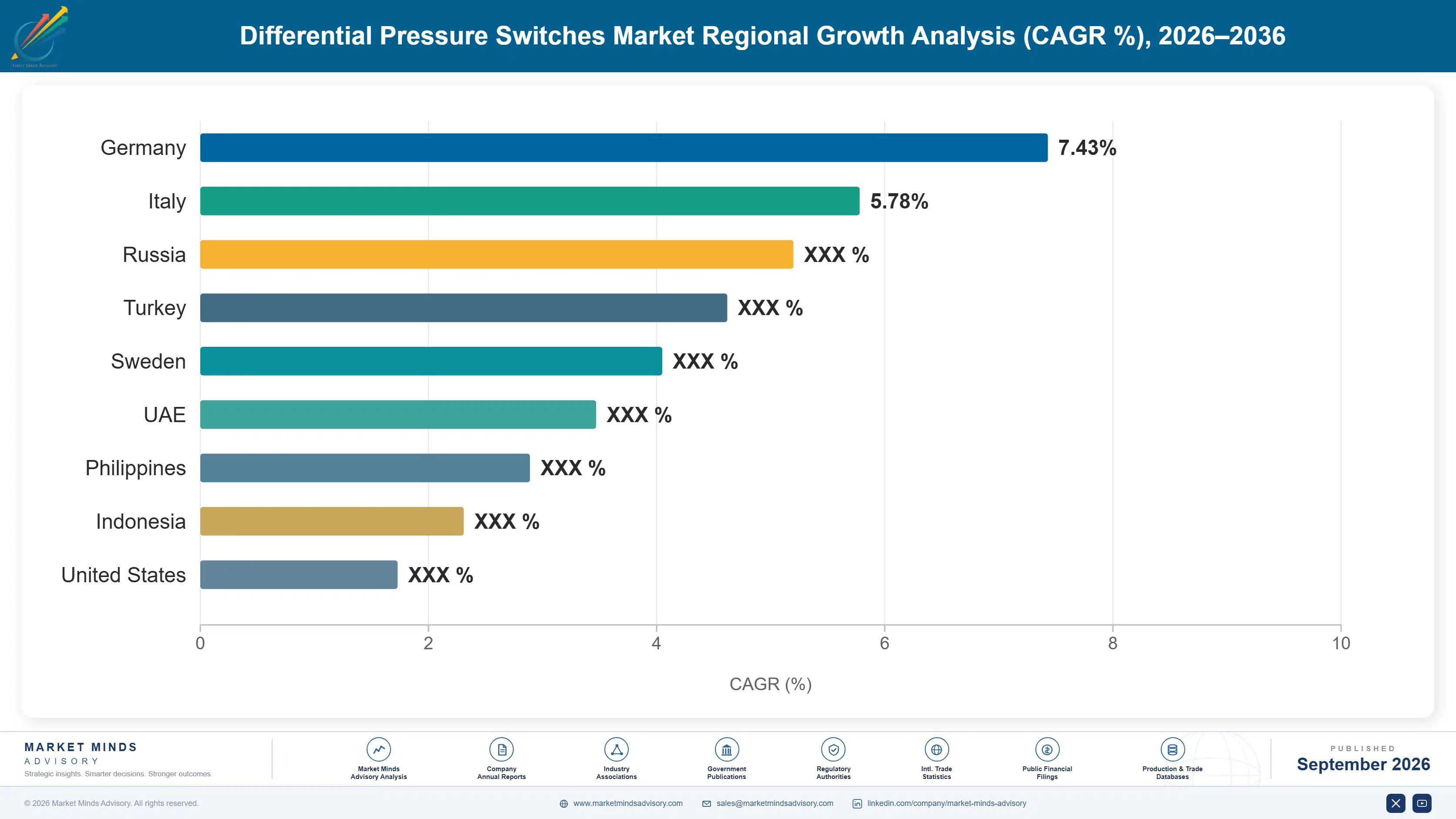
differential-pressure-switches-market-country-cagr-analysis-1790010132085

Where Manufacturers Still Defend Value

Four commercial moves separate manufacturers holding position from those defending commercial building volume that connected sensors are taking anyway. Each accepts that the switch survives on independence and evidence rather than on measurement, and that price competition in the eroding applications is wasted effort. Price competition in the eroding applications is money spent losing slowly.

Specify Into Safety Interlocks Rather Than Monitoring

Fire codes and process safety assessments require contacts that operate without a controller being powered or correctly configured, and no transmitter arrangement satisfies that. Manufacturers concentrating sales effort on those applications sustain gross margins 16 to 24 points above those chasing commercial building monitoring, where a connected sensor wins on data whatever the price. The applications are fewer and considerably more durable, which is the whole point of moving toward them deliberately. Losing the commercial volume is the cost of that move, and it was going anyway. That trade is worth making now.
Market Impact: Sustains gross margins 16 to 24 points higher

Build Self-Checking Into Every Electronic Construction

Around 64% of installed switches have never been proof tested and 18% of mechanical units drift beyond tolerance within five years, which is a serious argument against specifying switches at all. Devices that verify their own setpoint and report a fault convert a silent failure into a visible one, and manufacturers offering it report specification win rates 2.4 times those of equivalent mechanical products. It also answers the objection that safety engineers raise first in every evaluation. Nothing else in the product answers that question at all. Deflection has stopped working.
Market Impact: Raises specification win rates by 2.4 times over

Win Original Equipment Sockets Before Redesign

Roughly 71% of units ship inside fans, filters, and pumps, so equipment manufacturers are the real customer and their design cycles are the real sales cycle. Winning a socket secures volume across a product generation, and engagement during design rather than at purchasing raises the win rate by 39 to 52 points. Losing one removes the volume entirely, since nobody specifies a replacement switch into equipment that was designed around an integrated sensor. Serving equipment manufacturers requires qualification and supply reliability that small makers cannot fund, which is why this field consolidated.
Market Impact: Raises socket win rates 39 to 52 points

Offer Combined Devices Instead Of Forcing Choices

Specifiers facing both a safety interlock requirement and a trending requirement currently install two devices or argue about which matters more. Combined switch-transmitter products satisfy both from one body, at a price above either alone and roughly 30% below the pair, with one installation and one commissioning step. They grow at 5.7% and have been adopted fastest in cleanroom and critical facility work, where both requirements appear together as a matter of routine. Nobody has to lose the argument. Cleanroom and critical facility work adopted them fastest, since both requirements appear together there as a matter of routine.
Market Impact: Costs about 30% below two separate devices fitted

Who Controls the Margin Pool

Concentration is moderate. Five manufacturers hold 36% of unit revenue, measured consistently on that basis across all participants, and position rests on original equipment relationships and certification portfolios rather than on any measurement advantage. Beneath them sit specialists in hazardous area and hygienic applications alongside Chinese manufacturers competing hard across general commercial volume. Consolidation happened because serving equipment manufacturers demands scale and qualification that small makers cannot fund from component margins.
Competition currently turns on three things: certification breadth across hazardous area, hygienic, and functional safety approvals; original equipment design engagement, since 71% of units ship inside somebody else's product; and self-checking capability, which answers the objection safety engineers raise first. Setpoint accuracy alone decides very little now. Delivered price decides general commercial volume outright, and decides almost nothing where a certifier has named an approval class in a document.

Pressure comes from two directions. Transmitter and building system suppliers keep absorbing monitoring applications where a controller is already present. Meanwhile low-cost manufacturers take general commercial volume outright. Rankings will shift toward manufacturers holding certified safety applications and equipment sockets, because both resist the displacement affecting everything else.
differential-pressure-switches-market-company-positioning-matrix-1790010132614

Competitive Moat and Risk Dimensions

DWYER INSTRUMENTS

Moat: Specification Familiarity And Breadth

Decades of presence in building and process specifications mean engineers write model numbers from memory, and a specification written around one manufacturer's device is rarely revisited during a project. Breadth across pressure ranges and constructions means one relationship covers most requirements a consulting engineer encounters in practice.
DWYER INSTRUMENTS

Risk: Commercial Building Volume Erosion

A large share of historical volume sits in filter monitoring and airflow proving, precisely the applications connected sensors are taking because facilities teams want trends rather than alarms. Rebuilding around safety interlocks means competing where certification portfolios rather than specification familiarity decide the award. Familiarity counts for little there.
HONEYWELL

Moat: Certification And Safety Portfolio

Functional safety, hazardous area, and burner management certifications take years and considerable expense to establish and maintain, and they gate participation in exactly the applications that resist displacement. Customers requalifying an alternative face documentation costs exceeding the devices, which holds those positions through renewal cycles reliably.
HONEYWELL

Risk: Component Attention Against Systems

A low-priced component inside a portfolio dominated by control systems and building platforms competes internally for engineering attention against products worth far more per sale. Specialists whose entire business is this device iterate faster on self-checking and construction, and equipment manufacturers notice that difference during design cycles.

Players Tracked

Prominent Players

Dwyer Instruments
Honeywell
Siemens
Danfoss
Johnson Controls

Other Key Players

Ashcroft
WIKA
Barksdale
United Electric Controls
Setra Systems
Sensata Technologies
SOR
Nagano Keiki
Trafag
Huba Control
Beck Sensortechnik
Kobold Messring
Fuji Electric
Nidec Components
Schneider Electric

Recent Developments

FEBRUARY 2026

Dwyer Instruments Releases Self-Checking Electronic Differential Pressure Switch

Dwyer Instruments released an electronic switch that verifies its own setpoint at intervals and signals a fault when verification fails, addressing installations where proof testing has never been performed since the original commissioning. Pricing sits materially above equivalent mechanical constructions, positioned against verification labour rather than performance.
Signal: Manufacturers are attacking silent failure because it is the objection safety engineers raise before any other.
AUGUST 2025

WIKA Acquires Differential Pressure Instrument Manufacturer For Certification Depth

WIKA completed an acquisition of a differential pressure instrument manufacturer, adding hazardous area and functional safety certification coverage across pressure ranges the company had previously served through partner supply arrangements. Approval timelines run to several years, which the company cited as the reason for buying rather than building the coverage.
Signal: Certification portfolios are being bought rather than built, since approval timelines run to several years. Building it takes too long.
APRIL 2025

Danfoss Signs Original Equipment Supply Agreement With Air Handling Manufacturer

Danfoss entered a multi-year supply agreement covering differential pressure switches across an air handling equipment manufacturer's product range, with engagement beginning during design rather than at the purchasing stage. The agreement covers a product generation lasting several years, with no acquisition or joint venture involved.
Signal: Sockets are won during equipment design, and losing one removes the volume for a generation. Purchasing decides nothing here.

What A Switch Costs To Build

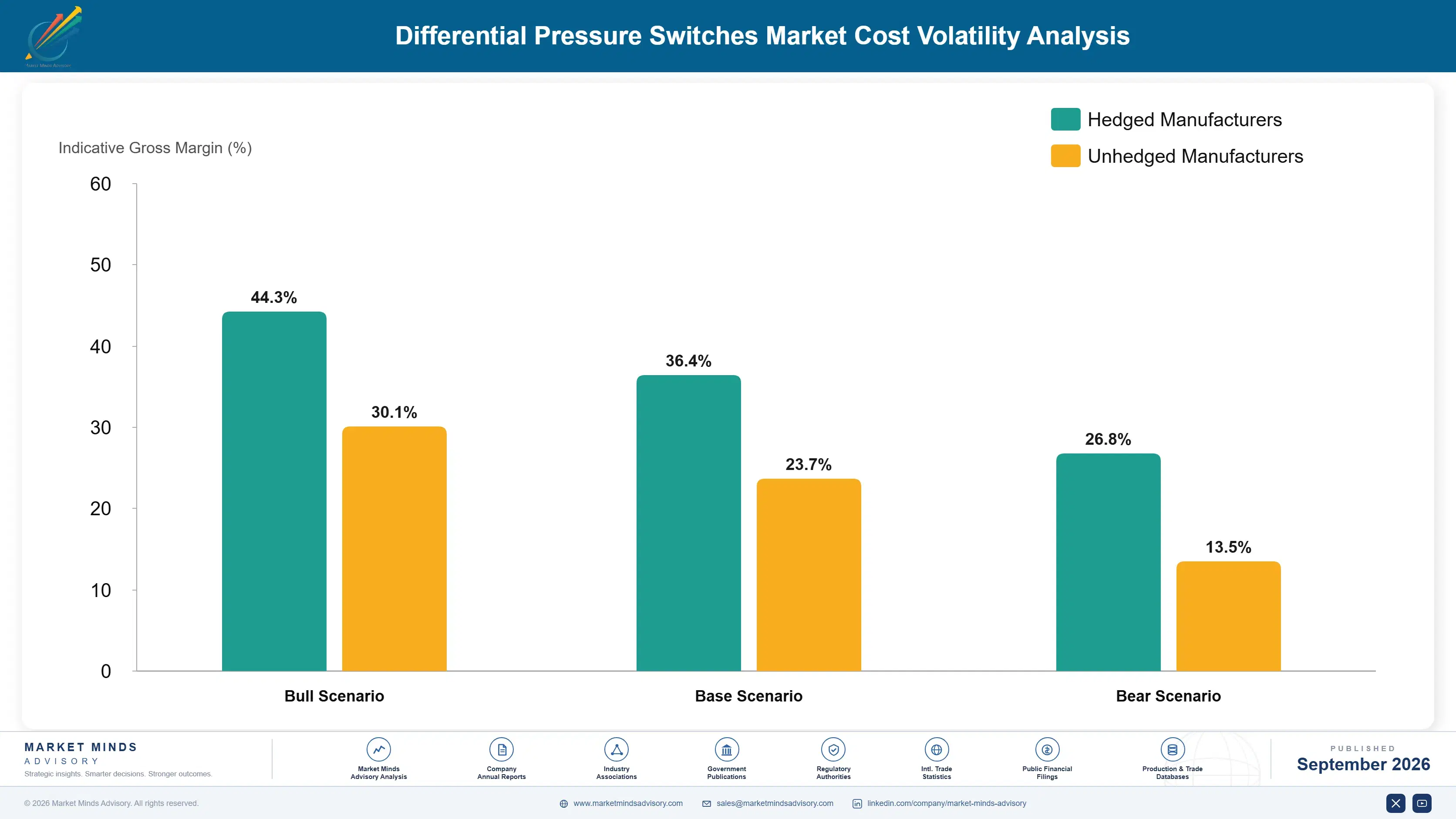
Three input groups dominate cost. Switch contacts, micro-switches, and electronics run 30% to 38% of cost of goods sold, with silver contact material the most volatile line inside that range. Diaphragm materials, whether elastomer or metal, take 20% to 27%, and the range reflects how differently hygienic and hazardous area constructions are specified. Housings, enclosure certification, and assembly add 18% to 25%, most of it certification rather than metal.
Silver prices rose sharply through 2024 and 2025, and International Monetary Fund commodity data recorded the movement across both years. Several manufacturers described the contact material cost effect directly in their annual reports for that period. The impact fell hardest on mechanical constructions, since a device selling near USD 78 has little room to absorb it, while electronic switches carry contact material as a smaller proportion of total cost.

The competitive disadvantage mechanism runs through certification maintenance rather than manufacturing cost. Hazardous area, hygienic, and functional safety approvals require ongoing surveillance, documentation, and periodic reassessment that must be funded whether volume justifies it or not. Exposure varies by manufacturer type, and narrow specialists carry it against little revenue. Broad-line manufacturers spread that obligation across many catalogue entries instead.
differential-pressure-switches-market-cost-volatility-analysis-1790010132811

Move Toward Electronic Constructions Where Application Permits

Silver contact material is the most volatile cost line and it represents a larger share of a mechanical switch than of an electronic one selling at a higher price. Shifting the range toward solid-state constructions reduces exposure to precious metal movement while addressing the drift objection that specifiers now raise in nearly every evaluation.

Share Enclosure And Certification Platforms Across Ranges

Hazardous area and hygienic approvals require ongoing surveillance and periodic reassessment funded regardless of the volume each product carries. Common enclosure and electronics platforms across pressure ranges let one certification effort support many catalogue entries, which is the practical reason broad-line manufacturers outlast specialists through cost cycles. Specialists cannot spread it comparably. The arithmetic is not close.

Commit Contact Material Volumes Under Longer Agreements

Silver moved sharply across two consecutive years and a device selling near USD 78 cannot absorb that inside its own margin. Longer supply agreements covering committed contact material volumes smooth the exposure and remove the awkward mid-contract price conversations with equipment manufacturers who have already published their own pricing. Equipment makers have already published their prices.

Portfolio Architecture for Margin Defence

Margin follows certification rather than construction. General commercial monitoring switches are close to commodity, with Chinese manufacturers competing on delivered price into applications that connected sensors are taking anyway. Hazardous area and hygienic devices earn better, because approval gates participation. Functional safety certified interlocks earn most, since a certifier requires them and no alternative arrangement qualifies at all. Certification rather than engineering decides the whole margin hierarchy here.
The tension between volume and premium runs through who wrote the specification. An equipment manufacturer choosing a switch for a filter housing compares delivered cost across qualified suppliers and switches readily. A validation engineer specifying room pressure monitoring, or a safety assessor specifying a burner interlock, names an approval class and stops negotiating. The two behave as separate markets sharing a component.

High-value pools concentrate where the contact carries consequence: fire and smoke control, burner management, cleanroom pressurisation under regulatory record keeping, and hazardous area process interlocks. Price is not the deciding factor in any of them. Where the switch merely reports a dirty filter, connected sensors take the application and the remaining devices compete purely on landed cost. Landed cost is the only remaining question there.

Volume / Commodity-Adjacent

General commercial monitoring and filter status switches sold on delivered price into applications connected sensors are steadily taking. The ten-point range reflects manufacturing scale and contact material purchasing rather than any product difference between the participants.
Gross Margin: 24% to 34%

Premium / Certified

Hazardous area and hygienic approved devices where certification gates participation and specifiers name an approval class rather than a manufacturer. The ten-point range separates manufacturers holding certification directly from those supplying through partners who hold it.
Gross Margin: 40% to 50%

Sustainability / Regulatory / Next-Generation

Functional safety certified interlocks and self-checking electronic devices where a certifier requires an independent contact and no alternative qualifies. The fourteen-point range reflects functional safety approval depth and whether self-verification is included in the device.
Gross Margin: 52% to 66%
differential-pressure-switches-market-portfolio-architecture-1790010133319

High-value Sub-segments and Strategic Watch-out

Functional Safety Interlock Devices

Highest value in the category, required by fire codes and safety assessments that no transmitter arrangement satisfies at any price. Approval takes years to obtain. The fourteen-point range reflects certification depth and whether self-verification is built into the device. Nothing else qualifies for these applications.
Gross Margin: 54% to 68%

Self-Checking Electronic Switches

Fastest growth at 6.3%, answering the drift objection directly since 64% of installed devices have never been proof tested. The twelve-point range separates devices verifying their own setpoint from electronic constructions offering no verification capability at all. Safety engineers ask about verification first. Prices sit well above mechanical equivalents.
Gross Margin: 46% to 58%

Original Equipment Socket Supply

Volume core carrying 71% of units shipped, won during equipment design cycles rather than through purchasing conversations. The ten-point range reflects certification breadth and supply reliability, which equipment manufacturers weigh more heavily than unit price. Losing a socket removes the volume for a generation. Purchasing departments decide almost nothing here.
Gross Margin: 30% to 40%

Commercial Filter Monitoring

The strategic watch-out. Connected sensors provide trends that facilities teams prefer to a single alarm contact, and low-cost manufacturers compete on landed price for what remains. The ten-point range reflects purchasing scale and nothing commercially defensible. Facilities teams prefer trends to a single contact. Little here is defensible.
Gross Margin: 20% to 30%

How This Revenue Repeats

Installed switches last about 11 years and are usually replaced only after failure, which makes aftermarket revenue thin and unpredictable. The revenue that matters recurs through equipment production instead: 71% of units ship inside somebody else's product, so a won socket pays out across every unit that manufacturer builds during a product generation. That is a production annuity rather than a service one, and it behaves quite differently.
Attachment depth follows specification and certification rather than any relationship. A device named in a fire strategy, a validation protocol, or a safety assessment cannot be substituted without redoing the document that names it, which nobody does for a component costing USD 78. A switch chosen by an equipment manufacturer on landed cost has no attachment whatever and is reconsidered at every product refresh.

The buyer has shifted from facilities and maintenance toward design engineering and safety assessment. Maintenance teams once replaced switches like consumables and bought whatever the wholesaler stocked. Equipment design engineers now select for a production generation, and safety assessors name approval classes in documents that outlive the people who wrote them. Manufacturers selling to wholesalers are addressing the participant with the least influence remaining.
differential-pressure-switches-market-end-use-penetration-index-1790010133809

Where This Market Rewards

These are among the four positions where our research anticipates prominent divergence between winners and laggards over the coming forecast period. Each is grounded in the demand model, the regulatory perimeter, and the announced capacity pipeline.
01 / SAFETY INDEPENDENCE FOCUS

Sell where software cannot be trusted

Fire codes, burner management standards, and process safety assessments require contacts that operate without any controller being powered or correctly configured, and no transmitter arrangement satisfies that condition at any price. Manufacturers concentrating there sustain gross margins 16 to 24 points above those chasing commercial building monitoring. Those applications are fewer and considerably more durable, which is precisely why moving toward them deliberately is worth the lost volume, and that volume was leaving regardless of what anybody charged for it.
02 / SILENT FAILURE ELIMINATION

A drifted switch looks exactly like a working one

Roughly 18% of mechanical devices drift beyond tolerance within five years and 64% of the installed population has never been proof tested since commissioning. That is the strongest argument against specifying switches at all, and safety engineers raise it before anything else. Devices verifying their own setpoint and reporting failure win specifications 2.4 times more often than equivalent mechanical products, because they answer the objection rather than deflecting it, which is what distinguishes a credible product from a defensive one.
03 / DESIGN CYCLE ENGAGEMENT

Sockets are won years before any purchase order

Around 71% of units ship inside fans, filters, and pumps, so equipment manufacturers are the customer and their design cycles are the sales cycle rather than their purchasing departments. Engaging during design instead of at procurement raises win rates by 39 to 52 points. Losing a socket removes the volume entirely for a product generation, since nobody retrofits a switch into equipment designed around an integrated sensor, so the socket has to be won before the drawings are finished, years before any purchase order exists at all.
04 / COMBINED DEVICE POSITIONING

Stop making specifiers choose one requirement

Specifiers facing a safety interlock requirement and a trending requirement currently fit two devices or argue about which one matters more to the project. Combined switch-transmitter products satisfy both from one body at roughly 30% below the price of the pair, with a single installation and commissioning step. They grow at 5.7% and cleanroom construction adopted them fastest, since both requirements appear together there routinely, and neither requirement has to lose its argument any more, and installation and commissioning effort both fall as well.

Engagement Snapshot From the Field

A live engagement with an industry participant carrying material or product regulatory and market exposure ahead of a defining policy shift, showing how our research translates into a defensible multi-year portfolio strategy.
MARKET MINDS ADVISORY · CLIENT ENGAGEMENT SUMMARY
Differential Pressure Switches Producer Strategic Portfolio Review and Transition Roadmap 2026·Investment Scenario on Differential Pressure Switches Exposure Evaluation 2025-26
CLIENT PROFILE
A pharmaceutical manufacturer operating six sterile production facilities across three countries, with approximately 2,400 differential pressure switches monitoring room pressurisation, filter status, and airflow across classified spaces. Instrument maintenance was contracted to two regional providers at an annual cost near USD 780,000 (client-reported, unverified by MMA). Neither provider held verification records covering the classified spaces at any of the six sites.
STRATEGIC CHALLENGE
A regulatory inspection had questioned whether room pressure monitoring devices were verified at any interval, and quality could not produce records for most of them. Engineering argued the devices were reliable and testing was unnecessary, while nobody had data supporting either position across any of the six sites. The argument had run unresolved for months.
MMA APPROACH
MMA sampled 340 installed switches across the six facilities, tested each against its documented setpoint, and compared results by device age, construction type, and installation environment. Maintenance records were reconciled against the installed population to establish what proportion had ever been verified at all. Installation environment was recorded alongside every tested device.
KEY FINDINGS
  1. Of 340 switches tested, 21% actuated outside their documented setpoint tolerance, and every one of those was a mechanical diaphragm or piston construction rather than electronic.
  2. Maintenance records covered only 29% of the installed population, and the remaining devices had no verification record since original commissioning at any of the six sites.
  3. Drift correlated strongly with installation environment rather than device age, with switches in high vibration plant rooms failing at nearly three times the general rate.
  4. Room pressure monitoring in classified spaces relied on 190 devices, of which 118 had never been tested despite carrying an explicit regulatory record keeping obligation.
CLIENT PROFILE
A pharmaceutical manufacturer operating six sterile production facilities across three countries, with approximately 2,400 differential pressure switches monitoring room pressurisation, filter status, and airflow across classified spaces. Instrument maintenance was contracted to two regional providers at an annual cost near USD 780,000 (client-reported, unverified by MMA). Neither provider held verification records covering the classified spaces at any of the six sites.
STRATEGIC CHALLENGE
A regulatory inspection had questioned whether room pressure monitoring devices were verified at any interval, and quality could not produce records for most of them. Engineering argued the devices were reliable and testing was unnecessary, while nobody had data supporting either position across any of the six sites. The argument had run unresolved for months.
MMA APPROACH
MMA sampled 340 installed switches across the six facilities, tested each against its documented setpoint, and compared results by device age, construction type, and installation environment. Maintenance records were reconciled against the installed population to establish what proportion had ever been verified at all. Installation environment was recorded alongside every tested device.
KEY FINDINGS
  1. Of 340 switches tested, 21% actuated outside their documented setpoint tolerance, and every one of those was a mechanical diaphragm or piston construction rather than electronic.
  2. Maintenance records covered only 29% of the installed population, and the remaining devices had no verification record since original commissioning at any of the six sites.
  3. Drift correlated strongly with installation environment rather than device age, with switches in high vibration plant rooms failing at nearly three times the general rate.
  4. Room pressure monitoring in classified spaces relied on 190 devices, of which 118 had never been tested despite carrying an explicit regulatory record keeping obligation.
RECOMMENDED STRATEGY
Phase 1: Phase one: replace all room pressure monitoring devices in classified spaces with self-checking electronic switches, prioritising the 118 with no verification record. Phase 2: Phase two: establish documented proof test intervals for remaining mechanical devices, weighted by installation environment rather than applied uniformly across every site. Phase 3: Phase three: specify electronic constructions as standard for all replacements, accepting the higher unit price against the verification burden it removes.
OUTCOME
The follow-up inspection accepted the verification programme with no further observations (client-reported, unverified by MMA). Instrument maintenance cost rose 9% while the untested population fell from 71% to under 12%. Replacement capital came to USD 310,000 across the six facilities. Electronic constructions are now standard for every replacement.

Frequently Asked Questions

Foundational context covering the market sizes, CAGR, scope, country, region and competition that inform every finding below. This section is provided to cover basics and most often pre-purchase conversations, answered from the MMA Primary Research Dataset.

What is the current size of the Differential Pressure Switches Market?

The market was worth USD 1.4 billion in 2025 and reaches USD 1.5 billion in 2026. Value covers switch devices only, excluding transmitters and controllers.

How large will the Differential Pressure Switches Market be by 2036?

MMA forecasts USD 2.3 billion by 2036, an increase of USD 0.8 billion across the forecast period. That represents 1.53 times the 2026 base of USD 1.5 billion.

What is the CAGR for the Differential Pressure Switches Market 2026 to 2036?

The base case compound annual growth rate is 4.2%, with a bull case at 5.4% and a bear case at 3.0%. Historical growth from 2020 to 2025 ran at 3.4%.

Which segment is growing fastest?

Electronic solid-state switches grow at 6.3%, half again the market rate of 4.2%. They displace mechanical constructions on setpoint drift rather than expanding the category at all.

Who are the major companies in the Differential Pressure Switches Market?

Dwyer Instruments, Honeywell, Siemens, Danfoss, and Johnson Controls lead, together holding 36% of unit revenue. Certification portfolios and equipment design relationships decide position rather than measurement performance.

Which country is growing fastest?

India grows at 7.8%, driven by pharmaceutical and biologics facility construction where room pressure monitoring is specified by validation engineers under an explicit regulatory obligation.

Report Segmentation Architecture

The full report scope spans multiple orthogonal segmentation dimensions, with cross-tabulated demand data provided for each dimension pair. Coverage extends further to regional breakdowns, trend trajectories, and the competitive detail needed to support segment-level decision-making.

By Device Construction

  • Diaphragm Switches
  • Piston Switches
  • Bellows and Capsule Switches
  • Electronic Solid-State Switches
  • Magnetic and Reed Actuated Switches
  • Combined Switch-Transmitter Devices

By End-Use Industry

  • Commercial and Institutional Buildings
  • Pharmaceutical and Cleanroom Facilities
  • Oil, Gas and Petrochemical
  • Water and Wastewater Treatment
  • Food, Beverage and Hygienic Processing
  • Power Generation and Heavy Industry

By Commercial Dimension

  • Original Equipment Manufacturer Supply
  • Distributor and Wholesaler Channel
  • Engineering Contractor Specification
  • Hazardous Area Certified Supply
  • Functional Safety Certified Supply
  • Aftermarket Replacement Sale

By Region

  • East Asia
  • North America
  • Western Europe
  • South Asia and Pacific
  • Latin America
  • Middle East and Africa
  • Eastern Europe

Scope, Methodology, and Coverage

Every figure in this report is reproducible from documented input assumptions. The scope below maps the historical period, the forecast horizon, the segmentation dimensions, and the countries covered, alongside the underlying primary and qualitative methodology.
Historical Period
2020 to 2025
Forecast Period
2026 to 2036
Base Year
2025 (USD billions; MMA Primary Research Dataset, September 2026)
Market Definition
This market covers devices that actuate an electrical contact when the pressure difference across two ports crosses a setpoint, including diaphragm switches, piston switches, bellows and capsule switches, electronic solid-state switches, magnetic and reed actuated switches, and combined switch-transmitter devices. It excludes differential pressure transmitters with output only, pressure gauges, flow meters, controllers and building management systems, and the filters, fans, and pumps monitored.
Quantitative Units
USD billions, device revenue at manufacturer level
Segmentation Dimensions
Device construction, end-use industry, commercial dimension, region
Regions Covered
East Asia, North America, Western Europe, South Asia and Pacific, Latin America, Middle East and Africa, Eastern Europe
Countries Covered
China, Japan, South Korea, Taiwan, United States, Canada, Mexico, Germany, Switzerland, United Kingdom, France, Italy, Netherlands, Sweden, Spain, India, Indonesia, Vietnam, Thailand, Australia, Brazil, Mexico, Colombia, Chile, Saudi Arabia, United Arab Emirates, Egypt, South Africa, Poland, Czechia
Key Companies Profiled
Dwyer Instruments, Honeywell, Siemens, Danfoss, Johnson Controls, Ashcroft, WIKA, Barksdale, United Electric Controls, Setra Systems, Sensata Technologies, SOR, Nagano Keiki, Trafag, Huba Control, Beck Sensortechnik, Kobold Messring, Fuji Electric, Nidec Components, Schneider Electric
Quantitative Methodology
Primary survey, n=3,800 respondents, Q4 2025, six countries; demand-side model with trade association cross-validation
Qualitative Methodology
47 expert interviews, Q4 2025; applied to validate demand model assumptions, identify emerging dynamics, and assess competitive positioning
Report Format
PDF and XLSX data workbook (Word format preview document)
Publisher
Market Minds Advisory
Report Code
MMA-2026-CON-741
Published
September 2026
Contact
sales@marketmindsadvisory.com | www.marketmindsadvisory.com

Purchase the full Differential Pressure Switches Market Report (2026 to 2036).

The full report sizes the differential pressure switch market across six device constructions, seven regions, and thirty countries, with forecasts to 2036 under base, bull, and bear cases. It examines why transmitters keep taking the volume applications, what safety independence means commercially, and how setpoint drift and absent proof testing undermine the argument for specifying switches at all. Competitive analysis covers twenty participants evaluated consistently on device revenue, with detailed treatment of certification portfolios and equipment design engagement. Cost structure, margin architecture, and regional manufacturing drivers are analysed throughout. Primary research includes 3,800 survey responses and 47 expert interviews.
Six device constructions sized and forecast separately
Twenty participants evaluated on device revenue consistently
Regional manufacturing and regulated construction drivers across seven geographies
Margin architecture by construction and certification class
Setpoint drift and proof testing benchmarking across installed populations
Original equipment socket economics measured across design cycle engagement

Built For The People Who Decide

From boardroom strategy to bench-side execution, this report is read cover-to-cover by leaders shaping the next decade of their industry, turning demand scenarios, market dynamics and valuation benchmarks into decisions.
CXOs/ Presidents/ VPs/ Managers
M&A and Corporate Development
Strategy Teams and R&D Heads
Procurement and Product Directors
Regulatory and Compliance Leaders
Investor Relations and Equity Analysts