Market Minds Advisory
Diethyl Phthalate Market

Diethyl Phthalate Market: Fragrance Fixative, Cellulose Acetate, and Pharmaceutical Coating Demand Through 2036

A fragrance formulator swapping diethyl phthalate for an alternative fixative discovers the substitute changes how a scent actually smells six hours later, and that performance gap is what keeps a scrutinized plasticizer chemistry commercially durable.

Lead Analyst

Bilal Shaikh

Published

September 2026

Make Smarter Decisions with Customized Research Insights

Request a free sample report and evaluate market opportunities, growth trends, and competitive dynamics relevant to your business needs.

2025 MARKET VALUE$0.6BMarket Size 2025
2036 FORECAST VALUE$0.9BBase Case , 2026 to 2036
CAGR 2026 TO 20363.8 %Bull 5.0% / Bear 2.6%
INCREMENTAL OPPORTUNITY$0.3BNet 10- year value creation
EXPANSION MULTIPLE1.45x2036 value over 2026 base
Strategic Levers
M&A Pipeline
Regional Outlook
Country Rankings
Competitive Intelligence
Segmental Deep-dive
Call-Us : 91 93563 13602

Executive Snapshot and Market Trajectory

Diethyl phthalate has survived the broader phthalate regulatory retreat by occupying a narrower, more defensible role as a fragrance fixative and cellulose acetate plasticizer where documented low-risk status keeps formulators from switching entirely, reshaping how formulators weigh substitution risk against proven performance across every major regional formulation market.
Nail polish and color cosmetics applications are now the fastest-growing segment, expanding near 6.8% annually as color cosmetics manufacturers specify DEP for its documented film-forming and fragrance-carrying properties, well over 75% faster than the wider market's pace. East Asia anchors close to three tenths of global value through China's dominant specialty chemical manufacturing and cosmetics ingredient export base, while India's expanding personal care manufacturing pulls South Asian demand higher each year.
Competitive intensity concentrates around five global specialty chemical majors that hold decades of formulation expertise and fragrance and cosmetics industry relationships, even as regional Chinese and Indian manufacturers compete aggressively on cost for standard industrial grades. Regulatory compliance documentation and pharmaceutical-grade purity increasingly determine which suppliers capture premium fragrance and pharmaceutical contracts beyond commodity plasticizer volume, particularly as compound-specific toxicology data becomes a genuine competitive differentiator industry-wide.
Market Definition
The diethyl phthalate market covers commercial production and sale of diethyl phthalate used as a fragrance fixative, cellulose acetate plasticizer, pharmaceutical coating excipient, insect repellent carrier, industrial solvent, and color cosmetics formulation ingredient. It excludes other phthalate ester chemistries such as dibutyl phthalate and diethylhexyl phthalate, which the industry classifies as distinct chemical products with separate regulatory and application profiles.
Base Year Value
$0.6B in 2025 (MMA Primary Research Dataset, August 2026)
Forecast Period
2026 to 2036, eleven discrete annual values
CAGR
3.8% base case. Bull 5.0%. Bear 2.6%.
Fastest Growth Segment
Nail Polish and Color Cosmetics Applications: 6.8% CAGR
Fastest Growth Country
India: 7.5% CAGR
Fastest Growth Region
South Asia and Pacific: 5.8% CAGR
Largest Region
East Asia: 28% of 2025 global value
Market Leaders
Eastman Chemical Company, Lanxess AG, UPC Technology Corporation, Hallstar Company, KLJ Group. Source: MMA Analysis based on company annual reports.
Primary Survey
n=3,800 procurement and R&D decision-makers, Q4 2025, six countries
Methodology
Demand-side build-up, cross-validated against public data, 47 expert interviews

Diethyl Phthalate Market Forecast Scenarios

diethyl-phthalate-market-trends-size-forecast-scenario-1787549833431
Diethyl phthalate demand grew unevenly from 2020 to 2025, as pandemic-era personal care manufacturing disruption briefly slowed volume before color cosmetics demand accelerated growth from 2023 onward. Chinese and Indian manufacturing capacity expanded steadily across the period. The market grew at a 3.2% historical CAGR, slower than the forecast pace as color cosmetics-driven demand only scaled meaningfully in the final two years.
The base case carries diethyl phthalate to a 3.8% CAGR through 2036 on three mechanisms. First, fragrance formulators keep specifying DEP as a documented low-risk fixative that competing phthalate alternatives have not matched on performance or regulatory clarity. Second, color cosmetics manufacturers keep expanding nail polish and related product lines across growing Asian consumer markets. Third, pharmaceutical coating applications keep growing as excipient manufacturers specify DEP for documented film-forming consistency.
The bull case, 5.0%, assumes color cosmetics and pharmaceutical coating adoption accelerates faster than currently projected as more mid-sized manufacturers specify the chemistry across a broader range of formulations. The bear case, 2.6%, assumes tightening regulatory scrutiny and formulator substitution pressure cap premium application specification, keeping growth concentrated in standard industrial solvent formats tied to baseline volume alone.

A Scrutinized Chemistry Holds Its Narrower Ground

Diethyl phthalate now splits along a regulatory-documentation and application-purity line rather than a purely commodity one. Standard industrial and solvent grades, the volume backbone of the category, meet baseline specification at pricing closer to commodity plasticizers. Fragrance and pharmaceutical grades instead serve buyers facing strict purity and documentation requirements, commanding meaningfully higher pricing for validated regulatory compliance and consistency across the full product lifecycle and application scope.
MARKET CONCENTRATIONCR5: 46%Top five suppliers hold under half of global sales
AVERAGE SELLING PRICEUSD 1.85 per kilogramPricing varies sharply between industrial and pharmaceutical-grade formats
TOP PRODUCING COUNTRYChina: 27% of global production volumeDominant specialty chemical manufacturing base anchors export output
EXPORT TRADE INTENSITY38% of output crosses a borderCross border trade links manufacturing hubs to global formulators
FEEDSTOCK COST SHARE44% to 56% of COGSPhthalic anhydride and ethanol pricing drives significant cost volatility
REGULATORY DOCUMENTATION BURDEN12 to 18 months per new market filingFiling timeline shapes recurring market entry and renewal cost
Buyers split sharply by application sensitivity and sourcing sophistication. Fragrance and cosmetics formulators specify pharmaceutical-grade DEP with full regulatory documentation to protect against compliance risk across major consumer markets, requiring purity validation and toxicology data that commodity suppliers struggle to match consistently. Industrial buyers instead specify standard grades, competing largely on price per kilogram rather than deep documentation differentiation across their broader formulation portfolios and product lines.
Over the next decade, fragrance and pharmaceutical-grade formats should keep pulling value toward higher-margin specialty tiers, while Chinese and Indian manufacturing keeps driving the largest underlying volume base for standard industrial formats. Regulatory documentation depth, not personal care volume growth alone, increasingly looks like the most durable driver of category-wide grade upgrades across application segments and international geographic markets worldwide.
"Every few years someone predicts diethyl phthalate gets regulated out of existence. It hasn't happened, because nobody has found a fixative that carries a fragrance the same way without changing the formulation entirely."
Director, Specialty Chemicals and Personal Care Ingredients Practice · MMA Chemicals and Materials Practice · August 2026

Market Trends

Color Cosmetics Manufacturers Expand DEP Specification

Color cosmetics manufacturers have increasingly specified diethyl phthalate as a standard nail polish and coating formulation ingredient, treating its documented film-forming consistency as a defining performance requirement rather than a substitutable commodity solvent choice. Several major color cosmetics brands now require pharmaceutical-grade purity documentation rather than accepting generic industrial-grade fitment common across earlier formulation generations. Suppliers including Eastman and Lanxess have invested in dedicated cosmetics-grade production and documentation teams, recognizing that formulator contracts increasingly hinge on demonstrated regulatory compliance data rather than traditional price-per-kilogram metrics alone across nearly every major color cosmetics product line.
Market Impact: Fixative demand adds 4,200 metric tons

Pharmaceutical Coating Applications Expand Beyond Legacy Formulations

Pharmaceutical coating applications, historically concentrated in a narrow set of legacy excipient formulations, have expanded meaningfully into newer film-coating chemistries, since improved purity validation and falling documentation costs have made DEP commercially viable across a considerably broader range of pharmaceutical applications than earlier generations supported. Several excipient manufacturers have already launched DEP-based coating lines priced within reach of mid-sized pharmaceutical formulators, reflecting genuine application diffusion rather than incremental feature addition. Suppliers with established pharmaceutical-grade documentation capability are capturing these contracts well ahead of competitors still building comparable regulatory expertise across nearly every major pharmaceutical dosage form.
Market Impact: Asian cosmetics demand grows 6.2% annually

Market Opportunities and Growth Drivers

Fragrance Fixative Performance Lacks a Proven Substitute

Fragrance formulators across major markets continue specifying diethyl phthalate as their primary fixative despite years of substitution research, forcing suppliers to maintain full regulatory documentation across their fragrance-grade product range rather than treating compliance as a discretionary investment. Several major fragrance houses have signaled continued DEP reliance through the current forecast period specifically, giving suppliers a durable, quantified demand timeline that shapes multi-year production investment rather than one-off regulatory response. That fixative durability distinguishes fragrance-grade demand from more discretionary industrial solvent purchasing elsewhere in the category particularly across markets where alternative fixatives have not matched documented olfactory performance.
Market Impact: Regulatory review adds 14 months delay

Growing Asian Color Cosmetics Consumption Lifts Demand

Persistent growth in Asian color cosmetics consumption continues lifting demand for premium DEP formulations marketed explicitly on documented formulation consistency, a purchase driver that has grown considerably alongside rising disposable income and cosmetics category expansion across the region historically. Manufacturers have responded by publishing formulation performance data directly in supplier qualification materials, a practice that barely existed at current scope before 2022 and now shapes procurement decisions among regional cosmetics brands specifically. Several suppliers have expanded cosmetics-grade production capacity to meet this consumption-driven demand segment particularly among brands expanding regional color cosmetics product lines across emerging Asian markets.
Market Impact: Substitution pressure caps growth at 24%

Market Restraints and Challenges

Regulatory Scrutiny Limits New Application Development

Diethyl phthalate faces continued regulatory scrutiny as part of the broader phthalate category despite its documented lower-risk profile relative to other phthalate esters, and formulators developing new applications increasingly face lengthy compliance review before commercial launch. The underlying cause is that regulators frequently apply category-wide phthalate restrictions without fully distinguishing DEP's specific toxicology profile from higher-risk phthalate chemistries, creating documentation burden that individual compound data alone cannot fully resolve. That scrutiny limits how quickly new application development can proceed in regulation-sensitive markets. Suppliers are responding by funding independent toxicology research to support compound-specific regulatory differentiation.
Market Impact: Color cosmetics demand grows 6.8% annually

Formulator Substitution Pressure Limits Premium Growth

Diethyl phthalate carries meaningful reputational exposure tied to broader phthalate category concerns, and many consumer-facing brands, particularly in price-sensitive and reputation-conscious segments, continue exploring alternative fixative and plasticizer chemistries despite documented performance advantages that DEP offers over substitute formulations. The underlying cause is that consumer brands increasingly weigh perceived ingredient risk more heavily than documented technical performance, especially where marketing positioning around ingredient transparency shapes purchasing decisions. That substitution pressure limits how quickly premium DEP penetration can grow in consumer-facing categories. Suppliers are responding by developing enhanced transparency documentation for brand partners.
Market Impact: Pharmaceutical coating demand grows 5.9% yearly
3 additional market trends, 4 additional growth drivers, and 3 additional restraints and challenges are covered in the full report. Contact sales@marketmindsadvisory.com to access the complete intelligence.

Segment CAGR and Growth Architecture

Segmentation follows end-use application, a single classification logic separating diethyl phthalate demand by the formulation role it serves. Fragrance fixative, cellulose acetate, pharmaceutical coating, insect repellent, industrial solvent, and color cosmetics applications each carry distinct purity requirements and buyer occasions, keeping upstream production grades and downstream formulation channels from blurring together across application tiers.
diethyl-phthalate-market-trends-market-share-analysis-1787549833965

Nail Polish and Color Cosmetics Applications

Nail polish and color cosmetics applications are growing at 6.8% annually, well over 75% faster than the wider market's 3.8% pace, as color cosmetics manufacturers specify DEP for its documented film-forming and fragrance-carrying properties that alternative plasticizers have not consistently matched. This application requires cosmetics-grade purity validation distinct from conventional industrial solvent production, since formulators require documented consistency across batch-to-batch color and finish performance that industrial specifications do not guarantee. Retail and formulator pricing for cosmetics-grade DEP runs well above standard industrial formats, reflecting both purity validation investment and brand willingness to pay for documented formulation reliability. Eastman and Lanxess have both prioritized capital investment in dedicated cosmetics-grade production, positioning the segment to capture continuing Asian color cosmetics growth.
CAGR 6.8%

Pharmaceutical Coating and Excipient Applications

Pharmaceutical coating and excipient applications grow at 5.9% annually, driven by excipient manufacturers specifying DEP-based film coatings for documented consistency in tablet and capsule coating processes that alternative plasticizers cannot reliably replicate at pharmaceutical purity standards. This segment commands meaningful premium pricing over standard formats, reflecting both purity validation complexity and the genuine regulatory documentation involved in matching pharmaceutical-grade specifications across varied dosage form manufacturing requirements. Several excipient manufacturers have expanded pharmaceutical-grade specification across broader formulation programs, extending a niche application into mainstream tablet coating supply chains. Capacity expansion has proceeded steadily among established pharmaceutical-grade suppliers, though regulatory documentation expertise limits how quickly new entrants can credibly compete in this demanding segment.
CAGR 5.9%
Full segment breakdown across 6 segments available in the complete report.

Regional Architecture and Country Demand Map

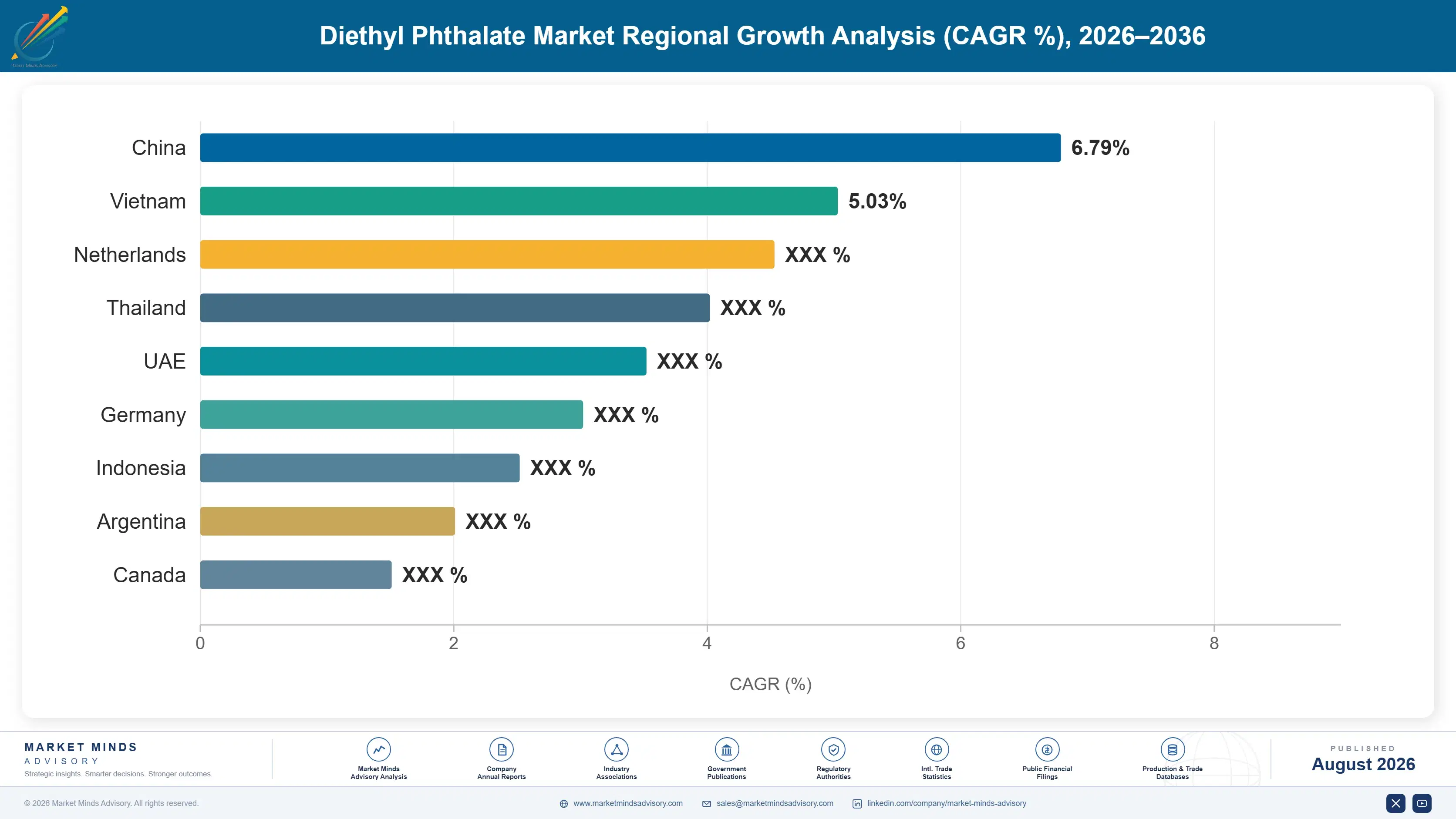
Diethyl phthalate production and consumption concentrate in East Asia, anchored by China's dominant specialty chemical manufacturing and cosmetics ingredient export base. India carries the fastest country-level growth, as its expanding personal care manufacturing pulls South Asian demand higher across the forecast period Established Chinese export capacity continues reinforcing this concentration.

North America

United States demand anchors North American diethyl phthalate consumption, driven by the country's large fragrance and personal care formulation industry concentrated around established consumer brand headquarters. Eastman and Hallstar maintain substantial domestic manufacturing and documentation capacity serving both fragrance and pharmaceutical channels simultaneously. Canada follows a similar consumption pattern at smaller scale, with comparable fragrance formulation and personal care trends. Mexico's growing personal care manufacturing role adds further regional production capacity supporting cross-border consumer goods supply chains. Growth here tracks close to the global average, reflecting a mature, diversified buyer base spanning both premium fragrance-grade fitment and steady standard industrial demand Growing indie beauty brand formulation activity adds further incremental demand across smaller specialty manufacturers.
Share: 25% | CAGR: 3.9% (2026 to 2036)

Western Europe

Western Europe's diethyl phthalate demand centers on France, Germany, and the United Kingdom, where Lanxess and established European fragrance houses maintain deep regional manufacturing and formulation presence built around decades of European perfumery industry leadership. The European Union's tightening chemical regulation forces suppliers to maintain comprehensive documentation coverage rather than offering compliance data as a niche service. Italy and Spain contribute additional demand tied to expanding personal care manufacturing infrastructure across the region specifically. Growth trails East Asia and South Asia and Pacific as the region's fragrance and cosmetics market is already mature, with incremental regulatory tightening representing gradual grade upgrades rather than underlying market expansion Poland's growing chemical manufacturing role adds modest additional regional supporting demand.
Share: 21% | CAGR: 2.3% (2026 to 2036)
Regional intelligence for 5 additional markets available in the complete report: East Asia, South Asia and Pacific, Latin America, Middle East and Africa, Eastern Europe. Contact sales@marketmindsadvisory.com.
diethyl-phthalate-market-trends-country-cagr-analysis-1787549834479

Where Suppliers Can Capture Margin

Margin defense in diethyl phthalate increasingly depends on moving beyond commodity industrial pricing toward positioning that lets a supplier charge for documented regulatory compliance, pharmaceutical-grade purity, or cosmetics formulation validation. The four moves below target the fastest-growing buyer segments most willing to pay well above standard pricing for genuine differentiation across fragrance and pharmaceutical channels.

Build Compound-Specific Regulatory Documentation Broadly Now

Suppliers with comprehensive compound-specific toxicology and regulatory documentation command retail and formulator pricing running well above standard industrial grades, and demand from fragrance and cosmetics brands has grown faster than the industry's dedicated documentation capability currently available across major suppliers. Suppliers that invest in independent toxicology research now capture premium fragrance contracts before competitors establish comparable regulatory differentiation, since brands increasingly specify documented compound-specific data as a baseline requirement. The documentation investment requires meaningful research capacity, but the roughly 26% margin uplift over standard formats justifies the cost for most established suppliers.
Market Impact: Regulatory documentation typically commands roughly a 26% premium

Expand Pharmaceutical-Grade Purity Capability Rapidly Now

Pharmaceutical-grade DEP commands meaningful premium pricing over standard industrial formats, and demand from excipient manufacturers has grown faster than the industry's dedicated purity validation capability currently available across established suppliers. Suppliers that secure pharmaceutical-grade certification now capture premium contracts before competitors establish comparable validated purity data, since excipient manufacturers increasingly favor documented consistency in supplier qualification criteria. The certification investment requires meaningful testing infrastructure, but the roughly 22% pricing premium and reduced batch rejection risk it provides justifies the cost for suppliers pursuing pharmaceutical-linked growth across multiple excipient product lines simultaneously.
Market Impact: Pharmaceutical-grade purity typically commands roughly a 22% premium

Develop Cosmetics-Grade Consistency Capability Broadly Now

Suppliers with established cosmetics-grade batch consistency capability command substantial premium pricing over competitors lacking documented formulation validation, and demand from color cosmetics manufacturers navigating rising brand quality expectations has grown faster than the industry's dedicated consistency validation capacity currently available across established suppliers. Suppliers that invest in consistency testing infrastructure now capture contracts from brands specifying documented formulation reliability as standard equipment across expanding cosmetics programs. The validation investment requires meaningful capital and specialized testing infrastructure, but the roughly 20% margin premium this segment commands justifies the cost for suppliers serving quality-sensitive markets well ahead of broader category adoption.
Market Impact: Consistency validation typically adds roughly a 20% premium

Secure Long-Term Formulator Supply Contracts Now

Fragrance and cosmetics formulators increasingly prefer multi-year DEP supply commitments over spot purchasing across major product line programs, since supply disruption during formulation production carries business continuity risk that formulators cannot easily absorb given coordinated product launch scheduling. Suppliers that secure these contracts now lock in demand and pricing before competitors capture the same formulator accounts, since formulators rarely switch DEP suppliers once a formulation has been validated for a product line. The contracting investment requires support capacity, but the multi-year revenue visibility, typically locking in roughly 18% more contracted volume than spot sourcing, justifies the cost for established suppliers.
Market Impact: Long-term contracts typically lock in 18% more volume

Who Controls the Margin Pool

Competitive concentration sits at a moderate CR5 of 46%, reflecting a market split between large global specialty chemical majors competing on regulatory documentation depth and fragrance and cosmetics industry relationships, and regional Chinese and Indian manufacturers competing on cost for standard industrial grades. The gap between category leaders and mid-tier challengers remains built on decades of documentation expertise and formulator sourcing relationships.
Competitive activity currently runs along three lines. Global specialty chemical majors compete on regulatory documentation depth and fragrance industry program breadth, applying compliance expertise smaller competitors cannot easily replicate. Regional Chinese and Indian manufacturers compete on cost and proximity to expanding domestic personal care production. Pharmaceutical-grade specialists compete on purity validation and consistency documentation, since access to verified compound-specific data increasingly determines who wins premium excipient contracts.

Pressure is building from two directions. Chinese domestic manufacturers are moving upmarket into premium cosmetics-grade formulation, challenging global majors on territory once defensible through decades of documentation investment. Pharmaceutical-grade purity is becoming a differentiator, rewarding suppliers willing to fund validation infrastructure over those competing on generic industrial pricing. Rankings over the next five years will favor whoever combines regulatory documentation depth with credible pharmaceutical purity validation.
diethyl-phthalate-market-trends-company-positioning-matrix-1787549834999

Competitive Moat and Risk Dimensions

EASTMAN CHEMICAL COMPANY

Moat: Deep regulatory documentation scale

Eastman holds decades of compound-specific toxicology research and fragrance industry sourcing relationships across major global formulators that newer entrants, domestic or international, cannot replicate on any reasonable timeline, giving it program access and documentation credibility that smaller specialized competitors genuinely struggle to match across fragrance and pharmaceutical segments alike.
EASTMAN CHEMICAL COMPANY

Risk: Exposed to margin pressure

Eastman's substantial standard industrial grade revenue base remains exposed to continuing pricing pressure from Chinese and Indian manufacturers, and the company must increasingly rely on fragrance and pharmaceutical-grade segment growth to offset that persistent margin headwind facing its largest historical revenue category over the next several years.
LANXESS AG

Moat: Established European fragrance relationships

Lanxess maintains substantial fragrance industry sourcing relationships and formulation support expertise built through decades of European perfumery industry presence, giving it commercial credibility and program access that competitors lacking comparable fragrance house relationships cannot easily replicate across similarly demanding formulation programs spanning multiple product categories and markets.
LANXESS AG

Risk: Smaller pharmaceutical-grade capability scale

Lanxess's more limited direct pharmaceutical-grade purity validation scale relative to specialized excipient suppliers limits how quickly it can capture premium pharmaceutical coating contracts, potentially constraining its ability to capture the full excipient growth opportunity without additional validation investment or a strategic partner across multiple product categories and geographic markets simultaneously.

Players Tracked

Prominent Players

Eastman Chemical Company
Lanxess AG
UPC Technology Corporation
Hallstar Company
KLJ Group

Other Key Players

Aekyung Petrochemical Co Ltd
Jiangsu Yida Chemical Co Ltd
Shandong Qilu Plasticizers Co Ltd
Nan Ya Plastics Corporation
LG Chem Ltd
Vertellus Holdings LLC
Ferro Corporation
Merck KGaA
BASF SE
Vibrantz Technologies Inc
Elementis plc
Emerald Kalama Chemical LLC
Cepsa Quimica SA
Camlin Fine Sciences Limited
Vizag Chemical International

Recent Developments

APRIL 2024

Eastman launches enhanced cosmetics-grade documentation program

Eastman launched a new compound-specific toxicology documentation program for its cosmetics-grade diethyl phthalate line, integrating expanded regulatory data with formulation support services for premium fragrance and cosmetics brand programs. The launch was an organic product introduction, not a joint venture or acquisition of any competing supplier.
Signal: Signals established specialty chemical majors investing directly in compound-specific documentation ahead of confirmed formulator specification requirements.
SEPTEMBER 2024

Shandong Qilu Plasticizers expands cosmetics-grade production capacity

Shandong Qilu Plasticizers announced expanded cosmetics-grade diethyl phthalate production capacity at its domestic Chinese facilities, responding directly to growing formulator demand for documented purity standards ahead of continued color cosmetics growth. The expansion was an organic capacity investment, not a joint venture or acquisition of any regional manufacturer.
Signal: Signals Chinese domestic producers scaling premium formulation capability well ahead of continued domestic cosmetics growth trajectory.
JANUARY 2025

Lanxess acquires minority stake in toxicology research venture

Lanxess acquired a minority equity stake in an independent toxicology research venture to strengthen its direct compound-specific documentation presence ahead of anticipated regulatory scrutiny growth. The transaction was a minority equity investment, not a full acquisition, merger, or joint venture arrangement across North America and Western Europe.
Signal: Signals established fragrance chemical suppliers building dedicated toxicology capability rather than relying entirely on third-party research partners alone.

Phthalic Anhydride Costs Set The Floor

Phthalic anhydride and ethanol together account for 44% to 56% of production cost for diethyl phthalate, sourced from globally traded petrochemical feedstock supply chains whose pricing tracks broader plastics and chemical intermediate markets rather than any DEP-specific supply and demand pattern. Pharmaceutical-grade production carries a higher processing cost share than standard industrial formats, reflecting the additional purification and documentation needed for regulatory qualification.
The 2022 petrochemical price spike illustrated input cost exposure directly. EIA and broader commodity market data recorded phthalic anhydride prices reaching multi-year highs through 2022 as global petrochemical supply chains tightened following pandemic-era disruption and geopolitical supply constraints. Suppliers without hedged forward contracts or diversified sourcing absorbed significant cost increases, passing some of that cost through to formulator customers who had few alternative low-cost sourcing options at the time.

Exposure falls hardest on smaller regional suppliers without long-term feedstock contracts or diversified sourcing relationships, who must buy phthalic anhydride and ethanol closer to spot pricing and absorb whatever margin compression results from commodity market volatility. Larger diversified specialty chemical majors with established feedstock hedging and geographic sourcing diversification smooth that volatility considerably better than smaller, less capitalized regional competitors currently exposed to full commodity market swings.
diethyl-phthalate-market-trends-cost-volatility-analysis-1787549835195

Lock Long-Term Feedstock Supply Contracts

Suppliers negotiating multi-year phthalic anhydride and ethanol supply agreements convert volatile spot pricing into a planned input cost, protecting downstream formulator pricing that resists frequent adjustments across long product development cycles. This favors larger established suppliers with existing purchasing relationships, but smaller suppliers can access similar terms through regional purchasing consortia rather than negotiating individually.

Diversify Feedstock Sourcing Across Suppliers

Suppliers reduce single-source commodity exposure by sourcing phthalic anhydride and ethanol across multiple regional suppliers rather than depending entirely on any single relationship for the majority of material volume. That diversification smooths input availability across different regional commodity cycles, though it adds supplier qualification complexity across each additional sourcing relationship a supplier incorporates into its network.

Standardize Production Across Multiple Facilities

Suppliers reduce production cost by standardizing manufacturing processes across multiple regional facilities rather than developing bespoke production for each individual market specification, capturing economies of scale that facility-specific development cannot achieve. This standardization strategy suits larger suppliers serving multiple regional markets best, but delivers durable margin improvement that persists regardless of future feedstock market volatility.

Portfolio Architecture for Margin Defence

Diethyl phthalate's portfolio splits into three tiers with meaningfully different margin economics. Volume standard industrial and solvent grades, sold through established chemical distribution channels on price and delivered volume, compete on cost and earn steady but thin margins. Fragrance and pharmaceutical-grade premium formats earn substantially more, since documented regulatory compliance and purity validation create switching costs commodity suppliers cannot replicate quickly.
The tension for suppliers is capital allocation between two economics. Volume standard grade production generates dependable cash flow that funds operations and documentation research, while fragrance and pharmaceutical-grade capacity requires meaningful regulatory and specialized testing investment before generating comparable returns at much higher margin. Suppliers leaning entirely on standard volume risk losing share to faster-growing differentiated competitors, while those chasing premium investment too aggressively risk underutilized capacity if cosmetics demand proves slower than currently projected.

High-value margin pools concentrate in fragrance and pharmaceutical-grade formats carrying genuine regulatory or purity differentiation that standard formats cannot match. Frontier opportunity sits in combining verified compound-specific documentation with credible pharmaceutical-grade purity validation, letting suppliers capture premium pricing from both fragrance and pharmaceutical channels while retaining steady standard grade revenue simultaneously.

Volume / Commodity-Adjacent Tier

Standard industrial and solvent grades sold through established chemical distribution channels on price and delivered volume, priced close to comparable specialty chemicals with minimal differentiation between competing regional suppliers nationwide.
Gross Margin: 10-18%

Premium / Certified Tier

Fragrance and pharmaceutical-grade formats carrying documented regulatory compliance and purity validation that commands sustained premiums over standard formats across cosmetics brands and pharmaceutical excipient manufacturers worldwide reflecting genuine regulatory and purity differentiation across the category.
Gross Margin: 26-40%

Sustainability / Regulatory / Next-Generation Tier

Emerging bio-based fixative alternatives and next-generation compound-specific documentation formats designed to serve increasingly demanding transparency requirements ahead of continued regulatory scrutiny, though scale-up economics remain largely unproven at full commercial volume today.
Gross Margin: 18-32%
diethyl-phthalate-market-trends-portfolio-architecture-1787549835696

High-value Sub-segments and Strategic Watch-out

Nail Polish and Color Cosmetics Applications

Color cosmetics demand grows fastest at 6.8% annually and already commands pricing well above conventional industrial formats. Global majors investing in cosmetics-grade capability and brands expanding color programs both continue growing, and rising Asian consumption should keep margin strong through the forecast period ahead considerably.
Gross Margin: 26-40%

Pharmaceutical Coating and Excipient Applications

Pharmaceutical demand grows at a healthy 5.9% annually, driven by excipient manufacturer specification, though specialized purity validation expertise limits how quickly new entrants can credibly compete in this technically demanding and quality-critical segment currently commanding strong margins near the upper end of the category's premium range currently.
Gross Margin: 24-36%

Fragrance and Cosmetic Fixative Applications

Fragrance fixative applications remain the largest format by volume, anchored by decades of established formulation specification across mainstream perfumery production globally. Margins stay steady but modest, competing on price and delivered volume rather than differentiation, but the segment anchors baseline category revenue today across nearly every regional market worldwide.
Gross Margin: 12-20%

Industrial Solvent and Specialty Coating Applications

Industrial solvent demand faces gradual competitive pressure as alternative solvent chemistries increasingly specify comparable performance without phthalate category association, narrowing the addressable market for DEP-based industrial applications. Producers concentrated purely in this segment risk volume erosion absent diversification into premium formats across nearly every regional industrial market tracked.
Gross Margin: 10-18%

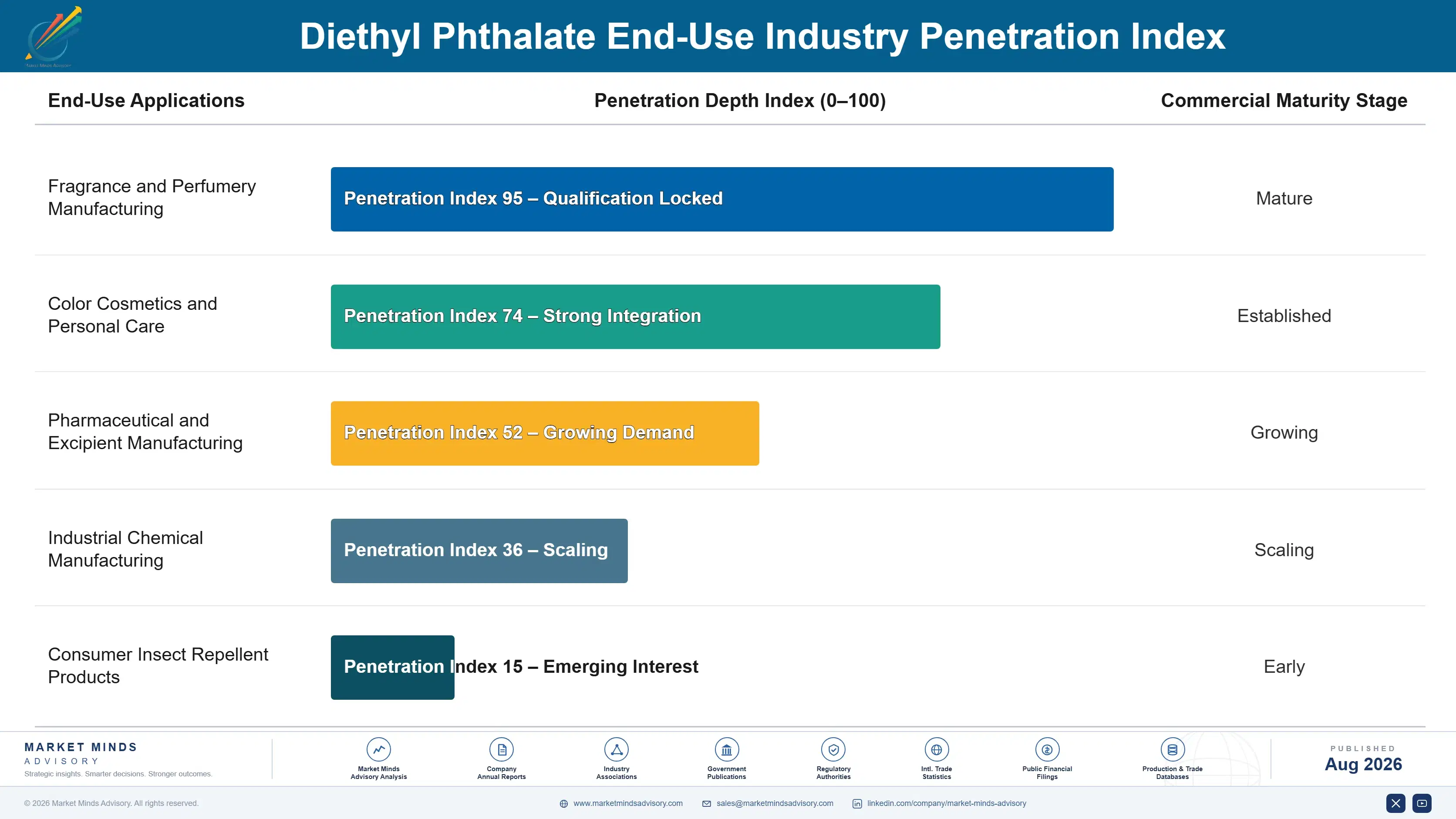
Why Formulator Relationships Run Long

Diethyl phthalate demand behaves like an annuity within fragrance and pharmaceutical formulator relationships, since buyers validate a supplier through extended formulation and regulatory qualification and then source against that relationship for the product lifecycle rather than re-tendering routinely, given the reformulation and regulatory resubmission risk of switching mid-program. Standard industrial buyers behave less predictably, since purchasing decisions follow individual budget cycles and spot availability rather than long-term supply commitment.
Stickiness varies sharply by buyer type and application sensitivity. Fragrance and pharmaceutical formulators rarely switch DEP suppliers once a formulation has been validated, given the reformulation and regulatory resubmission exposure involved in switching mid-program across a multi-year product cycle. Standard industrial buyers show less loyalty, comparing compatible grades on price and delivery reliability for each purchase decision. Cosmetics brand programs sit in between, valuing documentation expertise without the single-supplier commitment industrial procurement lacks.

Buyer profiles are shifting generationally within both fragrance and industrial channels specifically. Cosmetics brand quality teams increasingly treat compound-specific regulatory documentation as a non-negotiable purchase criterion rather than a routine compliance decision, a shift that favors suppliers offering documented toxicology and purity differentiation over those competing purely on generic price compliance alone.
diethyl-phthalate-market-trends-end-use-penetration-index-1787549836186

Where Suppliers Should Bet

These are among the four positions where our research anticipates prominent divergence between winners and laggards over the coming forecast period. Each is grounded in the demand model, the regulatory perimeter, and the announced capacity pipeline.
01 / REGULATORY DOCUMENTATION PRIORITY

Build compound-specific data before scrutiny narrows the field further

Fragrance-grade demand is growing well over 75% faster than the wider market's pace in adjacent color cosmetics applications, and documented formats already command meaningful pricing above standard industrial grades, yet most suppliers still lack dedicated compound-specific toxicology capability at meaningful commercial scale. Suppliers that invest now in independent research position ahead of continuing regulatory scrutiny across every major consumer market. Waiting risks ceding the category's most durable differentiation opportunity permanently to competitors currently building that documentation capability well ahead of broader industry adoption.
02 / PHARMACEUTICAL PURITY DEVELOPMENT

Secure excipient certification before pharmaceutical demand accelerates further

Pharmaceutical-grade DEP commands meaningful premium pricing, and demand from excipient manufacturers has grown considerably faster than the industry's dedicated purity validation capability currently available across established suppliers. Suppliers that secure pharmaceutical-grade certification now capture premium contracts before competitors establish comparable validated purity data, since excipient manufacturers increasingly favor documented consistency in supplier qualification. Every supplier without a certification strategy today risks losing this genuine differentiation opportunity to competitors already locking in pharmaceutical relationships, leaving significant pricing power on the table.
03 / COSMETICS CONSISTENCY DEVELOPMENT

Build formulation validation before color cosmetics demand accelerates further

Suppliers with established cosmetics-grade batch consistency capability command substantial premium pricing, and demand from color cosmetics manufacturers has grown considerably faster than the industry's dedicated consistency validation capacity currently available across established suppliers. Suppliers that invest now in testing infrastructure capture contracts from brands before competitors establish comparable specialized capability. Every supplier relying purely on standard industrial formats risks missing this fast-growing, technically differentiated revenue opportunity entirely, ceding ground to competitors already scaling specialized capacity across multiple brand programs across every major regional market.
04 / LONG-TERM PROGRAM CONTRACTS

Lock formulators into multi-year supply agreements now

Fragrance and cosmetics formulators increasingly prefer multi-year DEP supply commitments over spot purchasing across major product line development, since supply disruption during formulation production carries genuine business continuity risk that formulators cannot comfortably absorb given tightly coordinated product launch scheduling. Suppliers that secure these contracts now lock in demand and pricing before competitors capture the same formulator accounts, since formulators rarely switch DEP suppliers once a formulation has been validated. Every supplier relying purely on spot sales risks missing the category's most durable and valuable revenue opportunity entirely.

Engagement Snapshot From the Field

A live engagement with an industry participant carrying material or product regulatory and market exposure ahead of a defining policy shift, showing how our research translates into a defensible multi-year portfolio strategy.
MARKET MINDS ADVISORY · CLIENT ENGAGEMENT SUMMARY
Diethyl Phthalate Producer Strategic Portfolio Review and Transition Roadmap 2026·Investment Scenario on Diethyl Phthalate Exposure Evaluation 2025-26
CLIENT PROFILE
A mid-sized North American color cosmetics brand manufacturing nail polish and related formulations approached MMA while evaluating whether to consolidate its diethyl phthalate sourcing around a single documented supplier ahead of anticipated retail partner scrutiny. The client reported annual formulation ingredient spending near USD 14 million, with diethyl phthalate sourced from three separate suppliers carrying varying documentation depth (client-reported, unverified by MMA).
STRATEGIC CHALLENGE
Management faced a strategic decision between consolidating sourcing around a single fully documented supplier to simplify retail partner compliance reporting or maintaining multiple suppliers to preserve pricing competition and supply security. The procurement team worried consolidation would reduce negotiating leverage, while the compliance team worried continued multi-supplier sourcing would complicate the documentation retail partners increasingly required.
MMA APPROACH
MMA benchmarked documentation depth and compliance reporting burden across the client's existing supplier base, assessed retail partner documentation requirements relative to each supplier's current capability, and evaluated which consolidation approach offered the most commercially attractive balance between compliance simplification and continued pricing competition and reviewed how comparable brands structured retail partner reporting across multiple product categories.
KEY FINDINGS
  1. Comparable brands that consolidated around a single well-documented supplier reported meaningfully reduced compliance reporting burden compared with brands maintaining fragmented multi-supplier sourcing.
  2. Pricing differences across the client's existing suppliers were smaller than anticipated once documentation and compliance support costs were fully accounted for in the total cost comparison.
  3. One of the client's three existing suppliers already possessed documentation depth exceeding retail partner requirements, offering a natural consolidation candidate without a full supplier transition.
  4. A phased consolidation approach preserving a secondary supplier relationship allowed the client to retain some pricing competition while simplifying primary compliance reporting.
CLIENT PROFILE
A mid-sized North American color cosmetics brand manufacturing nail polish and related formulations approached MMA while evaluating whether to consolidate its diethyl phthalate sourcing around a single documented supplier ahead of anticipated retail partner scrutiny. The client reported annual formulation ingredient spending near USD 14 million, with diethyl phthalate sourced from three separate suppliers carrying varying documentation depth (client-reported, unverified by MMA).
STRATEGIC CHALLENGE
Management faced a strategic decision between consolidating sourcing around a single fully documented supplier to simplify retail partner compliance reporting or maintaining multiple suppliers to preserve pricing competition and supply security. The procurement team worried consolidation would reduce negotiating leverage, while the compliance team worried continued multi-supplier sourcing would complicate the documentation retail partners increasingly required.
MMA APPROACH
MMA benchmarked documentation depth and compliance reporting burden across the client's existing supplier base, assessed retail partner documentation requirements relative to each supplier's current capability, and evaluated which consolidation approach offered the most commercially attractive balance between compliance simplification and continued pricing competition and reviewed how comparable brands structured retail partner reporting across multiple product categories.
KEY FINDINGS
  1. Comparable brands that consolidated around a single well-documented supplier reported meaningfully reduced compliance reporting burden compared with brands maintaining fragmented multi-supplier sourcing.
  2. Pricing differences across the client's existing suppliers were smaller than anticipated once documentation and compliance support costs were fully accounted for in the total cost comparison.
  3. One of the client's three existing suppliers already possessed documentation depth exceeding retail partner requirements, offering a natural consolidation candidate without a full supplier transition.
  4. A phased consolidation approach preserving a secondary supplier relationship allowed the client to retain some pricing competition while simplifying primary compliance reporting.
RECOMMENDED STRATEGY
Phase 1: Phase 1 (0 to 6 months): Consolidate the majority of sourcing volume with the existing supplier offering the strongest documentation depth. Phase 2: Phase 2 (6 to 15 months): Formalize expanded documentation and compliance reporting support with the primary supplier across all retail partner relationships. Phase 3: Phase 3 (15 to 30 months): Maintain a secondary supplier relationship for a smaller volume share to preserve pricing competition and supply security.
OUTCOME
The client completed its primary supplier consolidation and reported meaningfully simplified retail partner compliance reporting within the first six months of the engagement. Retail partners specifically praised the simplified documentation structure. The client is now evaluating further documentation partnership expansion based on the consolidation's documented performance (client-reported, unverified by MMA).

Frequently Asked Questions

Foundational context covering the market sizes, CAGR, scope, country, region and competition that inform every finding below. This section is provided to cover basics and most often pre-purchase conversations, answered from the MMA Primary Research Dataset.

What is the current size of the Diethyl Phthalate Market?

The global diethyl phthalate market reached USD 0.62 billion in 2026, based on MMA Primary Research Dataset findings. Growth increasingly reflects fragrance and cosmetics-grade demand rather than standard industrial volume alone.

How large will the Diethyl Phthalate Market be by 2036?

MMA's base case projects the market reaching USD 0.90 billion by 2036, an incremental opportunity of roughly USD 0.28 billion over the 2026 to 2036 forecast period.

What is the CAGR for the Diethyl Phthalate Market 2026 to 2036?

The base case CAGR is 3.8%, with a bull case of 5.0% and a bear case of 2.6% depending on regulatory scrutiny and color cosmetics adoption pace.

Which segment is growing fastest?

Nail polish and color cosmetics applications lead at a 6.8% CAGR, well over 75% faster than the overall market rate, as manufacturers specify documented film-forming performance.

Who are the major companies in the Diethyl Phthalate Market?

Leading participants include Eastman Chemical Company, Lanxess AG, UPC Technology Corporation, Hallstar Company, and KLJ Group, assessed on documentation and formulation program breadth worldwide across fragrance, cosmetics, and pharmaceutical application segments.

Which country is growing fastest?

India leads country-level growth at 7.5% annually, driven by its rapidly expanding personal care manufacturing, ahead of every other emerging cosmetics manufacturing market and its rapidly growing color cosmetics manufacturing base.

Report Segmentation Architecture

The full report scope spans multiple orthogonal segmentation dimensions, with cross-tabulated demand data provided for each dimension pair. Coverage extends further to regional breakdowns, trend trajectories, and the competitive detail needed to support segment-level decision-making.

By End-Use Application

  • Fragrance and Cosmetic Fixative Applications
  • Cellulose Acetate Plastics and Film Applications
  • Pharmaceutical Coating and Excipient Applications
  • Insect Repellent and Personal Care Formulation Applications
  • Industrial Solvent and Specialty Coating Applications
  • Nail Polish and Color Cosmetics Applications

By End-Use Industry

  • Fragrance and Perfumery Manufacturing
  • Color Cosmetics and Personal Care
  • Pharmaceutical and Excipient Manufacturing
  • Industrial Chemical Manufacturing
  • Consumer Insect Repellent Products

By Commercial Dimension

  • Direct Formulator Supply Contracts
  • Chemical Distributor Sales
  • Regulatory Documentation Service Contracts
  • Long-Term Brand Partnership Agreements

By Region

  • North America
  • Western Europe
  • East Asia
  • South Asia and Pacific
  • Latin America
  • Middle East and Africa
  • Eastern Europe

Scope, Methodology, and Coverage

Every figure in this report is reproducible from documented input assumptions. The scope below maps the historical period, the forecast horizon, the segmentation dimensions, and the countries covered, alongside the underlying primary and qualitative methodology.
Historical Period
2020 to 2025
Forecast Period
2026 to 2036
Base Year
2025 (USD billions; MMA Primary Research Dataset, August 2026)
Market Definition
The diethyl phthalate market covers commercial production and sale of diethyl phthalate used as a fragrance fixative, cellulose acetate plasticizer, pharmaceutical coating excipient, insect repellent carrier, industrial solvent, and color cosmetics formulation ingredient. It excludes other phthalate ester chemistries such as dibutyl phthalate and diethylhexyl phthalate, which the industry classifies as distinct chemical products with separate regulatory and application profiles.
Quantitative Units
USD billions (current prices); metric tons of diethyl phthalate produced and sold where applicable
Segmentation Dimensions
By End-Use Application; By End-Use Industry; By Commercial Dimension; By Region
Regions Covered
North America, Western Europe, East Asia, South Asia and Pacific, Latin America, Middle East and Africa, Eastern Europe
Countries Covered
USA, China, Germany, France, UK, Japan, South Korea, India, Australia, Canada, Brazil, Mexico, Indonesia, Vietnam, Thailand, Malaysia, UAE, Saudi Arabia, South Africa, Nigeria, Turkey, Poland, Netherlands, Italy, Spain, Sweden, Switzerland, Argentina, Colombia, Singapore, and additional markets relevant to this sector
Key Companies Profiled
Eastman Chemical Company, Lanxess AG, UPC Technology Corporation, Hallstar Company, KLJ Group, Aekyung Petrochemical Co Ltd, Jiangsu Yida Chemical Co Ltd, Shandong Qilu Plasticizers Co Ltd, Nan Ya Plastics Corporation, LG Chem Ltd, Vertellus Holdings LLC, Ferro Corporation, Merck KGaA, BASF SE, Vibrantz Technologies Inc, Elementis plc, Emerald Kalama Chemical LLC, Cepsa Quimica SA, Camlin Fine Sciences Limited, Vizag Chemical International
Quantitative Methodology
Primary survey, n=3,800 respondents, Q4 2025, six countries; demand-side model with trade association cross-validation
Qualitative Methodology
47 expert interviews, Q4 2025; applied to validate demand model assumptions, identify emerging dynamics, and assess competitive positioning
Report Format
PDF and XLSX data workbook (Word format preview document)
Publisher
Market Minds Advisory
Report Code
MMA-2026-CHM-103
Published
August 2026
Contact
sales@marketmindsadvisory.com | www.marketmindsadvisory.com

Purchase the full Diethyl Phthalate Market Report (2026 to 2036).

The full MMA Diethyl Phthalate report sizes the market across six end-use application segments, five end-use industries, four commercial supply models, and seven regions through 2036. It profiles twenty participants on a consistent basis of documentation and formulation program breadth across standard, fragrance, and pharmaceutical-grade formats, scoring each on regulatory documentation investment, purity validation depth, and cosmetics consistency readiness. Scenario models quantify how regulatory scrutiny, color cosmetics growth, and feedstock cost conditions move both category volume and pricing. The report includes phthalic anhydride cost modeling, a regulatory documentation benchmark, and cosmetics-grade validation pathway assessment built for personal care and investment strategy teams.
Six-application demand model with documentation-adjusted pricing
Phthalic anhydride and ethanol cost volatility modeling
Regulatory documentation pathway benchmarking scoring model
Twenty-company competitive profiling on consistent program basis
Seven-region demand map with country-level growth detail
Pharmaceutical purity and cosmetics consistency assessment

Built For The People Who Decide

From boardroom strategy to bench-side execution, this report is read cover-to-cover by leaders shaping the next decade of their industry, turning demand scenarios, market dynamics and valuation benchmarks into decisions.
CXOs/ Presidents/ VPs/ Managers
M&A and Corporate Development
Strategy Teams and R&D Heads
Procurement and Product Directors
Regulatory and Compliance Leaders
Investor Relations and Equity Analysts