Market Minds Advisory
Diesel Power Engine Market

Diesel Power Engine Market: Data Centre Backup, Renewable Diesel Approvals, and an Asset That Runs Thirty-Eight Hours a Year

A technology written off a decade ago is now sold out for two years because hyperscale data centres will not accept anything else for multi-day resilience, and nothing available has replaced it.

Lead Analyst

David Horsley

Published

September 2026

Make Smarter Decisions with Customized Research Insights

Request a free sample report and evaluate market opportunities, growth trends, and competitive dynamics relevant to your business needs.

2025 MARKET VALUE$14.8BMarket Size 2025
2036 FORECAST VALUE$27.8BBase Case , 2026 to 2036
CAGR 2026 TO 20365.9 %Bull 7.1% / Bear 4.7%
INCREMENTAL OPPORTUNITY$12.1BNet 10- year value creation
EXPANSION MULTIPLE1.77x2036 value over 2026 base
Strategic Levers
M&A Pipeline
Regional Outlook
Country Rankings
Competitive Intelligence
Segmental Deep-dive
Call-Us : 91 93563 13602

Executive Snapshot and Market Trajectory

A standby diesel engine runs roughly thirty-eight hours in a year and exists to do nothing well. That single fact explains why fuel efficiency barely features in the purchase decision while starting reliability, load acceptance, and parts availability decide everything. Buyers pay for confidence rather than for performance data.
Commercial power sits with manufacturers holding large-frame capacity and aftermarket coverage rather than with anyone able to build a diesel engine. Engines above 2 MW grow fastest at 9.4%, roughly 1.59 times the market, pulled almost entirely by data centre backup requirements. East Asia holds 29% of total global value, carried by Chinese manufacturing scale alongside regional industrial and data centre demand together.
Concentration is high at roughly 52% for the top five, and large-frame engine capacity is the reason, since few manufacturers can build above two megawatts at volume. Data centres now take 24% of large engine value, and their lead times run into years. Renewable diesel approval has become a genuine selling point. Delivery slots rather than price are what data centre developers now negotiate over. Order books extend into 2028 across large frames.
Market Definition
The market comprises diesel engines supplied for stationary electrical power generation, covering ratings below 75 kW, 75 to 375 kW, 375 to 750 kW, 750 kW to 2 MW, and above 2 MW. Value is measured at engine manufacturer level including aftermarket parts and service. On-highway vehicle engines, marine propulsion engines, off-highway mobile equipment engines, gas and dual-fuel generating engines, alternators, and complete packaged generator sets sold by integrators fall outside scope.
Base Year Value
$14.8B in 2025 (MMA Primary Research Dataset, August 2026)
Forecast Period
2026 to 2036, eleven discrete annual values
CAGR
5.9% base case. Bull 7.1%. Bear 4.7%.
Fastest Growth Segment
Above 2 MW Power Engines: 9.4% CAGR
Fastest Growth Country
India: 9.2% CAGR
Fastest Growth Region
South Asia and Pacific: 8.0% CAGR
Largest Region
East Asia: 29% of 2025 global value
Market Leaders
Caterpillar, Cummins, Rolls-Royce Power Systems, Wärtsilä, and Mitsubishi Heavy Industries lead on stationary power engine revenue. Source: company annual reports and MMA Analysis, July 2026.
Primary Survey
n=3,800 procurement and R&D decision-makers, Q4 2025, six countries
Methodology
Demand-side build-up, cross-validated against public data, 47 expert interviews

Diesel Power Engine Market Forecast Scenarios

diesel-power-engine-market-trends-size-forecast-scenario-1787549148528
Between 2020 and 2025 the market recovered from an expected decline into an unexpected shortage. Emissions rules and decarbonisation commitments suggested diesel generation would shrink, and data centre construction instead created demand faster than anyone had built capacity to supply. Lead times on large frames stretched past eighteen months. Component and casting costs rose sharply. The 4.6% historical growth understates a market that changed direction partway through.
The 5.9% base case rests on three mechanisms. Data centre construction keeps demanding multi-day resilience that battery storage cannot economically provide, and every hyperscale campus specifies diesel backup regardless of its renewable commitments. Grid reliability continues deteriorating in several developed markets while remaining poor across much of Asia and Africa. And renewable diesel approvals let operators claim decarbonisation progress without replacing an asset that has thirty years of life left in it.
The 7.1% bull case assumes data centre construction holds at present rates and grid instability worsens across developed markets. The 4.7% bear case reflects data centre capital discipline, battery storage costs falling far enough to cover longer outages, and Chinese manufacturers compressing pricing across the mid-range where technical differentiation is weakest. Battery cost curves matter more than diesel policy here.

An Insurance Policy That Happens to Burn Fuel

Three things set the commercial shape of this market. Availability comes first, because a standby engine exists to start when everything else has failed, and buyers pay for confidence rather than for performance. Large-frame capacity comes second, since building above two megawatts requires casting, machining, and test capability that few manufacturers possess. Emissions classification comes third and creates an unusual regulatory asymmetry.
TOP-FIVE CONCENTRATION52%Share of global power engine shipments held by leading manufacturers
AVERAGE SELLING PRICEUSD 148 per kWBlended engine pricing across mainstream stationary power ratings
DATA CENTRE DEMAND SHARE24%Portion of large engine value from data centre backup
ANNUAL RUNNING HOURS38 hoursTypical standby engine operation across a full year
AFTERMARKET REVENUE SHARE31%Portion of manufacturer revenue from parts and service
EMISSIONS COMPLIANCE COST19%Aftertreatment content within total engine manufacturing cost overall
That asymmetry deserves attention. Engines certified for emergency standby duty face far lighter emissions requirements than prime power units in most jurisdictions, because they run so few hours that their contribution is negligible. Aftertreatment content is 19% of manufacturing cost where it applies, so standby classification materially changes both product cost and what a customer actually receives.
Renewable diesel has changed the conversation without changing the hardware. Hydrotreated vegetable oil is a drop-in replacement that most modern engines run without modification, and manufacturer approval for its use has become a genuine specification requirement for data centre operators with emissions commitments. The fuel costs more, and the operator gets to keep an asset with decades of remaining life rather than replacing it with something unproven.
"The industry spent ten years being told diesel gensets were finished, and then every hyperscaler in the world discovered that batteries are wonderful for eight minutes and useless for eight hours. Order books are now full into 2028. Nothing about the technology improved; the alternative simply failed to arrive."
Practice Director, Power Generation and Distributed Energy Equipment · MMA Energy and Power Equipment Practice · August 2026

Market Trends

Data Centre Resilience Requirements Rebuilt Large Engine Demand

Hyperscale and colocation operators specify multi-day fuel-based backup because battery storage economics collapse beyond a few hours of autonomy, and no operator will accept an outage risk measured against uptime penalties in the millions. Data centres now take 24% of large engine value and the share keeps rising with campus construction. Orders arrive years ahead of commissioning, which has given manufacturers visibility that this industry has rarely enjoyed. What matters commercially is that these buyers specify redundancy generously and treat engine cost as trivial against the consequence of a failure they cannot explain.
Market Impact: Outage duration up over 20%
Renewable Diesel Approval Becomes a Specification Requirement

Hydrotreated vegetable oil runs in most modern diesel engines without modification and cuts lifecycle emissions substantially, which lets an operator meet decarbonisation commitments while keeping an asset with thirty years of life remaining. Manufacturer approval for the fuel has consequently moved from a technical footnote to a tender requirement among data centre and institutional buyers. Engines without documented approval are being excluded from shortlists regardless of price or delivery. The approval work itself is modest, and manufacturers who completed it early are winning specifications that competitors cannot currently bid for at all.
Market Impact: Aftermarket supplies 31% of revenue

Market Opportunities and Growth Drivers

Grid Reliability Deterioration Extends Backup Demand Into New Sectors

Transmission constraints, weather-driven outages, and generation mix changes have made supply less predictable across several developed markets that previously took reliability for granted. Commercial buildings, healthcare facilities, water utilities, and manufacturing sites are specifying backup where none previously existed, and insurers increasingly ask about it. In emerging markets the driver is simpler still, with grid unavailability making prime and continuous power a routine operating requirement rather than an emergency provision. Both patterns expand the installed base that will generate aftermarket revenue for decades regardless of what happens to new unit demand.
Market Impact: Lead times exceed 18 months

Aftermarket Revenue Compounds With Every Unit Installed

Parts, service, load bank testing, fuel polishing, and overhauls together supply 31% of manufacturer revenue at margins well above new engine sales, and the relationship persists for the twenty-five to thirty years a standby unit remains in service. Because these engines run so few hours, they rarely wear out and are instead maintained against a calendar rather than an hour meter, which makes the revenue unusually predictable. Manufacturers with dealer networks capable of reaching every installed unit hold an annuity that competitors selling through distributors simply never see. Distributor-sold engines rarely generate any of it.
Market Impact: Storage covers 4 hour outages

Market Restraints and Challenges

Large Frame Capacity Cannot Expand Quickly Enough

Lead times on engines above two megawatts stretched past eighteen months and in some configurations considerably further, and manufacturers cannot resolve that inside a planning cycle. The root cause is upstream: large castings, crankshaft forgings, and engine test cell capacity all require specialist suppliers and multi-year investment nobody made when the technology looked terminal. Expanding now risks building capacity for a demand surge that may not persist. Manufacturers mitigate through allocation to strategic accounts, supplier capacity reservation, and premium pricing for delivery slots, none of which adds a single engine.
Market Impact: Data centres take 24% of value

Battery Storage Encroaches on Shorter Duration Applications

Lithium storage now covers outages measured in minutes and increasingly in a few hours at costs that compare favourably with maintaining a small standby engine. The root cause is straightforward cost decline in cells combined with genuinely better round-trip behaviour for brief interruptions. Small and mid-range engine demand is where this bites, since large multi-day resilience remains economically out of reach for storage. Manufacturers mitigate through hybrid packages pairing storage with a smaller engine, and by concentrating development on the large-frame ratings storage cannot practically address. Hybrid packaging is the response most manufacturers have chosen.
Market Impact: Cuts lifecycle emissions above 60%
4 additional market trends, 3 additional growth drivers, and 2 additional restraints and challenges are covered in the full report. Contact sales@marketmindsadvisory.com to access the complete intelligence.

Segment CAGR and Growth Architecture

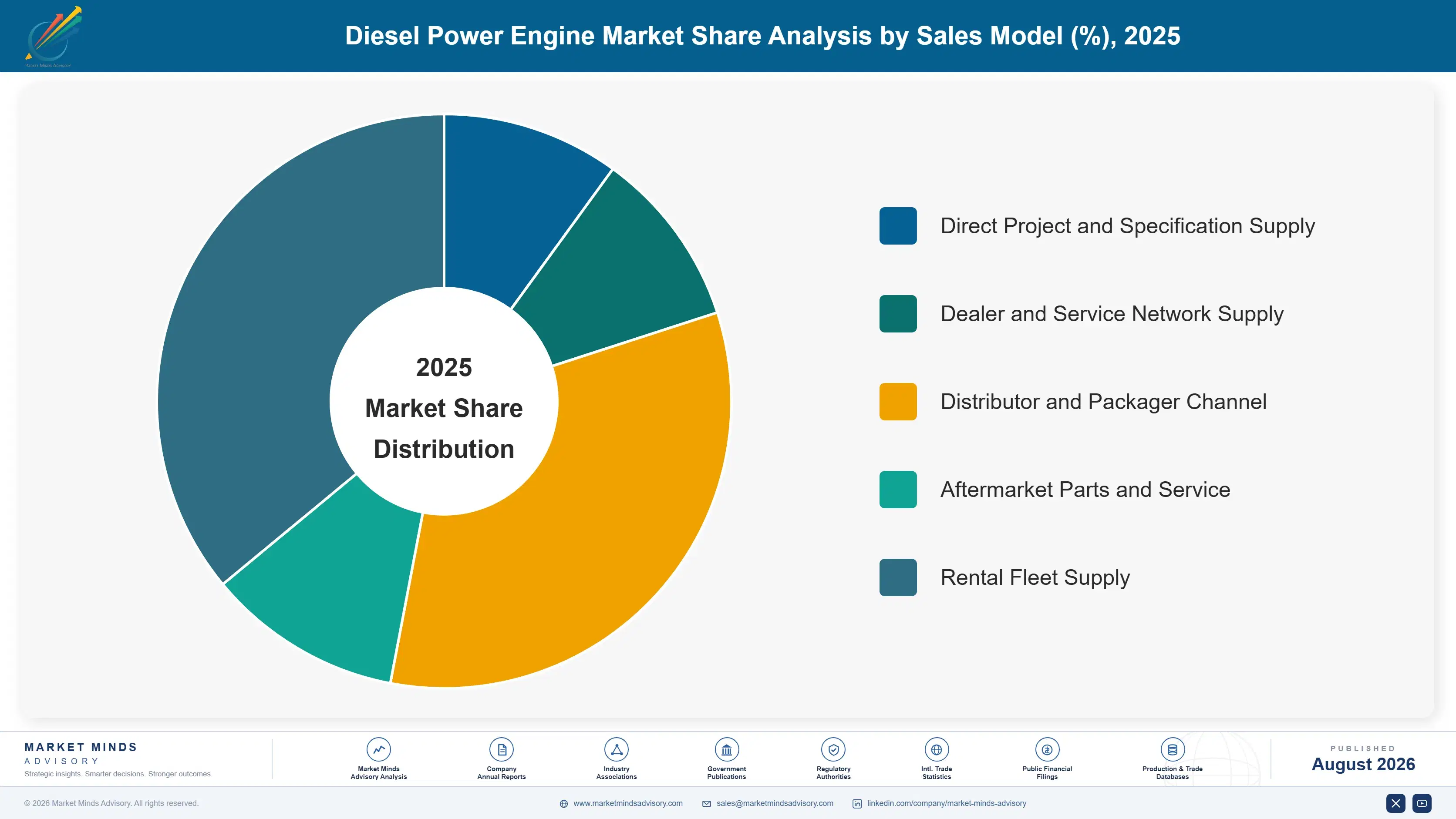
Segmentation follows power rating, because output band determines application, manufacturing capability required, emissions classification, competitive field, and price per kilowatt. Five bands cover commercial supply, and they compete hardly at all, since the manufacturers able to build above two megawatts are largely different companies from those serving small standby duty. Battery substitution reaches only the smallest bands.
diesel-power-engine-market-trends-market-share-analysis-1787549149060

Above 2 MW Power Engines

The fastest-growing band at 9.4%, roughly 1.59 times the market, and the segment where nearly all the recent excitement sits. Hyperscale data centre campuses specify multiple units in this range because redundancy requirements multiply the installed capacity well beyond actual load. Manufacturing capability is the binding constraint: large castings, crankshaft forgings, and test cells are held by very few suppliers and cannot be added quickly. Lead times past eighteen months have allowed premium pricing for delivery slots, which is an unusual position for a mature industrial product. Renewable diesel approval and load acceptance performance are the technical criteria that decide awards among the manufacturers who can actually supply. Redundancy multiplies installed capacity well beyond actual campus load.
CAGR 9.4%

750 kW to 2 MW Power Engines

Second fastest at 7.9%, serving colocation data centres, hospitals, large commercial buildings, and industrial sites where a single unit covers the critical load. This is the band where hybrid configurations pairing an engine with battery storage make most commercial sense, since storage handles brief interruptions while the engine covers extended outages. Competition is broader here than above two megawatts, with Chinese and Korean manufacturers competing credibly on price and increasingly on emissions compliance. Aftermarket attachment is strong because these units serve institutional owners who maintain them on strict schedules and value dealer response times far more than they value a lower purchase price. Institutional owners in this band buy on service response above almost everything else.
CAGR 7.9%
Full segment breakdown across 5 segments available in the complete report.

Regional Architecture and Country Demand Map

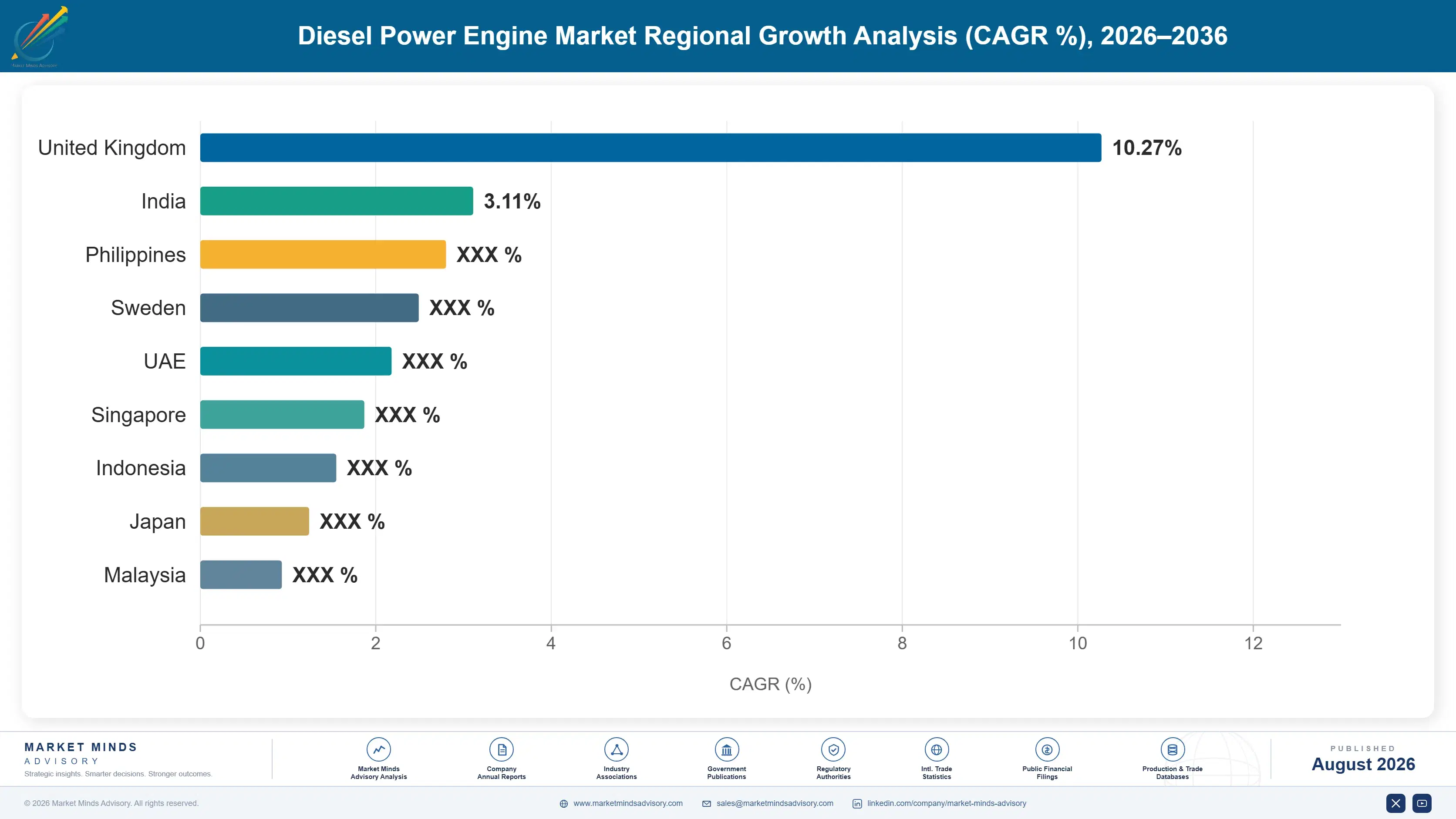
Regional shares follow grid reliability, data centre construction, and manufacturing location together. Emerging markets consume enormous unit volumes at low value per unit, while developed markets buy fewer and much larger engines for resilience rather than for primary supply. Emissions classification differs enough between them to change product cost materially.

North America

Data centre construction dominates the value story here and has transformed a market that was expected to shrink. Hyperscale campuses across Virginia, Texas, Arizona, and the Midwest specify large engines in numbers that redundancy requirements multiply well beyond actual load, and orders now run years ahead of commissioning. Grid reliability concerns following weather events in Texas and California extended backup specification into commercial and institutional buildings that previously had none. Emergency standby emissions classification keeps aftertreatment content out of much of this equipment. Caterpillar and Cummins hold commanding positions built on dealer networks that reach every installed unit for aftermarket work. Growth of 6.9% rests heavily on data centre capital continuing.
Share: 26% | CAGR: 6.9% (2026 to 2036)

Western Europe

Slower growth and stricter regulation define this market, with Stage V emissions requirements applying more broadly than comparable American rules and several jurisdictions restricting standby engine operation and testing hours. Data centre construction across Ireland, the Netherlands, and the Nordics has been constrained by grid connection availability rather than by demand, which caps engine volumes indirectly. Renewable diesel adoption is furthest advanced here, and manufacturer approval for the fuel is effectively mandatory in institutional tenders. Rolls-Royce Power Systems and MAN Energy Solutions anchor regional manufacturing alongside strong Scandinavian and German engineering positions. Growth of 4.4% is the slowest in the report and reflects regulatory friction as much as any demand weakness.
Share: 18% | CAGR: 4.4% (2026 to 2036)
Regional intelligence for 5 additional markets available in the complete report: East Asia, South Asia and Pacific, Latin America, Middle East and Africa, Eastern Europe. Contact sales@marketmindsadvisory.com.
diesel-power-engine-market-trends-country-cagr-analysis-1787549149624

Four Moves That Change the Economics

Advantage here comes from large-frame capacity, aftermarket reach, and fuel approval status rather than from engine design, which across the industry converged years ago. Four moves are worth capital and management attention across the forecast period, and the first requires committing capital against a demand surge that may or may not persist. The other three cost effort rather than money.

Reserve upstream casting and forging capacity now

Lead times above two megawatts exceed eighteen months because large castings, crankshaft forgings, and test cells sit with specialist suppliers who did not invest while the technology looked terminal. Reserving that capacity through multi-year commitments costs perhaps $15 million to $40 million in prepayment and take-or-pay exposure, and it converts a delivery constraint into a competitive weapon while competitors quote 2028. Data centre buyers currently pay premiums for delivery slots rather than negotiating price, which is an unusual and temporary position worth exploiting deliberately. The window will close once competitors finish their own capacity investments.
Market Impact: Costs $15 million to $40 million in prepayment

Certify the whole range for renewable diesel

Hydrotreated vegetable oil approval has moved from technical footnote to tender requirement among data centre and institutional buyers with emissions commitments, and engines lacking documented approval are being excluded from shortlists outright. The testing and validation work costs perhaps $400,000 to $900,000 per engine family and takes under a year, which is trivial against the tenders it opens. Operators value it because it lets them claim above 60% lifecycle emissions reduction while keeping an asset with thirty years of remaining life rather than replacing it. Validation work is modest and the tenders it opens are not.
Market Impact: Claims above 60% in lifecycle carbon emission reduction

Extend dealer service reach to every installed unit

Aftermarket supplies 31% of revenue at margins well above new engines, and a standby unit stays in service twenty-five to thirty years generating calendar-based maintenance the whole time. Manufacturers whose dealers can physically reach every installed engine capture that annuity, and those selling through distributors watch independent service firms take it instead. Building coverage costs technicians, parts depots, and diagnostic tooling rather than manufacturing capital, and each unit sold permanently enlarges the base the investment serves. Independent service firms take the revenue wherever coverage is absent. Every installed unit enlarges the base permanently.
Market Impact: Captures 31% of the entire industry revenue base

Package hybrid storage with mid-range engines

Battery storage now handles outages up to roughly four hours economically and is taking demand from small and mid-range standby engines, which is a category manufacturers cannot defend on cost alone. Packaging storage alongside a smaller engine covers brief interruptions on batteries and extended ones on fuel, which reduces engine size 30 to 45% while improving the customer's operating economics measurably. It turns a substitution threat into a system sale, and it requires storage partnerships and controls integration rather than engine development. Storage partnerships and controls integration are the requirement, not engine work.
Market Impact: Reduces required engine size by 30 to 45%

Who Controls the Margin Pool

Concentration is high: the top five hold roughly 52% of global stationary power engine revenue, and large-frame manufacturing capability rather than commercial reach explains most of it. Caterpillar and Cummins lead through combined manufacturing scale and dealer networks that reach installed units for aftermarket work across decades. Rolls-Royce Power Systems, Wärtsilä, and Mitsubishi each hold strong positions at the large end where few competitors can build at all.
Competitive activity runs on three fronts. Delivery capability is the first and currently the most decisive, because a manufacturer quoting 2028 loses to one quoting 2027 regardless of any other consideration. Aftermarket network density is the second, and it determines who captures the revenue that follows every installation. Fuel approval status is the third, and it now screens bidders before technical evaluation begins.

Pressure is building from two directions. Chinese manufacturers compete effectively across mid-range ratings in emerging markets and are moving upward in capability. And battery storage suppliers are taking short-duration applications entirely, which erodes the small engine base that once funded dealer coverage. The first pressure reaches emerging markets first and the second reaches developed ones, which means very few manufacturers escape both of them entirely.
diesel-power-engine-market-trends-company-positioning-matrix-1787549150144

Competitive Moat and Risk Dimensions

CATERPILLAR

Moat: Dealer network reaching every unit

An independent dealer network with parts depots and technicians positioned to reach installed engines anywhere gives Caterpillar an aftermarket annuity across the twenty-five to thirty years a standby unit remains in service. Buyers specifying critical backup weigh service response above almost everything, which makes that network a purchasing argument rather than merely a support function.
CATERPILLAR

Risk: Capacity constraint at large frames

Order books extending years ahead protect pricing today and hand competitors an opening tomorrow, because a data centre developer who cannot get a delivery slot will qualify somebody else rather than delay a campus. Every quarter of extended lead time gives challengers a reason to be evaluated that no amount of commercial effort would otherwise create.
CUMMINS

Moat: Range breadth and emissions capability

Covering ratings from small standby units through large-frame engines with consistent controls, emissions technology, and service support lets Cummins serve a customer's whole estate rather than one application within it. Aftertreatment expertise developed for on-highway markets transfers directly and gives real advantage wherever prime power emissions rules apply strictly.
CUMMINS

Risk: Exposure to mid-range substitution

A broad range means substantial exposure to precisely the small and mid-range ratings that battery storage is now taking economically for short-duration applications. Defending those volumes on engine cost alone is not possible against falling cell prices, which forces investment in hybrid packaging that competes with the company's own product.

Players Tracked

Prominent Players

Caterpillar
Cummins
Rolls-Royce Power Systems
Wärtsilä
Mitsubishi Heavy Industries

Other Key Players

Kohler
Generac
Volvo Penta
Deutz
Yanmar
Kubota
HD Hyundai Infracore
Weichai Power
Guangxi Yuchai Machinery
SDEC
Kirloskar Oil Engines
Mahindra Powerol
MAN Energy Solutions
Scania
Ashok Leyland

Recent Developments

MARCH 2025

Manufacturer expands large frame engine capacity

Additional machining and assembly capacity for engines above two megawatts entered service, responding to data centre order books extending years ahead of commissioning. Upstream casting and forging supply rather than assembly capability had been the binding constraint on how quickly output could rise. Delivery dates improved marginally.
Signal: Capacity investment is finally following the data centre surge, though upstream castings remain the real bottleneck
JULY 2025

Renewable diesel approval extended across engine range

A major manufacturer completed validation for hydrotreated vegetable oil across its full stationary power range, publishing approval documentation for warranty purposes. Data centre and institutional tenders had begun excluding engines without documented approval regardless of pricing or delivery position. Warranty terms were published alongside the approval documentation for operator reference.
Signal: Fuel approval has become a screening criterion, deciding who gets evaluated before technical comparison even begins
NOVEMBER 2025

Hybrid storage and engine package launched commercially

A packaged system pairing battery storage with a reduced-size diesel engine was introduced for commercial and institutional backup, covering brief interruptions on batteries and extended outages on fuel. The configuration targets applications where storage alone had begun displacing small standby engines entirely. Commercial buyers had begun choosing storage alone.
Signal: Manufacturers are now packaging the substitute rather than fighting it, which protects the extended outage revenue

What Sets the Cost Base

Castings and forgings dominate at roughly 29% of manufacturing cost, covering blocks, heads, crankshafts, and connecting rods from a specialist supplier base that contracted sharply during the years diesel looked terminal. Emissions aftertreatment contributes 19% where it applies, which is why standby classification materially changes product cost. Fuel systems, turbochargers, and controls take 21% between them. Assembly labour, testing, and warranty provision absorb the balance across typical manufacturing operations.
The period from 2021 onward exposed the casting supply base badly. Foundry capacity had been rationalised through the previous decade, semiconductor shortages delayed engine controls, and steel and aluminium costs rose sharply. Caterpillar and Cummins both referenced supply chain constraints and input cost inflation across their reporting for those years. Lead times extended past eighteen months on large frames, and output went to strategic accounts.

Exposure divides on supplier relationships and product mix rather than on scale. Manufacturers holding reserved casting and forging capacity delivered while competitors queued, and that difference cost real market positions among buyers who could not wait. Aftertreatment exposure splits the field differently again, falling entirely on prime power products while standby-classified engines avoid it, which makes product mix matter more than manufacturing efficiency.
diesel-power-engine-market-trends-cost-volatility-analysis-1787549150340

Reserve foundry and forging capacity on multi-year terms

The specialist supplier base for large castings and crankshaft forgings contracted while diesel looked terminal and cannot expand inside a planning cycle. Multi-year reservation agreements with prepayment secure allocation priority when demand surges again. The cost is committed volume through any downturn, which is uncomfortable, and it proved far cheaper than losing accounts to competitors who could deliver.

Standardise controls platforms across the rating range

Engine controls and instrumentation were the binding constraint during the semiconductor shortage and remain exposed to electronics supply cycles. Running one controls platform across every rating raises volume per part number, improves supply priority, and reduces the engineering effort on each configuration. The trade-off is losing some optimisation at the extremes of the range, which most manufacturers accept willingly.

Design product mix around emissions classification boundaries

Aftertreatment is 19% of cost where it applies and nothing where standby classification exempts the engine. Configuring products deliberately around those boundaries, rather than treating classification as a compliance afterthought, changes cost position materially on identical hardware. It requires regulatory strategy to sit inside product planning rather than following it, which surprisingly few manufacturers organise properly.

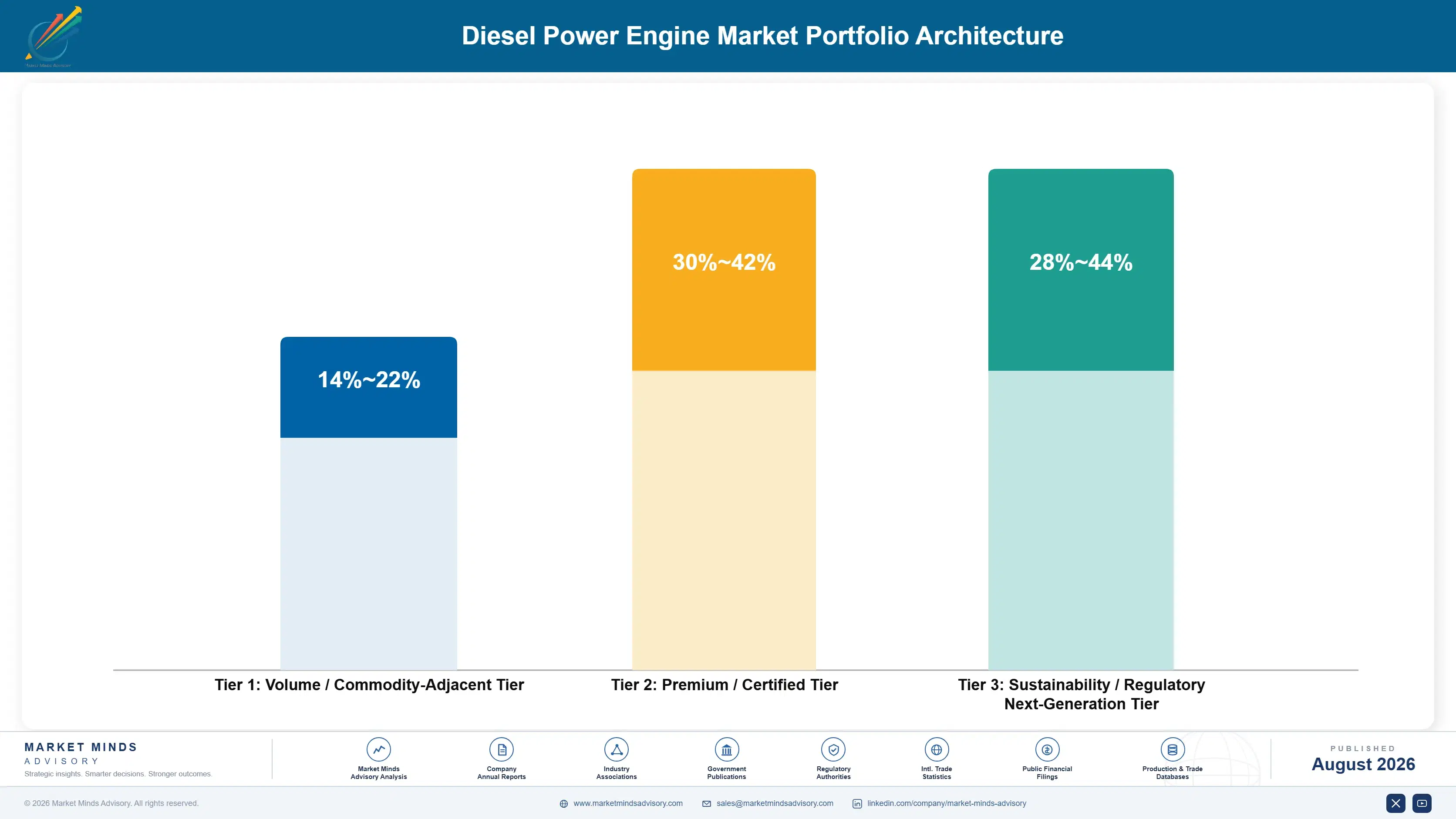
Portfolio Architecture for Margin Defence

Margin follows rating band and aftermarket attachment rather than volume. Small standby engines sold through distribution earn modest gross margin against Chinese and Indian competition, and battery storage is now taking part of that demand outright. Large-frame engines earn considerably more, because only a handful of manufacturers can build them and buyers currently pay premiums for delivery slots rather than negotiating on price at all.
The volume and premium tension shows in dealer economics rather than in factory loading. Small engine volumes justify the dealer coverage and parts depots that make large engine aftermarket service possible, so losing that base to storage weakens the network supporting the profitable business. That is the strategic problem hybrid packaging is really meant to solve, whatever the marketing says about it.

High-value pools concentrate in three places: large-frame engines for data centre backup, aftermarket parts and service across the installed base, and renewable diesel certified products for institutional buyers. Each is defended by capacity, network reach, or approval status rather than by price. Price competition arrives in each only when a competitor secures casting capacity, builds dealer reach, or completes fuel validation, and the first of those takes years.

Volume / Commodity-Adjacent Tier

Small standby engines below 375 kW sold through distribution into commercial and light industrial backup. Competes against Chinese and Indian manufacturers on price. The wide range reflects large differences in manufacturing cost and emissions classification.
Gross Margin: 14%-22%

Premium / Certified Tier

Large-frame engines above 2 MW supplied with commissioning support and delivery commitments into data centre and critical infrastructure projects. The buyer purchases availability and delivery certainty rather than hardware specification.
Gross Margin: 30%-42%

Sustainability / Regulatory / Next-Generation Tier

Renewable diesel certified engines, hybrid storage packages, and low-emission prime power configurations. Fuel approval and emissions commitments drive selection. The range is wide because hybrid package pricing has not yet settled commercially.
Gross Margin: 28%-44%
diesel-power-engine-market-trends-portfolio-architecture-1787549150840

High-value Sub-segments and Strategic Watch-out

Large Frame Data Centre Engines

The strongest position in this market, protected by casting and test capacity that cannot be added quickly by anyone. Buyers currently pay premiums for delivery slots rather than negotiating price. Reserve upstream capacity while the surge continues. The pricing position will not last indefinitely. Move now.
Gross Margin: 32%-44%

Installed Base Aftermarket Service

Supplies 31% of revenue at premium margins across the twenty-five to thirty years a standby unit stays in service. Calendar-based maintenance makes it unusually predictable. Only manufacturers whose dealers reach every unit actually capture it. Build coverage before the installed base ages further. Act early.
Gross Margin: 38%-52%

Renewable Diesel Certified Products

Approval has become a screening criterion rather than a differentiator, so absence excludes a bidder before evaluation. Validation costs under a million dollars per engine family. Institutional and data centre tenders are where it decides awards. Complete validation across the whole range quickly. Do it now.
Gross Margin: 30%-42%

Small Standby Engine Supply

The strategic watch-out. Battery storage covers the outage durations these units address, and Chinese manufacturers set the price on what remains. It funds dealer coverage that the profitable large engine business depends on entirely. Defend it for the network, not the margin. Manage carefully. Price it low.
Gross Margin: 14%-21%

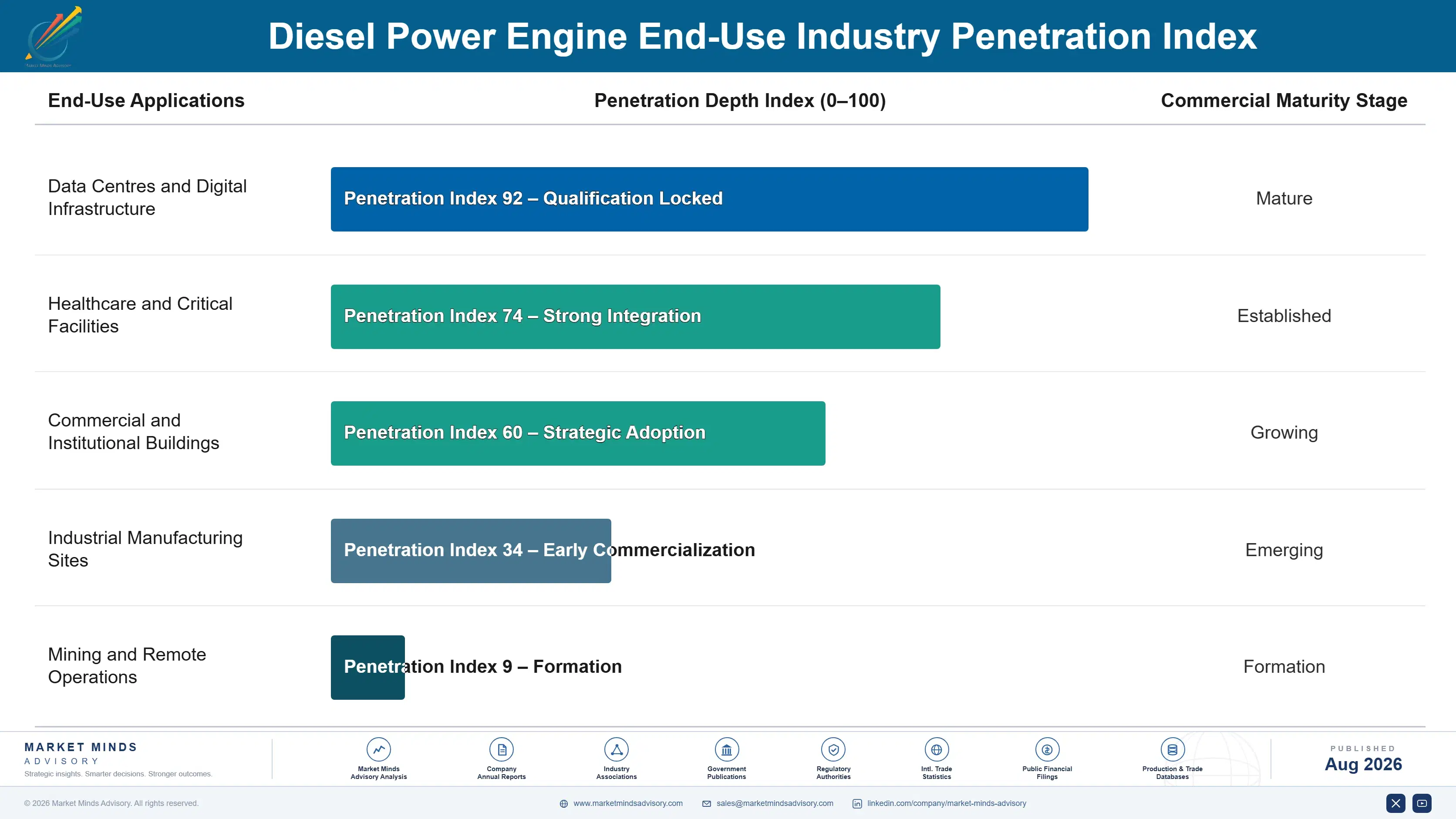
How Demand Actually Reaches Manufacturers

The annuity here is exceptional and widely underestimated. A standby engine runs thirty-eight hours a year, rarely wears out, and stays in service twenty-five to thirty years while consuming scheduled maintenance, load bank testing, fuel polishing, and eventual overhaul throughout. That produces 31% of manufacturer revenue on a calendar rather than an hour meter, which makes it more predictable than almost any industrial aftermarket. New unit sales swing with construction cycles while the service base only grows.
Adoption depth varies sharply by buyer type. Data centre operators run the deepest specifications because uptime penalties dwarf any equipment cost, and they buy redundancy generously. Healthcare and water utilities buy to regulatory resilience requirements. Industrial sites weigh outage cost against capital. Commercial building owners buy the minimum their insurer or code requires and switch on price. That spread makes portfolio positioning unusually consequential.

The buyer has shifted toward critical facilities engineers and resilience planners rather than procurement. Those specialists evaluate service response commitments and fuel approvals ahead of equipment price. A manufacturer who cannot commit to a four hour response time will not reach the shortlist at a critical facility, whatever the engine costs or however quickly it arrives.
diesel-power-engine-market-trends-end-use-penetration-index-1787549151328

Where the Money Sits

These are among the four positions where our research anticipates prominent divergence between winners and laggards over the coming forecast period. Each is grounded in the demand model, the regulatory perimeter, and the announced capacity pipeline.
01 / UPSTREAM CAPACITY RESERVATION

Buy the castings now, because delivery is the whole argument

Lead times above two megawatts exceed eighteen months and the constraint sits upstream in castings, forgings, and test cells that specialist suppliers never expanded while diesel looked finished. Reserving that capacity costs $15 million to $40 million in prepayment and take-or-pay exposure, and it converts a delivery constraint into the only competitive weapon that currently matters. Data centre buyers are paying premiums for slots rather than negotiating price, which is a genuinely temporary position and worth exploiting hard before it closes again.
02 / FUEL APPROVAL COVERAGE

Certify for renewable diesel, because tenders now screen on it

Hydrotreated vegetable oil approval has moved from a technical footnote to a screening criterion, and engines without documented validation are excluded from data centre and institutional shortlists before any technical comparison begins. Testing costs $400,000 to $900,000 per engine family and takes under a year, which is trivial against the tenders it opens. Buyers value it because it delivers above 60% lifecycle emissions reduction while preserving an asset that still has three full decades of remaining service life ahead of it.
03 / AFTERMARKET NETWORK REACH

Reach every installed unit, or somebody else services it

Parts and service supply 31% of revenue at margins well above new engines, and a standby unit generates calendar-based maintenance across twenty-five to thirty years of doing almost nothing. Manufacturers whose dealers can physically reach every installed engine capture that annuity, while those selling through distributors simply watch independent service firms take all of it instead. Coverage costs technicians, parts depots, and diagnostic tooling rather than any manufacturing capital, and every single unit sold permanently enlarges the base it serves.
04 / HYBRID PACKAGE RESPONSE

Package the battery rather than losing the application entirely

Storage now covers outages up to roughly four hours at costs that beat maintaining a small standby engine, and no amount of engine cost reduction changes that arithmetic as cell prices keep falling. Pairing storage with a reduced engine covers brief interruptions on batteries and extended ones on fuel, cutting engine size 30 to 45% while improving customer operating economics. It converts a substitution threat into a system sale and protects the small unit base that quietly funds dealer coverage everywhere.

Engagement Snapshot From the Field

A live engagement with an industry participant carrying material or product regulatory and market exposure ahead of a defining policy shift, showing how our research translates into a defensible multi-year portfolio strategy.
MARKET MINDS ADVISORY · CLIENT ENGAGEMENT SUMMARY
Diesel Power Engine Producer Strategic Portfolio Review and Transition Roadmap 2026·Investment Scenario on Diesel Power Engine Exposure Evaluation 2025-26
CLIENT PROFILE
A European manufacturer of stationary power engines spanning 200 kW to 1.6 MW, selling through distributors across Europe, the Middle East, and Africa with revenue near EUR 320 million (client-reported, unverified by MMA). The business held no capacity above two megawatts, no renewable diesel approvals, and captured aftermarket revenue at roughly 14% of the total.
STRATEGIC CHALLENGE
Small engine volumes had fallen for three years as battery storage took short-duration applications, while the large-frame data centre demand transforming competitor order books sat entirely outside the client's manufacturing capability. Two institutional tenders had been lost on renewable diesel approval alone. Management needed to decide where to invest and what to concede.
MMA APPROACH
MMA sized the addressable data centre and institutional demand by rating band and region, modelled the cost and timeline of extending manufacturing above two megawatts against alternative growth routes, and analysed aftermarket capture against dealer coverage. Forty-seven expert interviews with facilities engineers, data centre developers, and service contractors established buying criteria.
KEY FINDINGS
  1. Extending manufacturing above two megawatts would take four years and require casting supply the client could not secure, making the fastest-growing segment realistically inaccessible within the forecast period.
  2. Renewable diesel validation across the existing range would cost under two million euros in total and immediately requalify the business for institutional tenders it was currently excluded from entirely.
  3. Independent service firms were capturing the majority of aftermarket revenue on the client's installed base, worth several times what the business earned from parts sales itself.
  4. Hybrid storage packaging tested well with commercial buyers who had been considering storage-only solutions, and preserved engine content the client would otherwise have lost outright.
CLIENT PROFILE
A European manufacturer of stationary power engines spanning 200 kW to 1.6 MW, selling through distributors across Europe, the Middle East, and Africa with revenue near EUR 320 million (client-reported, unverified by MMA). The business held no capacity above two megawatts, no renewable diesel approvals, and captured aftermarket revenue at roughly 14% of the total.
STRATEGIC CHALLENGE
Small engine volumes had fallen for three years as battery storage took short-duration applications, while the large-frame data centre demand transforming competitor order books sat entirely outside the client's manufacturing capability. Two institutional tenders had been lost on renewable diesel approval alone. Management needed to decide where to invest and what to concede.
MMA APPROACH
MMA sized the addressable data centre and institutional demand by rating band and region, modelled the cost and timeline of extending manufacturing above two megawatts against alternative growth routes, and analysed aftermarket capture against dealer coverage. Forty-seven expert interviews with facilities engineers, data centre developers, and service contractors established buying criteria.
KEY FINDINGS
  1. Extending manufacturing above two megawatts would take four years and require casting supply the client could not secure, making the fastest-growing segment realistically inaccessible within the forecast period.
  2. Renewable diesel validation across the existing range would cost under two million euros in total and immediately requalify the business for institutional tenders it was currently excluded from entirely.
  3. Independent service firms were capturing the majority of aftermarket revenue on the client's installed base, worth several times what the business earned from parts sales itself.
  4. Hybrid storage packaging tested well with commercial buyers who had been considering storage-only solutions, and preserved engine content the client would otherwise have lost outright.
RECOMMENDED STRATEGY
Phase 1: Phase one: complete renewable diesel validation across the entire range immediately, treating it as a tender qualification requirement rather than a product development project. Phase 2: Phase two: build direct aftermarket capability with parts depots and certified technicians, reclaiming service revenue currently captured by independent firms across the installed base. Phase 3: Phase three: develop hybrid storage packages for commercial backup rather than pursuing large-frame capability the business cannot realistically fund or supply.
OUTCOME
The client completed renewable diesel validation within eleven months and re-entered institutional tendering successfully. Aftermarket revenue rose from 14% to 26% of the total across two years as direct service coverage expanded, hybrid packages reached commercial launch, and blended gross margin improved 5.4 percentage points (client-reported, unverified by MMA).

Frequently Asked Questions

Foundational context covering the market sizes, CAGR, scope, country, region and competition that inform every finding below. This section is provided to cover basics and most often pre-purchase conversations, answered from the MMA Primary Research Dataset.

What is the current size of the Diesel Power Engine Market?

The market was valued at USD 14.8 billion in 2025, rising to an estimated USD 15.67 billion in 2026. East Asia holds the largest regional share at 29% of global value.

How large will the Diesel Power Engine Market be by 2036?

MMA forecasts USD 27.81 billion by 2036 under the base case, an expansion multiple of 1.77 times the 2026 value. That represents USD 12.14 billion of incremental value across the forecast period.

What is the CAGR for the Diesel Power Engine Market 2026 to 2036?

The base case CAGR is 5.9%, with a bull case of 7.1% and a bear case of 4.7%. The spread reflects uncertainty over data centre construction and battery storage cost trajectories.

Which segment is growing fastest?

Engines above 2 MW grow fastest at 9.4%, roughly 1.59 times the market rate. The 750 kW to 2 MW band follows at 7.9% on colocation data centre and institutional demand.

Who are the major companies in the Diesel Power Engine Market?

Caterpillar, Cummins, Rolls-Royce Power Systems, Wärtsilä, and Mitsubishi Heavy Industries lead on stationary power engine revenue. The top five hold roughly 52% of global value between them.

Which country is growing fastest?

India grows fastest at 9.2%, driven by grid unavailability that makes diesel generation a routine operating requirement rather than emergency provision. Domestic manufacturers hold substantial share against international competition.

Report Segmentation Architecture

The full report scope spans multiple orthogonal segmentation dimensions, with cross-tabulated demand data provided for each dimension pair. Coverage extends further to regional breakdowns, trend trajectories, and the competitive detail needed to support segment-level decision-making.

By Power Output Rating

  • Below 75 kW
  • 75 to 375 kW
  • 375 to 750 kW
  • 750 kW to 2 MW
  • Above 2 MW

By End-Use Industry

  • Data Centres and Digital Infrastructure
  • Healthcare and Critical Facilities
  • Commercial and Institutional Buildings
  • Industrial Manufacturing Sites
  • Mining and Remote Operations

By Sales Model

  • Direct Project and Specification Supply
  • Dealer and Service Network Supply
  • Distributor and Packager Channel
  • Aftermarket Parts and Service
  • Rental Fleet Supply

By Region

  • North America
  • Western Europe
  • East Asia
  • South Asia and Pacific
  • Latin America
  • Middle East and Africa
  • Eastern Europe

Scope, Methodology, and Coverage

Every figure in this report is reproducible from documented input assumptions. The scope below maps the historical period, the forecast horizon, the segmentation dimensions, and the countries covered, alongside the underlying primary and qualitative methodology.
Historical Period
2020 to 2025
Forecast Period
2026 to 2036
Base Year
2025 (USD billions; MMA Primary Research Dataset, August 2026)
Market Definition
The market comprises diesel engines supplied for stationary electrical power generation in standby, prime, and continuous duty, covering ratings below 75 kW, 75 to 375 kW, 375 to 750 kW, 750 kW to 2 MW, and above 2 MW. Value is measured at engine manufacturer level and includes aftermarket parts and service revenue. On-highway vehicle engines, marine propulsion engines, off-highway mobile equipment engines, gas and dual-fuel generating engines, alternators and switchgear, and complete packaged generator sets assembled by third-party integrators fall outside scope.
Quantitative Units
USD billions (current prices); engines shipped annually by rating band; USD per kilowatt of installed generating capacity
Segmentation Dimensions
By Power Output Rating; By End-Use Industry; By Sales Model; By Region
Regions Covered
North America, Western Europe, East Asia, South Asia and Pacific, Latin America, Middle East and Africa, Eastern Europe
Countries Covered
United States, Canada, Mexico, Germany, United Kingdom, France, Italy, Netherlands, Ireland, Sweden, Poland, Czechia, Romania, China, Japan, South Korea, India, Australia, Singapore, Malaysia, Indonesia, Brazil, Chile, Peru, Saudi Arabia, United Arab Emirates, Nigeria, Kenya, South Africa
Key Companies Profiled
Caterpillar, Cummins, Rolls-Royce Power Systems, Wärtsilä, Mitsubishi Heavy Industries, Kohler, Generac, Volvo Penta, Deutz, Yanmar, Kubota, HD Hyundai Infracore, Weichai Power, Guangxi Yuchai Machinery, SDEC, Kirloskar Oil Engines, Mahindra Powerol, MAN Energy Solutions, Scania, Ashok Leyland
Quantitative Methodology
Primary survey, n=3,800 respondents, Q4 2025, six countries; demand-side model with trade association cross-validation
Qualitative Methodology
47 expert interviews, Q4 2025; applied to validate demand model assumptions, identify emerging dynamics, and assess competitive positioning
Report Format
PDF and XLSX data workbook (Word format preview document)
Publisher
Market Minds Advisory
Report Code
MMA-2026-ENE-138
Published
August 2026
Contact
sales@marketmindsadvisory.com | www.marketmindsadvisory.com

Purchase the full Diesel Power Engine Market Report (2026 to 2036).

The full report sizes stationary diesel power engine demand across five rating bands, five end-use categories, and seven regions with 2026 to 2036 forecasts under base, bull, and bear cases. It separates new engine sales from aftermarket revenue, which behave as different businesses with different cycles and margins. Competitive profiles cover twenty manufacturers assessed consistently on stationary power engine revenue, large-frame capability, and service network reach. Cost analysis traces casting, forging, and aftertreatment exposure alongside emissions classification effects. Commercial guidance addresses capacity reservation, renewable diesel certification, aftermarket network reach, and hybrid storage packaging.
Five rating bands sized separately by region
Data centre demand isolated within large engine value
Aftermarket revenue modelled across installed base life
Renewable diesel approval status tracked across twenty manufacturers
Battery storage substitution mapped by outage duration
Emissions classification effects quantified on product cost

Built For The People Who Decide

From boardroom strategy to bench-side execution, this report is read cover-to-cover by leaders shaping the next decade of their industry, turning demand scenarios, market dynamics and valuation benchmarks into decisions.
CXOs/ Presidents/ VPs/ Managers
M&A and Corporate Development
Strategy Teams and R&D Heads
Procurement and Product Directors
Regulatory and Compliance Leaders
Investor Relations and Equity Analysts