Market Minds Advisory
Dielectric Gases Market

Dielectric Gases Market: Insulating Media Across High Voltage Switchgear and Grid Equipment, 2026 to 2036

The insulating gas is 4% of what a switchgear bay costs and carries a global warming potential of 23,500, which is why regulation rather than engineering is rewriting this market entirely.

Lead Analyst

Bilal Shaikh

Published

September 2026

Make Smarter Decisions with Customized Research Insights

Request a free sample report and evaluate market opportunities, growth trends, and competitive dynamics relevant to your business needs.

2025 MARKET VALUE$0.9BMarket Size 2025
2036 FORECAST VALUE$2.3BBase Case , 2026 to 2036
CAGR 2026 TO 20368.4 %Bull 9.7% / Bear 7.2%
INCREMENTAL OPPORTUNITY$1.3BNet 10- year value creation
EXPANSION MULTIPLE2.24x2036 value over 2026 base
Strategic Levers
M&A Pipeline
Regional Outlook
Country Rankings
Competitive Intelligence
Segmental Deep-dive
Call-Us : 91 93563 13602

Executive Snapshot and Market Trajectory

Sulphur hexafluoride is simultaneously the best electrical insulating gas anybody has ever found and the most potent greenhouse gas anybody has ever measured, at 23,500 times the potential of carbon dioxide. That combination has turned a product representing barely 4% of switchgear cost into the entire industry's defining regulatory problem.
Growth concentrates in fluoronitrile blends, expanding at 12.6%, where a fluorinated nitrile mixed with carbon dioxide and oxygen delivers dielectric strength close enough to the incumbent that equipment makers can redesign around it rather than start again. East Asia holds 34% of value, above the band that this report applies elsewhere, because Chinese grid construction and domestic fluorochemical production together consume and supply more insulating gas than any other region does.
The supplier base is highly concentrated, with just five participants holding fully 66% of the gas volume supplied, because fluorochemical synthesis at this purity sits with a very small number of producers. Competition runs on regulatory acceptability and equipment qualification rather than on price, which is trivial against a switchgear bay. European fluorinated gas rules, not technical development, now set the pace here entirely.
Market Definition
The market comprises gases and gas mixtures supplied as electrical insulating and arc-quenching media in high and medium voltage switchgear, gas insulated lines and instrument transformers, spanning fluoronitrile blends, fluoroketone blends, clean air and nitrogen systems, carbon dioxide and technical gas mixtures, and sulphur hexafluoride. Sizing captures gas revenue at realised delivered price across initial equipment fill, top-up supply, servicing and end-of-life recovery and reprocessing. Switchgear and circuit breaker equipment, vacuum interrupter technology, solid and liquid insulation, gas handling and recovery equipment, and semiconductor process gases fall outside scope.
Base Year Value
$0.9B in 2025 (MMA Primary Research Dataset, August 2026)
Forecast Period
2026 to 2036, eleven discrete annual values
CAGR
8.4% base case. Bull 9.7%. Bear 7.2%.
Fastest Growth Segment
Fluoronitrile Blends: 12.6% CAGR
Fastest Growth Country
India: 11.2% CAGR
Fastest Growth Region
South Asia and Pacific: 10.6% CAGR
Largest Region
East Asia: 34% of 2025 global value
Market Leaders
Syensqo, 3M, Linde, Air Liquide, Resonac. Source: MMA Analysis based on company annual reports.
Primary Survey
n=3,800 procurement and R&D decision-makers, Q4 2025, six countries
Methodology
Demand-side build-up, cross-validated against public data, 47 expert interviews

Dielectric Gases Market Forecast Scenarios

dielectric-gases-market-trends-size-forecast-scenario-1787310457443
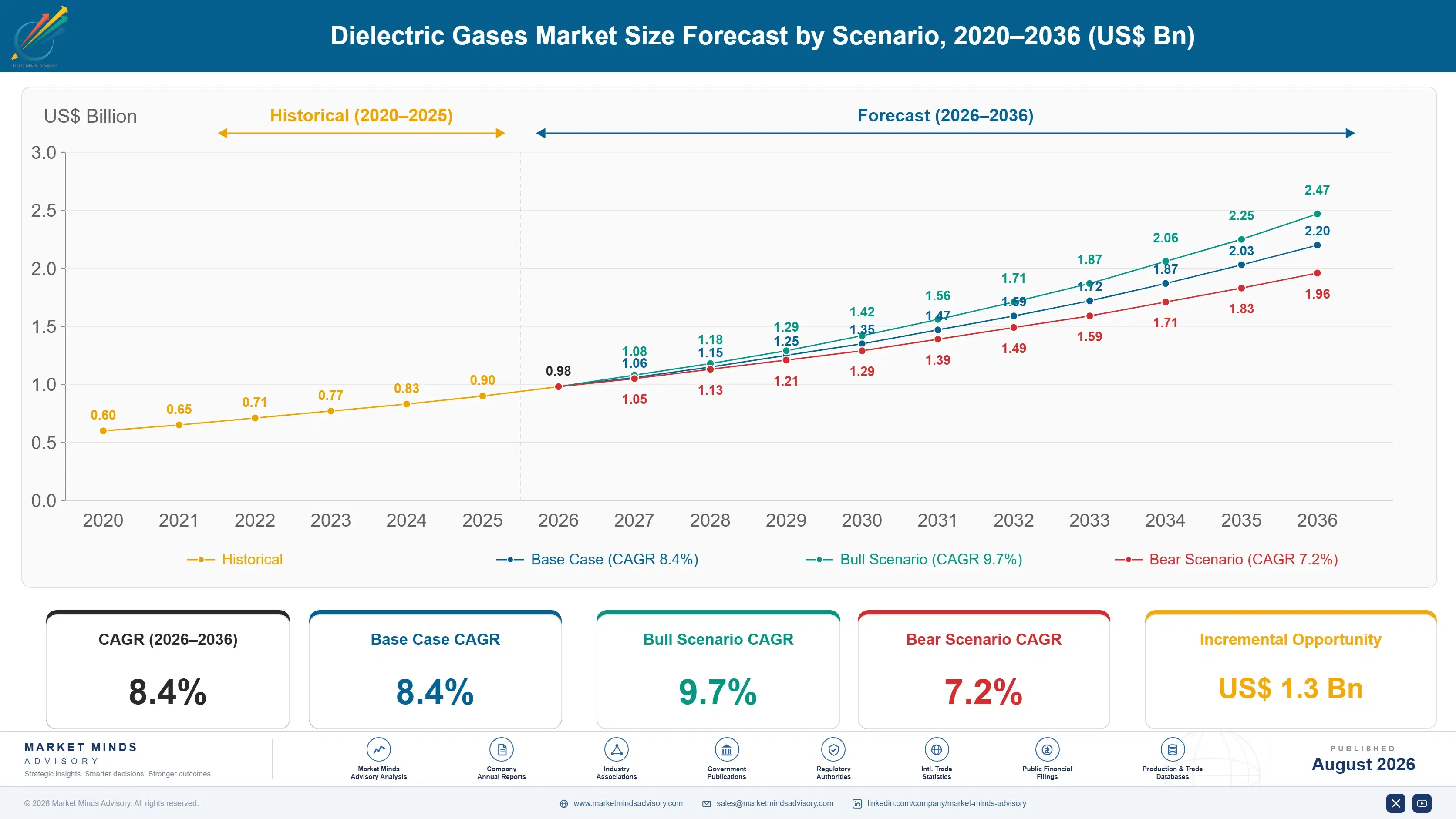
Growth of 6.9% across 2020 to 2025 came from grid investment rather than from any change in what the industry used. Transmission and distribution spending rose across every region on renewable connection, and each new bay carried a gas fill regardless of chemistry. Alternative gases existed and remained a small share throughout, held back by equipment availability rather than by doubt about whether they worked.
The base case at 8.4% rests on three mechanisms. European F-gas regulation restricts sulphur hexafluoride in new medium and high voltage switchgear on a defined schedule, which converts alternatives from optional to mandatory across a very large equipment market. Grid investment continues rising globally on renewable connection and electrification alike. And alternative gases carry a considerably higher price per unit than the incumbent, so market value grows faster than installed volume.
The bull case at 9.7% turns on other jurisdictions adopting European-style restrictions, which several are actively considering and which would accelerate conversion sharply. The bear case at 7.2% turns on chemistry. Fluorinated alternatives face their own scrutiny under emerging restrictions on persistent substances, and a broad restriction would leave the industry with clean air systems that work at medium voltage and poorly above it.

What Drives Insulating Gas Value

This market is unusual in that the product is nearly irrelevant to the customer's cost and central to the customer's regulatory position. Insulating gas represents 4% of what a switchgear bay costs installed, so nobody in a utility procurement department has ever cared much about its price. What they care about now is that sulphur hexafluoride carries a warming potential of 23,500, that roughly 17,000 tonnes sits inside operating equipment worldwide, and that regulators have noticed both facts.
TOP FIVE SHARE66%Concentration of insulating gas volume across the largest suppliers
GLOBAL WARMING POTENTIAL23,500Warming potential of the incumbent insulating gas over a century
ANNUAL LEAKAGE RATE0.5%Share of installed gas inventory escaping from equipment each year
INSTALLED EQUIPMENT BANK17,000 tonnesGas held inside operating high voltage switchgear across the world
SWITCHGEAR COST SHARE4%Insulating gas share of installed high voltage equipment cost
END OF LIFE RECOVERY96%Share of gas recovered when equipment is decommissioned to standard
Leakage is small and cumulative, which is the difficult combination. Modern sealed equipment leaks around 0.5% of its charge annually, a rate that sounds negligible until multiplied by the installed bank and by a warming potential that large. Recovery at decommissioning reaches 96% where procedures are followed properly, and considerably less where they are not.
The alternatives all involve a trade. Fluoronitrile and fluoroketone blends approach the dielectric performance of the incumbent and carry their own persistent chemistry questions. Clean air and nitrogen work well at medium voltage and require substantially larger equipment above it. Nobody has found a replacement that is simultaneously as good electrically, as benign environmentally and as compact physically.
"Utilities spent thirty years being told this gas was inert, stable and completely safe, which was true of everything except its atmospheric lifetime. Now they hold seventeen thousand tonnes of it in equipment designed to last another forty years, and the conversation has moved from whether to replace it to who pays for the recovery."
Director, Grid Equipment and Industrial Gases Practice · MMA Energy / Grid Equip

Market Trends

European Regulation Forces Alternative Gas Adoption Directly

Revised European fluorinated gas rules restrict sulphur hexafluoride in new medium and high voltage switchgear on a defined timetable, which converts alternative gases from an option that utilities could decline into a requirement every one of them must design around. Roughly 62% of European switchgear tenders now specify alternatives or carry them as an evaluated criterion. Equipment makers have responded with qualified product ranges across voltage classes, and the constraint has shifted from whether alternatives work at all to whether manufacturing capacity exists to supply them at the scale required.
Market Impact: Covers 2,900 substation projects

Persistent Chemistry Scrutiny Threatens Fluorinated Alternatives

The fluorinated alternatives that replaced sulphur hexafluoride are themselves under examination within emerging restrictions on persistent substances, which creates an awkward position for utilities that have just committed to equipment designed around them. Around 41% of alternative gas volume uses chemistry that could fall within proposed restriction scope. Clean air and vacuum technologies avoid the question entirely at medium voltage, and equipment makers are hedging by developing both routes rather than committing to one, which raises development cost across the whole industry without resolving anything. Utilities are understandably reluctant to commit before the question settles.
Market Impact: Carries roughly 4 times gas value

Market Opportunities and Growth Drivers

Grid Investment Rises Across Every Producing Region

Transmission and distribution spending is rising everywhere on renewable connection, electrification of heat and transport, and replacement of infrastructure installed decades ago. Roughly 2,900 substation projects are currently under construction or committed across the major grids. Each bay carries an insulating gas fill regardless of which chemistry it uses, and gas demand therefore tracks equipment installation directly rather than depending on any technology decision anybody takes. This is the most predictable demand in the market because grid investment plans are published years ahead by regulated utilities and rarely change much.
Market Impact: Affects 41% of alternative volume

Alternative Gases Carry Substantially Higher Unit Value

Fluoronitrile and fluoroketone blends cost considerably more per unit of equipment filled than the incumbent gas they replace, because the molecules are considerably harder to synthesise and the supply base behind them is far narrower. A converted bay carries roughly 4 times the gas value of the equivalent sulphur hexafluoride fill. Market value therefore grows considerably faster than installed equipment volume across the transition, which is why this market expands at 8.4% while grid equipment installation grows at a considerably more modest rate. Conversion raises value without adding a single bay.
Market Impact: Bank holds 17,000 tonnes installed

Market Restraints and Challenges

Alternative Chemistry Faces Its Own Regulatory Exposure

Fluoronitrile and fluoroketone molecules are persistent, and emerging restrictions on that class create real uncertainty for equipment specified around them. The root cause is that the properties making a molecule a good insulating gas, stability and inertness, are the same properties that make it persist in the environment. Commercially this leaves utilities reluctant to commit and manufacturers developing parallel routes at roughly doubled development cost. Participants are responding with clean air designs at medium voltage, vacuum interruption where it works, and regulatory engagement arguing for a use-specific exemption based on containment.
Market Impact: Covers 62% of European tenders

Installed Base Locks Incumbent Gas In For Decades

Roughly 17,000 tonnes of sulphur hexafluoride sits inside switchgear designed for forty-year service life, and none of it disappears because a regulation restricts new equipment. The root cause is simply asset longevity: utilities do not scrap functioning high voltage equipment early. Commercially this sustains top-up, servicing and recovery demand for decades regardless of what new equipment uses, which is a considerably better business than the transition narrative generally suggests to anybody reading it. Participants are deliberately building recovery, reprocessing and lifetime management services around that installed bank rather than abandoning it.
Market Impact: Affects 41% of alternative volume
4 additional market trends, 2 additional growth drivers, and 3 additional restraints and challenges are covered in the full report. Contact sales@marketmindsadvisory.com to access the complete intelligence.

Segment CAGR and Growth Architecture

Segmentation follows gas chemistry class, which is the dimension determining dielectric performance, regulatory standing, equipment compatibility and realised price together. Voltage class and equipment type cut across most chemistries without separating them commercially, since the same fluoronitrile blend serves several voltage levels, so both of those belong in demand analysis rather than in this primary hierarchy.
dielectric-gases-market-trends-market-share-analysis-1787310457994

Fluoronitrile Blends

Growing at 12.6%, which is exactly 1.50 times the market rate, and the alternative that equipment makers have qualified most widely across the high voltage classes. A fluorinated nitrile mixed with carbon dioxide and oxygen delivers dielectric strength close enough to the incumbent that switchgear can be redesigned rather than reinvented, which matters enormously to manufacturers protecting decades of accumulated product platform investment. Warming potential falls by a factor of several thousand against the incumbent gas it displaces. The chemistry is nonetheless persistent and therefore exposed to emerging restrictions on that substance class, which is the single issue capable of reversing this segment's trajectory entirely rather than merely slowing it down.
CAGR 12.6%

Fluoroketone Blends

Expanding at 10.4% on chemistry that degrades far faster in the atmosphere than fluoronitrile does, giving it a genuinely low warming potential and a far shorter environmental lifetime that regulators have found considerably easier to accept. Boiling point is the practical constraint, since the molecule requires carrier gases and careful handling at low ambient temperatures, which limits deployment across cold climates unless heating provision is designed in. Supply concentration is acute, resting on a very small number of producers, and the announced withdrawal of one major participant from fluorochemical manufacture has raised genuine questions about long-term availability right across the industry. Equipment designed around it now carries an unexpected supply risk.
CAGR 10.4%
Full segment breakdown across 5 segments available in the complete report.

Regional Architecture and Country Demand Map

Regional value follows grid construction and regulatory pressure together, which currently point in different directions. Europe converts fastest on regulation while Asia installs the most equipment, and gas demand accrues to both regions for entirely separate reasons. Installed base servicing follows a third geography again.

East Asia

Thirty-four percent of value sits here, above the band this report applies to global markets. Note: the deviation is genuine, since Chinese grid construction and domestic fluorochemical production together consume and supply more insulating gas than any other region by a considerable margin. Chinese transmission investment has run at levels no other country approaches for two decades, and ultra-high voltage lines require gas insulated equipment at scale. Domestic producers supply most of that demand and export substantially beyond the region. Japanese and Korean equipment makers have qualified alternative gases for export markets ahead of domestic requirement. Growth of 9.3% runs above the global rate on installation volume alone, before any conversion effect.
Share: 34% | CAGR: 9.3% (2026 to 2036)

North America

Twenty-two percent of value from grid replacement and renewable connection investment that has accelerated sharply, with transmission projects proceeding at a pace unseen for decades. Regulatory pressure is state-driven rather than federal, with California and several northeastern states restricting sulphur hexafluoride ahead of any national requirement, which fragments specification considerably. Utilities elsewhere continue specifying the incumbent gas where permitted, on cost and familiarity grounds. Recovery and reprocessing services are well established across the region and commercially mature. Alternative gas qualification is proceeding at equipment makers serving both domestic and European customers. Growth of 8.9% is the highest outside Asia, driven by equipment installation rather than by conversion, which lags Europe substantially.
Share: 22% | CAGR: 8.9% (2026 to 2036)
Regional intelligence for 5 additional markets available in the complete report: Western Europe, South Asia and Pacific, Latin America, Middle East and Africa, Eastern Europe. Contact sales@marketmindsadvisory.com.
dielectric-gases-market-trends-country-cagr-analysis-1787310458507

Where Insulating Gas Suppliers Earn More

Competing on price for a product representing 4% of switchgear cost achieves nothing, since no utility procurement team anywhere is optimising that particular line. The value available sits in equipment qualification, in the installed base that regulation cannot remove, in recovery services, and in the regulatory positioning that will decide which chemistry survives at all.

Qualify Chemistry Into Equipment Platforms Before Competitors

Switchgear makers design a platform around a specific gas and its handling requirements, then sell that platform for a decade or more without revisiting the choice. Suppliers qualified into a platform at design stage capture roughly 6 times the lifetime volume that later entrants achieve, because every bay sold carries their chemistry and every service visit tops it up. Qualification requires joint development with the manufacturer rather than a commercial approach. Most gas suppliers still treat equipment makers as customers to be sold to rather than as development partners to work alongside.
Market Impact: Captures roughly 6 times the lifeti

Build Recovery And Lifetime Management Around Installed Gas

Roughly 17,000 tonnes of incumbent gas sits inside equipment with decades of service life remaining, and none of it vanishes simply because regulation restricts new installations from a given date. Suppliers offering recovery, reprocessing, certified destruction and inventory reporting earn roughly 2.3 times the value of top-up gas supply alone across an asset's remaining life. Utilities need that reporting for their own emissions accounting and mostly lack the capability to produce it internally. This revenue grows as conversion proceeds rather than shrinking alongside it, which is the opposite of what most suppliers assume.
Market Impact: Earns roughly 2.3 times the top-up

Develop Clean Air Capability Against Chemistry Restriction

Fluorinated alternatives now face restriction proposals covering roughly 41% of all alternative gas volume, and a broad ruling would leave the industry needing chemistry-free options very quickly indeed. Suppliers holding clean air and technical gas mixture capability alongside their fluorinated products hold a hedge that costs relatively little to maintain and protects roughly 55% of addressable volume under an adverse ruling. Clean air works well at medium voltage and requires physically larger equipment above it. Building that capability now is considerably cheaper than attempting to acquire it under regulatory pressure later.
Market Impact: Protects roughly 55% of addressable

Engage Regulators On Use-Specific Exemption Directly

Restrictions on persistent substances are currently being drafted very broadly indeed, and a sealed switchgear application where gas is recovered at 96% and never contacts the environment during service represents a genuinely different exposure from dispersive industrial uses. Suppliers and equipment makers who present that case jointly to regulators, supported by actual recovery data rather than by industry assertion, have secured use-specific treatment in roughly 3 regulatory processes so far. The alternative is a blanket ruling that removes the chemistry entirely, regardless of how well it is actually contained in service.
Market Impact: Secured treatment in roughly 3 regu

Who Controls the Margin Pool

Concentration is high and rooted in fluorochemical synthesis. The top five participants hold 66% of insulating gas volume supplied, the basis used throughout this section, and the gap between them reflects who can make these molecules at the purity switchgear requires rather than any commercial advantage. Syensqo and 3M developed the principal alternatives; Linde, Air Liquide and Resonac supply, handle and service across the installed base and the new chemistry alike.
Competition currently runs on three dimensions and price is barely one of them. Equipment platform qualification decides whose chemistry ships inside a switchgear range for a decade. Regulatory standing decides which molecules remain sellable at all. Service and recovery capability decides who captures the installed base revenue that conversion does not remove at all.

Pressure is building from two directions. Persistent substance restrictions threaten the fluorinated alternatives that the industry just adopted. Chinese producers supply the incumbent gas at prices that make conversion economically unattractive wherever regulation does not compel it. Rankings shift first across European equipment platforms, where the qualification decisions being taken right now will determine supply for the entire following decade.
dielectric-gases-market-trends-company-positioning-matrix-1787310459035

Competitive Moat and Risk Dimensions

3M

Moat: Fluoroketone chemistry and position

Developing the fluoroketone route and qualifying it into equipment platforms across several manufacturers created a position resting on molecules that competitors cannot simply replicate, since synthesis and purification at switchgear specification is genuinely difficult. Decades of application data across installed equipment give the company credibility with utilities that no newer entrant can assemble quickly.
3M

Risk: Announced fluorochemical manufacturing exit

The stated intention to exit fluorochemical manufacturing raises immediate questions about long-term supply of the chemistry that equipment platforms were designed around, and utilities specifying that equipment have noticed. Whether the position transfers to another producer, and on what terms, is the single largest uncertainty facing anybody who committed to fluoroketone-based switchgear.
SYENSQO

Moat: Fluoronitrile and equipment partnerships

The fluoronitrile route has been qualified across the widest range of high voltage equipment platforms, developed jointly with manufacturers rather than sold to them, which embeds the chemistry into product designs that will ship for a decade or more. Fluorochemical synthesis capability at the required purity sits with very few producers globally.
SYENSQO

Risk: Persistent substance restriction exposure

Fluoronitrile is persistent, and emerging restrictions on that substance class could reach it regardless of how well it is contained inside sealed equipment during service. A broad ruling would strand chemistry that equipment makers have designed around, and the regulatory argument for use-specific exemption is being made now rather than settled.

Players Tracked

Prominent Players

Syensqo
3M
Linde
Air Liquide
Resonac

Other Key Players

Chemours
Kanto Denka Kogyo
Concorde Specialty Gases
Messer Group
Taiyo Nippon Sanso
Air Products and Chemicals
Honeywell
Arkema
Daikin Industries
Zhejiang Juhua
Dongyue Group
Sinochem Lantian
AGC
Matheson Tri-Gas
Advanced Specialty Gases

Recent Developments

APRIL 2025

Utility awards alternative gas switchgear across transmission programme

A European transmission system operator specified alternative insulating gas across an entire multi-year substation programme, requiring qualified equipment across high voltage classes and full lifetime gas management including recovery reporting, in direct response to fluorinated gas regulation restricting the incumbent chemistry from a defined date.
Signal: Lifetime gas management written into equip
SEPTEMBER 2025

Persistent substance restriction consultation covers insulating gases

Regulatory consultation on restricting persistent substances explicitly considered fluorinated insulating gases within its scope, with detailed industry submissions arguing that sealed switchgear applications with recovery above 96% present a fundamentally different exposure profile from the dispersive industrial uses that the restriction was originally drafted against.
Signal: Whether sealed containment earns an exempt
JANUARY 2025

Clean air switchgear qualified at higher voltage class

Vacuum interruption combined with clean air insulation has completed full qualification at a voltage class that had previously required fluorinated gas, using substantially larger equipment dimensions to compensate for the lower dielectric strength involved while eliminating fluorinated chemistry from the equipment design entirely and permanently.
Signal: Every voltage class that clean air reaches

What Sits Inside Insulating Gas Cost

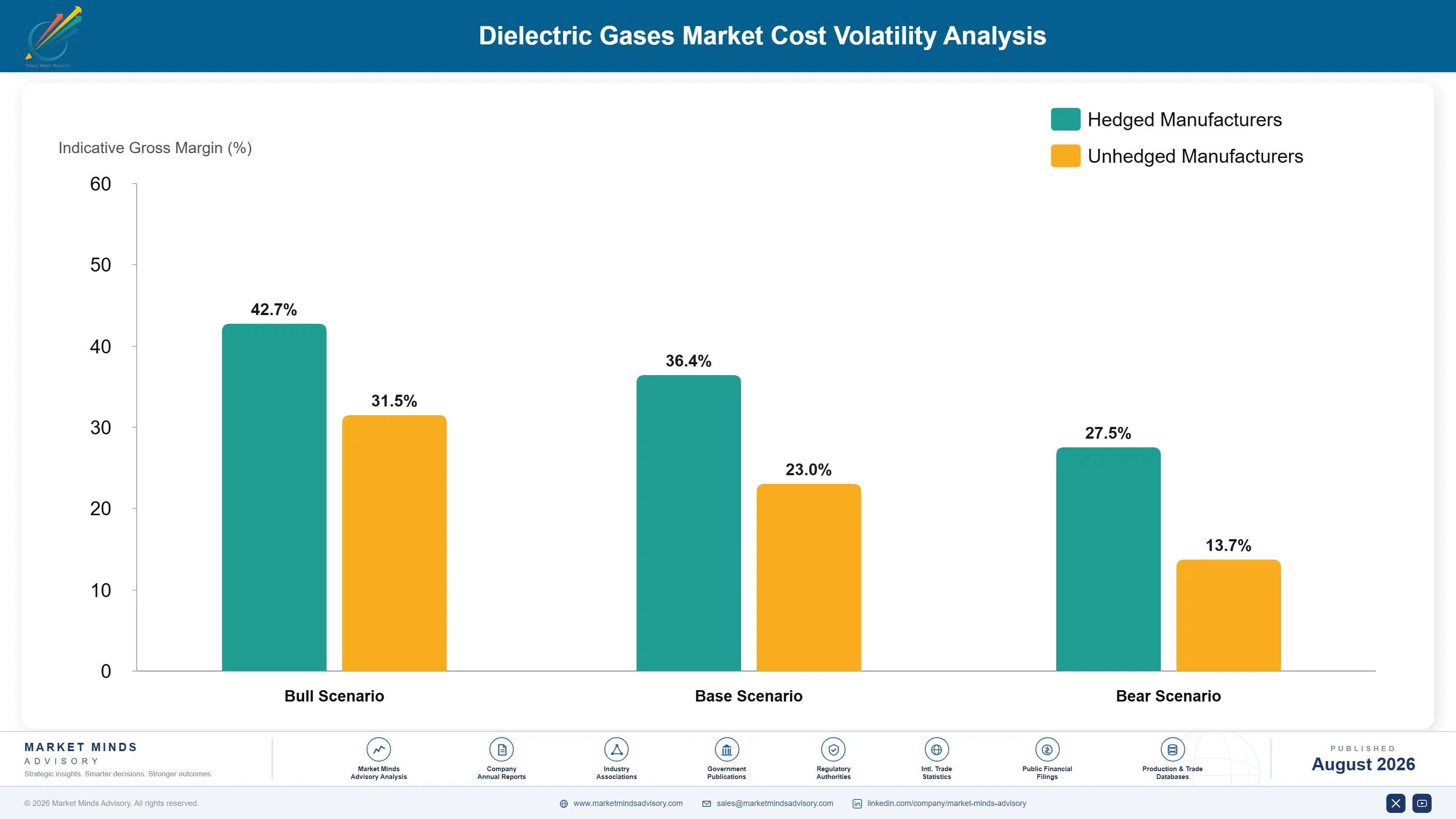
Fluorspar and the hydrogen fluoride derived from it account for roughly 34% of fluorinated insulating gas production cost, sourced from a supply base concentrated heavily in China and Mexico. Fluorination reaction chemistry and catalysts add around 18%. Purification and separation to the parts-per-million specification switchgear demands takes about 21%, cylinder packaging and handling 14%, and energy the remaining 13% of delivered cost.
Fluorspar and energy both moved sharply through 2021 and 2022. Chinese provincial power rationing during late 2021 constrained fluorspar and hydrogen fluoride output across producing regions, and European industrial energy prices through 2022 reached levels the IEA documented as unprecedented for the sector. Solvay Annual Report 2022 and 3M Annual Report 2022 both recorded elevated raw material and energy costs across their fluorochemical operations, alongside the regulatory developments reshaping demand.

The competitive disadvantage mechanism runs through fluorochemical synthesis capability rather than through fluorspar purchasing. Making these molecules at switchgear purity requires reaction and separation expertise that very few producers hold, and the capital sits idle unless equipment platforms qualify the product. Established fluorochemical producers amortise that capability across many products. Anybody entering carries the full cost against a single uncertain qualification, which is why nobody has.
dielectric-gases-market-trends-cost-volatility-analysis-1787310459234

Contract fluorspar supply across multiple producing regions

Fluorspar supply concentrated in China and Mexico is exposed to export policy and to power rationing that no commercial arrangement anticipates particularly well. Agreements spanning several producing countries cost rather more in normal conditions and they secure feedstock whenever a producing region constrains its output, which has happened twice within the past five years alone.

Recover and reprocess gas from decommissioned equipment

Recovered gas reprocessed back to specification substitutes directly for newly synthesised material, reducing exposure to fluorspar and energy costs while generating service revenue from the customer at the same time. Recovery reaches 96% wherever procedures are actually followed properly, and the reprocessing infrastructure required is modest against the value of the material being handled.

Maintain clean air capability alongside fluorinated products

Clean air and technical gas mixtures require no fluorochemical synthesis at all, which removes both the input cost exposure and the regulatory exposure that fluorinated chemistry inevitably carries with it. Holding both sets of capability together costs relatively little to maintain, and it hedges an outcome that no amount of regulatory engagement can fully control.

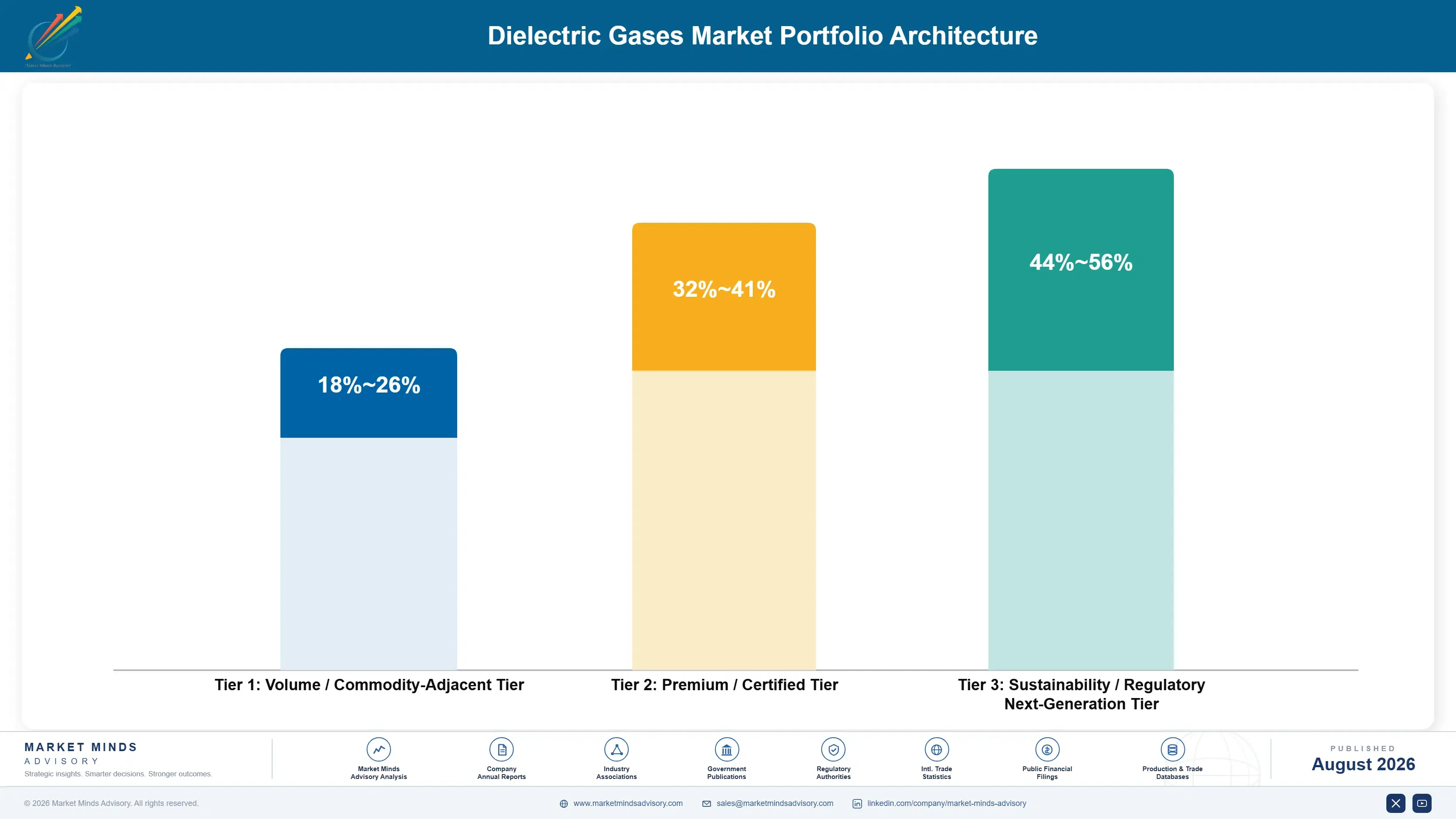
Portfolio Architecture for Margin Defence

Margin architecture separates by regulatory standing rather than by technical performance, which is unusual and uncomfortable for an industry built on dielectric engineering. Incumbent gas earns commodity margins in the markets where it remains permitted, competing against Chinese supply at prices that make conversion economically unattractive without a mandate. Value rises with equipment platform qualification and with regulatory acceptability, neither of which any amount of manufacturing effic
The volume versus premium tension runs between the installed base and new equipment. Incumbent gas supply, top-up and servicing across 17,000 tonnes of installed inventory carries steady volume for decades at modest margins. Alternative gases qualified into new equipment platforms earn several times better on volumes that are currently small and growing quickly. Suppliers positioned only in the incumbent have a declining annuity; those only in alternatives have an uncertain chemistry.

High-value pools concentrate in three places. Platform-qualified alternative chemistry commands price because the equipment was designed around it and cannot readily use anything else. Recovery and lifetime management services earn on regulatory reporting obligations that utilities cannot discharge themselves. And clean air systems earn on being immune to the chemistry restrictions that threaten everything else.

Volume / Commodity-Adjacent Tier

Sulphur hexafluoride supplied for new equipment where permitted and for top-up across the installed base, competing against Chinese production at prices that reflect a mature commodity with no differentiation available.
Gross Margin: 18-26%

Premium / Certified Tier

Recovery, reprocessing, certified destruction and inventory reporting services built around the installed gas bank. Regulatory reporting obligations defend pricing here. The nine-point range reflects basic recovery against full lifetime management economics.
Gross Margin: 32-41%

Sustainability / Regulatory / Next-Generation Tier

Fluoronitrile and fluoroketone blends qualified into equipment platforms, alongside clean air systems immune to chemistry restriction. Qualification and regulatory standing defend pricing strongly. The twelve-point range reflects qualified fluorinated against clean air economics.
Gross Margin: 44-56%
dielectric-gases-market-trends-portfolio-architecture-1787310459746

High-value Sub-segments and Strategic Watch-out

Platform-qualified fluoronitrile chemistry

High value and high growth together, because equipment designed around a specific gas cannot readily use anything else and switchgear platforms continue shipping for a decade or more once they have launched. Persistent substance restriction remains the single risk capable of reversing that position entirely.
Gross Margin: 44-56%

Recovery and lifetime gas management services

Strong realised value on genuinely steady long-term growth, because 17,000 tonnes of installed inventory generates reporting and recovery obligations that most utilities simply cannot discharge with internal resources. This revenue grows steadily as conversion proceeds rather than shrinking alongside the incumbent gas volumes it services.
Gross Margin: 32-41%

Incumbent gas supply and top-up volume

The volume core here, carrying steady demand across the installed base for decades while earning only commodity margins against Chinese supply wherever regulation still permits its continued use. Necessary for commercial scale, but this tier is a long declining annuity rather than a growth business.
Gross Margin: 18-26%

Clean air and vacuum interruption systems

The strategic watch-out here, because these particular approaches are entirely immune to the chemistry restrictions that now threaten roughly 41% of all alternative gas volume, and every single voltage class they reach removes addressable demand from fluorinated products permanently rather than merely temporarily displacing it.
Gross Margin: 34-52%

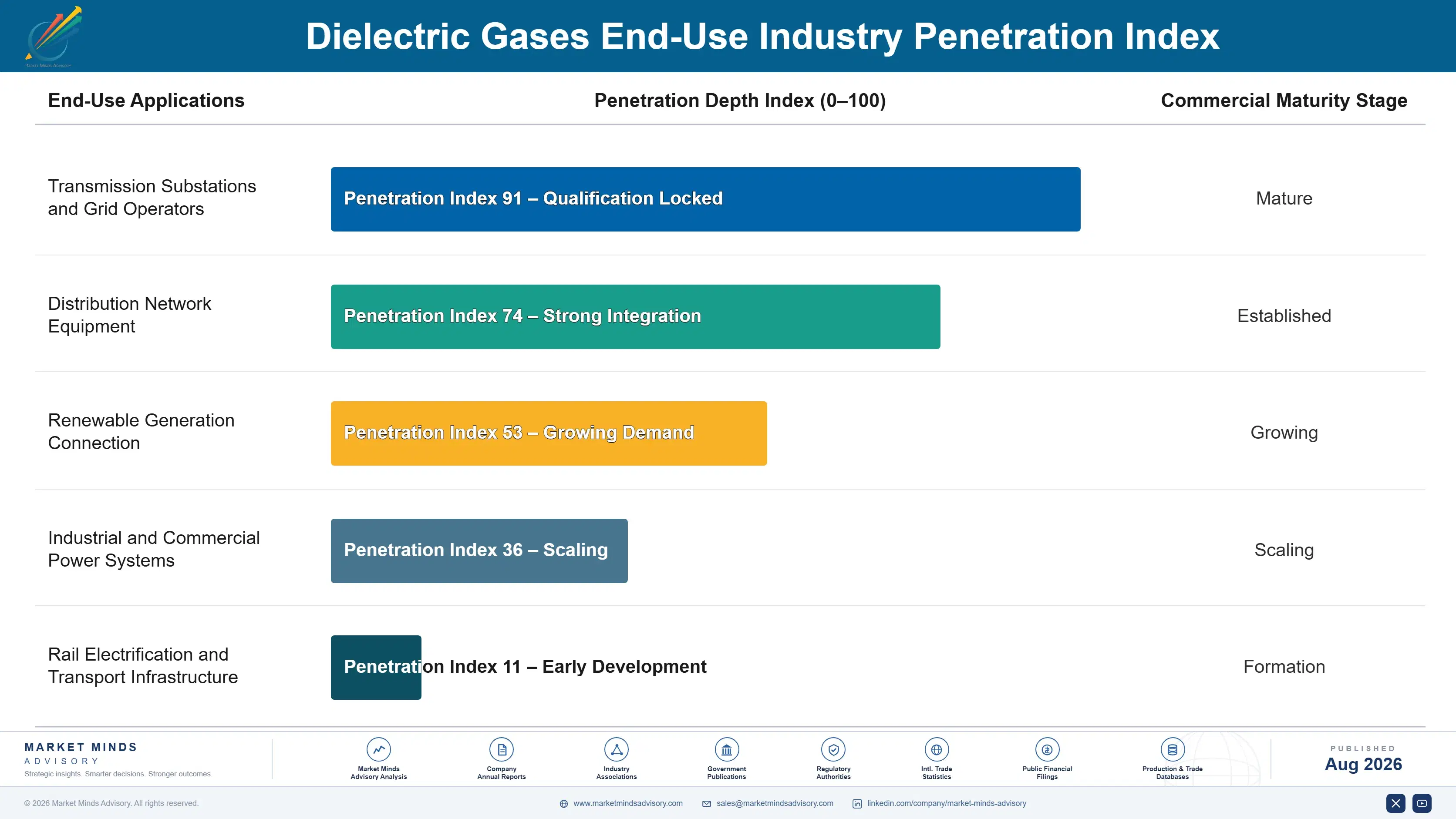
How Insulating Gas Demand Behaves

Demand is asset-locked over an unusually long horizon. Switchgear is designed for forty years of service, filled once at manufacture and topped up periodically against a leakage rate near 0.5% annually, then recovered at decommissioning. Winning the initial fill through equipment platform qualification effectively wins four decades of top-up and eventual recovery revenue, which is why platform decisions matter far more than any individual sale and why suppliers compete so hard at design stage.
Stickiness is close to absolute once equipment ships. Incumbent gas top-up is loosest, bought from whichever supplier quotes best since the molecule is identical everywhere. Alternative gases are effectively locked, because the equipment was engineered around specific handling, pressure and temperature characteristics that another chemistry does not share. Recovery services sit somewhere between, competitive on price but favouring whoever supplied the original fill and holds the equipment records.

The buyer profile has moved from engineering toward sustainability reporting in a way few suppliers anticipated. A decade ago insulating gas was specified by substation engineers on dielectric performance and bought by procurement on price. Today utility sustainability functions track gas inventory, leakage and recovery as reportable emissions, and they increasingly shape specification before engineering evaluation begins.
dielectric-gases-market-trends-end-use-penetration-index-1787310460239

Where We Land On This

These are among the four positions where our research anticipates prominent divergence between winners and laggards over the coming forecast period. Each is grounded in the demand model, the regulatory perimeter, and the announced capacity pipeline.
01 / PLATFORM QUALIFICATION PRIORITY

Win equipment platform design, not switchgear tenders

Switchgear makers design a platform around a specific gas and its handling characteristics, then ship that platform for a decade or more without ever revisiting the chemistry decision. Suppliers qualified at design stage capture roughly 6 times the lifetime volume that later entrants manage, since every bay sold carries their gas and every service visit tops it up again. Most suppliers still treat equipment makers as customers rather than as joint development partners, which is where the position is actually won.
02 / INSTALLED BASE MONETISATION

Build services around gas that regulation cannot remove

Roughly 17,000 tonnes of incumbent gas sits inside equipment carrying decades of remaining service life, and none of that disappears simply because a regulation restricts new installations from a certain date onward. Suppliers offering recovery, reprocessing, certified destruction and full inventory reporting earn roughly 2.3 times the value of top-up supply alone across each asset's remaining service life. Utilities need that reporting for their own emissions accounting, and they almost universally lack the internal capability required to produce it themselves.
03 / CHEMISTRY RISK HEDGING

Hold clean air capability against a restriction ruling

Emerging restrictions on persistent substances could reach the fluorinated alternatives that cover roughly 41% of alternative gas volume, which this industry had adopted precisely in order to solve the previous regulatory problem it faced. Suppliers holding clean air and technical gas mixture capability alongside their fluorinated products protect roughly 55% of addressable volume under an adverse ruling, at a relatively modest cost to maintain. Building that capability now is considerably cheaper than attempting to acquire it later under regulatory pressure.
04 / REGULATORY ENGAGEMENT DISCIPLINE

Argue sealed use with recovery data, not assertion

Restrictions on persistent substances are being drafted broadly, and sealed switchgear where gas is recovered at 96% and never contacts the environment in service presents a genuinely different exposure profile from dispersive industrial uses. Suppliers and equipment makers who present that case jointly with actual recovery data, rather than with industry assertion alone, have secured use-specific treatment in roughly 3 regulatory processes so far. The alternative outcome is a blanket ruling that ignores containment entirely and removes the chemistry regardless.

Engagement Snapshot From the Field

A live engagement with an industry participant carrying material or product regulatory and market exposure ahead of a defining policy shift, showing how our research translates into a defensible multi-year portfolio strategy.
MARKET MINDS ADVISORY · CLIENT ENGAGEMENT SUMMARY
Dielectric Gases Producer Strategic Portfolio Review and Transition Roadmap 2026·Investment Scenario on Dielectric Gases Exposure Evaluation 2025-26
CLIENT PROFILE
An industrial gas producer supplying insulating gases to switchgear manufacturers and utilities across Europe and Asia, holding a substantial incumbent gas position alongside a small alternative gas business and established recovery services. Insulating gas revenue approached EUR 110 million annually (client-reported, unverified by MMA), roughly three quarters of it in incumbent gas supply, top-up and servicing.
STRATEGIC CHALLENGE
Management treated the European regulatory transition as a threat to be managed and had responded by lobbying against restriction schedules rather than by positioning for them. Alternative gas business had not grown, and nobody had established whether the client could qualify into equipment platforms at all. Recovery services were run as a compliance offering rather than as a commercial business.
MMA APPROACH
MMA interviewed forty-seven switchgear manufacturers, transmission operators, distribution utilities and regulatory specialists across six markets, establishing how platform qualification and gas specification decisions are actually taken. We modelled installed base revenue over forty years against conversion scenarios, assessed the client's fluorochemical position, and mapped every open qualification opportunity at European equipment makers.
KEY FINDINGS
  1. Equipment platform qualification decisions for the coming decade were being taken during the engagement, and the client had approached none of the manufacturers involved in any of them.
  2. Installed base recovery and reporting revenue over the remaining asset life exceeded projected new alternative gas revenue substantially (client-reported, unverified by MMA), and was being run as a compliance service at cost.
  3. Utility sustainability functions rather than substation engineers were specifying gas requirements at four of six transmission operators interviewed, and the client had no relationship with any of them.
  4. Clean air capability required no fluorochemical investment and would hedge a restriction outcome that the client's own regulatory team assessed as genuinely possible.
CLIENT PROFILE
An industrial gas producer supplying insulating gases to switchgear manufacturers and utilities across Europe and Asia, holding a substantial incumbent gas position alongside a small alternative gas business and established recovery services. Insulating gas revenue approached EUR 110 million annually (client-reported, unverified by MMA), roughly three quarters of it in incumbent gas supply, top-up and servicing.
STRATEGIC CHALLENGE
Management treated the European regulatory transition as a threat to be managed and had responded by lobbying against restriction schedules rather than by positioning for them. Alternative gas business had not grown, and nobody had established whether the client could qualify into equipment platforms at all. Recovery services were run as a compliance offering rather than as a commercial business.
MMA APPROACH
MMA interviewed forty-seven switchgear manufacturers, transmission operators, distribution utilities and regulatory specialists across six markets, establishing how platform qualification and gas specification decisions are actually taken. We modelled installed base revenue over forty years against conversion scenarios, assessed the client's fluorochemical position, and mapped every open qualification opportunity at European equipment makers.
KEY FINDINGS
  1. Equipment platform qualification decisions for the coming decade were being taken during the engagement, and the client had approached none of the manufacturers involved in any of them.
  2. Installed base recovery and reporting revenue over the remaining asset life exceeded projected new alternative gas revenue substantially (client-reported, unverified by MMA), and was being run as a compliance service at cost.
  3. Utility sustainability functions rather than substation engineers were specifying gas requirements at four of six transmission operators interviewed, and the client had no relationship with any of them.
  4. Clean air capability required no fluorochemical investment and would hedge a restriction outcome that the client's own regulatory team assessed as genuinely possible.
RECOMMENDED STRATEGY
Phase 1: Phase 1 (0 to 9 months): Stop lobbying against restriction schedules and approach every equipment maker with an open platform qualification immediately. Phase 2: Phase 2 (9 to 24 months): Rebuild recovery and reporting as a commercial lifetime management offer priced against utility emissions obligations. Phase 3: Phase 3 (24 to 42 months): Add clean air and technical mixture capability as a hedge, and engage regulators jointly with equipment makers on sealed use.
OUTCOME
The client redirected regulatory effort from opposition toward use-specific exemption arguments made jointly with two equipment makers (client-reported, unverified by MMA). Two platform qualifications opened within a year, recovery services were repriced as lifetime management and grew substantially, and clean air capability entered development eighteen months into the engagement.

Frequently Asked Questions

Foundational context covering the market sizes, CAGR, scope, country, region and competition that inform every finding below. This section is provided to cover basics and most often pre-purchase conversations, answered from the MMA Primary Research Dataset.

What is the current size of the Dielectric Gases Market?

The market reached USD 0.95 billion in 2025, measured as gas revenue at realised delivered price including fill, top-up and servicing. Sulphur hexafluoride still accounts for the largest share of volume.

How large will the Dielectric Gases Market be by 2036?

MMA forecasts USD 2.31 billion by 2036, an expansion of 2.24 times the 2026 level. Incremental value across the forecast period reaches USD 1.28 billion.

What is the CAGR for the Dielectric Gases Market 2026 to 2036?

The base case compound annual growth rate is 8.4%, with a bull case of 9.7% and a bear case of 7.2%. Regulatory adoption beyond Europe and persistent substance restrictions separate those scenarios.

Which segment is growing fastest?

Fluoronitrile blends grow fastest at 12.6%, exactly 1.50 times the overall market rate. Equipment makers have qualified this chemistry most widely across high voltage classes to date.

Who are the major companies in the Dielectric Gases Market?

Syensqo, 3M, Linde, Air Liquide and Resonac lead, holding 66% of gas volume between them. Fluorochemical synthesis capability at switchgear purity explains that concentration entirely.

Which country is growing fastest?

India grows fastest at 11.2%, driven by transmission investment expanding at rates comparable to Chinese construction two decades ago. Gas insulated substations are increasingly specified in dense urban areas.

Report Segmentation Architecture

The full report scope spans multiple orthogonal segmentation dimensions, with cross-tabulated demand data provided for each dimension pair. Coverage extends further to regional breakdowns, trend trajectories, and the competitive detail needed to support segment-level decision-making.

By Gas Chemistry Class

  • Fluoronitrile Blends
  • Fluoroketone Blends
  • Clean Air and Nitrogen Systems
  • Carbon Dioxide and Technical Gas Mixtures
  • Sulphur Hexafluoride

By End-Use Industry

  • Transmission Substations and Grid Operators
  • Distribution Network Equipment
  • Renewable Generation Connection
  • Industrial and Commercial Power Systems
  • Rail Electrification and Transport Infrastructure

By Customer Type and Channel

  • Switchgear Original Equipment Manufacturers
  • Transmission System Operators
  • Distribution Utilities
  • Service and Maintenance Contractors
  • Specialty Gas Distributors

By Region

  • North America
  • Western Europe
  • East Asia
  • South Asia and Pacific
  • Latin America
  • Middle East and Africa
  • Eastern Europe

Scope, Methodology, and Coverage

Every figure in this report is reproducible from documented input assumptions. The scope below maps the historical period, the forecast horizon, the segmentation dimensions, and the countries covered, alongside the underlying primary and qualitative methodology.
Historical Period
2020 to 2025
Forecast Period
2026 to 2036
Base Year
2025 (USD billions; MMA Primary Research Dataset, August 2026)
Market Definition
The market comprises gases and gas mixtures supplied as electrical insulating and arc-quenching media in high and medium voltage switchgear, gas insulated lines, busbars and instrument transformers, spanning fluoronitrile blends, fluoroketone blends, clean air and nitrogen systems, carbon dioxide and technical gas mixtures, and sulphur hexafluoride. Sizing captures gas revenue at realised delivered price across initial equipment fill, top-up supply, servicing, and end-of-life recovery and reprocessing across transmission, distribution, industrial and rail applications. Switchgear and circuit breaker equipment, vacuum interrupter hardware, solid and liquid insulation, gas handling and recovery equipment, and semiconductor process gases fall outside scope.
Quantitative Units
USD billions (current prices); insulating gas tonnes supplied annually; USD per equipment bay filled at realised delivered price
Segmentation Dimensions
By Gas Chemistry Class; By End-Use Industry; By Customer Type and Channel; By Region
Regions Covered
North America, Western Europe, East Asia, South Asia and Pacific, Latin America, Middle East and Africa, Eastern Europe
Countries Covered
USA, Canada, Mexico, Germany, France, UK, Italy, Spain, Netherlands, Sweden, Switzerland, Austria, Poland, Czech Republic, Romania, Turkey, China, Japan, South Korea, Taiwan, India, Australia, Singapore, Vietnam, Indonesia, Brazil, Chile, Argentina, Saudi Arabia, UAE, Qatar, South Africa, and additional markets relevant to this sector
Key Companies Profiled
Syensqo, 3M, Linde, Air Liquide, Resonac, Chemours, Kanto Denka Kogyo, Concorde Specialty Gases, Messer Group, Taiyo Nippon Sanso, Air Products and Chemicals, Honeywell, Arkema, Daikin Industries, Zhejiang Juhua, Dongyue Group, Sinochem Lantian, AGC, Matheson Tri-Gas, Advanced Specialty Gases.
Quantitative Methodology
Primary survey, n=3,800 respondents, Q4 2025, six countries; demand-side model with trade association cross-validation
Qualitative Methodology
47 expert interviews, Q4 2025; applied to validate demand model assumptions, identify emerging dynamics, and assess competitive positioning
Report Format
PDF and XLSX data workbook (Word format preview document)
Publisher
Market Minds Advisory
Report Code
MMA-2026-ENE-501
Published
August 2026
Contact
sales@marketmindsadvisory.com | www.marketmindsadvisory.com

Purchase the full Dielectric Gases Market Report (2026 to 2036).

The full report sizes the dielectric gases market across five chemistry classes, five end-use industries, five customer channels and seven regions, with annual forecasts to 2036 in revenue and gas tonnes supplied. It models installed base revenue over forty year asset lives against three conversion scenarios, which is the analysis establishing what the incumbent gas business is genuinely worth as regulation tightens. Twenty participants are assessed on a consistent gas volume supplied basis, with equipment platform qualification positions mapped separately from production capability. Regulatory restriction schedules are tracked jurisdiction by jurisdiction across every covered market.
Five gas chemistry classes sized and forecast annually
Installed base revenue modelled across three conversion scenarios
Twenty participants on consistent gas volume supplied basis
Equipment platform qualification positions mapped separately
Regulatory restriction schedules tracked jurisdiction by jurisdiction
Persistent substance restriction exposure quantified by chemistry

Built For The People Who Decide

From boardroom strategy to bench-side execution, this report is read cover-to-cover by leaders shaping the next decade of their industry, turning demand scenarios, market dynamics and valuation benchmarks into decisions.
CXOs/ Presidents/ VPs/ Managers
M&A and Corporate Development
Strategy Teams and R&D Heads
Procurement and Product Directors
Regulatory and Compliance Leaders
Investor Relations and Equity Analysts