Market Minds Advisory
Die Casting Services Market

Die Casting Services Market: Die Casting Services Market. Zinc Volume Meets the Gigacasting Shift

Die casting services built their industrial base on zinc and aluminum component production, but gigacasting technology now concentrates capital fastest across automotive structural manufacturing. across most automotive supply networks nationwide

Lead Analyst

Published

September 2026

Make Smarter Decisions with Customized Research Insights

Request a free sample report and evaluate market opportunities, growth trends, and competitive dynamics relevant to your business needs.

2025 MARKET VALUE$78.5BMarket Size 2025
2036 FORECAST VALUE$137.1BBase Case , 2026 to 2036
CAGR 2026 TO 20365.2 %Bull 6.4% / Bear 4.0%
INCREMENTAL OPPORTUNITY$54.5BNet 10- year value creation
EXPANSION MULTIPLE1.66x2036 value over 2026 base
Strategic Levers
M&A Pipeline
Regional Outlook
Country Rankings
Competitive Intelligence
Segmental Deep-dive
Call-Us : 91 93563 13602

Executive Snapshot and Market Trajectory.

Die casting services built their industrial base on zinc and aluminum component production, and that base still anchors most annual revenue today. Gigacasting and large-format die casting now grow fastest of all, as EV structural design demand pulls capital toward capabilities legacy small-component-only manufacturers were never designed to deliver.
Gigacasting and large-format die casting are growing fastest as automakers seek documented structural integration accuracy that standard small-component casting cannot offer without dedicated large-press engineering investment. East Asia anchors global demand on established manufacturing scale and EV production volume, while China posts the fastest national growth on expanding domestic EV manufacturing and export capacity. That split reflects production maturity as much as raw automotive volume across regions.
Roughly fifty companies compete across a market split between commodity zinc and aluminum casting sold largely through automotive supply contracts, and gigacasting and precision machining services earning meaningfully more on tooling depth and press capacity breadth. Aluminum and zinc alloy sourcing volatility genuinely complicates production planning in ways contract pricing cannot always fully offset, and that exposure keeps widening for smaller casters as tooling certification requirements tighten. Consolidation among second-tier casters appears increasingly likely over
Market Definition
The market covers die casting service products including aluminum die casting services, zinc die casting services, magnesium die casting services, high-pressure die casting services, gigacasting and large-format die casting, and precision machining and finishing services. Sand casting and unrelated forging services are excluded from this scope.
Base Year Value
$78.5B in 2025 (MMA Primary Research Dataset, August 2026)
Forecast Period
2026 to 2036, eleven discrete annual values
CAGR
5.2% base case. Bull 6.4%. Bear 4.0%.
Fastest Growth Segment
Gigacasting and Large-Format Die Casting: 8.4% CAGR
Fastest Growth Country
China: 7.2% CAGR
Fastest Growth Region
South Asia and Pacific: 7.2% CAGR
Largest Region
East Asia: 30% of 2025 global value
Market Leaders
Dynacast International LLC, Ryobi Die Casting (USA) Inc, Nemak SAB de CV, Endurance Technologies Limited, GF Casting Solutions AG. Source: MMA Analysis based on company annual reports.
Primary Survey
n=3,800 procurement and R&D decision-makers, Q4 2025, six countries
Methodology
Demand-side build-up, cross-validated against public data, 47 expert interviews

Die Casting Services Market Forecast Scenarios

die-casting-services-market-size-forecast-scenario-1788167644373
Between 2020 and 2025 the market grew near 4.6% a year, propelled initially by post-pandemic automotive production recovery before gigacasting demand began contributing meaningfully toward the end of the historical period, a shift that strengthened once EV structural design standards justified broader large-press investment across established automotive supply channels worldwide. That acceleration has continued gathering pace
The base case carries the market to 5.2% CAGR on three mechanisms: rising automotive lightweighting requirements driving baseline aluminum casting demand, growing EV structural integration sustaining gigacasting adoption, and precision machining investment scaling to meet tolerance requirements across established and emerging automotive markets. None of these three mechanisms depends on any single supply channel alone, which is what makes the base case durable across funding cycles. Casters positioned across all three mechanisms simultaneously typically capture disproportionate share of new programme awards.
The bull case at 6.4% assumes faster gigacasting adoption across major automotive supply channels than currently modelled. The bear case at 4.0% assumes continued aluminum and zinc alloy cost volatility outweighs production demand growth by a wider margin than currently anticipated, leaving overall category volume flatter than the base case projects. Insurers increasingly price both scenarios into supply contract terms.

Zinc Volume Meets the Gigacasting Pull

Die casting services sit at an inflection point where decades of small-component casting investment now compete for capital against gigacasting and large-format adoption. Zinc and aluminum component casting still account for over a third of category revenue, but the fastest-growing spend is shifting toward single-piece structural castings, high-pressure large-format tooling, and integrated precision machining. Casters who delayed that shift now face requalification timelines that put them a full production
ZINC CASTING REVENUE SHARE38%share of revenue still from zinc component casting
MARKET CONCENTRATIONCR5 24%combined share held by top five casting companies
AVERAGE TOOLING INVESTMENT$1.8 milliontypical gigacasting tooling investment per press line today
TOP PRODUCING COUNTRYChina 28%share of global output from a single country
PRESS UTILISATION RATE78%average capacity utilisation across major press facilities nationwide
ALUMINUM INPUT COST SHARE31% of COGSshare of production cost from aluminum alloy inputs
Automaker expectations across major automotive supply channels continue climbing, and casting companies are responding with tooling investment that increasingly favours large-format, integrated structural lines over dedicated legacy small-component tooling. That flexibility matters more as automakers proliferate vehicle platforms requiring shorter tooling changeover windows between production runs. Casters unable to fund that transition risk losing supply allocation priority as major automakers consolidate awards toward fewer, more capable suppliers.
Consolidation among mid-tier casting suppliers continues as tooling development costs and press capacity investment reward scale. Meanwhile a growing tier of specialist gigacasting providers is capturing disproportionate margin by solving specific structural integration bottlenecks that larger small-component-focused suppliers have been slower to address internally. Private equity interest in specialist gigacasting capacity has grown accordingly, with several notable acquisitions
"The casters winning new automotive contracts right now are not the ones with the most press lines. They are the ones who requalified fastest when platforms moved to single-piece structures."
Senior Analyst, Automotive Manufacturing Practice · MMA Construction and Industrial Equipment Practice · August 2026

Market Trends

Gigacasting Reshapes Structural Tooling Standards Fast

Major automakers have moved beyond multi-part welded assemblies into single-piece gigacasting structures for underbody and structural components across most EV production platforms. Casters have jointly qualified several dozen new large-format tooling programmes since 2023, cutting typical part count from seventy components to under ten for select structural castings. Digital simulation paired with automated die design now lets casters qualify large-format tooling without full physical prototype cycles, compressing what used to be year-long qualification loops into months for incremental tooling revisions across multiple active production programmes. Casters who move early typically retain preferred qualification status well beyond the initial award cycle.
Market Impact: Adds 12 billion dollar backlog
EV Lightweighting Drives Major Aluminum Investment

EV lightweighting requirements across major automotive markets continue climbing toward stricter efficiency targets, pulling billions in new aluminum casting capacity investment into structural and powertrain categories across China and North America. Casters who under-invested during the pandemic downturn are now racing to requalify idled press capacity while simultaneously bidding for new large-format lines, creating a bifurcated market between well-capitalised scale casters and smaller shops struggling to finance simultaneous expansion and requalification. Larger casters are now piloting shared capacity pools across multiple automotive platforms. Larger casters are now piloting shared capacity pools across multiple automotive platforms requiring tighter delivery standards.
Market Impact: Sustains 19% of segment revenue

Market Opportunities and Growth Drivers

EV Production Growth Sustains Casting Backlogs

Multi-year EV production commitments across major automakers continue expanding structural and powertrain casting backlogs well beyond current tooling capacity. Battery enclosure, structural underbody, and powertrain housing programmes together represent a growing share of tier-one caster order books, providing counter-cyclical demand when internal combustion production rates soften. Casters with dual EV and traditional qualification credentials increasingly command premium allocation priority from automakers managing constrained capacity across both segments simultaneously. Backlog visibility of this depth is increasingly rare across the broader automotive supply base, which is precisely why automakers value it so highly across most active procurement cycles today.
Market Impact: Moves margins 7 points

Electronics Housing Demand Pulls Zinc Casting

Rising consumer electronics and industrial equipment production is driving sustained demand for certified zinc and aluminum housing components, independent of broader automotive production cycles. Manufacturers deferring general equipment purchases amid supply constraints are instead investing in precision-cast housing components that require continuous certified parts flow from qualified casters. This dynamic has proven more resilient through downturns than automotive-only demand, giving diversified casters a demand floor that automotive-only specialists lack. Casters with established electronics manufacturer relationships are best positioned to capture this expanding pipeline over the coming years. That demand floor is becoming a genuine differentiator when casters pitch for new
Market Impact: Extends lead times 6 weeks

Market Restraints and Challenges

Aluminum and Zinc Alloy Input Volatility

Aluminum and zinc alloy supply remains concentrated among a handful of producers, leaving casting companies exposed to price swings that can move input costs twenty percent within a single quarter. Casters without long-term offtake agreements or vertically integrated feedstock access face the sharpest margin compression during these cycles, often absorbing cost volatility rather than passing it through given fixed-price long-term supply contracts with automotive integrators. Some casters now treat shared consortium purchasing as a core requirement rather than a contingency measure, pooling volume to negotiate more favourable index-linked pricing terms with upstream alloy producers across several qualified grades.
Market Impact: Cuts part count 85%

Skilled Tooling Engineer Shortage Constrains Output

Certified tooling engineers and die designers remain in persistently short supply across major production regions, with average vacancy duration for specialised roles now exceeding six months at many tier-one facilities. Training pipelines have not kept pace with retiring workforce demographics, and the specialised certification requirements for large-format tooling work limit how quickly new hires can reach full production capability. This constraint increasingly caps how fast casters can convert won backlog into shipped revenue regardless of available capital or facility capacity. Larger casters with diversified training academies tend to weather these shortages more comfortably than smaller specialist tooling shops.
Market Impact: Adds 1,600 monthly castings
3 additional market trends, 2 additional growth drivers, and 4 additional restraints and challenges are covered in the full report. Contact sales@marketmindsadvisory.com to access the complete intelligence.

Segment CAGR and Growth Architecture

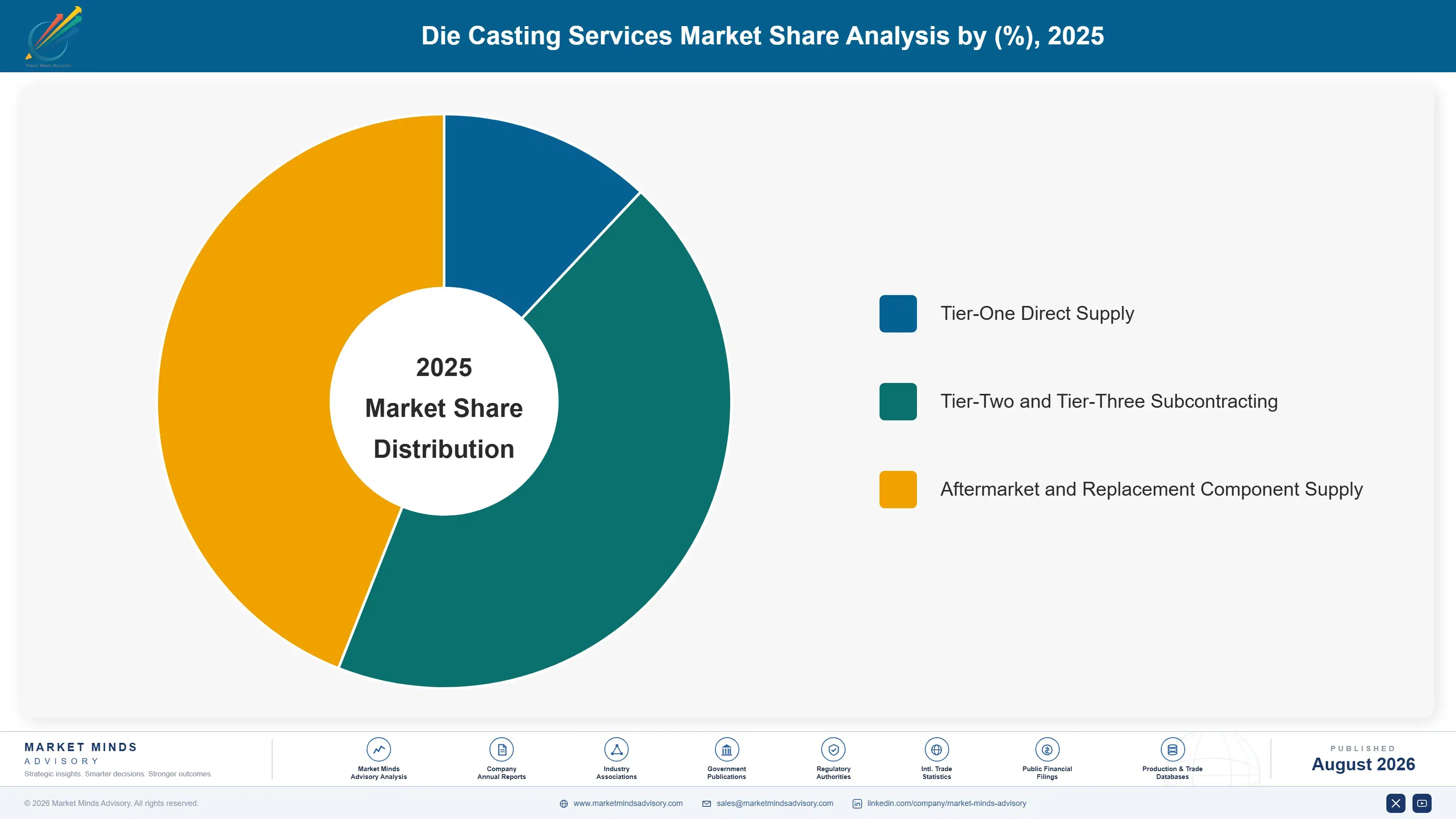
Die casting services span six distinct production disciplines, from commodity zinc and aluminum casting through precision machining and now gigacasting solutions. That production diversity increasingly separates category leaders from smaller regional challengers competing on scale alone across most tiers. Casters who commit early to large-format tooling increasingly separate themselves from competitors still reliant on legacy small-component-only capacity across most channels.
die-casting-services-market-market-share-analysis-1788167644980

Gigacasting and Large-Format Die Casting

Gigacasting and large-format die casting have moved from experimental technology to mainstream production discipline as automakers qualify single-piece structural castings across active EV platforms. Casters investing early in large-tonnage press capacity, paired with digital simulation tooling, are capturing disproportionate share of new structural qualification awards. The segment benefits from structurally shorter assembly cycles and lower part-count complexity than conventional multi-part processes, letting well-capitalised casters compete for awards that would otherwise require prohibitive tooling investment. Automakers increasingly treat gigacasting qualification credentials as a baseline differentiator rather than an emerging capability across major structural component categories today. That advantage compounds further as automakers grow more comfortable extending gigacasting qualification to larger, more structurally demanding part categories.
CAGR 8.4%

Aluminum Die Casting Services

Aluminum die casting services continue expanding as automotive programmes push lightweighting content higher on both structural and powertrain applications for efficiency and range gains. Automated high-pressure die casting and thermal management investment increasingly separates casters who can hit tolerance targets from those still reliant on legacy low-pressure methods that cap throughput. Certification depth around structural integrity and porosity control has become a genuine competitive moat, since qualifying a new aluminum supplier for structural components can take years. That specification pattern is spreading beyond large EV programmes into smaller ICE production efforts seeking similar weight-saving economics. Casters who invested early in thermal management technology now hold a multi-year lead over competitors only beginning that capital transition.
CAGR 6.8%
Full segment breakdown across 6 segments available in the complete report.

Regional Architecture and Country Demand Map

East Asia anchors global demand on established manufacturing scale and EV production volume, while China posts the fastest national growth as domestic EV manufacturing and export capacity continue expanding rapidly. Gigacasting adoption depth and EV production scale increasingly determine which regional supply base captures new automotive allocation over the coming

East Asia

China's domestic EV manufacturing base anchors global demand, with gigacasting and aluminum production concentrated around established Jiangsu and Guangdong industrial clusters. Japanese and South Korean automakers contribute meaningful precision casting demand through established supplier networks tied to shared quality certification standards. Rapid EV platform proliferation across the region continues expanding new tooling investment beyond traditional internal combustion supply channels, and several casters have expanded gigacasting press capacity specifically to capture this broader structural demand. That combined manufacturing and EV momentum positions the region to widen its lead over other regions over the coming decade, assuming continued export demand and policy support. Skilled workforce availability remains an ongoing planning priority for regional manufacturers.
Share: 30% | CAGR: 6.2% (2026 to 2036)

North America

United States automotive gigacasting adoption anchors regional demand, with structural casting purchases concentrated around major EV assembly hubs and established tier-one supplier networks. Canadian casters contribute meaningful component volume through cross-border supply agreements tied to shared quality certification standards. EV platform proliferation across both countries continues expanding new tooling investment beyond traditional powertrain-only channels, and several casters have expanded large-format press capacity specifically to capture recurring structural component revenue. Labour availability for certified tooling engineers remains the binding constraint on how quickly this capacity converts into shipped structural output. Manufacturers who secure retail placement early typically retain preferred shelf status well beyond the initial launch season across subsequent contract cycles.
Share: 24% | CAGR: 5.8% (2026 to 2036)
Regional intelligence for 5 additional markets available in the complete report: Western Europe, South Asia and Pacific, Latin America, Middle East and Africa, Eastern Europe. Contact sales@marketmindsadvisory.com.
die-casting-services-market-country-cagr-analysis-1788167645494

Where Casters Capture Outsized Margin

Die casting services reward casters who move beyond commodity zinc and aluminum work toward certified gigacasting capability. Four paths consistently separate margin leaders from volume-only competitors across the current supply cycle in this category. Casters pursuing several of these paths simultaneously tend to outperform single-focus competitors on both margin and backlog stability across most active programme categories.

Qualify gigacasting for structural component contracts

Casters who invest early in large-format press qualification capture disproportionate share of new structural component awards as automakers shift tooling budgets toward single-piece castings. The qualification process itself takes 18 to 30 months, creating a durable window where early movers hold pricing power before broader industry qualification catches up across the caster base. Casters who move early typically retain preferred vendor status well beyond the initial contract term across multiple subsequent programme awards. Regulators grow more comfortable extending qualification pathways to larger structural categories as flight hours on gigacast parts accumulate across active commercial programmes.
Market Impact: Lifts gross margin by roughly 8 full points

Diversify across automotive and electronics customer bases

Casters serving both automotive and electronics customers smooth demand volatility that pure automotive specialists absorb directly during production downturns. Electronics housing depth provides counter-cyclical revenue precisely when automotive production rates soften, and dual customer credentials increasingly command allocation priority from primes managing constrained capacity. Dual-customer casters report roughly 27% less quarter-to-quarter revenue swing than single-customer peers, a gap that widens further as electronics production continues expanding across most demographic categories. Casters who move early typically retain this dual-customer advantage well beyond the initial qualification cycle across subsequent contract renewal negotiations and expanded scope awards.
Market Impact: Reduces overall revenue volatility by roughly 27% total

Secure long-term aluminum and zinc offtake agreements

Casters with locked-in feedstock pricing avoid the sharpest margin compression during input cost spikes that erode competitors relying on spot-market purchasing. Vertically integrated or offtake-secured casters can bid more aggressively on fixed-price long-term contracts, knowing their input cost exposure is substantially hedged relative to peers. Locked-in pricing typically covers 55 to 75% of annual alloy volume for hedged casters, a pricing cushion that persists for several years before broader industry consolidation narrows the gap. Smaller casters increasingly pool purchasing volume through consortium arrangements to access offtake terms that would otherwise require scale beyond their individual production footprint alone.
Market Impact: Protects margin against roughly 18% total input swings

Build integrated precision machining capacity now

Casters who invest in integrated precision machining and finishing capability can hit rising tolerance requirements that standalone casting operations physically cannot match at scale. This capital investment creates a lead of roughly 2 years over competitors still reliant on outsourced machining, particularly as major automakers push tighter integration higher across most active component categories. Casters offering integrated cast-to-finish packages typically outperform casting-only competitors on contract renewal rates today across most established automotive accounts. Private equity buyers increasingly favour targets with demonstrated integrated machining capability, viewing the capital investment as a durable moat against smaller, less capitalised competitors.
Market Impact: Doubles machining revenue within roughly 24 total months

Who Controls the Margin Pool

Die casting services remain highly fragmented, with the top five companies holding an estimated 24% combined share on an annual casting revenue basis. Dynacast and Ryobi lead precision zinc and aluminum casting, while Nemak and Endurance dominate automotive structural and powertrain categories, leaving a meaningful gap to the strongest mid-tier challengers still building comparable tooling breadth. That gap has narrowed over the past two years as second-tier
Current competitive activity centres on gigacasting press capacity build-out, precision machining investment, and selective acquisition of specialist tooling and electronics housing providers. Several casters have announced multi-year capital programmes explicitly targeting large-format tooling development, while private equity buyers continue consolidating fragmented mid-tier casting and machining capacity across North America and East Asia. Deal volume has concentrated among casters seeking feedstock security or large-format

Emerging pressure is coming from specialist gigacasting providers capturing disproportionate margin by solving specific structural integration bottlenecks faster than larger small-component-focused rivals. Expect ranking shifts among mid-tier casters over the next several years as gigacasting depth and dual-customer access increasingly separate winners from those still reliant on commodity zinc casting volume alone. Casters who fail to invest in either dual-customer access or gigacasting depth risk gradual share erosion
die-casting-services-market-company-positioning-matrix-1788167646019

Competitive Moat and Risk Dimensions

DYNACAST INTERNATIONAL LLC

Moat: Deep Precision Casting Network

Decades of dedicated precision zinc and aluminum casting work for automotive and electronics customers give Dynacast process depth and tooling scale that few casters can replicate quickly given the qualification timelines involved. That relationship depth extends across multiple successive product generations, effectively locking in decades of recurring production and aftermarket component revenue for the incumbent.
DYNACAST INTERNATIONAL LLC

Risk: Gigacasting Transition Lag

Heavy revenue dependence on small-component precision casting leaves Dynacast disproportionately exposed to any single shift toward large-format structural demand growth. Diversifying into gigacasting press capacity remains an ongoing priority, though meaningful progress has been slower than management initially projected to investors. Competitors moving faster on large-format capacity could gradually erode this advantage over
NEMAK SAB DE CV

Moat: Automotive Structural Certification Depth

Nemak's decades-long automotive structural certification history and proprietary aluminum casting technology give it certification depth few competitors match, particularly across powertrain and structural component categories generating recurring aftermarket demand. Few rivals can match this combined breadth of certified equipment across legacy and next-generation platform categories.
NEMAK SAB DE CV

Risk: Customer Concentration Risk

Heavy revenue dependence on a small number of automotive OEM customers leaves Nemak disproportionately exposed to any single programme rate change or extended production pause. Diversifying into electronics and industrial customer segments remains an ongoing priority for management. Meaningful progress has been slower than management initially projected to investors seeking diversified revenue streams across the broader industrial base.

Players Tracked

Prominent Players

Dynacast International LLC
Ryobi Die Casting (USA) Inc
Nemak SAB de CV
Endurance Technologies Limited
GF Casting Solutions AG

Other Key Players

Consolidated Metco Inc
Alcast Company
Bocar Group
Gibbs Die Casting Group
Cast-Fab Technologies Inc
Dietech Manufacturing Solutions LLC
Yushin Precision Equipment Co Ltd
Guangdong Hongtu Technology Co Ltd
Rheinmetall Automotive AG
Shloka Overseas
Pace Industries LLC
Miba AG
Martinrea International Inc
Meridian Lightweight Technologies Inc
Form Technologies Inc

Recent Developments

MARCH 2025

Dynacast completed the acquisition of a gigacasting technology specialist to expand large-format press capacity for its structural product line. The deal strengthens Dynacast's competitive position considerably overall. The acquisition adds dozens of qualified tooling engineers to Dynacast's expanding structural division. Buyers noticed quickly. today. overall.
Signal: Signals continued consolidation of gigacasting capability among tier-one casting companies. Rivals without similar gigacasting capability face growing pressure to pursue
SEPTEMBER 2024

Nemak expanded its aluminum structural casting facility, adding new large-format press lines for both EV and traditional platform categories. Several hundred new units joined production capacity overall. The expansion strengthens Nemak's competitive position ahead of anticipated EV production rate increases. Retailers welcomed the news. today.
Signal: Reinforces Nemak's lead in flight-critical structural casting certification depth regionally. Competing casters are accelerating comparable investment to avoid falling behind
JUNE 2025

Ryobi signed a long-term component supply agreement with an upstream aluminum producer, securing feedstock pricing stability for its casting production lines. The deal covers multiple qualified alloy grades overall. The agreement secures feedstock stability through the next several years for Ryobi's casting lines. today. overall.
Signal: Reflects growing industry preference for hedged input cost exposure over spot purchasing. Expect similar hedging agreements across the sector as

Aluminum and Zinc Alloy Input Exposure

Aluminum and zinc alloy inputs together represent roughly 31% of cost of goods sold for a typical die casting manufacturer, with primary aluminum sourced primarily from Chinese, Canadian, and Middle Eastern smelters whose combined output remains concentrated among a small number of qualified suppliers. Zinc alloy supply is similarly concentrated among a handful of producers holding automotive-grade qualification credentials.
Aluminum prices spiked more than 30% between mid-2021 and early 2022 following global energy cost disruption tied to smelting production constraints, according to IEA industrial metals reporting. Casters without long-term offtake agreements absorbed much of that spike directly, since fixed-price long-term supply contracts with automotive integrators left little room to pass costs through, compressing margins materially across an entire earnings quarter for several exposed casters.

Casters without vertically integrated feedstock access or hedged offtake agreements face a durable cost disadvantage relative to larger integrated companies who can absorb volatility across broader balance sheets. This disadvantage is most acute for smaller regional casters in Eastern Europe and Latin America, who typically lack the purchasing scale to negotiate favourable index-linked pricing terms with upstream aluminum and zinc producers.
die-casting-services-market-cost-volatility-analysis-1788167646214

Long-term aluminum offtake agreements

Casters increasingly negotiate multi-year index-linked offtake agreements directly with upstream aluminum smelters, trading some pricing flexibility for materially reduced exposure to spot-market volatility during supply disruption cycles across most qualified suppliers. This capability increasingly separates casters who can bid aggressively on fixed-price long-term contracts from those forced to price in significant hedging risk premiums against future volatility.

Consortium purchasing pools

Smaller and mid-tier casters increasingly pool purchasing volume through industry consortium arrangements, accessing offtake pricing terms that would otherwise require production scale beyond their individual footprint over multiple recent negotiation cycles. This collective approach has become particularly common among Eastern European and Latin American casters lacking the individual purchasing scale to negotiate directly with major upstream producers.

Vertical integration into alloy processing

Several larger casters have pursued selective backward integration into aluminum and zinc alloy processing, reducing dependence on external suppliers for their most cost-sensitive input categories over time. This approach requires substantial upfront capital but delivers durable margin protection that smaller, purely downstream competitors cannot easily replicate without comparable balance sheet capacity across the sector.

Portfolio Architecture for Margin Defence

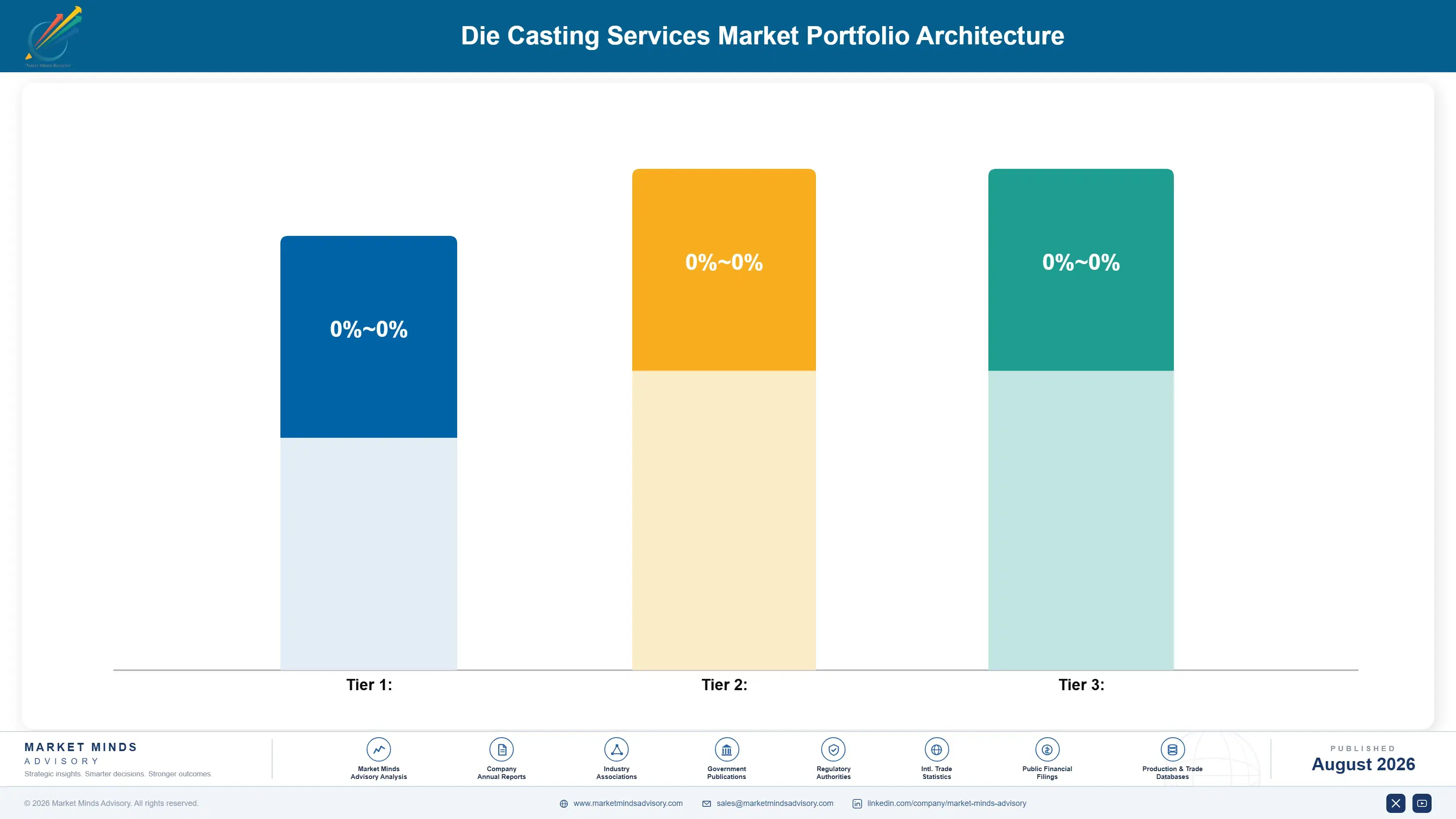
Die casting services splits into three tiers with meaningfully different margin economics. Volume zinc and aluminum casting delivers steady but thin margins on high production volume, while gigacasting and precision machining categories command materially better economics tied to tooling depth and structural integration rather than pure throughput. Casters who diversify across all three tiers typically post more stable blended margins.
The volume versus premium tension shapes most caster capital allocation decisions today. Casters who stay purely commodity-focused face gradual margin compression as automakers push pricing pressure down the supply chain, while those investing in certified specialty capability increasingly capture disproportionate share of new qualification awards. Consolidation among mid-tier commodity casters continues as tooling development costs climb, rewarding scale.

High-value margin pools concentrate in gigacasting, precision machining, and electronics housing work for next-generation structural protocols. Casters positioned across all three categories simultaneously are best placed to weather programme rate volatility while capturing the sector's fastest-growing revenue streams over the coming decade. Casters positioned only in commodity volume work face the steepest durable margin ceiling, regardless of how efficiently they operate, since pricing power in that tier rests overwhelmingly with automotive prime integrators.

Commodity zinc and aluminum casting sold largely through tiered supplier contracts on price and delivery reliability rather than certification depth. Competitive intensity here remains highest across the entire value chain.
Gross Margin

Structural aluminum casting and precision machining earning meaningfully more on certification breadth, tooling investment, and documented reliability track record across programmes. Casters here typically hold multi-year relationships that are costly for buyers to replace.
Gross Margin

Gigacasting, electronics housing precision, and next-generation structural production commanding the highest margins tied to scarce qualification credentials and capital intensity. Few casters currently qualify, keeping competitive intensity comparatively low for now.
Gross Margin
die-casting-services-market-portfolio-architecture-1788167646710

High-value Sub-segments and Strategic Watch-out

Gigacasting and Large-Format Die Casting

Gigacasting combines the fastest segment growth with the category's strongest margin profile, driven by scarce qualification credentials and structurally lower part-count complexity than conventional multi-part processes. Early movers retain preferred qualification status well beyond the initial part award across subsequent programme cycles. across most active categories.

Aluminum Die Casting Services

Aluminum casting commands strong margins tied to certification depth, though growth trails gigacasting as the segment matures and automated high-pressure capacity becomes more widely available across casters. Casters who invested early hold a multi-year capability lead over competitors only beginning that capital transition. today. overall

Zinc Die Casting Services

Zinc casting remains the largest revenue category by volume, but thinner margins and rising pricing pressure from automakers make this segment a scale-dependent rather than margin-driven business overall. Casters here compete primarily on delivery reliability and unit cost. Limited room for differentiation persists beyond operational efficiency gains.

Magnesium Die Casting Services

Magnesium casting faces disruption risk as durable aluminum alternatives increasingly substitute for magnesium in select weight-sensitive applications, though certified legacy magnesium demand persists across most active production programmes today across the sector. Diversification into gigacasting-adjacent services increasingly determines which specialists remain relevant over the coming decade.

How Programme Backlogs Compound

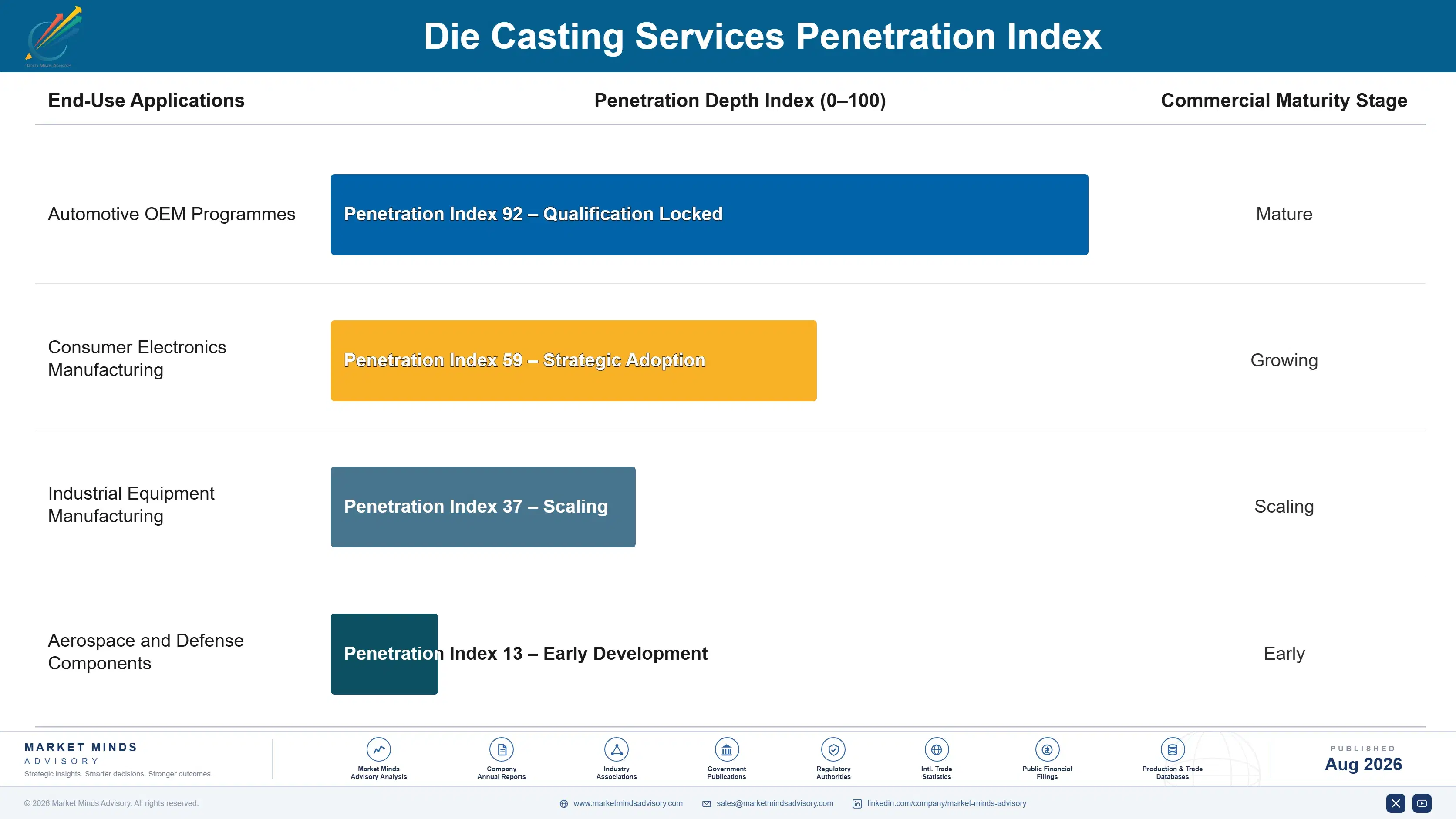
Die casting services runs on multi-year programme commitments rather than one-off purchases, and that annuity economics defines most caster revenue visibility. A single structural part qualification, once won, typically generates a decade or more of recurring production revenue tied directly to the parent vehicle programme's build rate and service life. Suppliers rarely lose qualified positions once won, since requalifying an alternate source is
Adoption stickiness varies meaningfully by end-use vertical. Automotive OEM programmes lock casters into the deepest, longest relationships given production run lengths measured in years, while electronics customers offer shorter but higher-margin runs tied to specific product cycles. Industrial equipment customers sit between the two, offering moderate volume with somewhat greater customer diversification across smaller programme families. Casters who diversify across all three verticals typically build

Buyer profiles are shifting generationally as younger procurement officers increasingly weight gigacasting qualification depth and digital process control alongside traditional cost and delivery metrics. Younger engineering leadership at major automakers shows measurably greater willingness to qualify new specialist casters offering demonstrated digital capability, a shift that favours innovative mid-tier challengers over legacy incumbents resistant to process change. Casters slow to adapt risk gradual exclusion from next-generation qualification
die-casting-services-market-end-use-penetration-index-1788167647190

What Determines Long-Term Position

These are among the four positions where our research anticipates prominent divergence between winners and laggards over the coming forecast period. Each is grounded in the demand model, the regulatory perimeter, and the announced capacity pipeline.
01 / GIGACASTING QUALIFICATION DEPTH

Large-format credentials increasingly gate premium contract access

Casters who secured gigacasting qualification early now hold a multi-year lead over competitors only beginning that process, a gap that widens further with each additional structural award won across active programmes. This advantage compounds as automakers shift tooling budgets toward single-piece castings and extend approval pathways to larger, more structurally demanding categories that carry disproportionately higher margin. Expect the divide between qualified and unqualified casters to widen substantially as broader industry adoption accelerates across most structural programme categories over the coming decade.
02 / ALLOY COST HEDGING DISCIPLINE

Feedstock security separates resilient casters from exposed ones

Casters without long-term aluminum and zinc offtake agreements face the sharpest margin compression during input cost spikes that hedged competitors largely avoid through locked-in pricing structures negotiated well ahead of volatility cycles. This disadvantage is most acute for smaller regional casters lacking the purchasing scale to negotiate favourable index-linked terms directly with upstream producers. Consortium purchasing arrangements offer a partial remedy for these smaller players, but rarely match the full protection that direct offtake agreements provide larger, better-capitalised competitors over time.
03 / DUAL-CUSTOMER PROGRAMME ACCESS

Automotive and electronics access provides counter-cyclical revenue stability

Casters serving both automotive and electronics customers smooth demand volatility that pure automotive specialists must absorb directly during production downturns and programme rate reductions. Electronics housing depth provides meaningful counter-cyclical revenue precisely when automotive production rates soften, and dual customer credentials increasingly command allocation priority from primes managing constrained capacity across both segments simultaneously. This diversification is fast becoming a near-mandatory strategic requirement rather than an optional hedge for casters seeking durable, multi-cycle revenue stability across most active programme categories.
04 / PRECISION MACHINING INVESTMENT

Integrated finishing capacity determines rate-target readiness

Casters who invested early in integrated precision machining can meet rising tolerance requirements that standalone casting operations physically cannot match at the production scale major automakers now require across the region. This capital investment creates a durable, multi-year lead over competitors still reliant on outsourced machining as programmes push tighter integration further into mainstream commercial and structural production categories. Private equity buyers increasingly favour acquisition targets with demonstrated machining capability already installed, viewing it as a durable moat against smaller, less capitalised entrants.

Engagement Snapshot From the Field

A live engagement with an industry participant carrying material or product regulatory and market exposure ahead of a defining policy shift, showing how our research translates into a defensible multi-year portfolio strategy.
MARKET MINDS ADVISORY · CLIENT ENGAGEMENT SUMMARY
Die Casting Services Producer Strategic Portfolio Review and Transition Roadmap 2026·Investment Scenario on Die Casting Services Exposure Evaluation 2025-26
CLIENT PROFILE
A mid-tier die casting supplier serving both automotive and electronics customers across North American and East Asian facilities, generating approximately $310 million in annual revenue (client-reported, unverified by MMA) with roughly 1,600 employees across four production sites. The company had grown steadily through organic contract wins over the prior decade but had not previously undertaken a formal capacity expansion planning process ahead of a major capital commitment decision.
STRATEGIC CHALLENGE
The client faced mounting pressure to expand gigacasting capacity ahead of anticipated EV rate increases but lacked internal data on which part categories would deliver the strongest qualification return relative to required capital investment across competing programme options. Leadership was divided internally between prioritising battery enclosure categories, where competitive activity was already visible, and less-crowded underbody categories where qualification timelines remained comparatively uncertain to management.
MMA APPROACH
MMA conducted primary interviews with programme engineers at two major automakers, benchmarked qualification timelines across comparable gigacasting investments, and modelled capacity return scenarios against three programme rate trajectories to prioritise the client's investment sequencing decision. The engagement concluded with a phased capital deployment recommendation designed to sequence investment toward the categories offering the strongest near-term qualification and margin return.
KEY FINDINGS
  1. Underbody structural castings offered the fastest qualification return, with typical approval timelines nearly forty percent shorter than battery enclosure categories the client had initially prioritised.
  2. Competing suppliers pursuing similar gigacasting investment were concentrated in battery enclosure categories, suggesting underbody structures offered a more differentiated near-term positioning opportunity with less immediate competitive overlap.
  3. Electronics housing qualification pathways carried materially higher margin potential than commercial equivalents despite longer initial approval timelines, a gap only visible once both were modelled together consistently.
  4. Capital intensity for the recommended sequencing was roughly 25% lower than the client's original expansion plan, primarily by deferring the largest single press purchase by eighteen months.
CLIENT PROFILE
A mid-tier die casting supplier serving both automotive and electronics customers across North American and East Asian facilities, generating approximately $310 million in annual revenue (client-reported, unverified by MMA) with roughly 1,600 employees across four production sites. The company had grown steadily through organic contract wins over the prior decade but had not previously undertaken a formal capacity expansion planning process ahead of a major capital commitment decision.
STRATEGIC CHALLENGE
The client faced mounting pressure to expand gigacasting capacity ahead of anticipated EV rate increases but lacked internal data on which part categories would deliver the strongest qualification return relative to required capital investment across competing programme options. Leadership was divided internally between prioritising battery enclosure categories, where competitive activity was already visible, and less-crowded underbody categories where qualification timelines remained comparatively uncertain to management.
MMA APPROACH
MMA conducted primary interviews with programme engineers at two major automakers, benchmarked qualification timelines across comparable gigacasting investments, and modelled capacity return scenarios against three programme rate trajectories to prioritise the client's investment sequencing decision. The engagement concluded with a phased capital deployment recommendation designed to sequence investment toward the categories offering the strongest near-term qualification and margin return.
KEY FINDINGS
  1. Underbody structural castings offered the fastest qualification return, with typical approval timelines nearly forty percent shorter than battery enclosure categories the client had initially prioritised.
  2. Competing suppliers pursuing similar gigacasting investment were concentrated in battery enclosure categories, suggesting underbody structures offered a more differentiated near-term positioning opportunity with less immediate competitive overlap.
  3. Electronics housing qualification pathways carried materially higher margin potential than commercial equivalents despite longer initial approval timelines, a gap only visible once both were modelled together consistently.
  4. Capital intensity for the recommended sequencing was roughly 25% lower than the client's original expansion plan, primarily by deferring the largest single press purchase by eighteen months.
RECOMMENDED STRATEGY
Phase 1: Phase one prioritised underbody structural qualification, sequencing capital spend toward the fastest-return categories identified through the benchmarking exercise. Reference checks confirmed prior programme outcomes. Phase 2: Phase two expanded qualification into battery enclosure part categories, using phase one revenue to partially fund the higher-margin but longer-cycle investment. Phase 3: Phase three evaluated a second gigacasting line only once phase one and two utilisation metrics confirmed sustained demand beyond initial forecasts.
OUTCOME
The client secured qualification for nine new part numbers within fourteen months, ahead of the eighteen-month internal target, and reported a 22% increase in structural-related revenue within the first year post-implementation (client-reported, unverified by MMA). Leadership credited the phased sequencing approach with reducing capital exposure during the initial ramp period while preserving optionality for the larger battery-enclosure investment.

Frequently Asked Questions

Foundational context covering the market sizes, CAGR, scope, country, region and competition that inform every finding below. This section is provided to cover basics and most often pre-purchase conversations, answered from the MMA Primary Research Dataset.

What is the current size of the Die Casting Services Market?

The global die casting services market reached an estimated $78.5 billion in 2025. Zinc and aluminum component casting still accounts for the largest single share, though gigacasting is expanding fastest.

How large will the Die Casting Services Market be by 2036?

The market is projected to reach approximately $137.1 billion by 2036, nearly doubling from its 2026 base as gigacasting adoption and EV structural demand accelerate procurement growth.

What is the CAGR for the Die Casting Services Market 2026 to 2036?

The market is projected to grow at a 5.2% compound annual rate between 2026 and 2036, supported by rising EV lightweighting requirements and expanding gigacasting investment.

Which segment is growing fastest?

Gigacasting and large-format die casting is growing fastest at 8.4% CAGR, roughly 1.6 times the overall market rate, as automakers shift tooling budgets toward single-piece structural castings.

Who are the major companies in the Die Casting Services Market?

Dynacast, Ryobi, Nemak, Endurance, and GF Casting Solutions lead the market, together holding an estimated 24% combined share on an annual casting revenue basis. overall

Which country is growing fastest?

China is growing fastest at 7.2% CAGR, driven by expanding domestic EV manufacturing and rising export capacity across most major production regions nationwide. and regions

Report Segmentation Architecture

The full report scope spans multiple orthogonal segmentation dimensions, with cross-tabulated demand data provided for each dimension pair. Coverage extends further to regional breakdowns, trend trajectories, and the competitive detail needed to support segment-level decision-making.
  • Aluminum Die Casting Services
  • Zinc Die Casting Services
  • Magnesium Die Casting Services
  • High-Pressure Die Casting Services
  • Gigacasting and Large-Format Die Casting
  • Precision Machining and Finishing Services
  • Automotive OEM Programmes
  • Consumer Electronics Manufacturing
  • Industrial Equipment Manufacturing
  • Aerospace and Defense Components
  • Tier-One Direct Supply
  • Tier-Two and Tier-Three Subcontracting
  • Aftermarket and Replacement Component Supply

By Region

  • East Asia
  • North America
  • Western Europe
  • South Asia and Pacific
  • Latin America
  • Middle East and Africa
  • Eastern Europe

Scope, Methodology, and Coverage

Every figure in this report is reproducible from documented input assumptions. The scope below maps the historical period, the forecast horizon, the segmentation dimensions, and the countries covered, alongside the underlying primary and qualitative methodology.
Historical Period
2020 to 2025
Forecast Period
2026 to 2036
Base Year
2025 (USD billions; MMA Primary Research Dataset, August 2026)
Market Definition
The market covers die casting service activities producing aluminum, zinc, and magnesium components including high-pressure die casting, gigacasting and large-format structural production, and precision machining and finishing services for automotive, electronics, and industrial customers. Sand casting and unrelated forging services are excluded from this defined scope.
Quantitative Units
USD billions
Segmentation Dimensions
Regions Covered
East Asia, North America, Western Europe, South Asia and Pacific, Latin America, Middle East and Africa, Eastern Europe
Countries Covered
Key Companies Profiled
Dynacast International LLC, Ryobi Die Casting (USA) Inc, Nemak SAB de CV, Endurance Technologies Limited, GF Casting Solutions AG, Consolidated Metco Inc, Alcast Company, Bocar Group, Gibbs Die Casting Group, Cast-Fab Technologies Inc, Dietech Manufacturing Solutions LLC, Yushin Precision Equipment Co Ltd, Guangdong Hongtu Technology Co Ltd, Rheinmetall Automotive AG, Shloka Overseas, Pace Industries LLC, Miba AG, Martinrea International Inc, Meridian Lightweight Technologies Inc, Form Technologies Inc
Quantitative Methodology
Primary survey, n=3,800 respondents, Q4 2025, six countries; demand-side model with trade association cross-validation
Qualitative Methodology
47 expert interviews, Q4 2025; applied to validate demand model assumptions, identify emerging dynamics, and assess competitive positioning
Report Format
PDF and XLSX data workbook (Word format preview document)
Publisher
Market Minds Advisory
Report Code
MMA-2026-CON-115
Published
August 2026
Contact
sales@marketmindsadvisory.com | www.marketmindsadvisory.com

Purchase the full Die Casting Services Market Report (2026 to 2036).

This report provides comprehensive analysis of the global die casting services market, covering production trends, segment-level demand, and regional supply chain dynamics through 2036. It examines competitive positioning among leading casting companies, quantifies gigacasting adoption, and identifies revenue levers separating margin leaders from volume-only competitors. The analysis draws on primary survey data, expert interviews, and company disclosures to support strategic capacity and investment planning decisions across the supply chain. A dedicated case study illustrates how one mid-tier supplier applied this framework to sequence a major capacity expansion decision.
Six-segment production demand breakdown and outlook
Regional supply chain concentration analysis by country
Competitive benchmarking of top casting companies
Gigacasting adoption tracking and analysis framework
Aluminum and zinc input cost exposure modelling
Revenue lever analysis for margin expansion strategy

Built For The People Who Decide

From boardroom strategy to bench-side execution, this report is read cover-to-cover by leaders shaping the next decade of their industry, turning demand scenarios, market dynamics and valuation benchmarks into decisions.
CXOs/ Presidents/ VPs/ Managers
M&A and Corporate Development
Strategy Teams and R&D Heads
Procurement and Product Directors
Regulatory and Compliance Leaders
Investor Relations and Equity Analysts