Market Minds Advisory
Die Cast Toys Market

Die Cast Toys Market: Die Cast Toys Market: Adults Pay For It, Zinc Decides The Margin, And The Licence Can End A Product Line, 2026 to 2036

Adults buying for their own collections supply about 43% of revenue while retail is built for children. Zinc runs 31% of manufacturing cost and roughly 7% of manufacturers hedge it.

Lead Analyst

Published

September 2026

Make Smarter Decisions with Customized Research Insights

Request a free sample report and evaluate market opportunities, growth trends, and competitive dynamics relevant to your business needs.

2025 MARKET VALUE$7.8BMarket Size 2025
2036 FORECAST VALUE$13.9BBase Case , 2026 to 2036
CAGR 2026 TO 20365.4 %Bull 6.6% / Bear 4.2%
INCREMENTAL OPPORTUNITY$5.7BNet 10- year value creation
EXPANSION MULTIPLE1.70x2036 value over 2026 base
Strategic Levers
M&A Pipeline
Regional Outlook
Country Rankings
Competitive Intelligence
Segmental Deep-dive
Call-Us : 91 93563 13602

Executive Snapshot and Market Trajectory.

Adults buying for their own collections supply around 43% of category revenue, at price points and detail levels no child requires. The aisle, the packaging, and the safety testing are all built for a buyer funding less than half of it now. The mismatch costs realisation on every premium unit.
Premium collector-grade replicas grow at 8.1%, half again the market rate of 5.4%, on detail and licensing that a play product cannot justify. Mid-scale detailed models follow at 7.2%. Die-cast aircraft and military models grow slowest of the six classes at 4.0%, on a collector base that is ageing rather than replacing itself. Small-scale mass play vehicles carry most units and almost none of the growth.
East Asia holds 34% of demand and manufactures nearly all of it, with Chinese growth of 9.4% leading every market covered. Zinc casting alloy runs about 31% of manufacturing cost before decoration, and roughly 7% of manufacturers hedge that exposure against contracted production volume. About 68% of revenue depends on licences held by other parties, and a lapse ends a product line rather than repricing it. Tooling amortisation goes unrecovered with it.
Market Definition
This market covers zinc and aluminium die-cast miniature vehicles, machines, and figures sold as toys and collectibles, including small-scale mass play vehicles, small-scale collector series, mid-scale detailed models, premium collector-grade replicas, die-cast construction and agricultural models, and die-cast aircraft and military models. It excludes plastic-only toy vehicles, radio-controlled models, unassembled scale model kits, resin-only collectibles, and die-cast industrial components.
Base Year Value
$7.8B in 2025 (MMA Primary Research Dataset, September 2026)
Forecast Period
2026 to 2036, eleven discrete annual values
CAGR
5.4% base case. Bull 6.6%. Bear 4.2%.
Fastest Growth Segment
Premium Collector-Grade Replicas: 8.1% CAGR
Fastest Growth Country
China: 9.4% CAGR
Fastest Growth Region
South Asia and Pacific: 7.4% CAGR
Largest Region
East Asia: 34% of 2025 global value
Market Leaders
Mattel, Takara Tomy, Bandai Namco Holdings, May Cheong Group, and Simba Dickie Group lead the field. Source: MMA Primary Research Dataset, July 2026.
Primary Survey
n=3,800 procurement and R&D decision-makers, Q4 2025, six countries
Methodology
Demand-side build-up, cross-validated against public data, 47 expert interviews

Die Cast Toys Market Forecast Scenarios

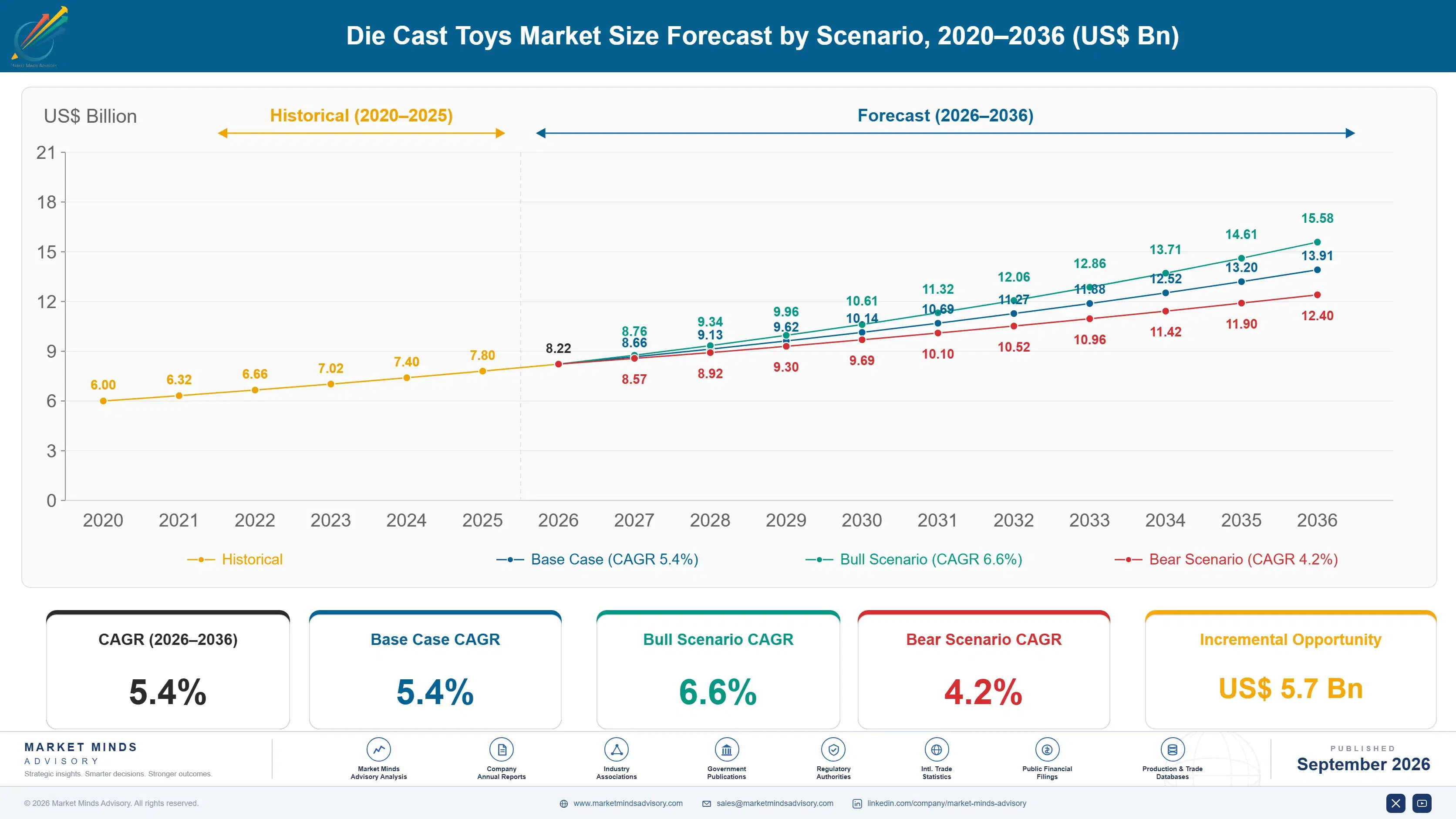
die-cast-toys-market-size-forecast-scenario-1790020377987
Growth from 2020 to 2025 ran at 4.3% and the composition shifted much further than the rate. Adult collector purchasing expanded substantially while children's play volume was flat to declining, which lifted average selling price without lifting unit counts. Zinc price volatility through the middle of the period compressed margins for manufacturers who had never treated metal exposure as something requiring management.
The base case at 5.4% rests on three mechanisms. Adult collecting keeps expanding, particularly at premium detail levels where price realisation is highest. Chinese domestic collecting grows quickly alongside the region's manufacturing base, with country growth at 9.4% leading every market covered. And limited and variant releases keep working commercially because scarcity in this category is manufactured deliberately and buyers accept it. None of the three assumes the industry stops merchandising premium product beside play vehicles.
The bull case at 6.6% depends on manufacturers reaching adult collectors through channels built for them rather than through toy retail, which would lift realisation further. The bear case at 4.2% is licensing: about 68% of revenue depends on automotive and entertainment licences held by other parties, and a renewal lost is a product line ended rather than repriced.

Who Is Actually Buying These

The buyer changed and the retail structure did not. Around 43% of category revenue now comes from adults purchasing for their own collections, at detail levels and price points that no child needs or notices. Those products sit in a toy aisle, in packaging built to appeal to a parent, carrying testing scoped for a three year old. The mismatch costs realisation on every premium unit sold.
TOP FIVE CONCENTRATION46%Share of category revenue held by the leading manufacturers
ADULT PURCHASE SHARE43%Category revenue from adults buying for their own collections
ZINC MANUFACTURING COST SHARE31%Casting alloy share of manufacturing cost before decoration
METAL HEDGING ADOPTION7%Manufacturers hedging zinc exposure against contracted production volume
LICENCE DEPENDENT REVENUE68%Revenue tied to automotive or entertainment licences held externally
TOOLING LIFE SHOT COUNT180000Castings a die produces before dimensional tolerance is lost
The cost structure is a metals business that thinks it is a toy business. Zamak casting alloy is overwhelmingly zinc, and the alloy runs about 31% of manufacturing cost before any decoration is applied. Zinc moves on mining supply and industrial demand with no relationship to toy demand at all, and roughly 7% of manufacturers hedge that exposure. Margin in this category is therefore set substantially by a commodity nobody in it manages.
Then licensing, which is the risk that ends businesses rather than trimming them. About 68% of revenue is tied to automotive or entertainment licences held by other parties, and a licence is not repriced when it lapses, it stops. Tooling makes it worse: a die costs a great deal and is useless once the marque is no longer licensed.
"Nearly half the money now comes from adults buying for themselves, and the industry is still merchandising to a parent in a toy aisle. Meanwhile the largest cost line is a base metal that almost nobody hedges, in a business that does not think of itself as exposed to metals at all."
Practice Director, Toys and Collectible Products · MMA Consumer Toys and Collectibles Practice · September 2026

Market Trends

Adult Collecting Funds What Children Do Not Buy

Premium collector-grade replicas grow at 8.1% and mid-scale detailed models at 7.2%, against small-scale mass play vehicles at 4.6%. Adults now supply around 43% of category revenue and effectively all of the growth in average selling price. The commercial problem is channel: those buyers are reached through hobby retail, direct online, and collector communities rather than through the toy aisle that carries most of the industry's shelf space. Manufacturers merchandising premium product to parents are pricing it against a play alternative it does not compete with. The product does not change and the comparison the buyer makes does.
Market Impact: Country grows at 9.4%
Manufactured Scarcity Works And Is Rarely Managed

Limited runs, variant releases, and deliberately restricted distribution sustain a secondary market that sets perceived value on a meaningful share of premium volume. Manufacturers capture none of that resale value directly and benefit from it entirely through primary demand and pricing power. The risk is calibration: scarcity generated too aggressively frustrates the collectors funding the category, while scarcity generated too little removes the pricing effect. Very few manufacturers treat release planning as the pricing instrument it actually is. Release planning is a pricing instrument in this category, and it is scheduled against marketing calendars almost everywhere instead.
Market Impact: Dies last 180000 castings

Market Opportunities and Growth Drivers

Chinese Collecting Grows Beside The Production Base

China grows at 9.4%, faster than any country covered, as domestic collecting expands alongside a manufacturing base that produces nearly all of the world's die-cast toys. East Asia holds 34% of world demand. Japanese collector culture is the deepest anywhere and treats small-scale die-cast as an adult hobby rather than a children's product, which is the pattern Western markets have been moving toward for a decade. Regional manufacturers increasingly sell finished collector product under their own brands. Regional licensing relationships with Japanese and Korean marques are difficult for Western competitors to obtain on comparable terms.
Market Impact: Zinc runs 31% of cost

Tooling Economics Reward Decoration Over New Castings

A die costs a great deal and produces roughly 180,000 castings before dimensional tolerance is lost, which makes the economics strongly favour running one casting through many decoration variants rather than tooling new subjects. That is why a single body appears in dozens of liveries across a decade. It also explains why licence loss is so damaging: the tooling remains serviceable and becomes unusable, with the amortisation unrecovered and nothing to run on the die. Planning livery and variant programmes against remaining tool life rather than against a marketing calendar recovers amortisation considerably faster.
Market Impact: Licences carry 68% revenue

Market Restraints and Challenges

Zinc Sets The Margin And Nobody Manages It

Casting alloy runs about 31% of manufacturing cost before decoration and roughly 7% of manufacturers hedge the exposure, and the root cause is that toy companies do not see themselves as metals businesses. Commercially this means margin swings on a commodity moving for reasons entirely unrelated to toy demand. Manufacturers respond by contracting alloy against mine supply cycles, by hedging against committed production volume, and by designing wall thickness to reduce metal content without losing perceived heft. The instruments are ordinary and widely available, and the obstacle is a matter of self-perception rather than capability.
Market Impact: Adults supply 43% revenue

A Lapsed Licence Ends A Line Rather Than Repricing It

About 68% of revenue depends on automotive or entertainment licences held by other parties, and the root cause is that the appeal of a die-cast model is almost entirely the marque it reproduces. Commercially a lapse is terminal for that product rather than costly, and the tooling amortisation goes unrecovered. Manufacturers respond by staggering renewal dates across a portfolio, by developing unlicensed original subjects, and by negotiating tooling wind-down periods into licence terms. Concentrating renewals into a single window is a scheduling accident that turns into a company-level commercial event.
Market Impact: Premium grows at 8.1%
3 additional market trends, 4 additional growth drivers, and 2 additional restraints and challenges are covered in the full report. Contact sales@marketmindsadvisory.com to access the complete intelligence.

Segment CAGR and Growth Architecture

Segmentation follows product class by scale and grade across six categories: small-scale mass play vehicles, small-scale collector series, mid-scale detailed models, premium collector-grade replicas, die-cast construction and agricultural models, and die-cast aircraft and military models. Subject licence, price tier, and channel are treated as separate dimensions. Plastic vehicles, radio-controlled models, and unassembled kits fall outside the defined scope entirely.
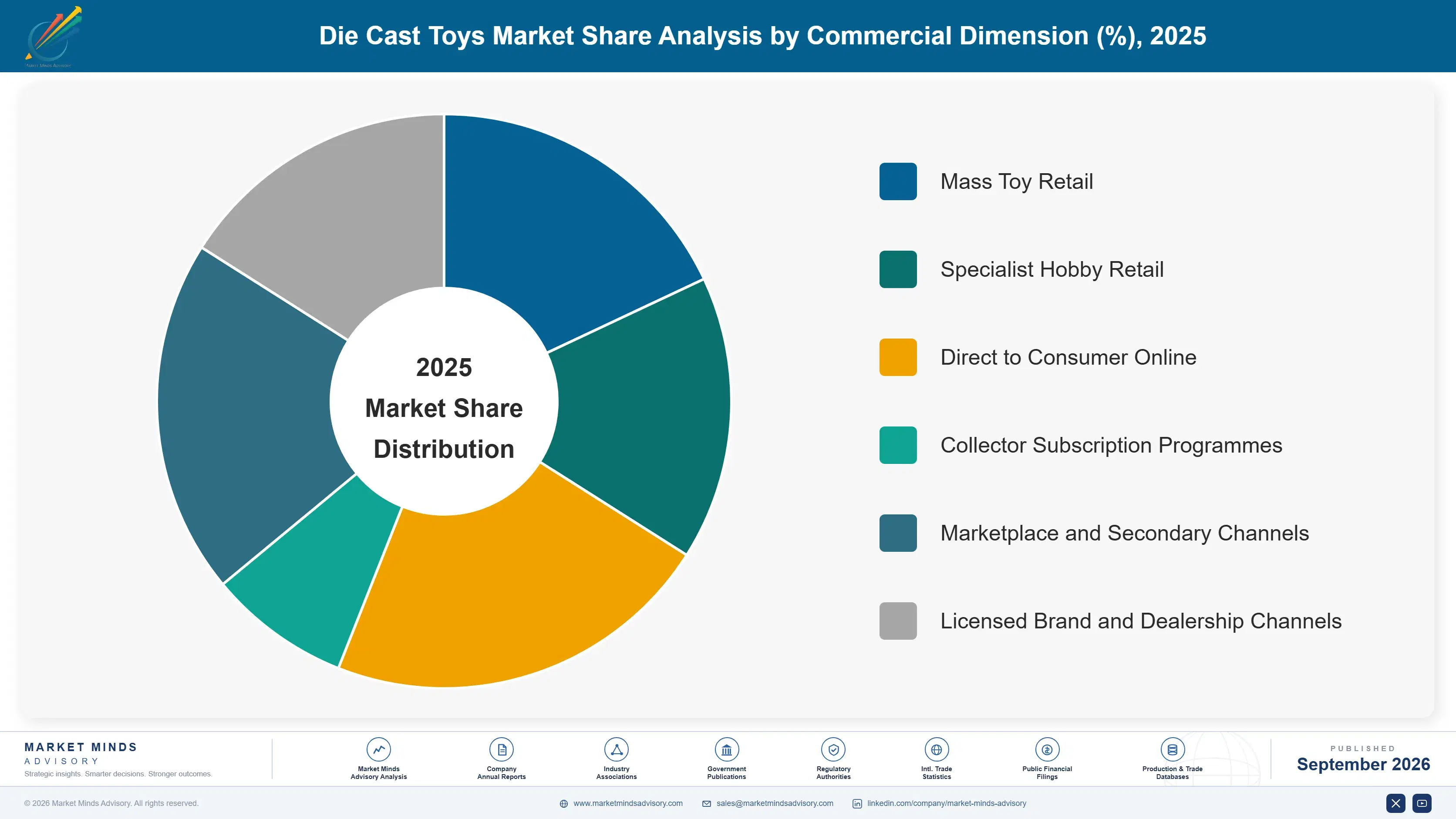
die-cast-toys-market-market-share-analysis-1790020378946

Premium Collector-Grade Replicas

Premium collector-grade replicas grow at 8.1%, half again the market rate of 5.4%, on detail, opening components, and licensed accuracy that no play product could justify at any price. The buyer is an adult purchasing for a collection, and the purchase is closer to a hobby acquisition than a toy transaction in every respect that matters commercially. Tooling cost per subject is high and run lengths are short, which inverts the economics that govern mass die-cast entirely. Channel is the binding constraint rather than demand, since these products reach their buyer through hobby retail and direct sales rather than through the toy aisle carrying most industry shelf space. Toy retail scale works against this segment rather than for it.
CAGR 8.1%

Mid-Scale Detailed Models

Mid-scale detailed models grow at 7.2% by sitting between a gift purchase and a collection purchase, which is a commercially useful position and a difficult one to hold. The scale supports genuine detail at a price a non-collector will still pay, which makes it the entry point through which most adult collectors arrive. Tooling amortises across longer runs than premium grades allow, so the margin structure is considerably more forgiving. The risk is drifting upward in detail and cost until the product loses the gift buyer without gaining the serious collector, which several manufacturers have managed to do. Holding that position requires deliberate restraint on detail and cost. Several manufacturers have drifted upward and lost that buyer.
CAGR 7.2%
Full segment breakdown across 6 segments available in the complete report.

Regional Architecture and Country Demand Map

Regional shares reflect where die-cast toys and collectibles are purchased rather than where they are cast. Three regions sit outside the standard bands, for reasons named in their own paragraphs and summarised below for operator review. Collector culture, licensing access, and channel structure vary sharply between them.

East Asia

At 34% this sits above the standard band, and the justification is that the region casts nearly all of the world's die-cast product while Japanese collector culture is the deepest anywhere and Chinese domestic collecting grows fastest. Chinese growth of 9.4% leads every country covered. Japanese buyers have treated small-scale die-cast as an adult hobby for decades, which is the pattern Western markets have been slowly adopting. Regional manufacturers increasingly sell finished collector product under their own brands rather than casting for others. Licensing relationships with Japanese and Korean marques are held regionally. That regional licence position is difficult for Western competitors to match on comparable terms at all. Casting capacity sits here too.
Share: 34% | CAGR: 6.4% (2026 to 2036)

North America

Adult collecting is furthest advanced here as a proportion of category spending, and secondary market activity around limited and variant releases is the most developed anywhere. Growth of 4.8% runs a little under the world rate. Toy retail still carries most shelf space while hobby retail and direct online channels carry a rising share of value, which is where the channel mismatch is most visible. Automotive licensing relationships are concentrated here and renewal exposure is correspondingly high. Small parts and safety testing costs weigh heavily on short collector runs. Premium product merchandised beside play vehicles loses realisation on every unit, and the channel structure that made the category large is now the thing capping its value growth.
Share: 24% | CAGR: 4.8% (2026 to 2036)
Regional intelligence for 5 additional markets available in the complete report: Western Europe, South Asia and Pacific, Latin America, Middle East and Africa, Eastern Europe. Contact sales@marketmindsadvisory.com.
die-cast-toys-market-country-cagr-analysis-1790020379845

Where Die-Cast Makers Build Position

Four commercial moves matter in a category funded by adults, merchandised to children, priced by a metal nobody hedges, and dependent on licences somebody else controls. Each addresses a mismatch between how the business actually works and how it is currently run. None of the four requires new tooling or a new licence to begin with.

Reach Adult Collectors Through Their Own Channels

Adults supply around 43% of category revenue and effectively all of the growth in average selling price, while most industry shelf space sits in toy retail built for a parent. Manufacturers reaching collectors through hobby retail, direct online, and community channels report price realisation 2.4 times higher on premium product than the same items achieve in toy aisles. The product does not change and the comparison the buyer makes does, which is where the realisation difference comes from entirely. Toy retail scale is an advantage for play product and a constraint on everything above it.
Market Impact: Raises achieved price realisation to 2.4 times higher

Hedge Zinc Against Committed Production Volume

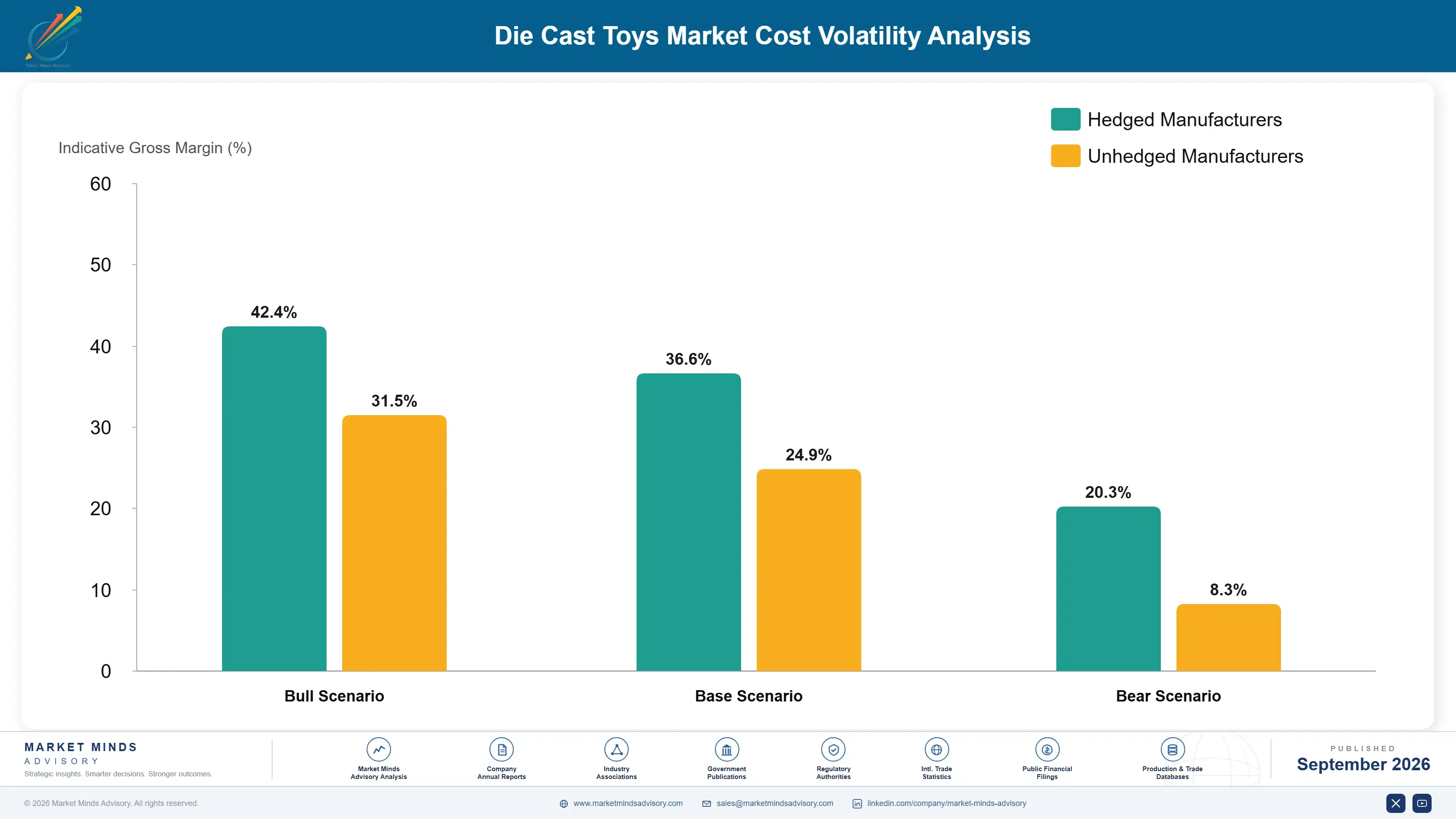
Casting alloy runs about 31% of manufacturing cost before decoration and roughly 7% of manufacturers hedge it, which leaves margin swinging on a commodity moving for reasons unrelated to toy demand. Manufacturers hedging against contracted production report gross margin volatility 3.1 times lower through metal price cycles. The instruments are ordinary and widely available. The obstacle is that toy companies do not think of themselves as exposed to metals at all. Designing wall thickness against measured perceived heft rather than tradition reduces metal content per unit at the same time, which compounds across every run on the tool.
Market Impact: Cuts gross margin volatility 3.1 times lower overall

Stagger Licence Renewals Across The Portfolio

About 68% of revenue depends on licences held by other parties, and a lapse ends a product line rather than repricing it while leaving tooling amortisation unrecovered. Manufacturers staggering renewal dates and negotiating wind-down periods report revenue volatility 2.7 times lower through licence transitions. Concentrating renewals in one window is a scheduling accident that becomes a commercial event. Developing unlicensed original subjects alongside licensed ones provides a floor that licensing alone cannot. Developing unlicensed original subjects alongside licensed ones provides a revenue floor that no counterparty can withdraw, which licensing alone cannot supply at any price.
Market Impact: Cuts revenue volatility to 2.7 times lower overall

Plan Release Scarcity As A Pricing Instrument

Limited runs and variant releases sustain a secondary market that sets perceived value on a meaningful share of premium volume, and manufacturers benefit through primary pricing rather than resale. Manufacturers treating release planning as deliberate pricing report premium realisation 1.9 times higher than those releasing to forecast demand. Too much scarcity frustrates the collectors funding the category and too little removes the effect entirely. Very few plan it as the instrument it plainly is. Manufacturers benefit through primary pricing rather than resale capture, which means the instrument works without any participation in the secondary market at all.
Market Impact: Raises premium price realisation to 1.9 times higher

Who Controls the Margin Pool

Concentration is moderately high. Five manufacturers hold 46% of category revenue, measured consistently on that basis across all participants, and the remainder divides between specialist collector model makers, regional toy groups, licensed manufacturers serving particular marques, and Chinese casters increasingly selling finished product under their own brands rather than for others. The leader to challenger gap is wide in licence portfolio breadth and almost absent in casting capability.
Competition currently turns on three dimensions: licence portfolio breadth and renewal timing, which decides what can be made at all; tooling and finishing capability at collector detail levels; and channel reach into adult collector communities, where the growth in realisation is concentrated. Price decides at mass toy retail, which still accounts for the large majority of units moved across every region covered here.

Pressure builds from two directions at once. Chinese casters hold the manufacturing cost base and are moving into branded collector product. Licence holders are consolidating and negotiating harder on terms. Rankings will shift toward manufacturers holding staggered licence portfolios and genuine collector channel reach rather than toy retail shelf space. Manufacturers holding only mass play volume face the most exposed position of anyone in the field.
die-cast-toys-market-company-positioning-matrix-1790020380827

Competitive Moat and Risk Dimensions

MATTEL

Moat: Licence Portfolio And Retail Scale

The broadest automotive licence portfolio in the category combined with retail scale that guarantees shelf space gives access to subjects and distribution that specialist competitors cannot match. Breadth also spreads renewal risk across many counterparties rather than concentrating it in a handful of critical relationships.
MATTEL

Risk: Toy Retail Structure Caps Realisation

Retail scale in toy aisles is an advantage for play product and a constraint on premium collector items, which are priced against a play alternative they do not compete with. Reaching adult collectors properly means building channels that partly bypass the distribution strength the business is built on.
TAKARA TOMY

Moat: Collector Culture And Regional Licences

Operating in the market where small-scale die-cast has been an adult hobby for decades produces product design assumptions built around collectors rather than children. Japanese and Korean marque licences held regionally are also difficult for Western competitors to obtain on comparable terms. Design assumptions built around collectors rather than children transfer directly.
TAKARA TOMY

Risk: Western Channel Reach Limited

Collector-oriented design and regional licence strength convert poorly into Western retail and hobby distribution, where relationships and shelf negotiation decide placement. Direct online reach helps and does not substitute for the physical presence that Western collector retail still provides at scale. Physical collector retail presence still matters at scale in those markets.

Players Tracked

Prominent Players

Mattel
Takara Tomy
Bandai Namco Holdings
May Cheong Group
Simba Dickie Group

Other Key Players

Hasbro
Spin Master
Jada Toys
Greenlight Collectibles
Round 2
Kyosho
Autoart
Minichamps
Norev
Solido
Hornby Hobbies
Sieper
Motorart
Welly Die Casting
First Gear

Recent Developments

MARCH 2026

Mattel Expands Direct Collector Channel Outside Toy Retail

Mattel expanded a direct collector sales channel for premium die-cast product, operating separately from its toy retail distribution. Pricing and release scheduling are managed independently of the mass retail calendar entirely. Release scheduling is now managed against collector demand rather than against the retail calendar.
Signal: Premium product priced beside play product loses realisation every time. Separating the channels separates the price comparison.
SEPTEMBER 2025

Simba Dickie Begins Hedging Zinc Against Contracted Production

Simba Dickie Group began hedging zinc exposure against committed production volume, addressing a casting alloy cost line running near a third of manufacturing cost. Management cited margin volatility rather than any expectation of price direction. Hedging runs against committed volume rather than against a price view.
Signal: The largest cost line was unmanaged because nobody called it metals. Naming the exposure correctly is most of the work.
MAY 2025

Greenlight Collectibles Acquires Unlicensed Original Subject Business

Greenlight Collectibles completed an acquisition of a business developing original unlicensed die-cast subjects. The transaction was an outright acquisition rather than a joint venture or minority stake, with licence renewal exposure cited as the rationale. Original subject tooling transferred with the business under agreed terms.
Signal: A revenue floor that no licence holder can withdraw is worth building. A floor nobody withdraws is worth paying for.

What A Die-Cast Model Costs

Three cost groups dominate. Zinc casting alloy runs 28% to 36% of cost of goods sold, and the eight-point range separates thin-wall premium castings from heavier play product. Tooling amortisation and casting operations take 24% to 32%, rising sharply for collector subjects with short production runs. Licensing royalty, decoration, and packaging account for 26% to 34%, with royalty rates varying widely by marque and entertainment property.
Zinc pricing moved through 2024 and 2025 on mine supply and industrial demand together, and United States Geological Survey mineral commodity summaries documented the underlying movements across the period. Several manufacturers described casting alloy as the dominant margin variable in their annual reports. Safety testing and certification costs rose across the same window on requirements unconnected to metal pricing entirely. The three exposures moved independently of each other.

The competitive disadvantage mechanism runs through metal exposure rather than through manufacturing efficiency. A manufacturer that does not hedge zinc carries a margin swing on a commodity it cannot influence and does not forecast, and roughly 7% of the field hedges at all. Exposure therefore varies by treasury practice rather than by production scale, and mid-sized manufacturers without commodity capability carry it most heavily of anybody.
die-cast-toys-market-cost-volatility-analysis-1790020381174

Treat Casting Alloy As A Managed Commodity Exposure

Zinc runs close to a third of manufacturing cost and moves on mining and industrial cycles unrelated to toy demand. Hedging against contracted production volume uses ordinary instruments and removes the largest single source of margin volatility, which is a treasury decision rather than a manufacturing one and costs very little to implement. It is a treasury decision.

Design Wall Thickness Against Perceived Heft

Buyers judge quality partly by weight, but perceived heft saturates well below the metal content most castings actually carry. Designing wall thickness against measured perception rather than tradition reduces alloy consumption per unit without any loss of quality signal, which compounds across every casting run on the tool. Perceived heft saturates well below the metal most castings carry.

Amortise Tooling Across Decoration Rather Than Subjects

A die produces roughly 180,000 castings before tolerance is lost, and tooling a new subject costs far more than decorating an existing casting differently. Planning livery and variant programmes against remaining tool life rather than against marketing calendars recovers amortisation faster and defers capital considerably. Tooling a new subject costs far more than decorating an existing casting differently.

Portfolio Architecture for Margin Defence

Margin follows channel and licence position rather than casting quality. Small-scale mass play vehicles compete close to commodity terms against Chinese casters using comparable tooling. Construction and agricultural models earn moderately on specialist subject appeal. Mid-scale detailed models earn well where the gift and collector buyer overlap, and premium collector-grade replicas earn most, provided they reach the buyer through a channel that is not a toy aisle.
The tension between volume and premium runs through what the buyer is comparing against. A parent in a toy aisle compares a detailed replica against three play vehicles at the same price and buys the three. A collector in a hobby shop or a direct channel compares the same replica against other collector models and against what it will be worth in five years, and pays several times what the toy aisle would support.

High-value pools concentrate in premium replicas sold through collector channels, in staggered licence portfolios that survive a renewal loss, and in unlicensed original subjects nobody can withdraw. Where the product is a small-scale play vehicle sold on a toy shelf against a price point, Chinese casting capacity holds the cost position and the licence holder takes the differentiation.

Volume / Commodity-Adjacent

Small-scale mass play vehicles sold on toy shelves at fixed price points against comparable alternatives. The ten-point range reflects casting cost and licence royalty rather than any capability a parent could evaluate at the point of purchase.
Gross Margin: 24% to 34%

Premium / Certified

Mid-scale detailed models and construction and agricultural subjects sold through toy and hobby channels together. The twelve-point range separates genuine tooling and finishing capability from decorated castings positioned above their actual detail level.
Gross Margin: 40% to 52%

Sustainability / Regulatory / Next-Generation

Premium collector-grade replicas and limited variant programmes sold through collector channels at collector pricing. The sixteen-point range reflects channel position and release planning discipline, neither of which toy retail scale provides.
Gross Margin: 58% to 74%
die-cast-toys-market-portfolio-architecture-1790020382079

High-value Sub-segments and Strategic Watch-out

Collector Channel Premium Replicas

Highest value in the category, provided the product reaches its buyer somewhere other than a toy aisle beside play vehicles. The sixteen-point range reflects channel position, which most of the industry's distribution strength actively works against. Direct and hobby channels are where that realisation actually sits.
Gross Margin: 60% to 76%

Staggered Licence Portfolios

High value because a renewal loss ends a product line rather than repricing it, and concentration makes that a company event. The fourteen-point range reflects portfolio breadth and renewal scheduling rather than anything about the castings themselves. Unlicensed original subjects provide a floor nobody can withdraw.
Gross Margin: 48% to 62%

Mid-Scale Detailed Models

Volume core sitting between gift and collection purchasing, which is the entry point most adult collectors arrive through. The twelve-point range reflects the discipline to hold that position rather than drifting upward into premium cost. Several manufacturers have drifted upward and lost the gift buyer.
Gross Margin: 40% to 52%

Small-Scale Mass Play Vehicles

The strategic watch-out. Fixed price points, comparable tooling available to anyone, and a licence holder capturing the differentiation entirely. The ten-point range reflects casting cost and royalty rate with nothing else defending it. Chinese casters hold the manufacturing cost base here outright, and licence holders take the rest.
Gross Margin: 22% to 32%

How This Demand Repeats

Collector demand repeats in a way play demand never does. A collector buys a series rather than a product, returns for each release, and treats a gap in a run as a problem to be solved rather than an option to decline. That produces predictable recurring revenue from a defined population, and it is why 43% of revenue comes from a minority buying repeatedly.
Play demand repeats on gifting occasions and on pocket money rather than on any relationship with the manufacturer. A child receives a vehicle, plays with it, and the next purchase is decided by whichever product is on the shelf at the right price when an occasion arrives. Brand matters far less than availability, which is why toy retail placement rather than product quality governs that half of the business.

The buyer is shifting further toward the collector as children's play volume stays flat and adult participation grows. That buyer asks about licence accuracy, production run size, and whether a series will be completed, and almost none of that information is published. Manufacturers organised around toy retail rhythms reach them through channels that were never designed for the questions they ask.
die-cast-toys-market-end-use-penetration-index-1790020383020

Where This Market Rewards

These are among the four positions where our research anticipates prominent divergence between winners and laggards over the coming forecast period. Each is grounded in the demand model, the regulatory perimeter, and the announced capacity pipeline.
01 / COLLECTOR CHANNEL BUILDING

Adults fund a children's aisle

Adults buying for their own collections supply around 43% of category revenue and effectively all of the growth in average selling price, while most industry shelf space sits in toy retail built for a parent. Manufacturers reaching collectors through hobby retail, direct online, and community channels report price realisation 2.4 times higher on identical premium product. The product does not change and the comparison the buyer makes does, which is the whole difference, and toy retail scale is an advantage for play product and a constraint above it.
02 / METAL EXPOSURE MANAGEMENT

Seven per cent hedge the metal

Zinc casting alloy runs about 31% of manufacturing cost before decoration while roughly 7% of manufacturers hedge that exposure against contracted production volume. Manufacturers who do hedge report gross margin volatility 3.1 times lower through metal price cycles than the rest of the field. The instruments are ordinary and widely available, and the obstacle is simply that toy companies do not think of themselves as exposed to base metals, and designing wall thickness against measured perceived heft reduces metal content alongside it.
03 / LICENCE RENEWAL STAGGERING

A lapse ends the line entirely

About 68% of category revenue depends on automotive or entertainment licences held by other parties, and a lapse ends the product line rather than repricing it while leaving tooling amortisation unrecovered. Manufacturers staggering renewal dates and negotiating wind-down periods report revenue volatility 2.7 times lower through licence transitions. Concentrating renewals into one window is a scheduling accident that turns into a company-level commercial event, and unlicensed original subjects provide a revenue floor that no licensing counterparty is able to withdraw.
04 / RELEASE SCARCITY PLANNING

Scarcity is a pricing instrument

Limited runs and variant releases sustain a secondary market that sets perceived value on a meaningful share of premium volume, with manufacturers benefiting through primary pricing rather than resale capture. Manufacturers treating release planning as deliberate pricing report premium realisation 1.9 times higher than those simply releasing to forecast demand. Too much scarcity frustrates the collectors funding the category and too little removes the pricing effect completely, and the instrument works through primary pricing without participating in resale at all.

Engagement Snapshot From the Field

A live engagement with an industry participant carrying material or product regulatory and market exposure ahead of a defining policy shift, showing how our research translates into a defensible multi-year portfolio strategy.
MARKET MINDS ADVISORY · CLIENT ENGAGEMENT SUMMARY
Die Cast Toys Producer Strategic Portfolio Review and Transition Roadmap 2026·Investment Scenario on Die Cast Toys Exposure Evaluation 2025-26
CLIENT PROFILE
A die-cast manufacturer with revenue near USD 310 million (client-reported, unverified by MMA) across North America, Western Europe, and East Asia. Gross margin had swung by several points in each of three consecutive years without any change in product mix, and premium launches were underperforming their business cases consistently. Margin had never been reported net of metal movement.
STRATEGIC CHALLENGE
Margin volatility was being attributed to freight and to promotional depth, and nobody had traced it against zinc pricing. Premium underperformance was being read as a product problem, when the products were being merchandised beside play vehicles at a third of their price point. Licence renewal dates had never been mapped against each other.
MMA APPROACH
MMA reconciled three years of gross margin against zinc price movements, compared premium product realisation between toy retail and hobby and direct channels, mapped licence renewal dates across the portfolio, and modelled hedging and channel separation against the incumbent plan. Realisation was compared for identical stock numbers across channels rather than for comparable products, so the difference could not be attributed to specification.
KEY FINDINGS
  1. Margin variance tracked zinc pricing almost exactly across all three years, and neither freight nor promotional depth explained more than a small fraction of the movement.
  2. Identical premium models achieved substantially higher realisation in hobby and direct channels than on toy shelves, where they were compared against play vehicles.
  3. Four automotive licences representing a large share of revenue were scheduled to renew within the same eleven month window, which nobody had noticed.
  4. No product in the portfolio was unlicensed, so every line in the business depended on a counterparty decision the client did not control.
CLIENT PROFILE
A die-cast manufacturer with revenue near USD 310 million (client-reported, unverified by MMA) across North America, Western Europe, and East Asia. Gross margin had swung by several points in each of three consecutive years without any change in product mix, and premium launches were underperforming their business cases consistently. Margin had never been reported net of metal movement.
STRATEGIC CHALLENGE
Margin volatility was being attributed to freight and to promotional depth, and nobody had traced it against zinc pricing. Premium underperformance was being read as a product problem, when the products were being merchandised beside play vehicles at a third of their price point. Licence renewal dates had never been mapped against each other.
MMA APPROACH
MMA reconciled three years of gross margin against zinc price movements, compared premium product realisation between toy retail and hobby and direct channels, mapped licence renewal dates across the portfolio, and modelled hedging and channel separation against the incumbent plan. Realisation was compared for identical stock numbers across channels rather than for comparable products, so the difference could not be attributed to specification.
KEY FINDINGS
  1. Margin variance tracked zinc pricing almost exactly across all three years, and neither freight nor promotional depth explained more than a small fraction of the movement.
  2. Identical premium models achieved substantially higher realisation in hobby and direct channels than on toy shelves, where they were compared against play vehicles.
  3. Four automotive licences representing a large share of revenue were scheduled to renew within the same eleven month window, which nobody had noticed.
  4. No product in the portfolio was unlicensed, so every line in the business depended on a counterparty decision the client did not control.
RECOMMENDED STRATEGY
Phase 1: Phase one: hedge zinc against contracted production volume and report margin net of metal movement rather than gross. Report both figures to the board each quarter. Phase 2: Phase two: separate premium collector product into hobby and direct channels with pricing managed independently of toy retail. Hold premium releases outside the retail calendar. Phase 3: Phase three: stagger licence renewals deliberately and develop unlicensed original subjects as a revenue floor. Negotiate wind-down periods into every renewal.
OUTCOME
Gross margin volatility fell sharply in the first year of hedging and premium realisation rose materially after channel separation (client-reported, unverified by MMA). Two licence renewals were renegotiated onto different dates. Unlicensed development began in the following planning cycle. Premium launches began meeting their business cases for the first time in three years.

Frequently Asked Questions

Foundational context covering the market sizes, CAGR, scope, country, region and competition that inform every finding below. This section is provided to cover basics and most often pre-purchase conversations, answered from the MMA Primary Research Dataset.

What is the current size of the Die Cast Toys Market?

The market was worth USD 7.8 billion in 2025 and stands at USD 8.2 billion in 2026. Value covers die-cast miniature vehicles, machines, and figures at manufacturer selling price.

How large will the Die Cast Toys Market be by 2036?

MMA forecasts USD 13.9 billion by 2036, an increase of USD 5.7 billion across the forecast period. That represents 1.70 times the 2026 base of USD 8.2 billion.

What is the CAGR for the Die Cast Toys Market 2026 to 2036?

The base case compound annual growth rate is 5.4%, with a bull case at 6.6% and a bear case at 4.2%. Historical growth from 2020 to 2025 ran at 4.3%.

Which segment is growing fastest?

Premium collector-grade replicas grow at 8.1%, half again the market rate of 5.4%. The buyer is an adult purchasing for a collection rather than a child receiving a toy.

Who are the major companies in the Die Cast Toys Market?

Mattel, Takara Tomy, Bandai Namco Holdings, May Cheong Group and Simba Dickie Group lead the field. Together they hold 46% of category revenue, with Chinese casters moving into branded product.

Which country is growing fastest?

China grows at 9.4%, as domestic collecting expands alongside a manufacturing base producing nearly all of the world's die-cast product. Domestic collecting is now a substantial market in its own right.

Report Segmentation Architecture

The full report scope spans multiple orthogonal segmentation dimensions, with cross-tabulated demand data provided for each dimension pair. Coverage extends further to regional breakdowns, trend trajectories, and the competitive detail needed to support segment-level decision-making.

By Product Class

  • Small-Scale Mass Play Vehicles
  • Small-Scale Collector Series
  • Mid-Scale Detailed Models
  • Premium Collector-Grade Replicas
  • Die-Cast Construction and Agricultural Models
  • Die-Cast Aircraft and Military Models

By End-Use Industry

  • Children's Play Use
  • Adult Collecting and Display
  • Gift and Occasion Purchasing
  • Corporate and Promotional Models
  • Museum and Institutional Display
  • Motorsport and Event Merchandise

By Commercial Dimension

  • Mass Toy Retail
  • Specialist Hobby Retail
  • Direct to Consumer Online
  • Collector Subscription Programmes
  • Marketplace and Secondary Channels
  • Licensed Brand and Dealership Channels

By Region

  • East Asia
  • North America
  • Western Europe
  • South Asia and Pacific
  • Latin America
  • Middle East and Africa
  • Eastern Europe

Scope, Methodology, and Coverage

Every figure in this report is reproducible from documented input assumptions. The scope below maps the historical period, the forecast horizon, the segmentation dimensions, and the countries covered, alongside the underlying primary and qualitative methodology.
Historical Period
2020 to 2025
Forecast Period
2026 to 2036
Base Year
2025 (USD billions; MMA Primary Research Dataset, September 2026)
Market Definition
This market covers zinc and aluminium die-cast miniature vehicles, machines, and figures sold as toys and collectibles, across small-scale mass play vehicles, small-scale collector series, mid-scale detailed models, premium collector-grade replicas, die-cast construction and agricultural models, and die-cast aircraft and military models. It excludes plastic-only toy vehicles, radio-controlled models, unassembled scale model kits, resin-only collectibles, and die-cast industrial components.
Quantitative Units
USD billions, revenue at manufacturer selling price
Segmentation Dimensions
Product class by scale and grade, end-use setting, commercial dimension, region
Regions Covered
East Asia, North America, Western Europe, South Asia and Pacific, Latin America, Middle East and Africa, Eastern Europe
Countries Covered
China, Japan, South Korea, Taiwan, United States, Canada, Mexico, Germany, Italy, France, United Kingdom, Spain, Netherlands, Poland, Czechia, India, Indonesia, Thailand, Vietnam, Australia, Brazil, Argentina, Colombia, Chile, Saudi Arabia, United Arab Emirates, Qatar, Turkey, Egypt, South Africa
Key Companies Profiled
Mattel, Takara Tomy, Bandai Namco Holdings, May Cheong Group, Simba Dickie Group, Hasbro, Spin Master, Jada Toys, Greenlight Collectibles, Round 2, Kyosho, Autoart, Minichamps, Norev, Solido, Hornby Hobbies, Sieper, Motorart, Welly Die Casting, First Gear
Quantitative Methodology
Primary survey, n=3,800 respondents, Q4 2025, six countries; demand-side model with trade association cross-validation
Qualitative Methodology
47 expert interviews, Q4 2025; applied to validate demand model assumptions, identify emerging dynamics, and assess competitive positioning
Report Format
PDF and XLSX data workbook (Word format preview document)
Publisher
Market Minds Advisory
Report Code
MMA-2026-CON-731
Published
September 2026
Contact
sales@marketmindsadvisory.com | www.marketmindsadvisory.com

Purchase the full Die Cast Toys Market Report (2026 to 2036).

The full report sizes the die-cast toys market across six product classes, seven regions, and thirty countries, with forecasts to 2036 under base, bull, and bear cases. It separates adult collector revenue from children's play purchasing, traces gross margin against zinc pricing rather than against product mix, and maps licence renewal exposure across portfolios. Competitive analysis covers twenty participants evaluated consistently on category revenue, with detailed treatment of collector channel reach and tooling economics. Release scarcity planning and secondary market effects are analysed throughout. Primary research includes 3,800 survey responses and 47 expert interviews.
Six product classes sized and forecast separately
Twenty participants evaluated on category revenue consistently
Adult collector revenue separated from children's play purchasing
Gross margin traced against zinc pricing across three years
Licence renewal exposure mapped across manufacturer portfolios
Price realisation compared between toy retail and collector channels

Built For The People Who Decide

From boardroom strategy to bench-side execution, this report is read cover-to-cover by leaders shaping the next decade of their industry, turning demand scenarios, market dynamics and valuation benchmarks into decisions.
CXOs/ Presidents/ VPs/ Managers
M&A and Corporate Development
Strategy Teams and R&D Heads
Procurement and Product Directors
Regulatory and Compliance Leaders
Investor Relations and Equity Analysts