

Market Minds Advisory
Diaphragm Coupling Market

Diaphragm Coupling Market: LNG Buildout Now Sets the Order Book

A commercial reading of diaphragm couplings, where LNG and hydrogen compressor buildout pulls contoured diaphragm demand forward, predictive maintenance sensors integrate into assemblies, and qualification cycles protect incumbent suppliers broadly.

Lead Analyst

David Horsley

Published

September 2026

Make Smarter Decisions with Customized Research Insights

Request a free sample report and evaluate market opportunities, growth trends, and competitive dynamics relevant to your business needs.

2025 MARKET VALUE$1.1BMarket Size 2025
2036 FORECAST VALUE$1.7BBase Case , 2026 to 2036
CAGR 2026 TO 20364.2 %Bull 5.4% / Bear 2.9%
INCREMENTAL OPPORTUNITY$0.6BNet 10- year value creation
EXPANSION MULTIPLE1.51x2036 value over 2026 base
Strategic Levers
M&A Pipeline
Regional Outlook
Country Rankings
Competitive Intelligence
Segmental Deep-dive
Call-Us : 91 93563 13602

Executive Snapshot and Market Trajectory

A compressor train that fails at a coupling joint does not lose a cheap part, it loses days of production on a facility that cost hundreds of millions to build, and that specific asymmetry is why turbomachinery operators pay a genuine premium for coupling reliability over price.
The market stands at USD 1.1 billion in 2025 and reaches USD 1.73 billion by 2036 at a 4.2% CAGR. Contoured diaphragm couplings grow fastest at 6.2%, about 1.48 times the overall rate, pulled forward by LNG and hydrogen compressor buildout requiring high torque density coupling designs. East Asia holds 30% of value on expanding industrial and energy infrastructure investment, while China posts the fastest national growth at 5.8% on LNG liquefaction capacity expansion.
Concentration sits at a moderate 48% among the top five, led by Voith Turbo's turbomachinery coupling engineering depth and KTR Systems' precision manufacturing scale. Two forces reshape the field now. LNG and hydrogen compressor growth is driving contoured diaphragm demand as energy transition infrastructure requires higher torque density couplings, and predictive maintenance sensors are increasingly integrating directly into diaphragm coupling assemblies for turbomachinery condition monitoring.
Market Definition
The diaphragm coupling market covers flexible metallic diaphragm couplings used to transmit torque between rotating shafts in turbomachinery, including single, double, multiple diaphragm pack, contoured, and hybrid diaphragm-disc designs sold for compressors, turbines, pumps, and generators. Elastomeric and gear couplings using non-diaphragm flexing mechanisms are excluded.
Base Year Value
$1.1B in 2025 (MMA Primary Research Dataset, August 2026)
Forecast Period
2026 to 2036, eleven discrete annual values
CAGR
4.2% base case. Bull 5.4%. Bear 2.9%.
Fastest Growth Segment
Contoured Diaphragm Couplings: 6.2% CAGR
Fastest Growth Country
China: 5.8% CAGR
Fastest Growth Region
South Asia and Pacific: 6.2% CAGR
Largest Region
East Asia: 30% of 2025 global value
Market Leaders
Voith Turbo, KTR Systems, Rexnord Corporation, Flender GmbH, John Crane. Source: MMA Analysis based on company annual reports and industry association data.
Primary Survey
n=3,800 procurement and R&D decision-makers, Q4 2025, six countries
Methodology
Demand-side build-up, cross-validated against public data, 47 expert interviews

Diaphragm Coupling Market Forecast Scenarios

diaphragm-coupling-market-size-forecast-scenario-1787332361649
Growth from 2020 to 2025 compounded near 3.7%, reflecting steady turbomachinery replacement demand before accelerating gradually from 2023 onward as LNG liquefaction capacity investment expanded considerably and hydrogen compressor projects began emerging as a distinct new demand driver for the category specifically across most major global energy markets tracked closely by analysts and manufacturers alike.
Three mechanisms carry the base case to 4.2%. First, rising LNG liquefaction capacity investment, which requires high torque density contoured diaphragm couplings for large compressor trains across major export terminal projects worldwide and regionally. Second, aging industrial turbomachinery fleet replacement, which sustains steady aftermarket demand across established compressor and turbine installations globally. Third, predictive maintenance sensor integration, which is driving coupling redesign cycles across most major turbomachinery categories tracked closely.
The bull case at 5.4% assumes LNG and hydrogen compressor investment accelerates faster than current project pipelines suggest and predictive maintenance integration spreads more quickly across mainstream turbomachinery applications beyond premium installations. The bear case at 2.9% assumes high precision manufacturing costs continue limiting competition to established suppliers and long qualification cycles keep slowing new entrant access to critical turbomachinery applications.

Why the Compressor Train Sets the Coupling Standard

Three forces set demand. Turbomachinery original equipment procurement provides the steadiest layer, since every new compressor, turbine, and pump train requires couplings sized specifically for that application at first fit. LNG and hydrogen compressor buildout adds a fast-growing second layer, requiring contoured diaphragm designs engineered for the torque density these applications demand. Aftermarket replacement adds a third layer, tied to the aging global turbomachinery fleet reaching sched
MARKET CONCENTRATIONCR5: 48%Moderately concentrated behind established turbomachinery coupling engineering specialists
AVERAGE SELLING PRICEUSD 8,000 to 220,000 per unitVaries considerably by torque rating and diaphragm configuration complexity
TOP PRODUCING REGIONEast Asia: 30% of global valueReflects expanding industrial and energy infrastructure investment regionally
SENSOR INTEGRATION RATERoughly 22% of new installationsRising steadily as predictive maintenance adoption expands across turbomachinery
REPLACEMENT CYCLE LENGTH10 to 15 years typicalReflects durable metallic components with periodic diaphragm pack servicing
TRADE INTENSITYAbout 45% of units exportedTracks cross-border turbomachinery OEM supply chains spanning multiple regions
The commercial character rewards engineering reliability and qualification track record over price competition alone in critical applications. An operator or OEM choosing a coupling supplier weighs multi-year platform qualification history and field reliability as heavily as unit price, since a coupling failure on a critical compressor train costs far more in lost production than any price difference. Voith Turbo's engineering depth and KTR Systems' manufacturing scale give both a trust advantage newer entrants must earn.
The next decade turns on two things. Whether contoured diaphragm coupling capacity can scale quickly enough to match the LNG and hydrogen compressor orderbook now building across several major energy infrastructure projects. And whether predictive maintenance sensor integration becomes standard specification across mainstream turbomachinery applications rather than remaining concentrated in premium, safety-critical installations only.
"Nobody thinks about the coupling until it fails, and by then the operator has already lost more in downtime than the entire coupling budget for the plant's service life. That asymmetry is the whole business."
Director, Power Transmission Components Practice · MMA Construction and Industri

Market Trends

LNG and Hydrogen Growth Drives Contoured Demand

LNG liquefaction and hydrogen compressor projects increasingly specify contoured diaphragm couplings engineered for the higher torque density these applications require compared with conventional compressor and turbine installations. This shift reflects the larger compressor trains and higher operating speeds that modern LNG export terminals and emerging hydrogen infrastructure projects demand from their power transmission components. Voith Turbo and KTR Systems have both expanded contoured diaphragm production capacity considerably to meet rising demand from major energy infrastructure projects globally. The commercial consequence is that manufacturers without genuine contoured diaphragm engineering capability increasingly cannot compete for this fastest-growing application category specifically.
Market Impact: LNG capacity investment rose 20% ye

Predictive Maintenance Sensors Integrate Into Assemblies

Turbomachinery operators increasingly specify diaphragm couplings with integrated vibration and temperature sensors that feed predictive maintenance systems, allowing early detection of misalignment or fatigue before a coupling failure disrupts production. This capability meaningfully reduces unplanned downtime risk on critical compressor and turbine trains where failure costs considerably exceed the sensor integration premium. Rexnord Corporation and Flender GmbH have both expanded sensor-integrated coupling product lines considerably across their most recent product generations launched. The commercial consequence is that manufacturers without genuine sensor integration capability increasingly lose specification on premium, safety-critical turbomachinery applications specifically.
Market Impact: Aging fleet exceeds 30% share

Market Opportunities and Growth Drivers

Rising LNG Investment Drives Turbomachinery Demand

Global LNG liquefaction capacity investment continues expanding considerably as energy security concerns and rising gas demand drive new export terminal construction across multiple major producing regions and countries. Every LNG liquefaction train requires large compressor systems dependent on high-reliability diaphragm couplings engineered for continuous, high-torque operation over multi-decade facility service lives. United States, Qatari, and Australian LNG capacity expansion have all driven substantial new compressor train procurement in recent years specifically. This driver continues strengthening as additional LNG capacity investment decisions proceed across several major projects currently under construction or in final investment planning stages.
Market Impact: Tooling investment exceeds USD 15 m

Aging Turbomachinery Fleet Drives Replacement Demand

The global installed base of industrial turbomachinery continues aging, with a meaningful share of compressors and turbines now approaching or exceeding typical coupling replacement intervals of ten to fifteen years across most major industrial and energy sectors. Operators increasingly prioritize scheduled coupling replacement during planned maintenance outages to avoid the considerably higher cost of unplanned failure during continuous operation periods. This aftermarket replacement demand provides a steady revenue layer largely independent of new capital project investment cycles across the broader economy. This driver continues strengthening as more of the installed fleet reaches its scheduled replacement window.
Market Impact: Qualification takes 18-36 months

Market Restraints and Challenges

Precision Manufacturing Costs Limit New Competition

Diaphragm couplings require precision manufacturing tolerances and specialized metallurgy to achieve the fatigue resistance and balance characteristics critical turbomachinery applications demand, a capital and engineering barrier that remains genuinely difficult for new entrants to overcome economically. The root cause is that diaphragm pack manufacturing requires specialized forming and heat treatment equipment representing substantial capital investment relative to the addressable market size for any single new entrant. Commercially this concentrates competition among a small number of established manufacturers with existing precision manufacturing infrastructure. Manufacturers are responding by expanding capacity incrementally rather than facing new entrant competition directly.
Market Impact: Contoured couplings reach 25% of or

Qualification Cycles Slow New Entrant Market Access

Critical turbomachinery applications require extensive qualification testing before original equipment manufacturers will specify a new coupling supplier, a process that can extend market entry timelines considerably beyond typical industrial component categories given the safety consequences of failure. The root cause is that OEMs bear direct liability and reputational risk for coupling failures on customer installations, justifying rigorous qualification requirements that inherently favour established, proven suppliers over new entrants. Commercially this protects incumbent suppliers considerably while extending sales cycles for any genuinely new competitor attempting market entry. Manufacturers are responding by pursuing qualification proactively on next-generation platforms.
Market Impact: Sensor integration reached 22% shar
3 additional market trends, 4 additional growth drivers, and 3 additional restraints and challenges are covered in the full report. Contact sales@marketmindsadvisory.com to access the complete intelligence.

Segment CAGR and Growth Architecture

Segmentation follows diaphragm configuration and technology, a single product logic describing the specific mechanical design each coupling type uses to flex and transmit torque across most applications tracked. Each configuration carries distinct torque capacity and application suitability, so commercial position tracks configuration rather than end-use turbomachinery type, which appears separately within the framework below.
diaphragm-coupling-market-market-share-analysis-1787332362175

Contoured Diaphragm Couplings

Contoured diaphragm couplings grow fastest at 6.2%, about 1.48 times the overall 4.2% rate, pulled forward by LNG and hydrogen compressor buildout requiring the higher torque density this configuration delivers compared with conventional flat diaphragm designs currently available. This category requires specialized profile engineering that optimizes fatigue life at the higher operating speeds and torque loads modern energy infrastructure compressor trains increasingly demand. Voith Turbo and KTR Systems have both expanded contoured diaphragm production capacity considerably to meet rising demand from major energy infrastructure projects across multiple regions tracked. Compressor OEMs increasingly specify this configuration first when designing new LNG and hydrogen application platforms given its clear torque density advantage.
CAGR 6.2%

Multiple Diaphragm Pack Couplings

Multiple diaphragm pack couplings grow at 5.5%, the second-fastest category, as high-power turbomachinery applications increasingly specify stacked diaphragm pack designs that distribute load across multiple flexing elements for improved fatigue life and reliability over the equipment's service life. This category benefits from expanding high-power compressor and turbine installations where a single diaphragm design cannot reliably handle the combined torque and misalignment accommodation requirements simultaneously across most applications. Rexnord Corporation and Flender GmbH both maintain meaningful positions here given established relationships with major turbine and compressor original equipment manufacturers globally and regionally. Power generation and large industrial compressor applications add a further layer of demand alongside the faster-growing energy infrastructure category specifically.
CAGR 5.5%
Full segment breakdown across 5 segments available in the complete report.

Regional Architecture and Country Demand Map

Industrial and energy infrastructure investment together set this distribution, since coupling demand tracks closely where new turbomachinery capacity and aftermarket fleets concentrate most heavily worldwide today and steadily. East Asia leads on expanding infrastructure investment, while South Asia and Pacific posts the fastest regional growth.

North America

United States LNG export terminal investment and established turbomachinery aftermarket demand together anchor North American demand more than any other single factor. North America holds 26% of value, with domestic LNG liquefaction capacity expansion driving substantial new compressor train procurement across several major export terminal projects underway nationwide. Aging petrochemical and refining sector turbomachinery sustains steady aftermarket coupling replacement demand across the region's mature industrial base. Canadian and Mexican energy infrastructure investment follows broadly similar demand patterns, though from a smaller overall project pipeline currently. Growth of 3.8% reflects mature market dynamics tempered by continued LNG-driven demand expansion. Regional predictive maintenance sensor adoption continues expanding across most major compressor installations.
Share: 26% | CAGR: 3.8% (2026 to 2036)

Western Europe

Established industrial turbomachinery base and energy transition infrastructure investment together define this market above any other single factor. Western Europe holds 22% of value, with German, British, and Norwegian energy and industrial sectors driving meaningful coupling demand across both conventional and emerging hydrogen infrastructure applications specifically. Hydrogen compressor pilot projects have grown considerably across the region given aggressive national decarbonization policy commitments and funding programmes. Aftermarket replacement demand remains substantial given the region's large existing industrial turbomachinery installed base accumulated over decades. Growth of 2.8%, the slowest of the seven, reflects mature market penetration and declining conventional industrial capacity in several major markets. Scandinavian countries lead in hydrogen infrastructure investment given strong renewable energy resource availability.
Share: 22% | CAGR: 2.8% (2026 to 2036)
Regional intelligence for 5 additional markets available in the complete report: East Asia, South Asia and Pacific, Latin America, Middle East and Africa, Eastern Europe. Contact sales@marketmindsadvisory.com.
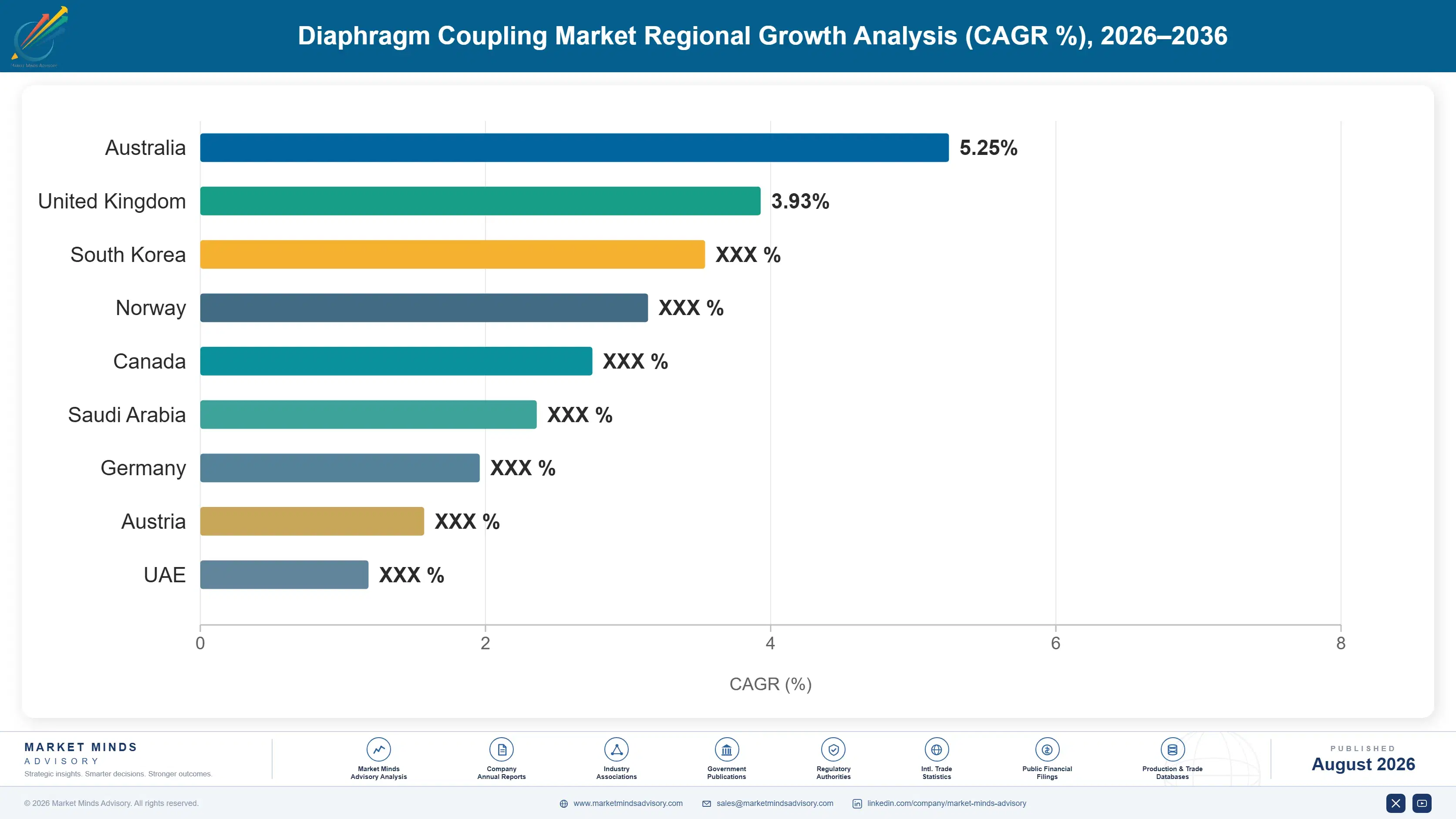
diaphragm-coupling-market-country-cagr-analysis-1787332362687

Where Diaphragm Coupling Manufacturer Margin Concentrates

Competing purely on unit price per coupling concentrates margin in exactly the standard segment where qualified regional manufacturers now compete most aggressively and repeatedly worldwide. The four moves below shift value toward positions engineering depth and qualification history genuinely protect: contoured diaphragm engineering, predictive maintenance sensor integration, OEM qualification depth, and aftermarket service relationships.

Build Contoured Diaphragm Engineering Capability Now

Contoured diaphragm couplings have reached roughly 25 percent of new orders, a share that has risen steadily as LNG and hydrogen compressor buildout requires the higher torque density this configuration delivers compared with conventional flat diaphragm designs across most energy projects. Manufacturers with genuine contoured profile engineering capability capture specification that generalist coupling producers increasingly cannot match as energy infrastructure projects prioritize torque density and fatigue life simultaneously. Building this capability requires sustained investment in specialized profile engineering and metallurgy beyond conventional diaphragm manufacturing expertise entirely, a multi-year commitment most smaller competitors avoid.
Market Impact: Contoured couplings now reach rough

Develop Predictive Maintenance Sensor Integration Broadly

Sensor-integrated coupling adoption has reached roughly 22 percent of new installations as turbomachinery operators increasingly specify vibration and temperature monitoring capability that feeds predictive maintenance systems reducing unplanned downtime risk considerably across critical compressor and turbine installations tracked closely worldwide today. Manufacturers with genuine sensor integration engineering capture specification on premium, safety-critical applications that competitors offering only conventional couplings increasingly cannot access as operators prioritize condition monitoring more heavily each purchasing cycle. This capability requires sustained investment in electronics integration and data connectivity expertise beyond conventional mechanical coupling engineering entirely.
Market Impact: Sensor integration now reaches roug

Deepen OEM Qualification and Platform Relationships

Critical turbomachinery applications require extensive qualification testing that can take 18 to 36 months before original equipment manufacturers will specify a new coupling supplier, making qualification depth a genuine competitive moat that transactional pricing alone cannot overcome quickly or cheaply anywhere. Manufacturers investing in proactive qualification on next-generation platforms capture specification advantage that competitors waiting for customer-initiated qualification requests increasingly cannot match consistently across most turbomachinery categories. This relationship depth compounds over successive turbomachinery platform generations as qualified suppliers default to repeat specification across an OEM's broader product lineup and portfolio.
Market Impact: Qualification cycles run roughly 18

Build Aftermarket Service and Replacement Relationships

The aging global turbomachinery fleet, with roughly 30 percent of the installed base now exceeding typical replacement intervals, increasingly requires scheduled coupling replacement during planned maintenance outages, and manufacturers with established aftermarket service relationships capture recurring replacement revenue that transactional original equipment sellers increasingly cannot access as reliably. This aftermarket layer, once established, generates considerably higher margin than original equipment sales alone and deepens the operator relationship over the full turbomachinery service life spanning decades. Manufacturers should treat aftermarket service as a genuine revenue stream, not a bundled sales afterthought.
Market Impact: Aging fleet now exceeds roughly 30%

Who Controls the Margin Pool

Concentration sits at a moderate 48% among the top five, led by Voith Turbo's turbomachinery coupling engineering depth and KTR Systems' precision manufacturing scale built over decades of OEM relationships. The gap between leaders and challengers is qualification history and engineering depth rather than raw price, which qualified regional manufacturers undercut in standard categories. All participants are assessed on global coupling unit shipment volume as disclosed in company reports, held co
Competition runs along four lines. First, contoured diaphragm engineering capability, increasingly the fastest-growing purchase consideration as energy infrastructure investment expands. Second, predictive maintenance sensor integration that commands premium specification on safety-critical applications. Third, OEM qualification depth built across successive platform generations. Fourth, aftermarket service relationships that capture recurring replacement revenue across the installed fleet.

Pressure is building from two directions. Regional manufacturers in China and India have built meaningful manufacturing scale and are converting cost advantages into share gains in price-sensitive standard application segments domestically. Meanwhile established leaders continue defending position through sustained contoured diaphragm and sensor integration investment that smaller competitors struggle to match. Rankings should favour manufacturers combining engineering depth with genuine qualification history over those competing on standard coupling price alone.
diaphragm-coupling-market-company-positioning-matrix-1787332363206

Competitive Moat and Risk Dimensions

VOITH TURBO

Moat: Turbomachinery engineering depth

Voith Turbo maintains deep turbomachinery coupling engineering expertise built over decades of OEM platform relationships spanning compressors, turbines, and generators across multiple industrial sectors. Its contoured diaphragm engineering capability positions it strongly for the fastest-growing energy infrastructure application category specifically. Strong qualification history with major turbomachinery OEMs sustains repeat specification across successive platform generations globally.
VOITH TURBO

Risk: Regional manufacturers scaling quickly

Regional manufacturers in China and India increasingly offer comparable standard coupling specifications at meaningfully lower prices, eroding the premium Voith Turbo has historically commanded in cost-sensitive emerging market segments. Its focus on premium engineered applications leaves standard commodity segments more exposed to regional competition. Newer entrants with sensor integration expertise are moving faster on next-generation predictive maintenance features currently.
KTR SYSTEMS

Moat: Precision manufacturing scale

KTR Systems maintains substantial precision manufacturing capacity spanning multiple diaphragm coupling configurations, giving it scale advantages that smaller specialized competitors cannot easily replicate. Its diversified application base across industrial, energy, and marine sectors provides considerable revenue stability across economic cycles. Established relationships with major European and global turbomachinery manufacturers provide considerable specification advantage.
KTR SYSTEMS

Risk: Narrower energy infrastructure focus

KTR Systems' broader industrial focus, while valuable for diversification, gives it less concentrated energy infrastructure engineering depth than specialists focused specifically on LNG and hydrogen compressor applications currently. Capital allocation decisions must balance investment across multiple industrial segments rather than concentrating entirely on the fastest-growing energy category. Specialist competitors are moving faster on next-generation contoured diaphragm engineering specifically.

Players Tracked

Prominent Players

Voith Turbo
KTR Systems
Rexnord Corporation
Flender GmbH
John Crane

Other Key Players

Lovejoy Inc
Regal Rexnord
Altra Industrial Motion
Emerson Electric
R+W Coupling Technology
Renold plc
Ameridrives Couplings
Zero-Max Inc
Centa Transmissions
Mayr Power Transmission
Sier-Bath Gear Couplings
TB Wood's
Lenze SE
SKF Group
Coupling Corporation of America

Recent Developments

MARCH 2025

Voith Turbo expands contoured diaphragm manufacturing capacity

Voith Turbo expanded manufacturing capacity for its contoured diaphragm coupling product line to meet rising demand from LNG and hydrogen compressor projects across multiple energy infrastructure customers globally. This was an organic capacity expansion rather than any acquisition, reflecting confidence in sustained energy infrastructure demand growth.
Signal: Established turbomachinery coupling leader
OCTOBER 2024

Rexnord Corporation signs supply agreement with LNG compressor manufacturer

Rexnord Corporation signed a multi-year supply agreement with a major compressor original equipment manufacturer to provide sensor-integrated diaphragm couplings across an expanding LNG project pipeline through the end of the decade. This was a supply agreement rather than a joint venture, securing volume without shared ownership or new capital investment.
Signal: Established suppliers are locking in energ
JANUARY 2025

KTR Systems acquires predictive maintenance sensor firm

KTR Systems acquired a specialist predictive maintenance sensor firm to strengthen its condition monitoring integration capability across its existing diaphragm coupling product line and future development roadmap. This was an acquisition rather than a joint venture, adding proprietary sensor technology directly into its existing product organization.
Signal: Established manufacturers are buying senso

Specialty Alloys and Precision Forming

Specialty steel alloys and precision forming processes together account for 42% to 55% of cost of goods sold, reflecting the fatigue-resistant metallurgy diaphragm couplings require for reliable operation under continuous cyclic loading conditions over decades of service. These materials are sourced predominantly from specialty steel producers in North America, Europe, and East Asia directly and reliably.
Specialty steel alloy prices rose considerably through 2021 and 2022 amid broader commodity market volatility, with several coupling manufacturers disclosing meaningfully higher input costs during that period, per IEA and company annual report commentary on the same commodity cycle. Several manufacturers passed through a portion of this cost increase to turbomachinery OEM customers with a lag of several months given multi-year fixed-price contracts already in place. Prices have since moderated somewhat, though certain alloy grades remain elevated.

Exposure separates clearly by manufacturer scale and procurement contract structure. Larger manufacturers with hedged specialty steel procurement contracts absorbed less disruption than smaller competitors purchasing alloys on the spot market during the tightest volatility periods specifically. Manufacturers with in-house precision forming capability faced considerably less exposure to the external supply constraints that affected smaller assemblers more heavily during recent shortages.
diaphragm-coupling-market-cost-volatility-analysis-1787332363400

Hedge specialty alloy procurement contracts

Spot-market specialty steel purchasing exposed several manufacturers to meaningful cost spikes during the 2021 and 2022 volatility period specifically and repeatedly across the industry. Longer-term hedged procurement contracts reduce this exposure considerably across future commodity price cycles ahead for most manufacturers. The trade-off is reduced flexibility to benefit from price declines when metal markets soften unexpectedly later.

Pursue in-house precision forming capability

Larger manufacturers with in-house precision forming capability faced meaningfully less disruption than smaller competitors dependent on external suppliers during recent shortages and price spikes across the sector. Vertical integration reduces exposure to cross-border supply disruption considerably over time and across cycles. This requires manufacturing investment that only larger, well-capitalized manufacturers can typically justify given current production volumes.

Pass through costs via indexed OEM contracts

Multi-year OEM supply agreements increasingly include indexed pricing clauses tied to underlying specialty alloy costs, reducing the margin compression manufacturers previously absorbed during volatility periods entirely and predictably. This shifts commodity price risk more transparently onto the broader turbomachinery supply chain rather than concentrating it entirely on coupling manufacturers alone or their smaller suppliers.

Portfolio Architecture for Margin Defence

The portfolio splits into three tiers with distinct economics. Standard single and double diaphragm couplings form the volume tier, competing increasingly on price against qualified regional manufacturers with margin set by material cost and production efficiency. Contoured diaphragm and sensor-integrated couplings earn considerably more since profile engineering depth and electronics integration deter competitors lacking comparable technical investment. Aftermarket service agreements are priced
The tension runs between standard coupling revenue that funds the business today and contoured diaphragm and sensor integration investment that positions it for the next decade of energy infrastructure demand. A manufacturer defending standard coupling volume too aggressively against regional competition cedes the highest-margin contoured and sensor-integrated segments to competitors investing there directly. Companies managing this well use standard coupling cash flow to fund engineering research rather than treating them as competing priorities.

High-value pools concentrate where profile engineering depth, sensor integration, or qualification history limit competition: contoured diaphragm couplings, sensor-integrated designs for safety-critical applications, and aftermarket service relationships across the aging fleet. Standard diaphragm couplings sold without differentiated capability sit at the other end, competing almost entirely on price against every qualified regional manufacturer serving cost-sensitive buyers.

Volume / Commodity-Adjacent Tier

Standard single and double diaphragm couplings competing increasingly on price against qualified regional manufacturers, with margin set overwhelmingly by material cost and production efficiency across most conventional categories tracked and monitored.
Gross Margin: 20-30%

Premium / Certified Tier

Contoured diaphragm and multiple pack couplings supporting meaningfully stronger margin than standard production, reflecting genuine profile engineering and qualification differentiation earned over years of OEM platform validation, testing, and trials.
Gross Margin: 30-42%

Sustainability / Regulatory / Next-Generation Tier

Sensor-integrated predictive maintenance couplings, hydrogen-ready contoured designs, and aftermarket service platforms developed ahead of expanding energy infrastructure investment across multiple regions currently under active engineering development, testing, validation, and review.
Gross Margin: 28-44%
diaphragm-coupling-market-portfolio-architecture-1787332363899

High-value Sub-segments and Strategic Watch-out

Contoured Diaphragm Couplings

High value and high growth at 6.2%, the fastest category in the market, driven by LNG and hydrogen compressor buildout requiring the higher torque density this configuration delivers across most major energy infrastructure projects currently expanding worldwide and consistently each year across most regions and countries.
Gross Margin: 30-42%

Multiple Diaphragm Pack Couplings

High value with strong growth at 5.5%, the second-fastest category, driven by high-power turbomachinery applications increasingly specifying stacked diaphragm designs for improved fatigue life across most major compressor and turbine platforms currently in development worldwide and regionally across most manufacturers, OEMs, engineering teams, and project developers.
Gross Margin: 30-42%

Double Diaphragm Couplings

The volume core by revenue, growing near 4.0% as this remains the largest and most established category across nearly every major turbomachinery application tracked currently worldwide, though growth has moderated meaningfully as premium alternatives gain share steadily each year across most established markets and platforms.
Gross Margin: 20-30%

Single Diaphragm Couplings

The strategic watch-out, growing near 2.5% and facing steady decline as higher-power applications increasingly require multiple diaphragm or contoured alternatives across most new turbomachinery platforms currently under development globally and regionally across most manufacturers, suppliers, distribution networks, engineering teams, project developers, and end operators worldwide.
Gross Margin: 18-28%

How Platform Qualification Locks In Volume

Revenue depends on OEM platform qualification and multi-generation specification loyalty, and a manufacturer's default status on a turbomachinery platform generates years of guaranteed volume across that platform's full production run and aftermarket service life. Switching suppliers mid-platform requires costly requalification and testing, a barrier that deters displacement even when a competitor offers marginally better pricing after initial award decisions are made.
Adoption depth varies sharply by configuration. Contoured diaphragm buyers commit hardest, given the engineering integration complexity and torque density validation interdependence with the broader compressor train once specified for production. Multiple diaphragm pack buyers sit in the middle, balancing established supplier relationships against periodic competitive retendering during platform refreshes. Standard single diaphragm buyers switch most readily, since specification differentiation between qualified manufacturers remains genuinely minimal across comparable conventional products.

Buyer profiles have shifted from purchasing engineers evaluating unit cost alone toward platform engineering teams weighing torque density, sensor integration, and multi-decade reliability together. Predictive maintenance adoption has introduced a new buyer consideration around condition monitoring data access that conventional mechanical coupling economics never required previously. Younger turbomachinery engineers also weigh digital integration and analytics capability more heavily than predecessors did.
diaphragm-coupling-market-end-use-penetration-index-1787332364386

Our Call on Diaphragm Couplings

These are among the four positions where our research anticipates prominent divergence between winners and laggards over the coming forecast period. Each is grounded in the demand model, the regulatory perimeter, and the announced capacity pipeline.
01 / CONTOURED ENGINEERING DEPTH

Energy infrastructure now dictates design priority

Contoured diaphragm couplings have reached roughly 25 percent of new orders, a share that has risen steadily as LNG and hydrogen compressor buildout requires the higher torque density this configuration delivers compared with conventional flat diaphragm designs across most major energy projects. Manufacturers with genuine contoured profile engineering capability capture specification that generalist coupling producers increasingly cannot match as energy infrastructure projects prioritize torque density and fatigue life. Companies should build this capability now, since it increasingly gates access to the fastest-growing application category available.
02 / SENSOR INTEGRATION DEPTH

Predictive maintenance rewards electronics investment

Sensor-integrated coupling adoption has reached roughly 22 percent of new installations as turbomachinery operators increasingly specify vibration and temperature monitoring capability that feeds predictive maintenance systems reducing unplanned downtime risk considerably across critical compressor trains and turbine installations tracked closely. Manufacturers with genuine sensor integration engineering capture specification on premium, safety-critical applications that competitors offering only conventional couplings increasingly cannot access. Companies should invest in this capability deliberately, since it increasingly determines specification on the highest-margin application category available today.
03 / OEM QUALIFICATION DEPTH

Proactive qualification decides platform awards

Critical turbomachinery applications require extensive qualification testing that can take 18 to 36 months before original equipment manufacturers will specify a new coupling supplier, making qualification depth a genuine competitive moat that transactional pricing alone cannot overcome quickly or cheaply anywhere across most global markets. Manufacturers investing in proactive qualification on next-generation platforms capture specification advantage that competitors waiting for customer-initiated requests increasingly cannot match. Companies should pursue qualification proactively, since delays can determine which supplier wins a platform award.
04 / AFTERMARKET SERVICE DEPTH

Aging fleet rewards recurring service relationships

The aging global turbomachinery fleet increasingly requires scheduled coupling replacement during planned maintenance outages, and manufacturers with established aftermarket service relationships capture recurring replacement revenue that transactional original equipment sellers increasingly cannot access as reliably across the installed base. This aftermarket layer, once established, generates considerably higher margin than original equipment sales alone and deepens the operator relationship over decades. Companies should treat aftermarket service as a genuine revenue stream worth building deliberately, not a bundled sales afterthought treated casually.

Engagement Snapshot From the Field

A live engagement with an industry participant carrying material or product regulatory and market exposure ahead of a defining policy shift, showing how our research translates into a defensible multi-year portfolio strategy.
MARKET MINDS ADVISORY · CLIENT ENGAGEMENT SUMMARY
Diaphragm Coupling Producer Strategic Portfolio Review and Transition Roadmap 2026·Investment Scenario on Diaphragm Coupling Exposure Evaluation 2025-26
CLIENT PROFILE
A mid-tier turbomachinery component supplier generating the majority of its revenue from standard diaphragm coupling sales to conventional compressor platforms engaged MMA ahead of a decision on whether and how quickly to invest in contoured diaphragm engineering capability. The client reported growing pressure from compressor original equipment manufacturer customers requesting contoured diaphragm quotes it currently could not fulfil (client-reported, unverified by MMA).
STRATEGIC CHALLENGE
Leadership faced a choice between a rapid, capital-intensive push into contoured diaphragm engineering or a slower, more measured transition that risked ceding early LNG and hydrogen platform awards to faster-moving competitors already investing heavily. The board worried that moving too aggressively could strain balance sheet capacity, while moving too slowly could permanently exclude the company from the fastest-growing segment of its core market entirely.
MMA APPROACH
MMA benchmarked contoured diaphragm engineering investment requirements against the client's existing balance sheet capacity and standard coupling cash flow over a five-year horizon. We assessed which existing OEM relationships were most likely to award early contoured diaphragm platform business given historical loyalty patterns. We then modelled phased investment scenarios balancing capability development against continued standard coupling service commitments.
KEY FINDINGS
  1. Two of the client's five largest existing OEM customers had already begun sourcing contoured diaphragm couplings from competitors, representing an estimated 18 percent revenue risk over five years.
  2. A phased investment approach could fund contoured diaphragm engineering primarily through existing standard coupling cash flow without requiring significant new external capital.
  3. Early contoured diaphragm platform awards typically required at least eighteen months of validated engineering track record before an OEM would commit significant volume.
  4. Partnering with a metallurgy specialist for initial contoured diaphragm programmes reduced time to market by roughly 35 percent compared with fully in-house development.
CLIENT PROFILE
A mid-tier turbomachinery component supplier generating the majority of its revenue from standard diaphragm coupling sales to conventional compressor platforms engaged MMA ahead of a decision on whether and how quickly to invest in contoured diaphragm engineering capability. The client reported growing pressure from compressor original equipment manufacturer customers requesting contoured diaphragm quotes it currently could not fulfil (client-reported, unverified by MMA).
STRATEGIC CHALLENGE
Leadership faced a choice between a rapid, capital-intensive push into contoured diaphragm engineering or a slower, more measured transition that risked ceding early LNG and hydrogen platform awards to faster-moving competitors already investing heavily. The board worried that moving too aggressively could strain balance sheet capacity, while moving too slowly could permanently exclude the company from the fastest-growing segment of its core market entirely.
MMA APPROACH
MMA benchmarked contoured diaphragm engineering investment requirements against the client's existing balance sheet capacity and standard coupling cash flow over a five-year horizon. We assessed which existing OEM relationships were most likely to award early contoured diaphragm platform business given historical loyalty patterns. We then modelled phased investment scenarios balancing capability development against continued standard coupling service commitments.
KEY FINDINGS
  1. Two of the client's five largest existing OEM customers had already begun sourcing contoured diaphragm couplings from competitors, representing an estimated 18 percent revenue risk over five years.
  2. A phased investment approach could fund contoured diaphragm engineering primarily through existing standard coupling cash flow without requiring significant new external capital.
  3. Early contoured diaphragm platform awards typically required at least eighteen months of validated engineering track record before an OEM would commit significant volume.
  4. Partnering with a metallurgy specialist for initial contoured diaphragm programmes reduced time to market by roughly 35 percent compared with fully in-house development.
RECOMMENDED STRATEGY
Phase 1: Phase 1 (0 to 6 months): Partner with a metallurgy specialist to accelerate initial contoured diaphragm engineering capability very quickly. Phase 2: Phase 2 (6 to 18 months): Pursue early contoured diaphragm platform validation with the client's most loyal existing OEM customers. Phase 3: Phase 3 (18 to 36 months): Scale contoured diaphragm manufacturing capacity based on validated platform award volume secured much earlier.
OUTCOME
The client partnered with a metallurgy specialist and secured its first contoured diaphragm platform validation within fourteen months, ahead of its original eighteen-month internal target set earlier. Existing standard coupling customer relationships were maintained throughout the transition without measurable service disruption (client-reported, unverified by MMA).

Frequently Asked Questions

Foundational context covering the market sizes, CAGR, scope, country, region and competition that inform every finding below. This section is provided to cover basics and most often pre-purchase conversations, answered from the MMA Primary Research Dataset.

What is the current size of the Diaphragm Coupling Market?

The global diaphragm coupling market is valued at USD 1.1 billion in 2025, covering single, double, multiple diaphragm pack, contoured, and hybrid diaphragm-disc couplings for compressors, turbines, pumps, and generators. Gear and elastomeric couplings are excluded.

How large will the Diaphragm Coupling Market be by 2036?

The market is forecast to reach USD 1.73 billion by 2036 in the base case, about 1.51 times the 2026 level. That represents incremental value of roughly USD 0.58 billion across the decade.

What is the CAGR for the Diaphragm Coupling Market 2026 to 2036?

The market grows at a 4.2% CAGR in the base case, with bull and bear scenarios at 5.4% and 2.9%. The spread turns mainly on LNG and hydrogen compressor investment pace.

Which segment is growing fastest?

Contoured diaphragm couplings grow fastest at 6.2%, about 1.48 times the overall rate, pulled forward by LNG and hydrogen compressor buildout. Multiple diaphragm pack couplings follow at 5.5%.

Who are the major companies in the Diaphragm Coupling Market?

Leading companies include Voith Turbo, KTR Systems, Rexnord Corporation, Flender GmbH, and John Crane. Concentration sits at a moderate 48%, led by Voith Turbo's engineering depth.

Which country is growing fastest?

China grows fastest at a 5.8% CAGR, driven by expanding LNG liquefaction capacity and rising industrial compressor demand. India follows on national manufacturing policy initiatives.

Report Segmentation Architecture

The full report scope spans multiple orthogonal segmentation dimensions, with cross-tabulated demand data provided for each dimension pair. Coverage extends further to regional breakdowns, trend trajectories, and the competitive detail needed to support segment-level decision-making.

By Diaphragm Configuration

  • Single Diaphragm Couplings
  • Double Diaphragm Couplings
  • Multiple Diaphragm Pack Couplings
  • Contoured Diaphragm Couplings
  • Hybrid Diaphragm-Disc Couplings

By End-Use Turbomachinery Type

  • Compressors
  • Turbines
  • Pumps
  • Generators

By Commercial Dimension

  • Original Equipment Manufacturer Supply
  • Aftermarket Replacement Supply
  • Platform Co-Development Agreements
  • Sensor Integration Service Contracts

By Region

  • North America
  • Western Europe
  • East Asia
  • South Asia and Pacific
  • Latin America
  • Middle East and Africa
  • Eastern Europe

Scope, Methodology, and Coverage

Every figure in this report is reproducible from documented input assumptions. The scope below maps the historical period, the forecast horizon, the segmentation dimensions, and the countries covered, alongside the underlying primary and qualitative methodology.
Historical Period
2020 to 2025
Forecast Period
2026 to 2036
Base Year
2025 (USD billions; MMA Primary Research Dataset, August 2026)
Market Definition
The diaphragm coupling market comprises flexible metallic diaphragm couplings used to transmit torque between rotating shafts in turbomachinery, valued at manufacturer revenue for original equipment and aftermarket units sold for compressors, turbines, pumps, and generators. Elastomeric and gear couplings using non-diaphragm flexing mechanisms are excluded from this scope.
Quantitative Units
USD billions (current prices); unit shipment volume by configuration where applicable
Segmentation Dimensions
By Diaphragm Configuration; By End-Use Turbomachinery Type; By Commercial Dimension; By Region
Regions Covered
North America, Western Europe, East Asia, South Asia and Pacific, Latin America, Middle East and Africa, Eastern Europe
Countries Covered
USA, Canada, Mexico, Germany, UK, Norway, France, Italy, China, Japan, South Korea, India, Australia, Vietnam, Indonesia, Brazil, Argentina, Saudi Arabia, Qatar, UAE, Turkey, South Africa, Nigeria, Poland, Romania, Ukraine, Czech Republic, Sweden, Netherlands, Singapore, and additional markets relevant to this sector
Key Companies Profiled
Voith Turbo, KTR Systems, Rexnord Corporation, Flender GmbH, John Crane, Lovejoy Inc, Regal Rexnord, Altra Industrial Motion, Emerson Electric, R+W Coupling Technology, Renold plc, Ameridrives Couplings, Zero-Max Inc, Centa Transmissions, Mayr Power Transmission, Sier-Bath Gear Couplings, TB Wood's, Lenze SE, SKF Group, Coupling Corporation of America
Quantitative Methodology
Primary survey, n=3,800 respondents, Q4 2025, six countries; demand-side model with trade association cross-validation
Qualitative Methodology
47 expert interviews, Q4 2025; applied to validate demand model assumptions, identify emerging dynamics, and assess competitive positioning
Report Format
PDF and XLSX data workbook (Word format preview document)
Publisher
Market Minds Advisory
Report Code
MMA-2026-CON-305
Published
August 2026
Contact
sales@marketmindsadvisory.com | www.marketmindsadvisory.com

Purchase the full Diaphragm Coupling Market Report (2026 to 2036).

The full MMA Diaphragm Coupling report sizes the market across five diaphragm configurations, four turbomachinery types, four commercial channels, and seven regions through 2036. It profiles 20 companies on a consistent unit shipment volume basis, scoring each on contoured diaphragm engineering, predictive maintenance sensor integration, OEM qualification depth, and aftermarket service relationships. Scenario models quantify how LNG and hydrogen investment, aging fleet replacement, and sensor integration trends move both unit demand and achievable margin by configuration. The report also includes OEM qualification mapping and energy infrastructure project tracking for manufacturer and investor strategy teams.
Five-configuration and four-channel market sizing to 2036
Twenty-company benchmark on unit shipment volume basis
Contoured diaphragm engineering competitive positioning analysis
Predictive maintenance sensor integration benchmarking review
OEM qualification cycle and platform award tracking
Energy infrastructure project pipeline and demand mapping

Built For The People Who Decide

From boardroom strategy to bench-side execution, this report is read cover-to-cover by leaders shaping the next decade of their industry, turning demand scenarios, market dynamics and valuation benchmarks into decisions.
CXOs/ Presidents/ VPs/ Managers
M&A and Corporate Development
Strategy Teams and R&D Heads
Procurement and Product Directors
Regulatory and Compliance Leaders
Investor Relations and Equity Analysts