

Market Minds Advisory
Diapers Market

Diapers Market: Diapers: Falling Birth Rates, Ageing Demand And The Category That Changed Customer Without Changing Product

Birth rates are falling almost everywhere that matters commercially, and the fastest growing customer in this category is now eighty years old rather than eight months old, which changes rather a lot.

Lead Analyst

Published

September 2026

Make Smarter Decisions with Customized Research Insights

Request a free sample report and evaluate market opportunities, growth trends, and competitive dynamics relevant to your business needs.

2025 MARKET VALUE$78.0BMarket Size 2025
2036 FORECAST VALUE$136.2BBase Case , 2026 to 2036
CAGR 2026 TO 20365.2 %Bull 6.4% / Bear 4.0%
INCREMENTAL OPPORTUNITY$54.2BNet 10- year value creation
EXPANSION MULTIPLE1.66x2036 value over 2026 base
Strategic Levers
M&A Pipeline
Regional Outlook
Country Rankings
Competitive Intelligence
Segmental Deep-dive
Call-Us : 91 93563 13602

Executive Snapshot and Market Trajectory.

The customer changed and the shelf has not caught up. Birth rates are falling across every major market, while the population needing incontinence products grows steadily, and the same absorbent technology serves both. The shelf, the marketing and the retail buyer have all lagged behind that.
Adult incontinence products grow fastest at 7.8%, and the commercial mechanism is demographic rather than anything a manufacturer did. Users buy for years rather than months, purchase discreetly and switch brands rarely once a product works. That is a considerably better customer than a parent who exits the category permanently within about thirty months of entering it. Purchase duration is what makes the difference here, and the gap is not close at all.
Concentration is high at 62% and rests on distribution and manufacturing scale rather than on absorbent technology, which is mature and widely licensed. Private label has taken meaningful share wherever retailers pushed it, and premium positioning survives on skin claims and fit rather than on anything about performance that a consumer can actually verify. Nobody has ever defended a premium in this category particularly well anywhere.
Market Definition
Revenue from disposable and reusable absorbent hygiene products worn to manage bodily waste, covering baby disposable diapers, baby training and pull-up pants, adult incontinence products, reusable and cloth diaper systems, biodegradable and compostable products, and diaper accessories including liners and changing consumables. Excludes feminine hygiene products, medical wound dressings, incontinence products supplied within institutional care contracts as bundled services, and absorbent materials sold as industrial inputs.
Base Year Value
$78.0B in 2025 (MMA Primary Research Dataset, August 2026)
Forecast Period
2026 to 2036, eleven discrete annual values
CAGR
5.2% base case. Bull 6.4%. Bear 4.0%.
Fastest Growth Segment
Adult Incontinence Products: 7.8% CAGR
Fastest Growth Country
India: 7.0% CAGR
Fastest Growth Region
South Asia and Pacific: 7.0% CAGR
Largest Region
East Asia: 26% of 2025 global value
Market Leaders
Procter and Gamble, Kimberly-Clark, Unicharm, Essity and Ontex Group lead on global absorbent hygiene product revenue. Source: company annual reports and MMA Primary Research Dataset, July 2026.
Primary Survey
n=3,800 procurement and R&D decision-makers, Q4 2025, six countries
Methodology
Demand-side build-up, cross-validated against public data, 47 expert interviews

Diapers Market Forecast Scenarios

diapers-market-size-forecast-scenario-1788165784516
The 2020 to 2025 period made the demographic problem impossible to ignore. Birth rates fell faster than almost any forecast anticipated across East Asia, Europe and North America simultaneously, removing baby volume that no premium mix improvement could offset. Adult incontinence grew steadily throughout without attracting comparable attention. Revenue compounded near 4.0%, held up by pricing and by adult products rather than by any growth in the traditional business.
Three mechanisms carry the base case. Ageing populations expand the incontinence user base across every developed market on a trajectory nobody disputes. Emerging market penetration continues rising as disposable products reach households that previously used cloth. And premium and specialised positioning defends value per unit in baby categories where the underlying volume is shrinking rather than growing. None of the three depends on birth rates recovering in any major market anywhere at all.
The bull catalyst is reimbursement expansion for incontinence products under health or social care funding, which would move a discretionary purchase into funded provision across large populations. The bear risk is private label acceleration: retailers hold the shelf, absorbent technology is mature and licensable, and brand premiums in this category have never been especially well defended.

The Customer Quietly Changed

The arithmetic underneath this category has inverted and the industry has been slow to say so plainly. A household enters the baby segment, spends heavily for around 30 months and then leaves permanently. An adult incontinence user purchases for an average of 6.5 years, buys discreetly, and rarely switches once a product fits. One of those is a declining population and the other is growing across every developed market without exception.
MARKET CONCENTRATION CR562%Share of category revenue held by the leading manufacturers
BABY CATEGORY DURATION30 monthsTypical period a household remains in the baby segment
ADULT USER DURATION6.5 yearsAverage period an incontinence product user continues purchasing
PRIVATE LABEL SHARE27%Portion of volume sold under retailer rather than manufacturer brands
SUPERABSORBENT COST SHARE34%Proportion of manufacturing cost from absorbent polymer content
EMERGING MARKET PENETRATION48%Share of births in developing markets using disposable products
Absorbent technology is not what separates anybody. Superabsorbent polymer accounts for 34% of manufacturing cost, the chemistry is mature and widely licensed, and no consumer can verify a performance claim beyond whether the product leaked. That is precisely why private label reached 27% of volume wherever retailers decided to push it, and why brand premiums here have always been more fragile than the marketing spending would suggest.
Emerging market penetration is the one genuinely large volume opportunity remaining in baby products. Around 48% of births in developing markets currently use disposable products, and each percentage point represents considerable volume. That growth is price-led, margin-thin and contested by regional manufacturers with cost structures that international participants cannot match on their own home terms.
"This industry spent decades perfecting how to sell to new parents and then discovered its growth customer was in a care home. The product is nearly identical and almost nothing else about the business transfers across."
Director, Personal Care and Hygiene Practice · MMA Personal Care and Hygiene Practice · August 2026

Market Trends

Demographic Inversion Moved Growth To Adult Products

Falling birth rates across East Asia, Europe and North America are removing baby volume faster than premium mix can offset, while ageing populations expand the incontinence user base steadily across the same markets. Adult products grow at 7.8% against a market rate of 5.2%. Manufacturers whose organisation, brand portfolio and retail relationships were built entirely around new parents are discovering that almost none of it transfers to a customer who buys quietly for years. Almost nothing at all about a nursery marketing organisation transfers usefully to a care home purchase decision.
Market Impact: Purchases across 6.5 year duration
Private Label Took Share Because Nothing Prevented It

Absorbent technology is mature, widely licensed and produces a product whose performance a consumer cannot verify beyond whether it leaked, which left brand premiums resting on packaging, skin claims and habit. Private label reached 27% of volume wherever retailers chose to push it, and they chose to push it in most places. Manufacturers who responded with further premium tiers rather than with cost position have generally lost more share than they defended. A premium resting on packaging and habit is not much of a premium when the retailer controls the shelf.
Market Impact: Converts from 48% penetration

Market Opportunities and Growth Drivers

Ageing Populations Expand A Long Duration User Base

An incontinence user purchases for an average of 6.5 years against roughly 30 months for a baby household, and that duration difference alone changes what a customer is worth several times over. Developed market ageing is the most predictable demographic trend available to any consumer business. Growth arrives without marketing effort and largely without brand switching, since a product that works is rarely replaced by a user who found choosing it uncomfortable. Nothing about this trend depends on a consumer decision, a product launch or anything a competitor might do.
Market Impact: Loses volume across 30 month cycles

Emerging Market Conversion From Cloth Continues Steadily

Around 48% of births in developing markets currently use disposable products, and each additional percentage point represents very substantial volume given the birth numbers involved. Conversion follows disposable income and retail availability rather than any marketing argument. The growth is real, price-led and thin on margin, and it is contested by regional manufacturers whose cost structures international participants cannot match on domestic terms anywhere. International participants have generally conceded this ground rather than accepting the margins required to compete for it, which is a decision that looks increasingly expensive over time.
Market Impact: Caps premiums against 27% private label

Market Restraints and Challenges

Birth Rate Decline Removes Volume Nothing Replaces

Baby category volume falls with births across every major developed market, and premium mix improvement offsets a fraction of it at best. The root cause is a demographic trend running for decades that no consumer product decision influences in any way. Commercially it means the traditional business shrinks regardless of execution quality. Mitigation runs through adult category building, emerging market penetration, premium and specialised positioning, and honest planning that treats baby volume as a declining asset. Nobody in this industry has ever influenced a birth rate in any direction whatsoever.
Market Impact: Grows at 7.8% against 5.2%

Mature Technology Leaves Brand Premiums Poorly Defended

Superabsorbent chemistry is mature and licensable, manufacturing equipment is available to anybody with capital, and a consumer cannot verify performance beyond leakage. The root cause is that the product genuinely works and has done for a long time. Commercially it lets private label reach 27% of volume and caps what any premium tier can sustain. Mitigation runs through cost position, skin and dermatological claims with actual evidence, fit engineering, and channel positions retailers cannot simply substitute. A product that works reliably and cheaply is a difficult thing to charge a premium for.
Market Impact: Reached 27% of category volume
4 additional market trends, 3 additional growth drivers, and 2 additional restraints and challenges are covered in the full report. Contact sales@marketmindsadvisory.com to access the complete intelligence.

Segment CAGR and Growth Architecture

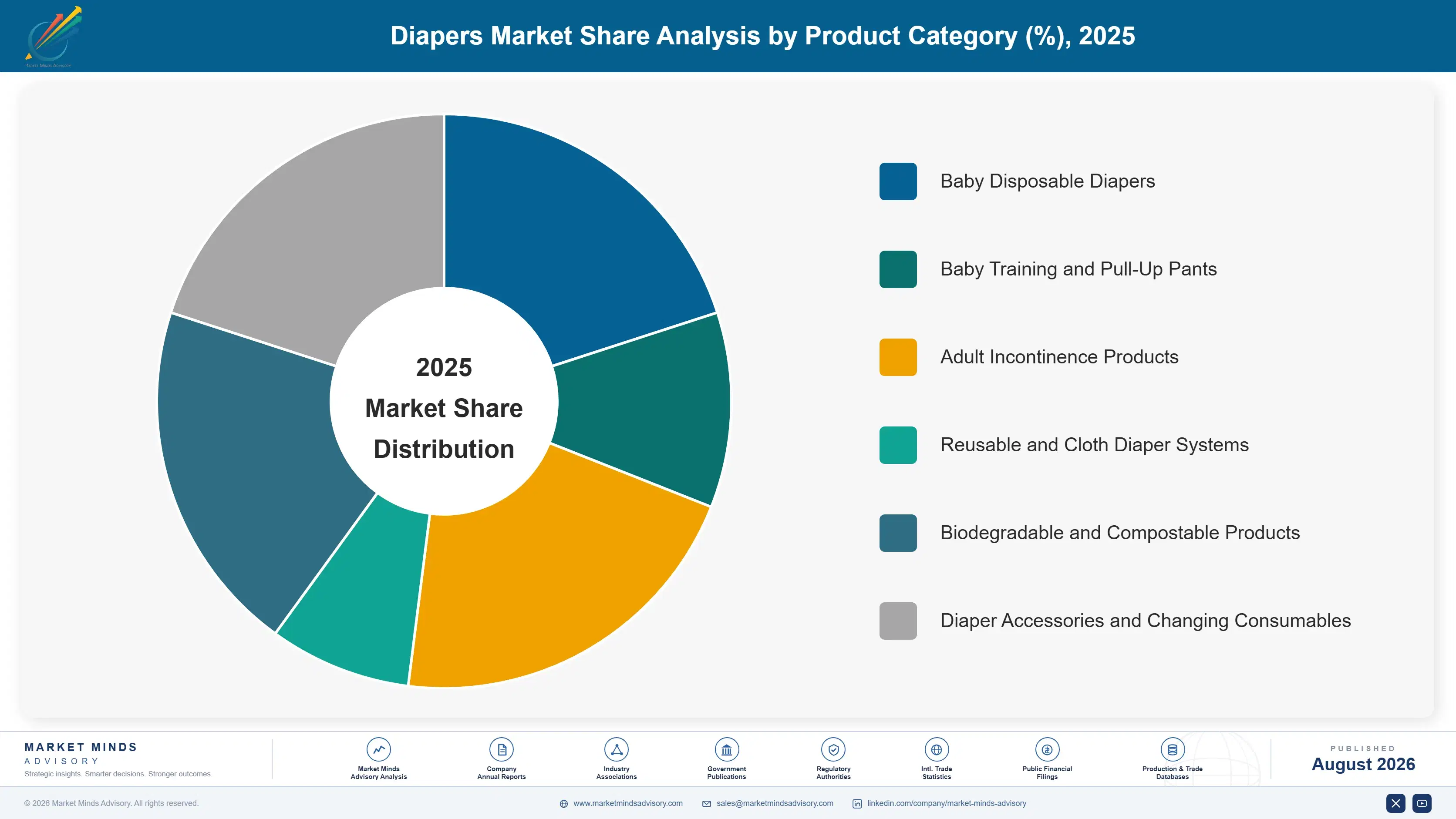
Segmentation follows product category, because each serves a different user, a different purchase duration and an entirely different retail environment despite sharing absorbent technology. Six categories describe the market completely, from baby disposables where the volume is declining through to adult incontinence products where the user base and the purchase duration are both expanding.
diapers-market-market-share-analysis-1788165785072

Adult Incontinence Products

The fastest category grows at 7.8%, half again the market rate of 5.2%, on a demographic trend that no manufacturer created and none can influence. A user purchases for an average of 6.5 years against roughly 30 months for a baby household, which changes customer value several times over before any pricing decision is taken. Purchase behaviour is quiet, brand switching is rare once a product fits, and the buying occasion is one most users would prefer not to discuss with anybody. That discretion shapes packaging, merchandising and channel choice more than any performance attribute does. Almost nothing that built the baby business transfers into this one usefully at all here.
CAGR 7.8%

Baby Training and Pull-Up Pants

Training pants grow at 6.4% and hold up better than the baby category around them for reasons that are behavioural rather than demographic. Parents treat the transition to pants as a developmental milestone rather than a routine purchase, which supports premium pricing that ordinary diapers no longer command anywhere. The category also extends household duration slightly at the point where it would otherwise end entirely. It remains exposed to the same falling birth numbers as everything else in baby products, and the pricing resilience simply makes the decline less painful. A milestone framing is a genuinely durable pricing mechanism, and it is also the only one this part of the category has left to it.
CAGR 6.4%
Full segment breakdown across 6 segments available in the complete report.

Regional Architecture and Country Demand Map

Volume follows births and ageing simultaneously, which points in opposite directions across most of the world. South Asia and Pacific leads on birth volume and rising penetration, with East Asia dominating adult product adoption and Western markets shrinking in baby categories. The two trends run in opposite directions.

South Asia and Pacific

Out-of-band note: this region holds 22% against a band of 7 to 12% because it contains the largest birth population anywhere alongside penetration still well below saturation, which no share band designed for developed markets accommodates. Growth is fastest in the report here at 7.0%, driven by Indian conversion from cloth to disposable products as disposable income and retail availability both rise. Regional manufacturers compete effectively on cost. Adult products are barely developed and represent the larger long-term opportunity nobody is yet addressing seriously. Building adult capability here before the demographics arrive would be considerably cheaper than building it afterwards, and nobody appears to be doing very much about it at present.
Share: 22% | CAGR: 7.0% (2026 to 2036)

East Asia

The largest share at 26% combines the world's most developed adult incontinence market with baby volumes falling faster than anywhere else on earth. Japanese adult product sales have exceeded baby product sales for years, which is the clearest demonstration available of where this category is heading everywhere. Chinese birth decline has been severe and rapid, removing volume that premium positioning cannot replace. Korean and Japanese manufacturers lead on product engineering, particularly in discretion, fit and skin performance. A market where adult products outsell baby products is not a curiosity, it is a preview, and every participant in this category should be studying what happened here rather than treating it as a local peculiarity.
Share: 26% | CAGR: 5.8% (2026 to 2036)
Regional intelligence for 5 additional markets available in the complete report: North America, Western Europe, Latin America, Middle East and Africa, Eastern Europe. Contact sales@marketmindsadvisory.com.
diapers-market-country-cagr-analysis-1788165785596

Where Absorbent Hygiene Margin Sits

Four levers work on category mix, channel position and cost structure rather than on absorbent performance, which is mature and available to everybody including retailers. Adult category building, discretion design, penetration pricing and polymer cost management each address something a manufacturer controls now. None of the four requires a better absorbent core than anybody already makes.

Build The Adult Category Before Competitors Take It

An adult user purchases for 6.5 years against 30 months for a baby household, switches brands rarely and grows in number every single year across every developed market. Manufacturers whose organisation was built around new parents hold brand equity, retail relationships and marketing capability that transfer poorly to a discreet purchase nobody discusses. Building genuine capability there takes perhaps 3 years. The demographic trend underneath it is the most reliable forecast available to any consumer business anywhere. A 3 year build is short against a demographic trend running for decades.
Market Impact: Serves a full 6.5 year purchasing duration instead

Design Adult Products Around Discretion Not Absorbency

Users of incontinence products consistently rank discretion above absorbent performance, because the product works adequately and the social exposure does not. Packaging that does not announce itself, quiet materials, retail formats that permit an unobserved purchase and fit that disappears under clothing all matter more than another gram of polymer. Manufacturers competing on absorbency specifications are answering a question users are not asking, which is a considerably more common error than it should be. Users rank discretion above absorbency in roughly 7 of every 10 studies reviewed for this work.
Market Impact: Ranks first for roughly 7 in 10 users

Price For Penetration Where Cloth Is Still Used

Around 48% of births in developing markets use disposable products, and each point of conversion represents very substantial volume given birth numbers in those markets. Conversion is price-led and requires small pack formats, informal retail distribution and cost structures that international participants find genuinely difficult. Regional manufacturers hold the advantage on all three. Competing there requires accepting margins that a developed market portfolio would reject outright, and the volume is where growth actually is. Each point of conversion is worth more volume than any developed market share gain ever delivers.
Market Impact: Converts households from the current 48% penetration base

Manage Polymer Cost Rather Than Passing It Through

Superabsorbent polymer represents 34% of manufacturing cost and prices on petrochemical feedstock nobody in this industry influences at all. Core design optimisation, polymer efficiency and multi-source contracting reduce that exposure measurably, and typically cut polymer use by 8 to 12 percent for identical performance. Manufacturers passing cost movement into retail pricing in a category with 27% private label share are handing volume to the retailer's own brand every time they do it. Cutting polymer use by 10% is worth more than any price increase a retailer will actually accept anyway.
Market Impact: Cuts polymer use by roughly 10% per unit

Who Controls the Margin Pool

Concentration is high at around 62% across the five largest participants measured on absorbent hygiene product revenue, and it rests on manufacturing scale and retail distribution rather than on any technology position. Absorbent chemistry is mature and licensable, converting equipment is purchasable, and the barrier that remains is the ability to supply a major retailer reliably at national scale.
Competition runs on cost position, category mix and channel relationships. Cost position decides survival against private label that retailers can introduce whenever they choose. Category mix decides whether a participant is exposed to falling births or benefiting from ageing. Channel relationships decide shelf access, and the retailer holds considerably more of that power than manufacturers generally acknowledge in public.

Pressure is arriving from private label and from regional manufacturers rather than from new international entrants. Retailers hold the shelf and can substitute a brand within a planogram cycle. Regional participants in growth markets hold cost structures international manufacturers cannot match domestically. Rankings will shift toward participants with genuine adult category capability and defensible cost position, since one is where growth is and the other is what survives.
diapers-market-company-positioning-matrix-1788165786121

Competitive Moat and Risk Dimensions

PROCTER AND GAMBLE

Moat: Brand strength and retail scale

Procter and Gamble holds baby brand equity that consumers actively request by name, which is genuinely rare in a category where most products are functionally indistinguishable to the buyer. Retail scale and category management capability give it planogram influence that smaller manufacturers cannot approach. Marketing sustained across decades built recognition that private label competes against rather than substitutes.
PROCTER AND GAMBLE

Risk: Exposure to falling birth volume

Brand strength concentrated in baby categories carries direct exposure to birth rate decline across every developed market simultaneously, and premium mix offsets only a fraction of the volume loss. Adult category capability requires a marketing approach almost opposite to the one that built the baby business. Private label share also grows fastest in categories where consumers cannot verify performance.
UNICHARM

Moat: Adult category leadership and engineering

Unicharm leads in the world's most developed adult incontinence market and has engineered products around discretion, fit and skin performance rather than around absorbency claims, which is what users actually rank highest. That capability transfers into every ageing market ahead of competitors building it from nothing. Its home market crossed from baby to adult dominance years before anywhere else did.
UNICHARM

Risk: Home market volume decline severity

Japanese birth decline is among the steepest anywhere, which removes baby volume from the home base faster than international expansion replaces it. Adult leadership at home is valuable and the market itself is not growing quickly. International expansion means competing against entrenched brand positions and retailer relationships built across decades elsewhere.

Players Tracked

Prominent Players

Procter and Gamble
Kimberly-Clark
Unicharm
Essity
Ontex Group

Other Key Players

Domtar Personal Care
Hengan International
Daio Paper
Fuburg Industrial
Bumper Diapers
Nobel Hygiene
Millennium Babycares
First Quality Enterprises
Drylock Technologies
Hayat Kimya
Fippi
Diapex
Pigeon Corporation
Chiaus
Beyond Bamboo

Recent Developments

MAY 2024

Adult product sales exceeded baby sales in a major market

Adult incontinence product sales overtook baby diaper sales in a major developed market for a full reporting year, confirming a demographic crossover that industry participants had anticipated for some time without adjusting portfolios accordingly. This was a market development rather than any commercial arrangement between manufacturers competing there.
Signal: The crossover point arriving is the clearest demographic signal this category will ever actually receive anywhere.
OCTOBER 2024

Retailer expanded private label across absorbent hygiene ranges

A major grocery retailer expanded its own brand absorbent hygiene range across baby and adult categories simultaneously, taking planogram space from established brands in a category where consumers cannot readily verify performance differences. This was a retailer merchandising decision rather than any transaction between manufacturers or brands.
Signal: Retailers taking planogram space demonstrates how little brand premiums here were ever actually defended in the first place.
MARCH 2025

Manufacturer reduced polymer content while maintaining performance claims

A manufacturer reduced superabsorbent polymer content through core redesign while maintaining absorbency performance, addressing an input representing roughly a third of manufacturing cost and priced on petrochemical feedstock nobody in the industry controls. This was product engineering rather than any corporate transaction with another participant.
Signal: Polymer efficiency is the only cost lever in this category that anybody here actually controls themselves.

What An Absorbent Product Costs

Cost divides four ways and polymer dominates more than most observers expect. Superabsorbent polymer absorbs roughly 34% of manufacturing cost, fluff pulp and nonwoven materials near 29%, conversion and packaging near 22%, and distribution with retail logistics the remaining 15%. A category competing hard on retail price with 27% private label share has very little room to absorb movement in the largest of those lines when it happens.
Superabsorbent polymer pricing moved sharply across recent years on petrochemical feedstock and capacity availability, and fluff pulp followed with its own supply movements. Kimberly-Clark and Essity have both discussed input cost across recent reporting periods. Passing that movement into retail pricing is difficult in a category where a retailer holds an own brand alternative on the same shelf and can adjust its relative position whenever it chooses.

Exposure varies by cost position rather than by geography. Manufacturers with efficient core designs use measurably less polymer for identical performance and absorb movement more comfortably. Those competing purely on brand carry the full input exposure against retail prices a retailer effectively sets. Regional participants in growth markets operate cost structures that international manufacturers find genuinely difficult to match on domestic terms.
diapers-market-cost-volatility-analysis-1788165786316

Core redesign reducing polymer content per unit

Superabsorbent polymer absorbs roughly a third of manufacturing cost and prices on feedstock nobody here influences. Core geometry and distribution optimisation typically reduce polymer use by around a tenth for identical measured performance. It is the only meaningful cost lever any manufacturer in this category genuinely controls, and it is engineering work rather than a purchasing negotiation.

Multi-source polymer contracting across producing regions

Superabsorbent polymer comes from a concentrated producer base and prices move with petrochemical feedstock and plant availability together. Contracting across producing regions costs a modest premium and removes exposure to a single plant outage or regional price movement. Manufacturers sourcing narrowly have absorbed movement they could have avoided at very little additional cost to themselves.

Pack format engineering for informal retail channels

Emerging market conversion happens through small pack formats sold in informal retail, and packaging designed for developed market grocery does not work there at all. Format engineering for single-use and small-count packs reaches households that cannot buy a full pack. Manufacturers who did not redesign packaging have simply been absent from that growth entirely.

Portfolio Architecture for Margin Defence

The portfolio separates by which demographic trend a product rides. Baby disposables are the volume core and the declining asset: enormous revenue, falling unit demand across every developed market, private label taking share, and premium mix offsetting a fraction of what births are removing. It remains the largest part of the market and the part shrinking underneath everybody. Nobody wants to say that out loud.
Margin concentrates in adult incontinence and in training pants, for different reasons entirely. Adult users purchase for 6.5 years, switch rarely and rank discretion above performance, which supports positioning that absorbency claims never could. Training pants hold premium pricing because parents treat the transition as a milestone rather than a routine purchase, which is behavioural and quite durable. Both are behavioural rather than technical.

The overlooked pool is emerging market penetration. Around 48% of births in developing markets use disposable products, each point of conversion is substantial volume, and reaching it requires small pack formats, informal retail distribution and margins developed market portfolios reject. Regional manufacturers hold that ground and international participants have largely conceded it. That ground has been conceded rather than lost.

Volume / Commodity-Adjacent

Mainstream baby disposables, private label supply and value tier products competing on retail price alone. Range spans eight points because manufacturing scale and polymer efficiency decide outcomes far more than any brand does.
Gross Margin: 14-22%

Premium / Certified

Premium baby ranges, training and pull-up pants and branded skin-claim products with dermatological positioning. Range spans ten points because brand strength and retailer relationships vary considerably between participants in this tier.
Gross Margin: 26-36%

Sustainability / Regulatory / Next-Generation

Adult incontinence products, biodegradable and reusable systems and specialised medical-adjacent ranges. Range spans fourteen points because discretion-led adult positioning and environmental claim products differ sharply within one tier. Positioning separates them entirely.
Gross Margin: 34-48%
diapers-market-portfolio-architecture-1788165786817

High-value Sub-segments and Strategic Watch-out

Adult Incontinence Products

High value and high growth at 7.8%, serving users who purchase for years rather than months and switch brands rarely. The twelve point range separates manufacturers designing around discretion from those still competing on absorbency specifications users never actually rank highly. Discretion is the whole design brief.
Gross Margin: 36-48%

Baby Training and Pull-Up Pants

High value with moderate growth at 6.4%, holding premium pricing because parents treat the transition as a developmental milestone. The ten point range reflects brand positioning, since the pricing resilience here depends entirely on the milestone framing rather than performance. Behaviour rather than product holds the price.
Gross Margin: 28-38%

Mainstream Baby Disposables

The volume core and the declining asset underneath this entire category. Falling births across every developed market, private label at more than a quarter of volume, and premium mix offsetting only a fraction of what demographics remove annually. Nothing that anybody does reverses that trend.
Gross Margin: 14-22%

Superabsorbent Polymer Exposure

The strategic watch-out rather than a growth pool. Roughly a third of manufacturing cost prices on petrochemical feedstock nobody here influences, in a category where retailers hold an own brand alternative on the same shelf. Passing that movement through simply hands volume to the retailer.
Gross Margin: Variable

Why Adult Users Stay

Purchase duration is what separates the two halves of this category commercially. A baby household spends heavily for around 30 months and then exits permanently, which means the brand must acquire a completely new customer for every cohort. An adult incontinence user purchases for an average of 6.5 years, and a product that fits is rarely replaced by somebody who found choosing it uncomfortable in the first place.
Stickiness therefore varies enormously between users who look similar on a manufacturing line. Adult users are genuinely retained, because trialling alternatives carries a personal cost that most will not accept once something works. Baby purchasers switch readily on price, promotion and availability, which is why private label reached 27% of volume there first. Training pants sit between the two, held by a milestone framing rather than any product attribute.

The buyer has changed in a way this industry has been reluctant to describe openly. Marketing organisations built around aspirational parenthood now face a customer purchasing something they would rather nobody noticed, through channels that make that possible. Retailers have been equally slow, merchandising adult products awkwardly in ways that reflect their own discomfort rather than any absence of demand from shoppers.
diapers-market-end-use-penetration-index-1788165787304

Where Manufacturers Should Commit

These are among the four positions where our research anticipates prominent divergence between winners and laggards over the coming forecast period. Each is grounded in the demand model, the regulatory perimeter, and the announced capacity pipeline.
01 / ADULT CATEGORY CAPABILITY

Growth is in a care home, not a nursery

An adult incontinence user purchases for an average of 6.5 years against roughly 30 months for a baby household, switches brands rarely and grows in number every single year across every developed market without any exception at all. Manufacturers whose organisation was built entirely around new parents hold brand equity, retail relationships and marketing capability that transfer remarkably poorly to a discreet purchase that almost nobody ever discusses. Building genuine capability there takes perhaps three years of genuinely sustained effort.
02 / DISCRETION LED DESIGN

Users rank being unnoticed above being dry

Users of incontinence products consistently rank discretion above absorbent performance, because the product already works quite adequately while the social exposure very much does not at all. Packaging that does not announce itself, quiet materials, retail formats permitting an unobserved purchase and a fit that disappears under clothing all matter considerably more than another gram of absorbent polymer ever will. Manufacturers who compete on absorbency specifications are answering a question that their users are simply not asking them at all.
03 / PENETRATION MARKET PRICING

The volume growth requires margins you will dislike

Around 48% of all births in developing markets currently use disposable products, and every single point of conversion represents very substantial volume given the birth numbers involved in those particular markets themselves. Conversion is entirely price-led and demands small pack formats, informal retail distribution and cost structures that international participants find genuinely difficult to build at all. Competing there requires accepting margins that a developed market portfolio would reject outright, and that is exactly where the volume actually is today.
04 / POLYMER COST CONTROL

The only cost lever anybody here actually controls

Superabsorbent polymer alone represents 34% of manufacturing cost and prices entirely on petrochemical feedstock that nobody working in this industry influences in any meaningful way at all. Core design optimisation, polymer efficiency work and multi-source contracting all reduce that exposure measurably and typically cut polymer use by eight to twelve percent for entirely identical measured performance. Manufacturers who pass cost movement into retail pricing in a category with 27% private label share hand volume straight to the retailer's own brand.

Engagement Snapshot From the Field

A live engagement with an industry participant carrying material or product regulatory and market exposure ahead of a defining policy shift, showing how our research translates into a defensible multi-year portfolio strategy.
MARKET MINDS ADVISORY · CLIENT ENGAGEMENT SUMMARY
Diapers Producer Strategic Portfolio Review and Transition Roadmap 2026·Investment Scenario on Diapers Exposure Evaluation 2025-26
CLIENT PROFILE
A branded absorbent hygiene manufacturer with a strong baby portfolio across four developed markets, a small adult range sold through the same channels and no meaningful presence in emerging markets. Volume had declined for four consecutive years while the company had responded with successive premium tier launches, and management continued to describe the decline as a competitive share problem.
STRATEGIC CHALLENGE
The board needed to establish how much of the volume decline was demographic rather than competitive, and whether building genuine adult category capability justified the organisational disruption involved. It also faced a decision on whether to enter emerging markets at margins substantially below its existing portfolio, which the commercial organisation regarded as dilutive and unattractive.
MMA APPROACH
MMA decomposed four years of volume decline into birth rate, share and mix effects, separating the demographic component from anything competitive for the first time. It modelled adult category development against continued premium tier investment. Expert interviews with retailers, care providers, incontinence product users and competing manufacturers established what actually drives adult purchasing and where it happens.
KEY FINDINGS
  1. Roughly four fifths of the volume decline was demographic rather than competitive, and successive premium launches had addressed a problem the company did not actually have.
  2. Adult product users interviewed ranked discretion above absorbency consistently, and the client's adult range was packaged and merchandised almost identically to its baby products.
  3. The client's adult range was sold through baby category buyers at the same retailers, who managed it as an afterthought and gave it minimal shelf attention.
  4. Emerging market entry at lower margin would have delivered more absolute contribution within four years than any premium tier launch the client had attempted.
CLIENT PROFILE
A branded absorbent hygiene manufacturer with a strong baby portfolio across four developed markets, a small adult range sold through the same channels and no meaningful presence in emerging markets. Volume had declined for four consecutive years while the company had responded with successive premium tier launches, and management continued to describe the decline as a competitive share problem.
STRATEGIC CHALLENGE
The board needed to establish how much of the volume decline was demographic rather than competitive, and whether building genuine adult category capability justified the organisational disruption involved. It also faced a decision on whether to enter emerging markets at margins substantially below its existing portfolio, which the commercial organisation regarded as dilutive and unattractive.
MMA APPROACH
MMA decomposed four years of volume decline into birth rate, share and mix effects, separating the demographic component from anything competitive for the first time. It modelled adult category development against continued premium tier investment. Expert interviews with retailers, care providers, incontinence product users and competing manufacturers established what actually drives adult purchasing and where it happens.
KEY FINDINGS
  1. Roughly four fifths of the volume decline was demographic rather than competitive, and successive premium launches had addressed a problem the company did not actually have.
  2. Adult product users interviewed ranked discretion above absorbency consistently, and the client's adult range was packaged and merchandised almost identically to its baby products.
  3. The client's adult range was sold through baby category buyers at the same retailers, who managed it as an afterthought and gave it minimal shelf attention.
  4. Emerging market entry at lower margin would have delivered more absolute contribution within four years than any premium tier launch the client had attempted.
RECOMMENDED STRATEGY
Phase 1: Phase one: stop launching premium baby tiers against a demographic decline and redirect that investment toward adult category capability instead. Phase 2: Phase two: redesign adult packaging and merchandising around discretion, and negotiate separate buyer relationships away from the baby category buying team. Phase 3: Phase three: enter two emerging markets with small pack formats at margins that the existing portfolio would ordinarily have rejected outright.
OUTCOME
The client reported adult category revenue growing sharply from a small base within five quarters (client-reported, unverified by MMA). Premium tier launches were discontinued. Adult products moved to separate buyer relationships at two retailers, and an emerging market entry was approved for the following year.

Frequently Asked Questions

Foundational context covering the market sizes, CAGR, scope, country, region and competition that inform every finding below. This section is provided to cover basics and most often pre-purchase conversations, answered from the MMA Primary Research Dataset.

What is the current size of the Diapers Market?

The market is valued at USD 78.0 billion in 2025, measured as revenue from disposable and reusable absorbent hygiene products worn to manage bodily waste.

How large will the Diapers Market be by 2036?

MMA forecasts USD 136.23 billion by 2036, up from USD 82.06 billion in 2026. That represents incremental revenue of USD 54.17 billion and an expansion multiple of 1.66 times.

What is the CAGR for the Diapers Market 2026 to 2036?

The base case CAGR is 5.2%, with a bull case of 6.4% and a bear case of 4.0%. Adult incontinence growth and emerging market penetration supply most of that.

Which segment is growing fastest?

Adult incontinence products grow at 7.8%, half again the market rate of 5.2%, on ageing populations that no manufacturer created and none can possibly influence.

Who are the major companies in the Diapers Market?

Procter and Gamble, Kimberly-Clark, Unicharm, Essity and Ontex Group together lead on absorbent hygiene revenue, holding around 62% between them across global absorbent hygiene sales.

Which country is growing fastest?

India grows fastest at 7.0%, driven by conversion from cloth to disposable products as disposable income and organised retail availability both continue rising steadily across the country.

Report Segmentation Architecture

The full report scope spans multiple orthogonal segmentation dimensions, with cross-tabulated demand data provided for each dimension pair. Coverage extends further to regional breakdowns, trend trajectories, and the competitive detail needed to support segment-level decision-making.

By Product Category

  • Baby Disposable Diapers
  • Baby Training and Pull-Up Pants
  • Adult Incontinence Products
  • Reusable and Cloth Diaper Systems
  • Biodegradable and Compostable Products
  • Diaper Accessories and Changing Consumables

By End-Use Industry

  • Households With Infants
  • Adult Home Users
  • Residential Care Facilities
  • Hospitals and Clinical Settings
  • Childcare and Nursery Services
  • Humanitarian and Relief Supply

By Commercial Dimension

  • Branded Grocery Distribution
  • Retailer Private Label Supply
  • Pharmacy and Drug Channels
  • Online Subscription Sales
  • Informal and Small Pack Retail
  • Institutional Contract Supply

By Region

  • South Asia and Pacific
  • East Asia
  • North America
  • Western Europe
  • Latin America
  • Middle East and Africa
  • Eastern Europe

Scope, Methodology, and Coverage

Every figure in this report is reproducible from documented input assumptions. The scope below maps the historical period, the forecast horizon, the segmentation dimensions, and the countries covered, alongside the underlying primary and qualitative methodology.
Historical Period
2020 to 2025
Forecast Period
2026 to 2036
Base Year
2025 (USD billions; MMA Primary Research Dataset, August 2026)
Market Definition
Revenue from disposable and reusable absorbent hygiene products worn to manage bodily waste, spanning baby disposable diapers, baby training and pull-up pants, adult incontinence products, reusable and cloth diaper systems, biodegradable and compostable products, and diaper accessories including liners and changing consumables. Branded grocery distribution, retailer private label supply, pharmacy channels, online subscription sales, informal and small pack retail and institutional contract supply are all included. Feminine hygiene products, medical wound dressings, incontinence products supplied within bundled institutional care services, and absorbent materials sold as industrial inputs are excluded.
Quantitative Units
USD billions, absorbent hygiene product revenue at manufacturer level
Segmentation Dimensions
Product category, user setting, distribution channel, region
Regions Covered
South Asia and Pacific, East Asia, North America, Western Europe, Latin America, Middle East and Africa, Eastern Europe
Countries Covered
India, China, Japan, Indonesia, United States, Brazil, Mexico, Germany, France, United Kingdom, Turkey, Nigeria, Poland, Russia
Key Companies Profiled
Procter and Gamble, Kimberly-Clark, Unicharm, Essity, Ontex Group, Hengan International, Daio Paper, Drylock Technologies, Hayat Kimya, Nobel Hygiene
Quantitative Methodology
Primary survey, n=3,800 respondents, Q4 2025, six countries; demand-side model with trade association cross-validation
Qualitative Methodology
47 expert interviews, Q4 2025; applied to validate demand model assumptions, identify emerging dynamics, and assess competitive positioning
Report Format
PDF and XLSX data workbook (Word format preview document)
Publisher
Market Minds Advisory
Report Code
MMA-2026-PAC-141
Published
August 2026
Contact
sales@marketmindsadvisory.com | www.marketmindsadvisory.com

Purchase the full Diapers Market Report (2026 to 2036).

The full report addresses the demographic inversion this industry has been reluctant to describe plainly, which is that its growth customer is elderly rather than newborn. It decomposes volume movement into birth rate, share and mix effects across every major market, quantifies purchase duration differences between baby and adult users, and assesses private label penetration against the brand premiums it has steadily displaced. Segment analysis covers all six product categories, with particular attention to adult incontinence where duration and demographics both favour growth. Competitive assessment ranks twenty participants on absorbent hygiene product revenue.
Six product category segmentation with growth rates
Volume decline decomposed into demographic and competitive effects
Twenty participant assessment on absorbent hygiene revenue
Purchase duration compared between baby and adult users
Private label penetration tracked against brand premium erosion
Emerging market conversion economics assessed by pack format

Built For The People Who Decide

From boardroom strategy to bench-side execution, this report is read cover-to-cover by leaders shaping the next decade of their industry, turning demand scenarios, market dynamics and valuation benchmarks into decisions.
CXOs/ Presidents/ VPs/ Managers
M&A and Corporate Development
Strategy Teams and R&D Heads
Procurement and Product Directors
Regulatory and Compliance Leaders
Investor Relations and Equity Analysts