Market Minds Advisory
Diamond Core Drilling Market

Diamond Core Drilling Market: Critical Minerals Exploration and Construction Demand

Critical minerals exploration for lithium, copper, and rare earths is pulling mining-grade diamond core drilling rigs into a capex cycle mature construction coring demand alone could never have sustained on its own.

Lead Analyst

David Horsley

Published

September 2026

Make Smarter Decisions with Customized Research Insights

Request a free sample report and evaluate market opportunities, growth trends, and competitive dynamics relevant to your business needs.

2025 MARKET VALUE$4.2BMarket Size 2025
2036 FORECAST VALUE$8.5BBase Case , 2026 to 2036
CAGR 2026 TO 20366.6 %Bull 7.9% / Bear 5.3%
INCREMENTAL OPPORTUNITY$4.0BNet 10- year value creation
EXPANSION MULTIPLE1.89x2036 value over 2026 base
Strategic Levers
M&A Pipeline
Regional Outlook
Country Rankings
Competitive Intelligence
Segmental Deep-dive
Call-Us : 91 93563 13602

Executive Snapshot and Market Trajectory

Critical minerals exploration budgets, driven by lithium, copper, nickel, and rare earths demand tied to electrification, are pulling mineral exploration drilling rigs into a capital spending cycle far stronger than mature construction coring demand alone could ever sustain independently across a normal equipment replacement cycle today.
Australia anchors the fastest growth in this report, as exploration budgets tied to its established mining sector expand faster than any other large market tracked. Mineral exploration core drilling rigs lead everywhere, but wireline drilling systems follow closely on productivity economics. North America and Europe anchor manufacturing and equipment engineering even as exploration activity growth concentrates in Australia, Latin America, and Africa.
Competitive intensity now centers heavily on drilling productivity and total exploration cost per meter, since mining companies budget entire programs on cost efficiency rather than headline rig price alone. Regulatory pressure adds a second front entirely: several jurisdictions are tightening environmental permitting for exploration drilling, and manufacturers able to certify low-impact systems fastest are winning contracts well ahead of slower-moving competitors still catching up on compliance.
Market Definition
The diamond core drilling market covers rigs, drill bits, and consumable tooling used to extract cylindrical rock or concrete core samples for mineral exploration, geotechnical investigation, and construction applications, spanning surface and underground mining rigs, wireline systems, and construction concrete coring equipment. It excludes rotary and percussion drilling equipment that does not extract intact core samples and blasthole production drilling rigs used in active mine production.
Base Year Value
$4.2B in 2025 (MMA Primary Research Dataset, August 2026)
Forecast Period
2026 to 2036, eleven discrete annual values
CAGR
6.6% base case. Bull 7.9%. Bear 5.3%.
Fastest Growth Segment
Mineral Exploration Core Drilling Rigs: 9.8% CAGR
Fastest Growth Country
Australia: 10.2% CAGR
Fastest Growth Region
South Asia and Pacific: 8.6% CAGR
Largest Region
East Asia: 28% of 2025 global value
Market Leaders
Boart Longyear Group Ltd., Epiroc AB, Sandvik AB, Hilti Corporation, Husqvarna Construction Products. Source: MMA Analysis based on company annual reports.
Primary Survey
n=3,800 procurement and R&D decision-makers, Q4 2025, six countries
Methodology
Demand-side build-up, cross-validated against public data, 47 expert interviews

Diamond Core Drilling Market Forecast Scenarios

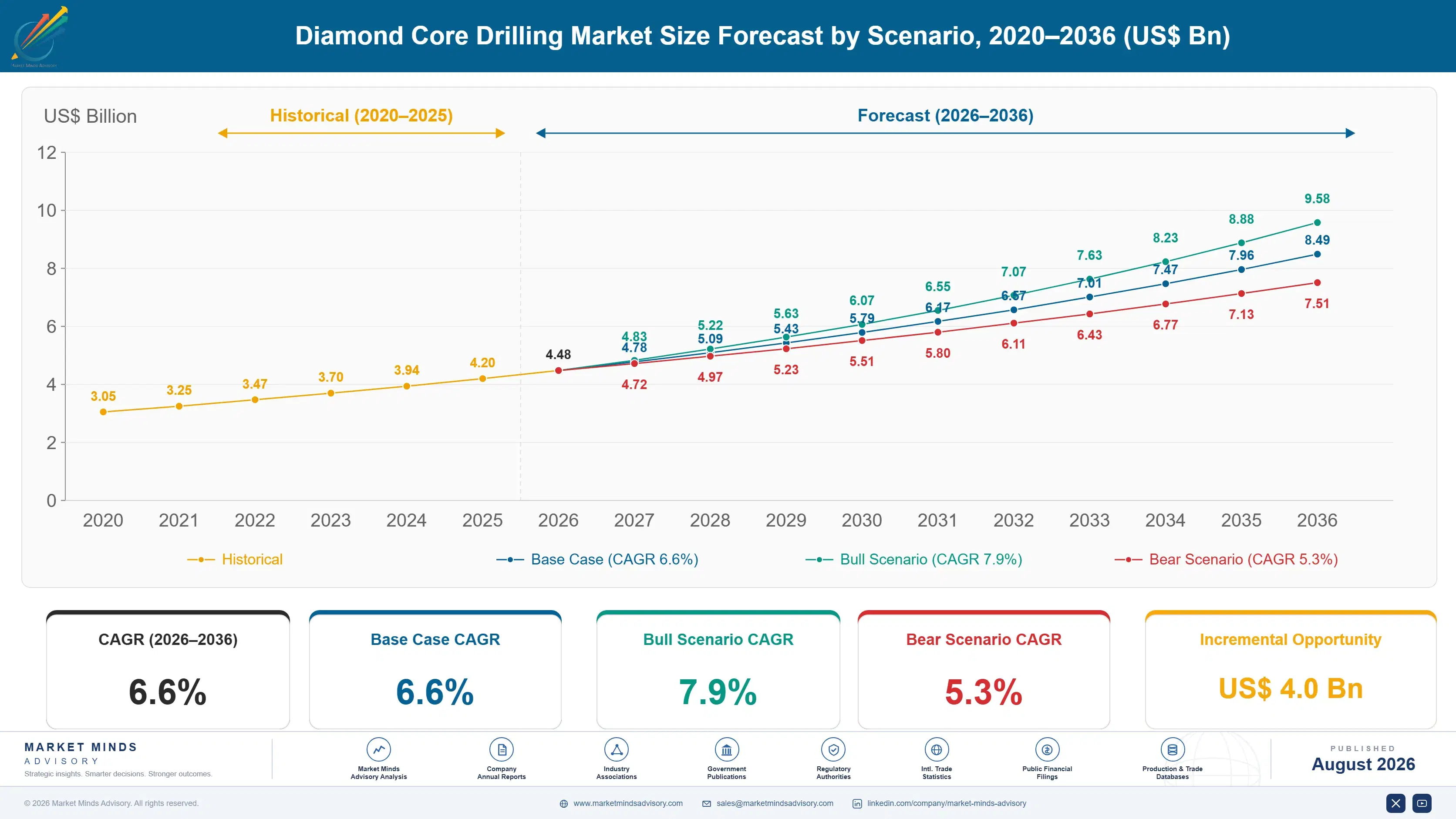
diamond-core-drilling-market-size-forecast-scenario-1787301614664
Diamond core drilling demand grew unevenly between 2020 and 2025. Pandemic-era exploration budget cuts depressed rig utilization through 2021, then a sharp rebound in critical minerals exploration spending from 2022 onward tracked rising lithium, copper, and rare earths demand. Growth over the period compounded at an estimated 5.6%, trailing the forecast years because the current exploration cycle, still building, had not yet reached its current intensity.
The base case assumes 6.6% annual growth through 2036, anchored on three mechanisms. First, critical minerals exploration budgets keep expanding as electrification and clean energy supply chains demand more lithium, copper, and rare earths than proven reserves can supply. Second, wireline drilling productivity gains keep lowering exploration cost per meter, expanding the viable exploration budget for a given mining company. Third, construction coring demand keeps growing steadily alongside infrastructure investment, providing a stable demand floor beneath the more cyclical exploration segment tracked separately in this report.
A bull case builds if critical minerals prices sustain current levels long enough to fund a multi-year exploration budget expansion, pushing growth toward 7.9%. The bear risk is exploration budget cyclicality: mining companies have historically cut exploration spending sharply during commodity price downturns, and a renewed downturn could stall rig orders and cap growth near 5.3% across the full forecast period covered.

Exploration Capex Cycles and the Productivity Economics

Diamond core drilling sits at an unusual intersection of cyclical mining exploration capital spending and steady construction infrastructure demand, giving the category two distinct demand rhythms operating simultaneously across very different customer bases and buying cycles. Mining exploration spending swings sharply with commodity prices, while construction coring demand tracks infrastructure investment on a much steadier, less volatile cycle over time.
MARKET CONCENTRATION29% CR5Fragmented industry with dozens of regional manufacturers competing
AVERAGE SELLING PRICE$185,000 per rigBlended price across exploration, geotechnical, and coring types
TOP PRODUCING COUNTRYChina, 26%Single country supplies over a quarter of global output
CAPACITY UTILISATION68%Exploration cycle swings keep utilisation below continuous-process norms
TRADE INTENSITY54% export shareWell over half of rigs cross a border before deployment
INPUT COST SHARE31% of COGSIndustrial diamond and steel drill string components dominate costs
Vendors compete less on rig price than on total exploration cost per meter drilled: mining companies evaluate drilling contractors and equipment on productivity, uptime, and core recovery quality rather than upfront capital cost alone at purchase. Manufacturing remains concentrated in China, Sweden, and the United States, with Australia and Canada gaining share in specialized wireline and underground rig assembly work each year.
The next decade will be shaped by two forces pulling in the same direction: sustained critical minerals exploration investment and steady construction infrastructure coring demand growing worldwide across most major economies. Both push rig utilization upward even as mature markets see construction-segment growth remain comparatively modest against an already large, slow-turning installed base of equipment.
"Every lithium deposit anyone finds in the next decade gets found with a diamond bit first. That's not a metaphor, that's literally how exploration works."
Director, Mining and Construction Equipment Practice · MMA Construction and Indu

Market Trends

Critical Minerals Exploration Budgets Expand Sharply

Lithium, copper, nickel, and rare earths exploration budgets have expanded significantly as electrification and clean energy supply chains demand volumes of these materials that currently proven reserves cannot reliably supply over the coming decade. Mining companies and junior explorers are directing an increasing share of exploration spending toward these specific commodities rather than spreading budgets evenly across the broader mineral portfolio prioritized a decade ago. This is converting diamond core drilling from a mature, replacement-driven category into one experiencing genuine capital investment growth, pulling manufacturers to expand rig capacity and wireline engineering for the deep exploration programs critical minerals deposits require.
Market Impact: Sustains capex 3 years longer
Wireline Systems Cut Exploration Cost Per Meter

Wireline drilling systems, which let crews retrieve core samples without pulling the entire drill string out of the hole, are cutting exploration drilling time and cost per meter significantly compared with conventional core barrel retrieval methods still common on older rigs. This productivity gain is expanding the viable exploration budget for mining companies, since lower cost per meter lets a fixed budget cover more ground and test more targets within a single field season. Manufacturers with strong wireline engineering, including Boart Longyear and Sandvik, are capturing disproportionate share of new orders as exploration companies increasingly specify wireline capability as a baseline requirement.
Market Impact: Adds 14% to fleet stock

Market Opportunities and Growth Drivers

Electrification Demand Sustains Multi-Year Exploration Cycles

Electric vehicle and grid storage battery demand keeps pulling lithium, copper, and nickel exploration budgets higher across multiple consecutive years, breaking the historical boom-bust exploration cycle that previously tracked commodity price swings much more tightly. Mining companies increasingly treat critical minerals exploration as a multi-year commitment rather than a discretionary spend cut quickly during any short-term price dip, since long-term supply agreements with battery and electronics manufacturers require demonstrated reserve growth to sustain corporate credibility with buyers. This lasting shift in exploration budgeting behavior, driven by demand visibility electrification provides, is giving equipment manufacturers more confidence to invest in production capacity than prior cycles ever supported.
Market Impact: Risks 22% of exploration rig orders

Infrastructure Investment Sustains Construction Coring Demand

Global infrastructure investment, spanning transportation, utility, and building construction, keeps generating steady demand for concrete coring equipment used in utility penetrations, structural inspection, and demolition preparation work across active construction sites worldwide. This segment provides a demand floor beneath the more volatile mining exploration cycle, since construction coring activity tracks infrastructure spending rather than commodity prices directly. Equipment rental companies increasingly stock diamond coring equipment as standard fleet inventory rather than a specialty item, reflecting how routine coring has become across general construction and renovation work in most developed and rapidly developing markets.
Market Impact: Delays 19% of planned drilling star

Market Restraints and Challenges

Exploration Budget Cyclicality Threatens Order Consistency

Mining companies have historically cut exploration spending sharply during commodity price downturns, and equipment manufacturers that built capacity around sustained critical minerals growth face real order volatility risk if current price levels do not hold. The root cause is capital discipline: exploration is typically the first budget line boards cut when prices soften, since exploration spending produces no immediate production revenue to offset the cut. This creates lumpy, hard-to-forecast revenue for manufacturers most exposed to junior exploration customers. Vendors are mitigating this by diversifying into construction coring and geotechnical segments that track stable infrastructure spending.
Market Impact: Adds 3,400 new exploration drill ri

Environmental Permitting Delays Slow Exploration Programs

Environmental permitting requirements for exploration drilling have tightened across several major mining jurisdictions, extending the time between project approval and actual drilling start by months in cases that previously moved faster under older regulatory frameworks. The root cause is genuinely increased environmental scrutiny of exploration activity, particularly in ecologically sensitive regions where new critical minerals deposits are often located. This slows equipment demand timing even when underlying budgets remain fully intact, since delayed permits push rig orders later than originally planned. Manufacturers are mitigating this by developing lower-impact drilling systems designed to meet stricter permitting requirements faster than conventional rigs can.
Market Impact: Cuts exploration cost per meter 28%
3 additional market trends, 3 additional growth drivers, and 3 additional restraints and challenges are covered in the full report. Contact sales@marketmindsadvisory.com to access the complete intelligence.

Segment CAGR and Growth Architecture

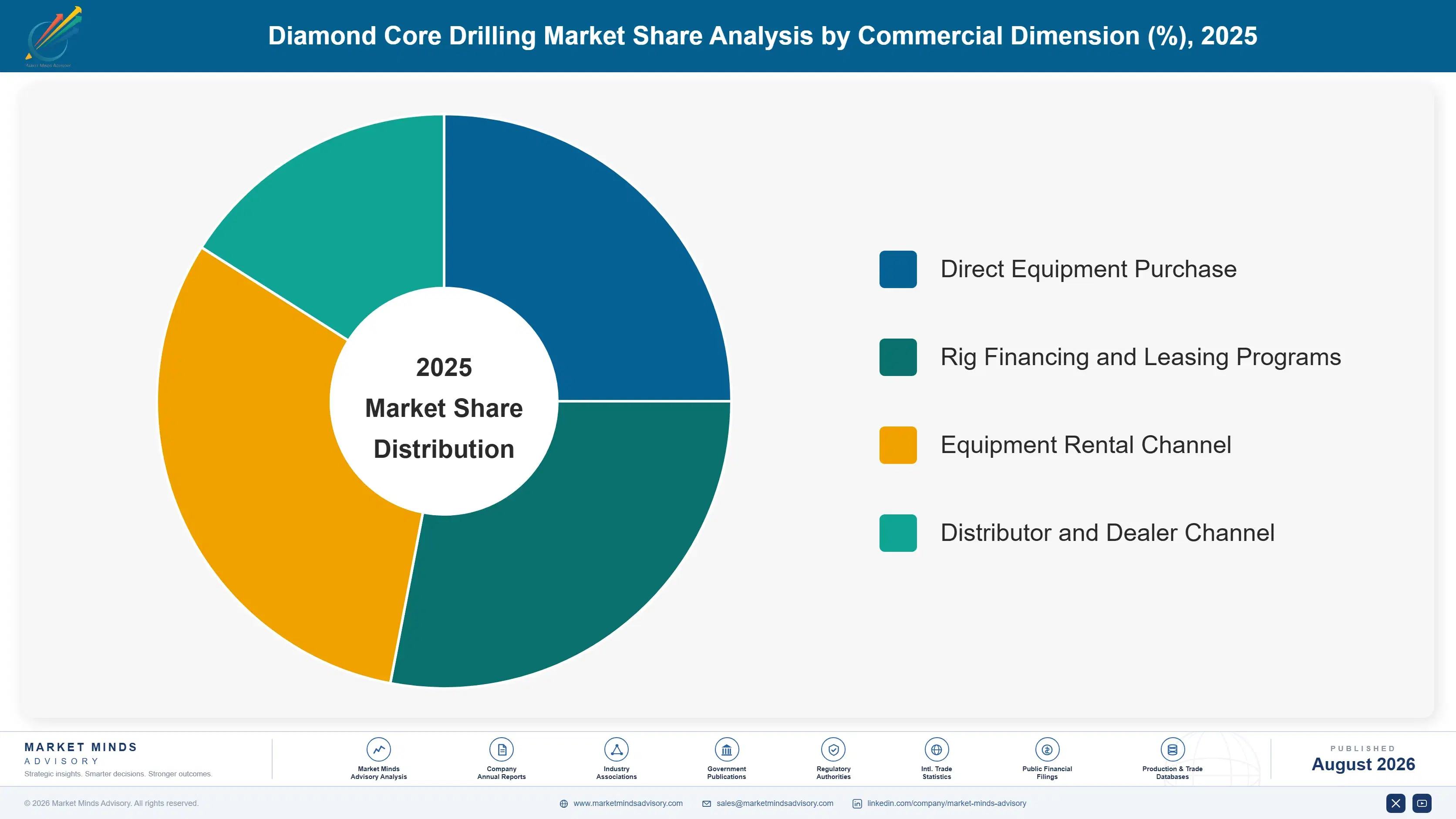
MMA segments the market by drilling application and rig configuration, the classification mining companies and contractors use when specifying equipment and comparing productivity across competing vendor bids. This avoids blending upstream drill bit consumables, a separate commercial dimension entirely, with the rig configuration types that define how a given drilling program is actually equipped and executed.
diamond-core-drilling-market-market-share-analysis-1787301615198

Mineral Exploration Core Drilling Rigs

Mineral exploration rigs are converting from a cyclical, replacement-driven category into the segment manufacturers compete hardest to win, as critical minerals exploration budgets expand faster than any other demand driver in this report. Growth concentrates wherever lithium, copper, and rare earths exploration programs are most active, particularly across Australia, Chile, and increasingly parts of Africa where new deposits are being delineated. Boart Longyear and Epiroc have each expanded exploration rig production capacity, recognizing that deep, precision-capable rigs command a meaningful premium over shallow, conventional configurations exploration programs previously favored. At a 9.8% forecast CAGR, roughly 1.5 times the market average, this segment is pulling capital investment away from slower-growing construction coring product development.
CAGR 9.8%

Wireline Core Drilling Systems

Wireline drilling systems track exploration productivity economics more directly than any other segment, making cost-per-meter competitiveness a disproportionate growth driver for this category specifically. Sandvik and Boart Longyear lead on wireline engineering depth, while regional manufacturers compete on price for shallower, lower-complexity exploration programs that do not require full wireline capability. Demand here is less tied to general rig replacement cycles than other segments, since wireline adoption follows exploration company productivity requirements rather than simple equipment age alone. Growth tracks exploration program depth and complexity more closely than general economic conditions, giving this segment a distinct demand cycle apart from the rest of the broader portfolio described throughout this report.
CAGR 8.4%
Full segment breakdown across 6 segments available in the complete report.

Regional Architecture and Country Demand Map

Demand concentrates where mining exploration spending, infrastructure investment, and manufacturing capability overlap tightly. East Asia leads on manufacturing and coring demand, North America and Western Europe follow on equipment engineering, while South Asia and Pacific converts fastest as Australian exploration budgets expand steadily each year.

North America

United States and Canadian mining company headquarters concentration anchors regional demand, as Boart Longyear and Major Drilling Group manage exploration programs spanning multiple continents from North American corporate bases while maintaining substantial domestic rig manufacturing and fleet deployment. Canada's own critical minerals exploration activity, spanning lithium and rare earths projects across several provinces, adds meaningful domestic demand beyond the corporate headquarters effect alone. United States construction coring demand follows steady infrastructure investment patterns tied to federal and state infrastructure spending programs. Growth stays close to the global base rate because the region's exploration equipment base is already well-established, leaving mostly steady replacement and fleet expansion demand rather than substantial first-time adoption opportunity ahead for most vendors active in the category.
Share: 24% | CAGR: 6.8% (2026 to 2036)

Western Europe

Sweden anchors both regional manufacturing engineering depth, through Epiroc and Sandvik, and equipment export activity, as its mining equipment sector serves exploration and construction customers across every region covered in this report. Germany and the United Kingdom follow with steadier construction coring demand tied to infrastructure renovation and utility penetration work rather than mining exploration specifically. Regulatory pressure compounds this: European Union environmental permitting standards for exploration drilling keep tightening, pushing manufacturers toward lower-impact drilling systems that favor newer rig designs over legacy conventional configurations still common. Growth trails East Asia and South Asia because Western Europe's own domestic mining exploration activity remains comparatively limited relative to construction-driven coring demand across the region.
Share: 19% | CAGR: 5.0% (2026 to 2036)
Regional intelligence for 5 additional markets available in the complete report: East Asia, South Asia and Pacific, Latin America, Middle East and Africa, Eastern Europe. Contact sales@marketmindsadvisory.com.
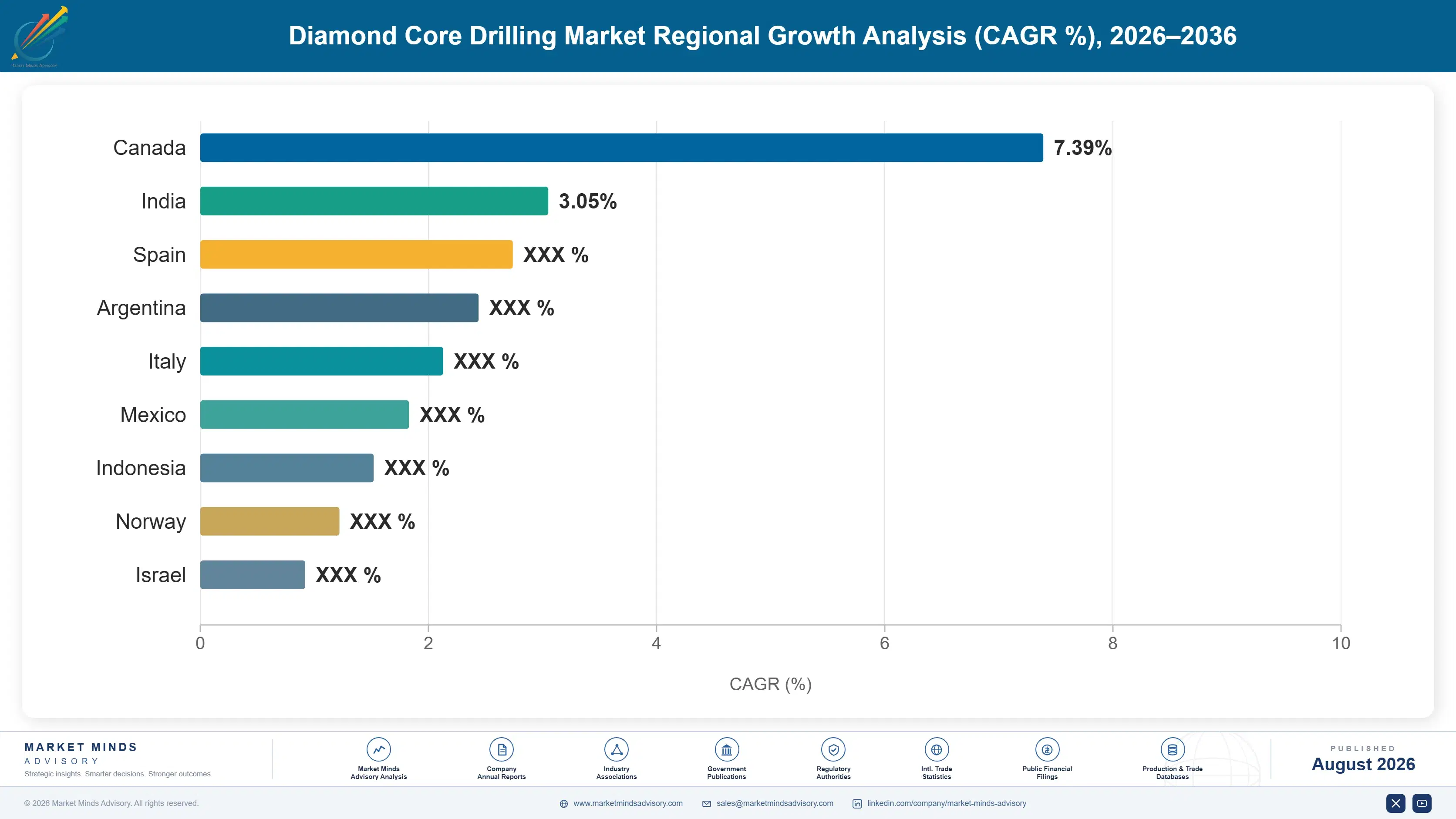
diamond-core-drilling-market-country-cagr-analysis-1787301615713

Where Drilling Equipment Vendors Actually Capture Margin

Rig hardware increasingly competes on price as manufacturing standardizes, so the vendors protecting margin monetize the parts of the transaction adjacent to the rig itself: consumable drill bits, productivity software, and long-term fleet service contracts. The four levers below reflect where MMA's interviews with mining and construction buyers show real, sustained willingness to pay.

Diamond Drill Bit and Consumable Supply Contracts

Diamond drill bits wear out and require replacement far more frequently than the rig itself, and manufacturers bundling long-term consumable supply agreements alongside rig sales capture recurring revenue worth roughly 45% of a rig's total lifetime revenue over a typical multi-year exploration program. Mining companies increasingly prefer single-vendor consumable relationships that guarantee bit availability and consistent quality across an entire drilling campaign, rather than sourcing bits separately and risking supply interruptions mid-program. This is becoming the primary profit center for equipment manufacturers, since bit margin typically exceeds rig hardware margin by a meaningful amount across most product lines.
Market Impact: Locks in 45 percent of lifetime rig

Drilling Productivity Software and Data Analytics

Connected drilling rigs that report penetration rate, core recovery quality, and downtime data back to a vendor's analytics platform let manufacturers sell a recurring software subscription that helps exploration companies optimize drilling parameters in real time across an entire program. For mining companies running multiple rigs simultaneously across a large exploration campaign, the value proposition is meaningfully lower cost per meter drilled, achieved through data-driven parameter optimization rather than trial-and-error adjustment. Early adopters report productivity software attach rates approaching 24% on large exploration fleet contracts, growing faster than any other service line vendors currently track across the industry.
Market Impact: Reaches nearly 24 percent attach ra

Long-Term Fleet Maintenance and Uptime Contracts

Unplanned rig downtime during an active exploration program can cost a mining company far more in lost drilling days than the maintenance contract itself, giving exploration companies strong incentive to pay for guaranteed uptime contracts backed by scheduled preventive maintenance and rapid parts delivery commitments. Vendors offering these contracts capture premium recurring service revenue worth roughly 18% of rig price annually from customers unwilling to risk a multi-day production stoppage during a compressed field season with hard weather-driven deadlines that leave little room for equipment failure, part shortages, or unplanned delay of any kind.
Market Impact: Adds recurring uptime revenue worth

Rig Financing and Leasing Programs for Junior Explorers

Smaller junior exploration companies, which often cannot justify a large capital outlay for owned equipment given uncertain future funding, increasingly rely on rig financing and leasing programs that convert a difficult capital decision into a manageable operating expense tied directly to an active drilling program. Manufacturers offering in-house or partnered financing close deals faster than competitors requiring buyers to arrange financing separately, and MMA interviews suggest financed orders now average 30% larger in scope than cash-purchase orders among junior exploration company customers specifically active in the category and dependent on external capital.
Market Impact: Grows financed order size by 30 per

Who Controls the Margin Pool

CR5 sits at 29%, reflecting a fragmented industry still dominated by dozens of regional manufacturers serving local exploration and construction customer bases across different geographies worldwide. Boart Longyear and Epiroc lead on a revenue basis, with neither commanding the outright dominance typical of more consolidated mining equipment categories, since exploration drilling contractors often maintain long-standing regional relationships that resist easy displacement by larger competitors e
Current activity centers on three dimensions: wireline productivity engineering for exploration applications, drill bit consumable supply relationships, and long-term fleet service capability for large mining company customers. Vendors lacking deep wireline engineering are increasingly partnering with specialist consumable suppliers rather than losing exploration contracts to vendors offering integrated rig and bit packages as a single bundled solution across the board.

Emerging pressure comes from Chinese manufacturers expanding aggressively on price into construction coring and shallow exploration segments historically dominated by Western and Australian brands for decades. If critical minerals exploration growth continues outpacing construction demand, expect rankings among the next five challengers to shift by 2029, as manufacturers with strong wireline engineering convert technical leadership into share against slower-moving diversified incumbents globally.
diamond-core-drilling-market-company-positioning-matrix-1787301616234

Competitive Moat and Risk Dimensions

BOART LONGYEAR GROUP LTD.

Moat: Global Exploration Drilling Service Network

Boart Longyear's decades-long presence across major mining exploration jurisdictions gives it service network depth and drilling contractor relationships few competitors can match, letting it win large multi-rig exploration contracts on service reliability alone. That combined footprint makes Boart Longyear the default vendor for mining companies running exploration programs across multiple continents simultaneously.
BOART LONGYEAR GROUP LTD.

Risk: Exposure to Mining Capex Cycles

Boart Longyear's revenue remains tied closely to mining exploration capital spending, leaving it exposed to any sharp downturn in commodity prices that triggers the exploration budget cuts mining companies have historically made quickly. Diversifying further into construction coring, a steadier but lower-margin segment, requires balancing near-term margin against long-term revenue stability across genuinely different customer bases.
EPIROC AB

Moat: Underground Mining Equipment Integration

Epiroc's broader underground mining equipment portfolio gives it engineering integration advantages that pure-play drilling manufacturers cannot easily replicate, letting it bundle exploration and underground production drilling equipment into single large mining company contracts. That combined engineering depth lets Epiroc command a pricing premium among mining companies seeking one integrated equipment supplier relationship.
EPIROC AB

Risk: Slower Construction Segment Penetration

Epiroc's core strength in mining-focused equipment has translated less quickly into the construction coring segment, where smaller, more specialized competitors like Hilti and Husqvarna maintain stronger brand recognition among construction contractors. Closing this gap requires channel investment that competes directly with Epiroc's traditional mining-focused sales motion for capital and management attention.

Players Tracked

Prominent Players

Boart Longyear Group Ltd.
Epiroc AB
Sandvik AB
Hilti Corporation
Husqvarna Construction Products

Other Key Players

Atlas Copco AB
Major Drilling Group International Inc.
Foraco International SA
Diamond Products Company
ICS Blount Inc.
Weka Elektrowerkzeuge GmbH
Tyrolit (Swarovski KG)
Hycon A/S
Cardi S.p.A.
Norton Clipper (Saint-Gobain Abrasives)
Drillco Tools SA
Fordia Inc.
Rocmec Inc.
Geotec s.r.o.
Dando Drilling International Ltd.

Recent Developments

MAY 2025

Boart Longyear Launches Next-Generation Wireline Drilling System

Boart Longyear introduced an upgraded wireline drilling system featuring faster rod-handling automation designed to cut exploration drilling time significantly for deep critical minerals exploration programs worldwide. The launch targets mining companies seeking lower cost per meter across large multi-rig exploration campaigns during compressed field seasons.
Signal: Signals Boart Longyear prioritizing produc
OCTOBER 2025

Epiroc Expands Australia Manufacturing and Service Capacity

Epiroc announced an expansion of its Australia manufacturing and service footprint dedicated to exploration rig production, adding assembly capacity to address backlog tied to the country's expanding critical minerals exploration activity nationwide. The expansion targets shorter delivery lead times for Australian and broader Asia-Pacific exploration customers specifically.
Signal: Signals Epiroc defending its Australian ma
JANUARY 2026

Hilti Launches New Diamond Coring System for Construction Applications

Hilti introduced an upgraded diamond coring system featuring improved dust extraction and automated feed control designed for large commercial construction and infrastructure renovation projects worldwide across multiple countries. The launch responds to tightening workplace silica dust exposure regulations affecting construction coring contractors across several major markets.
Signal: Signals Hilti prioritizing regulatory comp

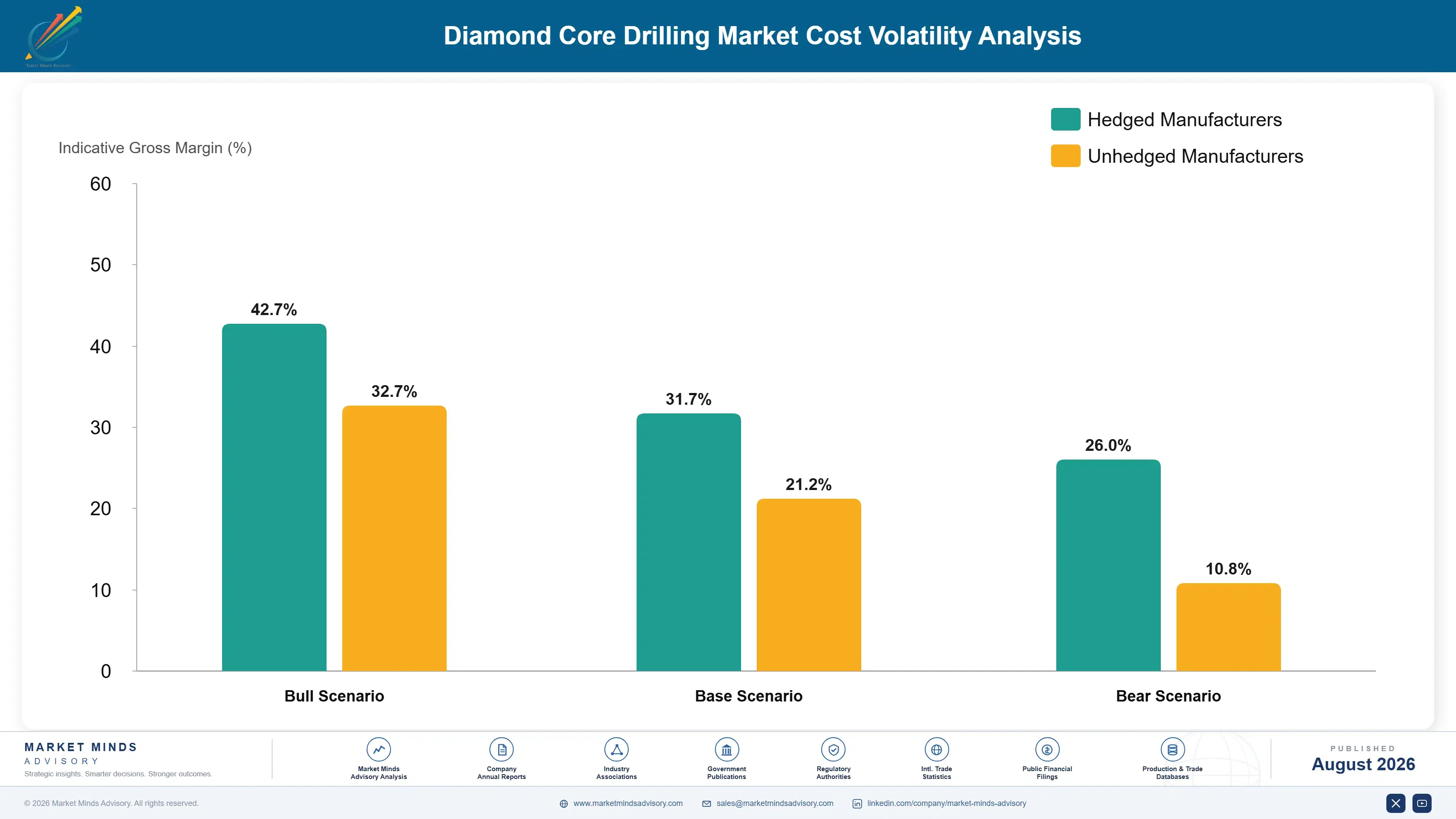
Industrial Diamond and Steel Drill String Costs

Industrial diamond material and steel drill string components together account for roughly 31% of diamond core drilling equipment cost of goods sold, with industrial diamond contributing the larger share on drill bit consumables specifically. Industrial diamond is sourced from a concentrated group of synthetic diamond producers, while precision steel drill string components come from a smaller number of specialized manufacturers concentrated in China and Sweden.
Synthetic industrial diamond prices spiked through 2023 as global demand for precision cutting and grinding applications, driven partly by electronics and semiconductor manufacturing, competed directly with drilling equipment manufacturers for the same specialized diamond supply, according to China MIIT materials tracking data. Manufacturers without long-term supply contracts saw bit costs rise faster than they could pass through to mining company pricing, compressing margins on fixed-price exploration contracts signed before the spike occurred.

Smaller regional manufacturers without hedging arrangements or long-term diamond supply contracts absorb price volatility directly into thin margins, while larger players like Boart Longyear and Epiroc use group-level procurement scale to negotiate forward pricing across multiple product lines simultaneously. Manufacturers without in-house diamond bit production carry additional exposure compared with vertically integrated competitors who capture more of the consumable value chain themselves.
diamond-core-drilling-market-cost-volatility-analysis-1787301616429

Forward Industrial Diamond Purchasing Agreements

Larger manufacturers are locking twelve to eighteen months of synthetic diamond supply through forward agreements directly with producers rather than buying spot, smoothing input cost volatility into predictable production budgeting across major bit product lines. This reduces exposure to spikes like the 2023 electronics-driven surge, though it requires balance-sheet capacity smaller manufacturers typically lack in practice.

In-House Diamond Bit Manufacturing Capability

The largest manufacturers are investing directly in diamond bit production capability rather than relying entirely on third-party consumable suppliers, capturing more of the value chain and reducing exposure to spot-market price swings across the category's highest-margin consumable product lines specifically. This requires sustained capital investment smaller manufacturers cannot easily commit to matching consistently.

Dual-Sourcing Precision Steel Components

Vendors are qualifying second steel drill string suppliers across different countries rather than depending on a single specialized manufacturing source, reducing single-point-of-failure risk after recent regional supply disruptions affected delivery timelines across the industry broadly and unpredictably during peak exploration seasons each field year across most major producing regions worldwide.

Portfolio Architecture for Margin Defence

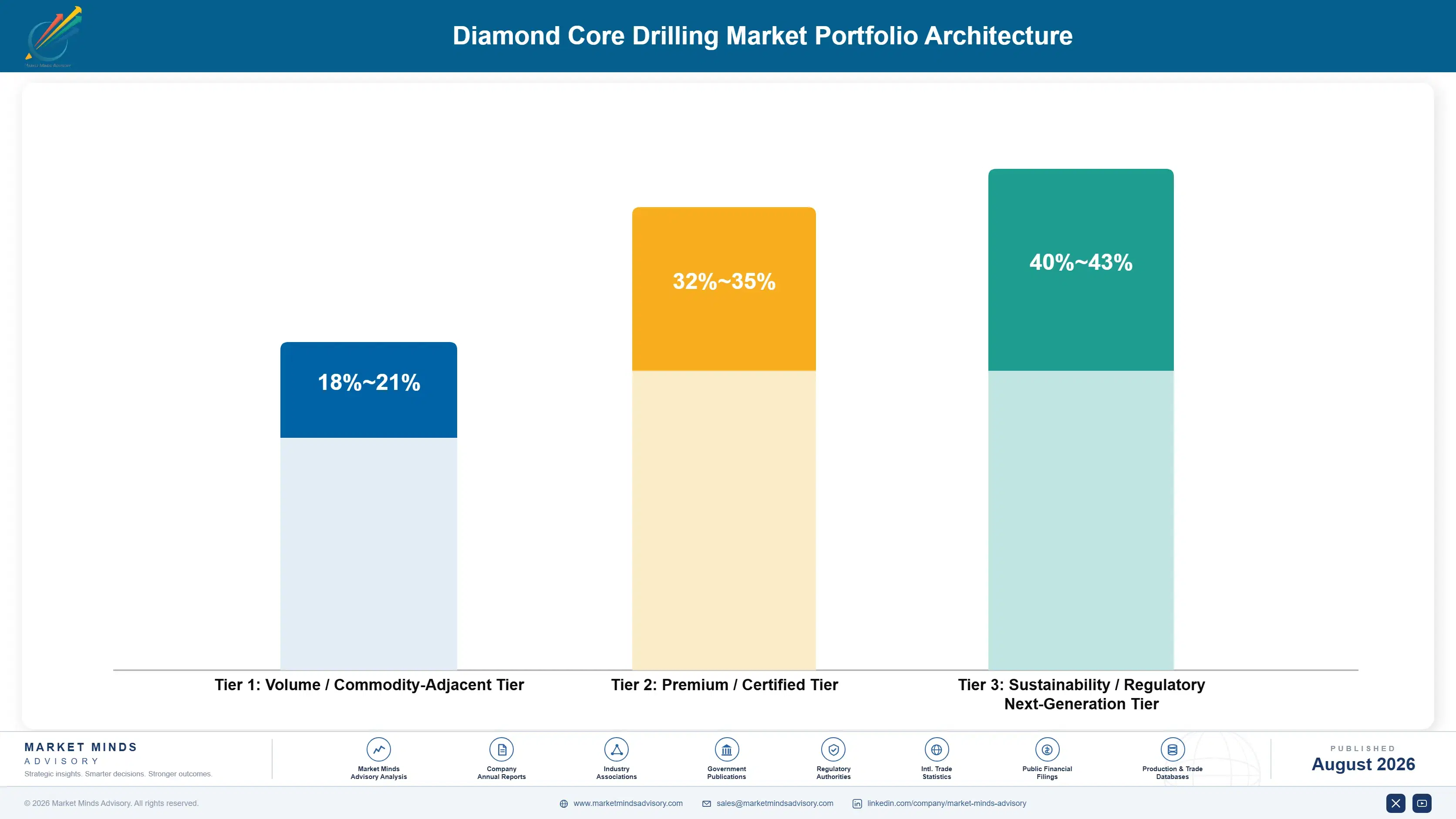
MMA's tier architecture separates the category into three margin bands. Volume and commodity-adjacent construction coring equipment competes on price against regional manufacturers and carries thin margin, premium and certified exploration and wireline rigs carry higher margin on productivity engineering and consumable attachment, and sustainability-linked next-generation lines, including low-impact drilling systems and connected productivity platforms, command the highest margin as the newest t
The tension between volume and premium plays out most visibly in mid-sized junior exploration companies, who want productivity-grade wireline capability at closer to construction-equipment price, and vendors most want to move these buyers up-tier through financing and consumable bundling over time. Construction coring competition remains the most price-sensitive segment and the hardest to convert toward premium exploration-grade equipment and pricing.

High-value margin pools concentrate in exploration fleet orders bundled with consumable supply agreements, productivity software, and long-term maintenance contracts, where service and consumable-attach revenue increasingly outweighs the margin earned on any individual rig sale alone. That shift is pushing vendors to organize sales teams around total account value rather than unit sales.

Volume / Commodity-Adjacent Tier

Basic construction coring equipment sold primarily on price against regional manufacturers, serving cost-sensitive contractors where gross margin stays thin and competition is driven almost entirely by landed unit cost and rental availability.
Gross Margin: 18%-21%

Premium / Certified Tier

Exploration and wireline rigs specified by mining companies requiring documented productivity, consumable supply, and service coverage, commanding meaningfully higher margin on engineering depth and total exploration cost economics achieved reliably.
Gross Margin: 32%-35%

Sustainability / Regulatory / Next-Generation Tier

Low-impact drilling systems and connected productivity platforms positioned for mining companies chasing environmental compliance and data-driven optimization, where software revenue and engineering depth support the category's highest margin overall today.
Gross Margin: 40%-43%
diamond-core-drilling-market-portfolio-architecture-1787301616930

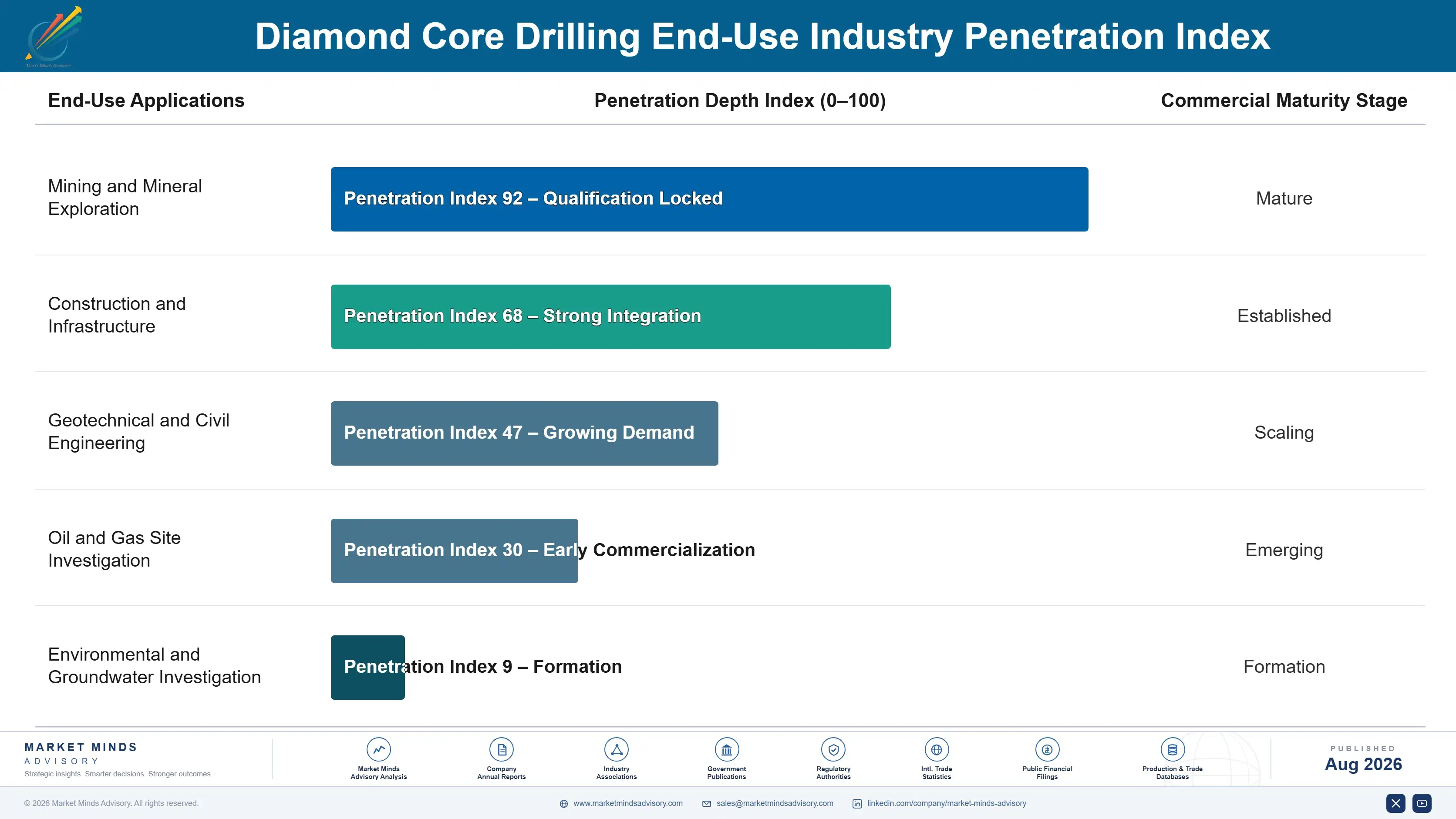
Consumable Attachment and Exploration Cycle Economics

A drilling rig sale is rarely the primary revenue relationship anymore. Diamond bit consumable contracts, productivity software subscriptions, and long-term maintenance agreements convert what used to be a one-time purchase into a recurring relationship running the length of a multi-year exploration program or construction fleet's operating life. Vendors that capture the consumable and service attachment at time of first sale retain far more lifetime value per customer than those competing on ri
Adoption depth varies sharply by buyer type. Large mining companies running multi-rig exploration programs convert fastest and most completely, standardizing entire fleets onto one vendor's productivity platform once a pilot proves out, making them the highest-value account type despite competitive fleet pricing. Junior exploration companies and smaller construction contractors convert more slowly, often relying on rental equipment for years before building direct vendor relationships.

A generational shift in buyers is compounding the productivity-driven shift. Younger exploration geologists and drilling engineers entering the industry increasingly expect data-driven productivity optimization as standard, a purchasing expectation an older generation of drilling supervisors, who managed rigs by experience and instinct, rarely held. That shift is accelerating premium-tier adoption even among mining companies that have not yet run a data-optimized program.
diamond-core-drilling-market-end-use-penetration-index-1787301617425

What Matters Most Through 2036

These are among the four positions where our research anticipates prominent divergence between winners and laggards over the coming forecast period. Each is grounded in the demand model, the regulatory perimeter, and the announced capacity pipeline.
01 / CRITICAL MINERALS ENGINEERING FOCUS

Build dedicated deep exploration rig platforms ahead of demand

Mineral exploration rigs are growing at roughly 1.5 times the category average and remain the segment where deep, precision drilling capability, not basic rig hardware, decides which vendor wins large exploration contracts. Vendors that build dedicated platforms optimized for critical minerals exploration depth requirements will capture disproportionate share as global exploration budgets continue expanding across Australia, Latin America, and Africa simultaneously. Continuing to treat critical minerals exploration as an extension of general mining drilling risks ceding the fastest-growing, most defensible segment to focused competitors already building specialized engineering teams.
02 / CONSUMABLE REVENUE CAPTURE

Bundle diamond bit supply contracts into every rig quote

Diamond bit consumable contracts already generate recurring revenue worth a meaningful share of a rig's total lifetime value, yet many vendors still sell bits as a separate transaction rather than a default part of every quote presented to buyers. Manufacturers that make consumable supply attachment the default, requiring buyers to actively opt out rather than opt in, will capture materially more lifetime value per installed rig than competitors treating consumables as an afterthought sold separately. This remains underexploited by every vendor outside the two largest global players currently active in the category today.
03 / EXPLORATION CYCLE DIVERSIFICATION

Balance exploration exposure with steadier construction revenue

Exploration budget cyclicality has already disrupted order timing for vendors overly concentrated in mining exploration customers, exposing a real revenue volatility risk tied to commodity price swings outside any single manufacturer's control. Vendors that build meaningful construction coring revenue alongside exploration equipment will weather the next commodity downturn better than competitors that bet everything on sustained critical minerals exploration growth continuing uninterrupted for years. This diversification requires sustained investment years before any downturn actually threatens core exploration revenue in a material way.
04 / AUSTRALIA MARKET POSITIONING

Expand Australia service capacity ahead of exploration budget growth

Australia is growing faster than any other large market tracked in this report, yet regional manufacturing and service capacity has not kept pace with the country's expanding critical minerals exploration activity across multiple states simultaneously. Vendors that establish deeper service and assembly capability in Australia now will secure preferred-vendor status with exploration companies before competitors catch up on lead time and field service responsiveness during peak drilling seasons. Waiting for demand to fully materialize before investing risks losing first-mover advantage in the fastest-growing market tracked in this report.

Engagement Snapshot From the Field

A live engagement with an industry participant carrying material or product regulatory and market exposure ahead of a defining policy shift, showing how our research translates into a defensible multi-year portfolio strategy.
MARKET MINDS ADVISORY · CLIENT ENGAGEMENT SUMMARY
Diamond Core Drilling Producer Strategic Portfolio Review and Transition Roadmap 2026·Investment Scenario on Diamond Core Drilling Exposure Evaluation 2025-26
CLIENT PROFILE
The client is a mid-tier lithium exploration company operating across several tenements in Western Australia, relying primarily on rented drilling rigs rather than an owned fleet as exploration activity accelerated faster than anticipated. Facing rising rental costs and rig availability constraints during peak exploration season, leadership needed a fleet ownership versus rental strategy covering a planned capital outlay of roughly $22 million (client-reported, unverified by MMA).
STRATEGIC CHALLENGE
The client's exploration program had scaled faster than its equipment strategy, and continued reliance on rented rigs during peak season exposed the company to availability risk and rising costs just as drilling intensity needed to increase. Leadership needed to decide how many rigs to own outright versus continue renting, balancing capital constraints typical of a mid-tier explorer against the productivity advantages of an owned fleet.
MMA APPROACH
MMA built a fleet economics model comparing ownership, financed purchase, and continued rental scenarios against the client's projected multi-year exploration program intensity and rig utilization forecasts. The analysis drew on MMA's primary survey data and expert interviews with drilling equipment manufacturers and exploration companies to benchmark realistic financing terms and utilization rates achievable for an explorer of this size and program scale.
KEY FINDINGS
  1. Owning a core fleet of three wireline rigs, supplemented by rental capacity during peak season, offered the lowest total cost across the projected three-year exploration program compared with full rental or full ownership.
  2. Financed rig purchases carried meaningfully lower effective cost than continued rental once utilization exceeded roughly sixty percent across a full field season, a threshold the client's program was projected to clear.
  3. Bundled consumable supply agreements negotiated alongside rig financing reduced total drilling cost per meter more than the financing terms alone would have suggested in isolation.
  4. Rig availability risk during peak season, not just cost, drove the final ownership decision once leadership recognized how frequently rental rig shortages had already delayed planned drilling starts.
CLIENT PROFILE
The client is a mid-tier lithium exploration company operating across several tenements in Western Australia, relying primarily on rented drilling rigs rather than an owned fleet as exploration activity accelerated faster than anticipated. Facing rising rental costs and rig availability constraints during peak exploration season, leadership needed a fleet ownership versus rental strategy covering a planned capital outlay of roughly $22 million (client-reported, unverified by MMA).
STRATEGIC CHALLENGE
The client's exploration program had scaled faster than its equipment strategy, and continued reliance on rented rigs during peak season exposed the company to availability risk and rising costs just as drilling intensity needed to increase. Leadership needed to decide how many rigs to own outright versus continue renting, balancing capital constraints typical of a mid-tier explorer against the productivity advantages of an owned fleet.
MMA APPROACH
MMA built a fleet economics model comparing ownership, financed purchase, and continued rental scenarios against the client's projected multi-year exploration program intensity and rig utilization forecasts. The analysis drew on MMA's primary survey data and expert interviews with drilling equipment manufacturers and exploration companies to benchmark realistic financing terms and utilization rates achievable for an explorer of this size and program scale.
KEY FINDINGS
  1. Owning a core fleet of three wireline rigs, supplemented by rental capacity during peak season, offered the lowest total cost across the projected three-year exploration program compared with full rental or full ownership.
  2. Financed rig purchases carried meaningfully lower effective cost than continued rental once utilization exceeded roughly sixty percent across a full field season, a threshold the client's program was projected to clear.
  3. Bundled consumable supply agreements negotiated alongside rig financing reduced total drilling cost per meter more than the financing terms alone would have suggested in isolation.
  4. Rig availability risk during peak season, not just cost, drove the final ownership decision once leadership recognized how frequently rental rig shortages had already delayed planned drilling starts.
RECOMMENDED STRATEGY
Phase 1: Phase 1 (Months 1 to 4): Finance and deploy three core wireline rigs, negotiating bundled consumable supply agreements alongside the equipment purchase. Phase 2: Phase 2 (Months 5 to 18): Supplement the owned fleet with rental capacity during peak exploration season, using ownership economics validated in phase one. Phase 3: Phase 3 (Months 19 to 36): Evaluate further fleet expansion as exploration results justify continued program intensity and capital availability allows.
OUTCOME
The client deployed its owned rig fleet within four months of the engagement, ahead of the original six-month target, and reported meeting its peak-season drilling targets without the rental availability delays that had disrupted the prior field season (client-reported, unverified by MMA). The bundled consumable agreement was subsequently extended to cover the company's full multi-year exploration program.

Frequently Asked Questions

Foundational context covering the market sizes, CAGR, scope, country, region and competition that inform every finding below. This section is provided to cover basics and most often pre-purchase conversations, answered from the MMA Primary Research Dataset.

What is the current size of the Diamond Core Drilling Market?

MMA estimates the global diamond core drilling market at $4.2 billion in 2025. Growth concentrates in Australia, Latin America, and Africa, driven by critical minerals exploration budgets tied to electrification.

How large will the Diamond Core Drilling Market be by 2036?

MMA forecasts the market reaching $8.5 billion by 2036, up from $4.5 billion in 2026. That represents roughly a 1.89 times expansion over the full ten-year forecast period covered.

What is the CAGR for the Diamond Core Drilling Market 2026 to 2036?

MMA's base case forecasts a 6.6% compound annual growth rate, with a bull case of 7.9% and a bear case of 5.3% depending on critical minerals price sustainability.

Which segment is growing fastest?

Mineral exploration core drilling rigs lead at a 9.8% CAGR, roughly 1.5 times the overall market rate, as critical minerals exploration budgets expand faster than any other demand driver tracked.

Who are the major companies in the Diamond Core Drilling Market?

Boart Longyear, Epiroc, Sandvik, Hilti, and Husqvarna Construction Products lead the category, together holding an estimated 29% combined share on a revenue basis worldwide.

Which country is growing fastest?

Australia leads at an estimated 10.2% CAGR, outpacing the global average as critical minerals exploration budgets tied to its established mining sector expand rapidly across multiple states and provinces.

Report Segmentation Architecture

The full report scope spans multiple orthogonal segmentation dimensions, with cross-tabulated demand data provided for each dimension pair. Coverage extends further to regional breakdowns, trend trajectories, and the competitive detail needed to support segment-level decision-making.

By Drilling Application and Rig Configuration

  • Mineral Exploration Core Drilling Rigs
  • Wireline Core Drilling Systems
  • Underground Diamond Drilling Rigs
  • Geotechnical Investigation Drilling Rigs
  • Construction Concrete Coring Equipment
  • Diamond Core Drill Bits and Consumables

By End-Use Industry

  • Mining and Mineral Exploration
  • Construction and Infrastructure
  • Geotechnical and Civil Engineering
  • Oil and Gas Site Investigation
  • Environmental and Groundwater Investigation

By Commercial Dimension

  • Direct Equipment Purchase
  • Rig Financing and Leasing Programs
  • Equipment Rental Channel
  • Distributor and Dealer Channel

By Region

  • North America
  • Western Europe
  • East Asia
  • South Asia and Pacific
  • Latin America
  • Middle East and Africa
  • Eastern Europe

Scope, Methodology, and Coverage

Every figure in this report is reproducible from documented input assumptions. The scope below maps the historical period, the forecast horizon, the segmentation dimensions, and the countries covered, alongside the underlying primary and qualitative methodology.
Historical Period
2020 to 2025
Forecast Period
2026 to 2036
Base Year
2025 (USD billions; MMA Primary Research Dataset, August 2026)
Market Definition
This report covers rigs, drill bits, and consumable tooling used to extract cylindrical rock or concrete core samples for mineral exploration, geotechnical investigation, and construction applications, spanning surface and underground mining rigs, wireline systems, and construction concrete coring equipment. It excludes rotary and percussion drilling equipment that does not extract intact core samples and blasthole production drilling rigs used in active mine production.
Quantitative Units
USD billions (current prices); unit shipment volumes where cited
Segmentation Dimensions
By Drilling Application and Rig Configuration; By End-Use Industry; By Commercial Dimension; By Region
Regions Covered
North America, Western Europe, East Asia, South Asia and Pacific, Latin America, Middle East and Africa, Eastern Europe
Countries Covered
USA, China, Germany, France, UK, Japan, South Korea, India, Australia, Canada, Brazil, Mexico, Indonesia, Vietnam, Thailand, Malaysia, UAE, Saudi Arabia, South Africa, Nigeria, Turkey, Poland, Netherlands, Italy, Spain, Sweden, Switzerland, Argentina, Colombia, Singapore, and additional markets relevant to this sector
Key Companies Profiled
Boart Longyear Group Ltd., Epiroc AB, Sandvik AB, Hilti Corporation, Husqvarna Construction Products, Atlas Copco AB, Major Drilling Group International Inc., Foraco International SA, Diamond Products Company, ICS Blount Inc., Weka Elektrowerkzeuge GmbH, Tyrolit (Swarovski KG), Hycon A/S, Cardi S.p.A., Norton Clipper (Saint-Gobain Abrasives), Drillco Tools SA, Fordia Inc., Rocmec Inc., Geotec s.r.o., Dando Drilling International Ltd.
Quantitative Methodology
Primary survey, n=3,800 respondents, Q4 2025, six countries; demand-side model with trade association cross-validation
Qualitative Methodology
47 expert interviews, Q4 2025; applied to validate demand model assumptions, identify emerging dynamics, and assess competitive positioning
Report Format
PDF and XLSX data workbook (Word format preview document)
Publisher
Market Minds Advisory
Report Code
MMA-2026-CON-106
Published
August 2026
Contact
sales@marketmindsadvisory.com | www.marketmindsadvisory.com

Purchase the full Diamond Core Drilling Market Report (2026 to 2036).

The full report provides detailed market sizing and ten-year forecasts for the global diamond core drilling market, broken out across all seven regions and six application segments covered in this summary. It includes complete profiles of the top twenty manufacturers, including capacity, distribution footprint, and recent corporate developments, along with a detailed input-cost and exploration-cycle economics model calibrated to primary survey data. Buyers receive a full regional data workbook, segment-level forecast tables through 2036, and a competitive benchmarking matrix built on the same commercially consistent basis used throughout this summary. A dedicated chapter tracks critical minerals exploration budget trends across major mining jurisdictions.
Full regional data workbook across all seven regions
Twenty-vendor competitive profiles with capacity benchmarking
Segment-level forecast tables through 2036 by application type
Critical minerals exploration budget tracking chapter
Input-cost and diamond material pricing sensitivity model
Access to MMA analyst inquiry for three months

Built For The People Who Decide

From boardroom strategy to bench-side execution, this report is read cover-to-cover by leaders shaping the next decade of their industry, turning demand scenarios, market dynamics and valuation benchmarks into decisions.
CXOs/ Presidents/ VPs/ Managers
M&A and Corporate Development
Strategy Teams and R&D Heads
Procurement and Product Directors
Regulatory and Compliance Leaders
Investor Relations and Equity Analysts