Market Minds Advisory
Dialysis Device and Concentrates Market

Dialysis Device and Concentrates Market: From Dialysis Center to Home Treatment

Dialysis device demand is shifting from center-based hemodialysis toward home and portable systems, as chronic kidney disease prevalence rises alongside payer reimbursement policies that increasingly favor lower-cost home treatment modalities.

Lead Analyst

Alice Ballenger

Published

September 2026

Make Smarter Decisions with Customized Research Insights

Request a free sample report and evaluate market opportunities, growth trends, and competitive dynamics relevant to your business needs.

2025 MARKET VALUE$16.5BMarket Size 2025
2036 FORECAST VALUE$34.0BBase Case , 2026 to 2036
CAGR 2026 TO 20366.8 %Bull 8.1% / Bear 5.5%
INCREMENTAL OPPORTUNITY$16.4BNet 10- year value creation
EXPANSION MULTIPLE1.93x2036 value over 2026 base
Strategic Levers
M&A Pipeline
Regional Outlook
Country Rankings
Competitive Intelligence
Segmental Deep-dive
Call-Us : 91 93563 13602

Executive Snapshot and Market Trajectory

Dialysis device purchasing increasingly reflects a shift toward home-based treatment modalities, where portable hemodialysis systems and peritoneal dialysis compete directly against traditional center-based care on cost and patient quality of life grounds across most reimbursement systems tracked today throughout the industry, region, and beyond current expectations set previously.
Rising chronic kidney disease and diabetes prevalence expanding the global end-stage renal disease patient population, payer reimbursement policies increasingly favoring home dialysis modalities over center-based treatment, and rapid growth in portable and wearable dialysis technology are together concentrating demand upside in two clear directions: East Asian markets where patient volume growth outpaces most other regions, and home hemodialysis systems that reduce total cost of care while improving patient independence and quality of life.
Fresenius Medical Care, Baxter International, and B. Braun Melsungen lead a highly concentrated field where integrated device and concentrates manufacturing capability is becoming as commercially decisive as core machine reliability, while smaller specialty vendors compete primarily on portable and home-focused innovation targeting patients seeking greater treatment flexibility outside traditional dialysis center settings currently expanding rapidly across most emerging healthcare markets tracked by MMA analysts closely.
Market Definition
The dialysis device and concentrates market covers hemodialysis and peritoneal dialysis machines, dialyzers, bloodline sets, and acid and bicarbonate concentrates used in chronic kidney failure treatment. Water treatment systems sold independently of dialysis center infrastructure and unrelated blood filtration technologies are excluded.
Base Year Value
$16.5B in 2025 (MMA Primary Research Dataset, August 2026)
Forecast Period
2026 to 2036, eleven discrete annual values
CAGR
6.8% base case. Bull 8.1%. Bear 5.5%.
Fastest Growth Segment
Home Hemodialysis Systems: 11.5% CAGR
Fastest Growth Country
China: 7.8% CAGR
Fastest Growth Region
South Asia and Pacific: 8.8% CAGR
Largest Region
East Asia: 29% of 2025 global value
Market Leaders
Fresenius Medical Care, Baxter International, B. Braun Melsungen, Nipro Corporation, Nikkiso Co. Source: MMA Analysis, July 2026.
Primary Survey
n=3,800 procurement and R&D decision-makers, Q4 2025, six countries
Methodology
Demand-side build-up, cross-validated against public data, 47 expert interviews

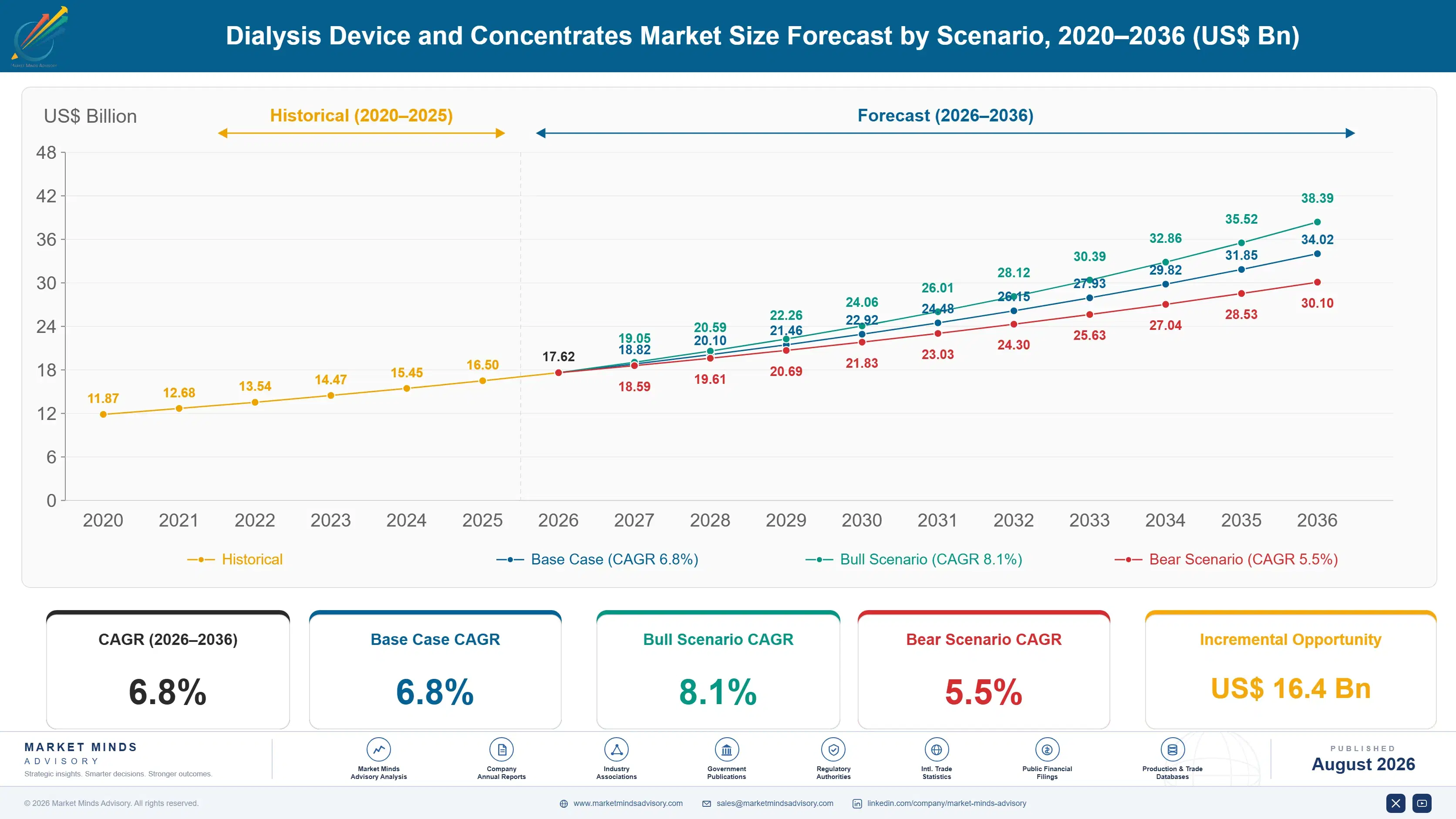
Dialysis Device and Concentrates Market Forecast Scenarios

dialysis-device-and-concentrates-market-size-forecast-scenario-1787304972793
Dialysis device demand grew steadily between 2020 and 2025, with rising chronic kidney disease prevalence tied to global diabetes and hypertension trends sustaining consistent patient population growth throughout the historical period. Pandemic-related disruption temporarily slowed elective procedure volume affecting some device categories, though dialysis treatment itself remained a protected essential service, limiting disruption compared to most other medical device categories tracked closely.
The base case assumes 6.8 percent annual growth through 2036, anchored on three commercial mechanisms: rising chronic kidney disease and diabetes prevalence expanding the global end-stage renal disease patient population requiring ongoing dialysis treatment, payer reimbursement policies increasingly favoring home dialysis modalities that reduce total cost of care compared to center-based treatment, and steady replacement of aging center-based hemodialysis machines as water treatment and safety standards continue tightening across most developed and emerging healthcare markets alike.
The bull case centers on faster-than-expected home dialysis reimbursement expansion pulling forward patient conversion away from center-based treatment at scale. The bear case flags dialysis center capital budget constraints and slower kidney transplant waitlist reduction, which could limit patient population growth in some developed markets and leave device replacement cycles running longer than currently planned across established dialysis center networks.

From Dialysis Center to Living Room

Dialysis device competition increasingly centers on treatment modality rather than pure machine performance, as payers and patients alike push toward home-based hemodialysis and peritoneal dialysis that reduce total cost of care compared to traditional center-based treatment. Manufacturers with integrated device, consumables, and concentrates portfolios hold a considerable advantage, since dialysis treatment requires ongoing consumables purchasing that generates recurring revenue far exceeding t
MARKET CONCENTRATIONCR5 68%Top five manufacturers control roughly two thirds of unit sales
AVERAGE SELLING PRICEUSD 24,500Blended average price across hemodialysis and peritoneal system tiers
TOP PRODUCING COUNTRY SHARE32%Share of global patient population concentrated in leading country
ANNUAL MACHINE REPLACEMENT RATE9%Average annual machine replacement rate across accredited dialysis centers
TRADE INTENSITY41%Portion of concentrates trade crossing borders versus locally produced
INPUT COST SHARE53%Consumables and concentrates costs as share of total treatment cost
Reimbursement policy varies sharply by geography and shapes modality mix considerably across markets. Countries that have expanded home dialysis reimbursement parity with center-based treatment have seen home modality adoption accelerate meaningfully within several years, while jurisdictions still favoring center-based reimbursement rates show markedly slower home dialysis penetration despite comparable device availability and patient interest in home treatment options.
Rising diabetes and hypertension prevalence globally continues expanding the end-stage renal disease patient population requiring ongoing dialysis treatment, sustaining a decade-long increase in device and concentrates demand regardless of near-term economic conditions across most markets tracked. Water treatment and dialysis safety standards continue tightening across most developed markets, driving steady replacement demand for aging center-based machines even in markets with otherwise stable patient population growth.
"The machine that wins a hospital tender and the machine a patient chooses to keep in their bedroom are becoming two different products entirely, and most vendors still only build one of them well."
Director, Renal Care and Medical Devices Practice · MMA Medical Devices / Renal

Market Trends

Home Dialysis Reimbursement Parity Accelerates Modality Shift

Several major healthcare systems have expanded reimbursement parity between home and center-based dialysis in recent years, removing a longstanding financial disincentive that historically pushed patients toward center-based treatment regardless of clinical suitability or personal preference. This policy shift has accelerated home hemodialysis and peritoneal dialysis adoption meaningfully in markets where it has taken effect, with several national health systems publishing explicit targets for home modality patient share within the next five years. Device manufacturers are responding with expanded home-focused product development investment, recognizing that reimbursement policy increasingly determines addressable market size more than pure technology capability alone.
Market Impact: Diabetes causes over 40% of cases
Portable and Wearable Dialysis Technology Advances

Portable and wearable dialysis device development has accelerated meaningfully, with several manufacturers advancing miniaturized continuous dialysis technology toward regulatory clearance targeting patients seeking greater treatment flexibility beyond traditional scheduled sessions and center visits. Early clinical trial results suggest meaningful patient quality of life improvement compared to conventional intermittent treatment schedules, though widespread commercial availability remains several years away for most wearable platforms currently in development. This technology trajectory is reshaping how established device majors think about long-term product roadmap investment, pulling research and development spending increasingly toward continuous and ambulatory treatment modalities.
Market Impact: Screening programs target ages 60 p

Market Opportunities and Growth Drivers

Diabetes Prevalence Expands End-Stage Renal Disease Population

Global diabetes prevalence continues rising steadily across most regions, and diabetic nephropathy remains the leading cause of chronic kidney failure requiring dialysis treatment in most developed and emerging healthcare markets. This demographic trend translates directly into expanding dialysis patient population growth that runs largely independent of broader economic cycles, since dialysis treatment represents medically necessary care rather than discretionary healthcare spending. Health systems across most countries are expanding dialysis center capacity and home treatment program funding specifically to accommodate this steadily growing patient population, sustaining consistent device and concentrates demand growth.
Market Impact: Training programs run 6 to 8

Aging Population Increases Chronic Kidney Disease Incidence

Population aging across most developed economies is increasing chronic kidney disease incidence directly, since kidney function naturally declines with age and older patients face compounding risk factors including hypertension and cardiovascular disease. National health systems in several countries have expanded kidney disease screening programs targeting older populations, identifying patients earlier and directing more of them toward dialysis treatment before acute kidney failure emergencies occur. This trend sustains steady patient population growth even in markets where diabetes prevalence has begun stabilizing, broadening the demand base beyond any single underlying disease driver alone.
Market Impact: Machines often run 12 plus years

Market Restraints and Challenges

Home Dialysis Training Burden Limits Patient Conversion

Home hemodialysis and peritoneal dialysis require meaningful patient and caregiver training before independent treatment can begin safely, a burden rooted in the genuine clinical complexity of self-administered dialysis compared to supervised center-based treatment. This training requirement slows patient conversion from center-based to home modalities even where reimbursement and device availability support the transition, since not every patient or caregiver has the capacity or willingness to complete required training programs. Manufacturers and dialysis providers are mitigating this restraint through simplified device interfaces and expanded remote monitoring support that reduces the clinical complexity patients must manage independently at home.
Market Impact: Covers over 60% of major markets

Dialysis Center Capital Budget Constraints Slow Replacement

Many dialysis center operators, particularly smaller independent facilities, face genuine capital budget constraints rooted in reimbursement rate pressure and competing facility investment priorities beyond machine replacement alone across most facility types nationwide. This restraint keeps some facilities operating aging hemodialysis machines well past their intended replacement timeline, creating water treatment compliance risk during regulatory inspections. Manufacturers are mitigating this barrier through equipment leasing and subscription-based financing models that spread capital outlay over multiple budget cycles rather than requiring full upfront machine replacement investment across an entire facility simultaneously and permanently.
Market Impact: Early trials show 25% improvement
4 additional market trends, 4 additional growth drivers, and 4 additional restraints and challenges are covered in the full report. Contact sales@marketmindsadvisory.com to access the complete intelligence.

Segment CAGR and Growth Architecture

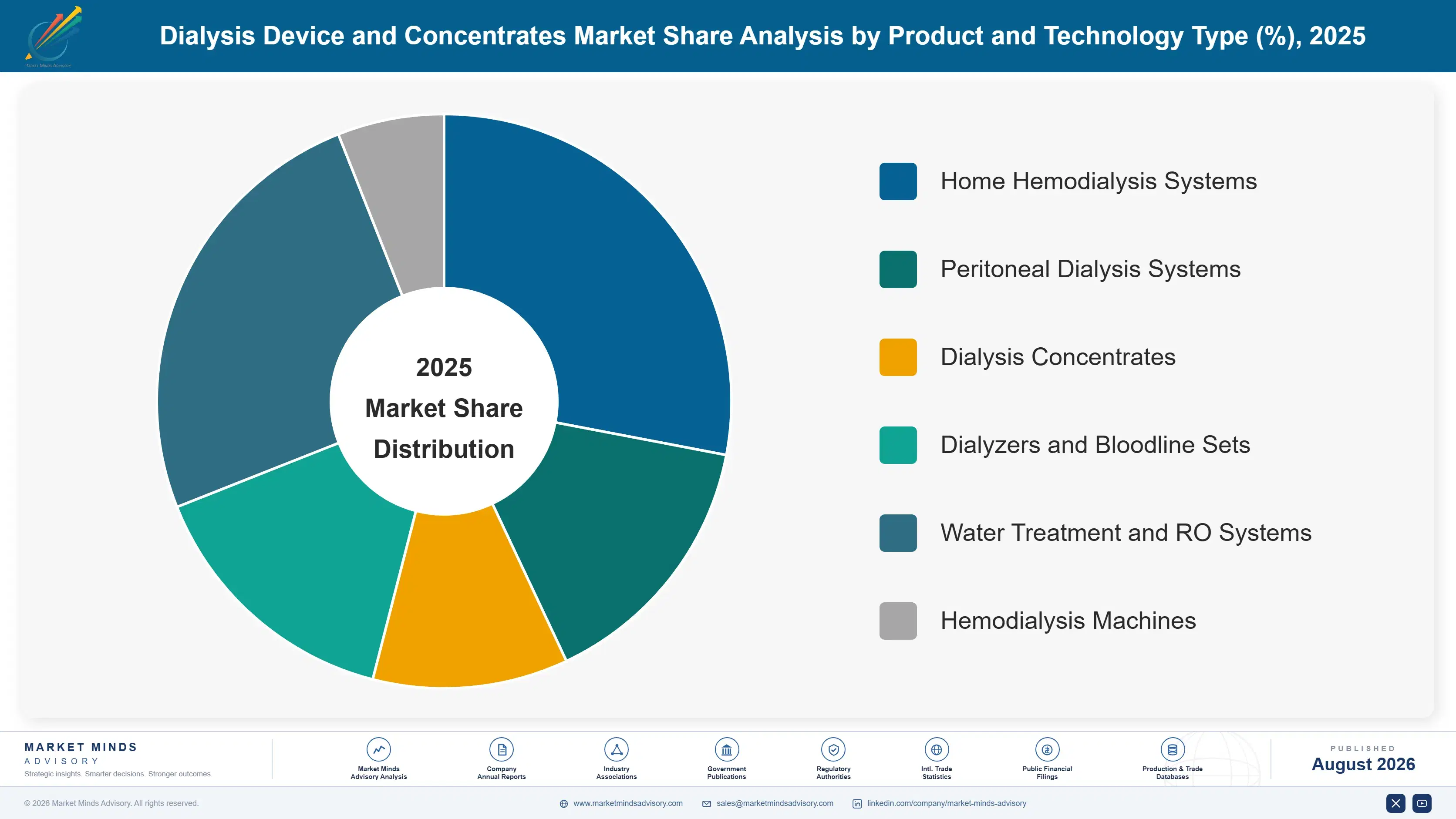
Dialysis device and concentrates segments by product and technology type across six categories spanning machines, consumables, and treatment infrastructure used across most healthcare systems. Home hemodialysis systems and peritoneal dialysis systems are the two fastest-growing categories tracked, both expanding well ahead of the broader market as reimbursement policy and patient preference shift decisively toward home-based treatment.
dialysis-device-and-concentrates-market-market-share-analysis-1787304973680

Home Hemodialysis Systems

Home hemodialysis systems, which enable patients to perform dialysis treatment independently at home rather than at a dedicated dialysis center, are converting the fastest share of new patient starts as reimbursement parity expands and manufacturers simplify device interfaces for non-clinical operators across most participating markets. These systems reduce total cost of care meaningfully compared to center-based treatment while improving patient quality of life and treatment schedule flexibility considerably. Payers across several major markets have published explicit home dialysis adoption targets, creating sustained policy tailwind that is reshaping how device manufacturers structure long-term product development investment and training program infrastructure to support growing patient conversion volume across most developed healthcare systems.
CAGR 11.5%

Peritoneal Dialysis Systems

Peritoneal dialysis systems, which use the patient own peritoneal membrane as a natural filter rather than requiring vascular access and external blood filtration, are expanding rapidly as a lower-cost, more accessible home dialysis modality suited to markets with limited dialysis center infrastructure across most emerging healthcare systems, provinces, districts, and municipalities. Growth here tracks patient population expansion in emerging markets particularly strongly, since peritoneal dialysis requires considerably less specialized infrastructure investment than hemodialysis center buildout. This category benefits directly from simplified automated cycler technology, lowering the training burden while improving treatment consistency and giving healthcare systems a genuinely more cost-effective pathway to expanding dialysis access in underserved regions and communities.
CAGR 8.8%
Full segment breakdown across 6 segments available in the complete report.

Regional Architecture and Country Demand Map

Dialysis device demand concentrates most heavily in East Asia, where China rapidly expanding end-stage renal disease patient population outpaces most other regions on a patient volume basis. North America follows closely on value, while South Asia and Pacific markets post the fastest regional growth off a smaller installed base.

North America

North America follows East Asia closely in absolute revenue terms, supported by comprehensive government-funded dialysis reimbursement coverage that sustains a large and stable patient population across accredited dialysis centers nationwide and across every state, territory, region, province, and local community. The United States accounts for the large majority of regional volume, with home dialysis reimbursement parity increasingly determining manufacturer product strategy among established device majors serving diverse patient populations. Canada contributes a smaller but steadily growing share tied to comparable provincial health system coverage. Dialysis center capital budget cycles affect North American purchasing decisions considerably, since reimbursement rate pressure has intensified competition among independent and larger chain dialysis providers nationwide.
Share: 27% | CAGR: 7.3% (2026 to 2036)

Western Europe

Western Europe generates a meaningful share of global revenue, anchored by Germany, France, and the United Kingdom, where national health system dialysis programs fund equipment upgrades on multi-year capital cycles and coordinated procurement schedules across most participating regions and health authorities. Home dialysis adoption varies considerably across member states depending on national reimbursement structure, with several countries actively expanding home modality coverage to reduce overall dialysis program cost. Germany maintains the largest installed base of dialysis center capacity in the region, reflecting its dense hospital and outpatient center network. Growth trails East Asia and South Asia as the patient population matures, though public health system investment sustains steady replacement demand.
Share: 20% | CAGR: 5.3% (2026 to 2036)
Regional intelligence for 5 additional markets available in the complete report: East Asia, South Asia and Pacific, Latin America, Middle East and Africa, Eastern Europe. Contact sales@marketmindsadvisory.com.
dialysis-device-and-concentrates-market-country-cagr-analysis-1787304974632

Home Modality Expansion and Consumables Growth

Dialysis device and concentrates vendors are pursuing several distinct paths to grow revenue beyond initial machine sale as the category shifts steadily toward home treatment and recurring consumables demand. Four levers stand out as commercially significant across the forecast period, spanning home modality expansion, concentrates supply agreements, equipment financing structures, and remote monitoring service growth.

Home Modality Conversion Program Investment Strategy

Manufacturers investing directly in patient training infrastructure and simplified home device interfaces are capturing disproportionate share of new home dialysis patient starts as reimbursement parity expands across major markets. Vendors with dedicated home modality conversion programs report patient conversion rates approaching 35 percent among eligible center-based patients within two years of program launch, a figure considerably above industry average conversion timelines. This investment requires meaningful upfront training infrastructure cost but generates durable long-term consumables revenue as converted patients typically remain on home therapy for years, creating a considerably more predictable revenue relationship than single machine sale transactions alone.
Market Impact: Home modality conversion programs n

Long-Term Concentrates Supply Agreement Structuring Strategy

Vendors negotiating long-term concentrates supply agreements directly with dialysis center chains, rather than competing for spot purchase orders repeatedly, are securing predictable recurring revenue that generates margin considerably above device hardware sales alone. These structured agreements, now covering an estimated 45 percent of major dialysis chain concentrates volume, lock in pricing and delivery commitments across multi-year terms that reduce both vendor and customer exposure to short-term price volatility. This lever matters most for vendors with integrated device and concentrates manufacturing capability able to bundle machine placement with guaranteed consumables supply relationships.
Market Impact: Supply agreements now cover 45 perc

Equipment Leasing and Subscription Financing Structures

Vendors offering equipment leasing and subscription-based financing structures are opening purchasing decisions to smaller independent dialysis center operators that lack capital budget for outright hemodialysis machine fleet replacement across their facilities. Vendors offering per-treatment subscription pricing report win rates roughly 20 percent higher among independent operators compared to standard upfront capital sale terms. This lever matters most in price-sensitive segments including smaller independent dialysis chains and emerging market operators, where operating budget flexibility often exceeds available capital budget by a considerable margin, making financing structure the deciding factor in many purchasing decisions.
Market Impact: Leasing win rates rise 20% among in

Remote Monitoring and Predictive Maintenance Services

Vendors offering remote monitoring and predictive maintenance service contracts, which flag failing machine components before they cause unplanned treatment disruption, are capturing meaningful service revenue beyond core hardware and consumables sales across their installed base. Leading vendors now attach remote monitoring contracts to more than 50 percent of new machine placements, strengthening customer retention at contract renewal while reducing costly emergency service visits. This lever matters most in premium dialysis center accounts where treatment disruption carries direct clinical and financial consequences for both providers and patients relying on scheduled treatment continuity.
Market Impact: Remote monitoring now attaches to o

Who Controls the Margin Pool

Dialysis device and concentrates carries a CR5 near sixty-eight percent, reflecting a highly concentrated category where integrated device and consumables manufacturing capability creates considerable barriers for smaller entrants. The gap between Fresenius Medical Care, the largest single vendor, and the next tier of challengers is substantial, since installed base scale and concentrates supply relationships compound advantages considerably.
Current competitive activity plays out across three dimensions: home modality product development races among established vendors seeking to defend patient conversion share, portable and wearable technology investment targeting patients seeking greater treatment flexibility, and consolidation among smaller regional concentrates manufacturers lacking capital to compete on integrated device and consumables offerings. Larger vendors are also pursuing selective acquisitions of home dialysis technology specialists.

Emerging pressure comes from specialty portable dialysis technology firms developing wearable and continuous treatment devices that could eventually bypass traditional center-based infrastructure entirely, and from regional Asian manufacturers expanding concentrates production capacity at costs established multinational vendors increasingly struggle to match. Rankings could shift meaningfully if home modality adoption speed diverges significantly between leaders, particularly as payers increasingly favor vendors demonstrating the clearest path to total cost of care reduction across their broader treatment portfolio.
dialysis-device-and-concentrates-market-company-positioning-matrix-1787304975519

Competitive Moat and Risk Dimensions

FRESENIUS MEDICAL CARE

Moat: Integrated Device and Consumables Manufacturing

Fresenius Medical Care operates the broadest integrated dialysis device, dialyzer, and concentrates manufacturing footprint among all vendors tracked, generating recurring consumables revenue tied directly to its own installed machine base. This vertical integration gives Fresenius considerably more predictable cash flow than competitors dependent primarily on machine hardware sales, while also supporting tighter quality control across the full treatment supply chain.
FRESENIUS MEDICAL CARE

Risk: Dual Provider and Vendor Conflict

Fresenius operates both as a dialysis device manufacturer and as one of the largest dialysis center operators globally, creating potential channel conflict when competing dialysis chains evaluate whether to purchase equipment from a company that also competes with them for patients. This dual role could limit equipment sales growth among independent competing chains wary of strengthening a direct competitor.
BAXTER INTERNATIONAL

Moat: Peritoneal Dialysis Market Leadership

Baxter International holds the strongest global position in peritoneal dialysis systems and consumables among all vendors tracked, a category benefiting disproportionately from home modality reimbursement expansion and emerging market infrastructure buildout. This leadership position gives Baxter considerable advantage as peritoneal dialysis growth outpaces the broader hemodialysis category across most emerging healthcare markets.
BAXTER INTERNATIONAL

Risk: Hemodialysis Segment Competitive Gap

Baxter maintains a comparatively smaller hemodialysis machine and concentrates position relative to Fresenius Medical Care, limiting its ability to capture recurring consumables revenue tied to the larger center-based hemodialysis patient population that still represents the majority of global dialysis treatment volume today. Closing this gap would require substantial capital investment in manufacturing and distribution capacity.

Players Tracked

Prominent Players

Fresenius Medical Care
Baxter International
B. Braun Melsungen
Nipro Corporation
Nikkiso Co.

Other Key Players

Asahi Kasei Medical
Toray Medical
JMS Co.
Rockwell Medical
NxStage Medical
Outset Medical
Quanta Dialysis Technologies
Medivators
Terumo
Medica S.p.A.
Diaverum
Physidia
Sichuan Nigale Biomedical
Allmed Medical
Weigao Group

Recent Developments

MAY 2025

Fresenius Medical Care Launches Simplified Home Hemodialysis System

Fresenius Medical Care launched a new home hemodialysis system with simplified touchscreen controls and integrated remote monitoring, designed to reduce the training burden for patients transitioning from center-based treatment. The system connects directly to clinical support teams for real-time treatment monitoring, addressing safety concerns that have historically slowed adoption.
Signal: Signals accelerating vendor investment in
OCTOBER 2024

Baxter International Signs Multi-Year Concentrates Supply Agreement With Dialysis Chain

Baxter International signed a multi-year concentrates supply agreement with a large regional dialysis center chain covering acid and bicarbonate concentrates across sixty facilities, replacing a fragmented multi-vendor procurement arrangement with standardized supply terms. The agreement includes pricing stability provisions through 2028 and coordinated delivery logistics across the entire facility network.
Signal: Signals growing dialysis chain preference
JANUARY 2025

B. Braun Melsungen Acquires Portable Dialysis Technology Startup

B. Braun Melsungen completed the acquisition of a portable dialysis technology startup developing miniaturized continuous treatment devices, adding wearable dialysis research capability that strengthens its long-term home and ambulatory treatment product roadmap. The acquisition accelerates B. Braun internal portable technology development timeline, reducing dependence on external licensing partnerships.
Signal: Signals continued industry consolidation a

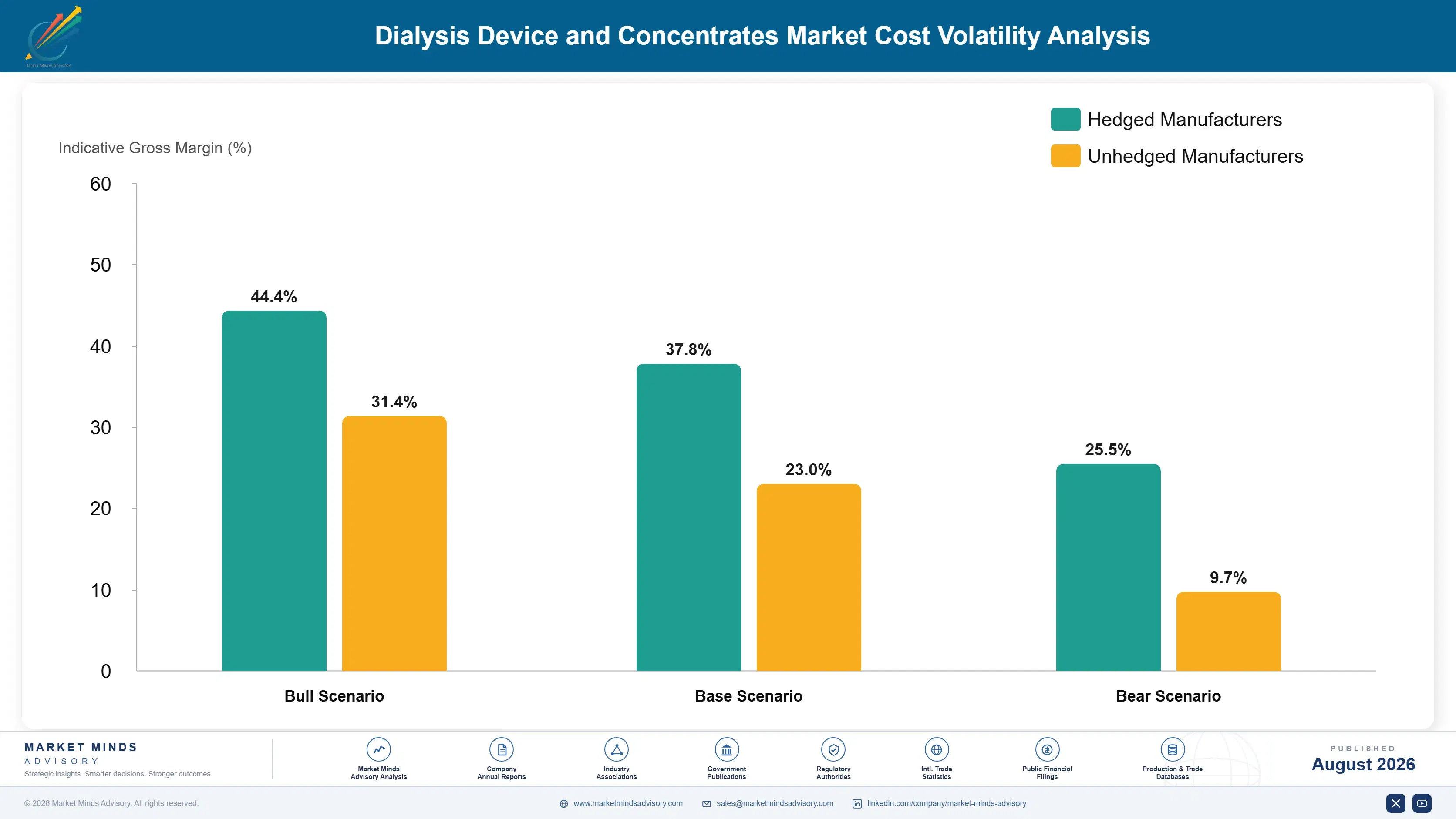
Concentrates Raw Material and Resin Cost

Acid and bicarbonate concentrates raw materials, along with polysulfone and cellulosic dialyzer membrane resins, together represent roughly fifty to fifty-five percent of dialysis device and concentrates cost of goods sold overall. These inputs derive from specialty chemical and petrochemical feedstocks sourced from a moderately concentrated global supplier base spanning North America, Europe, and East Asia.
Specialty resin and chemical feedstock prices rose meaningfully during 2021 and 2022 amid broader petrochemical supply disruption and rising energy costs affecting chemical manufacturers globally alongside many other industrial categories. Several vendors disclosed in annual reports that concentrates raw material cost inflation compressed margin during this period, prompting some manufacturers toward alternative supplier qualification and longer-term feedstock agreements to stabilize costs through 2023 and into 2024.

Cost exposure varies by vendor manufacturing model and integration depth. Vertically integrated vendors with in-house concentrates production absorb raw material volatility more easily than smaller competitors purchasing concentrates entirely from third-party chemical suppliers on shorter-term contracts. Geographic exposure also differs: vendors sourcing dialyzer membrane resin primarily from East Asian chemical manufacturers face different cost and logistics patterns than those relying on North American or European specialty chemical production.
dialysis-device-and-concentrates-market-cost-volatility-analysis-1787304975818

Dual-Source Chemical Supplier Qualification

Vendors are qualifying second suppliers for specialty resins and concentrates raw materials to reduce dependence on any single chemical manufacturer during periods of supply tightness affecting the broader industry and category. This lengthens initial qualification cycles but meaningfully reduces exposure to regional supply disruption, giving procurement teams greater negotiating leverage on pricing during tight supply conditions.

Vertical Integration Into Concentrates Manufacturing

Several major vendors have expanded in-house concentrates manufacturing capacity to capture margin previously paid to third-party chemical suppliers while gaining tighter control over raw material quality and delivery timing across their facility networks and regions. This shift requires substantial upfront capital investment but reduces exposure to external supplier cost volatility over multi-year manufacturing cycles ahead.

Long-Term Feedstock Supply Agreements

Vendors are negotiating longer-term feedstock supply agreements with specialty chemical manufacturers, locking in pricing and delivery commitments rather than relying on shorter-term spot purchasing arrangements across most sourcing categories and territories. This reduces margin volatility during periods of raw material cost inflation and gives finance teams clearer forward visibility into concentrates manufacturing cost trajectory across upcoming quarters.

Portfolio Architecture for Margin Defence

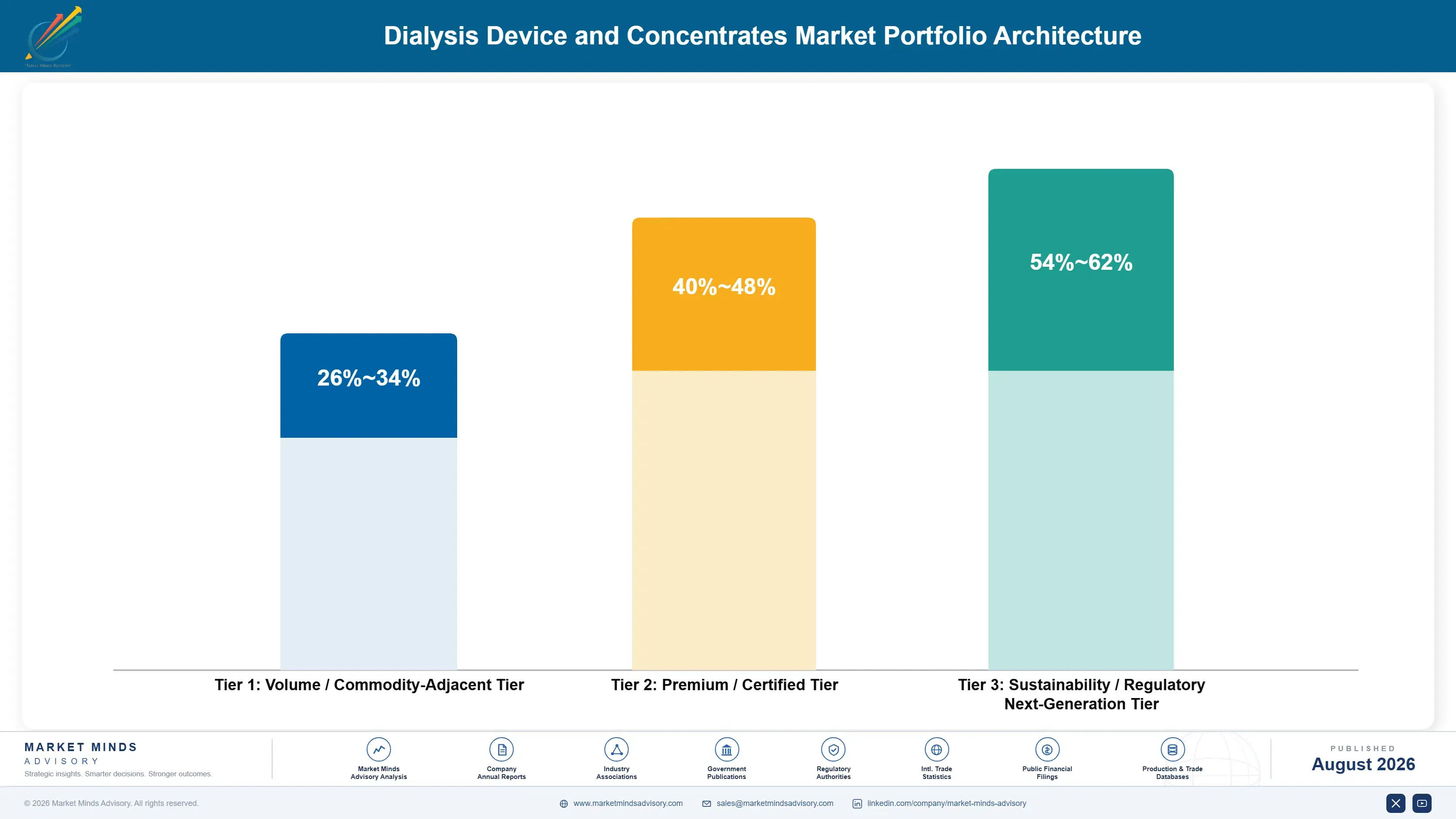
Dialysis device and concentrates portfolios span three margin tiers running from commodity-adjacent center-based hemodialysis machines through certified home dialysis systems to sustainability-linked next-generation portable and wearable treatment platforms. Gross margin widens considerably moving up the tier structure, driven primarily by consumables attach and home modality training service depth rather than machine hardware differences alone across most vendor product lines and accounts.
Volume tier competition centers on price and basic machine reliability for cost-constrained dialysis center operators, where core treatment performance and concentrates compatibility determine competitiveness more than home modality sophistication or portable technology depth. Premium tier competition instead centers on home dialysis training infrastructure, remote monitoring capability, and portable technology development, an entirely different buying calculus that rewards vendors with dedicated patient support capability built over many years.

High-value margin pools concentrate overwhelmingly in the premium and next-generation tiers, where home modality consumables and remote monitoring services generate recurring revenue well above any one-time machine sale transaction alone across the full treatment lifecycle. Vendors increasingly steer product development and sales incentive structures toward this upper tier as volume-tier margin continues compressing under sustained reimbursement rate pressure and intensifying price competition from lower-cost regional manufacturers.

Volume / Commodity-Adjacent Tier

Standard center-based hemodialysis machines and basic concentrates targeting cost-constrained dialysis center operators where core treatment reliability matters more than advanced home modality features or portable treatment technology capability across most facility types.
Gross Margin: 26%-34%

Premium / Certified Tier

Home hemodialysis and peritoneal dialysis systems with simplified interfaces and remote monitoring, typically sold with comprehensive patient training programs and consumables contracts to health systems expanding home modality reimbursement coverage.
Gross Margin: 40%-48%

Sustainability / Regulatory / Next-Generation Tier

Portable and wearable continuous dialysis platforms targeting leading academic medical centers and health systems piloting next-generation ambulatory treatment technology ahead of broader regulatory clearance and industry-wide commercial adoption timelines currently underway.
Gross Margin: 54%-62%
dialysis-device-and-concentrates-market-portfolio-architecture-1787304976653

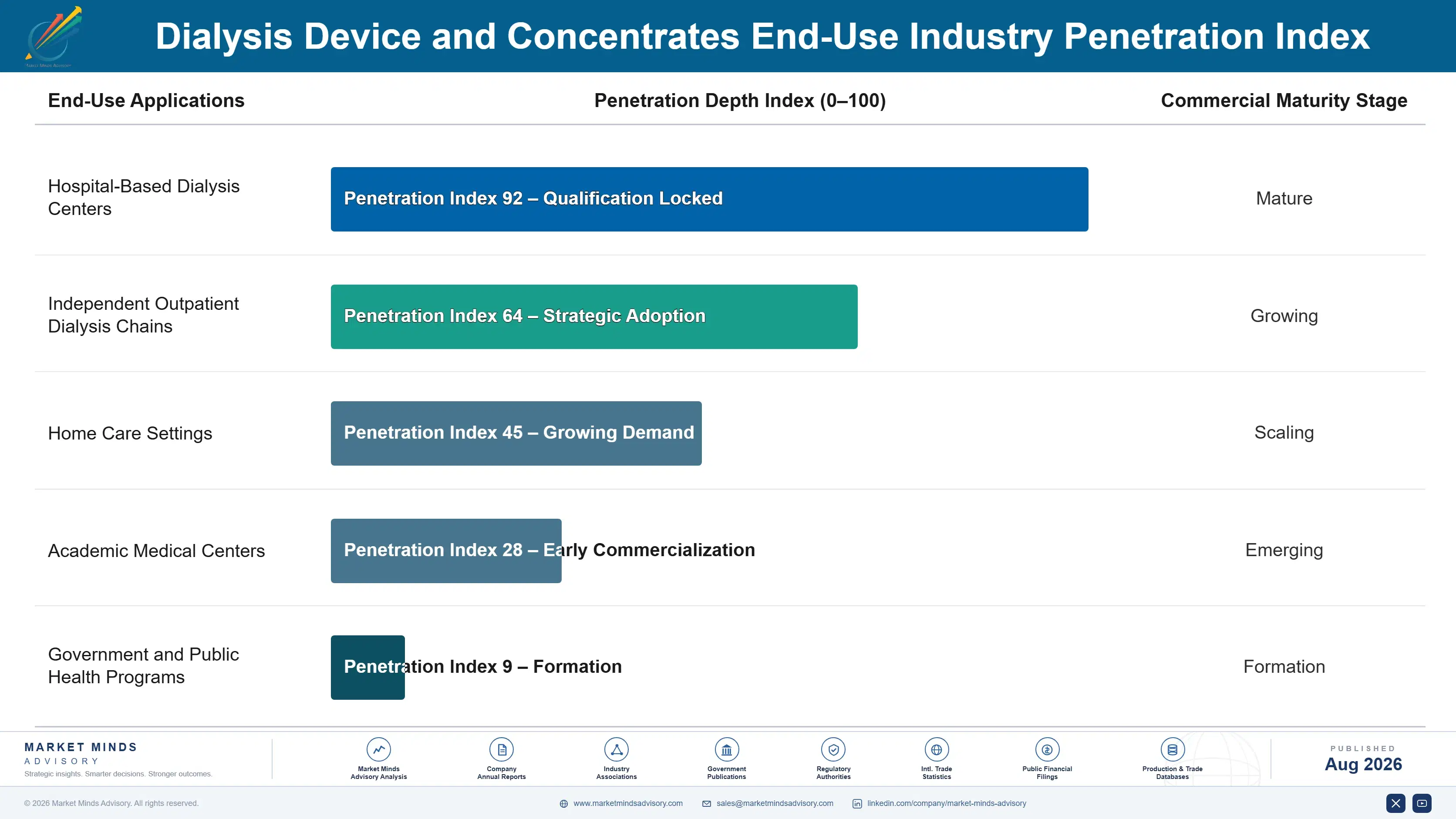
Lifetime Treatment Relationships and Modality Loyalty

Dialysis device demand carries genuine annuity characteristics through consumables and concentrates purchasing that continues for the duration of a patient life on dialysis, often spanning many years or even decades, meaning vendors capture far more value from ongoing treatment relationships than from the initial machine transaction alone. Vendors increasingly structure sales and account management around lifetime treatment value rather than pure machine placement volume across their broader pat
Adoption depth varies by end-use vertical and modality. Home dialysis programs at leading academic health systems show the deepest engagement, layering training infrastructure and remote monitoring across nearly their entire eligible patient population. Smaller independent dialysis center operators adopt home modality programs more gradually, with training infrastructure still catching up as capital and staffing constraints limit program expansion pace considerably.

A generational shift in patient and physician preference is underway as younger nephrologists trained on home modality clinical evidence increasingly steer eligible patients toward home treatment rather than defaulting to center-based care. This cohort expects home dialysis as a standard treatment pathway option rather than an exceptional case, reshaping referral patterns and procurement criteria away from pure center-based capacity expansion that dominated dialysis program planning a decade ago.
dialysis-device-and-concentrates-market-end-use-penetration-index-1787304977471

Where Dialysis Device Value Concentrates

These are among the four positions where our research anticipates prominent divergence between winners and laggards over the coming forecast period. Each is grounded in the demand model, the regulatory perimeter, and the announced capacity pipeline.
01 / HOME MODALITY INFRASTRUCTURE INVESTMENT

Prioritize Home Training Infrastructure Over Machine Sales Alone

Vendors that invest directly in patient training infrastructure and simplified home device interfaces are capturing disproportionate share of new home dialysis patient conversion across most reimbursement-expanded markets today and in the years ahead. Purchasing committees and health systems increasingly weigh training program depth alongside core machine reliability, a shift that rewards sustained infrastructure investment over incremental hardware refinement alone. Vendors slow to build genuine home modality capability risk losing patient conversion share within three to five years as this becomes the clear industry default.
02 / EAST ASIAN CAPACITY GROWTH

Expand East Asian Manufacturing Ahead of Patient Population Growth

East Asian markets are adding new dialysis patients faster than most vendors currently have manufacturing and distribution capacity to serve profitably at meaningful scale across most affected provinces, cities, and regional healthcare networks today and beyond. Establishing local manufacturing and distribution partnerships ahead of patient population growth requires patient multi-year investment with limited near-term payback for most vendors entering these markets. Vendors that build this presence early are positioned to capture disproportionate share as government dialysis coverage programs continue expanding steadily.
03 / CONCENTRATES SUPPLY RELATIONSHIP DEFENSE

Lock In Long-Term Concentrates Agreements With Dialysis Chains

Regional manufacturers offering lower-cost concentrates threaten to compress recurring revenue faster than established vendors can offset through pure price competition alone across most standard dialysis chain procurement decisions and budget cycles worldwide and internationally each year. Vendors need genuine long-term supply agreements and integrated device relationships that regional competitors cannot easily replicate without comparable manufacturing scale of their own. Vendors failing to defend concentrates supply relationships risk losing the recurring revenue that sustains profitability across the long patient treatment relationship.
04 / PORTABLE TECHNOLOGY DEFENSIVE POSITIONING

Invest in Portable Technology Before Disruptive Entrants Scale

Specialty portable and wearable dialysis technology firms threaten to eventually bypass traditional center-based infrastructure entirely, particularly among younger, more technology-comfortable patients seeking greater treatment flexibility across their daily lives, routines, and work schedules. Established vendors need genuine portable technology investment rather than treating this as a distant threat, since patient and physician preference could shift faster than product development timelines allow. Vendors that build credible portable platforms early are better positioned to defend long-term category leadership against disruptive new entrants.

Engagement Snapshot From the Field

A live engagement with an industry participant carrying material or product regulatory and market exposure ahead of a defining policy shift, showing how our research translates into a defensible multi-year portfolio strategy.
MARKET MINDS ADVISORY · CLIENT ENGAGEMENT SUMMARY
Dialysis Device and Concentrates Producer Strategic Portfolio Review and Transition Roadmap 2026·Investment Scenario on Dialysis Device and Concentrates Exposure Evaluation 2025-26
CLIENT PROFILE
The client is a regional dialysis center chain operating eighteen outpatient facilities across the midwestern United States, serving a patient population exceeding three thousand individuals across primarily center-based hemodialysis treatment. The chain faced growing pressure from a major regional payer to expand home dialysis program enrollment as part of a value-based care contract tying reimbursement partly to home modality patient share targets.
STRATEGIC CHALLENGE
Leadership needed to evaluate whether investing in dedicated home modality training infrastructure could meaningfully increase patient conversion rates within the payer contract timeline, without disrupting existing center-based operations that still represented the large majority of chain revenue. The chain also needed to select equipment vendors capable of supporting rapid training program scale-up across all eighteen facilities simultaneously.
MMA APPROACH
MMA conducted an independent vendor capability assessment across three home dialysis equipment platforms, benchmarking training program support infrastructure, patient conversion evidence from comparable dialysis chains, and total cost of ownership over a five-year contract period. The engagement combined primary interviews with nursing and clinical leadership at six pilot facilities, competitive benchmarking against peer dialysis chains, and phased training program rollout planning sequencing by patient eligibility.
KEY FINDINGS
  1. One of three candidate vendors offered training program support infrastructure capable of scaling to all eighteen facilities within the payer contract timeline without additional staffing.
  2. Patient conversion rates at comparable dialysis chains using the selected vendor training program averaged approximately twenty-eight percent within eighteen months (client-reported, unverified by MMA), based on peer benchmarking data.
  3. Total cost of ownership over five years favored the selected vendor by an estimated eleven percent versus the next closest competitor, driven primarily by consumables pricing structure.
  4. Pilot deployment at six facilities converted patients at a rate exceeding initial internal projections, prompting the chain to accelerate full rollout by approximately three months ahead of schedule.
CLIENT PROFILE
The client is a regional dialysis center chain operating eighteen outpatient facilities across the midwestern United States, serving a patient population exceeding three thousand individuals across primarily center-based hemodialysis treatment. The chain faced growing pressure from a major regional payer to expand home dialysis program enrollment as part of a value-based care contract tying reimbursement partly to home modality patient share targets.
STRATEGIC CHALLENGE
Leadership needed to evaluate whether investing in dedicated home modality training infrastructure could meaningfully increase patient conversion rates within the payer contract timeline, without disrupting existing center-based operations that still represented the large majority of chain revenue. The chain also needed to select equipment vendors capable of supporting rapid training program scale-up across all eighteen facilities simultaneously.
MMA APPROACH
MMA conducted an independent vendor capability assessment across three home dialysis equipment platforms, benchmarking training program support infrastructure, patient conversion evidence from comparable dialysis chains, and total cost of ownership over a five-year contract period. The engagement combined primary interviews with nursing and clinical leadership at six pilot facilities, competitive benchmarking against peer dialysis chains, and phased training program rollout planning sequencing by patient eligibility.
KEY FINDINGS
  1. One of three candidate vendors offered training program support infrastructure capable of scaling to all eighteen facilities within the payer contract timeline without additional staffing.
  2. Patient conversion rates at comparable dialysis chains using the selected vendor training program averaged approximately twenty-eight percent within eighteen months (client-reported, unverified by MMA), based on peer benchmarking data.
  3. Total cost of ownership over five years favored the selected vendor by an estimated eleven percent versus the next closest competitor, driven primarily by consumables pricing structure.
  4. Pilot deployment at six facilities converted patients at a rate exceeding initial internal projections, prompting the chain to accelerate full rollout by approximately three months ahead of schedule.
RECOMMENDED STRATEGY
Phase 1: Phase 1 (Months 1 to 3): Complete vendor capability assessment and peer dialysis chain benchmarking across all three candidate home modality equipment platforms. Phase 2: Phase 2 (Months 4 to 7): Deploy training program and equipment at six pilot facilities, tracking patient conversion rates against payer contract targets closely. Phase 3: Phase 3 (Months 8 to 15): Roll out validated training program across remaining twelve facilities, sequencing deployment by patient eligibility and facility staffing capacity.
OUTCOME
Within fifteen months, the dialysis chain expanded home modality enrollment across all eighteen facilities, met the payer contract home dialysis patient share target ahead of schedule, and secured full value-based care reimbursement bonus payments (client-reported, unverified by MMA). Patient satisfaction scores improved meaningfully among converted patients, reinforcing the chain long-term home modality expansion strategy.

Frequently Asked Questions

Foundational context covering the market sizes, CAGR, scope, country, region and competition that inform every finding below. This section is provided to cover basics and most often pre-purchase conversations, answered from the MMA Primary Research Dataset.

What is the current size of the Dialysis Device and Concentrates Market?

The global dialysis device and concentrates market was valued at 16.5 billion dollars in 2025. This figure covers hemodialysis and peritoneal dialysis machines, dialyzers, and concentrates.

How large will the Dialysis Device and Concentrates Market be by 2036?

MMA forecasts the market will reach 34.02 billion dollars by 2036, nearly doubling in value. This growth is driven primarily by rising chronic kidney disease prevalence and home dialysis adoption.

What is the CAGR for the Dialysis Device and Concentrates Market 2026 to 2036?

The base case CAGR is 6.8 percent annually across the forecast period. Bull and bear scenarios range from 8.1 percent to 5.5 percent depending on reimbursement policy and patient conversion pace.

Which segment is growing fastest?

Home hemodialysis systems are the fastest-growing segment, expanding at approximately 11.5 percent annually. This is roughly 1.7 times the overall market growth rate, driven by reimbursement parity expansion.

Who are the major companies in the Dialysis Device and Concentrates Market?

The five leading companies, Fresenius Medical Care, Baxter International, B. Braun Melsungen, Nipro Corporation, and Nikkiso Co., hold a combined CR5 near sixty-eight percent of the global market.

Which country is growing fastest?

China is the fastest-growing national market, expanding at approximately 7.8 percent annually. This reflects a rapidly expanding end-stage renal disease patient population and government-funded dialysis coverage.

Report Segmentation Architecture

The full report scope spans multiple orthogonal segmentation dimensions, with cross-tabulated demand data provided for each dimension pair. Coverage extends further to regional breakdowns, trend trajectories, and the competitive detail needed to support segment-level decision-making.

By Product and Technology Type

  • Home Hemodialysis Systems
  • Peritoneal Dialysis Systems
  • Dialysis Concentrates
  • Dialyzers and Bloodline Sets
  • Water Treatment and RO Systems
  • Hemodialysis Machines

By End-Use Industry

  • Hospital-Based Dialysis Centers
  • Independent Outpatient Dialysis Chains
  • Home Care Settings
  • Academic Medical Centers
  • Government and Public Health Programs

By Commercial Dimension

  • Direct Dialysis Chain Procurement
  • Group Purchasing Organization Contracts
  • Equipment Leasing and Subscription Models
  • Distributor and Channel Sales

By Region

  • North America
  • Western Europe
  • East Asia
  • South Asia and Pacific
  • Latin America
  • Middle East and Africa
  • Eastern Europe

Scope, Methodology, and Coverage

Every figure in this report is reproducible from documented input assumptions. The scope below maps the historical period, the forecast horizon, the segmentation dimensions, and the countries covered, alongside the underlying primary and qualitative methodology.
Historical Period
2020 to 2025
Forecast Period
2026 to 2036
Base Year
2025 (USD billions; MMA Primary Research Dataset, August 2026)
Market Definition
The dialysis device and concentrates market covers hemodialysis and peritoneal dialysis machines, dialyzers, bloodline sets, and acid and bicarbonate concentrates used in chronic kidney failure treatment. Water treatment systems sold independently of dialysis center infrastructure and unrelated blood filtration technologies are excluded.
Quantitative Units
USD billions (current prices); patient population and installed machine units where applicable
Segmentation Dimensions
By Product and Technology Type; By End-Use Industry; By Commercial Dimension; By Region
Regions Covered
North America, Western Europe, East Asia, South Asia and Pacific, Latin America, Middle East and Africa, Eastern Europe
Countries Covered
USA, China, Germany, France, UK, Japan, South Korea, India, Australia, Canada, Brazil, Mexico, Indonesia, Vietnam, Thailand, Malaysia, UAE, Saudi Arabia, South Africa, Nigeria, Turkey, Poland, Netherlands, Italy, Spain, Sweden, Switzerland, Argentina, Colombia, Singapore, and additional markets relevant to this sector
Key Companies Profiled
Fresenius Medical Care, Baxter International, B. Braun Melsungen, Nipro Corporation, Nikkiso Co., Asahi Kasei Medical, Toray Medical, JMS Co., Rockwell Medical, NxStage Medical, Outset Medical, Quanta Dialysis Technologies, Medivators, Terumo, Medica S.p.A., Diaverum, Physidia, Sichuan Nigale Biomedical, Allmed Medical, Weigao Group
Quantitative Methodology
Primary survey, n=3,800 respondents, Q4 2025, six countries; demand-side model with trade association cross-validation
Qualitative Methodology
47 expert interviews, Q4 2025; applied to validate demand model assumptions, identify emerging dynamics, and assess competitive positioning
Report Format
PDF and XLSX data workbook (Word format preview document)
Publisher
Market Minds Advisory
Report Code
MMA-2026-MED-523
Published
August 2026
Contact
sales@marketmindsadvisory.com | www.marketmindsadvisory.com

Purchase the full Dialysis Device and Concentrates Market Report (2026 to 2036).

The full report delivers detailed segment-level revenue forecasts across all six product categories through 2036. It includes country-level breakdowns for the fourteen markets carrying the deepest primary research coverage, alongside a complete competitive benchmarking module covering all twenty profiled companies. Proprietary MMA survey data drawn from 3,800 respondents across six countries supports the demand analysis, complemented by expert interview findings from 47 industry specialists gathered during the fourth quarter of 2025. Buyers also receive editable data tables and a quarterly market monitor update subscription for twelve months following purchase.
Segment-level revenue forecasts across six product categories
Country-level breakdowns for fourteen deeply researched markets
Competitive benchmarking module covering twenty profiled companies
Proprietary survey data from 3,800 respondents worldwide
Expert interview findings from 47 industry specialists
Twelve months of quarterly market monitor updates

Built For The People Who Decide

From boardroom strategy to bench-side execution, this report is read cover-to-cover by leaders shaping the next decade of their industry, turning demand scenarios, market dynamics and valuation benchmarks into decisions.
CXOs/ Presidents/ VPs/ Managers
M&A and Corporate Development
Strategy Teams and R&D Heads
Procurement and Product Directors
Regulatory and Compliance Leaders
Investor Relations and Equity Analysts