

Market Minds Advisory
Desiccant Dehumidifiers Market

Desiccant Dehumidifiers Market: The Regeneration Heat Is the Whole Argument

Desiccant units reach dew points that refrigerant machines physically cannot, and they pay for it in regeneration energy that buyers keep discovering only after their first full winter of operation.

Lead Analyst

David Horsley

Published

September 2026

Make Smarter Decisions with Customized Research Insights

Request a free sample report and evaluate market opportunities, growth trends, and competitive dynamics relevant to your business needs.

2025 MARKET VALUE$1.9BMarket Size 2025
2036 FORECAST VALUE$4.2BBase Case , 2026 to 2036
CAGR 2026 TO 20367.6 %Bull 8.8% / Bear 6.4%
INCREMENTAL OPPORTUNITY$2.2BNet 10- year value creation
EXPANSION MULTIPLE2.08x2036 value over 2026 base
Strategic Levers
M&A Pipeline
Regional Outlook
Country Rankings
Competitive Intelligence
Segmental Deep-dive
Call-Us : 91 93563 13602

Executive Snapshot and Market Trajectory

Below about 4 degrees dew point, refrigerant dehumidifiers stop working because the coil freezes. Desiccant machines keep going, which is why they exist, and the price is regeneration heat running around 63% of total operating cost. Almost every specification gets that trade wrong initially.
Growth runs at 7.6% and the energy answer leads it. Heat recovery and hybrid regeneration systems grow at 11.4%, exactly 1.50 times the market rate, because cutting regeneration load attacks the one objection that costs these machines projects. East Asia holds the largest share at 30%, on Chinese and Korean lithium battery and electronics manufacturing where dry rooms are mandatory. Standard rotary wheel units follow at 8.0% and remain the volume configuration across industrial applications.
Concentration reaches 51% across the top five measured on units shipped weighted by airflow capacity. The desiccant rotor is where the barrier sits: manufacturing consistent silica gel or molecular sieve media across a rotating wheel is genuinely difficult, and very few companies make their own rather than buying them in. Chinese machine builders supply rotary units at costs Western manufacturers cannot approach. Refrigerant suppliers keep taking marginal dew point work.
Market Definition
This market covers desiccant-based dehumidification equipment for industrial, commercial, and process applications, spanning rotary desiccant wheel dehumidifiers, heat recovery and hybrid regeneration systems, liquid desiccant systems, compact and portable desiccant units, and desiccant rotor and media supply. Refrigerant-based condensing dehumidifiers, membrane air dryers, compressed air dryers, general air handling units without desiccant sections, and building humidification equipment fall outside scope.
Base Year Value
$1.9B in 2025 (MMA Primary Research Dataset, August 2026)
Forecast Period
2026 to 2036, eleven discrete annual values
CAGR
7.6% base case. Bull 8.8%. Bear 6.4%.
Fastest Growth Segment
Heat Recovery and Hybrid Regeneration Systems: 11.4% CAGR
Fastest Growth Country
India: 9.8% CAGR
Fastest Growth Region
South Asia and Pacific: 9.4% CAGR
Largest Region
East Asia: 30% of 2025 global value
Market Leaders
Munters, Bry-Air, Seibu Giken, Trotec, Condair. Source: MMA Analysis based on company annual reports.
Primary Survey
n=3,800 procurement and R&D decision-makers, Q4 2025, six countries
Methodology
Demand-side build-up, cross-validated against public data, 47 expert interviews

Desiccant Dehumidifiers Market Forecast Scenarios

desiccant-dehumidifiers-market-size-forecast-scenario-1787301863289
The 2020 to 2025 period ran at 6.4% and lithium battery manufacturing rather than general industry carried it. Dry room construction across Chinese, Korean, and later European and American cell plants created demand at dew points nothing else can reach. Pharmaceutical and food processing held steady while general industrial and warehouse applications fell through 2020 and recovered slowly afterward.
Three mechanisms carry the 7.6% base case. Battery and electronics dry room construction is the largest, since cell manufacturing requires dew points around minus 40 degrees and there is no alternative technology. Regeneration energy reduction is the second, which addresses the objection that loses projects. And pharmaceutical and food processing humidity control is the third, driven by product quality requirements rather than by comfort. None of the three depends on any advance in desiccant chemistry.
The 8.8% bull case rests on battery cell capacity additions proceeding at announced rates across Europe and North America, where dry room demand arrives years before production does. The 6.4% bear case is energy cost pressure pushing specifiers toward refrigerant systems wherever dew point requirements are marginal, combined with battery plant deferrals that would remove the segment carrying most of the growth.

Why the Energy Bill Surprises Everyone

Refrigerant dehumidifiers work by cooling air until moisture condenses out, which stops functioning somewhere around 4 degrees dew point because the coil ices over. Desiccant machines adsorb moisture onto a rotating wheel of silica gel or molecular sieve and then drive it off with heat, and that mechanism has no such floor. Lithium cell manufacturing needs around minus 40 degrees dew point, and nothing else reaches it.
REGENERATION ENERGY SHARE63%Of total operating cost consumed by desiccant regeneration heat
REFRIGERANT DEW POINT FLOOR4 degreesBelow which condensing dehumidifiers stop working as coils freeze
BATTERY DRY ROOM REQUIREMENTMinus 40Degrees dew point demanded by lithium cell manufacturing lines
HEAT RECOVERY SAVING34%Of regeneration energy recoverable through purge sector heat exchange
TOP FIVE CONCENTRATION51%Moderate, and concentrated on desiccant rotor manufacturing capability
ROTOR REPLACEMENT INTERVAL8 yearsBefore media contamination degrades moisture capacity beyond acceptable limits
The cost of that capability is regeneration heat. Driving moisture off the wheel consumes roughly 63% of total operating cost, and it is a recurring energy bill rather than a capital item, which is exactly why it surprises people. Specifications written on dew point capability and purchase price routinely omit it, and the customer discovers the number after a full heating season rather than during procurement.
The technical answer is well understood and unevenly applied. Purge sector heat exchange recovers around 34% of regeneration energy by using the hot exhaust to preheat incoming regeneration air, and hybrid arrangements that precool with refrigerant before the desiccant stage cut the moisture load the wheel has to handle. Both add capital cost, and both lose to a cheaper machine whenever the tender ignores operating cost.
"A pharmaceutical client called us in March, furious about an energy bill. The machine was working perfectly. It had simply been specified by somebody who compared dew point and price and stopped reading there."
Principal, Industrial Air Treatment and Process Equipment Practice · MMA Industr

Market Trends

Regeneration Energy Recovery Becomes The Competitive Ground

Purge sector heat exchange and hybrid precooling attack the roughly 63% of operating cost that regeneration heat consumes, recovering around 34% of it through exhaust preheating alone. Heat recovery and hybrid systems grow at 11.4% against 7.6% for the market. The technology is well established rather than novel, and adoption depends entirely on whether a specification evaluates operating cost, which most tenders written on dew point and purchase price still do not. Energy models supplied at quotation change what the buyer is comparing rather than arguing product quality. Consumption guarantees do the same thing more firmly.
Market Impact: Regeneration is 63% of cost
Battery Dry Rooms Create Demand No Alternative Serves

Lithium cell manufacturing requires dew points around minus 40 degrees across enormous floor areas, and no refrigerant system reaches anywhere near that because condensing coils freeze around 4 degrees. Dry room equipment is therefore specified at plant design with no comparative evaluation at all. Cell plant construction across China, Korea, Europe, and North America is the single largest demand source in this market, and it arrives years before production starts. Dry room work is systems engineering and construction coordination rather than equipment supply. Manufacturing cost position contributes relatively little to winning it.
Market Impact: Refrigerant fails below 4 degrees

Market Opportunities and Growth Drivers

Pharmaceutical Manufacturing Treats Humidity As Product Quality

Solid dose manufacturing, powder handling, and freeze drying all require controlled low humidity because moisture affects tablet hardness, powder flow, and product stability directly. Those requirements sit in validated process documentation rather than in a facilities budget, which means the dehumidifier is qualified equipment and cannot be changed without revalidation. That makes pharmaceutical accounts unusually durable and considerably less price sensitive than general industrial ones. Changing the equipment triggers revalidation, which no operator undertakes for a price difference. Qualified installations therefore behave as annuities rather than as one-time equipment sales. Specification quality here is unusually high.
Market Impact: Regeneration is 63% of operating co

Cold Storage Expansion Demands Frost-Free Loading Areas

Refrigerated warehouse construction across Asian and Latin American food supply chains creates demand for dehumidification at loading docks and freezer entrances, where warm humid air meets sub-zero surfaces and produces ice on floors and doors. Refrigerant systems cannot operate in those conditions at all, since their own coils would freeze. Desiccant units run continuously in those positions and the alternative is manual defrosting and a genuine safety hazard. Refrigerated warehouse construction across Asian and Latin American food supply chains continues expanding quickly. Ice on floors and doors is a safety hazard rather than an inconvenience.
Market Impact: Rotors last about 8 years

Market Restraints and Challenges

Operating Cost Arrives After The Purchase Decision

Regeneration heat consumes roughly 63% of total operating cost and appears in an energy budget months after a capital purchase was approved on dew point capability and price. The root cause is that tenders evaluate what can be compared at quotation stage. Commercial impact is heat recovery and hybrid systems losing to cheaper machines that cost far more to run. Mitigation runs through operating cost written into tender evaluation, energy modelling at specification, and performance guarantees on annual consumption. Energy managers entering the specification conversation are beginning to change that evaluation.
Market Impact: Hybrid systems growing at 11.4%

Rotor Contamination Degrades Adsorption Capacity Invisibly

Desiccant media adsorbs oils, solvents, and particulates alongside moisture, and capacity falls gradually across roughly eight years until the machine no longer holds the specified dew point. The root cause is that adsorption is not selective. Commercial impact is process excursions in applications where humidity is a quality parameter, discovered through product failure rather than through monitoring. Mitigation runs through inlet filtration, scheduled rotor replacement, and continuous dew point monitoring rather than periodic spot checks. Inlet filtration is cheap and routinely omitted, particularly in solvent-bearing process environments. Continuous monitoring converts an eventual failure into a scheduled replacement instead.
Market Impact: Requires minus 40 degrees
3 additional market trends, 4 additional growth drivers, and 2 additional restraints and challenges are covered in the full report. Contact sales@marketmindsadvisory.com to access the complete intelligence.

Segment CAGR and Growth Architecture

Segmentation here follows the regeneration approach and the system configuration, because those two things together determine energy consumption, achievable dew point, capital cost, and which application each machine can realistically serve at all. Regeneration approach decides the operating cost outright, which is what makes end-use industry and airflow capacity considerably weaker primary dimensions here.
desiccant-dehumidifiers-market-market-share-analysis-1787301863823

Heat Recovery And Hybrid Regeneration Systems

The fastest configuration at 11.4%, exactly 1.50 times the market rate, and the only one attacking the objection that costs this technology projects. Purge sector heat exchange recovers around 34% of regeneration energy by preheating incoming air with hot exhaust, and hybrid precooling reduces the moisture load reaching the wheel at all. Neither of those is novel engineering in any sense. Adoption depends entirely on whether a tender evaluates operating cost, and most are still written on dew point capability and purchase price alone. Energy models supplied at quotation stage change what a buyer is actually comparing. Guaranteed annual consumption does the same more firmly, and very few suppliers currently offer it at all.
CAGR 11.4%

Rotary Desiccant Wheel Dehumidifiers

Second fastest at 8.0% and the volume configuration across every application, using a slowly rotating wheel of silica gel or molecular sieve that adsorbs moisture on one sector while heat drives it off another. Achievable dew points reach around minus 40 degrees, which is what lithium cell dry rooms require and what no refrigerant machine approaches. Rotor manufacturing consistency is the barrier to entry, since very few companies produce their own media and wheel rather than buying them from a specialist. Rotors also require replacement roughly every eight years as contamination degrades adsorption capacity. That recurring revenue flows to whoever manufactured the wheel rather than the machine around it. Most builders hand it away.
CAGR 8.0%
Full segment breakdown across 5 segments available in the complete report.

Regional Architecture and Country Demand Map

East Asia leads at 30% on Chinese and Korean lithium battery and electronics manufacturing where dry rooms are mandatory. Western Europe follows on pharmaceutical and process industry demand, ahead of North America. South Asia and Pacific grows fastest. Energy cost shapes configuration choice differently everywhere.

East Asia

Thirty percent, the largest share, and lithium cell manufacturing explains most of it rather than any general industrial demand. Chinese and Korean battery plants operate dry rooms at around minus 40 degrees dew point across floor areas measured in tens of thousands of square metres, and that equipment is specified at plant design with no comparative evaluation. Japanese rotor manufacturing supplies media into machines built worldwide. Growth at 8.6% runs above the market rate, driven by continued cell capacity additions across China and Korea. Chinese machine builders also supply general industrial units at costs Western manufacturers cannot approach. Heat recovery adoption lags Western Europe considerably given lower industrial energy pricing.
Share: 30% | CAGR: 8.6% (2026 to 2036)

Western Europe

Pharmaceutical and process industry demand rather than battery construction carries this 23%, though European cell plant projects are adding to it quickly. German, Swiss, Danish, and Irish pharmaceutical manufacturing treats humidity as a validated process parameter, which makes the equipment qualified and the accounts durable. Energy cost is also highest here, so heat recovery adoption runs ahead of every other region. Growth at 6.0% is the slowest, reflecting mature pharmaceutical demand rather than any weakness in specification quality. Consumption guarantees and energy modelling at quotation are more common here than anywhere else. European cell plant projects are adding dry room demand quickly on top of that base. Specification quality is genuinely high.
Share: 23% | CAGR: 6.0% (2026 to 2036)
Regional intelligence for 5 additional markets available in the complete report: North America, South Asia and Pacific, Latin America, Middle East and Africa, Eastern Europe. Contact sales@marketmindsadvisory.com.
desiccant-dehumidifiers-market-country-cagr-analysis-1787301864359

Attacking the Regeneration Energy Bill

Regeneration heat consumes roughly 63% of operating cost, refrigerant systems fail below 4 degrees dew point, heat recovery returns around 34% of that energy, and rotors last about eight years. Value comes from selling operating cost, from dry room applications, and from owning rotor supply. The wheel rather than the machine holds most of the value.

Get Operating Cost Into The Tender Evaluation

Regeneration heat consumes roughly 63% of the total operating cost of these machines and appears in an energy budget months after the capital decision was taken on dew point capability and purchase price. Heat recovery configurations recovering around 34% of that energy lose to cheaper machines in every tender that omits it. Supplying an energy model at quotation stage, and offering a guarantee on annual consumption, changes what the buyer is comparing rather than arguing about product quality. Energy managers now entering these conversations are beginning to change how tenders actually get written.
Market Impact: Regeneration is 63% of the total op

Concentrate On Applications With No Alternative

Refrigerant dehumidifiers stop working around 4 degrees dew point, and lithium cell dry rooms need roughly minus 40 degrees across enormous floor areas, so that equipment is specified at plant design without any comparative evaluation happening. Cold storage loading docks and freezer entrances sit in exactly the same position commercially. Applications where a competing technology exists produce price contests; applications where it physically cannot operate produce specifications, and those are worth pursuing disproportionately. Pharmaceutical installations behave in much the same way, since qualified equipment cannot be changed without triggering full revalidation.
Market Impact: Refrigerant machines fail below 4 d

Own Rotor Manufacturing Rather Than Buying Wheels

Producing consistent silica gel or molecular sieve media across a rotating wheel is genuinely difficult, and most machine builders buy rotors from a small group of specialists who therefore hold the margin and the technical position. Rotors also require replacement roughly every eight years as contamination degrades capacity, which is recurring revenue flowing to whoever made the wheel rather than the machine. Owning that capability changes both of those economics at once, and it takes years to develop. Purchased rotors carry roughly 28% of manufactured cost plus the specialist supplier's margin on top.
Market Impact: Rotors replace on an 8 year service

Sell Continuous Dew Point Monitoring With The Machine

Rotor capacity falls gradually across roughly eight years as media adsorbs oils, solvents, and particulates alongside moisture, and in applications where humidity is a quality parameter the degradation is discovered through product failure rather than through measurement. Continuous dew point monitoring converts that into a scheduled replacement, and it creates a service relationship where the supplier would otherwise disappear for most of a decade after commissioning. Inlet filtration is cheap and routinely omitted in solvent-bearing process environments. Rotors typically last around 8 years before capacity falls below specification. Spot checks miss gradual degradation entirely.
Market Impact: Adsorption capacity degrades across

Who Controls the Margin Pool

Concentration reaches 51% across the top five measured on units shipped weighted by airflow capacity, and the barrier holding it there is rotor manufacturing rather than machine assembly. Producing consistent silica gel or molecular sieve media across a rotating wheel demands process control that very few companies have developed, so most machine builders buy rotors from specialists who capture the margin. The leader to challenger gap is wide in rotor capability and narrow in assembly.
Competitive activity runs on three fronts. Rotor media performance and consistency is the first and least visible, since it determines achievable dew point and how quickly capacity degrades. Regeneration energy efficiency is the second, where heat recovery and hybrid configurations differentiate genuinely. And dry room project capability is the third, which is a systems engineering business rather than an equipment supply one.

Pressure arrives from two directions. Chinese machine builders supply rotary units at costs Western manufacturers cannot approach in general industrial applications. And refrigerant system suppliers keep winning marginal dew point applications on operating cost. Both pressures land in general industrial applications where dew point requirements are modest enough to allow substitution.

Rankings shift on dry room project awards rather than on product cycles.
desiccant-dehumidifiers-market-company-positioning-matrix-1787301864882

Competitive Moat and Risk Dimensions

MUNTERS

Moat: Rotor manufacturing and application breadth

Producing desiccant rotors in-house rather than buying them captures the margin and the replacement revenue that most machine builders hand to a specialist supplier. It also allows media formulation to be matched to the application rather than selected from a catalogue. Application breadth across pharmaceutical, battery, food, and cold storage spreads engineering cost widely.
MUNTERS

Risk: Cost exposure in general industrial

Chinese machine builders supply rotary units into general industrial and warehouse applications at costs Western manufacturing cannot approach, and those applications rarely evaluate rotor quality or energy consumption carefully. Integrated rotor capability defends the demanding applications and contributes little in the price-led ones. Volume erodes from the bottom while the technical position holds at the top.
BRY-AIR

Moat: Emerging market cost position

Manufacturing in India with rotor production in-house gives a cost position Western competitors cannot match while retaining the technical capability that machine assemblers lack, which is an unusual combination in this market. Serving Indian pharmaceutical exporters also means qualifying to regulated market humidity standards routinely rather than occasionally, so the specification credibility travels internationally.
BRY-AIR

Risk: Battery dry room systems capability

Lithium cell dry rooms are large systems engineering projects rather than equipment sales, requiring integration, controls, and construction coordination across enormous floor areas. Equipment cost position contributes relatively little to winning that work. The fastest-growing demand in this market sits in a project capability that manufacturing strength alone does not deliver.

Players Tracked

Prominent Players

Munters
Bry-Air
Seibu Giken
Trotec
Condair

Other Key Players

DehuTech
Desiccant Technologies Group
FRAL
Airrex
Dantherm Group
Kaeser Kompressoren
Atlas Copco
CtrlTech
Ebac Industrial Products
Fisen Corporation
Hangzhou Fuda Dehumidification
Shanghai Zeyu
Arid Technologies
NovelAire Technologies
Proflute

Recent Developments

JANUARY 2025

Battery plant specifies dry room package at facility design

A lithium cell manufacturer specified a complete dry room dehumidification package during plant design, ahead of any equipment tender, on the basis that no alternative technology reaches the required dew point. The specification was an engineering design decision rather than any joint venture, acquisition, or partnership with an equipment supplier.
Signal: Applications with no competing technology
APRIL 2025

Pharmaceutical operator adds annual energy guarantee to tender

A pharmaceutical manufacturer added guaranteed annual regeneration energy consumption to its dehumidifier tender evaluation, after an installed machine produced operating costs well above what the purchase comparison had implied. The change was a procurement specification revision rather than any dispute, warranty claim, or supplier arrangement change.
Signal: Operating cost enters tenders only after s
AUGUST 2025

Manufacturer expands in-house desiccant rotor production capacity

An equipment manufacturer expanded in-house desiccant rotor and media production, reducing dependence on specialist wheel suppliers and capturing the replacement revenue that follows every installation. The expansion was organic capital expenditure rather than any acquisition, joint venture, or licensing arrangement with a rotor specialist. Media formulation work accompanied it.
Signal: Rotor supply holds the margin and the repl

Desiccant Media, Steel and Heaters

Desiccant rotor and media carry roughly 28% of manufactured cost for builders who purchase wheels, considerably less for those producing their own, with silica gel and molecular sieve raw materials priced on chemical rather than industrial markets. Steel casing and ducting add about 19%, regeneration heaters and burners near 15%, fans and motors around 14%, and controls, assembly, and testing the balance.
Steel and electrical component pricing moved sharply through 2021 and 2022, and several air treatment manufacturers disclosed material cost increases and extended component lead times in annual filings covering those years. Molecular sieve supply also tightened, since production concentrates among a small number of chemical producers globally. Specialist manufacturing labour cost rose alongside and has not retreated since the recovery began. Component lead times have partly normalised.

The competitive disadvantage mechanism runs through rotor sourcing rather than through commodity purchasing. A machine builder buying wheels from a specialist pays that supplier's margin on every unit and again on every eight-year replacement, while an integrated producer captures both and can match media formulation to application. Steel and motors cost broadly the same for everyone; the wheel does not, and it determines performance as well as cost.
desiccant-dehumidifiers-market-cost-volatility-analysis-1787301865080

Integrate rotor production rather than purchasing finished wheels

Purchased rotors carry roughly 28% of manufactured cost plus a specialist supplier's margin on top, and that same supplier captures the replacement revenue every eight years across the entire installed base. Integrated production captures both and allows media formulation to be matched to application. The process control required takes years rather than months to develop properly.

Design regeneration heating for available site energy

Regeneration heaters and burners carry about 15% of manufactured cost and then determine roughly 63% of operating cost thereafter, so matching the heat source to whatever a site has cheaply available matters enormously. Waste heat, steam, gas, and electric options all suit quite different installations, and machines built to a single configuration force an expensive choice.

Qualify second molecular sieve sources ahead of demand growth

Molecular sieve production concentrates among a small number of chemical producers, and battery dry room demand is growing faster than that supply base has historically needed to expand. Qualifying alternative media sources costs testing time and validation work rather than capital. Manufacturers who wait until allocation appears will be requalifying media during a shortage instead of before one.

Portfolio Architecture for Margin Defence

Three tiers describe this business and the spread follows whether an alternative technology exists for the application. Compact and portable units sit at the bottom, competing against refrigerant machines and low-cost imports in applications where dew point requirements are modest. Standard rotary industrial units occupy the middle. Dry room systems and heat recovery configurations sit at the top, where no alternative exists or where energy performance is genuinely evaluated.
The tension is that volume applications are where competing technology and Chinese manufacturing both bite, while the demanding applications require systems engineering rather than equipment supply. A manufacturer strong in equipment cost struggles to win dry room projects that are construction coordination exercises. One organised around projects carries overhead that volume applications cannot absorb. Very few participants hold both properly.

High-value pools concentrate where humidity is a process parameter rather than a comfort question. Pharmaceutical and battery applications are the clearest cases, since the equipment is qualified or specified at design and changing it triggers revalidation. Cold storage loading positions pool value similarly, because refrigerant systems cannot operate there at all. All three sit outside the price-led contest entirely.

Volume / Commodity-Adjacent Tier

Compact and portable desiccant units competing against refrigerant machines and low-cost imports wherever dew point requirements stay modest. Chinese manufacturers supply this tier at costs Western producers cannot approach, and rotor quality is rarely evaluated.
Gross Margin: 20-27%

Premium / Certified Tier

Standard rotary industrial dehumidifiers across food, warehouse, and general process applications. Rotor manufacturing capability differentiates genuinely here, though tenders written on dew point and price alone rarely reward it properly.
Gross Margin: 29-37%

Sustainability / Regulatory / Next-Generation Tier

Battery dry room systems, pharmaceutical qualified installations, and heat recovery configurations recovering around 34% of regeneration energy. Best margin by a clear distance, since no alternative technology reaches these conditions at all.
Gross Margin: 38-48%
desiccant-dehumidifiers-market-portfolio-architecture-1787301865593

Projects, Qualification and Rotors

Revenue arrives as equipment at a project and then as rotor replacement roughly every eight years, with very little in between unless a service contract exists. That pattern makes the installation decision valuable and the replacement cycle valuable to whoever manufactured the wheel, which is frequently a different company from the one that supplied the machine. Dry room projects behave differently, arriving as large systems engineering engagements.
Stickiness depends almost entirely on whether the equipment is qualified. Pharmaceutical installations sit inside validated process documentation and cannot be changed without revalidation, which no operator undertakes for a price difference. Battery dry rooms are similarly locked by plant integration. General industrial and warehouse machines stick hardly at all and are retendered on price whenever they need replacing.

Buyer profiles shifted as energy cost rose and battery construction scaled. The earlier buyer was a facilities engineer comparing dew point capability and purchase price. The current population increasingly includes process engineers treating humidity as a quality parameter and energy managers who ask about annual consumption first. Those buyers ask for annual consumption figures before comparing purchase prices at all.
desiccant-dehumidifiers-market-end-use-penetration-index-1787301866105

What We Would Tell a Board

These are among the four positions where our research anticipates prominent divergence between winners and laggards over the coming forecast period. Each is grounded in the demand model, the regulatory perimeter, and the announced capacity pipeline.
01 / OPERATING COST VISIBILITY

The energy bill arrives long after the tender closes

Regeneration heat consumes roughly 63% of total operating cost and appears in an energy budget months after a capital decision was already taken on dew point capability and purchase price alone. Heat recovery configurations recovering around 34% of that energy lose to cheaper machines in every single tender that omits it from the evaluation. Supplying an energy model at quotation stage, and guaranteeing annual consumption alongside it, changes what the buyer is actually comparing rather than arguing about product quality.
02 / APPLICATION SELECTION DISCIPLINE

Chase the jobs refrigerant machines physically cannot do

Refrigerant dehumidifiers stop functioning at around 4 degrees dew point as their condensing coils freeze over, and lithium cell dry rooms require roughly minus 40 degrees across enormous floor areas, with no alternative technology available anywhere at all. That equipment gets specified at plant design stage without any comparative evaluation ever taking place at all. Applications where a competing technology exists produce price contests, while applications where that technology physically cannot operate produce specifications instead, and those are worth pursuing disproportionately.
03 / ROTOR CAPABILITY OWNERSHIP

The wheel holds the margin and the replacement cycle

Producing consistent silica gel or molecular sieve media across a rotating wheel is genuinely difficult, so most machine builders buy rotors from a small group of specialists who capture both the margin and the technical position. Those rotors then need replacing roughly every eight years as contamination degrades capacity, and all of that recurring revenue flows to whoever made the wheel. Owning that capability changes both economics simultaneously, and the process control involved takes years rather than months to develop properly.
04 / DEGRADATION MONITORING SERVICE

Nobody notices capacity falling until product fails

Rotor capacity declines gradually across roughly eight years, as the desiccant media adsorbs oils, solvents, and particulates alongside the moisture it is actually supposed to capture. In applications where humidity is treated as a quality parameter, that degradation gets discovered through product failure rather than through any measurement anybody had scheduled. Continuous dew point monitoring converts that into a planned replacement instead, and it creates a service relationship where a supplier would otherwise vanish for the best part of a decade.

Engagement Snapshot From the Field

A live engagement with an industry participant carrying material or product regulatory and market exposure ahead of a defining policy shift, showing how our research translates into a defensible multi-year portfolio strategy.
MARKET MINDS ADVISORY · CLIENT ENGAGEMENT SUMMARY
Desiccant Dehumidifiers Producer Strategic Portfolio Review and Transition Roadmap 2026·Investment Scenario on Desiccant Dehumidifiers Exposure Evaluation 2025-26
CLIENT PROFILE
An industrial dehumidification manufacturer with approximately 145 million dollars in annual revenue (client-reported, unverified by MMA), building rotary desiccant units for food, warehouse, and general process applications across two regions. Rotors were purchased from a specialist supplier, heat recovery configurations were offered and rarely sold, and gross margin had declined for three consecutive years against stable unit volume.
STRATEGIC CHALLENGE
Management attributed the margin decline to low-cost import competition and proposed moving assembly to a lower-cost location. The board wanted an independent view on where margin was actually being lost before committing capital to a relocation that would take years and would be difficult to reverse afterward. Rotor sourcing had never been reviewed.
MMA APPROACH
We decomposed margin by product configuration and by application, separating purchased rotor cost from assembly and overhead. Lost tenders were reviewed for whether operating cost appeared anywhere in the evaluation criteria. Rotor replacement revenue across the installed base was traced to determine who was capturing it, and dry room project requirements were assessed against the client's current capability.
KEY FINDINGS
  1. Purchased rotor cost and the supplier margin embedded in it accounted for a substantial share of the gap against competitors producing their own wheels.
  2. Heat recovery configurations were quoted regularly and lost consistently, and no reviewed tender had included operating cost anywhere in its evaluation criteria.
  3. Rotor replacement revenue across the client's installed base was flowing almost entirely to the specialist wheel supplier rather than to the client.
  4. Dry room projects required systems engineering and construction coordination the client did not hold, and that segment carried the fastest growth. Capability gaps were substantial.
CLIENT PROFILE
An industrial dehumidification manufacturer with approximately 145 million dollars in annual revenue (client-reported, unverified by MMA), building rotary desiccant units for food, warehouse, and general process applications across two regions. Rotors were purchased from a specialist supplier, heat recovery configurations were offered and rarely sold, and gross margin had declined for three consecutive years against stable unit volume.
STRATEGIC CHALLENGE
Management attributed the margin decline to low-cost import competition and proposed moving assembly to a lower-cost location. The board wanted an independent view on where margin was actually being lost before committing capital to a relocation that would take years and would be difficult to reverse afterward. Rotor sourcing had never been reviewed.
MMA APPROACH
We decomposed margin by product configuration and by application, separating purchased rotor cost from assembly and overhead. Lost tenders were reviewed for whether operating cost appeared anywhere in the evaluation criteria. Rotor replacement revenue across the installed base was traced to determine who was capturing it, and dry room project requirements were assessed against the client's current capability.
KEY FINDINGS
  1. Purchased rotor cost and the supplier margin embedded in it accounted for a substantial share of the gap against competitors producing their own wheels.
  2. Heat recovery configurations were quoted regularly and lost consistently, and no reviewed tender had included operating cost anywhere in its evaluation criteria.
  3. Rotor replacement revenue across the client's installed base was flowing almost entirely to the specialist wheel supplier rather than to the client.
  4. Dry room projects required systems engineering and construction coordination the client did not hold, and that segment carried the fastest growth. Capability gaps were substantial.
RECOMMENDED STRATEGY
Phase 1: Phase 1 (months one to twelve): halt the relocation study, begin rotor production capability development and qualify a second media source. Phase 2: Phase 2 (months twelve to twenty-four): supply energy models with every heat recovery quotation and offer annual consumption guarantees. across both regions. Phase 3: Phase 3 (months twenty-four to forty-two): build dry room systems engineering capability through recruitment and selective project partnership. with construction contractors.
OUTCOME
The relocation was cancelled. Rotor production development was funded and a second media source qualified within three quarters, heat recovery win rates improved materially once energy models accompanied quotations, and the first dry room project engagement was secured (client-reported, unverified by MMA). Rotor margin capture began in the following year.

Frequently Asked Questions

Foundational context covering the market sizes, CAGR, scope, country, region and competition that inform every finding below. This section is provided to cover basics and most often pre-purchase conversations, answered from the MMA Primary Research Dataset.

What is the current size of the Desiccant Dehumidifiers Market?

The market is valued at USD 1.9 billion in 2025, rising to USD 2.04 billion in 2026. Scope covers desiccant-based dehumidification equipment and rotor supply, not refrigerant condensing units, compressed air dryers, or humidification equipment.

How large will the Desiccant Dehumidifiers Market be by 2036?

MMA forecasts USD 4.25 billion by 2036, an increase of USD 2.21 billion over the 2026 base. That represents an expansion multiple of 2.08 times across the forecast period.

What is the CAGR for the Desiccant Dehumidifiers Market 2026 to 2036?

The base case CAGR is 7.6%, with a bull case of 8.8% and a bear case of 6.4%. The historical rate from 2020 to 2025 was 6.4%, carried by lithium battery dry room construction.

Which segment is growing fastest?

Heat recovery and hybrid regeneration systems at 11.4%, exactly 1.50 times the market rate. They attack the roughly 63% of operating cost that regeneration heat consumes across every installation.

Who are the major companies in the Desiccant Dehumidifiers Market?

Munters, Bry-Air, Seibu Giken, Trotec, and Condair lead on units shipped weighted by airflow capacity. The top five hold 51%, concentrated on desiccant rotor manufacturing capability rather than assembly.

Which country is growing fastest?

India at 9.8%, where pharmaceutical manufacturing expansion runs alongside food processing and cold chain construction. Formulation plants exporting into regulated markets specify to those humidity standards rather than domestic ones.

Report Segmentation Architecture

The full report scope spans multiple orthogonal segmentation dimensions, with cross-tabulated demand data provided for each dimension pair. Coverage extends further to regional breakdowns, trend trajectories, and the competitive detail needed to support segment-level decision-making.

By Regeneration Approach And Configuration

  • Rotary Desiccant Wheel Dehumidifiers
  • Heat Recovery And Hybrid Regeneration Systems
  • Liquid Desiccant Systems
  • Compact And Portable Desiccant Units
  • Desiccant Rotor And Media Supply

By End-Use Industry

  • Lithium Battery And Electronics Manufacturing
  • Pharmaceutical And Life Science Production
  • Food Processing And Cold Storage
  • Warehousing And Logistics Facilities
  • Chemicals, Plastics And General Industry

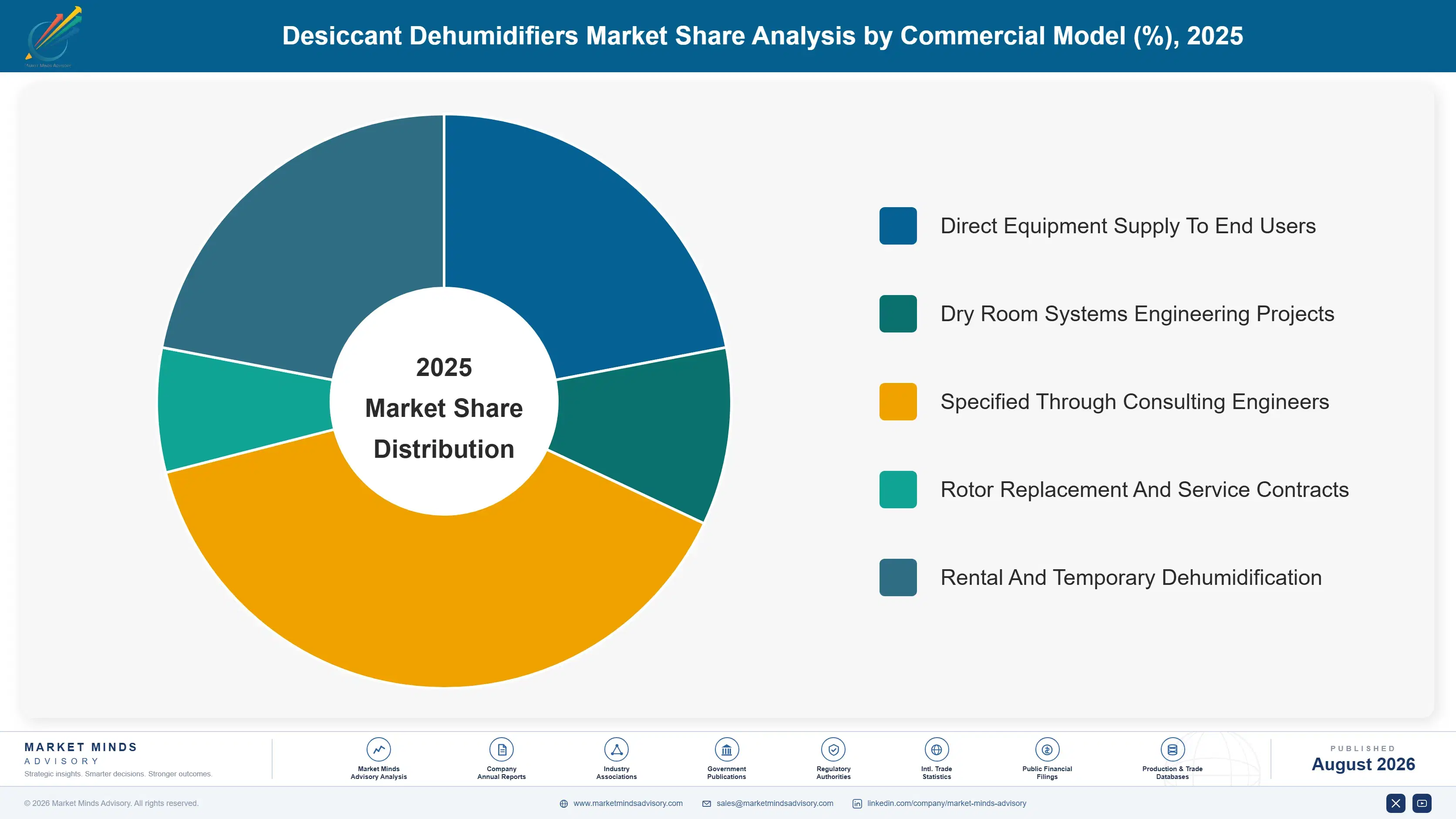
By Commercial Model

  • Direct Equipment Supply To End Users
  • Dry Room Systems Engineering Projects
  • Specified Through Consulting Engineers
  • Rotor Replacement And Service Contracts
  • Rental And Temporary Dehumidification

By Region

  • East Asia
  • Western Europe
  • North America
  • South Asia and Pacific
  • Latin America
  • Middle East and Africa
  • Eastern Europe

Scope, Methodology, and Coverage

Every figure in this report is reproducible from documented input assumptions. The scope below maps the historical period, the forecast horizon, the segmentation dimensions, and the countries covered, alongside the underlying primary and qualitative methodology.
Historical Period
2020 to 2025
Forecast Period
2026 to 2036
Base Year
2025 (USD billions; MMA Primary Research Dataset, August 2026)
Market Definition
This market comprises desiccant-based dehumidification equipment and associated media supply for industrial, commercial, and process applications, measured at manufacturer revenue across equipment sales, systems projects, and replacement media. Coverage spans rotary desiccant wheel dehumidifiers, heat recovery and hybrid regeneration systems, liquid desiccant systems, compact and portable desiccant units, and desiccant rotor and media supplied to machine builders or as replacement. Refrigerant-based condensing dehumidifiers, membrane and compressed air dryers, general air handling units supplied without a desiccant section, building humidification equipment, domestic consumer dehumidifiers, and installation and ductwork contracting fall outside scope.
Quantitative Units
USD billions (current prices); units shipped weighted by airflow capacity; achievable dew point by configuration; regeneration energy per kilogram of moisture removed
Segmentation Dimensions
By Regeneration Approach And Configuration; By End-Use Industry; By Commercial Model; By Region
Regions Covered
East Asia, Western Europe, North America, South Asia and Pacific, Latin America, Middle East and Africa, Eastern Europe
Countries Covered
China, South Korea, Japan, Taiwan, Germany, Switzerland, Denmark, Sweden, Ireland, United Kingdom, France, United States, Canada, Mexico, India, Thailand, Australia, Brazil, Argentina, Saudi Arabia, United Arab Emirates, South Africa, Poland, Czechia, Hungary, and additional markets relevant to this sector
Key Companies Profiled
Munters, Bry-Air, Seibu Giken, Trotec, Condair, DehuTech, Desiccant Technologies Group, FRAL, Airrex, Dantherm Group, Kaeser Kompressoren, Atlas Copco, CtrlTech, Ebac Industrial Products, Fisen Corporation, Hangzhou Fuda Dehumidification, Shanghai Zeyu, Arid Technologies, NovelAire Technologies, Proflute
Quantitative Methodology
Primary survey, n=3,800 respondents, Q4 2025, six countries; demand-side model with trade association cross-validation
Qualitative Methodology
47 expert interviews, Q4 2025; applied to validate demand model assumptions, identify emerging dynamics, and assess competitive positioning
Report Format
PDF and XLSX data workbook (Word format preview document)
Publisher
Market Minds Advisory
Report Code
MMA-2026-CON-665
Published
August 2026
Contact
sales@marketmindsadvisory.com | www.marketmindsadvisory.com

Purchase the full Desiccant Dehumidifiers Market Report (2026 to 2036).

The full report sizes desiccant dehumidifiers across five configurations, five end-use industries, five commercial models, and seven regions, with regeneration energy consumption modelled separately from capital cost throughout. Achievable dew point is mapped against application requirements, since the boundary where refrigerant technology fails defines this market's defensible territory. Rotor manufacturing capability is assessed separately from machine assembly, because the wheel holds the margin and the replacement cycle. Competitive profiling covers twenty companies on units shipped weighted by airflow capacity, and dry room project requirements are analysed against equipment supply capability.
Regeneration energy modelled separately from capital cost throughout
Achievable dew point mapped against application requirement boundaries
Rotor manufacturing capability assessed separately from machine assembly
Dry room project requirements analysed against equipment supply capability
Heat recovery adoption tracked against tender evaluation criteria
Rotor degradation and replacement cycles quantified by application contamination

Built For The People Who Decide

From boardroom strategy to bench-side execution, this report is read cover-to-cover by leaders shaping the next decade of their industry, turning demand scenarios, market dynamics and valuation benchmarks into decisions.
CXOs/ Presidents/ VPs/ Managers
M&A and Corporate Development
Strategy Teams and R&D Heads
Procurement and Product Directors
Regulatory and Compliance Leaders
Investor Relations and Equity Analysts