Market Minds Advisory
Dental Autoclaves Market

Dental Autoclaves Market: Selling Documented Compliance And Chair Time

A steam steriliser is a Victorian pressure vessel with a heating element. What a dental practice pays for is a printed record proving every load reached temperature, plus the minutes it takes.

Lead Analyst

Alice Ballenger

Published

September 2026

Make Smarter Decisions with Customized Research Insights

Request a free sample report and evaluate market opportunities, growth trends, and competitive dynamics relevant to your business needs.

2025 MARKET VALUE$0.9BMarket Size 2025
2036 FORECAST VALUE$1.8BBase Case , 2026 to 2036
CAGR 2026 TO 20366.2 %Bull 7.4% / Bear 5.0%
INCREMENTAL OPPORTUNITY$0.8BNet 10- year value creation
EXPANSION MULTIPLE1.82x2036 value over 2026 base
Strategic Levers
M&A Pipeline
Regional Outlook
Country Rankings
Competitive Intelligence
Segmental Deep-dive
Call-Us : 91 93563 13602

Executive Snapshot and Market Trajectory

The underlying technology here is Victorian. A dental autoclave is a pressure vessel with a heating element, and nothing about steam sterilisation has changed in a century. What a practice actually buys instead is documented compliance and the minutes a cycle takes, and both of those are commercially consequential.
The market reaches USD 0.92 billion in 2025 and compounds at 6.2% to USD 1.78 billion by 2036. Rapid cycle cassette sterilisers grow fastest at 9.3%, exactly 1.50 times the market rate, because they sell chair time rather than sterility. East Asia holds 28% of value on Chinese dental clinic expansion, while South Asia and Pacific takes 13%, above the band this framework applies, on Indian clinic and dental college growth.
Concentration sits at 42% across the top five, with European builders holding the compliance-driven markets and Asian builders taking the cost-driven ones almost entirely. Cycle time is the operational currency that nobody ever puts into a tender document. A practice short of instrument sets is throughput-limited entirely by reprocessing, and every minute cut from a cycle is another patient the surgery can actually get through.
Market Definition
The dental autoclaves market covers small steam sterilisers used to reprocess instruments within dental practices, clinics, and dental education settings, spanning rapid cycle cassette sterilisers, Class B pre-vacuum autoclaves, Class S autoclaves, Class N gravity displacement autoclaves, and large-chamber multi-operatory units, together with associated validation, traceability, and service revenue. Central sterile services department autoclaves for hospital use, washer-disinfectors sold separately, chemical and dry heat sterilisers, ultrasonic cleaners, and single-use instrument supply are excluded.
Base Year Value
$0.9B in 2025 (MMA Primary Research Dataset, August 2026)
Forecast Period
2026 to 2036, eleven discrete annual values
CAGR
6.2% base case. Bull 7.4%. Bear 5.0%.
Fastest Growth Segment
Rapid Cycle Cassette Sterilisers: 9.3% CAGR
Fastest Growth Country
India: 9.4% CAGR
Fastest Growth Region
South Asia and Pacific: 8.6% CAGR
Largest Region
East Asia: 28% of 2025 global value
Market Leaders
Melag Medizintechnik, W&H Group, Coltene, Midmark, Cefla. Source: MMA Primary Research Dataset, July 2026.
Primary Survey
n=3,800 procurement and R&D decision-makers, Q4 2025, six countries
Methodology
Demand-side build-up, cross-validated against public data, 47 expert interviews

Dental Autoclaves Market Forecast Scenarios

dental-autoclaves-market-size-forecast-scenario-1787298449031
The 2020 to 2025 period pushed this market twice in the same direction. Dental practices closed through 2020 and deferred every capital purchase, then infection control moved sharply up the agenda for both regulators and patients, which pulled replacement forward once practices reopened. Chinese and Indian clinic growth continued throughout. A 5.1% historical CAGR averages a deferral year against a compressed catch-up cycle afterwards.
Three mechanisms carry the 6.2% base case. Asian dental clinic expansion is the largest, since every new surgery needs a steriliser regardless of what it charges patients. Compliance tightening is the second, as more jurisdictions require validated Class B cycles with documented cycle records rather than accepting simpler gravity displacement units. And dental service organisation consolidation is the third, standardising equipment and traceability software across dozens of sites at once.
The 7.4% bull case rests on documented traceability requirements spreading into Asian and Latin American regulation, which would obsolete a very large installed base of Class N units and force replacement rather than incremental upgrade. The 5.0% bear case is practice consolidation reducing total site count in mature markets, since a group practice running central reprocessing needs fewer sterilisers than the surgeries it replaced.

Steam, Paperwork And Minutes

Nothing about steam sterilisation is technically interesting and everything about proving it happened is commercially decisive. A practice inspected by a regulator, audited by an insurer, or defending a cross-infection complaint needs a record showing that a specific load reached specific conditions for a specific time. Cycle documentation, validated Class B performance, and traceability linking an instrument set to a patient are what the money actually buys.
TOP FIVE CONCENTRATION42%European builders dominate compliance markets, Asian builders take cost ones
CLASS B CYCLE TIME45 minutesDuration of a full pre-vacuum cycle including the drying phase
RAPID CASSETTE CYCLE7 minutesTime to sterilise a single cassette of wrapped instruments
PRACTICE REPLACEMENT CYCLE11 yearsWorking life before a chairside steriliser is finally replaced
SERVICE REVENUE SHARE31%Portion of builder revenue from validation, parts and servicing
INSTRUMENT SET HOLDING14 setsKits a practice holds to cover reprocessing turnaround between patients
Cycle time is the other half and it is almost never in the tender document. A surgery holding fourteen instrument sets can only run as many patients as reprocessing allows, so a seven-minute cassette cycle against a forty-five-minute Class B cycle changes the working day rather than the sterility outcome. Practices that understand this buy on throughput. Practices that do not buy on chamber size and price.
The market therefore splits geographically along regulation rather than along wealth. Where validated Class B cycles and documented records are mandatory, European builders hold the position and pricing follows. Where gravity displacement units remain acceptable, Chinese and Indian manufacturers supply the great majority at a fraction of the price, and the technical difference matters far less than the compliance one.
"Every practice principal I speak to compares chamber volume and price. Almost none of them has worked out that the autoclave decides how many patients they can see on a Tuesday, which is the only number that actually pays for it."
Director, Dental Equipment And Practice Technology Practice · MMA Medical Device

Market Trends

Traceability Software Becomes Part Of The Purchase

Regulators and indemnity insurers increasingly expect a practice to link a sterilised instrument set to the patient it was used on, which turns a cycle printout into a data requirement no standalone autoclave satisfies. Builders now supply barcode labelling, cycle logging, and practice management integration alongside the hardware, and that software attaches the customer far more firmly than any chamber does. It also creates recurring subscription revenue in a category that previously earned nothing whatsoever between one eleven year replacement decision and the next. That changes the business model rather than the product.
Market Impact: Each new surgery buys 1 unit
Dental Service Organisations Standardise Equipment Across Sites

Group practice consolidation has moved a growing share of surgeries into organisations operating dozens or hundreds of sites under common clinical governance and common procurement. A steriliser specified centrally reaches every site in the group rather than one practice at a time, and traceability systems get standardised alongside it because audit consistency matters to the group more than local preference. That single decision is worth years of individual practice selling, and it concentrates the risk in exactly the same measure. One group changing supplier removes hundreds of sites at once, with no warning.
Market Impact: Obsoletes 40% of installed base

Market Opportunities and Growth Drivers

Asian Dental Clinic Numbers Keep Expanding Rapidly

Chinese private dental chains have opened clinics at a pace no other market approaches, and Indian dental colleges graduate more dentists annually than any country in the world, most of whom eventually open or join a practice needing reprocessing equipment. Every new surgery buys at least one steriliser regardless of what it charges patients or which class of unit it selects. This is mechanical demand rather than discretionary replacement, and it accounts for the substantial majority of unit growth anywhere in this market. Specification rises later, once regulation catches up with clinic numbers.
Market Impact: Working life exceeds 11 years

Validated Class B Requirements Spread Across Jurisdictions

A growing number of national dental regulators now require pre-vacuum cycles capable of sterilising hollow, porous, and wrapped loads with documented cycle verification, rather than continuing to accept simple gravity displacement. Each jurisdiction adopting the requirement obsoletes a substantial installed base of Class N units outright and forces replacement rather than permitting any incremental upgrade. Compliance rather than any clinical evidence drives these purchases, which makes the demand unusually predictable once a regulation date has been published. Builders tracking consultation processes see the volume coming years ahead of anyone else.
Market Impact: Six surgeries become 1 clinic

Market Restraints and Challenges

Eleven Year Working Life Makes Deferral Almost Costless

A well-maintained chairside autoclave runs for eleven years or more, and a practice principal deferring replacement another two years sees no visible penalty on any operating measure. The root cause is that pressure vessels and heating elements degrade slowly and get patched through routine servicing long before failure. Commercially this makes order books extremely sensitive to practice profitability rather than to dental demand. Participants are mitigating through service contracts that maintain the relationship, through traceability subscriptions that recur regardless, and through finance arrangements that move the decision off the practice capital budget entirely.
Market Impact: Subscriptions recur across 11 years

Group Consolidation Reduces Total Steriliser Count

A dental service organisation replacing six individual surgeries with one larger clinic running a central reprocessing room needs fewer sterilisers than the practices it absorbed, even allowing for larger chamber sizes. The root cause is simply that centralised reprocessing is more efficient per chair than chairside units are. Commercially this shrinks unit demand in precisely those mature markets where pricing per unit is highest. Mitigation runs toward large-chamber multi-operatory units, toward traceability and validation services priced per site, and toward emerging markets where total clinic counts are still rising steadily.
Market Impact: Groups standardise across 100 sites
2 additional market trends, 4 additional growth drivers, and 3 additional restraints and challenges are covered in the full report. Contact sales@marketmindsadvisory.com to access the complete intelligence.

Segment CAGR and Growth Architecture

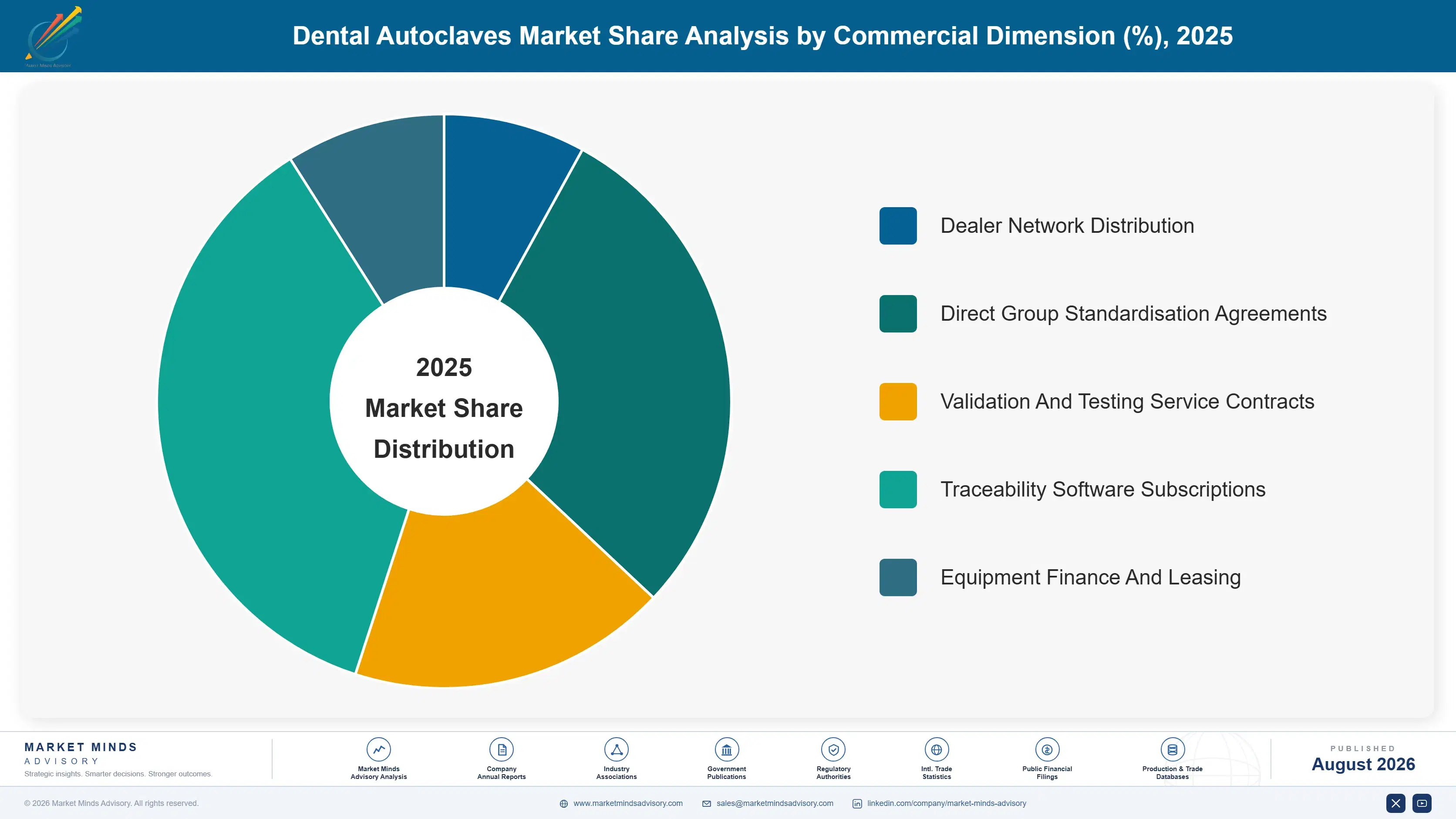
Segmentation follows the sterilisation cycle class, because the cycle determines which load types a unit can process, what regulation permits it to be used for, how long a practice waits between patients, and which manufacturers can credibly supply it. Practice setting, chamber size, and purchase route are handled in the framework instead of here.
dental-autoclaves-market-market-share-analysis-1787298449951

Rapid Cycle Cassette Sterilisers

Rapid cassette units grow fastest at 9.3%, exactly 1.50 times the market rate, processing a single wrapped cassette in roughly seven minutes against forty-five for a full pre-vacuum cycle. That difference does nothing for sterility and everything for throughput, since a surgery holding fourteen instrument sets is limited by how fast they come back rather than by anything clinical. Practices buying these units are buying chair time and generally understand exactly that. The clinical outcome is identical either way. Capacity per cycle is small, so most sites run one alongside a conventional unit rather than replacing it outright. North American penetration is deeper than anywhere else by a considerable margin.
CAGR 9.3%

Class B Pre-Vacuum Autoclaves

Class B pre-vacuum units grow at 8.4%, using fractionated pre-vacuum phases to remove air from hollow instruments, porous loads, and wrapped packs that gravity displacement cycles simply cannot penetrate reliably. This has become the compliance benchmark across most European regulation and increasingly well beyond it, and each jurisdiction adopting it obsoletes an entire installed base rather than merely encouraging a voluntary upgrade. Cycle documentation is integral to these units rather than an optional extra bolted on afterwards. European builders have held this segment almost entirely, and pricing reflects the certification rather than the engineering, which was settled decades ago. Chinese manufacturers obtaining European certification now threaten precisely that position directly.
CAGR 8.4%
Full segment breakdown across 5 segments available in the complete report.

Regional Architecture and Country Demand Map

Regional shares here divide along regulation rather than along wealth, which is genuinely unusual. Where validated cycles and documented records are mandatory, European builders hold the position and pricing follows; where they are not, Asian manufacturers supply very nearly everything that gets sold at all.

East Asia

East Asia holds 28% of total value, the largest share of any region, on Chinese private dental chain expansion, which has opened new clinics at a pace nothing anywhere else approaches. Domestic manufacturers including Shinva and Runyes supply the great majority of units sold, at prices that European builders cannot begin to match, and Chinese regulation has not yet mandated validated pre-vacuum cycles right across the sector. Japanese and Korean practice is highly compliance-conscious and buys certified Class B units almost exclusively. Traceability requirements are not yet a factor in most Chinese purchasing decisions. Growth at 7.2% exceeds the global rate on clinic count expansion rather than on any specification upgrade.
Share: 28% | CAGR: 7.2% (2026 to 2036)

South Asia and Pacific

South Asia and Pacific takes 13% of value against a 12% ceiling in this framework, and Indian clinic and dental college growth explains the breach. India graduates more dentists each year than any other country in the world, and every one of them eventually needs reprocessing equipment in a practice somewhere. Domestic and Chinese manufacturers supply the majority of it, with Class N units still widely sold wherever regulation continues to permit them. Australian practice follows European compliance convention with validated cycles required. A regulator consultation on validated cycles is currently open. Growth at 8.6% is the fastest of any region in this forecast, and it comes almost entirely from new sites opening.
Share: 13% | CAGR: 8.6% (2026 to 2036)
Regional intelligence for 5 additional markets available in the complete report: Western Europe, North America, Latin America, Middle East and Africa, Eastern Europe. Contact sales@marketmindsadvisory.com.
dental-autoclaves-market-country-cagr-analysis-1787298450784

Earning Between Eleven Year Replacements

A unit sold today will not be replaced for eleven years, so builders who depend on hardware orders live through every deferral their customers make. Traceability subscriptions, validation services, group standardisation, and throughput selling each shorten that gap or widen the sale. Four follow, and only one of them is about the autoclave itself.

Attach Traceability Subscriptions To Every Installation

Linking a sterilised instrument set to a patient requires barcode labelling, cycle logging, and practice management integration that no standalone chamber provides at all, and regulators and indemnity insurers increasingly expect it. Subscriptions run USD 400 to USD 1,200 per site annually and recur right through the entire eleven year hardware life rather than arriving just once. They also make the eventual replacement decision considerably harder to award elsewhere, because years of audit history sit inside the incumbent supplier's system and migrating it is nobody's idea of a good afternoon.
Market Impact: Subscriptions run USD 400 to 1,200 each year

Sell Validation And Periodic Testing As A Service

Validated cycles require documented commissioning, periodic performance qualification, and load testing that most practices have neither the equipment nor the slightest inclination to perform for themselves. Builders offering annual validation as a contracted service earn USD 600 to USD 1,500 per site each year at margins well above hardware, and they visit the practice often enough to spot a failing unit before the principal ever notices it. Very few builders have staffed this properly despite already owning both the installed base and the relationship needed to sell it into every practice.
Market Impact: Validation earns USD 600 to 1,500 per site

Win Group Standardisation Rather Than Individual Practices

A dental service organisation specifying centrally reaches every one of its sites from a single decision, which for the largest groups means several hundred installations plus the matching traceability systems. Field selling to individual practice principals converts slowly and costs more per site won than the first two years of revenue actually return. Group standardisation inverts that whole arithmetic completely, and it concentrates risk in exactly the same measure, since one group changing supplier removes several hundred sites at once. Group awards typically cover 5 to 10 years of supply.
Market Impact: Reaches up to 300 sites in one decision

Quantify Chair Time Rather Than Chamber Volume

A surgery holding fourteen instrument sets is throughput-limited entirely by reprocessing, and a seven-minute cassette cycle set against a forty-five-minute pre-vacuum cycle changes how many patients fit into a working day. Builders quoting chamber litres and unit price are competing on numbers that every Chinese manufacturer already matches for considerably less money. Builders quantifying additional patients treated per week compete on something that only a demonstration at the practice itself can properly establish, and it supports pricing 30% to 45% above the comparable chamber specification offered by any low-cost manufacturer.
Market Impact: Supports a 30% to 45% pricing premium overall

Who Controls the Margin Pool

Concentration at 42% across the top five conceals a market split cleanly along regulatory lines rather than along scale. All participants here are compared on measured global revenue from dental sterilisation equipment and associated validation, traceability, and service work, which separates dedicated dental builders from diversified sterilisation groups where dental units are a modest line inside hospital-focused businesses.
Competition inside compliance markets runs on certification depth, service network density, and traceability integration rather than on chamber engineering, which has been settled for decades. Melag and W&H hold strong European positions built on Class B credibility and installed service coverage. Coltene competes through rapid cassette sterilisation where the argument is throughput. Midmark holds North American practice relationships alongside wider surgery equipment. Cefla and Euronda compete across Europe and export markets.

Pressure is arriving from Chinese manufacturers moving up rather than from any European rival. Shinva and Runyes now supply units meeting Class B specification at prices European builders cannot approach, and they are entering markets where regulation demands the cycle but procurement decides on price. Rankings shift most on group standardisation awards, since one dental service organisation decision moves hundreds of sites at once.
dental-autoclaves-market-company-positioning-matrix-1787298451678

Competitive Moat and Risk Dimensions

MELAG MEDIZINTECHNIK

Moat: Certification And Service Density

Melag holds deep certification coverage across European jurisdictions and operates a service and validation network dense enough that a practice can expect an engineer quickly almost anywhere in its core markets. In a category where compliance documentation is the product, that combination decides awards before chamber specification is even discussed. Newer entrants cannot assemble equivalent coverage quickly.
MELAG MEDIZINTECHNIK

Risk: Exposure To Mature European Practices

The strongest positions sit in Western European markets where practice consolidation is reducing total site count and where the installed base is already fully compliant. Growth there depends on replacement rather than on new surgeries. Asian markets adding clinics fastest are precisely where domestic manufacturers hold cost advantage the company cannot match at any specification.
W&H GROUP

Moat: Integrated Surgery Equipment Relationships

W&H supplies sterilisation alongside handpieces, implantology equipment, and surgical devices, which lets a practice or group consolidate across categories with one supplier and one service relationship. That breadth wins standardisation decisions where a sterilisation specialist can only bid on part of the requirement, and it makes displacement considerably harder for any competitor.
W&H GROUP

Risk: Sterilisation Competing For Internal Priority

Sterilisation sits inside a portfolio where handpieces and implantology carry higher margins and shorter replacement cycles, which competes for development and commercial attention. Traceability software integration demands sustained investment in a comparatively small line. Specialists making sterilisation their entire priority have moved faster on exactly the software capability that now attaches customers.

Players Tracked

Prominent Players

Melag Medizintechnik
W&H Group
Coltene
Midmark
Cefla

Other Key Players

Tuttnauer
Getinge
Euronda
Shinva Medical
Runyes Medical
Dentsply Sirona
Planmeca
A-dec
NSK Nakanishi
J Morita
Prestige Medical
Matachana
Steelco
Faro Group
Gnatus

Recent Developments

MARCH 2025

Melag Extends Traceability Integration Across Practice Management Platforms

Melag widened integration between its cycle documentation systems and several widely used dental practice management platforms, allowing instrument set records to link automatically to patient files. The development was internal and organic, and the company cited indemnity insurer expectations rather than any regulatory requirement as the driver behind it.
Signal: Traceability integration attaches a dental practice far more durably than any chamber specification could ever manage
JUNE 2025

Large Dental Group Standardises Sterilisation Across European Sites

A dental service organisation operating across several European countries standardised sterilisation equipment and traceability systems across its entire clinic network under a single supply agreement. The award followed competitive evaluation and covered installation, commissioning validation, and annual performance testing at every site included in the network.
Signal: One group standardisation decision moves more volume than several years of individual practice selling ever will
OCTOBER 2025

Chinese Manufacturer Secures European Class B Certification

A Chinese sterilisation equipment manufacturer obtained European certification for a pre-vacuum autoclave meeting Class B cycle requirements, opening compliance-driven markets that had previously been closed to it entirely. Distribution was arranged through existing dental equipment dealers rather than through any partnership with an established European builder.
Signal: Certification rather than engineering was always the real barrier here, and it has now been crossed

Steel, Heating And Controls

Stainless steel pressure vessels, doors, and chamber assemblies account for roughly 26% to 34% of build cost, tracking regional steel pricing and specialist fabrication capacity. Heating elements, vacuum pumps, valves, and steam generators add 20% to 27%. Electronic controls, sensors, printers, and increasingly connectivity modules run 14% to 19%, and skilled assembly and certification testing account for the remainder.
European stainless steel and energy costs both rose sharply through 2022 with the gas price shock the IEA documented that year, and pressure vessel fabrication is energy intensive in both forming and welding. Getinge described substantial raw material and energy cost inflation across its sterilisation businesses in its 2022 annual report. Builders holding annual fixed-price dealer agreements absorbed the entire increase before contract renewal allowed any repricing at all.

Exposure separates by manufacturing location rather than by scale. A European builder carries steel, energy, and skilled labour costs that Chinese manufacturers do not, and no commercial flexibility closes that gap on a comparable chamber. What European builders hold instead is certification, service density, and traceability software, none of which appears on a bill of materials. That is precisely why the competitive split runs along regulation rather than along cost.
dental-autoclaves-market-cost-volatility-analysis-1787298452028

Index Steel Content In Dealer Supply Agreements

Annual fixed-price dealer agreements transfer every point of steel and energy volatility to the builder, and dealers accept indexation far more readily than most manufacturers assume. Tying the steel component to a published benchmark converts an unmanageable exposure into a pass-through, and it removes the risk premium a padded fixed price otherwise carries for both parties.

Standardise Chamber Platforms Across Product Families

Designing each model around a different chamber size and door assembly multiplies tooling, certification, and spare parts inventory unnecessarily across a range. Common pressure vessel platforms with model-specific controls and cycle software consolidate fabrication volume, shorten certification when a variant is added, and cut the service parts holding required to support an installed base.

Dual-Source Electronic Controls Across Two Regions

Controls, sensors, and connectivity modules come from a narrow supplier base and long lead times have repeatedly stopped otherwise complete units from shipping. Qualifying a second regional source needs certification variations and testing over roughly a year, and it removes a dependency that becomes impossible to fix at the point where it finally matters.

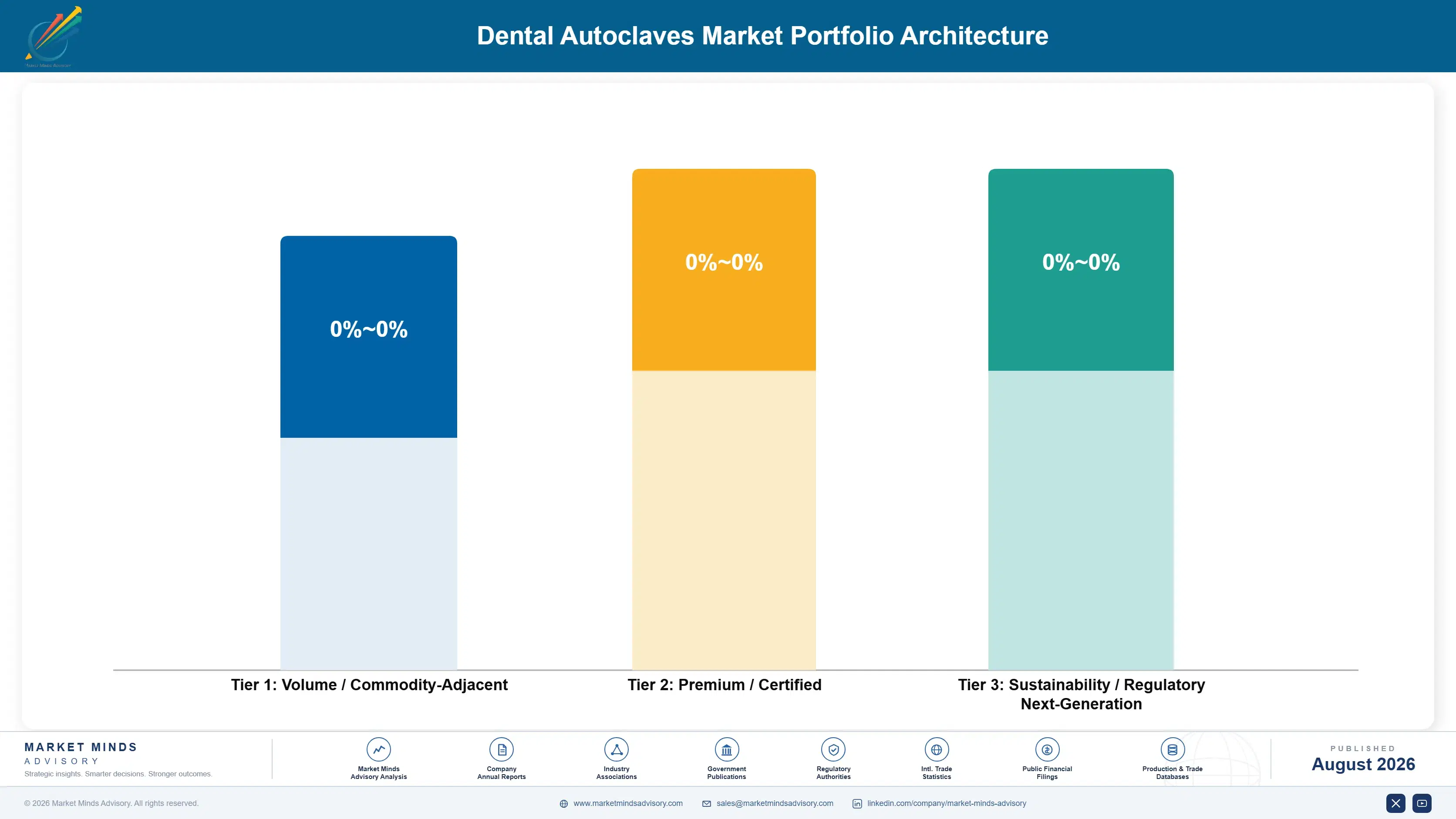
Portfolio Architecture for Margin Defence

Margin architecture separates by whether the buyer needs documentation or simply needs steam. Class N gravity displacement units and basic chambers earn 14% to 22%, competed on price against Chinese and Indian manufacturers wherever regulation permits them. Certified Class B units, rapid cassette sterilisers, and traceability-integrated systems earn 32% to 44%, because certification and software integration both remove the straightforward price comparison.
The tension is that unit growth sits in the markets where regulation is loosest and margin sits where it is strictest. Chinese and Indian clinics are opening fastest and buying cheapest, while European practices buy properly and are consolidating into fewer sites. European builders defending margin are defending a shrinking installed base, and the growth markets are exactly where their cost structure cannot follow.

High-value pools concentrate in traceability subscriptions, validation and testing services, and group standardisation agreements. All three recur annually rather than once every eleven years, which is the whole problem with a hardware-only model in this category. Traceability software carries the widest margin range, because a standalone logging module and a full practice management integration share a description and nothing else.

Volume / Commodity-Adjacent

Class N gravity displacement units and basic chambers sold on price into markets where regulation does not require validated pre-vacuum cycles. The eight-point range separates regional manufacturers with local cost bases from European builders competing well outside their natural position.
Gross Margin: 14% to 22%

Premium / Certified

Certified Class B pre-vacuum autoclaves, rapid cassette sterilisers, and large-chamber multi-operatory units sold into compliance-driven markets. The twelve-point range separates straightforward certified hardware from throughput-positioned units where chair time rather than chamber volume decides the sale.
Gross Margin: 32% to 44%

Sustainability / Regulatory / Next-Generation

Traceability subscriptions, validation and periodic testing services, group standardisation agreements, and connectivity modules. The thirty-six point range reflects real divergence: hardware modules price near equipment economics while software subscriptions carry entirely different margins.
Gross Margin: 26% to 62%
dental-autoclaves-market-portfolio-architecture-1787298452891

High-value Sub-segments and Strategic Watch-out

Traceability Subscription Services

Highest margin in this market and the only revenue that recurs annually rather than once every eleven years. Regulators and indemnity insurers are driving adoption rather than practices requesting it. Data history held inside a supplier's system makes the eventual replacement decision considerably harder to award elsewhere.
Gross Margin: 48% to 62%

Validation And Testing Services

High value with steady growth, earning six hundred to fifteen hundred dollars per site annually while putting a company engineer inside the practice on a regular schedule. Very few builders have staffed this properly despite already owning the installed base and the relationship needed to sell it.
Gross Margin: 38% to 52%

Certified Class B Hardware

The value core of every compliance-driven market, where validated cycles and documented verification are hard regulatory requirements rather than preferences. Chinese manufacturers have now obtained European certification for comparable units, which removes the barrier that protected this position for the better part of two decades.
Gross Margin: 32% to 44%

Class N Gravity Displacement Units

Strategic watch-out here. Every single jurisdiction adopting validated cycle requirements obsoletes this installed base rather than upgrading it, and a consultation is now open in the single largest clinic growth market. Volume looks entirely healthy right up until the moment a regulation date is published somewhere.
Gross Margin: 14% to 22%

Living Off Eleven Year Cycles

The annuity here is the installed unit rather than the customer, and it is a thin one by any standard. A chairside autoclave runs for eleven years generating parts, servicing, and validation revenue worth roughly 31% of what builders earn, while the hardware decision itself happens once per generation of practice ownership. Builders treating service as an after-sales obligation rather than a business give away the only revenue that survives a capital deferral cycle intact.
Depth varies sharply by customer type. Dental service organisations with standardised equipment and traceability across every site are the stickiest, because changing supplier means retraining, revalidating, and migrating audit records across dozens of locations at once. Compliance-market individual practices are next, held by service relationships and validation history. Cost-market practices are shallowest, buying on delivered price with no loyalty whatsoever between purchases.

Buyer profiles have shifted considerably. Equipment selection moved from the practice principal choosing on familiarity toward group procurement functions comparing total cost across estates, while indemnity insurers and regulators effectively dictate the specification floor. Both changes reward builders who can demonstrate traceability and validation coverage across a whole group, and they steadily erode anybody selling a chamber on litres and price.
dental-autoclaves-market-end-use-penetration-index-1787298453684

Where We Come Out

These are among the four positions where our research anticipates prominent divergence between winners and laggards over the coming forecast period. Each is grounded in the demand model, the regulatory perimeter, and the announced capacity pipeline.
01 / RECURRING REVENUE PRIORITY

Hardware every eleven years is not a business model

A chairside autoclave runs for eleven years or more, which means a builder depending on equipment orders alone lives through every capital deferral its customers choose to make. Traceability subscriptions at four hundred to twelve hundred dollars a site and annual validation services at six hundred to fifteen hundred both recur across that entire installed life. Builders who own the installed base and have not staffed these services are leaving the only dependable revenue in this category on the table.
02 / CERTIFICATION BARRIER EROSION

The moat was certification, and it has just been crossed

European builders held compliance-driven markets for two decades on Class B certification rather than on any engineering advantage, since steam sterilisation itself has been technically settled for the better part of a century. Chinese manufacturers now hold European certification for pre-vacuum units at prices no European cost base can approach on comparable specification. What remains defensible is service network density, validation capability, and traceability software, and none of those three appears on a bill of materials that anybody can simply copy quickly.
03 / THROUGHPUT SELLING DISCIPLINE

Practices buy chair time and nobody sells it to them

A surgery holding fourteen instrument sets is limited by how quickly they come back rather than by anything clinical, so a seven-minute cassette cycle against forty-five minutes changes how many patients fit into a working day. Builders quoting chamber litres and price are competing on numbers every low-cost manufacturer matches for less money. Quantifying additional patients per week supports pricing thirty to forty-five percent above comparable specification, and demonstrating it at the practice does what no brochure has ever managed.
04 / GROUP ACCOUNT FOCUS

One central decision now moves hundreds of installations

Dental service organisations specify equipment and traceability centrally across every clinic they operate, which turns a purchasing decision taken at one desk into several hundred installations plus the matching software and validation work. Field selling to individual practice principals converts slowly and costs more per site won than the first two years of revenue return on each installation. The risk concentrates in exactly the same measure, because a single group switching supplier removes several hundred sites simultaneously and without much notice.

Engagement Snapshot From the Field

A live engagement with an industry participant carrying material or product regulatory and market exposure ahead of a defining policy shift, showing how our research translates into a defensible multi-year portfolio strategy.
MARKET MINDS ADVISORY · CLIENT ENGAGEMENT SUMMARY
Dental Autoclaves Producer Strategic Portfolio Review and Transition Roadmap 2026·Investment Scenario on Dental Autoclaves Exposure Evaluation 2025-26
CLIENT PROFILE
A European dental sterilisation manufacturer with roughly EUR 120 million in annual revenue (client-reported, unverified by MMA), supplying certified Class B autoclaves through dealer networks across eighteen countries. Around 84% of revenue came from hardware, service and validation were delivered by third-party dealers rather than by the company, and it held no traceability software of its own.
STRATEGIC CHALLENGE
Unit volumes had been flat for three years as European practice consolidation reduced site counts, while a Chinese manufacturer had just obtained European certification and was quoting well below the client's cost base. The board needed to decide whether to compete on price, to move into growth markets it had no cost position in, or to change what it was actually selling.
MMA APPROACH
MMA analysed revenue and retention across the client's installed base by customer type, interviewed twenty-four practice principals and nine dental service organisation procurement leads on selection criteria, and modelled service and traceability revenue against the existing eleven year installed life. Chinese certified competitor economics were benchmarked to establish where price competition was survivable and where it was not.
KEY FINDINGS
  1. Dealers captured 78% of service and validation revenue on the client's own installed base, and the client had no visibility of which units were failing or approaching replacement.
  2. Group procurement leads ranked traceability integration and audit consistency above chamber specification in eight of nine interviews, and the client offered neither capability.
  3. Certified Chinese units were quoted at 46% below the client's dealer price on comparable specification, which no cost reduction programme modelled could close.
  4. Practices running rapid cassette units alongside conventional autoclaves reported treating meaningfully more patients per week, and the client had no product in that format at all.
CLIENT PROFILE
A European dental sterilisation manufacturer with roughly EUR 120 million in annual revenue (client-reported, unverified by MMA), supplying certified Class B autoclaves through dealer networks across eighteen countries. Around 84% of revenue came from hardware, service and validation were delivered by third-party dealers rather than by the company, and it held no traceability software of its own.
STRATEGIC CHALLENGE
Unit volumes had been flat for three years as European practice consolidation reduced site counts, while a Chinese manufacturer had just obtained European certification and was quoting well below the client's cost base. The board needed to decide whether to compete on price, to move into growth markets it had no cost position in, or to change what it was actually selling.
MMA APPROACH
MMA analysed revenue and retention across the client's installed base by customer type, interviewed twenty-four practice principals and nine dental service organisation procurement leads on selection criteria, and modelled service and traceability revenue against the existing eleven year installed life. Chinese certified competitor economics were benchmarked to establish where price competition was survivable and where it was not.
KEY FINDINGS
  1. Dealers captured 78% of service and validation revenue on the client's own installed base, and the client had no visibility of which units were failing or approaching replacement.
  2. Group procurement leads ranked traceability integration and audit consistency above chamber specification in eight of nine interviews, and the client offered neither capability.
  3. Certified Chinese units were quoted at 46% below the client's dealer price on comparable specification, which no cost reduction programme modelled could close.
  4. Practices running rapid cassette units alongside conventional autoclaves reported treating meaningfully more patients per week, and the client had no product in that format at all.
RECOMMENDED STRATEGY
Phase 1: Phase one: take service and validation in-house across the largest five markets, accepting dealer friction in exchange for recurring revenue and installed base visibility. Phase 2: Phase two: build or acquire traceability software with practice management integration, and price it as an annual subscription rather than bundling it into hardware. Phase 3: Phase three: withdraw from open price competition on basic certified units below a defined threshold, and develop a rapid cassette product for throughput-led selling.
OUTCOME
The client brought service in-house across four markets within a year and acquired a small traceability software business. Recurring revenue rose from 16% to 29% of turnover, group standardisation wins doubled, and gross margin improved by five points despite hardware units falling 7% (client-reported, unverified by MMA).

Frequently Asked Questions

Foundational context covering the market sizes, CAGR, scope, country, region and competition that inform every finding below. This section is provided to cover basics and most often pre-purchase conversations, answered from the MMA Primary Research Dataset.

What is the current size of the Dental Autoclaves Market?

The global dental autoclaves market reached USD 0.92 billion in 2025, covering small steam sterilisers used in dental practices, clinics, and education settings. Associated validation, traceability, and service revenue is included.

How large will the Dental Autoclaves Market be by 2036?

MMA forecasts USD 1.78 billion by 2036, up from USD 0.98 billion in 2026, an increase of USD 0.81 billion. That represents an expansion multiple of 1.82 times across the forecast period.

What is the CAGR for the Dental Autoclaves Market 2026 to 2036?

The base case CAGR is 6.2%, with a bull case of 7.4% and a bear case of 5.0%. Historical growth between 2020 and 2025 ran at 5.1%, averaging a practice closure year against a compressed catch-up cycle.

Which segment is growing fastest?

Rapid cycle cassette sterilisers grow fastest at 9.3%, exactly 1.50 times the market rate, by selling chair time rather than sterility. Class B pre-vacuum autoclaves follow at 8.4% on spreading compliance requirements.

Who are the major companies in the Dental Autoclaves Market?

Melag Medizintechnik, W&H Group, Coltene, Midmark, and Cefla lead, together holding 42% of the market. European builders dominate compliance markets while Asian manufacturers take cost-driven ones.

Which country is growing fastest?

India grows fastest at 9.4%, driven by clinic numbers and by graduating more dentists annually than any other country. Class N units still sell widely where regulation permits them.

Report Segmentation Architecture

The full report scope spans multiple orthogonal segmentation dimensions, with cross-tabulated demand data provided for each dimension pair. Coverage extends further to regional breakdowns, trend trajectories, and the competitive detail needed to support segment-level decision-making.

By Sterilisation Cycle Class

  • Rapid Cycle Cassette Sterilisers
  • Class B Pre-Vacuum Autoclaves
  • Class S Autoclaves
  • Class N Gravity Displacement Autoclaves
  • Large-Chamber Multi-Operatory Units

By End-Use Industry

  • Independent Dental Practices
  • Dental Service Organisation Clinics
  • Dental Hospitals And Teaching Schools
  • Oral Surgery And Implantology Centres
  • Mobile And Community Dental Services

By Commercial Dimension

  • Dealer Network Distribution
  • Direct Group Standardisation Agreements
  • Validation And Testing Service Contracts
  • Traceability Software Subscriptions
  • Equipment Finance And Leasing

By Region

  • East Asia
  • South Asia and Pacific
  • Western Europe
  • North America
  • Latin America
  • Middle East and Africa
  • Eastern Europe

Scope, Methodology, and Coverage

Every figure in this report is reproducible from documented input assumptions. The scope below maps the historical period, the forecast horizon, the segmentation dimensions, and the countries covered, alongside the underlying primary and qualitative methodology.
Historical Period
2020 to 2025
Forecast Period
2026 to 2036
Base Year
2025 (USD billions; MMA Primary Research Dataset, August 2026)
Market Definition
The dental autoclaves market covers small steam sterilisers used to reprocess reusable instruments within dental practices, group clinics, oral surgery centres, and dental education settings. Scope spans rapid cycle cassette sterilisers, Class B pre-vacuum autoclaves, Class S autoclaves, Class N gravity displacement units, and large-chamber multi-operatory systems, together with associated validation, periodic testing, traceability software, and service revenue. Hospital central sterile services autoclaves, separately sold washer-disinfectors, chemical and dry heat sterilisers, ultrasonic cleaners, and single-use instrument supply are excluded.
Quantitative Units
USD billions at manufacturer revenue level; units shipped annually; installed base by cycle class.
Segmentation Dimensions
By sterilisation cycle class; by end-use industry; by commercial dimension; by region.
Regions Covered
East Asia, South Asia and Pacific, Western Europe, North America, Latin America, Middle East and Africa, Eastern Europe
Countries Covered
United States, Canada, Germany, Italy, France, United Kingdom, Spain, Netherlands, Poland, Czech Republic, China, Japan, South Korea, India, Australia, Thailand, Brazil, Mexico, Saudi Arabia, South Africa.
Key Companies Profiled
Melag Medizintechnik, W&H Group, Coltene, Midmark, Cefla, Tuttnauer, Getinge, Euronda, Shinva Medical, Runyes Medical, Dentsply Sirona, Planmeca, A-dec, NSK Nakanishi, J Morita, Prestige Medical, Matachana, Steelco, Faro Group, Gnatus.
Quantitative Methodology
Primary survey, n=3,800 respondents, Q4 2025, six countries; demand-side model with trade association cross-validation
Qualitative Methodology
47 expert interviews, Q4 2025; applied to validate demand model assumptions, identify emerging dynamics, and assess competitive positioning
Report Format
PDF and XLSX data workbook (Word format preview document)
Publisher
Market Minds Advisory
Report Code
MMA-2026-MED-862
Published
August 2026
Contact
sales@marketmindsadvisory.com | www.marketmindsadvisory.com

Purchase the full Dental Autoclaves Market Report (2026 to 2036).

The full MMA report on dental autoclaves covers cycle class, regional, and competitive analysis in detail, with separate treatment of the recurring service and traceability revenue that sustains builders between eleven year replacement decisions. It includes regulatory requirement mapping by jurisdiction with adoption timelines, throughput economics comparing cycle classes at practice level, dental service organisation standardisation tracking, and certified low-cost competitor entry assessment. Regional chapters cover twenty countries with clinic counts and compliance requirements assessed individually. Competitive profiling spans twenty builders on a consistent revenue basis.
Twenty country clinic count and compliance chapters
Regulatory requirement mapping with jurisdiction adoption timelines
Throughput economics comparing cycle classes at practice level
Group standardisation and procurement tracking across markets
Twenty builder competitive profiles compared consistently
Certified low-cost competitor entry assessment by region

Built For The People Who Decide

From boardroom strategy to bench-side execution, this report is read cover-to-cover by leaders shaping the next decade of their industry, turning demand scenarios, market dynamics and valuation benchmarks into decisions.
CXOs/ Presidents/ VPs/ Managers
M&A and Corporate Development
Strategy Teams and R&D Heads
Procurement and Product Directors
Regulatory and Compliance Leaders
Investor Relations and Equity Analysts