Market Minds Advisory
Dengue Vaccines Market

Dengue Vaccines Market: Supply as the Constraint, Public Manufacture, and Life After Dengvaxia

Demand is not the problem here. Countries want doses they cannot obtain, a manufacturer's capacity timetable sets the forecast, and the largest supplier of all intends to make no profit whatsoever.

Lead Analyst

Alice Ballenger

Published

September 2026

Make Smarter Decisions with Customized Research Insights

Request a free sample report and evaluate market opportunities, growth trends, and competitive dynamics relevant to your business needs.

2025 MARKET VALUE$0.6BMarket Size 2025
2036 FORECAST VALUE$2.9BBase Case , 2026 to 2036
CAGR 2026 TO 203615.4 %Bull 16.8% / Bear 14.0%
INCREMENTAL OPPORTUNITY$2.2BNet 10- year value creation
EXPANSION MULTIPLE4.20x2036 value over 2026 base
Strategic Levers
M&A Pipeline
Regional Outlook
Country Rankings
Competitive Intelligence
Segmental Deep-dive
Call-Us : 91 93563 13602

Executive Snapshot and Market Trajectory

Supply rather than demand sets this market. Endemic countries want doses they cannot obtain, national programmes are being sized against manufacturing timetables instead of epidemiology, and a single manufacturer's capacity expansion schedule effectively determines the forecast. Nothing about this market resembles a normal vaccine launch.
Single-dose live-attenuated vaccines compound at 23.1%, a full 1.50x the market, because one dose removes the completion problem costing programmes real coverage, and because a Brazilian public institute is scaling that product for the country carrying the heaviest burden. Latin America holds the largest share at 32%, far above the standard regional band, and South Asia and Pacific follows at 30%: burden rather than spending power sets this pattern, because dengue is a tropical disease.
Concentration is extreme at 92%, with Takeda and Instituto Butantan holding positions built on entirely different economics. The first licensed dengue vaccine was withdrawn after increasing severe disease risk in uninfected recipients, and that still shapes regulatory caution. Capacity runs near 65 million doses annually against a disease infecting hundreds of millions, so dose volume measures this category better than revenue does. Every produced dose is already committed to a buyer.
Market Definition
This market covers vaccines indicated for the prevention of dengue disease, spanning two-dose live-attenuated vaccines, single-dose live-attenuated vaccines, chimeric yellow fever backbone vaccines, inactivated whole-virus vaccines and subunit or next-generation platform vaccines, measured at manufacturer or institute supply value including public-sector cost-recovery supply. Dengue diagnostics, vector control products and insecticides, mosquito population suppression technologies, antiviral therapeutics, and vaccines against other flaviviruses are excluded.
Base Year Value
$0.6B in 2025 (MMA Primary Research Dataset, August 2026)
Forecast Period
2026 to 2036, eleven discrete annual values
CAGR
15.4% base case. Bull 16.8%. Bear 14.0%.
Fastest Growth Segment
Single-Dose Live-Attenuated Vaccines: 23.1% CAGR
Fastest Growth Country
Brazil: 22.6% CAGR
Fastest Growth Region
South Asia and Pacific: 17.6% CAGR
Largest Region
Latin America: 32% of 2025 global value
Market Leaders
Takeda, Instituto Butantan, Sanofi, Panacea Biotec, and Serum Institute of India. Source: MMA Primary Research Dataset, July 2026.
Primary Survey
n=3,800 procurement and R&D decision-makers, Q4 2025, six countries
Methodology
Demand-side build-up, cross-validated against public data, 47 expert interviews

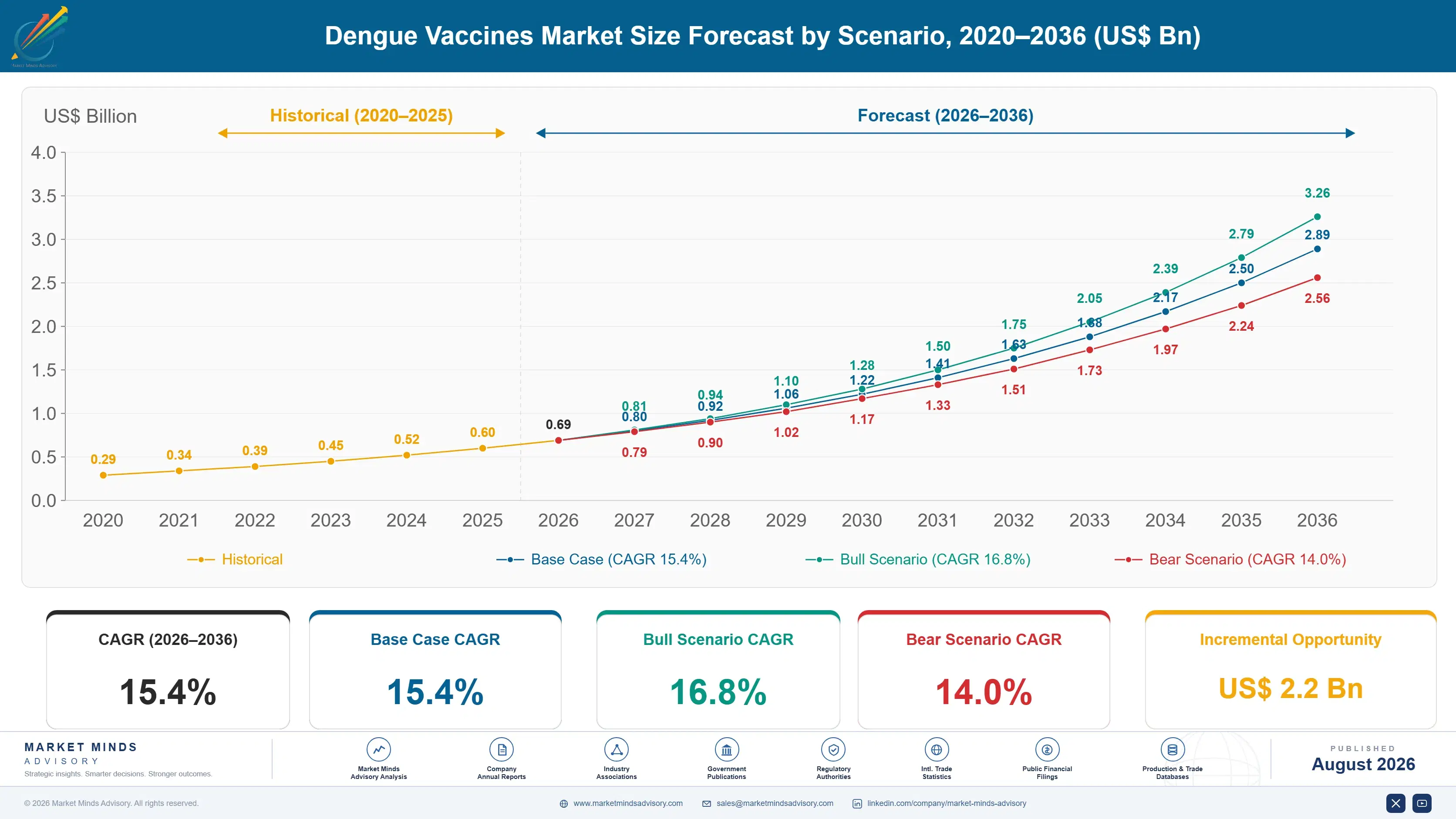
Dengue Vaccines Market Forecast Scenarios

dengue-vaccines-market-size-forecast-scenario-1787304903992
Growth ran near 14.2% from 2020 to 2025 from an unusually troubled base. The first licensed dengue vaccine had already been suspended in its largest programme after safety findings in uninfected recipients, and its manufacturer later confirmed it would stop production. A second vaccine reached European approval in 2022 and World Health Organization prequalification in 2024, which reopened a market that had effectively closed itself.
Base case growth of 15.4% rests on three mechanisms. Manufacturing capacity expands on schedules that are already contracted and publicly stated, and every additional dose finds a buyer immediately. Endemic country national programmes are launching as prequalification and financing arrangements fall into place. And a single-dose product manufactured by a Brazilian public institute enters the market with the country holding the world's largest case burden as its first customer. None of the three depends on the others.
The bull case at 16.8% assumes capacity expansion arrives ahead of schedule and international financing extends procurement into lower-income endemic countries that cannot currently pay. The bear case at 14.0% is a safety or confidence event: any signal resembling the first vaccine's problem would suspend programmes immediately, and public trust remains fragile enough that recovery would take years.

Dengue Vaccines: Capacity, Confidence and Public Manufacture

This is a market where the usual questions do not apply. Nobody is competing for demand, nobody is discounting to win share, and no health minister in an endemic country needs persuading that dengue is worth vaccinating against. Total licensed manufacturing capacity runs near 65 million doses a year against a disease infecting hundreds of millions. Every dose produced is spoken for, and the forecast is essentially a capacity schedule.
TOP FIVE CONCENTRATION92%Extremely concentrated across two commercial suppliers and one public institute
GLOBAL MANUFACTURING CAPACITY65 million dosesAnnual output available across all licensed suppliers combined worldwide
AVERAGE DOSE PRICEUSD 22Blended across public programme procurement and private travel vaccination
TWO-DOSE COMPLETION RATE71%Recipients returning for the second scheduled dose in programme settings
ENDEMIC SEROPOSITIVE SHARE78%Population with prior infection across high-transmission endemic settings
NATIONAL PROGRAMME COUNTRIES9 countriesEndemic states operating publicly funded dengue immunisation programmes at scale
The reason the market is this small is a decade old. The first licensed dengue vaccine was found to increase severe disease risk in recipients who had never been infected before, a consequence of antibody-dependent enhancement that nobody had adequately anticipated. A national programme was suspended, criminal proceedings followed, and confidence in routine immunisation fell measurably in the country concerned. Regulators everywhere took the lesson.
What makes the commercial picture genuinely unusual is who supplies it. Instituto Butantan, a Brazilian public institute, is scaling a single-dose vaccine for the country with the world's heaviest case burden, and it is not attempting to earn a commercial return. A large share of global doses will therefore be supplied at cost, which distorts every value-based forecast.
"Every other vaccine market I cover is a demand problem dressed up as a supply story. This one is the reverse. The binding constraint is bioreactor capacity and the release testing behind it, and no amount of commercial ingenuity moves that faster."
Principal Analyst, Vaccines and Global Health Markets Practice · MMA Healthcare

Market Trends

Single-dose regimens remove the programme completion problem

Two-dose schedules lose coverage between doses, with completion running near 71% in programme settings, and every uncompleted course is a partially protected person and a wasted dose. A single-dose vaccine removes that leakage entirely, simplifies campaign logistics and halves the cold chain burden per person protected. The segment compounds at 23.1% on those operational grounds rather than on any efficacy advantage. For mass campaigns in endemic settings, regimen simplicity is worth more than incremental immunogenicity. Ministries planning mass campaigns weight delivery simplicity heavily, and several have already begun favouring single-dose candidates in forward planning regardless of comparative immunogenicity data.
Market Impact: Brazil compounding at 22.6% annuall
Public manufacture supplies doses without generating market value

A Brazilian public institute is scaling production of a single-dose vaccine intended primarily for its own national programme, supplied at cost rather than at any commercial price. That arrangement will deliver a substantial share of global doses while contributing very little to market value, which is why dose volume is a more honest measure of this category than revenue. Comparable public manufacturing capability exists in India and Indonesia, and both are pursuing indigenous dengue candidates. That model makes dose volume rather than revenue the honest measure of scale here. Revenue forecasts understate the category badly.
Market Impact: Programmes operating in 9 countries

Market Opportunities and Growth Drivers

Case burden reaches record levels across endemic regions

Dengue transmission has intensified sharply, with the Americas recording their heaviest year on record and Brazil alone reporting case numbers in the millions. Warming temperatures, urbanisation and expanding vector range have together pushed transmission into areas that had little or none previously, including parts of southern Europe and the southern United States. Brazil compounds at 22.6% as its national programme scales. Health ministries facing hospital systems overwhelmed by dengue admissions do not require any commercial persuasion. Introduction decisions follow outbreak experience far more closely than they follow income, with countries recovering from a crisis moving fastest of all.
Market Impact: Capacity limited to 65 million dose

Prequalification and financing open lower-income endemic procurement

World Health Organization prequalification in 2024 allowed United Nations agencies to procure a dengue vaccine for the first time since the earlier product's difficulties, and international financing mechanisms have added dengue to their investment priorities. That combination converts endemic countries unable to fund vaccination from theoretical demand into contracted procurement. Roughly nine endemic states now operate publicly funded programmes at scale, and the pipeline of countries preparing introduction decisions is considerably longer. Financing bodies have joined introduction decisions as funders rather than advisers, which determines which lower-income endemic states can proceed at all.
Market Impact: Confidence lost across 1 programme

Market Restraints and Challenges

Manufacturing capacity rather than demand caps the market

Licensed capacity runs near 65 million doses annually against a disease infecting hundreds of millions, and every dose produced is committed before it leaves the facility. The root cause is that live-attenuated viral vaccine manufacture requires long production cycles, extensive release testing and facilities that take years to build and qualify. Commercial impact is a market sized by bioreactors rather than by epidemiology. Participants are adding fill-finish partnerships, technology transfer arrangements and dedicated new facilities, none of which delivers quickly. Release testing throughput adds weeks to every batch and is the least visible part of the constraint.
Market Impact: Completion running near 71% current

Antibody-dependent enhancement shapes regulatory caution permanently

The first licensed dengue vaccine increased severe disease risk in recipients with no prior infection, and the resulting programme suspension damaged public confidence in immunisation well beyond dengue itself. The root cause is antibody-dependent enhancement, a genuine immunological phenomenon rather than any manufacturing failure. Commercial impact is a regulatory bar considerably higher than for other vaccines and an enduring public wariness. Participants are pursuing large safety databases, extended follow-up commitments and careful communication around seronegative recipients. Extended post-licensure surveillance has effectively become the price of introduction anywhere. Communication around seronegative recipients remains delicate.
Market Impact: Compounding at 23.1% each year
3 additional market trends, 4 additional growth drivers, and 2 additional restraints and challenges are covered in the full report. Contact sales@marketmindsadvisory.com to access the complete intelligence.

Segment CAGR and Growth Architecture

Segmentation follows vaccine product class, because class determines the construct, the dosing regimen, the manufacturing process and the regulatory history a product carries with it. Five product classes cover dengue vaccine supply without overlap between them. Recipient age group and programme type cut across every class at once and are treated here as use attributes rather than as segments.
dengue-vaccines-market-market-share-analysis-1787304904529

Single-Dose Live-Attenuated Vaccines

Growing at 23.1%, a full 1.50x the market rate, single-dose vaccines remove the completion leakage that costs two-dose programmes real coverage, since roughly 29% of recipients never return for the second dose. One visit rather than two halves cold chain handling per person protected and simplifies campaign logistics enormously in settings where reaching people twice is genuinely hard. The Brazilian public institute scaling this class supplies at cost rather than commercially, which means the segment will contribute far more to global dose volume than to market value over the forecast period. Assessing it on revenue alone badly understates its public health contribution. Comparable public manufacturing capability exists across India and Indonesia, and both are pursuing indigenous candidates.
CAGR 23.1%

Two-Dose Live-Attenuated Vaccines

Two-dose live-attenuated vaccines grow at 17.4% and currently carry almost the entire commercial market, following European approval in 2022 and World Health Organization prequalification in 2024. Crucially this class requires no pre-vaccination screening for prior infection, which is what made the earlier chimeric product unworkable in mass programmes. Manufacturing capacity rather than demand limits volume, and every contracted dose is committed well ahead of production. Completion between doses remains the operational weakness, running near 71% and considerably lower in campaign settings than in routine schedules. Indigenous candidates advancing in India and Indonesia with public sector backing represent the clearest threat to this class, since licensure in either would remove procurement volume from a very large endemic market permanently.
CAGR 17.4%
Full segment breakdown across 5 segments available in the complete report.

Regional Architecture and Country Demand Map

Regional shares here reflect where the disease is rather than where health spending is, so the pattern departs sharply from almost every other vaccine market. Note: several regional positions sit outside standard bands for that reason. Each deviation is justified in the relevant paragraph below.

Latin America

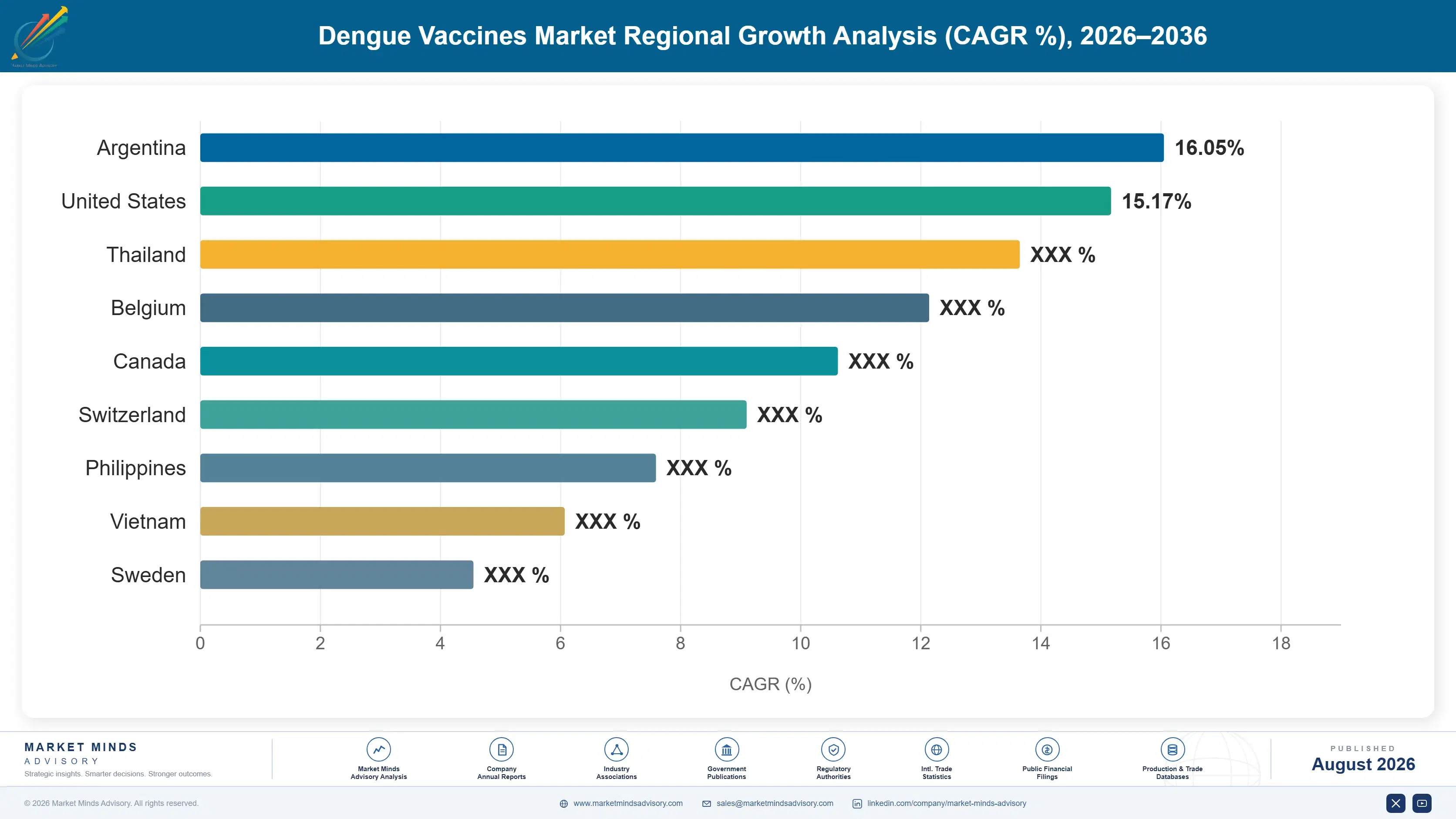
Latin America holds the largest share at 32%. Note: this sits far above the standard regional band because Brazil alone recorded case numbers in the millions during its heaviest year on record, and because a Brazilian public institute manufactures domestically for the national programme. Brazil compounds at 22.6% as that programme scales, and Argentina has licensed the two-dose product following its own severe outbreak years. Regional health ministries face hospital systems periodically overwhelmed by dengue admissions, which removes any need for commercial demand generation entirely. Mexico, Colombia and Peru all carry substantial burden and are at earlier stages of introduction decision-making. Domestic manufacture removes procurement dependence entirely for the largest market.
Share: 32% | CAGR: 16.0% (2026 to 2036)

South Asia and Pacific

Thirty per cent of value and the fastest regional growth at 17.6%. Note: this exceeds the standard band because the region carries the largest absolute dengue burden anywhere, across Indonesia, the Philippines, Vietnam, Thailand and India. Indonesia was the first market to license the two-dose product commercially. Indian indigenous candidates are in advanced trials with public sector backing, and domestic manufacturing capability there is substantial. Philippine public confidence remains fragile following the earlier programme suspension, and reintroduction there has proceeded with unusual caution. Vietnamese and Thai health ministries have both signalled introduction intent, and regional manufacturing capability is substantial enough that supply may eventually be met domestically. Introduction pace varies enormously between neighbouring states.
Share: 30% | CAGR: 17.6% (2026 to 2036)
Regional intelligence for 5 additional markets available in the complete report: East Asia, Western Europe, North America, Middle East and Africa, Eastern Europe. Contact sales@marketmindsadvisory.com.
dengue-vaccines-market-country-cagr-analysis-1787304905050

Where Dengue Vaccine Value Concentrates

Demand exceeds supply, price is set by public procurement rather than negotiation, and the largest volume supplier intends no commercial return at all. Value therefore accrues to whoever adds qualified capacity fastest and to whoever can serve the small high-price travel segment alongside endemic programmes. Conventional commercial levers barely apply here at all. Manufacturing decides everything.

Add qualified capacity faster than the procurement queue grows

Licensed capacity runs near 65 million doses annually against demand that is effectively unlimited, so every additional qualified dose converts directly into revenue with no selling required at all. Fill-finish partnerships, technology transfer to regional manufacturers and dedicated new facilities each shorten the timeline differently, and the constraint is qualification rather than construction. Commercial teams in this category matter far less than manufacturing and regulatory affairs teams do, which is an unusual internal allocation that few organisations make comfortably. Release testing throughput deserves the same attention as bioreactor volume. Qualification, not construction, sets the timeline.
Market Impact: Capacity is capped near 65 million

Serve travel medicine alongside endemic public procurement

Travel vaccination through private clinics in Europe, North America and East Asia commands prices many times the roughly USD 22 blended dose value that endemic procurement supports, on volumes that are trivial by comparison. That segment funds nothing on its own and improves blended margin considerably when supply allows. The judgement is allocation rather than marketing: diverting doses from an endemic programme to a travel clinic is commercially attractive and reputationally difficult, and several suppliers have chosen not to. Reputational exposure in this category is real and durable. Several suppliers have chosen not to divert.
Market Impact: Travel pricing far exceeding the US

Design regimens for programme delivery rather than trial elegance

Roughly 29% of recipients never return for a second dose, which means a two-dose vaccine protects fewer people than its efficacy data implies once programme reality is applied. Single-dose regimens compound at 23.1% on that operational argument alone. Cold chain simplicity, single-visit delivery and reduced wastage matter more to a health ministry running a mass campaign than incremental immunogenicity does. Development programmes optimising for trial endpoints rather than for field delivery are solving a problem that ministries do not have. Wastage falls too, which matters when supply is the binding constraint on coverage.
Market Impact: Recovers the 29% who never complete

Build safety databases larger than regulators currently require

The earlier licensed vaccine increased severe disease risk in previously uninfected recipients and its suspension damaged confidence in immunisation well beyond dengue, across at least 1 major national programme. Regulators and health ministries in this category are permanently more cautious as a result, and extended follow-up commitments are effectively the price of introduction. Suppliers treating post-licensure surveillance as a compliance obligation rather than as a market access investment consistently underestimate how much introduction decisions depend on it. Ministries examine those databases closely before committing to any national introduction. It is a market access investment.
Market Impact: Confidence was damaged across 1 maj

Who Controls the Margin Pool

Concentration is extreme at 92% across the top five, measured on annual dose supply value including public-sector cost-recovery supply, the single basis applied throughout this analysis. Takeda holds essentially the whole commercial market on the two-dose product, while Instituto Butantan supplies the Brazilian national programme on entirely non-commercial terms. Sanofi retains a residual position on a product it has confirmed it will stop producing.
Competition in the ordinary sense barely exists. Suppliers are not fighting for share of a fixed market; they are racing to qualify capacity against demand that exceeds everything available. What competition does occur runs on regulatory pathway speed, on manufacturing partnerships with regional producers, and on the safety databases that ministries examine before committing to introduction. Price competition is essentially absent because there is nothing to compete for.

Pressure builds from indigenous public manufacturing rather than from commercial rivalry. Indian and Indonesian institutes are advancing domestic candidates with government backing, and both countries have substantial vaccine manufacturing capability and strong reasons to supply themselves. Rankings shift most as those programmes reach licensure, since a domestically produced vaccine in a large endemic market removes procurement volume that no commercial supplier can replace elsewhere.
dengue-vaccines-market-company-positioning-matrix-1787304905579

Competitive Moat and Risk Dimensions

TAKEDA

Moat: Prequalified two-dose product

Holding the only widely prequalified dengue vaccine requiring no pre-vaccination screening gives Takeda a position that took more than a decade and considerable clinical investment to establish. World Health Organization prequalification opens United Nations agency procurement, and the accumulated safety database is exactly what health ministries examine before committing to national introduction decisions.
TAKEDA

Risk: Capacity ceiling limits revenue

Revenue is bounded by manufacturing output rather than by demand, and expanding live-attenuated viral vaccine capacity takes years of construction and qualification that cannot be compressed. Indigenous public manufacturing in India and Indonesia will remove procurement volume from large endemic markets. Any safety signal resembling the earlier product's would suspend programmes immediately.
INSTITUTO BUTANTAN

Moat: Domestic single-dose public manufacture

Manufacturing a single-dose vaccine domestically for the country with the world's heaviest case burden gives Butantan a position no commercial supplier can contest, since procurement, regulation and production all sit within one national system. Single-dose delivery removes the completion leakage that costs two-dose programmes coverage, which matters enormously in campaign settings.
INSTITUTO BUTANTAN

Risk: Non-commercial funding dependence

Operating at cost recovery rather than commercial return leaves capacity expansion dependent on public budget allocation rather than on reinvested margin, which makes scaling slower and more politically exposed than a commercial operator would accept. Export capability beyond Brazil is limited. Regulatory acceptance outside the domestic market requires processes not yet completed.

Players Tracked

Prominent Players

Takeda
Instituto Butantan
Sanofi
Panacea Biotec
Serum Institute of India

Other Key Players

Merck and Co.
Bharat Biotech
Indian Immunologicals
Biological E
GSK
Johnson and Johnson
Valneva
Bio Farma
Sinovac Biotech
Walvax Biotechnology
Zydus Lifesciences
Hilleman Laboratories
Codagenix
Emergent BioSolutions
Sun Pharmaceutical Industries

Recent Developments

MAY 2025

Brazilian national programme expands single-dose vaccination coverage

Brazil widened its publicly funded dengue immunisation programme across additional states following record case numbers, an organic public health expansion drawing on domestic manufacturing capacity rather than on any commercial procurement arrangement with an international supplier. Coverage widened fastest in states that had recorded the heaviest case numbers.
Signal: Domestic public manufacture is supplying a
SEPTEMBER 2025

Capacity expansion commitments extend contracted dose supply timelines

Suppliers confirmed further manufacturing capacity investment and fill-finish partnership arrangements, organic expansion rather than acquisition, as contracted demand from endemic country programmes continued to exceed available annual output by a substantial margin throughout the year. Qualification timelines rather than construction determined when additional output arrives.
Signal: Forecasting this market means forecasting
JANUARY 2026

Indigenous candidates advance in India and Indonesia toward licensure

Domestically developed dengue vaccine candidates progressed through late-stage trials in India and Indonesia with public sector backing, advancing toward licensure in two of the largest endemic markets with substantial existing vaccine manufacturing capability already in place. Both governments have signalled clear preference for domestic supply.
Signal: Large endemic markets clearly intend to su

Viral Culture, Release Testing and Cold Chain

Live-attenuated viral vaccine manufacture carries a cost structure unlike most biologics. Cell culture media, viral seed maintenance and bioreactor operation account for roughly 34% of cost of goods, while release testing, potency assays and stability programmes contribute a further 26%, which is unusually high and reflects the regulatory scrutiny this category attracts. Fill-finish, cold chain packaging and distribution carry most of the remainder across long endemic-country supply routes.
Energy and specialist consumable costs across European manufacturing rose materially through 2022 and 2023, affecting bioreactor operation and cold chain storage together. Manufacturer annual reports across that period documented both the input cost movement and the capacity investment commitments made regardless of it, since dengue capacity expansion decisions were driven by contracted demand rather than by input economics. Single-use bioreactor consumable supply also tightened noticeably during the same window.

Exposure varies sharply by supplier type and geography. Commercial manufacturers price through to procurement agencies under multi-year agreements that lag input movement considerably, while a public institute operating at cost recovery absorbs increases directly into a fixed budget allocation. That difference makes public manufacture more vulnerable to input shocks than commercial supply, despite the usual assumption running the other way around entirely.
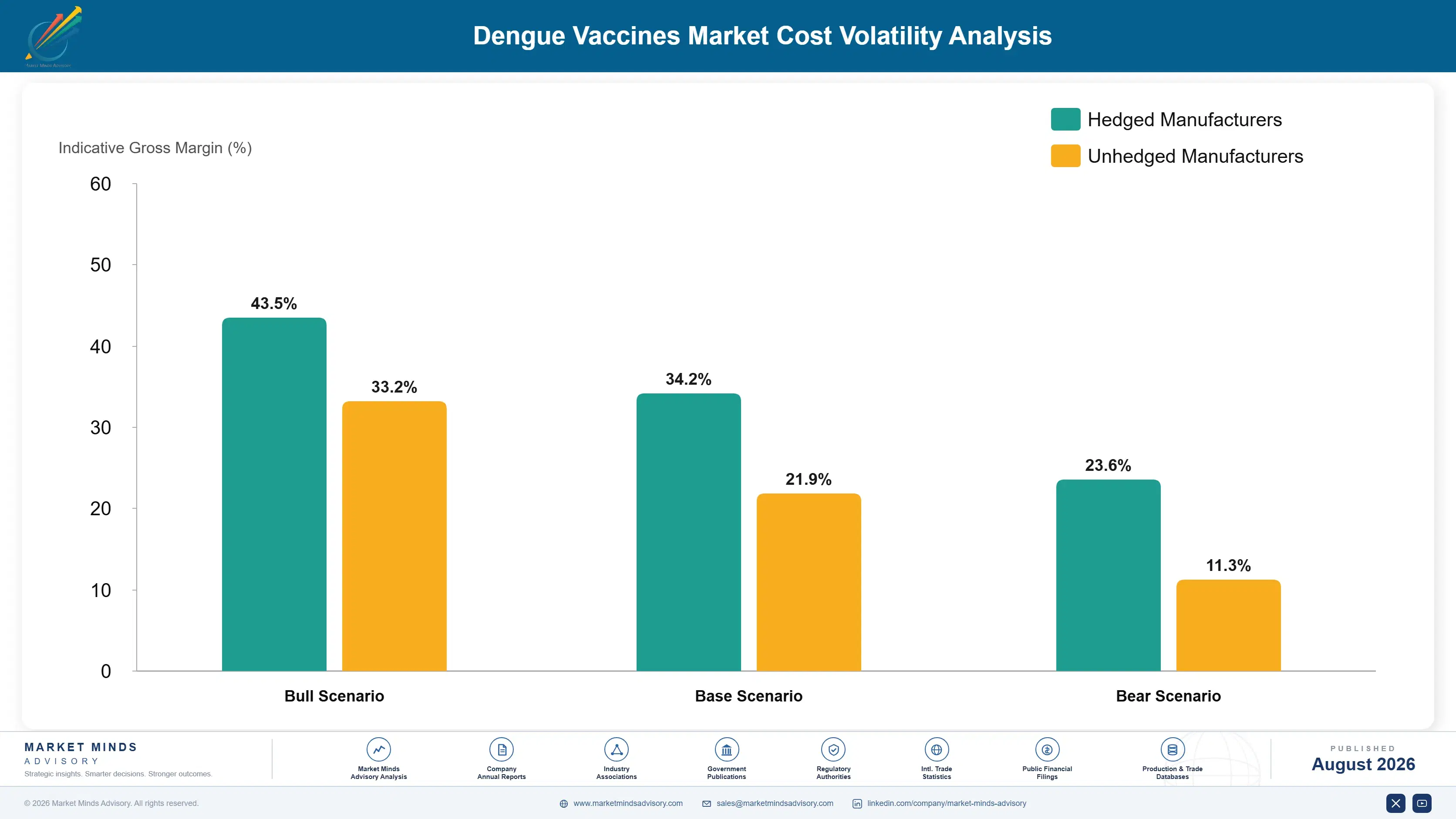
dengue-vaccines-market-cost-volatility-analysis-1787304905774

Contract single-use bioreactor consumables on multi-year terms

Single-use bioreactor bags, filters and media supply tightened materially during recent disruption, and these consumables have qualification requirements that prevent quick substitution when availability falls. Multi-year agreements covering qualified components protect continuity cheaply. Suppliers buying these inputs on spot terms expose a capacity-constrained product to avoidable interruption. Qualification requirements make substitution slow precisely when speed matters most.

Transfer fill-finish to regional partners near endemic demand

Cold chain distribution across long routes into endemic countries carries both cost and wastage that regional fill-finish substantially reduces, while also shortening the supply chain that constrains total output. Technology transfer takes time and regulatory work rather than capital. Several endemic countries have qualified fill-finish capability sitting idle that could be brought into dengue supply.

Design release testing programmes for throughput as well as compliance

Release testing and potency assays account for roughly 26% of cost of goods and, more importantly, add weeks to every batch release in a supply-constrained product. Parallel testing capacity, validated rapid assays and additional qualified laboratories each shorten that cycle. In a market where demand exceeds supply, testing throughput converts directly into deliverable doses.

Portfolio Architecture for Margin Defence

Margin architecture here separates on who is buying rather than on what is supplied. Public procurement into endemic country programmes, whether through national budgets or international financing, sets prices near the roughly USD 22 blended level and leaves modest commercial margin. Travel vaccination through private clinics in non-endemic markets commands several times that on trivial volumes. Public institute supply at cost recovery generates no margin at all by design.
The volume against premium tension is unusually extreme. Endemic programmes will consume essentially all available doses at procurement pricing, while travel medicine would pay far more for a fraction of the output. Allocating supply toward the higher price is commercially rational and reputationally difficult in a category where the disease burden is overwhelmingly in the countries least able to pay. Several suppliers have declined to make that trade.

High-value pools concentrate around qualified capacity and around the small non-endemic travel segment. Every additional qualified dose finds a committed buyer, which makes manufacturing investment the most reliable value creation available. Products confined to a single national programme, however large that programme, generate volume without commercial return and should be assessed on public health output rather than on any conventional revenue measure.

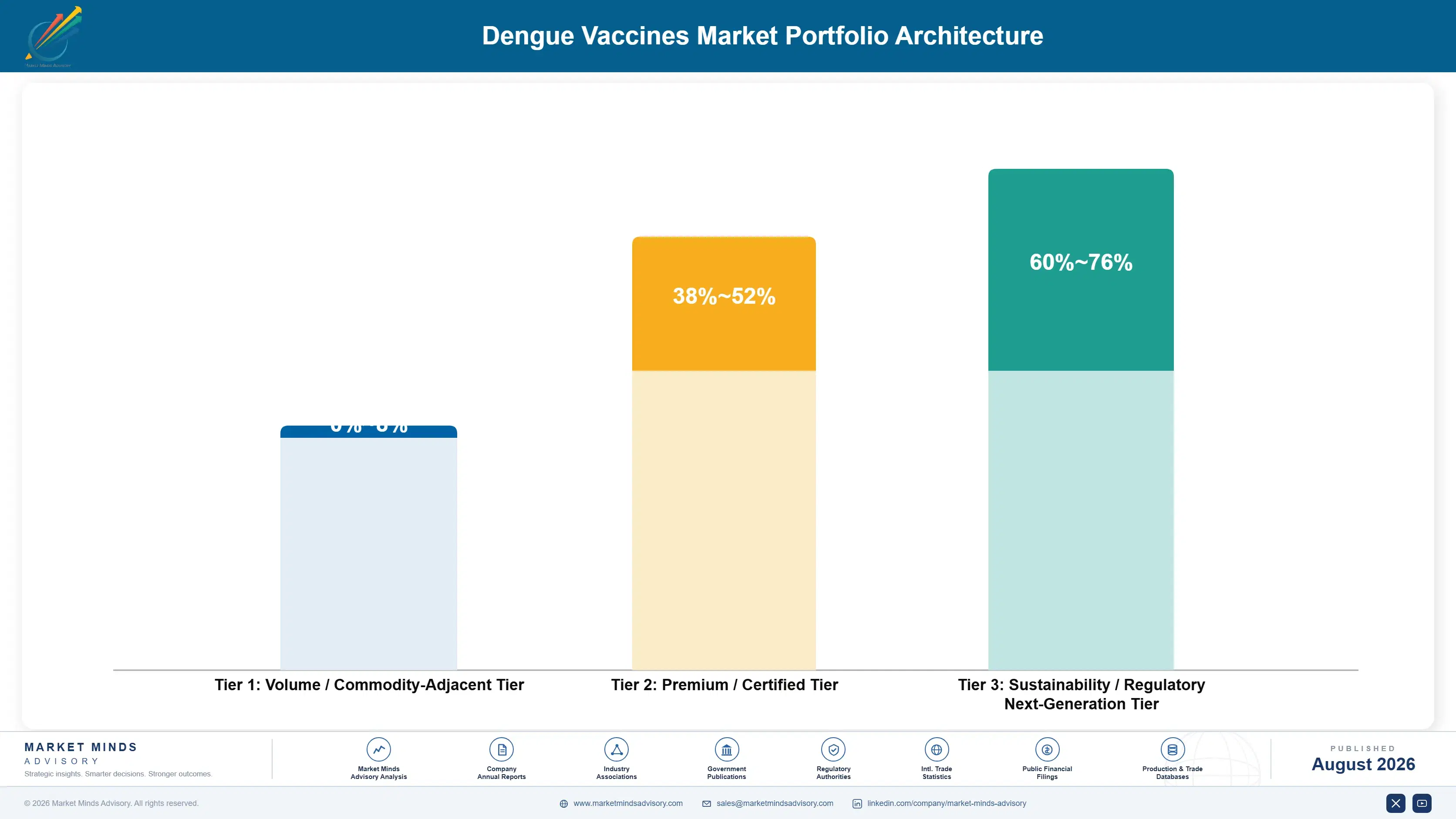
Volume / Commodity-Adjacent Tier

Public institute supply at cost recovery into domestic national programmes, generating substantial dose volume and no commercial margin by explicit design rather than through any competitive pressure. Public health output is the appropriate measure here.
Gross Margin: 0-8%

Premium / Certified Tier

Prequalified commercial supply into endemic country public procurement under multi-year agreements, protected by manufacturing scarcity and by regulatory qualification that competitors need years to replicate. Every contracted dose is committed ahead of production.
Gross Margin: 38-52%

Sustainability / Regulatory / Next-Generation Tier

Travel medicine supply through private clinics in non-endemic markets and single-dose products reducing programme delivery cost, commanding pricing several times the endemic procurement level on very modest volumes. Allocation judgement rather than marketing decides how much reaches this tier.
Gross Margin: 60-76%
dengue-vaccines-market-portfolio-architecture-1787304906279

Programme Cohorts and Travel Episodes

Demand arrives in two entirely different shapes. Endemic programme procurement is contracted, forecast years ahead against birth cohorts or defined age groups, and paid from public budgets or international financing, which makes it predictable in a way commercial vaccine demand rarely is. Travel vaccination is episodic, individual, seasonal and priced many times higher, arriving through private clinics rather than through any procurement process at all.
Adoption depth follows outbreak experience more closely than income. Countries that have recently seen hospital systems overwhelmed by dengue admissions introduce programmes quickly and expand them aggressively, while neighbouring countries with comparable transmission but no recent crisis move considerably more slowly. The Philippines is the exception in the other direction, where the earlier programme suspension left public confidence fragile enough that reintroduction has proceeded with unusual caution and deliberate pace.

Decision profiles have shifted meaningfully. National immunisation technical advisory groups and health ministries were the only relevant audience for a decade, and introduction depended on their assessment of the earlier product's difficulties. International financing bodies have joined as funders rather than advisers, and their priorities determine which lower-income endemic countries can proceed. Travel clinics represent a fourth profile again, buying individually.
dengue-vaccines-market-end-use-penetration-index-1787304906766

Where Dengue Vaccine Strategy Lands

These are among the four positions where our research anticipates prominent divergence between winners and laggards over the coming forecast period. Each is grounded in the demand model, the regulatory perimeter, and the announced capacity pipeline.
01 / CAPACITY INVESTMENT PRIORITY

Manufacturing schedules are the forecast, not demand

Licensed capacity runs near 65 million doses annually against a disease infecting hundreds of millions, and every dose produced is contracted before it leaves the facility without any selling effort required. That makes manufacturing and regulatory affairs the two functions that actually determine revenue here, while commercial organisations contribute considerably less than they would in any comparable vaccine category. Organisations allocating investment by conventional commercial logic are systematically underfunding the one constraint that genuinely binds their growth in this market.
02 / FIELD DELIVERY DESIGN

Programme reality beats trial endpoints every time

Roughly 29% of recipients never return for a second dose, which means that a two-dose vaccine protects meaningfully fewer people than its published efficacy data implies once actual programme delivery conditions are applied to it in the field. Single-dose products compound at 23.1% on that purely operational argument rather than on any demonstrated immunological advantage over the available alternatives. Cold chain simplicity and single-visit delivery matter considerably more to a health ministry running a mass campaign than incremental immunogenicity data ever will.
03 / CONFIDENCE REBUILDING INVESTMENT

One safety failure still governs this entire field

The first licensed dengue vaccine increased severe disease risk in previously uninfected recipients, and the resulting suspension damaged public confidence in routine immunisation well beyond dengue itself across at least 1 major national programme. Regulators and health ministries alike remain permanently more cautious as a result, and extended safety follow-up has effectively become the price of introduction anywhere. Suppliers treating post-licensure surveillance as a compliance obligation rather than as market access investment consistently underestimate how national introduction decisions are actually made.
04 / PUBLIC MANUFACTURE ACCOUNTING

Dose volume measures this market better than revenue

A Brazilian public institute is scaling single-dose supply for the country carrying the heaviest case burden anywhere in the world and is quite deliberately not attempting to earn any commercial return on it. Indian and Indonesian public institutes are advancing indigenous candidates with government backing and broadly comparable non-commercial intentions behind them. Value-based forecasts consequently understate this category's real scale by a considerable margin, and any strategic assessment built on revenue alone will misjudge where global supply is actually heading.

Engagement Snapshot From the Field

A live engagement with an industry participant carrying material or product regulatory and market exposure ahead of a defining policy shift, showing how our research translates into a defensible multi-year portfolio strategy.
MARKET MINDS ADVISORY · CLIENT ENGAGEMENT SUMMARY
Dengue Vaccines Producer Strategic Portfolio Review and Transition Roadmap 2026·Investment Scenario on Dengue Vaccines Exposure Evaluation 2025-26
CLIENT PROFILE
A vaccine manufacturer holding a licensed dengue product with prequalification in place, operating a single production facility and confronting contracted demand well beyond available annual output. Annual dengue revenue was approximately USD 310 million (client-reported, unverified by MMA), with every produced dose committed to endemic country procurement agreements and no supply available for other channels.
STRATEGIC CHALLENGE
Endemic country introduction requests substantially exceeded what the facility could produce, while indigenous candidates advancing in two large endemic markets threatened to remove significant future procurement volume. The board needed to determine how aggressively to expand owned capacity against transferring technology to regional manufacturers, and how to allocate scarce doses between public procurement and far higher-priced travel medicine.
MMA APPROACH
MMA conducted 47 expert interviews spanning national immunisation programme managers, health ministry procurement officials, international financing body advisers, vaccine manufacturing directors, regulatory affairs specialists and travel medicine clinicians across six countries. A quantitative survey of 3,800 respondents established introduction intent, programme delivery constraints and vaccination attitudes in endemic settings. We then modelled capacity expansion and allocation outcomes against contracted demand and indigenous licensure timelines.
KEY FINDINGS
  1. Programme managers in five of six endemic countries surveyed had sized introduction plans against expected dose availability rather than against their own epidemiological need assessments.
  2. Second-dose completion in campaign settings ran materially below routine schedule performance, and several ministries had already begun weighting single-dose candidates in future planning.
  3. International financing advisers indicated procurement volumes would rise substantially once supply allowed, making capacity rather than affordability the binding constraint on access.
  4. Travel medicine clinicians reported willingness to pay several times endemic procurement pricing, on volumes too small to justify any diversion of constrained supply.
CLIENT PROFILE
A vaccine manufacturer holding a licensed dengue product with prequalification in place, operating a single production facility and confronting contracted demand well beyond available annual output. Annual dengue revenue was approximately USD 310 million (client-reported, unverified by MMA), with every produced dose committed to endemic country procurement agreements and no supply available for other channels.
STRATEGIC CHALLENGE
Endemic country introduction requests substantially exceeded what the facility could produce, while indigenous candidates advancing in two large endemic markets threatened to remove significant future procurement volume. The board needed to determine how aggressively to expand owned capacity against transferring technology to regional manufacturers, and how to allocate scarce doses between public procurement and far higher-priced travel medicine.
MMA APPROACH
MMA conducted 47 expert interviews spanning national immunisation programme managers, health ministry procurement officials, international financing body advisers, vaccine manufacturing directors, regulatory affairs specialists and travel medicine clinicians across six countries. A quantitative survey of 3,800 respondents established introduction intent, programme delivery constraints and vaccination attitudes in endemic settings. We then modelled capacity expansion and allocation outcomes against contracted demand and indigenous licensure timelines.
KEY FINDINGS
  1. Programme managers in five of six endemic countries surveyed had sized introduction plans against expected dose availability rather than against their own epidemiological need assessments.
  2. Second-dose completion in campaign settings ran materially below routine schedule performance, and several ministries had already begun weighting single-dose candidates in future planning.
  3. International financing advisers indicated procurement volumes would rise substantially once supply allowed, making capacity rather than affordability the binding constraint on access.
  4. Travel medicine clinicians reported willingness to pay several times endemic procurement pricing, on volumes too small to justify any diversion of constrained supply.
RECOMMENDED STRATEGY
Phase 1: Phase one: commit to owned capacity expansion immediately, since qualification timelines rather than construction determine when additional doses can actually reach programmes. Phase 2: Phase two: transfer fill-finish to qualified regional partners near endemic demand, shortening cold chain routes and adding output without new facility construction. Phase 3: Phase three: hold allocation to endemic procurement rather than diverting to travel medicine, protecting introduction relationships that indigenous competition will later test.
OUTCOME
The client committed roughly USD 400 million to capacity expansion and established two regional fill-finish partnerships (client-reported, unverified by MMA), while declining travel medicine allocation entirely. Contracted dose supply rose materially within eighteen months, two additional endemic countries confirmed introduction, and the regional partnerships positioned the company favourably in markets pursuing domestic manufacture.

Frequently Asked Questions

Foundational context covering the market sizes, CAGR, scope, country, region and competition that inform every finding below. This section is provided to cover basics and most often pre-purchase conversations, answered from the MMA Primary Research Dataset.

What is the current size of the Dengue Vaccines Market?

The global dengue vaccines market was valued at USD 0.6 billion in 2025, covering live-attenuated, chimeric, inactivated and next-generation platform vaccines. Licensed manufacturing capacity runs near 65 million doses annually against demand that far exceeds it.

How large will the Dengue Vaccines Market be by 2036?

MMA forecasts the market at USD 2.90 billion by 2036, expanding 4.20 times from the 2026 base of USD 0.69 billion. That represents roughly USD 2.21 billion of incremental value across the forecast decade.

What is the CAGR for the Dengue Vaccines Market 2026 to 2036?

The base case compound annual growth rate is 15.4%, with a bull case of 16.8% and a bear case of 14.0%. The bull case assumes capacity expansion arrives ahead of schedule and financing extends procurement further.

Which segment is growing fastest?

Single-dose live-attenuated vaccines grow at 23.1%, a full 1.50x the overall market rate. One visit rather than two removes the completion leakage that costs two-dose programmes roughly 29% of intended coverage.

Who are the major companies in the Dengue Vaccines Market?

Takeda, Instituto Butantan, Sanofi, Panacea Biotec and Serum Institute of India together hold 92% of supply value. Takeda holds essentially the whole commercial market while Butantan supplies Brazil on non-commercial terms.

Which country is growing fastest?

Brazil grows fastest at 22.6%, scaling a domestically manufactured single-dose programme against the world's heaviest case burden. Latin America is the largest region at 32% of value, far above typical regional patterns.

Report Segmentation Architecture

The full report scope spans multiple orthogonal segmentation dimensions, with cross-tabulated demand data provided for each dimension pair. Coverage extends further to regional breakdowns, trend trajectories, and the competitive detail needed to support segment-level decision-making.

By Vaccine Product Class

  • Two-Dose Live-Attenuated Vaccines
  • Single-Dose Live-Attenuated Vaccines
  • Chimeric Yellow Fever Backbone Vaccines
  • Inactivated Whole-Virus Vaccines
  • Subunit and Next-Generation Platform Vaccines

By End-Use Industry

  • National Immunisation Programmes
  • Public Health Outbreak Response Campaigns
  • Travel Medicine Clinics
  • Private Hospitals and Paediatric Practices
  • Military and Deployed Personnel Services
  • Occupational Health Programmes

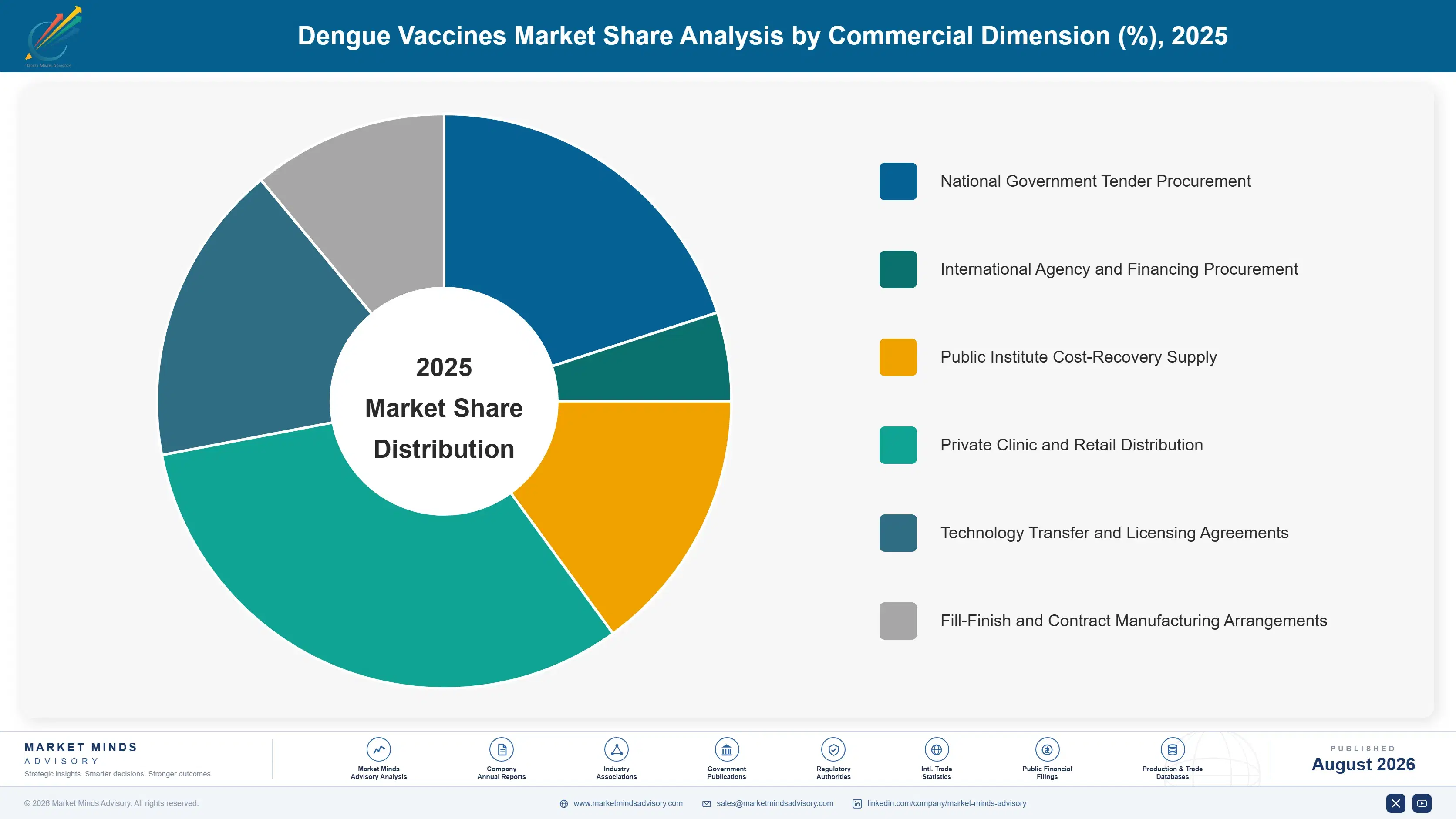
By Commercial Dimension

  • National Government Tender Procurement
  • International Agency and Financing Procurement
  • Public Institute Cost-Recovery Supply
  • Private Clinic and Retail Distribution
  • Technology Transfer and Licensing Agreements
  • Fill-Finish and Contract Manufacturing Arrangements

By Region

  • Latin America
  • South Asia and Pacific
  • East Asia
  • Western Europe
  • North America
  • Middle East and Africa
  • Eastern Europe

Scope, Methodology, and Coverage

Every figure in this report is reproducible from documented input assumptions. The scope below maps the historical period, the forecast horizon, the segmentation dimensions, and the countries covered, alongside the underlying primary and qualitative methodology.
Historical Period
2020 to 2025
Forecast Period
2026 to 2036
Base Year
2025 (USD billions; MMA Primary Research Dataset, August 2026)
Market Definition
This market comprises vaccines indicated for the prevention of dengue disease, measured at manufacturer or institute supply value across national government tender procurement, international agency and financing procurement, public institute cost-recovery supply, private clinic distribution, technology transfer arrangements and contract fill-finish supply. Coverage spans two-dose live-attenuated tetravalent vaccines, single-dose live-attenuated vaccines, chimeric yellow fever backbone vaccines, inactivated whole-virus vaccines, and subunit, viral vector and nucleic acid platform vaccines at licensure or advanced clinical stage. Dengue diagnostic tests and serological screening products, vector control products including insecticides and larvicides, mosquito population suppression and sterile insect technologies, antiviral or supportive therapeutics for dengue disease, vaccines against other flaviviruses including yellow fever, Japanese encephalitis and Zika, and health system service delivery costs fall outside scope.
Quantitative Units
USD millions (current prices); doses supplied by product class; licensed manufacturing capacity; average procurement price per dose; national programmes operating; regimen completion rate
Segmentation Dimensions
By Vaccine Product Class; By End-Use Industry; By Commercial Dimension; By Region
Regions Covered
Latin America, South Asia and Pacific, East Asia, Western Europe, North America, Middle East and Africa, Eastern Europe
Countries Covered
Brazil, Argentina, Mexico, Colombia, Peru, Honduras, Indonesia, Philippines, Vietnam, Thailand, India, Malaysia, Bangladesh, Sri Lanka, Australia, China, Taiwan, Japan, South Korea, Singapore, United States, Puerto Rico, Canada, Germany, France, United Kingdom, Spain, Italy, Saudi Arabia, Sudan, Nigeria, Poland, and additional markets relevant to dengue vaccine analysis
Key Companies Profiled
Takeda, Instituto Butantan, Sanofi, Panacea Biotec, Serum Institute of India, Merck and Co., Bharat Biotech, Indian Immunologicals, Biological E, GSK, Johnson and Johnson, Valneva, Bio Farma, Sinovac Biotech, Walvax Biotechnology, Zydus Lifesciences, Hilleman Laboratories, Codagenix, Emergent BioSolutions, Sun Pharmaceutical Industries
Quantitative Methodology
Primary survey, n=3,800 respondents, Q4 2025, six countries; demand-side model with trade association cross-validation
Qualitative Methodology
47 expert interviews, Q4 2025; applied to validate demand model assumptions, identify emerging dynamics, and assess competitive positioning
Report Format
PDF and XLSX data workbook (Word format preview document)
Publisher
Market Minds Advisory
Report Code
MMA-2026-HLT-276
Published
August 2026
Contact
sales@marketmindsadvisory.com | www.marketmindsadvisory.com

Purchase the full Dengue Vaccines Market Report (2026 to 2036).

The full MMA report treats dengue vaccination as the supply-constrained market it actually is, modelling qualified manufacturing capacity as the binding determinant of volume rather than treating demand as the variable. It sizes five product classes and seven regions to 2036, covering doses supplied, procurement pricing, introduction timelines and capacity qualification separately so that public health output can be assessed alongside commercial value. Competitive assessment covers twenty suppliers on one consistent supply value basis, including non-commercial public manufacture. Cost exposure is traced through viral culture, release testing and cold chain. Four commercial levers and a strategic verdict close the report, grounded in 47 expert interviews and a 3,800-respondent survey.
Five vaccine product classes sized separately through 2036
Manufacturing capacity modelled as the binding volume constraint
Public institute cost-recovery supply separated from commercial revenue
Twenty suppliers assessed on one consistent supply basis
National programme introduction timelines mapped across endemic countries
Anonymised client engagement with tested strategic recommendations

Built For The People Who Decide

From boardroom strategy to bench-side execution, this report is read cover-to-cover by leaders shaping the next decade of their industry, turning demand scenarios, market dynamics and valuation benchmarks into decisions.
CXOs/ Presidents/ VPs/ Managers
M&A and Corporate Development
Strategy Teams and R&D Heads
Procurement and Product Directors
Regulatory and Compliance Leaders
Investor Relations and Equity Analysts