Market Minds Advisory
Dengue Fever Treatment Market

Dengue Fever Treatment Market: No Drug, Fluid Management, and the Antiviral That Might Arrive

After decades of effort there is still no drug for dengue, so a disease infecting a hundred million people a year is treated with fluids, paracetamol and very careful watching.

Lead Analyst

Alice Ballenger

Published

September 2026

Make Smarter Decisions with Customized Research Insights

Request a free sample report and evaluate market opportunities, growth trends, and competitive dynamics relevant to your business needs.

2025 MARKET VALUE$0.8BMarket Size 2025
2036 FORECAST VALUE$2.4BBase Case , 2026 to 2036
CAGR 2026 TO 20369.8 %Bull 11.0% / Bear 8.6%
INCREMENTAL OPPORTUNITY$1.4BNet 10- year value creation
EXPANSION MULTIPLE2.56x2036 value over 2026 base
Strategic Levers
M&A Pipeline
Regional Outlook
Country Rankings
Competitive Intelligence
Segmental Deep-dive
Call-Us : 91 93563 13602

Executive Snapshot and Market Trajectory

No antiviral is approved for dengue anywhere in the world. Treatment means fluid volume management, paracetamol and close observation, so this market sells supportive care into health systems that can afford very little of it. Nothing else at this disease burden looks remotely like it.
Direct-acting antivirals compound at 14.7%, a full 1.50x the market rate, from a base close to zero as pan-serotype inhibitors advance through late-stage study toward a first approval. South Asia and Pacific holds the largest share at 34%, far above the standard band, because India, Bangladesh, Indonesia and the Philippines together carry the heaviest case burden anywhere and treat it in hospital. Latin America follows closely on Brazil's record epidemics.
Concentration is low at 31% because the therapy is generic fluids, generic analgesia and blood products supplied largely by national services. Treatment costs roughly USD 68 per case against enormous volume, which inverts the value density of almost every other therapeutic category. Roughly 4.5% of symptomatic infections progress to severe disease and that small cohort consumes most of the spend, over an average admission running four days. Everyone else takes paracetamol and fluids by mouth.
Market Definition
This market covers products used in the clinical management of dengue fever, spanning intravenous fluids and volume replacement, analgesics and antipyretics, blood products and platelet concentrates, direct-acting antivirals in late-stage development, plant-derived and traditional preparations with regulatory approval, and supportive care and monitoring consumables, measured at manufacturer revenue. Dengue vaccines, diagnostic tests, vector control products, hospital service and bed-day charges, and general hospital equipment without dengue-specific application are excluded.
Base Year Value
$0.8B in 2025 (MMA Primary Research Dataset, August 2026)
Forecast Period
2026 to 2036, eleven discrete annual values
CAGR
9.8% base case. Bull 11.0%. Bear 8.6%.
Fastest Growth Segment
Direct-Acting Antivirals: 14.7% CAGR
Fastest Growth Country
Bangladesh: 16.4% CAGR
Fastest Growth Region
South Asia and Pacific: 11.8% CAGR
Largest Region
South Asia and Pacific: 34% of 2025 global value
Market Leaders
Baxter, B. Braun, Fresenius Kabi, Grifols, and Micro Labs. Source: MMA Primary Research Dataset, July 2026.
Primary Survey
n=3,800 procurement and R&D decision-makers, Q4 2025, six countries
Methodology
Demand-side build-up, cross-validated against public data, 47 expert interviews

Dengue Fever Treatment Market Forecast Scenarios

dengue-fever-treatment-market-size-forecast-scenario-1787304897945
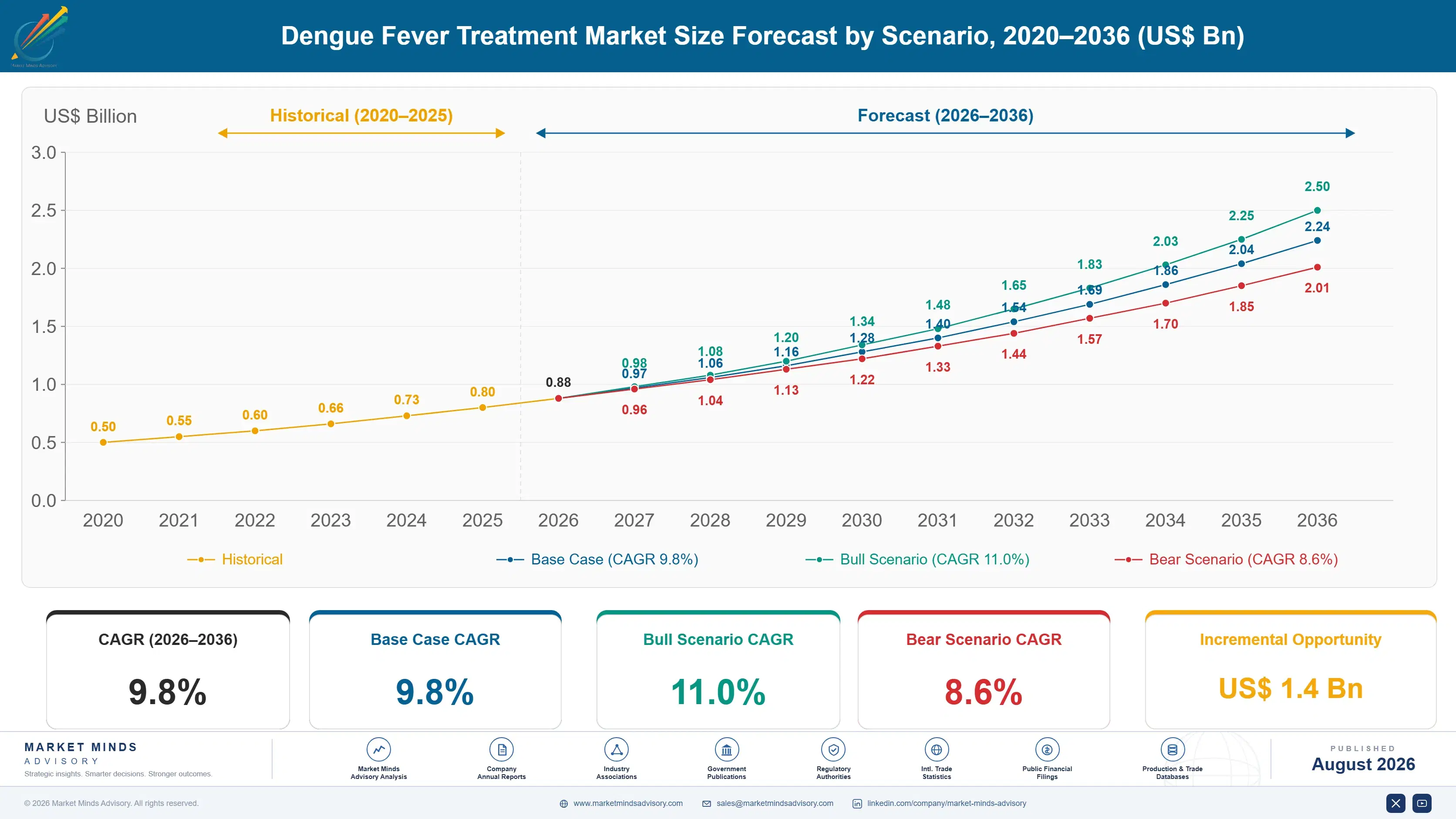
Growth ran near 8.4% from 2020 to 2025, and almost all of it came from case burden rather than from any therapeutic advance. Record epidemics struck Bangladesh, Brazil and much of Latin America, filling hospitals and consuming fluids, analgesia and blood products at volumes health systems had not planned for. Nothing new was approved to treat the disease across the entire period.
Base case growth of 9.8% rests on three mechanisms. Transmission keeps intensifying as warming and urbanisation extend vector range, which raises hospitalised case volume directly. Severe case management improves as more health systems adopt structured fluid protocols and monitoring, which raises spend per case. And pan-serotype antivirals advance through late-stage study, adding a product category that currently generates essentially no revenue at all. None of the three requires the others to arrive first.
The bull case at 11.0% assumes a direct-acting antiviral reaches approval and finds a price the endemic countries can actually pay, which would create a genuine therapeutic market where none exists. The bear case at 8.6% is pricing failure: an antiviral arrives at a price no high-burden system will fund, uptake stays confined to private care, and supportive management remains what patients receive.

Dengue Treatment: Fluids, Platelets and Absent Drugs

The most important thing to understand about this market is that the drug does not exist. Zero direct-acting antivirals are approved for dengue anywhere, and clinical management consists of measuring plasma leakage, replacing volume carefully and giving paracetamol. Everything sold into this category is supportive care, which explains why treatment costs roughly USD 68 per case against a disease infecting well over a hundred million people annually.
TOP FIVE CONCENTRATION31%Fragmented across fluid manufacturers, generic producers and national blood services
APPROVED ANTIVIRAL THERAPIES0 productsDirect-acting agents licensed for dengue by any regulator worldwide
SEVERE CASE RATE4.5%Symptomatic infections progressing to severe disease requiring intensive management
TREATMENT COST PER CASEUSD 68Blended product cost across hospitalised and ambulatory dengue management
AVERAGE HOSPITAL STAY4 daysTypical inpatient duration for admitted patients requiring fluid management
CASE FATALITY WITH CARE0.1%Deaths among severe cases receiving appropriate fluid management and monitoring
Fluid management is genuinely the therapy rather than an adjunct, and harder than it sounds. Too little volume and the patient goes into shock; too much and pulmonary oedema follows when plasma leakage reverses. Guidance from the World Health Organization concerns volume and timing rather than any medicine. Case fatality among severe patients falls to around 0.1% where that management is done well, and rises sharply where it is not.
One widely used intervention has notably weak support. Platelet transfusion is administered routinely for dengue thrombocytopenia across high-burden countries, and randomised evidence has repeatedly failed to show benefit from prophylactic transfusion in patients who are not bleeding. Practice has changed slowly regardless. It represents a substantial share of severe case cost, and the evidence to practice gap here is unusually wide.
"This is a hundred million case disease with a sixty eight dollar treatment cost and no drug. Any antiviral that works will face the same question every neglected disease product faces, which is whether the countries with the patients can pay what the developer needs."
Principal Analyst, Infectious Disease and Global Health Therapeutics Practice ·

Market Trends

Pan-serotype antivirals advance toward a first approval

Direct-acting inhibitors active across all four dengue serotypes have progressed through early clinical study with several programmes now in later-stage evaluation, targeting reduced viraemia and prevention of progression to severe disease. The segment compounds at 14.7% from a base of essentially nothing, since 0 such products are currently approved anywhere. The commercial question is not efficacy but price, because the countries carrying the burden fund treatment at roughly USD 68 per case across everything they currently use. Tiered pricing, volume commitments and international financing would all need assembling well before an approval rather than negotiated afterwards.
Market Impact: Bangladesh compounding at 16.4% ann
Structured fluid protocols raise spend per hospitalised case

Health systems across high-burden countries are adopting formal fluid management protocols with defined monitoring intervals, haematocrit tracking and stepped volume replacement, replacing the informal practice that produced widely variable outcomes. Case fatality among severe patients falls toward 0.1% where these are followed properly. Implementation raises consumption of crystalloid and colloid solutions, monitoring consumables and laboratory testing per admission, which lifts product spend even where case numbers hold steady. Too little volume and the patient progresses to shock; too much and pulmonary oedema follows when plasma leakage reverses during recovery. Protocol discipline rather than any product decides that outcome.
Market Impact: Severe disease affecting 4.5% of ca

Market Opportunities and Growth Drivers

Record epidemics overwhelm hospital capacity across endemic regions

Transmission has intensified sharply, with Bangladesh, Brazil and much of Latin America recording their heaviest years on record and hospitals converting general wards into dengue units during peak season. Bangladesh compounds at 16.4% as treatment capacity expands against that burden. Warming temperatures, urbanisation and expanding vector range are pushing transmission into areas that had little previously. Health ministries facing filled wards buy fluids, analgesia and blood products without any commercial persuasion required. Suppliers holding regional inventory capture surge volumes at prices well above contracted tender levels, because emergency purchasing bypasses normal procurement entirely.
Market Impact: Exactly 0 antivirals approved anywh

Severe disease management consumes disproportionate product volume

Roughly 4.5% of symptomatic infections progress to severe disease requiring intensive fluid management, monitoring and frequently blood product support, and that minority consumes the great majority of treatment spend. Average inpatient stay runs around four days for admitted patients. As case numbers rise the severe cohort rises with them in absolute terms, and health systems increasingly triage toward hospitalising the patients most likely to deteriorate rather than admitting broadly. The far larger ambulatory population takes oral fluids and paracetamol and generates almost no measurable revenue for anybody, which makes severity rather than incidence the commercially relevant denominator here.
Market Impact: Spending capped near USD 68

Market Restraints and Challenges

No approved antiviral exists after decades of development effort

Exactly 0 direct-acting agents are licensed for dengue by any regulator, so clinical management remains supportive in every setting worldwide. The root cause is a combination of four circulating serotypes requiring pan-serotype activity, a short viraemic window that limits treatment timing, and trial design difficulty in a self-limiting illness. Commercial impact is a category with no therapeutic value density at all. Participants are pursuing pan-serotype inhibitors, host-targeted approaches and prophylactic dosing in household contacts. None of those approaches has yet produced an approved product anywhere. Household contact prophylaxis is the newest approach under study.
Market Impact: Compounding at 14.7% each year

Treatment spend per case cannot support therapeutic pricing

Health systems currently fund dengue management at roughly USD 68 per case across fluids, analgesia, monitoring and blood products combined, and that figure reflects what high-burden middle-income countries can actually afford at epidemic scale. The root cause is that dengue burden and health system budget capacity are inversely distributed. Commercial impact will fall hardest on any antiviral seeking conventional pricing. Tiered pricing, international financing and volume commitments are the mechanisms under discussion. None of them can be assembled quickly once an approval has already arrived. Endemic country ministries would need engaging years ahead.
Market Impact: Fatality falling toward 0.1%
4 additional market trends, 3 additional growth drivers, and 2 additional restraints and challenges are covered in the full report. Contact sales@marketmindsadvisory.com to access the complete intelligence.

Segment CAGR and Growth Architecture

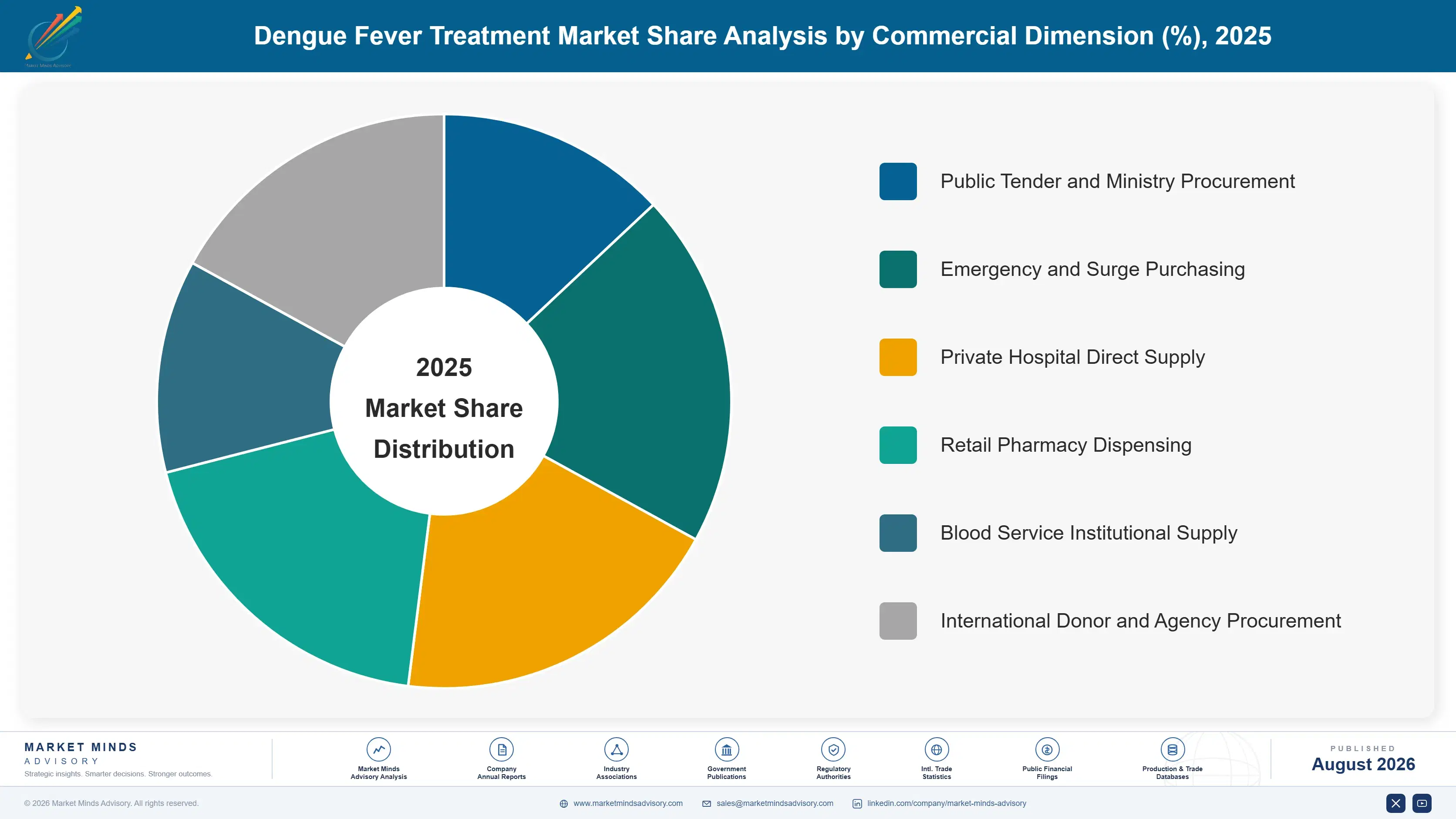
Segmentation follows product class used in clinical management, because class determines the manufacturing base, the regulatory pathway, the procurement route and what a health system will pay. Six product classes cover dengue treatment supply without overlap between them. Disease severity and care setting cut across every class at once and are treated here as use attributes rather than segments.
dengue-fever-treatment-market-market-share-analysis-1787304898527

Direct-Acting Antivirals

Growing at 14.7%, a full 1.50x the market rate, direct-acting antivirals represent the category's only genuine therapeutic prospect, with pan-serotype inhibitors advancing through clinical study toward what would be a first approval anywhere. Development difficulty has been considerable: four circulating serotypes demand pan-serotype activity, the viraemic window is short enough to limit treatment timing, and demonstrating benefit in a largely self-limiting illness requires very large trials. The unresolved question is commercial rather than scientific, since the countries carrying the burden fund all current treatment at roughly USD 68 per case. Tiered pricing and international financing arrangements would need agreeing with health ministries well before any launch. Nothing about the difficulty here is scientific.
CAGR 14.7%

Blood Products and Platelet Concentrates

Blood products grow at 11.8% as severe case volumes rise with overall transmission, covering platelet concentrates, fresh frozen plasma and whole blood used in patients with significant thrombocytopenia or bleeding. The uncomfortable fact is that randomised evidence has repeatedly failed to demonstrate benefit from prophylactic platelet transfusion in patients who are not actively bleeding, and practice has nonetheless changed very slowly across high-burden countries. National blood services supply most volume, which makes this a public sector procurement question rather than a commercial one across much of the endemic world. Budget pressure across those services is now beginning to close the gap between the published evidence and routine practice, which would reduce consumption materially without any clinical harm.
CAGR 11.8%
Full segment breakdown across 6 segments available in the complete report.

Regional Architecture and Country Demand Map

Regional shares follow where dengue actually is rather than where health spending sits, so this market appears in almost the opposite places to most therapeutic categories. Note: several regional positions fall outside standard bands accordingly. Reading health expenditure statistics gives an entirely misleading picture of where this demand actually sits.

South Asia and Pacific

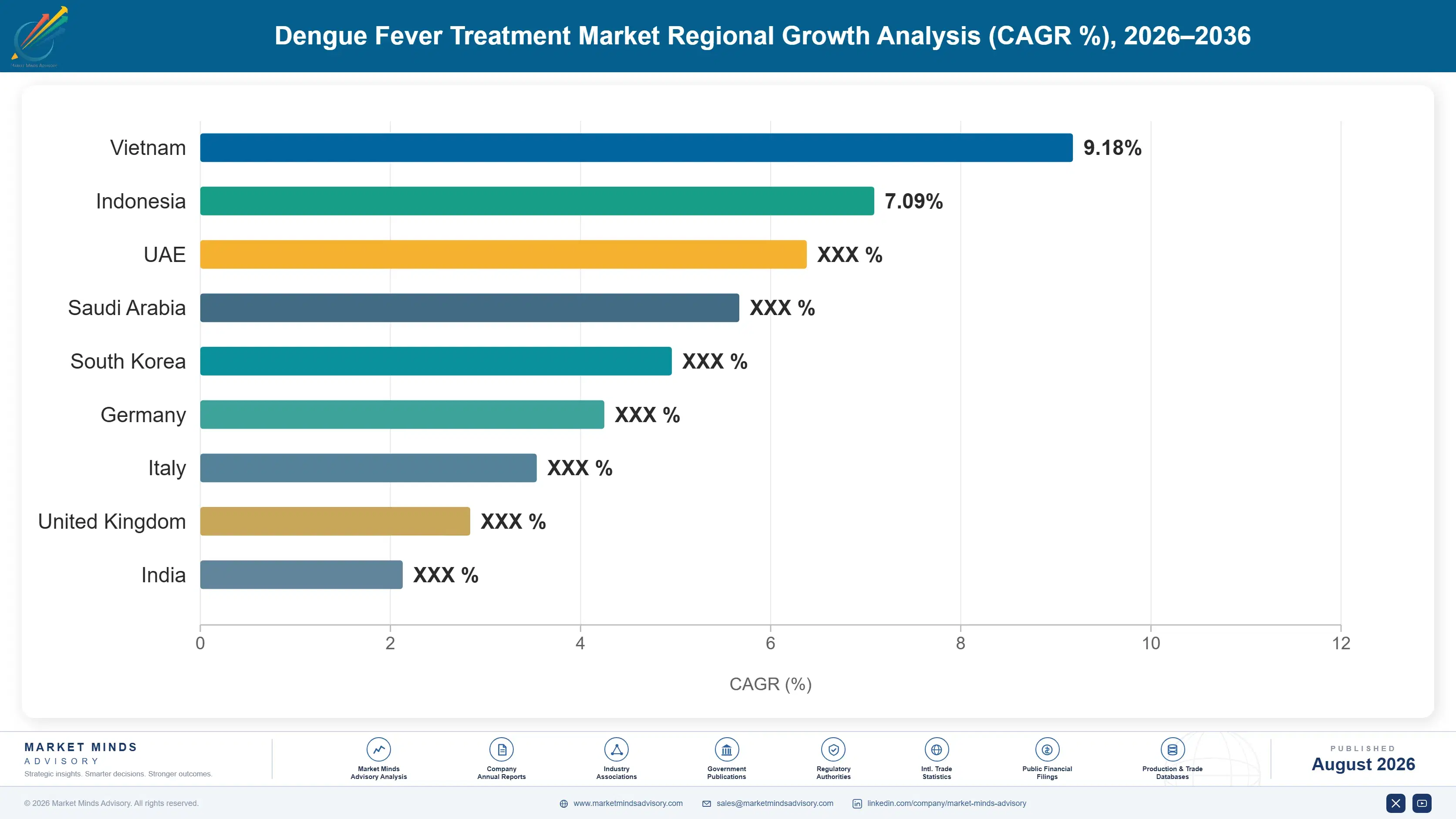
The largest share at 34% and the fastest regional growth at 11.8%. Note: this greatly exceeds the standard band because India, Bangladesh, Indonesia, the Philippines and Vietnam together carry the heaviest dengue burden anywhere and hospitalise a substantial proportion of symptomatic cases. Bangladesh compounds at 16.4% as treatment capacity expands against record epidemics. Indian regulation approved a papaya leaf extract for dengue thrombocytopenia on evidence Western regulators would not accept, making it the only widely marketed dengue-specific product anywhere in the world. Domestic manufacture of fluids and generics covers regional demand almost entirely. Emergency surge purchasing bypasses tender arrangements during peak transmission months, and suppliers holding regional inventory capture that volume at prices well above contracted levels.
Share: 34% | CAGR: 11.8% (2026 to 2036)

Latin America

Twenty-eight per cent of value, growing at 10.4%. Note: this far exceeds the standard band because Brazil recorded case numbers in the millions during its heaviest year and the wider region experienced simultaneous epidemics across most member countries. Brazilian public health infrastructure hospitalises severe cases at scale and consumes fluids, monitoring consumables and blood products accordingly. Argentina, Peru, Colombia and Mexico all recorded substantial outbreaks. Regional manufacturing of intravenous fluids and generic analgesia supplies most demand without significant import dependence. Brazil compounds fastest within the region as public hospital capacity expands against recurring epidemic seasons, and emergency procurement there bypasses normal tender processes during peak transmission months. Blood service capacity is the binding constraint during peaks.
Share: 28% | CAGR: 10.4% (2026 to 2036)
Regional intelligence for 5 additional markets available in the complete report: East Asia, Western Europe, North America, Middle East and Africa, Eastern Europe. Contact sales@marketmindsadvisory.com.
dengue-fever-treatment-market-country-cagr-analysis-1787304899044

Where Dengue Treatment Value Can Exist

There is no drug, health systems spend roughly USD 68 per case, and the countries with the patients have the least money. Value therefore depends on supplying the supportive care that constitutes actual treatment, and on solving the pricing problem before any antiviral arrives. Very little about this category behaves like a therapeutic market.

Supply the fluid management that is the actual therapy

Volume replacement is the treatment rather than an adjunct to one, and health systems consume crystalloid and colloid solutions, giving sets and monitoring consumables in proportion to admitted cases rather than to any prescribing decision. Structured protocols raise consumption per admission while cutting severe case fatality toward 0.1%. Suppliers positioned in endemic country hospital procurement capture epidemic surge demand directly, and that demand arrives without any promotional effort at all. Regional manufacturing rather than commercial effort decides who supplies it, because freight on a heavy low-value product settles most tender awards before anything else is considered.
Market Impact: Severe fatality falls toward 0.1% u

Solve antiviral pricing before the product arrives

Exactly 0 antivirals are approved for dengue, and the countries carrying the burden currently fund all treatment at roughly USD 68 per case combined. A therapeutic priced on conventional pharmaceutical logic will reach private care in Singapore and Brazil and nowhere else. Tiered pricing agreed with high-burden health ministries before launch, volume commitments and international financing arrangements each address that, and none of them can be assembled quickly after an approval arrives. Burden and budget capacity are inversely distributed across the endemic world, which is the whole difficulty. Nobody has solved it yet.
Market Impact: Health systems funding only USD 68

Build surge supply capability for epidemic seasons

Dengue arrives in waves rather than steadily, and hospitals convert general wards into dengue units within weeks when transmission peaks, consuming several months of normal fluid and consumable volume in that period. Bangladesh compounds at 16.4% largely on this pattern. Suppliers holding regional inventory, flexible manufacturing allocation and established emergency procurement relationships capture that demand while competitors are still arranging shipment from another continent entirely. Emergency purchasing bypasses tender processes entirely and pays well above contracted levels, which makes positioned inventory considerably more valuable than an additional tender win. Carrying cost is modest against that.
Market Impact: Surge market is growing at 16.4% ev

Address the platelet transfusion evidence gap directly

Prophylactic platelet transfusion in non-bleeding dengue patients has repeatedly failed to demonstrate benefit in randomised study, yet it remains routine across high-burden countries and consumes a meaningful share of the severe case cost within a 4.5% severe cohort. Blood services and health ministries under budget pressure will eventually act on that evidence. Suppliers and clinical partners engaging with the question now shape the transition rather than being surprised by it later. Several national blood service directors expect policy change within the forecast period on budget grounds alone. Engaging now shapes that transition.
Market Impact: Severe cohort covering 4.5% of all

Who Controls the Margin Pool

Concentration is low at 31% across the top five, measured on annual revenue from products used in dengue clinical management, the single basis applied throughout this analysis. Baxter, B. Braun and Fresenius Kabi lead on intravenous fluid supply, which is the actual therapy, while Grifols and Micro Labs hold positions in plasma-derived products and in the papaya leaf extract approved in India respectively.
Competition looks nothing like a normal therapeutic market. Fluid manufacturers compete on delivered cost, regional manufacturing presence and tender terms against a product that is chemically identical between suppliers. Analgesia is generic paracetamol at pennies per dose. Blood products are supplied largely by national services rather than commercially. Antiviral developers compete for a market that does not yet exist and may not be affordable when it does.

Pressure builds from two directions that rarely coincide. Domestic manufacturers across India, Brazil, China and Indonesia supply fluids and generics at costs multinational producers cannot approach, and they hold most endemic country volume already. Separately, an approved antiviral would reorganise the category entirely. Rankings shift most if a therapeutic reaches approval at a price that high-burden health systems can genuinely fund at epidemic scale.
dengue-fever-treatment-market-company-positioning-matrix-1787304899566

Competitive Moat and Risk Dimensions

BAXTER

Moat: Global intravenous fluid manufacturing

Manufacturing intravenous solutions at scale across multiple continents with regional plants close to endemic demand gives Baxter the ability to serve epidemic surges when transport from distant facilities would arrive too late. Established hospital procurement relationships and registration across many endemic markets took years to build and cannot be assembled quickly by a competitor responding to an outbreak.
BAXTER

Risk: Domestic manufacturer cost competition

Intravenous fluids are chemically identical between suppliers and domestic manufacturers across India, Brazil, China and Indonesia produce them at costs multinational producers cannot approach in tender processes. Freight economics for a low-value high-volume product favour local production decisively. Public procurement in endemic markets decides almost entirely on delivered price.
B. BRAUN

Moat: Integrated infusion system supply

Supplying solutions alongside giving sets, pumps and monitoring consumables lets B. Braun serve a hospital's whole fluid management requirement rather than one component, which matters when a ward is converted for dengue admissions during a surge. Manufacturing presence across several endemic regions supports responsiveness that distant supply chains cannot match during peak transmission seasons.
B. BRAUN

Risk: Low value per case exposure

Revenue depends on a category where health systems fund total treatment at roughly USD 68 per case, leaving very little margin available across any component of supply. Public tender procurement compresses pricing continuously. An approved antiviral would redirect scarce health budget toward therapy and away from supportive care consumables.

Players Tracked

Prominent Players

Baxter
B. Braun
Fresenius Kabi
Grifols
Micro Labs

Other Key Players

Otsuka Pharmaceutical
Nipro
Terumo
Johnson and Johnson
Novartis
Sanofi
Cipla
Sun Pharmaceutical Industries
Dr Reddys Laboratories
Kedrion Biopharma
Octapharma
Hetero Labs
Zydus Lifesciences
Macleods Pharmaceuticals
Aurobindo Pharma

Recent Developments

MARCH 2025

Pan-serotype antiviral programmes advance through later-stage clinical study

Direct-acting inhibitors active against all four dengue serotypes progressed through further clinical evaluation, examining reduced viraemia and prevention of progression to severe disease, an evidence development rather than any corporate transaction between developers. Demonstrating benefit in a largely self-limiting illness requires very large trial populations.
Signal: A first approved dengue therapeutic would
AUGUST 2025

Record epidemic seasons convert general wards into dengue units

Hospitals across Bangladesh, Brazil and several Southeast Asian countries converted general medical wards into dedicated dengue management units during peak transmission, consuming several months of normal fluid and consumable volume within a matter of weeks. Emergency purchasing bypassed contracted tender arrangements entirely throughout those periods.
Signal: Surge capability rather than contracted an
JANUARY 2026

Blood services review prophylactic platelet transfusion practice in dengue

National blood services across several high-burden countries began reviewing prophylactic platelet transfusion practice in non-bleeding dengue patients, responding to accumulated randomised evidence showing no demonstrable benefit and to sustained budget pressure on supply. Practice has nonetheless changed slowly across most high-burden countries. Supply pressure across collecting services compounded the review.
Signal: Evidence and clinical practice have diverg

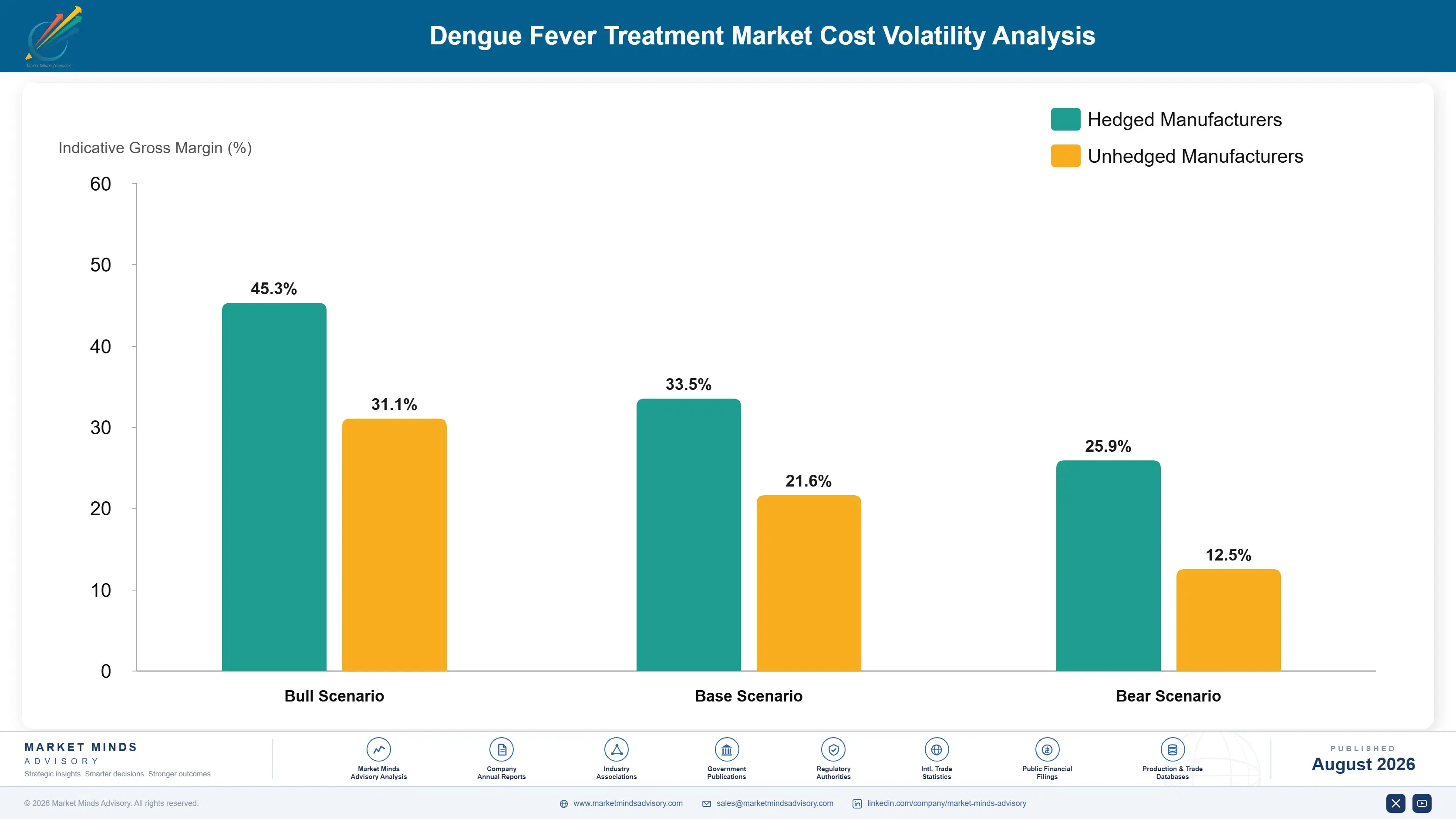
Solution, Packaging and Cold Chain Exposure

Intravenous fluid economics are dominated by things other than the medicine. Water purification, sodium chloride and dextrose account for a small fraction of cost, while flexible plastic containers, overwrap film and sterilisation together represent roughly 51% of cost of goods, sourced from medical polymer producers concentrated in Western Europe, the United States and increasingly Asia. Freight is the other dominant cost, since these are heavy low-value products travelling badly.
Medical grade resin availability tightened materially through 2021 and 2022 as several producers withdrew from medical applications entirely, and intravenous solution manufacturers found themselves requalifying container materials under considerable time pressure. Manufacturer annual reports across the period documented supply disruption and subsequent inventory building. Blood product supply faced separate constraints as donation rates fell and recovered unevenly across most collecting countries. Recovery has been uneven across most collecting countries since.

Exposure varies most by manufacturing location relative to demand. Producers with plants inside endemic regions carry local input and freight costs, while those shipping from distant facilities carry freight that can exceed the product value on low-concentration solutions. Geography compounds it further: Indian, Brazilian, Chinese and Indonesian manufacturers operate at cost structures that make imported fluids uncompetitive in endemic tenders.
dengue-fever-treatment-market-cost-volatility-analysis-1787304899761

Locate solution manufacturing inside endemic demand regions

Intravenous solutions are heavy, low in value and travel badly, so freight from a distant plant can approach or exceed the product value itself on standard crystalloid presentations. Regional manufacturing removes that entirely and enables surge response during epidemic seasons when shipping schedules cannot help. The capital requirement is modest against the tender volumes it makes accessible.

Qualify alternate container polymer grades in advance

Several medical resin producers exited the segment because liability exposure outweighed modest volumes, and solution manufacturers discovered the dependency only when supply stopped arriving. Containers and overwrap represent roughly half of cost of goods, so the exposure is material. Qualifying alternate grades during ordinary conditions costs validation and filing work rather than any capital investment.

Hold regional inventory positioned against seasonal transmission

Dengue arrives in predictable seasonal waves, and hospitals consume several months of normal volume within weeks when transmission peaks in a given country. Inventory positioned regionally ahead of season captures that demand while competitors arrange shipment. Carrying cost is modest against the tender relationships that reliable surge supply secures afterwards. Seasonality here is predictable enough to plan against.

Portfolio Architecture for Margin Defence

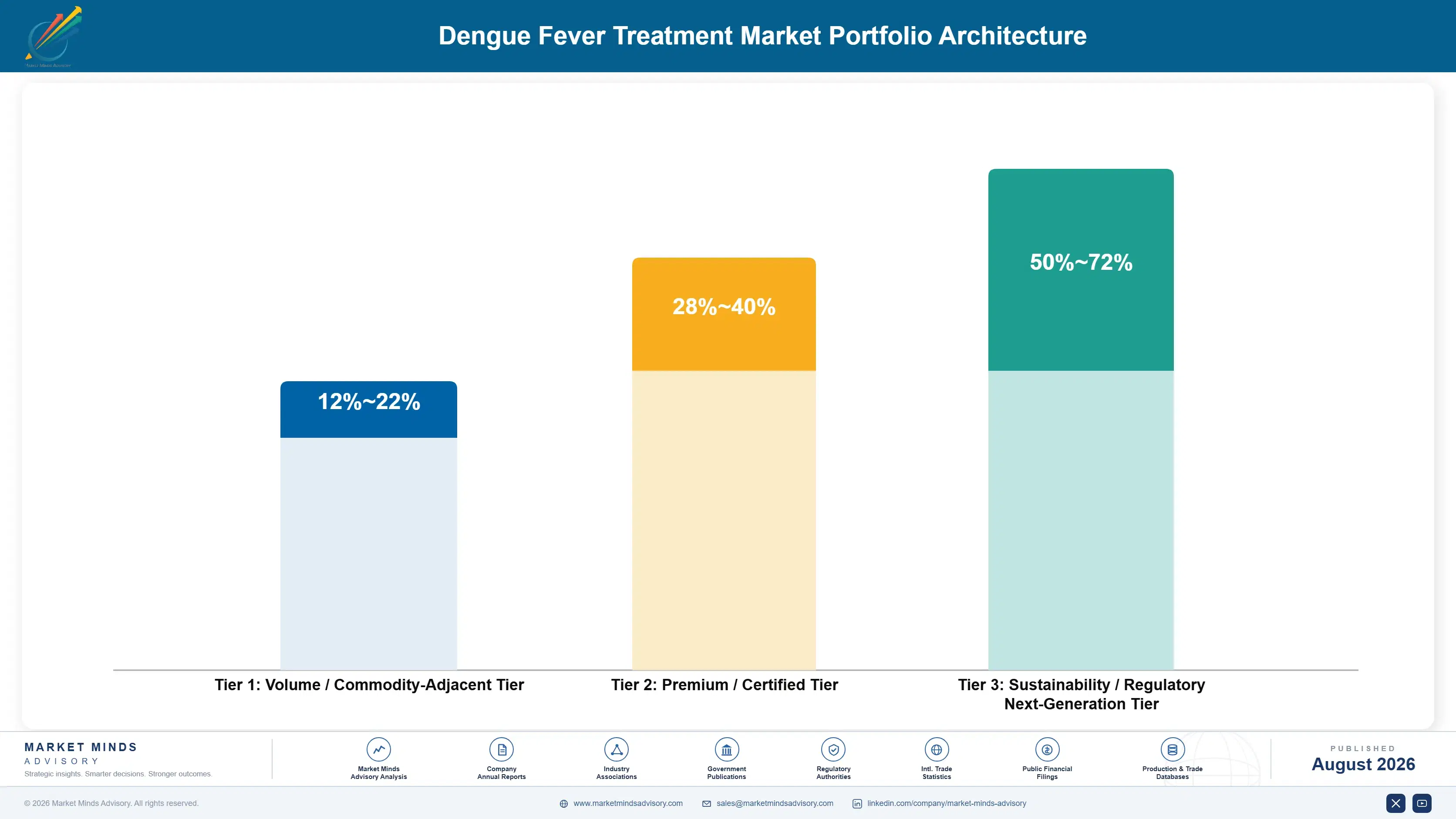
Margin architecture here is compressed almost everywhere. Intravenous solutions and generic paracetamol earn commodity margins on enormous volumes, decided by tender pricing against domestic producers with lower cost structures. Blood products move largely through national services at cost recovery rather than commercially. Monitoring consumables and specialised colloid solutions earn somewhat better. Nothing in the category currently earns therapeutic margins, because nothing in it is a therape
The volume against premium tension is unusually stark. Endemic countries generate essentially all the case volume at roughly USD 68 per case in total product spend, while travel-acquired cases in Europe and North America receive intensive management at many times that cost across very small numbers. Neither pattern supports a business on its own, and serving both requires accepting that the profitable patients are almost entirely irrelevant to disease burden.

High-value pools would concentrate around an approved antiviral if one arrives at a fundable price, and around surge supply capability in the meantime. Regional manufacturing positions, established emergency procurement relationships and specialised colloid and monitoring products all hold value that commodity crystalloid supply does not. Imported standard solutions, whatever their quality, lose endemic tenders to domestic producers on freight arithmetic alone.

Volume / Commodity-Adjacent Tier

Standard crystalloid solutions and generic paracetamol supplied through public tender in endemic countries, competing against domestic manufacturers whose freight and production cost structures imported product cannot approach at all. Freight settles most of these awards.
Gross Margin: 12-22%

Premium / Certified Tier

Colloid solutions, integrated infusion systems and monitoring consumables supplied into structured fluid management protocols, protected by clinical familiarity and by the system compatibility that hospitals will not readily disrupt. Intensive care clinicians hold genuine preference here.
Gross Margin: 28-40%

Sustainability / Regulatory / Next-Generation Tier

Direct-acting antivirals in late-stage development and approved dengue-specific preparations, where pricing is entirely unresolved because no product has yet had to meet endemic country affordability in practice. Nothing in this tier currently generates meaningful revenue.
Gross Margin: 50-72%
dengue-fever-treatment-market-portfolio-architecture-1787304900278

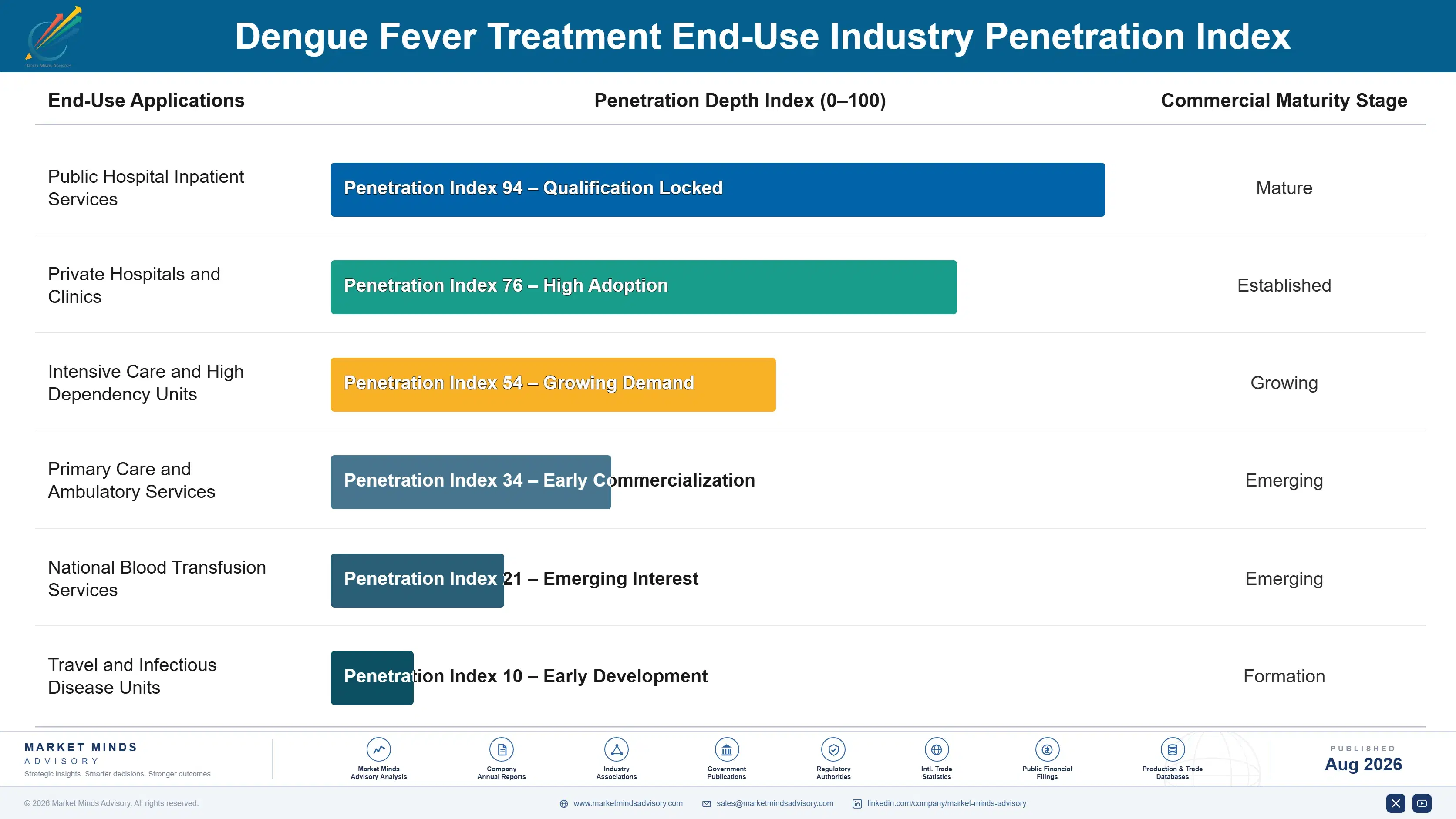
Seasonal Surges and Severity Concentration

Demand here is seasonal and episodic rather than continuous, which removes the predictability that most therapeutic categories rely upon. Transmission peaks with rainfall and vector density, hospitals convert wards within weeks, and consumption compresses several months of normal volume into a short window. Between seasons the same institutions buy very little. Forecasting therefore means forecasting transmission rather than any prescribing pattern or treated population.
Consumption concentrates sharply by severity rather than by case count. Roughly 4.5% of symptomatic infections progress to severe disease requiring intensive fluid management, monitoring and frequently blood products, and that small cohort consumes the great majority of product spend across a four day average admission. The far larger ambulatory population takes paracetamol and fluids by mouth, generating almost no measurable revenue for anybody supplying the category.

Purchasing profiles differ from most therapeutic markets entirely. Health ministry procurement agencies and public hospital tender committees buy fluids and generics on delivered price, with clinicians having little influence over supplier selection. National blood services operate as separate institutions with their own budgets and evidence review. Private hospitals in Singapore, Brazil and Gulf states represent a small high-value segment behaving quite differently from everything around it.
dengue-fever-treatment-market-end-use-penetration-index-1787304900770

Where Dengue Treatment Strategy Lands

These are among the four positions where our research anticipates prominent divergence between winners and laggards over the coming forecast period. Each is grounded in the demand model, the regulatory perimeter, and the announced capacity pipeline.
01 / SUPPORTIVE CARE REALITY

Fluid management is the therapy, not an adjunct

Exactly 0 direct-acting antivirals have been approved for dengue anywhere in the world to date, so clinical management consists of measuring plasma leakage, replacing fluid volume very carefully and administering paracetamol while watching closely for deterioration. Case fatality among severe patients falls toward 0.1% wherever structured fluid protocols are followed properly, and it rises very sharply where they are not. Commercial positioning built around any therapeutic proposition badly misreads a category in which supportive care genuinely constitutes the entirety of available treatment.
02 / AFFORDABILITY BEFORE APPROVAL

An antiviral priced conventionally reaches almost nobody

High-burden health systems currently fund the entire clinical management of a single dengue case at roughly USD 68, covering fluids, analgesia, monitoring and blood products together across an admission averaging four days. A therapeutic priced on conventional pharmaceutical logic would reach private care in a handful of wealthier endemic cities and essentially nowhere else at all. Tiered pricing, volume commitments and international financing arrangements must all be assembled well before approval, because none of them can be arranged quickly afterwards.
03 / SURGE RESPONSE CAPABILITY

Epidemic weeks decide the year's supply relationships

Dengue arrives in seasonal waves rather than steadily, and hospitals across endemic countries convert general medical wards into dedicated dengue units within weeks, consuming several months of normal fluid and consumable volume across that one compressed period. Bangladesh compounds at 16.4% substantially on exactly that pattern of episodic and highly compressed seasonal surge demand. Suppliers holding regional manufacturing capacity, pre-positioned inventory and established emergency procurement relationships capture that entire volume while their more distant competitors are still arranging international shipment.
04 / TRANSFUSION EVIDENCE GAP

Routine platelet practice will not survive budget pressure

Prophylactic platelet transfusion in non-bleeding dengue patients has now repeatedly failed to demonstrate any benefit at all in randomised study, and yet it remains entirely routine across high-burden countries, where it consumes a meaningful share of the cost within a 4.5% severe cohort. National blood services facing sustained supply constraints and budget pressure have now begun reviewing that practice directly. Participants engaging seriously with that accumulated evidence now will help shape the eventual transition rather than being caught out by it later.

Engagement Snapshot From the Field

A live engagement with an industry participant carrying material or product regulatory and market exposure ahead of a defining policy shift, showing how our research translates into a defensible multi-year portfolio strategy.
MARKET MINDS ADVISORY · CLIENT ENGAGEMENT SUMMARY
Dengue Fever Treatment Producer Strategic Portfolio Review and Transition Roadmap 2026·Investment Scenario on Dengue Fever Treatment Exposure Evaluation 2025-26
CLIENT PROFILE
An intravenous solutions manufacturer supplying crystalloid and colloid products across Southeast Asian and Latin American markets from two regional plants, with an established hospital tender presence. Annual revenue attributable to dengue management was approximately USD 41 million (client-reported, unverified by MMA), concentrated in public sector tenders won largely on delivered price rather than on any differentiation.
STRATEGIC CHALLENGE
Tender pricing had eroded steadily against domestic manufacturers with lower cost structures, while epidemic surges repeatedly exceeded the client's allocated volumes and were filled by competitors with regional inventory. The board needed to decide whether to compete further on manufacturing cost, invest in surge supply capability, or expand into colloids and monitoring consumables carrying better margins.
MMA APPROACH
MMA conducted 47 expert interviews spanning hospital procurement officers, infectious disease physicians, intensive care clinicians, health ministry supply managers, national blood service directors and emergency procurement coordinators across six countries. A quantitative survey of 3,800 respondents established treatment protocol adherence, procurement decision criteria and surge purchasing behaviour. We then modelled revenue outcomes under cost competition, surge investment and portfolio expansion strategies against observed epidemic patterns.
KEY FINDINGS
  1. Procurement officers in five of six markets awarded standard crystalloid tenders on delivered price alone, and none reported that supplier reputation or quality had influenced an award.
  2. Emergency surge purchasing bypassed normal tender processes entirely, and suppliers able to deliver within days captured volumes at prices well above contracted tender levels.
  3. Intensive care clinicians reported meaningful preference between colloid presentations and monitoring systems, an influence they held nowhere in standard crystalloid purchasing at all.
  4. National blood service directors had begun questioning prophylactic platelet transfusion practice, and several expected policy change within the forecast period entirely on budget grounds.
CLIENT PROFILE
An intravenous solutions manufacturer supplying crystalloid and colloid products across Southeast Asian and Latin American markets from two regional plants, with an established hospital tender presence. Annual revenue attributable to dengue management was approximately USD 41 million (client-reported, unverified by MMA), concentrated in public sector tenders won largely on delivered price rather than on any differentiation.
STRATEGIC CHALLENGE
Tender pricing had eroded steadily against domestic manufacturers with lower cost structures, while epidemic surges repeatedly exceeded the client's allocated volumes and were filled by competitors with regional inventory. The board needed to decide whether to compete further on manufacturing cost, invest in surge supply capability, or expand into colloids and monitoring consumables carrying better margins.
MMA APPROACH
MMA conducted 47 expert interviews spanning hospital procurement officers, infectious disease physicians, intensive care clinicians, health ministry supply managers, national blood service directors and emergency procurement coordinators across six countries. A quantitative survey of 3,800 respondents established treatment protocol adherence, procurement decision criteria and surge purchasing behaviour. We then modelled revenue outcomes under cost competition, surge investment and portfolio expansion strategies against observed epidemic patterns.
KEY FINDINGS
  1. Procurement officers in five of six markets awarded standard crystalloid tenders on delivered price alone, and none reported that supplier reputation or quality had influenced an award.
  2. Emergency surge purchasing bypassed normal tender processes entirely, and suppliers able to deliver within days captured volumes at prices well above contracted tender levels.
  3. Intensive care clinicians reported meaningful preference between colloid presentations and monitoring systems, an influence they held nowhere in standard crystalloid purchasing at all.
  4. National blood service directors had begun questioning prophylactic platelet transfusion practice, and several expected policy change within the forecast period entirely on budget grounds.
RECOMMENDED STRATEGY
Phase 1: Phase one: build regional inventory positioned ahead of seasonal transmission peaks, capturing emergency surge purchasing that bypasses tender pricing entirely. Phase 2: Phase two: expand into colloid presentations and monitoring consumables where intensive care clinicians hold genuine preference and margins are considerably better. Phase 3: Phase three: concede standard crystalloid tenders where domestic manufacturers hold permanent freight and production cost advantages rather than defending them.
OUTCOME
The client established pre-positioned regional inventory across four markets, expanded its colloid and monitoring consumable range, and withdrew from several standard crystalloid tenders (client-reported, unverified by MMA). Surge revenue exceeded plan substantially during the following epidemic season, blended margin improved by several points, and two intensive care networks adopted the expanded range.

Frequently Asked Questions

Foundational context covering the market sizes, CAGR, scope, country, region and competition that inform every finding below. This section is provided to cover basics and most often pre-purchase conversations, answered from the MMA Primary Research Dataset.

What is the current size of the Dengue Fever Treatment Market?

The global dengue fever treatment market was valued at USD 0.85 billion in 2025, spanning intravenous fluids, analgesia, blood products, antivirals in development and supportive consumables. No direct-acting antiviral is approved anywhere.

How large will the Dengue Fever Treatment Market be by 2036?

MMA forecasts the market at USD 2.38 billion by 2036, expanding 2.56 times from the 2026 base of USD 0.93 billion. That represents roughly USD 1.45 billion of incremental value across the forecast decade.

What is the CAGR for the Dengue Fever Treatment Market 2026 to 2036?

The base case compound annual growth rate is 9.8%, with a bull case of 11.0% and a bear case of 8.6%. The bull case assumes an antiviral reaches approval at a price endemic countries can fund.

Which segment is growing fastest?

Direct-acting antivirals grow at 14.7%, a full 1.50x the overall market rate, from a base close to zero. Pan-serotype inhibitors are advancing toward what would be a first approval anywhere.

Who are the major companies in the Dengue Fever Treatment Market?

Baxter, B. Braun, Fresenius Kabi, Grifols and Micro Labs together hold 31% of revenue, leading in intravenous fluids, plasma products and the papaya leaf extract approved in India.

Which country is growing fastest?

Bangladesh grows fastest at 16.4%, as treatment capacity expands against record epidemic seasons. South Asia and Pacific is the largest region at 34% of value on case burden alone.

Report Segmentation Architecture

The full report scope spans multiple orthogonal segmentation dimensions, with cross-tabulated demand data provided for each dimension pair. Coverage extends further to regional breakdowns, trend trajectories, and the competitive detail needed to support segment-level decision-making.

By Product Class

  • Intravenous Fluids and Volume Replacement
  • Analgesics and Antipyretics
  • Blood Products and Platelet Concentrates
  • Direct-Acting Antivirals
  • Plant-Derived and Traditional Preparations
  • Supportive Care and Monitoring Consumables

By End-Use Industry

  • Public Hospital Inpatient Services
  • Private Hospitals and Clinics
  • Intensive Care and High Dependency Units
  • Primary Care and Ambulatory Services
  • National Blood Transfusion Services
  • Travel and Infectious Disease Units

By Commercial Dimension

  • Public Tender and Ministry Procurement
  • Emergency and Surge Purchasing
  • Private Hospital Direct Supply
  • Retail Pharmacy Dispensing
  • Blood Service Institutional Supply
  • International Donor and Agency Procurement

By Region

  • South Asia and Pacific
  • Latin America
  • East Asia
  • Western Europe
  • North America
  • Middle East and Africa
  • Eastern Europe

Scope, Methodology, and Coverage

Every figure in this report is reproducible from documented input assumptions. The scope below maps the historical period, the forecast horizon, the segmentation dimensions, and the countries covered, alongside the underlying primary and qualitative methodology.
Historical Period
2020 to 2025
Forecast Period
2026 to 2036
Base Year
2025 (USD billions; MMA Primary Research Dataset, August 2026)
Market Definition
This market comprises products used in the clinical management of dengue fever, measured at manufacturer revenue across public tender and ministry procurement, emergency and surge purchasing, private hospital direct supply, retail pharmacy dispensing, blood service institutional supply and international agency procurement. Coverage spans intravenous crystalloid and colloid solutions with associated giving sets used in volume replacement, analgesics and antipyretics indicated in dengue management, blood products including platelet concentrates, fresh frozen plasma and whole blood, direct-acting antivirals in late-stage clinical development, plant-derived and traditional preparations holding national regulatory approval for dengue indications, and supportive care and haematocrit monitoring consumables. Dengue vaccines, diagnostic and serological testing products, vector control products including insecticides and mosquito suppression technologies, hospital bed-day and service charges, general hospital equipment without dengue-specific application, and vaccines or therapeutics for other flaviviruses fall outside scope.
Quantitative Units
USD millions (current prices); treated cases by severity; product volumes consumed per admission; treatment cost per case; hospitalisation duration; severe case rate; blood product units supplied
Segmentation Dimensions
By Product Class; By End-Use Industry; By Commercial Dimension; By Region
Regions Covered
South Asia and Pacific, Latin America, East Asia, Western Europe, North America, Middle East and Africa, Eastern Europe
Countries Covered
India, Bangladesh, Indonesia, Philippines, Vietnam, Thailand, Malaysia, Sri Lanka, Australia, Brazil, Argentina, Colombia, Peru, Mexico, Honduras, Paraguay, China, Taiwan, Japan, Singapore, United States, Puerto Rico, Canada, France, Italy, Spain, Germany, Saudi Arabia, Sudan, Nigeria, Poland, and additional markets relevant to dengue management analysis
Key Companies Profiled
Baxter, B. Braun, Fresenius Kabi, Grifols, Micro Labs, Otsuka Pharmaceutical, Nipro, Terumo, Johnson and Johnson, Novartis, Sanofi, Cipla, Sun Pharmaceutical Industries, Dr Reddys Laboratories, Kedrion Biopharma, Octapharma, Hetero Labs, Zydus Lifesciences, Macleods Pharmaceuticals, Aurobindo Pharma
Quantitative Methodology
Primary survey, n=3,800 respondents, Q4 2025, six countries; demand-side model with trade association cross-validation
Qualitative Methodology
47 expert interviews, Q4 2025; applied to validate demand model assumptions, identify emerging dynamics, and assess competitive positioning
Report Format
PDF and XLSX data workbook (Word format preview document)
Publisher
Market Minds Advisory
Report Code
MMA-2026-HLT-332
Published
August 2026
Contact
sales@marketmindsadvisory.com | www.marketmindsadvisory.com

Purchase the full Dengue Fever Treatment Market Report (2026 to 2036).

The full MMA report treats dengue management as the supportive care market it actually is, quantifying what health systems spend when no therapeutic exists and what would change if one arrived. It sizes six product classes and seven regions to 2036, modelling treated cases by severity, product consumption per admission, treatment cost per case and seasonal surge patterns separately. Competitive assessment covers twenty suppliers on one consistent revenue basis. Cost exposure is traced through solution, container and freight inputs. Four commercial levers and a strategic verdict close the report, grounded in 47 expert interviews and a 3,800-respondent survey.
Six product classes sized separately through 2036
Severe case consumption separated from ambulatory management entirely
Seasonal surge demand modelled against contracted tender volumes
Twenty suppliers assessed on one consistent revenue basis
Antiviral affordability tested against endemic health system capacity
Anonymised client engagement with tested strategic recommendations

Built For The People Who Decide

From boardroom strategy to bench-side execution, this report is read cover-to-cover by leaders shaping the next decade of their industry, turning demand scenarios, market dynamics and valuation benchmarks into decisions.
CXOs/ Presidents/ VPs/ Managers
M&A and Corporate Development
Strategy Teams and R&D Heads
Procurement and Product Directors
Regulatory and Compliance Leaders
Investor Relations and Equity Analysts