Market Minds Advisory
Demand for DFB Narrow Linewidth Single Frequency Lasers in UK

Demand for DFB Narrow Linewidth Single Frequency Lasers in UK: DFB Narrow Linewidth Single Frequency Lasers in the UK: A Buyer, Not A Maker

Britain buys almost every one of these from somewhere else, waits eleven weeks for an export licence, and then builds the systems that actually make them worth having at all.

Lead Analyst

Published

September 2026

Make Smarter Decisions with Customized Research Insights

Request a free sample report and evaluate market opportunities, growth trends, and competitive dynamics relevant to your business needs.

2025 MARKET VALUE$0.1BMarket Size 2025
2036 FORECAST VALUE$0.4BBase Case , 2026 to 2036
CAGR 2026 TO 203614.0 %Bull 15.3% / Bear 12.7%
INCREMENTAL OPPORTUNITY$0.3BNet 10- year value creation
EXPANSION MULTIPLE3.73x2036 value over 2026 base
Strategic Levers
M&A Pipeline
Regional Outlook
Country Rankings
Competitive Intelligence
Segmental Deep-dive
Call-Us : 91 93563 13602

Executive Snapshot and Market Trajectory.

The United Kingdom is a serious buyer of these devices and barely a maker of them. Some 94% of units arrive from manufacturers abroad, and where dual use controls apply an export licence adds eleven weeks to a lead time that the buyer cannot influence at all.
Quantum sensing and cold atom systems grow at 21.0%, half again the market rate of 14.0%, because the national quantum programme funds hubs and a national computing centre that all need lasers locked to specific atomic transitions. Some 23% of demand now originates in publicly funded research rather than in any commercial application, which makes this market unusually sensitive to a spending review. No other laser category in Britain carries quite that dependency.
Concentration is high at 64% of units supplied, because narrow linewidth semiconductor fabrication is difficult and only a handful of firms worldwide do it well. Where British companies genuinely compete is one step up: taking somebody else's diode and building the stabilised, packaged, frequency-locked system an application actually needs, which is where most of the value sits anyway. That distinction shapes almost every commercial decision made in this market.
Market Definition
This market covers distributed feedback semiconductor lasers with narrow spectral linewidth and single frequency output supplied into United Kingdom end use, spanning distributed fibre optic sensing, quantum sensing and cold atom systems, coherent optical communications, frequency modulated LiDAR, gas detection and spectroscopy, and metrology, interferometry and inertial navigation. Scope covers devices, modules and packaged laser systems supplied to organisations operating in the United Kingdom. Excluded are broad linewidth telecommunications lasers, fibre and solid state laser sources, laser diodes for materials processing, detectors and receiver components, and complete sensing instruments supplied without a laser source.
Base Year Value
$0.1B in 2025 (MMA Primary Research Dataset, September 2026)
Forecast Period
2026 to 2036, eleven discrete annual values
CAGR
14.0% base case. Bull 15.3%. Bear 12.7%.
Fastest Growth Segment
Quantum Sensing and Cold Atom Systems: 21.0% CAGR
Fastest Growth Country
United Kingdom: 14.0% CAGR
Fastest Growth Region
South Asia and Pacific: 16.0% CAGR
Largest Region
Western Europe: 88% of 2025 global value
Market Leaders
NKT Photonics, Coherent, Toptica Photonics, Thorlabs and EMCORE. Source: MMA Analysis, July 2026.
Primary Survey
n=3,800 procurement and R&D decision-makers, Q4 2025, six countries
Methodology
Demand-side build-up, cross-validated against public data, 47 expert interviews

Demand for DFB Narrow Linewidth Single Frequency Lasers in UK Market Forecast Scenarios

demand-for-dfb-narrow-linewidth-single-frequency-l-size-forecast-scenario-1788234652313
Between 2020 and 2025 demand compounded at 12.6% and public funding rather than commercial adoption explained most of it. Quantum hub awards and the national computing centre created procurement that did not previously exist, and distributed sensing deployments on rail and pipeline infrastructure added steadily underneath. Supply chain disruption mid-period lengthened lead times and taught buyers to order well ahead of need.
The 14.0% base case rests on three mechanisms. Quantum programme funding continues through committed multi-year hub awards that do not reopen annually, which makes near-term demand visible rather than speculative. Distributed acoustic sensing keeps extending across rail, pipeline and perimeter applications where a single deployment consumes multiple sources. And coherent optical infrastructure keeps upgrading as data centre interconnect capacity rises. None of the three depends on any British manufacturing capability emerging.
The bull case at 15.3% turns on frequency modulated LiDAR reaching automotive or industrial volume production, which would change the order of magnitude of demand for a device currently bought in tens and hundreds. The bear case at 12.7% is public spending: with 23% of demand originating in funded research programmes, a spending review that reprofiles quantum funding removes a substantial block of orders quickly.

Imported Diodes, British Systems

The commercial shape of this market follows from one fact: Britain does not fabricate these devices. Some 94% of units arrive from manufacturers in the United States, Germany, Denmark, Japan and increasingly China, because narrow linewidth fabrication requires processes and volumes no British facility runs. What Britain has instead is a strong photonics integration base, and that is where domestic value is created.
TOP FIVE CONCENTRATION64%Share of supplied units held by five manufacturers
AVERAGE SELLING PRICEGBP 8,400Mean price per unit across all specification classes
TYPICAL LINEWIDTH ACHIEVED2 kHzSpectral width delivered by a standard commercial device
IMPORT SHARE OF SUPPLY94%Portion of units arriving from manufacturers outside the country
EXPORT LICENCE DELAY11 weeksAdded delay where dual use controls apply to shipment
QUANTUM PROGRAMME SHARE23%Portion of demand originating in publicly funded research programmes
Buying an imported device is not simply a matter of ordering one. Where the specification falls under dual use export control, which many narrow linewidth devices do, licensing adds around eleven weeks to a lead time already lengthened by low production volumes. Research groups working to grant timetables and system integrators quoting delivery dates both plan around that. The organisations that hold buffer stock are the ones that meet their commitments.
Public funding is a larger part of this market than of almost any comparable component category. Some 23% of demand originates in the national quantum programme, its hubs and the national computing centre, all requiring sources locked to specific atomic transitions rather than to telecommunications bands. That is genuine demand with real budgets behind it, and it is also demand that a spending decision can reprofile.
"The interesting British companies in this business have never made a laser diode and never will. They buy the hardest component from somewhere else and build the thing the customer actually needs around it, which is a better position than most of them realise."
Director, Photonics and Quantum Systems Practice · MMA Technology Practice · September 2026

Market Trends

Quantum programme funding created a procurement channel

The national quantum technologies programme has funded research hubs and a national computing centre whose experimental work depends on sources locked to specific atomic transitions rather than on telecommunications wavelengths, which created demand that simply did not exist before the awards were made. Some 23% of category demand now originates in publicly funded research. Multi-year hub commitments make that demand visible several years ahead, which is unusual and commercially useful. It also concentrates a substantial share of the market on decisions taken in a spending review rather than in any laboratory.
Market Impact: Stabilises devices to 2 kHz

Distributed sensing deployments consume sources at scale

Distributed acoustic and temperature sensing across rail networks, pipelines, subsea cables and site perimeters uses fibre already in the ground as a continuous sensor, and each deployment requires narrow linewidth sources whose coherence determines how far along the fibre the system can usefully see. British rail and energy infrastructure has adopted this steadily rather than dramatically, which produces predictable repeat demand at commercial rather than research volumes. It is the largest single application by units and it attracts far less attention than quantum work does from anybody. Nobody talks about it much at all.
Market Impact: Grows at 11.2% annually

Market Opportunities and Growth Drivers

British integration capability creates the domestic value

The devices are imported and the systems built around them are not, which is where the commercial position sits. Frequency locking, thermal stabilisation, packaging for field deployment and integration into an instrument all require capability that several British photonics firms hold at a genuinely competitive level. A bare diode reaching 2 kilohertz linewidth is a component; the same diode locked, packaged and specified for a customer's application is a product worth many times more. That step is where domestic firms compete and where they should be measured. Britain competes one step up the chain.
Market Impact: Adds 11 weeks to delivery

Coherent optical infrastructure keeps expanding capacity

Data centre interconnect and long haul optical capacity upgrades both require narrow linewidth sources as local oscillators and seed lasers, because coherent detection schemes depend on spectral purity to encode more bits per symbol. British data centre construction and subsea cable landings have both expanded materially, and each upgrade generation demands narrower linewidth than the last did. This is commercial demand with commercial procurement behind it rather than grant funding, which makes it the steadiest part of the market and the least discussed anywhere. It is the steadiest revenue in this whole category, and almost nobody writes about it.
Market Impact: Risks 23% of total demand

Market Restraints and Challenges

Export licensing adds delay nobody can shorten

Many narrow linewidth devices fall within dual use export control lists, which means shipment into the United Kingdom requires licensing that adds around eleven weeks and occasionally considerably more, entirely outside the buyer's influence. The root cause is that the same spectral purity making these devices useful for sensing also makes them useful for applications governments monitor. Commercial impact is delivery risk on projects with fixed grant or contract timetables. Participants are responding with buffer inventory, pre-licensed stock held by distributors, specification choices that fall below control thresholds, and early licence applications before orders are placed.
Market Impact: Funds 23% of category demand

Public funding concentration exposes the whole market

With 23% of demand originating in publicly funded quantum research, a spending review that reprofiles or delays programme funding removes a large block of orders on a decision that no supplier can influence or predict. The root cause is that a research programme is a policy instrument rather than a market, however genuine the science behind it. Commercial impact is revenue concentration in a customer whose budget is politically determined. Mitigation runs through commercial application development, export sales into other national programmes, longer framework agreements with hubs and deliberate diversification toward infrastructure sensing.
Market Impact: Deploys across 4 infrastructure types
3 additional market trends, 4 additional growth drivers, and 2 additional restraints and challenges are covered in the full report. Contact sales@marketmindsadvisory.com to access the complete intelligence.

Segment CAGR and Growth Architecture

Segmentation follows application, the dimension on which required linewidth, wavelength and purchase volume all move together. Distributed sensing and gas detection carry the units at commercial volumes and moderate specifications. Quantum systems and coherent LiDAR carry the growth, because both demand spectral purity and wavelength precision that ordinary devices cannot deliver. Funding decides one and physics decides the other.
demand-for-dfb-narrow-linewidth-single-frequency-l-market-share-analysis-1788234652845

Quantum Sensing and Cold Atom Systems

Quantum sensing and cold atom systems grow at 21.0%, half again the market rate of 14.0%, and public funding rather than commercial demand created almost the whole segment. Cold atom gravimeters, optical clocks and quantum computing platforms all require sources locked precisely to atomic transitions in rubidium, caesium or strontium, at wavelengths the telecommunications industry never had reason to serve, and with linewidth and stability specifications far beyond ordinary sensing use. British hubs at Birmingham, Glasgow, Oxford and York and the national computing centre at Harwell all procure against those requirements. Unit volumes are small and unit prices are very high, and the whole segment sits on funding decisions taken well outside anybody's laboratory.
CAGR 21.0%

Frequency Modulated LiDAR

Frequency modulated continuous wave LiDAR at 16.5% uses coherent detection to measure both range and velocity simultaneously from a single return, which conventional pulsed LiDAR cannot do and which requires a source with genuine spectral purity and a linear frequency sweep. British demand sits in autonomous systems research, industrial metrology and defence sensing rather than in automotive production, since no volume vehicle programme is manufactured here. That keeps volumes small and specifications demanding. If any automotive or industrial application reaches volume production during the forecast period, the order of magnitude of demand for these sources changes completely and the current numbers stop describing the market at all. Nothing in the current numbers would survive that.
CAGR 16.5%
Full segment breakdown across 6 segments available in the complete report.

Regional Architecture and Country Demand Map

This market is scoped to United Kingdom demand, so Western Europe carries 88% by definition. The residual reflects British organisations procuring for operations and research collaborations held overseas. Every one of the seven lines therefore sits outside its usual band, which is a scoping artefact rather than a finding.

Western Europe

The 88% share follows directly from the market being scoped to United Kingdom demand, which sits inside this region by definition rather than by any commercial reasoning. Within Britain the demand concentrates around a small number of identifiable places: the quantum hubs at Birmingham, Glasgow, Oxford and York, the national computing centre at Harwell, defence research establishments, the rail and pipeline operators running distributed sensing, and a photonics integration cluster in Scotland and the Thames Valley. Supply arrives overwhelmingly from Denmark, Germany and the United States. Growth at 13.0% reflects the modelled national line, and the country is a buyer and integrator rather than a fabricator throughout. That position is stable and unlikely to change soon.
Share: 88% | CAGR: 13.0% (2026 to 2036)

North America

The 4% share is out of any normal band because this market is scoped to British demand, and it reflects United Kingdom organisations procuring devices for research collaborations, subsidiary operations and joint programmes located in North America rather than any North American consumption. American manufacturers are the largest single source of supply into Britain, which makes this region far more important to the market as an origin than these figures suggest. Export licensing between the two jurisdictions is the practical constraint on that trade. Growth at 12.6% tracks the collaborative research relationships rather than anything about the American domestic market itself. The origin relationship matters far more here than the demand line does.
Share: 4% | CAGR: 12.6% (2026 to 2036)
Regional intelligence for 5 additional markets available in the complete report: East Asia, South Asia and Pacific, Latin America, Middle East and Africa, Eastern Europe. Contact sales@marketmindsadvisory.com.
demand-for-dfb-narrow-linewidth-single-frequency-l-country-cagr-analysis-1788234653373

Four Moves For British Suppliers

None of these four involves making a laser diode, because no British firm does and none realistically will inside the forecast period. Each works on the position Britain actually holds, which is integration, application knowledge and proximity to a funded research programme that buys. Two of the four are inventory decisions rather than technical ones.

Hold pre-licensed stock against the delay

Export licensing adds around 11 weeks to devices falling under dual use control, and buyers working to grant deadlines or contract delivery dates cannot absorb that when it arrives unexpectedly. A distributor or integrator holding pre-licensed inventory in the United Kingdom sells availability rather than product, at a premium the customer pays willingly because the alternative is missing a milestone. The capital tied up is modest against average selling prices near GBP 8,400. Very few participants hold meaningful stock, which is why the ones that do win the urgent orders.
Market Impact: Removes all 11 weeks from the delivery schedule

Sell the locked system, not the diode

A bare device reaching 2 kilohertz linewidth is a component that competes on price against identical parts from the same handful of manufacturers. The same device frequency locked, thermally stabilised, packaged for field use and specified against a customer's application is a product worth several times more, and it is precisely what British photonics integration capability produces well. Moving up that step requires application engineering rather than any fabrication investment. Firms reselling devices are competing in the one part of this chain where Britain has no advantage at all. That is the whole British argument.
Market Impact: Multiplies value earned on a 2 kHz device

Frame around the hub funding cycle

Some 23% of demand comes from publicly funded quantum research where procurement follows award timetables, capital equipment windows and financial year ends rather than any commercial buying pattern. Suppliers who understand those cycles quote at the right moment, structure orders to fit capital rules and hold stock ahead of predictable procurement peaks. It is calendar knowledge rather than technology. Suppliers treating research institutions as ordinary industrial customers consistently arrive with a quotation two months after the money had to be committed. Suppliers arrive with a quotation two months after the money had to be committed.
Market Impact: Serves the 23% of demand on its cycle

Follow distributed sensing into the infrastructure

Distributed acoustic and temperature sensing across rail, pipeline, subsea and perimeter applications is the largest single use by units and it attracts a fraction of the attention that quantum work does. Those buyers procure commercially, repeat their orders and specify against operational requirements rather than research ones, which makes the revenue considerably steadier than grant funded demand. The segment grows at 8.4%, slower than quantum, and it does not disappear in a spending review. Suppliers weighted entirely toward research programmes are carrying avoidable concentration risk. Concentration risk here is avoidable and largely unexamined.
Market Impact: Adds a segment now growing at 8.4% annually

Who Controls the Margin Pool

CR5 stands at 64% of units supplied into United Kingdom end use, which is the only comparable basis given that no participant reports this device category separately. Concentration is high because narrow linewidth distributed feedback fabrication is genuinely difficult and only a handful of firms worldwide operate the processes reliably. Every one of those five manufactures outside Britain. Britain has no fabrication position here and will not acquire one.
Competition runs on wavelength coverage, delivered linewidth and supply reliability. Wavelength coverage decides who can serve atomic transition applications at all, since telecommunications bands are not what quantum work needs. Linewidth decides the specification. Supply reliability, including licensing capability, decides who a buyer with a deadline actually orders from. Price decides remarkably little at these volumes. Availability beats specification more often than anybody admits here.

Rankings will move as Chinese manufacturers extend into narrow linewidth devices at prices well below established suppliers, which British commercial buyers will weigh differently from publicly funded ones bound by procurement rules. The pressure comes from a new supply origin rather than from any technical advance. Established manufacturers are defending on reliability and support rather than on specification. Funded and commercial buyers will answer that differently.
demand-for-dfb-narrow-linewidth-single-frequency-l-company-positioning-matrix-1788234653897

Competitive Moat and Risk Dimensions

NKT PHOTONICS

Moat: Linewidth performance and specialist focus

Sustained specialisation in low noise and narrow linewidth sources gives the company performance at the demanding end of the specification range that general laser manufacturers do not match, and buyers working at the limits of coherence specify accordingly. That reputation is cumulative and built on delivered instruments. A generalist competitor cannot acquire it by matching a datasheet.
NKT PHOTONICS

Risk: Small addressable volumes overall

Serving applications that buy in tens and hundreds rather than thousands means revenue depends on high prices holding, and any competitor willing to accept thinner margins at adequate specification threatens that directly. Chinese entrants are testing exactly that boundary now. A premium position in a small market is comfortable until somebody decides the premium is worth attacking.
TOPTICA PHOTONICS

Moat: Atomic wavelength coverage

Long engagement with atomic physics research gives the company coverage of the specific transition wavelengths quantum work requires and a reputation among the research groups now spending public money on quantum programmes. Those groups specify by name because they have used the equipment for years. Wavelength coverage of that kind is built application by application over a long period.
TOPTICA PHOTONICS

Risk: Research funding drives the demand

Strength concentrated in publicly funded quantum research ties revenue to programme budgets that a spending review can reprofile without warning, in Britain and in every other country running a comparable programme. Commercial applications for the same wavelengths remain small. Diversifying into industrial sensing means competing where the reputation earned in physics laboratories carries considerably less weight.

Players Tracked

Prominent Players

NKT Photonics
Coherent
Toptica Photonics
Thorlabs
EMCORE

Other Key Players

Lumentum
Furukawa Electric
Eblana Photonics
Photodigm
RPMC Lasers
Sacher Lasertechnik
Vescent Photonics
M Squared Lasers
Alpes Lasers
OEwaves
Gooch and Housego
Nanoplus
QD Laser
Innolume
Frankfurt Laser Company

Recent Developments

FEBRUARY 2025

Quantum hub awards confirmed multi-year equipment budgets

Confirmed multi-year funding for the national quantum research hubs gave procurement teams visibility of capital equipment budgets across several financial years rather than one, allowing laser purchases to be planned against experimental programmes instead of against the annual allocations that previously had to be committed and spent very quickly.
Signal: Multi-year visibility changes how a research customer buys far more than the total funding ever does.
JUNE 2025

British integrator qualified Chinese narrow linewidth sources

A United Kingdom photonics integrator completed qualification of Chinese manufactured narrow linewidth devices for commercial sensing products, at prices materially below established European and American suppliers. Publicly funded customers meanwhile continued specifying the incumbent manufacturers, under procurement rules that commercial buyers simply do not face.
Signal: The market has quietly split into two, and only one half is available to the new entrants.
OCTOBER 2025

Rail distributed sensing programme extended across further routes

A distributed acoustic sensing programme monitoring track condition and trespass detection extended onto additional British rail routes, using fibre already installed alongside the line. Each extension requires additional interrogator units and therefore additional narrow linewidth sources, procured entirely commercially rather than through any form of research funding.
Signal: The largest application by units keeps growing quietly while everybody else watches the quantum programme instead.

Wafers, Packaging And Licensing

For the imported device itself, epitaxial wafer and semiconductor processing account for roughly 38% of manufacturing cost, hermetic packaging and thermoelectric control around 24%, and test and characterisation a further 18%. For the British integrator buying that device, the purchased laser is 46% of the delivered system cost, with control electronics, optics and assembly labour making up most of the remainder.
Semiconductor supply disruption through 2021 and 2022 reached this category with unusual force because the volumes are small and specialist compound semiconductor lines had no incentive to prioritise them. Lead times extended well beyond a year on some devices, and US Census Bureau trade data recorded the resulting import pattern. Integrators holding inventory continued delivering systems. Those ordering against confirmed customer orders missed delivery dates and, in several cases, lost the follow-on work.

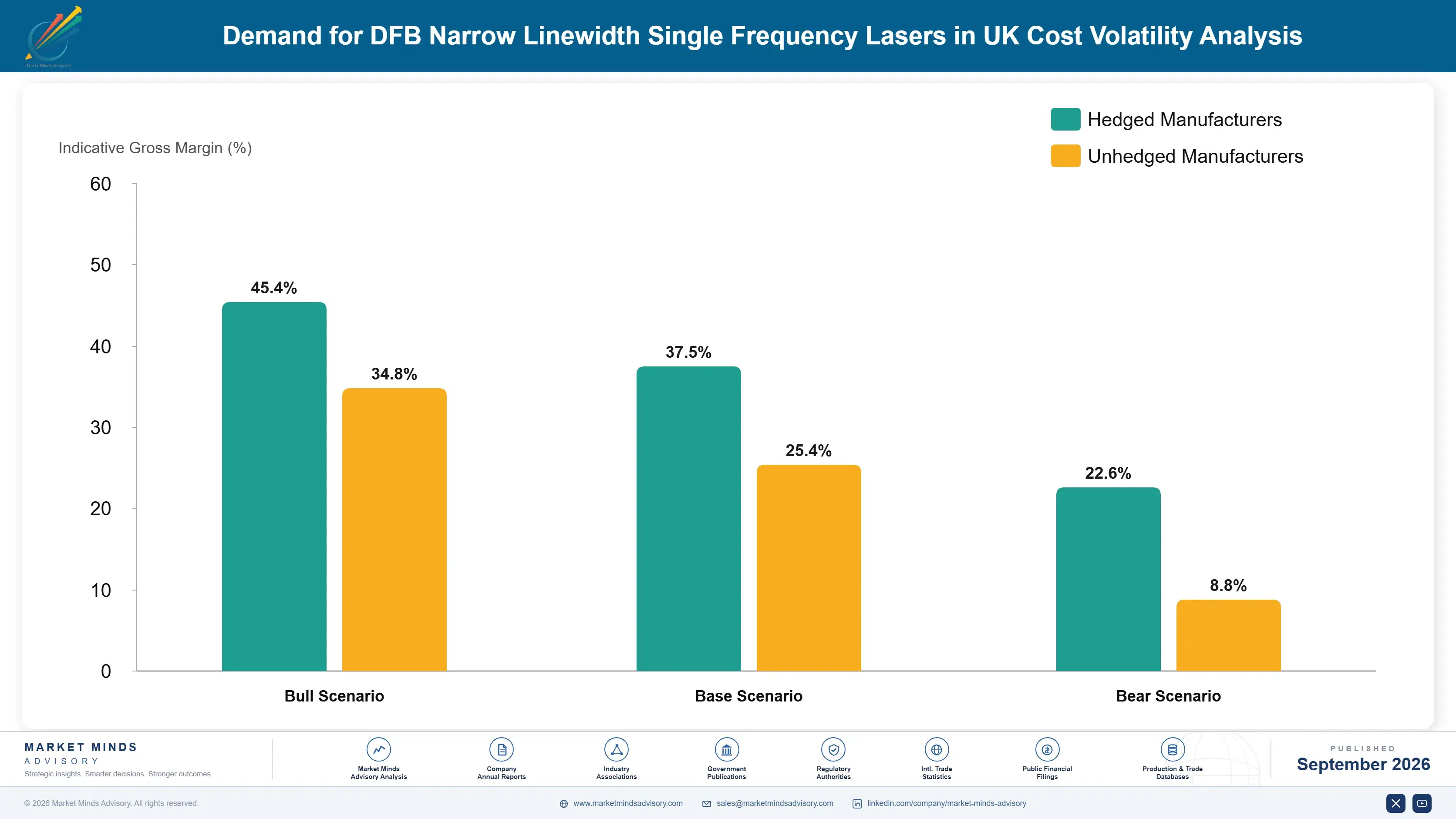
The disadvantage falls on inventory position rather than on purchasing skill, which is not where most attention goes. A device costing around GBP 8,400 tied up for six months carries a financing cost that is small against the value of a system delivered on time or the cost of a missed grant deadline. Firms minimising inventory as working capital are optimising the wrong number here.
demand-for-dfb-narrow-linewidth-single-frequency-l-cost-volatility-analysis-1788234654092

Hold buffer inventory against long lead times

Devices average around GBP 8,400 and lead times extend well beyond a year during any disruption, while a missed delivery costs a customer relationship and sometimes a grant milestone that cannot be recovered. Holding buffer stock costs financing on modest capital and protects revenue worth many times more. Firms minimising inventory in this market are optimising the wrong number.

Apply for export licences ahead of firm orders

Dual use licensing adds around 11 weeks and the application can frequently begin before a customer order is confirmed, provided the end use is known. Pre-applying converts a delay into a formality and lets an integrator quote delivery dates competitors cannot match. It costs administrative effort and some abandoned applications, which is trivial against the orders it wins.

Qualify a second source at every wavelength

Concentration at 64% among five manufacturers means a single supplier decision or an export restriction can remove access to a specific wavelength entirely. Qualifying an alternative device at each wavelength used costs testing time and design margin rather than capital. Most integrators design around a single preferred device and discover the exposure only when that device becomes unavailable to them.

Portfolio Architecture for Margin Defence

Margin here follows integration rather than distribution, which is the whole commercial argument for a British participant. Reselling an imported device competes on price against every other reseller of the same part from the same five manufacturers. Locking, stabilising, packaging and specifying that device into a system earns several times as much on a component cost that has not changed at all.
Volume and premium pull against each other through application knowledge rather than the workshop. Distributed sensing and gas detection buy in commercial volumes at moderate specifications and keep an integrator's engineering team employed and its supplier relationships active. That continuity is what makes the low volume, high specification quantum and metrology work affordable to pursue at all, since those programmes buy occasionally and demand a great deal.

High-value pools sit in quantum wavelength systems, in pre-licensed inventory and in application engineering nobody charges for separately. The third is genuinely unpriced: research groups and instrument builders routinely ask for locking scheme advice, noise budget analysis and integration support, and integrators supply all of it as a cost of sale rather than as the specialist service it actually is.

Volume / Commodity-Adjacent

Resale and distribution of imported devices at standard telecommunications and sensing wavelengths against competing resellers of identical parts. No British value is added at this tier. The 8 point spread reflects whether the reseller holds stock or ships against order.
Gross Margin: 12 to 20%

Premium / Certified

Frequency locked, thermally stabilised and field packaged laser modules built around imported devices for sensing and metrology applications. Integration capability rather than the device supports the price. The 8 point spread reflects whether the customer specification required bespoke engineering work.
Gross Margin: 34 to 42%

Sustainability / Regulatory / Next-Generation

Atomic wavelength systems for quantum applications, pre-licensed inventory positions and application engineering sold as a service. Margins are high because capability and availability are both genuinely scarce. The 18 point spread separates hardware supply from engineering and advisory work entirely.
Gross Margin: 44 to 62%
demand-for-dfb-narrow-linewidth-single-frequency-l-portfolio-architecture-1788234654589

High-value Sub-segments and Strategic Watch-out

Quantum Sensing and Cold Atom Systems

High value and high growth at 21.0%. Atomic transition wavelengths and extreme stability requirements exclude most suppliers, and publicly funded budgets support prices commercial buyers would refuse. The 8 point spread reflects whether the supplier also provides locking and control electronics alongside the source itself.
Gross Margin: 48 to 56%

Frequency Modulated LiDAR

High value with strong growth at 16.5%. Coherent ranging demands genuine spectral purity and a linear sweep, and British demand sits in research and defence rather than automotive production. The 8 point spread reflects whether the sweep control electronics are supplied together with the laser source.
Gross Margin: 40 to 48%

Distributed Fibre Optic Sensing

The volume core. It earns modestly and it provides the steady commercial revenue that funds pursuing the small, high specification programmes sitting above it. The 8 point spread reflects whether the supplier builds interrogator systems or supplies sources into somebody else's. Steady work funds the interesting work.
Gross Margin: 26 to 34%

Coherent Optical Communications

The strategic watch-out. Telecommunications volumes attract manufacturers who price against network equipment budgets rather than instrument budgets, which compresses margins for everybody else. The 22 point spread separates specialist test and research supply from the volume network deployment now competing purely on price. Margins compress from below.
Gross Margin: 16 to 38%

Grants, Programmes And Repeat Orders

The annuity here is unusual because it runs on two entirely different clocks. Research demand follows grant award cycles, capital equipment windows and financial year ends, arriving in concentrated bursts that a supplier either anticipates or misses completely. Infrastructure sensing demand follows deployment programmes that extend route by route and site by site, producing steady repeat orders that nobody in the sector talks about.
Stickiness varies enormously by application rather than by customer size. A device designed into a quantum experiment stays there for the life of the apparatus, because rebuilding a locking scheme costs months of laboratory time nobody has. A sensing interrogator built in volume can change source between production batches if a cheaper qualified alternative appears. The first position is far more defensible and it is far smaller.

Buyer profiles have shifted from research physicists toward procurement functions and systems engineers, and suppliers have not entirely adjusted. A physicist asked about linewidth, frequency stability and mode hop behaviour. A procurement officer asks about framework agreements, delivery guarantees and whether an export licence is already in place. Both must be satisfied now, and the second determines whether an order is actually placed.
demand-for-dfb-narrow-linewidth-single-frequency-l-end-use-penetration-index-1788234655088

What Britain Should Sell

These are among the four positions where our research anticipates prominent divergence between winners and laggards over the coming forecast period. Each is grounded in the demand model, the regulatory perimeter, and the announced capacity pipeline.
01 / LICENSED STOCK POSITION

Sell availability while everyone else quotes lead times

Dual use export licensing adds around 11 weeks to devices arriving in Britain, and buyers working to grant milestones or contract delivery dates cannot absorb that delay when it appears without warning halfway through a project. A distributor or integrator holding pre-licensed inventory is selling availability rather than product, at a premium customers pay willingly because the alternative is a missed deadline. The capital involved is modest against prices near GBP 8,400 per unit, and remarkably few participants hold any real stock.
02 / INTEGRATION VALUE CAPTURE

Never sell a bare diode to anybody

A device reaching 2 kilohertz linewidth is a component competing on price against identical parts from the same five manufacturers worldwide, and no British firm has any advantage whatsoever in that contest. The identical device frequency locked, thermally stabilised, field packaged and specified against a customer's actual application is worth several times as much, and it is precisely what the domestic photonics integration base does genuinely well. Firms reselling devices are competing in the one part of this chain where Britain holds nothing.
03 / FUNDING CYCLE TIMING

Quote when the money must be committed

Roughly 23% of demand originates in publicly funded quantum research where procurement follows award timetables, capital equipment windows and financial year end deadlines rather than any commercial buying pattern anybody would recognise. Suppliers who understand those cycles quote at the moment budget must be committed, structure orders to satisfy capital rules and hold stock ahead of predictable peaks. It is calendar knowledge rather than technology, and suppliers treating research hubs as ordinary industrial accounts consistently arrive about two months late.
04 / INFRASTRUCTURE SENSING WEIGHTING

Balance the grants with something commercial

Distributed acoustic and temperature sensing across rail, pipeline, subsea and perimeter applications is the largest single application by units and attracts a small fraction of the attention that quantum work receives from anybody in this sector. Those buyers procure commercially, repeat their orders and specify against operational requirements, which makes that revenue far steadier than any grant funded demand ever manages to be. That segment grows at 8.4% and, unlike any research funding, it does not simply disappear in a spending review.

Engagement Snapshot From the Field

A live engagement with an industry participant carrying material or product regulatory and market exposure ahead of a defining policy shift, showing how our research translates into a defensible multi-year portfolio strategy.
MARKET MINDS ADVISORY · CLIENT ENGAGEMENT SUMMARY
Demand for DFB Narrow Linewidth Single Frequency Lasers in UK Producer Strategic Portfolio Review and Transition Roadmap 2026·Investment Scenario on Demand for DFB Narrow Linewidth Single Frequency Lasers in UK Exposure Evaluation 2025-26
CLIENT PROFILE
A British photonics integrator building stabilised laser modules around imported narrow linewidth devices, supplying research institutions and instrument manufacturers, with annual revenue in the single digit millions of pounds and revenue concentrated heavily in publicly funded quantum programmes (client-reported, unverified by MMA). Delivery performance had deteriorated across two years. Nobody in the business had ever measured that concentration.
STRATEGIC CHALLENGE
The client was missing delivery dates because imported devices arrived late, losing follow-on orders as a result, and it was simultaneously exposed to quantum programme funding that a spending review could reprofile. Management wanted to address both problems and believed neither had an affordable answer available to a business of that size.
MMA APPROACH
MMA reconstructed every late delivery across three years against its cause, separating export licensing delay from manufacturer lead time and from internal engineering slippage. Forty-seven expert interviews with device manufacturers, research procurement staff, infrastructure sensing buyers and competing integrators established what customers actually valued and what they would pay for it.
KEY FINDINGS
  1. Export licensing rather than manufacturer lead time caused 7 of the 11 late deliveries, and the client had never applied for a licence ahead of a firm order.
  2. Holding buffer stock of the 3 most used devices would have prevented every one of those delays, at a financing cost under 2% of the revenue lost.
  3. Infrastructure sensing buyers interviewed wanted stabilised modules the client could already build and reported never having been approached by anybody in the sector at all.
  4. Some 74% of revenue came from publicly funded programmes, a concentration that the client had never actually quantified before this work began.
CLIENT PROFILE
A British photonics integrator building stabilised laser modules around imported narrow linewidth devices, supplying research institutions and instrument manufacturers, with annual revenue in the single digit millions of pounds and revenue concentrated heavily in publicly funded quantum programmes (client-reported, unverified by MMA). Delivery performance had deteriorated across two years. Nobody in the business had ever measured that concentration.
STRATEGIC CHALLENGE
The client was missing delivery dates because imported devices arrived late, losing follow-on orders as a result, and it was simultaneously exposed to quantum programme funding that a spending review could reprofile. Management wanted to address both problems and believed neither had an affordable answer available to a business of that size.
MMA APPROACH
MMA reconstructed every late delivery across three years against its cause, separating export licensing delay from manufacturer lead time and from internal engineering slippage. Forty-seven expert interviews with device manufacturers, research procurement staff, infrastructure sensing buyers and competing integrators established what customers actually valued and what they would pay for it.
KEY FINDINGS
  1. Export licensing rather than manufacturer lead time caused 7 of the 11 late deliveries, and the client had never applied for a licence ahead of a firm order.
  2. Holding buffer stock of the 3 most used devices would have prevented every one of those delays, at a financing cost under 2% of the revenue lost.
  3. Infrastructure sensing buyers interviewed wanted stabilised modules the client could already build and reported never having been approached by anybody in the sector at all.
  4. Some 74% of revenue came from publicly funded programmes, a concentration that the client had never actually quantified before this work began.
RECOMMENDED STRATEGY
Phase 1: Phase one: hold buffer inventory of the 3 most used devices and apply for export licences in advance of firm customer orders. Phase 2: Phase two: approach infrastructure sensing buyers directly with the stabilised modules already in the range, requiring no new development at all. Phase 3: Phase three: quote research customers against capital budget deadlines rather than against enquiry dates, which is when the money is committed.
OUTCOME
Within four quarters late deliveries had stopped entirely and the client held two infrastructure sensing contracts alongside its research work (client-reported, unverified by MMA). Publicly funded revenue fell below two thirds of the total. Inventory financing cost less than a single lost order had. Delivery performance has held since.

Frequently Asked Questions

Foundational context covering the market sizes, CAGR, scope, country, region and competition that inform every finding below. This section is provided to cover basics and most often pre-purchase conversations, answered from the MMA Primary Research Dataset.

What is the current size of the Demand for DFB Narrow Linewidth Single Frequency Lasers in UK?

United Kingdom demand was valued at USD 0.1 billion in 2025, covering narrow linewidth distributed feedback laser devices, modules and packaged systems. The 2026 figure reaches USD 0.11 billion.

How large will the Demand for DFB Narrow Linewidth Single Frequency Lasers in UK be by 2036?

MMA forecasts USD 0.41 billion by 2036, an increase of USD 0.30 billion over the 2026 base. That represents an expansion multiple of 3.73 times across the forecast period.

What is the CAGR for the Demand for DFB Narrow Linewidth Single Frequency Lasers in UK 2026 to 2036?

The base case compound annual growth rate is 14.0%, with a bull case at 15.3% and a bear case at 12.7%. Historical growth between 2020 and 2025 ran at 12.6%.

Which segment is growing fastest?

Quantum sensing and cold atom systems grow at 21.0%, half again the market rate of 14.0%, on national quantum programme funding. Frequency modulated LiDAR follows at 16.5%.

Who are the major companies in the Demand for DFB Narrow Linewidth Single Frequency Lasers in UK?

NKT Photonics, Coherent, Toptica Photonics, Thorlabs and EMCORE lead on units supplied into British end use, with combined CR5 of 64%. All five manufacture outside the United Kingdom.

Which country is growing fastest?

The United Kingdom is the scoped market and grows at 14.0%, driven by quantum programme funding and expanding distributed sensing deployment. Residual regional lines reflect British procurement deployed overseas.

Report Segmentation Architecture

The full report scope spans multiple orthogonal segmentation dimensions, with cross-tabulated demand data provided for each dimension pair. Coverage extends further to regional breakdowns, trend trajectories, and the competitive detail needed to support segment-level decision-making.

By Application

  • Distributed Fibre Optic Sensing
  • Quantum Sensing and Cold Atom Systems
  • Coherent Optical Communications
  • Frequency Modulated LiDAR
  • Gas Detection and Spectroscopy
  • Metrology, Interferometry and Inertial Navigation

By End-Use Industry

  • Publicly Funded Research Institutions
  • Defence and Security Programmes
  • Rail and Transport Infrastructure
  • Energy and Pipeline Operators
  • Telecommunications Network Operators
  • Instrument and System Manufacturers

By Commercial Dimension

  • Direct Manufacturer Supply
  • Distributor and Reseller Channels
  • Integrated Module Supply
  • Framework Procurement Agreements
  • Research Grant Funded Purchase
  • Application Engineering Services

By Region

  • North America
  • Western Europe
  • East Asia
  • South Asia and Pacific
  • Latin America
  • Middle East and Africa
  • Eastern Europe

Scope, Methodology, and Coverage

Every figure in this report is reproducible from documented input assumptions. The scope below maps the historical period, the forecast horizon, the segmentation dimensions, and the countries covered, alongside the underlying primary and qualitative methodology.
Historical Period
2020 to 2025
Forecast Period
2026 to 2036
Base Year
2025 (USD billions; MMA Primary Research Dataset, September 2026)
Market Definition
This market covers distributed feedback semiconductor lasers with narrow spectral linewidth and single frequency output supplied into United Kingdom end use, spanning distributed fibre optic sensing, quantum sensing and cold atom systems, coherent optical communications, frequency modulated LiDAR, gas detection and spectroscopy, and metrology, interferometry and inertial navigation. Scope covers devices, modules and packaged laser systems supplied to organisations operating in the United Kingdom. Excluded are broad linewidth telecommunications lasers, fibre and solid state laser sources, laser diodes for materials processing, detectors and receiver components, and complete sensing instruments supplied without a laser source.
Quantitative Units
USD billion, 2025 base year, 2026 to 2036 forecast period
Segmentation Dimensions
Application, end-use organisation, commercial channel, region
Regions Covered
North America, Western Europe, East Asia, South Asia and Pacific, Latin America, Middle East and Africa, Eastern Europe
Countries Covered
United Kingdom, with supply origin and collaboration coverage across United States, Germany, Denmark, Japan, China, South Korea, Australia, Singapore, Canada, France, Netherlands, Switzerland, Ireland, Poland, Czechia, Brazil, Chile, South Africa
Key Companies Profiled
20 companies across device manufacturers, module builders and British integrators
Quantitative Methodology
Primary survey, n=3,800 respondents, Q4 2025, six countries; demand-side model with trade association cross-validation
Qualitative Methodology
47 expert interviews, Q4 2025; applied to validate demand model assumptions, identify emerging dynamics, and assess competitive positioning
Report Format
PDF and XLSX data workbook (Word format preview document)
Publisher
Market Minds Advisory
Report Code
MMA-2026-TEC-581
Published
September 2026
Contact
sales@marketmindsadvisory.com | www.marketmindsadvisory.com

Purchase the full Demand for DFB Narrow Linewidth Single Frequency Lasers in UK Report (2026 to 2036).

The full MMA report on United Kingdom demand for narrow linewidth distributed feedback lasers runs to detailed application models across the 2026 to 2036 forecast period, with cost benchmarks separated between imported device and domestically added integration value. It profiles 20 companies on a consistent units supplied basis, covering device manufacturers, module builders and British integrators. Publicly funded and commercial demand are modelled separately, since the two behave nothing alike in timing or in price sensitivity. Regional lines describe where British procurement is deployed rather than independent regional markets. Primary research draws on a quantitative survey of 3,800 respondents across six countries and 47 expert interviews conducted in Q4 2025.
Cost benchmarks separating imported device from domestic integration value
Publicly funded and commercial demand modelled entirely separately
Export licensing delay quantified across device specification classes
Twenty company profiles on consistent units supplied basis
Quantum programme procurement cycles mapped against equipment budgets
Application chapters with supply origin and collaboration detail tables

Built For The People Who Decide

From boardroom strategy to bench-side execution, this report is read cover-to-cover by leaders shaping the next decade of their industry, turning demand scenarios, market dynamics and valuation benchmarks into decisions.
CXOs/ Presidents/ VPs/ Managers
M&A and Corporate Development
Strategy Teams and R&D Heads
Procurement and Product Directors
Regulatory and Compliance Leaders
Investor Relations and Equity Analysts