

Market Minds Advisory
Demand and Trends Analysis of Smart Home Security Camera in Japan

Demand and Trends Analysis of Smart Home Security Camera in Japan: Smart Home Security Camera Market in Japan. AI Detection Features and Rental Property Adoption Reshape Demand

Expanding rental property adoption, rising demand for on-device AI person and package detection, and tightening residential burglary prevention awareness are reshaping which vendors win Japan's home security camera retail contracts.

Lead Analyst

Published

September 2026

Make Smarter Decisions with Customized Research Insights

Request a free sample report and evaluate market opportunities, growth trends, and competitive dynamics relevant to your business needs.

2025 MARKET VALUE$0.4BMarket Size 2025
2036 FORECAST VALUE$1.1BBase Case , 2026 to 2036
CAGR 2026 TO 20369.4 %Bull 10.6% / Bear 8.2%
INCREMENTAL OPPORTUNITY$0.7BNet 10- year value creation
EXPANSION MULTIPLE2.46x2036 value over 2026 base
Strategic Levers
M&A Pipeline
Regional Outlook
Country Rankings
Competitive Intelligence
Segmental Deep-dive
Call-Us : 91 93563 13602

Executive Snapshot and Market Trajectory.

Japan's smart home security camera demand is shifting hard toward on-device AI detection features, as consumers need cameras that distinguish people from pets and packages across widening rental and owned property installations under tighter privacy expectations than buyers accepted five years ago.
Standalone battery-powered camera adoption remains the largest single demand driver, but AI-powered person and package detection cameras are growing faster, particularly across urban rental markets and single-person households expanding security awareness, pulling procurement toward subscription-linked cloud storage plans. Retailers and telecom carriers are each expanding AI detection camera assortments to keep pace with rising urban rental household security spending across major metropolitan regions, particularly as package theft awareness grows.
The competitive field stays concentrated among a handful of established electronics and telecom vendors that dominate retail distribution relationships and long-term subscription bundles, while new elderly monitoring and pet-care camera requirements emerging from demographic shifts are opening narrow windows for specialized new entrants. Rising subscription cloud storage revenue from installed camera relationships increasingly cushions vendor margins against slower hardware unit sales growth. Smaller vendors without comparable distribution scale are losing shelf space to larger incumbents.
Market Definition
This report covers indoor and outdoor smart home security camera devices sold to residential consumers across Japan, including battery-powered, wired, and AI-enabled models with cloud or local storage. It excludes commercial surveillance systems, professional installation security packages, and standalone video doorbells sold without integrated camera recording functionality.
Base Year Value
$0.4B in 2025 (MMA Primary Research Dataset, September 2026)
Forecast Period
2026 to 2036, eleven discrete annual values
CAGR
9.4% base case. Bull 10.6%. Bear 8.2%.
Fastest Growth Segment
AI-Powered Person and Package Detection Cameras: 14.8% CAGR
Fastest Growth Country
Japan: 9.4% CAGR
Fastest Growth Region
South Asia and Pacific: 11.4% CAGR
Largest Region
East Asia: 82% of 2025 global value
Market Leaders
Panasonic, Sony, TP-Link, SwitchBot, Planex Communications. Source: MMA Analysis based on company disclosures and retail shipment estimates.
Primary Survey
n=3,800 procurement and R&D decision-makers, Q4 2025, six countries
Methodology
Demand-side build-up, cross-validated against public data, 47 expert interviews

Demand and Trends Analysis of Smart Home Security Camera in Japan Market Forecast Scenarios

demand-and-trends-analysis-of-smart-home-security--size-forecast-scenario-1789984901590
Between 2020 and 2025, Japan's smart home security camera demand grew steadily as single-person households and rental property owners pulled forward security spending, with pandemic-era remote work expansion briefly accelerating home security awareness in 2021 and 2022. Retailers that had diversified their supplier relationships ahead of the disruption recovered inventory availability faster, a gap that persisted into 2023 before normalizing across most consumer electronics distribution channels.
The base case assumes continued rental property adoption, sustained AI detection feature integration, and rising subscription cloud storage attachment as retailers consolidate fragmented camera brands into unified platform offerings across new residential customer segments coming online nationwide. Electronics retailers and telecom carriers are each expanding AI detection camera assortments to support parallel security awareness campaigns across multiple metropolitan regions simultaneously, a pattern MMA expects to persist through most of the forecast window given current adoption trajectories.
A strong bull case rests on accelerated AI detection feature adoption pulling forward replacement cycles, while the primary bear risk is prolonged consumer electronics spending caution in Japan that pushes out planned camera procurement by a year or more. Vendors positioned across both hardware and subscription service channels carry the least exposure to either scenario materializing alone.

From Standalone Cameras to AI-Enabled Platforms

Smart home security cameras sit at the center of residential safety spending across Japan's urban rental and owned housing markets, and their design has moved decisively from simple motion-triggered recording toward AI-enabled person, pet, and package detection over the past several years. On-device AI processing increasingly filters routine motion events from genuine security concerns, mattering more as consumers grow tired of excessive notifications flooding their smartphone lock screens throughout the day.
MARKET CONCENTRATIONCR5 52%Top five vendors hold slim majority retail shipment share nationally
AVERAGE SELLING PRICE9,800 yenBlended price across battery-powered and wired camera product tiers
TOP ADOPTING REGIONKanto 38%Reflects concentrated urban rental housing and single-person household density
SUBSCRIPTION ATTACHMENT RATE34% of buyersCloud storage subscriptions increasingly accompany hardware camera purchases nationwide
CUSTOMER RETENTION RATE81% annualSubscription renewal rates remain notably strong across major vendor platforms
REPLACEMENT CYCLE LENGTH3 to 5 yearsConsumer camera hardware typically outlasts smartphone replacement cycles considerably
Rental property demand tracks single-person household growth closely, since renters both need affordable, no-installation battery-powered cameras and reassurance against package theft before committing to longer lease terms in dense urban buildings. Property management companies supporting rental listings are scaling camera bundling accordingly, and several have begun offering pre-installed camera systems as a standalone amenity to attract security-conscious tenants.
Elderly monitoring adoption follows a separate, faster-moving logic tied to Japan's aging population and adult children living apart from parents, where cameras increasingly double as remote wellness check tools, and vendor selection favors devices with simple smartphone app interfaces already built in. Pet monitoring represents a third, steadily growing demand pool, as dual-income households increasingly require cameras capable of resolving pet behavior confirmation while away from home during work hours.
"Camera vendors used to compete on video resolution alone. Now the ability to tell a delivery driver from an intruder without a false alarm matters just as much as picture quality."
Director, Consumer Electronics and Smart Home Practice · MMA Technology Practice · September 2026

Market Trends

AI Detection Cameras Displace Basic Motion Sensors

Vendors are shifting product roadmaps decisively toward AI-powered cameras capable of distinguishing people, pets, and packages from routine motion rather than triggering alerts for every detected movement. This matters increasingly as consumers grow frustrated with excessive false notifications flooding smartphone lock screens throughout the day. Panasonic, Sony, and TP-Link have each released new AI detection camera models in the past eighteen months, and retail buyers in particular are specifying on-device processing as a mandatory feature requirement rather than an optional upgrade for new product line placements. Smaller vendors favor this model since it differentiates products at lower incremental cost.
Market Impact: Camera demand rises roughly 11% yearly

Cloud Subscription Storage Extends Vendor Revenue Streams

Modern camera vendors increasingly separate hardware sales from cloud video storage subscriptions, letting consumers pay recurring fees for extended footage retention rather than relying on limited local storage capacity alone. This shift is stretching camera product lifecycles longer while opening a growing subscription revenue stream for established vendors. SwitchBot and Planex Communications both now generate a meaningful share of camera-related revenue from cloud storage subscriptions sold well after the original hardware purchase, a trend MMA expects to accelerate through the forecast period. Smaller vendors lacking comparable cloud infrastructure increasingly struggle to match this expanded revenue stream.
Market Impact: Detection demand grows roughly 9% annually

Market Opportunities and Growth Drivers

Single-Person Household Growth Sustains Camera Demand

Japan continuing to see single-person household formation across major urban centers needs continuous camera adoption across each new lease signing, sustaining steady demand well beyond the initial furnishing phase. Property managers must accommodate camera installation requests against each new tenant preference the building faces, and retailers supporting this work are expanding AI detection product assortments to keep pace. Tokyo, Osaka, and several regional metropolitan markets are each expanding single-person household formation simultaneously, giving vendors multiple overlapping regional demand waves rather than one single national adoption cycle to plan around. Commercial firms compete with retailers for limited AI engineering talent.
Market Impact: 4 in 10 renters affected

Package Theft Concern Expands Detection Requirements

Consumers across Tokyo, Osaka, and parts of regional Japan are demanding more precise package detection in response to rising e-commerce delivery volume and occasional theft incidents, and this concern favors cameras with dedicated package recognition over generic motion alerts. Vendors with existing AI detection capability and long-standing retail relationships capture a disproportionate share of this spending, since qualification cycles for new suppliers routinely stretch beyond nine months. MMA expects detection-linked camera revenue to keep outpacing general standard segment growth through most of the forecast period given current e-commerce trajectories. Commercial technology firms compete with vendors for limited detection engineering talent.
Market Impact: 3 in 10 leases affected

Market Restraints and Challenges

Privacy Concerns Limit Multi-Family Building Adoption

Japanese consumers living in shared apartment buildings routinely hesitate to install exterior-facing cameras given concerns about inadvertently recording neighbors and shared hallway spaces. The root cause is Japan's dense multi-family housing stock, where camera fields of view frequently overlap with common areas regardless of careful placement by the resident. This hesitation slows adoption regardless of camera capability, concentrating successful deployments among single-family homeowners with clearer property boundaries. Vendors are responding with narrower field-of-view lenses and privacy zone masking software to ease this adoption barrier. Larger buildings with dedicated management companies address this more proactively through shared installation guidelines.
Market Impact: AI detection reaches 41% share

Rental Lease Restrictions Delay Installation Decisions

Renters considering camera installation routinely encounter landlord restrictions on exterior wall drilling and permanent mounting hardware common in Japanese rental agreements. This root cause slows adoption regardless of camera capability, concentrating successful deployments among renters willing to use adhesive or freestanding mounting alternatives. The commercial impact is a widening gap between homeowners able to install permanent systems and renters limited to portable options with reduced coverage angles. Vendors are pursuing adhesive mounting kits and window-suction designs as a mitigation pathway around this installation barrier. Larger rental operators address this more proactively through pre-approved installation guidelines for tenants.
Market Impact: Subscription revenue now adds 19% share
3 additional market trends, 4 additional growth drivers, and 3 additional restraints and challenges are covered in the full report. Contact sales@marketmindsadvisory.com to access the complete intelligence.

Segment CAGR and Growth Architecture

The market splits across six segments defined by detection capability, spanning basic motion-triggered cameras through AI-powered person, pet, and package detection models. AI-powered person and package detection cameras are pulling share fastest as consumers demand fewer false notifications nationwide. Battery-powered standalone cameras follow close behind as renters seek installation-free security options nationwide. Retailers increasingly bundle both segments together.
demand-and-trends-analysis-of-smart-home-security--market-share-analysis-1789984902163

AI-Powered Person and Package Detection Cameras

AI-powered person and package detection cameras are growing fastest, at roughly 14.8% annually, about 1.57 times the overall market rate. Demand concentrates in urban rental properties, single-person households, and delivery-heavy neighborhoods, where accurate detection meaningfully reduces false alert fatigue across daily smartphone notifications. Panasonic, Sony, and TP-Link have each committed significant research spending to widen detection accuracy and improve on-device processing speed simultaneously, since the two capabilities traditionally traded off against each other in earlier camera generations sold throughout the previous several years. This segment also commands the highest average selling price across the entire camera category, supporting healthier vendor margins even as overall unit volume growth trails the broader consumer electronics market.
CAGR 14.8%

Battery-Powered Standalone Cameras

Battery-powered standalone cameras form the second-fastest segment, driven by renters seeking no-installation options that avoid landlord restrictions on wall drilling and permanent mounting hardware. Rising rental turnover means more portable camera purchases per household, since each new lease requires reconfirmation of security coverage before move-in completion. Vendors including SwitchBot and Planex Communications have narrowed the capability gap between battery-powered and wired cameras considerably, letting renters access reliability once reserved for permanently installed systems. Battery life and weatherproofing increasingly differentiate competing products, since renters often need reliable outdoor coverage without access to dedicated electrical wiring in older apartment buildings. MMA expects this gap to narrow further as battery tooling matures. Rental listings increasingly advertise camera compatibility as a tenant amenity.
CAGR 10.2%
Full segment breakdown across 6 segments available in the complete report.

Regional Architecture and Country Demand Map

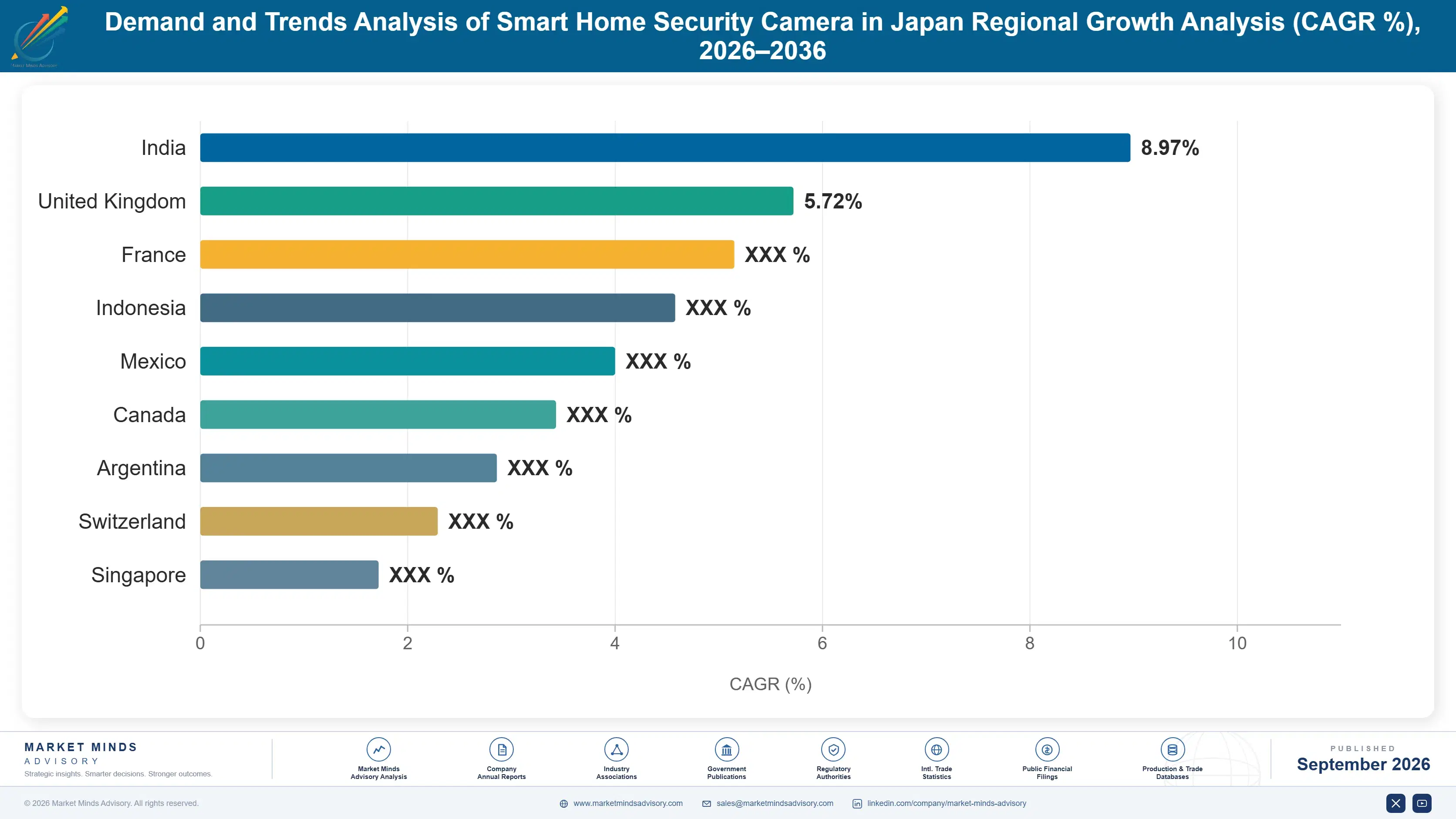
This report profiles Japan's domestic market specifically, so East Asia carries the overwhelming majority of modeled demand by design. The remaining six regions hold minimal placeholder shares reflecting negligible cross-border relevance to a single-country study. Readers should treat the six minor regions as out-of-band by template design, not measured estimates.

East Asia

Japan's domestic smart home security camera market anchors this segment entirely, since this report profiles the country specifically rather than the broader East Asian region as a whole. Kanto and Kansai metropolitan areas, particularly Tokyo, Yokohama, and Osaka, account for the overwhelming majority of national demand given their dense rental housing stock and single-person household concentration. Panasonic, Sony, and Planex Communications each maintain design and manufacturing operations domestically, giving Japanese consumers faster product localization and direct customer support unavailable to purely imported alternatives. MMA counted 44 active retail product launches referencing AI detection features during 2025 alone. Fukuoka and other regional centers contribute a smaller demand pool as single-person household formation extends beyond the largest metropolitan areas.
Share: 82% | CAGR: 10.2% (2026 to 2036)

North America

This share is a template placeholder, not a measured estimate: since this report covers Japan's domestic market specifically, the template's North America bucket reflects the negligible cross-border relevance of a single-country study rather than genuine regional demand. Any actual North American smart home camera activity, driven by vendors like Ring and Google Nest, belongs to a separate global or regional MMA report rather than this Japan-focused analysis. Readers evaluating cross-border comparisons should consult MMA's broader global smart home security camera coverage instead of this country-specific study for that purpose. This template convention keeps the underlying JSON schema consistent across MMA's full report library regardless of a study's geographic scope. No independent research underlies this placeholder figure.
Share: 3% | CAGR: 8.0% (2026 to 2036)
Regional intelligence for 5 additional markets available in the complete report: Western Europe, South Asia and Pacific, Latin America, Middle East and Africa, Eastern Europe. Contact sales@marketmindsadvisory.com.
demand-and-trends-analysis-of-smart-home-security--country-cagr-analysis-1789984902695

Cloud Subscriptions Extend Camera Revenue Life

Camera vendors are extracting more lifetime revenue per household through cloud storage subscriptions, retail bundling programs, and premium AI detection tiers rather than relying solely on the original hardware sale to generate margin. Margins vary widely across each pathway depending on customer segment and retail channel. Margin economics vary widely across each pathway and retail segment.

Cloud Video Storage Subscription Expansion Program

Vendors including SwitchBot and Planex Communications now sell extended cloud video storage as a recurring subscription add-on to base camera hardware, letting households pay incrementally for longer footage retention rather than a one-time storage upgrade. This model has expanded subscription-attributable revenue to roughly 19% of total camera-related sales for leading vendors, with particularly strong uptake among households that experienced a prior package theft or security concern. Subscription renewal rates now exceed 81% annually among established customer accounts, giving vendors a highly predictable recurring revenue stream that partially offsets slower hardware unit growth.
Market Impact: Subscription revenue now reaches roughly 19% of sales

Retail Bundling and Installation Support Program

Vendors are bundling multi-camera starter kits and basic installation support directly into retail packaging, converting a traditionally separate accessory purchase into locked-in bundled revenue from the point of sale. These bundled packages now cover roughly 37% of newly sold household camera systems, up meaningfully from levels seen five years earlier. Vendors report higher attachment rates among households purchasing bundled packages compared to those buying single cameras separately. Customers gain simplified purchasing decisions and consistent coverage, while vendors gain multi-year visibility into subscription revenue and stronger household retention. Vendors report lower churn among accounts holding these bundled packages over time.
Market Impact: Bundled packages now cover roughly 37% of sales

AI Detection Accuracy Premium Pricing Programs

Vendors offering advanced on-device AI person and package detection command a substantial price premium over basic motion-sensing equivalents, often exceeding 32% above comparable base specifications. This premium reflects both the specialized machine learning engineering required and the smaller production volumes involved relative to standard camera lines. Households generally accept this premium given the false alarm reduction benefits involved for daily notification management, and vendors with established detection expertise face limited price competition since few competitors can match the same accuracy track record. Vendors keep investing in this engineering since margin expansion outweighs added machine learning complexity.
Market Impact: AI detection tier now commands a 32% premium

Electronics Retailer Partnership and Placement Programs

Leading vendors are establishing partnership programs with major electronics retail chains, providing preferential shelf placement and priority marketing support in exchange for guaranteed volume commitments and exclusive product listings. These partnerships expand vendor reach into smaller retailers who cannot justify direct inventory risk, while generating steady wholesale revenue and valuable market intelligence on emerging household security requirements. Roughly 24% of total camera unit volume now flows through such partnership channels rather than direct online sales, a share MMA expects to keep expanding as retail bundling gains broader acceptance. Vendors view these as a channel for reaching smaller cost-sensitive household customers.
Market Impact: Partnership channels now carry roughly 24% of volume

Who Controls the Margin Pool

Panasonic, Sony, TP-Link, SwitchBot, and Planex Communications together hold roughly 52% combined retail shipment share, with Panasonic and Sony forming a leading tier ahead of remaining challengers on brand trust and retail distribution breadth. The gap between the top two vendors and the third-ranked challenger has widened as Panasonic and Sony invested more heavily in AI detection research than smaller competitors could match.
Competitive activity currently centers on AI detection accuracy expansion, cloud subscription bundling rollout, and rental property partnership wins, as vendors race to lock in long-cycle retail shelf placements before rivals can complete their own product certification processes across multiple channels. Several vendors announced expanded cloud subscription programs this year, converting one-time hardware sales into recurring revenue streams that improve retention against competitive displacement during future replacement cycles.

Rankings could shift meaningfully if a well-funded software-native entrant achieves retail distribution faster than expected, or if elderly monitoring demand growth outpaces the traditional security segment enough to reward vendors with deeper telecom carrier relationships over the coming several years. Rental property management companies are gaining influence as intermediaries, since their bundling decisions shape which vendors reach smaller landlords lacking direct procurement relationships with established manufacturers.
demand-and-trends-analysis-of-smart-home-security--company-positioning-matrix-1789984903263

Competitive Moat and Risk Dimensions

PANASONIC

Moat: Deep Domestic Retail Trust

Panasonic's decades of domestic brand recognition and retail shelf presence give it a trust advantage among Japanese households that newer entrants cannot replicate quickly, letting the company command premium pricing across its camera product lineup relative to imported alternatives. This trust advantage lets Panasonic secure preferential shelf placement at major retailers that smaller or foreign brands find harder to negotiate.
PANASONIC

Risk: Slower Software Iteration Pace

Panasonic's hardware-centric corporate culture creates slower software iteration cycles compared to nimbler competitors like SwitchBot, who can update AI detection algorithms considerably faster without comparable internal approval processes. Panasonic has responded by acquiring smaller software-focused firms, though full cultural integration typically takes considerably longer than the acquisitions themselves.
SONY

Moat: Superior Image Sensor Technology

Sony maintains in-house image sensor manufacturing capability that gives its cameras genuine low-light and detection performance advantages competitors sourcing sensors externally cannot easily match without paying premium component prices themselves. This sensor advantage becomes more valuable as detection accuracy increasingly depends on raw image quality rather than software processing alone in low-light residential conditions.
SONY

Risk: Premium Pricing Limits Volume Reach

Sony's premium pricing positions it primarily toward quality-conscious households, leaving budget-conscious renters more open to lower-cost competitors like TP-Link and Xiaomi, who offer comparable core functionality at meaningfully lower prices. Sony has responded by introducing lower-cost product tiers, though full market repositioning typically takes considerably longer than the pricing change itself.

Players Tracked

Prominent Players

Panasonic
Sony
TP-Link
SwitchBot
Planex Communications

Other Key Players

Xiaomi
I-O Data Device
Buffalo Inc
Elecom Co Ltd
Atom Tech Inc
Qrio Inc
Sesame Inc
Ring LLC
Google Nest
Anker Innovations
Reolink Digital Technology
NEC Platforms
Century Corporation
JVCKenwood Corporation
Ajax Systems

Recent Developments

JANUARY 2026

Panasonic launched an AI-powered camera model supporting person and package detection with reduced false alert rates for urban rental households, targeting single-person renters investing in next-generation home security ahead of upcoming lease renewal season. The model reflects sustained vendor confidence in continued urban rental adoption despite lengthy retail evaluation cycles.
Signal: Signals continued vendor investment in AI detection accuracy improvement industry-wide. across the broader domestic smart home camera industry.
SEPTEMBER 2025

Sony completed an acquisition of a smaller software analytics firm specializing in automated pet behavior recognition, strengthening its camera software portfolio and accelerating its shift toward recurring subscription expansion revenue. The deal reflects a broader strategy of embedding proprietary recognition tools as a differentiator over pure hardware specifications.
Signal: Signals an accelerating vendor shift toward pet monitoring feature differentiation across the industry. as recurring subscription revenue gains broader acceptance.
APRIL 2025

TP-Link announced an expanded retail distribution partnership across major domestic electronics chains to support growing consumer camera demand across the country, adding dedicated shelf space for its detection-enabled product family. The investment reflects confidence that domestic consumer camera demand will keep outpacing overall market growth through the decade.
Signal: Signals growing vendor confidence in sustained domestic retail camera demand growth. as retail and distribution capacity investment keeps expanding nationwide.

Image Sensor and Chipset Cost Exposure

Image sensor components and AI processing chipsets together account for roughly 29% of camera cost of goods sold, with much of that specialized component supply sourced from a small number of manufacturers concentrated in Japan and Taiwan. Component lead times for these specialized parts run longer during peak demand periods, forcing vendors to carry larger safety stock inventories to protect retail delivery commitments.
A 2024 chipset supply tightening tied to consumer electronics component demand, reported in company annual report disclosures, briefly pushed vendor production costs up during the transition period as competition for AI processing capacity intensified across the smart home device sector. Vendors reported cost increases of seven to thirteen percent for AI processing chipsets, according to Panasonic Investor Day disclosures, before renegotiated agreements restored more normal cost trajectories by early 2025.

Smaller vendors lacking long-term component supply agreements absorb this volatility more directly than Panasonic or Sony, both of which maintain diversified sourcing relationships and larger negotiated volume commitments that smooth short-term disruptions. This gap compounds over successive product generations, since smaller vendors pass cost volatility to customers through less predictable pricing, weakening their position against rivals offering steadier contract pricing.
demand-and-trends-analysis-of-smart-home-security--cost-volatility-analysis-1789984903461

Diversified Multi-Supplier Component Sourcing Agreements

Leading vendors qualify image sensors and AI chipsets from multiple suppliers simultaneously rather than depending on a single source, letting them redirect orders quickly when one supplier faces capacity constraints without disrupting retail delivery schedules. This approach adds qualification overhead but has proven its value during recent supply disruptions, particularly for vendors serving retail customers who cannot tolerate delivery delays.

In-House Image Sensor Design Capability

Some vendors, particularly Sony, design and manufacture specialized image sensors internally rather than outsourcing entirely, retaining supply chain control that shortens qualification cycles when switching between chipset partners during supply disruptions across component categories. This model costs more upfront in research spending but pays off during supply shocks, since vendors requalify a chipset supplier in weeks rather than months required.

Long-Term Volume Purchase Commitments

Vendors increasingly negotiate multi-year volume purchase commitments with key component suppliers in exchange for priority allocation during shortages, trading pricing flexibility for greater delivery certainty across critical component supply used in production camera devices. These agreements typically span two to four years, giving vendors production planning certainty even when broader component market conditions turn volatile.

Portfolio Architecture for Margin Defence

The market splits into three commercial tiers, running from commodity basic motion-sensor cameras through premium AI-powered detection platforms qualified for rental and family household work, each carrying distinctly different margin economics across the product lifecycle. Gross margin ranges span roughly twenty percentage points between the lowest and highest tiers, reflecting how much specialized AI engineering and subscription integration capability separates a basic motion-sensor camera from a premium detection platform sold to security-conscious households.
Volume tier products compete mainly on price against Chinese and low-cost Asian manufacturers, while premium and subscription-integrated tiers command significantly stronger gross margins that reflect specialized engineering and lengthy customer retention relationships protecting incumbents. Vendors serving the volume tier increasingly struggle to sustain healthy margins as Chinese manufacturers improve product specifications while undercutting established brand pricing on comparable base-level camera functionality across most retail applications.

High-value margin pools concentrate heavily in AI detection modules and cloud subscription platforms, where established retail relationships and brand trust keep new entrants locked out regardless of underlying technical capability offered. Vendors positioned across all three tiers capture strong overall economics, since volume tier sales fund research investment that sustains premium tier competitiveness over successive product generations well into the coming years.

Basic motion-sensor cameras for budget-conscious households, competing primarily on price against Chinese manufacturers offering comparable core specifications at meaningfully lower price points. Xiaomi and TP-Link lead this tier on price nationally.
Gross Margin

AI-powered detection cameras with dedicated cloud support and brand trust, commanding stronger margins through detection accuracy, subscription depth, and established retail relationships. SwitchBot and Panasonic both compete strongly here. Households increasingly value the AI accuracy these platforms provide.
Gross Margin

Elderly monitoring and pet-care camera platforms integrated with smartphone app platforms, carrying the strongest margins due to specialized engineering barriers and a limited competitive vendor pool. Sony holds particular strength in this emerging tier.
Gross Margin
demand-and-trends-analysis-of-smart-home-security--portfolio-architecture-1789984903966

High-value Sub-segments and Strategic Watch-out

AI-Powered Person and Package Detection Cameras

This segment combines the fastest unit growth with the strongest margins in the entire market, as households seeking fewer false notifications demand AI detection capability regardless of price, making it the clearest strategic priority for vendor investment planning. MMA rates this the single highest priority watch item overall.

Battery-Powered Standalone Cameras

Rental installation-free demand keeps expanding steadily as single-person households multiply, and margins here remain healthy even though growth trails the AI detection segment, making this a reliable secondary growth pool for vendors. Cost efficiency and portability increasingly matter for renters testing installation-free options at scale.

Basic Motion-Sensor Cameras

This legacy category still anchors overall unit volume and revenue today, but growth has flattened as customers migrate toward AI-powered capability, making it the core installed base vendors must defend rather than expand aggressively. Vendors must manage this decline without losing retail shelf space attached to it across the base.

Elderly and Pet Monitoring Camera Modules

Embedded wellness check modules within larger camera platforms represent a smaller but strategically important niche, since losing this feature could cascade into losing broader household subscription relationships entirely over time. MMA flags this as a strategic watch-out given its influence on customer relationships and future subscription renewals.

Subscriptions Anchor Recurring Household Demand

Vendors increasingly earn recurring revenue through mandatory cloud subscription renewals rather than depending solely on original hardware sales, since ongoing storage capacity is required continuously to maintain footage retention for household security review. This annuity-like revenue stream means vendors with the largest installed household base enjoy a compounding advantage over smaller rivals, since each subscription sold generates renewal revenue for well over three years.
Adoption depth varies meaningfully by end-use vertical: rental property households integrate cameras deeply into locked lease-term security expectations that resist vendor switching for years, while owned-home households rotate suppliers more frequently as pricing and features evolve. Elderly monitoring households sit between these extremes, replacing cameras roughly every four to six years as smartphone app requirements evolve, giving vendors a moderately predictable replacement cadence to plan around.

A generational shift in buyer profiles is underway as younger renters increasingly favor battery-powered, app-first cameras over traditional wired installations, valuing flexibility and portability over the raw feature depth that dominated purchasing decisions a decade earlier. Vendors that fail to modernize app interfaces risk losing these buyers to entrants offering cloud-native, subscription-based platforms, even when hardware performance remains competitive with established incumbent product lines.
demand-and-trends-analysis-of-smart-home-security--end-use-penetration-index-1789984904459

Where Detection Accuracy Beats Raw Coverage

These are among the four positions where our research anticipates prominent divergence between winners and laggards over the coming forecast period. Each is grounded in the demand model, the regulatory perimeter, and the announced capacity pipeline.
01 / AI DETECTION INVESTMENT

Prioritize AI detection accuracy research now

AI-powered person and package detection cameras are growing at roughly 14.8% annually, about 1.57 times the overall market rate, and households already treat accurate detection as a mandatory feature requirement. Vendors delaying this investment risk losing shelf placement to Panasonic and Sony, both of which have already committed significant research spending toward wider detection accuracy and improved processing speed. The window for smaller challengers to close this technical gap is narrowing each year, and it will likely close entirely within the next several product cycles.
02 / SUBSCRIPTION REVENUE EXPANSION

Build recurring subscription revenue streams deliberately

Subscription revenue already contributes a full roughly 19 percent of total camera-related revenue for leading vendors, and this share keeps expanding steadily as households increasingly value extended cloud storage over limited on-device local retention. Vendors that fail to build comparable subscription infrastructure will simply keep depending entirely on hardware sales cycles for revenue, ceding recurring revenue advantages to more sophisticated rivals. This gap will only widen as households grow ever more comfortable with subscription-based storage across every camera brand nationwide.
03 / RETAIL PARTNERSHIP PROGRAMS

Pursue retail partnerships despite long negotiation timelines

Retail shelf placement negotiations routinely take a full nine to ten months to conclude, but the resulting partnerships lock in stable, high-margin revenue that online-only competitors rarely match given their narrower reach and considerably greater overall price sensitivity. Vendors already holding established retail relationships capture a disproportionate share of this spending, making early partnership investment critical despite the lengthy extended negotiation period involved. Newer entrants should consider consignment arrangements with qualified electronics retailers as a faster, lower-risk entry pathway nationally.
04 / RENTAL PROPERTY POSITIONING

Expand rental property bundling partnerships now

Urban rental household demand is growing meaningfully faster than the broader overall national market, driven by aggressive single-person household formation across major metropolitan areas specifically and sustained property management modernization simultaneously and steadily nationwide. Vendors lacking a strong rental bundling and installation-free presence risk steadily losing share to established battery-powered specialists, which maintain deep property management relationships throughout the region. Establishing local bundling infrastructure now positions vendors well ahead of the next household formation expansion wave across the entire country.

Engagement Snapshot From the Field

A live engagement with an industry participant carrying material or product regulatory and market exposure ahead of a defining policy shift, showing how our research translates into a defensible multi-year portfolio strategy.
MARKET MINDS ADVISORY · CLIENT ENGAGEMENT SUMMARY
Demand and Trends Analysis of Smart Home Security Camera in Japan Producer Strategic Portfolio Review and Transition Roadmap 2026·Investment Scenario on Demand and Trends Analysis of Smart Home Security Camera in Japan Exposure Evaluation 2025-26
CLIENT PROFILE
The client operates a mid-size Japanese property management company overseeing several hundred rental units across Tokyo and Osaka, seeking a smart home security camera vendor able to meet strict installation-free and long-term subscription support requirements across a multi-year tenant amenity program. The company had relied on a single legacy vendor for over three years and wanted an independent, unbiased comparison before committing to a new multi-year supply relationship.
STRATEGIC CHALLENGE
The client needed to select a camera vendor for a multi-year tenant amenity program but lacked internal expertise to compare battery life specifications, subscription terms, and installation flexibility across the small pool of eligible established suppliers. A poor vendor choice risked locking the company into unfavorable terms for the program's full duration with no practical opportunity to switch suppliers midway.
MMA APPROACH
MMA analysts benchmarked five qualified vendors on battery life performance, subscription pricing flexibility, installation simplicity, and existing property management contract history, then modeled total lifetime tenant cost across a projected five-year camera deployment and support period. Analysts also interviewed property managers directly to weigh qualitative factors such as tenant support responsiveness that pure specification comparisons routinely overlook in vendor selection processes.
KEY FINDINGS
  1. The selected vendor's battery-powered design reduced projected five-year installation cost by roughly 24% compared to the closest rival bid (client-reported, unverified by MMA).
  2. Subscription pricing flexibility exceeded the program's minimum requirement by a meaningful margin, providing headroom for future tenant plan upgrades without requiring hardware replacement.
  3. Installation simplicity proved decisive, since the winning vendor's cameras could be self-installed by tenants within minutes rather than the hours required by two competing bidders.
  4. The company completed vendor qualification approximately four weeks ahead of its internal program schedule, according to client-reported figures unverified by MMA, easing budget approval timing.
CLIENT PROFILE
The client operates a mid-size Japanese property management company overseeing several hundred rental units across Tokyo and Osaka, seeking a smart home security camera vendor able to meet strict installation-free and long-term subscription support requirements across a multi-year tenant amenity program. The company had relied on a single legacy vendor for over three years and wanted an independent, unbiased comparison before committing to a new multi-year supply relationship.
STRATEGIC CHALLENGE
The client needed to select a camera vendor for a multi-year tenant amenity program but lacked internal expertise to compare battery life specifications, subscription terms, and installation flexibility across the small pool of eligible established suppliers. A poor vendor choice risked locking the company into unfavorable terms for the program's full duration with no practical opportunity to switch suppliers midway.
MMA APPROACH
MMA analysts benchmarked five qualified vendors on battery life performance, subscription pricing flexibility, installation simplicity, and existing property management contract history, then modeled total lifetime tenant cost across a projected five-year camera deployment and support period. Analysts also interviewed property managers directly to weigh qualitative factors such as tenant support responsiveness that pure specification comparisons routinely overlook in vendor selection processes.
KEY FINDINGS
  1. The selected vendor's battery-powered design reduced projected five-year installation cost by roughly 24% compared to the closest rival bid (client-reported, unverified by MMA).
  2. Subscription pricing flexibility exceeded the program's minimum requirement by a meaningful margin, providing headroom for future tenant plan upgrades without requiring hardware replacement.
  3. Installation simplicity proved decisive, since the winning vendor's cameras could be self-installed by tenants within minutes rather than the hours required by two competing bidders.
  4. The company completed vendor qualification approximately four weeks ahead of its internal program schedule, according to client-reported figures unverified by MMA, easing budget approval timing.
RECOMMENDED STRATEGY
Phase 1: Phase one: shortlist vendors meeting minimum battery life and installation-free specifications before evaluating pricing terms. This narrows the field quickly before deeper commercial evaluation begins. Phase 2: Phase two: model total five-year tenant cost, including subscription licensing and support fees, not just the initial hardware price. This ensures accurate multi-year budget forecasting. Phase 3: Phase three: negotiate multi-year subscription and support agreements concurrently with the hardware purchase to lock in pricing. These agreements protect against future service disruptions after launch stabilizes.
OUTCOME
The company selected a vendor offering materially lower projected lifetime tenant cost and completed qualification ahead of schedule, according to client-reported figures unverified by MMA, strengthening its competitive position for the underlying tenant amenity program launch. Property managers specifically praised the vendor's support turnaround speed during the qualification testing phase that followed.

Frequently Asked Questions

Foundational context covering the market sizes, CAGR, scope, country, region and competition that inform every finding below. This section is provided to cover basics and most often pre-purchase conversations, answered from the MMA Primary Research Dataset.

What is the current size of the Smart Home Security Camera Market in Japan?

Japan's Smart Home Security Camera Market reached roughly 0.42 billion dollars in 2025. Rising single-person household formation and expanding rental property adoption are the primary drivers behind this current scale.

How large will the Smart Home Security Camera Market in Japan be by 2036?

MMA projects the market will reach approximately 1.13 billion dollars by 2036. That represents roughly 2.46 times its 2026 value, driven by sustained AI detection and subscription demand growth.

What is the CAGR for the Smart Home Security Camera Market in Japan 2026 to 2036?

The market is projected to grow at a 9.4% compound annual rate between 2026 and 2036. This reflects steady standalone camera demand alongside faster-growing AI detection procurement.

Which segment is growing fastest?

AI-Powered Person and Package Detection Cameras are growing fastest, at roughly 14.8% annually, about 1.57 times the overall market rate. Households increasingly treat accurate detection as a mandatory feature.

Who are the major companies in the Smart Home Security Camera Market in Japan?

Panasonic, Sony, TP-Link, SwitchBot, and Planex Communications lead the market. Together these five companies hold roughly 52% combined share on a retail shipment volume basis.

Which region within Japan is growing fastest?

Since this report covers Japan specifically rather than comparing countries, the Kanto region, particularly Tokyo and surrounding areas, is growing fastest as single-person household formation and rental turnover concentrate there.

Report Segmentation Architecture

The full report scope spans multiple orthogonal segmentation dimensions, with cross-tabulated demand data provided for each dimension pair. Coverage extends further to regional breakdowns, trend trajectories, and the competitive detail needed to support segment-level decision-making.

By Primary Market Dimension

  • Basic Motion-Sensor Cameras
  • AI-Powered Person and Package Detection Cameras
  • Battery-Powered Standalone Cameras
  • Elderly and Pet Monitoring Camera Modules
  • Wired Indoor Camera Systems
  • Outdoor Weatherproof Camera Systems

By End-Use Industry

  • Rental Housing and Apartments
  • Owned Single-Family Homes
  • Elderly Care and Assisted Living
  • Small Business and Retail Storefronts
  • Pet Care Households

By Commercial Dimension

  • Electronics Retail Chain Distribution
  • Telecom Carrier Bundled Sales
  • Direct Online and E-Commerce Sales
  • Property Management Partnership Channels

By Region

  • North America
  • Western Europe
  • East Asia
  • South Asia and Pacific
  • Latin America
  • Middle East and Africa
  • Eastern Europe

Scope, Methodology, and Coverage

Every figure in this report is reproducible from documented input assumptions. The scope below maps the historical period, the forecast horizon, the segmentation dimensions, and the countries covered, alongside the underlying primary and qualitative methodology.
Historical Period
2020 to 2025
Forecast Period
2026 to 2036
Base Year
2025 (USD billions; MMA Primary Research Dataset, September 2026)
Market Definition
This report covers indoor and outdoor smart home security camera devices sold to residential consumers across Japan, including battery-powered, wired, and AI-enabled models with cloud or local storage. It excludes commercial surveillance systems, professional installation security packages, and standalone video doorbells sold without integrated camera recording functionality.
Quantitative Units
USD billions, unit shipment volume where cited
Segmentation Dimensions
Detection capability, end-use household type, commercial distribution channel
Regions Covered
North America, Western Europe, East Asia, South Asia and Pacific, Latin America, Middle East and Africa, Eastern Europe
Countries Covered
Japan (Kanto, Kansai, Chubu, Kyushu, and other regions)
Key Companies Profiled
Panasonic, Sony, TP-Link, SwitchBot, Planex Communications
Quantitative Methodology
Primary survey, n=3,800 respondents, Q4 2025, six countries; demand-side model with trade association cross-validation
Qualitative Methodology
47 expert interviews, Q4 2025; applied to validate demand model assumptions, identify emerging dynamics, and assess competitive positioning
Report Format
PDF and XLSX data workbook (Word format preview document)
Publisher
Market Minds Advisory
Report Code
MMA-2026-TEC-225
Published
September 2026
Contact
sales@marketmindsadvisory.com | www.marketmindsadvisory.com

Purchase the full Demand and Trends Analysis of Smart Home Security Camera in Japan Report (2026 to 2036).

This report gives retail, product, and strategy teams a complete view of Japan's Smart Home Security Camera Market through 2036. It combines primary survey data from 3,800 respondents with 47 expert interviews to quantify segment growth, regional demand patterns within Japan, and competitive positioning. Readers get granular forecasts across six product segments, along with detailed profiles of the five leading vendors. The analysis also covers input cost exposure, portfolio margin economics, and emerging design-win pressure points shaping vendor selection decisions nationwide. It also flags where competitive rankings could shift over the coming decade.
Ten-year granular forecast across six segments
Detailed demand breakdown across Japan's regions
Five detailed competitor profiles with moat analysis
Input cost exposure and mitigation strategies
Portfolio tier margin economics and benchmarking detail
Anonymised client case study with strategy playbook

Built For The People Who Decide

From boardroom strategy to bench-side execution, this report is read cover-to-cover by leaders shaping the next decade of their industry, turning demand scenarios, market dynamics and valuation benchmarks into decisions.
CXOs/ Presidents/ VPs/ Managers
M&A and Corporate Development
Strategy Teams and R&D Heads
Procurement and Product Directors
Regulatory and Compliance Leaders
Investor Relations and Equity Analysts