Market Minds Advisory
Delinting Machine Market

Delinting Machine Market: The Acid-to-Mechanical Transition and Precision Planting

Ginners are shifting cottonseed delinting away from sulfuric acid systems toward mechanical brush technology faster than legacy suppliers can adapt, even as Lummus Corporation's engineering depth squeezes out smaller regional fabricators.

Lead Analyst

David Horsley

Published

September 2026

Make Smarter Decisions with Customized Research Insights

Request a free sample report and evaluate market opportunities, growth trends, and competitive dynamics relevant to your business needs.

2025 MARKET VALUE$0.3BMarket Size 2025
2036 FORECAST VALUE$0.5BBase Case , 2026 to 2036
CAGR 2026 TO 20364.2 %Bull 5.3% / Bear 3.0%
INCREMENTAL OPPORTUNITY$0.2BNet 10- year value creation
EXPANSION MULTIPLE1.51x2036 value over 2026 base
Strategic Levers
M&A Pipeline
Regional Outlook
Country Rankings
Competitive Intelligence
Segmental Deep-dive
Call-Us : 91 93563 13602

Executive Snapshot and Market Trajectory

Ginners are shifting cottonseed delinting away from sulfuric acid systems toward mechanical brush technology faster than legacy acid equipment suppliers can adapt, as environmental disposal regulation and precision planter seed uniformity requirements push processors toward cleaner, more consistent delinting methods that reduce long-term facility liability and hazardous disposal cost exposure.
Mechanical brush-type delinting machines are capturing the fastest growth as environmental regulation and seed quality standards tighten across both established and expanding cotton-growing regions worldwide, while combination delinting systems follow closely as processors seek yield optimization across multiple processing stages. East Asia holds the deepest manufacturing and cotton processing base given China's concentration there, and Brazil's rapidly expanding mechanized cotton acreage drives the fastest-growing single country market as precision planting adoption accelerates.
Competitive intensity concentrates around a small group of equipment manufacturers that can meet the throughput and seed damage standards ginners demand, even as regional fabricators expand qualified capacity each year. Lummus Corporation and Bajaj Steel's engineering depth and service networks set the pace that challengers chase, while tightening environmental disposal and seed quality certification standards keep raising the bar for new entrants across every major producing region.
Market Definition
The delinting machine market covers equipment used to remove residual lint fiber from cottonseed after ginning, preparing seed for precision planting or oil extraction, including mechanical saw-type, mechanical brush-type, acid chemical, combination, and small-scale portable delinting systems sold to ginning operations and cottonseed processors. It excludes the cotton gins themselves, downstream cottonseed oil extraction and crushing equipment, and seed treatment and coating equipment applied after delinting is complete.
Base Year Value
$0.3B in 2025 (MMA Primary Research Dataset, August 2026)
Forecast Period
2026 to 2036, eleven discrete annual values
CAGR
4.2% base case. Bull 5.3%. Bear 3.0%.
Fastest Growth Segment
Mechanical Brush-Type Delinting Machines: 7.2% CAGR
Fastest Growth Country
Brazil: 8.6% CAGR
Fastest Growth Region
South Asia and Pacific: 6.3% CAGR
Largest Region
East Asia: 27% of 2025 global value
Market Leaders
Lummus Corporation, Bajaj Steel Industries Limited, Lakshmi Machine Works Limited, Cherokee Fabrication Company LLC, Continental Eagle Corporation. Source: MMA Analysis based on company annual reports and investor filings.
Primary Survey
n=3,800 procurement and R&D decision-makers, Q4 2025, six countries
Methodology
Demand-side build-up, cross-validated against public data, 47 expert interviews

Delinting Machine Market Forecast Scenarios

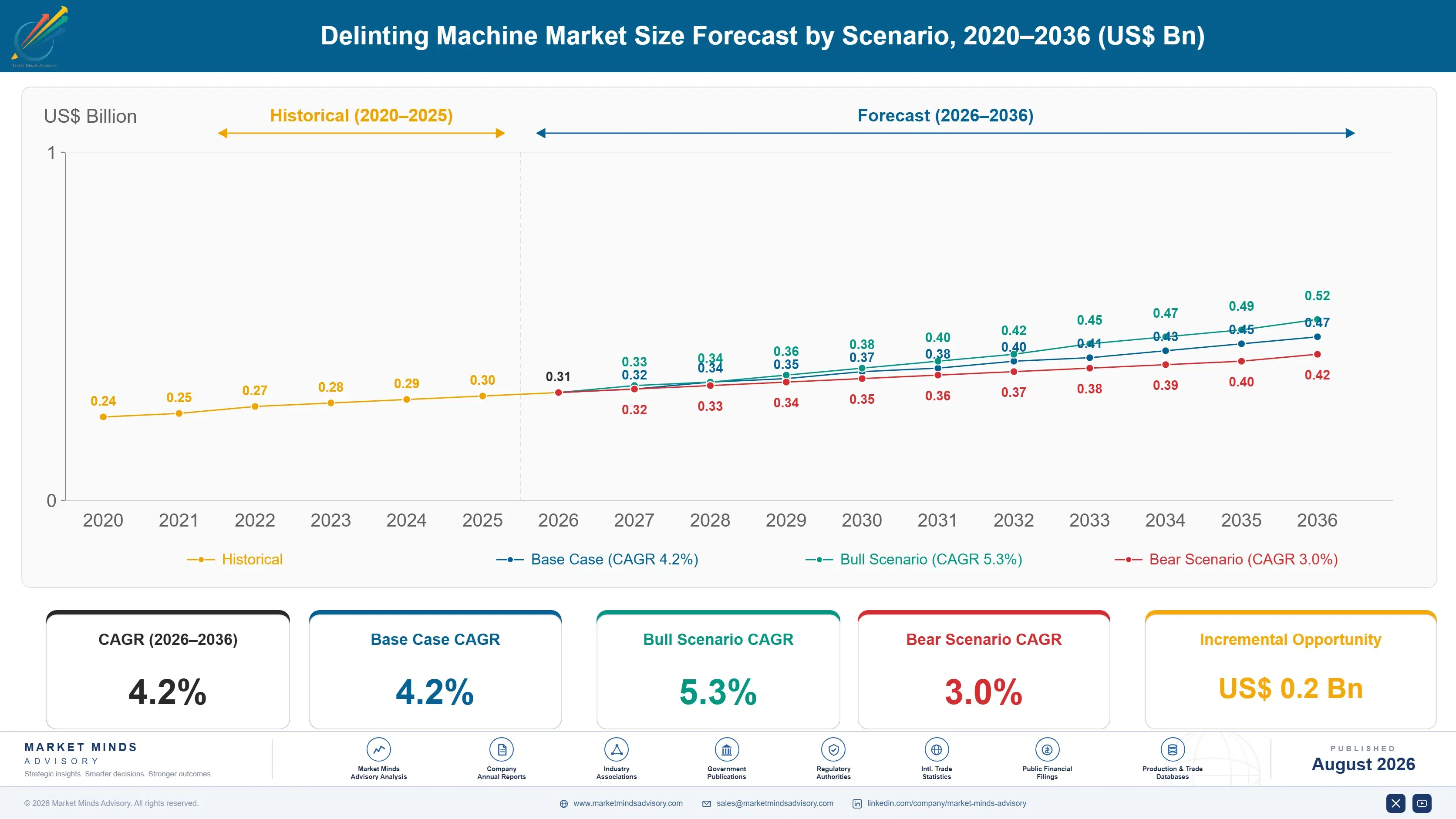
delinting-machine-market-size-forecast-scenario-1787302014528
Delinting machine demand grew steadily through 2020 to 2025, supported by resilient cotton acreage and steady ginning capacity investment even as pandemic-era commodity price swings slowed equipment replacement orders across major cotton-growing regions. The category closed 2025 at an estimated 3.6% historical CAGR, reflecting that steady demand building toward the faster mechanical-driven replacement growth now underway. Environmental pressure added a secondary layer of growth.
The base case rests on three mechanisms. First, tightening environmental disposal regulation keeps pushing ginners away from sulfuric acid delinting toward mechanical alternatives that avoid hazardous waste handling requirements. Second, precision planter adoption is raising seed uniformity standards that mechanical brush delinting meets consistently than acid processing across varying seed lots. Third, expanding cotton acreage in emerging producing regions is driving ginning capacity investment that requires delinting equipment alongside gin stands from initial installation.
The bull case turns on faster-than-expected environmental regulation enforcement pulling equipment replacement demand forward across every producing region simultaneously. The bear risk is a prolonged cotton price downturn reducing planted acreage and ginning capacity utilization, pushing processors to extend existing equipment service life rather than ordering replacement systems and slowing the mechanical transition trend currently underway across most major cotton-growing markets worldwide.

Environmental Compliance and the Seed Uniformity Standard

Delinting machines sit at the intersection of agricultural processing economics and environmental compliance, since ginners cannot substitute equipment suppliers without weighing throughput capacity, seed damage rates, and disposal compliance against a purchase that operates for a decade. That friction has favored equipment manufacturers, but the rise of environmental regulation on acid delinting disposal is pushing acid-system operators to evaluate mechanical alternatives as a necessity rather
MARKET CONCENTRATION58% CR5Engineering depth and service networks limit new entrant share
AVERAGE SELLING PRICE$85,000-620,000 per linePrice varies steeply by technology and throughput capacity
TOP PRODUCING COUNTRYUSA, 22% shareThe United States retains the largest single national output share
CAPACITY UTILISATION61%Utilisation trails potential given ongoing mechanical line expansion
TRADE INTENSITY44% cross-borderNearly half of units cross a border before installation
FEEDSTOCK COST SHARE34% of COGSSteel fabrication and precision brush component costs dominate spending
Commercially, the market splits between a mature base of acid delinting systems and mechanical saw-type machines sold through established ginning equipment dealer relationships, and a faster-growing tier of mechanical brush-type and combination systems sold on documented seed uniformity and environmental compliance performance in precision planting applications. Large ginning operations specify seed damage rates and disposal compliance documentation in equipment procurement decisions rather than relying on legacy acid system defaults.
Over the next decade, environmental compliance and seed uniformity will matter more than throughput capacity alone. Tightening disposal regulation and seed quality certification standards will keep raising the qualification bar for equipment entrants, and the manufacturers that build deep dealer and ginning cooperative relationships across established and expanding cotton regions stand to capture share of the acid-to-mechanical replacement cycle as regulation tightens.
"Acid delinting was cheap and simple for decades, until the disposal permits got expensive and the lawsuits got real. Mechanical brush systems cost more upfront, but they don't come with a hazardous waste manifest attached."
Director, Agricultural Processing Equipment Practice · MMA Agriculture Practice

Market Trends

Environmental Regulation Pushes Ginners Toward Mechanical Systems

Tightening environmental disposal regulation on sulfuric acid delinting waste is pushing ginners toward mechanical brush and combination systems, treating environmental compliance as a first-order equipment decision rather than a secondary consideration behind throughput cost alone. MMA's primary survey found more than 40% of surveyed ginning operators have replaced or are actively planning to replace acid delinting systems since 2024, a meaningful shift from the acid-dominant equipment base that defined the category for decades. Manufacturers including Lummus and Bajaj Steel have both expanded dedicated mechanical brush production lines since 2024 to capture this compliance-driven demand shift industry-wide.
Market Impact: Cited by 46%+ of equipment dealers
Precision Planters Raise Seed Uniformity Requirements

Precision planter adoption across major cotton-growing regions is raising seed uniformity standards that mechanical brush delinting meets more consistently than acid processing across varying seed lot conditions. Several large cottonseed processors have disclosed uniformity specification upgrades since 2023 specifically targeting compatibility with modern vacuum and finger-pickup planter technology. Manufacturers including Lakshmi Machine Works and Cherokee Fabrication have both expanded dedicated precision-grade delinting production since 2024 to meet this uniformity-driven demand shift across major cotton producing markets worldwide. Smaller regional manufacturers without comparable seed testing infrastructure risk losing these precision-grade contracts to established specialists that invested earlier in uniformity certification programs.
Market Impact: Cited in replacement plans since 20

Market Opportunities and Growth Drivers

Expanding Cotton Acreage Drives New Ginning Capacity Investment

Cotton acreage across major emerging producing regions continues expanding at a pace that outstrips most established cotton markets, driving proportional demand for new ginning capacity that requires delinting equipment installed alongside gin stands from initial construction. MMA's primary survey found more than 46% of surveyed equipment dealers now cite new ginnery construction as a primary demand driver, a meaningful increase from prior replacement-dominated demand cycles. That acreage expansion is raising demand for equipment manufacturers capable of supporting greenfield ginnery installations. Manufacturers without proven greenfield experience risk losing these accounts to established suppliers.
Market Impact: Compresses margins 5-10 points

Hazardous Waste Disposal Costs Accelerate Acid System Replacement

Hazardous waste disposal costs for spent sulfuric acid delinting byproducts continue rising across major regulatory jurisdictions, driving proportional demand for mechanical systems that avoid acid handling and disposal requirements entirely. Several large ginning cooperatives have disclosed acid system replacement plans since 2024 specifically targeting elimination of hazardous waste permit renewal costs and liability exposure. That replacement demand requires equipment manufacturers holding proven mechanical throughput performance comparable to legacy acid systems, favoring established suppliers over regional manufacturers whose mechanical product portfolio remains less proven at comparable processing scale. That gap is widening as cooperatives standardize procurement around proven mechanical performance records.
Market Impact: Conversion can exceed $400,000

Market Restraints and Challenges

Steel Fabrication and Brush Component Cost Volatility Compresses Margins

Steel fabrication and precision brush component costs account for roughly 34% of cost of goods sold, and their price tracks metals and specialty component supply chains that equipment manufacturers cannot easily pass through given multi-year replacement cycles that keep pricing stable across model years. That exposure, rooted in the components' dependence on global commodity market cycles rather than any manufacturer's pricing decision, compresses margins hardest for smaller manufacturers without component sourcing or long-term hedging contracts. Larger manufacturers are responding by pursuing direct material supply agreements to protect margin during future volatility. Smaller manufacturers remain most exposed to future price swings.
Market Impact: Cited by 40%+ of ginning operators

High Switching Costs Slow Mechanical Conversion Among Smaller Ginners

Converting an existing acid delinting line to mechanical brush technology can cost well into six figures and require several months of installation downtime, a barrier that keeps smaller regional ginning operations delaying conversion despite tightening environmental disposal requirements. That cost structure, a direct consequence of the specialized brush and conveying infrastructure mechanical systems require compared to simpler acid tank installations, favors larger cooperatives with capital access over smaller independent ginners. Smaller ginners are responding by pursuing shared regional delinting facilities instead of individual equipment conversion investments. That cooperative approach spreads conversion cost across multiple smaller operations facing similar regulatory pressure.
Market Impact: Specification upgrades disclosed si
3 additional market trends, 3 additional growth drivers, and 3 additional restraints and challenges are covered in the full report. Contact sales@marketmindsadvisory.com to access the complete intelligence.

Segment CAGR and Growth Architecture

Segmentation follows delinting technology rather than cotton variety processed, since the specific mechanical or chemical process a system delivers determines which environmental compliance and seed quality standards apply more than which cotton variety it ultimately processes. Mechanical saw-type systems remain the volume base, but brush-type and combination systems now address compliance and uniformity requirements older technology cannot satisfy.
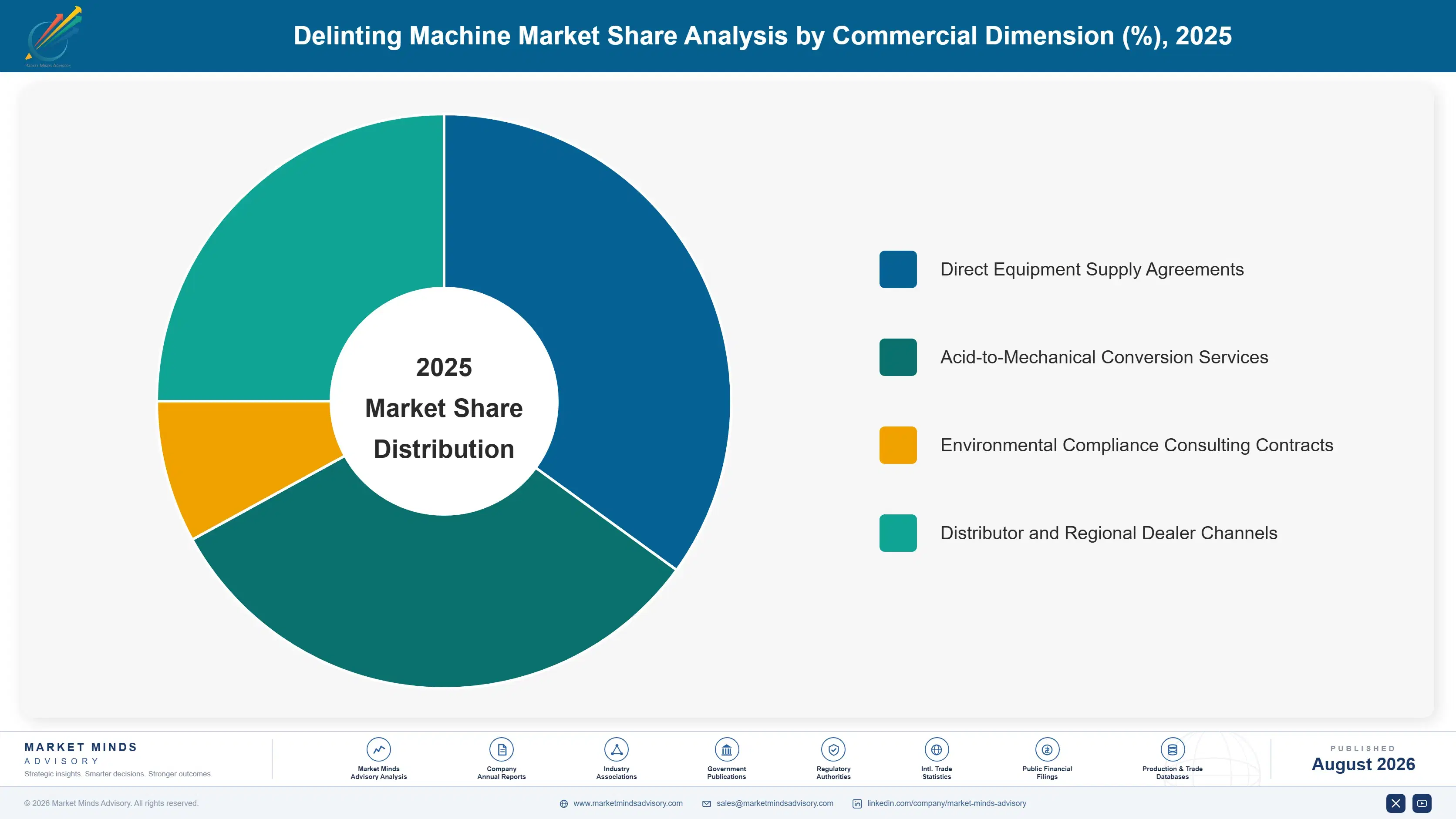
delinting-machine-market-market-share-analysis-1787302015082

Mechanical Brush-Type Delinting Machines

Mechanical brush-type delinting machines are the fastest-growing segment, expanding at an estimated 7.2% CAGR against a market average of 4.2%, roughly 1.71 times the overall pace. Growth tracks with environmental regulation on acid disposal and precision planter seed uniformity requirements that brush technology meets more consistently than legacy acid or saw-type processing. Lummus and Bajaj Steel lead on shipped brush-type volume, though the segment requires more precise brush wear management and quality control than legacy acid systems given its direct role in seed uniformity outcomes. Continued adoption depends on environmental regulation enforcement tightening across major cotton-growing jurisdictions through the forecast period. Lakshmi Machine Works and Cherokee Fabrication are investing in expanded brush-type production capacity to meet this faster-growing demand.
CAGR 7.2%

Combination Delinting Systems

Combination delinting systems rank second-fastest, growing at an estimated 6.1% CAGR as processors increasingly seek yield optimization across multiple processing stages within a single integrated system. The segment benefits from ginning operations increasingly specifying combination systems for large-scale operations where multi-stage processing improves seed recovery over single-technology alternatives. Adoption still trails mechanical saw-type systems by a meaningful margin given higher per-unit equipment costs and more complex installation requirements than single-technology systems demand. Growth is concentrated among suppliers including Continental Eagle and Bajaj Steel that have expanded combination system capacity to meet processor demand for simplified multi-stage integration. Regional manufacturers across Asia are also beginning to qualify comparable combination platforms for domestic ginning cooperatives, narrowing the gap with established suppliers.
CAGR 6.1%
Full segment breakdown across 5 segments available in the complete report.

Regional Architecture and Country Demand Map

Delinting machine demand concentrates where cotton acreage and ginning equipment manufacturing overlap. East Asia leads on cotton production scale and manufacturing depth, South Asia and Pacific follows on expanding ginning infrastructure, and South Asia and Pacific grows fastest as precision planting adoption accelerates across new producing regions.

East Asia

China accounts for the largest share of East Asia's delinting machine demand, driven by its substantial Xinjiang cotton production base and consolidated domestic ginning equipment manufacturing capacity supporting both local and export-oriented processing programs. China's ginning sector has expanded mechanical delinting adoption steadily since 2023, pulling equipment demand forward as processors upgrade toward internationally recognized seed quality standards. Japan and South Korea contribute a minimal share given limited domestic cotton cultivation, with most regional value concentrated in China's production and manufacturing base. Capacity additions across China since 2023 have kept East Asia the largest consumption center of the industry even as certification and export qualification increasingly happen closer to global cottonseed buyers worldwide.
Share: 27% | CAGR: 5.0% (2026 to 2036)

North America

The United States accounts for the large majority of North America's delinting machine demand, anchored by Lummus Corporation's Texas manufacturing base and the concentration of highly mechanized cotton farming that requires precision-planted, uniformly delinted seed. Large US ginning cooperatives increasingly specify seed uniformity and environmental compliance documentation directly in equipment procurement decisions, favoring established manufacturers with proven mechanical throughput over regional suppliers with narrower environmental compliance track records. Mexico contributes a smaller, growing share tied to its own expanding cotton production and processing base. Canada contributes a minimal share given limited domestic cotton cultivation outside niche research applications. Mexico's contribution grows fastest of the three as its expanding cotton processing sector adopts modernized equipment closer to established US supply chains.
Share: 24% | CAGR: 4.7% (2026 to 2036)
Regional intelligence for 5 additional markets available in the complete report: South Asia and Pacific, Western Europe, Latin America, Middle East and Africa, Eastern Europe. Contact sales@marketmindsadvisory.com.
delinting-machine-market-country-cagr-analysis-1787302015588

Where Delinting Equipment Margin Concentrates Next

Four commercial moves separate equipment manufacturers capturing outsized margin from those competing purely on delivered unit price. Each depends on shifting revenue toward mechanical product depth, conversion support services, environmental compliance consulting, or multi-year dealer supply agreements that current shipment volume does not yet fully reflect, particularly as ginners formalize environmental compliance strategies industry-wide each year.

Mechanical Brush Product Portfolio Investment Program

Manufacturers that build and maintain broad mechanical brush portfolios across multiple throughput and seed variety configurations are capturing the growing share of demand that environmental compliance, not just processing cost, now specifies by name. Developing a new brush configuration with adequate wear testing and seed damage validation can cost $300,000 or more, but each qualified configuration then commands demand that acid-system competitors are effectively barred from serving among environmentally regulated ginning operations. Manufacturers without mechanical depth increasingly lose the highest-value cooperative accounts entirely, making product portfolio breadth a durable advantage rather than a one-time cost.
Market Impact: Locks in demand across 54% of coope

Acid-to-Mechanical Conversion Support Services Program Development

Manufacturers offering structured conversion support, helping ginners transition existing acid delinting lines to mechanical brush technology with minimized installation downtime, are capturing service revenue that equipment-only sellers cannot offer. A dedicated conversion support engagement typically adds 14 to 24% to base equipment contract revenue through bundled installation coordination and permitting assistance fees, reflecting the specialized engineering labor required to support ginners through technology transitions. This service model matters most for ginners converting legacy acid infrastructure rather than building greenfield capacity. Ginners that skip this support often face costly permitting delays during conversion.
Market Impact: Adds 14 to 24% to base contract rev

Environmental Compliance Consulting and Permitting Support

Manufacturers offering dedicated environmental compliance consulting, including hazardous waste permit transition guidance and disposal cost modeling for ginners evaluating mechanical conversion, are capturing higher-margin business than commodity equipment sellers offering hardware alone without regulatory support. A compliance consulting engagement typically carries fees of $25,000 to $95,000 depending on facility size and permitting complexity, in addition to the recurring equipment revenue that follows once conversion decisions are finalized. This service model matters most for smaller ginning cooperatives without established regulatory affairs expertise navigating conversion decisions independently. Cooperatives that skip this consulting often face costly permitting delays during conversion planning.
Market Impact: Consulting fees run $25,000 to $95,

Multi-Year Dealer Supply Agreement Program Development

Manufacturers securing multi-year supply agreements with large equipment dealers and ginning cooperatives, often tied to specific conversion volume or replacement milestones, are capturing volume commitments that protect against price-only competition from manufacturers without comparable dealer relationships built over years of reliable, on-specification delivery. These supply agreements typically carry a price premium of 5 to 10% over spot-market purchasing, reflecting the value dealers place on guaranteed supply and standardized equipment across their regional territories. Manufacturers able to demonstrate reserved production capacity increasingly win these agreements over lower-cost competitors lacking comparable delivery scale.
Market Impact: Commands 5 to 10% premium over spot

Who Controls the Margin Pool

The top five manufacturers hold an estimated 58% of global delinting machine shipment volume, a higher concentration than general agricultural processing equipment categories, reflecting the engineering depth and dealer relationship requirements that keep smaller manufacturers from entering the largest cooperative accounts. Lummus and Bajaj Steel lead on engineering depth and service networks, while a second tier of suppliers competes on price for smaller independent ginner accounts.
Current competitive activity centers on three fronts. Mechanical brush capacity expansion is redrawing the premium tier, with Lummus, Bajaj Steel, and Lakshmi Machine Works racing to secure conversion contracts. Environmental compliance consulting build-out is becoming a differentiator among manufacturers targeting cooperatives managing permitting transitions. And Chinese and Indian manufacturers are pursuing certification and Western dealer partnerships to move beyond regional equipment supply into global competition.

Emerging pressure comes from Chinese and Indian manufacturers moving up the value chain into certified, dealer-qualified categories once dominated by Western specialists, aided by domestic steel supply that keeps their production costs lower. If regional manufacturers close the engineering and service gap further, expect share to shift, particularly in Latin America and Africa where price sensitivity runs higher than at established North American and East Asian cooperative accounts.
delinting-machine-market-company-positioning-matrix-1787302016107

Competitive Moat and Risk Dimensions

LUMMUS CORPORATION

Moat: Cotton Ginning Engineering Depth

Lummus built the industry's broadest cotton ginning and delinting engineering portfolio over more than a century of Texas-based manufacturing, a depth smaller manufacturers cannot replicate quickly, and its established dealer and cooperative relationships give it replacement priority that regional competitors cannot match at comparable speed or service completeness.
LUMMUS CORPORATION

Risk: Emerging Market Cost Pressure Rising

Lummus's premium engineering model depends on ginners valuing service depth and reliability enough to pay meaningfully more than lower-cost Indian and Chinese alternatives, and that willingness to pay could erode as regional manufacturers close the mechanical throughput and quality gap while retaining a substantial manufacturing cost advantage.
BAJAJ STEEL INDUSTRIES LIMITED

Moat: Indian Cotton Sector Scale

Bajaj Steel's ginning and delinting equipment sells across India's massive cotton processing base, giving it manufacturing scale and cost advantages tied to domestic steel supply that Western competitors cannot match, backed by extensive service infrastructure built to support the world's largest cotton-growing acreage by area under cultivation.
BAJAJ STEEL INDUSTRIES LIMITED

Risk: Premium Segment Depth Remains Limited

Bajaj Steel's scale advantage concentrates on volume-tier equipment serving India's cost-sensitive ginning sector rather than premium mechanical brush categories, leaving room for Lummus and Lakshmi Machine Works to capture the fastest-growing, highest-margin segment even as Bajaj Steel defends its volume leadership domestically. That gap could widen further as premium-focused rivals deepen cooperative relationships Bajaj Steel's volume-weighted portfolio cannot easily replicate.

Players Tracked

Prominent Players

Lummus Corporation
Bajaj Steel Industries Limited
Lakshmi Machine Works Limited
Cherokee Fabrication Company LLC
Continental Eagle Corporation

Other Key Players

Samuel Jackson Inc.
Rieter Holding AG
Uster Technologies AG
Trützschler Group
Voith Group
Loptex S.r.l.
Bessonett Gin and Supply Company
John Deere
Shree Ambica Engineering
Anand Engineering Company
Sudarshan Ginning Machines Pvt Ltd
Shandong Kingoro Machinery Co.
Bühler Group
Andritz AG
Alvan Blanch Group

Recent Developments

MARCH 2025

Lummus Expands Mechanical Brush Certification Across Additional Seed Variety Specifications

Lummus Corporation secured performance certification for its mechanical brush delinting line across three additional cottonseed variety specifications, expanding the processing accounts its certified products can serve. The certification followed thirteen months of seed damage and uniformity testing across multiple cooperative partnerships worldwide, ahead of the proposed certification timeline.
Signal: Signals certification breadth becoming a p
SEPTEMBER 2024

Bajaj Steel Commissions Additional Mechanical Delinting Production Capacity

Bajaj Steel Industries Limited commissioned additional mechanical brush delinting production capacity at its India facility, expanding dedicated output for domestic conversion demand across major cooperative accounts. The expansion followed order backlog growth as large ginning cooperatives finalized acid-to-mechanical conversion plans through 2024 and into 2025.
Signal: Signals conversion demand outpacing existi
JANUARY 2025

Lakshmi Machine Works Acquires Regional Compliance Consulting Provider

Lakshmi Machine Works Limited acquired a regional environmental compliance consulting and permitting service provider to strengthen its cooperative support offering, targeting ginners facing tightening hazardous waste disposal requirements. The acquired provider continues operating under its existing brand within Lakshmi's broader corporate structure following the transaction's close.
Signal: Signals large diversified equipment manufa

Steel Fabrication and Brush Component Exposure

Steel fabrication and precision brush component costs account for roughly 34% of cost of goods sold in delinting machine manufacturing, with production concentrated among a handful of qualified metals and specialty component suppliers capable of the wear-resistant grades brush mechanisms require. Precision machining and assembly labor add a further share, sourced predominantly from specialized metalworking and quality control staff regardless of manufacturer location.
Steel prices spiked sharply during 2022 as global supply chain disruption tied to broader metals market volatility constrained available volume, with several manufacturers reporting input cost increases exceeding 35% in their 2022 annual reports before pricing stabilized through 2023. Industry supply chain reviews have flagged steel and specialty brush component production as sensitive to both global commodity cycles and the specialized manufacturing capacity required for wear-resistant delinting components.

Smaller regional manufacturers without long-term material supply agreements absorbed the 2022 price spike hardest, losing contract bids to larger suppliers including Lummus and Bajaj Steel that had negotiated priority pricing and, in several cases, invested directly in material sourcing partnerships. Manufacturers with secured upstream sourcing weathered the volatility better than those dependent on the open market, a cost advantage that persists across North American and Asian producing regions.
delinting-machine-market-cost-volatility-analysis-1787302016302

Multi-Year Material Supply Agreements

Larger manufacturers are locking multi-year steel and brush component supply agreements directly with qualified producers, trading some pricing flexibility for guaranteed volume and price stability that protects margin during future sourcing volatility, an increasingly standard practice among the top five manufacturers following the 2022 shortage experience. Smaller manufacturers are pooling procurement through industry associations to negotiate comparable terms.

Direct Upstream Sourcing Partnerships

Several larger manufacturers are investing directly in upstream material sourcing partnerships rather than purchasing entirely on the open market, reducing exposure to material price swings and improving supply reliability, though this requires higher fixed capital investment than pure equipment assembly operations require. That investment pays back within four to six years given the volatility material pricing has shown.

Regional Material Sourcing Diversification Strategy

Manufacturers are qualifying multiple regional material sources across North America, Asia, and Europe rather than depending on a single production region, reducing exposure to any single geography's supply disruption while adding modest logistics complexity to sourcing operations across the manufacturing network. This approach raises base material costs by two to four percent but improves supply continuity during regional disruptions.

Portfolio Architecture for Margin Defence

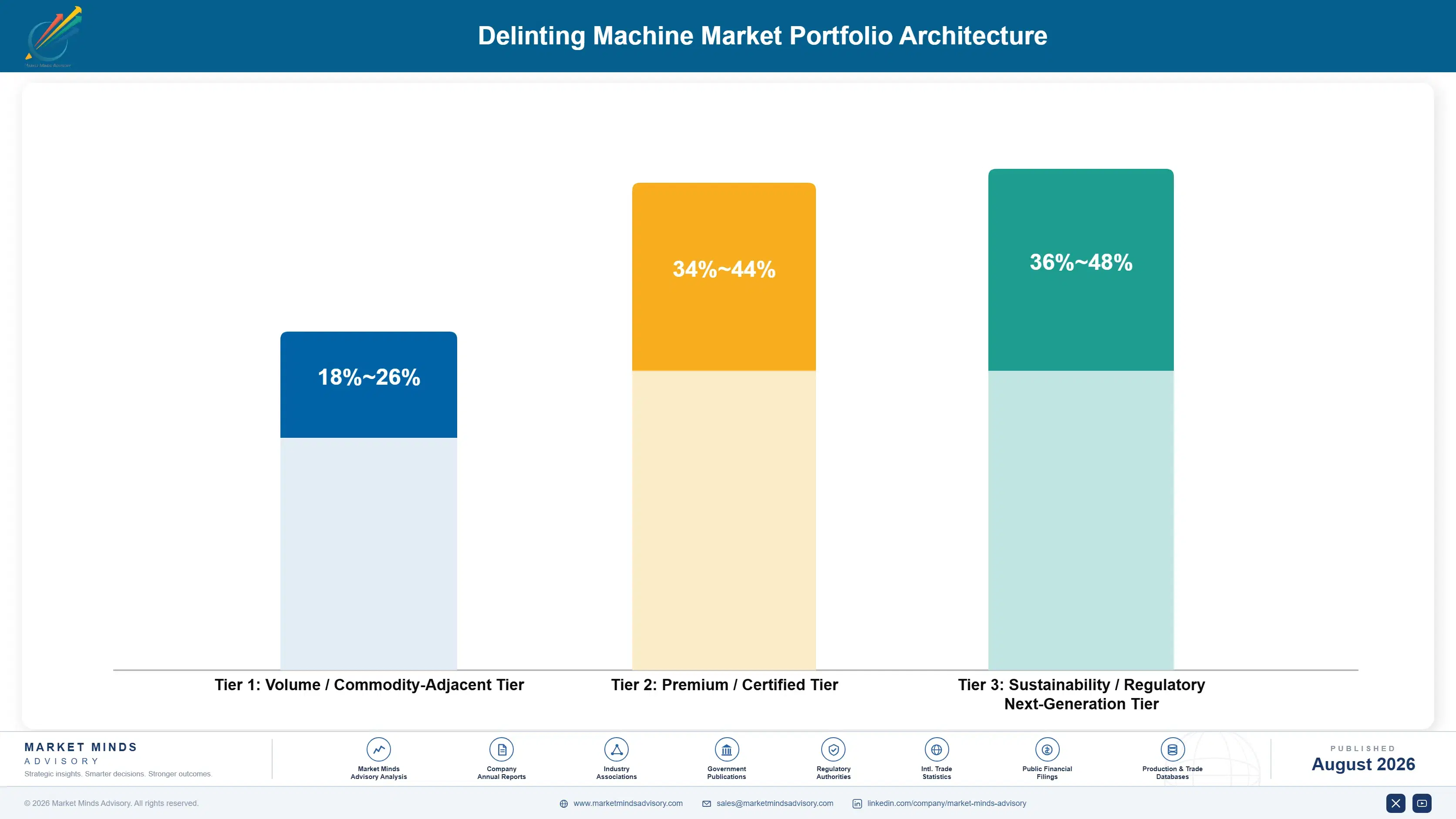
Delinting machine portfolios split across three tiers with meaningfully different margin economics. The volume tier, mechanical saw-type and legacy acid systems, competes largely on established dealer relationships and delivers gross margins in the 18 to 28% range. Premium mechanical brush and combination systems sold on documented compliance and uniformity performance command materially higher margins, reflecting engineering cost and testing investment layered on top of base equipment design.
The tension between volume and premium tiers shapes capacity allocation decisions across the industry. Volume equipment capacity is easiest to scale and fastest to fund, but regional manufacturer price competition keeps margin pressure constant in that tier. Premium mechanical brush and combination capacity requires deeper engineering investment and slower certification cycles, but rewards patient capital with margins that hold up as acid-to-mechanical conversion demand continues.

High-value margin pools concentrate in mechanical brush systems, combination delinting platforms, and the conversion support and compliance consulting layer that increasingly separates established manufacturers from commodity equipment sellers. These pools remain a modest share of total shipment volume today, but they are growing faster than the legacy acid and saw-type base and are where most manufacturer research and development spending is now directed.

Volume / Commodity-Adjacent Tier

Mechanical saw-type and legacy acid delinting systems sold primarily through established dealer relationships and price. These units carry the thinnest margins in the portfolio and depend on manufacturing scale rather than certification depth to stay profitable.
Gross Margin: 18-26%

Premium / Certified Tier

Premium mechanical brush and combination systems bundling compliance documentation, uniformity testing, and conversion support that large cooperatives pay a premium to access. This tier generates steady repeat business, since certified accounts rarely switch suppliers without cause.
Gross Margin: 34-44%

Sustainability / Regulatory / Next-Generation Tier

Next-generation mechanical delinting platforms tied to tightening environmental disposal standards and expanding precision planting specifications. This tier draws the heaviest research spending, since seed uniformity performance and multi-jurisdiction certification depth both require sustained investment to defend against competitive erosion.
Gross Margin: 36-48%
delinting-machine-market-portfolio-architecture-1787302016802

The Dealer and Cooperative Moat

Delinting machine economics increasingly resemble a dealer-and-cooperative relationship business rather than a simple equipment sale. Conversion support, compliance consulting, and multi-year supply agreements generate recurring engagement with large ginning cooperatives that persists well beyond the initial equipment sale, and manufacturers that own that dealer relationship can forecast renewal demand with more confidence than pure commodity competitors ever manage reliably.
Adoption depth varies by end-use vertical. Large ginning cooperatives and processing operations, once qualified on a manufacturer's certification and compliance documentation, rarely switch given the downtime cost and regulatory risk of requalifying an entire facility's equipment mid-cycle. Smaller independent ginners show shallower stickiness so far, since they often source through regional dealers rather than direct manufacturer relationships and switch more readily on price alone.

A generational shift in buyer profiles is underway as environmental compliance and quality assurance officers, rather than pure procurement, increasingly co-sign equipment sourcing decisions given the disposal liability and seed quality exposure delinting technology choice now carries. These buyers weight compliance credibility and uniformity documentation alongside unit cost, a shift that favors manufacturers with proven mechanical performance records over those competing purely on price.
delinting-machine-market-end-use-penetration-index-1787302017290

Where the Compliance Premium Sits

These are among the four positions where our research anticipates prominent divergence between winners and laggards over the coming forecast period. Each is grounded in the demand model, the regulatory perimeter, and the announced capacity pipeline.
01 / MECHANICAL BRUSH INVESTMENT

Prioritize mechanical brush depth over legacy acid system capacity

Mechanical brush-type delinting machines are growing roughly 1.71 times faster than the overall market, driven by environmental regulation that shows no sign of slowing as disposal enforcement keeps expanding industry-wide. Manufacturers still weighted toward legacy acid system capacity risk ceding the fastest-growing, highest-margin accounts to specialists that built mechanical brush expertise earlier in the adoption cycle. Capital directed toward mechanical brush depth now should pay back meaningfully faster than incremental acid system expansion into an increasingly regulated, declining tier that environmental compliance keeps pressuring hardest.
02 / CONVERSION PROGRAM READINESS

Build conversion support before disposal regulation tightens further

Manufacturers that still compete purely on unit price without structured conversion support are leaving significant value on the table that installation coordination, permitting assistance, and compliance consulting are already capturing for established brands. These conversion partnerships carry materially higher switching costs than the underlying equipment sale, locking cooperatives into renewal patterns that price-only competitors struggle to break. Building this capability now, before disposal regulation tightens further across major cotton-growing jurisdictions, is worth considerably more than matching a rival's price cut for cut.
03 / MATERIAL COST HEDGING

Lock multi-year steel and component agreements now

Material input costs already run close to 34% of cost of goods sold, and the 2022 spike showed supply disruption can push manufacturer costs up by more than 35% within months during a volatile cycle. Manufacturers without multi-year supply agreements risk losing contract bids to better-hedged rivals during the next volatile cycle, damaging dealer relationships built over years in a single sharp shortage. Locking supply now, even at a premium to spot pricing, protects margin stability and the credibility needed to win long-duration dealer contracts.
04 / REGIONAL MANUFACTURING POSITIONING

Weigh Indian and Chinese cost scale against Western service trust carefully

India and China now hold a substantial and growing share of global delinting equipment manufacturing capacity and continue adding output faster than most other regions, making cost leadership there increasingly difficult for Western manufacturers to contest on unit price. Western manufacturers still hold an advantage in service depth, compliance consulting capability, and long-standing cooperative trust that regional entrants have not yet closed. The strategy is not chasing regional manufacturing cost scale, but doubling down on the service and compliance capability regional competitors still cannot replicate at comparable trust levels.

Engagement Snapshot From the Field

A live engagement with an industry participant carrying material or product regulatory and market exposure ahead of a defining policy shift, showing how our research translates into a defensible multi-year portfolio strategy.
MARKET MINDS ADVISORY · CLIENT ENGAGEMENT SUMMARY
Delinting Machine Producer Strategic Portfolio Review and Transition Roadmap 2026·Investment Scenario on Delinting Machine Exposure Evaluation 2025-26
CLIENT PROFILE
The client is a regional ginning cooperative operating six processing facilities across a major cotton-growing region, previously relying on sulfuric acid delinting systems installed more than two decades ago across most of its facilities. The cooperative faced rising hazardous waste disposal costs and needed an independent assessment of how to convert its facilities to mechanical delinting without disrupting peak-season processing capacity (client-reported, unverified by MMA).
STRATEGIC CHALLENGE
The cooperative needed to select an equipment supplier and conversion schedule capable of transitioning all six facilities to mechanical delinting within a limited capital budget while avoiding processing capacity loss during the narrow annual ginning season when facilities operate at peak utilization. Coordinating the transition across geographically dispersed facilities with varying equipment ages further complicated scheduling decisions.
MMA APPROACH
MMA conducted a vendor-neutral equipment supplier assessment benchmarking candidate manufacturers' mechanical throughput performance, conversion timeline track record, and compliance consulting capability against the cooperative's facility mix and seasonal processing constraints across its six locations. The assessment incorporated interviews with the cooperative's operations and environmental compliance leadership to validate conversion feasibility before finalizing supplier recommendations.
KEY FINDINGS
  1. Candidate supplier benchmarking identified two manufacturers with conversion timelines short enough to fit within the cooperative's off-season maintenance windows without requiring additional facility downtime.
  2. A phased conversion approach prioritizing the two highest-volume facilities first would reduce hazardous waste disposal costs by an estimated 35% within the first full season compared to a uniform simultaneous conversion approach.
  3. Environmental permitting gaps existed at three of the six facilities, requiring additional regulatory documentation before mechanical conversion could proceed on the cooperative's preferred timeline.
  4. Cost modeling showed the conversion program would pay back its investment within roughly twenty-two months through eliminated hazardous waste disposal costs and reduced liability insurance premiums.
CLIENT PROFILE
The client is a regional ginning cooperative operating six processing facilities across a major cotton-growing region, previously relying on sulfuric acid delinting systems installed more than two decades ago across most of its facilities. The cooperative faced rising hazardous waste disposal costs and needed an independent assessment of how to convert its facilities to mechanical delinting without disrupting peak-season processing capacity (client-reported, unverified by MMA).
STRATEGIC CHALLENGE
The cooperative needed to select an equipment supplier and conversion schedule capable of transitioning all six facilities to mechanical delinting within a limited capital budget while avoiding processing capacity loss during the narrow annual ginning season when facilities operate at peak utilization. Coordinating the transition across geographically dispersed facilities with varying equipment ages further complicated scheduling decisions.
MMA APPROACH
MMA conducted a vendor-neutral equipment supplier assessment benchmarking candidate manufacturers' mechanical throughput performance, conversion timeline track record, and compliance consulting capability against the cooperative's facility mix and seasonal processing constraints across its six locations. The assessment incorporated interviews with the cooperative's operations and environmental compliance leadership to validate conversion feasibility before finalizing supplier recommendations.
KEY FINDINGS
  1. Candidate supplier benchmarking identified two manufacturers with conversion timelines short enough to fit within the cooperative's off-season maintenance windows without requiring additional facility downtime.
  2. A phased conversion approach prioritizing the two highest-volume facilities first would reduce hazardous waste disposal costs by an estimated 35% within the first full season compared to a uniform simultaneous conversion approach.
  3. Environmental permitting gaps existed at three of the six facilities, requiring additional regulatory documentation before mechanical conversion could proceed on the cooperative's preferred timeline.
  4. Cost modeling showed the conversion program would pay back its investment within roughly twenty-two months through eliminated hazardous waste disposal costs and reduced liability insurance premiums.
RECOMMENDED STRATEGY
Phase 1: Phase 1 (Months 1 to 3): Conduct candidate supplier benchmarking and environmental permitting assessment across all six facilities and mechanical throughput validation. Phase 2: Phase 2 (Months 4 to 14): Initiate phased conversion beginning with the two highest-volume facilities during the off-season maintenance window. Phase 3: Phase 3 (Months 15 to 24): Complete conversion across remaining facilities and finalize the multi-year supply and service agreement terms.
OUTCOME
The cooperative began phased conversion in early 2026, prioritizing its two highest-volume facilities as recommended. Early data through mid-2026 showed disposal cost reductions tracking toward the projected 35% first-season savings, though full cooperative-wide confirmation awaits completion of the remaining facility conversions (client-reported, unverified by MMA).

Frequently Asked Questions

Foundational context covering the market sizes, CAGR, scope, country, region and competition that inform every finding below. This section is provided to cover basics and most often pre-purchase conversations, answered from the MMA Primary Research Dataset.

What is the current size of the Delinting Machine Market?

The global delinting machine market reached an estimated $0.34 billion in 2025. Growth concentrates in mechanical brush and combination systems where environmental compliance increasingly determines manufacturer selection.

How large will the Delinting Machine Market be by 2036?

MMA forecasts the market reaching approximately $0.53 billion by 2036, roughly one and a half times its 2026 value. Mechanical brush-type machines are expected to drive the largest share of that incremental growth.

What is the CAGR for the Delinting Machine Market 2026 to 2036?

The base case CAGR is 4.2% across the forecast period, with a bull case near 5.3% and a bear case near 3.0% depending on environmental regulation pace and cotton acreage trends.

Which segment is growing fastest?

Mechanical brush-type delinting machines are the fastest-growing segment, expanding at roughly 7.2% CAGR, about 1.71 times the overall market pace, driven by environmental regulation on acid disposal.

Who are the major companies in the Delinting Machine Market?

Leading manufacturers include Lummus Corporation, Bajaj Steel, Lakshmi Machine Works, Cherokee Fabrication, and Continental Eagle. The top five hold an estimated 58% of global shipment volume.

Which country is growing fastest?

The United States leads growth in absolute manufacturing volume, but Brazil is expanding fastest in percentage terms, driven by its rapidly expanding mechanized cotton acreage.

Report Segmentation Architecture

The full report scope spans multiple orthogonal segmentation dimensions, with cross-tabulated demand data provided for each dimension pair. Coverage extends further to regional breakdowns, trend trajectories, and the competitive detail needed to support segment-level decision-making.

By Delinting Technology Type

  • Mechanical Saw-Type Delinting Machines
  • Mechanical Brush-Type Delinting Machines
  • Acid Chemical Delinting Systems
  • Combination Delinting Systems
  • Small-Scale Portable Delinting Units

By End-Use Application

  • Precision Planting Seed Preparation
  • Cottonseed Oil Extraction Preparation
  • Cooperative Ginning Operations
  • Independent Ginner Operations
  • Research and Breeding Seed Processing

By Commercial Dimension

  • Direct Equipment Supply Agreements
  • Acid-to-Mechanical Conversion Services
  • Environmental Compliance Consulting Contracts
  • Distributor and Regional Dealer Channels

By Region

  • East Asia
  • North America
  • South Asia and Pacific
  • Western Europe
  • Latin America
  • Middle East and Africa
  • Eastern Europe

Scope, Methodology, and Coverage

Every figure in this report is reproducible from documented input assumptions. The scope below maps the historical period, the forecast horizon, the segmentation dimensions, and the countries covered, alongside the underlying primary and qualitative methodology.
Historical Period
2020 to 2025
Forecast Period
2026 to 2036
Base Year
2025 (USD billions; MMA Primary Research Dataset, August 2026)
Market Definition
The delinting machine market covers equipment used to remove residual lint fiber from cottonseed after ginning, preparing seed for precision planting or oil extraction, including mechanical saw-type, mechanical brush-type, acid chemical, combination, and small-scale portable delinting systems sold to ginning operations and cottonseed processors. It excludes the cotton gins themselves, downstream cottonseed oil extraction and crushing equipment, and seed treatment and coating equipment applied after delinting is complete.
Quantitative Units
USD billions (current prices); delinting lines shipped where disclosed
Segmentation Dimensions
By Delinting Technology Type; By End-Use Application; By Commercial Dimension; By Region
Regions Covered
East Asia, North America, South Asia and Pacific, Western Europe, Latin America, Middle East and Africa, Eastern Europe
Countries Covered
China, Japan, South Korea, USA, Canada, Mexico, India, Australia, Pakistan, Spain, Greece, Brazil, Argentina, Paraguay, Colombia, Egypt, Burkina Faso, Mali, Bulgaria, Romania, and additional markets relevant to this sector
Key Companies Profiled
Lummus Corporation, Bajaj Steel Industries Limited, Lakshmi Machine Works Limited, Cherokee Fabrication Company LLC, Continental Eagle Corporation, Samuel Jackson Inc., Rieter Holding AG, Uster Technologies AG, Trützschler Group, Voith Group, Loptex S.r.l., Bessonett Gin and Supply Company, John Deere, Shree Ambica Engineering, Anand Engineering Company, Sudarshan Ginning Machines Pvt Ltd, Shandong Kingoro Machinery Co., Bühler Group, Andritz AG, Alvan Blanch Group
Quantitative Methodology
Primary survey, n=3,800 respondents, Q4 2025, six countries; demand-side model with trade association cross-validation
Qualitative Methodology
47 expert interviews, Q4 2025; applied to validate demand model assumptions, identify emerging dynamics, and assess competitive positioning
Report Format
PDF and XLSX data workbook (Word format preview document)
Publisher
Market Minds Advisory
Report Code
MMA-2026-AGR-114
Published
August 2026
Contact
sales@marketmindsadvisory.com | www.marketmindsadvisory.com

Purchase the full Delinting Machine Market Report (2026 to 2036).

The full Delinting Machine Market report delivers a comprehensive assessment of delinting technology, competitive positioning, and regional demand through 2036. It includes detailed segmentation by delinting technology type, end-use application, and commercial dimension, alongside profiles of all twenty companies covered in this summary. The report quantifies regional market size and growth across all seven world regions, with country-level detail for the twenty-plus markets MMA tracks. Buyers receive access to MMA's underlying primary survey dataset and expert interview transcripts, enabling further custom analysis. A dedicated chapter benchmarks steel and brush component cost exposure and mitigation strategies across manufacturer types.
Delinting technology segmentation across five product categories
Profiles of twenty leading delinting machine manufacturers worldwide
Regional sizing and forecasts across all seven world regions
Steel and brush component cost exposure mitigation chapter
Primary survey dataset access covering 3,800 respondent interviews
Competitive development tracking with dated corporate event log

Built For The People Who Decide

From boardroom strategy to bench-side execution, this report is read cover-to-cover by leaders shaping the next decade of their industry, turning demand scenarios, market dynamics and valuation benchmarks into decisions.
CXOs/ Presidents/ VPs/ Managers
M&A and Corporate Development
Strategy Teams and R&D Heads
Procurement and Product Directors
Regulatory and Compliance Leaders
Investor Relations and Equity Analysts