Market Minds Advisory
Dehydrated Skin Product Market

Dehydrated Skin Product Market: Dehydrated Skin Product Market: Humectants Without Occlusion, A Condition Nobody Can Self-Diagnose and Undisclosed Molecular Weights, 2026 to 2036

Hyaluronic acid draws water in from wherever it can find it. In dry air with nothing sealed over the top, that means drawing it out of the skin underneath instead.

Lead Analyst

Published

September 2026

Make Smarter Decisions with Customized Research Insights

Request a free sample report and evaluate market opportunities, growth trends, and competitive dynamics relevant to your business needs.

2025 MARKET VALUE$5.4BMarket Size 2025
2036 FORECAST VALUE$13.7BBase Case , 2026 to 2036
CAGR 2026 TO 20368.8 %Bull 10.0% / Bear 7.6%
INCREMENTAL OPPORTUNITY$7.8BNet 10- year value creation
EXPANSION MULTIPLE2.32x2036 value over 2026 base
Strategic Levers
M&A Pipeline
Regional Outlook
Country Rankings
Competitive Intelligence
Segmental Deep-dive
Call-Us : 91 93563 13602

Executive Snapshot and Market Trajectory.

Dehydrated skin lacks water and dry skin lacks oil. They are different conditions needing different chemistry, and about 24% of consumers can tell which one they actually have, which is the commercial foundation of this entire category. Oily skin can be dehydrated and frequently is.
Barrier lipid replacement systems grow at 13.2%, half again the market rate of 8.8%, because ceramides and cholesterol address why water is escaping rather than replacing it after the fact. Occlusive sealing systems follow at 11.4%. Both are taking share from humectant serums that dominate the shelf and solve only half the problem. Basic humectant serums built on commodity fermented hyaluronic acid grow slowest of anything covered.
The humectant issue is the one formulators discuss and packs never mention. Around 57% of products rely on water binding with no sealing layer above it, and below roughly 40% ambient humidity an unsealed humectant pulls water from deeper skin and loses it to the air. The product then makes the condition worse in exactly the climate that caused it. Every formulator understands this and almost no packaging mentions it anywhere at all.
Market Definition
This market covers skincare products formulated and positioned for dehydrated skin, meaning water deficiency in the stratum corneum, including humectant systems, occlusive sealing systems, barrier lipid replacement systems, combined humectant and occlusive systems, hydration actives and osmolytes, and film-forming polymer systems. It excludes products positioned solely for dry or lipid-deficient skin, anti-ageing and pigmentation treatments, cleansers, sun care, body and hand care, and prescription dermatological therapies.
Base Year Value
$5.4B in 2025 (MMA Primary Research Dataset, September 2026)
Forecast Period
2026 to 2036, eleven discrete annual values
CAGR
8.8% base case. Bull 10.0%. Bear 7.6%.
Fastest Growth Segment
Barrier Lipid Replacement Systems: 13.2% CAGR
Fastest Growth Country
South Korea: 15.4% CAGR
Fastest Growth Region
South Asia and Pacific: 10.8% CAGR
Largest Region
East Asia: 39% of 2025 global value
Market Leaders
L'Oreal Groupe, Estee Lauder Companies, Shiseido, Amorepacific, and Beiersdorf lead the field. Source: MMA Primary Research Dataset, July 2026.
Primary Survey
n=3,800 procurement and R&D decision-makers, Q4 2025, six countries
Methodology
Demand-side build-up, cross-validated against public data, 47 expert interviews

Dehydrated Skin Product Market Forecast Scenarios

dehydrated-skin-product-market-size-forecast-scenario-1790014405271
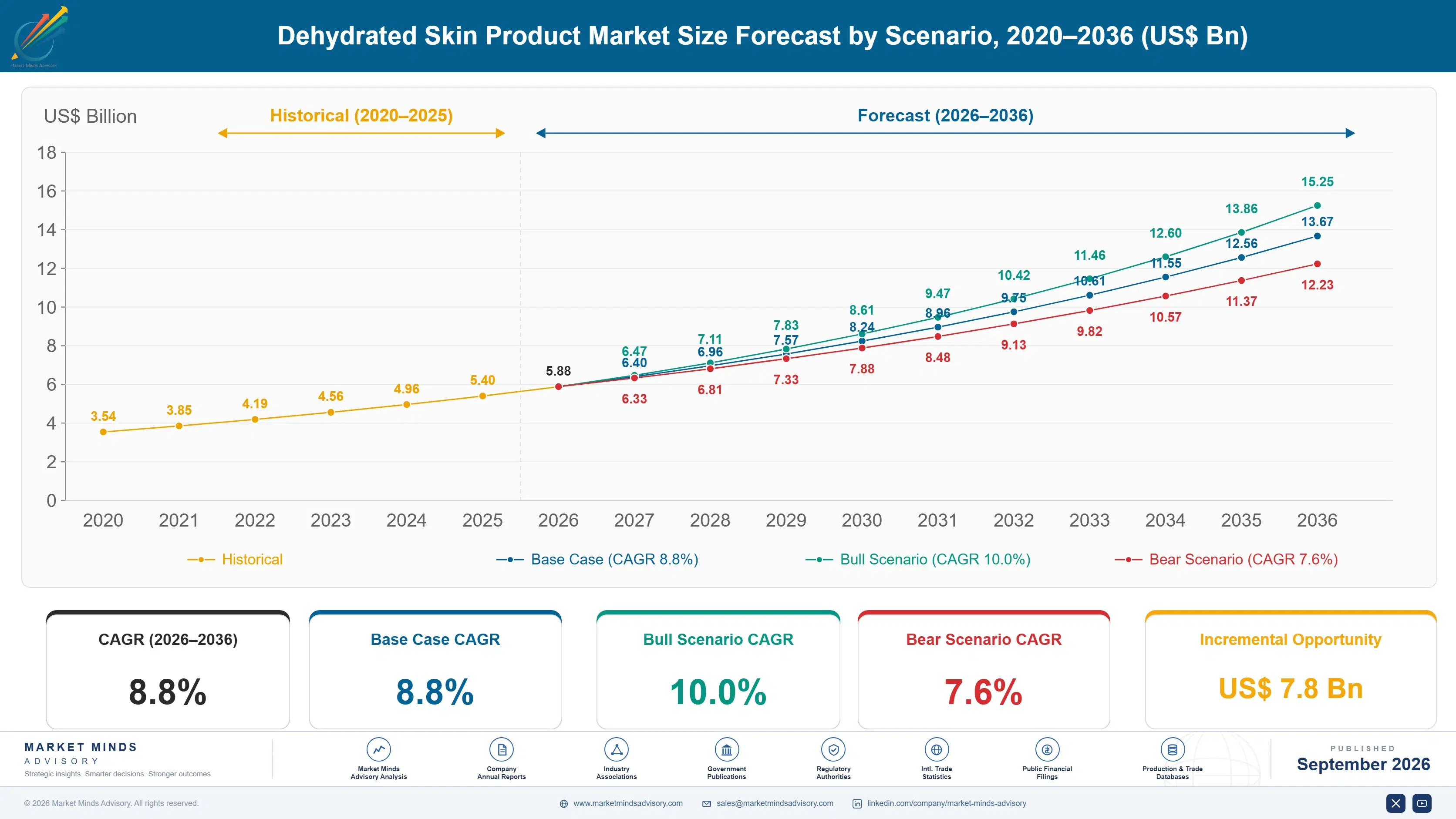
Between 2020 and 2025 the category grew at 7.4% on a hydration narrative that arrived from Korea and spread through every market that watched it. Essence and layering routines normalised buying several hydrating products rather than one, hyaluronic acid became the most recognised ingredient in skincare, and barrier science moved out of dermatology journals into mainstream product claims.
The base case at 8.8% rests on three mechanisms. Barrier lipid systems keep taking share as consumers learn that sealing matters more than adding water. Korean and Chinese development cycles push new hydration actives into mainstream ranges faster than Western product development can respond. And climate conditions across more markets make ambient humidity a genuine skincare variable rather than a seasonal one. None of the three requires consumers to diagnose their own condition correctly.
The bull case at 10.0% depends on accessible measurement reaching consumers, since a buyer who could distinguish water loss from lipid deficiency would purchase far more accurately and far more often. The bear case at 7.6% is the humectant problem becoming public: 57% of products ship without occlusion, the mechanism is well documented, and a consumer group explaining it would damage the largest part of the category.

The Condition Nobody Can Measure

Dehydration and dryness feel identical and are chemically opposite problems. Dehydrated skin has lost water from the stratum corneum and needs humectants and a seal; dry skin lacks sebum and needs lipids. Oily skin can be dehydrated and frequently is. Around 24% of consumers correctly identify which condition they have, and the products for each are formulated on entirely different principles.
TOP FIVE CONCENTRATION38%Share of category revenue held by the leading manufacturers
SELF DIAGNOSIS ACCURACY24%Consumers correctly distinguishing water loss from lipid deficiency
HUMECTANT WITHOUT OCCLUSION57%Products relying on water binding with no sealing layer
MOLECULAR WEIGHT DISCLOSURE11%Brands publishing the actual distribution behind their claim
LOW HUMIDITY REVERSAL THRESHOLD40%Ambient level below which unsealed humectants draw water outward
AVERAGE SERUM SELLING PRICEUSD 34Delivered retail price across the hydrating serum segment
The self-diagnosis problem has no consumer solution. Transepidermal water loss is measurable with an instrument that costs more than most people spend on skincare in a decade, and the sensation both conditions produce is the same tightness. A buyer therefore selects on packaging language rather than on condition, which is why a category built on a real dermatological distinction sells largely on marketing vocabulary.
Then the mechanism that formulators know and packaging avoids. Hyaluronic acid binds water from wherever it is available, and in ambient humidity below roughly 40% with no occlusive layer sealing it, the nearest available water is in the skin beneath. It draws that water upward and the air takes it. About 57% of products in this category ship without the seal that prevents exactly that.
"Every formulator in this category can explain why an unsealed humectant serum makes dehydration worse in dry air. Roughly 57% of what we ship does exactly that. The instruction to apply an occlusive on top would fix it and would also imply the serum alone was not enough, which nobody wants printed on a box."
Practice Director, Skincare Formulation and Dermocosmetics · MMA Chemicals and Materials Practice · September 2026

Market Trends

Barrier Lipids Address Why Water Leaves At All

Barrier lipid replacement systems grow at 13.2%, the fastest rate here, by rebuilding the ceramide, cholesterol, and fatty acid structure that holds water in rather than replacing water after it has gone. The distinction matters commercially because a repaired barrier keeps working between applications while a humectant serum stops the moment it dries. Consumer understanding has moved considerably faster here than in most skincare categories, helped by dermatologists explaining the mechanism directly on social platforms. Ingredient cost is high and ratio precision matters enormously, which limits how far the segment can trade down.
Market Impact: Country grows at 15.4%

Molecular Weight Claims Outrun Any Disclosure

Multi-weight hyaluronic acid appears on a very large share of packaging and about 11% of brands publish the actual molecular weight distribution behind the claim. Weight determines whether the molecule sits on the surface or penetrates, which is the whole basis of the differentiation being asserted. Without disclosure the claim is unfalsifiable, and buyers comparing two serums have no way to establish whether either contains what the front of the pack implies. Publishing a measured distribution costs an analysis per production lot. The first brand to publish creates a position competitors must answer.
Market Impact: Threshold sits at 40%

Market Opportunities and Growth Drivers

Korean Development Cycles Set The Hydration Agenda

South Korean growth of 15.4% leads every country covered, and the hydration category itself is largely a Korean invention that spread outward through essence formats and layering routines. Development cycles there run short enough that new hydration actives reach mainstream ranges years before Western product development can respond. Korean brands also explain mechanisms to consumers more directly than Western marketing does, which raises category understanding alongside sales considerably. Korean indie brands reach global consumers directly through social channels without any distribution investment, which compresses the advantage multinational scale would normally provide here.
Market Impact: Only 24% diagnose correctly

Ambient Humidity Becomes A Genuine Purchase Variable

Below roughly 40% ambient humidity an unsealed humectant draws water outward rather than holding it, and an increasing number of markets now spend substantial parts of the year below that threshold through heating, air conditioning, and climate shift. Consumers in those conditions notice that hydrating serums stop working and frequently buy more of them. Brands explaining occlusion convert that frustration into a second purchase rather than losing the customer entirely. Heated interiors in winter and air conditioning in summer both push indoor humidity below the threshold, so the problem is no longer confined to genuinely arid geographies.
Market Impact: Affects 57% of products

Market Restraints and Challenges

Consumers Cannot Identify Which Condition They Have

About 24% of consumers correctly distinguish water loss from lipid deficiency, and the root cause is that both produce identical tightness and no accessible instrument measures the difference. Commercially it means a large share of purchases address the wrong condition entirely and disappoint accordingly. Brands respond with in-store measurement devices, with diagnostic questionnaires, and with combined formulations that address both problems rather than requiring the buyer to choose correctly. Combined formulations addressing both conditions are the practical answer, since they remove the diagnosis from the purchase entirely. Very few brands have taken that route yet.
Market Impact: Segment grows at 13.2%

Unsealed Humectants Reverse In Dry Conditions

Around 57% of products rely on water binding without an occlusive layer, and the root cause is that adding an occlusive changes the light finish consumers prefer and implies the serum alone is insufficient. Commercially it produces failure in exactly the dry climates that create the condition. Brands respond with light film-forming polymers, with silicone-free occlusive systems, and with routine guidance that most packaging still omits entirely. Adding the guidance implies the serum alone was never sufficient, which is exactly why almost nobody prints it. The mechanism is well documented and rarely stated.
Market Impact: Only 11% disclose weights
4 additional market trends, 3 additional growth drivers, and 2 additional restraints and challenges are covered in the full report. Contact sales@marketmindsadvisory.com to access the complete intelligence.

Segment CAGR and Growth Architecture

Segmentation follows water retention mechanism across six categories: barrier lipid replacement systems, occlusive sealing systems, combined humectant and occlusive systems, humectant systems, hydration actives and osmolytes, and film-forming polymer systems. Product format, price tier, and retail channel are treated as separate dimensions rather than mixed into this hierarchy. Delivery vehicles are counted within the mechanism they carry.
dehydrated-skin-product-market-market-share-analysis-1790014405839

Barrier Lipid Replacement Systems

Barrier lipid systems grow at 13.2%, half again the market rate of 8.8%, by addressing the reason water escapes rather than replacing it afterwards. Ceramides, cholesterol, and free fatty acids in physiological ratios rebuild the structure that retains water, and a repaired barrier continues working between applications where a humectant stops the moment it dries. Consumer understanding has advanced faster here than in most of skincare, largely because dermatologists explain the mechanism directly rather than through brand marketing. Ingredient cost is high and ratio precision matters considerably, which limits how far the segment can trade down. Mass brands frequently add a marketable quantity and stop there. Dermatologists explain the difference more effectively than brands do.
CAGR 13.2%

Occlusive Sealing Systems

Occlusive systems grow at 11.4% as consumers discover that the serum they bought needs something over the top of it to work at all. Petrolatum, squalane, and modern film-forming alternatives all reduce transepidermal water loss by physically limiting evaporation, which is the step 57% of the category leaves out. The obstacle is entirely sensory: occlusives feel heavier than the light finish hydration buyers expect, and lighter alternatives that perform comparably cost considerably more per application than the traditional materials they replace. Consumers who understand the mechanism buy the sealing step willingly, and those selecting on packaging language never learn that the serum they bought needs anything above it at all. Education rather than reformulation is the binding constraint here.
CAGR 11.4%
Full segment breakdown across 6 segments available in the complete report.

Regional Architecture and Country Demand Map

Regional shares here reflect where dehydrated skin products are actually being purchased by their own consumers rather than simply where they happen to be manufactured. Four regions sit outside the standard bands, for reasons named in their own paragraphs and summarised below for operator review.

East Asia

At 39% this sits well above the standard band, and the justification is that the hydration category is substantially a Korean and Japanese creation that the rest of the world subsequently adopted. Korean growth of 15.4% leads every country covered. Essence formats and layering routines normalised buying several hydrating products where Western consumers bought one, which raises category value per user considerably. Chinese demand is expanding quickly and follows Korean product direction closely rather than Western dermatological framing. Japanese formulation depth in occlusive and film-forming systems is considerably ahead of Western practice, and it reaches Western consumers mainly through online channels rather than conventional retail distribution. Chinese demand follows Korean direction closely.
Share: 39% | CAGR: 9.8% (2026 to 2036)

North America

Barrier science reached mainstream consumers here faster than anywhere outside East Asia, largely through dermatologists explaining ceramide function directly on social platforms rather than through brand marketing. Growth of 8.4% runs close to the world rate. Heated and air-conditioned interiors keep ambient humidity below the reversal threshold for much of the year across northern markets, which makes the unsealed humectant problem unusually visible to consumers here. Barrier repair positioning has consequently taken share from hydration language faster here than in any Western market, and dermatologist-founded brands hold credibility that mass beauty marketing has not been able to replicate. Social platforms carry more weight than retail advice, and dermatologist-founded brands reach consumers there without any distribution investment at all.
Share: 22% | CAGR: 8.4% (2026 to 2036)
Regional intelligence for 5 additional markets available in the complete report: Western Europe, South Asia and Pacific, Latin America, Middle East and Africa, Eastern Europe. Contact sales@marketmindsadvisory.com.
dehydrated-skin-product-market-country-cagr-analysis-1790014406367

Where Brands Build Genuine Positions

Four commercial moves separate brands building durable positions from those selling hyaluronic acid into a shelf where every product carries the same claim. Each addresses an honest failure here: buyers cannot diagnose, humectants reverse without a seal, weights go undisclosed, and climate is treated as irrelevant. Three of the four require no reformulation at all.

Put Measurement In Front Of The Buyer

Around 24% of consumers correctly distinguish water loss from lipid deficiency, and both conditions produce identical tightness with no accessible way to tell them apart. Brands deploying in-store or connected measurement report conversion rates 2.8 times higher and materially lower return rates, because the recommendation matches the condition. Measurement also converts a guess into a diagnosis, which shifts the conversation from marketing language toward something the buyer can act on. Nothing else available to a consumer distinguishes the two conditions. Both conditions produce identical tightness and no instrument is available to a consumer.
Market Impact: Raises purchase conversion rates to 2.8 times higher

Sell The Seal With Every Humectant Serum

About 57% of products rely on water binding with no occlusive layer, and below roughly 40% ambient humidity that arrangement draws water out of the skin instead of holding it. Brands bundling or explicitly recommending an occlusive step report routine completion rates 3.2 times higher and substantially better repurchase. It admits the serum alone is insufficient, which is uncomfortable commercially and considerably better than a customer concluding the product does not work. Losing the customer costs considerably more than the admission does. The admission is uncomfortable and the alternative is worse.
Market Impact: Raises routine completion rates to 3.2 times higher

Publish Molecular Weight Distributions Quite Openly

Multi-weight hyaluronic acid appears on most packaging and roughly 11% of brands publish the actual distribution, which makes the differentiation claim unfalsifiable for anybody comparing two products. Brands disclosing measured distributions report specification-led conversion 2.1 times higher among informed buyers who already suspect the gap. The analysis costs very little, and the first brands to publish in each market gain a position competitors must then answer directly. An analysis per production lot is the entire cost involved, and the position it creates is one competitors must then answer rather than ignore.
Market Impact: Raises specification-led conversion rates to 2.1 times higher

Formulate And Market By Ambient Humidity

The same product performs oppositely above and below roughly 40% ambient humidity, and no brand currently segments its range or its guidance on that basis. Brands offering humidity-appropriate routines report satisfaction scores 34% to 46% higher in dry-climate markets. Regional formulation is expensive and regional routine guidance costs almost nothing, and the second delivers most of the benefit without fragmenting the range at all. Regional reformulation is expensive and regional routine guidance is close to free, which makes the second the obvious place to start for any brand selling across climates.
Market Impact: Raises satisfaction scores by 34 to 46% overall

Who Controls the Margin Pool

Concentration is moderate. Five manufacturers hold 38% of category revenue, measured consistently on that basis across all participants, and the remainder spreads across Korean indie brands, dermocosmetic pharmacy houses, and a large population of direct-to-consumer entrants formulating through contract manufacturers. Barriers to entry in humectant serums are close to nothing, and considerably higher in barrier lipid systems where ratio precision genuinely requires formulation competence.
Competition currently turns on three dimensions: barrier lipid formulation depth, where ratio precision genuinely separates products; mechanism communication, since consumers who understand occlusion buy differently and buy more; and ingredient disclosure, which is becoming a comparison basis rather than a technical footnote. Clinical evidence depth has become a fourth dimension as dermatologist recommendation reaches consumers directly. Humidity-specific guidance is emerging as a fifth dimension that no brand has yet claimed anywhere.

Pressure builds from two directions. Korean indie brands move faster on new hydration actives than any multinational can. Meanwhile dermocosmetic houses hold clinical credibility on barrier repair. Rankings will shift toward brands explaining mechanisms honestly, since informed buyers are the fastest growing part of this market. Honest description of limitations is becoming a competitive position rather than a risk.
dehydrated-skin-product-market-company-positioning-matrix-1790014406898

Competitive Moat and Risk Dimensions

L'OREAL GROUPE

Moat: Dermocosmetic Portfolio Breadth

Positions across pharmacy dermocosmetics and mass beauty let the business reach both the clinically informed buyer and the mainstream shopper with formulations calibrated to each, which very few competitors can do simultaneously. Barrier repair credibility built through pharmacy channels then transfers into mass distribution at scale.
L'OREAL GROUPE

Risk: Humectant Portfolio Exposure

Substantial volumes sit in unsealed humectant serums that perform poorly below the humidity reversal threshold, and public explanation of that mechanism would affect the largest part of the portfolio first. Reformulating toward occlusion means changing a sensory profile that mass consumers currently prefer. Sensory preference is genuinely hard to move.
AMOREPACIFIC

Moat: Hydration Category Origination

The essence format and layering routine that created this category came from Korean development, and the business has been formulating for hydration considerably longer than most Western competitors have been treating it as distinct from dryness. Development cycles remain short enough to move ahead of any multinational response.
AMOREPACIFIC

Risk: Domestic Indie Brand Competition

Korean indie brands operate on shorter cycles still and reach global consumers directly through social and online channels without any distribution investment. Scale confers less advantage in a market where the fastest growing consumers discover products through dermatologist explanation rather than retail presence. Distribution investment confers less advantage than it once did.

Players Tracked

Prominent Players

L'Oreal Groupe
Estee Lauder Companies
Shiseido
Amorepacific
Beiersdorf

Other Key Players

LG Household and Health Care
Unilever
Kenvue
Kao Corporation
COSRX
Torriden
Round Lab
Beauty of Joseon
Paula's Choice
NAOS
Pierre Fabre
Galderma
Rohto Pharmaceutical
Isdin
Mediheal

Recent Developments

MARCH 2026

Amorepacific Publishes Water Loss Measurement Data Across Hydration Range

Amorepacific began publishing measured transepidermal water loss reduction across its hydration range under stated ambient conditions, disclosing performance that varies with humidity and that packaging across this category has consistently avoided mentioning. Results are reported at several humidity levels rather than averaged into a single figure.
Signal: Conditional performance disclosure becomes a competitive position rather than a liability. Competitors must now answer the humidity question.
OCTOBER 2025

L'Oreal Expands Barrier Lipid Production Capacity

L'Oreal Groupe completed an organic capacity expansion for ceramide and barrier lipid production, funded internally with no partner involved, after dermocosmetic and mass range demand for physiological ratio formulations outran available synthesis throughput. Physiological ratio formulation rather than ceramide volume was the stated objective. Synthesis capacity had been limiting output.
Signal: Barrier chemistry is taking capacity investment that humectant serums no longer command. Ratio precision is where the money now goes.
JUNE 2025

Shiseido Acquires Barrier Repair Specialist Brand

Shiseido completed an acquisition of a barrier repair specialist with dermatologist recommendation and published clinical data, adding mechanism credibility to a portfolio historically weighted toward hydration positioning and sensory formulation. The clinical evidence and dermatologist relationships were the principal assets rather than the formulations themselves.
Signal: Clinical credibility on barrier function is being purchased rather than developed. Credibility is bought faster than it can be built.

What Hydration Chemistry Costs

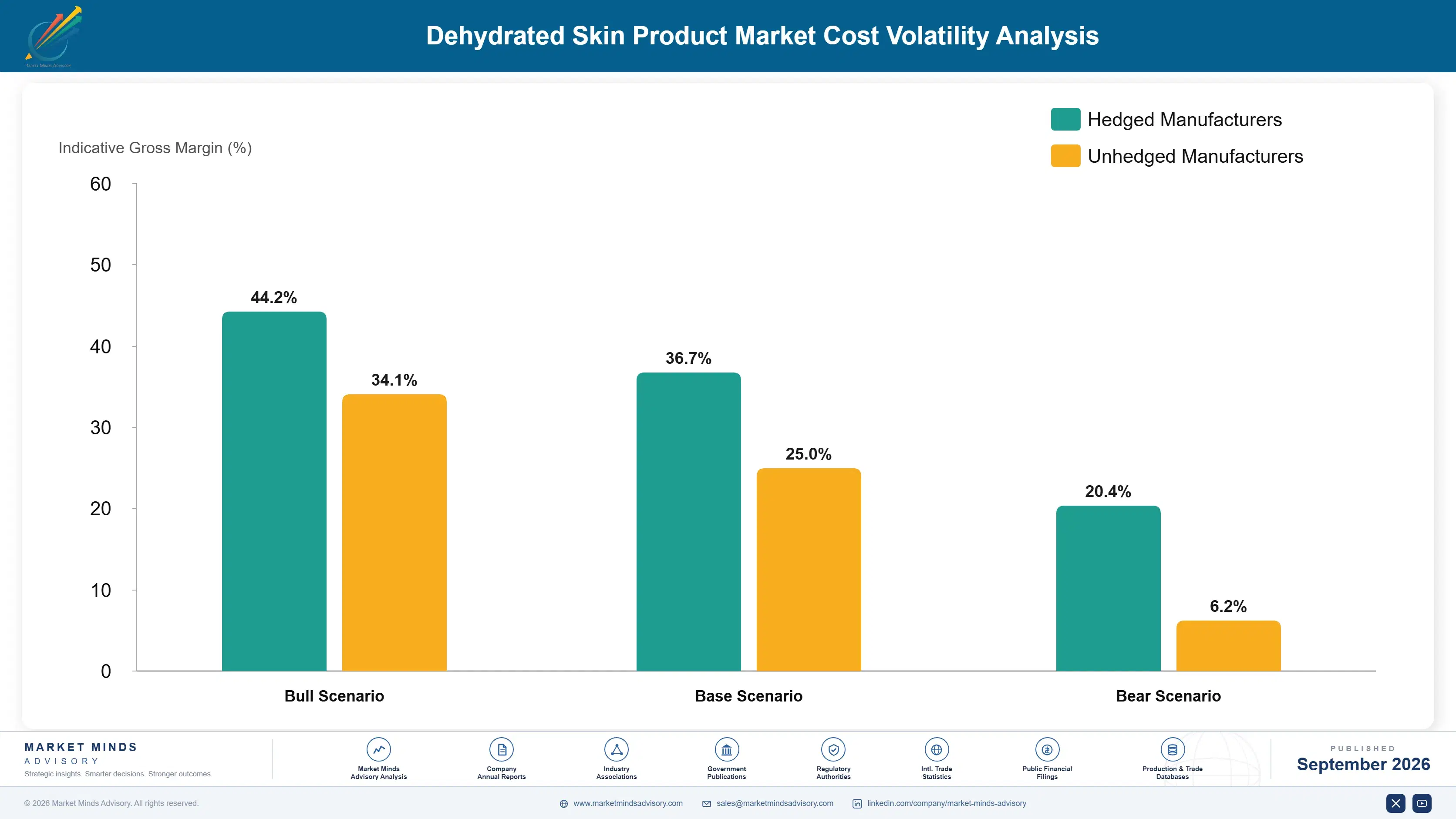
Three input groups dominate cost. Active ingredients including hyaluronic acid, ceramides, and osmolytes run 26% to 34% of cost of goods sold, and the eight-point range separates commodity fermented hyaluronic acid from synthesised ceramides in physiological ratios. Emollient and occlusive base chemistry takes 24% to 32%. Packaging adds 28% to 36%, frequently exceeding the actives in premium presentations.
Ceramide synthesis costs moved through 2024 and 2025 as specialty chemical capacity adjusted while demand from both skincare and pharmaceutical applications rose simultaneously, and American Chemistry Council statistics documented the underlying intermediate movements. Several manufacturers described the resulting margin pressure in their annual reports. Fermented hyaluronic acid pricing fell over the same period as Chinese capacity expanded considerably. Packaging followed general resin and glass markets separately again throughout the period.

The competitive disadvantage mechanism runs through ratio precision rather than through ingredient cost. Barrier lipid systems only work at physiological ceramide, cholesterol, and fatty acid ratios, and a formulator adding ceramides without that precision spends the money without achieving the effect. Exposure varies sharply by capability: dermocosmetic houses formulate to ratio while mass brands frequently add a marketable quantity and stop. That distinction is invisible on an ingredient list.
dehydrated-skin-product-market-cost-volatility-analysis-1790014407095

Formulate Barrier Lipids To Physiological Ratios

Ceramides only rebuild barrier function at the right ratio against cholesterol and free fatty acids, and adding them outside that balance spends the ingredient budget without producing the effect. Getting the ratio right costs formulation work rather than more expensive materials, and it is the difference between a claim and a result. Very few mass brands attempt the ratio properly.

Buy Hyaluronic Acid On Distribution Not Grade

Fermented hyaluronic acid pricing has fallen as capacity expanded, and molecular weight distribution rather than nominal grade determines what the ingredient actually does in a formulation. Specifying and verifying distribution costs an analysis per lot and prevents paying premium prices for material that behaves like the commodity alternative. Chinese capacity expansion has changed the pricing considerably.

Review Packaging Cost Against Active Concentration

Packaging frequently exceeds active cost in premium hydration presentations, which is difficult to defend as the category shifts toward mechanism and disclosure. Reallocating part of that budget toward barrier lipid concentration changes what the product can demonstrate, and informed buyers increasingly judge on exactly that. Premium presentation costs more than the actives inside it in a surprising number of cases.

Portfolio Architecture for Margin Defence

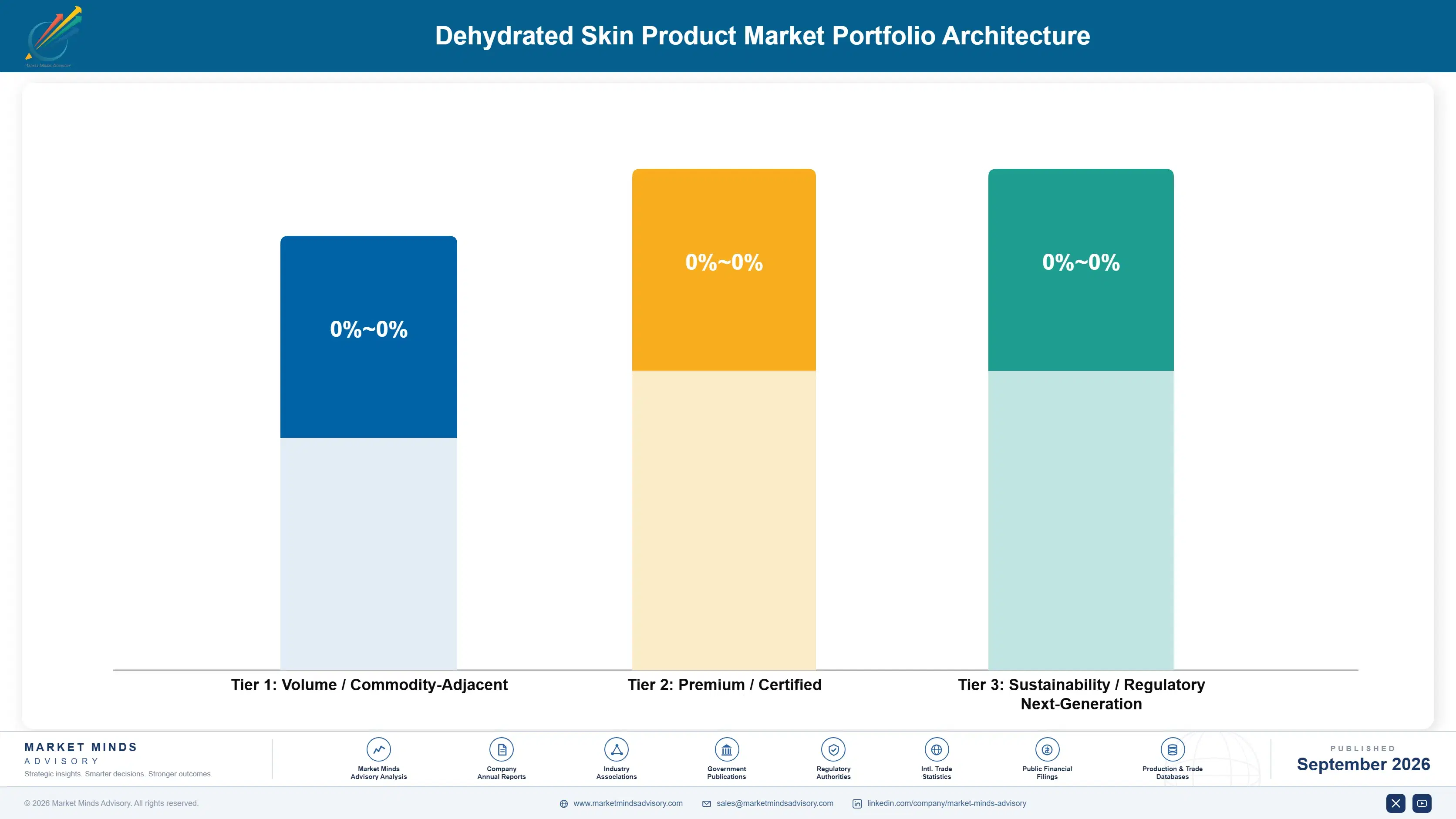
Margin follows whether the product does something a competitor cannot copy from an ingredient list. Basic humectant serums compete close to commodity terms, since fermented hyaluronic acid is cheap and every brand carries one. Toners and mists earn least of all. Combined systems earn better on formulation work, and barrier lipid systems earn most, because physiological ratios require competence rather than a purchase order. The margin spread across those groups is narrower than in most chemistry categories because packaging dominates cost throughout.
The tension between volume and premium runs through consumer understanding. Buyers selecting on packaging language purchase the lightest serum with the most recognised ingredient name and are disappointed in dry conditions. Buyers who understand barrier function purchase differently, pay considerably more, and stay with brands that explained the mechanism to them in the first place.

High-value pools concentrate where the condition is chronic and the climate is hostile: heated northern winters, air-conditioned Gulf interiors, and consumers with compromised barriers from over-exfoliation or dermatological conditions. Where the purchase is a hydrating mist bought on a summer promotion, price and fragrance decide and nothing about the mechanism enters the decision. That divide follows climate more than income.

Volume / Commodity-Adjacent

Basic humectant serums, toners, and mists built on commodity fermented hyaluronic acid that every competitor also carries. The ten-point range reflects packaging cost and brand pricing power rather than any formulation property a buyer could verify.
Gross Margin: 48% to 58%

Premium / Certified

Combined humectant and occlusive systems and film-forming polymer formulations that address both binding and sealing together. The twelve-point range separates products with genuine occlusive performance from those adding a light emollient and describing it as a seal.
Gross Margin: 62% to 74%

Sustainability / Regulatory / Next-Generation

Barrier lipid systems at physiological ratios with published clinical data and disclosed molecular weight distributions. The ten-point range reflects formulation precision and evidence depth, which very few mass brands currently attempt at all.
Gross Margin: 76% to 86%
dehydrated-skin-product-market-portfolio-architecture-1790014407599

High-value Sub-segments and Strategic Watch-out

Physiological Ratio Barrier Systems

Highest value in the category, growing at 13.2% by addressing why water escapes rather than replacing it after the fact. The twelve-point range reflects ratio precision, since ceramides outside physiological balance spend the budget without producing the effect. Dermatologist recommendation drives most of the demand.
Gross Margin: 76% to 88%

Light Occlusive Sealing Systems

High value growing at 11.4% by supplying the step that 57% of this category currently leaves out entirely. The twelve-point range reflects sensory engineering, since heavy occlusives work well and consumers reject how they feel. Sensory acceptance is the binding constraint. Lighter alternatives cost considerably more.
Gross Margin: 64% to 76%

Disclosed Weight Humectant Serums

Volume core where published molecular weight distributions separate a product from identical-looking competitors on shelf. The ten-point range reflects whether distribution is measured and published or the multi-weight claim simply appears on the front. Disclosure is currently rare enough to differentiate. Informed buyers already suspect the gap.
Gross Margin: 56% to 66%

Basic Mists And Hydrating Toners

The strategic watch-out. Commodity actives, no sealing function, and performance that reverses in exactly the dry conditions prompting purchase. The ten-point range reflects packaging and brand pricing power rather than anything the formulation achieves. Performance reverses in the conditions prompting purchase. Nothing in the formulation resists that.
Gross Margin: 44% to 54%

How This Demand Repeats

Repurchase runs on a genuine consumable cycle, since a serum lasts a defined number of applications and the condition returns whenever ambient conditions do. That produces predictable replenishment among satisfied users and equally predictable abandonment among those whose product reversed on them in a dry winter. The category loses and replaces a substantial share of its user base every year without noticing.
Attachment depth follows understanding rather than satisfaction. A consumer who has had barrier function explained buys a routine rather than a product, replaces components as they run out, and rarely switches brands wholesale. A consumer selecting on ingredient recognition buys whichever serum is promoted, is disappointed in dry weather, and moves on. The first group is smaller and worth several times more. Understanding predicts retention far better than satisfaction does.

The buyer profile is shifting toward the informed end faster than in most of skincare, because dermatologists explaining mechanisms on social platforms reach consumers directly and at scale. That shift rewards brands willing to describe what their products actually do, including the limitations, and it penalises those relying on ingredient recognition and packaging language alone.
dehydrated-skin-product-market-end-use-penetration-index-1790014408090

Where This Market Rewards

These are among the four positions where our research anticipates prominent divergence between winners and laggards over the coming forecast period. Each is grounded in the demand model, the regulatory perimeter, and the announced capacity pipeline.
01 / CONDITION MEASUREMENT ACCESS

Both conditions feel exactly the same

Roughly 24% of consumers correctly distinguish water loss from lipid deficiency, and both produce identical tightness with no accessible instrument available to tell them apart. Brands deploying in-store or connected measurement report conversion rates 2.8 times higher alongside materially lower returns, because the recommendation finally matches the condition. Measurement converts a guess into a diagnosis, which changes what the buyer is willing to pay for entirely, and nothing else available to a consumer distinguishes between the two conditions at all.
02 / OCCLUSION STEP SELLING

The serum alone makes it worse

About 57% of products in this category rely on water binding with no occlusive layer above them, and below roughly 40% ambient humidity that arrangement pulls water out of the skin. Brands bundling or explicitly recommending an occlusive step report routine completion 3.2 times higher and considerably better repurchase rates. Admitting the serum alone is insufficient is uncomfortable and far better than a customer concluding the product does not work, which is a considerably cheaper outcome than losing that customer altogether.
03 / WEIGHT DISTRIBUTION DISCLOSURE

Multi-weight means nothing unpublished

Multi-weight hyaluronic acid appears on most packaging across this category, and around 11% of brands publish the actual distribution sitting behind that claim. Brands that disclose their measured distributions now report specification-led conversion 2.1 times higher among the informed buyers who already suspected that gap existed. The analysis costs very little, and the first to publish in each market creates a position that competitors are then forced to answer, since the analysis itself costs almost nothing per production lot to run.
04 / HUMIDITY ROUTINE GUIDANCE

The same product behaves oppositely

Product performance inverts above and below roughly 40% ambient humidity, and no brand currently segments either its range or its usage guidance on that basis anywhere. Brands that offer humidity-appropriate routine advice now report satisfaction scores 34% to 46% higher across their dry-climate markets specifically. Regional reformulation is expensive while regional guidance costs almost nothing, and the second delivers most of the available benefit without fragmenting a range, which makes guidance the obvious starting point for any brand selling across climates.

Engagement Snapshot From the Field

A live engagement with an industry participant carrying material or product regulatory and market exposure ahead of a defining policy shift, showing how our research translates into a defensible multi-year portfolio strategy.
MARKET MINDS ADVISORY · CLIENT ENGAGEMENT SUMMARY
Dehydrated Skin Product Producer Strategic Portfolio Review and Transition Roadmap 2026·Investment Scenario on Dehydrated Skin Product Exposure Evaluation 2025-26
CLIENT PROFILE
A global skincare brand with hydration range revenue near USD 410 million (client-reported, unverified by MMA), selling humectant serums and moisturisers across twenty-six markets. Repurchase rates in northern European and North American markets had fallen for three consecutive years while the same products performed normally across Asian markets. The board wanted the divergence explained before committing further promotional budget to the underperforming markets.
STRATEGIC CHALLENGE
The team attributed the divergence to competitive intensity and had proposed increased promotional support in the underperforming markets. Nobody had examined whether ambient humidity in those markets differed enough to change how the products behaved, or whether the routine advice given to consumers accounted for it. The two explanations imply entirely different remedies.
MMA APPROACH
MMA matched repurchase data to seasonal indoor humidity by market, ran in-home testing across high and low humidity conditions with and without an occlusive step, surveyed users on routine composition, and modelled outcomes under promotion, routine guidance, and reformulation. Packaging instructions were compared against what testing showed the product actually required in each condition.
KEY FINDINGS
  1. Repurchase decline correlated closely with the months each market spent below 40% indoor humidity, and showed no relationship at all to competitive activity.
  2. In-home testing found the serum reduced skin hydration measurably in low humidity when used without any occlusive layer above it, and improved it when sealed.
  3. Only 19% of surveyed users applied anything over the serum, and none had been advised to, since the packaging described it as a complete step.
  4. Promotional support would have driven trial of a product that measurably underperforms in the conditions those specific markets experience for much of the year.
CLIENT PROFILE
A global skincare brand with hydration range revenue near USD 410 million (client-reported, unverified by MMA), selling humectant serums and moisturisers across twenty-six markets. Repurchase rates in northern European and North American markets had fallen for three consecutive years while the same products performed normally across Asian markets. The board wanted the divergence explained before committing further promotional budget to the underperforming markets.
STRATEGIC CHALLENGE
The team attributed the divergence to competitive intensity and had proposed increased promotional support in the underperforming markets. Nobody had examined whether ambient humidity in those markets differed enough to change how the products behaved, or whether the routine advice given to consumers accounted for it. The two explanations imply entirely different remedies.
MMA APPROACH
MMA matched repurchase data to seasonal indoor humidity by market, ran in-home testing across high and low humidity conditions with and without an occlusive step, surveyed users on routine composition, and modelled outcomes under promotion, routine guidance, and reformulation. Packaging instructions were compared against what testing showed the product actually required in each condition.
KEY FINDINGS
  1. Repurchase decline correlated closely with the months each market spent below 40% indoor humidity, and showed no relationship at all to competitive activity.
  2. In-home testing found the serum reduced skin hydration measurably in low humidity when used without any occlusive layer above it, and improved it when sealed.
  3. Only 19% of surveyed users applied anything over the serum, and none had been advised to, since the packaging described it as a complete step.
  4. Promotional support would have driven trial of a product that measurably underperforms in the conditions those specific markets experience for much of the year.
RECOMMENDED STRATEGY
Phase 1: Phase one: halt promotional escalation and add explicit occlusive step guidance to packaging and digital content across all dry-climate markets. Phase 2: Phase two: bundle a light occlusive with the serum in those markets rather than selling it as a complete single step. Phase 3: Phase three: publish measured water loss data under stated humidity conditions, which no competitor currently provides. No competitor currently publishes anything comparable.
OUTCOME
Repurchase rates in the affected markets recovered to within four points of Asian levels within four quarters (client-reported, unverified by MMA). Bundle attachment exceeded forecasts substantially. Promotional spend was redirected into consumer education across the same markets. Packaging guidance has since been extended across every market the brand serves.

Frequently Asked Questions

Foundational context covering the market sizes, CAGR, scope, country, region and competition that inform every finding below. This section is provided to cover basics and most often pre-purchase conversations, answered from the MMA Primary Research Dataset.

What is the current size of the Dehydrated Skin Product Market?

The market was worth USD 5.4 billion in 2025 and reaches USD 5.9 billion in 2026. Value covers products formulated and positioned for water deficiency in skin.

How large will the Dehydrated Skin Product Market be by 2036?

MMA forecasts USD 13.7 billion by 2036, an increase of USD 7.8 billion across the forecast period. That represents 2.32 times the 2026 base of USD 5.9 billion.

What is the CAGR for the Dehydrated Skin Product Market 2026 to 2036?

The base case compound annual growth rate is 8.8%, with a bull case at 10.0% and a bear case at 7.6%. Historical growth from 2020 to 2025 ran at 7.4%.

Which segment is growing fastest?

Barrier lipid replacement systems grow at 13.2%, half again the market rate of 8.8%. They address why water escapes rather than replacing it after the fact.

Who are the major companies in the Dehydrated Skin Product Market?

L'Oreal Groupe, Estee Lauder Companies, Shiseido, Amorepacific, and Beiersdorf lead the category. Together they hold 38% of revenue, with Korean indie brands moving considerably faster.

Which country is growing fastest?

South Korea grows at 15.4%, the fastest of any country covered here. The hydration category is largely a Korean invention that spread outward through essence formats and layering routines.

Report Segmentation Architecture

The full report scope spans multiple orthogonal segmentation dimensions, with cross-tabulated demand data provided for each dimension pair. Coverage extends further to regional breakdowns, trend trajectories, and the competitive detail needed to support segment-level decision-making.

By Water Retention Mechanism

  • Barrier Lipid Replacement Systems
  • Occlusive Sealing Systems
  • Combined Humectant and Occlusive Systems
  • Humectant Systems
  • Hydration Actives and Osmolytes
  • Film-Forming Polymer Systems

By End-Use Industry

  • Facial Serums and Essences
  • Facial Moisturisers and Creams
  • Masks and Overnight Treatments
  • Toners, Mists and Lotions
  • Eye and Lip Hydration
  • Professional and Clinic Treatments

By Commercial Dimension

  • Prestige Beauty Retail
  • Mass Beauty and Grocery
  • Dermocosmetic Pharmacy Channels
  • Online Direct to Consumer
  • Social Commerce and Live Selling
  • Dermatologist and Clinic Recommendation

By Region

  • East Asia
  • North America
  • Western Europe
  • South Asia and Pacific
  • Latin America
  • Middle East and Africa
  • Eastern Europe

Scope, Methodology, and Coverage

Every figure in this report is reproducible from documented input assumptions. The scope below maps the historical period, the forecast horizon, the segmentation dimensions, and the countries covered, alongside the underlying primary and qualitative methodology.
Historical Period
2020 to 2025
Forecast Period
2026 to 2036
Base Year
2025 (USD billions; MMA Primary Research Dataset, September 2026)
Market Definition
This market covers skincare products formulated and positioned for dehydrated skin, meaning water deficiency in the stratum corneum, across barrier lipid replacement systems, occlusive sealing systems, combined humectant and occlusive systems, humectant systems, hydration actives and osmolytes, and film-forming polymer systems. It excludes products positioned solely for lipid-deficient dry skin, anti-ageing and pigmentation treatments, cleansers, sun care, body care, and prescription dermatological therapies.
Quantitative Units
USD billions, retail value at manufacturer selling price
Segmentation Dimensions
Water retention mechanism, product application, commercial dimension, region
Regions Covered
East Asia, North America, Western Europe, South Asia and Pacific, Latin America, Middle East and Africa, Eastern Europe
Countries Covered
South Korea, Japan, China, Taiwan, United States, Canada, Mexico, France, Germany, United Kingdom, Italy, Spain, Belgium, Poland, Czechia, India, Indonesia, Thailand, Vietnam, Australia, Brazil, Colombia, Chile, Argentina, Saudi Arabia, United Arab Emirates, Turkey, Egypt, Nigeria, South Africa
Key Companies Profiled
L'Oreal Groupe, Estee Lauder Companies, Shiseido, Amorepacific, Beiersdorf, LG Household and Health Care, Unilever, Kenvue, Kao Corporation, COSRX, Torriden, Round Lab, Beauty of Joseon, Paula's Choice, NAOS, Pierre Fabre, Galderma, Rohto Pharmaceutical, Isdin, Mediheal
Quantitative Methodology
Primary survey, n=3,800 respondents, Q4 2025, six countries; demand-side model with trade association cross-validation
Qualitative Methodology
47 expert interviews, Q4 2025; applied to validate demand model assumptions, identify emerging dynamics, and assess competitive positioning
Report Format
PDF and XLSX data workbook (Word format preview document)
Publisher
Market Minds Advisory
Report Code
MMA-2026-CHM-331
Published
September 2026
Contact
sales@marketmindsadvisory.com | www.marketmindsadvisory.com

Purchase the full Dehydrated Skin Product Market Report (2026 to 2036).

The full report sizes the dehydrated skin product market across six water retention mechanisms, seven regions, and thirty countries, with forecasts to 2036 under base, bull, and bear cases. It sets out why consumers cannot distinguish water loss from lipid deficiency, quantifies how much of the category ships humectants without the occlusive layer they require, and maps performance inversion against ambient humidity by market. Competitive analysis covers twenty participants evaluated consistently on category revenue, with detailed treatment of barrier lipid formulation precision. Cost structure, ratio economics, and channel margin architecture are analysed throughout. Primary research includes 3,800 survey responses and 47 expert interviews.
Six water retention mechanisms sized and forecast separately
Twenty participants evaluated on category revenue consistently
Self-diagnosis accuracy measured against actual skin condition
Humidity reversal thresholds mapped across markets and seasons
Molecular weight disclosure practice compared across leading brands
Barrier lipid ratio precision assessed by manufacturer and price tier

Built For The People Who Decide

From boardroom strategy to bench-side execution, this report is read cover-to-cover by leaders shaping the next decade of their industry, turning demand scenarios, market dynamics and valuation benchmarks into decisions.
CXOs/ Presidents/ VPs/ Managers
M&A and Corporate Development
Strategy Teams and R&D Heads
Procurement and Product Directors
Regulatory and Compliance Leaders
Investor Relations and Equity Analysts