Market Minds Advisory
Deep Learning Market

Deep Learning Market: Deep Learning Market. Generative AI, Computer Vision, and Neural Network Platforms, 2026 to 2036

Enterprises racing to deploy generative AI beyond pilot projects are forcing deep learning platform vendors to prove measurable production reliability and cost control rather than raw model capability alone across every deployment.

Lead Analyst

Published

September 2026

Make Smarter Decisions with Customized Research Insights

Request a free sample report and evaluate market opportunities, growth trends, and competitive dynamics relevant to your business needs.

2025 MARKET VALUE$45.0BMarket Size 2025
2036 FORECAST VALUE$241.5BBase Case , 2026 to 2036
CAGR 2026 TO 203616.5 %Bull 17.8% / Bear 15.2%
INCREMENTAL OPPORTUNITY$189.0BNet 10- year value creation
EXPANSION MULTIPLE4.61x2036 value over 2026 base
Strategic Levers
M&A Pipeline
Regional Outlook
Country Rankings
Competitive Intelligence
Segmental Deep-dive
Call-Us : 91 93563 13602

Executive Snapshot and Market Trajectory.

Deep learning has moved decisively from research labs and narrow computer vision pilots into production infrastructure powering generative AI applications across nearly every enterprise software category deployed at genuine scale today, reshaping software procurement decisions entirely across most large organizations worldwide and every industry served.
Generative AI and large language model platforms are growing fastest as enterprises move beyond chatbot pilots into production applications for document processing, code generation, and customer service automation deployed at genuine scale across every department. North America leads regional demand given its concentration of hyperscale cloud infrastructure and enterprise software buyers willing to fund large-scale model training and inference deployment across every industry vertical served nationwide and beyond.
Competitive character increasingly centers on inference cost efficiency and model deployment reliability rather than raw benchmark accuracy scores, since enterprises now measure vendor value by total cost per production query rather than headline capability claims made during initial vendor pitches and sales presentations. Vendors offering transparent cost controls and dedicated enterprise support win disproportionate share of new contracts signed across regulated industries requiring predictable, auditable spending each fiscal quarter of the year.
Market Definition
The Deep Learning Market covers software platforms, frameworks, and services that build, train, and deploy neural network models for generative AI, computer vision, natural language processing, and predictive analytics applications across enterprise and consumer use cases. It excludes underlying AI training hardware, general-purpose cloud computing infrastructure, and traditional rule-based machine learning algorithms lacking neural network architecture.
Base Year Value
$45.0B in 2025 (MMA Primary Research Dataset, September 2026)
Forecast Period
2026 to 2036, eleven discrete annual values
CAGR
16.5% base case. Bull 17.8%. Bear 15.2%.
Fastest Growth Segment
Generative AI and Large Language Model Platforms: 24.0% CAGR
Fastest Growth Country
United Arab Emirates: 19.0% CAGR
Fastest Growth Region
South Asia and Pacific: 18.5% CAGR
Largest Region
North America: 36% of 2025 global value
Market Leaders
Leading vendors: NVIDIA, Google, Microsoft, Amazon Web Services, OpenAI. Source: MMA Primary Research Dataset, July 2026.
Primary Survey
n=3,800 procurement and R&D decision-makers, Q4 2025, six countries
Methodology
Demand-side build-up, cross-validated against public data, 47 expert interviews

Deep Learning Market Forecast Scenarios

deep-learning-market-size-forecast-scenario-1789995726361
Growth through 2020 to 2025 accelerated sharply following the broad commercial availability of capable large language models starting in 2023, a shift that redirected enterprise software investment from narrow, task-specific machine learning models toward general-purpose deep learning platforms capable of handling many different application types from a single underlying model architecture across the entire organization.
Base case growth through 2036 rests on three commercial mechanisms: continued enterprise migration of production workloads from pilot projects into scaled generative AI deployment across document processing, coding, and customer service functions company-wide, expanding computer vision adoption across manufacturing quality control and autonomous systems requiring real-time visual inference at scale, and growing regulatory and competitive pressure pushing every enterprise software category to embed deep learning capability directly into existing products.
A bull scenario turns on faster inference cost reduction that makes deep learning economically viable for a much broader range of lower-value use cases currently priced out of production deployment entirely. The bear risk is that persistent model hallucination and reliability concerns slow enterprise adoption in liability-sensitive industries like healthcare and legal services, compressing near-term addressable market relative to current growth expectations across the sector.

The Inference Cost Economics Behind Every Model Deployment

Vendors no longer compete primarily on raw model benchmark scores, since capability differences between leading foundation models have narrowed considerably for most common enterprise tasks across the board, but rather on inference cost efficiency and production deployment reliability that determine whether a pilot project actually survives the transition into a fully funded enterprise budget line.
MARKET CONCENTRATIONCR5: 48%Top five platform vendors hold nearly half the market
AVERAGE ENTERPRISE CONTRACT VALUE$620,000/yearTypical annual spend for a large enterprise deployment
TOP DEPLOYING COUNTRY SHAREUSA: 38%Reflects concentration of hyperscale infrastructure and enterprise buyers
INFERENCE COST PER QUERY$0.02Typical benchmark cost vendors cite for production queries
PRODUCTION DEPLOYMENT RATE34%Share of enterprise pilots that reach production deployment
COMPUTE SHARE OF COGS52%Reflects cloud infrastructure cost as share of total expense
Pricing has shifted from flat platform licensing toward usage-based consumption models tied to tokens processed or queries executed, since enterprises increasingly resist paying fixed fees for capacity they use unevenly across different workloads and times of day throughout the year. Vendors offering granular cost visibility and predictable spending caps win larger enterprise commitments because finance teams can budget confidently around variable usage patterns.
GPU compute cost has become the single largest line item behind gross margin variation across vendors, since training and running large models continuously against live production traffic costs meaningfully more than the smaller, task-specific models many enterprises used previously across most workloads. Vendors that have built efficient model distillation and caching techniques increasingly report noticeably better unit economics on high-volume enterprise contracts than those relying entirely on raw compute scale.
"Every vendor claims their model is smartest. The ones winning enterprise deals are the ones that can tell a CFO exactly what a million queries will cost next quarter."
Practice Lead, Enterprise AI and Machine Learning Infrastructure Research · MMA Technology Practice · September 2026

Market Trends

Smaller Distilled Models Replace Oversized General-Purpose Deployments

Enterprises have discovered that a smaller, task-specific model distilled from a larger foundation model often performs comparably on narrow production tasks while costing a fraction of the inference expense, prompting widespread migration away from routing every single request through the largest, most expensive available model regardless of task complexity. Roughly 44 percent of enterprise deep learning deployments in 2025 now route at least some traffic through a distilled or smaller specialized model, up sharply from under 15 percent just two years earlier as the cost savings became impossible to ignore.
Market Impact: 62% cite AI in headcount planning

Agentic Workflows Chain Multiple Model Calls Together

Enterprise deployments increasingly chain multiple model calls into agentic workflows that plan, execute, and verify multi-step tasks autonomously rather than relying on a single prompt-response interaction, fundamentally changing how production inference cost and reliability get measured and budgeted across an entire enterprise deployment spanning multiple teams, departments, business units, and geographic regions nationwide. Roughly 37 percent of new enterprise generative AI deployments in 2025 incorporate some form of agentic workflow orchestration, up from under 10 percent just eighteen months earlier as the underlying tooling matured rapidly across the industry. Adoption is expected to keep rising rapidly.
Market Impact: 3,400 products added AI

Market Opportunities and Growth Drivers

Knowledge Worker Productivity Pressure Accelerates Enterprise Adoption

Enterprises facing sustained pressure to grow revenue without proportionally growing headcount increasingly deploy deep learning tools to automate document drafting, code generation, and customer service tasks that previously required dedicated staff across every department and function within the broader organization and its many teams. Roughly 62 percent of large enterprises surveyed in 2025 reported that generative AI deployment directly influenced headcount planning decisions for the following fiscal year, up sharply from under 25 percent just two years earlier as the technology's productivity impact became measurable and undeniable across nearly every business function.
Market Impact: 100% of output needs review

Competitive Pressure Forces Software Vendors to Embed AI

Software vendors across nearly every enterprise category now face competitive pressure to embed deep learning capability directly into existing products, since customers increasingly expect intelligent automation as a standard feature rather than a premium add-on purchased separately from a dedicated specialist vendor elsewhere in the broader software market. Roughly 3,400 enterprise software products added a generative AI feature during 2025 according to industry product launch tracking, a pace that would have seemed implausible just three years earlier before the underlying technology matured enough for mainstream product integration across the industry.
Market Impact: Training delayed by 3 months

Market Restraints and Challenges

Model Hallucination Risk Slows Adoption in Liability-Sensitive Settings

Large language models occasionally generate plausible-sounding but factually incorrect output, a failure mode that has proven stubbornly difficult to eliminate entirely despite substantial engineering investment across leading vendors and academic research institutions worldwide. The root cause is that generative models are trained to produce statistically fluent text rather than to independently verify factual accuracy against ground truth. Healthcare, legal, and financial services buyers report requiring mandatory human review of every generated output before use, which caps the labor savings vendors promise their customers. Some vendors now attach retrieval-augmented grounding to reduce hallucination rates measurably in production deployments.
Market Impact: 44% now use distilled models

GPU Compute Shortages Constrain Model Training Capacity

Demand for advanced GPU compute capacity for both model training and inference has consistently outstripped available supply since 2023, forcing enterprises and smaller AI vendors alike to wait months for capacity or pay substantial premiums for expedited access to scarce hardware resources. The underlying cause is that a small handful of chip manufacturers and cloud providers control the overwhelming majority of advanced GPU manufacturing and hosting capacity worldwide. This scarcity routinely delays new model training projects by several months. Several enterprises now diversify across multiple cloud providers specifically to secure additional available compute capacity.
Market Impact: 37% now use agentic workflows
4 additional market trends, 4 additional growth drivers, and 3 additional restraints and challenges are covered in the full report. Contact sales@marketmindsadvisory.com to access the complete intelligence.

Segment CAGR and Growth Architecture

The market splits by application architecture rather than by underlying model provider or cloud hosting platform, since pricing, deployment complexity, and accuracy requirements vary sharply across each specific category and use case. Six categories cover the field: generative AI and large language models, computer vision, natural language processing, predictive analytics, autonomous systems, and hardware acceleration software.
deep-learning-market-market-share-analysis-1789995726919

Generative AI and Large Language Model Platforms

Generative AI and large language model platforms are the fastest-growing category by a wide margin, driven by enterprises moving beyond chatbot pilots into production applications spanning document processing, code generation, and customer service automation deployed at genuine operational scale across every department. Adoption started among large technology companies but has spread rapidly into financial services, healthcare, and professional services firms where document-heavy workflows offer the clearest automation opportunity available today. Pricing has shifted from flat platform licensing toward usage-based consumption tied to tokens processed, and vendors increasingly bundle retrieval-augmented grounding and agentic workflow orchestration directly into the base platform rather than selling each capability separately to the same enterprise buyer.
CAGR 24.0%

Computer Vision and Image Recognition Systems

Computer vision systems address a genuinely distinct commercial need, since manufacturing quality control, autonomous vehicle perception, and retail analytics all require real-time visual inference rather than text-based reasoning capability of any meaningful kind whatsoever in daily operational practice. Adoption has concentrated among manufacturing and automotive sectors facing acute pressure to automate visual inspection tasks that human inspectors perform inconsistently across long shifts and repetitive production runs day after day. This category commands premium pricing relative to generative text applications given the specialized sensor integration and edge deployment engineering required, and vendors report that customers adopting these tools do so specifically because generic language models cannot handle visual inference tasks reliably.
CAGR 18.0%
Full segment breakdown across 6 segments available in the complete report.

Regional Architecture and Country Demand Map

North America leads on hyperscale cloud infrastructure and enterprise software spending power, the United Arab Emirates leads on the fastest growth rate through sovereign AI investment programs, and East Asia contributes rapidly expanding computer vision deployment across manufacturing and consumer electronics production lines throughout the region.

North America

US hyperscale cloud providers and enterprise software buyers account for the single largest concentration of deep learning spending anywhere, reflecting both the sheer scale of domestic model training infrastructure and enterprise compliance budgets willing to fund production AI deployment at scale. Canada contributes meaningful volume through its own concentrated AI research talent base and growing enterprise adoption in financial services and technology sectors. The region's outsized 36 percent share, above the standard regional band, reflects genuine infrastructure scale advantage built over more than a decade of continuous hyperscale cloud investment across every major provider headquartered domestically. Federal government AI adoption initiatives have separately added a demand channel. Insurance and healthcare enterprises are separately piloting claims automation at scale.
Share: 36% | CAGR: 15.5% (2026 to 2036)

Western Europe

Germany, France, and the United Kingdom lead regional enterprise adoption, though EU AI Act compliance requirements have pushed enterprises toward vendors offering transparent model governance and documented risk assessment capability rather than adopting the fastest-moving vendor available. The financial services sector across the region has adopted deep learning fastest for fraud detection and regulatory reporting automation, driven by measurable cost savings that justify compliance overhead. Growth trails North America and East Asia meaningfully since regulatory caution slows deployment timelines compared with less restrictive markets elsewhere in the world. Nordic countries have moved fastest within the region on public sector AI deployment specifically for citizen services. Italian and Spanish manufacturers are following the German pattern from a somewhat smaller installed base.
Share: 18% | CAGR: 15.0% (2026 to 2036)
Regional intelligence for 5 additional markets available in the complete report: East Asia, South Asia and Pacific, Latin America, Middle East and Africa, Eastern Europe. Contact sales@marketmindsadvisory.com.
deep-learning-market-country-cagr-analysis-1789995727494

Where Vendors Actually Capture AI Margin

Base model access has commoditized rapidly as capability differences narrow across leading foundation models, so the strongest performers capture additional margin through agentic workflow orchestration, vertical-specific fine-tuning, and enterprise deployment support layered on top of raw inference pricing rather than through the base model access fee alone across every deployed customer account and product line.

Charge Premium Pricing for Agentic Workflow Orchestration

Vendors that layer agentic workflow orchestration on top of base model access capture 30 to 40 percent more revenue per account than those selling raw inference alone, since enterprises increasingly value pre-built multi-step automation over assembling individual model calls themselves through custom engineering work every time. This pricing structure also raises switching costs meaningfully once a customer has built production workflows around a specific orchestration framework and its particular conventions and integration points. Contract renewal conversations increasingly start from this orchestration baseline directly rather than from a raw inference price quote.
Market Impact: Orchestration pricing adds 30 to 40% more revenue

Sell Vertical-Specific Fine-Tuning as a Premium Service

Vertical-specific fine-tuning for healthcare, legal, and financial services applications commands a price premium of roughly 35 to 45 percent above general-purpose model access, since regulated buyers value measurable accuracy improvement on domain-specific tasks enough to pay meaningfully more for it every single year. Vendors that built these fine-tuning capabilities early now report considerably longer average contract lengths in regulated verticals than in general enterprise accounts lacking similar accuracy requirements to satisfy. Renewal rates in these regulated accounts run noticeably higher as a direct result of this deep, sustained specialization work.
Market Impact: Vertical fine-tuning commands 35 to 45% more premium

Charge Consumption Fees Tied to Inference Volume Growth

Vendors increasingly charge consumption-based fees tied to actual inference volume rather than a flat platform license, capturing 20 to 30 percent more revenue as enterprise usage scales organically across departments and use cases without requiring a fresh contract negotiation each time usage grows meaningfully. This pricing structure also lowers the barrier to initial adoption, letting enterprises start with a small pilot deployment and expand spend as internal confidence in the platform builds over time. Larger enterprise accounts routinely pay well above this stated baseline figure once usage scales meaningfully over time.
Market Impact: Consumption fees add 20 to 30% more revenue

Sell Dedicated Enterprise Deployment and Support Packages

Vendors increasingly sell paid deployment and ongoing support packages to enterprises lacking in-house machine learning engineering expertise, charging a premium typically running 25 to 35 percent above the base platform price for hands-on implementation support through the entire production rollout process from start to finish. This service tier has become especially popular among mid-market enterprises entering production AI deployment for the first time without dedicated internal expertise or staff of their own. Larger custom deployments routinely exceed this baseline threshold considerably each contract renewal year across every product category and customer segment.
Market Impact: Support packages command 25 to 35% more premium

Who Controls the Margin Pool

CR5 sits at 48 percent, evaluated on annual deep learning platform and infrastructure revenue across each vendor's full product portfolio, reflecting a market where hyperscale cloud providers and leading foundation model developers hold real advantages in compute access and distribution reach. NVIDIA holds the clearest lead given its dominant position in AI training hardware, though the gap to Google and Microsoft has narrowed as enterprise platform bundling accelerates.
Competitive activity today centers on inference cost efficiency and agentic workflow tooling rather than raw model capability, which has largely converged across leading foundation model providers for most common enterprise tasks. NVIDIA, Google, and Microsoft have all launched dedicated enterprise deployment platforms over the past year, while specialist vendors focus on vertical-specific fine-tuning and deployment support that larger platform vendors deprioritize in their broader product roadmap.

Emerging pressure comes from open-source foundation models that let specialist vendors build competitive capability at a fraction of the licensing cost previously required from the largest proprietary model providers, narrowing the technical gap between platform giants and focused challengers. Rankings are most likely to shift in vertical-specific applications like healthcare and legal services, where domain expertise and compliance capability matter more than general model capability alone.
deep-learning-market-company-positioning-matrix-1789995728019

Competitive Moat and Risk Dimensions

NVIDIA

Moat: AI Training Hardware Dominance

NVIDIA's dominant position in AI training and inference hardware gives it visibility into demand trends and customer roadmaps that pure software vendors lack entirely, letting it extend upstream into software platforms and enterprise deployment tools built directly on top of its own hardware advantage and installed base.
NVIDIA

Risk: Software Platform Immaturity Risk

NVIDIA's software platform offerings remain less mature than dedicated cloud platform vendors with decades of enterprise software experience behind them already, occasionally costing it deals to buyers preferring an integrated cloud-native deployment experience over hardware-centric tooling that requires additional integration work and specialized engineering effort.
GOOGLE

Moat: Integrated Research and Cloud Scale

Google's deep AI research organization feeds directly into its cloud platform's model offerings, giving it a genuine technical advantage in bringing advanced research capability into production-ready enterprise products faster than competitors relying entirely on external research partnerships alone for their core underlying capability and roadmap.
GOOGLE

Risk: Enterprise Sales Motion Weakness

Google's enterprise cloud sales organization remains smaller and less established than Microsoft's decades-deep enterprise relationships built over many years of steady investment, occasionally costing it large enterprise deals to competitors with stronger existing procurement relationships and account management infrastructure already firmly in place across the industry.

Players Tracked

Prominent Players

NVIDIA
Google
Microsoft
Amazon Web Services
OpenAI

Other Key Players

Meta Platforms
IBM
Anthropic
Baidu
Databricks
Hugging Face
Cohere
Scale AI
DataRobot
C3.ai
Palantir Technologies
SAS Institute
Snowflake
Salesforce
Alibaba Cloud

Recent Developments

JANUARY 2026

Anthropic Launches Enterprise Agentic Workflow Platform

Anthropic launched a dedicated enterprise agentic workflow platform enabling multi-step task automation across document processing and coding applications, positioning it directly against similar offerings from OpenAI and Google with a standalone subscription targeting mid-market enterprise buyers across every industry vertical served nationwide, internationally, and across every region.
Signal: Confirms agentic workflow orchestration has become a required competitive baseline across leading foundation model providers today.
OCTOBER 2025

Databricks Acquires Vertical Fine-Tuning Startup

Databricks acquired a smaller vertical fine-tuning startup specializing in healthcare and financial services model customization, closing a specific capability gap identified by enterprise customers evaluating its platform against specialist competitors offering deeper domain expertise and much stronger regulatory compliance capability overall today across every regulated industry.
Signal: Shows platform vendors continuing to acquire specialized capability rather than build it entirely in-house on their own.
JUNE 2025

Google Expands Model Distillation Tooling for Enterprises

Google expanded its model distillation tooling to let enterprise customers create smaller, task-specific models from larger foundation models automatically, reducing inference cost substantially for customers running high-volume production workloads across their entire deployed application portfolio and much broader global infrastructure footprint worldwide today and going forward.
Signal: Signals inference cost efficiency is becoming as competitively important as raw model capability itself these days.

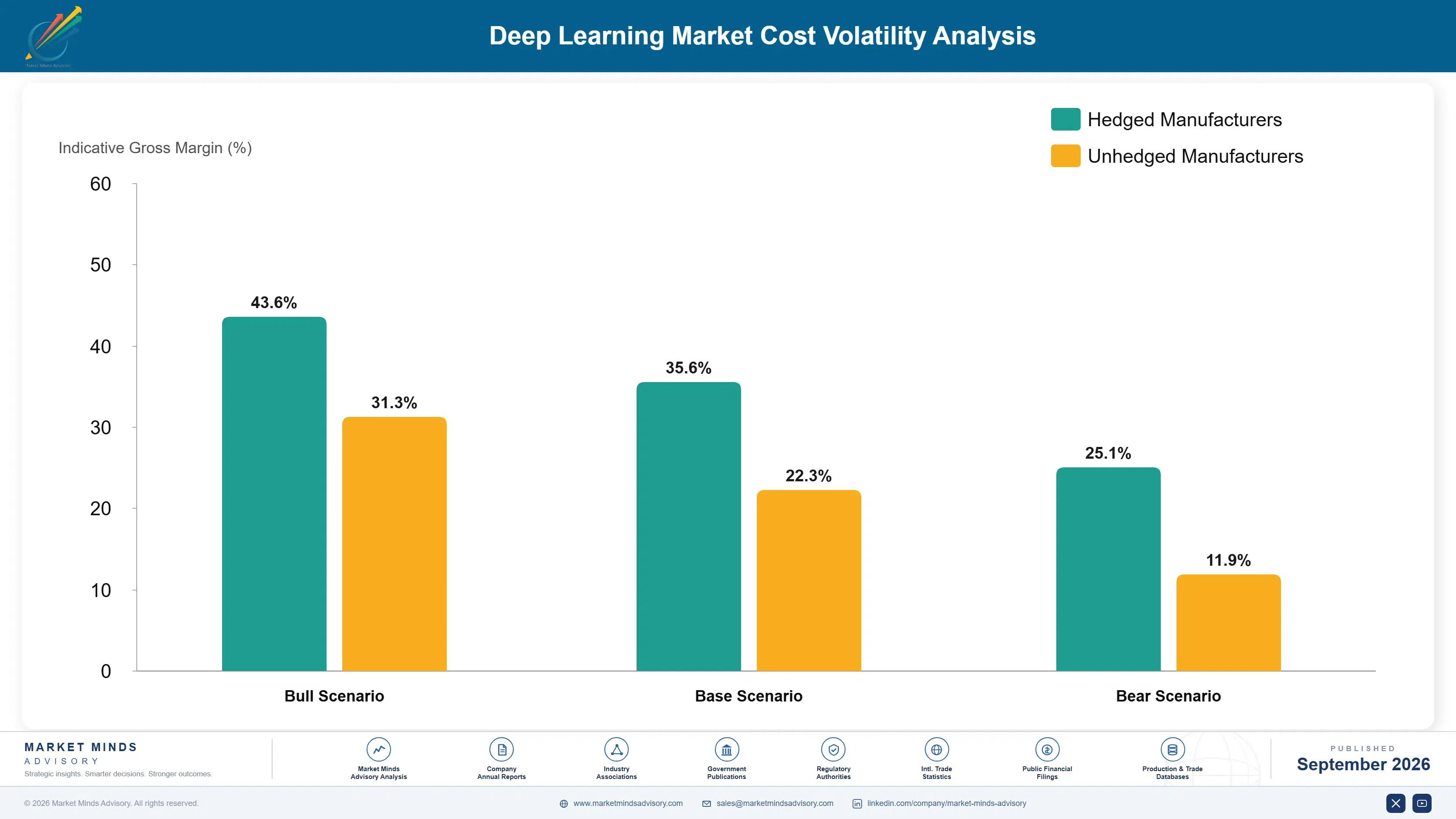
GPU Compute Cost Behind Every Model Call

GPU compute for training and inference accounts for roughly 52 percent of cost of goods sold for a typical deep learning platform vendor, with the remainder split across engineering, data licensing, and customer support expenses paid throughout the product lifecycle. Compute demand originates almost entirely from a small handful of advanced chip manufacturers and cloud providers concentrated primarily in the United States and Taiwan.
A 2025 surge in GPU rental pricing during a period of unprecedented training demand, documented in cloud provider pricing disclosures reviewed by MMA analysts, pushed inference cost per million tokens processed up roughly 22 percent industrywide within a single quarter as available capacity tightened sharply across major cloud regions. Vendors without long-term compute reservation contracts already in place absorbed the increase immediately in their own gross margin.

Smaller vendors relying entirely on on-demand GPU rental face far more cost volatility than the largest vendors that negotiate long-term reserved capacity agreements directly with chip manufacturers and cloud providers at massive scale. That negotiating advantage increasingly determines which challengers can sustain competitive, usage-based pricing during a compute price spike without eroding margin to an unsustainable level relative to larger, better-capitalized competitors operating with far greater scale.
deep-learning-market-cost-volatility-analysis-1789995728217

Reserve GPU Capacity Through Multi-Year Cloud Contracts

Larger vendors negotiate multi-year GPU capacity reservation contracts with cloud providers, trading a volume commitment for pricing roughly 20 to 25 percent below on-demand spot rates, shielding them from the sharp inference price swings smaller vendors face during periods of unusually high training and compute demand across the entire global industry each fiscal quarter.

Deploy Smaller Distilled Models to Cut Inference Cost

Several vendors have built smaller, distilled models trained to replicate larger foundation model behavior on narrow production tasks, cutting inference compute cost per query by roughly 60 percent while maintaining accuracy adequate for the specific task at hand across most routine daily enterprise use cases seen nationwide, internationally, and across every single deployed region.

Diversify Across Multiple Chip Architectures and Providers

Vendors increasingly design software to run efficiently across multiple GPU architectures and cloud providers rather than depending on a single chip supplier, reducing exposure to any one provider's pricing changes or capacity constraints while also enabling cost-optimized routing across whichever provider offers the best pricing at that particular moment in time each single day.

Portfolio Architecture for Margin Defence

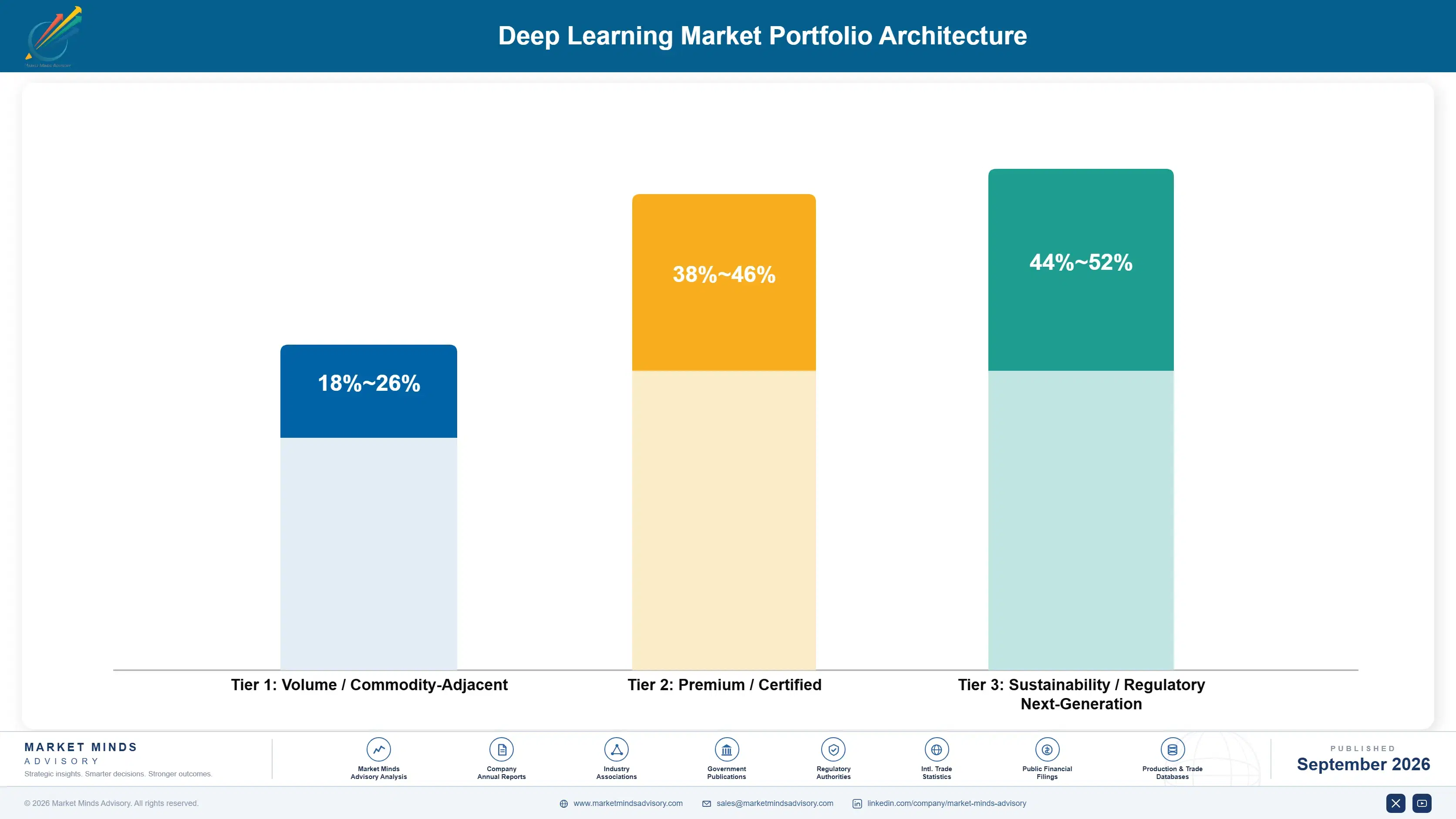
Gross margin in deep learning platforms spreads widely depending on compute intensity and how much of the revenue comes from raw model access versus premium orchestration and fine-tuning services layered on top. A commodity model API sold at competitive pricing clears margin well below what a fine-tuned, orchestration-enabled enterprise platform commands, since the latter embeds specialized engineering that buyers pay a real, sustained premium to access reliably over time.
Volume and premium tiers pull vendors toward genuinely different customer bases and engineering investment levels. Volume players compete on low-cost, general-purpose model access sold broadly across developer and small business markets, while premium players concentrate on large regulated enterprises willing to pay substantially more for fine-tuning, compliance, and deployment support built directly into the platform. Few vendors execute both strategies at once, since engineering investment and sales motion diverge sharply.

High-value margin pools concentrate specifically in vertical-specific fine-tuning, agentic workflow orchestration, and long-term enterprise deployment contracts rather than in general-purpose model access, which increasingly functions as a low-margin, high-volume entry point that funds the compute infrastructure supporting the much higher-margin fine-tuned and orchestrated business built on top of that same underlying foundation model platform and shared compute infrastructure across the company.

Volume / Commodity-Adjacent

General-purpose model API access sold at low, competitive pricing to developers and small businesses, competing mainly on price, ease of integration, and broad availability across every possible use case and deployment scenario worldwide.
Gross Margin: 18-26%

Premium / Certified

Fine-tuned enterprise platforms bundled with agentic workflow orchestration, deployment support, and dedicated account management sold to large regulated enterprise accounts across every industry vertical, geography, and company size worldwide today.
Gross Margin: 38-46%

Sustainability / Regulatory / Next-Generation

Vertical-specific compliance and governance modules meeting emerging AI regulation standards demanded by financial services, healthcare, and government buyers operating under strict continuous regulatory oversight and formal audit requirements each year.
Gross Margin: 44-52%
deep-learning-market-portfolio-architecture-1789995728721

High-value Sub-segments and Strategic Watch-out

Vertical-Specific Fine-Tuning Services

The highest-margin pool in the category, growing fastest as regulated enterprises demand domain-specific accuracy that general-purpose models cannot deliver reliably without additional customization work, validation, and rigorous testing effort each development cycle. Renewal rates for this tier run consistently higher than the base platform alone.
Gross Margin: 48-56%

Agentic Workflow Orchestration

High-value, software-driven capability commanding strong margin as enterprises increasingly demand pre-built multi-step automation rather than assembling individual model calls through custom engineering work themselves entirely from scratch each and every single passing time. Adoption of these tools keeps rising sharply among the largest enterprise accounts.
Gross Margin: 40-48%

Commodity Model API Access

The largest volume core of the market, mature and increasingly low-margin, facing continued commoditization pressure as open-source foundation models steadily close the capability gap on both price and raw performance metrics steadily over time. Vendors increasingly treat this tier as a lead generation channel for upsell.
Gross Margin: 16-24%

Open-Source Model Substitution

A strategic watch-out segment where increasingly capable open-source foundation models threaten to compress licensing margin for vendors that do not differentiate through proprietary fine-tuning depth, support, and dedicated customer service quality overall today. Vendors must differentiate sharply to avoid losing this segment entirely over time.
Gross Margin: N/A

Why Deep Learning Contracts Compound Fast

A deep learning platform contract behaves more like an annuity than a one-time software license once fine-tuned models, workflow orchestration logic, and integration pipelines become embedded inside an enterprise's production systems. Migrating to a new provider means retraining fine-tuned models on the new platform's infrastructure, rebuilding agentic workflow logic from scratch, and revalidating accuracy against every use case the prior deployment already covered, a cost most enterprises would rather avoid entirely.
Stickiness varies sharply by deployment depth and accuracy criticality achieved during initial rollout. Enterprises running fine-tuned, vertical-specific models show the deepest lock-in, since replicating months of domain-specific training and validation work on a competing platform proves genuinely expensive and time-consuming. Enterprises using only general-purpose model APIs for low-stakes tasks show comparatively shallow stickiness, since switching a bare API call requires far less engineering effort overall.

Buyer profiles are shifting generationally as dedicated AI engineering and machine learning operations teams, rather than general software developers treating model calls as one integration task among many, increasingly drive platform selection decisions. This generational shift favors vendors offering strong observability, cost management, and fine-tuning tooling over vendors competing primarily on raw model benchmark scores and headline capability claims.
deep-learning-market-end-use-penetration-index-1789995729212

Where to Compete in Deep Learning

These are among the four positions where our research anticipates prominent divergence between winners and laggards over the coming forecast period. Each is grounded in the demand model, the regulatory perimeter, and the announced capacity pipeline.
01 / AGENTIC ORCHESTRATION INVESTMENT

Build production-grade agentic workflows before they commoditize

Agentic workflow orchestration already commands a substantial price premium over raw model access, yet many vendors still offer immature orchestration tooling that has not been genuinely proven reliable at real enterprise scale and complexity. A challenger investing early in production-grade orchestration can win large enterprise accounts before this becomes a baseline requirement every competitor offers as standard practice across the broader market. That differentiation window narrows measurably each year as orchestration frameworks mature and spread more broadly across the entire industry.
02 / VERTICAL FINE-TUNING FOCUS

Build domain-specific fine-tuning before generalists close the gap

Vertical-specific fine-tuning already commands a substantial price premium over general-purpose model access, yet most vendors still rely on lightly customized general models for regulated industry customers who genuinely need considerably more depth and rigor. A challenger investing early in genuine domain-specific fine-tuning can lock in healthcare and financial services accounts before the largest platform vendors close the accuracy gap through their own dedicated engineering investment. That window narrows measurably each year as foundation models continue improving broadly across the entire board.
03 / INFERENCE COST EFFICIENCY

Deploy model distillation to protect margin against compute inflation

Rising GPU compute costs are compressing margin for vendors still routing every request through the largest, most expensive available model regardless of task complexity or the actual accuracy requirements needed for that specific narrow task at hand. Vendors that invest in model distillation and efficient inference now protect their own margin against the next compute price shock far better than competitors relying entirely on brute-force compute scale alone. This efficiency investment increasingly separates resilient vendors from margin-squeezed, exposed ones over time.
04 / COMPUTE SUPPLY DIVERSIFICATION

Diversify GPU sourcing before the next capacity allocation shock

The 2025 GPU rental pricing surge demonstrated clearly how exposed single-provider vendors are to sudden compute cost spikes entirely beyond their direct control or influence over available global compute supply. Vendors that diversify GPU sourcing across multiple chip architectures and cloud providers now protect their own margin against the next inevitable shock far better than competitors dependent on just one single supplier alone without alternatives. This diversification decision increasingly separates resilient vendors from fragile, exposed ones facing real ongoing risk.

Engagement Snapshot From the Field

A live engagement with an industry participant carrying material or product regulatory and market exposure ahead of a defining policy shift, showing how our research translates into a defensible multi-year portfolio strategy.
MARKET MINDS ADVISORY · CLIENT ENGAGEMENT SUMMARY
Deep Learning Producer Strategic Portfolio Review and Transition Roadmap 2026·Investment Scenario on Deep Learning Exposure Evaluation 2025-26
CLIENT PROFILE
The client operates a regional property and casualty insurance carrier processing roughly 40,000 claims annually across six states, reporting client-reported annual premium revenue of approximately $890 million (client-reported, unverified by MMA). Facing rising claims processing labor costs and inconsistent turnaround times, leadership sought an independent evaluation of generative AI claims automation vendors before committing to a company-wide rollout.
STRATEGIC CHALLENGE
The client's claims adjusters spent a substantial share of each workday on document review and data extraction from submitted claims paperwork rather than actual claims judgment work, and three competing vendors offered wildly different accuracy claims and pricing structures that the client's own team lacked the technical expertise to independently verify before committing significant budget.
MMA APPROACH
MMA analysts designed a blinded accuracy evaluation comparing each vendor's document extraction output against adjuster-reviewed reference claims across several distinct claim types, alongside a total cost of ownership model incorporating licensing, implementation, and expected adjuster time savings under three realistic adoption scenarios reflecting different rollout paces and claim volumes over time.
KEY FINDINGS
  1. The vendor with the highest headline accuracy claim actually underperformed a lower-claiming competitor by 9 percentage points on the specific claim types the client processes most frequently.
  2. Adjuster time savings varied sharply by claim complexity, ranging from under 10 minutes on simple auto claims to over 45 minutes on complex property damage claims.
  3. None of the three vendors offered pre-built extraction templates for the client's specific state-mandated claims documentation formats, requiring a custom template development phase.
  4. The selected vendor's usage-based pricing, once modeled against actual claim volume projections, ran roughly $210,000 lower annually (client-reported, unverified by MMA) than the closest competing bid.
CLIENT PROFILE
The client operates a regional property and casualty insurance carrier processing roughly 40,000 claims annually across six states, reporting client-reported annual premium revenue of approximately $890 million (client-reported, unverified by MMA). Facing rising claims processing labor costs and inconsistent turnaround times, leadership sought an independent evaluation of generative AI claims automation vendors before committing to a company-wide rollout.
STRATEGIC CHALLENGE
The client's claims adjusters spent a substantial share of each workday on document review and data extraction from submitted claims paperwork rather than actual claims judgment work, and three competing vendors offered wildly different accuracy claims and pricing structures that the client's own team lacked the technical expertise to independently verify before committing significant budget.
MMA APPROACH
MMA analysts designed a blinded accuracy evaluation comparing each vendor's document extraction output against adjuster-reviewed reference claims across several distinct claim types, alongside a total cost of ownership model incorporating licensing, implementation, and expected adjuster time savings under three realistic adoption scenarios reflecting different rollout paces and claim volumes over time.
KEY FINDINGS
  1. The vendor with the highest headline accuracy claim actually underperformed a lower-claiming competitor by 9 percentage points on the specific claim types the client processes most frequently.
  2. Adjuster time savings varied sharply by claim complexity, ranging from under 10 minutes on simple auto claims to over 45 minutes on complex property damage claims.
  3. None of the three vendors offered pre-built extraction templates for the client's specific state-mandated claims documentation formats, requiring a custom template development phase.
  4. The selected vendor's usage-based pricing, once modeled against actual claim volume projections, ran roughly $210,000 lower annually (client-reported, unverified by MMA) than the closest competing bid.
RECOMMENDED STRATEGY
Phase 1: Phase 1 (Months 1 to 2): Deploy the selected vendor on simple auto claims first to validate accuracy and build adjuster confidence in the new workflow. Phase 2: Phase 2 (Months 3 to 5): Extend deployment to complex property damage claims and build the custom state-specific documentation extraction templates. Phase 3: Phase 3 (Months 6 to 8): Complete rollout across all claim types and formally renegotiate pricing based on actual usage volume data.
OUTCOME
The carrier completed the full rollout on schedule and reported adjuster time savings of approximately 35 percent (client-reported, unverified by MMA) across all claim types within the first year of deployment. Average claims turnaround time improved measurably, and adjuster satisfaction scores rose alongside the reduced administrative burden.

Frequently Asked Questions

Foundational context covering the market sizes, CAGR, scope, country, region and competition that inform every finding below. This section is provided to cover basics and most often pre-purchase conversations, answered from the MMA Primary Research Dataset.

What is the current size of the Deep Learning Market?

The Deep Learning Market reached $45.0 billion in base-year value in 2025, spanning generative AI, computer vision, natural language processing, and predictive analytics platforms worldwide.

How large will the Deep Learning Market be by 2036?

The market is projected to reach $241.46 billion by 2036, expanding roughly 4.61 times its 2026 value as enterprises scale generative AI from pilots into production.

What is the CAGR for the Deep Learning Market 2026 to 2036?

The market is forecast to grow at a compound annual growth rate of 16.5 percent between 2026 and 2036, driven by enterprise productivity pressure and competitive feature adoption.

Which segment is growing fastest?

Generative AI and large language model platforms lead all segments at a 24.0 percent CAGR, roughly 1.45 times the overall market rate, as enterprises scale production deployment.

Who are the major companies in the Deep Learning Market?

NVIDIA, Google, Microsoft, Amazon Web Services, and OpenAI lead the competitive field, evaluated on annual deep learning platform and infrastructure revenue across every product line.

Which country is growing fastest?

The United Arab Emirates leads all countries tracked at a 19.0 percent CAGR, fueled by sovereign wealth fund investment in domestic foundation model development programs.

Report Segmentation Architecture

The full report scope spans multiple orthogonal segmentation dimensions, with cross-tabulated demand data provided for each dimension pair. Coverage extends further to regional breakdowns, trend trajectories, and the competitive detail needed to support segment-level decision-making.

By Primary Market Dimension

  • Generative AI and Large Language Model Platforms
  • Computer Vision and Image Recognition Systems
  • Natural Language Processing and Speech Systems
  • Predictive Analytics and Forecasting
  • Autonomous Systems and Robotics Deep Learning
  • Hardware Acceleration Software

By End-Use Industry

  • Technology and Professional Services
  • Banking, Financial Services, and Insurance
  • Healthcare
  • Retail and Consumer
  • Manufacturing and Automotive

By Commercial Dimension

  • Usage-Based API Consumption
  • Enterprise Platform Subscription
  • Fine-Tuning and Deployment Services
  • Embedded OEM Licensing

By Region

  • North America
  • Western Europe
  • East Asia
  • South Asia and Pacific
  • Latin America
  • Middle East and Africa
  • Eastern Europe

Scope, Methodology, and Coverage

Every figure in this report is reproducible from documented input assumptions. The scope below maps the historical period, the forecast horizon, the segmentation dimensions, and the countries covered, alongside the underlying primary and qualitative methodology.
Historical Period
2020 to 2025
Forecast Period
2026 to 2036
Base Year
2025 (USD billions; MMA Primary Research Dataset, September 2026)
Market Definition
The Deep Learning Market covers software platforms, frameworks, and services that build, train, and deploy neural network models for generative AI, computer vision, natural language processing, and predictive analytics applications across enterprise and consumer use cases. It excludes underlying AI training hardware, general-purpose cloud computing infrastructure, and traditional rule-based machine learning algorithms lacking neural network architecture.
Quantitative Units
USD billions (current prices); inference query volume where applicable
Segmentation Dimensions
By Primary Market Dimension; By End-Use Industry; By Commercial Dimension; By Region
Regions Covered
North America, Western Europe, East Asia, South Asia and Pacific, Latin America, Middle East and Africa, Eastern Europe
Countries Covered
USA, China, Germany, France, UK, Japan, South Korea, India, Australia, Canada, Brazil, Mexico, Indonesia, Vietnam, Thailand, Malaysia, UAE, Saudi Arabia, South Africa, Nigeria, Turkey, Poland, Netherlands, Italy, Spain, Sweden, Switzerland, Argentina, Colombia, Singapore, and additional markets relevant to this sector
Key Companies Profiled
NVIDIA, Google, Microsoft, Amazon Web Services, OpenAI, Meta Platforms, IBM, Anthropic, Baidu, Databricks, Hugging Face, Cohere, Scale AI, DataRobot, C3.ai, Palantir Technologies, SAS Institute, Snowflake, Salesforce, Alibaba Cloud
Quantitative Methodology
Primary survey, n=3,800 respondents, Q4 2025, six countries; demand-side model with trade association cross-validation
Qualitative Methodology
47 expert interviews, Q4 2025; applied to validate demand model assumptions, identify emerging dynamics, and assess competitive positioning
Report Format
PDF and XLSX data workbook (Word format preview document)
Publisher
Market Minds Advisory
Report Code
MMA-2026-TEC-213
Published
September 2026
Contact
sales@marketmindsadvisory.com | www.marketmindsadvisory.com

Purchase the full Deep Learning Market Report (2026 to 2036).

This report delivers a comprehensive assessment of the Deep Learning Market from 2026 through 2036, covering sizing, segmentation, and regional demand patterns across all seven world regions tracked. It profiles twenty companies competing on inference cost efficiency, agentic workflow tooling, and vertical fine-tuning depth rather than raw benchmark scores alone. Readers get detailed analysis of revenue levers, input cost exposure, and portfolio margin economics specific to this software category and its buyers. The report closes with a strategic verdict identifying exactly where new capital should concentrate over the coming decade.
Full seven-region market sizing and forecast data
Twenty-company competitive profiling and moat analysis
Segment-level CAGR and market share breakdown
GPU cost exposure and mitigation pathway analysis
Revenue lever and portfolio margin economics detail
Anonymized client case study with recommended strategy

Built For The People Who Decide

From boardroom strategy to bench-side execution, this report is read cover-to-cover by leaders shaping the next decade of their industry, turning demand scenarios, market dynamics and valuation benchmarks into decisions.
CXOs/ Presidents/ VPs/ Managers
M&A and Corporate Development
Strategy Teams and R&D Heads
Procurement and Product Directors
Regulatory and Compliance Leaders
Investor Relations and Equity Analysts