

Market Minds Advisory
Decompression Toys Market

Decompression Toys Market: Decompression Toys Market. Social Media Virality Turns Stress Relief Into a Recurring Purchase.

Silicone push-pop and fidget toys are shifting from a pandemic-era fad into a recurring novelty purchase category, as social media trend cycles and classroom sensory-tool adoption sustain repeat demand well beyond the original viral spike.

Lead Analyst

Published

September 2026

Make Smarter Decisions with Customized Research Insights

Request a free sample report and evaluate market opportunities, growth trends, and competitive dynamics relevant to your business needs.

2025 MARKET VALUE$3.4BMarket Size 2025
2036 FORECAST VALUE$7.0BBase Case , 2026 to 2036
CAGR 2026 TO 20366.8 %Bull 8.0% / Bear 5.5%
INCREMENTAL OPPORTUNITY$3.4BNet 10- year value creation
EXPANSION MULTIPLE1.93x2036 value over 2026 base
Strategic Levers
M&A Pipeline
Regional Outlook
Country Rankings
Competitive Intelligence
Segmental Deep-dive
Call-Us : 91 93563 13602

Executive Snapshot and Market Trajectory.

Decompression toys are settling into a recurring novelty purchase pattern rather than fading as a one-time pandemic fad, with classroom sensory-tool adoption and social media trend cycles sustaining repeat demand across most major markets today and beyond current viral cycles, seasonal fluctuations, and shifting consumer tastes.
Sensory chew and textured fidget tools are pulling growth well ahead of standard silicone push-pop formats, as occupational therapists and parents increasingly treat these products as genuine sensory regulation tools rather than pure novelty items sold at retail. East Asia anchors the overwhelming majority of global manufacturing capacity, with Chinese toy clusters supplying both domestic demand and international retail channels at price points few Western manufacturers can match, while Vietnam grows as a manufacturing alternative.
Competitive intensity splits between established toy conglomerates adding fidget lines to existing product portfolios and a vast field of Chinese OEM manufacturers competing primarily on price for unbranded silicone products sold through most online marketplaces and retail channels worldwide. Social media virality increasingly determines which specific product designs achieve breakout sales, pushing brands toward faster trend-response product development cycles than traditional toy launches historically required across the category.
Market Definition
The Decompression Toys Market covers silicone, foam, and plastic sensory and fidget products designed for stress relief and tactile stimulation, including push-pop, chew, and squeeze formats. It excludes traditional stuffed toys, board games, and electronic gaming devices.
Base Year Value
$3.4B in 2025 (MMA Primary Research Dataset, September 2026)
Forecast Period
2026 to 2036, eleven discrete annual values
CAGR
6.8% base case. Bull 8.0%. Bear 5.5%.
Fastest Growth Segment
Sensory Chew and Textured Fidget Tools: 9.5% CAGR
Fastest Growth Country
Vietnam: 10.6% CAGR
Fastest Growth Region
South Asia and Pacific: 8.8% CAGR
Largest Region
East Asia: 38% of 2025 global value
Market Leaders
Spin Master Corp, Hasbro Inc, MGA Entertainment Inc, Zuru Inc, Moose Toys Pty Ltd. Source: MMA Analysis, company annual reports.
Primary Survey
n=3,800 procurement and R&D decision-makers, Q4 2025, six countries
Methodology
Demand-side build-up, cross-validated against public data, 47 expert interviews

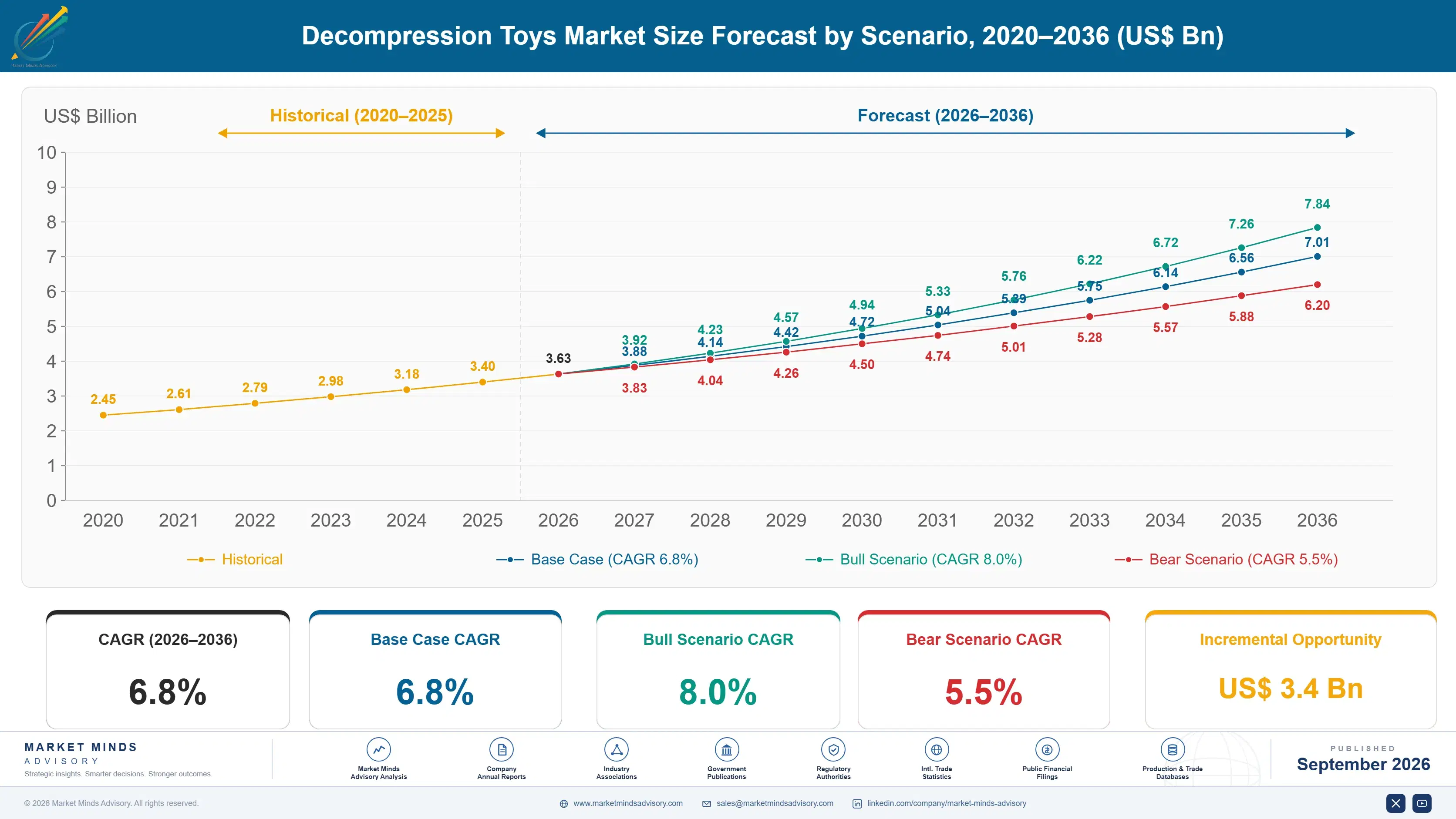
Decompression Toys Market Forecast Scenarios

decompression-toys-market-size-forecast-scenario-1790024255708
Decompression toy volume spiked sharply in 2020 and 2021 as pandemic-era stress relief demand surged across most major markets, then moderated through 2023 before stabilizing at a level above pre-pandemic baseline, reflecting genuine sensory-tool adoption among a meaningful share of buyers rather than a purely temporary fad-driven spike tied to viral trends alone and passing novelty.
The base case assumes continued classroom and therapeutic sensory-tool adoption, steady social media trend cycling introducing new product variants regularly, and rising parent awareness of sensory regulation benefits for children across most demographics. Three mechanisms drive the forecast specifically: occupational therapy professionals increasingly recommending specific products clinically to families, social media trend cycles refreshing purchase interest regularly across most age groups and regions, and classroom bulk purchasing by schools normalizing the category as an educational tool.
A bull scenario turns on major toy conglomerates successfully repositioning fidget tools as clinically-endorsed sensory products rather than pure novelty items, substantially expanding addressable spend across most demographics. The bear risk centers on social media trend fatigue reducing purchase-driving virality meaningfully, which could slow category growth back toward pre-pandemic novelty toy baseline rates across most price tiers.

Trend Cycles Reshape Novelty Toy Economics

Decompression toy economics increasingly resemble fast-fashion logic rather than traditional durable toy pricing, since trend cycle speed now determines commercial success more than product durability or material cost across most retail channels and price tiers. That shift rewards manufacturers who can move from design concept to retail shelf fastest, compressing traditional toy development timelines considerably across the entire category and buyer base.
MARKET CONCENTRATIONCR5 29%top five companies hold combined global revenue share
AVERAGE RETAIL PRICE$6.50 per unittypical price across silicone and foam product formats
TOP PRODUCING COUNTRYChina 44%leads global manufacturing and export volume by far
CLASSROOM BULK PURCHASE SHARE24%share of unit sales completed through school procurement channels
SOCIAL COMMERCE SALES SHARE38%share of unit sales driven directly by social media platforms
AVERAGE PRODUCT LIFESPAN8 monthstypical duration before replacement due to wear or novelty loss
Manufacturing economics favor Chinese OEM producers with flexible tooling and extremely low per-unit production cost, letting them respond to trend shifts faster than Western toy conglomerates dependent on longer product development and safety testing cycles across most jurisdictions and regulatory regimes worldwide. Scale matters less here than manufacturing flexibility and speed to market, since trend-driven demand can vanish before traditional production timelines complete their full cycle.
The next decade will likely see occupational therapy endorsement increasingly differentiate clinically-positioned sensory products from pure novelty items, as parents and schools seek credible guidance amid an overwhelming volume of similar-looking silicone products flooding most retail channels and online marketplaces worldwide and across most demographics and age groups, narrowing the field of genuinely differentiated brands considerably over time.
"These aren't toys anymore in the traditional sense. They're a trend cycle you can hold in your hand, and the manufacturers who understand that win."
Practice Lead, Consumer Products and Novelty Goods Practice · MMA Consumer Products and Novelty Goods Practice · September 2026

Market Trends

Occupational Therapists Endorse Sensory Tools Clinically

Occupational therapists increasingly recommend specific textured and chewable fidget products as genuine sensory regulation tools for children with attention or sensory processing differences, lending clinical credibility that pure novelty marketing previously lacked entirely across most retail channels. This endorsement pathway has expanded the buyer base beyond parents seeking a passing trend toward those pursuing a specific therapeutic outcome for their child, willing to pay meaningfully more for products carrying credible professional backing. Manufacturers increasingly fund clinical usability studies to support these claims, differentiating from unsubstantiated competitors across most price tiers.
Market Impact: Grows classroom purchase share 24%
Social Media Micro-Trends Compress Product Lifecycle Speed

Short-form video platforms have compressed the time between a new fidget design going viral and market saturation from roughly a year to a matter of weeks, forcing manufacturers to adopt trend-responsive product development far faster than traditional toy launch cycles allowed previously across most product categories and price tiers. This compression favors manufacturers with flexible Chinese OEM production relationships over Western conglomerates bound by longer internal approval and safety testing processes. Brands able to identify and manufacture viral product variants within weeks capture disproportionate early sales before market saturation sets in.
Market Impact: Cuts average unit price 30%

Market Opportunities and Growth Drivers

Classroom Sensory-Tool Adoption Normalizes Bulk Purchasing

Schools increasingly stock sensory fidget tools as standard classroom equipment for supporting students with attention or regulation needs, generating bulk procurement demand distinct from individual consumer purchases driven by trend virality alone and social media exposure nationwide. This institutional channel provides meaningfully more stable demand than social-media-driven retail sales, since school procurement cycles follow academic calendars rather than trend cycles that fluctuate seasonally and unpredictably. Manufacturers increasingly develop dedicated classroom product lines and bulk pricing structures specifically to capture this steadier institutional revenue stream across most districts and grade levels.
Market Impact: Drives 32% unsold inventory write-off

Falling Manufacturing Cost Sustains Impulse Purchase Volume

Chinese OEM manufacturers have driven silicone product manufacturing cost down considerably through scaled tooling reuse and simplified mold designs across most factories and supplier networks nationwide and abroad today and consistently, keeping retail prices low enough to sustain impulse purchase behavior even as individual products fall out of trend cycles quickly and unpredictably. This cost structure lets retailers stock a wide variety of trend-responsive designs without carrying meaningful inventory risk, since low per-unit cost limits downside exposure on products that fail to achieve viral traction across social platforms and online marketplaces.
Market Impact: Affects 15% of tested products

Market Restraints and Challenges

Trend Volatility Creates Genuine Inventory Risk

Retailers and manufacturers face genuine risk from misjudging which specific product designs will achieve viral traction, since social media trends shift unpredictably and unsold inventory of yesterday's viral design carries essentially no resale value once interest fades entirely and permanently. The root cause is the category's fundamental dependence on unpredictable social platform algorithms rather than traditional demand forecasting methods that worked for conventional toy categories in the past. Manufacturers are responding by adopting smaller production runs and faster reorder cycles, accepting higher per-unit cost in exchange for reduced inventory exposure.
Market Impact: Lifts therapeutic buyer conversion 26%

Material Safety Concerns Persist Among Budget Products

Independent testing has repeatedly found phthalate and heavy metal content exceeding safety thresholds in a portion of unbranded silicone fidget products, particularly among the cheapest Chinese OEM manufacturers competing purely on price across most online marketplaces and discount retailers nationwide and abroad. The root cause traces to inconsistent material sourcing and testing standards across a highly fragmented manufacturing base with minimal quality oversight. Established brands are responding by publishing third-party safety certification results prominently, while regulators in several markets have begun tightening import testing requirements for children's sensory products specifically.
Market Impact: Cuts trend-to-shelf time 70%
4 additional market trends, 3 additional growth drivers, and 2 additional restraints and challenges are covered in the full report. Contact sales@marketmindsadvisory.com to access the complete intelligence.

Segment CAGR and Growth Architecture

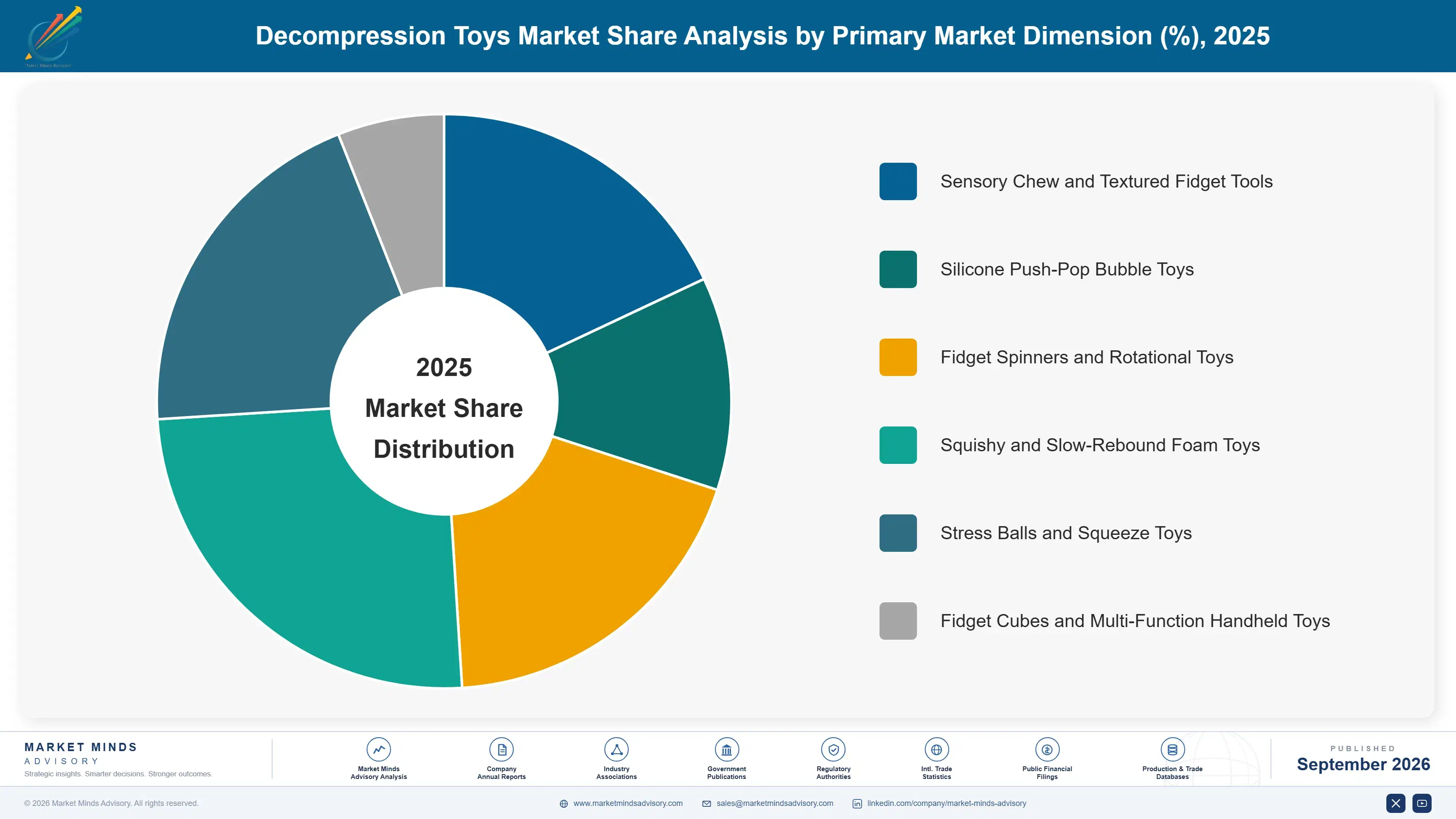
Segmentation follows product form factor and sensory function, the dimension buyers and retailers actually use to compare products across the category and its many competing designs and price points. Six categories span simple push-pop designs through clinically-positioned therapeutic sensory tools, reflecting the full range of positioning available to manufacturers today across every price tier.
decompression-toys-market-market-share-analysis-1790024256256

Sensory Chew and Textured Fidget Tools

Sensory chew and textured fidget tools combine tactile and oral-motor stimulation in formats increasingly recommended by occupational therapists for children with sensory processing differences, positioning the segment closer to therapeutic equipment than pure novelty entirely and consistently across most product lines, price points, and retail channels nationwide. This clinical positioning commands meaningful price premiums over standard silicone push-pop alternatives, since parents pursuing a specific therapeutic outcome show less price sensitivity than those buying a passing trend item for entertainment alone. Growth here consistently outpaces every other segment as professional endorsement continues expanding the credible buyer base beyond casual novelty purchasers and trend followers seeking short-term appeal rather than lasting value.
CAGR 9.5%

Silicone Push-Pop Bubble Toys

Silicone push-pop bubble toys remain the category's most recognizable and highest-volume format, having launched the broader decompression toy trend during the pandemic period and continuing to anchor mainstream retail presence across most major markets, channels, and price points worldwide and consistently over time and geography. This segment shows the fastest design turnover of any category, as manufacturers continuously introduce new shapes, colors, and character licensing tie-ins to sustain purchase interest among buyers who already own multiple units at home and school. Price competition runs most intense here, since countless nearly-identical Chinese OEM manufacturers compete directly for the same impulse-purchase retail shelf space and online marketplace listings nationwide and abroad today.
CAGR 8.2%
Full segment breakdown across 6 segments available in the complete report.

Regional Architecture and Country Demand Map

Regional distribution reflects toy manufacturing concentration far more than consumption alone, with East Asia anchoring the overwhelming majority of global production and export volume, well ahead of North America and Western Europe combined despite their meaningful and steadily growing consumption share across most retail channels today.

North America

North America represents the largest Western consumption market, with established toy conglomerates including Spin Master and Hasbro commanding meaningful shelf presence in mass retail alongside a growing volume of Chinese-manufactured products sold through online marketplaces and social commerce platforms nationwide and abroad today and consistently. American buyers show strong classroom and therapeutic adoption among parents and educators, while casual novelty purchasers drive the bulk of trend-cycle volume through social media discovery. This dual demand pattern shapes retail merchandising considerably, with major retailers stocking both branded and unbranded products side by side on their shelves nationwide. Growth here tracks close to the category average across most demographic segments and income levels.
Share: 23% | CAGR: 7.5% (2026 to 2036)

Western Europe

Western Europe's decompression toy market centers on established toy retail chains and increasingly stringent product safety regulation compared to most other regions worldwide and domestically today and consistently over time and across most countries. European buyers show more conservative adoption of unbranded Chinese imports compared to North America, partly reflecting stricter chemical safety certification requirements that raise import barriers for smaller manufacturers entering the market and competing for shelf space. Regulatory standards around phthalate content and children's product safety run considerably stricter here than in most regions worldwide. Growth trails the category average somewhat, reflecting a smaller addressable buyer base for budget unbranded products specifically across most member states, demographics, and income levels.
Share: 18% | CAGR: 5.2% (2026 to 2036)
Regional intelligence for 5 additional markets available in the complete report: East Asia, South Asia and Pacific, Latin America, Middle East and Africa, Eastern Europe. Contact sales@marketmindsadvisory.com.
decompression-toys-market-country-cagr-analysis-1790024256797

Ways Brands Can Build Lasting Category Value

Margin expansion in decompression toys concentrates on building repeat-purchase habits and clinical credibility rather than chasing individual viral moments, since trend-driven sales alone cannot sustain a durable brand beyond any single product cycle or season across the wider category and buyer base. Four distinct levers address this from different commercial angles across the buyer relationship.

Occupational Therapy Endorsement Programs for Credibility

Pursuing formal endorsement or usability studies from occupational therapy professionals lets brands command price premiums averaging 35% over comparable unendorsed products, since parents increasingly research clinical credibility before purchase rather than relying on social media hype alone across most retail channels and price tiers nationwide and abroad today and consistently. This investment carries meaningful upfront cost but differentiates credibly from the flood of unbranded Chinese products flooding online marketplaces globally. Brands with formal endorsement report meaningfully higher conversion among therapeutic buyers specifically and consistently across most demographics, income levels, and geographies.
Market Impact: Lifts price premiums by roughly 35% overall today

Classroom Bulk Procurement Programs for Institutional Sales

Developing dedicated bulk pricing and classroom-specific product lines targeting school procurement budgets generates meaningfully more stable revenue than pure social-media-driven retail sales, since institutional demand follows academic calendars rather than unpredictable trend cycles that shift weekly across most platforms, demographics, and price tiers nationwide and abroad. Brands with formal classroom sales programs report roughly 28% steadier quarterly revenue than those relying purely on consumer retail channels alone. This institutional relationship also builds durable brand recognition among parents who encounter products first through school use and educator recommendations across most districts.
Market Impact: Smooths quarterly revenue by roughly 28% overall today

Subscription Variety Boxes for Repeat Trend Followers

Offering subscription boxes that automatically deliver new trend-responsive product variants monthly captures recurring revenue from buyers who previously purchased individual viral products one at a time without any ongoing brand relationship or loyalty program in place at all or previously established. Brands piloting this model report subscription consignors showing roughly 40% higher lifetime value than one-time purchasers, since the subscription itself builds habitual engagement that resists competitive switching pressure over time and across market cycles. This approach also smooths demand forecasting considerably, reducing inventory risk tied to unpredictable trend timing.
Market Impact: Lifts consignor lifetime value by roughly 40% overall

Safety Certification Investment for Premium Trust

Pursuing third-party material safety certification addressing phthalate and heavy metal content lets brands command meaningful price premiums over uncertified competitors, since safety-conscious parents increasingly research certification before purchase amid widespread media coverage of unsafe products across most channels, price tiers, and retail formats nationwide and abroad today and consistently. This certification investment differentiates credibly from budget Chinese competitors lacking comparable testing, cutting return and complaint rates by roughly 25% among certified product lines. Brands with formal certification report meaningfully stronger retailer partnership terms as well across most major accounts and channels.
Market Impact: Cuts return and complaint rates by roughly 25%

Who Controls the Margin Pool

The Decompression Toys Market carries a CR5 near 29%, moderate concentration reflecting a fragmented field of established toy conglomerates and thousands of Chinese OEM manufacturers competing largely on price alone across most online marketplaces and retail platforms. Spin Master and Hasbro lead the branded segment, with a clear gap separating recognized brands from the highly fragmented unbranded silicone product field dominated by smaller producers nationwide and abroad.
Current competitive activity centers on occupational therapy endorsement investment, classroom bulk procurement programs, and safety certification differentiation against budget Chinese alternatives across most price tiers and retail formats worldwide. Players increasingly differentiate through clinical credibility and institutional sales channels rather than pure price competition, since the unbranded segment has already compressed toward commodity pricing industry-wide and globally across most channels.

Emerging pressure comes from Chinese manufacturers increasingly adding basic safety certification and clinical-sounding marketing language to previously unbranded products, narrowing the differentiation gap that established brands have relied on for years to justify pricing and brand loyalty. Rankings could shift meaningfully if Chinese manufacturers successfully replicate credible therapeutic endorsement at their existing price points across most retail channels and demographics.
decompression-toys-market-company-positioning-matrix-1790024257323

Competitive Moat and Risk Dimensions

SPIN MASTER CORP

Moat: Trend-Responsive Product Development Speed

Spin Master has built organizational capability specifically for rapid trend-responsive product launches, giving it faster time-to-market than larger, more bureaucratic toy conglomerates when a specific design shows early viral signals across social media platforms and short-form video content. This speed advantage compounds as its design and manufacturing teams gain repeated practice cycles.
SPIN MASTER CORP

Risk: Limited Pure-Price Competitiveness

Spin Master cannot match Chinese OEM manufacturer pricing on basic unbranded silicone products given its higher domestic overhead and licensing cost structure, ceding the absolute budget segment entirely to competitors willing to operate on much thinner margins across most price-sensitive buyer segments and online marketplaces.
HASBRO INC

Moat: Established Retail Distribution Relationships

Hasbro's decades-long retail relationships across mass merchandisers and specialty toy stores give it shelf placement and buyer trust that newer entrants cannot replicate regardless of product design quality, particularly during peak holiday and back-to-school buying seasons when shelf space competition intensifies considerably across most major retail chains.
HASBRO INC

Risk: Slower Trend Response Organizational Speed

Hasbro's larger organizational structure and centralized product approval process moves more slowly than nimble Chinese OEM competitors, risking missed viral windows in a category where specific product designs can rise and fall in popularity within weeks rather than traditional multi-year toy product cycles common at larger conglomerates.

Players Tracked

Prominent Players

Spin Master Corp
Hasbro Inc
MGA Entertainment Inc
Zuru Inc
Moose Toys Pty Ltd

Other Key Players

Mattel Inc
Basic Fun Inc
Jazwares LLC
WowWee Group Limited
Tomy Company Ltd
Fat Brain Toys LLC
Learning Resources Inc
Buffalo Games LLC
Yiwu Sunshine Toys Co Ltd
Shantou Chenghai Sanmu Toys Co Ltd
Ningbo Baby Care Toys Co Ltd
IS Gift Pty Ltd
Schylling Inc
Melissa and Doug LLC
Ban Dai Co Ltd

Recent Developments

JANUARY 2026

Spin Master Launches Occupational Therapist-Endorsed Sensory Line

Spin Master launched a new sensory fidget product line carrying formal endorsement from a pediatric occupational therapy association, targeting the fastest-growing segment of the category with clinical usability data published alongside the product launch across its primary retail and online distribution channels nationwide and internationally.
Signal: Signals major toy conglomerates racing to secure clinical credibility ahead of unbranded competitors across the category.
SEPTEMBER 2025

Yiwu Sunshine Toys Signs Distribution Agreement With European Retailer

Yiwu Sunshine Toys signed a private-label supply agreement with a major European discount retail chain, expanding its silicone product distribution significantly beyond online marketplaces into physical retail shelf space across multiple countries and regional markets throughout Europe and neighboring territories, strengthening its brand presence considerably.
Signal: Signals Chinese manufacturers actively pursuing physical retail distribution beyond e-commerce channels and digital platforms entirely today.
MAY 2025

Hasbro Introduces Third-Party Safety Certification Across Fidget Line

Hasbro introduced third-party material safety certification across its entire fidget and sensory product line, responding directly to consumer safety concerns that had previously suppressed conversion among budget-conscious buyers considering premium alternatives sold through online marketplaces nationwide and internationally across most channels, price tiers, and retail formats.
Signal: Signals safety certification becoming a genuine competitive differentiator across the entire category industry-wide and consistently today.

Managing Silicone and Packaging Input Cost

Food-grade silicone resin and printed packaging together represent roughly 35% to 45% of total cost of goods sold for decompression toy manufacturers, a meaningfully higher packaging share than most toy categories carry given rapid trend-driven design turnover and frequent packaging redesigns each season. Silicone resin sourcing concentrates among petrochemical suppliers, while packaging printing sources primarily from Chinese manufacturing clusters nationwide.
A notable volatility event occurred when silicone resin prices climbed sharply during 2024 amid rising petrochemical feedstock costs globally and shifting global supply and demand balances across most producing regions, according to industry trade reporting on specialty polymer and chemical markets, pushing manufacturing costs meaningfully higher across the category and compressing margins for manufacturers unable to pass through the full increase to price-sensitive impulse-purchase buyers purchasing online.

Chinese OEM manufacturers face comparatively lower exposure here, since they source silicone resin domestically within integrated petrochemical and manufacturing clusters nationwide and consistently. Western toy conglomerates face disproportionate exposure, since importing raw silicone across longer supply chains adds cost and currency risk that domestic Chinese competitors avoid almost entirely across most product categories, price tiers, and distribution channels.
decompression-toys-market-cost-volatility-analysis-1790024257520

Diversify Silicone Resin Suppliers

Sourcing silicone resin from multiple petrochemical suppliers across different regions and continents reduces exposure to any single supply disruption or price spike or geopolitical event of any kind, letting manufacturers maintain production continuity during localized shortages that would otherwise halt operations entirely and delay shipments considerably, eroding competitive position over time and across market cycles.

Lock In Long-Term Resin Supply Contracts

Negotiating multi-year resin supply agreements well ahead of anticipated demand growth locks in favorable pricing before volatility hits the broader petrochemical market and specialty chemical supply chain simultaneously and consistently, giving manufacturers with sufficient scale and creditworthiness meaningful cost predictability over multi-year planning horizons that smaller producers typically cannot access as easily or affordably.

Simplify Packaging Design for Cost Control

Standardizing packaging templates across multiple product variants rather than redesigning packaging for every trend cycle reduces printing and tooling cost meaningfully across most product lines and price tiers, letting manufacturers respond to trends faster without the added expense of fully custom packaging each time a new design launches across the category and its many competing formats.

Portfolio Architecture for Margin Defence

Portfolio economics split across three tiers by clinical credibility and design differentiation rather than simple price point, since a mid-priced endorsed sensory product can command margins rivaling far pricier unendorsed novelty items lacking comparable credentials and testing entirely. Volume-tier unbranded silicone products carry thin per-unit margins offset by extremely high transaction counts across major online marketplaces worldwide and internationally today.
Premium and clinically-endorsed tiers carry meaningfully higher margins justified by certification investment and institutional sales relationships, creating real tension with volume-tier economics that depend on trend-cycle throughput rather than per-unit margin to sustain overall profitability across the full product range and channel mix. Manufacturers increasingly segment product lines internally to serve both models without compromising either positioning, building distinct marketing approaches for each customer segment.

High-value margin pools concentrate in clinically-endorsed, certified sensory product lines, where therapeutic credibility and safety credentials command premiums unmatched anywhere else in the category, well above what standard trend-driven novelty items can support even at meaningfully higher unit volume across comparable transaction counts and price points throughout the year and across most major retail channels worldwide and well beyond today.

Volume / Commodity-Adjacent Tier

Standard unbranded silicone push-pop and fidget toys with minimal safety documentation, competing mainly on price through online marketplaces, targeting budget-conscious impulse buyers making a passing trend purchase without any brand loyalty consideration at all.
Gross Margin: 10%-18%

Premium / Certified Tier

Branded sensory products with documented safety credentials and established brand trust, targeting buyers seeking measurable quality assurance beyond generic unbranded alternatives sold broadly online at standard retail outlets nationwide and internationally.
Gross Margin: 32%-40%

Sustainability / Regulatory / Next-Generation Tier

Clinically-endorsed, occupational-therapy-backed sensory tools meeting the strictest emerging safety and efficacy standards available in the market today, targeting affluent, therapeutically-motivated consumers and institutional buyers seeking maximum credibility and supporting documentation.
Gross Margin: 38%-48%
decompression-toys-market-portfolio-architecture-1790024258029

High-value Sub-segments and Strategic Watch-out

Clinically-Endorsed Therapeutic Sensory Tools

Clinically-endorsed therapeutic sensory tools command the highest margins in the category as buyers pay substantial premiums for verified occupational therapy backing, representing the fastest-growing high-value niche within the broader premium tier and drawing significant manufacturer investment today and into the coming years and decades ahead.
Gross Margin: 38%-48%

Branded Certified Sensory Products

Branded certified sensory products command strong margins through documented safety credentials and established brand trust, generating solid per-unit value with steady growth as manufacturers expand certification programs to differentiate from unbranded budget competitors over time and across most retail channels, price tiers, and buyer segments.
Gross Margin: 32%-40%

Standard Unbranded Silicone Products

The largest unit-volume segment by far, standard unbranded silicone products generate steady revenue at thinner margins, forming the foundation of category economics even as growth concentrates in higher-margin certified and endorsed tiers positioned well above this core volume segment across nearly every major platform and retail channel worldwide.
Gross Margin: 10%-16%

Silicone Resin Input Cost Volatility

Rising silicone resin input cost volatility represents a genuine strategic watch-out, since sustained price spikes could compress manufacturer margins meaningfully if smaller Chinese OEM producers cannot secure the supplier diversification that larger, better-capitalized competitors maintain consistently across every major market, price tier, and distribution channel.
Gross Margin: N/A

Repeat Purchase Economics Across Buyer Motivations

Decompression toys carry a modest but genuine replacement cycle of eight to twelve months, shorter than most durable toy categories, generating recurring revenue distinct from the true one-time-purchase pattern of traditional stuffed animals or board games that persist for years without replacement or significant wear and tear of any kind.
Adoption depth varies sharply by end-use vertical: parents pursuing therapeutic outcomes for children with sensory needs engage most deeply, repurchasing specific endorsed products consistently as children grow and their needs evolve over time and across developmental stages and milestones reached along the way. Casual trend-following buyers purchase whatever design currently trends and rarely return to the same brand once interest fades, showing meaningfully lower brand loyalty than therapeutic buyers overall.

Generational buyer shifts favor younger, social-media-native consumers who treat product discovery as entertainment itself rather than a functional purchase decision, contrasting with parents purchasing specifically for a child's documented sensory needs who weight clinical credibility over trend appeal considerably more heavily throughout the buying process and decision-making timeline. This split is gradually reshaping how manufacturers design product marketing and packaging across most channels and demographics.
decompression-toys-market-end-use-penetration-index-1790024258537

Where Toy Brands Should Focus Next

These are among the four positions where our research anticipates prominent divergence between winners and laggards over the coming forecast period. Each is grounded in the demand model, the regulatory perimeter, and the announced capacity pipeline.
01 / CLINICAL ENDORSEMENT PRIORITY

Secure occupational therapy endorsement before competitors do

Clinical endorsement is becoming the category's defining premium differentiator, and brands that secure credible therapeutic credentials now will hold a meaningful pricing edge as parent buyers increasingly research clinical backing before purchase across most major retail channels, platforms, and price tiers nationwide. Waiting until competitors establish endorsed positioning first costs considerably more in lost premium share than proactive investment does today. Smaller manufacturers should seriously consider industry consortium endorsement programs rather than pursuing standalone clinical studies entirely alone and unassisted.
02 / INSTITUTIONAL SALES INVESTMENT

Build dedicated classroom procurement programs for stable revenue

Manufacturers that build dedicated classroom procurement relationships gain access to demand that follows predictable academic calendars rather than volatile social media trend cycles that shift weekly across most platforms, demographics, and geographies. This positioning provides meaningfully steadier revenue than pure consumer retail channels, insulating brands somewhat from unpredictable viral swings and trend fatigue across the broader market. Brands delaying institutional sales investment risk ceding this steadier revenue stream entirely to competitors already building dedicated school relationships and procurement pipelines nationwide.
03 / TREND-RESPONSE SPEED PRIORITY

Build flexible Chinese manufacturing relationships for faster response

Launch-to-market speed increasingly determines competitive success as social media trend cycles compress from months to weeks across the category and most major platforms, demographics, and geographies worldwide today. Brands that build flexible Chinese OEM manufacturing relationships capture disproportionate early visibility for new trending designs, while those relying solely on traditional internal development lose ground steadily over time. This shift favors organizationally nimble brands over larger conglomerates with slower internal approval processes and decision chains across most regions and price tiers.
04 / SAFETY CERTIFICATION INVESTMENT

Pursue third-party safety certification to build lasting trust

Material safety concerns remain a persistent barrier suppressing conversion among safety-conscious parents considering budget Chinese alternatives of uncertain quality sold through online marketplaces and discount retailers nationwide and abroad today and consistently. Manufacturers pursuing credible third-party safety certification signal genuine confidence that resonates with buyers increasingly wary of unsafe products following widespread media coverage of contamination incidents. This investment costs meaningfully less than rebuilding trust after a safety incident damages brand reputation broadly and permanently across most markets and channels.

Engagement Snapshot From the Field

A live engagement with an industry participant carrying material or product regulatory and market exposure ahead of a defining policy shift, showing how our research translates into a defensible multi-year portfolio strategy.
MARKET MINDS ADVISORY · CLIENT ENGAGEMENT SUMMARY
Decompression Toys Producer Strategic Portfolio Review and Transition Roadmap 2026·Investment Scenario on Decompression Toys Exposure Evaluation 2025-26
CLIENT PROFILE
The client is a mid-sized independent decompression toy brand with growing social commerce sales but limited institutional or classroom sales relationships across most regions. Revenue growth had become increasingly volatile as social media trend cycles shortened, prompting leadership to seek an outside assessment of whether to pursue institutional sales channels or continue prioritizing trend-responsive consumer retail expansion.
STRATEGIC CHALLENGE
Leadership needed to decide whether to invest limited capital in occupational therapy endorsement and classroom sales infrastructure or continue scaling trend-responsive social commerce production, without clear visibility into which approach would stabilize revenue most effectively given the brand's current organizational capacity, financial resources, and available management bandwidth, staffing, and expertise.
MMA APPROACH
MMA combined primary survey data across parent and educator buyers with a competitive benchmarking exercise against five comparable independent brands that had pursued different expansion strategies over recent years. The team modeled both institutional sales and continued trend-responsive retail paths against projected revenue volatility and margin retention over a three-year horizon.
KEY FINDINGS
  1. Revenue volatility tied to trend cycles had risen 45% over eighteen months as social media discovery patterns shifted unpredictably across most platforms and channels.
  2. Comparable brands pursuing classroom sales channels showed 30% lower quarter-to-quarter revenue variance than trend-dependent competitors relying purely on social commerce and viral marketing.
  3. Occupational therapy endorsement correlated with 26% higher average selling prices across comparable independent brand product lines and categories studied closely and consistently.
  4. Brand awareness among parents grew twice as fast following classroom pilot programs compared to social media marketing alone during the same period.
CLIENT PROFILE
The client is a mid-sized independent decompression toy brand with growing social commerce sales but limited institutional or classroom sales relationships across most regions. Revenue growth had become increasingly volatile as social media trend cycles shortened, prompting leadership to seek an outside assessment of whether to pursue institutional sales channels or continue prioritizing trend-responsive consumer retail expansion.
STRATEGIC CHALLENGE
Leadership needed to decide whether to invest limited capital in occupational therapy endorsement and classroom sales infrastructure or continue scaling trend-responsive social commerce production, without clear visibility into which approach would stabilize revenue most effectively given the brand's current organizational capacity, financial resources, and available management bandwidth, staffing, and expertise.
MMA APPROACH
MMA combined primary survey data across parent and educator buyers with a competitive benchmarking exercise against five comparable independent brands that had pursued different expansion strategies over recent years. The team modeled both institutional sales and continued trend-responsive retail paths against projected revenue volatility and margin retention over a three-year horizon.
KEY FINDINGS
  1. Revenue volatility tied to trend cycles had risen 45% over eighteen months as social media discovery patterns shifted unpredictably across most platforms and channels.
  2. Comparable brands pursuing classroom sales channels showed 30% lower quarter-to-quarter revenue variance than trend-dependent competitors relying purely on social commerce and viral marketing.
  3. Occupational therapy endorsement correlated with 26% higher average selling prices across comparable independent brand product lines and categories studied closely and consistently.
  4. Brand awareness among parents grew twice as fast following classroom pilot programs compared to social media marketing alone during the same period.
RECOMMENDED STRATEGY
Phase 1: Phase one: pursue a pilot occupational therapy endorsement study with one regional pediatric practice group first before expanding into new markets. Phase 2: Phase two: launch a limited classroom pilot program in partnership with several local elementary schools directly and immediately this year. Phase 3: Phase three: expand successful classroom and endorsement programs regionally while maintaining core trend-responsive retail product lines and channels intact throughout.
OUTCOME
Within twelve months of the pilot programs, the client reported (client-reported, unverified by MMA) a 28% increase in classroom channel revenue and meaningfully reduced quarter-to-quarter volatility overall across most product lines. The client subsequently expanded classroom partnerships to two additional states while maintaining its trend-responsive consumer product lines.

Frequently Asked Questions

Foundational context covering the market sizes, CAGR, scope, country, region and competition that inform every finding below. This section is provided to cover basics and most often pre-purchase conversations, answered from the MMA Primary Research Dataset.

What is the current size of the Decompression Toys Market?

The Decompression Toys Market was valued at 3.4 billion dollars in 2025. This figure reflects global retail and e-commerce sales across all product formats and channels.

How large will the Decompression Toys Market be by 2036?

The market is projected to reach 7.0 billion dollars by 2036. This represents roughly a 1.93 times expansion from 2026 value over the ten-year forecast period.

What is the CAGR for the Decompression Toys Market 2026 to 2036?

The market is forecast to grow at a 6.8% compound annual rate between 2026 and 2036. Growth is faster in sensory chew and textured fidget segments than in standard formats.

Which segment is growing fastest?

Sensory Chew and Textured Fidget Tools are growing fastest, at a 9.5% CAGR. That is roughly 1.4 times the overall market growth rate through the full 2036 forecast horizon.

Who are the major companies in the Decompression Toys Market?

Major companies include Spin Master Corp, Hasbro Inc, MGA Entertainment Inc, Zuru Inc, and Moose Toys Pty Ltd, together holding a moderate but not dominant revenue share.

Which country is growing fastest?

Vietnam is the fastest-growing country market, expanding at a 10.6% CAGR. Manufacturing diversification and rising domestic demand are the primary growth drivers behind this expansion.

Report Segmentation Architecture

The full report scope spans multiple orthogonal segmentation dimensions, with cross-tabulated demand data provided for each dimension pair. Coverage extends further to regional breakdowns, trend trajectories, and the competitive detail needed to support segment-level decision-making.

By Primary Market Dimension

  • Sensory Chew and Textured Fidget Tools
  • Silicone Push-Pop Bubble Toys
  • Fidget Spinners and Rotational Toys
  • Squishy and Slow-Rebound Foam Toys
  • Stress Balls and Squeeze Toys
  • Fidget Cubes and Multi-Function Handheld Toys

By End-Use Industry

  • Home and Personal Use
  • K-12 Classroom and Education
  • Therapeutic and Occupational Health
  • Corporate Wellness Programs

By Commercial Dimension

  • Social Commerce Platform
  • Mass Retail and Toy Store
  • Classroom Bulk Procurement
  • Subscription Direct-to-Consumer

By Region

  • North America
  • Western Europe
  • East Asia
  • South Asia and Pacific
  • Latin America
  • Middle East and Africa
  • Eastern Europe

Scope, Methodology, and Coverage

Every figure in this report is reproducible from documented input assumptions. The scope below maps the historical period, the forecast horizon, the segmentation dimensions, and the countries covered, alongside the underlying primary and qualitative methodology.
Historical Period
2020 to 2025
Forecast Period
2026 to 2036
Base Year
2025 (USD billions; MMA Primary Research Dataset, September 2026)
Market Definition
The Decompression Toys Market covers silicone, foam, and plastic sensory and fidget products designed for stress relief and tactile stimulation, including push-pop, chew, and squeeze formats. It excludes traditional stuffed toys, board games, and electronic gaming devices.
Quantitative Units
USD billions (current prices); unit shipment volume in millions where applicable
Segmentation Dimensions
By Product Form and Function; By End-Use Industry; By Commercial Dimension; By Region
Regions Covered
North America, Western Europe, East Asia, South Asia and Pacific, Latin America, Middle East and Africa, Eastern Europe
Countries Covered
USA, China, Germany, France, UK, Japan, South Korea, India, Australia, Canada, Brazil, Mexico, Indonesia, Vietnam, Thailand, Malaysia, UAE, Saudi Arabia, South Africa, Nigeria, Turkey, Poland, Netherlands, Italy, Spain, Sweden, Switzerland, Argentina, Colombia, Singapore, and additional markets relevant to this sector
Key Companies Profiled
Spin Master Corp, Hasbro Inc, MGA Entertainment Inc, Zuru Inc, Moose Toys Pty Ltd, Mattel Inc, Basic Fun Inc, Jazwares LLC, WowWee Group Limited, Tomy Company Ltd, Fat Brain Toys LLC, Learning Resources Inc, Buffalo Games LLC, Yiwu Sunshine Toys Co Ltd, Shantou Chenghai Sanmu Toys Co Ltd, Ningbo Baby Care Toys Co Ltd, IS Gift Pty Ltd, Schylling Inc, Melissa and Doug LLC, Ban Dai Co Ltd
Quantitative Methodology
Primary survey, n=3,800 respondents, Q4 2025, six countries; demand-side model with trade association cross-validation
Qualitative Methodology
47 expert interviews, Q4 2025; applied to validate demand model assumptions, identify emerging dynamics, and assess competitive positioning
Report Format
PDF and XLSX data workbook (Word format preview document)
Publisher
Market Minds Advisory
Report Code
MMA-2026-CON-208
Published
September 2026
Contact
sales@marketmindsadvisory.com | www.marketmindsadvisory.com

Purchase the full Decompression Toys Market Report (2026 to 2036).

This report provides a comprehensive assessment of the global Decompression Toys Market, covering market sizing, segmentation, regional dynamics, and competitive positioning through 2036. It draws on primary survey data across 3,800 respondents in six countries and 47 expert interviews conducted in Q4 2025, combined with company disclosures and MMA proprietary analysis across every major product category. The report is designed to support strategic decisions on clinical endorsement investment, channel strategy, and competitive positioning across the forecast period. Readers gain a clear view of where margin pools concentrate and how trend economics are likely to shift.
Detailed segmentation by product form and function
Seven-region market sizing with growth forecasts
Competitive benchmarking of twenty leading companies
Silicone cost and supply chain risk analysis
Revenue lever and margin expansion strategies
Anonymized client case study with outcomes

Built For The People Who Decide

From boardroom strategy to bench-side execution, this report is read cover-to-cover by leaders shaping the next decade of their industry, turning demand scenarios, market dynamics and valuation benchmarks into decisions.
CXOs/ Presidents/ VPs/ Managers
M&A and Corporate Development
Strategy Teams and R&D Heads
Procurement and Product Directors
Regulatory and Compliance Leaders
Investor Relations and Equity Analysts