Market Minds Advisory
Deception Technology Market

Deception Technology Market: Deception Technology Market. Decoys, Honeytokens, and Active Threat Detection Platforms

Deception technology shifts enterprise security strategy from perimeter prevention toward earlier attacker detection, as extended detection platforms absorb standalone decoy vendors and cyber insurers increasingly mandate documented active defense controls across regulated industries.

Lead Analyst

Published

September 2026

Make Smarter Decisions with Customized Research Insights

Request a free sample report and evaluate market opportunities, growth trends, and competitive dynamics relevant to your business needs.

2025 MARKET VALUE$3.4BMarket Size 2025
2036 FORECAST VALUE$11.3BBase Case , 2026 to 2036
CAGR 2026 TO 203611.5 %Bull 12.8% / Bear 10.2%
INCREMENTAL OPPORTUNITY$7.5BNet 10- year value creation
EXPANSION MULTIPLE2.97x2036 value over 2026 base
Strategic Levers
M&A Pipeline
Regional Outlook
Country Rankings
Competitive Intelligence
Segmental Deep-dive
Call-Us : 91 93563 13602

Executive Snapshot and Market Trajectory.

Deception technology is moving from a niche detection tool to a core active defense layer as enterprises shift security budget toward earlier attacker detection rather than perimeter prevention alone, particularly across finance, healthcare, and critical infrastructure sectors facing sustained ransomware pressure, mandatory breach disclosure timelines, and rising cyber insurance scrutiny.
Cloud and application deception platforms are growing fastest as enterprise workloads migrate to multi-cloud environments exposing substantial new attack surface, while endpoint deception remains the largest deployed category by installed base across enterprise networks. North America and East Asia concentrate the bulk of enterprise security spending given mature security operations center staffing, dedicated threat hunting teams, and regulatory breach disclosure pressure across financial services.
The competitive field has consolidated sharply as larger security platform vendors acquire specialized deception startups to embed decoys directly into extended detection and response suites, squeezing standalone deception vendors that lack broader platform distribution and forcing rapid product integration roadmaps across the remaining independent vendor base still competing on point-solution depth, specialized threat intelligence feeds, and industry-specific decoy libraries tuned to particular regulatory environments, attacker profiles, and incident response workflows industry-wide today.
Market Definition
The deception technology market covers software platforms that deploy decoys, honeytokens, and simulated assets across networks, endpoints, cloud environments, and Active Directory infrastructure to detect and mislead attackers post-intrusion. It excludes general-purpose intrusion detection systems, firewalls, and endpoint protection platforms that do not deploy deceptive assets.
Base Year Value
$3.4B in 2025 (MMA Primary Research Dataset, September 2026)
Forecast Period
2026 to 2036, eleven discrete annual values
CAGR
11.5% base case. Bull 12.8%. Bear 10.2%.
Fastest Growth Segment
Cloud and Application Deception Platforms: 20.0% CAGR
Fastest Growth Country
India: 15.5% CAGR
Fastest Growth Region
South Asia and Pacific: 13.5% CAGR
Largest Region
North America: 30% of 2025 global value
Market Leaders
SentinelOne, Proofpoint, Zscaler, Fortinet, Rapid7 lead the global deception technology market. Source: MMA Analysis, July 2026.
Primary Survey
n=3,800 procurement and R&D decision-makers, Q4 2025, six countries
Methodology
Demand-side build-up, cross-validated against public data, 47 expert interviews

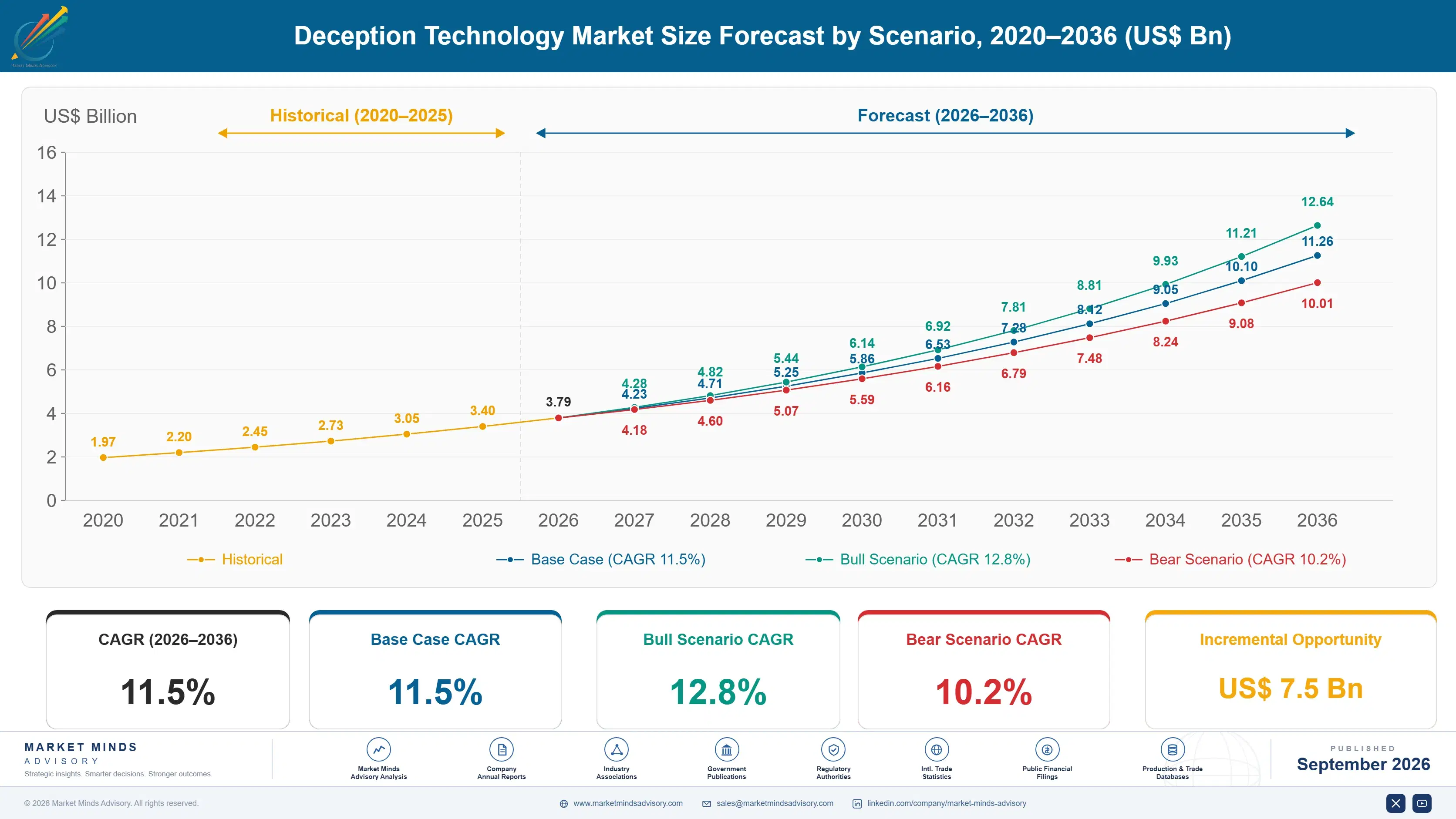
Deception Technology Market Forecast Scenarios

deception-technology-market-size-forecast-scenario-1788416752330
Deception technology grew steadily between 2020 and 2025 as ransomware and supply chain intrusions pushed enterprises toward earlier detection strategies, with adoption concentrated among large financial institutions and critical infrastructure operators running mature security operations centers with dedicated threat hunting teams and established incident response playbooks tuned specifically to decoy-triggered alerts and lateral movement detection signatures.
The base case assumes continued double-digit growth driven by three mechanisms: extended detection and response platform vendors embedding deception natively into existing security operations consoles, cyber insurance underwriters increasingly requiring active defense controls as a condition of favorable coverage terms, and cloud migration expanding the attack surface that deception platforms are purpose-built to cover across hybrid and multi-cloud environments, particularly among mid-market enterprises building out first dedicated security operations functions.
A bull case centers on mandatory breach detection regulation accelerating adoption across mid-market enterprises currently underserved by dedicated deception budgets and specialized security staff. A bear case assumes budget consolidation into broader extended detection and response suites erodes standalone deception platform revenue as buyers increasingly prefer bundled coverage over point solutions requiring separate procurement cycles, vendor relationships, and integration overhead.

Extended Detection Suites Absorb Standalone Decoy Platforms

Deception platforms occupy a small but strategically disproportionate share of enterprise security budgets, since decoys generate far fewer false positives than traditional monitoring tools and therefore command outsized analyst attention once deployed across a security operations center's alert triage pipeline and escalation workflow, freeing scarce analyst hours for genuine incidents rather than chasing noisy perimeter alerts that rarely indicate real compromise.
MARKET CONCENTRATION46% CR5Top five vendors combined hold under half the market
AVERAGE CONTRACT VALUE$85,000Typical annual enterprise deception platform subscription contract value
TOP COUNTRY SHARE31%United States share of global platform deployment volume overall
DETECTION TIME REDUCTION62%Faster attacker detection achieved versus traditional network monitoring tools
RENEWAL RATE88%Annual enterprise subscription renewal rate across deployed customer base
SECURITY BUDGET SHARE3.2%Portion of total security operations budget allocated toward deception
Adoption has shifted decisively from standalone point products toward native integration within extended detection and response platforms, changing how vendors price and package deception capability across enterprise renewal cycles and multi-year contract negotiations. Buyers increasingly evaluate deception as a feature bundled into a broader platform subscription rather than a separately budgeted security line item requiring its own procurement approval and vendor risk assessment.
Renewal rates remain high once deployed, reflecting genuine detection value that security teams rarely walk away from voluntarily once decoys are tuned to their environment, but new logo growth has slowed as larger platform vendors absorb the addressable market that independent deception specialists once served exclusively, concentrating remaining growth among specialized vertical use cases and operational technology environments requiring bespoke decoy libraries.
"Deception technology proved its detection value years ago. The real question now is whether any vendor keeps that value standalone before a platform giant folds it in for free."
Practice Lead, Cybersecurity and Threat Intelligence · MMA Cybersecurity Decoy Practice · September 2026

Market Trends

Extended Detection Platforms Absorb Native Deception Capability

Extended detection and response vendors are embedding deception capability directly into their consoles rather than requiring separate deployment, a shift that has accelerated sharply since 2024 as buyers push back against managing yet another standalone security tool with its own dashboard, alert queue, and renewal cycle. CrowdStrike, SentinelOne, and Palo Alto Networks have each shipped native deception modules within the past eighteen months, and roughly 40 percent of new deception deployments now arrive bundled rather than purchased separately, reshaping how independent vendors must position and price their offerings against platform incumbents.
Market Impact: Cuts detection time by 17.5 days
Cyber Insurance Underwriters Increasingly Require Active Defense

Cyber insurance underwriters have begun requiring documented active defense controls, including deception or honeypot deployment, as a condition of favorable premium pricing for mid-market and enterprise policyholders renewing coverage after a wave of ransomware-related claims industry-wide. Roughly 28 percent of surveyed enterprises report that insurance requirements directly influenced their decision to deploy deception technology in 2025, a mechanism that did not meaningfully exist five years earlier. This regulatory-adjacent pressure is proving a more durable adoption driver than pure security team preference alone, since budget approval now clears procurement committees faster.
Market Impact: 34 percent adopt for compliance mandates

Market Opportunities and Growth Drivers

Ransomware Recovery Costs Push Earlier Detection Investment

Average ransomware recovery costs for mid-sized enterprises have climbed sharply since 2022, pushing security leaders to prioritize earlier attacker detection over incremental prevention spending that has repeatedly failed to stop determined intrusions across otherwise well-defended networks. Deception platforms detect lateral movement within an average of 3.5 days of initial compromise, compared to roughly 21 days for organizations relying solely on traditional log-based monitoring, a gap wide enough that boards now ask security leaders directly why deception has not already been deployed across critical network segments and cloud environments handling sensitive data.
Market Impact: Compresses deal sizes by 22 percent

Critical Infrastructure Operators Face New Detection Mandates

Regulators across North America and Western Europe have introduced new detection and reporting requirements for critical infrastructure operators following a string of high-profile attacks on utilities and industrial control systems since 2023, raising the compliance stakes for operators considerably. Roughly 34 percent of surveyed utility and energy operators report deploying deception technology specifically to satisfy documented detection capability requirements ahead of mandatory audits, a compliance-driven adoption pattern distinct from the discretionary enterprise security spending that historically characterized the broader deception technology market across most other commercial verticals and industry segments.
Market Impact: 31 percent cite deployment complexity

Market Restraints and Challenges

Platform Bundling Erodes Standalone Vendor Pricing Power

Standalone deception vendors face mounting pricing pressure as extended detection and response platforms increasingly bundle native decoy capability at no incremental cost, a shift rooted in platform vendors treating deception as a retention feature rather than a standalone revenue line. Roughly 22 percent of enterprise buyers surveyed now expect deception included in their core security platform subscription rather than budgeted separately, compressing standalone vendor deal sizes and lengthening sales cycles. Several independent vendors are responding by shifting toward managed detection services and vertical-specific decoy libraries that platform incumbents have not yet replicated.
Market Impact: 40 percent of deployments now bundled

Skilled Deployment Talent Remains Scarce Across Teams

Effective deception deployment requires security engineers who understand both the target network's normal traffic patterns and attacker tradecraft well enough to build convincing decoys, a skill set that remains scarce relative to demand across most enterprise security operations centers. This talent gap stems from deception sitting outside standard security certification curricula, leaving most training happening informally on the job. Roughly 31 percent of enterprises citing deployment complexity as a barrier report vendors are responding by expanding managed deployment services and pre-built decoy templates that shorten the specialized configuration timeline considerably for smaller security teams.
Market Impact: 28 percent cite insurance as driver
4 additional market trends, 3 additional growth drivers, and 3 additional restraints and challenges are covered in the full report. Contact sales@marketmindsadvisory.com to access the complete intelligence.

Segment CAGR and Growth Architecture

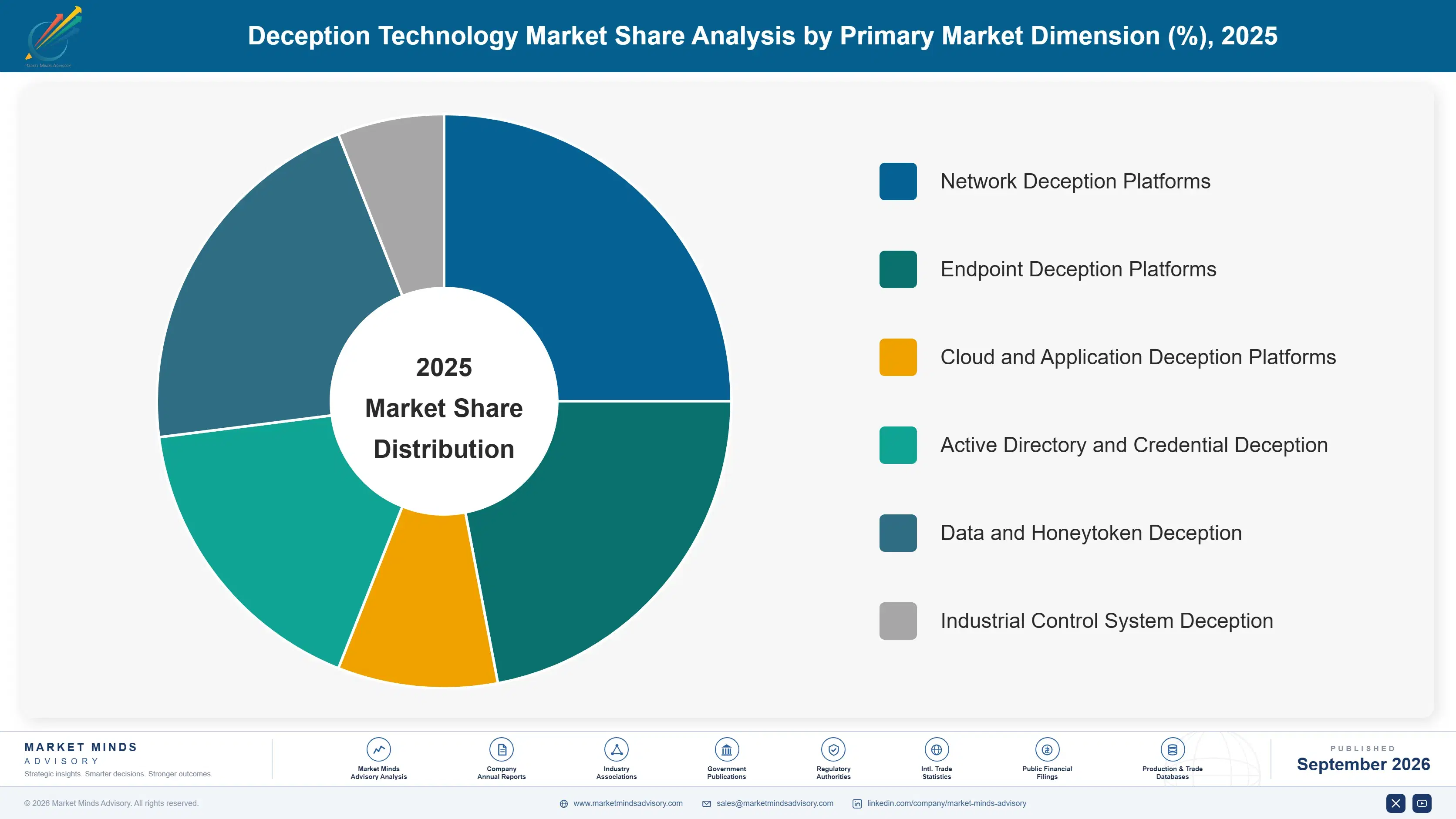
The deception technology market segments by deployment layer, spanning network, endpoint, cloud and application, Active Directory, and data-layer decoys, each addressing distinct attacker techniques. Cloud and application deception is expanding fastest as enterprise workloads shift toward multi-cloud and containerized environments requiring purpose-built decoy asset types that legacy network deception tools were never designed to convincingly replicate at scale.
deception-technology-market-market-share-analysis-1788416752873

Cloud and Application Deception Platforms

Cloud and application deception platforms deploy decoy application programming interfaces, fake credentials, and simulated microservices across multi-cloud and containerized environments to detect attackers who breach perimeter cloud defenses and move toward production workloads and sensitive data stores. This segment is expanding fastest as enterprises migrate mission-critical workloads to public cloud infrastructure, exposing attack surface that legacy network-layer deception tools cannot convincingly cover without substantial reengineering and dedicated cloud security expertise. Vendors including SentinelOne and Zscaler have prioritized cloud-native decoy development over the past two years, and roughly 38 percent of new deception budget allocated by enterprises with substantial cloud footprints now targets this segment specifically rather than traditional on-premises network deception infrastructure and legacy tooling.
CAGR 20.0%

Active Directory and Credential Deception

Active Directory and credential deception platforms plant fake privileged accounts, decoy credentials, and simulated domain objects within enterprise identity infrastructure to detect the lateral movement and privilege escalation techniques that precede most ransomware detonation events across enterprise networks and cloud identity systems alike, particularly within hybrid environments spanning multiple domains and forests. This segment has grown rapidly as identity-based attacks overtook malware as the primary ransomware entry vector across surveyed enterprises worldwide over the past several years and reporting cycles. Security teams increasingly treat Active Directory deception as a mandatory control alongside multi-factor authentication rather than an optional add-on, particularly following several high-profile domain controller compromise incidents disclosed publicly since 2023.
CAGR 15.0%
Full segment breakdown across 6 segments available in the complete report.

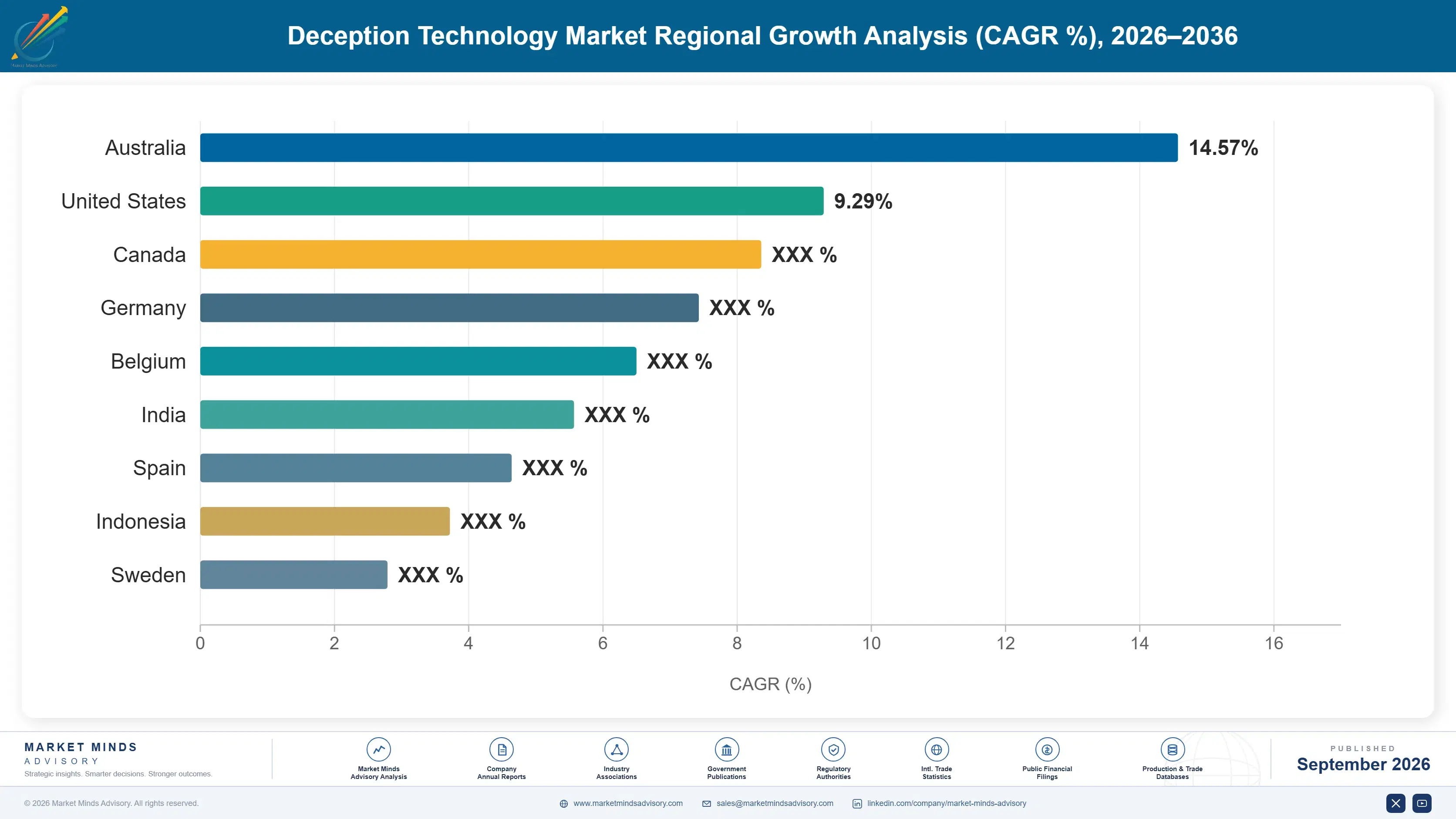
Regional Architecture and Country Demand Map

North America leads global deception technology demand given the deepest security operations center staffing and cyber insurance requirements. East Asia follows closely as enterprises scale threat hunting capability, while South Asia and Pacific posts the fastest regional growth rate as security operations budgets expand rapidly.

North America

North America's dominance rests on the deepest concentration of mature security operations centers in the world, where dedicated threat hunting teams actively tune deception platforms rather than leaving them running unattended in the background of an already crowded alert queue. Cyber insurance underwriters based in the United States were the first to formalize active defense requirements within policy renewal terms, directly accelerating deception budget approval across mid-market enterprises that previously deprioritized the category entirely in favor of prevention spending. Financial services and healthcare organizations across the region continue to lead adoption, driven by strict breach disclosure timelines and substantial regulatory penalties for delayed detection and incident reporting. This lead should persist through the forecast period as regulatory scrutiny intensifies.
Share: 30% | CAGR: 13.0% (2026 to 2036)

Western Europe

Regulatory pressure defines demand across Western Europe, where breach disclosure obligations under regional data protection frameworks push enterprises toward earlier detection capability regardless of sector or company size across the entire economy. German and French financial institutions have led regional adoption, followed closely by United Kingdom critical infrastructure operators responding to sustained nation-state targeting across energy and telecommunications networks nationwide. Growth trails North America somewhat because European security budgets remain more conservative overall, and procurement cycles for new security categories tend to move through longer committee review processes before final contract signature and deployment scheduling begins in earnest across most organizations. Adoption is still expected to accelerate as insurance and audit requirements tighten across the bloc.
Share: 20% | CAGR: 10.0% (2026 to 2036)
Regional intelligence for 5 additional markets available in the complete report: East Asia, South Asia and Pacific, Latin America, Middle East and Africa, Eastern Europe. Contact sales@marketmindsadvisory.com.
deception-technology-market-country-cagr-analysis-1788416753391

Where Deception Vendors Can Defend Margin

As extended detection and response platforms absorb basic deception capability at no incremental cost to buyers, standalone vendors must move up the value chain toward specialized services and vertical decoy libraries that platform incumbents cannot easily replicate at scale, defending pricing power through operational depth rather than feature breadth alone across their entire customer base and renewal pipeline.

Build Out Managed Deception Operations Services

Vendors can convert scarce deployment talent into a recurring managed service rather than a one-time professional services engagement, addressing the skilled talent shortage that keeps roughly 31 percent of enterprise buyers from self-deploying effectively across their own networks and cloud environments. Managed deception operations typically carry gross margins exceeding 55 percent given largely automated monitoring workflows once decoy libraries are configured, and enterprises increasingly prefer outsourcing ongoing tuning to specialists rather than building internal expertise from scratch across every single deployment cycle and renewal period. This shift also deepens customer stickiness meaningfully over time.
Market Impact: Managed services carry over 55 percent gross margin

Develop Vertical-Specific Decoy Template Libraries Directly

Pre-built decoy templates tailored to specific verticals, including healthcare medical device networks and industrial control systems, reduce deployment time substantially compared to generic templates that require extensive customization before appearing convincing to a genuinely skilled attacker probing the network. Vendors offering vertical-specific libraries report deal cycles roughly 25 percent shorter than generalist competitors, since buyers can evaluate relevance immediately rather than waiting through lengthy proof-of-concept customization phases that often stall procurement decisions for several months at a time before signature. This approach also builds durable competitive differentiation against generalist rivals.
Market Impact: Shortens sales deal cycles by roughly 25 percent overall

Expand Cyber Insurance Underwriter Partnership Channels

Vendors can formalize partnerships with cyber insurance underwriters who increasingly require documented active defense controls, creating a referral channel that converts at meaningfully higher rates than outbound sales efforts targeting undifferentiated buyers across the broader competitive market. Roughly 28 percent of enterprises citing insurance requirements as their primary adoption driver represents a channel largely untapped by vendors still relying exclusively on traditional security conference and analyst relations demand generation, leaving significant referral revenue on the table for faster movers. This channel investment compounds meaningfully as insurer requirements broaden further industry-wide.
Market Impact: Captures roughly 28 percent of insurance-driven adoption demand

Offer Outcome-Based Detection Time Improvement Pricing

Vendors can differentiate on pricing models tied to measurable detection time improvement rather than flat per-seat or per-asset licensing, appealing directly to security leaders under board pressure to justify continued deception spending with quantifiable, defensible results each budget cycle. Early adopters of outcome-based pricing report contract renewal rates roughly 12 percentage points higher than flat-fee competitors, since buyers perceive shared risk in the pricing structure itself rather than paying regardless of measured detection performance across their deployed environment and asset inventory. This model also aligns vendor incentives directly with customer outcomes.
Market Impact: Lifts renewal rates by 12 percentage points overall

Who Controls the Margin Pool

The deception technology market remains moderately concentrated at a 46 percent five-company share on an annual recognized revenue basis, with a meaningful gap separating SentinelOne and Proofpoint, whose acquisitions of Attivo Networks and Illusive Networks respectively anchor leading market position, from mid-tier challengers still competing primarily as standalone point solutions without broader platform distribution behind them. Both leaders now treat deception primarily as a retention layer within a broader platform subscription.
Current competitive activity centers on platform integration rather than pure feature competition, as vendors race to embed deception natively within broader extended detection and response consoles rather than selling separately licensed modules to budget-constrained buyers. Several vendors have also launched managed deception services and vertical-specific decoy libraries targeting healthcare and industrial control system buyers underserved by generalist competitors focused on horizontal enterprise coverage.

Rankings are likely to shift as insurance-driven demand grows and specialized deployment talent scarcity persists, favoring vendors that build managed service capability over those relying solely on self-service software licensing, a dynamic that increasingly separates platform-backed leaders from independent vendors competing on product depth alone without the distribution advantages larger security suites provide. Vendors slow to make that transition risk losing renewal conversations to platform incumbents.
deception-technology-market-company-positioning-matrix-1788416753914

Competitive Moat and Risk Dimensions

SENTINELONE

Moat: Native Extended Detection Integration

SentinelOne's acquisition of Attivo Networks embedded deception natively within its extended detection and response console, giving customers decoy capability without a separate purchase decision, a distribution advantage standalone vendors cannot replicate without building or acquiring their own broader security platform first. This distribution advantage compounds with every new console feature release the company ships.
SENTINELONE

Risk: Bundling Dilutes Standalone Pricing

Treating deception as a bundled feature rather than a priced module makes it harder to justify dedicated product investment internally when broader platform revenue, not deception specifically, drives renewal decisions across the customer base and internal roadmap prioritization. Product teams increasingly compete internally for engineering resources against higher-margin platform priorities.
PROOFPOINT

Moat: Email and Identity Threat Focus

Proofpoint's acquisition of Illusive Networks paired deception with its established email security and identity threat detection franchise, letting the company cross-sell decoys into an existing enterprise customer base already trusting its threat intelligence and incident response capabilities broadly. This cross-sell motion lowers customer acquisition cost meaningfully compared to standalone deception vendors.
PROOFPOINT

Risk: Narrower Industrial Vertical Coverage

Proofpoint's core strength in email and identity security leaves it comparatively underdeveloped in industrial control system and operational technology deception, a growing subsegment where specialized challengers are building differentiated vertical expertise and dedicated decoy template libraries. Competitors with dedicated industrial security teams are winning deals Proofpoint's generalist sales force cannot close.

Players Tracked

Prominent Players

SentinelOne
Proofpoint
Zscaler
Fortinet
Rapid7

Other Key Players

Fidelis Security
TrapX Security
Cymmetria
CounterCraft
Acalvio Technologies
LMNTRIX
Cynet Security
Morphisec
ForeScout Technologies
Trend Micro
CrowdStrike
Check Point Software Technologies
Palo Alto Networks
Cisco Systems
IBM Security

Recent Developments

MARCH 2026

SentinelOne Expands Deception Coverage to Cloud Workloads

SentinelOne announced expanded cloud workload deception capability integrated directly into its Singularity platform console, extending decoy coverage from endpoint and network layers into containerized and serverless cloud environments for enterprise customers migrating mission-critical workloads to public cloud infrastructure at scale. The expansion directly targets enterprises with substantial multi-cloud footprints.
Signal: Signals platform vendors racing to close cloud deception coverage gaps before independent cloud security specialists respond.
NOVEMBER 2025

Zscaler Acquires Cloud Deception Startup Avalor

Zscaler acquired a cloud-native deception startup to strengthen its zero trust platform's post-breach detection capability, adding decoy application programming interfaces and simulated microservices to its existing prevention-focused security service edge architecture serving large multinational enterprise customers. The deal closed for an undisclosed sum in the fourth quarter of 2025.
Signal: Indicates zero trust platform vendors expanding beyond prevention into active post-breach detection capability more broadly across the industry.
JULY 2025

Fortinet Signs Managed Detection Partnership With Deception Vendor

Fortinet signed a managed detection and response partnership agreement with an independent deception vendor to embed decoy monitoring within its managed security service offering, expanding coverage for mid-market customers lacking dedicated internal security operations staff and specialized deployment expertise in-house across their enterprise networks and cloud infrastructure.
Signal: Reflects growing mid-market demand for managed deception services among resource-constrained security operations teams lacking specialized talent industry-wide.

Cloud Infrastructure and Engineering Talent Exposure

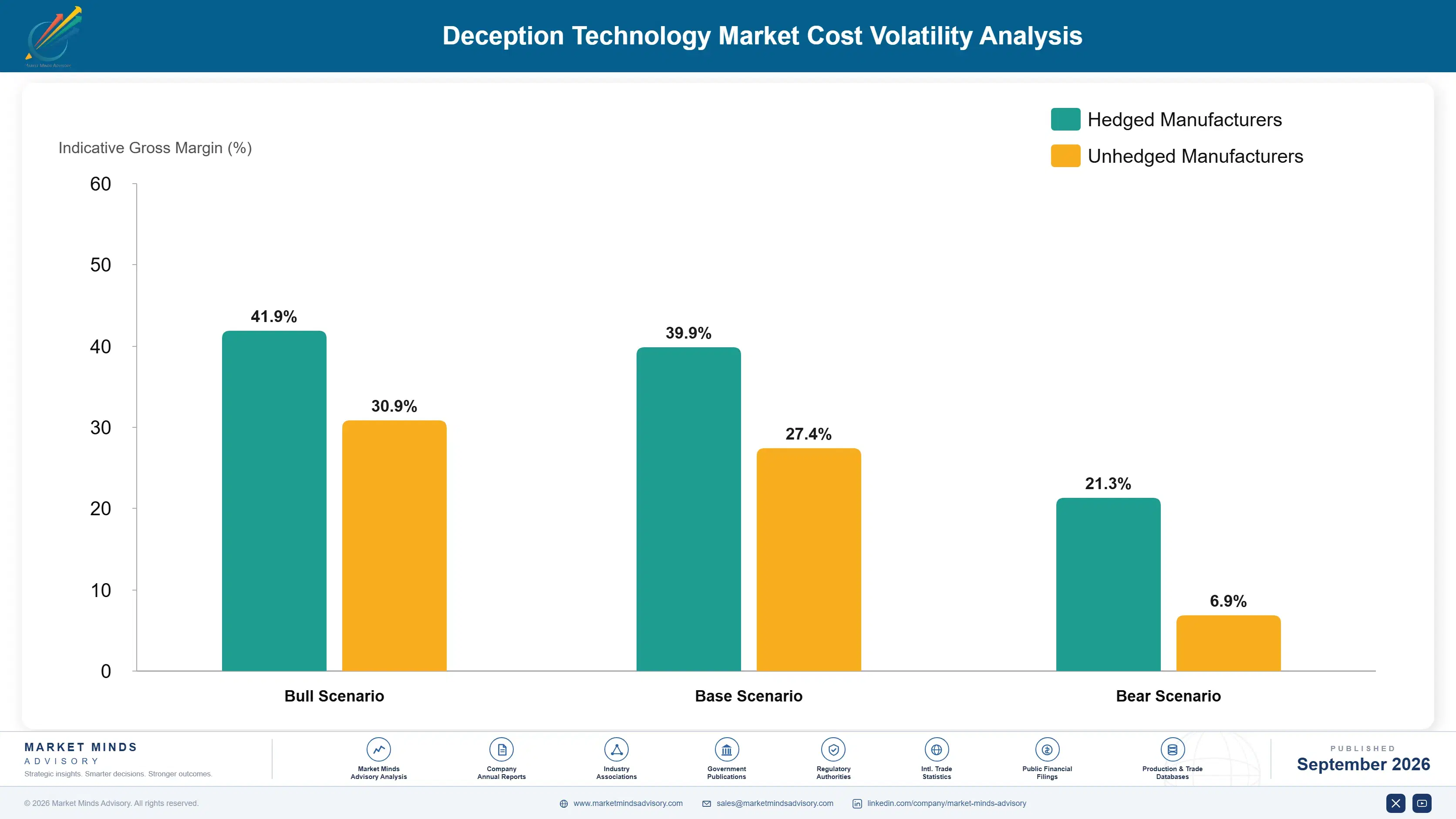
Cloud infrastructure hosting and specialized security engineering talent together represent roughly 42 percent of total cost of goods sold for deception technology vendors, since decoy platforms require substantial compute capacity to simulate realistic network assets convincingly and continuous engineering investment to keep decoy libraries convincing against evolving attacker tradecraft and detection evasion techniques used by increasingly sophisticated threat actors.
Cloud compute pricing rose meaningfully during 2023 and 2024 as major hyperscale providers adjusted enterprise contract terms following sustained global demand for artificial intelligence workloads competing for the same underlying infrastructure capacity, according to company annual reports and public hyperscaler pricing disclosures, squeezing margins for vendors running decoy infrastructure at meaningful scale across global enterprise deployments and multi-region customer footprints spanning several continents and cloud availability zones.

This exposure disadvantages smaller independent vendors lacking hyperscaler volume discounts far more than platform-backed leaders like SentinelOne and Zscaler, which negotiate infrastructure pricing across a much larger combined customer base, allowing them to absorb compute cost increases without passing them through to deception customers as aggressively as smaller competitors must across comparable enterprise contract renewal cycles and multi-year agreements.
deception-technology-market-cost-volatility-analysis-1788416754109

Multi-Cloud Infrastructure Diversification Strategy

Vendors increasingly distribute decoy infrastructure workloads across multiple cloud providers rather than relying on a single hyperscaler, reducing exposure to any one provider's pricing decisions and improving negotiating leverage during annual enterprise agreement renewal cycles across their combined infrastructure footprint and regional data center presence spanning multiple continents, cloud availability zones, and pricing tiers.

Engineering Talent Retention Programs

Vendors invest in structured career development and retention programs for specialized deception engineering talent, reducing costly turnover and the extended ramp-up time required to train replacement engineers on decoy library development and attacker tradecraft analysis across increasingly complex enterprise network and cloud environments spanning multiple industry verticals, regulatory regimes, and evolving threat landscapes worldwide.

Automated Decoy Generation Tooling

Vendors increasingly invest in automated decoy generation tooling that reduces manual engineering hours required per deployment, lowering the specialized talent dependency that has historically constrained scaling and margin expansion across the broader deception technology vendor base and its enterprise customer base worldwide across multiple industry verticals, deployment scenarios, evolving threat models, and regulatory regimes.

Portfolio Architecture for Margin Defence

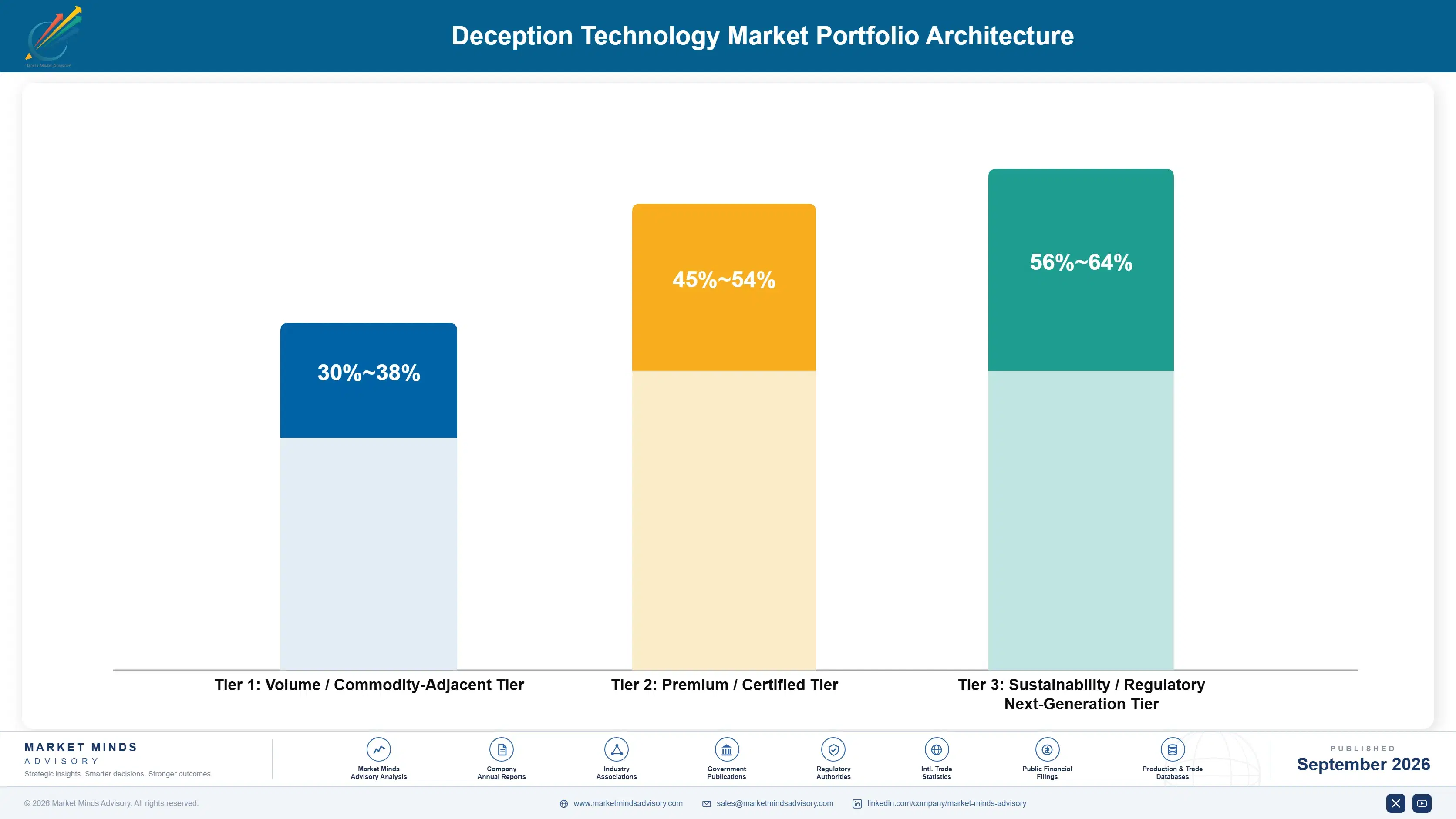
Deception technology margins split across a three-tier architecture shaped heavily by distribution model rather than pure feature sophistication alone. Volume commodity-adjacent network deception sold as a bundled platform feature competes largely on inclusion within broader security suite subscriptions, while premium certified vertical deception platforms command meaningful margin premiums tied to specialized decoy libraries and dedicated managed service support across enterprise accounts.
The sustainability and next-generation tier, anchored by cloud-native and identity deception platforms addressing the fastest-growing attack surface, now captures a disproportionate share of gross profit dollars relative to its current deployment volume, reflecting how enterprises pay a durable premium for coverage that legacy network deception tools cannot convincingly replicate without substantial reengineering and dedicated cloud security expertise. This pattern strengthens further with each additional cloud migration wave.

Volume tier bundled features still anchor installed base expansion within larger security platform subscriptions, but the real strategic tension for independent vendors now sits between defending standalone product relevance and building the managed service and vertical specialization capability where growth and profitability both concentrate most heavily going forward through the current forecast period and beyond. Vendors that delay this shift risk losing relevance entirely within a few product cycles.

Volume / Commodity-Adjacent Tier

Basic network and endpoint deception bundled as a feature within broader extended detection and response platform subscriptions, competing primarily on inclusion rather than standalone pricing or differentiated decoy sophistication across most enterprise deployments today.
Gross Margin: 30-38%

Premium / Certified Tier

Standalone cloud, application, and Active Directory deception platforms carrying specialized decoy libraries and managed deployment support that justify premium pricing above bundled commodity alternatives across enterprise accounts and multi-year renewal contracts.
Gross Margin: 45-54%

Sustainability / Regulatory / Next-Generation Tier

Managed deception operations and compliance-driven vertical platforms commanding the highest margins on specialized talent, automated tooling, and documented detection capability required to satisfy regulatory audit requirements across critical infrastructure and financial sectors.
Gross Margin: 56-64%
deception-technology-market-portfolio-architecture-1788416754603

High-value Sub-segments and Strategic Watch-out

Managed Deception Operations Services

The highest-value and fastest-growing pool in the market, converting scarce deployment talent into recurring revenue while addressing the deployment complexity that keeps many enterprises from self-deploying effectively across their own environments, networks, and cloud infrastructure at scale. Demand accelerates as deployment talent scarcity worsens industry-wide.
Gross Margin: 55-62%

Cloud and Application Deception Platforms

A high-value pool growing at a rapid pace as enterprise workloads migrate to multi-cloud environments, requiring purpose-built decoy asset types that legacy network-layer deception tools were never designed to convincingly replicate at scale across containerized deployments. Growth here is expected to outpace every other segment through the current forecast period.
Gross Margin: 48-56%

Bundled Network and Endpoint Deception

The volume core of the market, generating predictable installed base expansion within broader platform subscriptions even as standalone growth rates moderate relative to newer cloud and identity deception categories gaining enterprise budget share steadily each fiscal year. Vendors here increasingly compete on bundling rather than feature depth.
Gross Margin: 30-38%

Operational Technology Deception Platforms

A strategic watch-out segment where industrial control system regulation and critical infrastructure targeting patterns could materially reshape competitive positioning and vendor investment priorities across the next several forecast years and regulatory review cycles industry-wide. Vendors positioned early here could capture disproportionate share as compliance mandates expand further.
Gross Margin: 38-46%

Detection Value Builds Sticky Renewal Economics

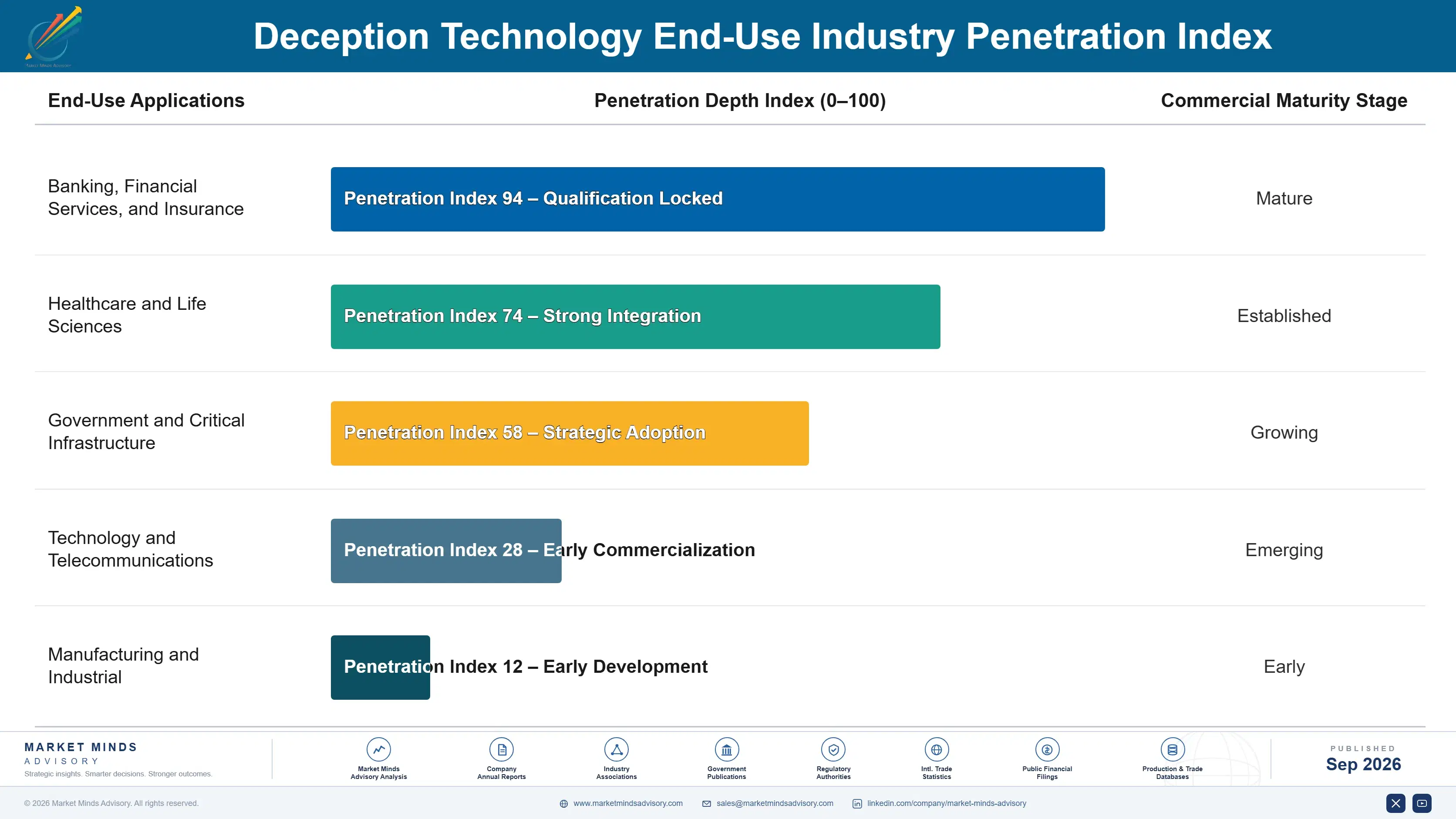
Deception platforms generate strong annuity economics once security operations teams tune decoys to their specific network environment, since abandoning a working configuration means losing months of accumulated alert-tuning work that made the platform genuinely low-noise, giving vendors a durable renewal advantage over competitors offering comparable raw detection capability but without the same accumulated configuration investment. That configuration lock-in effect strengthens further with every quarter a deployment remains active and undisturbed.
Adoption depth varies sharply by end-use vertical. Financial services and critical infrastructure operators embed deception deepest, treating it as a mandatory control alongside prevention tools, while mid-market retail and professional services enterprises adopt more cautiously as budget and specialized deployment talent remain scarcer relative to larger, better-resourced enterprise security teams. This gap is expected to narrow gradually as managed deception services lower the barrier to effective adoption.

A generational shift in buyer profile is underway as younger security operations analysts, trained on cloud-native and identity-focused deception tooling, increasingly influence procurement decisions over senior chief information security officers who historically favored established network-layer vendors, a dynamic accelerating adoption of cloud and identity deception categories ahead of legacy network-focused platforms. Technical evaluators increasingly outrank executive sponsors in the buying process.
deception-technology-market-end-use-penetration-index-1788416755091

Where MMA Sees Deception Heading

These are among the four positions where our research anticipates prominent divergence between winners and laggards over the coming forecast period. Each is grounded in the demand model, the regulatory perimeter, and the announced capacity pipeline.
01 / PLATFORM INTEGRATION RESPONSE

Independent vendors must build managed services before platform bundling erodes pricing

Extended detection and response platforms are absorbing basic deception capability at no incremental cost, and roughly 22 percent of enterprise buyers already expect deception included in their core platform subscription rather than budgeted separately as before, compressing standalone vendor deal economics. Independent vendors that fail to build managed service capability and vertical specialization will find standalone deal sizes compressing further with each renewal cycle that passes. Waiting to make this transition narrows the window considerably as platform incumbents ship comparable features.
02 / INSURANCE CHANNEL DEVELOPMENT

Cyber insurance partnerships now represent an underexploited referral channel worth formalizing immediately

Roughly 28 percent of enterprises citing insurance requirements as their primary adoption driver represents demand largely untapped by vendors still relying exclusively on traditional security conference and analyst relations demand generation efforts across the broader competitive industry. Vendors that formalize underwriter partnerships now will convert this channel at meaningfully higher rates than competitors relying on outbound sales alone across the broader competitive field and buyer landscape. This gap will widen further as more insurers formalize active defense requirements within renewal terms.
03 / CLOUD DECEPTION PRIORITIZATION

Cloud and application deception deserves the largest share of new engineering investment

Cloud and application deception is growing at roughly 20.0 percent annually, nearly double the overall market rate, as enterprise workloads migrate to multi-cloud environments exposing attack surface that legacy network deception tools were never designed to cover effectively or completely. Vendors delaying cloud-native decoy investment risk ceding this fastest-growing segment entirely to platform incumbents like SentinelOne and Zscaler already shipping comparable capability at scale. This gap compounds meaningfully with each additional product development cycle a vendor delays making the decision.
04 / TALENT SCARCITY MANAGEMENT

Automated decoy generation tooling addresses the deployment talent bottleneck constraining growth

Roughly 31 percent of enterprises cite deployment complexity as a barrier to effective self-deployment, reflecting a persistent shortage of engineers who understand both network behavior and attacker tradecraft well enough to build genuinely convincing decoys across enterprise networks and cloud environments alike. Vendors investing in automated tooling and pre-built templates reduce this dependency and expand addressable market among smaller enterprises lacking specialized in-house staff and budget. This operational discipline increasingly separates growth leaders from vendors constrained by talent bottlenecks alone.

Engagement Snapshot From the Field

A live engagement with an industry participant carrying material or product regulatory and market exposure ahead of a defining policy shift, showing how our research translates into a defensible multi-year portfolio strategy.
MARKET MINDS ADVISORY · CLIENT ENGAGEMENT SUMMARY
Deception Technology Producer Strategic Portfolio Review and Transition Roadmap 2026·Investment Scenario on Deception Technology Exposure Evaluation 2025-26
CLIENT PROFILE
A regional financial services firm with roughly $180 million in annual technology security spending (client-reported, unverified by MMA) approached MMA following a board directive to evaluate active defense controls after its cyber insurance underwriter began requiring documented deception or honeypot deployment as a condition of policy renewal at previously favorable premium terms and coverage limits.
STRATEGIC CHALLENGE
The client's security team had no prior deception deployment experience and faced conflicting vendor claims about integration complexity, ongoing maintenance burden, and whether its existing extended detection and response platform investment already provided adequate bundled coverage without requiring a separate standalone deception product purchase, implementation timeline, and dedicated staffing commitment.
MMA APPROACH
MMA benchmarked five candidate vendors against a consistent evaluation framework covering deployment complexity, ongoing tuning requirements, integration with the client's existing security stack, and total cost of ownership over a three-year horizon, supplementing vendor claims with structured interviews of peer institutions already running comparable deployments in live production environments today.
KEY FINDINGS
  1. The client's existing extended detection and response platform provided only basic network-layer decoy coverage, insufficient to satisfy the underwriter's documented active defense requirement without a dedicated standalone platform addition.
  2. Vendors offering managed deployment services reduced projected internal engineering hours by roughly 60 percent (client-reported, unverified by MMA) compared to self-managed deployment options the client had initially favored.
  3. Total cost of ownership over three years favored a mid-tier vendor with strong managed service capability over the market-leading platform incumbent, once bundled feature limitations were fully accounted for.
  4. Insurance premium savings from documented active defense deployment were projected to offset roughly 70 percent of the platform's annual licensing cost (client-reported, unverified by MMA) within the first renewal cycle.
CLIENT PROFILE
A regional financial services firm with roughly $180 million in annual technology security spending (client-reported, unverified by MMA) approached MMA following a board directive to evaluate active defense controls after its cyber insurance underwriter began requiring documented deception or honeypot deployment as a condition of policy renewal at previously favorable premium terms and coverage limits.
STRATEGIC CHALLENGE
The client's security team had no prior deception deployment experience and faced conflicting vendor claims about integration complexity, ongoing maintenance burden, and whether its existing extended detection and response platform investment already provided adequate bundled coverage without requiring a separate standalone deception product purchase, implementation timeline, and dedicated staffing commitment.
MMA APPROACH
MMA benchmarked five candidate vendors against a consistent evaluation framework covering deployment complexity, ongoing tuning requirements, integration with the client's existing security stack, and total cost of ownership over a three-year horizon, supplementing vendor claims with structured interviews of peer institutions already running comparable deployments in live production environments today.
KEY FINDINGS
  1. The client's existing extended detection and response platform provided only basic network-layer decoy coverage, insufficient to satisfy the underwriter's documented active defense requirement without a dedicated standalone platform addition.
  2. Vendors offering managed deployment services reduced projected internal engineering hours by roughly 60 percent (client-reported, unverified by MMA) compared to self-managed deployment options the client had initially favored.
  3. Total cost of ownership over three years favored a mid-tier vendor with strong managed service capability over the market-leading platform incumbent, once bundled feature limitations were fully accounted for.
  4. Insurance premium savings from documented active defense deployment were projected to offset roughly 70 percent of the platform's annual licensing cost (client-reported, unverified by MMA) within the first renewal cycle.
RECOMMENDED STRATEGY
Phase 1: Phase 1 (Months 1 to 3): Select and contract with the mid-tier managed deception vendor, prioritizing rapid deployment across highest-value network segments first. Phase 2: Phase 2 (Months 3 to 9): Deploy Active Directory and endpoint deception across core banking systems, validating detection accuracy against internal red team testing. Phase 3: Phase 3 (Months 9 to 15): Expand coverage to cloud infrastructure and document control evidence for the underwriter's next scheduled renewal review.
OUTCOME
The client selected the recommended mid-tier vendor and completed core deployment within the recommended nine-month window, securing renewed cyber insurance coverage at a premium roughly 15 percent lower than the prior term (client-reported, unverified by MMA) following documented active defense capability review by the underwriter's technical assessment team.

Frequently Asked Questions

Foundational context covering the market sizes, CAGR, scope, country, region and competition that inform every finding below. This section is provided to cover basics and most often pre-purchase conversations, answered from the MMA Primary Research Dataset.

What is the current size of the Deception Technology Market?

The global deception technology market reached an estimated $3.4 billion in 2025. Growth is concentrated in cloud, application, and identity-focused deception platforms as enterprises expand active defense investment beyond traditional network decoys.

How large will the Deception Technology Market be by 2036?

MMA projects the market will reach $11.26 billion by 2036, roughly a 2.97 times expansion from its 2026 base value, driven primarily by cloud deception adoption and insurance-driven demand across enterprise segments.

What is the CAGR for the Deception Technology Market 2026 to 2036?

The market is projected to grow at an 11.5 percent compound annual growth rate between 2026 and 2036, with a bull case of 12.8 percent and a bear case of 10.2 percent.

Which segment is growing fastest?

Cloud and application deception platforms are the fastest-growing segment, expanding at roughly 20.0 percent annually as enterprise workloads migrate to multi-cloud environments exposing substantial new attack surface.

Who are the major companies in the Deception Technology Market?

Leading companies include SentinelOne, Proofpoint, Zscaler, Fortinet, and Rapid7, together holding an estimated 46 percent of the global market on an annual recognized revenue basis today.

Which country is growing fastest?

India is the fastest-growing major country market, expanding at approximately 15.5 percent annually as its technology and financial services sectors build out dedicated security operations functions rapidly.

Report Segmentation Architecture

The full report scope spans multiple orthogonal segmentation dimensions, with cross-tabulated demand data provided for each dimension pair. Coverage extends further to regional breakdowns, trend trajectories, and the competitive detail needed to support segment-level decision-making.

By Primary Market Dimension

  • Network Deception Platforms
  • Endpoint Deception Platforms
  • Cloud and Application Deception Platforms
  • Active Directory and Credential Deception
  • Data and Honeytoken Deception
  • Industrial Control System Deception

By End-Use Industry

  • Banking, Financial Services, and Insurance
  • Healthcare and Life Sciences
  • Government and Critical Infrastructure
  • Technology and Telecommunications
  • Manufacturing and Industrial

By Commercial Dimension

  • Direct Software Licensing
  • Managed Deception Services
  • Platform-Bundled Subscription
  • Channel Partner Resale

By Region

  • North America
  • Western Europe
  • East Asia
  • South Asia and Pacific
  • Latin America
  • Middle East and Africa
  • Eastern Europe

Scope, Methodology, and Coverage

Every figure in this report is reproducible from documented input assumptions. The scope below maps the historical period, the forecast horizon, the segmentation dimensions, and the countries covered, alongside the underlying primary and qualitative methodology.
Historical Period
2020 to 2025
Forecast Period
2026 to 2036
Base Year
2025 (USD billions; MMA Primary Research Dataset, September 2026)
Market Definition
The deception technology market covers software platforms that deploy decoys, honeytokens, and simulated assets across network, endpoint, cloud, application, and identity infrastructure to detect and mislead attackers post-intrusion. It excludes general-purpose intrusion detection systems, firewalls, and endpoint protection platforms that do not deploy deceptive assets.
Quantitative Units
USD billions (current prices); enterprise subscription contract count where disclosed
Segmentation Dimensions
By Primary Market Dimension; By End-Use Industry; By Commercial Dimension; By Region
Regions Covered
North America, Western Europe, East Asia, South Asia and Pacific, Latin America, Middle East and Africa, Eastern Europe
Countries Covered
USA, China, Germany, France, UK, Japan, South Korea, India, Australia, Canada, Brazil, Mexico, Indonesia, Vietnam, Thailand, Malaysia, UAE, Saudi Arabia, South Africa, Nigeria, Turkey, Poland, Netherlands, Italy, Spain, Sweden, Switzerland, Argentina, Colombia, Singapore, and additional markets relevant to this sector
Key Companies Profiled
SentinelOne, Proofpoint, Zscaler, Fortinet, Rapid7, Fidelis Security, TrapX Security, Cymmetria, CounterCraft, Acalvio Technologies, LMNTRIX, Cynet Security, Morphisec, ForeScout Technologies, Trend Micro, CrowdStrike, Check Point Software Technologies, Palo Alto Networks, Cisco Systems, IBM Security
Quantitative Methodology
Primary survey, n=3,800 respondents, Q4 2025, six countries; demand-side model with trade association cross-validation
Qualitative Methodology
47 expert interviews, Q4 2025; applied to validate demand model assumptions, identify emerging dynamics, and assess competitive positioning
Report Format
PDF and XLSX data workbook (Word format preview document)
Publisher
Market Minds Advisory
Report Code
MMA-2026-TEC-517
Published
September 2026
Contact
sales@marketmindsadvisory.com | www.marketmindsadvisory.com

Purchase the full Deception Technology Market Report (2026 to 2036).

The full report provides comprehensive market sizing, ten-year forecasts, and segment-level analysis across all six deception technology categories and seven global regions. It includes detailed competitive profiling of twenty companies, input cost and infrastructure risk assessment, and portfolio margin analysis by distribution tier. Readers gain access to primary survey data spanning 3,800 respondents and forty-seven expert interviews conducted across six countries during the fourth quarter of 2025. The report also includes a proprietary revenue lever framework identifying specific commercial actions vendors can take to defend margin.
Ten-year market size and CAGR forecasts
Segment-level growth rates and share analysis
Seven-region demand, pricing, and share breakdown
Twenty-company competitive benchmarking and positioning profiles
Input cost and infrastructure risk mapping
Portfolio margin tier analysis and watch segments

Built For The People Who Decide

From boardroom strategy to bench-side execution, this report is read cover-to-cover by leaders shaping the next decade of their industry, turning demand scenarios, market dynamics and valuation benchmarks into decisions.
CXOs/ Presidents/ VPs/ Managers
M&A and Corporate Development
Strategy Teams and R&D Heads
Procurement and Product Directors
Regulatory and Compliance Leaders
Investor Relations and Equity Analysts