Market Minds Advisory
DC Switchgear Market

DC Switchgear Market: AI Data Center Buildout Accelerates Solid-State Adoption

Data center operators now specify medium-voltage DC switchgear ahead of expanding AI compute buildout, solid-state circuit breaker technology nears broader commercial deployment, and manufacturers without proven arc-flash safety certification lose utility-scale procurement contracts outright.

Lead Analyst

David Horsley

Published

September 2026

Make Smarter Decisions with Customized Research Insights

Request a free sample report and evaluate market opportunities, growth trends, and competitive dynamics relevant to your business needs.

2025 MARKET VALUE$3.6BMarket Size 2025
2036 FORECAST VALUE$10.1BBase Case , 2026 to 2036
CAGR 2026 TO 20369.8 %Bull 11.2% / Bear 8.2%
INCREMENTAL OPPORTUNITY$6.1BNet 10- year value creation
EXPANSION MULTIPLE2.55x2036 value over 2026 base
Strategic Levers
M&A Pipeline
Regional Outlook
Country Rankings
Competitive Intelligence
Segmental Deep-dive
Call-Us : 91 93563 13602

Executive Snapshot and Market Trajectory

Data center operators increasingly treat solid-state fault interruption speed as the deciding procurement factor rather than switchgear voltage rating alone, since documented millisecond-level response data now determines which suppliers actually qualify for AI compute facility contracts across most major hyperscale developers simultaneously and without costly retrofit delay.
Solid-state DC circuit breakers lead growth at 17.5%, roughly 1.79 times the overall rate, as AI data center power distribution demand expands faster than conventional mechanical switchgear alone can satisfy across every compute facility buildout and expansion. North America now holds the largest regional share at 29%, driven by concentrated hyperscale data center investment and the world's most established AI compute infrastructure buildout across the country's leading technology campuses entirely.
Competitive intensity stays elevated at 52% held by five participants, since electrical engineering complexity and extensive utility certification requirements fragment share less than most other power equipment categories, concentrating supply around a handful of established manufacturers rather than dozens of regional suppliers competing broadly across the wider electrical infrastructure landscape, its many industrial applications, and several adjacent utility and railway markets. Buyers increasingly select suppliers on proven arc-flash safety data rather than delivered price alone.
Market Definition
This report covers switchgear equipment for direct current power distribution and protection, spanning air-insulated, gas-insulated, solid-state, vacuum, metal-enclosed, and modular systems. It excludes AC switchgear and unrelated power transformer equipment.
Base Year Value
$3.6B in 2025 (MMA Primary Research Dataset, August 2026)
Forecast Period
2026 to 2036, eleven discrete annual values
CAGR
9.8% base case. Bull 11.2%. Bear 8.2%.
Fastest Growth Segment
Solid-State DC Circuit Breakers: 17.5% CAGR
Fastest Growth Country
China: 11.8% CAGR
Fastest Growth Region
South Asia and Pacific: 11.8% CAGR
Largest Region
North America: 29% of 2025 global value
Market Leaders
ABB, Siemens, Schneider Electric, Eaton, Mitsubishi Electric. Source: MMA Analysis, July 2026.
Primary Survey
n=3,800 procurement and R&D decision-makers, Q4 2025, six countries
Methodology
Demand-side build-up, cross-validated against public data, 47 expert interviews

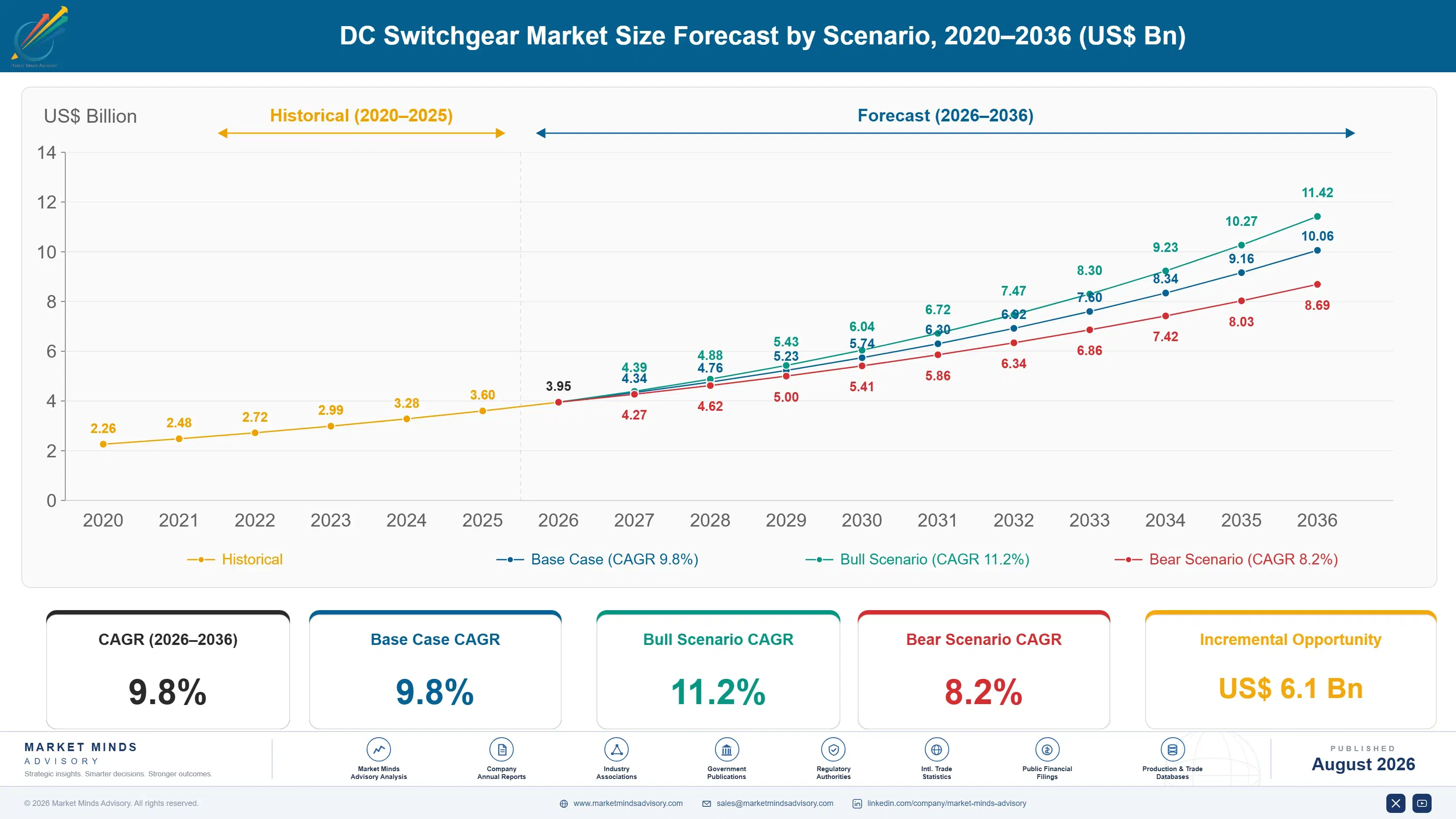
DC Switchgear Market Forecast Scenarios

dc-switchgear-market-size-forecast-scenario-1787303546056
Between 2020 and 2025 the market grew at an estimated 8.3% annually, as post-pandemic industrial capital investment recovery and expanding renewable energy grid connection projects pushed utilities toward expanded switchgear procurement faster than the industry's typical multi-year capital equipment cycle would otherwise dictate across most major power infrastructure markets worldwide, a pace that held steady even through supply chain disruption.
Three mechanisms carry the base case to 9.8%. First, AI data center buildout keeps accelerating globally, and every new hyperscale compute facility requires certified DC switchgear for power distribution and protection. Second, electric vehicle charging infrastructure keeps expanding as fast-charging networks require DC switchgear capable of handling high fault current levels safely. Third, renewable energy grid integration keeps sustaining demand as solar and battery storage installations require DC-side protection equipment.
The bull case at 11.2% assumes accelerating AI data center construction and renewable energy grid connection across additional major markets pulls forward switchgear procurement faster than currently planned by most utilities. The bear case at 8.2% assumes budget-constrained infrastructure capital programs delay planned equipment upgrades, slowing the pace of new DC switchgear demand growth across affected facility types and their broader capital budgets.

AI Data Center Buildout Reshapes Switchgear Procurement

DC switchgear occupies an unusual position within power distribution equipment: the underlying protection engineering is decades mature, yet AI data center power density is genuinely transforming procurement specifications in ways conventional mechanical switchgear cannot fully address. Hyperscale developers now request documented fault interruption speed and thermal management data alongside traditional voltage and current ratings, and manufacturers without solid-state platforms risk losing pre
MARKET CONCENTRATION52%Top five manufacturers hold roughly half global equipment share
AVERAGE UNIT PRICE$85,000/panelReflects fully engineered medium-voltage switchgear panel pricing typically observed
TOP PRODUCING COUNTRY SHARE29%One country dominates global data center switchgear purchasing volume substantially
EQUIPMENT SERVICE LIFE20 to 30 yearsTypical interval before utility systems require full switchgear replacement
SOLID-STATE ADOPTION RATE18% of unitsFast-interruption technology increasingly displaces conventional mechanical breaker equipment
COMPONENT COST SHARE35-43% of COGSSpecialty semiconductor and enclosure materials weigh heavily on costs
Demand now splits along two distinct tracks. Traditional utility and industrial customers still prioritize proven reliability and decades-long service life above nearly everything else, while data center and EV charging customers increasingly weigh interruption speed and compact footprint alongside reliability. These tracks are starting to command genuinely different premiums, since solid-state technology adds real cost that only high-density compute and fast-charging applications consistently justify.
Supply discipline remains tight because solid-state switchgear platform validation takes years of testing and utility certification, while AI data center buildout keeps accelerating faster than validated equipment supply can expand. That gap keeps procurement timelines elevated and rewards manufacturers who invested in solid-state research early. Data center growth is reshaping purchasing patterns faster than most participants expected, pushing established utility-focused manufacturers toward compact, high-speed platform development.
"Fault interruption speed, not voltage rating alone, is what actually wins hyperscale procurement committees today. Manufacturers without a credible solid-state roadmap are increasingly bidding for a shrinking share of data center budgets."
Director, Power Distribution and Electrical Equipment Practice · MMA Energy / Po

Market Trends

Solid-State Circuit Breakers Enter Commercial Deployment

Manufacturers are increasingly bringing solid-state DC circuit breaker technology to commercial deployment for AI data center power distribution, since semiconductor-based interruption achieves fault clearing speeds that conventional mechanical breakers physically cannot match at comparable current levels. This shift accelerated after several major manufacturers reported successful field deployments at hyperscale compute facilities, demonstrating commercial viability that data center developers can now reference directly in their own procurement decisions. Manufacturers lacking solid-state platforms are being excluded from serious hyperscale procurement consideration even when their conventional switchgear pricing is lower, since developers increasingly treat interruption speed as a non-negotiable facility safety requirement.
Market Impact: AI facility capacity grows 28% annu
EV Fast-Charging Networks Accelerate Equipment Demand

Charging network operators are increasingly deploying DC switchgear rated for the high fault current levels that ultra-fast charging stations require, since conventional AC-rated equipment cannot safely handle the direct current fault characteristics these installations present. This trend directly benefits manufacturers with proven DC-rated charging infrastructure products, forcing generalist switchgear suppliers without specialized certification to lean harder on custom engineering that charging network developers increasingly view as costly delays. Roughly thirty percent of new fast-charging corridor projects now specify certified DC switchgear explicitly, a share that keeps expanding each year as charging networks scale toward higher power outputs.
Market Impact: Renewable capacity adds 15 GW deman

Market Opportunities and Growth Drivers

AI Compute Capacity Expansion Sustains Baseline Demand

Global AI data center capacity keeps expanding across most major technology markets, and each new hyperscale compute facility requires certified DC switchgear regardless of hyperscaler or regional infrastructure standard used today. Developers are locking in multi-year equipment supply agreements well ahead of facility commissioning, since switchgear qualification and utility certification take twelve to eighteen months and cannot be rushed once construction timelines are set. Developers targeting high-density compute facilities continue specifying solid-state switchgear precisely because power density and reliability requirements increasingly favor this technology over conventional mechanical alternatives available today.
Market Impact: Solid-state units cost 2-3x more

Renewable Energy Grid Integration Sustains Demand

Utility-scale solar and battery storage installations keep requiring DC-side switchgear and protection equipment as renewable capacity additions accelerate across most major electricity markets, sustaining demand distinct from the traditional AC-dominated grid infrastructure business. Grid operators integrating substantial renewable capacity increasingly specify certified DC protection equipment specifically to manage the fault characteristics solar and storage installations present, which differ meaningfully from conventional generation sources. This driver is particularly pronounced across regions pursuing aggressive decarbonization targets, where renewable capacity additions are sustaining switchgear demand even as conventional generation capacity additions slow considerably.
Market Impact: Certification takes 2 to 3 years

Market Restraints and Challenges

High Solid-State Equipment Cost Limits Access

Solid-state DC circuit breakers with proven fast-interruption capability often cost two to three times more than conventional mechanical switchgear of comparable rating, making comprehensive facility upgrades financially challenging for smaller data center operators and industrial customers operating on constrained capital budgets. The root cause is semiconductor economics: solid-state interruption requires substantial power electronics and thermal management components that add meaningful cost beyond conventional mechanical switching hardware alone. That cost pressures smaller facilities toward conventional equipment or delayed upgrade cycles entirely. Manufacturers are responding by developing tiered product lines and financing programs to expand access among budget-constrained customers.
Market Impact: Solid-state deployment nears 18% of

Utility Certification Timelines Delay New Product Launches

New DC switchgear designs require extensive utility and regulatory certification testing before commercial deployment, and this certification process routinely takes two to three years given the safety-critical nature of high-voltage electrical protection equipment. The root cause is regulatory caution: utilities and safety agencies require extensive field testing and failure mode analysis before approving new switchgear technology for grid-connected or safety-critical applications. This certification timeline delays manufacturer ability to respond quickly to emerging market opportunities like AI data center buildout. Manufacturers are responding by initiating certification processes earlier in product development to reduce time-to-market once technology validation completes.
Market Impact: 30% of corridors specify DC switchg
3 additional market trends, 4 additional growth drivers, and 3 additional restraints and challenges are covered in the full report. Contact sales@marketmindsadvisory.com to access the complete intelligence.

Segment CAGR and Growth Architecture

DC switchgear segmentation follows interruption technology rather than end-use application alone, since the same customer pool evaluates distinct engineering platforms across most procurement decisions available today worldwide and across every industrial sector and utility. Six segments span air-insulated, gas-insulated, solid-state, vacuum, metal-enclosed, and modular systems, each carrying a distinct engineering complexity and certification pathway.
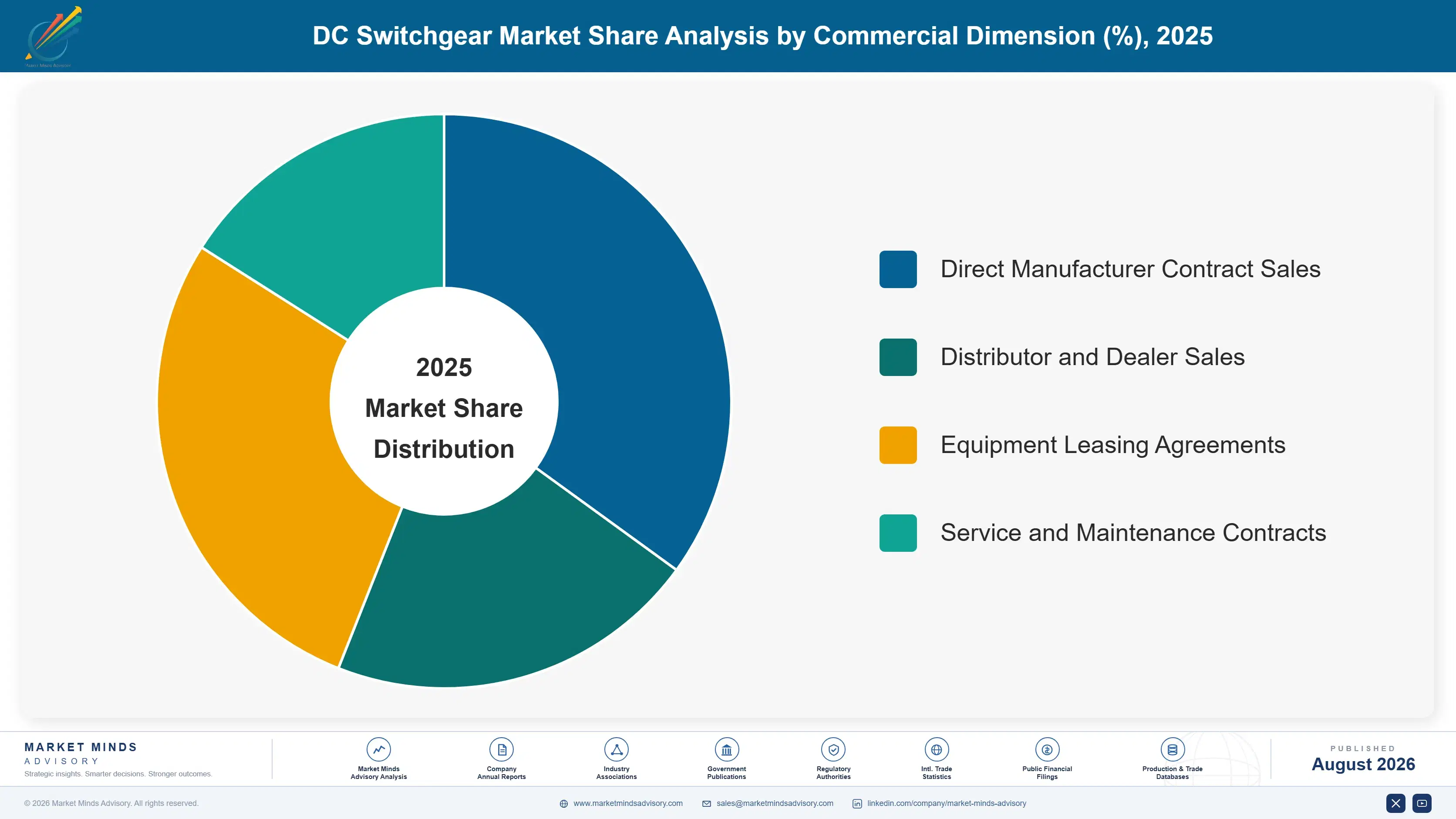
dc-switchgear-market-market-share-analysis-1787303546618

Solid-State DC Circuit Breakers

Solid-state DC circuit breakers are growing fastest overall as AI data center developers increasingly specify semiconductor-based interruption technology that conventional mechanical breakers cannot match on fault clearing speed at comparable current levels, equipment footprint, or reliability under continuous high-load operating conditions and extreme power density. Hyperscale compute facilities and high-power charging infrastructure are driving most of this growth, since solid-state platforms benefit disproportionately from documented field deployment data demonstrating commercial viability at scale. Manufacturers with proven solid-state utility certification are capturing disproportionate share of new hyperscale procurement contracts as developers increasingly specify this technology explicitly in equipment requirements, particularly across leading AI compute campuses in the United States and East Asia.
CAGR 17.5%

Modular and Compact DC Switchgear Systems

Modular and compact DC switchgear systems grow second-fastest overall today, favored for their standardized factory-built configuration that reduces on-site installation time compared with custom-engineered conventional switchgear that data center construction timelines increasingly cannot accommodate or absorb across most fast-moving construction schedules, permitting processes, utility interconnection requirements, and financing timelines nationwide. Data center and EV charging developers worldwide increasingly specify modular systems for rapid facility deployment, since these platforms allow parallel manufacturing and site preparation that sequential custom engineering approaches cannot match. Manufacturers offering fully validated modular platforms with standardized interfaces are capturing meaningful share from custom-engineering specialists, since developers increasingly prefer suppliers offering predictable delivery timelines over bespoke engineering flexibility alone.
CAGR 13.2%
Full segment breakdown across 6 segments available in the complete report.

Regional Architecture and Country Demand Map

North America commands the largest share on concentrated hyperscale data center investment and the world's most established AI compute infrastructure buildout, followed by East Asia and Western Europe on expanding manufacturing capacity and established renewable grid integration respectively across their major and rapidly evolving industrial markets.

North America

North American demand is anchored by concentrated hyperscale data center investment and the world's most established AI compute infrastructure buildout, giving the region genuine procurement leadership that other regions have not yet replicated at comparable scale, technology adoption depth, or manufacturing capacity today or in the near term. The United States dominates regional equipment volume, where major hyperscale developers increasingly deploy solid-state switchgear supported by expanding data center construction pipelines. Canada's smaller data center sector follows comparable procurement patterns at smaller absolute scale, anchored by its own provincial utility framework. Growth of 10.5% outpaces the global rate as AI compute expansion and renewable grid integration compound across an already substantial installed equipment base.
Share: 29% | CAGR: 10.5% (2026 to 2036)

Western Europe

Germany and the United Kingdom anchor most of Western Europe's demand, where established national grid modernization frameworks support broad DC switchgear adoption ahead of many other mature markets globally and across the wider continent's regulatory and reimbursement landscape, systems, institutions, and utility purchasing groups. The European Union's grid interconnection regulation is shaping which manufacturers actually capture procurement share across the bloc's stringent certification systems and member states. France's concentrated nuclear and renewable grid infrastructure sustains steady demand tied to established utility procurement relationships built over multiple decades. Growth of 8.2% trails the global average because the region's mature grid infrastructure base has already captured most feasible near-term procurement volume growth.
Share: 20% | CAGR: 8.2% (2026 to 2036)
Regional intelligence for 5 additional markets available in the complete report: East Asia, South Asia and Pacific, Latin America, Middle East and Africa, Eastern Europe. Contact sales@marketmindsadvisory.com.
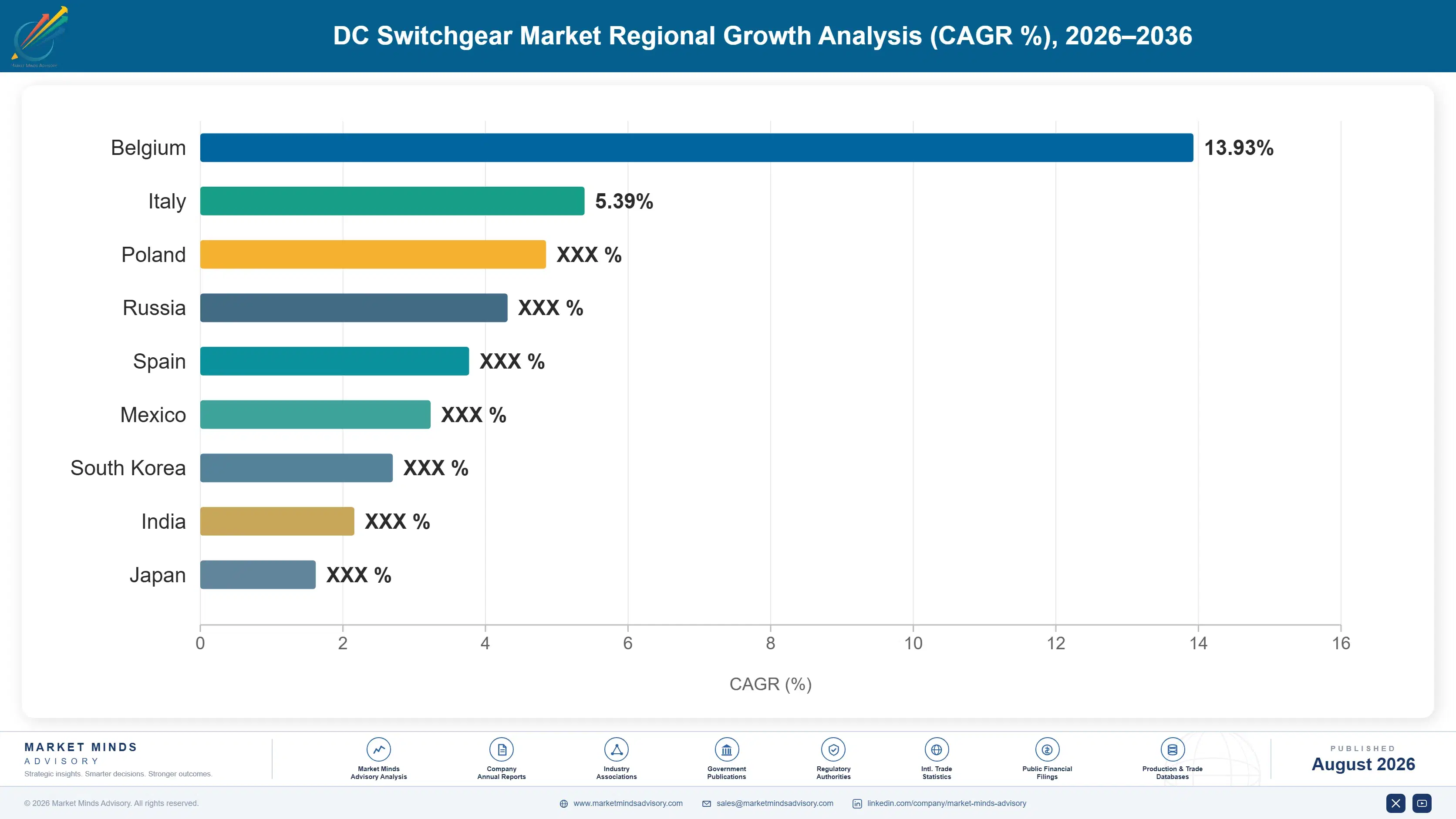
dc-switchgear-market-country-cagr-analysis-1787303547126

Where Switchgear Manufacturers Can Defend Margin

DC switchgear manufacturers capture margin unevenly across product categories, and the biggest opportunities sit in solid-state technology leadership, modular platform development, and hyperscale customer relationships rather than volume expansion alone. Four commercial levers stand out as genuinely actionable across most manufacturer types, regardless of whether the underlying platform serves data center or utility customers.

Lead Solid-State Circuit Breaker Technology Development

Manufacturers who develop proven solid-state interruption capability capture premium pricing of 25% to 35% over competitors offering only conventional mechanical switchgear, since hyperscale data center developers increasingly treat interruption speed as a non-negotiable facility safety requirement across most major markets, jurisdictions, regulatory environments, and utility interconnection standards. This advantage compounds as field deployment data accumulates, since procurement committees increasingly favor platforms with proven commercial track records over unvalidated alternatives. Manufacturers who have built this technology over multiple product generations cannot be quickly replicated by competitors starting solid-state development from scratch.
Market Impact: Solid-state technology commands a 2

Build Modular Platform Lines for Rapid Deployment

Manufacturers who develop standardized modular product lines specifically for data center construction timelines capture share from custom-engineering competitors offering longer lead times that developers increasingly view as unacceptable delays across most fast-moving construction schedules and permitting processes today. This positioning can add 20% to 30% incremental volume compared with manufacturers relying solely on custom-engineered switchgear, since data center construction timelines are compressing faster than traditional engineering cycles can accommodate or absorb across most facility types. Manufacturers who delay modular platform development risk permanently ceding this fast-growing channel to modular-first competitors.
Market Impact: Modular platforms add 20 to 30% inc

Establish Direct Hyperscale Developer Relationships Early

Manufacturers who invest in direct relationships with hyperscale data center developers capture design-in advantages that competitors selling through traditional distributor channels cannot match, since early engagement lets manufacturers influence facility specifications before competitive bidding occurs across most major procurement decisions, construction timelines, budgets, and vendor selection processes. This lever can lift win rates by 15% to 25% among manufacturers with established hyperscale relationships compared with those competing purely on published specifications alone. This lever rewards manufacturers who invest early in hyperscale account relationships over those relying purely on channel distribution.
Market Impact: Hyperscale relationships lift win r

Accelerate Utility Certification Ahead of Competitors

Manufacturers who initiate utility certification processes earlier in product development capture first-mover advantage in emerging application categories that competitors still navigating certification cannot yet address commercially across most major markets, use cases, regulatory jurisdictions, and utility interconnection standards worldwide today and going forward. This lever can compress time-to-market by 25% to 40% compared with manufacturers who wait until technology validation fully completes before beginning certification processes and regulatory review. This lever is particularly attractive for manufacturers pursuing genuinely novel switchgear technology where certification timelines represent the primary barrier to commercial deployment.
Market Impact: Early certification compresses time

Who Controls the Margin Pool

Concentration stays elevated at fifty-two percent held by five participants, evaluated on DC switchgear equipment revenue specifically. ABB and Siemens lead decisively on established utility relationships and electrical engineering breadth, while Schneider Electric, Eaton, and Mitsubishi Electric compete across different regional strongholds and application specialties, leaving a meaningful gap between the top two.
Current competitive activity centers on three dimensions. Manufacturers are racing to develop solid-state interruption capability, since AI data center developers increasingly specify this technology as a baseline requirement for new facilities. Modular platform development has become a genuine differentiator, with several manufacturers investing heavily in standardized product lines to capture the fastest-growing procurement channel. And hyperscale relationship depth is the third, as manufacturers build direct developer accounts to shape facility specifications before bidding.

Emerging pressure comes from Chinese domestic manufacturers, who are scaling engineering capability fast enough to challenge established Western electrical companies for share in price-sensitive markets within the next several years. Rankings could shift if a major Chinese manufacturer secures solid-state utility certification in Western markets, combining cost competitiveness with technology parity that pure Western incumbents currently charge premium pricing for. Modular-first specialists riding the data center construction wave also stand to gain incremental share.
dc-switchgear-market-company-positioning-matrix-1787303547648

Competitive Moat and Risk Dimensions

ABB LTD

Moat: Broadest Utility Relationship Network

ABB maintains the broadest utility procurement relationships of any switchgear manufacturer, built over decades of electrical equipment sales across multiple grid infrastructure categories, giving it cross-selling advantages and purchasing trust that newer entrants cannot quickly replicate. This relationship depth lets the company introduce new solid-state platforms and secure adoption faster than competitors building utility trust from scratch.
ABB LTD

Risk: Facing Nimble Data Center Specialists

ABB's utility-focused legacy business model faces competitive pressure from nimbler manufacturers who designed compact modular platforms specifically for data center construction timelines from the outset, rather than adapting utility-focused equipment. The company must continue investing in dedicated data center product lines to defend its position against competitors built for this fast-growing channel.
SIEMENS AG

Moat: Deepest Global Electrical Commercial Reach

Siemens's global commercial infrastructure across electrical equipment markets gives it distribution and utility procurement reach that smaller specialized competitors cannot match, letting it launch new DC switchgear platforms across dozens of markets simultaneously. This scale also lets the company absorb pricing pressure in any single market that would meaningfully threaten smaller, less diversified competitors.
SIEMENS AG

Risk: Slower Solid-State Rollout Pace

Siemens has moved more deliberately than some smaller, more focused competitors into solid-state interruption technology, leaving it comparatively exposed as hyperscale developers increasingly specify this capability over conventional mechanical switchgear. Closing this gap requires meaningful engineering investment that competitors with earlier solid-state commitments have already substantially completed.

Players Tracked

Prominent Players

ABB Ltd
Siemens AG
Schneider Electric SE
Eaton Corporation plc
Mitsubishi Electric Corporation

Other Key Players

General Electric Company (GE Vernova)
Hitachi Energy Ltd.
Hyundai Electric & Energy Systems Co., Ltd.
Toshiba Corporation
Fuji Electric Co., Ltd.
CHINT Group Co., Ltd.
TGOOD Global Limited
Larsen & Toubro Limited
Powell Industries, Inc.
S&C Electric Company
Alstom SA
CG Power and Industrial Solutions Limited
Rockwell Automation, Inc.
Legrand SA
Delta Electronics, Inc.

Recent Developments

MARCH 2026

ABB Launches AI Data Center Solid-State Circuit Breaker Platform

ABB launched a new solid-state DC circuit breaker platform specifically engineered for AI data center power distribution, expanding its certified product portfolio ahead of broader hyperscale adoption. This was a product launch milestone, not a corporate transaction, extending ABB's solid-state roadmap significantly across its switchgear franchise.
Signal: Shows leading manufacturers continuing to
OCTOBER 2025

Siemens Acquires Modular Data Center Switchgear Developer

Siemens completed the acquisition of a specialty modular switchgear technology developer focused on data center rapid-deployment applications, for an undisclosed sum. The acquisition was a full corporate purchase, not a licensing arrangement or joint venture, giving Siemens direct ownership of the underlying modular platform technology and intellectual property.
Signal: Indicates manufacturers increasingly prefe
JANUARY 2026

Eaton Signs Hyperscale Data Center Supply Agreement

Eaton signed a multi-year supply agreement with a major hyperscale data center developer to provide certified DC switchgear across several new AI compute facilities currently under construction nationwide. The arrangement was a supply agreement, not an acquisition or joint venture, extending Eaton's hyperscale customer relationships meaningfully.
Signal: Signals hyperscale developers increasingly

Semiconductor Components Set the Cost Floor

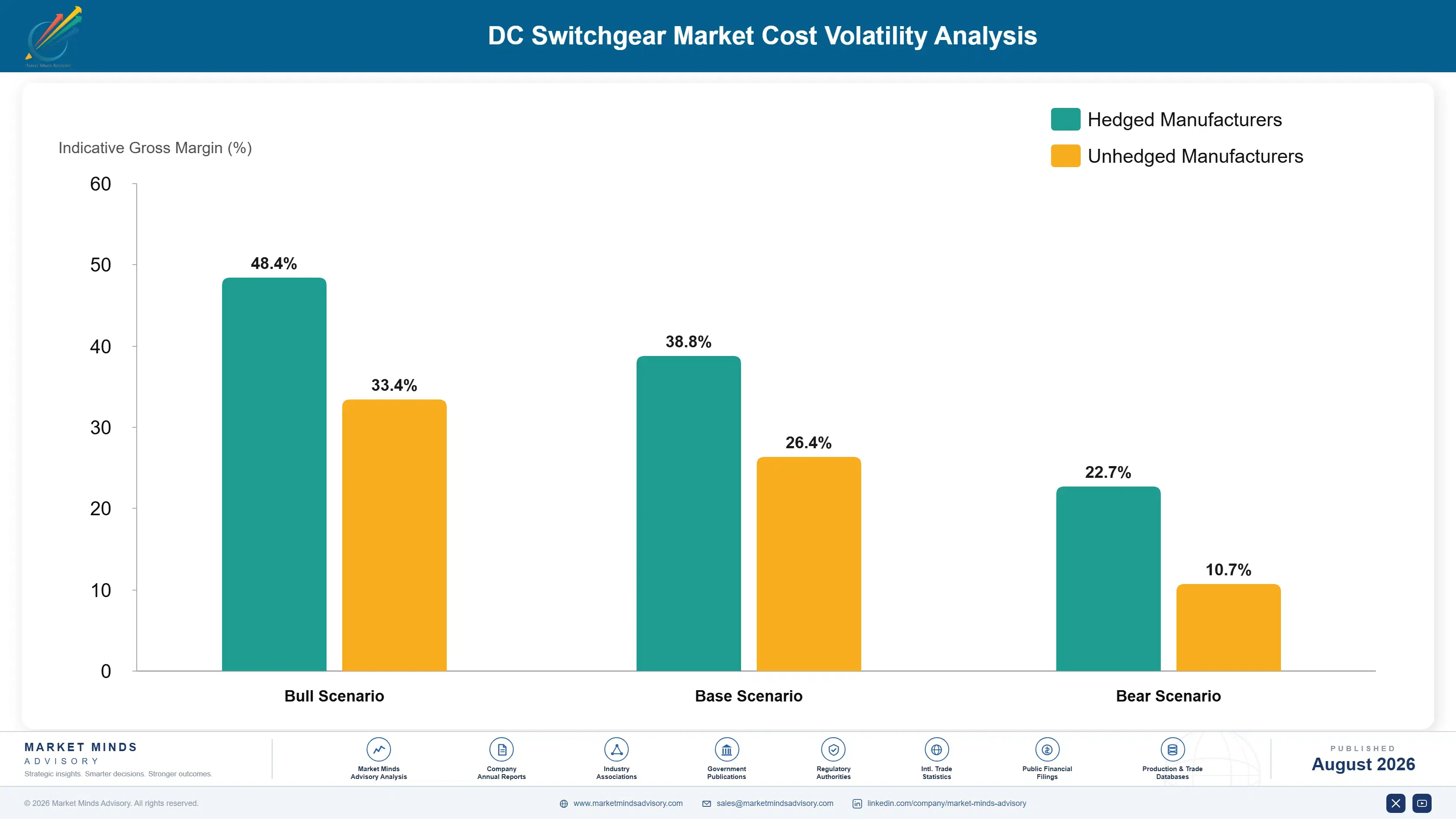
Specialty power semiconductor and enclosure materials typically account for roughly 35% to 43% of DC switchgear production cost, sourced primarily from specialized electronics suppliers in Germany, Japan, and the United States across regulated facilities. Copper busbar and thermal management components add a further meaningful share, reflecting the substantial current-carrying and heat dissipation requirements high-power switchgear demands.
Power semiconductor pricing rose meaningfully through 2024 as AI data center demand for high-current silicon carbide and gallium nitride components competed directly with broader electric vehicle manufacturing for the same limited specialized capacity, according to industry reporting. ABB's 2024 annual report disclosed higher component costs attributable to power semiconductor and copper intermediate inflation, noting that costs rose meaningfully faster than the company could pass through to utility customers without meaningful margin compression across its electrification segment specifically.

Manufacturers with long-term semiconductor supply agreements absorb cost volatility far more easily than those reliant on spot-market purchases, since contracted pricing locks in predictable input costs regardless of market tightness. Larger diversified electrical companies with broader semiconductor sourcing relationships also carry lower effective exposure than smaller specialized manufacturers, widening the competitive gap. Smaller solid-state-only manufacturers lacking either advantage face the sharpest margin compression during volatile periods.
dc-switchgear-market-cost-volatility-analysis-1787303547843

Lock Semiconductor Pricing Through Long-Term Contracts

Power semiconductor components are the largest single volatile input across most DC switchgear production and increasingly competed for by broader electric vehicle and renewable energy demand across multiple sectors. Long-term supply agreements with fixed or collared pricing, common practice among larger diversified manufacturers, smooth quarter-to-quarter volatility and let commercial teams quote utility contracts with genuine confidence.

Diversify Semiconductor Sourcing Across Suppliers

Reliance on a single semiconductor supplier concentrates both price and availability risk unnecessarily across an entire product line and broader utility customer base. Qualifying secondary sourcing partners across multiple countries, even at modestly higher unit cost, protects continuity when any single supplier faces production disruption or a sudden demand spike from competing electronics sectors.

Standardize Component Specifications Across Product Lines

Using standardized component specifications across multiple switchgear platforms rather than custom sourcing for each project reduces both procurement complexity and per-unit component cost through larger consolidated purchasing volume. This standardization, common practice among larger manufacturers, also shortens lead times since standardized component stock can be procured well ahead of specific project requirements actually materializing.

Portfolio Architecture for Margin Defence

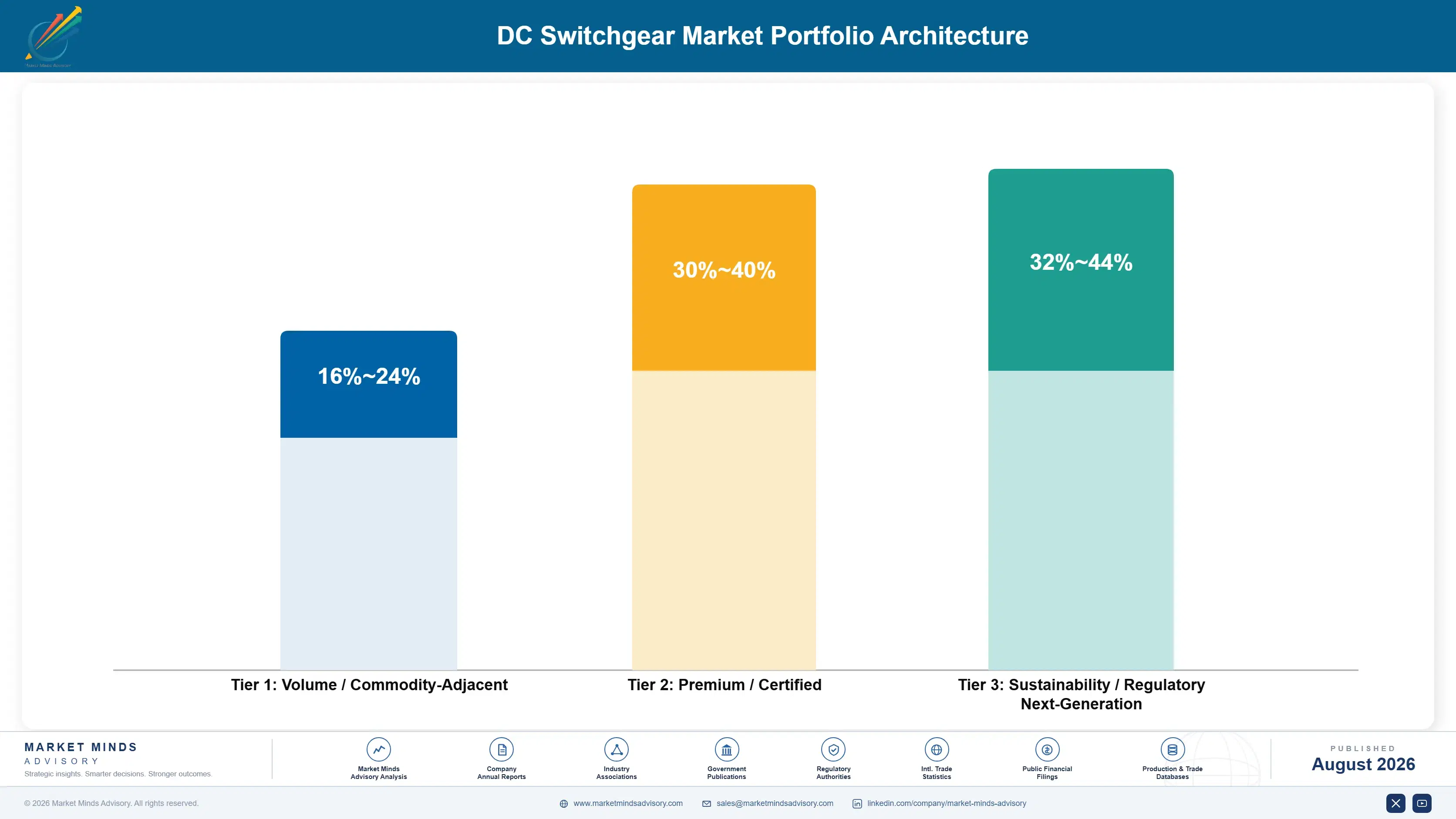
The DC switchgear portfolio splits into three tiers with meaningful margin separation tied to technology sophistication and application specialization. Volume tier products carry standard air-insulated and gas-insulated switchgear for conventional utility applications, competing largely on price against a crowded field of regional manufacturers. Premium certified products carry solid-state circuit breakers backed by proven hyperscale deployment data. Sustainability products, including next-gener
The tension between volume and premium runs through nearly every manufacturer's product roadmap. Volume products fund the manufacturing scale premium products eventually depend on, yet volume margins keep compressing as Chinese manufacturers scale aggressively on conventional switchgear equipment. Manufacturers that under-invest in solid-state technology breadth risk commoditization within their own category, while those chasing premium exclusively struggle to fund the production base needed to serve routine utility demand.

High-value margin pools concentrate specifically in solid-state and modular systems where technology depth and hyperscale validation carry the largest commercial stakes, and where deployment speed commands genuine pricing power. Conventional air-insulated equipment generates steadier volume but thinner margin, since that segment competes against a wider set of lower-cost regional manufacturers with adequate but unremarkable technology differentiation.

Volume / Commodity-Adjacent

Standard air-insulated and gas-insulated switchgear for conventional utility applications, competing largely on price against a crowded field of regional manufacturers offering broadly comparable electrical coverage, delivery terms, and service support.
Gross Margin: 16-24%

Premium / Certified

Solid-state circuit breakers backed by proven hyperscale deployment data and formal utility qualification, commanding meaningful pricing premiums over conventional equivalents across major data center accounts, specialty networks, and expanding charging infrastructure.
Gross Margin: 30-40%

Sustainability / Regulatory / Next-Generation

Next-generation modular and integrated protection platforms still scaling across data center and charging infrastructure applications, targeting deployment speed and reliability conventional switchgear manufacturing simply cannot achieve today at comparable cost.
Gross Margin: 32-44%
dc-switchgear-market-portfolio-architecture-1787303548339

Switchgear's Long Service Life Economics

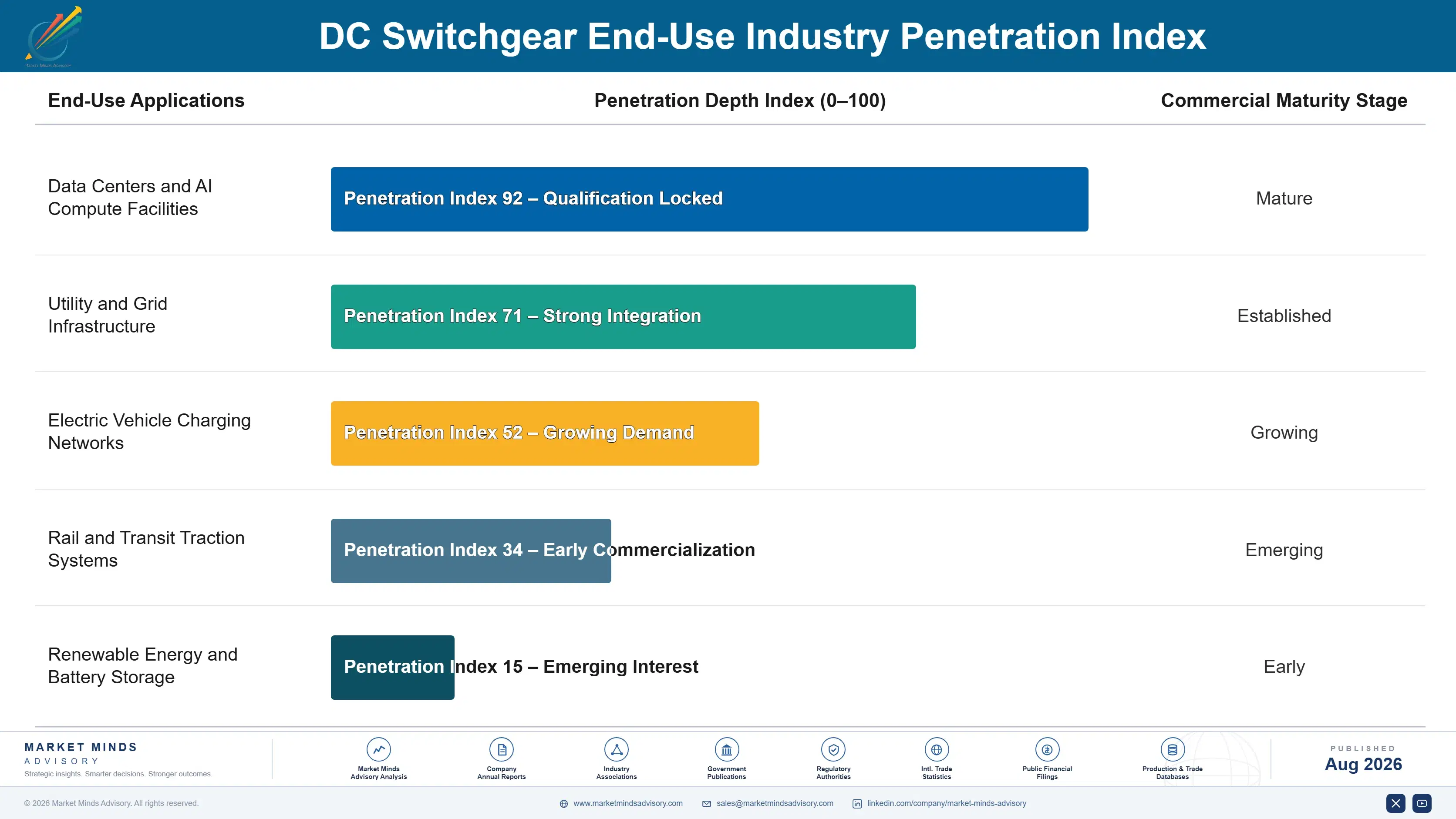
DC switchgear demand carries genuine annuity-like characteristics once a manufacturer wins an original equipment order, since the equipment's twenty to thirty year service life generates recurring maintenance, spare parts, and upgrade revenue that far exceeds the initial sale value. A single original equipment win typically locks in decades of predictable service relationship, giving qualified manufacturers revenue visibility that pure equipment sellers competing only on upfront price simply do
Adoption depth varies sharply by customer type. Utility relationships are deep and extremely sticky, since switching switchgear suppliers mid-infrastructure-lifecycle risks compatibility issues that grid operators strongly want to avoid. Data center relationships are shallower in tenure but rapidly deepening, since hyperscale developers are still establishing which suppliers and technology platforms will become their long-term standard across expanding compute campuses.

Buyer profiles are shifting generationally as data center facility engineers and sustainability officers gain real influence over procurement decisions once handled purely by traditional utility purchasing on price alone. This newer buyer cohort weighs deployment speed and solid-state technology depth alongside reliability, fundamentally reshaping which manufacturers even reach the final vendor shortlist for major hyperscale contracts.
dc-switchgear-market-end-use-penetration-index-1787303548831

Where Switchgear Strategy Should Focus Next

These are among the four positions where our research anticipates prominent divergence between winners and laggards over the coming forecast period. Each is grounded in the demand model, the regulatory perimeter, and the announced capacity pipeline.
01 / SOLID-STATE TECHNOLOGY INVESTMENT

Develop solid-state interruption before hyperscale standards consolidate

Hyperscale developers increasingly treat solid-state interruption speed as a non-negotiable facility safety requirement, and manufacturers lacking this capability are already being excluded from serious procurement consideration regardless of underlying voltage rating, price competitiveness, or brand reputation. Solid-state investment commands a 25 to 35 percent pricing premium while widening the gap against conventional mechanical competitors, and delay risks permanent exclusion from the fastest-growing procurement category. The window for building credible field deployment data is narrowing as competitors accelerate their own programs.
02 / MODULAR PLATFORM DEVELOPMENT STRATEGY

Build standardized modular products before construction timelines compress further

Data center construction timelines are compressing faster than traditional custom engineering cycles can accommodate, and manufacturers relying on bespoke switchgear design are ceding this fast-growing channel to modular-first competitors offering predictable delivery, shorter lead times, and fully standardized specifications. Modular platform investment can add 20 to 30 percent incremental volume while capturing customers before they establish loyalty to competing standardized product lines. Manufacturers who delay entry into modular development risk permanently losing ground to competitors already building this commercial advantage.
03 / HYPERSCALE ACCOUNT DEVELOPMENT STRATEGY

Direct developer relationships shape specifications before competitive bidding

Hyperscale data center developers increasingly finalize equipment specifications before formal competitive bidding begins, and manufacturers who invest in direct developer relationships capture design-in advantages that competitors selling through distributor channels cannot replicate at comparable speed or depth. Relationship investment can lift win rates by 15 to 25 percent among manufacturers with established hyperscale accounts compared with those competing purely on published specifications. Manufacturers who delay building these direct relationships risk losing an entire generation of hyperscale account share to earlier-moving competitors.
04 / CERTIFICATION ACCELERATION STRATEGY

Early certification investment captures first-mover advantage in new categories

Utility certification timelines represent the primary barrier separating novel switchgear technology from commercial deployment, and manufacturers who initiate certification earlier in development capture first-mover advantage that competitors still navigating regulatory review cannot yet access commercially, profitably, or at meaningful scale. Early certification investment can compress time-to-market by 25 to 40 percent compared with manufacturers waiting until technology validation fully completes and regulatory approval follows. Manufacturers who delay certification initiation forfeit meaningful first-mover revenue to competitors already positioned for commercial launch.

Engagement Snapshot From the Field

A live engagement with an industry participant carrying material or product regulatory and market exposure ahead of a defining policy shift, showing how our research translates into a defensible multi-year portfolio strategy.
MARKET MINDS ADVISORY · CLIENT ENGAGEMENT SUMMARY
DC Switchgear Producer Strategic Portfolio Review and Transition Roadmap 2026·Investment Scenario on DC Switchgear Exposure Evaluation 2025-26
CLIENT PROFILE
The client is a regional hyperscale data center developer constructing four AI compute campuses across a major metropolitan area, requiring substantial power distribution infrastructure to support high-density GPU cluster deployment. The company held approximately 320 million dollars in allocated infrastructure capital (client-reported, unverified by MMA) and faced pressure to finalize switchgear specifications ahead of accelerated construction timelines.
STRATEGIC CHALLENGE
The client's engineering team needed to decide between conventional mechanical switchgear with proven reliability and emerging solid-state technology offering faster fault interruption but limited long-term field performance data. Leadership needed to determine which approach best balanced construction timeline pressure, technical risk, and total cost of ownership across the four planned campuses.
MMA APPROACH
MMA conducted a technology assessment across five switchgear vendors, evaluating solid-state and conventional mechanical options against the client's power density requirements, construction timeline, and long-term reliability data carefully. The engagement modeled total cost of ownership across a twenty-year facility lifecycle rather than upfront equipment price alone, incorporating deployment speed explicitly.
KEY FINDINGS
  1. Solid-state switchgear reduced projected installation time by roughly 32 percent compared with conventional mechanical equipment across the client's planned campus configurations and timelines.
  2. Two of five candidate vendors lacked sufficient field deployment data for the client's specific power density requirements, narrowing realistic options considerably ahead of the deadline.
  3. The leading vendor's modular factory-built configuration eliminated a costly on-site engineering delay the client's original conventional approach would have otherwise required entirely.
  4. A phased deployment prioritizing the first campus ahead of schedule reduced the client's technology risk considerably compared with simultaneous four-campus rollout across all sites.
CLIENT PROFILE
The client is a regional hyperscale data center developer constructing four AI compute campuses across a major metropolitan area, requiring substantial power distribution infrastructure to support high-density GPU cluster deployment. The company held approximately 320 million dollars in allocated infrastructure capital (client-reported, unverified by MMA) and faced pressure to finalize switchgear specifications ahead of accelerated construction timelines.
STRATEGIC CHALLENGE
The client's engineering team needed to decide between conventional mechanical switchgear with proven reliability and emerging solid-state technology offering faster fault interruption but limited long-term field performance data. Leadership needed to determine which approach best balanced construction timeline pressure, technical risk, and total cost of ownership across the four planned campuses.
MMA APPROACH
MMA conducted a technology assessment across five switchgear vendors, evaluating solid-state and conventional mechanical options against the client's power density requirements, construction timeline, and long-term reliability data carefully. The engagement modeled total cost of ownership across a twenty-year facility lifecycle rather than upfront equipment price alone, incorporating deployment speed explicitly.
KEY FINDINGS
  1. Solid-state switchgear reduced projected installation time by roughly 32 percent compared with conventional mechanical equipment across the client's planned campus configurations and timelines.
  2. Two of five candidate vendors lacked sufficient field deployment data for the client's specific power density requirements, narrowing realistic options considerably ahead of the deadline.
  3. The leading vendor's modular factory-built configuration eliminated a costly on-site engineering delay the client's original conventional approach would have otherwise required entirely.
  4. A phased deployment prioritizing the first campus ahead of schedule reduced the client's technology risk considerably compared with simultaneous four-campus rollout across all sites.
RECOMMENDED STRATEGY
Phase 1: Phase 1 (Months 1-2): Complete the vendor evaluation and finalize the solid-state switchgear selection against all key power density requirements. Phase 2: Phase 2 (Months 3-10): Deploy switchgear across the first campus, carefully validating performance thoroughly before proceeding to any remaining sites. Phase 3: Phase 3 (Months 11-20): Complete deployment across the remaining three campuses and formalize ongoing vendor service and support agreements fully.
OUTCOME
The developer completed switchgear deployment across all four campuses ahead of its original construction timeline, achieving meaningful installation time savings without reliability compromise. The client reported (client-reported, unverified by MMA) that the phased deployment approach and modular configuration proved particularly valuable during construction, avoiding significant schedule delays.

Frequently Asked Questions

Foundational context covering the market sizes, CAGR, scope, country, region and competition that inform every finding below. This section is provided to cover basics and most often pre-purchase conversations, answered from the MMA Primary Research Dataset.

What is the current size of the DC Switchgear Market?

The global DC switchgear market is valued at $3.6 billion in 2025. Growth is driven primarily by AI data center buildout and solid-state technology adoption.

How large will the DC Switchgear Market be by 2036?

MMA projects the market will reach approximately $10.06 billion by 2036. This represents a 2.55 times expansion over the ten-year forecast period beginning in 2026.

What is the CAGR for the DC Switchgear Market 2026 to 2036?

The base case CAGR is 9.8%, with a bull case of 11.2% and a bear case of 8.2%. Solid-state and modular segments grow meaningfully faster than this average.

Which segment is growing fastest?

Solid-state DC circuit breakers lead at 17.5% CAGR, roughly 1.79 times the overall market rate. AI data center power distribution demand drives this fast pace.

Who are the major companies in the DC Switchgear Market?

Leading participants include ABB, Siemens, Schneider Electric, Eaton, and Mitsubishi Electric. Together these five leading global industry participants hold roughly fifty-two percent of the market.

Which country is growing fastest?

China leads regional growth at 11.8% CAGR, driven by rapidly expanding data center and rail infrastructure investment across its entire national economy and industrial base.

Report Segmentation Architecture

The full report scope spans multiple orthogonal segmentation dimensions, with cross-tabulated demand data provided for each dimension pair. Coverage extends further to regional breakdowns, trend trajectories, and the competitive detail needed to support segment-level decision-making.

By Primary Market Dimension

  • Air-Insulated DC Switchgear
  • Gas-Insulated DC Switchgear
  • Solid-State DC Circuit Breakers
  • Vacuum DC Switchgear
  • Metal-Enclosed DC Switchgear
  • Modular and Compact DC Switchgear Systems

By End-Use Industry

  • Data Centers and AI Compute Facilities
  • Utility and Grid Infrastructure
  • Electric Vehicle Charging Networks
  • Rail and Transit Traction Systems
  • Renewable Energy and Battery Storage

By Commercial Dimension

  • Direct Manufacturer Contract Sales
  • Distributor and Dealer Sales
  • Equipment Leasing Agreements
  • Service and Maintenance Contracts

By Region

  • North America
  • Western Europe
  • East Asia
  • South Asia and Pacific
  • Latin America
  • Middle East and Africa
  • Eastern Europe

Scope, Methodology, and Coverage

Every figure in this report is reproducible from documented input assumptions. The scope below maps the historical period, the forecast horizon, the segmentation dimensions, and the countries covered, alongside the underlying primary and qualitative methodology.
Historical Period
2020 to 2025
Forecast Period
2026 to 2036
Base Year
2025 (USD billions; MMA Primary Research Dataset, August 2026)
Market Definition
This report covers switchgear equipment for direct current power distribution and protection, spanning air-insulated, gas-insulated, solid-state, vacuum, metal-enclosed, and modular systems. It excludes AC switchgear and unrelated power transformer equipment.
Quantitative Units
USD billions (current prices); unit shipment volume where applicable
Segmentation Dimensions
By Primary Market Dimension; By End-Use Industry; By Commercial Dimension; By Region
Regions Covered
North America, Western Europe, East Asia, South Asia and Pacific, Latin America, Middle East and Africa, Eastern Europe
Countries Covered
USA, China, Germany, France, UK, Japan, South Korea, India, Australia, Canada, Brazil, Mexico, Indonesia, Vietnam, Thailand, Malaysia, UAE, Saudi Arabia, South Africa, Nigeria, Turkey, Poland, Netherlands, Italy, Spain, Sweden, Switzerland, Argentina, Colombia, Singapore, and additional markets relevant to this sector
Key Companies Profiled
ABB Ltd, Siemens AG, Schneider Electric SE, Eaton Corporation plc, Mitsubishi Electric Corporation, General Electric Company (GE Vernova), Hitachi Energy Ltd., Hyundai Electric & Energy Systems Co., Ltd., Toshiba Corporation, Fuji Electric Co., Ltd., CHINT Group Co., Ltd., TGOOD Global Limited, Larsen & Toubro Limited, Powell Industries, Inc., S&C Electric Company, Alstom SA, CG Power and Industrial Solutions Limited, Rockwell Automation, Inc., Legrand SA, Delta Electronics, Inc.
Quantitative Methodology
Primary survey, n=3,800 respondents, Q4 2025, six countries; demand-side model with trade association cross-validation
Qualitative Methodology
47 expert interviews, Q4 2025; applied to validate demand model assumptions, identify emerging dynamics, and assess competitive positioning
Report Format
PDF and XLSX data workbook (Word format preview document)
Publisher
Market Minds Advisory
Report Code
MMA-2026-ENE-506
Published
August 2026
Contact
sales@marketmindsadvisory.com | www.marketmindsadvisory.com

Purchase the full DC Switchgear Market Report (2026 to 2036).

The full DC Switchgear Market report delivers comprehensive analysis across all seven MMA-covered regions. It provides complete segment-level sizing and forecasts through 2036, plus detailed competitive profiling of twenty leading global manufacturers across the solid-state, modular, and conventional value chain. The report includes proprietary MMA primary survey data drawn from 3,800 respondents and forty-seven expert interviews conducted in the fourth quarter of 2025. It also delivers detailed input cost analysis, revenue lever assessment, and portfolio tier economics. Buyers receive full data tables, editable charts, and a structured executive briefing deck.
Full seven-region market sizing and forecast tables
Twenty-company competitive profiling and benchmarking analysis
Editable data tables and full chart package
Segment-level CAGR and value breakdowns detailed
Semiconductor cost structure and volatility analysis
Executive-ready briefing deck for board presentations

Built For The People Who Decide

From boardroom strategy to bench-side execution, this report is read cover-to-cover by leaders shaping the next decade of their industry, turning demand scenarios, market dynamics and valuation benchmarks into decisions.
CXOs/ Presidents/ VPs/ Managers
M&A and Corporate Development
Strategy Teams and R&D Heads
Procurement and Product Directors
Regulatory and Compliance Leaders
Investor Relations and Equity Analysts