Market Minds Advisory
DC and PKI Market

DC and PKI Market: Domain Controller and Public Key Infrastructure Market. Zero Trust Adoption and Certificate Lifecycle Automation Reshape Identity Security

Expanding zero trust architecture adoption, rising demand for automated certificate lifecycle management across large enterprise networks, and tightening post-quantum cryptography readiness requirements are reshaping which vendors win identity infrastructure contracts.

Lead Analyst

Published

September 2026

Make Smarter Decisions with Customized Research Insights

Request a free sample report and evaluate market opportunities, growth trends, and competitive dynamics relevant to your business needs.

2025 MARKET VALUE$5.8BMarket Size 2025
2036 FORECAST VALUE$12.0BBase Case , 2026 to 2036
CAGR 2026 TO 20366.8 %Bull 8.0% / Bear 5.6%
INCREMENTAL OPPORTUNITY$5.8BNet 10- year value creation
EXPANSION MULTIPLE1.93x2036 value over 2026 base
Strategic Levers
M&A Pipeline
Regional Outlook
Country Rankings
Competitive Intelligence
Segmental Deep-dive
Call-Us : 91 93563 13602

Executive Snapshot and Market Trajectory.

DC and PKI demand is shifting hard toward automated certificate lifecycle management, as enterprises need to eliminate manual renewal processes across widening device and workload identity populations under tighter zero trust deadlines than security teams accepted five years ago. Manual renewal processes struggle to satisfy modern zero trust compliance timelines.
Standard domain controller deployment remains the largest single demand driver, but automated certificate lifecycle management software is growing faster, particularly across the United States and parts of Asia-Pacific expanding cloud infrastructure adoption, pulling procurement toward automated renewal architectures. Identity security vendors and certificate authorities are each expanding automated renewal capacity to keep pace with rising machine identity population growth across multiple industry verticals worldwide, particularly as workload identities multiply.
The competitive field stays concentrated among a handful of established identity security vendors that dominate enterprise contract renewals and certificate authority trust relationships, while new post-quantum cryptography requirements emerging from encryption modernization mandates are opening narrow windows for specialized new entrants. Rising subscription and managed service revenue from installed enterprise identity relationships increasingly cushions vendor margins against slower new customer acquisition growth. Smaller vendors without comparable automation scale are losing enterprise accounts to larger incumbents.
Market Definition
This market covers domain controller identity services and public key infrastructure platforms used to authenticate users, devices, and workloads and manage digital certificate lifecycles across enterprise networks. It excludes general network firewall appliances, standalone multi-factor authentication hardware tokens, and endpoint antivirus software sold without integrated certificate management capability.
Base Year Value
$5.8B in 2025 (MMA Primary Research Dataset, September 2026)
Forecast Period
2026 to 2036, eleven discrete annual values
CAGR
6.8% base case. Bull 8.0%. Bear 5.6%.
Fastest Growth Segment
Automated Certificate Lifecycle Management Software: 10.6% CAGR
Fastest Growth Country
India: 9.2% CAGR
Fastest Growth Region
South Asia and Pacific: 9.0% CAGR
Largest Region
North America: 32% of 2025 global value
Market Leaders
Microsoft, DigiCert, Entrust, Keyfactor, Venafi. Source: MMA Analysis based on company disclosures and subscription revenue estimates.
Primary Survey
n=3,800 procurement and R&D decision-makers, Q4 2025, six countries
Methodology
Demand-side build-up, cross-validated against public data, 47 expert interviews

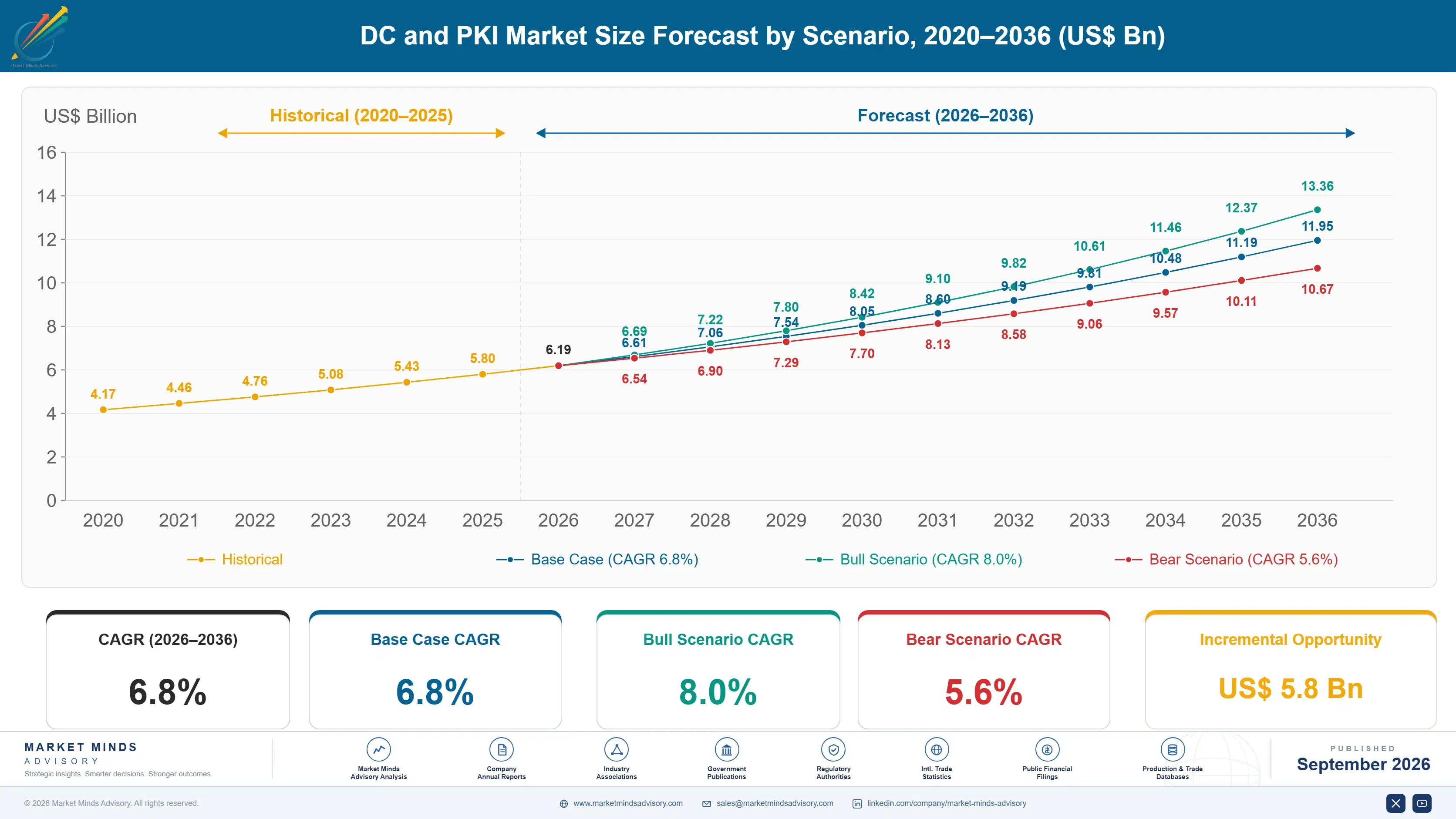
DC and PKI Market Forecast Scenarios

dc-and-pki-market-size-forecast-scenario-1789984862732
Between 2020 and 2025, DC and PKI demand grew steadily as enterprises pulled forward zero trust architecture initiatives across remote workforce and cloud migration programs, with pandemic-era remote access surges briefly straining certificate issuance capacity in 2021 and 2022. Vendors that had diversified their cloud infrastructure partnerships ahead of the disruption recovered certificate issuance capacity faster, a gap that persisted into 2023 before normalizing across most enterprise deployment segments.
The base case assumes continued zero trust adoption, sustained certificate lifecycle automation growth, and rising post-quantum cryptography readiness as enterprises consolidate fragmented identity infrastructure into unified platforms across new regulatory regimes coming online worldwide. Identity security vendors and certificate authorities are each expanding automated lifecycle capacity to support parallel zero trust programs across multiple enterprise networks simultaneously, a pattern MMA expects to persist through most of the forecast window given current adoption trajectories.
A strong bull case rests on accelerated post-quantum migration pulling forward platform replacement cycles, while the primary bear risk is prolonged enterprise information technology budget delays in key markets that push out planned identity infrastructure procurement by a year or more. Vendors positioned across on-premises and cloud-native infrastructure channels carry the least exposure to either scenario alone.

From Manual Renewal to Automated Certificate Lifecycles

DC and PKI platforms sit at the center of enterprise identity security work across cloud, on-premises, and hybrid infrastructure, and their design has moved decisively from manual certificate issuance toward automated, policy-driven lifecycle management over the past decade. Policy-driven lifecycle automation eliminates manual renewal tasks that previously required dedicated security staff time, mattering more as machine identity populations grow faster than human identity counts across modern enterprise infrastructure.
MARKET CONCENTRATIONCR5 47%Top five vendors hold under half enterprise subscription revenue share
AVERAGE CONTRACT VALUE$185,000Blended annual value across enterprise and mid-market subscription tiers
TOP ADOPTING COUNTRYUnited States 34%Reflects concentrated zero trust adoption and enterprise security budgets
AUTOMATION COVERAGE RATE48% of certificatesAutomated lifecycle management increasingly displaces manual renewal processes nationwide
CLIENT RETENTION RATE89% annualEnterprise subscription renewal rates remain notably strong across deployment tiers
IMPLEMENTATION TIMELINE2 to 6 monthsPlatform onboarding typically outlasts simpler point solution deployment considerably
Enterprise demand tracks zero trust architecture adoption closely, since organizations both need to authenticate every device and workload continuously and eliminate certificate expiration outages before certifying new security programs for production deployment. Contract managed security providers supporting zero trust rollouts are scaling certificate management capacity accordingly, and several have begun offering automated renewal as a standalone service line to enterprises lacking in-house expertise.
Post-quantum cryptography readiness follows a separate, faster-moving logic tied to encryption modernization mandates, where platforms increasingly must support quantum-resistant algorithms alongside legacy standards, and vendor selection favors platforms with proven migration tooling already built in. Internet of things device authentication represents a third, faster-growing demand pool, as manufacturers building connected products require platforms capable of resolving device identity across production certificate issuance volumes.
"Identity vendors used to compete on certificate issuance speed alone. Now the ability to migrate an entire enterprise to quantum-resistant algorithms without downtime matters just as much as speed."
Director, Enterprise Identity Security and Cryptography Practice · MMA Technology Practice · September 2026

Market Trends

Automated Lifecycle Management Displaces Manual Certificate Renewal

Vendors are shifting product roadmaps decisively toward automated certificate lifecycle management platforms capable of issuing, renewing, and revoking certificates without manual intervention across large enterprise certificate inventories. This matters increasingly as machine identity populations grow faster than human identity counts across modern cloud and container infrastructure deployments. Microsoft, DigiCert, and Entrust have each released new automation platform upgrades in the past eighteen months, and enterprise buyers in particular are specifying automated renewal as a mandatory qualification requirement rather than an optional feature for new procurement contracts. Smaller vendors particularly favor this model since it differentiates products at lower incremental cost.
Market Impact: Zero trust demand rises 9% yearly

Post-Quantum Migration Extends Vendor Revenue Streams

Modern identity platforms increasingly separate legacy cryptographic algorithm support from post-quantum migration tooling, letting enterprises plan phased transitions to quantum-resistant standards rather than facing a disruptive one-time cutover. This shift is stretching platform value chains wider while opening a growing migration consulting revenue stream for established vendors. Keyfactor and Venafi both now generate a meaningful share of platform-related revenue from post-quantum readiness assessments sold well after the original platform purchase, a trend MMA expects to accelerate through the forecast period. Smaller vendors lacking comparable quantum readiness expertise increasingly struggle to match this expanded revenue stream.
Market Impact: Machine identity demand grows 11% annually

Market Opportunities and Growth Drivers

Zero Trust Architecture Growth Sustains Platform Demand

Enterprises continuing to adopt zero trust security models across multiple network segments need continuous identity infrastructure investment across each new deployment phase, sustaining steady platform demand well beyond the initial rollout. Security teams must revalidate certificate policies against each new zero trust segment the organization deploys, and identity vendors supporting this work are expanding automation engineering teams to keep pace. The United States, India, and several European markets are each expanding zero trust adoption simultaneously, giving vendors multiple overlapping regional demand waves rather than one single global adoption cycle to plan around.
Market Impact: Integration takes 3 to 7 months

Machine Identity Growth Expands Certificate Requirements

Enterprises across the United States, the European Union, and parts of Asia-Pacific are deploying growing numbers of containers, microservices, and Internet of things devices in response to cloud infrastructure expansion, and this growth favors platforms with automated machine identity issuance over manual certificate management. Vendors with existing automation certification and long-standing enterprise relationships capture a disproportionate share of this spending, since qualification cycles for new suppliers routinely stretch beyond nine months. MMA expects machine identity-linked platform revenue to keep outpacing general human identity segment growth through most of the forecast period given current infrastructure trajectories.
Market Impact: Planning takes 6 to 12 months

Market Restraints and Challenges

Legacy System Integration Complexity Delays Adoption

Enterprises adopting modern identity platforms routinely struggle to integrate with decades-old domain controller and directory service systems still running critical authentication operations. The root cause is the absence of standardized protocols across older identity infrastructure generations, which forces custom integration work for nearly every enterprise deployment. This complexity slows adoption regardless of platform capability, concentrating successful deployments among enterprises with dedicated integration engineering budgets. Vendors are responding with pre-built connector libraries and protocol translation modules to ease this integration burden over time. Larger enterprises absorb this cost more easily given greater integration engineering budgets and dedicated technical staff.
Market Impact: Automated lifecycle reaches 48% share

Post-Quantum Migration Complexity Slows Adoption Progress

Enterprises planning post-quantum cryptography migration routinely encounter algorithm compatibility issues across legacy applications that were never designed to support quantum-resistant standards. This root cause slows implementation regardless of platform capability, concentrating successful migrations among enterprises with dedicated cryptography engineering teams. The commercial impact is a widening gap between well-resourced enterprises and smaller organizations lacking comparable cryptography expertise. Vendors are pursuing hybrid classical-quantum algorithm support and phased migration tooling as a mitigation pathway around this complexity barrier. Larger enterprises address this more proactively through dedicated cryptography research teams and vendor partnership programs.
Market Impact: Migration services now add 12% revenue
3 additional market trends, 4 additional growth drivers, and 3 additional restraints and challenges are covered in the full report. Contact sales@marketmindsadvisory.com to access the complete intelligence.

Segment CAGR and Growth Architecture

The market splits across six segments defined by identity function, spanning traditional domain controller directory services through modern automated certificate lifecycle and post-quantum migration platforms. Automated certificate lifecycle management software is pulling share fastest as enterprises eliminate manual renewal processes across expanding machine identity populations. Post-quantum migration tools follow close behind as regulatory deadlines push enterprises toward cryptographic modernization programs.
dc-and-pki-market-market-share-analysis-1789984863363

Automated Certificate Lifecycle Management Software

Automated certificate lifecycle management software is growing fastest, at roughly 10.6% annually, about 1.56 times the overall market rate. Demand concentrates in machine identity issuance, cloud-native workload authentication, and zero trust policy enforcement, where automated renewal meaningfully reduces certificate expiration outage risk across enterprise infrastructure. Microsoft, DigiCert, and Entrust have each committed significant research spending to widen automation coverage and improve policy enforcement simultaneously, since the two capabilities traditionally traded off against each other in earlier platform generations sold throughout the previous decade. This segment also commands the highest average contract value across the entire platform category, supporting healthier vendor margins even as overall deployment count growth trails the broader identity security market.
CAGR 10.6%

Post-Quantum Cryptography Migration Tools

Post-quantum cryptography migration tools form the second-fastest segment, driven by enterprises seeking to prepare cryptographic infrastructure for quantum-resistant algorithm standards ahead of regulatory deadlines. Rising encryption modernization complexity means more migration planning per enterprise, since each new application requires compatibility confirmation before production cutover. Vendors including Keyfactor and Venafi have narrowed the capability gap between classical and post-quantum platforms considerably, letting mid-market enterprises access migration tooling once reserved for organizations with dedicated cryptography teams. Consumption-based pricing and modular architecture increasingly differentiate competing offerings, since enterprises often need to migrate applications quickly across multiple parallel compliance deadline programs simultaneously. MMA expects this gap to narrow further as migration tooling matures. Enterprises increasingly value this modernization speed.
CAGR 8.9%
Full segment breakdown across 6 segments available in the complete report.

Regional Architecture and Country Demand Map

North America leads on concentrated zero trust adoption and vendor headquarters presence, while East Asia follows closely on rapid enterprise digitization across Chinese and Japanese corporate networks. South Asia and Pacific posts the fastest regional growth as India expands enterprise identity security adoption from a smaller installed base.

North America

Zero trust architecture adoption and vendor headquarters presence anchor North American demand, with the United States maintaining the largest single concentration of enterprise security budgets and identity infrastructure spending across multiple industry verticals. Microsoft, DigiCert, and Entrust each maintain headquarters and primary engineering operations here, giving domestic customers faster feature access and direct support relationships unavailable to overseas competitors. Federal zero trust mandate compliance adds a second steady demand pool, particularly around agency identity modernization and certificate automation certification work. MMA counted 39 active enterprise platform deployment contracts referencing automated lifecycle management during 2025 alone. Canada adds a smaller but stable demand pool through its own enterprise identity security adoption and compliance programs administered separately from United States procurement cycles.
Share: 32% | CAGR: 8.1% (2026 to 2036)

Western Europe

European Union data protection standards and cybersecurity resilience mandates both sustain platform demand across Germany, France, and the United Kingdom. Entrust's European operations and DigiCert hold a dominant regional service presence that smaller competitors struggle to match on multi-jurisdiction compliance depth. Financial services regulatory complexity adds a distinct regional demand pool, since German and French banks increasingly validate complex identity infrastructure against tightening European cybersecurity certification standards. Growth trails North America and East Asia here mainly because zero trust adoption across the region proceeded more slowly than in leading Asian and American markets. Nordic countries add a smaller but technically sophisticated demand pool tied to public sector digital identity programs supporting the region's growing e-government investment.
Share: 21% | CAGR: 5.5% (2026 to 2036)
Regional intelligence for 5 additional markets available in the complete report: East Asia, South Asia and Pacific, Latin America, Middle East and Africa, Eastern Europe. Contact sales@marketmindsadvisory.com.
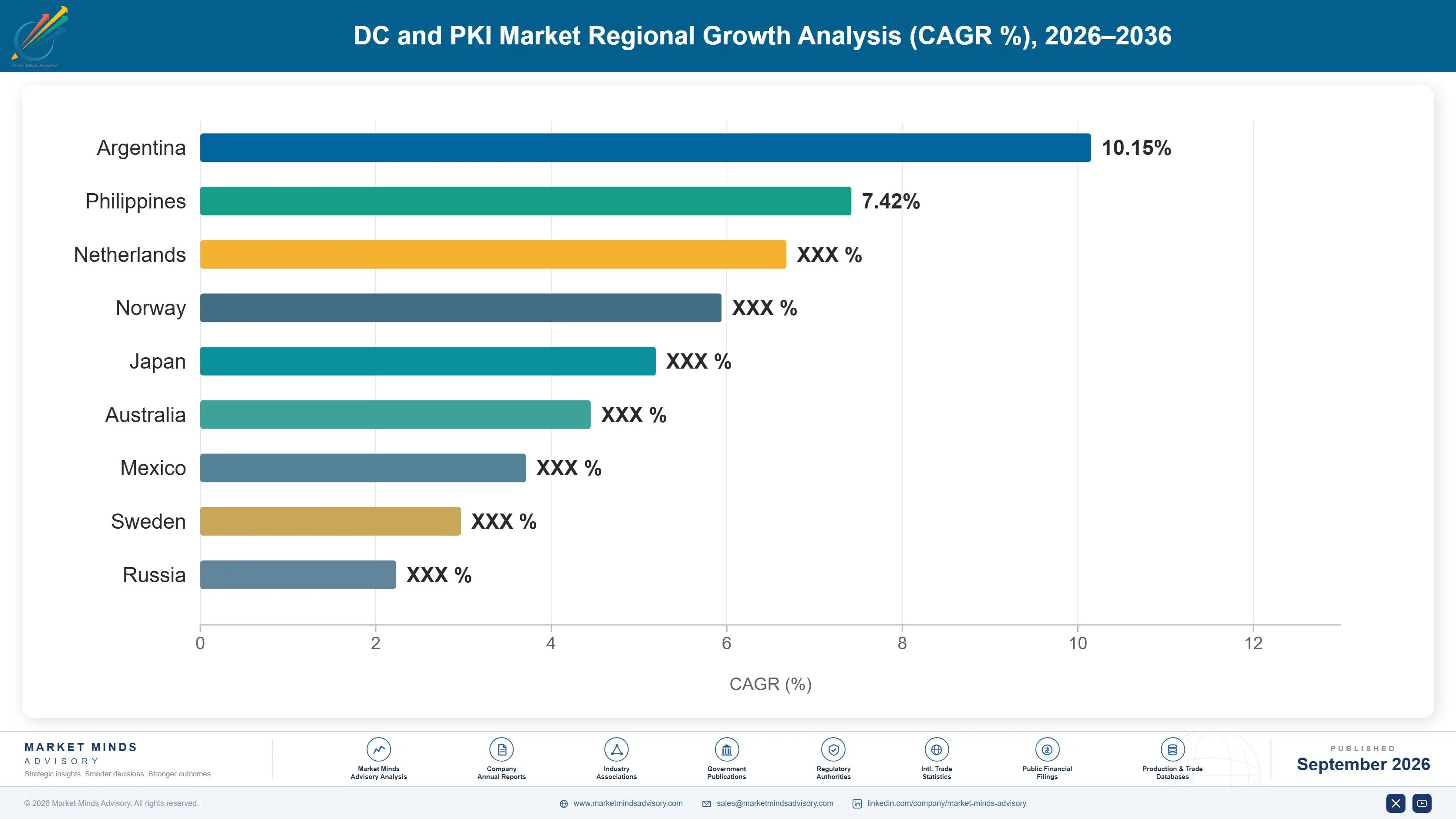
dc-and-pki-market-country-cagr-analysis-1789984863884

Migration Services Extend Platform Revenue Life

Identity security vendors are extracting more lifetime revenue per customer through post-quantum migration consulting, managed certificate services, and premium automation tiers rather than relying solely on the original subscription sale to generate margin. Margins vary widely across each pathway depending on customer segment and deployment scale. Margin economics vary widely across each pathway and customer segment.

Post-Quantum Migration Consulting Service Growth Program

Vendors including Keyfactor and Venafi now sell post-quantum readiness assessments and phased migration consulting as separate service engagements alongside base identity platforms, letting enterprises plan cryptographic transitions incrementally rather than facing disruptive one-time cutovers. This model has expanded consulting-attributable revenue to roughly 12% of total platform-related sales for leading vendors, with particularly strong uptake among enterprises facing near-term regulatory compliance deadlines. Engagement renewal rates for these consulting services now exceed 76% annually among established enterprise accounts, giving vendors a highly predictable recurring revenue stream that partially offsets slower new platform growth.
Market Impact: Consulting revenue now reaches roughly 12% of sales

Managed Certificate Lifecycle Support and Bundling

Vendors are bundling multi-year managed certificate lifecycle support contracts directly into new platform sales, converting a traditionally separate operations engagement into locked-in recurring revenue from the point of purchase. These bundled contracts now cover roughly 45% of newly sold enterprise deployments, up meaningfully from levels seen five years earlier. Vendors report lower churn among accounts holding bundled agreements compared to those procuring lifecycle support separately. Customers gain predictable operations costs and priority technical response, while vendors gain multi-year visibility into service revenue and stronger customer retention. Vendors report lower churn among accounts holding these bundled agreements over time.
Market Impact: Bundled contracts now cover roughly 45% of sales

Machine Identity Automation Premium Pricing Programs

Vendors offering advanced machine identity automation capability command a substantial price premium over manual certificate management equivalents, often exceeding 29% above comparable base specifications. This premium reflects both the specialized automation engineering required and the smaller customer base involved relative to standard platform product lines. Enterprises generally accept this premium given the outage prevention benefits involved for large-scale certificate inventories, and vendors with established automation expertise face limited price competition since few competitors can match the same reliability track record. Vendors keep investing in this automation since margin expansion outweighs added engineering complexity involved.
Market Impact: Automation tier now commands a full 29% premium

Systems Integrator Partnership Deployment Growth Programs

Leading vendors are establishing partnership programs with enterprise systems integrators, providing preferential pricing and priority support in exchange for guaranteed deployment commitments and exclusive implementation arrangements. These partnerships expand vendor reach into smaller enterprises who cannot justify direct platform evaluation, while generating steady wholesale revenue and valuable market intelligence on emerging zero trust requirements. Roughly 18% of total platform contract value now flows through such partnership channels rather than direct enterprise sales, a share MMA expects to keep expanding as outsourced implementation gains broader acceptance. Vendors view these arrangements as a channel for reaching smaller cost-sensitive enterprise customers.
Market Impact: Partnership channels now carry roughly 18% of value

Who Controls the Margin Pool

Microsoft, DigiCert, Entrust, Keyfactor, and Venafi together hold roughly 47% combined subscription revenue share, with Microsoft and DigiCert forming a leading tier ahead of remaining challengers on platform integration breadth and certificate authority trust relationships. The gap between the top two vendors and the third-ranked challenger has widened as Microsoft and DigiCert invested more heavily in automation research than smaller competitors could match.
Competitive activity currently centers on automated lifecycle management expansion, post-quantum migration tooling rollout, and zero trust integration wins, as vendors race to lock in long-cycle enterprise contracts before rivals can complete their own certification processes across multiple regulatory regimes. Several vendors announced expanded post-quantum migration programs this year, converting one-time platform sales into recurring consulting revenue streams that improve retention against competitive displacement during future contract renewal cycles.

Rankings could shift meaningfully if a well-funded automation-native entrant achieves enterprise qualification faster than expected, or if machine identity demand growth outpaces the traditional human identity segment enough to reward vendors with deeper cloud infrastructure relationships over the coming several years. Systems integrators are gaining influence as intermediaries, since their implementation decisions shape which vendors reach smaller enterprise customers lacking direct procurement relationships with established platforms.
dc-and-pki-market-company-positioning-matrix-1789984864413

Competitive Moat and Risk Dimensions

MICROSOFT

Moat: Integrated Active Directory Platform

Microsoft can bundle domain controller and PKI capability directly into its broader Active Directory and Azure identity platform already embedded across most enterprise customers, giving it a distribution advantage that standalone identity vendors cannot match without securing separate procurement approval. This lets Microsoft cross-sell identity capability into existing Azure contracts without a separate sales cycle, shortening the procurement timeline.
MICROSOFT

Risk: Slower Third-Party Innovation Pace

Microsoft's large enterprise customer base and legacy platform architecture create slower innovation cycles compared to nimbler competitors like Keyfactor, who can iterate on automation features considerably faster without comparable backward compatibility constraints. Microsoft has responded by acquiring smaller automation-focused firms, though full platform integration typically takes considerably longer than the acquisitions themselves.
DIGICERT

Moat: Deep Certificate Authority Trust

DigiCert maintains decades of certificate authority trust relationships embedded across nearly every browser and operating system root store, giving the company a foundational trust advantage that newer entrants cannot replicate without lengthy industry validation processes. This trust advantage becomes more valuable as enterprises seek certificate authorities with established browser compatibility and minimal risk of unexpected trust revocation events.
DIGICERT

Risk: Limited Broader Platform Integration

DigiCert's certificate authority focus leaves its broader identity platform integration depth thinner than dedicated vendors like Microsoft, who bundle certificate management into wider enterprise directory and access management suites. DigiCert has responded by acquiring smaller platform integration firms, though full platform breadth typically takes considerably longer than the acquisitions themselves.

Players Tracked

Prominent Players

Microsoft
DigiCert
Entrust
Keyfactor
Venafi

Other Key Players

GlobalSign
Sectigo
AppViewX
SSH Communications Security
HashiCorp
CyberArk
Thales Group
IBM
Google Cloud
Amazon Web Services
IdenTrust
GoDaddy
Let's Encrypt
Nexus Group
Certes Networks

Recent Developments

JANUARY 2026

Microsoft launched a new automated certificate lifecycle management module supporting zero trust policy enforcement across hybrid cloud and on-premises identity infrastructure, targeting enterprises investing in next-generation automation capability ahead of upcoming compliance deadlines. The module reflects sustained vendor confidence in continued zero trust adoption despite lengthy enterprise evaluation cycles.
Signal: Signals continued vendor investment in automated lifecycle management capability industry-wide. across the broader enterprise identity security and PKI industry.
SEPTEMBER 2025

DigiCert completed an acquisition of a smaller software analytics firm specializing in automated post-quantum readiness assessment, strengthening its cryptography platform capability and accelerating its shift toward recurring consulting revenue. The deal reflects a broader strategy of embedding proprietary assessment tools as a differentiator over pure certificate authority specifications.
Signal: Signals an accelerating vendor shift toward post-quantum migration consulting across the industry. as recurring consulting revenue gains broader acceptance.
APRIL 2025

Entrust announced an expanded engineering team investment at its United States headquarters to support growing enterprise zero trust demand across the region, adding dedicated staff for its identity platform product family. The investment reflects confidence that enterprise zero trust demand will keep outpacing overall market growth through the decade.
Signal: Signals growing vendor confidence in sustained zero trust adoption demand growth. as engineering and delivery capacity investment keeps expanding regionally.

Cloud Compute and HSM Cost Exposure

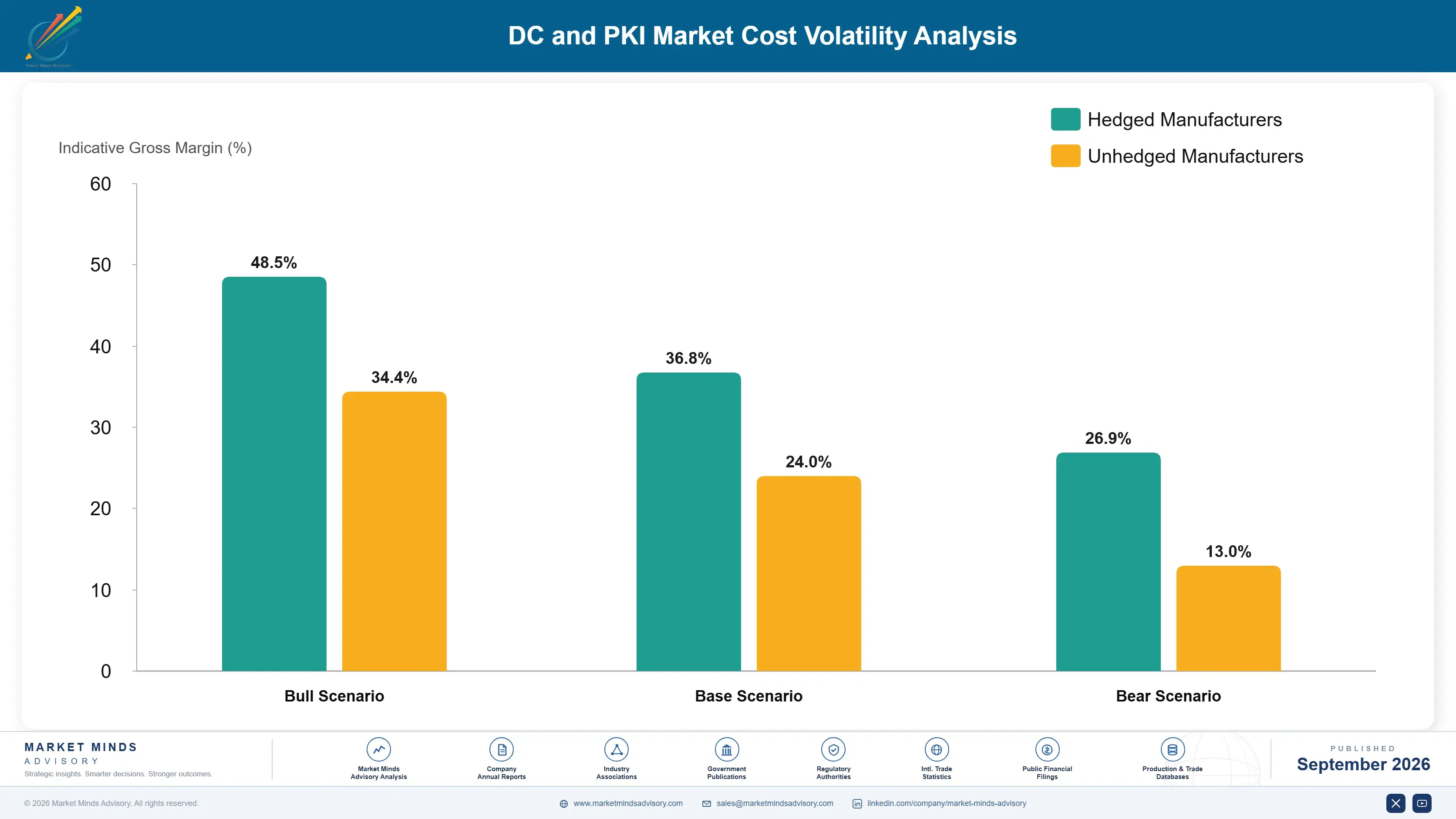
Cloud compute capacity and hardware security module infrastructure together account for roughly 27% of platform cost of goods sold, with much of that specialized infrastructure sourced from a small number of hyperscaler data center regions concentrated in the United States and Europe. Component lead times for premium compute access run longer during peak demand periods, forcing vendors to negotiate multi-year commitments well ahead of anticipated enterprise deployment surges.
A 2024 compute capacity tightening tied to hardware security module demand, reported in company annual report disclosures, briefly pushed vendor operating costs up during the transition period as competition for premium cryptographic processing capacity intensified across the enterprise security sector. Vendors reported cost increases of eight to fourteen percent for premium compute capacity, according to Microsoft Investor Day disclosures, before renegotiated agreements restored more normal cost trajectories by early 2025.

Smaller vendors lacking long-term cloud capacity agreements absorb this volatility more directly than Microsoft or DigiCert, both of which maintain diversified sourcing relationships and larger negotiated volume commitments that smooth short-term disruptions. This gap compounds over successive contract renewals, since smaller vendors pass cost volatility to customers through less predictable pricing, weakening their position against rivals offering steadier contract pricing.
dc-and-pki-market-cost-volatility-analysis-1789984864615

Diversified Multi-Region Cloud Capacity Agreements

Leading vendors reserve compute capacity across multiple cloud regions simultaneously rather than depending on a single data center, letting them redirect workloads quickly when one region faces capacity constraints without disrupting customer service. This approach adds reservation overhead but has proven its value during recent demand surges, particularly for vendors serving enterprise customers who cannot tolerate service delays.

In-House Hardware Security Module Design Capability

Some vendors, particularly Microsoft and DigiCert, design specialized hardware security modules internally and outsource only fabrication, retaining design control that shortens qualification cycles when switching between component partners during supply disruptions across categories. This model costs more upfront in research spending but pays off during supply shocks, since vendors requalify an alternative supplier in weeks rather than months rivals require.

Long-Term Reserved Instance Purchase Commitments

Vendors increasingly negotiate multi-year reserved instance commitments with cloud providers in exchange for priority allocation during shortages, trading pricing flexibility for greater delivery certainty across critical compute capacity used in production identity platforms. These agreements typically span one to three years, giving vendors production planning certainty even when broader cloud market conditions turn volatile across the industry.

Portfolio Architecture for Margin Defence

The market splits into three commercial tiers, running from commodity manual certificate issuance through premium automated lifecycle management platforms qualified for zero trust architecture work, each carrying distinctly different margin economics across the deployment lifecycle. Gross margin ranges span roughly twenty-two percentage points between the lowest and highest tiers, reflecting how much specialized automation engineering and post-quantum readiness capability separates a basic manual deployment from a premium automated platform sold to enterprise customers.
Volume tier deployments compete mainly on price against low-cost regional providers, while premium and automation-integrated tiers command significantly stronger gross margins that reflect specialized engineering and lengthy customer qualification barriers protecting incumbents. Vendors serving the volume tier increasingly struggle to sustain healthy margins as low-cost regional providers improve product specifications while undercutting established vendor pricing on comparable base-level certificate functionality across most commercial applications.

High-value margin pools concentrate heavily in automated lifecycle management and post-quantum migration platforms, where established vendor relationships and certificate authority trust keep new entrants locked out regardless of underlying technical capability offered. Vendors positioned across all three tiers capture strong overall economics, since volume tier sales fund research investment that sustains premium tier competitiveness over successive product generations well into the coming decade.

Basic manual certificate issuance for smaller enterprise deployments, competing primarily on price against low-cost regional providers offering comparable core functionality at meaningfully lower cost. GlobalSign and Sectigo lead this tier on price.
Gross Margin

Automated lifecycle management platforms qualified for zero trust certification, commanding stronger margins through automation depth, policy enforcement capability, and established customer qualification relationships. Keyfactor and Venafi both compete strongly here.
Gross Margin

Post-quantum cryptography platforms integrated with hybrid algorithm support systems, carrying the strongest margins due to specialized engineering barriers and a limited competitive vendor pool. Microsoft holds particular strength in this tier.
Gross Margin
dc-and-pki-market-portfolio-architecture-1789984865127

High-value Sub-segments and Strategic Watch-out

Automated Certificate Lifecycle Management Software

This segment combines the fastest unit growth with the strongest margins in the entire market, as enterprises seeking to eliminate manual renewal demand automation capability regardless of price, making it the clearest strategic priority for vendor investment planning. MMA rates this the single highest priority watch item overall.

Post-Quantum Cryptography Migration Tools

Regulatory compliance demand keeps expanding steadily as quantum readiness deadlines approach, and margins here remain healthy even though growth trails the automation segment, making this a reliable secondary growth pool for vendors. Consumption-based pricing increasingly matters for cost-conscious enterprises testing modular deployment options at scale.

Manual Certificate Issuance Platforms

This legacy category still anchors overall installed base and revenue today, but growth has flattened as customers migrate toward automated capability, making it the core installed base vendors must defend rather than expand aggressively. Vendors must manage this decline without losing valuable support revenue attached to it across the base.

Machine Identity Authentication Modules

Embedded authentication modules within larger identity platforms represent a smaller but strategically important niche, since losing this integration business could cascade into losing broader enterprise security relationships entirely over time. MMA flags this as a strategic watch-out given its influence on customer relationships and future contract renewals.

Subscription Renewals Anchor Recurring Demand

Vendors increasingly earn recurring revenue through mandatory subscription renewals rather than depending solely on original license sales, since ongoing platform updates are required continuously to maintain compatibility with evolving zero trust regulatory frameworks. This annuity-like revenue stream means vendors with the largest installed customer base enjoy a compounding advantage over smaller rivals, since each subscription sold generates renewal revenue for well over five years.
Adoption depth varies meaningfully by end-use vertical: financial services customers integrate platforms deeply into locked compliance programs that resist vendor switching for years, while technology companies rotate platforms more frequently as identity requirements evolve. Manufacturing customers sit between these extremes, replacing platforms roughly every three to five years as compliance requirements evolve, giving vendors a moderately predictable replacement cadence to plan around.

A generational shift in buyer profiles is underway as younger security architects increasingly favor cloud-native, API-first platforms over traditional legacy directory systems, valuing flexibility and rapid deployment over the raw feature depth that dominated purchasing decisions a decade earlier. Vendors that fail to modernize deployment models risk losing these buyers to entrants offering cloud-native, consumption-based platforms, even when automation depth remains competitive with established incumbent product lines.
dc-and-pki-market-end-use-penetration-index-1789984865612

Where Automation Beats Manual Renewal

These are among the four positions where our research anticipates prominent divergence between winners and laggards over the coming forecast period. Each is grounded in the demand model, the regulatory perimeter, and the announced capacity pipeline.
01 / AUTOMATION PLATFORM INVESTMENT

Prioritize certificate automation research now

Automated certificate lifecycle management software is growing at roughly 10.6% annually, about 1.56 times the overall market rate, and enterprises already treat automation as a mandatory qualification requirement. Vendors delaying this investment risk losing qualification bids to Microsoft and DigiCert, both of which have already committed significant research spending toward wider automation coverage and improved policy enforcement. The window for smaller challengers to close this technical gap is narrowing each year, and it will likely close entirely within the next several forecast cycles.
02 / CONSULTING REVENUE EXPANSION

Build recurring consulting revenue streams deliberately

Consulting revenue already contributes a full roughly 12 percent of total platform-related revenue for leading vendors, and this share keeps expanding steadily as enterprises increasingly value phased migration guidance over disruptive, one-time cutover events. Vendors that fail to build comparable consulting infrastructure will simply keep depending entirely on license sales cycles for revenue, ceding recurring revenue advantages to more sophisticated rivals. This gap will only widen as enterprises grow ever more comfortable with subscription-based migration support across every regulatory jurisdiction.
03 / ENTERPRISE QUALIFICATION PROGRAMS

Pursue enterprise qualification despite long timelines

Enterprise integration qualification cycles routinely exceed a full nine months, but the resulting contracts lock in stable, high-margin revenue that smaller organizations rarely match given their shorter evaluation cycles and considerably greater overall price sensitivity. Vendors already holding compliance certifications and established enterprise relationships capture a disproportionate share of this spending, making early qualification investment critical despite the multi-year payback period involved. Newer entrants should consider partnership arrangements with qualified systems integrators as a faster, lower-risk entry pathway into this segment.
04 / REGIONAL INTEGRATION POSITIONING

Expand India engineering and support capacity

India's enterprise identity security adoption demand is growing meaningfully faster than the broader overall global market, driven by aggressive government-backed digital economy investment across the country specifically and sustained capacity expansion across allied South Asian technology hubs simultaneously and steadily. Vendors lacking a strong regional service and support presence risk steadily losing share to established platforms, which maintain deep domestic engineering relationships throughout the region. Establishing local support infrastructure now positions vendors well ahead of the next enterprise adoption capacity expansion wave across the region.

Engagement Snapshot From the Field

A live engagement with an industry participant carrying material or product regulatory and market exposure ahead of a defining policy shift, showing how our research translates into a defensible multi-year portfolio strategy.
MARKET MINDS ADVISORY · CLIENT ENGAGEMENT SUMMARY
DC and PKI Producer Strategic Portfolio Review and Transition Roadmap 2026·Investment Scenario on DC and PKI Exposure Evaluation 2025-26
CLIENT PROFILE
The client operates a mid-size North American financial services firm expanding zero trust architecture capacity ahead of a planned regulatory compliance deadline, seeking a DC and PKI vendor able to meet strict automation and long-term certificate lifecycle requirements across a multi-year platform deployment program. The firm had relied on a single legacy vendor for over five years and wanted an independent comparison before committing to a new multi-year platform relationship.
STRATEGIC CHALLENGE
The client needed to select a platform vendor for a multi-year compliance program but lacked internal expertise to compare automation capability, licensing terms, and post-quantum readiness depth across the small pool of eligible established vendors serving the financial sector. A poor vendor choice risked locking the firm into unfavorable terms for the program's full duration with no practical opportunity to switch suppliers midway.
MMA APPROACH
MMA analysts benchmarked five qualified vendors on automation capability, post-quantum migration readiness, managed support flexibility, and existing financial services contract history, then modeled total lifetime ownership cost across a projected five-year platform deployment and support period. Analysts also interviewed program managers directly to weigh qualitative factors such as technical support responsiveness that pure specification comparisons routinely overlook in vendor selection processes.
KEY FINDINGS
  1. The selected vendor's automation model reduced projected five-year certificate management cost by roughly 20% compared to the closest rival bid (client-reported, unverified by MMA).
  2. Post-quantum migration readiness exceeded the program's minimum requirement by a meaningful margin, providing headroom for future regulatory mandate changes without requiring platform replacement.
  3. Managed support flexibility proved decisive, since the winning vendor could resolve compliance audit requests within days rather than the weeks required by two competing bidders.
  4. The firm completed vendor qualification approximately five weeks ahead of its internal program schedule, according to client-reported figures unverified by MMA, easing budget approval timing.
CLIENT PROFILE
The client operates a mid-size North American financial services firm expanding zero trust architecture capacity ahead of a planned regulatory compliance deadline, seeking a DC and PKI vendor able to meet strict automation and long-term certificate lifecycle requirements across a multi-year platform deployment program. The firm had relied on a single legacy vendor for over five years and wanted an independent comparison before committing to a new multi-year platform relationship.
STRATEGIC CHALLENGE
The client needed to select a platform vendor for a multi-year compliance program but lacked internal expertise to compare automation capability, licensing terms, and post-quantum readiness depth across the small pool of eligible established vendors serving the financial sector. A poor vendor choice risked locking the firm into unfavorable terms for the program's full duration with no practical opportunity to switch suppliers midway.
MMA APPROACH
MMA analysts benchmarked five qualified vendors on automation capability, post-quantum migration readiness, managed support flexibility, and existing financial services contract history, then modeled total lifetime ownership cost across a projected five-year platform deployment and support period. Analysts also interviewed program managers directly to weigh qualitative factors such as technical support responsiveness that pure specification comparisons routinely overlook in vendor selection processes.
KEY FINDINGS
  1. The selected vendor's automation model reduced projected five-year certificate management cost by roughly 20% compared to the closest rival bid (client-reported, unverified by MMA).
  2. Post-quantum migration readiness exceeded the program's minimum requirement by a meaningful margin, providing headroom for future regulatory mandate changes without requiring platform replacement.
  3. Managed support flexibility proved decisive, since the winning vendor could resolve compliance audit requests within days rather than the weeks required by two competing bidders.
  4. The firm completed vendor qualification approximately five weeks ahead of its internal program schedule, according to client-reported figures unverified by MMA, easing budget approval timing.
RECOMMENDED STRATEGY
Phase 1: Phase one: shortlist vendors meeting minimum automation and post-quantum readiness specifications before evaluating pricing terms. This narrows the field quickly before deeper commercial evaluation begins. Phase 2: Phase two: model total five-year ownership cost, including consulting and managed support fees, not just the initial contract price. This ensures accurate multi-year budget forecasting. Phase 3: Phase three: negotiate multi-year support and consulting agreements concurrently with the platform purchase to lock in pricing. These agreements protect against future service disruptions after launch stabilizes.
OUTCOME
The firm selected a vendor offering materially lower projected lifetime ownership cost and completed qualification ahead of schedule, according to client-reported figures unverified by MMA, strengthening its compliance position for the underlying regulatory deadline program. Program managers specifically praised the vendor's support turnaround speed during the qualification testing phase that followed.

Frequently Asked Questions

Foundational context covering the market sizes, CAGR, scope, country, region and competition that inform every finding below. This section is provided to cover basics and most often pre-purchase conversations, answered from the MMA Primary Research Dataset.

What is the current size of the DC and PKI Market?

The DC and PKI Market reached roughly 5.8 billion dollars in 2025. Rising zero trust architecture adoption and expanding machine identity growth are the primary drivers behind this current market scale.

How large will the DC and PKI Market be by 2036?

MMA projects the market will reach approximately 11.96 billion dollars by 2036. That represents roughly 1.93 times its 2026 value, driven by sustained automation and post-quantum demand growth.

What is the CAGR for the DC and PKI Market 2026 to 2036?

The market is projected to grow at a 6.8% compound annual rate between 2026 and 2036. This reflects steady domain controller demand alongside faster-growing certificate automation procurement.

Which segment is growing fastest?

Automated Certificate Lifecycle Management Software is growing fastest, at roughly 10.6% annually, about 1.56 times the overall market rate. Enterprises increasingly treat automation as a mandatory qualification requirement.

Who are the major companies in the DC and PKI Market?

Microsoft, DigiCert, Entrust, Keyfactor, and Venafi lead the market. Together these five companies hold roughly 47% combined share on a subscription revenue basis across enterprise contracts.

Which country is growing fastest?

India is growing fastest, at roughly 9.2% annually, as enterprise identity security adoption expands alongside aggressive government-backed digital economy investment. This is pulling procurement toward vendors with strong regional service networks.

Report Segmentation Architecture

The full report scope spans multiple orthogonal segmentation dimensions, with cross-tabulated demand data provided for each dimension pair. Coverage extends further to regional breakdowns, trend trajectories, and the competitive detail needed to support segment-level decision-making.

By Primary Market Dimension

  • Domain Controller Directory Services
  • Automated Certificate Lifecycle Management Software
  • Post-Quantum Cryptography Migration Tools
  • Machine Identity Authentication Modules
  • Hardware Security Module Integration
  • Certificate Authority Trust Services

By End-Use Industry

  • Financial Services and Banking
  • Technology and Software
  • Manufacturing and Industrial
  • Healthcare and Life Sciences
  • Government and Public Sector

By Commercial Dimension

  • Direct Enterprise Subscription Sales
  • Systems Integrator Partnership Channels
  • Managed Security Service Contracts
  • Cloud Marketplace Distribution

By Region

  • North America
  • Western Europe
  • East Asia
  • South Asia and Pacific
  • Latin America
  • Middle East and Africa
  • Eastern Europe

Scope, Methodology, and Coverage

Every figure in this report is reproducible from documented input assumptions. The scope below maps the historical period, the forecast horizon, the segmentation dimensions, and the countries covered, alongside the underlying primary and qualitative methodology.
Historical Period
2020 to 2025
Forecast Period
2026 to 2036
Base Year
2025 (USD billions; MMA Primary Research Dataset, September 2026)
Market Definition
This report covers domain controller identity services and public key infrastructure platforms used to authenticate users, devices, and workloads and manage digital certificate lifecycles across enterprise networks. It excludes general network firewall appliances, standalone multi-factor authentication hardware tokens, and endpoint antivirus software sold without integrated certificate management capability.
Quantitative Units
USD billions, subscription revenue where cited
Segmentation Dimensions
Identity function, end-use industry, commercial distribution channel
Regions Covered
North America, Western Europe, East Asia, South Asia and Pacific, Latin America, Middle East and Africa, Eastern Europe
Countries Covered
United States, China, India, Germany, United Kingdom, Brazil, Japan
Key Companies Profiled
Microsoft, DigiCert, Entrust, Keyfactor, Venafi
Quantitative Methodology
Primary survey, n=3,800 respondents, Q4 2025, six countries; demand-side model with trade association cross-validation
Qualitative Methodology
47 expert interviews, Q4 2025; applied to validate demand model assumptions, identify emerging dynamics, and assess competitive positioning
Report Format
PDF and XLSX data workbook (Word format preview document)
Publisher
Market Minds Advisory
Report Code
MMA-2026-TEC-227
Published
September 2026
Contact
sales@marketmindsadvisory.com | www.marketmindsadvisory.com

Purchase the full DC and PKI Market Report (2026 to 2036).

This report gives procurement, security, and strategy teams a complete view of the DC and PKI Market through 2036. It combines primary survey data from 3,800 respondents with 47 expert interviews to quantify segment growth, regional demand shifts, and competitive positioning. Readers get granular forecasts across six identity segments and seven regions, along with detailed profiles of the five leading vendors. The analysis also covers input cost exposure, portfolio margin economics, and emerging design-win pressure points shaping vendor selection across enterprise channels. It also flags where competitive rankings could shift.
Ten-year granular forecast across six segments
Full regional breakdown across seven markets
Five detailed competitor profiles with moat analysis
Input cost exposure and mitigation strategies
Portfolio tier margin economics and benchmarking detail
Anonymised client case study with strategy playbook

Built For The People Who Decide

From boardroom strategy to bench-side execution, this report is read cover-to-cover by leaders shaping the next decade of their industry, turning demand scenarios, market dynamics and valuation benchmarks into decisions.
CXOs/ Presidents/ VPs/ Managers
M&A and Corporate Development
Strategy Teams and R&D Heads
Procurement and Product Directors
Regulatory and Compliance Leaders
Investor Relations and Equity Analysts