

Market Minds Advisory
Data Masking Technology Market

Data Masking Technology Market: Data Masking Technology Market. Global Forecast and Competitive Analysis 2026 to 2036

Generative AI training pipelines and tightening data privacy regulation are forcing enterprises to mask sensitive records before they ever reach analytics or development environments, turning a once niche compliance tool into core data.

Lead Analyst

Published

September 2026

Make Smarter Decisions with Customized Research Insights

Request a free sample report and evaluate market opportunities, growth trends, and competitive dynamics relevant to your business needs.

2025 MARKET VALUE$3.1BMarket Size 2025
2036 FORECAST VALUE$10.3BBase Case , 2026 to 2036
CAGR 2026 TO 203611.5 %Bull 12.8% / Bear 10.2%
INCREMENTAL OPPORTUNITY$6.8BNet 10- year value creation
EXPANSION MULTIPLE2.97x2036 value over 2026 base
Strategic Levers
M&A Pipeline
Regional Outlook
Country Rankings
Competitive Intelligence
Segmental Deep-dive
Call-Us : 91 93563 13602

Executive Snapshot and Market Trajectory.

Generative AI training pipelines are forcing enterprises to mask sensitive records before feeding them into model development environments, a use case barely present three years ago reflecting sustained investment across regulated enterprise environments as adoption continues expanding across data-intensive industries supporting consistent compliance activity across major national frameworks reinforcing demand.
Adoption concentrates among banking, healthcare, and insurance enterprises subject to strict data privacy regulation, with North America and Western Europe together accounting for the majority of platform spending given their concentrated regulated industry bases and mature enterprise software procurement practices reflecting sustained investment across regulated enterprise environments as adoption continues expanding across data-intensive industries supporting consistent compliance activity across major national frameworks reinforcing demand visibility for vendors planning capacity investments ahead.
Competition remains fragmented between established database security vendors like Informatica and IBM and specialized entrants like K2View and Immuta building around synthetic data and AI-native masking workflows. Evolving privacy regulation and generative AI governance requirements continue reshaping which vendors can credibly serve regulated enterprise accounts reflecting sustained investment across regulated enterprise environments as adoption continues expanding across data-intensive industries supporting consistent compliance activity across.
Market Definition
This report defines the Data Masking Technology market as software platforms that obscure, tokenize, redact, or synthetically replace sensitive data fields within production and non-production environments to prevent unauthorized exposure while preserving data utility for testing, analytics, or AI model training. It excludes general-purpose encryption software, identity and access management platforms, and data loss prevention tools that do not directly transform or replace underlying sensitive field values.
Base Year Value
$3.1B in 2025 (MMA Primary Research Dataset, September 2026)
Forecast Period
2026 to 2036, eleven discrete annual values
CAGR
11.5% base case. Bull 12.8%. Bear 10.2%.
Fastest Growth Segment
Synthetic Data Generation and AI Training Data Masking: 19.0% CAGR
Fastest Growth Country
India: 14.0% CAGR
Fastest Growth Region
South Asia and Pacific: 13.5% CAGR
Largest Region
North America: 30% of 2025 global value
Market Leaders
IBM Corporation, Broadcom Inc, Informatica Inc, Oracle Corporation, Delphix Corp. Source: MMA Analysis, company disclosures, July 2026.
Primary Survey
n=3,800 procurement and R&D decision-makers, Q4 2025, six countries
Methodology
Demand-side build-up, cross-validated against public data, 47 expert interviews

Data Masking Technology Market Forecast Scenarios

data-masking-technology-market-size-forecast-scenario-1789982117855
Between 2020 and 2025 the market grew steadily as enterprises expanded non-production testing environments and data privacy regulation matured across major economies, with growth accelerating notably in the final two years as cloud data warehouse migration expanded the addressable data footprint requiring protection reflecting sustained investment across regulated enterprise environments as adoption continues expanding across data-intensive industries supporting consistent compliance activity.
The base case assumes continued generative AI training data governance requirements, expanding cloud data warehouse adoption, and steady regulatory enforcement across financial services and healthcare sectors. These three mechanisms together sustain double-digit growth through the decade even as established database vendors bundle basic masking capability into core platform offerings at lower incremental cost reflecting sustained investment across regulated enterprise environments as adoption continues expanding across data-intensive industries supporting consistent compliance activity across major national frameworks reinforcing demand.
The bull case assumes faster-than-expected mandatory AI training data governance rules across major economies requiring demonstrable masking of personal data before model development begins. The bear case assumes database and cloud platform vendors increasingly bundle adequate masking features natively, eroding demand for standalone specialized tools reflecting sustained investment across regulated enterprise environments as adoption continues expanding across data-intensive industries supporting.

AI Training Pipelines Reshape a Once-Niche Compliance Tool

Data masking has moved from a niche compliance checkbox to core data infrastructure as enterprises confront generative AI training pipelines that demand provably de-identified input data before development can proceed at all reflecting sustained investment across regulated enterprise environments as adoption continues expanding across data-intensive industries supporting consistent compliance activity across major national frameworks reinforcing demand visibility for vendors planning capacity investments ahead reflecting sustained.
MARKET CONCENTRATIONCR5 38%Reflects moderate fragmentation among specialized and platform vendors reflecting.
AVERAGE CONTRACT VALUE$185,000Shows considerable variation by regulated industry and deployment scale.
TOP ADOPTING COUNTRY SHAREUSA 34%Reflects concentrated regulated banking and healthcare enterprise adoption reflecting.
CLOUD DEPLOYMENT SHARE68%Indicates majority preference for cloud over on-premises deployment models.
TRADE INTENSITY44%Shows moderate cross-border software licensing relative to domestic deployment.
ENGINEERING COST SHARE50%Reflects skilled engineering talent dominating total delivery expense reflecting.
Regulated industries remain the primary growth engine, with banking and healthcare enterprises masking production data before it reaches non-production testing or analytics environments. Cloud data warehouse migration has meaningfully expanded the volume of data requiring protection, pulling budget toward platforms that scale across distributed cloud environments reflecting sustained investment across regulated enterprise environments as adoption continues expanding across data-intensive industries supporting consistent compliance activity across.
Vendors increasingly compete on synthetic data quality and AI governance credentials rather than basic field substitution capability, since enterprises now demand masked data that remains statistically useful for downstream model training reflecting sustained investment across regulated enterprise environments as adoption continues expanding across data-intensive industries supporting consistent compliance activity across major national frameworks reinforcing demand visibility for vendors planning capacity.
"The interesting shift is that masking used to be about hiding data from people. Now it's about making data safe enough to feed into a model, which is a completely different engineering problem than the category was built to solve."
Director, Data Security and Privacy Technology Practice · MMA Technology: Data Security and Privacy Software Practice · September 2026

Market Trends

Generative AI Training Pipelines Require Masked Input Data

Enterprises building internal generative AI models increasingly must mask personal and confidential fields before feeding production data into training pipelines, a use case that barely existed three years ago and now drives meaningful new platform demand. K2View and Immuta have both expanded synthetic data generation capability considerably to serve this specific need, since simple field substitution alone often fails to preserve the statistical patterns models need to train effectively. This shift is pulling budget away from legacy static masking tools toward platforms capable of generating statistically representative synthetic datasets at scale across large enterprise data environments.
Market Impact: Adds 40 million records to mandatory.

Cloud Data Warehouse Migration Expands Protected Footprint

Enterprises migrating analytics workloads to cloud data warehouses are discovering considerably larger volumes of sensitive data spread across more systems than their prior on-premises environments ever exposed in one place. Informatica and Oracle have both expanded cloud-native masking integrations considerably to address this expanded footprint, since legacy on-premises masking tools frequently cannot scale across distributed cloud data warehouse architectures without considerable reengineering effort. This migration wave is pulling forward masking budget that otherwise might have waited for a formal compliance audit trigger to justify the investment reflecting sustained investment across regulated enterprise environments as adoption continues.
Market Impact: Cuts manual anonymization labor 45 percent.

Market Opportunities and Growth Drivers

Tightening Data Privacy Regulation Expands Mandatory Coverage

Data privacy regulations across the United States, European Union, and India continue expanding the scope of personal data subject to mandatory protection requirements, directly enlarging the addressable market for masking vendors serving regulated enterprises. New state-level privacy laws across the United States have brought considerably more mid-sized enterprises into formal compliance scope over the past several years, an expansion that shows no sign of slowing given continued legislative momentum at the state level. India's data protection framework has similarly expanded coverage requirements for enterprises handling citizen data domestically, creating durable multi-year demand visibility for vendors serving.
Market Impact: Cuts standalone demand 12 percent reflecting.

Financial Services Consolidate Test Data Environments

Banks and insurers are consolidating fragmented non-production testing environments onto centralized masked data platforms, replacing ad hoc manual anonymization processes that previously varied considerably across development teams and business units. Broadcom's Test Data Manager platform has expanded considerably within financial services accounts pursuing this consolidation, since centralized masking reduces both compliance risk and the considerable manual labor previously required to anonymize test data inconsistently across dozens of separate development teams. This consolidation trend creates durable multi-year platform contracts that replace what were previously scattered internal tooling investments reflecting sustained investment across regulated enterprise environments as adoption.
Market Impact: Delays adoption timelines by 5 months.

Market Restraints and Challenges

Native Cloud Platform Bundling Erodes Standalone Demand

Major cloud data warehouse providers increasingly bundle basic masking capability directly into their core platform offerings at minimal incremental cost, threatening demand for standalone specialized masking vendors serving less complex use cases. The root cause is that basic field substitution has become technically straightforward enough that platform vendors can offer adequate functionality without requiring customers to purchase separate specialized software. This compresses the addressable market for standalone vendors serving simpler compliance needs specifically. Several specialized vendors are responding by pushing further into synthetic data generation and AI governance capability that native cloud bundling cannot easily replicate.
Market Impact: Adds 21 percent to AI-driven demand.

Synthetic Data Quality Concerns Slow Enterprise Adoption

Enterprises evaluating synthetic data generation for AI training pipelines frequently express concern that synthetically generated data fails to preserve statistical patterns closely enough for reliable model training outcomes. The root cause traces to the technical difficulty of generating synthetic records that remain both genuinely de-identified and statistically representative of real underlying data distributions simultaneously. This slows adoption timelines considerably among risk-averse enterprises unwilling to accept model performance degradation. Vendors including K2View are addressing this through expanded validation tooling that measures synthetic data fidelity before deployment into production training pipelines reflecting sustained investment across regulated enterprise environments.
Market Impact: Expands protected data footprint 33 percent.
3 additional market trends, 4 additional growth drivers, and 3 additional restraints and challenges are covered in the full report. Contact sales@marketmindsadvisory.com to access the complete intelligence.

Segment CAGR and Growth Architecture

MMA segments the Data Masking Technology market by underlying technology and deployment method, since this dimension best explains where margin and growth concentrate as platforms shift from static field substitution toward synthetic data generation for AI training use cases reflecting sustained investment across regulated enterprise environments as adoption continues expanding across data-intensive industries supporting consistent compliance activity.
data-masking-technology-market-market-share-analysis-1789982118407

Synthetic Data Generation and AI Training Data Masking

This segment generates statistically representative synthetic records to replace sensitive production data entirely, addressing generative AI training pipelines that require input data preserving statistical patterns while remaining fully de-identified from any real individual. K2View and Immuta have both expanded synthetic data capability considerably, proving that models trained on well-generated synthetic datasets can approach the performance of models trained on real production data. Growth here runs at roughly 1.65 times the overall market rate because enterprises increasingly treat synthetic data generation as essential AI governance infrastructure rather than a specialized compliance feature reserved for the most heavily regulated use cases alone reflecting sustained investment across regulated enterprise environments as adoption continues expanding across data-intensive industries supporting.
CAGR 19.0%

Dynamic Data Masking

Dynamic data masking applies masking rules in real time as queries execute against production databases, allowing different users to see different levels of data sensitivity without creating separate masked data copies at all. Informatica and Oracle have both expanded dynamic masking capability considerably within their broader data security portfolios, since real-time masking eliminates the storage overhead and synchronization complexity that static masking copies require. Growth trails synthetic data generation only because dynamic masking remains a more mature and already widely deployed capability among large regulated enterprises. Providers report meaningfully faster implementation timelines for dynamic masking compared with full synthetic data generation projects alone reflecting sustained investment across regulated enterprise environments as adoption continues expanding across.
CAGR 13.0%
Full segment breakdown across 6 segments available in the complete report.

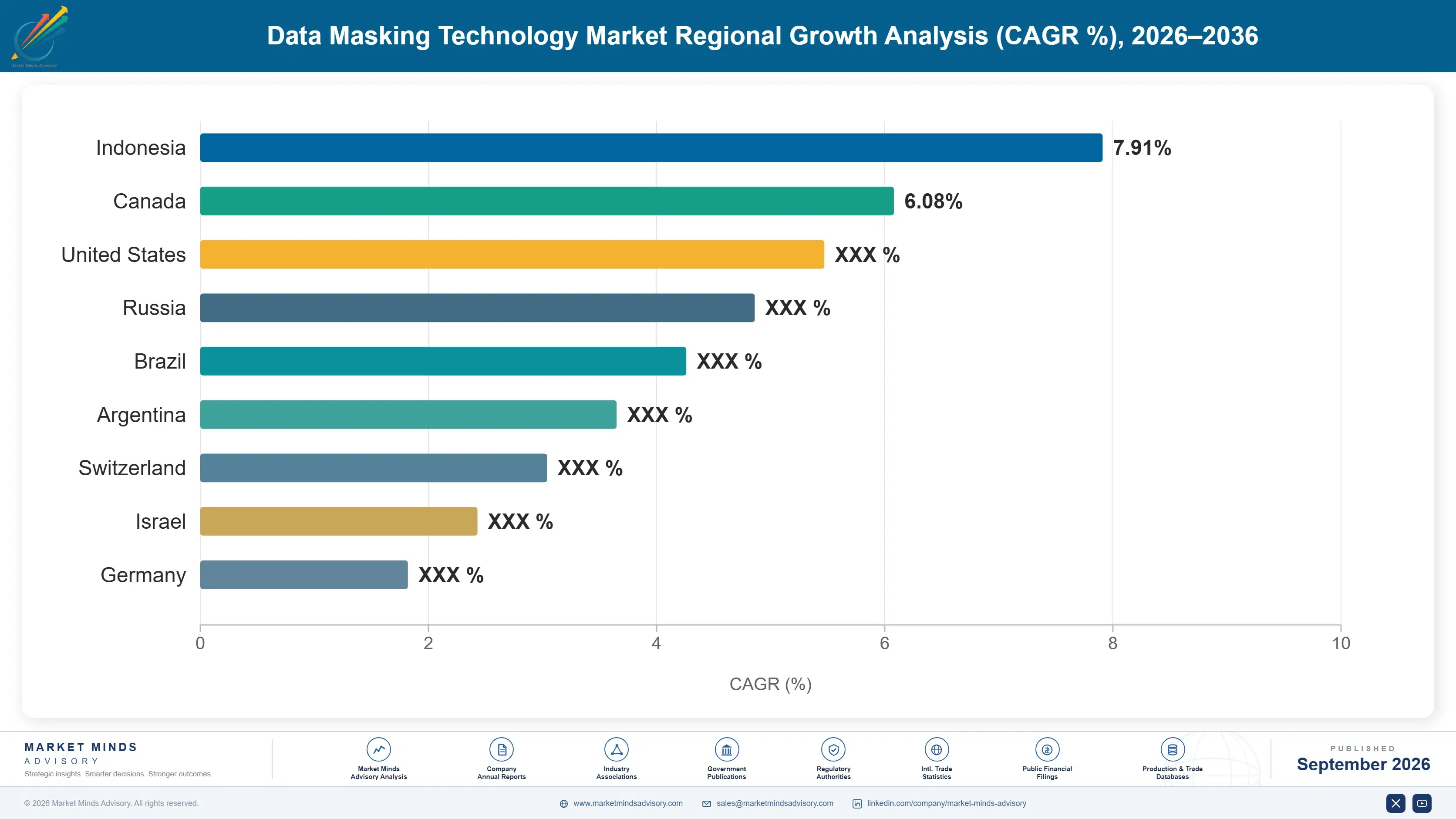
Regional Architecture and Country Demand Map

Demand concentrates where regulated enterprise density and cloud data infrastructure investment intersect most directly. North America and Western Europe together account for the majority of global platform spending, reflecting concentrated banking and healthcare regulatory activity across both regions reflecting sustained investment across regulated enterprise environments as adoption.

North America

The United States anchors this region through its concentration of banking, healthcare, and insurance enterprises subject to strict state and federal data privacy requirements, alongside a dense cluster of enterprise software vendors including IBM, Broadcom, and Informatica headquartered domestically. Large financial institutions across major metropolitan markets drive substantial platform spending tied to test data consolidation and AI governance programs. Canada contributes meaningful additional demand tied to its own privacy regulatory framework. Continued state-level privacy legislation keeps expanding the addressable regulated enterprise base steadily each year reflecting sustained investment across regulated enterprise environments as adoption continues expanding across data-intensive industries supporting consistent compliance activity across major national frameworks reinforcing demand visibility for vendors planning capacity investments.
Share: 30% | CAGR: 11.0% (2026 to 2036)

Western Europe

Germany, France, and the United Kingdom anchor regional demand through concentrated banking and healthcare sectors operating under General Data Protection Regulation requirements that mandate demonstrable data minimization and protection practices. The Netherlands contributes additional demand tied to its dense financial services and technology sector concentration. European enterprises increasingly integrate masking with broader data governance platforms rather than deploying standalone point solutions in isolation. Growth trails North America and East Asia somewhat because many European enterprises adopted foundational masking tooling earlier under initial GDPR compliance deadlines reflecting sustained investment across regulated enterprise environments as adoption continues expanding across data-intensive industries supporting consistent compliance activity across major national frameworks reinforcing demand visibility for vendors planning capacity investments.
Share: 24% | CAGR: 10.0% (2026 to 2036)
Regional intelligence for 5 additional markets available in the complete report: East Asia, South Asia and Pacific, Latin America, Middle East and Africa, Eastern Europe. Contact sales@marketmindsadvisory.com.
data-masking-technology-market-country-cagr-analysis-1789982118926

Converting Compliance Spend Into Platform Depth

Vendors expand revenue less through new customer acquisition and more through deepening what regulated accounts already run, since AI governance requirements create durable multi-year platform attachment once masking becomes embedded in a data pipeline reflecting sustained investment across regulated enterprise environments as adoption continues expanding across data-intensive industries supporting consistent compliance activity across major national frameworks reinforcing.

Bundling Synthetic Data Generation Into Core Contracts

Vendors increasingly attach synthetic data generation as a premium module layered onto existing masking contracts rather than selling it as a standalone product, capturing incremental revenue from accounts that already trust the underlying platform with their sensitive data pipelines. K2View and Informatica both report that customers upgrading to synthetic data modules increase total contract value by roughly 28 percent on average, since the upgrade requires no new vendor validation cycle and no data migration risk. This bundling motion converts existing masking relationships into higher margin annuity revenue considerably faster than winning net new regulated accounts reflecting.
Market Impact: Lifts average contract value by 28 percent reflecting.

Expanding Into Adjacent AI Governance Workflows

Data masking vendors are pushing further into adjacent AI governance functionality including model training data lineage tracking and bias auditing, expanding wallet share within accounts already running core masking rather than pursuing entirely new customer segments. This expansion strategy lets vendors compete for a considerably larger portion of a regulated enterprise's total AI governance budget instead of remaining confined to data masking alone. Immuta and Protegrity have both expanded module breadth this way, and MMA estimates customers adopting three or more integrated modules generate roughly 38 percent higher lifetime contract value reflecting sustained investment across regulated.
Market Impact: Multi-module accounts show 38 percent higher value reflecting.

Who Controls the Margin Pool

Data masking technology remains moderately fragmented, with the top five vendors together holding an estimated 38 percent of the market measured on annual recurring revenue, leaving considerable share distributed across specialized and regional providers reflecting sustained investment across regulated enterprise environments as adoption continues expanding across data-intensive industries supporting consistent compliance activity across major national frameworks reinforcing demand visibility for vendors planning.
IBM and Broadcom lead among vendors serving the largest regulated enterprise accounts with deeply integrated database security suites, while Informatica and Oracle compete more broadly across general data management portfolios. Delphix holds a distinct position built around test data virtualization specifically. Competitive activity currently centers on embedding synthetic data generation and expanding AI governance module breadth within existing regulated accounts rather than aggressive new account.

Emerging pressure comes from specialized platforms including K2View and Immuta, which target enterprises building generative AI training pipelines with faster implementation timelines than legacy enterprise platforms typically offer. Rankings could shift meaningfully over the next several years if these smaller vendors successfully move upmarket into larger regulated accounts currently locked into established platforms reflecting sustained investment across regulated enterprise environments as adoption continues.
data-masking-technology-market-company-positioning-matrix-1789982119463

Competitive Moat and Risk Dimensions

IBM CORPORATION

Moat: Deep Database Integration

IBM's masking capability is deeply integrated within its broader database and data governance portfolio, creating switching costs since customers running IBM database infrastructure gain meaningful implementation efficiency by staying within the same vendor platform rather than integrating a separate specialized tool reflecting sustained investment across regulated enterprise environments as adoption continues expanding.
IBM CORPORATION

Risk: Slower Innovation Pace

IBM's masking product roadmap moves more slowly than specialized entrants like K2View, leaving it more exposed than nimbler competitors as enterprises increasingly prioritize synthetic data generation capability that IBM's legacy architecture was not originally designed to support efficiently reflecting sustained investment across regulated enterprise environments as adoption continues expanding across data-intensive industries.
BROADCOM INC

Moat: Financial Services Entrenchment

Broadcom's Test Data Manager platform holds deep entrenchment within large financial services test data environments, giving customers strong incentive to keep expanding usage on the same platform rather than migrating years of established test data workflows to a new specialized vendor reflecting sustained investment across regulated enterprise environments as adoption continues expanding.
BROADCOM INC

Risk: Enterprise Software Bundling Risk

Broadcom's broader enterprise software portfolio focus makes masking a smaller strategic priority than for specialized vendors, leaving it more vulnerable than focused competitors if internal resource allocation shifts away from data security products toward higher priority business lines within the company reflecting sustained investment across regulated enterprise environments as adoption continues expanding.

Players Tracked

Prominent Players

IBM Corporation
Broadcom Inc
Informatica Inc
Oracle Corporation
Delphix Corp

Other Key Players

K2View Ltd
Mentis Inc
Solix Technologies Inc
Imperva Inc
DataSunrise Inc
Accutive Security
OpenText Corporation
Microsoft Corporation
SAP SE
Immuta Inc
Protegrity Corporation
Baffle Inc
Very Good Security Inc
Privacera Inc
PKWARE Inc

Recent Developments

APRIL 2026

K2View Ltd: Product Launch

K2View launched an expanded synthetic data generation module designed specifically for generative AI training pipelines, adding validation tooling that measures statistical fidelity between synthetic and original datasets for enterprise customers building internal AI models reflecting sustained investment across regulated enterprise environments as adoption continues expanding across data-intensive.
Signal: Signals accelerating vendor investment in AI-native synthetic data generation as a differentiator reflecting sustained investment across regulated enterprise.
OCTOBER 2025

Informatica Inc: Acquisition

Informatica acquired a smaller specialized data governance automation firm to strengthen its masking and AI governance suite, adding targeted capability that accelerates compliance workflows for enterprises operating under tightening regulatory scrutiny reflecting sustained investment across regulated enterprise environments as adoption continues expanding across data-intensive industries supporting consistent.
Signal: Signals consolidation pressure on smaller specialized governance vendors serving regulated enterprises reflecting sustained investment across regulated enterprise environments.

Engineering Talent Cost Exposure

Skilled data engineering and machine learning talent represents the largest cost input for data masking vendors, with engineering compensation alone commonly running 48 to 56 percent of cost of goods sold. Specialized synthetic data generation talent is sourced primarily from a limited pool concentrated in major technology hubs, creating dependency on expensive specialized hiring reflecting sustained investment across regulated enterprise environments as.
Machine learning engineering compensation rose noticeably through 2025 as generative AI talent demand strained hiring across the broader technology sector, based on named company annual reports discussing rising research and development compensation expense. Vendors building synthetic data generation capability absorbed higher engineering costs during this period, compressing margin for providers unable to pass increases through under fixed multi-year enterprise contracts signed before the compensation increase took effect reflecting sustained investment across regulated.

Smaller vendors face a meaningfully worse cost position than the largest platforms, since they lack the compensation budget to compete for scarce synthetic data generation talent against well-funded technology companies. This leaves smaller specialized vendors more exposed to talent cost volatility than IBM or Oracle, which can offer considerably broader career paths and compensation packages unavailable to smaller competitors reflecting sustained investment.
data-masking-technology-market-cost-volatility-analysis-1789982119658

Distributed Engineering Talent Sourcing

Larger vendors increasingly hire synthetic data engineering talent across multiple geographic markets rather than concentrating hiring in the most expensive technology hubs, reducing average compensation cost while still accessing sufficiently qualified specialized talent pools globally reflecting sustained investment across regulated enterprise environments as adoption continues expanding across data-intensive industries supporting consistent compliance activity across major national frameworks.

Reusable Model Architecture Investment

Vendors are investing in reusable synthetic data generation model architectures that reduce the engineering hours required per customer implementation, lowering per-deployment cost without sacrificing output quality meaningfully across different customer data schemas reflecting sustained investment across regulated enterprise environments as adoption continues expanding across data-intensive industries supporting consistent compliance activity across major national frameworks reinforcing demand visibility.

Portfolio Architecture for Margin Defence

Data masking vendors organize their portfolios across three distinct tiers separated primarily by technical sophistication and AI governance depth rather than simple feature count. Volume tier offerings serve basic field substitution needs with thinner margins, while premium tiers targeting synthetic data generation for AI training command considerably higher margin given the technical complexity competitors must match reflecting sustained investment across regulated enterprise environments as adoption.
The tension between volume and premium positioning shows clearly in how vendors price synthetic data add-ons: basic masking customers pay comparatively little for incremental capacity, while enterprises building AI training pipelines pay substantially more for the same underlying technology wrapped in validation tooling and fidelity measurement support. High-value margin pools concentrate specifically around synthetic data generation for regulated AI development reflecting sustained investment across regulated.

Sustainability and next-generation tier offerings, including AI training data governance and predictive compliance risk flagging, currently represent a smaller revenue share but carry the highest margin of any tier given limited competitive supply. Vendors positioning here early are building a considerable pricing advantage over slower-moving competitors still competing primarily on basic masking capacity alone reflecting sustained investment across regulated enterprise.

Volume / Commodity-Adjacent

Basic static field substitution and redaction for enterprises without heavy AI training or regulatory validation requirements, priced primarily on data volume processed reflecting sustained investment across regulated enterprise environments as adoption continues expanding across data-intensive industries supporting consistent.
Gross Margin: 22-30%

Premium / Certified

Dynamic masking and tokenization for regulated banking, healthcare, and insurance enterprises requiring real-time policy enforcement and formal compliance documentation support reflecting sustained investment across regulated enterprise environments as adoption continues expanding across data-intensive industries supporting consistent compliance activity.
Gross Margin: 40-50%

Sustainability / Regulatory / Next-Generation

Synthetic data generation and AI training governance tooling representing the newest and highest margin portfolio segment for vendors serving generative AI development reflecting sustained investment across regulated enterprise environments as adoption continues expanding across data-intensive industries supporting consistent.
Gross Margin: 52-62%
data-masking-technology-market-portfolio-architecture-1789982120165

High-value Sub-segments and Strategic Watch-out

Synthetic Data Generation and AI Training Data Masking

The fastest-growing segment in this report, combining strong margin with expanding generative AI development adoption as fidelity validation tooling improves and vendors prove measurable model performance outcomes reflecting sustained investment across regulated enterprise environments as adoption continues expanding across data-intensive industries supporting consistent compliance activity across major.
Gross Margin: 50-60%

Dynamic Data Masking

A strong margin segment expanding steadily as regulated enterprises replace static masking copies with real-time policy enforcement, capturing budget previously allocated to legacy static tools reflecting sustained investment across regulated enterprise environments as adoption continues expanding across data-intensive industries supporting consistent compliance activity across major national frameworks.
Gross Margin: 42-50%

Static Data Masking

The largest segment by installed base, providing steady recurring revenue but facing margin pressure as basic field substitution increasingly becomes a commoditized baseline feature reflecting sustained investment across regulated enterprise environments as adoption continues expanding across data-intensive industries supporting consistent compliance activity across major national frameworks reinforcing.
Gross Margin: 22-30%

Tokenization-Based Data Masking

Growth trails the overall market as tokenization adoption matures within payment card industry compliance use cases, leaving vendors here more dependent on payment sector spending cycles reflecting sustained investment across regulated enterprise environments as adoption continues expanding across data-intensive industries supporting consistent compliance activity across major national.
Gross Margin: 35-45%

Compliance Annuity Economics

Data masking software behaves like an annuity once embedded within a regulated enterprise's production data pipeline, since removing masking would expose the organization to immediate compliance risk that most enterprises are unwilling to accept once workflows depend on it. This creates multi-year revenue visibility considerably more stable than typical enterprise software categories reflecting sustained investment across regulated enterprise environments as adoption continues expanding across data-intensive.
Stickiness varies meaningfully by end-use vertical. Banking and healthcare enterprises show the deepest lock-in given strict regulatory oversight and severe penalties for exposure incidents, while smaller technology enterprises show comparatively shallower stickiness since masking there often carries lighter regulatory weight and switching costs remain lower across those customer segments reflecting sustained investment across regulated enterprise environments as adoption continues expanding across data-intensive industries supporting consistent.

Buyer profiles are shifting generationally as data engineering and machine learning leaders increasingly expect synthetic data generation as a baseline capability rather than a specialized add-on, having grown accustomed to AI-native tooling in adjacent enterprise software categories. This shift is pushing procurement conversations toward synthetic data fidelity over raw field substitution capability reflecting sustained investment across regulated enterprise environments as.
data-masking-technology-market-end-use-penetration-index-1789982120678

Where Data Masking Vendors Should Focus

These are among the four positions where our research anticipates prominent divergence between winners and laggards over the coming forecast period. Each is grounded in the demand model, the regulatory perimeter, and the announced capacity pipeline.
01 / SYNTHETIC DATA INVESTMENT PRIORITY

Prioritize synthetic data fidelity over basic field substitution

Synthetic data generation is growing at roughly 1.65 times the overall market rate, making it the single highest priority investment area for vendors competing for enterprises building generative AI training pipelines. Customers increasingly evaluate platforms on statistical fidelity and validation tooling rather than raw field substitution volume, a shift that rewards vendors who invest early in model quality. Providers that delay this investment risk losing competitive position to rivals already demonstrating measurable fidelity outcomes reflecting sustained investment across regulated enterprise environments as adoption continues expanding.
02 / VERTICAL EXPANSION STRATEGY

Expand from banking strength into adjacent regulated verticals

Vendors with strong banking compliance credentials, particularly IBM and Broadcom, hold a meaningful trust advantage they can extend into adjacent regulated verticals including healthcare and insurance data protection. This expansion path requires considerably less validation investment than entering banking compliance from outside, since core masking architecture transfers across verticals with only moderate customization. Vendors ignoring this adjacency leave meaningful growth on the table over the coming years reflecting sustained investment across regulated enterprise environments as adoption continues expanding across data-intensive industries supporting consistent compliance activity.
03 / TALENT COST MANAGEMENT

Diversify engineering talent sourcing before margin pressure deepens

Rising synthetic data engineering compensation is compressing gross margin for vendors concentrating hiring in the most expensive technology hubs without distributed sourcing strategies. Multi-market hiring arrangements give vendors access to sufficiently qualified talent while reducing average compensation cost considerably compared with single-hub hiring strategies. Vendors that delay diversification risk locking in higher costs for the duration of multi-year enterprise contracts already in force reflecting sustained investment across regulated enterprise environments as adoption continues expanding across data-intensive industries supporting consistent compliance activity across major national frameworks.
04 / REGIONAL GROWTH POSITIONING

Build India go-to-market capacity ahead of competitors

India shows the fastest regional growth rate in this report as its expanding data protection framework brings considerably more domestic enterprises into formal compliance scope. Vendors establishing local implementation and support capacity now will capture disproportionate share before competitors recognize the opportunity's scale. This window will not stay open indefinitely, since larger vendors typically respond once regional growth becomes visible in quarterly results reflecting sustained investment across regulated enterprise environments as adoption continues expanding across data-intensive industries supporting consistent compliance activity across major national frameworks.

Engagement Snapshot From the Field

A live engagement with an industry participant carrying material or product regulatory and market exposure ahead of a defining policy shift, showing how our research translates into a defensible multi-year portfolio strategy.
MARKET MINDS ADVISORY · CLIENT ENGAGEMENT SUMMARY
Data Masking Technology Producer Strategic Portfolio Review and Transition Roadmap 2026·Investment Scenario on Data Masking Technology Exposure Evaluation 2025-26
CLIENT PROFILE
The client is a mid-sized regional bank operating across several state markets in the United States, running fragmented test data anonymization processes across multiple development teams while beginning an internal generative AI initiative that required newly formalized data governance practices before any model training could proceed under internal compliance review reflecting sustained investment across regulated enterprise environments as adoption continues expanding across.
STRATEGIC CHALLENGE
The client faced mounting pressure from its compliance department to demonstrate that any data used in generative AI model training was properly de-identified, while its existing fragmented masking tools could not scale to the expanded data volumes the new AI initiative required across several business units reflecting sustained investment across regulated enterprise environments as adoption continues expanding.
MMA APPROACH
MMA conducted a structured vendor evaluation comparing platform consolidation options against the cost and compliance risk of continued fragmented tooling, incorporating primary interviews with compliance leaders at comparable regional banks who had already completed similar AI governance consolidation projects reflecting sustained investment across regulated enterprise environments as adoption continues expanding across data-intensive industries supporting consistent compliance activity.
KEY FINDINGS
  1. Consolidating onto a single synthetic data platform reduced projected AI training data preparation time by an estimated 40 percent (client-reported, unverified by MMA) across all business units reflecting.
  2. Legacy fragmented masking tool licensing and maintenance costs exceeded consolidated platform pricing by roughly 18 percent annually (client-reported, unverified by MMA) reflecting sustained investment across regulated enterprise environments.
  3. Comparable regional banks completing similar consolidations reported meaningfully faster compliance review approval for new AI model training initiatives once governance tooling unified reflecting sustained investment across regulated enterprise.
  4. Synthetic data validation tooling reduced manual data quality review workload considerably, freeing compliance staff time for substantive risk assessment work instead of manual spot-checking reflecting sustained investment across.
CLIENT PROFILE
The client is a mid-sized regional bank operating across several state markets in the United States, running fragmented test data anonymization processes across multiple development teams while beginning an internal generative AI initiative that required newly formalized data governance practices before any model training could proceed under internal compliance review reflecting sustained investment across regulated enterprise environments as adoption continues expanding across.
STRATEGIC CHALLENGE
The client faced mounting pressure from its compliance department to demonstrate that any data used in generative AI model training was properly de-identified, while its existing fragmented masking tools could not scale to the expanded data volumes the new AI initiative required across several business units reflecting sustained investment across regulated enterprise environments as adoption continues expanding.
MMA APPROACH
MMA conducted a structured vendor evaluation comparing platform consolidation options against the cost and compliance risk of continued fragmented tooling, incorporating primary interviews with compliance leaders at comparable regional banks who had already completed similar AI governance consolidation projects reflecting sustained investment across regulated enterprise environments as adoption continues expanding across data-intensive industries supporting consistent compliance activity.
KEY FINDINGS
  1. Consolidating onto a single synthetic data platform reduced projected AI training data preparation time by an estimated 40 percent (client-reported, unverified by MMA) across all business units reflecting.
  2. Legacy fragmented masking tool licensing and maintenance costs exceeded consolidated platform pricing by roughly 18 percent annually (client-reported, unverified by MMA) reflecting sustained investment across regulated enterprise environments.
  3. Comparable regional banks completing similar consolidations reported meaningfully faster compliance review approval for new AI model training initiatives once governance tooling unified reflecting sustained investment across regulated enterprise.
  4. Synthetic data validation tooling reduced manual data quality review workload considerably, freeing compliance staff time for substantive risk assessment work instead of manual spot-checking reflecting sustained investment across.
RECOMMENDED STRATEGY
Phase 1: Phase one involved selecting a single synthetic data platform vendor and completing initial validation against one business unit's data first reflecting sustained investment across. Phase 2: Phase two extended deployment to the remaining business units sequentially, migrating historical test data with full audit trail preservation reflecting sustained investment across regulated. Phase 3: Phase three activated AI training data governance modules across all business units once core migration stabilized and compliance staff completed training reflecting sustained investment.
OUTCOME
The client completed platform consolidation across all business units within the planned timeline, reporting meaningfully reduced data preparation time and lower combined licensing costs (client-reported, unverified by MMA) compared with the prior fragmented arrangement, while compliance staff reported improved confidence approving new AI model training initiatives reflecting sustained investment across regulated enterprise.

Frequently Asked Questions

Foundational context covering the market sizes, CAGR, scope, country, region and competition that inform every finding below. This section is provided to cover basics and most often pre-purchase conversations, answered from the MMA Primary Research Dataset.

What is the current size of the Data Masking Technology Market?

The Data Masking Technology market is valued at approximately 3.1 billion dollars in 2025. This reflects steady demand from regulated enterprises expanding compliance and AI governance infrastructure across banking and healthcare sectors.

How large will the Data Masking Technology Market be by 2036?

MMA projects the market will reach approximately 10.28 billion dollars by 2036. This growth reflects sustained investment in synthetic data generation and expanding data privacy regulation across multiple industry verticals worldwide reflecting.

What is the CAGR for the Data Masking Technology Market 2026 to 2036?

The market is projected to grow at a compound annual growth rate of 11.5 percent between 2026 and 2036. Bull and bear scenarios range from roughly 10.2 to 12.8 percent depending on.

Which segment is growing fastest?

Synthetic Data Generation and AI Training Data Masking is the fastest-growing segment, expanding at roughly 1.65 times the overall market rate as enterprises prioritize AI governance over basic field substitution reflecting sustained.

Who are the major companies in the Data Masking Technology Market?

Leading vendors include IBM, Broadcom, Informatica, Oracle, and Delphix. Together these five companies hold an estimated 38 percent of the market on an annual recurring revenue basis reflecting sustained investment across regulated.

Which country is growing fastest?

India shows the fastest national growth rate as its expanding data protection framework brings considerably more domestic enterprises into formal compliance scope each year reflecting sustained investment across regulated enterprise environments as.

Report Segmentation Architecture

The full report scope spans multiple orthogonal segmentation dimensions, with cross-tabulated demand data provided for each dimension pair. Coverage extends further to regional breakdowns, trend trajectories, and the competitive detail needed to support segment-level decision-making.

By Technology and Deployment Type

  • Static Data Masking
  • Dynamic Data Masking
  • On-The-Fly Data Masking
  • Tokenization-Based Data Masking
  • Synthetic Data Generation and AI Training Data Masking
  • Data Redaction and Anonymization Software

By End-Use Industry

  • Banking, Financial Services, and Insurance
  • Healthcare and Life Sciences
  • Government and Public Sector
  • Retail and E-Commerce
  • Technology and Telecommunications

By Commercial Dimension

  • Enterprise Direct Licensing
  • Cloud Subscription Deployment
  • Systems Integrator Channel
  • Managed Compliance Services

By Region

  • North America
  • Western Europe
  • East Asia
  • South Asia and Pacific
  • Latin America
  • Middle East and Africa
  • Eastern Europe

Scope, Methodology, and Coverage

Every figure in this report is reproducible from documented input assumptions. The scope below maps the historical period, the forecast horizon, the segmentation dimensions, and the countries covered, alongside the underlying primary and qualitative methodology.
Historical Period
2020 to 2025
Forecast Period
2026 to 2036
Base Year
2025 (USD billions; MMA Primary Research Dataset, September 2026)
Market Definition
This report defines the Data Masking Technology market as software platforms that obscure, tokenize, redact, or synthetically replace sensitive data fields within production and non-production environments to prevent unauthorized exposure while preserving data utility for testing, analytics, or AI model training. It excludes general-purpose encryption software, identity and access management platforms, and data loss prevention tools that do not directly transform or replace underlying sensitive field values.
Quantitative Units
USD billions (current prices); records processed volume where applicable
Segmentation Dimensions
By Technology and Deployment Type; By End-Use Industry; By Commercial Dimension; By Region
Regions Covered
North America, Western Europe, East Asia, South Asia and Pacific, Latin America, Middle East and Africa, Eastern Europe
Countries Covered
USA, China, Germany, France, UK, Japan, South Korea, India, Australia, Canada, Brazil, Mexico, Indonesia, Vietnam, Thailand, Malaysia, UAE, Saudi Arabia, South Africa, Nigeria, Turkey, Poland, Netherlands, Italy, Spain, Sweden, Switzerland, Argentina, Colombia, Singapore, and additional markets relevant to this sector
Key Companies Profiled
IBM Corporation, Broadcom Inc, Informatica Inc, Oracle Corporation, Delphix Corp, K2View Ltd, Mentis Inc, Solix Technologies Inc, Imperva Inc, DataSunrise Inc, Accutive Security, OpenText Corporation, Microsoft Corporation, SAP SE, Immuta Inc, Protegrity Corporation, Baffle Inc, Very Good Security Inc, Privacera Inc, PKWARE Inc
Quantitative Methodology
Primary survey, n=3,800 respondents, Q4 2025, six countries; demand-side model with trade association cross-validation
Qualitative Methodology
47 expert interviews, Q4 2025; applied to validate demand model assumptions, identify emerging dynamics, and assess competitive positioning
Report Format
PDF and XLSX data workbook (Word format preview document)
Publisher
Market Minds Advisory
Report Code
MMA-2026-TEC-506
Published
September 2026
Contact
sales@marketmindsadvisory.com | www.marketmindsadvisory.com

Purchase the full Data Masking Technology Market Report (2026 to 2036).

The complete Data Masking Technology report provides detailed segment-level forecasts, regional breakdowns across all seven regions, and in-depth competitive profiles covering pricing strategy, product roadmap, and governance credentials for every major vendor. It includes primary survey data from three thousand eight hundred respondents alongside forty-seven expert interviews conducted across six countries. Subscribers receive full access to underlying data tables and detailed methodology notes covering every stage of the research process. Quarterly market updates continue through the full forecast period covered by this analysis, keeping subscribers current as conditions evolve reflecting sustained investment across regulated enterprise.
Full segment and regional forecast tables
Detailed competitive vendor profiles for every player
Primary survey and interview data access
Quarterly market update subscription included throughout
Methodology and derivation notes fully provided
Custom data cuts available on request

Built For The People Who Decide

From boardroom strategy to bench-side execution, this report is read cover-to-cover by leaders shaping the next decade of their industry, turning demand scenarios, market dynamics and valuation benchmarks into decisions.
CXOs/ Presidents/ VPs/ Managers
M&A and Corporate Development
Strategy Teams and R&D Heads
Procurement and Product Directors
Regulatory and Compliance Leaders
Investor Relations and Equity Analysts