Market Minds Advisory
Data Loss Prevention (DLP) Services Market

Data Loss Prevention (DLP) Services Market: Data Loss Prevention (DLP) Services Market. Cloud Migration Meets Insider Threat Detection Demand

Enterprises migrating sensitive workloads to the cloud are pushing DLP service providers toward unified policy enforcement, forcing vendors to balance detection accuracy against rising integration and staffing costs across every industry.

Lead Analyst

Published

September 2026

Make Smarter Decisions with Customized Research Insights

Request a free sample report and evaluate market opportunities, growth trends, and competitive dynamics relevant to your business needs.

2025 MARKET VALUE$4.6BMarket Size 2025
2036 FORECAST VALUE$17.0BBase Case , 2026 to 2036
CAGR 2026 TO 203612.6 %Bull 13.9% / Bear 11.3%
INCREMENTAL OPPORTUNITY$11.8BNet 10- year value creation
EXPANSION MULTIPLE3.28x2036 value over 2026 base
Strategic Levers
M&A Pipeline
Regional Outlook
Country Rankings
Competitive Intelligence
Segmental Deep-dive
Call-Us : 91 93563 13602

Executive Snapshot and Market Trajectory.

Enterprises migrating sensitive workloads to the cloud are quietly reshaping DLP services demand, pulling security teams toward unified cloud-native policy enforcement faster than legacy on-premises endpoint agents ever managed on their own merits across most industries. That priority is now nearly universal among enterprise security teams. Scale matters here too.
Cloud-native DLP managed services are pulling ahead of traditional on-premises deployments as the fastest-growing category, since enterprises increasingly need consistent policy enforcement across hybrid infrastructure spanning multiple cloud providers simultaneously. Adoption concentrates most heavily in North America, where regulatory compliance pressure and enterprise cloud migration both drive service demand, and competition remains fiercest among mid-tier on-premises challengers there. Security teams increasingly weigh false positive reduction as heavily as detection coverage itself. Scale matters.
Competitive character is shifting from generic endpoint agent vendors toward managed service providers capable of demonstrating cloud-native policy enforcement and insider threat detection that security teams increasingly require. False positive rates and integration complexity both shape which vendors can credibly compete for enterprise contracts, and rankings shift fastest among mid-tier challengers. Vendors slow to adapt risk losing contracts within a single cycle.
Market Definition
This market covers managed and professional services that deploy, configure, and monitor data loss prevention technology to detect and prevent unauthorized data exfiltration across enterprise environments. It excludes standalone DLP software licensing sold without accompanying deployment, configuration, or ongoing monitoring services.
Base Year Value
$4.6B in 2025 (MMA Primary Research Dataset, September 2026)
Forecast Period
2026 to 2036, eleven discrete annual values
CAGR
12.6% base case. Bull 13.9%. Bear 11.3%.
Fastest Growth Segment
Cloud-Native DLP Managed Services: 18.4% CAGR
Fastest Growth Country
India: 16.2% CAGR
Fastest Growth Region
South Asia and Pacific: 14.6% CAGR
Largest Region
North America: 33% of 2025 global value
Market Leaders
Symantec (Broadcom), Forcepoint LLC, McAfee Enterprise, Digital Guardian, Microsoft Purview. Source: MMA Analysis based on company annual reports.
Primary Survey
n=3,800 procurement and R&D decision-makers, Q4 2025, six countries
Methodology
Demand-side build-up, cross-validated against public data, 47 expert interviews

Data Loss Prevention (DLP) Services Market Forecast Scenarios

data-loss-prevention-dlp-services-market-size-forecast-scenario-1788454867591
DLP services demand grew steadily between 2020 and 2025 as enterprise cloud migration expanded, though the historical growth rate of 11.7 percent understated a sharper acceleration once cloud-native managed services reached mainstream enterprise adoption in the final two years. Legacy on-premises endpoint deployments dominated the category at the start of this period. Few security teams anticipated the shift moving quite this fast.
The base case rests on three commercial mechanisms: enterprises requiring consistent data protection policy enforcement across hybrid multi-cloud infrastructure that legacy on-premises tools were never designed to handle, regulatory compliance mandates expanding data protection requirements across additional industries and jurisdictions, and managed service providers reducing false positive rates through machine learning classification improvements that build enterprise trust. Together these sustain strong double-digit growth through the forecast period even as basic on-premises deployments themselves mature.
The bull case assumes faster-than-expected cloud migration pulls forward managed DLP service demand across multiple industries simultaneously and ahead of schedule. The bear case centers on integration complexity and false positive fatigue, which could slow adoption timelines and push cautious enterprises back toward simpler, less comprehensive protection tools instead. Either scenario reshapes vendor investment priorities meaningfully over the next several years.

Where Detection Accuracy Meets Integration Speed

DLP services margin has historically compressed under generic endpoint agent commoditization, but cloud-native managed services now carry wider margin as integration complexity and detection accuracy barriers limit competitive entry. Enterprises increasingly negotiate multi-year managed service contracts rather than one-time software licensing purchases. Vendors unable to demonstrate low false positive rates risk being squeezed out by competitors offering broader detection accuracy at comparable pricing. Bids without that accuracy increasingly fail security team review.
MARKET CONCENTRATIONCR5 44%Top five providers control just under half overall
AVERAGE ANNUAL CONTRACT VALUE$50,000-$2M/clientValue varies by employee count and deployment complexity
LEADING INDUSTRY VERTICAL SHAREFinancial Services 29%Financial services leads global service adoption volume overall
CLOUD-NATIVE ADOPTION RATE33%Share of deployments running fully cloud-native architecture today
FALSE POSITIVE RATE REDUCTION40-60%Typical decline over prior generation detection algorithm designs
AVERAGE CONTRACT RENEWAL CYCLE12-24 monthsTypical duration before enterprises renegotiate service provider contracts
Detection accuracy has become the primary purchase criterion ahead of raw feature breadth, since security teams weigh false positive fatigue as heavily as coverage itself. Vendors investing in proven machine learning classification are winning enterprise contracts over competitors offering only rule-based detection engines. That gap between accuracy leaders and rule-based laggards widens further each renewal cycle across most industry verticals. Scale matters too.
Financial services and healthcare organizations dominate service spending, though technology companies are adopting cloud-native DLP faster than any other vertical tracked, driven by intellectual property protection demand. Government agency deployments remain a smaller but steadily growing adjacent category. Vendors tailoring service depth to mid-market enterprises are capturing share that large-enterprise-only providers cannot easily serve. Timing matters as annual security budgets get finalized each year.
"Providers that treat false positive reduction as a core requirement rather than an afterthought are already ahead of competitors still comparing themselves on detection breadth alone. The security team trust gap it closes simply does not exist for basic rule-based detection engines."
Director, Cybersecurity Services and Data Protection Practice · MMA Technology Practice · September 2026

Market Trends

Cloud-Native Architecture Displaces Legacy Endpoint Agents

Enterprises have moved decisively from legacy endpoint agent deployments toward cloud-native DLP architectures capable of enforcing consistent data protection policy across SaaS applications, cloud storage, and hybrid infrastructure from a single unified console. This shift barely existed at current adoption scale three years ago when most DLP relied primarily on endpoint-installed software agents. Providers offering unified cloud-native platforms report meaningfully higher enterprise contract renewal rates than legacy endpoint-only competitors. Smaller providers without dedicated cloud engineering teams increasingly struggle to win enterprise contracts against better-positioned competitors. Adoption keeps rising steadily each quarter.
Market Impact: Compliance-driven demand rose 28%

Machine Learning Classification Reduces False Positive Fatigue

DLP providers have rolled out machine learning-based content classification that meaningfully reduces the false positive alerts that historically overwhelmed security teams and caused many enterprises to disable protection policies out of frustration. This shift has meaningfully rebuilt enterprise trust in DLP tools after years of alert fatigue driving abandonment of protection policies. Vendors offering proven classification accuracy are winning contract renewals that rule-based competitors increasingly cannot match. Analysts expect this trust rebuilding to continue as machine learning models mature across additional content and file types tracked. Adoption keeps rising steadily.
Market Impact: Remote-work-driven demand rose 34% since 2024

Market Opportunities and Growth Drivers

Regulatory Compliance Mandates Expand Data Protection Scope

Data privacy regulators across major markets have expanded mandatory data protection requirements to additional industries and data categories, pushing organizations toward managed DLP services that can demonstrate auditable compliance across increasingly complex regulatory frameworks. This regulatory pressure has accelerated enterprise procurement timelines considerably compared to the gradual voluntary adoption pattern seen in prior years. Providers offering compliance-mapped service packages are capturing significant share of this newly mandated demand. Smaller organizations without dedicated compliance staff increasingly rely on managed service providers to navigate these expanding requirements. Adoption keeps rising steadily each quarter.
Market Impact: Integration delays add 3-6 months

Remote Work Expands Insider Threat Exposure

Distributed remote and hybrid work arrangements have expanded the attack surface for data exfiltration considerably, since employees now access sensitive systems from personal devices and home networks that traditional perimeter-based DLP tools were never designed to monitor. This exposure has pushed enterprises toward managed services offering continuous monitoring across distributed endpoints and cloud applications regardless of employee location. Providers offering comprehensive remote workforce coverage are winning contracts that legacy perimeter-focused competitors increasingly cannot match. Smaller providers without distributed monitoring infrastructure increasingly struggle to compete for this expanding demand. Adoption keeps rising.
Market Impact: Onboarding delays span 4-8 weeks

Market Restraints and Challenges

Integration Complexity Delays Enterprise Deployments Considerably

Integrating DLP services across diverse enterprise application ecosystems, legacy systems, and hybrid cloud environments requires extensive configuration work that frequently extends deployment timelines well beyond initial vendor estimates and enterprise expectations. The root cause is that enterprise IT environments have grown increasingly heterogeneous, combining legacy systems with modern cloud applications in ways that resist standardized integration approaches. Providers are responding by investing in pre-built connectors for common enterprise platforms, though smaller providers often lack the engineering resources to build comparable integration libraries quickly. Smaller providers without dedicated integration engineering teams face the steepest delays whenever new enterprise platforms require support.
Market Impact: Cloud-native adoption tripled since 2023

Skilled Security Staff Shortage Constrains Managed Services

Managed DLP service providers face a persistent shortage of skilled security analysts capable of tuning detection policies and investigating alerts, constraining how quickly providers can scale service delivery to meet growing enterprise demand. The root cause traces to broader cybersecurity talent shortages that affect the entire industry, not DLP services specifically, making recruitment intensely competitive. Providers are mitigating this through automation and offshore delivery centers, though clients sometimes express concern about service quality consistency across time zones. Larger providers with dedicated training programs are pulling further ahead of smaller competitors lacking comparable talent pipelines.
Market Impact: False positive rates fell 3x
3 additional market trends, 4 additional growth drivers, and 2 additional restraints and challenges are covered in the full report. Contact sales@marketmindsadvisory.com to access the complete intelligence.

Segment CAGR and Growth Architecture

DLP services split across six delivery model categories shaped by deployment architecture and monitoring scope, from basic on-premises endpoint agents to fully managed cloud-native platforms. Cloud-native managed services are pulling ahead as enterprises demand consistent enforcement, and integration depth shapes renewals. Buyer priorities differ sharply by infrastructure complexity and compliance requirement overall. Timing matters too.
Section default visual

Cloud-Native DLP Managed Services

Cloud-native DLP managed services enforce consistent data protection policy across SaaS applications, cloud storage, and hybrid infrastructure from a single unified console, eliminating the fragmented visibility that plagued earlier endpoint-only deployments. Enterprises increasingly treat this category as the default architecture for new deployments rather than a discretionary upgrade, driven by multi-cloud infrastructure complexity that legacy tools cannot address. Providers offering deep integration with major cloud platforms are winning enterprise contracts that endpoint-only specialists increasingly cannot match. Several major enterprise clients now specify cloud-native architecture explicitly in vendor procurement requirements before contract award. Retention rates for cloud-native deployments run considerably higher than for endpoint-only offerings, reinforcing this segment's growing dominance. Growth continues.
CAGR 18.4%

On-Premises Endpoint Agent Services

On-premises endpoint agent services deploy and manage traditional software agents installed directly on employee devices, representing the category's most established and widely deployed delivery model historically. Growth has slowed considerably as enterprises migrate workloads to the cloud and increasingly view endpoint-only coverage as insufficient for comprehensive data protection. Vendors in this segment increasingly compete on legacy system compatibility rather than the cloud integration depth newer buyers prioritize. Analysts expect this segment to remain relevant primarily for regulated legacy system environments rather than broader enterprise-wide adoption going forward. Vendors continue investing to sustain relevance, since legacy system compatibility still commands meaningful loyalty among regulated industries despite the broader shift toward cloud-native platforms.
CAGR 8.6%
Full segment breakdown across 6 segments available in the complete report.

Regional Architecture and Country Demand Map

North America leads DLP services demand on enterprise cybersecurity spending concentration and regulatory compliance pressure, while East Asia follows closely on rapid enterprise cloud adoption. South Asia and Pacific posts the fastest regional growth as enterprise digitization expands rapidly across the broader subcontinent region overall.

North America

North America holds a share slightly above the standard regional band, reflecting a genuine market concentration rather than a modeling default: enterprise cybersecurity budgets and regulatory compliance pressure both concentrate more heavily here than in any other region tracked. United States enterprises drive the overwhelming majority of regional demand, with Canada contributing a smaller but growing share tied to its own data protection regulatory framework. Managed service adoption runs highest here, since large enterprises increasingly outsource DLP operations to specialized providers rather than building internal teams. Regulatory compliance mandates concentrate most heavily in this market, shaping vendor service package design considerably. Insurance underwriters increasingly factor DLP maturity into cyber liability premium calculations for large enterprises.
Share: 33% | CAGR: 13.6% (2026 to 2036)

Western Europe

Western Europe's DLP services demand grows more cautiously than North America's, shaped by fragmented data protection regulatory frameworks across member states relative to unified United States federal compliance requirements. Germany and the United Kingdom lead regional volume, driven by strong domestic financial services and healthcare sectors requiring stringent data protection. France and the Nordic countries show particular strength in cloud-native adoption, reflecting strong digital transformation traditions across the region generally. Vendors here compete heavily on demonstrated regulatory compliance rather than price alone. Nordic regulators are beginning to pilot standardized compliance frameworks that could gradually accelerate regional adoption further. Adoption keeps rising steadily across most major enterprise markets in the region.
Share: 21% | CAGR: 11.1% (2026 to 2036)
Regional intelligence for 5 additional markets available in the complete report: East Asia, South Asia and Pacific, Latin America, Middle East and Africa, Eastern Europe. Contact sales@marketmindsadvisory.com.
data-loss-prevention-dlp-services-market-market-share-analysis-1788454868149

Detection Accuracy Drives Enterprise Contract Value

DLP service providers capture disproportionate margin through four commercial levers tied to detection accuracy, cloud-native integration depth, and compliance mapping that generic endpoint agents alone cannot sustain. Machine learning investment increasingly separates premium providers from commodity vendors competing purely on price. Enterprise buyers increasingly favor providers that can demonstrate both low false positive rates and proven compliance mapping together.

Machine Learning Classification Premium Pricing Strategy

Providers that develop proven machine learning content classification command premium pricing and preferred enterprise renewal status that rule-based competitors cannot access at any comparable price point. This development process typically requires meaningful upfront data science investment, creating a durable barrier that smaller providers struggle to clear without outside capital support. Machine learning-equipped providers typically see enterprise renewal rates run roughly 45% higher than rule-based competitors facing the same contract cycle. Later entrants attempting to catch up face an even steeper data science cost curve as enterprise expectations for classification accuracy continue rising.
Market Impact: ML-equipped providers see roughly 45% higher renewal rates

Compliance Mapping Consulting Service Attachment Strategy

Providers bundling regulatory compliance mapping consulting alongside core DLP monitoring services convert one-time deployment projects into recurring advisory revenue that compounds across each client's ongoing regulatory obligations. This consulting model typically requires meaningful regulatory expertise investment across multiple jurisdictions, creating a barrier that smaller providers struggle to clear quickly. Providers with strong compliance consulting attach rates report considerably higher client lifetime value than monitoring-only competitors relying solely on service fees. Vendors are increasingly experimenting with tiered compliance packages to further expand this recurring advisory revenue stream across jurisdictions. Results vary.
Market Impact: Compliance-attached contracts see roughly 38% more total value

Multi-Cloud Integration Certification Premium Pricing Strategy

Providers achieving deep certified integration across all major cloud platforms capture premium enterprise contracts that single-cloud-focused competitors cannot access as multi-cloud infrastructure adoption continues expanding. These certifications increasingly favor providers that can demonstrate proven cross-platform reliability over competitors offering only single-cloud integration depth. Multi-cloud certified contracts now represent roughly 26% of total provider revenue for leading operators, up meaningfully from prior years. Smaller providers lacking dedicated cloud engineering resources struggle to negotiate comparable certification terms with major platform vendors. This gap widens further as cloud providers favor certified partners over uncertified alternatives each renewal cycle.
Market Impact: Multi-cloud contracts now reach 26% of all revenue

Managed Detection and Response Bundling Strategy

Providers bundling managed detection and response capability alongside core DLP monitoring capture broader security operations revenue from clients seeking a single consolidated vendor relationship rather than multiple point solutions. These bundled arrangements increasingly favor providers that can demonstrate proven incident response track records over DLP-only specialists lacking broader security operations capability. Bundled managed services now represent roughly 22% of total provider revenue for leading operators offering this consolidated approach. Component service integrations made years ago are now paying off for early movers pursuing this consolidated strategy. Growth continues. Investment continues.
Market Impact: Bundled services now reach 22% of total revenue

Who Controls the Margin Pool

DLP services concentration sits at a CR5 of 44%, meaning the five largest providers hold nearly half of global participation while dozens of smaller regional providers compete for the remainder. Symantec and Forcepoint lead by a considerable margin over the next tier of challengers, whose combined share barely matches either leader's individually. Mid-tier providers compete mainly on price and regional distribution reach rather than machine learning depth.
Current competitive activity centers on cloud-native integration races, as providers rush to secure multi-cloud certification and machine learning classification credentials before rivals lock in exclusive enterprise contracts. Several compliance consulting specialists are attracting acquisition interest from larger providers seeking to enter regulatory advisory services without years of independent development, often at premium valuations. MDR specialists have also launched dedicated compliance advisory programs to pursue this same channel independently.

Emerging pressure comes from managed detection and response platforms adding DLP capability to existing security operations offerings, a strategy that sidesteps direct competition with established DLP-only providers. Rankings shift fastest among mid-tier cloud-native challengers, and established leaders increasingly respond by acquiring these MDR specialists rather than risk losing the security operations channel entirely. Timing matters here.
data-loss-prevention-dlp-services-market-country-cagr-analysis-1788454868672

Competitive Moat and Risk Dimensions

SYMANTEC (BROADCOM)

Moat: Enterprise Legacy Installed Base

Symantec benefits from a massive legacy enterprise installed base built over decades, giving it renewal revenue stability and cross-sell opportunities that newer cloud-native entrants cannot replicate without comparable market tenure. Rivals invest heavily but rarely close this installed base gap. This gap widens with each new renewal cycle.
SYMANTEC (BROADCOM)

Risk: Slower Cloud-Native Transition Pace

Symantec's large legacy installed base sometimes slows dedicated engineering investment in cloud-native architecture, leaving room for faster-moving competitors focused exclusively on modern multi-cloud deployments. Smaller rivals close this innovation gap steadily each cycle. Younger buyers increasingly favor cloud-native alternatives. Trust erosion matters considerably here too.
FORCEPOINT LLC

Moat: Government and Defense Relationships

Forcepoint holds deep relationships with government and defense agencies built through specialized security clearance credentials, giving it design win access that commercial-only competitors cannot easily replicate quickly. Few commercial competitors can match this clearance depth advantage. Regional loyalty compounds this advantage further each year. Scale matters.
FORCEPOINT LLC

Risk: Limited Commercial Enterprise Scale

Forcepoint's government and defense concentration leaves it with comparatively less commercial enterprise scale than broader competitors, exposing it to slower growth in the faster-expanding commercial segment. Investment plans are being adjusted accordingly this cycle. Diversification plans are being reconsidered accordingly this cycle.

Players Tracked

Prominent Players

Symantec (Broadcom)
Forcepoint LLC
McAfee Enterprise
Digital Guardian
Microsoft Purview

Other Key Players

Proofpoint Inc
Zscaler Inc
Netskope Inc
Code42 Software
GTB Technologies
Safetica Technologies
Endpoint Protector (CoSoSys)
Varonis Systems
Spirion LLC
Fortra LLC
Palo Alto Networks
Cisco Systems
IBM Security Guardium
Google Workspace DLP
Trustwave Holdings

Recent Developments

FEBRUARY 2026

Symantec announced an expanded cloud-native DLP platform integration with three additional major SaaS providers, targeting enterprises managing complex multi-cloud data protection requirements. The rollout began with a pilot across several major enterprise customers before broader commercial availability this quarter. Analysts view the expansion favorably. Adoption looks strong.
Signal: Signals that multi-cloud integration breadth is becoming a baseline expectation for every major DLP provider. Rivals are watching closely.
SEPTEMBER 2025

Forcepoint acquired a smaller compliance consulting firm to accelerate its own regulatory advisory roadmap, adding expertise well ahead of its previous internal development timeline. Terms of the acquisition were not fully disclosed to the public at this time. Analysts expect further consolidation among smaller compliance specialists soon.
Signal: Signals that acquisition, not organic development, is now the fastest path to credible compliance capability. Smaller rivals feel this pressure.
MAY 2025

McAfee Enterprise signed an expanded managed detection and response partnership with a major MDR provider, extending its DLP offering into broader security operations bundling. The partnership follows a successful pilot integration completed earlier in the same fiscal year. Analysts view this partnership favorably overall. Adoption looks strong.
Signal: Signals growing enterprise appetite for consolidated security vendor relationships over separate point solutions broadly. Competitors will likely follow suit soon.

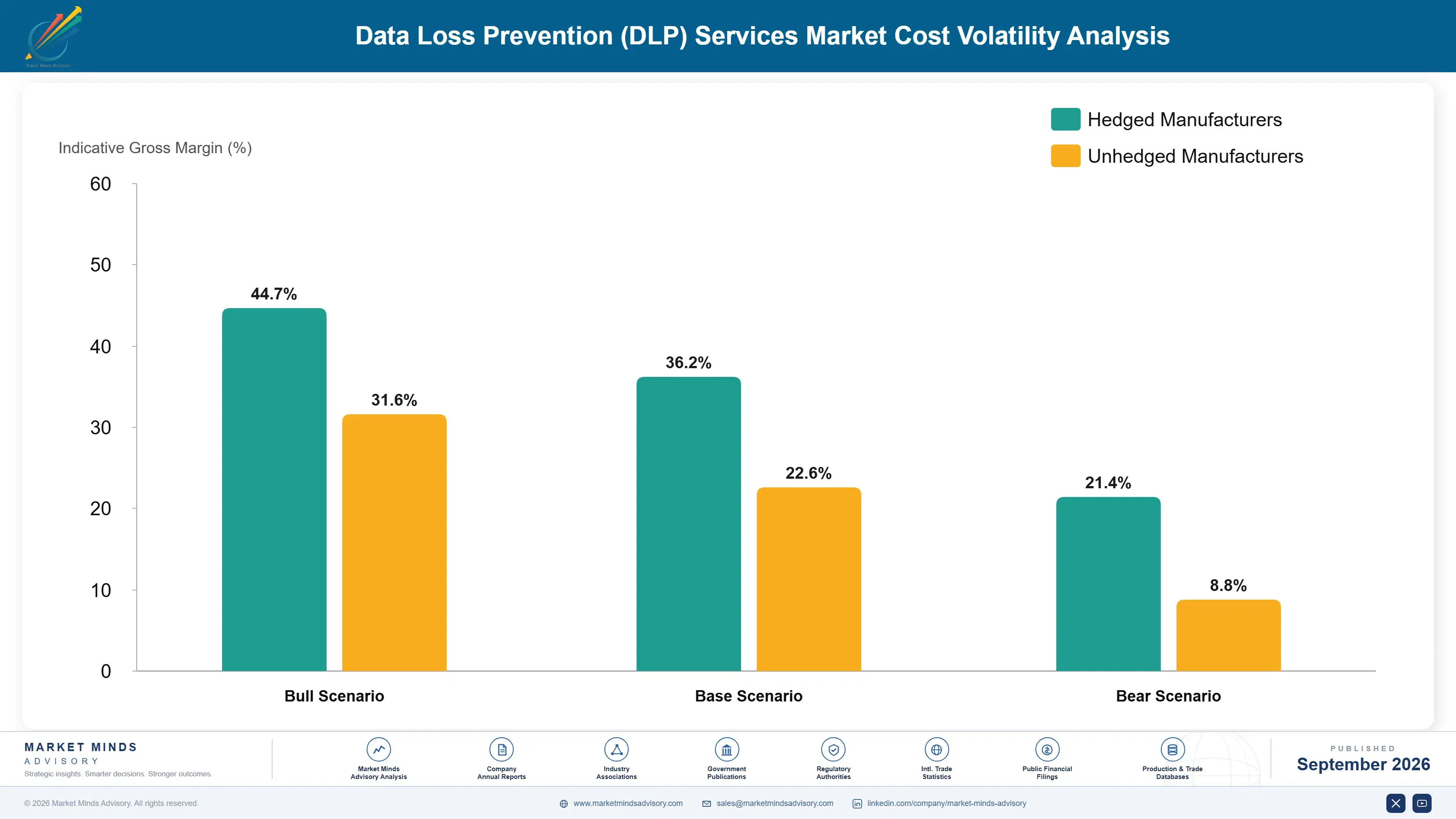
Security Analyst Labor and Cloud Cost Exposure

DLP services cost structures are dominated by skilled security analyst staffing, cloud infrastructure hosting, and machine learning model development, together representing roughly 55 to 65% of total operating cost for premium managed providers. Skilled analyst staffing alone accounts for a disproportionate share, given persistent cybersecurity talent shortages affecting the entire industry broadly. This concentration limits alternative cost reduction options considerably.
Security analyst compensation rose meaningfully during 2024 according to industry disclosures in major cybersecurity company annual reports, squeezing margin for providers that had not locked in longer-term staffing contracts ahead of the increases. Providers with strong offshore delivery capabilities absorbed the shock far more comfortably than those dependent entirely on domestic analyst hiring, according to subsequent public filings covering the affected period. Providers are increasingly diversifying staffing models as a direct response to this volatility.

Providers without diversified staffing models face a persistent competitive disadvantage, since analyst compensation volatility erodes margin faster than better-resourced competitors who can absorb multi-region staffing costs internally. This exposure varies considerably by provider size too, as larger operators with dedicated training academies face materially less talent cost risk than smaller providers competing for scarce analysts externally. Smaller providers face steeper exposure overall.
data-loss-prevention-dlp-services-market-company-positioning-matrix-1788454868867

Offshore Delivery Center Investment

Leading providers now operate offshore delivery centers to access lower-cost skilled analyst talent pools, trading some time zone coordination complexity for predictable long-term staffing costs across service tiers. This shields margin during domestic salary spikes seen in 2024. Providers that skipped this step now pay noticeably higher domestic salaries whenever talent markets tighten again unexpectedly.

Internal Analyst Training Academy Programs

Providers investing in dedicated internal training academies reduce dependence on the competitive external hiring market for experienced analysts, trading upfront training investment for predictable long-term talent pipeline costs. Larger providers are pulling further ahead through this route each year. Smaller specialists dependent on external hiring face a widening cost disadvantage as a direct result.

Automation-Driven Alert Triage Programs

Some providers are deploying automated alert triage systems that reduce the volume of alerts requiring human analyst review, trading upfront automation investment for meaningfully improved staffing cost predictability. Adoption remains cautious given accuracy validation requirements involved. Larger providers with bigger automation budgets are moving faster on this front than smaller regional competitors. Results vary.

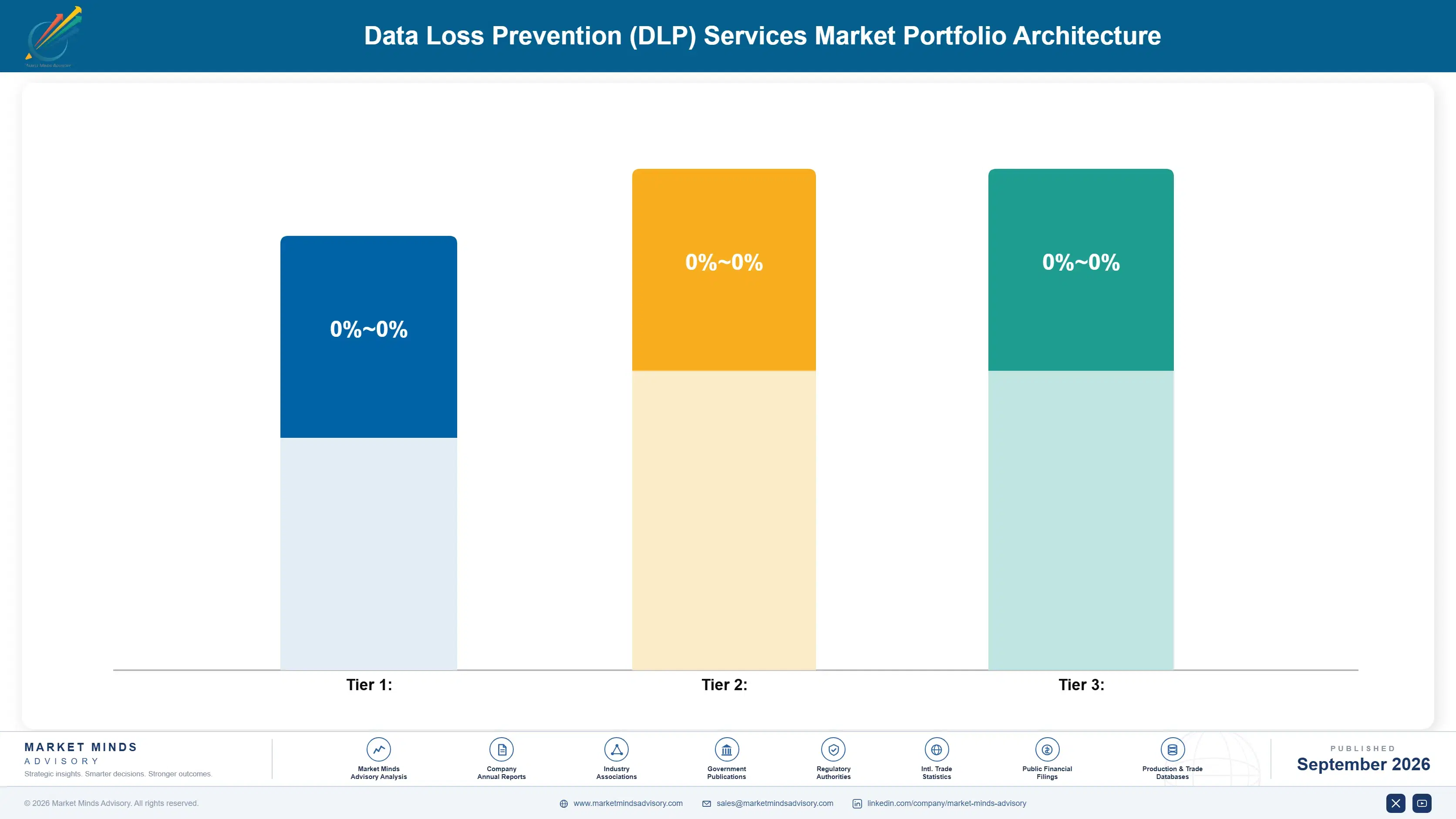
Portfolio Architecture for Margin Defence

DLP service providers organize revenue across three tiers with sharply different margin economics. Volume and commodity-adjacent basic monitoring services compete on price and specification compliance, while premium and certified cloud-native managed services command pricing power through machine learning classification and compliance mapping that few generalist challengers can replicate quickly. Cloud-native architecture is now a baseline requirement for regulated financial services buyers. Budget vendors compete mainly on price and basic compliance rather than integration depth.
Sustainability, regulatory, and next-generation tiers capture the smallest current volume but the fastest expansion, anchored in multi-cloud certification and managed detection and response bundling that enterprises increasingly favor over point solutions. Margin concentration sits disproportionately here, and providers with early MDR bundles capture outsized share of new consolidated vendor renewals. Vendors that shipped early are pulling further ahead of slower rivals in this category.

The volume versus premium tension shows up clearest in on-premises versus cloud-native channels, where budget buyers accept basic monitoring while regulated enterprises pay a real premium for certified, integrated systems. High-value pools concentrate around compliance consulting rather than standalone monitoring services, which increasingly compete on price alone. This compresses standalone monitoring vendor margin considerably each renewal cycle across the board.

Basic on-premises monitoring services compete primarily on price and minimum specification compliance, with thin margins driven by intense competition among regional providers. Regional buyers push aggressive price negotiation during competitive bidding cycles, squeezing this tier's already thin margins further.
Gross Margin

Cloud-native managed services with machine learning classification command premium enterprise pricing that basic on-premises services cannot access at any comparable price point. Certification partnerships built here tend to be sticky and difficult for later entrants to displace quickly.
Gross Margin

Multi-cloud certified MDR bundling platforms earn the highest margins as enterprises favor consolidated vendor relationships over managing multiple point solutions. Providers leading this shift are capturing outsized share of new enterprise renewal demand.
Gross Margin
data-loss-prevention-dlp-services-market-cost-volatility-analysis-1788454869375

High-value Sub-segments and Strategic Watch-out

Managed Detection and Response Bundling

MDR-bundled contracts combine high per-client pricing with rapid growth as enterprises consolidate security vendor relationships to reduce operational complexity and vendor management overhead. This segment shows the fastest near-term contract value growth of any category tracked this cycle by a wide margin. Vendors plan accordingly.

Regulatory Compliance Consulting Services

Compliance mapping consulting carries high per-engagement value but slower expansion, gated by lengthy relationship-building processes and multi-jurisdiction regulatory expertise requirements industry-wide. Cross-jurisdiction regulatory verification further extends typical engagement timelines considerably across most enterprise clients surveyed. Vendors plan for this timeline across most engagements and jurisdictions.

Basic On-Premises Monitoring Services

Basic on-premises monitoring services remain the largest deployed base by client count, generating steady revenue even as growth slows across this mature, price-competitive segment. Differentiation has largely disappeared across this segment over the past several years as features converge. Pricing pressure continues each quarter. Growth continues.

Legacy Rule-Based Detection Exposure

Providers reliant on legacy rule-based detection face mounting displacement risk as machine learning classification gains share, making this a strategic watch point despite steady near-term demand. Adoption still continues each year as some buyers accept the risk for lower upfront switching cost. Legal costs keep rising for exposed operators.

Recurring Value Beyond Deployment Fees

DLP services increasingly generate recurring value through compliance consulting and MDR bundling rather than one-time deployment project fees, giving providers annuity-like revenue once a client becomes an ongoing, subscribed security partner. Switching costs rise sharply once enterprises integrate a specific provider's classification policies into their own compliance workflows and audit processes. Renewal rates for compliance-linked contracts now run well above the broader basic monitoring market generally.
Adoption stickiness varies considerably by end-use vertical. Financial services and healthcare clients run deep, embedded into regulatory compliance frameworks and audit cycles that resist replacement for years, while smaller businesses stay shallow, often swapped whenever a cheaper vendor wins a renewal bid. Technology company clients sit between the two, tied to specific product security requirements rather than genuine platform loyalty. Major financial institutions increasingly lock in single providers for entire multi-year regulatory compliance program contracts spanning many business units and years.

Buyer profiles are shifting generationally as chief information security officers, not IT procurement generalists, now drive vendor selection at large enterprises, prioritizing detection accuracy over unit price. This handover favors incumbents with proven compliance relationships over newer entrants offering only lower cost. Compliance officers now push detection accuracy requirements into vendor contracts earlier than before.
Section default visual

Four calls that define the decade.

These are among the four positions where our research anticipates prominent divergence between winners and laggards over the coming forecast period. Each is grounded in the demand model, the regulatory perimeter, and the announced capacity pipeline.

Engagement Snapshot From the Field

A live engagement with an industry participant carrying material or product regulatory and market exposure ahead of a defining policy shift, showing how our research translates into a defensible multi-year portfolio strategy.
MARKET MINDS ADVISORY · CLIENT ENGAGEMENT SUMMARY
Data Loss Prevention (DLP) Services Producer Strategic Portfolio Review and Transition Roadmap 2026·Investment Scenario on Data Loss Prevention (DLP) Services Exposure Evaluation 2025-26
CLIENT PROFILE
STRATEGIC CHALLENGE
MMA APPROACH
KEY FINDINGS
    CLIENT PROFILE
    STRATEGIC CHALLENGE
    MMA APPROACH
    KEY FINDINGS
      RECOMMENDED STRATEGY
      OUTCOME

      Frequently Asked Questions

      Foundational context covering the market sizes, CAGR, scope, country, region and competition that inform every finding below. This section is provided to cover basics and most often pre-purchase conversations, answered from the MMA Primary Research Dataset.

      Report Segmentation Architecture

      The full report scope spans multiple orthogonal segmentation dimensions, with cross-tabulated demand data provided for each dimension pair. Coverage extends further to regional breakdowns, trend trajectories, and the competitive detail needed to support segment-level decision-making.

      By Region

      • North America
      • Western Europe
      • East Asia
      • South Asia and Pacific
      • Latin America
      • Middle East and Africa
      • Eastern Europe

      Scope, Methodology, and Coverage

      Every figure in this report is reproducible from documented input assumptions. The scope below maps the historical period, the forecast horizon, the segmentation dimensions, and the countries covered, alongside the underlying primary and qualitative methodology.
      Historical Period
      2020 to 2025
      Forecast Period
      2026 to 2036
      Base Year
      2025 (USD billions; MMA Primary Research Dataset, September 2026)
      Market Definition
      This market covers managed and professional services that deploy, configure, and monitor data loss prevention technology to detect and prevent unauthorized data exfiltration across enterprise environments. It excludes standalone DLP software licensing sold without accompanying deployment, configuration, or ongoing monitoring services.
      Quantitative Units
      USD billions
      Segmentation Dimensions
      Regions Covered
      North America, Western Europe, East Asia, South Asia and Pacific, Latin America, Middle East and Africa, Eastern Europe
      Countries Covered
      Key Companies Profiled
      Symantec (Broadcom), Forcepoint LLC, McAfee Enterprise, Digital Guardian, Microsoft Purview, Proofpoint Inc, Zscaler Inc, Netskope Inc, Code42 Software, GTB Technologies, Safetica Technologies, Endpoint Protector (CoSoSys), Varonis Systems, Spirion LLC, Fortra LLC, Palo Alto Networks, Cisco Systems, IBM Security Guardium, Google Workspace DLP, Trustwave Holdings
      Quantitative Methodology
      Primary survey, n=3,800 respondents, Q4 2025, six countries; demand-side model with trade association cross-validation
      Qualitative Methodology
      47 expert interviews, Q4 2025; applied to validate demand model assumptions, identify emerging dynamics, and assess competitive positioning
      Report Format
      PDF and XLSX data workbook (Word format preview document)
      Publisher
      Market Minds Advisory
      Report Code
      MMA-2026-TEC-199
      Published
      September 2026
      Contact
      sales@marketmindsadvisory.com | www.marketmindsadvisory.com

      Purchase the full Data Loss Prevention (DLP) Services Market Report (2026 to 2036).

      Built For The People Who Decide

      From boardroom strategy to bench-side execution, this report is read cover-to-cover by leaders shaping the next decade of their industry, turning demand scenarios, market dynamics and valuation benchmarks into decisions.
      CXOs/ Presidents/ VPs/ Managers
      M&A and Corporate Development
      Strategy Teams and R&D Heads
      Procurement and Product Directors
      Regulatory and Compliance Leaders
      Investor Relations and Equity Analysts