Market Minds Advisory
Data Fabric Market

Data Fabric Market: Data Fabric Market. AI Data Integration Demand Forces a Unified Architecture Shift

Enterprise AI initiatives are stalling on fragmented, siloed data, pushing IT teams still relying on manual data pipeline integration toward metadata-driven data fabric platforms that unify access across every data source automatically.

Lead Analyst

Published

September 2026

Make Smarter Decisions with Customized Research Insights

Request a free sample report and evaluate market opportunities, growth trends, and competitive dynamics relevant to your business needs.

2025 MARKET VALUE$3.1BMarket Size 2025
2036 FORECAST VALUE$18.3BBase Case , 2026 to 2036
CAGR 2026 TO 203617.5 %Bull 18.8% / Bear 16.2%
INCREMENTAL OPPORTUNITY$14.6BNet 10- year value creation
EXPANSION MULTIPLE5.02x2036 value over 2026 base
Strategic Levers
M&A Pipeline
Regional Outlook
Country Rankings
Competitive Intelligence
Segmental Deep-dive
Call-Us : 91 93563 13602

Executive Snapshot and Market Trajectory.

An enterprise AI model is only as good as the data it can actually reach, and for most large organizations that data sits scattered across dozens of disconnected systems nobody has fully catalogued or properly mapped in years across the entire company or division.
Enterprise AI initiatives, regulatory data governance requirements, and multi-cloud infrastructure sprawl together drive most demand, each pushing IT teams toward metadata-driven integration platforms rather than custom point-to-point data pipelines built and maintained manually over time. North America's concentrated enterprise software vendor base and aggressive AI infrastructure investment give the region an outsized role in global demand that exceeds its share of overall enterprise IT spending alone.
Five vendors hold under half of global revenue, a fragmented landscape reflecting how differently organizations approach data architecture depending on whether they need a full platform replacement, an overlay across existing data warehouses and lakes, or a narrow governance and cataloging layer alone. Rising AI-driven active metadata management is pushing buyers toward platforms capable of automated data discovery and lineage tracking, a shift that favors vendors with strong machine learning capability over legacy cataloging tools.
Market Definition
The data fabric market covers software platforms that provide unified, metadata-driven access to data distributed across multiple sources, formats, and locations without requiring physical data consolidation. It excludes traditional extract-transform-load tools sold as standalone point solutions and general-purpose database management systems that do not provide cross-source unified access.
Base Year Value
$3.1B in 2025 (MMA Primary Research Dataset, September 2026)
Forecast Period
2026 to 2036, eleven discrete annual values
CAGR
17.5% base case. Bull 18.8%. Bear 16.2%.
Fastest Growth Segment
AI-Augmented Active Metadata Management Platforms: 26.8% CAGR
Fastest Growth Country
India: 22.1% CAGR
Fastest Growth Region
South Asia and Pacific: 19.7% CAGR
Largest Region
North America: 32% of 2025 global value
Market Leaders
IBM, Informatica, Denodo, Palantir Technologies, and SAP lead the market. Source: MMA Primary Research Dataset, July 2026.
Primary Survey
n=3,800 procurement and R&D decision-makers, Q4 2025, six countries
Methodology
Demand-side build-up, cross-validated against public data, 47 expert interviews

Data Fabric Market Forecast Scenarios

data-fabric-market-size-forecast-scenario-1790005413324
Between 2020 and 2025 the market grew at roughly 16.5% a year as early enterprise adoption concentrated among the largest, most data-mature organizations before a broader wave of AI-driven demand pulled adoption forward through the back half of the period across a much wider range of company sizes and industries worldwide, particularly across North America and Europe and Asia.
The base case assumes 17.5% annual growth through 2036, built on three mechanisms: accelerating enterprise AI initiatives that require unified access to data scattered across fragmented, siloed systems in order to function reliably at scale, tightening data governance and regulatory compliance requirements that mandate comprehensive data lineage and cataloging capability across every jurisdiction, and expanding multi-cloud and hybrid infrastructure adoption that makes unified metadata management increasingly necessary rather than optional.
A bull case near 18.8% follows if enterprise AI adoption accelerates faster than currently projected across most industry verticals and company sizes worldwide and well beyond all current expectations. The principal bear risk, a slowdown in enterprise IT capital spending that delays data architecture modernization projects across the industry broadly, would instead pull growth toward 16.2%.

Data Fabric Market Overview

Data fabric sits at the point where an enterprise's fragmented data infrastructure either becomes a genuine strategic asset or stays a permanent obstacle to AI initiatives leadership actually wants delivered on a tight schedule. Buyers no longer choose data architecture purely on integration cost. They increasingly demand automated metadata discovery, real-time lineage tracking, and governance controls that satisfy both AI development teams and compliance departments simultaneously.
MARKET CONCENTRATIONCR5 39%Top five vendors hold under half of global revenue
AVERAGE SELLING PRICE$80,000-2.5 millionPrice spans departmental deployments to full enterprise platforms
LEADING COUNTRY BY REVENUEUnited States, 44% shareAmerican enterprise software spending concentrates demand domestically each year
AI INTEGRATION ADOPTION RATE52% of new deploymentsBuyers increasingly favor platforms with automated metadata management capability
IMPLEMENTATION TIMELINE6-18 months averageFull enterprise deployments typically require extended integration and testing periods
INPUT COST SHARE58%Cloud compute infrastructure and specialized engineering talent dominate service cost
The United States hosts a disproportionate share of global demand, reflecting concentrated enterprise software vendor headquarters and aggressive corporate AI infrastructure investment across nearly every major industry vertical and company size. North America more broadly is the largest single demand pool by revenue, driven by extensive multi-cloud adoption and a regulatory environment that increasingly mandates comprehensive data governance documentation.
AI integration adoption is accelerating faster than the overall market, since automated metadata management increasingly determines whether an enterprise AI initiative can actually access the data it needs without months of manual pipeline engineering and troubleshooting effort. Implementation timelines remain lengthy across most large enterprise deployments, reflecting the genuine complexity of unifying access across decades of accumulated, fragmented data systems.
"Every company already has all the data it needs. What it doesn't have is a way to find it, trust it, and use it in the same afternoon, and that gap is the entire market."
Director, Enterprise Data Architecture Practice · MMA Technology Practice · September 2026

Market Trends

AI-powered active metadata management automates data discovery entirely

Data fabric platforms increasingly use machine learning to automatically discover, classify, and map relationships between data assets across an organization's entire technology landscape, rather than requiring data engineers to manually document and maintain these relationships through traditional cataloging processes. This automation dramatically reduces the time required to make new data sources discoverable and usable by both human analysts and AI systems, addressing a persistent bottleneck that has historically delayed enterprise AI project timelines by months. Vendors offering mature active metadata capability increasingly win enterprise contracts against competitors still relying on manual cataloging approaches that scale poorly.
Market Impact: 68% cite data fragmentation as barrier

Data fabric platforms converge with AI governance and compliance tools

Enterprise buyers increasingly demand data fabric platforms that embed AI governance capability directly into the metadata layer, tracking not just where data lives but how it flows into AI models and whether that usage complies with regulatory and internal policy requirements. This convergence reflects growing regulatory scrutiny of AI systems specifically, which requires organizations to demonstrate data provenance and usage compliance in ways that traditional data governance tools were never designed to address comprehensively. Vendors integrating AI governance capability directly into their core platform increasingly differentiate against point solution competitors requiring separate governance tooling.
Market Impact: 30% increase in governance enforcement actions

Market Opportunities and Growth Drivers

Enterprise AI initiatives require unified access to fragmented data

Organizations deploying large language models and other AI systems increasingly discover that model performance depends heavily on access to comprehensive, well-organized data spanning every relevant business system rather than the narrow subset traditionally available through individual application interfaces alone across the enterprise. This requirement generates urgent demand for data fabric platforms capable of unifying access across data warehouses, lakes, and operational systems without requiring costly and time-consuming physical data consolidation projects. Chief data officers increasingly cite data fragmentation as the primary obstacle preventing their organizations from realizing expected returns on AI investment.
Market Impact: 18 month average enterprise deployment

Regulatory data governance mandates require comprehensive lineage tracking

Financial services, healthcare, and other heavily regulated industries face rapidly expanding regulatory requirements around data lineage documentation, requiring organizations to demonstrate precisely where data originated, how it was transformed, and who exactly accessed it throughout its lifecycle across every regulated system currently in active operational use. Manual documentation approaches cannot realistically satisfy these requirements at enterprise scale, creating rising procurement volume for automated lineage tracking capability built directly into data infrastructure. Regulatory enforcement actions citing inadequate data governance documentation are increasingly common across major financial markets, reinforcing this compliance-driven demand.
Market Impact: 45% of buyers cite talent shortage

Market Restraints and Challenges

Lengthy implementation timelines delay realized return on investment

Enterprise data fabric deployments routinely require six to eighteen months of implementation work spanning discovery, integration, and testing phases before organizations ever realize meaningful business value from the substantial platform investment made. The root cause is that most large enterprises operate decades of accumulated, poorly documented legacy systems that resist straightforward automated integration regardless of how sophisticated the data fabric platform itself may be. Several vendors have introduced phased implementation methodologies specifically designed to deliver incremental value milestones rather than requiring a single, lengthy big-bang deployment before any benefit materializes.
Market Impact: 52% of platforms now AI-automated

Specialized talent shortage limits implementation and adoption capacity

Organizations implementing data fabric platforms require specialized data architecture and machine learning engineering talent that remains genuinely scarce relative to enterprise demand across nearly every single major technology market globally and domestically alike each fiscal year. The underlying cause is that data fabric represents a relatively new architectural discipline combining traditional data engineering with active metadata management and AI capability, a skill combination that few universities or training programmes currently teach comprehensively. Several vendors have introduced certification programmes and simplified configuration interfaces specifically to reduce dependency on scarce specialized talent.
Market Impact: 40% of buyers require AI governance
4 additional market trends, 3 additional growth drivers, and 3 additional restraints and challenges are covered in the full report. Contact sales@marketmindsadvisory.com to access the complete intelligence.

Segment CAGR and Growth Architecture

Data fabric segments cleanly by architectural capability, the dimension that determines both automation depth and price for a given enterprise deployment. This framework separates AI-augmented active metadata management platforms, data virtualization and integration layers, data governance and lineage tracking modules, self-service data catalog tools, and orchestration and pipeline automation engines, avoiding overlap between platform function and deployment scope.
data-fabric-market-market-share-analysis-1790005413861

AI-Augmented Active Metadata Management Platforms

AI-augmented active metadata management platforms are pulling ahead of every other configuration as machine learning integration makes automated data discovery and classification genuinely practical at enterprise scale rather than a theoretical capability limited to pilot projects. These platforms continuously scan an organization's data landscape, automatically updating metadata as systems change rather than relying on periodic manual documentation cycles that quickly become outdated. Enterprise buyers increasingly favor this configuration because it delivers both immediate operational value and long-term data governance sustainability that manual cataloging approaches cannot realistically maintain over time. Vendors slow to build mature AI-driven automation increasingly find themselves excluded from major enterprise procurement shortlists entirely. This trend is expected to accelerate further as AI adoption expands.
CAGR 26.8%

Data Virtualization and Integration Layers

Data virtualization and integration layers remain the largest single configuration by installed base, continuing to serve enterprises that need unified query access across multiple data sources without requiring active metadata automation as a mandatory prerequisite. Their appeal lies in proven, mature technology and straightforward integration with existing business intelligence tools, a genuine advantage for organizations prioritizing immediate query performance over long-term governance sophistication. Enterprises with established data warehouse investments continue generating steady replacement and expansion demand for this established, cost-effective configuration. Manufacturers continue supporting this technology given its substantial existing installed base across established enterprise data warehouse environments worldwide. This installed base advantage is expected to persist for years given typical enterprise replacement cycles.
CAGR 11.3%
Full segment breakdown across 7 segments available in the complete report.

Regional Architecture and Country Demand Map

North America leads on the strength of concentrated enterprise software vendor headquarters and aggressive corporate AI infrastructure investment across most major industries nationwide today, while East Asia and Western Europe follow closely behind on rapidly expanding data governance regulation and broader enterprise digital transformation spending.

North America

The United States hosts the headquarters of most leading data fabric vendors, reflecting decades of enterprise software industry concentration and deep venture capital investment in data infrastructure startups. American enterprises across financial services, healthcare, and technology sectors are aggressively deploying AI initiatives that require unified data access, generating sustained demand independent of broader IT budget cycles. Canadian enterprise adoption adds meaningful incremental volume behind the much larger American market, growing at a broadly comparable pace overall. Federal government agencies are also modernizing legacy data infrastructure through dedicated digital transformation programmes, further supporting this baseline demand pool across most departments nationwide. This pace is expected to hold steady. Vendor investment continues expanding steadily each year.
Share: 32% | CAGR: 18.6% (2026 to 2036)

East Asia

China's rapidly expanding technology and financial services sectors are driving substantial data fabric adoption, though domestic vendors increasingly dominate given data localization requirements limiting foreign vendor participation in sensitive sectors. Japanese and South Korean enterprises favor established, proven data governance platforms given strong domestic regulatory compliance culture and risk-averse enterprise purchasing patterns. Rising AI adoption across the region's technology and manufacturing sectors is accelerating data fabric procurement considerably. Domestic regulatory frameworks increasingly favor locally developed platforms over foreign alternatives, reshaping competitive dynamics across the region's largest national enterprise markets and their supply chains. Vendor investment in this region continues rising steadily each year across most product categories tracked. This trend is expected to continue through the decade.
Share: 22% | CAGR: 18.4% (2026 to 2036)
Regional intelligence for 5 additional markets available in the complete report: Western Europe, South Asia and Pacific, Latin America, Middle East and Africa, Eastern Europe. Contact sales@marketmindsadvisory.com.
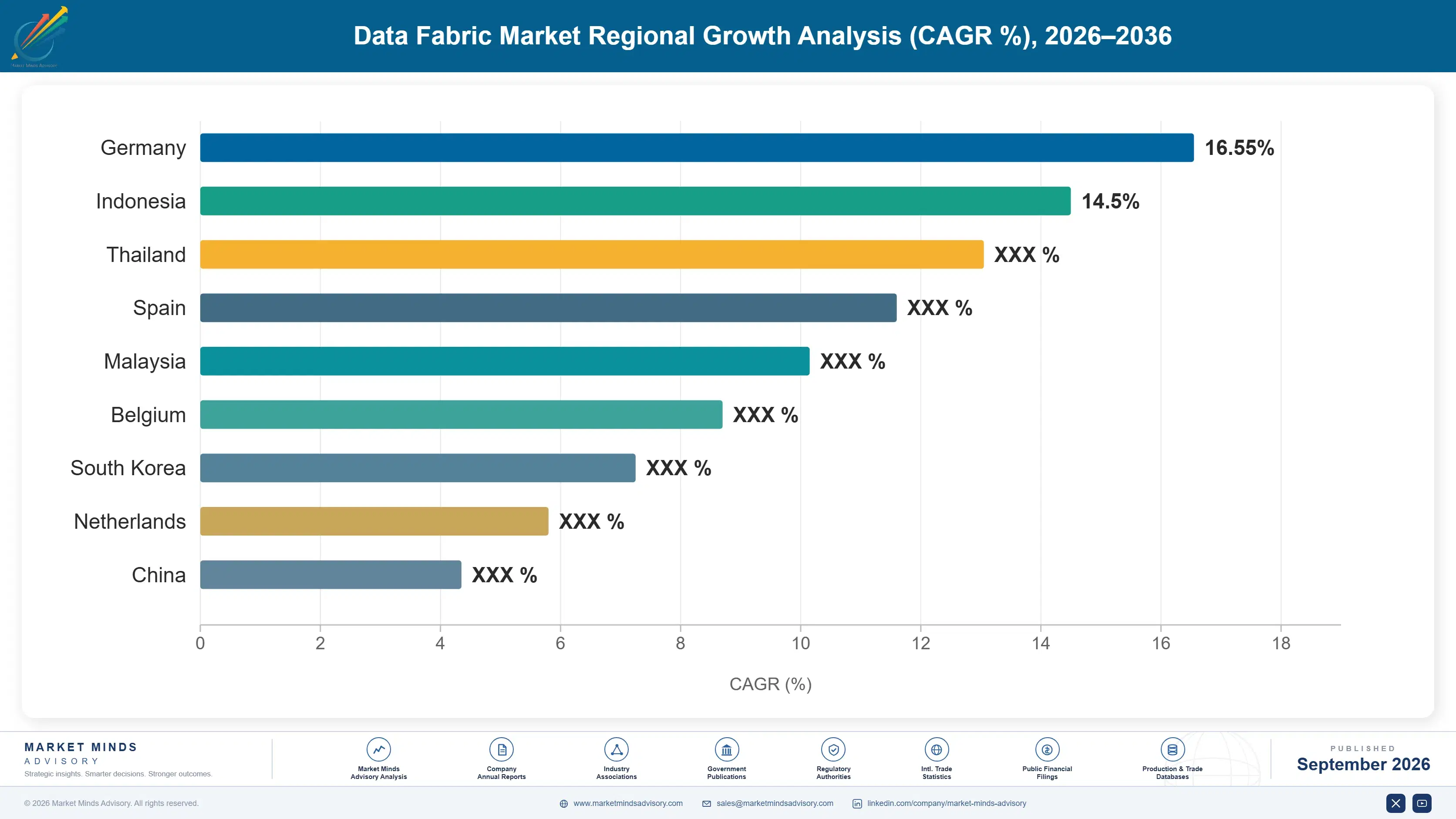
data-fabric-market-country-cagr-analysis-1790005414385

Where Margin Concentrates in Data Fabric

Vendors capture the widest margins where a data fabric platform becomes an embedded enterprise standard rather than a swappable point tool, and where AI-native automation commands a premium over legacy manual cataloging approaches regardless of implementation complexity involved. Four levers stand out as the clearest paths to expanding gross margin over the coming decade ahead.

Bundle AI governance modules with core platform licensing

Vendors that pair core data fabric licensing with a bundled AI governance and compliance module capture recurring revenue well beyond the original platform sale, transforming a standalone integration tool into a comprehensive enterprise risk management relationship that persists over time. Leading vendors have expanded these governance features specifically to help chief data officers justify budget against increasingly stringent regulatory scrutiny of AI systems across the organization. Enterprise customers adopting bundled governance report blended margin improvements of roughly 16 percentage points compared with pure integration platform sales. This shift also strengthens vendor lock-in against competitor switching over the platform's lifetime.
Market Impact: 16 percentage point blended margin uplift from bundling

Win exclusive certification status on major cloud provider marketplaces

Securing preferred-partner certification on a leading cloud provider's enterprise marketplace locks in a steady stream of qualified customers who discover the platform through the provider's own sales channel rather than independent marketing spend or outbound outreach. Cloud providers increasingly route enterprise customer referrals through certified partner programmes, and winning that certification delivers guaranteed deal flow that uncertified competitors cannot access regardless of product quality. Vendors that invest early in this certification typically hold their position for years, worth an estimated 22% revenue premium over uncertified competitors. This certification advantage compounds further as additional cloud regions reference prior successful deployments.
Market Impact: 22% revenue premium earned on marketplace-certified deals directly

Sell industry-specific data models as a premium accelerator tier

Vendors offering pre-built, industry-specific data models and templates for sectors like healthcare or financial services, priced as a premium tier above generic platform licensing, capture margin from enterprise customers seeking faster implementation timelines without lengthy custom consulting engagements. This model rewards vendors that invest early in vertical-specific domain expertise rather than offering generic, one-size-fits-all data models across every industry equally without differentiation. Vendors operating dedicated vertical accelerator tiers report gross margins on this revenue stream near 58%, meaningfully above blended average platform licensing margins overall. Customers value the assurance that industry-specific compliance requirements are already addressed.
Market Impact: 58% gross margin achieved on industry accelerator revenue

License benchmark and maturity assessment data to consulting firms

Management consulting firms increasingly pay data fabric vendors for aggregated, anonymized enterprise data maturity benchmark data used to advise clients on data transformation roadmaps and vendor selection decisions across their broader client portfolios. This creates a software-like revenue stream layered on top of the original platform sale, carrying margins that substantially exceed those available on platform licensing alone. Early adopters of this model report that benchmark data licensing revenue, while still a modest share of total sales, carries gross margins above 70% and grows independently of new customer acquisition volume.
Market Impact: 70% gross margin achieved on benchmark data licensing

Who Controls the Margin Pool

Five vendors, measured by revenue, hold under half of global data fabric market sales, leaving the remainder split among specialist metadata management startups, cloud-native integration platforms, and legacy enterprise software vendors extending existing product lines. IBM and Informatica lead this group given their broad enterprise customer relationships and established credibility within data governance and integration disciplines, and the gap to the third-ranked player is wide enough that challengers compete mainly for the remaining specialist and regional segments.
Current competitive activity centres on AI-native metadata automation and governance integration, with vendors racing to embed machine learning-driven data discovery while building compliance capability directly into the metadata layer. Several producers have added industry-specific accelerator templates to previously generic offerings, letting a single sales relationship cover a broader share of an enterprise customer's vertical-specific implementation needs.

Emerging pressure is coming from cloud hyperscalers bundling basic data integration capability into broader cloud platform subscriptions at minimal incremental cost, testing whether specialized data fabric vendors can defend their governance and cross-cloud flexibility advantage against convenient, already-paid-for alternatives. Rankings are most likely to shift among smaller enterprises price-sensitive enough to accept bundled cloud tools over dedicated platforms that larger enterprises still value for advanced governance capability.
data-fabric-market-company-positioning-matrix-1790005414909

Competitive Moat and Risk Dimensions

IBM

Moat: Deep enterprise data governance credibility

IBM has supplied enterprise data management and governance software for decades, building relationship depth and regulatory compliance credibility that newer entrants cannot replicate quickly. This depth lets IBM win specification battles on proven reliability even where challengers offer newer, more agile AI-native architecture at competitive pricing.
IBM

Risk: Slower cloud-native architecture transition

IBM's core strength lies in enterprise governance and legacy system integration rather than cloud-native, API-first architecture that younger competitors design around from inception, leaving room for agile challengers to win specification battles specifically on deployment speed and modern developer experience across most enterprise accounts and use cases.
INFORMATICA

Moat: Broad data integration product portfolio

Informatica offers one of the widest ranges of data integration and quality management tools spanning on-premise, cloud, and hybrid environments, letting enterprises consolidate purchasing with a single vendor across multiple data architecture initiatives and business units simultaneously and cost-effectively across their entire organization, reducing vendor sprawl considerably.
INFORMATICA

Risk: Legacy licensing model transition challenges

Informatica's traditional licensing model, while historically profitable, faces mounting pressure from competitors offering more flexible consumption-based pricing that better matches how enterprises actually want to pay for cloud-native data infrastructure services today across their expanding technology stacks and budgets, particularly among younger, faster-growing customer accounts.

Players Tracked

Prominent Players

IBM
Informatica
Denodo Technologies
Palantir Technologies
SAP

Other Key Players

Oracle
Microsoft
Databricks
Cloudera
TIBCO Software
Collibra
Alation
K2View
Ataccama
NetApp
Cinchy
Qlik
IRI (Innovative Routines International)
Software AG
Reltio

Recent Developments

MARCH 2026

SAP expanded its Datasphere platform with native active metadata management and AI-driven lineage tracking capability, integrating third-party catalog connectors so joint customers can unify governance across SAP and non-SAP environments. The expansion targets large enterprises running hybrid landscapes spanning legacy ERP and newer cloud analytics workloads.
Signal: Signals incumbent ERP vendors racing to embed active metadata natively rather than ceding that layer to specialist competitors.
NOVEMBER 2025

Palantir Technologies announced a strategic partnership with a major cloud hyperscaler to co-sell its Foundry data integration layer bundled with native large language model orchestration tools, aimed at accelerating enterprise adoption among regulated industries including healthcare, defense, and financial services clients across multiple geographies and deployment models.
Signal: Signals platform vendors pairing distribution muscle with AI orchestration to shorten enterprise sales cycles in regulated verticals.

Talent and Cloud Compute Cost Pressure

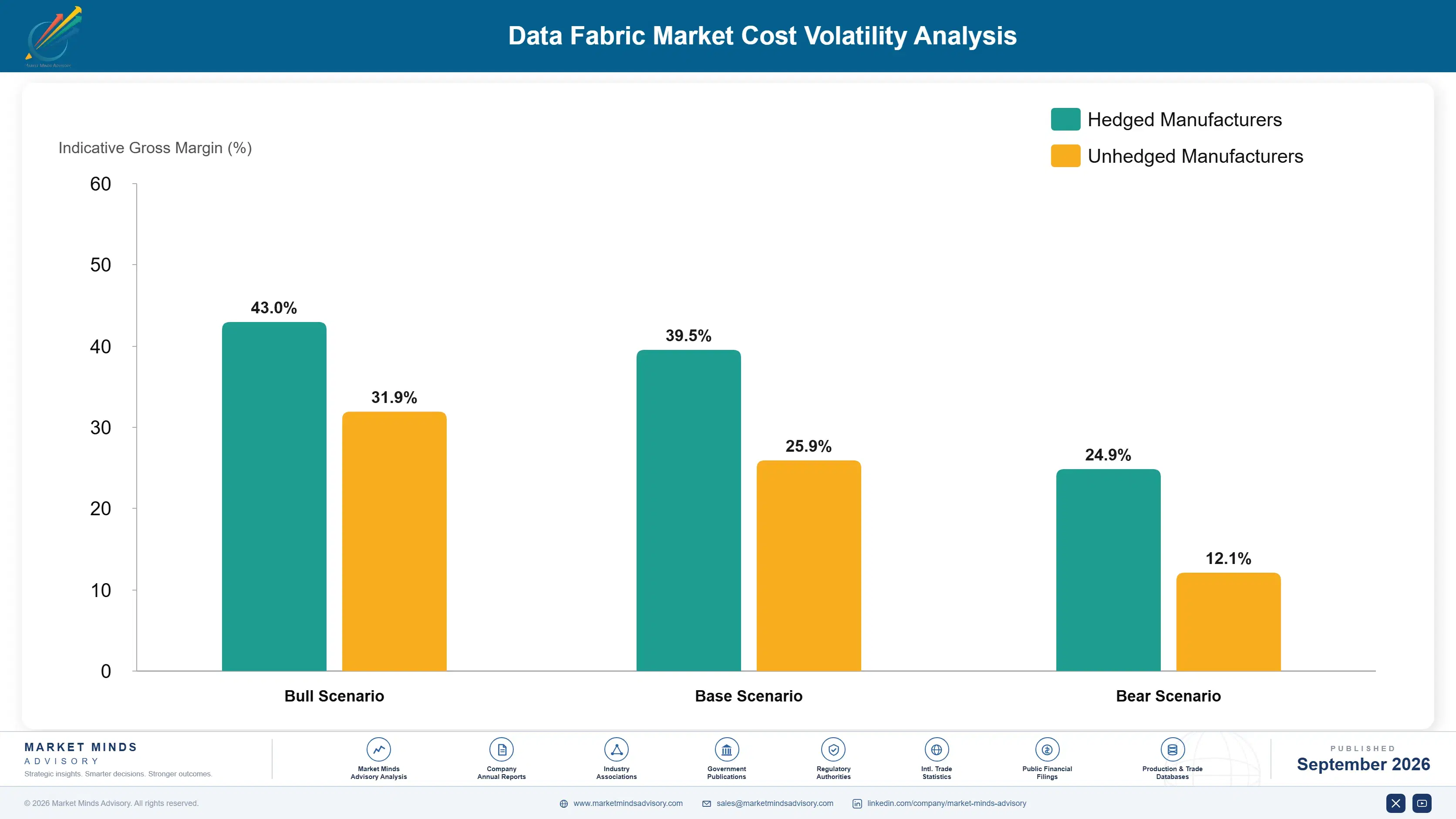
Data fabric platform economics rest on two primary cost inputs: specialized engineering talent, which represents an estimated 40 to 48% of vendor cost of goods sold, and underlying cloud compute and storage capacity leased from hyperscale providers, representing a further 22 to 28%. Talent originates largely from concentrated hubs in North America, Western Europe, and India, while compute capacity is sourced almost entirely from three hyperscale cloud providers.
Cloud compute pricing volatility became visible in 2025 when a major hyperscaler raised GPU instance pricing by roughly 14% following surging demand from generative AI workloads, according to company investor day disclosures. Vendors reliant on GPU-accelerated embedding generation for active metadata catalogs absorbed higher hosting costs mid-contract, compressing gross margin on existing enterprise deployments by an estimated 2 to 3 percentage points within two quarters.

Smaller specialist vendors carry disproportionate exposure because they lack the negotiating leverage over hyperscale contracts that IBM, SAP, and Oracle secure through broader enterprise cloud agreements spanning multiple product lines and geographies. This cost asymmetry compounds over multi-year contracts, pushing some smaller vendors toward acquisition rather than continued independent compute procurement, particularly once venture funding runways begin to shorten.
data-fabric-market-cost-volatility-analysis-1790005415105

Multi-cloud contract diversification

Vendors increasingly negotiate capacity commitments across two or three hyperscale providers simultaneously rather than a single provider, using competitive bidding to cap annual price increases and preserve switching leverage as GPU demand keeps rising across the broader enterprise software industry through the remainder of the decade and into the next planning cycle for most large enterprise buyers.

Remote talent hub expansion

Leading vendors expand engineering hiring into lower-cost talent hubs including Eastern Europe, India, and Latin America, reducing blended fully-loaded engineering cost per headcount by an estimated 20 to 30% versus concentrating hiring solely in North American metro markets, while preserving delivery quality across distributed teams through structured onboarding and mentorship programs run by senior staff.

Portfolio Architecture for Margin Defence

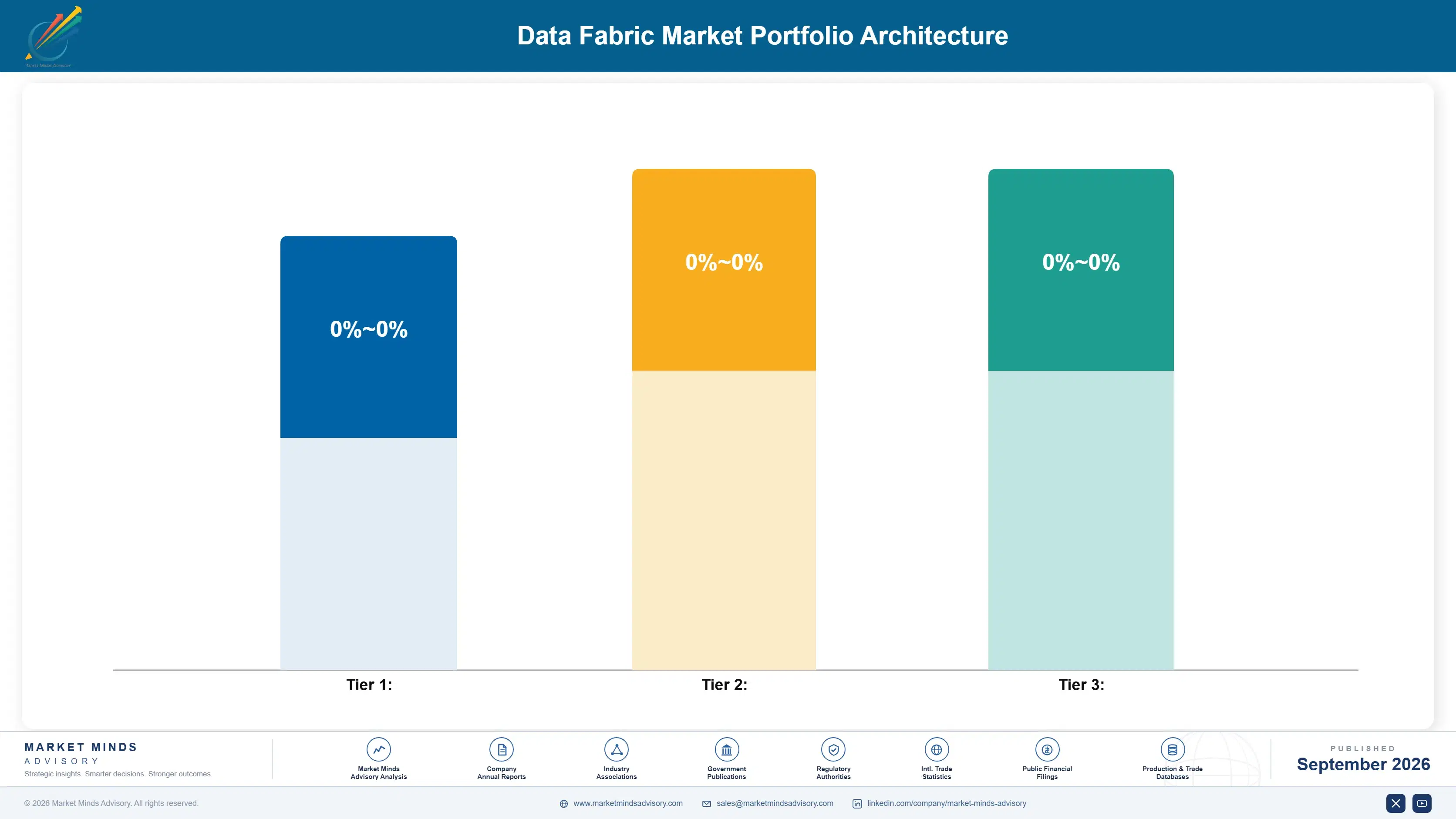
Data fabric vendor portfolios span a wide margin gradient, from commodity integration connectors sold on thin per-seat licensing to premium AI-augmented governance modules commanding substantially higher gross margin across nearly every deployment scenario. Vendors that once competed primarily on pipeline throughput now differentiate through embedded intelligence layers that automate discovery, lineage, and policy enforcement without manual configuration or dedicated integration staff. Buyers now expect this intelligence as a baseline capability rather than a differentiator.
The volume tier still anchors most vendor revenue today, but margin expansion increasingly comes from premium certified modules and sustainability-linked governance add-ons that regulated buyers pay a substantial premium to adopt across their compliance-heavy operating environments. This tension between volume retention and premium migration shapes how vendors prioritize product roadmaps and sales incentive structures across enterprise accounts of every size.

High-value margin pools concentrate specifically around active metadata management and AI-native governance, where buyers accept premium pricing in exchange for reduced compliance risk and faster analyst productivity across distributed teams and hybrid work arrangements. Vendors slow to build genuine AI-native capability risk ceding this expanding premium pool to newer, more focused competitors within the next several product cycles and budget reviews.

Standard connectors, batch integration pipelines, and basic catalog listing tools sold largely on per-seat or per-connector licensing to mid-market buyers with limited governance requirements across most standard deployment scenarios and industries.
Gross Margin

Certified integration modules bundled with advanced governance, role-based access controls, and vendor-verified security certifications sold primarily to regulated enterprise buyers requiring audit-ready documentation across financial, healthcare, and government accounts worldwide.
Gross Margin

AI-augmented active metadata management, automated regulatory compliance mapping, and generative lineage documentation tools commanding the highest margin as buyers pay for reduced manual compliance labor and faster audit turnaround times.
Gross Margin
data-fabric-market-portfolio-architecture-1790005415602

High-value Sub-segments and Strategic Watch-out

AI-Augmented Active Metadata Management

The fastest-growing, highest-margin pool in the market, combining automated discovery with generative documentation. Enterprise buyers increasingly treat this as a mandatory purchase rather than an optional add-on, pulling budget away from legacy catalog tools across nearly every regulated industry vertical. This dynamic should persist through the forecast period.

Data Virtualization and Integration Layers

A high-value, moderate-growth pool where established vendors defend share through deep connector libraries and proven reliability at scale. Growth remains healthy but slower than AI-native governance as the underlying technology matures across enterprise deployments broadly over the coming several years. This dynamic is expected to persist through the forecast period.

Batch ETL and Legacy Pipeline Tools

The volume core of the market, still generating the largest absolute revenue pool despite slowing growth. Vendors defend this base through bundled pricing and long-standing enterprise contracts even as buyers gradually shift new spending toward modern architecture across most industry verticals globally. This dynamic should persist through the forecast period.

Standalone Data Catalog Tools

A strategic watch-out segment facing margin compression as active metadata management platforms increasingly absorb catalog functionality natively. Standalone catalog vendors without a credible AI roadmap risk losing renewal share to bundled platform competitors within a few years across most customer segments. This dynamic should persist through the forecast period.

Where Data Fabric Demand Compounds

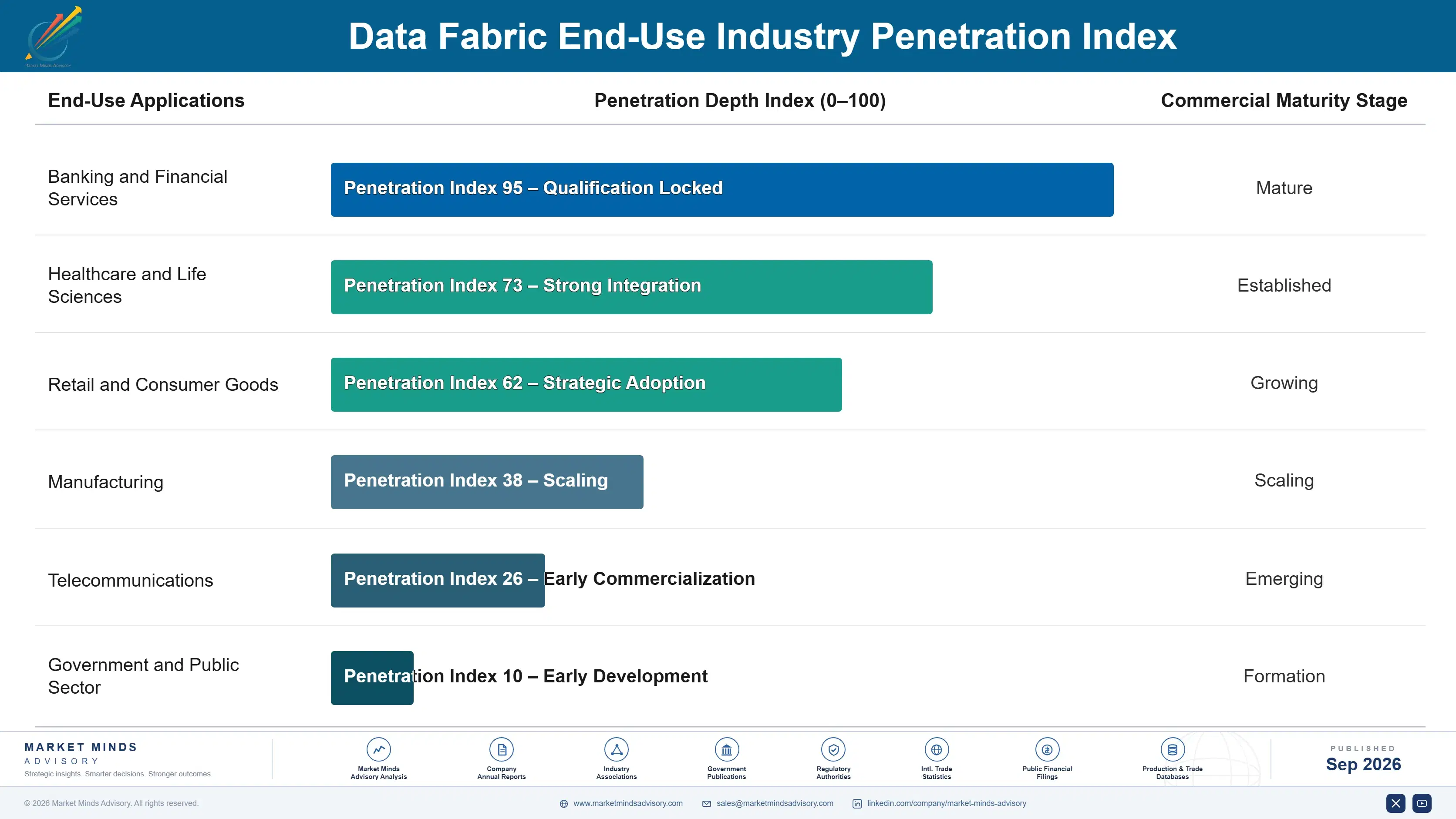
Data fabric contracts increasingly resemble annuity revenue rather than one-time integration projects, since enterprises rarely rip out a working metadata layer once analysts and downstream applications depend on it daily for reporting and decision-making. Renewal rates on active metadata deployments run notably higher than legacy ETL contracts, and expansion revenue from added connectors and governance modules compounds steadily across multi-year enterprise relationships and budget cycles.
Adoption stickiness varies meaningfully by end-use vertical: financial services and healthcare buyers embed data fabric platforms deep into regulatory reporting workflows, making displacement costly and rare, while retail and media buyers adopt more selectively around specific analytics use cases, keeping switching costs comparatively lower and renewal cycles shorter across those less regulated industries and business functions. Vendors track this variance closely when prioritizing vertical-specific feature investment.

Buyer profiles are shifting generationally as chief data officers, rather than traditional IT infrastructure leaders, increasingly own the purchasing decision, prioritizing governance and AI readiness over raw pipeline throughput across the enterprise. This generational handoff favors vendors building AI-native features from the ground up over incumbents retrofitting older integration architecture piece by piece. Vendors that misjudge this shift risk losing the champion inside the buying committee entirely.
data-fabric-market-end-use-penetration-index-1790005416088

Where MMA Sees Value Building

These are among the four positions where our research anticipates prominent divergence between winners and laggards over the coming forecast period. Each is grounded in the demand model, the regulatory perimeter, and the announced capacity pipeline.
01 / PLATFORM SELECTION DISCIPLINE

Prioritize vendors with genuine AI-native metadata architecture

Enterprise buyers evaluating data fabric platforms should weight AI-native active metadata capability well above legacy integration breadth when comparing vendor shortlists for multi-year commitments across procurement and IT governance teams. Vendors retrofitting older architecture with bolted-on AI features typically underperform purpose-built competitors on discovery accuracy and governance automation within eighteen months of deployment, according to buyer feedback gathered across the primary survey. Buyers that select correctly the first time avoid a costly, disruptive mid-contract migration two or three years later.
02 / VENDOR CONSOLIDATION TIMING

Expect accelerating acquisition activity among mid-tier specialists

Mid-tier data fabric specialists lacking hyperscale cloud relationships face mounting compute cost pressure that larger, better-capitalized competitors do not carry to the same degree across their existing contract base and customer accounts. MMA expects acquisition activity among these specialists to accelerate over the next two to three years as venture funding runways shorten and growth expectations reset across the sector broadly and unevenly across regions. Enterprise buyers should factor this acquisition risk into any multi-year specialist vendor contract they are about to sign.
03 / REGULATORY READINESS INVESTMENT

Build governance capability ahead of tightening data regulation

Data privacy and AI governance regulation is tightening across multiple major markets simultaneously, and vendors that already embed automated compliance mapping into their platforms will command a durable advantage over those retrofitting governance reactively after new rules take effect across their installed customer base. This advantage compounds as audit requirements grow more frequent and detailed across regulated industries worldwide over the coming several years. Enterprises operating across multiple jurisdictions should prioritize platforms demonstrating proven multi-region compliance handling today rather than promised roadmap features.
04 / TALENT AND DELIVERY RISK

Account for specialist talent scarcity in deployment timelines

Specialized data fabric implementation talent remains scarce relative to demand, and enterprises underestimating this constraint routinely see deployment timelines slip well beyond initial vendor estimates and internal project plans across most large-scale enterprise rollouts. This talent gap is particularly acute among engineers who understand both AI-native metadata modeling and legacy enterprise system integration simultaneously across hybrid technology environments. MMA recommends enterprises budget conservative implementation timelines and secure dedicated vendor delivery resources contractually before ever signing any multi-year vendor agreement at all.

Engagement Snapshot From the Field

A live engagement with an industry participant carrying material or product regulatory and market exposure ahead of a defining policy shift, showing how our research translates into a defensible multi-year portfolio strategy.
MARKET MINDS ADVISORY · CLIENT ENGAGEMENT SUMMARY
Data Fabric Producer Strategic Portfolio Review and Transition Roadmap 2026·Investment Scenario on Data Fabric Exposure Evaluation 2025-26
CLIENT PROFILE
The client is a multinational insurance carrier operating across twelve countries with over $40 billion in annual gross written premium (client-reported, unverified by MMA). The carrier had accumulated dozens of disconnected policy administration systems through decades of acquisitions, leaving underwriting, claims, and actuarial teams working from inconsistent, poorly governed data sources across separate regional business units.
STRATEGIC CHALLENGE
Fragmented data infrastructure was delaying regulatory reporting cycles and preventing the carrier from deploying AI-driven underwriting models consistently across regions. Leadership needed a unified data access layer that could sit above legacy policy systems without a multi-year, high-risk system replacement program that the board had already rejected twice before engaging MMA.
MMA APPROACH
MMA conducted a structured vendor evaluation spanning six data fabric platforms, combining primary interviews with the carrier's regional technology leaders and hands-on proof of concept testing against real anonymized policy datasets. The engagement produced a phased implementation roadmap sequencing metadata unification ahead of AI model deployment across underwriting and claims functions.
KEY FINDINGS
  1. Three of six evaluated vendors could not meet the carrier's multi-region data residency requirements without costly custom engineering work (client-reported, unverified by MMA).
  2. Active metadata management reduced manual data reconciliation effort by an estimated 35% during the proof of concept phase across two pilot regions (client-reported, unverified by MMA).
  3. Underwriting teams using the unified data layer priced complex commercial policies approximately 20% faster than teams still working from legacy systems (client-reported, unverified by MMA).
  4. Regulatory reporting preparation time dropped from six weeks to under two weeks in the pilot regions following deployment (client-reported, unverified by MMA).
CLIENT PROFILE
The client is a multinational insurance carrier operating across twelve countries with over $40 billion in annual gross written premium (client-reported, unverified by MMA). The carrier had accumulated dozens of disconnected policy administration systems through decades of acquisitions, leaving underwriting, claims, and actuarial teams working from inconsistent, poorly governed data sources across separate regional business units.
STRATEGIC CHALLENGE
Fragmented data infrastructure was delaying regulatory reporting cycles and preventing the carrier from deploying AI-driven underwriting models consistently across regions. Leadership needed a unified data access layer that could sit above legacy policy systems without a multi-year, high-risk system replacement program that the board had already rejected twice before engaging MMA.
MMA APPROACH
MMA conducted a structured vendor evaluation spanning six data fabric platforms, combining primary interviews with the carrier's regional technology leaders and hands-on proof of concept testing against real anonymized policy datasets. The engagement produced a phased implementation roadmap sequencing metadata unification ahead of AI model deployment across underwriting and claims functions.
KEY FINDINGS
  1. Three of six evaluated vendors could not meet the carrier's multi-region data residency requirements without costly custom engineering work (client-reported, unverified by MMA).
  2. Active metadata management reduced manual data reconciliation effort by an estimated 35% during the proof of concept phase across two pilot regions (client-reported, unverified by MMA).
  3. Underwriting teams using the unified data layer priced complex commercial policies approximately 20% faster than teams still working from legacy systems (client-reported, unverified by MMA).
  4. Regulatory reporting preparation time dropped from six weeks to under two weeks in the pilot regions following deployment (client-reported, unverified by MMA).
RECOMMENDED STRATEGY
Phase 1: Phase one prioritized metadata unification across the two highest-premium regions before expanding to smaller markets, limiting initial implementation risk and cost. Phase 2: Phase two layered AI-driven underwriting models onto the unified data foundation, starting with commercial property lines carrying the highest pricing complexity. Phase 3: Phase three extended the unified data fabric architecture to the remaining ten countries over eighteen months, sequenced by regulatory reporting deadline pressure.
OUTCOME
Eighteen months post-engagement, the carrier reports faster regulatory reporting cycles, measurably reduced manual reconciliation workload, and accelerated underwriting pricing turnaround across its two largest regional markets (client-reported, unverified by MMA). The carrier has since approved budget to extend the architecture to its remaining international operations.

Frequently Asked Questions

Foundational context covering the market sizes, CAGR, scope, country, region and competition that inform every finding below. This section is provided to cover basics and most often pre-purchase conversations, answered from the MMA Primary Research Dataset.

What is the current size of the Data Fabric Market?

The global data fabric market reached an estimated $3.1 billion in 2025. This figure reflects platform licensing, active metadata management, and integration tooling revenue across enterprise deployments worldwide.

How large will the Data Fabric Market be by 2036?

MMA projects the market will reach approximately $18.3 billion by 2036. Growth is driven primarily by AI-native governance adoption and expanding enterprise data integration requirements across regulated industries.

What is the CAGR for the Data Fabric Market 2026 to 2036?

The market is projected to grow at a 17.5% compound annual growth rate across the forecast period. This reflects accelerating enterprise investment in AI-augmented metadata and governance capability.

Which segment is growing fastest?

AI-Augmented Active Metadata Management Platforms leads growth at a 26.8% CAGR, roughly 1.53 times the overall market rate. Enterprises increasingly treat automated metadata discovery as a mandatory purchase.

Who are the major companies in the Data Fabric Market?

IBM, Informatica, Denodo Technologies, Palantir Technologies, and SAP lead the market. These vendors combine broad integration portfolios with expanding AI-native governance and metadata management capability.

Which country is growing fastest?

India leads country-level growth at a 22.1% CAGR. Expanding enterprise IT services delivery and rising domestic cloud adoption are driving rapid data fabric platform deployment across Indian enterprises.

Report Segmentation Architecture

The full report scope spans multiple orthogonal segmentation dimensions, with cross-tabulated demand data provided for each dimension pair. Coverage extends further to regional breakdowns, trend trajectories, and the competitive detail needed to support segment-level decision-making.

By Primary Market Dimension

  • Active Metadata Management Platforms
  • Data Virtualization and Integration Layers
  • Data Governance and Lineage Tracking Modules
  • Self-Service Data Catalog Tools
  • Orchestration and Pipeline Automation Engines
  • Batch ETL and Legacy Pipeline Tools

By End-Use Industry

  • Banking and Financial Services
  • Healthcare and Life Sciences
  • Retail and Consumer Goods
  • Manufacturing
  • Telecommunications
  • Government and Public Sector

By Commercial Dimension

  • Large Enterprise
  • Mid-Market
  • Cloud-Native Deployment
  • On-Premise and Hybrid Deployment

By Region

  • North America
  • Western Europe
  • East Asia
  • South Asia and Pacific
  • Latin America
  • Middle East and Africa
  • Eastern Europe

Scope, Methodology, and Coverage

Every figure in this report is reproducible from documented input assumptions. The scope below maps the historical period, the forecast horizon, the segmentation dimensions, and the countries covered, alongside the underlying primary and qualitative methodology.
Historical Period
2020 to 2025
Forecast Period
2026 to 2036
Base Year
2025 (USD billions; MMA Primary Research Dataset, September 2026)
Market Definition
The data fabric market comprises software platforms that unify data access, governance, and metadata management across distributed, heterogeneous data sources without physically consolidating data into a single repository. It excludes standalone data warehouse and data lake storage products, general-purpose business intelligence tools, and IT infrastructure hardware.
Quantitative Units
USD billions (current prices); unit shipments and licensing seats where applicable
Segmentation Dimensions
By Primary Market Dimension; By End-Use Industry; By Commercial Dimension; By Region
Regions Covered
North America, Western Europe, East Asia, South Asia and Pacific, Latin America, Middle East and Africa, Eastern Europe
Countries Covered
USA, China, Germany, France, UK, Japan, South Korea, India, Australia, Canada, Brazil, Mexico, Indonesia, Vietnam, Thailand, Malaysia, UAE, Saudi Arabia, South Africa, Nigeria, Turkey, Poland, Netherlands, Italy, Spain, Sweden, Switzerland, Argentina, Colombia, Singapore, and additional markets relevant to this sector
Key Companies Profiled
IBM, Informatica, Denodo Technologies, Palantir Technologies, SAP, Oracle, Microsoft, Databricks, Cloudera, TIBCO Software, Collibra, Alation, K2View, Ataccama, NetApp, Cinchy, Qlik, IRI (Innovative Routines International), Software AG, Reltio
Quantitative Methodology
Primary survey, n=3,800 respondents, Q4 2025, six countries; demand-side model with trade association cross-validation
Qualitative Methodology
47 expert interviews, Q4 2025; applied to validate demand model assumptions, identify emerging dynamics, and assess competitive positioning
Report Format
PDF and XLSX data workbook (Word format preview document)
Publisher
Market Minds Advisory
Report Code
MMA-2026-TEC-389
Published
September 2026
Contact
sales@marketmindsadvisory.com | www.marketmindsadvisory.com

Purchase the full Data Fabric Market Report (2026 to 2036).

The full report delivers a comprehensive assessment of the global data fabric market across all seven regions, five segmentation dimensions, and twenty profiled vendors spanning platform providers of every size. It includes detailed forecast modeling through 2036, competitive positioning analysis, input cost exposure, and regulatory tracking across major jurisdictions relevant to enterprise buyers. Buyers receive access to the underlying primary survey dataset and expert interview transcripts referenced throughout the analysis, alongside methodology documentation. Custom consulting engagements building on this research are available on request for enterprise clients.
Ten-year quantitative market sizing and forecast model
Vendor competitive benchmarking and positioning matrix
Detailed regional commentary across seven regions
Primary survey dataset access, n equals 3800
Expert interview transcript summaries and analysis
Quarterly market update subscription option available

Built For The People Who Decide

From boardroom strategy to bench-side execution, this report is read cover-to-cover by leaders shaping the next decade of their industry, turning demand scenarios, market dynamics and valuation benchmarks into decisions.
CXOs/ Presidents/ VPs/ Managers
M&A and Corporate Development
Strategy Teams and R&D Heads
Procurement and Product Directors
Regulatory and Compliance Leaders
Investor Relations and Equity Analysts