Market Minds Advisory
Data Center GPU Market

Data Center GPU Market: Data Center GPU Market. AI Compute Accelerators Racing To Meet Generative AI Training Demand

Generative AI model training clusters are consuming data center GPU supply faster than manufacturing capacity can expand, forcing hyperscalers into multi-year prepayment agreements just to secure allocation for planned compute buildouts.

Lead Analyst

Published

September 2026

Make Smarter Decisions with Customized Research Insights

Request a free sample report and evaluate market opportunities, growth trends, and competitive dynamics relevant to your business needs.

2025 MARKET VALUE$92.0BMarket Size 2025
2036 FORECAST VALUE$1169MBase Case , 2026 to 2036
CAGR 2026 TO 203626.0 %Bull 27.3% / Bear 24.7%
INCREMENTAL OPPORTUNITY$1053MNet 10- year value creation
EXPANSION MULTIPLE10.09x2036 value over 2026 base
Strategic Levers
M&A Pipeline
Regional Outlook
Country Rankings
Competitive Intelligence
Segmental Deep-dive
Call-Us : 91 93563 13602

Executive Snapshot and Market Trajectory.

Generative AI model training clusters are consuming data center GPU supply faster than manufacturing capacity can expand, forcing hyperscalers into multi-year prepayment agreements just to secure allocation for planned compute buildouts spanning multiple generations of accelerator hardware still on the announced product roadmap for the next several years.
AI training workloads adopt the newest GPU generations fastest, driven by escalating large language model parameter counts and inference serving scale, and North America leads deployment given its concentration of both hyperscaler headquarters and the largest AI infrastructure capital expenditure commitments, with enterprise buyers increasingly signing multi-year committed capacity agreements rather than purchasing GPU compute on a pay-as-you-go basis alone across a fragmented multi-vendor cloud strategy spanning both on-premises and public cloud environments.
Competitive intensity now centers on software platform lock-in and manufacturing allocation priority rather than raw chip specification comparison, as NVIDIA defends an overwhelming platform position while AMD pushes aggressive price and open-software positioning, and evolving export control regulation increasingly shapes which vendors clear procurement review at government and hyperscaler buyers navigating sensitive national security and supply chain resilience concerns across multiple allied jurisdictions simultaneously.
Market Definition
The Data Center GPU market covers graphics processing unit hardware deployed in data centers for AI model training, inference serving, and high-performance computing workloads, including supporting high-bandwidth memory components critical to GPU performance. It excludes consumer and gaming graphics cards, general-purpose CPU server processors, and non-GPU AI accelerator architectures such as wafer-scale or tensor streaming chips.
Base Year Value
$92.0B in 2025 (MMA Primary Research Dataset, September 2026)
Forecast Period
2026 to 2036, eleven discrete annual values
CAGR
26.0% base case. Bull 27.3%. Bear 24.7%.
Fastest Growth Segment
AI Training GPUs: 34.0% CAGR
Fastest Growth Country
India: 28.2% CAGR
Fastest Growth Region
South Asia and Pacific: 28.2% CAGR
Largest Region
North America: 32% of 2025 global value
Market Leaders
NVIDIA, AMD, Intel, Huawei, Biren Technology. Source: MMA Analysis based on company annual reports.
Primary Survey
n=3,800 procurement and R&D decision-makers, Q4 2025, six countries
Methodology
Demand-side build-up, cross-validated against public data, 47 expert interviews

Data Center GPU Market Forecast Scenarios

data-center-gpu-market-size-forecast-scenario-1789991297507
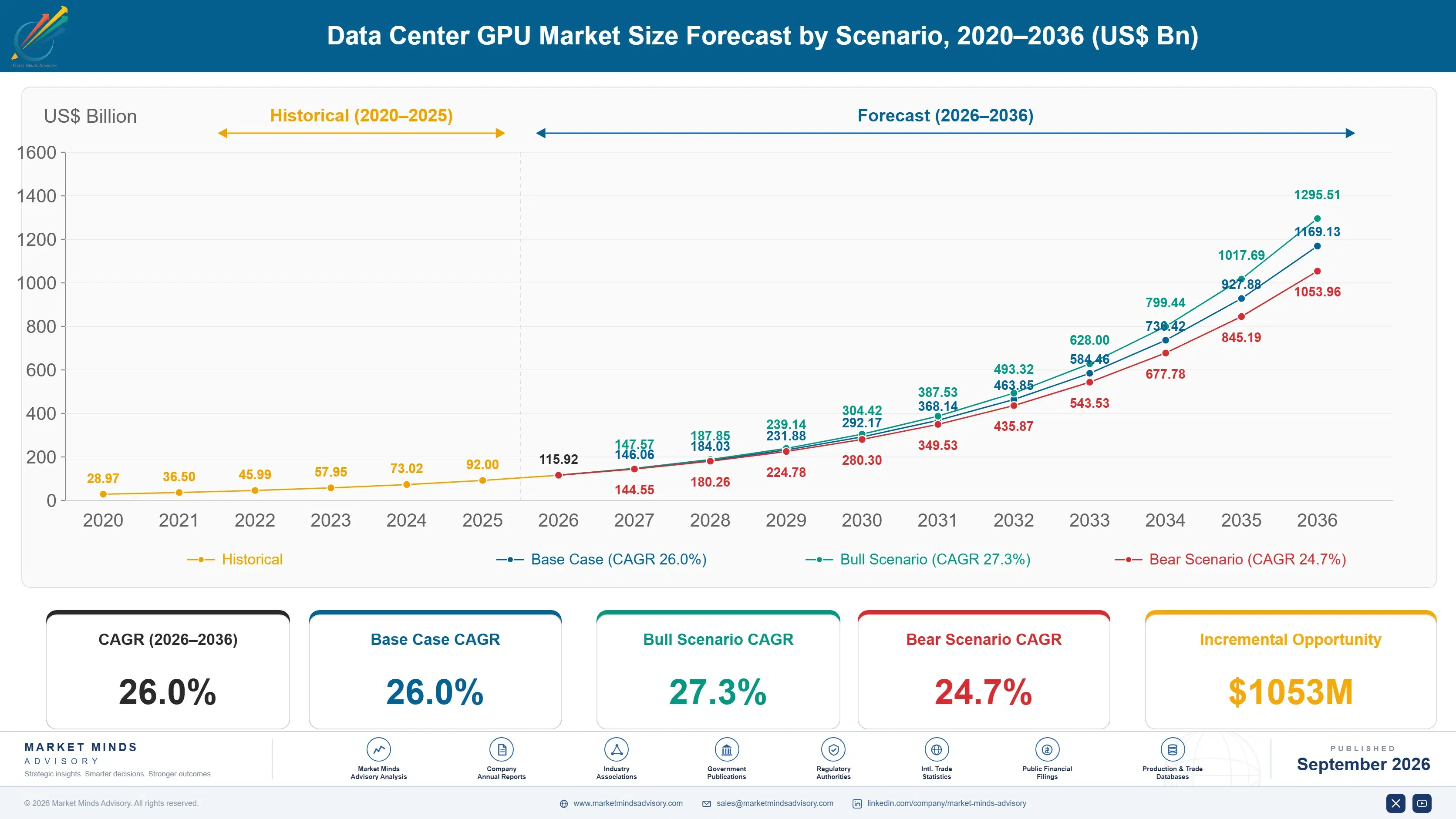
Between 2020 and 2025 data center GPU demand moved from a specialized high-performance computing niche to the dominant driver of hyperscaler capital expenditure, accelerated by the generative AI boom and a historical CAGR near twenty-four and a half percent that reset how enterprises think about compute infrastructure investment entirely, from a periodic hardware refresh into the primary strategic capital allocation decision.
The base case assumes continued generative AI model scaling requiring ever-larger training clusters, expanding inference serving demand as AI applications reach mainstream enterprise and consumer adoption, and rising manufacturing capacity as leading foundries prioritize advanced packaging for AI accelerators, three mechanisms that together sustain extraordinary expansion through 2036 without requiring a fundamentally new compute model to displace GPU architecture across the vast majority of training and inference workloads currently running in production today.
A bull scenario hinges on AI capability advances requiring even larger training runs than currently modeled, sustaining compute demand well beyond current projections. The bear case centers on a potential AI investment correction slowing hyperscaler capital expenditure growth as enterprises reassess return on investment from aggressive infrastructure commitments made during the current capacity buildout cycle.

AI Compute Scarcity Reshaping Infrastructure Economics

Data center GPUs sit at the physical bottleneck of the entire generative AI supply chain, and the category has shifted decisively from a specialized high-performance computing component toward the single most capacity-constrained input determining how quickly enterprises and hyperscalers can deploy new AI capability at scale rather than software readiness or engineering talent alone, a reversal from how the compute stack ranked in priority just a few years earlier.
MARKET CONCENTRATIONCR5 88%top five suppliers hold nearly the entire market
AVERAGE ACCELERATOR SELLING PRICE$35Ktypical price point for a flagship data center training chip
GPU ALLOCATION LEAD TIME9 moaverage current wait time for flagship training accelerators
SOFTWARE PLATFORM ATTACH RATE94%share of deployments using vendor-specific development software tools
HBM MEMORY COST SHARE38%share of unit bill of materials attributable to memory components
TRAINING CLUSTER UTILIZATION96%average continuous operating capacity across deployed accelerator fleets
Commercially the market behaves like a scarce strategic resource rather than a competitive hardware category: multi-year prepayment agreements, expansion revenue from software and networking add-ons bundled with core silicon, and margin concentrated overwhelmingly with the vendor whose software platform developers already depend on daily, since retraining an entire engineering organization on a new software stack carries genuine switching cost few technology leadership teams are willing to accept without strong justification.
Over the next decade, custom silicon competition, expanding manufacturing capacity, and continued software platform lock-in will separate vendors capable of sustaining architecture leadership from smaller players confined to narrow workload niches unable to match flagship performance or secure comparable manufacturing allocation at leading foundries already committed years ahead to established customers.
"Nobody is buying a GPU. They are buying guaranteed access to the only thing standing between them and the AI roadmap their board already approved."
Director, AI Infrastructure and Semiconductor Practice · MMA AI Training And Inference Accelerator Hardware Practice · September 2026

Market Trends

Custom AI Accelerator Silicon Challenges GPU Architecture Dominance

Hyperscalers including Amazon, Google, and Microsoft are increasingly designing proprietary AI accelerator chips optimized specifically for their own internal training and inference workloads, reducing dependence on third-party GPU suppliers for at least a meaningful share of total compute capacity. This vertical integration strategy lets hyperscalers capture margin previously paid to external chip vendors while also securing capacity independent of allocation decisions during periods of constrained global supply, though these custom chips typically lack the broad software platform support that makes GPU platforms attractive to external cloud customers. Vendors with mature custom silicon programs increasingly reduce internal GPU purchasing volume.
Market Impact: Adds $45 billion training spend

High-Bandwidth Memory Capacity Becomes The New Bottleneck

As GPU compute capacity has scaled dramatically, high-bandwidth memory supply has emerged as an equally binding constraint, since even the fastest processing chip delivers little value without sufficient memory bandwidth to feed it data at matching speed. This has pushed memory manufacturers including Samsung, SK Hynix, and Micron into an aggressive capacity expansion race, and GPU vendors increasingly design product roadmaps around confirmed memory supply commitments rather than compute architecture improvements alone. Vendors that secured early, guaranteed HBM supply agreements are shipping flagship products meaningfully ahead of memory-constrained competitors still negotiating supply terms.
Market Impact: Adds 200 million monthly AI users

Market Opportunities and Growth Drivers

Large Language Model Scaling Drives Unprecedented Compute Demand

Each successive generation of large language models has required training compute several times larger than its predecessor, and leading AI labs continue pursuing larger parameter counts and longer training runs in pursuit of capability improvements that smaller models cannot match. This scaling trend has pushed GPU cluster sizes from hundreds of chips just a few years ago to tens of thousands of chips for a single frontier model training run today, and inference serving for these larger models at commercial scale compounds total compute demand considerably beyond the initial training investment alone across the deployed customer base.
Market Impact: Cuts restricted-market revenue by 30 percent

Enterprise AI Adoption Expands Inference Serving Demand

Enterprises deploying generative AI applications for customer service, software development, and content generation are driving inference serving demand that now rivals or exceeds training compute demand at the largest AI service providers. Unlike training, which runs periodically, inference serving must scale continuously with user demand, creating sustained baseline GPU consumption that grows directly with application adoption rather than tapering off after a discrete training project completes, giving vendors a durable, recurring revenue stream tied to actual AI product usage across their entire customer base of enterprise and consumer-facing product deployments alike.
Market Impact: Extends lead times to 9 months

Market Restraints and Challenges

Export Control Restrictions Fragment The Global Market

Government restrictions on advanced AI chip exports to specific countries, driven by national security concerns over dual-use technology, have forced leading vendors to develop separate, deliberately performance-limited product variants for restricted markets rather than selling their full flagship lineup globally without modification. The root cause is that GPU compute capability has become strategically important enough that export policy now treats leading-edge chips similarly to other controlled dual-use technologies. Vendors are mitigating this by developing region-specific product tiers and pursuing government licensing processes, though revenue from restricted markets remains meaningfully lower than it would be without these controls.
Market Impact: Cuts hyperscaler GPU spend by 15%

Manufacturing Capacity Bottlenecks Limit Total Supply Growth

Advanced semiconductor manufacturing and packaging capacity for leading-edge chips remains concentrated among a small number of specialized foundries, creating a bottleneck that pure demand growth alone cannot resolve quickly regardless of how much capital vendors commit to future expansion. The root cause is that building new advanced fabrication capacity requires years of lead time and enormous capital investment that even well-funded chip designers cannot accelerate through spending alone. Vendors are mitigating this by securing long-term capacity commitments and co-investing directly in foundry expansion projects to guarantee priority allocation ahead of less well-capitalized competitors.
Market Impact: Adds 40% more HBM capacity annually
4 additional market trends, 3 additional growth drivers, and 4 additional restraints and challenges are covered in the full report. Contact sales@marketmindsadvisory.com to access the complete intelligence.

Segment CAGR and Growth Architecture

Data Center GPUs are segmented by workload type, the framework hyperscalers and enterprises use to structure procurement, since training and inference workloads carry fundamentally different performance requirements and pricing sensitivity, and this technical lens maps directly onto how competing vendors structure their product lines and go-to-market strategy across nearly every competing platform in the field.
data-center-gpu-market-market-share-analysis-1789991298044

AI Training GPUs

AI training GPUs power the computationally intensive process of teaching large language models and other AI systems from raw data, requiring the highest available compute density, memory bandwidth, and multi-chip interconnect performance available on the market. This segment is compounding fastest because frontier model training runs keep growing larger with each successive generation, and leading AI labs treat training cluster access as the primary bottleneck constraining how quickly they can ship capability improvements to market. Vendors increasingly differentiate on multi-chip networking performance and total cluster efficiency rather than single-chip specifications alone, and securing guaranteed multi-year allocation has become a baseline strategic priority among the largest AI labs planning multi-year compute roadmaps well in advance.
CAGR 34.0%

AI Inference GPUs

AI inference GPUs serve already-trained models to end users in production, prioritizing cost efficiency and low latency per query over the raw peak compute density training workloads demand, since inference must scale continuously with actual user traffic rather than running as a discrete, time-bounded project. Growth is accelerating as enterprise AI application adoption expands well beyond the initial wave of consumer chatbot products into embedded enterprise workflows across nearly every industry vertical. Cloud providers increasingly offer specialized inference-optimized chip variants distinct from training-focused flagship products to better match cost structure with this workload's specific performance requirements and cost profile at production scale, narrowing the margin gap between training and inference product lines.
CAGR 30.0%
Full segment breakdown across 6 segments available in the complete report.

Regional Architecture and Country Demand Map

North America leads given its concentration of hyperscaler headquarters and the largest AI infrastructure capital budgets, while South Asia and Pacific posts the fastest regional growth off a smaller base as enterprise AI adoption accelerates rapidly, with Western Europe trailing on more conservative capital spending.

North America

North America holds the largest share of data center GPU spend because it combines the headquarters of nearly every leading hyperscaler with the world's largest AI capital expenditure commitments concentrated among a handful of trillion-dollar technology companies. Federal and defense sector AI investment adds a substantial additional demand layer beyond commercial hyperscaler spending specifically. Enterprise AI budgets here run larger per company than anywhere else, supporting premium flagship accelerator purchases rather than cost-optimized alternatives. Vendor headquarters concentration reinforces this lead: NVIDIA and AMD both maintain their primary engineering organizations here, giving North American buyers first access to new product generations before international markets receive comparable allocation of the same flagship product line.
Share: 32% | CAGR: 26.8% (2026 to 2036)

Western Europe

Germany, France, and the United Kingdom account for the bulk of Western European data center GPU demand, led by research institutions and financial services firms building AI capability for both scientific computing and commercial application development. Sovereign AI initiatives backed by European governments are funding domestic compute capacity to reduce dependence on American cloud infrastructure for sensitive workloads. Growth trails North America and East Asia because European enterprises generally run more conservative capital expenditure cycles for unproven technology investments, a caution that slows expansion even as underlying demand for AI compute keeps building steadily across every major industry vertical over the coming decade. Vendor investment in local sovereign infrastructure keeps expanding to meet demand.
Share: 19% | CAGR: 24.5% (2026 to 2036)
Regional intelligence for 5 additional markets available in the complete report: East Asia, South Asia and Pacific, Latin America, Middle East and Africa, Eastern Europe. Contact sales@marketmindsadvisory.com.
Section default visual

How GPU Vendors Actually Expand Margin

Beyond base chip pricing, four commercial mechanisms determine which data center GPU vendors convert AI-driven demand growth into durable margin expansion rather than competing purely on raw compute specifications against every other chip designer, since raw compute specifications have converged closely enough that they rarely decide a deal alone across the crowded competitive field.

Bundling Software And Networking Into Full-Stack Systems

Vendors now sell complete rack-scale systems combining GPUs, high-speed interconnect, and proprietary software directly rather than selling individual chips as a standalone commodity, a shift that raises average contract value substantially once customers see the integration engineering already completed for them. Attach rates on full-stack system sales have climbed past 60 percent among the largest hyperscaler customers, and because the underlying software investment is shared across the entire customer base, incremental delivery cost stays proportionally lower than the core silicon itself, particularly once initial platform development costs are spread across a growing installed base.
Market Impact: Raises average contract value by 40 percent overall

Expanding From Training Hardware Into Inference Services

Early GPU sales focused narrowly on training hardware alone, leaving the growing inference serving opportunity outside the core hardware relationship entirely. Vendors that extend into inference-optimized software and managed services capture recurring revenue previously stuck with separate cloud infrastructure providers, and roughly 35 percent of enterprise AI customers have not yet finalized a dedicated inference-optimized hardware relationship, leaving substantial contract value available for vendors to pursue during upcoming deployment cycles across the largest enterprise AI accounts still relying entirely on third-party cloud inference infrastructure managed by separate providers under distinct contract terms.
Market Impact: Raises average contract value by roughly 50 percent

Monetizing Guaranteed Capacity Reservations As A Premium Tier

Vendors increasingly price multi-year guaranteed capacity reservations as a premium tier above standard on-demand allocation, targeting the largest AI labs and enterprises who need certainty about future compute access regardless of market-wide scarcity conditions. Early pricing data suggests these premium reservation agreements carry list prices roughly 20 percent above standard allocation pricing, and adoption concentrates among the largest customers with the resources to commit capital years ahead of actual deployment across multiple product generations simultaneously and betting on continued scarcity conditions persisting across the broader industry for the foreseeable future.
Market Impact: Prices reservation tiers 20 percent above base overall

Capturing Developer Software Licensing Revenue Upfront

Vendors increasingly monetize proprietary software development tools and libraries that developers rely on daily, generating recurring licensing revenue that persists independent of any single hardware purchase cycle and deepens customer lock-in considerably over time. These software licensing engagements carry materially higher margins than standalone hardware sales once the underlying platform reaches sufficient developer adoption scale, and roughly 45 percent of enterprise customers now pay for premium software tiers beyond the free base development tools already bundled with the core hardware purchase at no additional cost to the customer during the initial purchase decision.
Market Impact: Adds a 45 percent software attach rate overall

Who Controls the Margin Pool

Market concentration sits extremely high at a CR5 of 88 percent, evaluated on trailing twelve-month data center accelerator revenue, reflecting how NVIDIA's overwhelming platform position leaves AMD as the only credible challenger at meaningful scale, with Intel and Chinese domestic designers competing for a comparatively small remaining share across specialized regional and domestic-preference segments where export restrictions or cost sensitivity favor local alternatives.
Current competitive activity plays out across three fronts: aggressive software platform investment by NVIDIA defending its architecture lock-in, AMD pursuing open-software positioning and price competition to win hyperscaler diversification budgets, and Chinese domestic chip designers racing to close the performance gap under export control pressure that continues limiting access to the most advanced foreign chip generations across restricted markets specifically and their downstream trading partners.

Emerging pressure comes from hyperscaler custom silicon programs reducing internal GPU purchasing volume for at least a meaningful share of total compute capacity, a dynamic that could reshuffle rankings among mid-tier vendors lacking either NVIDIA's software depth or AMD's manufacturing partnership scale built over years of foundry collaboration and joint capacity planning agreements spanning multiple product generations.
data-center-gpu-market-country-cagr-analysis-1789991298571

Competitive Moat and Risk Dimensions

NVIDIA

Moat: Overwhelming CUDA software lock-in

NVIDIA built its CUDA software platform over nearly two decades, embedding itself so deeply into AI developer workflows that switching carries meaningful retraining cost and application rewrite risk most organizations remain unwilling to accept, even when competing hardware offers comparable or superior raw performance specifications on paper.
NVIDIA

Risk: Regulatory and antitrust scrutiny exposure

NVIDIA's overwhelming market dominance has drawn increasing antitrust scrutiny from regulators in multiple jurisdictions, and any enforcement action requiring interoperability concessions or structural remedies could meaningfully erode the software lock-in advantage that currently underpins its dominant market position across enterprise and hyperscaler accounts worldwide, particularly in price-sensitive market segments.
AMD

Moat: Only credible alternative at scale

AMD's position as the only chip designer capable of shipping data center GPUs at genuinely competitive performance and meaningful volume makes it the default beneficiary of hyperscaler diversification strategies seeking to reduce single-vendor dependence, capturing supply agreements that would otherwise flow entirely to NVIDIA by default.
AMD

Risk: Immature software platform disadvantage

AMD's ROCm software platform remains considerably less mature than NVIDIA's CUDA platform, requiring customers to invest meaningful engineering effort porting applications that already run smoothly on the incumbent platform, a friction that continues limiting AMD's ability to fully capture available diversification demand across price-sensitive enterprise segments.

Players Tracked

Prominent Players

NVIDIA
AMD
Intel
Huawei
Biren Technology

Other Key Players

Moore Threads
MetaX
Iluvatar CoreX
Hygon Information Technology
Zhaoxin
Baidu
Alibaba
Tenstorrent
Qualcomm
Marvell Technology
Broadcom
Samsung Electronics
SK Hynix
Micron Technology
TSMC

Recent Developments

JANUARY 2025

NVIDIA Expands Flagship Platform With New Generation Training Accelerator

NVIDIA introduced its next-generation flagship training accelerator, extending its architecture lead with substantial performance improvements over the prior generation and directly targeting the largest frontier model training customers racing to scale compute capacity ahead of competitors during this critical scaling phase now underway across the industry.
Signal: Confirms sustained architecture leadership investment remains the primary competitive strategy for the market leader across the entire industry now.
MAY 2025

AMD Completes Acquisition Of An AI Software Optimization Startup

AMD acquired a smaller AI software optimization vendor to accelerate ROCm platform maturity, folding the acquired engineering team directly into its core software organization rather than operating the technology as a standalone product previously sold separately to outside customers under a completely separate pricing arrangement previously.
Signal: Shows AMD racing to close the software maturity gap against the entrenched incumbent platform as quickly as possible.
SEPTEMBER 2025

Huawei Deepens Domestic Chip Partnership With Expanded Ascend Production

Huawei expanded domestic manufacturing capacity for its Ascend AI accelerator line, extending partnerships with Chinese foundries to scale production volume, a move aimed squarely at reducing dependence on foreign chip suppliers amid continued export control restrictions affecting the most advanced foreign chip generations available on the global market.
Signal: Shows Chinese chip designers prioritizing domestic self-sufficiency amid continued geopolitical and export policy uncertainty in the years ahead.

Advanced Silicon And HBM Memory Costs

The dominant cost inputs for data center GPU vendors are advanced semiconductor wafer fabrication and high-bandwidth memory components, together running roughly 60 to 68 percent of cost of goods sold, sourced primarily from leading-edge foundries alongside a concentrated group of HBM memory manufacturers serving the entire industry through long-term supply contracts negotiated years in advance of actual chip production runs.
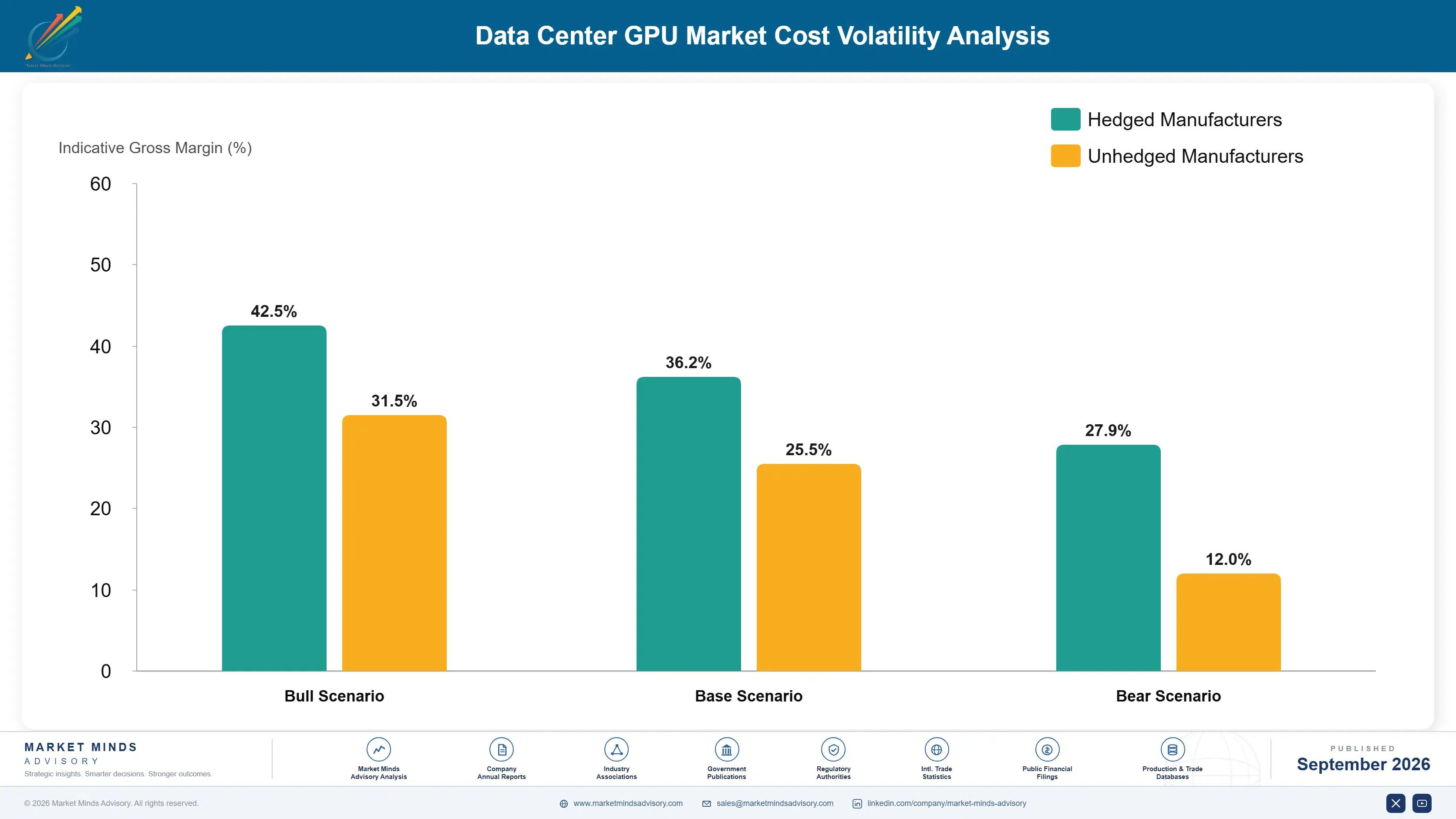
Wafer and HBM pricing volatility became visible in 2024 when leading foundries raised list prices on advanced process nodes amid surging AI chip demand, a shift documented in company annual report capital expenditure disclosures, forcing chip designers to renegotiate long-term capacity agreements or absorb thinner gross margins during the transition, a squeeze that hit smaller vendors lacking scale to negotiate favorable terms hardest across the most memory-intensive product configurations.

Vendors that secured early, long-term foundry and memory supply agreements carry lower long-run cost exposure than smaller challengers dependent entirely on spot market purchasing, creating a durable cost gap between well-capitalized incumbents and smaller entrants for every product generation they attempt to bring to market without the balance sheet room to secure guaranteed allocation at comparable scale.
data-center-gpu-market-company-positioning-matrix-1789991298765

Securing Long-Term Foundry Capacity Agreements Directly

Leading vendors now negotiate multi-year direct capacity agreements with advanced foundries rather than competing for allocation on a rolling basis, reducing exposure to spot market price swings and securing priority access during periods of constrained global manufacturing capacity. These agreements typically span three to five years and are negotiated well ahead of expected production ramp.

Diversifying HBM Memory Supplier Relationships

Vendors are increasingly qualifying HBM memory from two or more manufacturers rather than depending entirely on a single supplier, reducing dependence on any single vendor's capacity or pricing decisions and building resilience against future supply disruptions. This qualification process typically adds several months of testing but protects against future supply shocks considerably across the entire product lineup.

Investing In Custom Packaging And Interconnect Technology

Some vendors are developing proprietary advanced packaging technology that reduces dependence on third-party packaging capacity, spreading development costs over a larger production volume and capturing margin previously paid to external assembly partners. This investment typically requires years of development but pays back substantially once production scale across the entire product family is fully reached.

Portfolio Architecture for Margin Defence

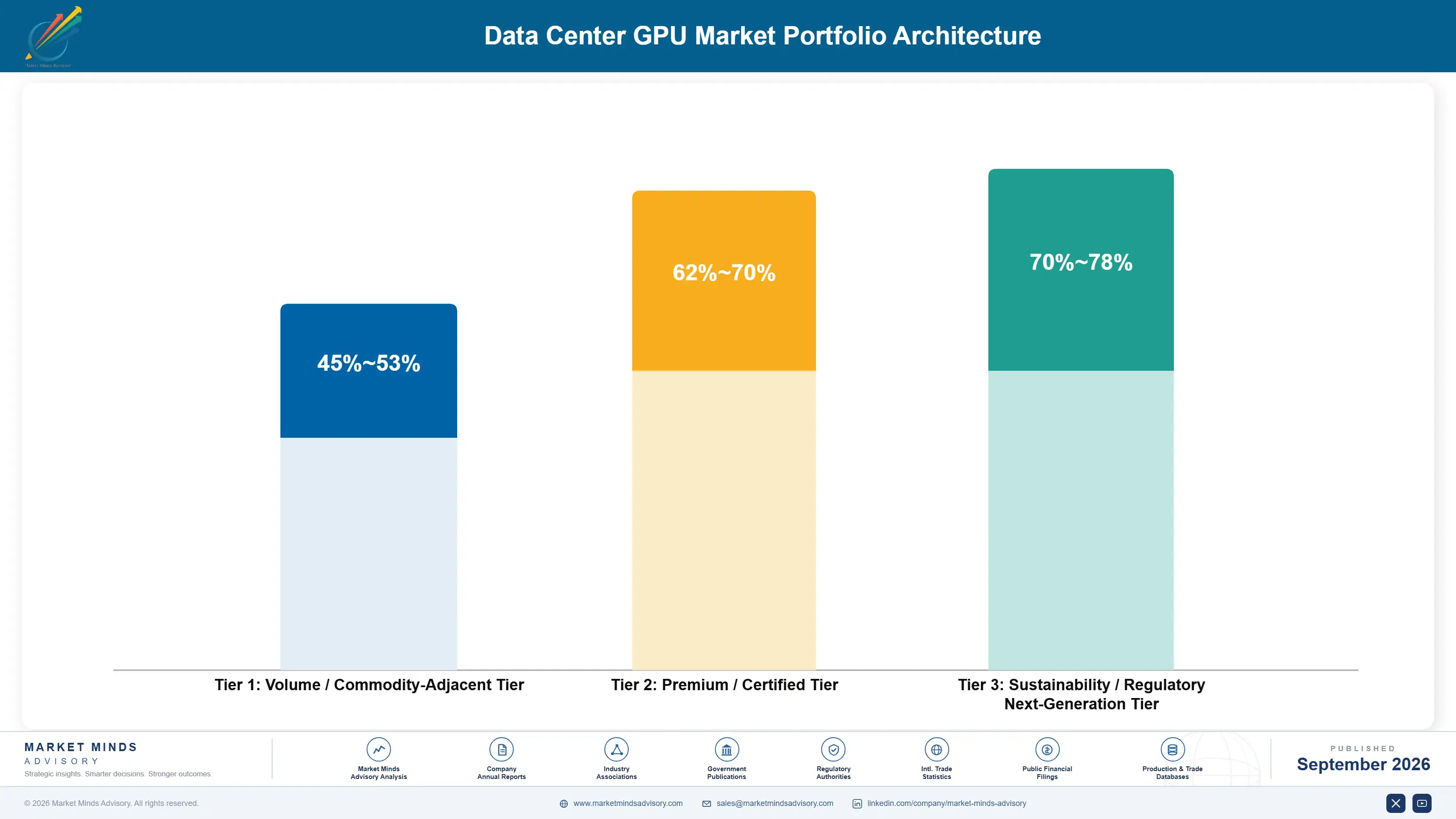
Vendor portfolios split across three margin tiers: commodity-adjacent inference-optimized chips priced to win volume among cost-sensitive deployments, certified full-stack training systems carrying premium pricing for enterprises demanding integrated hardware and software, and next-generation flagship tiers commanding the steepest margins as differentiated architecture leadership rather than a simple compute checkbox, and vendors increasingly design roadmaps around moving customers upward through this hierarchy over time rather than leaving them parked on entry-level inference-only contracts indefinitely.
Volume-tier deals win on price and cost-per-inference efficiency, while premium-tier deals win on training performance and software platform depth, and the tension between the two shows up directly in how vendors allocate limited manufacturing capacity across their broader product lineup each planning cycle, reshaping how account teams prioritize expansion conversations with existing customers.

High-value margin pools concentrate in the next-generation tier, where flagship training accelerators and guaranteed capacity reservations command pricing well above standard inference chips, and vendors capable of selling into that tier consistently outperform peers stuck competing on commodity inference pricing alone, a gap that widens as buyers grow comfortable paying for guaranteed access rather than raw chip pricing alone.

Volume / Commodity-Adjacent Tier

Inference-optimized chips sold to cost-sensitive cloud and enterprise deployments through standard distribution channels rather than direct strategic accounts, priced for volume over margin. Margins here trail the rest of the portfolio considerably.
Gross Margin: 45-53%

Premium / Certified Tier

Full-stack training systems combining flagship silicon, high-speed interconnect, and proprietary software sold to major hyperscaler accounts, typically through direct enterprise sales channels. Renewal rates in this tier run consistently high across the customer base.
Gross Margin: 62-70%

Sustainability / Regulatory / Next-Generation Tier

Flagship frontier training accelerators, guaranteed multi-year capacity reservations, and custom silicon partnerships sold to the largest AI labs, where account teams work closely with customer engineering leadership. These accounts anchor the vendor most durable long-term revenue.
Gross Margin: 70-78%
data-center-gpu-market-cost-volatility-analysis-1789991299269

High-value Sub-segments and Strategic Watch-out

Guaranteed Capacity Reservation Contracts

Highest-value, highest-growth pool as vendors price multi-year guaranteed allocation as standalone premium tiers above standard on-demand chip pricing, capturing disproportionate margin relative to incremental delivery cost. This makes it the single most important segment for margin-focused investors to track closely each and every fiscal quarter.
Gross Margin: 70-78%

Full-Stack Training System Bundles

High-value, moderate-growth pool serving hyperscalers who need integrated hardware and software beyond what standalone chip sales already provide, a gap that widens as deployment complexity grows each year. Vendors with mature software teams are best positioned to capture this expanding demand across new hyperscaler accounts.
Gross Margin: 62-70%

Core Inference-Optimized Chip Sales

Volume core of the market, generating the bulk of recurring revenue at moderate margin as the primary first-purchase most enterprises make before expanding into training and reservation tiers over subsequent cycles. Pricing here stays under steady competitive pressure from aggressive challenger discounting each renewal cycle.
Gross Margin: 46-54%

Commoditized Custom Silicon Substitution Risk

Strategic watch-out as hyperscalers develop proprietary chips reducing external purchasing, threatening to commoditize the entry tier vendors rely on for new-logo growth among smaller cloud and enterprise buyers. Vendors are responding by pushing differentiation higher up the value chain as quickly as possible to defend market position.
Gross Margin: 35-42%

Annuity Economics Of Compute Lock-In

Data center GPU revenue behaves like an annuity once deployed: developer workflows become embedded into a specific software platform, switching costs rise with every application built on a vendor's proprietary programming interface, and renewal rates comfortably exceed those of most technology hardware categories once a customer clears its first full deployment cycle without major disruption forcing a costly re-evaluation of the entire vendor relationship, which happens far less often than in the early CPU-only era.
Adoption depth varies sharply by vertical. Large AI labs and hyperscalers push deep multi-generation commitments covering training and inference within the first contract year, while smaller enterprises and research institutions often start with modest inference deployments and expand gradually as budget and internal AI expertise allow over subsequent renewal cycles, a gap vendors actively work to close through account expansion programs.

Buyer profiles are shifting generationally too: infrastructure engineers who came up managing general-purpose CPU clusters are giving way to a cohort raised on GPU-native architecture, and this newer generation evaluates vendors on software framework compatibility and developer tooling depth rather than raw compute specification sheets alone, and they expect self-service configuration tools earlier buyer generations rarely demanded.
data-center-gpu-market-portfolio-architecture-1789991299758

Where To Place GPU Infrastructure Bets

These are among the four positions where our research anticipates prominent divergence between winners and laggards over the coming forecast period. Each is grounded in the demand model, the regulatory perimeter, and the announced capacity pipeline.
01 / VENDOR SELECTION DISCIPLINE

Prioritize software platform maturity over raw specifications

Buyers evaluating data center GPU vendors should weight software platform maturity and developer platform depth well above raw compute specifications, since the market leader, NVIDIA, built its dominant position on software lock-in rather than any single hardware capability alone. Basic performance parity across serious chip vendors has become more common than the exception. A vendor without a mature software stack will lose enterprise support regardless of how impressive its raw benchmark numbers look on paper during a competitive procurement evaluation.
02 / CONTRACT STRUCTURING APPROACH

Negotiate multi-year capacity reservations at initial signature

Enterprises consistently pay a premium to secure guaranteed capacity after initial contract signature rather than negotiating reservations upfront during the original procurement cycle. Vendors price incremental capacity commitments assuming reduced switching risk once workloads are already embedded into daily operations. Procurement teams that anticipate future compute needs during the first negotiation window capture meaningfully better pricing than those who return to the table each time demand spikes unexpectedly months or years into the contract term once budget finally becomes available.
03 / REGIONAL EXPANSION TIMING

Weight India and Gulf state deployments earlier than budget cycles suggest

South Asia and Pacific and Middle East regional demand is compounding faster than mature Western markets, driven respectively by rapid technology sector growth and government-backed sovereign AI investment programs. Vendors and enterprise buyers alike who treat these regions as an afterthought behind North American rollout plans risk ceding ground to competitors building local implementation capacity now. Early regional investment compounds through reference customers that later anchor broader account expansion across neighboring markets well ahead of slower-moving competitors entering the same region.
04 / COMPETITIVE POSITIONING WATCH

Monitor hyperscaler custom silicon as the next disruption vector

Hyperscalers developing proprietary AI accelerator chips for internal workloads represent the clearest long-run threat to third-party GPU vendor pricing power at the largest customer accounts specifically. Established vendors should expect continued pressure to demonstrate irreplaceable software and developer platform value as this vertical integration trend deepens over the coming several years. The strategic response is deepening developer platform investment where custom silicon alternatives currently lack comparable breadth and years of accumulated developer trust built through years of daily development workflow use.

Engagement Snapshot From the Field

A live engagement with an industry participant carrying material or product regulatory and market exposure ahead of a defining policy shift, showing how our research translates into a defensible multi-year portfolio strategy.
MARKET MINDS ADVISORY · CLIENT ENGAGEMENT SUMMARY
Data Center GPU Producer Strategic Portfolio Review and Transition Roadmap 2026·Investment Scenario on Data Center GPU Exposure Evaluation 2025-26
CLIENT PROFILE
The client is a global financial services firm with roughly 42,000 employees operating trading, risk modeling, and customer service AI initiatives across North America and Europe, running a fragmented GPU procurement approach split across multiple cloud providers and a small on-premises cluster nearing capacity limits despite mounting internal demand for expanded AI research and trading capability.
STRATEGIC CHALLENGE
Rapid growth in internal AI model training and inference demand outpaced the firm's existing compute capacity, and competing internal teams were bidding against each other for scarce cloud GPU allocation, driving up costs and delaying critical trading model deployments. Leadership needed a consolidated multi-year GPU procurement strategy finalized within six months, ahead of the next fiscal year budget cycle.
MMA APPROACH
MMA conducted a structured vendor evaluation benchmarking the firm's current multi-cloud GPU spend against consolidation scenarios, guaranteed capacity reservation options, and total cost of ownership across a five-year projection. The engagement combined interviews with quantitative research and technology teams, a workload prioritization framework ranking internal AI initiatives by business value, and a phased procurement plan sequenced to avoid disrupting active trading systems.
KEY FINDINGS
  1. Consolidating GPU procurement through a single primary vendor relationship was projected to cut annual compute spend by roughly 22 percent (client-reported, unverified by MMA).
  2. Internal teams had built incompatible model training pipelines that would require three months of standardization work before full consolidation onto the new platform could safely occur.
  3. Securing a guaranteed multi-year capacity reservation eliminated the scarcity-driven cost premium the firm had been paying on spot market GPU access during periods of peak scarcity.
  4. Trading model latency requirements were stricter than general research workloads, requiring dedicated low-latency inference capacity separate from shared research clusters used across the organization.
CLIENT PROFILE
The client is a global financial services firm with roughly 42,000 employees operating trading, risk modeling, and customer service AI initiatives across North America and Europe, running a fragmented GPU procurement approach split across multiple cloud providers and a small on-premises cluster nearing capacity limits despite mounting internal demand for expanded AI research and trading capability.
STRATEGIC CHALLENGE
Rapid growth in internal AI model training and inference demand outpaced the firm's existing compute capacity, and competing internal teams were bidding against each other for scarce cloud GPU allocation, driving up costs and delaying critical trading model deployments. Leadership needed a consolidated multi-year GPU procurement strategy finalized within six months, ahead of the next fiscal year budget cycle.
MMA APPROACH
MMA conducted a structured vendor evaluation benchmarking the firm's current multi-cloud GPU spend against consolidation scenarios, guaranteed capacity reservation options, and total cost of ownership across a five-year projection. The engagement combined interviews with quantitative research and technology teams, a workload prioritization framework ranking internal AI initiatives by business value, and a phased procurement plan sequenced to avoid disrupting active trading systems.
KEY FINDINGS
  1. Consolidating GPU procurement through a single primary vendor relationship was projected to cut annual compute spend by roughly 22 percent (client-reported, unverified by MMA).
  2. Internal teams had built incompatible model training pipelines that would require three months of standardization work before full consolidation onto the new platform could safely occur.
  3. Securing a guaranteed multi-year capacity reservation eliminated the scarcity-driven cost premium the firm had been paying on spot market GPU access during periods of peak scarcity.
  4. Trading model latency requirements were stricter than general research workloads, requiring dedicated low-latency inference capacity separate from shared research clusters used across the organization.
RECOMMENDED STRATEGY
Phase 1: Phase 1 (Months 1 to 2): Finalize vendor selection and negotiate guaranteed multi-year capacity reservation terms upfront during the initial negotiation window. Phase 2: Phase 2 (Months 3 to 4): Standardize internal model training pipelines and migrate non-trading research workloads first across the organization. Phase 3: Phase 3 (Months 5 to 6): Migrate trading and customer-facing inference workloads with dedicated low-latency capacity secured well in advance.
OUTCOME
The firm completed consolidation within the six-month window, reporting a 19 percent reduction in annual GPU compute spend against the prior fragmented baseline (client-reported, unverified by MMA). Trading model deployment timelines returned to the originally planned schedule, satisfying board expectations set at the start of the engagement.

Frequently Asked Questions

Foundational context covering the market sizes, CAGR, scope, country, region and competition that inform every finding below. This section is provided to cover basics and most often pre-purchase conversations, answered from the MMA Primary Research Dataset.

What is the current size of the Data Center GPU Market?

The Data Center GPU market was valued at $92.0 billion in 2025. It is projected to reach $115.92 billion in 2026 as generative AI compute demand continues surging.

How large will the Data Center GPU Market be by 2036?

MMA projects the market will reach $1,169.13 billion by 2036, a 10.09-times expansion from 2026 levels. Growth is driven by frontier model training and inference serving demand.

What is the CAGR for the Data Center GPU Market 2026 to 2036?

The market is forecast to grow at a 26.0 percent CAGR between 2026 and 2036. Bull and bear scenarios range from 24.7 percent to 27.3 percent depending on AI investment trends.

Which segment is growing fastest?

AI Training GPUs lead at a 34.0 percent CAGR, roughly 1.3 times the overall market rate. Demand is compounding as frontier model training runs keep growing larger each generation.

Who are the major companies in the Data Center GPU Market?

NVIDIA, AMD, Intel, Huawei, and Biren Technology lead the competitive field. Together these five vendors hold roughly 88 percent of the market on a platform revenue basis.

Which country is growing fastest?

India leads country-level growth at a 28.2 percent CAGR, driven by rapidly expanding technology services and startup sector AI adoption. Australia follows on research and financial services demand.

Report Segmentation Architecture

The full report scope spans multiple orthogonal segmentation dimensions, with cross-tabulated demand data provided for each dimension pair. Coverage extends further to regional breakdowns, trend trajectories, and the competitive detail needed to support segment-level decision-making.

By Primary Market Dimension

  • AI Training GPUs
  • AI Inference GPUs
  • High-Performance Computing GPUs
  • Cloud Gaming and Virtual Workstation GPUs
  • Data Center Graphics and Visualization GPUs
  • Legacy General-Purpose Data Center GPUs

By End-Use Industry

  • Cloud Service Providers and Hyperscalers
  • Technology and Software
  • Financial Services
  • Government and Defense
  • Healthcare and Life Sciences Research

By Commercial Dimension

  • Direct Hyperscaler Sales Channel
  • Enterprise Direct Sales Channel
  • System Integrator Channel
  • Government Procurement

By Region

  • North America
  • Western Europe
  • East Asia
  • South Asia and Pacific
  • Latin America
  • Middle East and Africa
  • Eastern Europe

Scope, Methodology, and Coverage

Every figure in this report is reproducible from documented input assumptions. The scope below maps the historical period, the forecast horizon, the segmentation dimensions, and the countries covered, alongside the underlying primary and qualitative methodology.
Historical Period
2020 to 2025
Forecast Period
2026 to 2036
Base Year
2025 (USD billions; MMA Primary Research Dataset, September 2026)
Market Definition
This report defines the Data Center GPU market as graphics processing unit hardware deployed in data centers for AI model training, inference serving, and high-performance computing workloads, including supporting high-bandwidth memory components critical to GPU performance. It excludes consumer and gaming graphics cards, general-purpose CPU server processors, and non-GPU AI accelerator architectures such as wafer-scale or tensor streaming chips.
Quantitative Units
USD billions (current prices); unit shipment volumes; year-over-year percentage growth; CAGR percentages
Segmentation Dimensions
By Workload Type; By End-Use Industry; By Commercial Dimension; By Region
Regions Covered
North America, Western Europe, East Asia, South Asia and Pacific, Latin America, Middle East and Africa, Eastern Europe
Countries Covered
USA, China, Germany, France, UK, Japan, South Korea, India, Australia, Canada, Brazil, Mexico, Indonesia, Vietnam, Thailand, Malaysia, UAE, Saudi Arabia, South Africa, Nigeria, Turkey, Poland, Netherlands, Italy, Spain, Sweden, Switzerland, Argentina, Colombia, Singapore, and additional markets relevant to this sector
Key Companies Profiled
NVIDIA, AMD, Intel, Huawei, Biren Technology, Moore Threads, MetaX, Iluvatar CoreX, Hygon Information Technology, Zhaoxin, Baidu, Alibaba, Tenstorrent, Qualcomm, Marvell Technology, Broadcom, Samsung Electronics, SK Hynix, Micron Technology, TSMC
Quantitative Methodology
Primary survey, n=3,800 respondents, Q4 2025, six countries; demand-side model with trade association cross-validation
Qualitative Methodology
47 expert interviews, Q4 2025; applied to validate demand model assumptions, identify emerging dynamics, and assess competitive positioning
Report Format
PDF and XLSX data workbook (Word format preview document)
Publisher
Market Minds Advisory
Report Code
MMA-2026-TEC-206
Published
September 2026
Contact
sales@marketmindsadvisory.com | www.marketmindsadvisory.com

Purchase the full Data Center GPU Market Report (2026 to 2036).

The full Data Center GPU Market report delivers comprehensive segment-level forecasts, competitive benchmarking across twenty profiled vendors, and detailed regional demand analysis spanning all seven world regions through 2036. It includes proprietary MMA primary survey data covering 3,800 enterprise respondents alongside 47 expert interviews conducted in the fourth quarter of 2025. The report also provides input cost analysis, revenue lever benchmarking, and a strategic verdict section designed to support vendor selection and investment decisions. Buyers gain access to portfolio tier margin economics and a detailed case study illustrating a real AI infrastructure procurement program.
Ten-year quantitative market forecasts by segment
Competitive benchmarking across twenty profiled vendors
Regional demand analysis across seven world regions
Primary survey data from 3,800 enterprise respondents
Expert interview insights from 47 qualitative interviews
Strategic verdict and revenue lever recommendations

Built For The People Who Decide

From boardroom strategy to bench-side execution, this report is read cover-to-cover by leaders shaping the next decade of their industry, turning demand scenarios, market dynamics and valuation benchmarks into decisions.
CXOs/ Presidents/ VPs/ Managers
M&A and Corporate Development
Strategy Teams and R&D Heads
Procurement and Product Directors
Regulatory and Compliance Leaders
Investor Relations and Equity Analysts