Market Minds Advisory
Data Center Construction Tools and Anchoring Systems Market

Data Center Construction Tools and Anchoring Systems Market: Data Center Construction Tools and Anchoring Systems Market. Seismic Bracing and Precision Fastening for Hyperscale Facility Buildout

Unprecedented hyperscale data center construction driven by AI infrastructure buildout is pushing contractors toward seismic-rated anchoring systems and modular fastening tools, reshaping decades-old construction procurement across new facility construction worldwide simultaneously.

Lead Analyst

Published

September 2026

Make Smarter Decisions with Customized Research Insights

Request a free sample report and evaluate market opportunities, growth trends, and competitive dynamics relevant to your business needs.

2025 MARKET VALUE$2.4BMarket Size 2025
2036 FORECAST VALUE$7.0BBase Case , 2026 to 2036
CAGR 2026 TO 203610.2 %Bull 11.5% / Bear 8.9%
INCREMENTAL OPPORTUNITY$4.3BNet 10- year value creation
EXPANSION MULTIPLE2.64x2036 value over 2026 base
Strategic Levers
M&A Pipeline
Regional Outlook
Country Rankings
Competitive Intelligence
Segmental Deep-dive
Call-Us : 91 93563 13602

Executive Snapshot and Market Trajectory.

Data center contractors are specifying seismic-rated anchoring systems faster than expected, as hyperscale operators push rack bracing and floor anchoring from optional reinforcement into standard construction specification across most new facility builds. Contractors slow to adopt certified anchoring risk losing hyperscale contracts to competitors already meeting documented seismic specifications.
Commercially, modular construction fastening is emerging as an unexpected growth engine alongside traditional site-built anchoring, since prefabricated data center modules increasingly require standardized fastening systems that can be installed faster than conventional on-site anchoring work. North America and East Asia concentrate the bulk of near-term spending given the largest hyperscale construction pipelines happening simultaneously across both regions. Vendors offering bundled installation tooling increasingly command premium pricing over point-solution competitors.
The competitive field remains fragmented across specialized fastening manufacturers and construction tool majors, though integrated anchoring platforms combining seismic engineering with installation tooling increasingly separate credible bidders from basic hardware vendors serving narrower contractor budget categories. General contractors are also demanding longer-term product certification commitments as anchoring systems shift procurement conversations from one-time hardware purchases toward continuous engineering support relationships. Vendors investing early in engineering support are winning the largest contractor framework agreements.
Market Definition
This market covers specialized anchoring hardware, fastening systems, and installation tools procured for data center rack, raised floor, and structural construction, including seismic bracing, precision alignment equipment, and modular fastening systems. It excludes general building construction fasteners unrelated to data center applications, server rack hardware sold independent of anchoring systems, and standalone power tools sold for general construction use.
Base Year Value
$2.4B in 2025 (MMA Primary Research Dataset, September 2026)
Forecast Period
2026 to 2036, eleven discrete annual values
CAGR
10.2% base case. Bull 11.5%. Bear 8.9%.
Fastest Growth Segment
Seismic Rack Anchoring and Bracing Systems: 15.0% CAGR
Fastest Growth Country
India: 13.2% CAGR
Fastest Growth Region
South Asia and Pacific: 12.2% CAGR
Largest Region
North America: 34% of 2025 global value
Market Leaders
Hilti, Simpson Strong-Tie, Chatsworth Products, Eaton, Illinois Tool Works. Source: MMA Analysis based on company annual reports.
Primary Survey
n=3,800 procurement and R&D decision-makers, Q4 2025, six countries
Methodology
Demand-side build-up, cross-validated against public data, 47 expert interviews

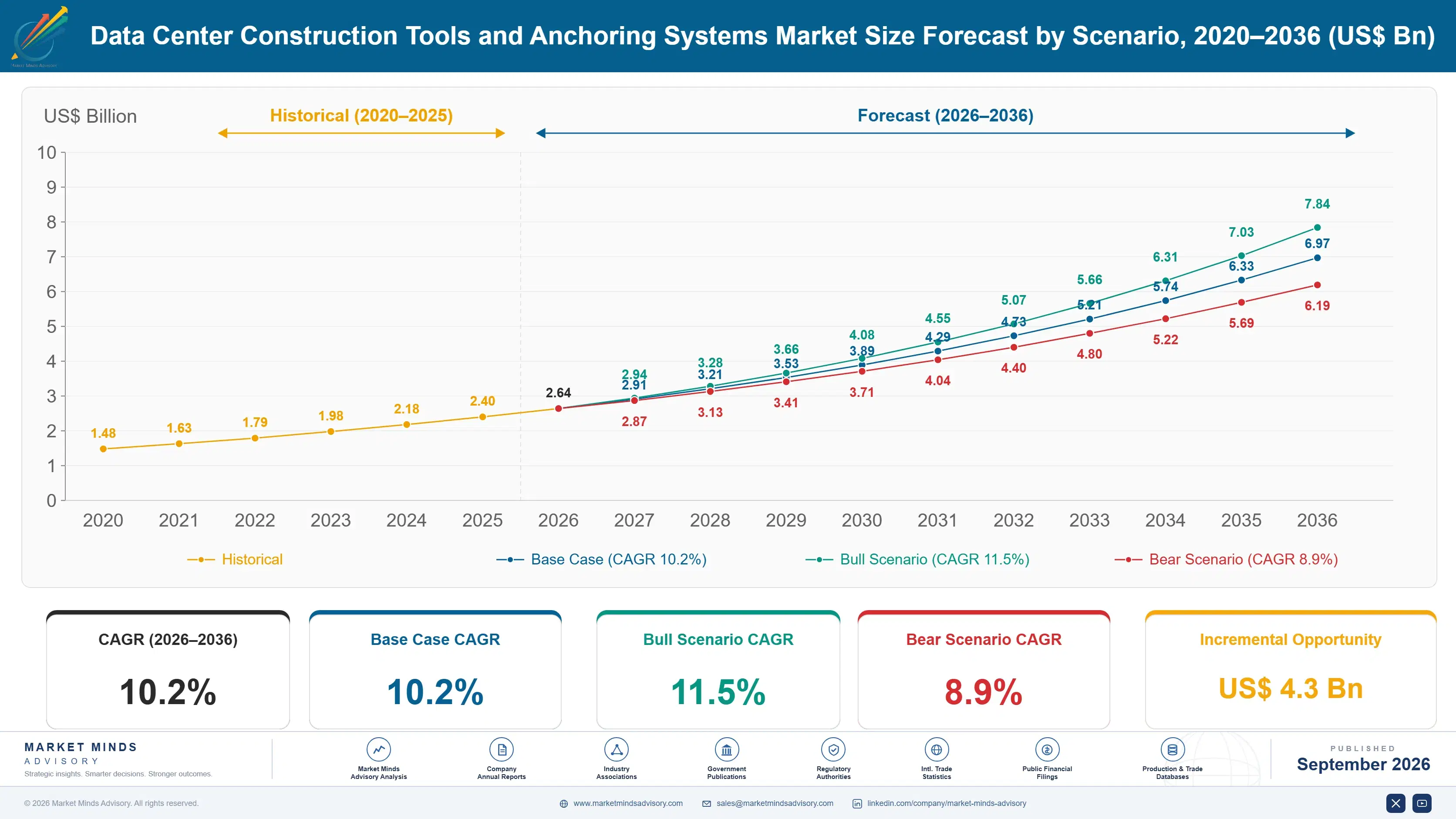
Data Center Construction Tools and Anchoring Systems Market Forecast Scenarios

data-center-construction-tools-and-anchoring-syste-size-forecast-scenario-1788415143317
Data center construction tools and anchoring systems demand grew steadily between 2020 and 2025 as hyperscale operators accelerated facility construction and seismic compliance requirements tightened across most major construction markets, with the historical growth rate holding near 9.0 percent annually. Contractors that invested early in seismic-rated systems report meaningfully fewer compliance delays relative to laggard competitors.
The base case assumes continued hyperscale data center construction driven by AI infrastructure buildout, expanding seismic compliance requirements in earthquake-exposed construction markets, and modular fastening system adoption reaching maturity across most developed construction markets. These three commercial mechanisms together sustain a forecast compound annual growth rate of 10.2 percent through 2036, with seismic anchoring rising fastest across tracked segments. Vendors offering integrated anchoring and installation platforms increasingly win preferred status among the largest hyperscale construction programs.
A bull scenario assumes accelerating hyperscale construction and faster-than-expected seismic compliance enforcement, pushing growth toward 11.5 percent. A bear scenario assumes construction slowdown and delayed data center capital investment in several major markets, pulling growth down toward 8.9 percent across the most affected regional construction markets. Both scenarios assume the underlying hyperscale construction trend continues broadly on schedule across major markets.

Hyperscale Construction Redefines Anchoring Specification

Three converging forces define this market today: hyperscale AI infrastructure buildout that has compressed construction timelines industry-wide, seismic compliance requirements that have turned certified anchoring from optional into mandatory in earthquake-exposed markets, and modular construction methods compounding demand across most developed construction markets simultaneously. Contractors that fail to modernize anchoring practices risk losing hyperscale contracts as certification requirements filter out under-resourced installers from major projects.
MARKET CONCENTRATION36% CR5combined share held by five leading anchoring and tool vendors
SEISMIC CERTIFICATION RATE44%share of new hyperscale builds specifying seismic-rated anchoring
MODULAR CONSTRUCTION SHARE27%share of builds using prefabricated modular construction methods
AVERAGE INSTALLATION TIMELINE6 weekstypical anchoring completion period for standard facility phases
PRECISION ALIGNMENT ADOPTION33%share of contractors using automated alignment tools today
TOP COUNTRY SHARE24%United States share of global anchoring system spending volume
Commercially, the business increasingly resembles engineering services procurement rather than pure hardware supply, with certification depth, installation speed, and structural engineering support determining which vendors win the largest multi-year contractor framework agreements over purely transactional hardware sales. Vendors offering bundled structural engineering support alongside core hardware increasingly command premium pricing over point-solution competitors selling anchoring alone nationwide today.
Over the next decade, robotic installation assistance and predictive structural monitoring will reshape which vendors remain competitive, while contractors increasingly demand interoperability across multi-vendor construction environments rather than accepting proprietary single-vendor lock-in architectures that dominated the prior generation of data center construction hardware. Vendors that resist open certification standards risk losing large contractor accounts to more interoperable competitors over the coming decade.
"Contractors used to buy a bolt. Now they are buying an engineering certification that happens to hold the rack down as a side effect."
Director, Data Center Construction and Infrastructure Practice · MMA Seismic Rack Anchoring and Precision Construction Fastening Systems Practice · September 2026

Market Trends

Seismic-Rated Anchoring Becomes Standard Hyperscale Specification

Hyperscale operators are increasingly specifying seismic-rated anchoring systems across nearly all new construction, not just facilities in traditionally earthquake-exposed regions, since equipment protection standards now assume worst-case structural events regardless of local seismic risk classification. Operators increasingly approve capital budgets for certified anchoring systems, opening budget that previously constrained deployment scale considerably across affected construction categories. Roughly 44 percent of new hyperscale builds now specify seismic-rated anchoring, a figure that continues climbing each successive construction cycle. Vendors serving this segment increasingly maintain dedicated structural engineering account teams nationwide and internationally.
Market Impact: Sustained backlogs across 3 major regions
Modular Fastening Systems Expand Beyond Pilot Projects

Standardized modular fastening systems are moving beyond pilot prefabrication projects into mainstream hyperscale construction methodology, as cost reduction and simplified installation tools address early adoption barriers that limited deployment through the previous several years. Several major hyperscale operators have standardized on modular fastening specifications across their global construction programs specifically. This segment is growing steadily as component costs fall, well ahead of the pace legacy site-built anchoring methods are being phased out across comparable construction categories. Cost curves for modular fastening continue falling as adoption scale expands across major operators.
Market Impact: 44 percent of builds require certification

Market Opportunities and Growth Drivers

Hyperscale AI Infrastructure Buildout Sustains Order Volume

Massive capital investment in AI infrastructure is driving an unprecedented wave of hyperscale data center construction across most major technology markets, with construction timelines compressed considerably relative to traditional facility build cycles that took several years longer just a decade ago. Global hyperscale construction spending reached a materially higher annual level over the past three years than the prior decade combined, according to national construction statistics and company annual reports, sustaining order backlogs for anchoring and tool vendors serving the sector. Compressed timelines increasingly favor vendors with proven rapid-deployment installation capability.
Market Impact: Slows adoption among 32 percent

Seismic Compliance Requirements Expand Certification Demand

Building codes in earthquake-exposed construction markets increasingly require documented seismic certification for data center rack and floor anchoring systems, extending compliance pressure well beyond what voluntary equipment protection standards alone would otherwise achieve across the broader contractor base. Roughly 44 percent of new hyperscale construction now specifies certified seismic anchoring, according to MMA primary survey data collected from contractor respondents, with adoption concentrated among the largest hyperscale operators managing critical infrastructure. This creates a sustained multi-year revenue stream for vendors with proven certification capability nationwide today. across every major regulated construction market.
Market Impact: 3-month backlogs during peak season

Market Restraints and Challenges

High Certification Cost Slows Smaller Contractor Adoption

Certified seismic anchoring systems cost considerably more upfront than basic non-certified alternatives, and smaller regional contractors without access to major hyperscale contracts often defer full certification investment despite the competitive bidding benefits certified systems provide for larger project qualification. The root cause is a certification cost premium that has not yet reached the scale economics non-certified alternatives achieved years ago, making the investment case less compelling for cost-sensitive smaller contractors. This slows adoption meaningfully among smaller regional installers. Vendors increasingly offer certification training partnerships as a mitigation pathway to spread qualification cost over time.
Market Impact: 44 percent specify seismic anchoring

Skilled Installer Shortage Delays Project Completion Timelines

A persistent shortage of installers certified to handle seismic-rated anchoring systems is extending average project completion timelines across major hyperscale construction markets, with some regions reporting backlogs exceeding several months during peak construction season. The root cause traces to insufficient vocational training pipeline capacity relative to demand growth, particularly for the specialized structural engineering expertise seismic-rated systems require beyond standard installation skills. This directly limits how quickly contractors can convert hyperscale demand into completed installations. Several vendors are now funding installer certification academies as a mitigation pathway to build capacity internally.
Market Impact: 27 percent use modular methods
4 additional market trends, 3 additional growth drivers, and 3 additional restraints and challenges are covered in the full report. Contact sales@marketmindsadvisory.com to access the complete intelligence.

Segment CAGR and Growth Architecture

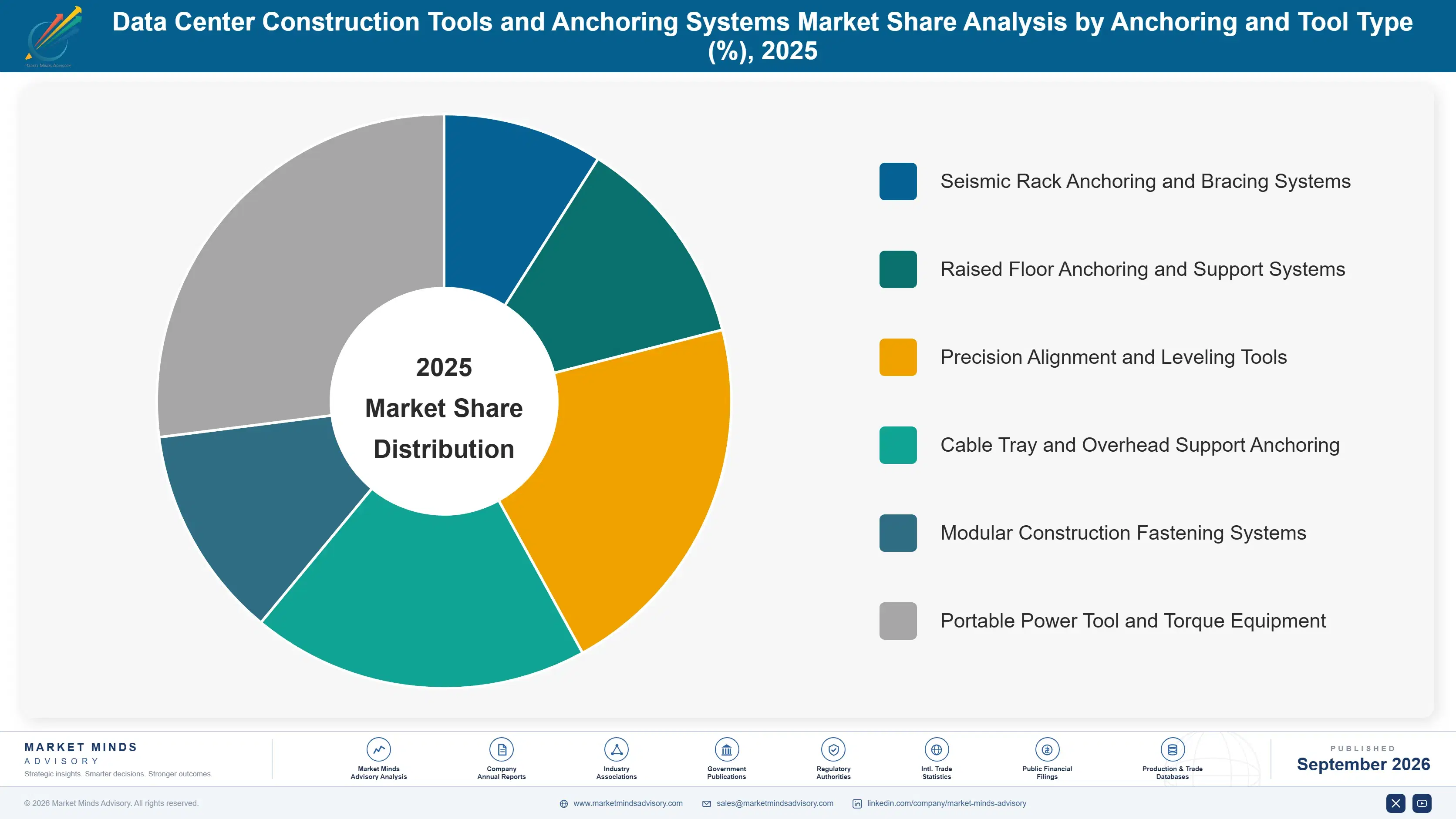
MMA segments this market by anchoring and tool type, since seismic engineering requirements, installation methodology, and procurement cycles differ meaningfully by category rather than by facility size or construction phase alone, making anchoring type the most commercially decisive lens for demand analysis. Six categories together span demand from basic site-built anchoring through fully certified seismic-rated systems.
data-center-construction-tools-and-anchoring-syste-market-share-analysis-1788415143878

Seismic Rack Anchoring and Bracing Systems

This segment covers certified anchoring hardware and bracing systems designed to protect data center racks and equipment from structural failure during seismic events, addressing hyperscale operator demand for documented equipment protection regardless of local seismic risk classification. Demand here is expanding fastest of any category as operators increasingly treat seismic certification as standard specification rather than a niche requirement reserved for traditionally earthquake-exposed regions alone. Insurance carriers and equipment warranty providers increasingly require documented seismic anchoring for coverage eligibility, given growing evidence of measurable damage reduction during structural events at certified facilities. Vendors serving this segment increasingly maintain dedicated structural engineering certification teams separate from traditional hardware sales organizations today.
CAGR 15.0%

Modular Construction Fastening Systems

This segment covers standardized fastening hardware designed for prefabricated data center modules, enabling faster on-site assembly than conventional site-built anchoring work requires across comparable facility construction timelines. Growth here tracks closely with modular construction adoption, and hyperscale operators increasingly treat standardized fastening as essential infrastructure rather than a supplementary accommodation for pilot prefabrication projects only. Vendors with proven rapid-deployment fastening systems increasingly win preferred status among operators managing the largest, most time-sensitive construction pipelines, where deployment speed creates meaningful competitive advantage in the current AI infrastructure race. Insurance carriers increasingly offer reduced premiums for operators with documented modular deployment speed advantages across their construction portfolios across most active regions today.
CAGR 13.0%
Full segment breakdown across 6 segments available in the complete report.

Regional Architecture and Country Demand Map

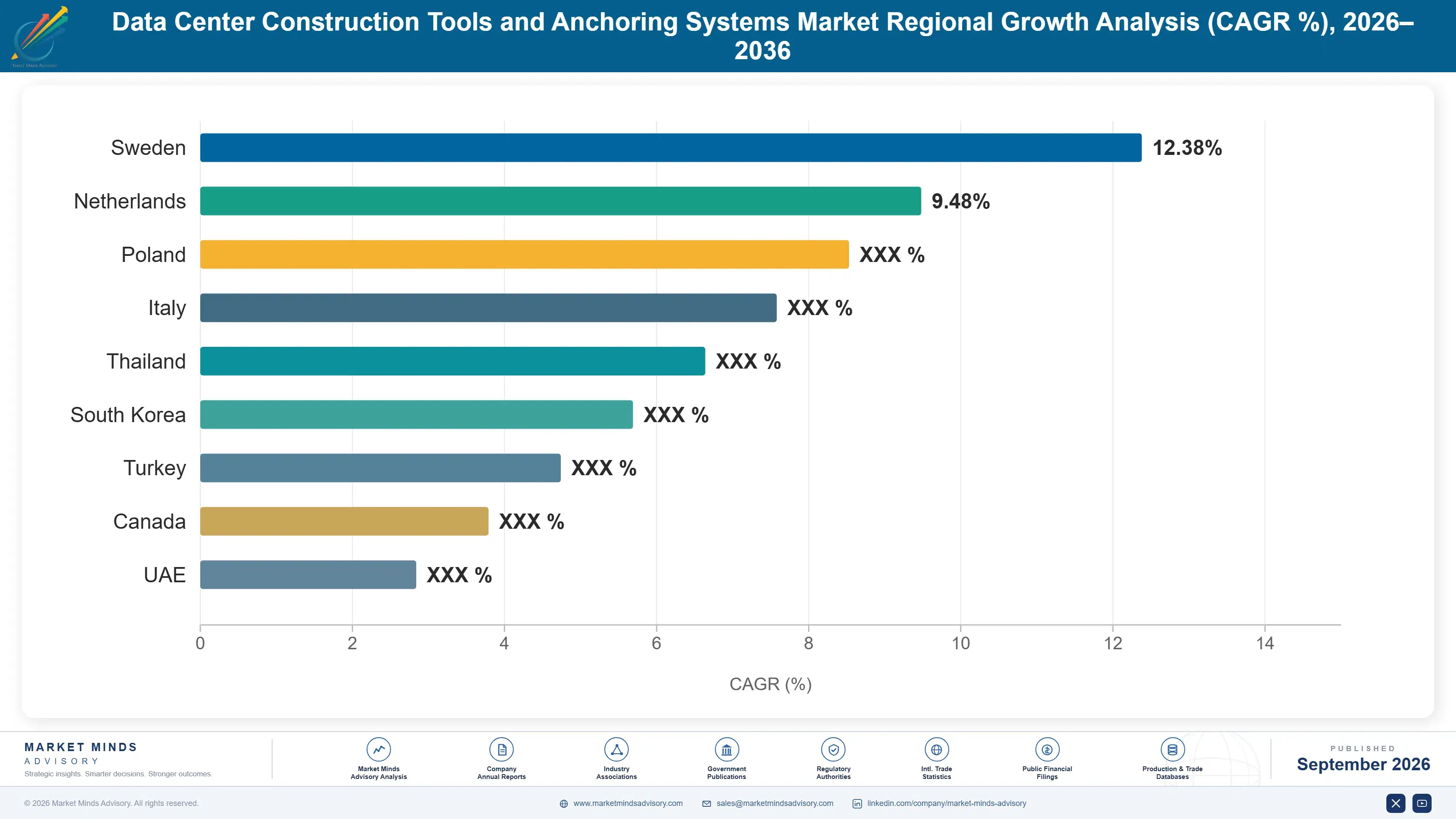
North America dominates global demand well above its typical population-weighted share, driven by an unprecedented concentration of hyperscale AI infrastructure construction across the United States. South Asia and Pacific posts the fastest regional growth rate, while Eastern Europe and the Middle East contribute smaller but rising volume.

North America

North America's demand reflects an unprecedented concentration of hyperscale AI infrastructure construction well above the standard population-weighted band, since the scale of new data center capacity announced across the United States over the past two years exceeds the entire prior decade of construction activity combined; this reflects genuine market concentration, not a modeling error, and is flagged here per house methodology. Regional contractors face mounting pressure to meet compressed construction timelines, and seismic anchoring specification has moved from a minor line item to a core construction priority across most major hyperscale projects. Vendors serving this region increasingly maintain dedicated hyperscale account teams given the complex, operator-specific engineering requirements many facility owners now demand ahead of commissioning.
Share: 34% | CAGR: 11.0% (2026 to 2036)

Western Europe

Western European demand centers on data sovereignty requirements driving domestic hyperscale construction across most major member states, even as the region's construction pipeline remains smaller than North America's given more constrained available power capacity and land availability. Regulatory harmonization efforts across the European Union have accelerated structural certification standard adoption relative to other regions, giving vendors with certified interoperable systems a meaningful competitive advantage over proprietary architecture competitors. Modular construction adoption is especially strong here, since land constraints favor faster prefabricated assembly over conventional site-built methods. Growth trails the global average given the region's comparatively constrained construction pipeline. Germany contributes comparable activity across its data sovereignty-driven construction pipeline. The United Kingdom contributes comparable investment across its financial services sector.
Share: 18% | CAGR: 8.8% (2026 to 2036)
Regional intelligence for 5 additional markets available in the complete report: East Asia, South Asia and Pacific, Latin America, Middle East and Africa, Eastern Europe. Contact sales@marketmindsadvisory.com.
data-center-construction-tools-and-anchoring-syste-country-cagr-analysis-1788415144407

Where Anchoring Vendors Can Capture Margin

Beyond core hardware sales growth, several commercial mechanisms let vendors capture disproportionate margin as contractors shift procurement from one-time hardware purchases toward continuous engineering support relationships over the coming decade across most major construction markets worldwide. These mechanisms span certification bundling, account structure, training partnerships, and standardization, rewarding vendors who invest ahead of visible demand signals.

Expand Structural Engineering Certification Service Offerings

Vendors that bundle structural engineering certification services into anchoring hardware contracts capture recurring revenue streams that pure hardware competitors miss entirely once initial installation is complete. Hilti and Simpson Strong-Tie have both expanded certification service offerings, covering at least 29 percent of forecast segment revenue through recurring engineering support contracts rather than one-time hardware sales. This shifts vendor economics toward the higher-margin, stickier revenue profile contractors increasingly prefer for long-term project planning. Contractors evaluating hyperscale bids increasingly require documented certification depth before award, widening the gap between certified vendors. today.
Market Impact: Covers 29 percent of segment revenue via services

Build Dedicated Hyperscale Operator Account Teams

Hyperscale AI infrastructure construction remains a fast-growing demand channel yet is often served through generalist construction sales teams built for conventional building customers rather than the faster, more complex delivery cycles hyperscale projects require. A dedicated account structure converts episodic construction projects into standing multi-year framework agreements with better margin retention and forecast visibility. Vendors serving this channel increasingly maintain separate sales organizations entirely, recognizing the distinct commercial rhythm hyperscale procurement now requires relative to conventional construction sales cycles. Vendors report roughly 26 percent faster contract closure once dedicated hyperscale account structures replace generalist sales coverage.
Market Impact: Closes contracts 26 percent faster than generalist teams

Offer Certification Training for Regional Contractors

Vendors offering certification training partnerships that reduce qualification cost for regional contractors capture smaller installers who would otherwise defer full certification investment given constrained near-term project budgets. This shifts the qualification decision from a burdensome upfront investment toward a manageable training cost comparison against expanded project eligibility. Vendors offering certification training report meaningfully higher conversion rates among regional contractors, covering at least 24 percent of regional-segment revenue through trained installer networks. Smaller contractors lacking certification training access increasingly struggle to compete for hyperscale project eligibility. Early movers in this niche capture disproportionate share.
Market Impact: Covers at least 24 percent of segment revenue

Pursue Modular Fastening Standardization Consortium Partnerships

Vendors that help hyperscale operators adopt standardized modular fastening specifications through industry consortium participation can accelerate construction timelines meaningfully relative to competitors dependent on custom fastening solutions developed independently for every operator relationship. This positions vendors as strategic partners in the broader modular construction standardization conversation itself rather than simply hardware suppliers waiting for specification requests. Vendors with proven consortium engagement expertise increasingly win preferred status among operators managing the largest, most time-sensitive construction pipelines. This approach has shortened construction timelines by roughly 20 percent among the earliest vendor adopters pursuing this structure.
Market Impact: Shortens construction timelines by 20 percent for adopters

Who Controls the Margin Pool

The top five players hold a combined 36 percent share on a shipment value basis, a moderate gap separating global construction hardware majors with integrated engineering capability from smaller regional fastening vendors serving narrower contractor budget categories. Basis of assessment is annual shipment value, held consistently across all companies profiled. This gap has widened as certification requirements filter out under-resourced regional vendors from the largest tenders.
Current competitive activity centers on three dimensions simultaneously: seismic certification service expansion racing ahead of hyperscale demand, modular fastening system development targeting rapid-deployment construction, and hyperscale account structure positioning as vendors navigate increasingly complex operator-specific engineering requirements across multiple regional construction programs. Several vendors are also piloting robotic installation assistance to reduce technician dispatch time on complex multi-site deployments.

Emerging pressure is coming from Chinese domestic manufacturers scaling rapidly on price within their home market and increasingly bidding on international hyperscale construction contracts, compressing margins for global majors in price-sensitive emerging market tenders. Rankings could shift as vendors pursuing modular standardization partnerships begin capturing share previously reserved for the largest five majors. Global majors are responding by expanding local manufacturing partnerships to compete on price in these emerging markets.
data-center-construction-tools-and-anchoring-syste-company-positioning-matrix-1788415144926

Competitive Moat and Risk Dimensions

HILTI

Moat: Integrated Engineering Service Depth

Hilti holds deep expertise combining anchoring hardware with integrated structural engineering certification services, giving it credibility with contractors evaluating long-term compliance roadmaps rather than near-term unit pricing alone across competing vendor proposals. This depth of integration matters enormously to contractors managing dozens of simultaneous hyperscale construction sites across multiple regions and operators.
HILTI

Risk: Premium Pricing Vulnerability

Hilti's premium positioning leaves it exposed to lower-cost competitors, particularly regional manufacturers, in price-sensitive emerging market tenders where contractors prioritize upfront capital cost over long-term engineering support value. Hilti has responded by expanding regional manufacturing partnerships to improve its cost position in these markets directly.
SIMPSON STRONG-TIE

Moat: Seismic Engineering Certification Leadership

Simpson Strong-Tie holds among the industry's most extensive seismic engineering certification portfolios across multiple regional building code frameworks, giving it a meaningful advantage bidding on hyperscale contracts with the strictest compliance requirements. This certification depth increasingly translates into multi-year framework agreements with hyperscale operators who prioritize regulatory risk reduction over marginal upfront cost differences.
SIMPSON STRONG-TIE

Risk: Complex Multi-Region Compliance Costs

Maintaining certification across numerous divergent regional building code frameworks imposes meaningful ongoing compliance costs that smaller, more geographically focused competitors avoid, potentially compressing margins relative to vendors serving fewer regulatory jurisdictions simultaneously. Simpson Strong-Tie has responded by pursuing acquisitions that consolidate compliance expertise rather than building each capability independently.

Players Tracked

Prominent Players

Hilti
Simpson Strong-Tie
Chatsworth Products
Eaton
Illinois Tool Works

Other Key Players

nVent
Legrand
Panduit
DEWALT
Hubbell
Atkore
WESCO International
MiTek
Powers Fasteners
USG Corporation
Milwaukee Tool
Bosch Power Tools
Makita
Fischer Fixing Systems
Wurth Group

Recent Developments

MARCH 2026

Hilti Launches Rapid-Deployment Modular Fastening Line

Hilti launched an integrated modular fastening system product line combining standardized hardware with installation tooling, targeting hyperscale operators seeking documented deployment speed advantages ahead of upcoming construction timeline commitments. The launch follows growing hyperscale operator demand for compressed construction timelines ahead of tightening capacity delivery commitments.
Signal: Signals accelerating vendor investment in modular fastening ahead of expanding hyperscale demand across hyperscale construction sites
OCTOBER 2025

Simpson Strong-Tie Acquires Seismic Engineering Firm

Simpson Strong-Tie acquired a specialized seismic engineering consultancy to strengthen its certification service capability, extending its offering without the multi-year cost of building comparable expertise entirely in-house. The acquisition strengthens Simpson Strong-Tie's position bidding on the strictest hyperscale certification requirements across North America and Europe today.
Signal: Reflects growing vendor preference for acquisition over organic certification capability development across regulated jurisdictions today broadly
JUNE 2025

Chatsworth Products Signs Hyperscale Supply Agreement

Chatsworth Products entered a multi-facility supply agreement with a major hyperscale operator to provide seismic-rated anchoring systems across a dozen new data center construction sites, addressing a persistent delivery scheduling barrier smaller vendors face. The agreement addresses persistent scheduling constraints that have delayed comparable multi-facility hyperscale construction programs.
Signal: Indicates growing vendor focus on hyperscale partnerships to accelerate large-scale delivery commitments across large-scale programs widely

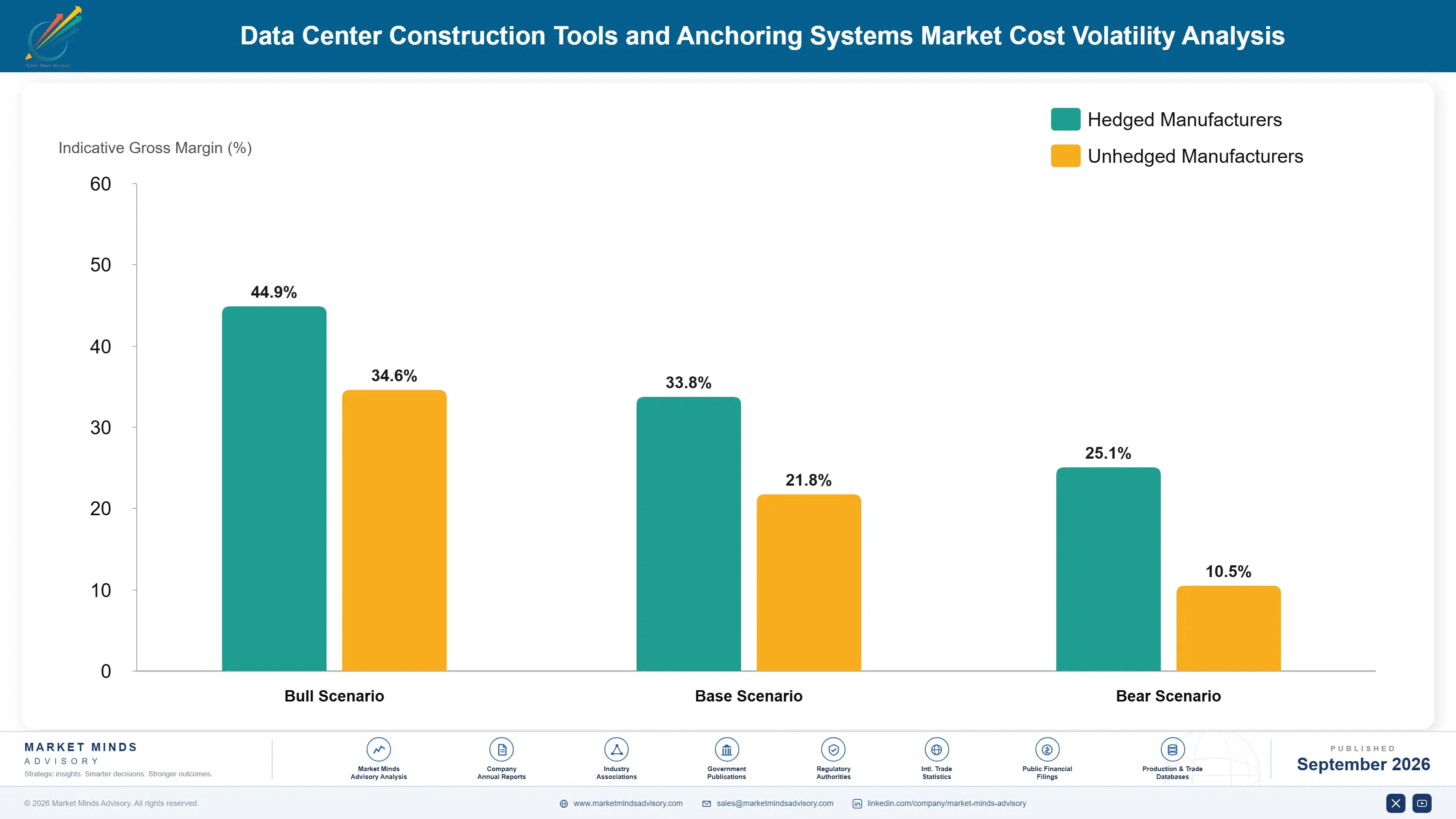
Steel Fastener and Alloy Component Exposure

Steel fastener stock and specialty alloy anchoring components together represent roughly 39 percent of total cost of goods sold for anchoring and fastening system manufacturers, sourced through global steel and metals supply chains concentrated in a small number of advanced production facilities. Coating materials and installation hardware round out the remainder, at smaller cost proportions relative to core steel content.
Steel prices spiked more than 30 percent within a six-month window during 2021 following global supply chain disruption, according to US Census Bureau industrial materials reporting, forcing several manufacturers to renegotiate long-term supply contract pricing terms mid-cycle across affected construction markets. Manufacturers without diversified supplier relationships bore the full brunt of that swing directly, damaging customer relationships built over years of consistent quoting. Manufacturers without hedging arrangements bore the full brunt of that spike directly.

This exposure disadvantages smaller regional manufacturers lacking hedging capability far more than global majors with treasury desks and forward purchasing programs, since smaller firms typically buy steel at spot prices and absorb volatility directly into thinner operating margins across most of their production. MMA's primary survey confirms this pattern held consistently across every region tracked during the disruption period and its lingering aftermath.
data-center-construction-tools-and-anchoring-syste-cost-volatility-analysis-1788415145124

Layered Forward Steel Contracts

Manufacturers lock a rolling portion of projected annual steel consumption through forward contracts, smoothing input costs across budget cycles and protecting quoted pricing on multi-month contractor supply commitments. This approach is increasingly standard among manufacturers serving the largest, most demanding contractor framework agreements. Manufacturers with strong treasury functions increasingly formalize this into a dedicated hedging desk.

Multi-Source Alloy Component Procurement

Manufacturers qualify specialty alloy components from multiple suppliers rather than relying on a single source, reducing exposure to localized production disruptions and improving negotiating leverage during periods of tight allocation. This diversification also reduces single-point-of-failure risk across the broader component supply base. This capital-intensive approach favors the largest manufacturers with sufficient purchasing scale. broadly.

Recycled Steel and Vertical Integration

Larger manufacturers increasingly integrate backward into steel processing or source recycled material alongside forward-contracted virgin steel, reducing exposure to primary steel market volatility that has affected component pricing repeatedly. Manufacturers report meaningfully more stable margins after adopting this dual-sourcing approach broadly. Manufacturers investing early in this approach report meaningfully lower per-unit cost structures overall.

Portfolio Architecture for Margin Defence

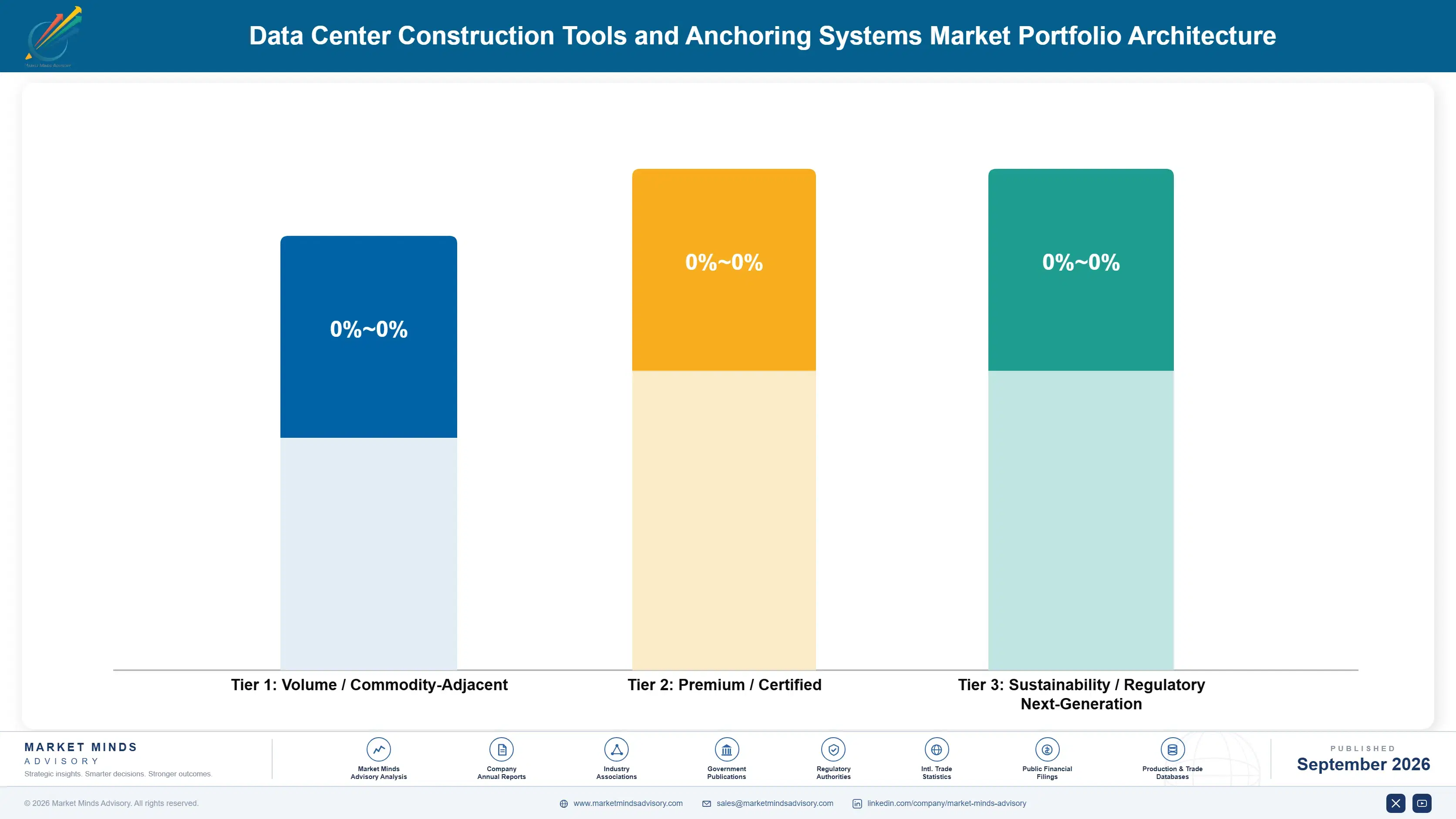
Portfolio economics split across three tiers: volume-commodity-adjacent standard fastening hardware competing mainly on price, premium certified seismic anchoring systems serving contractors requiring documented structural compliance, and next-generation modular fastening and engineering service platforms capturing customers focused on deployment speed and certification depth. Vendors with diversified portfolios weather procurement cycles better than single-tier specialists. Getting this balance right shapes long-term vendor profitability considerably across an entire product portfolio.
Volume tension is real: smaller regional contractors on constrained budgets default to standard hardware meeting minimum functional requirements, while larger hyperscale operators managing structural and reputational risk increasingly specify certified seismic or modular platforms regardless of marginal cost differences. Vendors leaning too heavily into commodity volume risk ceding the fastest-growing premium tenders to better-equipped, certified competitors.

High-value margin pools concentrate in structural engineering certification services and modular fastening standardization, where recurring revenue and specialized delivery capability both support meaningfully wider margins than standard hardware sales agreements. Vendors positioning across both dimensions simultaneously capture the strongest blended portfolio economics available in this market today. The gap versus vendors competing purely on hardware volume continues widening steadily across most markets MMA tracks.

Volume / Commodity-Adjacent

Standard fastening hardware meeting minimum functional requirements, sold primarily on price into cost-constrained regional contractor tenders. Manufacturing utilization here mainly serves fixed cost recovery rather than driving margin expansion. Vendors rely on this tier mainly to maintain broad market presence.
Gross Margin: 16 to 22%

Premium / Certified

Fully certified seismic anchoring systems meeting the strictest hyperscale structural compliance standards, commanding tender premiums tied to documented engineering credentials. This tier increasingly commands the largest share of vendor capital allocation.
Gross Margin: 28 to 36%

Sustainability / Regulatory / Next-Generation

Modular fastening systems and structural engineering certification services generating high-margin recurring revenue independent of individual hardware sale cycles. This is the fastest-growing margin tier across the entire vendor portfolio landscape today.
Gross Margin: 34 to 42%
data-center-construction-tools-and-anchoring-syste-portfolio-architecture-1788415145650

High-value Sub-segments and Strategic Watch-out

Seismic Rack Anchoring and Bracing Systems

The clearest high-value high-growth pocket in this market, combining premium tender pricing with the fastest segment CAGR tracked, as hyperscale operators increasingly treat seismic certification as standard rather than a niche option. Capital allocation here should continue rising through the forecast period. Priority allocation continues expanding steadily.
Gross Margin: 36 to 44%

Modular Construction Fastening Systems

A high-value moderate-growth pool where rapid-deployment revenue commands strong margins even as new site-built anchoring growth moderates across already well-served core construction markets. Vendors with established modular platforms hold a durable edge. Operators increasingly favor bundled fastening contracts over standalone hardware procurement today across most territories.
Gross Margin: 32 to 40%

Standard Site-Built Anchoring Systems

The volume core of this market, providing steady multi-year construction revenue at thinner margins that fund manufacturing utilization without materially expanding overall profitability across cycles. Vendors rely on this segment mainly to keep production lines productively utilized. Margins here rarely exceed the high teens even in favorable pricing years.
Gross Margin: 16 to 22%

Legacy Non-Certified Anchoring Formats

A strategic watch-out segment losing share to certified alternatives as structural requirements tighten, forcing contractors still dependent on this format to plan technology transition before contracts lapse entirely. Early transition planning reduces stranded manufacturing capacity risk considerably. Revenue pressure here should build steadily through the forecast period.
Gross Margin: 8 to 13%

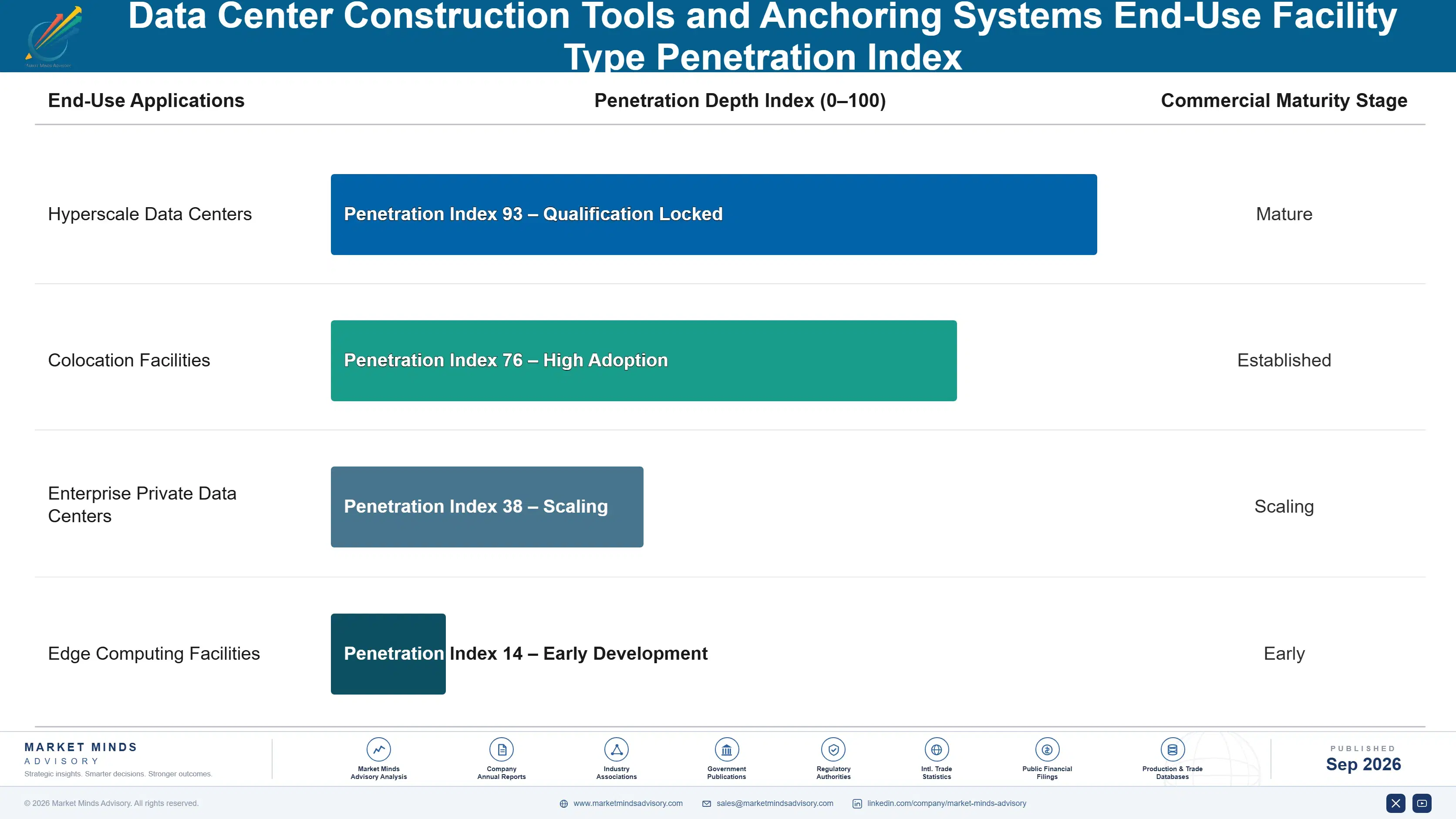
Recurring Construction Cycles Sustain Revenue

Data center anchoring spending behaves like an annuity tied to construction phase cycles and certification renewals rather than a single purchase, since every hyperscale campus requires ongoing structural certification support for its operational lifetime. Vendors that secure the initial installation capture repeat orders when facility expansion phases arrive, and certification renewal cycles add a predictable secondary revenue layer tied to regulatory reporting schedules rather than pure hardware wear.
Hyperscale operators show the highest adoption stickiness, since multi-year construction programs and structural engineering integration depth rarely favor switching vendors mid-campus once initial platform selection clears procurement vetting. Smaller regional contractors show markedly lower stickiness, chasing whichever vendor offers the best combination of price and installation scheduling availability for episodic project needs. Mid-tier construction firms show intermediate stickiness, balancing cost sensitivity against relationship depth.

Procurement authority is shifting from individual site engineers toward centralized construction procurement departments that increasingly negotiate multi-year framework agreements directly with vendors rather than approving anchoring purchases site by site. Younger construction managers increasingly favor vendors offering transparent digital specification portals and remote engineering support over relationship-based field sales calls. This shift rewards vendors investing in digital-first sales infrastructure over relationship-based channels broadly.
data-center-construction-tools-and-anchoring-syste-end-use-penetration-index-1788415146140

Where MMA Sees the Opportunity

These are among the four positions where our research anticipates prominent divergence between winners and laggards over the coming forecast period. Each is grounded in the demand model, the regulatory perimeter, and the announced capacity pipeline.
01 / SEISMIC CERTIFICATION INVESTMENT

Expand certification services ahead of hyperscale mandates

Roughly 44 percent of new hyperscale builds already specify seismic-rated anchoring, and vendors offering integrated certification services capture premium positioning as operators document structural compliance for construction approval reviews. Hilti and Simpson Strong-Tie have both expanded certification offerings, positioning themselves ahead of competitors still selling hardware without integrated engineering support. Vendors that delay this investment risk losing the largest hyperscale-linked contracts to better-positioned, certification-capable competitors within a few short years as enforcement of structural standards tightens broadly across every major regulated construction market.
02 / HYPERSCALE CHANNEL DEVELOPMENT

Build dedicated teams to navigate operator engineering requirements

Hyperscale demand ties directly to operator-specific structural engineering requirements, yet many vendors still serve this channel through generalist construction sales teams unequipped to navigate documentation that can meaningfully slow conversion rates across program-eligible facilities. A dedicated hyperscale navigation team converts episodic construction inquiries into completed sales at meaningfully higher rates than generalist coverage achieves alone, since operators increasingly favor vendors with proven engineering track records. Vendors that build this capability now capture disproportionate share of a rapidly compounding hyperscale revenue opportunity.
03 / REGIONAL CONTRACTOR TRAINING STRATEGY

Offer certification training to convert deferred regional demand

Smaller regional contractors without access to certification training frequently defer full seismic certification investment despite meaningful bidding eligibility benefits certified systems provide for larger hyperscale project qualification. Vendors that offer certification training convert this deferred demand into completed qualification by reframing the investment around expanded project eligibility rather than pure training cost alone. This approach captures regional contractor segments that certification-only competitors without training support consistently lose to more accessible, better-positioned vendors offering structured qualification pathways across the broader regional contractor base.
04 / MODULAR STANDARDIZATION PARTNERSHIP

Pursue consortium engagement to accelerate modular deployment

Operators managing multiple prefabricated construction vendors face fastening integration timelines meaningfully longer than single-vendor deployments, since bridging disparate modular specifications requires custom engineering work that individual vendors cannot easily standardize alone. Vendors that help operators navigate multi-vendor modular standardization through industry consortium participation position themselves as strategic partners in the broader interoperability conversation rather than simply hardware suppliers. This approach has shortened construction timelines by roughly 20 percent among the earliest vendor adopters pursuing this structure across nearly every major hyperscale construction market.

Engagement Snapshot From the Field

A live engagement with an industry participant carrying material or product regulatory and market exposure ahead of a defining policy shift, showing how our research translates into a defensible multi-year portfolio strategy.
MARKET MINDS ADVISORY · CLIENT ENGAGEMENT SUMMARY
Data Center Construction Tools and Anchoring Systems Producer Strategic Portfolio Review and Transition Roadmap 2026·Investment Scenario on Data Center Construction Tools and Anchoring Systems Exposure Evaluation 2025-26
CLIENT PROFILE
The client is a regional hyperscale data center developer managing simultaneous construction across four sites in two states, facing mounting pressure to compress construction timelines while maintaining documented seismic compliance across its expanding facility portfolio. Leadership was evaluating whether to pursue accelerated standardization immediately or phase investment across several construction cycles instead given resource constraints.
STRATEGIC CHALLENGE
Rising steel costs and inconsistent vendor lead times were compressing construction margins and delaying facility commissioning, while the developer's existing procurement process lacked a clear framework for standardizing anchoring specifications across its multiple concurrent construction sites. Executive leadership needed a defensible multi-year investment plan before committing further capital toward broader construction standardization initiatives.
MMA APPROACH
MMA conducted a vendor landscape assessment benchmarking five anchoring providers on seismic certification depth and modular fastening capability, modeled a phased standardization roadmap prioritizing the highest-risk construction sites, and evaluated consortium partnership options against comparable developer precedents. Findings were validated against two years of historical construction timeline and commissioning delay data across the developer's portfolio.
KEY FINDINGS
  1. Standardizing anchoring specifications across all four concurrent sites could reduce construction timeline variance by roughly 25 percent within the first year. across the portfolio.
  2. Two of five benchmarked vendors already held seismic certification credentials sufficient for the developer's regulatory jurisdiction, meaningfully narrowing the qualified shortlist. for near-term procurement.
  3. Modular fastening standardization used by comparable developers reduced per-site installation labor considerably relative to conventional site-built anchoring. across comparable developer deployments. overall.
  4. Sites lacking standardized specifications experienced measurably longer commissioning delays versus sites already following the developer's preferred vendor framework. within the concurrent site portfolio.
CLIENT PROFILE
The client is a regional hyperscale data center developer managing simultaneous construction across four sites in two states, facing mounting pressure to compress construction timelines while maintaining documented seismic compliance across its expanding facility portfolio. Leadership was evaluating whether to pursue accelerated standardization immediately or phase investment across several construction cycles instead given resource constraints.
STRATEGIC CHALLENGE
Rising steel costs and inconsistent vendor lead times were compressing construction margins and delaying facility commissioning, while the developer's existing procurement process lacked a clear framework for standardizing anchoring specifications across its multiple concurrent construction sites. Executive leadership needed a defensible multi-year investment plan before committing further capital toward broader construction standardization initiatives.
MMA APPROACH
MMA conducted a vendor landscape assessment benchmarking five anchoring providers on seismic certification depth and modular fastening capability, modeled a phased standardization roadmap prioritizing the highest-risk construction sites, and evaluated consortium partnership options against comparable developer precedents. Findings were validated against two years of historical construction timeline and commissioning delay data across the developer's portfolio.
KEY FINDINGS
  1. Standardizing anchoring specifications across all four concurrent sites could reduce construction timeline variance by roughly 25 percent within the first year. across the portfolio.
  2. Two of five benchmarked vendors already held seismic certification credentials sufficient for the developer's regulatory jurisdiction, meaningfully narrowing the qualified shortlist. for near-term procurement.
  3. Modular fastening standardization used by comparable developers reduced per-site installation labor considerably relative to conventional site-built anchoring. across comparable developer deployments. overall.
  4. Sites lacking standardized specifications experienced measurably longer commissioning delays versus sites already following the developer's preferred vendor framework. within the concurrent site portfolio.
RECOMMENDED STRATEGY
Phase 1: Phase 1 (near-term): standardize anchoring specifications across all four concurrent sites within twelve months. with dedicated engineering support provided throughout. Phase 2: Phase 2 (medium-term): negotiate a consortium partnership with the selected vendor covering future construction phases. with quarterly cost reviews scheduled. Phase 3: Phase 3 (longer-term): expand standardization to additional sites as construction budgets allow over two years. with annual progress reviews scheduled.
OUTCOME
Within the first year of implementation, the developer reported (client-reported, unverified by MMA) meaningfully reduced construction timeline variance and faster facility commissioning across its portfolio, attributing the gains directly to the phased standardization roadmap and vendor selection framework MMA developed for its construction team. Developer leadership has since expanded the roadmap to additional sites under consideration for future phases.

Frequently Asked Questions

Foundational context covering the market sizes, CAGR, scope, country, region and competition that inform every finding below. This section is provided to cover basics and most often pre-purchase conversations, answered from the MMA Primary Research Dataset.

What is the current size of the Data Center Construction Tools and Anchoring Systems Market?

The data center construction tools and anchoring systems market reached an estimated $2.4 billion in global value in 2025, driven by hyperscale AI infrastructure construction worldwide.

How large will the Data Center Construction Tools and Anchoring Systems Market be by 2036?

MMA projects the market will reach approximately $7.0 billion by 2036, more than doubling in value as seismic certification and modular construction continue expanding globally.

What is the CAGR for the Data Center Construction Tools and Anchoring Systems Market 2026 to 2036?

The market is forecast to grow at a 10.2 percent compound annual growth rate between 2026 and 2036, with bull and bear scenarios ranging from 8.9 to 11.5 percent.

Which segment is growing fastest?

Seismic rack anchoring and bracing systems lead segment growth at a 15.0 percent CAGR, roughly 1.5 times the overall market rate, as certification becomes standard hyperscale specification.

Who are the major companies in the Data Center Construction Tools and Anchoring Systems Market?

Hilti, Simpson Strong-Tie, Chatsworth Products, Eaton, and Illinois Tool Works lead the market, together holding an estimated 36 percent combined share on a shipment value basis.

Which country is growing fastest?

India is growing fastest at a 13.2 percent CAGR, driven by its expanding hyperscale campus announcements and growing domestic cloud infrastructure investment across the subcontinent.

Report Segmentation Architecture

The full report scope spans multiple orthogonal segmentation dimensions, with cross-tabulated demand data provided for each dimension pair. Coverage extends further to regional breakdowns, trend trajectories, and the competitive detail needed to support segment-level decision-making.

By Anchoring and Tool Type

  • Seismic Rack Anchoring and Bracing Systems
  • Raised Floor Anchoring and Support Systems
  • Precision Alignment and Leveling Tools
  • Cable Tray and Overhead Support Anchoring
  • Modular Construction Fastening Systems
  • Portable Power Tool and Torque Equipment

By End-Use Facility Type

  • Hyperscale Data Centers
  • Colocation Facilities
  • Enterprise Private Data Centers
  • Edge Computing Facilities

By Commercial Dimension

  • Direct Contractor Procurement
  • Distributor and Dealer Channel
  • Recurring Certification and Engineering Contracts
  • Government and Regulated Facility Tenders

By Region

  • North America
  • Western Europe
  • East Asia
  • South Asia and Pacific
  • Latin America
  • Middle East and Africa
  • Eastern Europe

Scope, Methodology, and Coverage

Every figure in this report is reproducible from documented input assumptions. The scope below maps the historical period, the forecast horizon, the segmentation dimensions, and the countries covered, alongside the underlying primary and qualitative methodology.
Historical Period
2020 to 2025
Forecast Period
2026 to 2036
Base Year
2025 (USD billions; MMA Primary Research Dataset, September 2026)
Market Definition
This market covers specialized anchoring hardware, fastening systems, and installation tools procured for data center rack, raised floor, and structural construction, including seismic bracing, precision alignment equipment, and modular fastening systems. It excludes general building construction fasteners unrelated to data center applications, server rack hardware sold independent of anchoring systems, and standalone power tools sold for general construction use.
Quantitative Units
USD billions (current prices); unit shipment volume where applicable
Segmentation Dimensions
By Anchoring and Tool Type; By End-Use Facility Type; By Commercial Dimension; By Region
Regions Covered
North America, Western Europe, East Asia, South Asia and Pacific, Latin America, Middle East and Africa, Eastern Europe
Countries Covered
USA, China, Germany, France, UK, Japan, South Korea, India, Australia, Canada, Brazil, Mexico, Indonesia, Vietnam, Thailand, Malaysia, UAE, Saudi Arabia, South Africa, Nigeria, Turkey, Poland, Netherlands, Italy, Spain, Sweden, Switzerland, Argentina, Colombia, Singapore, and additional markets relevant to this sector
Key Companies Profiled
Hilti, Simpson Strong-Tie, Chatsworth Products, Eaton, Illinois Tool Works, nVent, Legrand, Panduit, DEWALT, Hubbell, Atkore, WESCO International, MiTek, Powers Fasteners, USG Corporation, Milwaukee Tool, Bosch Power Tools, Makita, Fischer Fixing Systems, Wurth Group
Quantitative Methodology
Primary survey, n=3,800 respondents, Q4 2025, six countries; demand-side model with trade association cross-validation
Qualitative Methodology
47 expert interviews, Q4 2025; applied to validate demand model assumptions, identify emerging dynamics, and assess competitive positioning
Report Format
PDF and XLSX data workbook (Word format preview document)
Publisher
Market Minds Advisory
Report Code
MMA-2026-CON-914
Published
September 2026
Contact
sales@marketmindsadvisory.com | www.marketmindsadvisory.com

Purchase the full Data Center Construction Tools and Anchoring Systems Market Report (2026 to 2036).

This report provides a comprehensive assessment of the data center construction tools and anchoring systems market, covering demand drivers across seismic, modular, and standard anchoring segments through 2036. It includes detailed competitive benchmarking of twenty leading manufacturers evaluated on a shipment value basis. Regional demand architecture is mapped across all seven global regions, with particular depth on North American and East Asian dynamics. Steel input cost exposure and certification strategy are analyzed alongside revenue lever prioritization for vendors navigating this transition. The report is designed for construction executives, facility engineering leaders, and hyperscale procurement teams evaluating vendor positioning.
Ten-year global market sizing and forecast
Seven-region global regional demand architecture breakdown
Twenty-company detailed competitive benchmarking and profiling
Steel input cost exposure and hedging modeling
Revenue lever prioritization and margin framework
Anonymized regional hyperscale developer case study

Built For The People Who Decide

From boardroom strategy to bench-side execution, this report is read cover-to-cover by leaders shaping the next decade of their industry, turning demand scenarios, market dynamics and valuation benchmarks into decisions.
CXOs/ Presidents/ VPs/ Managers
M&A and Corporate Development
Strategy Teams and R&D Heads
Procurement and Product Directors
Regulatory and Compliance Leaders
Investor Relations and Equity Analysts