

Market Minds Advisory
Data Center Cabling Market

Data Center Cabling Market: Data Center Cabling Market. Fiber Optic, Copper, and High-Density Connectivity Infrastructure, 2026 to 2036

AI training clusters demanding far more bandwidth per rack than traditional cloud workloads are forcing data center operators to rip out copper cabling in favor of higher-density fiber years ahead of schedule.

Lead Analyst

Published

September 2026

Make Smarter Decisions with Customized Research Insights

Request a free sample report and evaluate market opportunities, growth trends, and competitive dynamics relevant to your business needs.

2025 MARKET VALUE$11.2BMarket Size 2025
2036 FORECAST VALUE$28.9BBase Case , 2026 to 2036
CAGR 2026 TO 20369.0 %Bull 10.2% / Bear 7.8%
INCREMENTAL OPPORTUNITY$16.7BNet 10- year value creation
EXPANSION MULTIPLE2.37x2036 value over 2026 base
Strategic Levers
M&A Pipeline
Regional Outlook
Country Rankings
Competitive Intelligence
Segmental Deep-dive
Call-Us : 91 93563 13602

Executive Snapshot and Market Trajectory.

Data center cabling has quietly become a bandwidth bottleneck rather than a commodity afterthought, as AI training clusters demand interconnect speeds that legacy copper infrastructure installed just a few years ago simply cannot physically support without a full rip-and-replace upgrade across the entire facility and its power systems.
High-density fiber optic cabling for AI and hyperscale data centers is growing fastest as operators race to support GPU cluster interconnects requiring far higher bandwidth per rack than traditional cloud computing workloads ever demanded across the entire facility and its many server rows. North America leads regional demand given its concentration of hyperscale cloud providers and the largest AI training infrastructure investment commitments announced to date across every major technology company and cloud platform.
Competitive character increasingly centers on pre-terminated, high-density fiber assembly capability rather than raw cable manufacturing volume, since data center operators building on aggressive construction timelines increasingly demand factory-terminated cable assemblies that eliminate field termination labor and reduce installation error rates considerably across every new facility built, and vendors offering rapid delivery on customized assemblies are winning disproportionate share of new contracts across the industry.
Market Definition
The Data Center Cabling Market covers fiber optic and copper structured cabling, cable management systems, patch panels, and high-density connectivity hardware used to interconnect servers, switches, and storage within data center facilities. It excludes wide-area network transmission cabling outside the facility boundary, general commercial building cabling, and standalone networking equipment like switches and routers.
Base Year Value
$11.2B in 2025 (MMA Primary Research Dataset, September 2026)
Forecast Period
2026 to 2036, eleven discrete annual values
CAGR
9.0% base case. Bull 10.2%. Bear 7.8%.
Fastest Growth Segment
High-Density Fiber Optic Cabling for AI and Hyperscale Data Centers: 13.0% CAGR
Fastest Growth Country
India: 13.5% CAGR
Fastest Growth Region
South Asia and Pacific: 11.3% CAGR
Largest Region
North America: 30% of 2025 global value
Market Leaders
Leading vendors: Corning, CommScope, Panduit, Belden, Legrand. Source: MMA Primary Research Dataset, July 2026.
Primary Survey
n=3,800 procurement and R&D decision-makers, Q4 2025, six countries
Methodology
Demand-side build-up, cross-validated against public data, 47 expert interviews

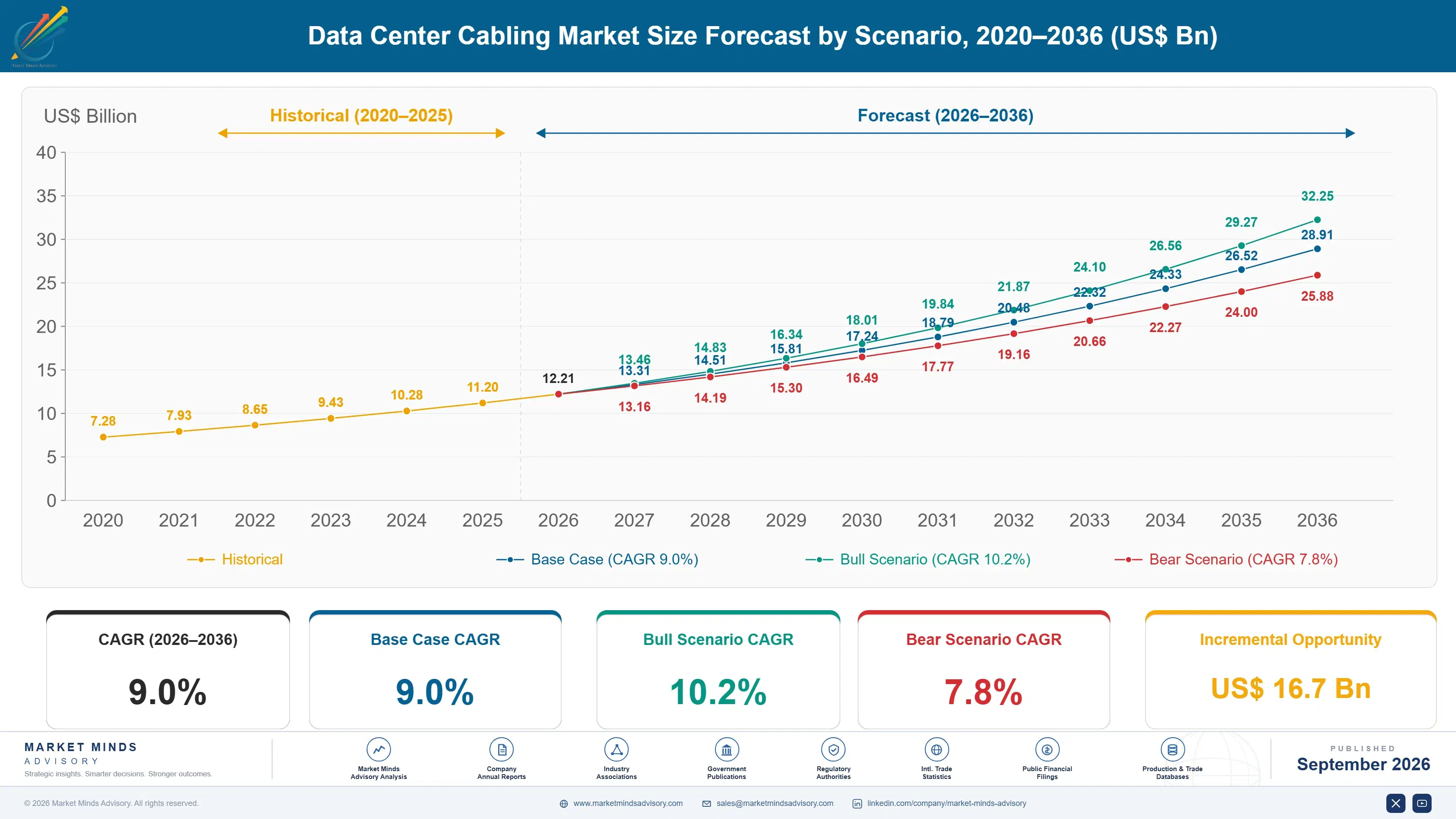
Data Center Cabling Market Forecast Scenarios

data-center-cabling-market-size-forecast-scenario-1789993080996
Growth through 2020 to 2025 was steady as hyperscale cloud provider capital expenditure expanded across new facility construction worldwide, though most cabling deployment through this period still relied on conventional copper and standard-density fiber architectures designed for pre-AI workload bandwidth requirements that now feel increasingly outdated given current interconnect demands across the entire global industry.
Base case growth through 2036 rests on three commercial mechanisms: accelerating AI training cluster deployment requiring far higher fiber density and interconnect bandwidth per rack across every new facility built worldwide, continued hyperscale and colocation facility construction expanding the underlying addressable installed base across every major region and market segment, and rising adoption of pre-terminated cable assemblies that command higher average selling prices than field-terminated alternatives requiring costly on-site labor.
A bull scenario turns on faster AI infrastructure buildout accelerating fiber density requirements across an even broader base of enterprise and colocation facilities beyond just hyperscale operators alone. The bear risk is that optical interconnect technology matures fast enough to reduce the total fiber count needed per rack, actually shrinking cabling revenue per facility even as facility count keeps growing steadily.

Fiber Density Economics Behind the AI Buildout

Data center cabling has shifted from a construction line item selected mostly on cost per meter into a genuine capacity planning decision, since undersized fiber density baked into a facility's initial build can permanently cap how much AI compute density that building can ever support across its entire operational lifetime, every future retrofit cycle attempted afterward, and each subsequent tenant lease term signed.
MARKET CONCENTRATIONCR5: 48%Top five manufacturers hold nearly half of the market
AVERAGE FIBER CABLE COST$3.20 per meterTypical multi-fiber cable installed cost including all connectors
TOP DEPLOYING COUNTRY SHAREUSA: 30%Reflects concentration of hyperscale data center construction activity
FIBER SHARE OF DEPLOYMENTS72% of cablingShare of new data center cabling now specified fiber
PRE-TERMINATED ASSEMBLY ADOPTION58%Share of new installations using factory-terminated cable assemblies
FACILITY CONSTRUCTION LEAD TIME18 to 24 monthsTypical time from site groundbreak to full cabling completion
Vendors compete less on raw cable manufacturing scale today and more on pre-terminated assembly speed and customization capability, since data center construction timelines have compressed dramatically and operators increasingly refuse to accept the labor delays and error rates that field termination introduces at scale across every new build and expansion project currently underway across the entire industry and every operating region.
GPU cluster interconnect requirements have pushed fiber density specifications well beyond what standard hyperscale cloud facilities required just a few years ago, forcing cabling vendors to develop genuinely new product categories specifically for AI training infrastructure rather than simply selling more of their existing standard product lines built for older, less demanding cloud workloads and applications now widely considered fully outdated.
"Everyone is still pricing this like a commodity cable business. The vendors who figure out that AI data centers need an entirely different cabling architecture are the ones who will own the next decade."
Practice Lead, Data Center Infrastructure and Connectivity Research · MMA Technology Practice · September 2026

Market Trends

AI Training Clusters Demand New Cabling Architectures

GPU cluster interconnect requirements for large-scale AI model training have pushed fiber density and bandwidth specifications well beyond what standard hyperscale cloud computing facilities required just a few years ago, forcing cabling vendors to develop entirely new product categories specifically optimized for AI training infrastructure rather than adapting existing designs incrementally. Several major cabling manufacturers have launched dedicated AI data center product lines over the past two years specifically to address this demand, and hyperscale operators increasingly specify these purpose-built architectures rather than standard enterprise data center cabling in new facility designs.
Market Impact: Hyperscale capex grows over 30% yearly

Pre-Terminated Cable Assembly Adoption Accelerates Sharply

Data center operators increasingly specify factory pre-terminated cable assemblies rather than field-terminated cabling, a shift driven by aggressive construction timelines that leave little room for the labor-intensive termination work and quality variability that field installation introduces at scale across every project site and construction crew involved. Several major cabling manufacturers have expanded pre-terminated assembly manufacturing capacity significantly over the past two years to meet this demand, and hyperscale operators increasingly treat pre-terminated assemblies as a standard specification requirement rather than an optional premium upgrade during new facility construction projects worldwide.
Market Impact: Fiber now wins 70% of builds

Market Opportunities and Growth Drivers

Hyperscale Data Center Construction Continues Expanding Rapidly

Major cloud providers have continued announcing large-scale data center construction commitments across multiple regions simultaneously and quite continuously, driven directly by growing AI training and inference compute demand that existing facility capacity cannot fully absorb at any reasonable scale or speed. Several hyperscale operators have publicly disclosed capital expenditure increases exceeding 30% year over year specifically directed toward new data center construction, and each new facility represents substantial cabling revenue opportunity for vendors capable of meeting aggressive construction timelines and increasingly demanding fiber density specifications required for modern AI workloads.
Market Impact: Lead times stretch to 6 months

Rising Bandwidth Requirements Drive Fiber Over Copper

Network switch and server interconnect bandwidth requirements have climbed steadily as data center operators upgrade from older network speeds toward faster interconnect standards required to keep pace with modern compute and storage hardware performance demands across the entire facility. Copper cabling faces genuine physical distance and bandwidth limitations at these higher speeds that fiber optic cabling does not share, and several major data center operators have publicly disclosed plans to standardize entirely on fiber for new facility builds going forward, directly expanding the addressable fiber cabling market at copper's expense.
Market Impact: Labor shortages delay projects 2 months

Market Restraints and Challenges

Fiber Optic Component Costs Remain Volatile

Fiber optic transceiver and connector component costs have remained genuinely volatile as demand from AI data center buildout has outpaced available manufacturing capacity across the industry, and the root cause is that specialized optical component manufacturing requires long lead time capacity expansion that cannot respond quickly to sudden demand surges. Vendors are mitigating this by securing multi-year supply agreements with key optical component manufacturers and by qualifying multiple component suppliers for critical parts, reducing single-source dependency risk that previously left some vendors exposed to sudden allocation shortages during periods of unusually high demand.
Market Impact: AI-specific cabling revenue grows 40% yearly

Skilled Installation Labor Shortages Slow Deployment

Data center cabling installation requires specialized technicians trained in high-density fiber termination and testing procedures used across every project, and the underlying cause is that the industry's rapid growth has outpaced available skilled labor supply across most major construction markets simultaneously and continuously worldwide. Vendors are mitigating this by expanding pre-terminated cable assembly offerings that reduce the amount of skilled field labor required per installation, and several major cabling manufacturers have launched dedicated technician training and certification programs specifically to expand the available skilled labor pool serving this specific market.
Market Impact: Pre-terminated adoption exceeds 55% of installations
3 additional market trends, 4 additional growth drivers, and 2 additional restraints and challenges are covered in the full report. Contact sales@marketmindsadvisory.com to access the complete intelligence.

Segment CAGR and Growth Architecture

The market divides into five segments by cabling technology, spanning high-density fiber optic cabling for AI and hyperscale data centers, standard fiber optic cabling, copper twisted pair cabling, cable management and pathway systems, and patch panels and connectivity hardware, each addressing a distinct layer of the physical connectivity infrastructure inside a modern data center.
data-center-cabling-market-market-share-analysis-1789993081534

High-Density Fiber Optic Cabling for AI and Hyperscale Data Centers

High-density fiber optic cabling for AI and hyperscale data centers is growing fastest as GPU cluster interconnect requirements push fiber density and bandwidth specifications well beyond what standard cloud computing facilities required just a few years ago and across every training cluster deployed to date globally across every major cloud provider and their many technology partners. This segment increasingly captures the largest share of new capital investment in cabling infrastructure, since operators building dedicated AI training facilities specify entirely new architectures from the outset rather than adapting existing standard designs incrementally, pushing legacy cabling manufacturers to rapidly develop specialized product lines they historically did not need to offer at meaningful scale.
CAGR 13.0%

Standard Fiber Optic Cabling

Standard fiber optic cabling remains the second-fastest-growing segment as enterprise and colocation data centers continue steadily migrating away from copper toward fiber for general-purpose networking needs that do not require AI-specific density levels or extreme bandwidth headroom for any future expansion currently planned or reasonably anticipated by most facility operators worldwide today and well into the future. This segment increasingly determines vendor selection at mid-tier data center operators, since fiber's superior distance and bandwidth characteristics over copper justify the higher unit cost for most new facility builds regardless of whether the facility will ultimately host AI-specific workloads or conventional enterprise computing applications across the entire tenant base and building lifecycle.
CAGR 10.0%
Full segment breakdown across 5 segments available in the complete report.

Regional Architecture and Country Demand Map

North America leads demand given its exceptional concentration of hyperscale cloud providers and the largest AI training infrastructure investment commitments announced globally to date, while East Asia and Western Europe both follow closely with substantial demand from their own established data center and colocation markets.

North America

American hyperscale cloud providers are building AI training facilities at a scale and pace unmatched anywhere else in the world, with individual campuses now specifying fiber densities that would have seemed excessive for entire regional data center clusters just five years ago and even more recently. Northern Virginia, Texas, and increasingly the Pacific Northwest have emerged as concentrated construction hotspots given power availability and proximity to existing fiber backbone infrastructure. Canadian data center operators contribute a smaller but steady secondary demand pool, often supplying overflow capacity for American hyperscale customers facing power constraints and permitting delays in their preferred domestic locations across the country and its many available power grids.
Share: 30% | CAGR: 10.0% (2026 to 2036)

Western Europe

German and British data center operators drive the bulk of Western European demand, with Frankfurt and London serving as established colocation hubs given their dense fiber backbone connectivity and financial services customer concentration across the wider metropolitan region. French and Nordic operators have attracted growing hyperscale investment specifically due to renewable energy availability supporting sustainability commitments that many cloud providers have publicly made to customers and regulators. Growth trails North America and East Asia given generally more constrained power grid capacity across the region and stricter environmental permitting processes that lengthen new facility construction timelines considerably compared with less regulated markets found in other developed economies located elsewhere around the world.
Share: 20% | CAGR: 7.6% (2026 to 2036)
Regional intelligence for 5 additional markets available in the complete report: East Asia, South Asia and Pacific, Latin America, Middle East and Africa, Eastern Europe. Contact sales@marketmindsadvisory.com.
data-center-cabling-market-country-cagr-analysis-1789993082052

Where Cabling Vendors Actually Grow Margin

Beyond raw meter volume, four distinct commercial mechanisms determine which vendors actually expand margin rather than simply competing on price each and every single fiscal quarter of the entire calendar year and budget cycle: high-density fiber upselling, pre-terminated assembly capability, vertical-specific AI cabling depth, and managed installation services layered on top of the base cable product.

Upselling High-Density Fiber to Existing Customers

Manufacturers that sell standard fiber cabling first, then upsell high-density AI-optimized fiber assemblies once a customer breaks ground on an AI-specific facility expansion, capture meaningfully higher revenue per meter than manufacturers selling premium capability to a buyer with no established purchasing relationship yet to build on at all today or in the near future. Several leading manufacturers report high-density fiber pricing running 40% above standard fiber equivalents on a per-meter basis, turning an existing customer relationship into an upsell opportunity without requiring any new customer acquisition effort at all this year.
Market Impact: High-density fiber commands a full 40% price premium

Building Deep Pre-Terminated Assembly Manufacturing Capacity

Manufacturers that invest in factory pre-terminated cable assembly capacity capture meaningfully higher revenue per project than manufacturers selling only raw cable requiring field termination, since operators increasingly pay a premium to eliminate labor-intensive on-site work and reduce installation error rates on aggressive construction schedules across every deployed facility, campus site, and expansion phase currently underway across the entire wider world. Enterprises report pre-terminated assemblies commanding price premiums of 25% to 35% over equivalent raw cable, making assembly manufacturing investment a genuinely favorable margin strategy for vendors serving hyperscale construction timelines.
Market Impact: Pre-terminated assemblies command a 25 to 35% premium

Building AI-Specific Vertical Cabling Product Lines

Manufacturers that build pre-configured cabling architectures specifically designed for GPU cluster interconnect requirements win deals faster and command premium pricing over generic configurable data center cabling requiring lengthy customization before any product can actually meet AI-specific density specifications at meaningful scale today across every regional market and every single buyer segment served worldwide today. Vertical-specific AI cabling reduces customer engineering time meaningfully, and several manufacturers report AI-focused product lines produce win rates roughly 25% higher than horizontal sales approaches targeting any data center customer regardless of workload type or specification.
Market Impact: AI-specific product lines lift win rates by 25%

Bundling Managed Installation and Testing Services

Manufacturers increasingly bundle full installation, testing, and certification services on top of the base cable product, capturing revenue that would otherwise flow to independent installation contractors hired separately by the data center operator to complete deployment and verification work before formal project handover occurs and is signed off. Services attach revenue now represents a meaningful share of total contract value at several leading manufacturers, sometimes exceeding 20% of total project value, and this bundling also deepens customer relationships and reduces future project risk since switching means re-establishing an entirely new installation relationship.
Market Impact: Services attach reaches over 20% of project value

Who Controls the Margin Pool

Competitive concentration sits at a substantial CR5 near 48%, evaluated on annual production capacity across the category, leaving considerable daylight between the largest global manufacturers and a long tail of smaller regional cabling specialists. Corning and CommScope hold the largest revenue bases through decades of accumulated fiber optic manufacturing scale and hyperscale customer relationships, and the gap to smaller regional competitors remains wide given the capital investment required to compete on high-density fiber.
Current competitive activity centers on high-density AI-specific cabling capability and pre-terminated assembly manufacturing capacity rather than raw cable production volume alone, which most established manufacturers already possess in abundance. Several manufacturers have pursued targeted capacity expansions specifically for AI data center product lines over the past two years, while others have doubled down on pre-terminated assembly manufacturing to meet aggressive hyperscale construction timelines.

Rankings are most likely to shift as manufacturers with genuine AI-specific product depth continue winning share from generalist cabling producers still selling standard hyperscale-era architectures into facilities now requiring far higher density specifications. Consolidation among smaller regional cabling specialists appears increasingly likely, and private equity interest in pre-terminated assembly manufacturers has picked up as buyers recognize the durability of hyperscale customer relationships.
data-center-cabling-market-company-positioning-matrix-1789993082577

Competitive Moat and Risk Dimensions

CORNING

Moat: Deepest Fiber Manufacturing Scale

Corning's decades of fiber optic glass manufacturing expertise and vertically integrated production process give it cost and quality advantages that newer entrants attempting to build comparable manufacturing scale simply cannot replicate quickly, particularly for the specialized high-density fiber types AI data centers increasingly require at scale.
CORNING

Risk: Exposure to Cyclical Capex Swings

Corning's revenue remains meaningfully exposed to hyperscale capital expenditure cycles that can swing sharply based on macroeconomic conditions and AI infrastructure investment sentiment, leaving the company more vulnerable to demand volatility than competitors with more diversified end-market exposure across enterprise and telecommunications customers globally each year.
COMMSCOPE

Moat: Broadest Data Center Product Portfolio

CommScope's broad product portfolio spanning fiber, copper, and connectivity hardware lets it serve as a single-vendor solution for data center operators seeking to consolidate purchasing across multiple cabling categories, reducing the vendor management complexity that multi-vendor sourcing strategies create for large enterprise accounts today and going forward.
COMMSCOPE

Risk: Elevated Debt Load Constrains Investment

CommScope carries a meaningfully elevated debt load relative to some competitors following past acquisitions, constraining the capital available for aggressive AI-specific product line investment compared with financially stronger rivals able to fund expansion more readily without balance sheet concerns limiting their strategic options going forward.

Players Tracked

Prominent Players

Corning
CommScope
Panduit
Belden
Legrand

Other Key Players

Amphenol
TE Connectivity
Siemon
Leviton
Nexans
Prysmian Group
Schneider Electric
Vertiv
Eaton
Chatsworth Products
Optical Cable Corporation
AFL
Hitachi Cable
Sumitomo Electric
Molex

Recent Developments

MARCH 2026

Corning Expands High-Density Fiber Manufacturing Capacity

Corning announced a significant expansion of high-density fiber optic manufacturing capacity in March 2026, adding dedicated production lines specifically for AI data center customers requiring the highest fiber counts and tightest specifications currently available. The expansion responds directly to sustained hyperscale customer demand for AI-specific cabling architectures.
Signal: Signals leading manufacturers racing quite hard to expand AI-specific production capacity well ahead of rising demand
MAY 2026

CommScope Signs Supply Agreement With Major Hyperscaler

CommScope signed a multi-year supply agreement with a major hyperscale cloud provider in May 2026, securing preferred vendor status for high-density fiber cabling across the customer's global data center construction pipeline spanning multiple regions. The agreement reflects growing hyperscale preference for consolidated, long-term supply relationships.
Signal: Signals hyperscale operators steadily consolidating their entire purchasing around fewer, more deeply committed cabling suppliers today
JANUARY 2026

Panduit Acquires Pre-Terminated Assembly Manufacturer

Panduit acquired a smaller pre-terminated cable assembly manufacturer in January 2026, expanding its factory termination capacity meaningfully to meet accelerating hyperscale construction timeline demands that field-terminated cabling increasingly cannot satisfy at scale. The acquisition strengthens Panduit's competitive position against larger diversified rivals in this specific segment.
Signal: Signals vendors actively consolidating pre-terminated assembly capability through targeted acquisition activity across the whole industry today

Glass and Copper Feedstock Drive Costs

Specialty optical glass and copper feedstock together represent the largest cost input for cabling manufacturers, running roughly 38% of cost of goods sold combined, sourced primarily from specialized glass producers and copper refiners across North America, Japan, and China. Connector and termination hardware components add a smaller but meaningful secondary cost line for most manufacturers.
A meaningful copper price spike hit the category in 2025 as broader industrial copper demand for electrification and grid infrastructure competed directly for the same metal supply worldwide, an event documented in multiple company annual reports and referenced in IEA reporting on copper demand growth tied to global electrification trends. Several manufacturers accelerated their planned shift toward fiber to reduce copper price exposure going forward.

Manufacturers without significant purchasing scale face a real cost disadvantage against Corning and CommScope, both of which can negotiate volume-based glass and copper feedstock pricing unavailable to smaller regional competitors managing comparable production volumes at scale. This exposure varies by geography too, since manufacturers sourcing materials entirely through Western suppliers face meaningfully higher costs than those with access to Asian glass and metal production capacity.
data-center-cabling-market-cost-volatility-analysis-1789993082777

Diversifying Glass and Copper Supplier Relationships

Leading manufacturers increasingly maintain relationships with multiple specialty glass and copper suppliers across different regions rather than depending entirely on any single supplier for their entire material needs and total production volume every year, reducing exposure to any one vendor's pricing changes or regional supply disruption during periods of unusually high commodity demand worldwide.

Accelerating the Shift From Copper to Fiber

Manufacturers are increasingly shifting production capacity and sales focus toward fiber optic cabling that carries considerably less exposure to volatile copper commodity pricing swings each year, reducing overall input cost risk meaningfully while also capturing the meaningfully higher margins that fiber products already command over comparable copper alternatives across most product categories sold today.

Negotiating Multi-Year Fixed-Price Feedstock Contracts

Manufacturers are negotiating multi-year fixed-price agreements with key glass and copper suppliers that lock in predictable material costs in exchange for guaranteed minimum purchase volumes committed well in advance of any actual future production need each year, trading some short-term flexibility for meaningfully more predictable margin as underlying commodity prices continue to fluctuate unpredictably.

Portfolio Architecture for Margin Defence

The market splits between commodity-adjacent standard copper and fiber cabling priced accessibly with thinner margins, and premium high-density AI-optimized fiber and pre-terminated assemblies carrying meaningfully higher gross margins because density specifications, factory termination quality, and rapid delivery capability justify substantially higher pricing at larger hyperscale accounts running aggressive construction timelines across every campus and expansion phase.
Tension between standard cabling and premium AI-optimized products plays out in how manufacturers allocate investment, since standard copper and fiber production requires ongoing cost competitiveness while premium high-density fiber development demands continuous manufacturing capacity investment that smaller regional manufacturers rarely fund adequately given their limited capital and production scale. Most successful manufacturers treat standard cabling as an installed-base relationship anchor rather than a standalone profit center, funding premium development from that steadier baseline revenue instead.

The highest-value margin pools concentrate around high-density AI-optimized fiber and pre-terminated assemblies serving hyperscale accounts willing to pay premium rates for rapid delivery and reduced field labor requirements, a customer set that increasingly determines which manufacturers capture the fastest-growing and most profitable share of the entire market going forward, leaving standard cabling producers competing on thinner and thinner margins with each passing quarter.

Volume / Commodity-Adjacent

Standard copper and fiber cabling priced accessibly for enterprise and smaller colocation data centers with conventional bandwidth and density requirements not specific to demanding AI training workloads and clusters currently deployed.
Gross Margin: 18-28%

Premium / Certified

Pre-terminated fiber assemblies with tested and certified performance specifications serving mid-tier hyperscale and colocation operators requiring reliable, rapid installation timelines and dedicated ongoing technical account support services throughout the contract.
Gross Margin: 35-45%

Sustainability / Regulatory / Next-Generation

High-density fiber optic cabling for AI and hyperscale data centers serving the largest operators willing to pay premium rates for maximum bandwidth density, sustained reliability, and consistently rapid product delivery.
Gross Margin: 45-55%
data-center-cabling-market-portfolio-architecture-1789993083289

High-value Sub-segments and Strategic Watch-out

High-Density Fiber Optic Cabling for AI and Hyperscale Data Centers

High-value and high-growth, this segment commands premium pricing from operators willing to pay for maximum bandwidth density, and its growth rate outpaces every other segment currently by a wide and widening margin as AI training cluster deployment accelerates across every major hyperscale operator worldwide today.
Gross Margin: 45-55%

Standard Fiber Optic Cabling

High-value with moderate growth, enterprise and colocation operators continue steadily migrating away entirely from copper, though adoption has matured enough at larger facilities that growth has settled into a much steadier overall pace than the considerably faster-growing AI-specific segment described earlier in this same section.
Gross Margin: 35-45%

Copper Twisted Pair Cabling

The volume core of the market, this segment generates the bulk of unit count and recurring enterprise replacement revenue across thousands of smaller facility accounts worldwide, even though per-unit margins run well below the fiber tiers described above and show little sign of expanding at all.
Gross Margin: 18-28%

Cable Management and Pathway Systems

A strategic watch-out segment: as fiber density increases steadily each year, cable management and pathway systems face growing complexity pressure, and manufacturers must watch this segment closely since it genuinely threatens to become a deployment bottleneck if not addressed proactively across every new facility ever built.
Gross Margin: 22-32%

Cabling That Outlasts Multiple Server Refreshes

Data center cabling revenue is fundamentally a one-time capital investment tied to facility construction rather than a recurring subscription, since a facility's fiber infrastructure typically outlasts multiple generations of server and networking equipment refresh cycles once physically installed and integrated into the building's pathway systems, meaning vendors depend heavily on continuous new facility construction and periodic capacity upgrades rather than predictable renewal revenue across a stable, unchanging customer base.
Adoption depth varies meaningfully by facility type: hyperscale and AI-specific facilities integrate cabling architecture so deeply into initial building design that switching vendors mid-construction risks disrupting entire project timelines and delaying facility opening by several months at considerable cost, while smaller enterprise facilities treat cabling more as a standard commodity procurement decision and switch more readily based on price and availability.

Buyer profiles have shifted generationally as procurement increasingly runs through data center design and construction engineering teams rather than facilities management alone, bringing more rigorous technical specification requirements and longer vendor qualification cycles but also stickier, better-integrated design relationships once a manufacturer's architecture becomes embedded in a facility's original construction documents and engineering specifications from the outset.
data-center-cabling-market-end-use-penetration-index-1789993083788

What Manufacturers Must Prioritize Now

These are among the four positions where our research anticipates prominent divergence between winners and laggards over the coming forecast period. Each is grounded in the demand model, the regulatory perimeter, and the announced capacity pipeline.
01 / AI-SPECIFIC CAPACITY INVESTMENT

High-density AI cabling capacity now determines which manufacturers win hyperscale deals

High-density fiber optic cabling for AI and hyperscale data centers has become the single most important growth driver in this category today, well ahead of any other product line manufacturers can offer. Manufacturers still selling only standard hyperscale-era architectures are losing the largest deals to competitors who can deliver AI-specific density specifications at scale. Building dedicated manufacturing capacity now, rather than treating it as a future roadmap item, positions a manufacturer to capture the fastest-growing segment of new capital investment.
02 / PRE-TERMINATED ASSEMBLY INVESTMENT

Factory pre-terminated assembly capability protects margin against field competitors

Manufacturers that invest in pre-terminated cable assembly manufacturing capacity capture meaningfully higher revenue per project than competitors selling only raw cable requiring field termination labor that hyperscale construction timelines increasingly cannot accommodate at any reasonable cost. This capability gap looks set to widen further as construction schedules continue compressing across the industry, pushing operators to demand factory-terminated solutions as a baseline requirement rather than an optional upgrade. Manufacturers without dedicated assembly capacity increasingly risk losing the largest hyperscale contracts to better-prepared competitors.
03 / SKILLED LABOR DEVELOPMENT STRATEGY

Technician training programs protect installation capacity and market share

Skilled installation labor shortages increasingly constrain how quickly manufacturers and their installation partners can deploy new cabling infrastructure across an expanding base of construction projects nationwide and internationally across every market. Manufacturers that invest proactively in technician training and certification programs build a genuine competitive advantage over rivals dependent entirely on an increasingly scarce external labor pool competing for the same limited talent pool available. This investment increasingly determines which manufacturers can actually deliver on aggressive hyperscale construction timelines that customers demand.
04 / SUPPLY CHAIN RESILIENCE STRATEGY

Diversified glass and copper sourcing protects margin during volatility

Fiber optic component and copper feedstock costs have remained genuinely volatile as AI data center demand has outpaced available manufacturing capacity across the broader supply chain serving this entire industry worldwide and across every region and market segment. Manufacturers that diversify supplier relationships across multiple regions and secure multi-year fixed-price agreements protect margin more effectively than competitors exposed entirely to single-source supply arrangements vulnerable to sudden disruption and shortage. Manufacturers slow to diversify risk losing price-sensitive customers to more resilient, better-prepared competitors.

Engagement Snapshot From the Field

A live engagement with an industry participant carrying material or product regulatory and market exposure ahead of a defining policy shift, showing how our research translates into a defensible multi-year portfolio strategy.
MARKET MINDS ADVISORY · CLIENT ENGAGEMENT SUMMARY
Data Center Cabling Producer Strategic Portfolio Review and Transition Roadmap 2026·Investment Scenario on Data Center Cabling Exposure Evaluation 2025-26
CLIENT PROFILE
The client was a mid-size colocation data center operator managing eight facilities across North America, generating approximately $310 million in annual revenue (client-reported, unverified by MMA) from enterprise and mid-market tenant customers. The company had historically relied on standard fiber and copper cabling from a single regional supplier without evaluating AI-specific density options for its newest facility expansion.
STRATEGIC CHALLENGE
The client's newest facility expansion targeted AI-focused tenant customers requiring far higher fiber density than the company's existing standard cabling architecture could reliably support at any reasonable cost or timeline, and management needed to evaluate whether to retrofit the design before construction proceeded further along its already aggressive timeline and budget.
MMA APPROACH
MMA conducted a structured vendor evaluation benchmarking four leading cabling manufacturers offering high-density AI-optimized fiber against the client's specific density, timeline, and budget requirements. The analysis incorporated primary interviews with the client's facility design and construction teams, modeling projected tenant revenue potential and total infrastructure cost across each finalist vendor using MMA's proprietary benchmarking dataset.
KEY FINDINGS
  1. The two AI-capable finalist vendors projected tenant revenue potential increases of 18 to 26 percentage points (client-reported, unverified by MMA) from the redesigned facility.
  2. Design revision costs accounted for roughly 15% of total incremental project budget, considerably less than management initially feared before conducting the full evaluation.
  3. Pre-terminated assembly lead times varied by nearly ten weeks between finalist vendors, driven primarily by differing manufacturing capacity and existing order backlogs.
  4. Facility design engineers ranked proven high-density track record as their single highest-priority evaluation criterion, well above unit pricing considered by procurement staff.
CLIENT PROFILE
The client was a mid-size colocation data center operator managing eight facilities across North America, generating approximately $310 million in annual revenue (client-reported, unverified by MMA) from enterprise and mid-market tenant customers. The company had historically relied on standard fiber and copper cabling from a single regional supplier without evaluating AI-specific density options for its newest facility expansion.
STRATEGIC CHALLENGE
The client's newest facility expansion targeted AI-focused tenant customers requiring far higher fiber density than the company's existing standard cabling architecture could reliably support at any reasonable cost or timeline, and management needed to evaluate whether to retrofit the design before construction proceeded further along its already aggressive timeline and budget.
MMA APPROACH
MMA conducted a structured vendor evaluation benchmarking four leading cabling manufacturers offering high-density AI-optimized fiber against the client's specific density, timeline, and budget requirements. The analysis incorporated primary interviews with the client's facility design and construction teams, modeling projected tenant revenue potential and total infrastructure cost across each finalist vendor using MMA's proprietary benchmarking dataset.
KEY FINDINGS
  1. The two AI-capable finalist vendors projected tenant revenue potential increases of 18 to 26 percentage points (client-reported, unverified by MMA) from the redesigned facility.
  2. Design revision costs accounted for roughly 15% of total incremental project budget, considerably less than management initially feared before conducting the full evaluation.
  3. Pre-terminated assembly lead times varied by nearly ten weeks between finalist vendors, driven primarily by differing manufacturing capacity and existing order backlogs.
  4. Facility design engineers ranked proven high-density track record as their single highest-priority evaluation criterion, well above unit pricing considered by procurement staff.
RECOMMENDED STRATEGY
Phase 1: Phase 1 (Months 1 to 2): Complete a full structured vendor evaluation and revised facility design cost modeling exercise carefully. Phase 2: Phase 2 (Months 3 to 8): Procure and install high-density fiber cabling across the newly redesigned facility expansion phase fully. Phase 3: Phase 3 (Months 9 to 11): Complete facility commissioning and begin marketing AI-ready capacity to prospective tenant customers directly and immediately.
OUTCOME
The company redesigned and completed its facility expansion with high-density AI-optimized cabling within eleven months, reporting a 22 percentage point tenant revenue increase (client-reported, unverified by MMA) compared with its standard-density facilities across the portfolio. Tenant interest from AI-focused customers exceeded initial marketing projections meaningfully.

Frequently Asked Questions

Foundational context covering the market sizes, CAGR, scope, country, region and competition that inform every finding below. This section is provided to cover basics and most often pre-purchase conversations, answered from the MMA Primary Research Dataset.

What is the current size of the Data Center Cabling Market?

The Data Center Cabling Market was valued at $11.2 billion in 2025, the base year for this report. Growth has accelerated as AI training clusters demand far higher fiber density than legacy architectures.

How large will the Data Center Cabling Market be by 2036?

MMA projects the market will reach $28.91 billion by 2036, up from $12.21 billion in 2026. That represents a 2.37x expansion over the ten-year forecast period.

What is the CAGR for the Data Center Cabling Market 2026 to 2036?

The market is projected to grow at a 9.0% CAGR between 2026 and 2036, with a bull case of 10.2% and a bear case of 7.8% depending on AI buildout speed.

Which segment is growing fastest?

High-density fiber optic cabling for AI and hyperscale data centers is growing fastest at a 13.0% CAGR, roughly 1.44 times the overall market rate today.

Who are the major companies in the Data Center Cabling Market?

Leading manufacturers include Corning, CommScope, Panduit, Belden, and Legrand, evaluated on annual production capacity across the category. Combined, the top five hold roughly 48% of the market.

Which country is growing fastest?

India is growing fastest at a 13.5% CAGR, reflecting massive new hyperscale investment commitments from both domestic conglomerates and major global cloud providers alike today.

Report Segmentation Architecture

The full report scope spans multiple orthogonal segmentation dimensions, with cross-tabulated demand data provided for each dimension pair. Coverage extends further to regional breakdowns, trend trajectories, and the competitive detail needed to support segment-level decision-making.

By Cabling Technology

  • High-Density Fiber Optic Cabling for AI and Hyperscale Data Centers
  • Standard Fiber Optic Cabling
  • Copper Twisted Pair Cabling
  • Cable Management and Pathway Systems
  • Patch Panels and Connectivity Hardware
  • Active Optical and Direct Attach Cables

By End-Use Facility Type

  • Hyperscale Cloud Data Centers
  • Colocation Data Centers
  • Enterprise Data Centers
  • AI Training and Inference Facilities
  • Edge Data Centers

By Commercial Dimension

  • Direct Manufacturer Sales
  • Distributor and Reseller Channel
  • Systems Integrator Partnerships
  • Managed Installation Services

By Region

  • North America
  • Western Europe
  • East Asia
  • South Asia and Pacific
  • Latin America
  • Middle East and Africa
  • Eastern Europe

Scope, Methodology, and Coverage

Every figure in this report is reproducible from documented input assumptions. The scope below maps the historical period, the forecast horizon, the segmentation dimensions, and the countries covered, alongside the underlying primary and qualitative methodology.
Historical Period
2020 to 2025
Forecast Period
2026 to 2036
Base Year
2025 (USD billions; MMA Primary Research Dataset, September 2026)
Market Definition
The Data Center Cabling Market covers fiber optic and copper structured cabling, cable management systems, patch panels, and high-density connectivity hardware used to interconnect servers, switches, and storage within data center facilities. It excludes wide-area network transmission cabling outside the facility boundary, general commercial building cabling, and standalone networking equipment like switches and routers.
Quantitative Units
USD billions (current prices); meter volume; CAGR percentage; regional share percentage
Segmentation Dimensions
By Cabling Technology; By End-Use Facility Type; By Commercial Dimension; By Region
Regions Covered
North America, Western Europe, East Asia, South Asia and Pacific, Latin America, Middle East and Africa, Eastern Europe
Countries Covered
USA, China, Germany, France, UK, Japan, South Korea, India, Australia, Canada, Brazil, Mexico, Singapore, Malaysia, Vietnam, Indonesia, UAE, Saudi Arabia, South Africa, Nigeria, Poland, Italy, Spain, Sweden, Switzerland, Netherlands, Ireland, Argentina, Turkey, Israel, and additional markets relevant to this sector
Key Companies Profiled
Corning, CommScope, Panduit, Belden, Legrand, Amphenol, TE Connectivity, Siemon, Leviton, Nexans, Prysmian Group, Schneider Electric, Vertiv, Eaton, Chatsworth Products, Optical Cable Corporation, AFL, Hitachi Cable, Sumitomo Electric, Molex
Quantitative Methodology
Primary survey, n=3,800 respondents, Q4 2025, six countries; demand-side model with trade association cross-validation
Qualitative Methodology
47 expert interviews, Q4 2025; applied to validate demand model assumptions, identify emerging dynamics, and assess competitive positioning
Report Format
PDF and XLSX data workbook (Word format preview document)
Publisher
Market Minds Advisory
Report Code
MMA-2026-TEC-207
Published
September 2026
Contact
sales@marketmindsadvisory.com | www.marketmindsadvisory.com

Purchase the full Data Center Cabling Market Report (2026 to 2036).

This report provides a comprehensive assessment of the global Data Center Cabling Market through 2036, covering cabling technology segmentation, regional demand patterns, and competitive positioning across fiber, copper, and connectivity hardware manufacturers. It quantifies market sizing, growth scenarios, and pricing dynamics shaped by accelerating AI training cluster deployment and rising fiber density requirements across every major hyperscale operator. Analysis extends to input cost exposure, portfolio margin architecture, and demand stickiness by facility type. The report closes with forward-looking strategic recommendations for manufacturers and investors evaluating this category.
Ten-year market sizing and forecast model
Full cabling technology and segmentation analysis
Full seven-region demand and growth breakdown
Competitive benchmarking of top twenty manufacturers
Input cost exposure and mitigation strategy review
Strategic verdict and revenue lever recommendations

Built For The People Who Decide

From boardroom strategy to bench-side execution, this report is read cover-to-cover by leaders shaping the next decade of their industry, turning demand scenarios, market dynamics and valuation benchmarks into decisions.
CXOs/ Presidents/ VPs/ Managers
M&A and Corporate Development
Strategy Teams and R&D Heads
Procurement and Product Directors
Regulatory and Compliance Leaders
Investor Relations and Equity Analysts