Market Minds Advisory
Data As A Service (DaaS) Market

Data As A Service (DaaS) Market: Data As A Service (DaaS) Market. Real-Time Streaming Redraws Data Delivery

Enterprises converting batch data-warehouse pipelines toward real-time streaming and analytics-ready subscriptions face a supplier realignment that reshapes procurement cycles, governance budgets, and multi-vendor data-quality contracts nationwide currently underway steadily across the industry.

Lead Analyst

Published

September 2026

Make Smarter Decisions with Customized Research Insights

Request a free sample report and evaluate market opportunities, growth trends, and competitive dynamics relevant to your business needs.

2025 MARKET VALUE$12.8BMarket Size 2025
2036 FORECAST VALUE$41.1BBase Case , 2026 to 2036
CAGR 2026 TO 203611.2 %Bull 12.6% / Bear 10.1%
INCREMENTAL OPPORTUNITY$26.9BNet 10- year value creation
EXPANSION MULTIPLE2.89x2036 value over 2026 base
Strategic Levers
M&A Pipeline
Regional Outlook
Country Rankings
Competitive Intelligence
Segmental Deep-dive
Call-Us : 91 93563 13602

Executive Snapshot and Market Trajectory.

The Data as a Service market is shifting from batch API access toward real-time streaming and analytics-ready curated subscriptions, as enterprises increasingly treat data-governance certification as a procurement requirement rather than an engineering preference, reshaping capital allocation across most enterprise-analytics programs currently underway broadly across the industry nationwide currently.
Real-time streaming data as a service now leads segment growth at 19.0% annually, well ahead of the wider market's 11.2% pace, as low-latency delivery demand outpaces conventional batch-feed expansion across most enterprise categories. North America holds a share well above typical regional patterns given its concentration of established cloud-data platforms and dense enterprise-analytics infrastructure, while Singapore's rapidly expanding financial-data investment pulls country-level growth meaningfully higher across every major enterprise segment nationwide.
Competitive intensity remains fragmented, with Snowflake and Palantir holding a substantial lead over challenger vendors on documented governance-certification and cross-platform integration reach. Analytics-ready curated dataset specialists increasingly separate vendors capturing premium enterprise mandates from those confined to conventional raw-feed contracts. Data-quality assurance depth is emerging as a further separator, insulating margins from commodity-feed substitution risk across the industry broadly. That combination continues shaping vendor rankings broadly nationwide.
Market Definition
The Data as a Service market covers software and subscription revenue across raw data feed and API access services, data integration and ETL-as-a-service, data quality and master data management services, analytics-ready curated dataset subscriptions, real-time streaming data as a service, and data governance and compliance-as-a-service. It excludes general-purpose cloud storage infrastructure and business-intelligence software licensing revenue outside documented data-delivery scope.
Base Year Value
$12.8B in 2025 (MMA Primary Research Dataset, September 2026)
Forecast Period
2026 to 2036, eleven discrete annual values
CAGR
11.2% base case. Bull 12.6%. Bear 10.1%.
Fastest Growth Segment
Real-Time Streaming Data as a Service: 19.0% CAGR
Fastest Growth Country
Singapore: 17.5% CAGR
Fastest Growth Region
South Asia and Pacific: 13.2% CAGR
Largest Region
North America: 32% of 2025 global value
Market Leaders
Snowflake Inc, Palantir Technologies Inc, Databricks Inc, Intercontinental Exchange Inc, London Stock Exchange Group plc. Source: MMA Analysis based on company annual reports.
Primary Survey
n=3,800 procurement and R&D decision-makers, Q4 2025, six countries
Methodology
Demand-side build-up, cross-validated against public data, 47 expert interviews

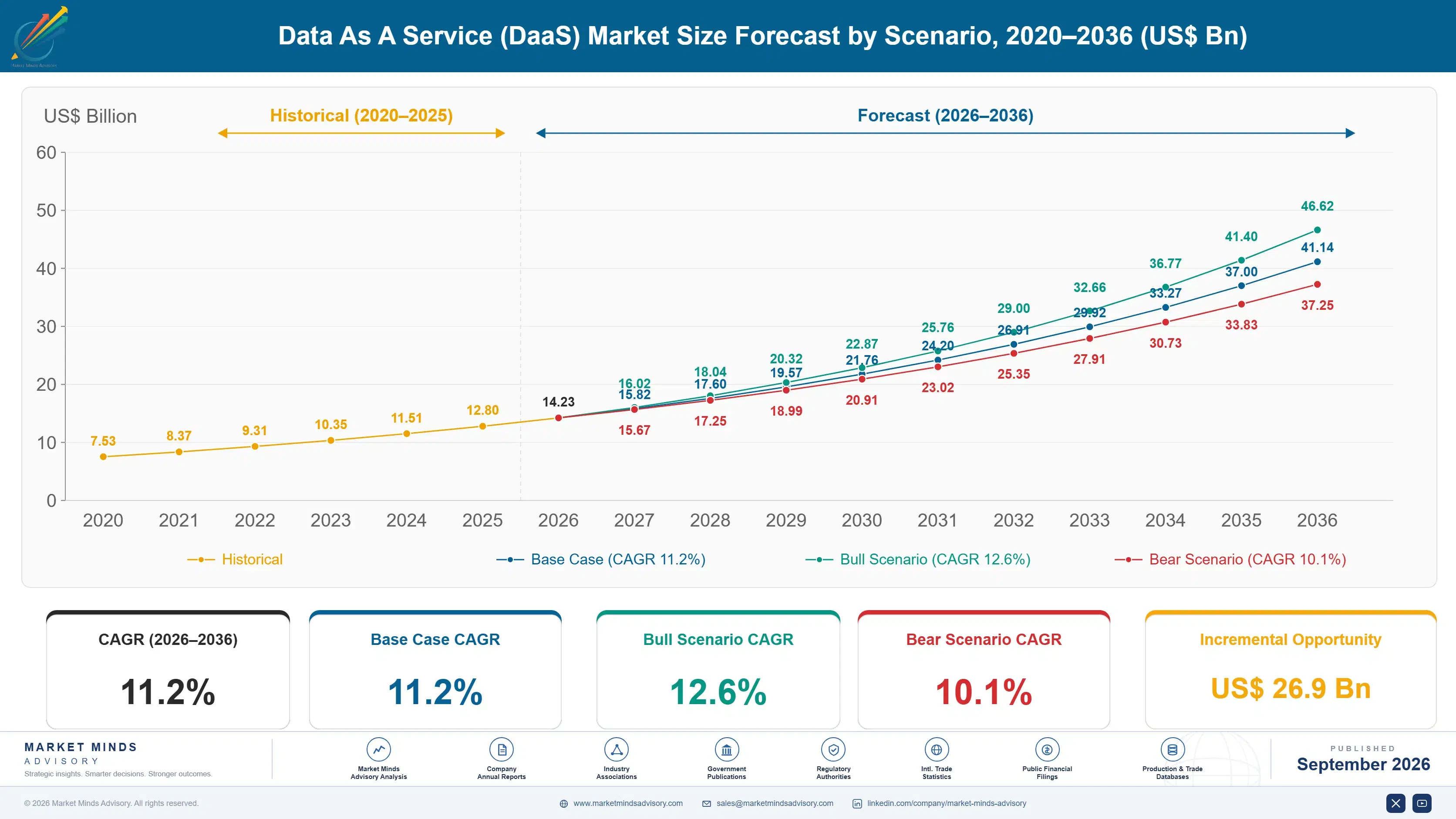
Data As A Service (DaaS) Market Forecast Scenarios

data-as-a-service-daas-market-size-forecast-scenario-1788425542758
The Data as a Service market grew steadily from 2020 to 2025, with batch API access giving way to accelerating real-time streaming and governance investment from 2023 onward as enterprises gained operational confidence in low-latency delivery performance. The market grew at a 9.9% historical CAGR, trailing the forecast pace as data-quality and governance-certification infrastructure only scaled meaningfully in the final two years across major enterprise accounts globally.
The base case carries the market to an 11.2% CAGR through 2036 on three mechanisms. First, enterprises keep expanding real-time streaming and analytics-ready subscriptions under tightening data-privacy and governance requirements. Second, enterprise budget-cycle timing keeps scaling multi-vendor procurement frequency across expanding fintech and healthcare-analytics programs. Third, enterprises keep expanding budget allocation for curated premium datasets over conventional raw-feed-only alternatives. Together these mechanisms reinforce vendor pricing power and extend average subscription-contract duration across most procurement channels globally.
The bull case, 12.6%, assumes real-time streaming infrastructure matures faster than currently projected as more enterprises mandate low-latency compliance programs. The bear case, 10.1%, assumes governance-cost pressure and raw-feed-format substitution slow conversion timing, keeping growth concentrated in commodity-feed channels alone. Enterprise budget-allocation cycles across major national markets continue shaping which scenario prevails through the decade ahead.

Governance Certification Redraws the Data Line

Data as a Service demand now splits along a governance-certification and delivery-latency line rather than a purely price-driven one. Conventional raw data feeds and batch API access, the backbone of the category, meet enterprise needs at pricing tied to compute and integration input costs. Real-time streaming and analytics-ready curated formats instead serve enterprises demanding documented governance-certification and delivery-latency performance, commanding differentiated platform value for that specialization across most enterprise-analytics programs underway.
MARKET CONCENTRATIONCR5: 31%Top five vendors hold roughly a third of category revenue
STREAMING DELIVERY PREMIUMUSD 0.18 average per-record streaming-delivery uplift over batch baselinePremium varies sharply between batch and real-time tiers
TOP PRODUCING COUNTRYUnited States: 41% of global Data as a Service revenueConcentrated cloud-data platform infrastructure anchors global delivery firmly
DATASET REFRESH CYCLE1 to 4 weeks per major curated dataset releaseRefresh cadence drives recurring subscription and licensing revenue
COMPUTE INFRASTRUCTURE COST SHARE29% of total delivery costCompute cost share shapes near-term vendor margin strategy
SUBSCRIPTION RENEWAL RATE73% across major enterprise subscription agreementsRenewal rate reflects switching costs built into certified formats
Buyers split sharply by enterprise segment and compliance mandate. Financial-services institutions and healthcare analytics platforms specify dedicated real-time streaming and governance-certified contracts engineered for documented compliance and delivery-latency performance to protect data outcomes, requiring data-quality-assurance depth that generic vendors struggle to match consistently. Budget-conscious mid-market buyers instead specify conventional raw-feed systems, competing largely on unit price rather than deep governance differentiation. Regional vendor partnerships continue reinforcing that split across most national markets.
Over the next decade, real-time streaming and analytics-ready curated formats should keep pulling value toward higher-margin subscription tiers, while conventional raw-feed platforms keep driving the largest underlying delivery volume among budget-conscious mid-market buyers. Documented governance-certification and data-quality-assurance depth, not unit price alone, increasingly looks like the most durable driver of vendor strategy across the forecast period ahead.
"Enterprises used to compete purely on dataset breadth and unit access price. Now governance certification and delivery-latency depth decide which vendor actually keeps the enterprise-analytics relationship."
Director, Enterprise Data Infrastructure Practice · MMA Technology Practice · September 2026

Market Trends

Enterprises Convert Pipelines Toward Real Time Streaming Delivery

Financial-services institutions and healthcare analytics platforms have increasingly prioritized converting standard batch data-feed orders toward documented real-time streaming and governance-certified systems rather than relying on batch-only deployment across critical decision-support programs, treating delivery-latency depth as a defining qualification consideration rather than a secondary specification handled after core coverage build-out. Several major enterprises now require multi-year governance-certification documentation before finalizing new data-vendor partnerships, rather than accepting batch-format qualification common across earlier procurement cycles. Snowflake has invested heavily in dedicated streaming infrastructure, recognizing that large enterprise mandates hinge on delivery-latency depth over unit price terms alone.
Market Impact: Data privacy regulation adds 13% demand
Enterprises Expand Documented Curated Dataset Format Adoption

Analytics-ready curated dataset format adoption, once concentrated almost entirely in premium financial-services programs, has expanded meaningfully into mainstream enterprise territory, since documented data-quality outcomes and falling per-record integration costs have made adoption commercially viable across a considerably broader range of enterprise budgets than earlier generations supported. Several major vendors have launched dedicated mainstream-configuration curated-dataset lines priced within reach of mid-tier analytics budgets, reflecting genuine operational change rather than incremental feature addition. Enterprises with established curated-dataset infrastructure are capturing these accounts well ahead of competitors still building comparable capability across regional distribution networks under active expansion.
Market Impact: Enterprise analytics investment adds 10% demand

Market Opportunities and Growth Drivers

Data Privacy Regulation Broadly Expands Platform Demand

Tightening data-privacy and governance requirements continue expanding documented accountability requirements across established and emerging enterprise categories, driving dedicated governance-certification demand well beyond levels seen in earlier forecast periods historically as enterprise-platform specifications tighten across the industry globally. Several major enterprises have announced expanded governance-compliance commitments through the current forecast period specifically, giving vendors a durable, quantified demand timeline that shapes multi-year contract investment rather than one-off project response. That durability distinguishes governance-format demand from more cyclical raw-feed-format budget spending elsewhere in the category. Vendors lacking comparable governance depth are responding by accelerating certification plans steadily.
Market Impact: Compute volatility compresses margins 7%

Enterprise Analytics Investment Sustains Streaming Demand

Growing enterprise-analytics investment continues expanding real-time streaming format distribution across established and emerging enterprise segments, lifting demand for both conventional and premium platform formats well beyond levels seen in earlier forecast periods historically as delivery-latency specifications tighten across regulated enterprise markets. Several major vendors have expanded dedicated streaming servicing capacity through the current forecast period specifically, a pace of capacity expansion that barely existed at current scope before 2023 and now shapes enterprise decisions among distribution partners specifically. That reinforces vendor research investment steadily across every major national market, extending contract visibility considerably.
Market Impact: Raw feed substitution limits growth 5%

Market Restraints and Challenges

Compute Cost Volatility Compresses Vendor Margins

Certified compute clusters and precision streaming-pipeline infrastructure carry substantial engineering and provisioning costs for Data as a Service vendors, and compute pricing faces significant volatility tied to a limited number of dominant cloud intermediaries that vendors cannot easily hedge through supply contracts alone. The underlying cause is that delivery reliability is tied closely to compute-commodity cycles, giving vendors limited independent control over input cost when cloud prices shift sharply. Vendors are responding by diversifying compute-supplier relationships to smooth exposure. That shift takes years to complete, leaving margins exposed to compute-cost swings across most product lines globally.
Market Impact: Real time streaming adoption reaches 24%

Raw Feed Format Substitution Limits Conversion Pace

Conventional raw data feed and batch platforms retain meaningful budget-driven persistence among smaller budget-conscious mid-market buyers across most standard deployment channels, across several recent procurement cycles, creating persistent conversion resistance that limits how quickly mainstream enterprises convert toward streaming and governance-certified systems even where quality advantages are documented. The underlying cause is that smaller buyers increasingly favor lower-cost raw-feed-format tools at reduced upfront investment, undercutting premium-format pricing across most major mid-market segments. Vendors are responding by emphasizing documented lifecycle-value transparency over generic price-schedule parity. That pivot takes considerable buyer-education investment across most competitive regional markets currently underway globally.
Market Impact: Mainstream curated dataset adoption reaches 20%
3 additional market trends, 4 additional growth drivers, and 3 additional restraints and challenges are covered in the full report. Contact sales@marketmindsadvisory.com to access the complete intelligence.

Segment CAGR and Growth Architecture

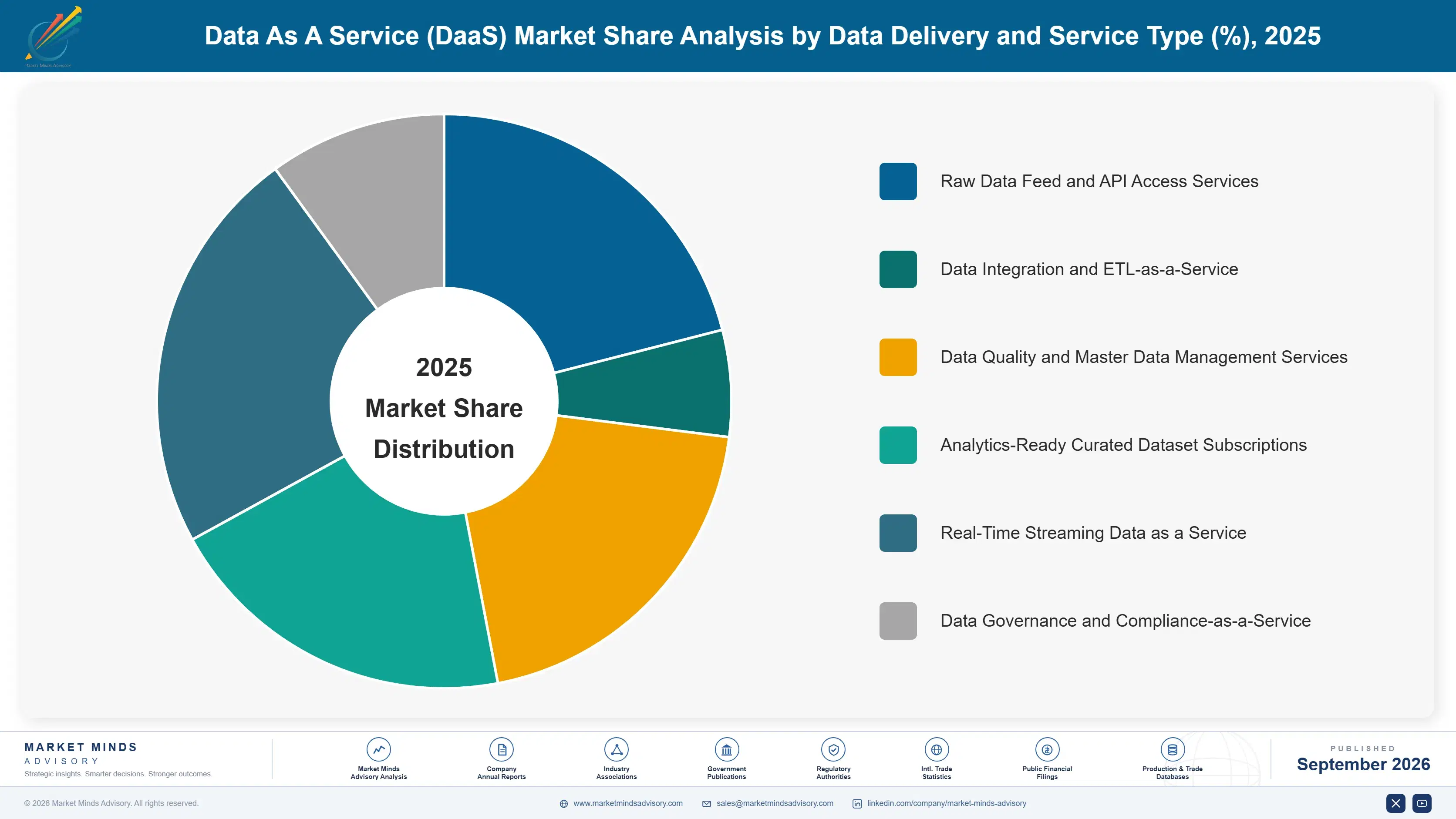
Segmentation follows data delivery and service type, a single classification logic separating the market by what an enterprise specifies rather than by buyer type or geography. Raw-feed, integration, quality, curated, streaming, and governance formats each carry distinct infrastructure and margin profiles, keeping conventional and premium revenue from blurring together across cycles considerably nationwide. That distinction holds broadly nationwide.
data-as-a-service-daas-market-market-share-analysis-1788425543341

Real-Time Streaming Data as a Service

Real-time streaming data as a service is growing at 19.0% annually, well ahead of the wider market's 11.2% pace, as low-latency delivery demand outpaces conventional batch-feed expansion across most enterprise-analytics markets. This segment requires specialized event-driven pipeline and edge-processing infrastructure distinct from conventional batch-only deployment, since matching institutional-grade delivery-latency precision to established enterprise benchmarks demands considerable technical investment across streaming-infrastructure buildout. Pricing for streaming data runs well above conventional-format economics, reflecting enterprise willingness to pay for documented low-latency delivery credentials. Snowflake and Palantir have prioritized capital investment in dedicated streaming infrastructure, positioning the segment for continuing growth across every major national market globally. That barrier should keep vendor share concentrated among established leaders through the decade ahead.
CAGR 19.0%

Analytics-Ready Curated Dataset Subscriptions

Analytics-ready curated dataset subscriptions grow at 16.8% annually, driven by expanding demand for governance-certified formats that increasingly displace standard raw-feed products across enterprises where documented data-quality performance matters most. This segment commands technology-intensive economics distinct from bulk raw-feed deployment, since matching consistent curation-quality reliability to established regulatory benchmarks demands considerable operational investment from vendors. Several major vendors have expanded dedicated long-term curated-dataset programs, extending a relationship once managed through single-license allocation into planned multi-year enterprise-partnership agreements. That advantage should compound through the forecast period ahead broadly, as fewer vendors hold the curation expertise enterprises increasingly require before signing subscription-contract agreements. Regional enterprises increasingly treat that depth as a renewal prerequisite, not an optional add-on.
CAGR 16.8%
Full segment breakdown across 6 segments available in the complete report.

Regional Architecture and Country Demand Map

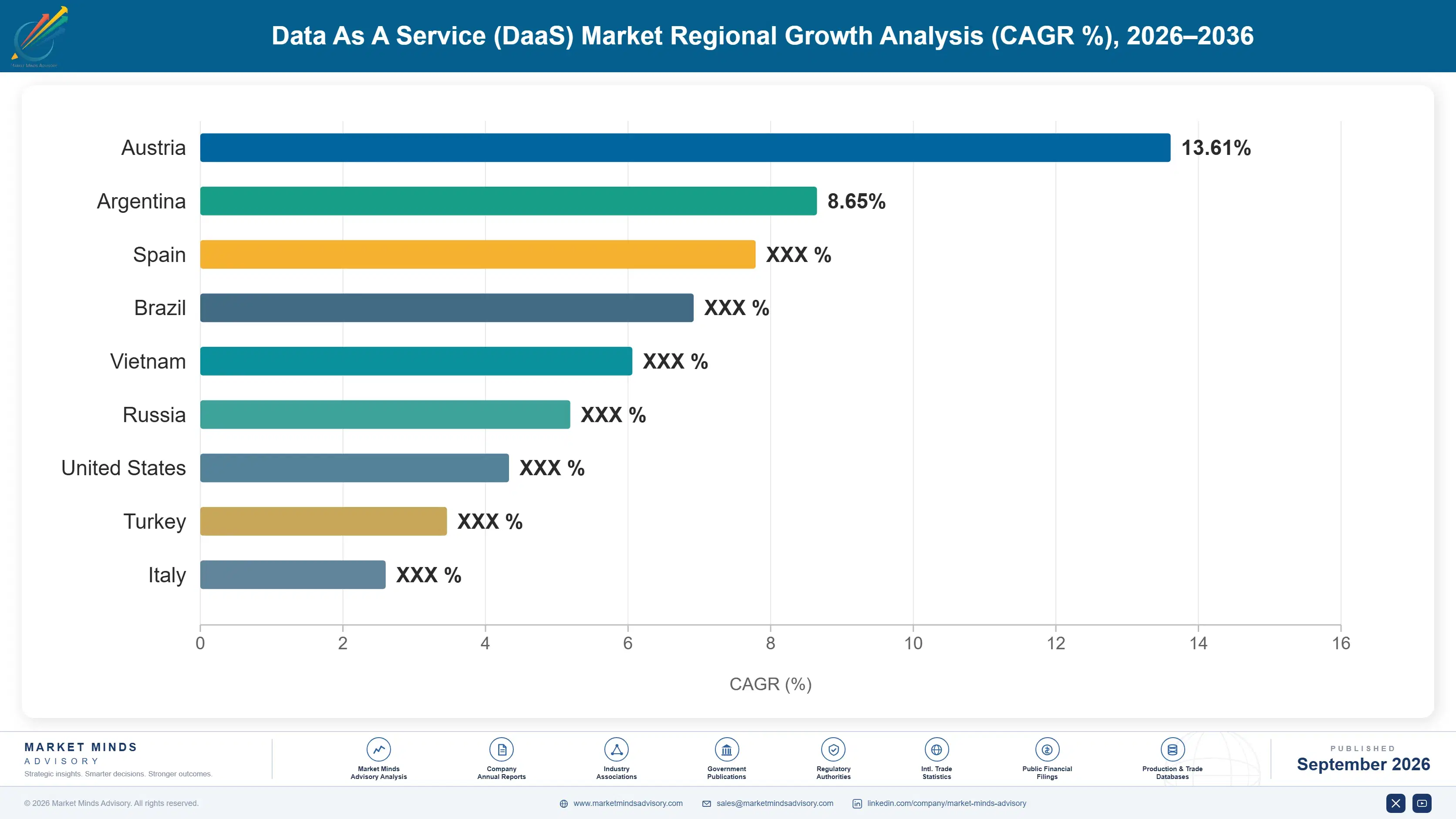
North America holds a share well above typical regional patterns given its concentration of established cloud-data platforms and dense enterprise-analytics infrastructure. Singapore carries the fastest country-level growth as financial-data investment expands rapidly. East Asia and Western Europe together contribute meaningful secondary demand across the forecast period.

North America

The United States anchors North American Data as a Service demand through Snowflake's and Palantir's concentrated cloud-data platform and enterprise-integration presence, supplying a considerable share of premium streaming and governance-certified revenue across enterprise channels nationwide. Canada contributes smaller additional demand tied to regional analytics-modernization budgets. Databricks and Intercontinental Exchange, both maintaining substantial domestic operations, continue expanding certified governance capacity to meet growing enterprise demand. Procurement teams across the region continue favoring vendors with documented governance credentials and proven commercial deployment references nationwide broadly, reinforcing platform competitiveness across the forecast period ahead. Domestic system integrators continue expanding certified governance capacity as national data-privacy mandates accelerate enterprise investment further across most major metropolitan markets nationwide.
Share: 32% | CAGR: 12.0% (2026 to 2036)

Western Europe

The United Kingdom's expanding domestic financial-data infrastructure anchors a meaningful share of Western European exposure to the Data as a Service market, as enterprises increasingly specify certified governance components to meet rising data-privacy standards under tightening GDPR directives. Germany and France contribute additional demand tied to established research and analytics-modernization programs across both national markets. The Netherlands adds smaller but growing demand tied to expanding regional distribution financing. Sweden adds further demand tied to its established data-research infrastructure. Regional growth trails East Asia meaningfully, reflecting a smaller enterprise-capital-spending base overall. Domestic vendors continue expanding certified-governance capacity to meet growing demand nationwide. Domestic vendors continue expanding certified governance capacity to meet growing enterprise demand steadily.
Share: 19% | CAGR: 9.7% (2026 to 2036)
Regional intelligence for 5 additional markets available in the complete report: East Asia, South Asia and Pacific, Latin America, Middle East and Africa, Eastern Europe. Contact sales@marketmindsadvisory.com.
data-as-a-service-daas-market-country-cagr-analysis-1788425543864

Where Vendors Can Capture Margin

Margin defense in the Data as a Service market increasingly depends on moving beyond commodity raw-feed pricing toward positioning that lets a vendor charge for documented governance certification, streaming innovation, or scalable curated-dataset capacity, targeting a distinct enterprise purchase behavior. The four moves below target the fastest-growing enterprise segments nationwide currently. Regional deployment timing varies by enterprise segment considerably nationwide.

Build Out Governance Certification Capacity Now

Certified real-time streaming platforms backed by documented governance-compliance testing command subscription rates running well above conventional raw-feed material, and demand from major enterprises has grown faster than the industry's dedicated certification capacity currently available across established vendors. Vendors that invest in governance infrastructure now capture premium mandates before competitors establish comparable enterprise scale, since enterprises increasingly push vendors toward documented governance certainty as a baseline qualification requirement. The infrastructure investment requires meaningful capital, but the roughly 25% margin uplift over conventional formats justifies the cost for established vendors pursuing sustained growth.
Market Impact: Governance certification typically commands a 25% margin premium

Secure Long-Term Enterprise Framework Contracts Now

Vendors with multi-year enterprise framework contracts command meaningful revenue-visibility advantages over competitors relying entirely on spot subscription sales, and demand from enterprises seeking procurement predictability has grown faster than the industry's dedicated contracting capacity currently available across established vendors. Vendors that invest in long-term contracting now lock in enterprise relationships before competitors face comparable renewal exposure, since enterprises increasingly favor vendors offering stable multi-year pricing. The contracting investment requires meaningful sales capacity, but the roughly 15% higher retention rate this approach delivers justifies the cost for vendors pursuing margin-linked growth.
Market Impact: Long-term framework contracts typically lift retention by 15%

Expand Streaming Engineering Support Capability Now

Vendors offering documented streaming-pipeline engineering support command substantially stronger enterprise retention than transactional feed-only sales, since enterprise partners increasingly value engineering collaboration over pure price competition given rising latency-complexity across new compliance programs. Vendors that build engineering capability now capture deeper enterprise relationships before competitors establish comparable engineering capacity, since enterprises rarely switch vendors once an engineering relationship has been validated. The support investment requires meaningful capital deployment, but the roughly 13% higher contract value this approach generates justifies the cost for vendors targeting large enterprise accounts over multi-year horizons ahead.
Market Impact: Streaming engineering support considerably increases value by 13%

Develop Long-Term Financial Institution Servicing Agreements Now

Institutional financial-services networks increasingly prefer subscription-based data servicing over spot purchasing across major analytics programs, since supply disruption during active reporting seasons carries operational continuity risk that vendors cannot easily absorb given tightly coordinated compliance scheduling. Vendors that secure these agreements now lock in recurring revenue and pricing before competitors capture the same institutional accounts, since financial networks rarely switch vendors once a servicing relationship has been validated. The investment required is modest relative to the roughly 11% more contracted volume this approach typically locks in over spot sourcing arrangements currently common.
Market Impact: Financial institution servicing agreements typically lock in 11%

Who Controls the Margin Pool

Competitive concentration sits at a fragmented CR5 of 31%, reflecting a market split between Snowflake's and Palantir's substantial lead over challenger vendors on documented governance-certification and cross-platform integration reach. The gap between category leaders and mid-tier challengers remains built on years of infrastructure investment and enterprise-relationship access across most established markets. Challenger vendors continue investing in comparable infrastructure to close that persistent gap steadily nationwide.
Competitive activity currently runs along three lines. Snowflake and Palantir compete on platform-scale and cross-category integration expertise, applying scale advantages smaller specialized competitors cannot easily replicate. Challenger vendors like Databricks and Intercontinental Exchange compete on documented streaming and curated-dataset format depth. Regional independent vendors compete on integrated enterprise-relationship and local-distribution reach, since access to competitive distribution relationships increasingly determines contract outcomes broadly across regional markets.

Pressure is building from two directions. Challenger vendors are moving upmarket into certified streaming and curated-dataset territory once defensible mainly through decades of platform scale held by category-leading majors. Governance-depth support is becoming a differentiator, rewarding vendors willing to fund technical teams over those competing on generic raw-feed pricing. Rankings will favor whoever combines platform scale with credible streaming and governance capability across the forecast period.
data-as-a-service-daas-market-company-positioning-matrix-1788425544389

Competitive Moat and Risk Dimensions

SNOWFLAKE INC

Moat: Deep cloud data platform scale

Snowflake holds substantial vertically integrated cloud-data infrastructure across raw-feed, streaming, and governance segments that newer entrants, domestic or international, cannot replicate on any reasonable timeline, giving it compute-cost and enterprise-relationship advantages that smaller specialized competitors genuinely struggle to match. Long-standing enterprise relationships reinforce this position further globally.
SNOWFLAKE INC

Risk: Exposed to compute cost risk

Snowflake's substantial certified-product revenue base remains exposed to continuing compute-cost volatility tied to a narrow cloud-supplier base, and the company must increasingly invest in diversified sourcing infrastructure to offset that persistent margin headwind facing its largest growth category. That exposure will persist until compute supply diversifies further globally.
PALANTIR TECHNOLOGIES INC

Moat: Deep government relationship network scale

Palantir maintains substantial government and defense-relationship infrastructure built through years of dedicated agency-relationship presence, giving it commercial relationship advantages and enterprise access that competitors lacking comparable specialization cannot easily replicate across similarly demanding qualification programs across major regional markets. That depth compounds with each new agency mandate secured.
PALANTIR TECHNOLOGIES INC

Risk: Limited streaming brand depth

Palantir's more limited direct streaming-format brand relationship depth relative to established latency-focused platforms limits how quickly it can capture broader enterprise-segment contracts, potentially constraining its ability to capture the full growth opportunity without additional brand-facing investment. Closing that gap will require sustained capital commitment well beyond current spending levels globally.

Players Tracked

Prominent Players

Snowflake Inc
Palantir Technologies Inc
Databricks Inc
Intercontinental Exchange Inc
London Stock Exchange Group plc

Other Key Players

Informatica Inc
Amazon Web Services Inc
Microsoft Corporation
Google LLC
Oracle Corporation
SAP SE
Qlik Technologies Inc
Fivetran Inc
Confluent Inc
Precisely Inc
TransUnion LLC
Equifax Inc
Dun & Bradstreet Holdings Inc
MSCI Inc
FactSet Research Systems Inc

Recent Developments

JUNE 2024

Snowflake expands governance certification testing capacity

Snowflake expanded dedicated governance-compliance certification testing capacity at its domestic facilities, responding directly to growing enterprise demand for documented data-privacy certainty ahead of tightening national regulatory requirements. The expansion was an organic capacity investment, not a joint venture or acquisition of any competing vendor across the region.
Signal: Signals established vendors investing directly in certified capacity ahead of confirmed enterprise sourcing mandates across the region.
DECEMBER 2024

Palantir signs long-term data platform partnership with financial services network

Palantir signed a multi-year data platform partnership with a major financial-services network to provide certified governance access across multiple analytics programs. The transaction was a supply agreement, not a joint venture, acquisition, or merger of any kind between the two organizations. The agreement reflects growing demand certainty.
Signal: Signals established vendors securing long-term enterprise demand commitments ahead of continued governance-driven growth broadly across the industry.
APRIL 2025

Databricks acquires regional streaming technology specialist

Databricks acquired a regional streaming-technology specialist to expand its low-latency pipeline engineering capability ahead of anticipated enterprise demand growth across major markets. The transaction was a full acquisition of the target company, not a joint venture or minority equity stake arrangement. The deal signals rising streaming-technology investment.
Signal: Signals established vendors expanding directly into certified streaming specialization well ahead of broader industry adoption globally.

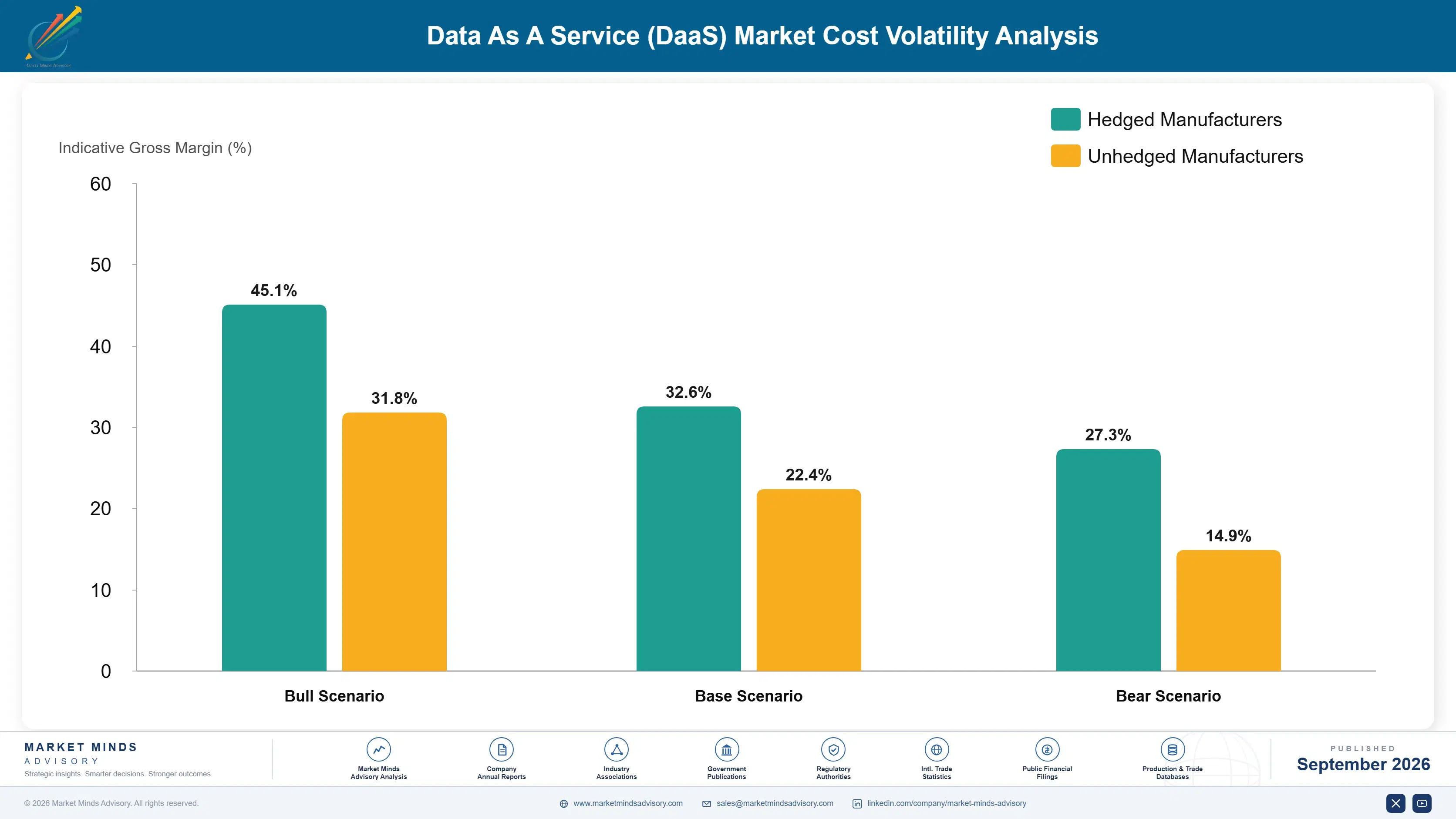
Compute Infrastructure Sets the Cost Floor

Certified compute clusters and precision streaming-pipeline infrastructure account for 27% to 38% of delivery cost for Data as a Service vendors, sourced from specialized cloud intermediaries whose pricing tracks commodity-cycle trends rather than vendor-specific supply and demand. Streaming platforms carry an additional cost component tied to specialized edge-processing infrastructure currently in place across most vendor lines. That additional cost varies by vendor depending on in-house versus outsourced sourcing arrangements.
The 2022 cloud-compute commodity tightening cycle illustrated compute cost exposure directly. Industry data recorded cloud-processing pricing tightening as demand outpaced data-center capacity across major producing regions, reducing alternatives for vendors, as documented in company annual reports covering the period. Vendors without diversified sourcing contracts absorbed significant cost increases, passing some cost through to enterprises who had few alternative sourcing options at the time. Contract renegotiation followed across several subscription channels in subsequent quarters.

Exposure falls hardest on smaller challenger vendors without long-term sourcing contracts or diversified supplier relationships, who must buy compute capacity closer to spot pricing and absorb whatever margin compression results from commodity-market volatility. Larger diversified vendors with integrated compute qualification and sourcing diversification smooth that volatility better than smaller, less capitalized regional competitors exposed to commodity-market swings.
data-as-a-service-daas-market-cost-volatility-analysis-1788425544584

Lock Long-Term Cloud Compute Supply Agreements

Vendors negotiating multi-year cloud-compute supply agreements convert volatile commodity pricing into a planned delivery cost, protecting downstream enterprise pricing that resists frequent adjustments across long vendor-partnership cycles. This favors larger vendors with existing relationships, but smaller vendors access similar terms through regional sourcing consortia annually. That access narrows the gap considerably for smaller vendors.

Diversify Compute Sourcing Across Suppliers

Vendors reduce single-supplier commodity exposure by sourcing compute capacity across multiple regional and specialized data-center networks rather than depending entirely on any single source for the majority of compute capacity. That diversification smooths input availability across different regional commodity cycles, though it adds qualification complexity across each new supplier relationship established currently. Smaller vendors benefit most from this approach.

Invest in Integrated Compute Production Capacity

Vendors reduce supplier dependence by acquiring direct integrated compute-production capacity, capturing cost stability that pure spot-market sourcing cannot achieve at comparable scale. This integration strategy suits larger vendors with meaningful capital access best, but delivers durable cost stability across multiple product segments and geographies over time, insulating margins from spot-market swings. Margins stay better protected as a result.

Portfolio Architecture for Margin Defence

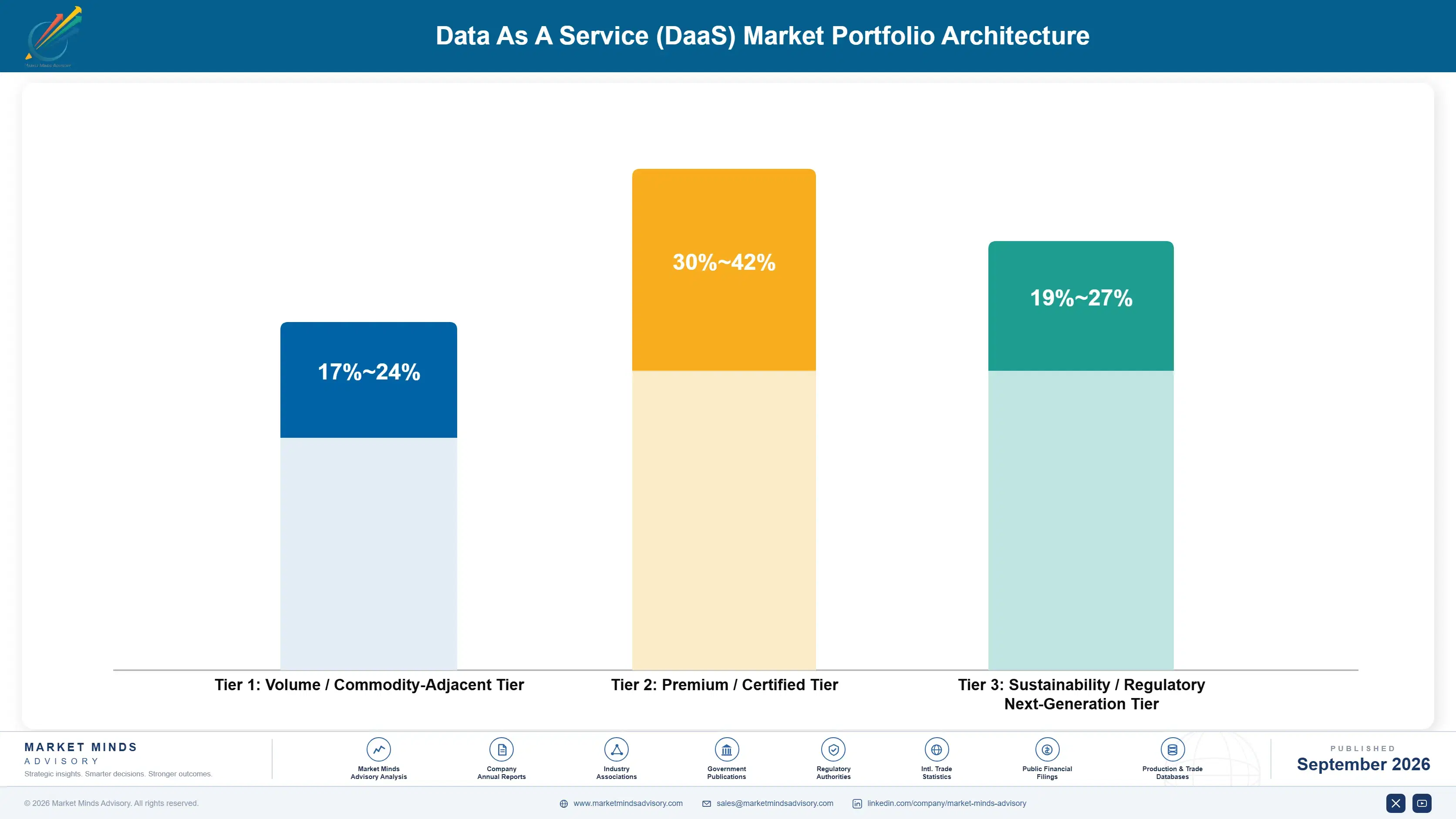
The Data as a Service portfolio splits into three tiers with meaningfully different margin economics. Volume raw-feed and integration formats, sold through established distribution channels on unit-price terms and delivered subscription volume, compete on cost and earn steady but thin margins. Streaming and curated-dataset formats earn substantially more, since documented governance precision and delivery-latency differentiation create switching costs standard formats cannot replicate quickly.
The tension for vendors is capital allocation between two economics. Volume standard formats generate dependable cash flow that funds operations and streaming-platform research, while streaming and curated-dataset capacity requires meaningful capital and technical investment before generating comparable returns at much higher margin. Vendors leaning entirely on standard formats risk losing share to faster-growing differentiated competitors, while premium investment risks underutilized capacity if certified-grade demand proves slower than currently projected globally.

High-value margin pools concentrate in streaming and curated-dataset services carrying genuine governance or engineering differentiation that standard formats cannot match. Frontier opportunity sits in combining verified delivery reliability with credible pipeline innovation, letting vendors capture premium fees from both mainstream and premium channels while retaining steady standard revenue simultaneously across every major enterprise segment globally.

Volume / Commodity-Adjacent Tier

Raw-feed and integration formats sold through established distribution channels on unit-price terms and delivered subscription volume, priced close to underlying compute and integration costs with minimal differentiation between competing regional vendors.
Gross Margin: 17-24%

Premium / Certified Tier

Streaming and curated-dataset formats carrying documented governance-compliance testing and delivery-latency validation that commands sustained premiums over standard formats across major enterprise and financial-services partners globally. Pricing reflects genuine differentiation rather than marketing positioning alone.
Gross Margin: 30-42%

Sustainability / Regulatory / Next-Generation Tier

Emerging next-generation privacy-preserving and federated-learning data-delivery formats designed to serve increasingly demanding regulatory and compliance requirements ahead of continued industry evolution, though large-scale operating economics remain largely unproven at full commercial deployment volume today.
Gross Margin: 19-27%
data-as-a-service-daas-market-portfolio-architecture-1788425545086

High-value Sub-segments and Strategic Watch-out

Real-Time Streaming Data as a Service

Streaming demand grows fastest at 19.0% annually and already commands pricing well above conventional formulations. Vendors positioned early here should retain durable pricing power well beyond the forecast horizon ahead nationwide currently. Vendors with established streaming infrastructure continue capturing premium enterprise mandates ahead of newer specialized competitors nationwide.

Analytics-Ready Curated Dataset Subscriptions

Curated-dataset demand grows at a healthy 16.8% annually, driven by expanding governance-certified formats. Vendors with established curation infrastructure keep capturing premium enterprise mandates ahead of newer specialized competitors nationally currently. That advantage should compound through the forecast period ahead, as fewer vendors hold comparable curation expertise nationwide.

Raw Data Feed and API Access Services

Raw-feed demand remains the largest format by delivery volume, anchored by decades of established buyer-preference specification across mainstream deployments regionally. Margins stay steady but moderate, anchoring meaningful category revenue overall nationwide. Vendors with established distribution infrastructure continue defending that volume base against newer streaming competitors nationwide.

Data Integration and ETL-as-a-Service

Integration-format demand faces gradual competitive pressure as alternative streaming capacity increasingly matches comparable reliability outcomes at moderately lower switching cost, narrowing the addressable market for legacy integration-format products nationwide broadly currently. Vendors relying entirely on legacy integration formats risk losing share to faster-growing differentiated competitors broadly nationwide.

Why Enterprise Contracts Run Long

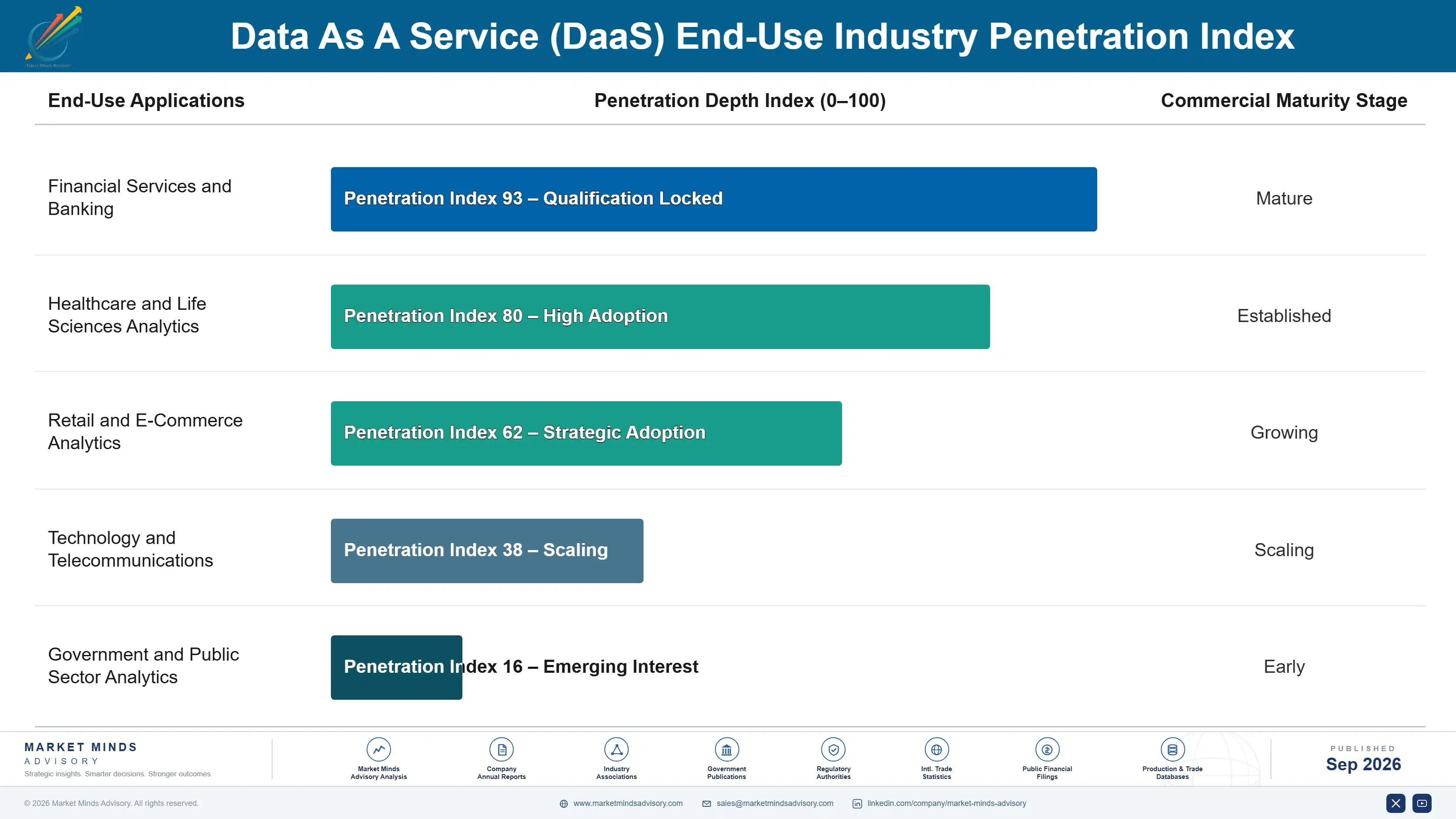
Data as a Service demand behaves like an annuity within enterprise framework relationships, since buyers validate a specific vendor through extended governance-testing and compliance review and then source against that relationship for continuous data operations rather than re-tendering routinely, given the disruption risk of switching mid-relationship. Budget-conscious mid-market buyers behave differently, since purchase decisions follow individual project budget cycles rather than pure continuous-catalogue supply commitment.
Stickiness varies sharply by enterprise type and compliance criticality. Financial-services institutions and healthcare analytics platforms rarely switch vendors once qualified for continuous compliance operations, given the disruption risk involved in switching mid-relationship across a multi-year enterprise-vendor cycle. Streaming-format partners show different loyalty patterns, favoring vendors with documented delivery-quality depth over pure price-term depth. Budget-conscious mid-market buyers sit in between, valuing reliable delivery without full continuous-catalogue vendor lock-in.

Buyer profiles are shifting generationally within both certified and standard channels specifically. Enterprise buyers increasingly treat documented governance-certification depth as a non-negotiable sourcing criterion rather than a routine procurement decision, a shift that favors vendors offering validated certified-grade supply over those competing purely on generic unit-price terms alone. That shift is visible in how large enterprises structure new data contracts globally.
data-as-a-service-daas-market-end-use-penetration-index-1788425545574

Where Vendors Should Bet

These are among the four positions where our research anticipates prominent divergence between winners and laggards over the coming forecast period. Each is grounded in the demand model, the regulatory perimeter, and the announced capacity pipeline.
01 / STREAMING DELIVERY PRIORITY

Build low-latency infrastructure before enterprise demand outpaces supply

Streaming demand is growing well ahead of the wider market's pace, and premium products already command meaningful pricing above standard formats, yet most vendors still lack dedicated low-latency infrastructure at meaningful commercial scale globally. Vendors that invest now in streaming capacity position ahead of continuing enterprise-driven demand growth across every major national market. Waiting risks ceding the category's fastest-growing and highest-margin segment permanently to competitors currently building that capability well ahead of broader industry adoption across the entire global market.
02 / CURATED DATASET STRATEGY

Secure governance advantage before margins compress further

Vendors with dedicated curated-dataset capability command meaningful cost and margin advantages, and demand for that documented governance depth has grown considerably faster than the industry's dedicated technology capacity currently available across established vendors. Vendors that invest now in curation infrastructure lock in mandate certainty before competitors face comparable qualification exposure, since enterprise partners increasingly favor vendors offering validated governance performance. Every vendor relying purely on standard formulations risks missing this durable advantage entirely, ceding ground permanently to better-positioned rivals across the entire global market.
03 / COMPUTE SOURCING INVESTMENT

Build sourcing capability before raw-feed pressure resurfaces further

Vendors offering documented compute-sourcing engineering support command substantially stronger enterprise retention than transactional vendors, and demand for that support has grown considerably faster than the industry's dedicated engineering capacity currently available across most established vendors today. Vendors that build engineering capability now capture deeper enterprise relationships before competitors establish comparable sourcing infrastructure across major mainstream and premium channels. Every vendor relying purely on transactional selling risks missing this durable relationship advantage entirely, ceding ground permanently to better-prepared rivals across the entire global market.
04 / LONG-TERM FINANCIAL AGREEMENTS

Lock large institutional accounts before rankings shift further

Institutional financial-services networks increasingly prefer multi-year vendor platform commitments over spot procurement purchasing across continuous research and compliance programs, since supply disruption during active reporting seasons carries genuine operational continuity risk that vendors cannot comfortably absorb given tightly coordinated project scheduling. Vendors that secure these agreements now lock in demand and pricing before competitors capture the same institutional accounts, since enterprises rarely switch vendors once a relationship has been validated. Every vendor relying purely on spot sales risks missing this durable revenue opportunity entirely across major markets.

Engagement Snapshot From the Field

A live engagement with an industry participant carrying material or product regulatory and market exposure ahead of a defining policy shift, showing how our research translates into a defensible multi-year portfolio strategy.
MARKET MINDS ADVISORY · CLIENT ENGAGEMENT SUMMARY
Data As A Service (DaaS) Producer Strategic Portfolio Review and Transition Roadmap 2026·Investment Scenario on Data As A Service (DaaS) Exposure Evaluation 2025-26
CLIENT PROFILE
A regional financial-services enterprise managing procurement across roughly fourteen active data-integration programs approached MMA while evaluating whether to convert its flagship data specification from standard raw-feed systems toward documented certified real-time streaming infrastructure. The client reported annual procurement-budget revenue near USD 65 million, with raw-feed systems representing roughly 56% of current spend (client-reported, unverified by MMA). Vendor data suggested strong latent demand for streaming conversion.
STRATEGIC CHALLENGE
Management faced a strategic decision between a full conversion toward certified streaming platforms across its flagship data programs or a phased approach limited to new-program launches only. The finance team worried full conversion would raise upfront costs given governance-certification pricing, while the operations team worried a phased approach would leave the flagship data portfolio exposed to competitive risk from tightening regional data-privacy requirements.
MMA APPROACH
MMA benchmarked conversion revenue outcomes and typical cost impacts across comparable enterprises that had completed similar streaming transitions, assessed the client's existing operational flexibility relative to alternative governance-integration requirements, and evaluated which vendor partnerships offered the most commercially attractive combination of revenue and margin positioning given the client's data scale.
KEY FINDINGS
  1. Comparable enterprises that converted flagship data programs toward certified streaming platforms captured latency gains that enterprises relying on raw-feed systems missed at a meaningfully higher rate during recent procurement cycles.
  2. Conversion costs, while measurable, were considerably smaller than the latency gains documented across comparable enterprises that completed similar streaming transitions across comparable procurement programs.
  3. The client's existing operational flexibility aligned closely with alternative governance-integration requirements, reducing the incremental conversion investment required compared with enterprises needing extensive requalification.
  4. A phased conversion approach targeting the client's highest-priority flagship data program first allowed validation of the latency-margin tradeoff before committing to broader portfolio-wide conversion.
CLIENT PROFILE
A regional financial-services enterprise managing procurement across roughly fourteen active data-integration programs approached MMA while evaluating whether to convert its flagship data specification from standard raw-feed systems toward documented certified real-time streaming infrastructure. The client reported annual procurement-budget revenue near USD 65 million, with raw-feed systems representing roughly 56% of current spend (client-reported, unverified by MMA). Vendor data suggested strong latent demand for streaming conversion.
STRATEGIC CHALLENGE
Management faced a strategic decision between a full conversion toward certified streaming platforms across its flagship data programs or a phased approach limited to new-program launches only. The finance team worried full conversion would raise upfront costs given governance-certification pricing, while the operations team worried a phased approach would leave the flagship data portfolio exposed to competitive risk from tightening regional data-privacy requirements.
MMA APPROACH
MMA benchmarked conversion revenue outcomes and typical cost impacts across comparable enterprises that had completed similar streaming transitions, assessed the client's existing operational flexibility relative to alternative governance-integration requirements, and evaluated which vendor partnerships offered the most commercially attractive combination of revenue and margin positioning given the client's data scale.
KEY FINDINGS
  1. Comparable enterprises that converted flagship data programs toward certified streaming platforms captured latency gains that enterprises relying on raw-feed systems missed at a meaningfully higher rate during recent procurement cycles.
  2. Conversion costs, while measurable, were considerably smaller than the latency gains documented across comparable enterprises that completed similar streaming transitions across comparable procurement programs.
  3. The client's existing operational flexibility aligned closely with alternative governance-integration requirements, reducing the incremental conversion investment required compared with enterprises needing extensive requalification.
  4. A phased conversion approach targeting the client's highest-priority flagship data program first allowed validation of the latency-margin tradeoff before committing to broader portfolio-wide conversion.
RECOMMENDED STRATEGY
Phase 1: Phase 1 (0 to 6 months): Convert the flagship data program to validate latency and margin assumptions under prevailing real market conditions. Phase 2: Phase 2 (6 to 18 months): Expand conversion across the remaining data portfolio based on validated performance from the initial transition. Phase 3: Phase 3 (18 to 36 months): Formalize long-term certified streaming vendor agreements to support continued portfolio scale and latency positioning.
OUTCOME
The client completed its flagship data program conversion and captured a significant latency improvement within the first six months of the engagement, exceeding initial projections by a wide margin. The client is now extending conversion across its remaining data portfolio based on the initial transition's documented latency performance (client-reported, unverified by MMA).

Frequently Asked Questions

Foundational context covering the market sizes, CAGR, scope, country, region and competition that inform every finding below. This section is provided to cover basics and most often pre-purchase conversations, answered from the MMA Primary Research Dataset.

What is the current size of the Data As A Service (DaaS) Market?

The Data as a Service market reached USD 14.23 billion in software and subscription revenue in 2026, based on MMA Primary Research Dataset findings. Growth increasingly reflects streaming demand rather than conventional raw-feed sales alone.

How large will the Data As A Service (DaaS) Market be by 2036?

MMA's base case projects the market reaching USD 41.14 billion by 2036, an incremental opportunity of roughly USD 26.91 billion over the 2026 to 2036 forecast period.

What is the CAGR for the Data As A Service (DaaS) Market 2026 to 2036?

The base case CAGR is 11.2%, with a bull case of 12.6% and a bear case of 10.1% depending on streaming infrastructure maturity and compute-cost conditions.

Which segment is growing fastest?

Real-time streaming data as a service leads at a 19.0% CAGR, well ahead of the overall market rate, as enterprises scale documented low-latency infrastructure. This segment continues outpacing every other category.

Who are the major companies in the Data As A Service (DaaS) Market?

Leading participants include Snowflake, Palantir Technologies, Databricks, Intercontinental Exchange, and London Stock Exchange Group, with competition remaining active across every segment, Snowflake and Palantir holding a commanding combined lead.

Which country is growing fastest?

Singapore leads country-level growth at 17.5% annually, driven by its rapidly expanding financial-data investment. Domestic vendors are scaling capacity to meet this rapidly growing demand.

Report Segmentation Architecture

The full report scope spans multiple orthogonal segmentation dimensions, with cross-tabulated demand data provided for each dimension pair. Coverage extends further to regional breakdowns, trend trajectories, and the competitive detail needed to support segment-level decision-making.

By Data Delivery and Service Type

  • Raw Data Feed and API Access Services
  • Data Integration and ETL-as-a-Service
  • Data Quality and Master Data Management Services
  • Analytics-Ready Curated Dataset Subscriptions
  • Real-Time Streaming Data as a Service
  • Data Governance and Compliance-as-a-Service

By End-Use Industry

  • Financial Services and Banking
  • Healthcare and Life Sciences Analytics
  • Retail and E-Commerce Analytics
  • Technology and Telecommunications
  • Government and Public Sector Analytics

By Commercial Dimension

  • Direct Enterprise Subscriptions
  • Cloud Marketplace Channels
  • Long-Term Institutional Framework Contracts
  • System Integrator and Reseller Channels

By Region

  • North America
  • Western Europe
  • East Asia
  • South Asia and Pacific
  • Latin America
  • Middle East and Africa
  • Eastern Europe

Scope, Methodology, and Coverage

Every figure in this report is reproducible from documented input assumptions. The scope below maps the historical period, the forecast horizon, the segmentation dimensions, and the countries covered, alongside the underlying primary and qualitative methodology.
Historical Period
2020 to 2025
Forecast Period
2026 to 2036
Base Year
2025 (USD billions; MMA Primary Research Dataset, September 2026)
Market Definition
The Data as a Service market covers software and subscription revenue across raw data feed and API access services, data integration and ETL-as-a-service, data quality and master data management services, analytics-ready curated dataset subscriptions, real-time streaming data as a service, and data governance and compliance-as-a-service. It excludes general-purpose cloud storage infrastructure and business-intelligence software licensing revenue outside documented data-delivery scope.
Quantitative Units
USD billions (current prices); software and subscription revenue generated where applicable
Segmentation Dimensions
By Data Delivery and Service Type; By End-Use Industry; By Commercial Dimension; By Region
Regions Covered
North America, Western Europe, East Asia, South Asia and Pacific, Latin America, Middle East and Africa, Eastern Europe
Countries Covered
United States, Canada, United Kingdom, Germany, France, Netherlands, Sweden, China, Japan, South Korea, Taiwan, Singapore, Australia, India, New Zealand, Brazil, Mexico, Colombia, Chile, Argentina, Saudi Arabia, South Africa, United Arab Emirates, Poland, Hungary, Czech Republic, Romania, Bulgaria, and additional markets relevant to this sector
Key Companies Profiled
Snowflake Inc, Palantir Technologies Inc, Databricks Inc, Intercontinental Exchange Inc, London Stock Exchange Group plc, Informatica Inc, Amazon Web Services Inc, Microsoft Corporation, Google LLC, Oracle Corporation, SAP SE, Qlik Technologies Inc, Fivetran Inc, Confluent Inc, Precisely Inc, TransUnion LLC, Equifax Inc, Dun & Bradstreet Holdings Inc, MSCI Inc, FactSet Research Systems Inc
Quantitative Methodology
Primary survey, n=3,800 respondents, Q4 2025, six countries; demand-side model with trade association cross-validation
Qualitative Methodology
47 expert interviews, Q4 2025; applied to validate demand model assumptions, identify emerging dynamics, and assess competitive positioning
Report Format
PDF and XLSX data workbook (Word format preview document)
Publisher
Market Minds Advisory
Report Code
MMA-2026-TEC-111
Published
September 2026
Contact
sales@marketmindsadvisory.com | www.marketmindsadvisory.com

Purchase the full Data As A Service (DaaS) Market Report (2026 to 2036).

The full MMA Data as a Service report sizes the market across six delivery-format segments, five end-use industries, four commercial subscription models, and all seven global regions through 2036. It profiles twenty participants on a consistent basis of software and subscription revenue across standard, streaming, and curated formats, scoring each on documented governance depth, platform scale, and enterprise-relationship reach. Scenario models quantify how data-privacy mandates, enterprise analytics investment growth, and compute-cost conditions move both category revenue and margin. The report includes compute cost modelling, a governance benchmark, and streaming pathway assessment built for enterprise data infrastructure strategy teams.
Six-segment demand model with certification-adjusted pricing
Compute cost volatility and supplier hedging modelling
Governance benchmarking and enterprise readiness model
Twenty-company competitive profiling on consistent program basis
Country-level demand map across all seven global regions
Data privacy and regulatory compliance assessment

Built For The People Who Decide

From boardroom strategy to bench-side execution, this report is read cover-to-cover by leaders shaping the next decade of their industry, turning demand scenarios, market dynamics and valuation benchmarks into decisions.
CXOs/ Presidents/ VPs/ Managers
M&A and Corporate Development
Strategy Teams and R&D Heads
Procurement and Product Directors
Regulatory and Compliance Leaders
Investor Relations and Equity Analysts