

Market Minds Advisory
Cytology Brushes Market

Cytology Brushes Market: Cervical Screening Expansion, Liquid-Based Cytology, and Endoscopic Sampling Precision

Cervical cancer screening expansion across developing markets and rising liquid-based cytology adoption are pulling brush manufacturers toward more sophisticated fiber engineering, quietly reshaping a single-use consumable most clinicians never think twice about.

Lead Analyst

Alice Ballenger

Published

September 2026

Make Smarter Decisions with Customized Research Insights

Request a free sample report and evaluate market opportunities, growth trends, and competitive dynamics relevant to your business needs.

2025 MARKET VALUE$1.4BMarket Size 2025
2036 FORECAST VALUE$2.8BBase Case , 2026 to 2036
CAGR 2026 TO 20366.4 %Bull 7.6% / Bear 5.2%
INCREMENTAL OPPORTUNITY$1.3BNet 10- year value creation
EXPANSION MULTIPLE1.87x2036 value over 2026 base
Strategic Levers
M&A Pipeline
Regional Outlook
Country Rankings
Competitive Intelligence
Segmental Deep-dive
Call-Us : 91 93563 13602

Executive Snapshot and Market Trajectory

Cytology brushes remain a low-cost, high-stakes diagnostic consumable, since a poorly designed brush head directly determines whether a cervical or endoscopic sample yields enough cells for accurate pathology reading, a quality dimension screening programs increasingly scrutinize as adequacy rates become a tracked clinical metric worldwide today.
North America and Western Europe carry the deepest liquid-based cytology adoption and organized screening infrastructure, while India's rapidly expanding national cervical cancer screening program is driving the fastest unit volume growth globally. Endoscopic bronchial and gastrointestinal brush applications are capturing a widening share of manufacturer revenue as pulmonology and gastroenterology procedure volumes climb alongside gynecological screening demand across nearly every major healthcare system worldwide. Momentum continues building steadily.
No single company commands outright market leadership because the category spans large diagnostics platform makers who bundle brushes with proprietary liquid-based cytology systems and independent consumable manufacturers competing purely on brush design and price, two genuinely different commercial models that rarely overlap organizationally within the same corporate structure. Consolidation activity remains modest given the category's relatively low capital intensity compared to broader diagnostics equipment, and buyers should expect this pattern to continue.
Market Definition
The cytology brushes market covers single-use and reusable brush devices designed to collect cellular samples from the cervix, endometrium, and endoscopically accessible mucosal surfaces for pathology analysis. It excludes the liquid-based cytology processing systems and pathology laboratory equipment that analyze the collected samples separately.
Base Year Value
$1.4B in 2025 (MMA Primary Research Dataset, August 2026)
Forecast Period
2026 to 2036, eleven discrete annual values
CAGR
6.4% base case. Bull 7.6%. Bear 5.2%.
Fastest Growth Segment
Liquid-Based Cytology Compatible Brushes: 9.5% CAGR
Fastest Growth Country
India: 9.2% CAGR
Fastest Growth Region
South Asia and Pacific: 8.6% CAGR
Largest Region
North America: 30% of 2025 global value
Market Leaders
Hologic Inc., Becton Dickinson and Company, CooperSurgical Inc., Rovers Medical Devices B.V., Boston Scientific Corporation. Source: MMA Analysis based on company annual reports.
Primary Survey
n=3,800 procurement and R&D decision-makers, Q4 2025, six countries
Methodology
Demand-side build-up, cross-validated against public data, 47 expert interviews

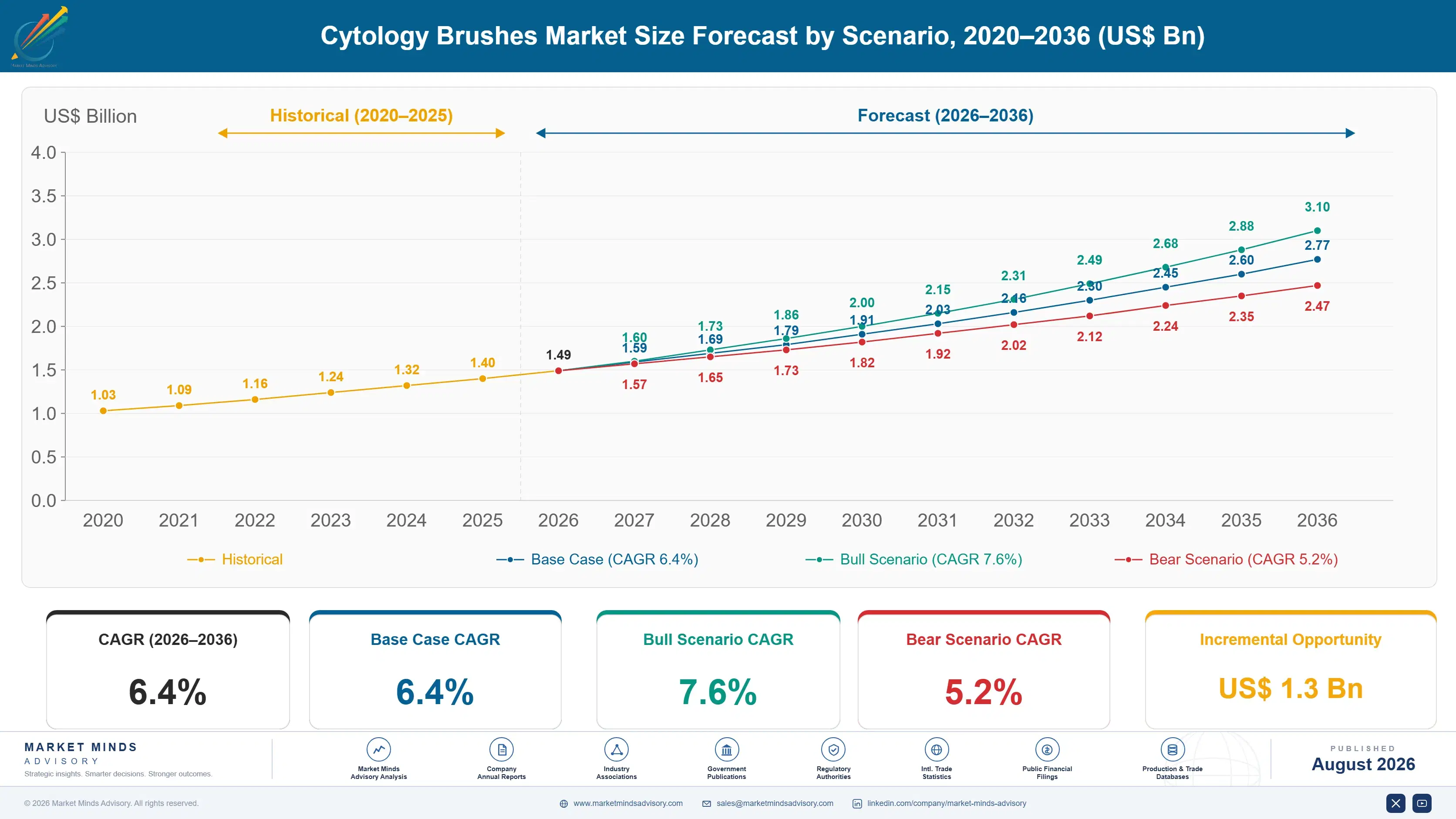
Cytology Brushes Market Forecast Scenarios

cytology-brushes-market-size-forecast-scenario-1787548816522
Between 2020 and 2025 cytology brush demand grew steadily as cervical cancer screening programs resumed and expanded following pandemic-era disruptions that temporarily suppressed routine gynecological visits, with the sharpest recovery concentrated in markets that had paused organized screening entirely. Several national health systems accelerated screening backlogs by extending clinic hours and expanding mobile screening unit deployment.
The base case assumes three commercial mechanisms drive growth beyond baseline screening volume alone: continued expansion of national cervical cancer screening programs across India and other developing markets, rising endoscopic bronchial and gastrointestinal procedure volumes tied to broader diagnostic pathology growth, and liquid-based cytology adoption pulling brush design toward more sophisticated fiber engineering. Together these forces keep the market growing considerably faster than population growth alone would suggest. Manufacturers investing across all three mechanisms simultaneously are outpacing narrower competitors considerably.
The bull case rests on accelerated national screening program rollout across South Asia and Africa pulling demand forward faster than currently forecast. The bear case centers on HPV self-collection testing gradually displacing traditional brush-based clinician sampling in several developed markets, a shift already underway in parts of Western Europe. Manufacturers positioned for both scenarios simultaneously hold the strongest long-term outlook across the industry.

Sample Adequacy Economics in a Screening-Driven Market

Cytology brush economics hinge on sample adequacy performance rather than pure unit cost, since a brush that yields an inadequate sample forces a repeat clinical visit that costs healthcare systems considerably more than any price premium the brush itself commands. Manufacturers unable to demonstrate this reliability increasingly lose bids regardless of unit price, since procurement teams weigh total cost of care rather than pure acquisition cost.
TOP PRODUCER SHAREUSA, 24%Share of global cytology brush revenue concentrated domestically
MARKET CONCENTRATIONCR5 36%Combined share held by the five largest global companies
AVERAGE SELLING PRICE$0.35-3.20 per unitTypical price range across gynecological and endoscopic tiers
SAMPLE ADEQUACY RATE92-99%Typical cell yield adequacy range across brush design tiers
FIBER COST SHARE34% of COGSSpecialty nylon and flocked fiber share of production cost
AVERAGE PRODUCT LIFESPANSingle useTypical usage pattern across nearly all disposable brush categories
The commercial character of the market splits between commodity gynecological brushes, which compete largely on price and reliable supply, and specialty endoscopic and liquid-based cytology compatible brushes, where manufacturers negotiate directly with hospital systems on clinical performance data rather than pure cost. Few manufacturers manage both segments equally well without meaningful internal friction between commercial and clinical affairs teams.
Over the next decade, national screening program expansion, HPV self-collection testing adoption, and liquid-based cytology penetration will decide which manufacturers retain their current market positions and which lose ground to competitors with stronger clinical evidence portfolios. The pace of specification change is accelerating each successive year across nearly every major screening program worldwide. Companies positioned across multiple dynamics simultaneously hold the strongest long-term competitive outlook.
"A cytology brush costs less than a cup of coffee and nobody notices it until the pathology report comes back inadequate. That is when the entire screening program's credibility rides on a two-dollar piece of plastic."
Director, Medical Devices and Diagnostic Consumables Practice · MMA Medical Devices and Diagnostic Sampling Consumables Practice · August 2026

Market Trends

Liquid-Based Cytology Compatible Brush Design Adoption

Brush manufacturers are increasingly engineering products specifically compatible with ThinPrep and SurePath liquid-based cytology processing systems, since sample transfer efficiency into the preservative vial directly affects adequacy rates and downstream pathology workflow efficiency. Several manufacturers have redesigned bristle geometry and detachable head mechanisms specifically to optimize cell release into liquid media rather than traditional slide smearing, a meaningful engineering shift from decades-old brush designs. Hospital procurement teams increasingly specify liquid-based cytology compatibility as a baseline requirement rather than an optional feature, forcing manufacturers without this capability to redesign their core product lines or lose market access entirely.
Market Impact: Adds 45M new screened patients
HPV Self-Collection Testing Emerging as Alternative Pathway

Self-collection HPV testing kits, which allow patients to collect their own vaginal samples using simplified swab devices rather than undergoing clinician-performed brush sampling, are gaining regulatory approval and screening program adoption across several developed markets as a strategy to improve screening participation among historically underscreened populations. This shift represents a genuine long-term threat to traditional cervical cytology brush volume in markets where self-collection becomes the primary screening pathway rather than a supplementary option. Manufacturers are responding by developing self-collection-compatible swab products to participate in this emerging category rather than losing volume entirely.
Market Impact: Adds 2.8 points to endoscopic growth

Market Opportunities and Growth Drivers

National Cervical Cancer Screening Program Expansion

India's national cervical cancer screening program, along with comparable initiatives across several African and Southeast Asian countries, is dramatically expanding organized screening coverage among populations that previously had minimal access to routine gynecological examination, directly driving new cytology brush demand at a scale few manufacturers anticipated even five years ago. Government health ministries are increasingly procuring brushes through centralized tender processes that favor manufacturers with proven quality certification and reliable supply chain capacity. Companies with established relationships with public health procurement agencies are capturing disproportionate share of this government-driven demand growth.
Market Impact: Cuts brush volume 8-15% by 2032

Rising Endoscopic Procedure Volume Across Specialties

Bronchoscopy and gastrointestinal endoscopy procedure volumes continue climbing across both developed and developing markets, each procedure often requiring cytology brush sampling for pathology diagnosis alongside biopsy and imaging techniques. Aging populations facing higher rates of pulmonary and gastrointestinal disease are driving sustained procedure growth independent of cervical screening trends entirely. Manufacturers with established relationships with endoscopy equipment makers and hospital procurement departments are capturing disproportionate share of this specialty-driven demand as procedure volumes continue expanding across multiple clinical disciplines. This trend is expected to accelerate further as diagnostic imaging referrals continue rising across most major healthcare systems worldwide.
Market Impact: Cuts testing frequency 40-60% per patient

Market Restraints and Challenges

HPV Self-Collection Testing Displacing Brush Sampling

Self-collection HPV testing kits are gradually displacing traditional clinician-performed brush sampling in several developed markets, particularly the United Kingdom and parts of Scandinavia, where screening programs have formally approved self-collection as a valid primary screening pathway rather than a supplementary option for underscreened populations. The root cause is genuine patient preference for a less invasive collection method combined with screening program interest in improving participation rates among historically underscreened populations. Manufacturers are mitigating the impact by developing self-collection-compatible swab products to participate in this emerging category rather than losing volume entirely to specialized swab makers.
Market Impact: Adds $0.15-0.40 per unit premium

Screening Interval Extension Reducing Testing Frequency

Several national screening guidelines have extended recommended screening intervals from annual to every three or five years based on HPV co-testing evidence, directly reducing the frequency of routine brush-based sampling per patient even as the overall screened population continues expanding. The root cause is clinical evidence demonstrating that longer intervals maintain screening effectiveness when combined with HPV testing, reducing unnecessary procedure volume without compromising patient outcomes. Manufacturers are mitigating the impact by expanding into endoscopic and specialty applications where procedure frequency remains independent of gynecological screening interval policy. Momentum keeps building steadily.
Market Impact: Could shift 15-20% of screening volume
4 additional market trends, 3 additional growth drivers, and 3 additional restraints and challenges are covered in the full report. Contact sales@marketmindsadvisory.com to access the complete intelligence.

Segment CAGR and Growth Architecture

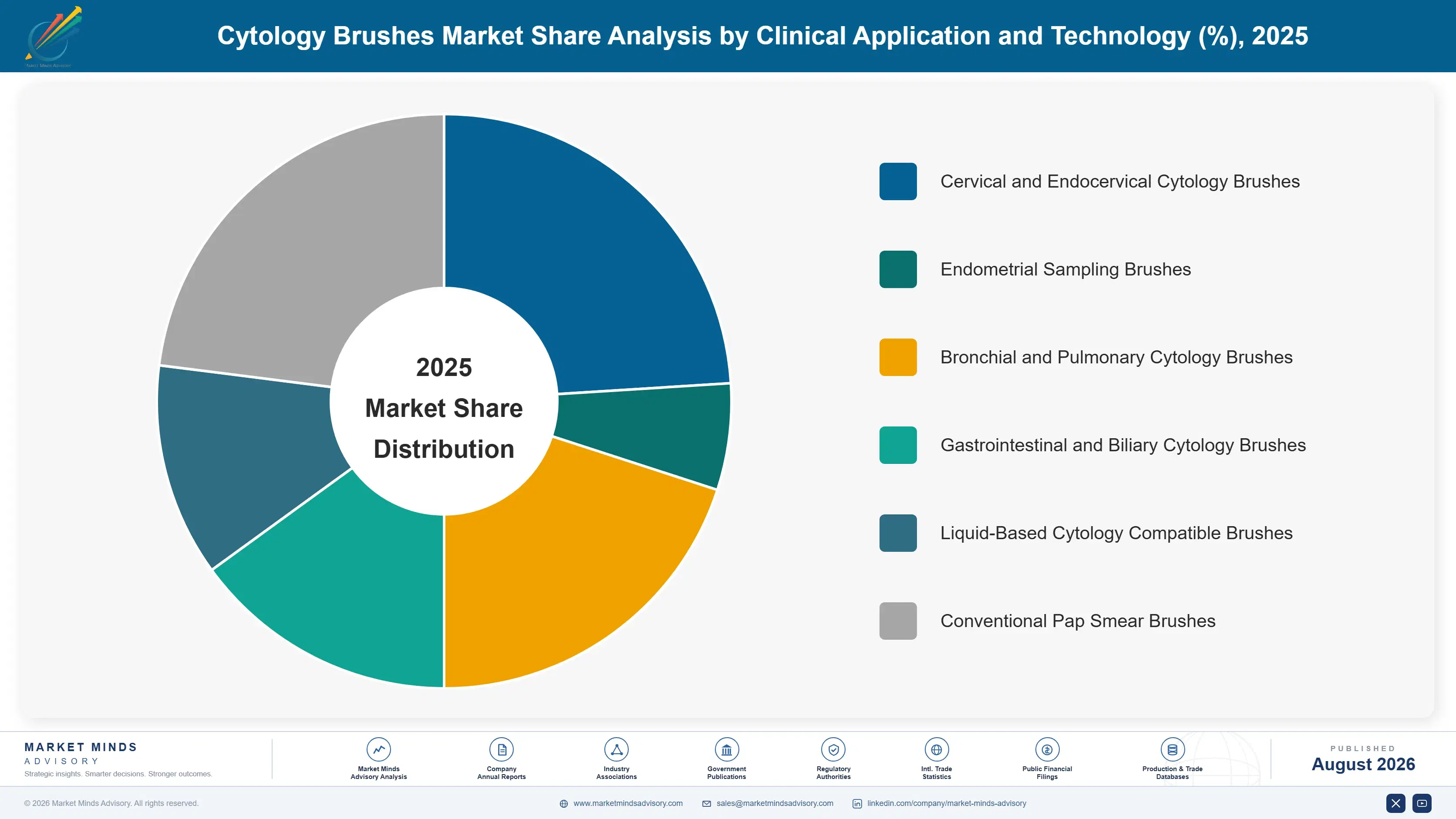
Segmentation follows clinical application and sampling technology, the dimension healthcare procurement teams specify against when awarding supply contracts, rather than by distribution channel or care setting, both of which sit outside this defined market scope and belong instead to adjacent commercial and channel-level analysis kept entirely separate from this market report and its scope.
cytology-brushes-market-market-share-analysis-1787548817067

Liquid-Based Cytology Compatible Brushes

Liquid-based cytology compatible brushes feature bristle geometry and detachable head mechanisms engineered specifically for optimal cell release into ThinPrep and SurePath preservative media rather than traditional slide smearing, a meaningful engineering differentiation from decades-old brush designs. Hospital procurement teams increasingly specify this compatibility as a baseline requirement rather than an optional feature, pulling specification wins away from manufacturers still reliant on conventional brush geometry. Companies need genuine expertise in fiber engineering and detachable head mechanics, a combination only a handful of manufacturers currently hold at meaningful scale. Pricing commands a premium over conventional brushes, and the segment is pulling research investment toward advanced fiber engineering across nearly every major manufacturer's product roadmap today.
CAGR 9.5%

Bronchial and Pulmonary Cytology Brushes

Bronchial and pulmonary cytology brushes are specialized endoscopic devices designed to collect cellular samples from airway and lung tissue during bronchoscopy procedures, representing a technically demanding application distinct from gynecological sampling given the need for compatibility with flexible endoscope working channels. Rising bronchoscopy procedure volumes, driven by aging populations facing higher rates of pulmonary disease, are pulling sustained demand growth independent of gynecological screening trends entirely. Manufacturers need established relationships with endoscopy equipment makers and specialized manufacturing capability for narrow-diameter flexible brush shafts. Gross margin on this segment benefits from specialized clinical requirements, making it a priority investment area for manufacturers seeking to diversify beyond cervical screening cyclicality entirely. today.
CAGR 7.0%
Full segment breakdown across 6 segments available in the complete report.

Regional Architecture and Country Demand Map

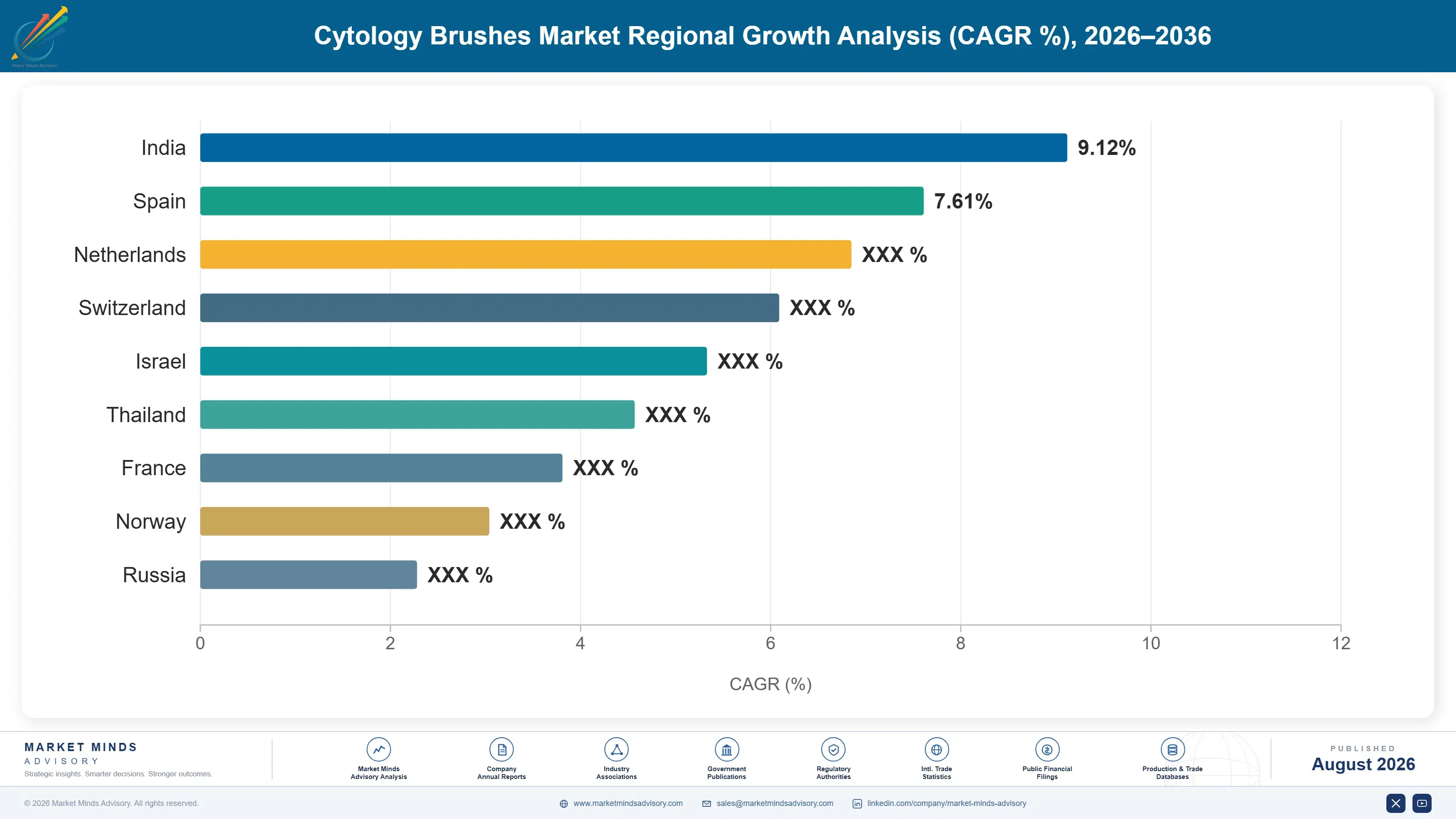
North America leads global cytology brush revenue through its deep liquid-based cytology adoption and organized screening infrastructure, while South Asia and Pacific, led by India's expanding national screening program, drive the fastest unit volume growth globally across nearly every clinical application category. today. overall. now.

North America

The United States carries the deepest liquid-based cytology adoption globally, supported by established insurance coverage for routine cervical cancer screening and a healthcare system that has largely transitioned away from conventional Pap smear methodology toward liquid-based systems. Hologic and Becton Dickinson's substantial domestic presence gives the region genuine leadership in both platform technology and compatible brush design. Canadian screening programs follow similar clinical protocols, though at meaningfully smaller scale than the US market. Regional growth trails the fastest-expanding Asian markets given the region's already mature and near-universal screening coverage. Insurance coverage decisions in the US increasingly shape which brush designs achieve broad clinical adoption. Growth stays modest. now. Growth continues.
Share: 30% | CAGR: 5.8% (2026 to 2036)

Western Europe

Germany, France, and the United Kingdom anchor regional demand through established organized screening programs, though the UK and several Scandinavian countries are pioneering HPV self-collection testing pathways that are gradually reducing traditional brush sampling volume in those specific markets. Rovers Medical Devices, headquartered in the Netherlands, represents one of the industry's most established specialty brush manufacturers by clinical reputation. National health insurance systems across most Western European countries provide comprehensive screening coverage, supporting steady baseline demand. Growth remains moderate given the region's already mature screening infrastructure. France and Italy contribute meaningful volume through mid-market screening programs still specifying conventional brush technology. Producer margins remain steady across most established manufacturing operations.
Share: 22% | CAGR: 4.9% (2026 to 2036)
Regional intelligence for 5 additional markets available in the complete report: East Asia, South Asia and Pacific, Latin America, Middle East and Africa, Eastern Europe. Contact sales@marketmindsadvisory.com.
cytology-brushes-market-country-cagr-analysis-1787548817587

Where Brush Makers Can Build Margin

Manufacturers facing commodity pricing pressure on standard gynecological brushes have four realistic paths to build durable margin without waiting for baseline screening volume alone to drive growth across every market they currently serve, plan to enter, or hope eventually to win business in over the coming years. ahead of competitors moving more slowly across the industry.

Investing Early in Liquid-Based Cytology Compatibility

Manufacturers that invest in bristle geometry and detachable head engineering specifically for liquid-based cytology systems can capture $0.15-0.40 per unit premium pricing over conventional brush designs, a genuine differentiation few competitors currently hold. The capability requires meaningful engineering investment and clinical validation studies, but manufacturers who move early are securing hospital procurement contracts that competitors entering later will struggle to match given the multi-year clinical evidence development timeline involved. Sponsors increasingly treat this qualification as a genuine competitive necessity today. Regulatory clarity around clinical validation requirements remains an evolving priority for most manufacturers pursuing this capability.
Market Impact: Adds \$0.15-0.40 per unit in premium pricing today

Building Self-Collection Swab Product Lines Now

Developing self-collection-compatible swab products, rather than treating HPV self-collection as a pure threat to traditional brush volume, lets manufacturers participate in the roughly 15-20% of screening volume shifting toward this pathway rather than losing it entirely to specialized swab makers. This diversification requires distinct product design and regulatory approval work separate from traditional brush development, but manufacturers succeeding here are protecting overall category revenue even as clinical practice patterns continue evolving across major developed screening markets. Manufacturers without this capability increasingly cede the fastest-growing screening pathway entirely to specialized competitors.
Market Impact: Captures share of 15-20% shifting volume overall today

Pursuing Government Tender Procurement Relationships Early

Establishing direct relationships with public health procurement agencies managing national screening program tenders, rather than relying purely on private hospital sales channels, gives manufacturers access to the roughly 45 million newly screened patients that government programs across India and other developing markets are adding to screening rolls. These relationships typically require quality certification and reliable supply chain capacity demonstrated well before formal tender awards, but manufacturers succeeding here are securing multi-year volume commitments that private channels rarely offer. Suppliers without this credibility are increasingly screened out during formal government tender evaluation rounds.
Market Impact: Captures share of 45M newly screened patients now

Expanding Endoscopic Specialty Brush Capability Now

Establishing or expanding manufacturing capability for bronchial and gastrointestinal cytology brushes, where procedure volumes continue growing at roughly 3% annually independent of cervical screening cyclicality, gives manufacturers access to demand that diversifies away from gynecological screening policy risk entirely. Domestic endoscopy equipment makers already hold meaningful incumbency here, so manufacturers need genuinely competitive clinical performance data and established equipment compatibility relationships rather than assuming gynecological brush expertise transfers directly. Manufacturers succeeding here are capturing outsized share of the industry's most stable, cyclicality-resistant demand pool available today. today. Diversification here reduces overall business risk considerably.
Market Impact: Diversifies revenue beyond 3% growth cyclicality risk widely

Who Controls the Margin Pool

The five largest cytology brush companies hold just over one-third of category revenue, a moderate concentration reflecting the genuinely split market between large diagnostics platform makers bundling brushes with proprietary systems and independent consumable manufacturers competing on design and price alone. The gap between platform-bundled leaders and independent challengers remains wide across developed screening markets specifically.
Current competitive activity centers on three dimensions: liquid-based cytology compatibility investment that determines platform bundling eligibility, self-collection swab product development that determines participation in the emerging HPV testing pathway, and government tender procurement relationships where the fastest volume growth remains concentrated. Companies investing across all three simultaneously are pulling ahead of narrowly focused competitors. Companies betting on just one of these dimensions increasingly find themselves outpaced by more diversified rivals across the industry.

Emerging pressure is coming from Chinese domestic manufacturers scaling production capacity to serve both export markets and China's own expanding screening programs, threatening established Western companies historical hold on price-sensitive commodity segments. Rankings are most likely to shift among mid-tier companies lacking either platform compatibility or government procurement relationships, both of which are becoming necessary rather than optional for long-term survival.
cytology-brushes-market-company-positioning-matrix-1787548818106

Competitive Moat and Risk Dimensions

HOLOGIC INC.

Moat: Proprietary Platform Bundling Scale

Hologic's ownership of the ThinPrep liquid-based cytology platform gives it a genuine commercial advantage in bundling compatible brush products directly with its processing systems, letting it serve hospital laboratories from a single qualified relationship spanning both equipment and consumables across nearly every major account. today.
HOLOGIC INC.

Risk: Self-Collection Testing Disruption Risk

Hologic's core brush and platform revenue faces genuine long-term exposure as HPV self-collection testing gains regulatory approval and screening program adoption, a shift that could meaningfully reduce clinician-performed brush sampling volume in markets where self-collection becomes the primary pathway. Hologic is investing meaningfully in self-collection technology to manage this exposure.
COOPERSURGICAL INC.

Moat: Deep Gynecological Product Reach

CooperSurgical's focused portfolio spanning gynecological devices beyond just cytology sampling gives it deep clinical relationships with obstetrics and gynecology practices that broader diagnostics platform makers do not cultivate to the same degree, supporting cross-sell opportunities across its wider product line. Few competitors can match this focused clinical relationship depth today.
COOPERSURGICAL INC.

Risk: Limited Endoscopic Category Presence

CooperSurgical's revenue concentration in gynecological applications leaves it more exposed than diversified competitors to cervical screening policy shifts, with comparatively limited presence in the faster-growing endoscopic specialty segments where broader medical device companies are capturing disproportionate growth. Diversifying into endoscopic applications remains an ongoing strategic priority for leadership.

Players Tracked

Prominent Players

Hologic Inc.
Becton Dickinson and Company
CooperSurgical Inc.
Rovers Medical Devices B.V.
Boston Scientific Corporation

Other Key Players

Copan Diagnostics Inc.
DTR Medical (Innovia Medical)
Puritan Medical Products Company Inc.
MedGyn Products Inc.
Cardinal Health Inc.
Medline Industries LP
Olympus Corporation
Cook Medical LLC
Jiangsu Hanheng Medical Technology Co. Ltd.
Boenmed Medical Devices Co. Ltd.
Teleflex Incorporated
Utah Medical Products Inc.
Micro-Tech Endoscopy (Nanjing) Co. Ltd.
Narang Medical Limited
Well Lead Medical Co. Ltd.

Recent Developments

FEBRUARY 2026

Hologic Launches Next-Generation ThinPrep Compatible Brush

Hologic launched a redesigned cervical sampling brush engineered for improved cell release into ThinPrep preservative media, targeting hospital laboratories seeking higher sample adequacy rates across their routine cervical cancer screening programs this year. The launch reflects continued investment in fiber engineering as a genuine competitive differentiator among platform makers.
Signal: Confirms platform makers continue investing in brush design as a key differentiator today alongside processing technology.
SEPTEMBER 2025

Jiangsu Hanheng Expands Export Manufacturing Capacity

Jiangsu Hanheng Medical Technology expanded production capacity at its Chinese facility to serve growing export demand for disposable cytology brushes across Southeast Asian and African screening programs seeking cost-competitive supply alternatives. The expansion directly targets government tender programs seeking reliable, cost-competitive supply partners widely today.
Signal: Shows Chinese manufacturers scaling capacity to capture government tender business across developing screening markets broadly today.
MAY 2025

CooperSurgical Expands Government Tender Relationships

CooperSurgical announced expanded relationships with public health procurement agencies across several developing markets, securing multi-year supply agreements tied to national cervical cancer screening program expansion initiatives launched this year. The relationships reflect growing manufacturer focus on public sector screening program expansion opportunities broadly today across the industry.
Signal: Indicates established manufacturers are increasingly prioritizing government procurement channels as a genuine growth strategy overall today.

Specialty Fiber and Bristle Cost Exposure

Specialty nylon and flocked fiber material accounts for roughly thirty-four percent of cytology brush production cost, with supply concentrated among a limited number of qualified fiber suppliers capable of meeting the consistent bristle stiffness and cell-release performance specifications clinical sampling requires. Regional shortages in any single fiber component can meaningfully delay entire production runs and raise landed costs across nearly every manufacturing operation.
Specialty medical-grade nylon fiber pricing spiked meaningfully during the 2021 to 2022 petrochemical feedstock disruption that affected synthetic fiber producers broadly, forcing several brush manufacturers to renegotiate fixed-price hospital and government tender contracts mid-cycle or absorb margin compression they had not budgeted for entering those agreements. The shortage reshaped how manufacturers now negotiate feedstock contracts, with multi-year commitments increasingly replacing spot purchasing common in earlier years.

Larger manufacturers with direct fiber supplier partnerships and diversified sourcing across multiple regions absorb volatility far better than smaller regional producers dependent on spot-market purchases, a gap in supply chain sophistication that is slowly reshaping which manufacturers can compete for large government tender contracts. Regional variation in exposure is widening as a result of these differing capabilities across the industry.
cytology-brushes-market-cost-volatility-analysis-1787548818300

Direct Fiber Supplier Partnerships

Negotiating multi-year supply agreements directly with qualified specialty fiber producers lets larger manufacturers guarantee priority allocation and pricing stability during periods of tight fiber availability, a structure smaller regional producers struggle to replicate without comparable purchasing volume. Larger manufacturers increasingly pursue this path given their capital access and negotiating position with major fiber suppliers.

Diversified Fiber Sourcing Regions

Qualifying specialty nylon and flocked fiber suppliers across two or more geographic regions reduces exposure to any single production disruption or regional trade policy shift, giving procurement teams alternative sourcing options during periods of tight regional fiber availability. This diversification requires meaningful upfront qualification investment across each new supplier relationship. Smaller manufacturers without comparable relationships struggle to secure similar terms.

Index-Linked Government Contract Clauses

Negotiating fiber price index clauses into multi-year government tender and hospital sourcing contracts lets manufacturers pass through a defined share of raw material volatility rather than absorbing the full swing themselves, a structure larger manufacturers have increasingly standardized across new contract negotiations. This practice supports greater pricing stability across successive contract renewal cycles. today.

Portfolio Architecture for Margin Defence

Cytology brush manufacturers organize their portfolios across three tiers separated primarily by clinical application sophistication and platform compatibility rather than by customer type alone, with gross margin climbing sharply from commodity gynecological brushes toward liquid-based cytology compatible and endoscopic specialty products commanding genuine technical differentiation. The gap between the lowest and highest tier has widened considerably as platform compatibility becomes a genuine qualification requirement for the industry's fastest-growing programs.
The volume-versus-premium tension is intensifying as government tender programs demand accessible pricing on standard gynecological brushes while hospital systems pay considerably more for platform-compatible and specialty endoscopic products, forcing manufacturers to run fundamentally different manufacturing and commercial organizations under a single corporate roof. Manufacturers that fail to separate these two operating models organizationally often see margin erosion bleed from the volume tier into programs that should command premium pricing.

High-value margin pools concentrate overwhelmingly in liquid-based cytology compatible and endoscopic specialty programs, both of which command qualification barriers that commodity producers cannot easily cross without meaningful capital investment and multi-year clinical validation development. Manufacturers building both capabilities simultaneously are positioning themselves to capture a disproportionate share of the industry's fastest-growing margin pool.

Volume / Commodity-Adjacent Tier

Standard conventional gynecological brushes sold primarily on price and reliable supply across government tender and public health screening program procurement channels. Margins remain thin and continue narrowing further each year across most producing regions.
Gross Margin: 12-20%

Premium / Certified Tier

Liquid-based cytology compatible brushes with proven clinical validation data, commanding higher pricing on hospital systems and private laboratory programs specifying platform compatibility. Programs here run at meaningful and growing commercial scale worldwide.
Gross Margin: 24-32%

Sustainability / Regulatory / Next-Generation Tier

Endoscopic specialty and self-collection swab products meeting the newest clinical and regulatory requirements, commanding the steepest qualification barriers and richest margin pools available. Demand for this tier keeps rising steadily each successive quarter.
Gross Margin: 34-44%
cytology-brushes-market-portfolio-architecture-1787548818791

High-value Sub-segments and Strategic Watch-out

Liquid-Based Cytology Compatible Brushes

Highest-value, fastest-growing segment as hospital laboratories specify platform compatibility as standard equipment across an expanding share of screening programs worldwide, pulling qualification budgets away from conventional brush designs entirely. Investment keeps accelerating across nearly every major manufacturer platform available today. Suppliers ignoring this shift risk losing relevance.
Gross Margin: 36-44%

Bronchial and Pulmonary Cytology Brushes

High-value, moderate-growth segment expanding steadily as endoscopic procedure volumes rise, offering manufacturers a durable margin premium tied to clinical specialization rather than volume scale alone across qualifying programs. Momentum is building steadily across most major developed healthcare markets each year. Suppliers here enjoy meaningful pricing power.
Gross Margin: 26-32%

Standard Government Tender Gynecological Brushes

The volume core of the market, carrying thin but stable margin across the largest share of global screening program demand, essential to manufacturer fixed-cost absorption even as growth concentrates elsewhere. Manufacturers rely on it for baseline fixed-cost coverage across their broader portfolios. Volume remains substantial.
Gross Margin: 12-20%

HPV Self-Collection Testing Displacement

Strategic watch-out segment where self-collection HPV testing gradually displaces traditional clinician-performed brush sampling, pressuring manufacturer revenue projections broadly across developed screening markets. Manufacturers exposed here face the sharpest long-term revenue erosion risk overall. Diversification into specialty applications offers the clearest available hedge against this pressure.
Gross Margin: 6-14%

Screening Cycles and Application Depth

Cytology brush demand behaves like an annuity anchored to hospital and government tender procurement cycles rather than one-off transactions: once a manufacturer wins qualification on a given screening program or hospital system, it typically holds that relationship for the full multi-year contract period, giving qualified manufacturers predictable revenue visibility across several years of program operation. Winning that initial qualification is therefore disproportionately valuable relative to its upfront bidding cost.
Adoption depth varies sharply by end-use vertical. Hospital and private laboratory customers specify the deepest platform compatibility requirements, including liquid-based cytology validation, while government tender programs still specify largely conventional brush designs given cost constraints across public health budgets. Endoscopic specialty customers sit in between, requiring consistent clinical performance without the extensive platform validation hospital laboratory customers demand.

A generational shift in procurement profile is underway as younger public health administrators increasingly specify liquid-based cytology compatibility even within government tender programs, pulling specification requirements toward richer brush content years earlier in the program lifecycle than in prior screening generations. Established hospital customers continue operating under long-standing supply relationships largely unchanged across multiple decades of clinical practice.
cytology-brushes-market-end-use-penetration-index-1787548819277

Where Manufacturers Should Invest Next

These are among the four positions where our research anticipates prominent divergence between winners and laggards over the coming forecast period. Each is grounded in the demand model, the regulatory perimeter, and the announced capacity pipeline.
01 / PLATFORM COMPATIBILITY INVESTMENT

Build liquid-based cytology compatibility before hospital procurement standardizes elsewhere

Manufacturers lacking liquid-based cytology compatible brush technology are ceding the fastest-growing, highest-margin segment of the market to better-equipped competitors across nearly every hospital laboratory program advancing today. Platform compatibility raises unit pricing meaningfully above conventional brush designs, giving early movers a durable revenue advantage over slower-moving rivals confined to commodity volume and thinning margins. Waiting for hospital systems to specify this capability unprompted means missing qualification windows on the programs defining the industry's remaining growth and outsized share of the fastest-growing demand pool overall.
02 / SELF-COLLECTION PRODUCT DIVERSIFICATION

Build self-collection swab capability before the shift accelerates further

HPV self-collection testing is displacing traditional brush sampling faster than many single-product manufacturers have prepared for, and companies without swab product lines risk losing the roughly 15-20% of screening volume shifting toward this pathway entirely. Manufacturers developing self-collection products early are protecting overall category revenue rather than ceding it entirely to specialized swab makers entering the category. Early investment here diversifies revenue against a genuine long-term shift in screening methodology that shows no sign of reversing across major developed healthcare markets.
03 / GOVERNMENT TENDER ACCESS

Secure public health procurement relationships before competitors dominate emerging markets

National screening program expansion across India and other developing markets represents the single largest volume growth opportunity in the industry today, and manufacturers relying solely on private hospital channels are missing this government-driven demand entirely. Direct procurement relationships require quality certification and reliable supply chain capacity demonstrated well before formal tender awards are granted across major regional programs. Manufacturers succeeding here capture a disproportionate share of the industry's best remaining growth opportunity, since waiting means missing volume commitments private channels rarely offer.
04 / ENDOSCOPIC CATEGORY EXPANSION

Diversify into endoscopic specialty brushes before cyclicality risk concentrates further

Manufacturers concentrated purely in gynecological applications remain exposed to screening policy shifts and self-collection displacement risk in ways that diversified competitors with endoscopic specialty revenue are not. Bronchial and gastrointestinal procedure volumes continue growing independent of cervical screening trends entirely, offering a genuine hedge against category-specific disruption across the wider industry. Manufacturers building this capability early are positioning for considerably more resilient long-term revenue than single-category competitors delaying diversification and needlessly concentrating risk entirely in one narrowing, increasingly screening-dependent revenue segment.

Engagement Snapshot From the Field

A live engagement with an industry participant carrying material or product regulatory and market exposure ahead of a defining policy shift, showing how our research translates into a defensible multi-year portfolio strategy.
MARKET MINDS ADVISORY · CLIENT ENGAGEMENT SUMMARY
Cytology Brushes Producer Strategic Portfolio Review and Transition Roadmap 2026·Investment Scenario on Cytology Brushes Exposure Evaluation 2025-26
CLIENT PROFILE
The client is a regional cytology brush manufacturer with production facilities across two countries, serving established government tender and hospital laboratory customers with conventional gynecological brush products, reporting annual revenue in the low tens of millions and a workforce spanning production, quality assurance, and commercial functions (client-reported, unverified by MMA). across its established markets today.
STRATEGIC CHALLENGE
The client was losing hospital laboratory contracts to competitors offering liquid-based cytology compatible brush technology it had not yet developed, while simultaneously facing early volume pressure from HPV self-collection testing pilots launching in several of its core developed export markets. Both dynamics threatened the client's longer-term competitive position considerably across its core business.
MMA APPROACH
MMA conducted a program-by-program competitive benchmarking exercise across the client's active and prospective customer relationships, combined with primary interviews among hospital and government procurement decision-makers, to identify which specific capability gaps were costing contracts and quantify the investment case for closing them within a realistic timeline. before finalizing recommendations for the leadership team.
KEY FINDINGS
  1. Roughly fifty percent of lost hospital bids over the prior two years traced directly to missing liquid-based cytology compatibility rather than price alone.
  2. Government tender procurement teams increasingly favored suppliers with proven quality certification, moving from optional to expected within roughly two years. across most major procurement channels.
  3. Self-collection testing pilots in the client's core export markets were advancing faster than internal forecasts had anticipated. prompting urgent internal strategic review.
  4. Endoscopic specialty customers represented a growing share of new contract volume the client had been systematically excluded from due to limited category presence.
CLIENT PROFILE
The client is a regional cytology brush manufacturer with production facilities across two countries, serving established government tender and hospital laboratory customers with conventional gynecological brush products, reporting annual revenue in the low tens of millions and a workforce spanning production, quality assurance, and commercial functions (client-reported, unverified by MMA). across its established markets today.
STRATEGIC CHALLENGE
The client was losing hospital laboratory contracts to competitors offering liquid-based cytology compatible brush technology it had not yet developed, while simultaneously facing early volume pressure from HPV self-collection testing pilots launching in several of its core developed export markets. Both dynamics threatened the client's longer-term competitive position considerably across its core business.
MMA APPROACH
MMA conducted a program-by-program competitive benchmarking exercise across the client's active and prospective customer relationships, combined with primary interviews among hospital and government procurement decision-makers, to identify which specific capability gaps were costing contracts and quantify the investment case for closing them within a realistic timeline. before finalizing recommendations for the leadership team.
KEY FINDINGS
  1. Roughly fifty percent of lost hospital bids over the prior two years traced directly to missing liquid-based cytology compatibility rather than price alone.
  2. Government tender procurement teams increasingly favored suppliers with proven quality certification, moving from optional to expected within roughly two years. across most major procurement channels.
  3. Self-collection testing pilots in the client's core export markets were advancing faster than internal forecasts had anticipated. prompting urgent internal strategic review.
  4. Endoscopic specialty customers represented a growing share of new contract volume the client had been systematically excluded from due to limited category presence.
RECOMMENDED STRATEGY
Phase 1: Phase 1 (Months 1-6): Build liquid-based cytology compatible brush technology and pilot it with one qualifying hospital customer. with a qualifying hospital directly. Phase 2: Phase 2 (Months 6-14): Develop a self-collection swab product line to participate in the emerging testing pathway directly. within eighteen months of launch. Phase 3: Phase 3 (Months 14-24): Expand into endoscopic specialty brushes to diversify revenue beyond gynecological screening cyclicality. across two priority regional markets.
OUTCOME
Within eighteen months of implementation, the client reported winning qualification on two additional hospital laboratory supply contracts, alongside a measurable improvement in bid win rate on platform-compatibility-scored sourcing evaluations across its regional customer base and several new prospective accounts secured through the revised approach (client-reported, unverified by MMA).

Frequently Asked Questions

Foundational context covering the market sizes, CAGR, scope, country, region and competition that inform every finding below. This section is provided to cover basics and most often pre-purchase conversations, answered from the MMA Primary Research Dataset.

What is the current size of the Cytology Brushes Market?

The global cytology brushes market is valued at approximately $1.4 billion in 2025. Growth is concentrated in liquid-based cytology compatible brushes and India's expanding national screening program.

How large will the Cytology Brushes Market be by 2036?

The market is projected to reach approximately $2.8 billion by 2036 under the base case scenario. This reflects roughly 1.87 times expansion from 2026 levels.

What is the CAGR for the Cytology Brushes Market 2026 to 2036?

The base case CAGR is 6.4% over the forecast period. Bull and bear scenarios range from 7.6% down to 5.2% depending on self-collection testing adoption.

Which segment is growing fastest?

Liquid-Based Cytology Compatible Brushes is the fastest-growing segment at a 9.5% CAGR, roughly 1.48 times the overall market rate. Bronchial and Pulmonary Cytology Brushes follows closely at 7.0%.

Who are the major companies in the Cytology Brushes Market?

Leading companies include Hologic Inc., Becton Dickinson and Company, CooperSurgical Inc., Rovers Medical Devices, and Boston Scientific Corporation. Together they hold just over one-third of global category revenue.

Which country is growing fastest?

India leads global growth at a 9.2% CAGR, driven by its rapidly expanding national cervical cancer screening program. Government procurement continues scaling alongside this surge.

Report Segmentation Architecture

The full report scope spans multiple orthogonal segmentation dimensions, with cross-tabulated demand data provided for each dimension pair. Coverage extends further to regional breakdowns, trend trajectories, and the competitive detail needed to support segment-level decision-making.

By Clinical Application and Technology

  • Cervical and Endocervical Cytology Brushes
  • Endometrial Sampling Brushes
  • Bronchial and Pulmonary Cytology Brushes
  • Gastrointestinal and Biliary Cytology Brushes
  • Liquid-Based Cytology Compatible Brushes
  • Conventional Pap Smear Brushes

By End-Use Healthcare Setting

  • Hospital Laboratories
  • Private Diagnostic Clinics
  • Government Screening Programs
  • Ambulatory Surgical Centers
  • Academic Medical Centers

By Commercial Sourcing Dimension

  • Direct Hospital Contracts
  • Government Tender Procurement
  • Distributor and Wholesale Supply
  • Platform Bundled Sales

By Region

  • North America
  • Western Europe
  • East Asia
  • South Asia and Pacific
  • Latin America
  • Middle East and Africa
  • Eastern Europe

Scope, Methodology, and Coverage

Every figure in this report is reproducible from documented input assumptions. The scope below maps the historical period, the forecast horizon, the segmentation dimensions, and the countries covered, alongside the underlying primary and qualitative methodology.
Historical Period
2020 to 2025
Forecast Period
2026 to 2036
Base Year
2025 (USD billions; MMA Primary Research Dataset, August 2026)
Market Definition
The cytology brushes market covers single-use and reusable brush devices designed to collect cellular samples from the cervix, endometrium, and endoscopically accessible mucosal surfaces for pathology analysis. It excludes the liquid-based cytology processing systems and pathology laboratory equipment that analyze the collected samples separately.
Quantitative Units
USD billions (current prices); unit volume in million brushes where applicable
Segmentation Dimensions
By Clinical Application and Technology; By End-Use Healthcare Setting; By Commercial Sourcing Dimension; By Region
Regions Covered
North America, Western Europe, East Asia, South Asia and Pacific, Latin America, Middle East and Africa, Eastern Europe
Countries Covered
USA, China, Germany, France, UK, Japan, South Korea, India, Australia, Canada, Brazil, Mexico, Indonesia, Vietnam, Thailand, Malaysia, UAE, Saudi Arabia, South Africa, Nigeria, Turkey, Poland, Netherlands, Italy, Spain, Sweden, Switzerland, Argentina, Colombia, Singapore, and additional markets relevant to this sector
Key Companies Profiled
Hologic Inc., Becton Dickinson and Company, CooperSurgical Inc., Rovers Medical Devices B.V., Boston Scientific Corporation, Copan Diagnostics Inc., DTR Medical (Innovia Medical), Puritan Medical Products Company Inc., MedGyn Products Inc., Cardinal Health Inc., Medline Industries LP, Olympus Corporation, Cook Medical LLC, Jiangsu Hanheng Medical Technology Co. Ltd., Boenmed Medical Devices Co. Ltd., Teleflex Incorporated, Utah Medical Products Inc., Micro-Tech Endoscopy (Nanjing) Co. Ltd., Narang Medical Limited, Well Lead Medical Co. Ltd.
Quantitative Methodology
Primary survey, n=3,800 respondents, Q4 2025, six countries; demand-side model with trade association cross-validation
Qualitative Methodology
47 expert interviews, Q4 2025; applied to validate demand model assumptions, identify emerging dynamics, and assess competitive positioning
Report Format
PDF and XLSX data workbook (Word format preview document)
Publisher
Market Minds Advisory
Report Code
MMA-2026-MED-120
Published
August 2026
Contact
sales@marketmindsadvisory.com | www.marketmindsadvisory.com

Purchase the full Cytology Brushes Market Report (2026 to 2036).

The full report delivers a comprehensive analysis of the global cytology brushes market, including detailed segmentation by clinical application and technology, regional demand forecasts across all seven MMA-tracked geographies, and competitive benchmarking of the twenty leading companies profiled. It includes primary survey data from three thousand eight hundred respondents and forty-seven expert interviews conducted in the fourth quarter of 2025. Buyers receive company capability matrices, fiber cost sensitivity models, and government tender sourcing cycle analysis. The full ten-year forecast spans 2026 through 2036 across every major regional market.
Ten-year quantitative forecast model spanning 2026-2036
Seven-region demand breakdown with growth drivers
Twenty-company competitive benchmarking profiles included in full
Primary survey and expert interview data
Specialty fiber and bristle cost sensitivity analysis
Government tender sourcing cycle and pattern mapping

Built For The People Who Decide

From boardroom strategy to bench-side execution, this report is read cover-to-cover by leaders shaping the next decade of their industry, turning demand scenarios, market dynamics and valuation benchmarks into decisions.
CXOs/ Presidents/ VPs/ Managers
M&A and Corporate Development
Strategy Teams and R&D Heads
Procurement and Product Directors
Regulatory and Compliance Leaders
Investor Relations and Equity Analysts