Market Minds Advisory
Cytokinins Market

Cytokinins Market: Application Timing, the Biostimulant Registration Route, and a Supply Base Concentrated in One Country

A dozen grams per hectare decides whether a kiwifruit crop makes premium grade, and the registration cost of any new molecule now exceeds what most of these compounds will ever earn.

Lead Analyst

Bilal Shaikh

Published

September 2026

Make Smarter Decisions with Customized Research Insights

Request a free sample report and evaluate market opportunities, growth trends, and competitive dynamics relevant to your business needs.

2025 MARKET VALUE$0.4BMarket Size 2025
2036 FORECAST VALUE$0.9BBase Case , 2026 to 2036
CAGR 2026 TO 20368.2 %Bull 9.4% / Bear 7.0%
INCREMENTAL OPPORTUNITY$0.5BNet 10- year value creation
EXPANSION MULTIPLE2.20x2036 value over 2026 base
Strategic Levers
M&A Pipeline
Regional Outlook
Country Rankings
Competitive Intelligence
Segmental Deep-dive
Call-Us : 91 93563 13602

Executive Snapshot and Market Trajectory

Cytokinins are applied at roughly twelve grams per hectare and decide whether a fruit crop reaches premium grade or sells as processing stock. Almost nothing else in crop protection delivers that much commercial consequence from that little material. The chemistry itself went off patent decades ago and costs very little.
Commercial power sits with suppliers providing agronomic timing support rather than with anyone able to manufacture the compound, because applying a few days early or late destroys the return entirely. Meta-topolin and aromatic derivatives grow fastest at 13.6%, roughly 1.66 times the market, driven by micropropagation laboratories rather than by field agriculture. East Asia holds 30% of global value and manufactures far more than that.
Concentration is moderate at roughly 36% for the top five, and Chinese producers supply 68% of technical material regardless of whose label appears on the drum. Registration of a new compound costs above USD 2.4 million per major market, which has effectively ended novel molecule development. The biostimulant route has become the workaround. Naturally derived cytokinins reach European markets under the fertilising products framework instead, for a fraction of the cost.
Market Definition
The market comprises cytokinin plant growth regulators supplied as technical material and formulated products, covering 6-benzylaminopurine, kinetin, forchlorfenuron, thidiazuron, zeatin and natural cytokinins, and meta-topolin and aromatic derivatives. Value is measured at supplier level across agricultural, horticultural, and plant tissue culture applications. Auxins, gibberellins, abscisic acid, ethylene regulators, general biostimulant blends without defined cytokinin content, and cosmetic formulations containing kinetin fall outside scope.
Base Year Value
$0.4B in 2025 (MMA Primary Research Dataset, August 2026)
Forecast Period
2026 to 2036, eleven discrete annual values
CAGR
8.2% base case. Bull 9.4%. Bear 7.0%.
Fastest Growth Segment
Meta-Topolin and Aromatic Cytokinin Derivatives: 13.6% CAGR
Fastest Growth Country
India: 11.6% CAGR
Fastest Growth Region
South Asia and Pacific: 10.4% CAGR
Largest Region
East Asia: 30% of 2025 global value
Market Leaders
Valent BioSciences, Nufarm, Sumitomo Chemical, Nippon Soda, and Fine Americas lead on cytokinin product revenue. Source: company annual reports and MMA Analysis, July 2026.
Primary Survey
n=3,800 procurement and R&D decision-makers, Q4 2025, six countries
Methodology
Demand-side build-up, cross-validated against public data, 47 expert interviews

Cytokinins Market Forecast Scenarios

cytokinins-market-trends-size-forecast-scenario-1787549087846
Between 2020 and 2025 growth came from high-value horticulture rather than from broad-acre agriculture. Table grape, kiwifruit, and apple growers adopted fruit sizing programmes more widely as premium grade price gaps widened, and micropropagation laboratories expanded with demand for disease-free planting material. Chinese environmental enforcement disrupted technical supply twice. The 6.9% historical growth reflects steady horticultural adoption interrupted by genuine supply volatility rather than any demand weakness.
The 8.2% base case rests on three mechanisms. Premium fresh produce grading keeps widening the price gap between sized and unsized fruit, which makes a twelve gram per hectare application among the highest return decisions a grower makes. Micropropagation capacity continues expanding for berry, banana, and ornamental planting material. And the European biostimulant framework offers a registration route costing a fraction of plant protection approval for naturally derived cytokinin products.
The 9.4% bull case assumes biostimulant registration continues opening markets and that seaweed and fermentation-derived cytokinins reach agronomic parity with synthetic compounds. The 7.0% bear case reflects residue tolerance tightening on forchlorfenuron, Chinese supply disruption, and consumer resistance to growth regulator use on fresh produce. Regulatory boundaries decide far more here than agronomy does. Agronomy is settled.

Twelve Grams That Decide a Crop's Grade

Three things set the commercial shape of this market. Application timing comes first, because a cytokinin applied outside a window measured in days does nothing useful and occasionally causes damage. Registration status comes second, since these compounds face plant protection approval in most jurisdictions and the dossier cost exceeds what many will ever earn. Manufacturing comes third and sits overwhelmingly in China.
TOP-FIVE CONCENTRATION36%Share of global cytokinin supply held by leading formulators
AVERAGE SELLING PRICEUSD 340 per kgBlended technical grade pricing across mainstream cytokinin compounds
TISSUE CULTURE SHARE23%Portion of volume consumed by plant micropropagation laboratories
REGISTRATION DOSSIER COSTUSD 2.4 millionTypical cost of registering one compound per major market
TYPICAL APPLICATION RATE12 grams per hectareField dose applied across mainstream fruit sizing programmes
CHINESE PRODUCTION SHARE68%Portion of global technical material manufactured within China
The timing point defines the commercial model. A grower buying fruit sizing chemistry is buying an agronomist who knows the local variety, the season, and the growth stage to target. Suppliers selling through distribution without that support see their products applied badly, blamed for the resulting failure, and dropped from the programme. The best agronomist wins the account, not the cheapest drum.
The biostimulant route has changed the economics of new products entirely. Naturally derived cytokinins in seaweed extracts and fermentation products can reach European markets under the fertilising products framework rather than through plant protection approval, at a small fraction of the cost and time. Whether that route holds as regulators examine efficacy claims more closely is the largest open question in the sector.
"Growers do not buy cytokinins, they buy fruit diameter. Miss the application window by four days and you have spent the money for nothing, which is why the supplier with the best agronomist wins the account and the one with the cheapest drum does not. The chemistry has been off patent for decades."
Practice Director, Crop Inputs and Agricultural Biologicals · MMA Agriculture and Crop Inputs Practice · August 2026

Market Trends

Biostimulant Registration Offers a Route Around Plant Protection Approval

Naturally derived cytokinins present in seaweed extracts, fermentation products, and plant extracts can be placed on European markets under the fertilising products framework rather than as plant protection products, provided claims stay within permitted boundaries. The cost difference is enormous: a plant protection dossier runs above USD 2.4 million per major market while biostimulant compliance costs a small fraction of that. Suppliers have redirected development accordingly, and the fastest product launches now come through this route. Regulators are examining efficacy claims more closely, and how firmly that boundary is policed will shape the category.
Market Impact: Applies at 12 grams per hectare
Micropropagation Laboratories Drive the Highest-Value Demand

Plant tissue culture consumes 23% of cytokinin volume at purity specifications field agriculture never requires, and laboratories pay accordingly. Shoot multiplication depends directly on cytokinin type and concentration, and newer aromatic compounds including meta-topolin reduce the physiological disorders that plague conventional 6-benzylaminopurine protocols. Demand grows with berry, banana, and ornamental planting material production, all of which have expanded as growers move toward certified disease-free stock. Laboratories buy on batch consistency and purity rather than price, which makes this the most defensible segment in the market for any supplier who can hold specification.
Market Impact: Grows above 10% each year

Market Opportunities and Growth Drivers

Premium Grade Price Gaps Justify Fruit Sizing Programmes

Retail specifications increasingly reward fruit diameter, and the price difference between premium and standard grade has widened across table grape, kiwifruit, apple, and stone fruit in most producing regions. A forchlorfenuron or benzylaminopurine application costing a modest amount per hectare can move a meaningful share of a crop across that grade boundary, which is among the highest return decisions a horticulturalist makes in a season. Adoption spreads through grower networks and packhouse advice rather than through advertising, and once a programme works locally it becomes standard practice quickly. Grower networks spread it faster than advertising ever could.
Market Impact: China supplies 68% of material

Certified Planting Material Expands Tissue Culture Capacity

Growers of berries, bananas, sugarcane, and ornamentals are shifting toward tissue culture propagated stock because it arrives disease-free and genetically uniform, and government programmes in India and several other countries actively fund the transition. Every laboratory expansion adds recurring cytokinin demand at the highest purity grades sold. Unlike field application this consumption repeats with every propagation cycle rather than seasonally, and it is insulated from weather, commodity prices, and the residue debates that affect fresh produce applications. Laboratory demand has grown faster than field demand for several years running. It is now the steadier half of the market.
Market Impact: Limits tightened in 6 markets

Market Restraints and Challenges

Chinese Manufacturing Concentration Exposes the Entire Supply Chain

Roughly 68% of global technical cytokinin material is manufactured in China, and for several compounds the figure is considerably higher. The root cause is economic rather than technical: the volumes are small, the chemistry is off patent, and nobody outside China has built capacity because the returns never justified it. Environmental enforcement campaigns and export documentation changes have both disrupted supply within the past five years. Suppliers mitigate through multi-year purchase agreements, strategic inventory, and qualification of Indian producers, and none of it removes the underlying concentration. Nobody expects new capacity elsewhere.
Market Impact: Cuts approval cost below $2.4 million

Residue Scrutiny Threatens the Highest-Value Applications

Forchlorfenuron on kiwifruit and table grape delivers the largest commercial benefit in this market and attracts the closest regulatory and consumer attention, following market incidents in Asia that generated significant publicity. The root cause is visibility: growth regulators used to enlarge fruit are easy for consumers to characterise unfavourably regardless of the toxicology. Maximum residue limits have tightened in several importing markets. Suppliers mitigate through lower-rate programmes, precise timing guidance that reduces residue at harvest, and repositioning toward naturally derived alternatives with better consumer acceptance. Timing guidance has become part of the product offer.
Market Impact: Laboratories take 23% of volume
4 additional market trends, 3 additional growth drivers, and 2 additional restraints and challenges are covered in the full report. Contact sales@marketmindsadvisory.com to access the complete intelligence.

Segment CAGR and Growth Architecture

Segmentation follows compound chemistry, because the specific cytokinin determines physiological effect, application crop, regulatory classification, purity requirement, and price. Six compound families cover commercial supply, and they overlap only partly, since a field sizing application and a tissue culture protocol demand quite different molecules at very different specifications. Purity requirements differ by an order of magnitude between them.
cytokinins-market-trends-market-share-analysis-1787549088405

Meta-Topolin and Aromatic Cytokinin Derivatives

The fastest-growing family at 13.6%, roughly 1.66 times the market, and almost entirely a laboratory story rather than a field one. Meta-topolin and related aromatic derivatives reduce hyperhydricity, poor rooting, and the acclimatisation losses that conventional benzylaminopurine protocols produce in micropropagation, and laboratories measure that directly in survival rates. Pricing runs several times conventional cytokinins and laboratories accept it because a percentage point of plantlet survival is worth far more than the chemical cost. Volumes remain very small in absolute terms. Purity and batch consistency rather than price determine which supplier a laboratory qualifies, and requalification is disruptive enough that positions hold for years. Laboratories measure the benefit directly in acclimatisation survival rates rather than taking any claim on trust.
CAGR 13.6%

Zeatin and Natural Cytokinins

Second fastest at 11.8%, and growing on regulatory positioning as much as on agronomy. Zeatin and related naturally occurring cytokinins appear in seaweed extracts, fermentation products, and plant-derived preparations, which allows placement under biostimulant frameworks rather than plant protection approval in Europe and increasingly elsewhere. That difference in registration cost is transformative for product economics. Agronomic performance is generally less predictable than synthetic compounds because concentration varies between batches of natural material. Suppliers standardising extracts to defined cytokinin content are closing that gap, and consumer acceptance of naturally derived inputs on fresh produce adds a commercial argument synthetic chemistry cannot match. Consumer acceptance of naturally derived inputs on fresh produce adds an argument synthetic chemistry cannot match.
CAGR 11.8%
Full segment breakdown across 6 segments available in the complete report.

Regional Architecture and Country Demand Map

Regional shares follow high-value horticulture and tissue culture capacity rather than total agricultural area. Fruit sizing programmes concentrate where premium grade price gaps are widest, and micropropagation capacity clusters around planting material industries serving specific crops. Registration status narrows the available compound list differently in each.

North America

Californian table grape, tree nut, and stone fruit production drives most demand, with packhouse grade specifications tight enough that sizing programmes are standard practice rather than optional. Washington apple and cherry growers apply cytokinins for both fruit sizing and lateral branching in young orchards. Environmental Protection Agency registration is demanding and expensive, which limits the number of compounds available but protects those already approved. Mexican protected horticulture serving American retail adds meaningful volume under similar specifications. Fine Americas and Valent BioSciences both hold strong positions built on agronomic field support rather than on product differentiation. Growth of 8.4% follows premium grade price gaps rather than planted area, which has been flat.
Share: 24% | CAGR: 8.4% (2026 to 2036)

Western Europe

Regulation defines this market and has narrowed the available compound list considerably, with several plant growth regulators withdrawn or restricted under European approval reviews. That has pushed development decisively toward the biostimulant route, and the fertilising products framework now carries most new naturally derived cytokinin launches. Italian and Spanish table grape and stone fruit production supply the largest field applications, while Dutch and Belgian ornamental micropropagation represents some of the most technically demanding laboratory demand anywhere. Residue scrutiny is stricter than in any other region and shapes both product choice and application timing. Growth of 6.6% is the slowest in the report and reflects regulatory narrowing rather than agronomic disinterest.
Share: 19% | CAGR: 6.6% (2026 to 2036)
Regional intelligence for 5 additional markets available in the complete report: East Asia, South Asia and Pacific, Latin America, Middle East and Africa, Eastern Europe. Contact sales@marketmindsadvisory.com.
cytokinins-market-trends-country-cagr-analysis-1787549088930

Four Moves That Change the Economics

Advantage here comes from agronomic support, registration strategy, and supply security rather than from manufacturing, which sits mostly in China regardless of whose label is on the product. Four moves are worth capital and management attention across the forecast period, and none of them requires building a plant. Each addresses a weakness most suppliers currently carry.

Field agronomists rather than distribution coverage

A cytokinin applied outside a window measured in days delivers nothing, and the grower blames the product rather than the timing. Suppliers fielding agronomists who know local varieties, growth stages, and seasonal variation see application success rates 20 to 35% higher than those selling through distribution alone, and they hold accounts through seasons when the weather ruins somebody's results. The cost is field technical staff rather than manufacturing capital, and the resulting programme position renews annually for as long as the advice keeps working. Programme positions renew annually while the advice keeps working.
Market Impact: Raises application success rates by 20 to 35%

Route naturally derived products through biostimulant frameworks

Plant protection registration costs above USD 2.4 million per major market and takes years, which no cytokinin will ever recover on the volumes involved. Naturally derived cytokinins placed under the European fertilising products framework reach market for a small fraction of that, provided claims stay within permitted boundaries. Suppliers who structured their development around this route are launching products while competitors are still assembling dossiers. The risk is that regulators tighten the boundary, which argues for building efficacy evidence that would survive scrutiny rather than relying on the framework alone.
Market Impact: Avoids the entire $2.4 million registration dossier cost

Secure technical supply outside single-country dependence

China manufactures 68% of global technical material, and environmental enforcement campaigns have interrupted supply twice within five years. Qualifying Indian producers, holding six to nine months of strategic inventory, and contracting multi-year volumes each reduce exposure at a cost of perhaps 8 to 14% on landed material. That premium looks unnecessary in a normal year and looks trivial during a disruption, when growers whose supplier could not deliver in the application window do not return the following season. A supplier who cannot deliver inside the window loses the account outright.
Market Impact: Costs 8 to 14% on landed technical material

Specialise in tissue culture grade purity and consistency

Micropropagation laboratories take 23% of volume at purity specifications field products never meet, and they pay several times field pricing because a percentage point of plantlet survival dwarfs the chemical cost. Qualification depends on batch consistency rather than price, and requalifying a supplier disrupts protocols enough that laboratories rarely bother. Building analytical and purification capability to hold that specification is modest investment against a segment growing faster than the market with almost no price competition inside it. Laboratories pay several times field pricing without much negotiation, because a single percentage point of plantlet survival dwarfs the chemical line entirely.
Market Impact: Serves 23% of total volume at premium pricing

Who Controls the Margin Pool

Concentration is moderate: the top five hold roughly 36% of global cytokinin product revenue, and agronomic support networks rather than manufacturing scale separate them. Valent BioSciences leads on registration breadth and field technical depth across high-value horticulture. Nufarm and Sumitomo compete through broader crop input portfolios that carry cytokinins alongside other chemistry, while Nippon Soda holds technical strength and Fine Americas anchors a specialist plant growth regulator position.
Competitive activity runs on three fronts. Registration portfolio breadth is the first, because a compound not approved in a market simply cannot be sold there and dossier costs prevent easy expansion. Agronomic field support is the second, and it decides whether a product performs and therefore whether the account renews. Technical supply security is the third, and it becomes decisive only during the disruptions that periodically hit Chinese production.

Pressure is building from two directions. Biostimulant entrants with naturally derived cytokinin products are reaching market far faster and cheaper than plant protection registration permits. And Chinese and Indian formulators are moving from technical supply into branded products in their own domestic and neighbouring markets. Neither has displaced the established positions in export horticulture.
cytokinins-market-trends-company-positioning-matrix-1787549089454

Competitive Moat and Risk Dimensions

VALENT BIOSCIENCES

Moat: Registration breadth and field support

Approvals across a wide range of crops and jurisdictions combined with agronomists who understand local application windows give Valent a position that neither a cheaper supplier nor a better-funded newcomer can quickly replicate. Growers renew programmes that worked last season, and the advice rather than the chemistry is what made them work.
VALENT BIOSCIENCES

Risk: Residue scrutiny on core applications

The highest-value applications involve fruit sizing on produce eaten fresh, which attracts consumer and regulatory attention that toxicology alone does not settle. Tightening maximum residue limits or a publicised market incident in a major importing country could remove a profitable application quickly, and the registration cost of replacing it is prohibitive.
NUFARM

Moat: Portfolio breadth across crop inputs

Carrying cytokinins within a wider crop protection and adjuvant portfolio lets Nufarm reach growers through relationships built on products they buy far more often, which lowers the cost of serving a small category. The same field organisation supports several product lines, making agronomic coverage economic where a specialist would struggle.
NUFARM

Risk: Limited category technical focus

Cytokinins sit inside a much larger business whose commercial priorities lie elsewhere, which limits investment in the timing expertise and tissue culture grade capability that decide positions in this category. Specialists with narrower focus consistently win the technically demanding accounts where the highest margins actually sit.

Players Tracked

Prominent Players

Valent BioSciences
Nufarm
Sumitomo Chemical
Nippon Soda
Fine Americas

Other Key Players

Syngenta
BASF
Corteva Agriscience
UPL
Sichuan Guoguang Agrochemical
Jiangsu Fengyuan Bioengineering
Hebei Zhongbao Green Agriculture
Alzchem Group
SePRO Corporation
Redox
Rallis India
Coromandel International
Xinyi Industrial
Bayer
Andermatt Group

Recent Developments

APRIL 2025

Supplier launches standardised natural cytokinin extract

A seaweed-derived product standardised to defined cytokinin content was launched under the European fertilising products framework rather than through plant protection registration. Standardisation addresses the batch variability that has historically made naturally derived cytokinins perform less predictably than synthetic equivalents in the field. Field trial data accompanied the launch.
Signal: Standardising natural extracts to defined content is what turns a biostimulant claim into a reliable agronomic product
JULY 2025

Indian tissue culture capacity expands under funding programme

Additional accredited micropropagation capacity for banana and sugarcane planting material entered operation under national horticulture funding. Laboratory demand for high-purity cytokinins grows directly with this capacity, and specifications there exceed anything field agriculture requires from the same compounds. Purity specifications there exceed field requirements by a wide margin.
Signal: Laboratory demand is becoming the steadier half of this market, insulated from weather and residue debates
OCTOBER 2025

Residue limits tightened on fruit sizing compound

Maximum residue limits for a widely used fruit sizing cytokinin were reduced in an importing market, requiring exporters to adjust application timing and rates. Growers serving that market moved to lower-rate programmes with more precise timing rather than abandoning the treatment entirely. Programme guidance was revised accordingly.
Signal: Residue tightening changes how these products are used rather than whether they are used at all

What Sets the Cost Base

Technical material purchased from Chinese and Indian manufacturers accounts for roughly 44% of formulated product cost, and for most suppliers this is a purchase rather than a manufacturing line. Formulation, solvents, adjuvants, and packaging contribute 17%. Regulatory maintenance, residue trials, and registration renewal absorb an unusually high 21%, which reflects how small the volumes are against fixed compliance obligations. Agronomic support and distribution cover the balance.
Chinese environmental enforcement campaigns disrupted technical supply in both 2021 and 2023, closing plants in producing provinces and extending lead times beyond a season. Suppliers holding no inventory missed application windows entirely, and a missed window means a lost year rather than a delayed sale. Sumitomo and Nufarm both referenced input cost and supply availability pressures across their reporting in that period. Prices for several compounds rose sharply and never fully retreated.

Exposure divides on inventory policy and sourcing breadth rather than on scale. Suppliers holding strategic stock and qualified alternative producers served their growers through both disruptions, while those buying spot did not and lost programme positions that took seasons to recover. Regulatory cost is the other dividing line, falling hardest on narrow portfolios since dossier obligations do not scale with volume.
cytokinins-market-trends-cost-volatility-analysis-1787549089650

Hold strategic inventory ahead of each application season

Application windows are measured in days and a supply failure means a lost season rather than a late delivery. Carrying six to nine months of technical material costs working capital and obsolescence risk on compounds with long shelf lives. Suppliers who held stock through the last Chinese disruption kept their programme positions, and those who did not spent seasons recovering.

Qualify Indian technical producers as second sources

Indian manufacturers produce several cytokinin compounds competently and represent the only meaningful alternative to Chinese supply at scale. Qualification requires impurity profiling and registration amendments in some jurisdictions, which takes time and must happen before any disruption. The cost premium on landed material is real and modest against the commercial consequence of missing an application window.

Consolidate registrations across compound and crop groups

Regulatory maintenance is 21% of cost and falls per registration rather than per unit sold, which punishes narrow portfolios severely. Grouping residue trials and renewal work across related compounds and crop clusters spreads that spend meaningfully. It requires regulatory planning to sit alongside commercial strategy rather than following it, which few suppliers of this size organise properly.

Portfolio Architecture for Margin Defence

Margin follows purity grade and agronomic service rather than volume. Field grade technical material sold through distribution into commodity horticulture earns modest margin, because the compounds are off patent and Chinese producers set the price. Tissue culture grade and supported field programmes earn several times that, since laboratories buy specification consistency and growers buy timing advice that determines whether the application works at all.
The volume and premium tension shows in field organisation economics rather than in manufacturing. Agronomists are expensive and only pay above a certain grower density, so suppliers take distribution volume they barely profit from to justify the technical coverage that supports the profitable programmes nearby. That logic fails wherever a competitor builds better local coverage on the same underlying chemistry.

High-value pools concentrate in three places: tissue culture grade supply, supported fruit sizing programmes in export horticulture, and standardised natural cytokinin products under biostimulant frameworks. Each is defended by specification, agronomic knowledge, or registration positioning rather than by price. Price competition arrives in each only when a competitor matches the purity specification, builds equivalent local agronomic knowledge, or navigates the same registration route successfully, and none of those is a purchasing decision anyone can simply make.

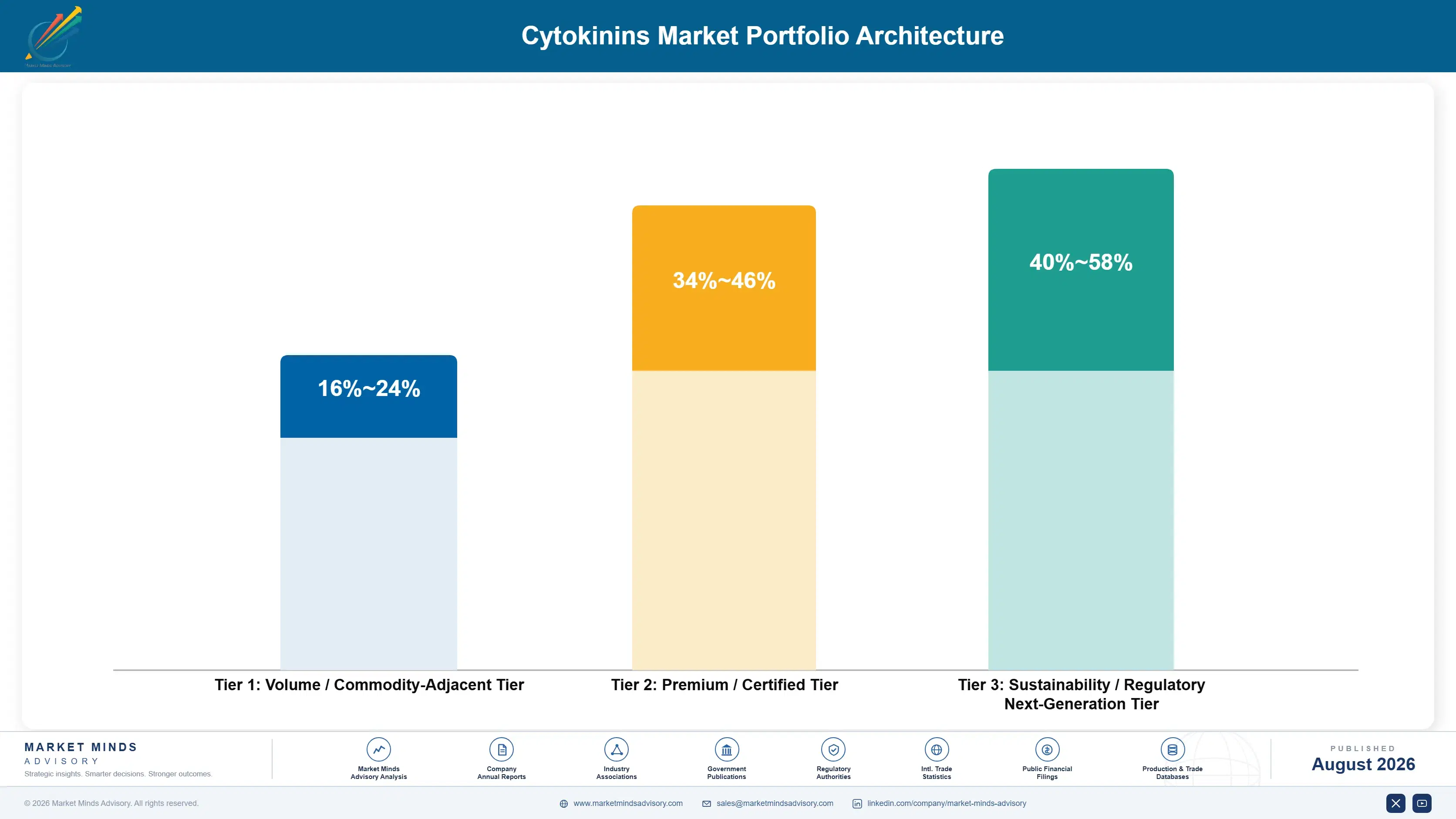
Volume / Commodity-Adjacent Tier

Field grade benzylaminopurine and kinetin formulations sold through distribution into commodity horticulture. Competes on price against Chinese and Indian formulators. The range reflects large differences in sourcing position and registration overhead carried.
Gross Margin: 16%-24%

Premium / Certified Tier

Registered fruit sizing programmes supported by field agronomists and residue management guidance in export horticulture. The grower purchases grade outcome and compliance rather than chemistry, and programmes renew annually when they work.
Gross Margin: 34%-46%

Sustainability / Regulatory / Next-Generation Tier

Tissue culture grade compounds, meta-topolin derivatives, and standardised natural cytokinins placed under biostimulant frameworks. Purity and registration route drive the premium. The range is wide because laboratory grade pricing varies enormously by compound.
Gross Margin: 40%-58%
cytokinins-market-trends-portfolio-architecture-1787549090154

High-value Sub-segments and Strategic Watch-out

Tissue Culture Grade Compounds

The most defensible pool in this market, taking 23% of volume at purity specifications field products never approach. Laboratories qualify on batch consistency and rarely requalify, so positions hold for years. Almost no price competition operates inside it. Purity documentation is the entry requirement here.
Gross Margin: 42%-58%

Supported Export Sizing Programmes

Where agronomic capability converts commodity chemistry into a defensible position, because timing rather than the molecule decides whether the application pays. Export growers under retail grade specifications pay for certainty. Residue management guidance is part of the offer. Local agronomic knowledge is the whole differentiator.
Gross Margin: 36%-48%

Standardised Natural Cytokinin Products

The biostimulant route avoids dossier costs above USD 2.4 million and reaches market in a fraction of the time. Standardisation to defined content is what makes performance predictable enough to build a programme on. Regulatory boundaries remain genuinely uncertain. Build efficacy evidence that would survive scrutiny.
Gross Margin: 38%-52%

Commodity Field Grade Formulations

The strategic watch-out. Off-patent chemistry sourced from the same Chinese producers competitors use, sold on price through distribution with no agronomic content attached. It builds grower presence and funds field coverage, and nothing beyond that. Price it for presence and field coverage only. Nothing more.
Gross Margin: 16%-23%

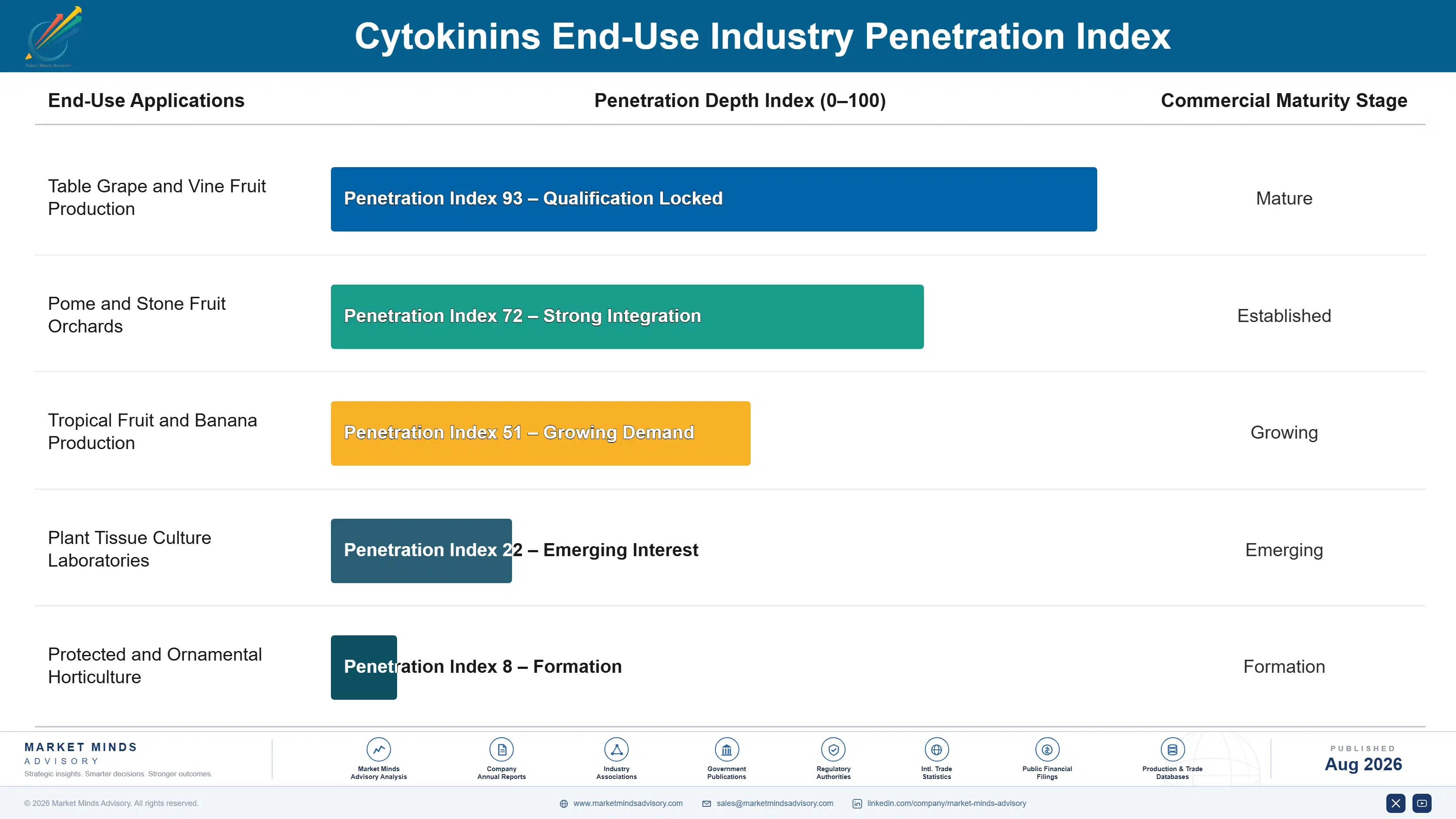
How Demand Actually Reaches Suppliers

Two demand types behave completely differently here. Field application is seasonal, weather-dependent, and concentrated into windows measured in days, which makes revenue lumpy and supply timing critical. Tissue culture demand repeats with every propagation cycle regardless of season, weather, or commodity prices, and it grows with laboratory capacity rather than with planted area. Suppliers weighted entirely toward field application carry volatility that laboratory demand would smooth considerably across the year.
Adoption depth varies sharply by grower type. Export horticulturalists under retail grade specifications run the deepest programmes because the grade premium is large and compliance is mandatory. Domestic fresh market growers apply selectively based on the season's price outlook. Tissue culture laboratories are the most technically demanding buyers in the market. Commodity growers rarely apply cytokinins at all, since the economics only work where grade premiums exist.

The buyer has shifted toward packhouse and export agronomists rather than individual growers. Those specialists set programmes across many farms and evaluate suppliers on residue outcomes as much as on results. A residue exceedance at the border costs a consignment and sometimes an entire retail listing, which makes compliance advice as commercially valuable to that buyer as the agronomic result itself.
cytokinins-market-trends-end-use-penetration-index-1787549090641

Where the Money Sits

These are among the four positions where our research anticipates prominent divergence between winners and laggards over the coming forecast period. Each is grounded in the demand model, the regulatory perimeter, and the announced capacity pipeline.
01 / AGRONOMIC FIELD CAPABILITY

Hire agronomists, because timing decides whether anything works

A cytokinin applied outside a window measured in days delivers nothing at all, and the grower blames the product rather than the application decision that ruined it. Suppliers fielding agronomists who understand local varieties and growth stages see success rates 20 to 35% above those selling through distribution alone, and they retain programmes through seasons that damage everyone's results. The chemistry has been off patent for decades, so agronomic advice is genuinely the only differentiated thing that any supplier has on offer.
02 / REGISTRATION ROUTE STRATEGY

Use the biostimulant framework while the boundary still holds

Plant protection registration costs above USD 2.4 million per major market and no cytokinin will recover that on the volumes this category moves in a decade. Naturally derived products placed under the European fertilising products framework reach the market for a small fraction of the cost and the time otherwise required. The sensible hedge is building efficacy evidence that would survive closer regulatory examination, because the boundary is being watched closely and relying on the framework alone is a fragile commercial position.
03 / TECHNICAL SUPPLY SECURITY

Hold stock, because a missed window costs a whole season

China manufactures 68% of global technical material and enforcement campaigns have interrupted supply twice in five years, each time during periods when growers needed product within days. Strategic inventory and qualified Indian second sources cost perhaps 8 to 14% on landed material, which looks wasteful in a normal year. Growers whose supplier could not deliver inside the application window do not come back the following season, and recovering those lost programme positions reliably takes several years of patient rebuilding work.
04 / LABORATORY GRADE POSITIONING

Serve tissue culture, because laboratories barely negotiate on price

Micropropagation laboratories consume 23% of volume at purity specifications field products never meet, and they pay several times field pricing because plantlet survival dwarfs the chemical cost entirely. Qualification turns entirely on batch consistency, and requalifying a supplier disrupts established protocols enough that laboratories almost never bother switching at all. Building the analytical and purification capability needed to hold that specification is a modest investment against a segment growing faster than the market with essentially no price competition operating inside it.

Engagement Snapshot From the Field

A live engagement with an industry participant carrying material or product regulatory and market exposure ahead of a defining policy shift, showing how our research translates into a defensible multi-year portfolio strategy.
MARKET MINDS ADVISORY · CLIENT ENGAGEMENT SUMMARY
Cytokinins Producer Strategic Portfolio Review and Transition Roadmap 2026·Investment Scenario on Cytokinins Exposure Evaluation 2025-26
CLIENT PROFILE
A regional supplier of plant growth regulators serving fruit and vegetable growers across southern Europe and North Africa, with revenue near EUR 42 million (client-reported, unverified by MMA). The business sold field grade cytokinin formulations through agricultural distributors, sourced all technical material from two Chinese producers, and employed no field agronomists of its own. Agronomic advice came from distributors.
STRATEGIC CHALLENGE
A Chinese supply interruption had caused the client to miss an application window across several export grape accounts, and those growers had moved to a competitor and not returned. Margins on distributed field product were also compressing. Management needed to decide between defending distribution volume and building a differentiated position it had never previously attempted.
MMA APPROACH
MMA analysed account retention against application success and supply reliability, sized the tissue culture and standardised natural cytokinin opportunities in the client's territory, and modelled the cost of field agronomic coverage against programme retention economics. Forty-seven expert interviews with growers, packhouse agronomists, and laboratory managers established what actually determines supplier choice.
KEY FINDINGS
  1. Every account lost in three years traced to either a missed application window or an application timed badly, and none was lost on price to a cheaper competitor.
  2. Export grape and stone fruit growers paid roughly 40% above distributed product pricing where a supplier agronomist set the programme and managed residue outcomes for them.
  3. Tissue culture laboratories within the client's territory bought entirely from Northern European suppliers, citing purity consistency the client had never attempted to demonstrate.
  4. Sourcing from two producers in the same Chinese province provided no diversification whatever, a concentration management had genuinely not recognised as single-point exposure.
CLIENT PROFILE
A regional supplier of plant growth regulators serving fruit and vegetable growers across southern Europe and North Africa, with revenue near EUR 42 million (client-reported, unverified by MMA). The business sold field grade cytokinin formulations through agricultural distributors, sourced all technical material from two Chinese producers, and employed no field agronomists of its own. Agronomic advice came from distributors.
STRATEGIC CHALLENGE
A Chinese supply interruption had caused the client to miss an application window across several export grape accounts, and those growers had moved to a competitor and not returned. Margins on distributed field product were also compressing. Management needed to decide between defending distribution volume and building a differentiated position it had never previously attempted.
MMA APPROACH
MMA analysed account retention against application success and supply reliability, sized the tissue culture and standardised natural cytokinin opportunities in the client's territory, and modelled the cost of field agronomic coverage against programme retention economics. Forty-seven expert interviews with growers, packhouse agronomists, and laboratory managers established what actually determines supplier choice.
KEY FINDINGS
  1. Every account lost in three years traced to either a missed application window or an application timed badly, and none was lost on price to a cheaper competitor.
  2. Export grape and stone fruit growers paid roughly 40% above distributed product pricing where a supplier agronomist set the programme and managed residue outcomes for them.
  3. Tissue culture laboratories within the client's territory bought entirely from Northern European suppliers, citing purity consistency the client had never attempted to demonstrate.
  4. Sourcing from two producers in the same Chinese province provided no diversification whatever, a concentration management had genuinely not recognised as single-point exposure.
RECOMMENDED STRATEGY
Phase 1: Phase one: recruit field agronomists for the two largest export horticulture districts and convert distributed accounts into supported programmes with residue management included. Phase 2: Phase two: qualify an Indian technical producer and hold six months of strategic inventory ahead of each season, accepting the working capital cost involved. Phase 3: Phase three: develop tissue culture grade supply with documented purity data, targeting the laboratories currently buying from Northern European competitors.
OUTCOME
The client recruited four agronomists and converted 61 accounts to supported programmes within two seasons. Programme revenue reached 38% of the total at pricing well above distributed product, the Indian second source covered a subsequent Chinese delay without any missed window, and blended gross margin improved 7.2 percentage points (client-reported, unverified by MMA).

Frequently Asked Questions

Foundational context covering the market sizes, CAGR, scope, country, region and competition that inform every finding below. This section is provided to cover basics and most often pre-purchase conversations, answered from the MMA Primary Research Dataset.

What is the current size of the Cytokinins Market?

The market was valued at USD 0.4 billion in 2025, rising to an estimated USD 0.43 billion in 2026. East Asia holds the largest regional share at 30% of global value.

How large will the Cytokinins Market be by 2036?

MMA forecasts USD 0.95 billion by 2036 under the base case, an expansion multiple of 2.20 times the 2026 value. That represents USD 0.52 billion of incremental value across the forecast period.

What is the CAGR for the Cytokinins Market 2026 to 2036?

The base case CAGR is 8.2%, with a bull case of 9.4% and a bear case of 7.0%. The spread reflects uncertainty over residue tolerances and biostimulant registration boundaries.

Which segment is growing fastest?

Meta-topolin and aromatic cytokinin derivatives grow fastest at 13.6%, roughly 1.66 times the market rate. Zeatin and natural cytokinins follow at 11.8% on biostimulant registration positioning.

Who are the major companies in the Cytokinins Market?

Valent BioSciences, Nufarm, Sumitomo Chemical, Nippon Soda, and Fine Americas lead on cytokinin product revenue. The top five hold roughly 36% of global value between them.

Which country is growing fastest?

India grows fastest at 11.6%, driven by tissue culture capacity for banana and sugarcane planting material under government funding. Export grape production around Nashik adds intensive field demand.

Report Segmentation Architecture

The full report scope spans multiple orthogonal segmentation dimensions, with cross-tabulated demand data provided for each dimension pair. Coverage extends further to regional breakdowns, trend trajectories, and the competitive detail needed to support segment-level decision-making.

By Compound Chemistry

  • 6-Benzylaminopurine
  • Kinetin
  • Forchlorfenuron
  • Thidiazuron
  • Zeatin and Natural Cytokinins
  • Meta-Topolin and Aromatic Derivatives

By End-Use Industry

  • Table Grape and Vine Fruit Production
  • Pome and Stone Fruit Orchards
  • Tropical Fruit and Banana Production
  • Plant Tissue Culture Laboratories
  • Protected and Ornamental Horticulture

By Sales Model

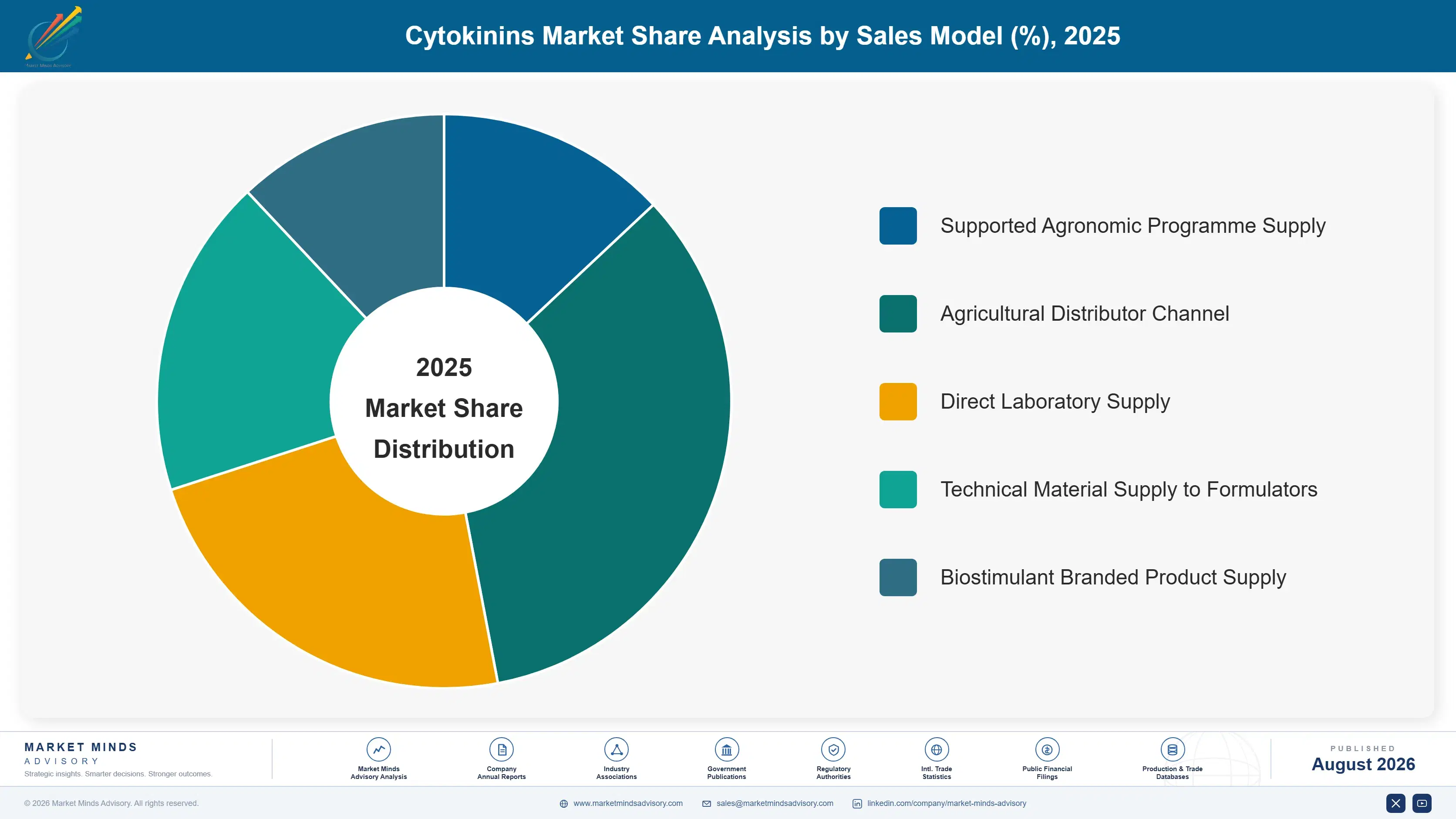
  • Supported Agronomic Programme Supply
  • Agricultural Distributor Channel
  • Direct Laboratory Supply
  • Technical Material Supply to Formulators
  • Biostimulant Branded Product Supply

By Region

  • North America
  • Western Europe
  • East Asia
  • South Asia and Pacific
  • Latin America
  • Middle East and Africa
  • Eastern Europe

Scope, Methodology, and Coverage

Every figure in this report is reproducible from documented input assumptions. The scope below maps the historical period, the forecast horizon, the segmentation dimensions, and the countries covered, alongside the underlying primary and qualitative methodology.
Historical Period
2020 to 2025
Forecast Period
2026 to 2036
Base Year
2025 (USD billions; MMA Primary Research Dataset, August 2026)
Market Definition
The market comprises cytokinin plant growth regulators supplied as technical material and formulated products, covering 6-benzylaminopurine, kinetin, forchlorfenuron, thidiazuron, zeatin and natural cytokinins, and meta-topolin and aromatic derivatives. Value is measured at supplier level across agricultural, horticultural, and plant tissue culture applications including products placed under biostimulant frameworks. Auxins, gibberellins, abscisic acid, ethylene regulators, undefined biostimulant blends without declared cytokinin content, and cosmetic formulations containing kinetin fall outside scope.
Quantitative Units
USD billions (current prices); metric tonnes of cytokinin active supplied annually; USD per kilogram by compound and purity grade
Segmentation Dimensions
By Compound Chemistry; By End-Use Industry; By Sales Model; By Region
Regions Covered
North America, Western Europe, East Asia, South Asia and Pacific, Latin America, Middle East and Africa, Eastern Europe
Countries Covered
United States, Canada, Mexico, Italy, Spain, France, Netherlands, Belgium, Greece, Poland, Romania, Serbia, China, Japan, South Korea, India, Australia, New Zealand, Thailand, Philippines, Chile, Peru, Brazil, Argentina, South Africa, Egypt, Morocco, Israel, Kenya
Key Companies Profiled
Valent BioSciences, Nufarm, Sumitomo Chemical, Nippon Soda, Fine Americas, Syngenta, BASF, Corteva Agriscience, UPL, Sichuan Guoguang Agrochemical, Jiangsu Fengyuan Bioengineering, Hebei Zhongbao Green Agriculture, Alzchem Group, SePRO Corporation, Redox, Rallis India, Coromandel International, Xinyi Industrial, Bayer, Andermatt Group
Quantitative Methodology
Primary survey, n=3,800 respondents, Q4 2025, six countries; demand-side model with trade association cross-validation
Qualitative Methodology
47 expert interviews, Q4 2025; applied to validate demand model assumptions, identify emerging dynamics, and assess competitive positioning
Report Format
PDF and XLSX data workbook (Word format preview document)
Publisher
Market Minds Advisory
Report Code
MMA-2026-AGR-127
Published
August 2026
Contact
sales@marketmindsadvisory.com | www.marketmindsadvisory.com

Purchase the full Cytokinins Market Report (2026 to 2036).

The full report sizes cytokinin demand across six compound families, five end-use categories, and seven regions with 2026 to 2036 forecasts under base, bull, and bear cases. It separates field application from tissue culture laboratory demand, which behave as different businesses with different volatility and buying criteria. Competitive profiles cover twenty suppliers assessed consistently on cytokinin product revenue, registration breadth, and agronomic support capability. Cost analysis traces Chinese technical material dependence alongside regulatory maintenance obligations. Commercial guidance addresses agronomic field capability, biostimulant registration routing, supply security, and tissue culture grade positioning.
Six compound families sized separately by region
Field application separated from tissue culture demand
Biostimulant registration routes mapped against plant protection approval
Chinese manufacturing concentration modelled as supply risk
Residue limit changes tracked across major importing markets
Agronomic support economics quantified against distribution selling

Built For The People Who Decide

From boardroom strategy to bench-side execution, this report is read cover-to-cover by leaders shaping the next decade of their industry, turning demand scenarios, market dynamics and valuation benchmarks into decisions.
CXOs/ Presidents/ VPs/ Managers
M&A and Corporate Development
Strategy Teams and R&D Heads
Procurement and Product Directors
Regulatory and Compliance Leaders
Investor Relations and Equity Analysts