Market Minds Advisory
Cytokine Release Syndrome (CRS) Management Market

Cytokine Release Syndrome (CRS) Management Market: A Market We Created On Purpose

This condition did not exist until we built therapies that cause it. Managing it well is now the thing that decides how many patients a cell therapy centre can physically treat each year.

Lead Analyst

Alice Ballenger

Published

September 2026

Make Smarter Decisions with Customized Research Insights

Request a free sample report and evaluate market opportunities, growth trends, and competitive dynamics relevant to your business needs.

2025 MARKET VALUE$1.1BMarket Size 2025
2036 FORECAST VALUE$4.7BBase Case , 2026 to 2036
CAGR 2026 TO 203613.6 %Bull 14.9% / Bear 12.3%
INCREMENTAL OPPORTUNITY$3.4BNet 10- year value creation
EXPANSION MULTIPLE3.58x2036 value over 2026 base
Strategic Levers
M&A Pipeline
Regional Outlook
Country Rankings
Competitive Intelligence
Segmental Deep-dive
Call-Us : 91 93563 13602

Executive Snapshot and Market Trajectory

Cytokine release syndrome is entirely iatrogenic. It exists because the industry built chimeric antigen receptor cell therapies and T-cell engaging antibodies that work by provoking exactly the immune response that then has to be controlled, which makes this market a direct derivative of theirs in every meaningful sense.
The market reaches USD 1.15 billion in 2025 and compounds at 13.6% to USD 4.68 billion by 2036, an expansion multiple of 3.58 times. Interleukin-1 pathway inhibitors grow fastest at 20.4%, exactly 1.50 times the market rate, entirely on off-label use in steroid-refractory cases. North America holds 30% of value on qualified treatment centre density and on commercial cell therapy volume that no other region currently matches.
Concentration is high at 58% across the top five, and one single approved agent standing against an otherwise entirely off-label field explains all of it. The commercial direction of travel in this market is genuinely counterintuitive. Prophylaxis is now cutting severe events by roughly 60%, which reduces rescue drug consumption per patient while pushing administration outpatient and multiplying how many patients each treatment centre can physically get through in a single year.
Market Definition
The cytokine release syndrome management market covers pharmacological prophylaxis and treatment of cytokine release syndrome and associated immune effector cell-associated neurotoxicity arising from chimeric antigen receptor cell therapies, T-cell engaging bispecific antibodies, and related immunotherapies. Scope spans interleukin-6 and interleukin-1 pathway inhibitors, interferon gamma and other cytokine-directed agents, prophylactic and rescue corticosteroid regimens, and vasopressor and organ support pharmacotherapy. The cell and bispecific therapies themselves, intensive care equipment, apheresis, diagnostic cytokine assays, and graft versus host disease treatment are excluded.
Base Year Value
$1.1B in 2025 (MMA Primary Research Dataset, August 2026)
Forecast Period
2026 to 2036, eleven discrete annual values
CAGR
13.6% base case. Bull 14.9%. Bear 12.3%.
Fastest Growth Segment
Interleukin-1 Pathway Inhibitors: 20.4% CAGR
Fastest Growth Country
China: 17.4% CAGR
Fastest Growth Region
South Asia and Pacific: 15.8% CAGR
Largest Region
North America: 30% of 2025 global value
Market Leaders
Roche, Sobi, Recordati, Fresenius Kabi, Biogen. Source: MMA Primary Research Dataset, July 2026.
Primary Survey
n=3,800 procurement and R&D decision-makers, Q4 2025, six countries
Methodology
Demand-side build-up, cross-validated against public data, 47 expert interviews

Cytokine Release Syndrome (CRS) Management Market Forecast Scenarios

cytokine-release-syndrome-crs-management-market-size-forecast-scenario-1787298443042
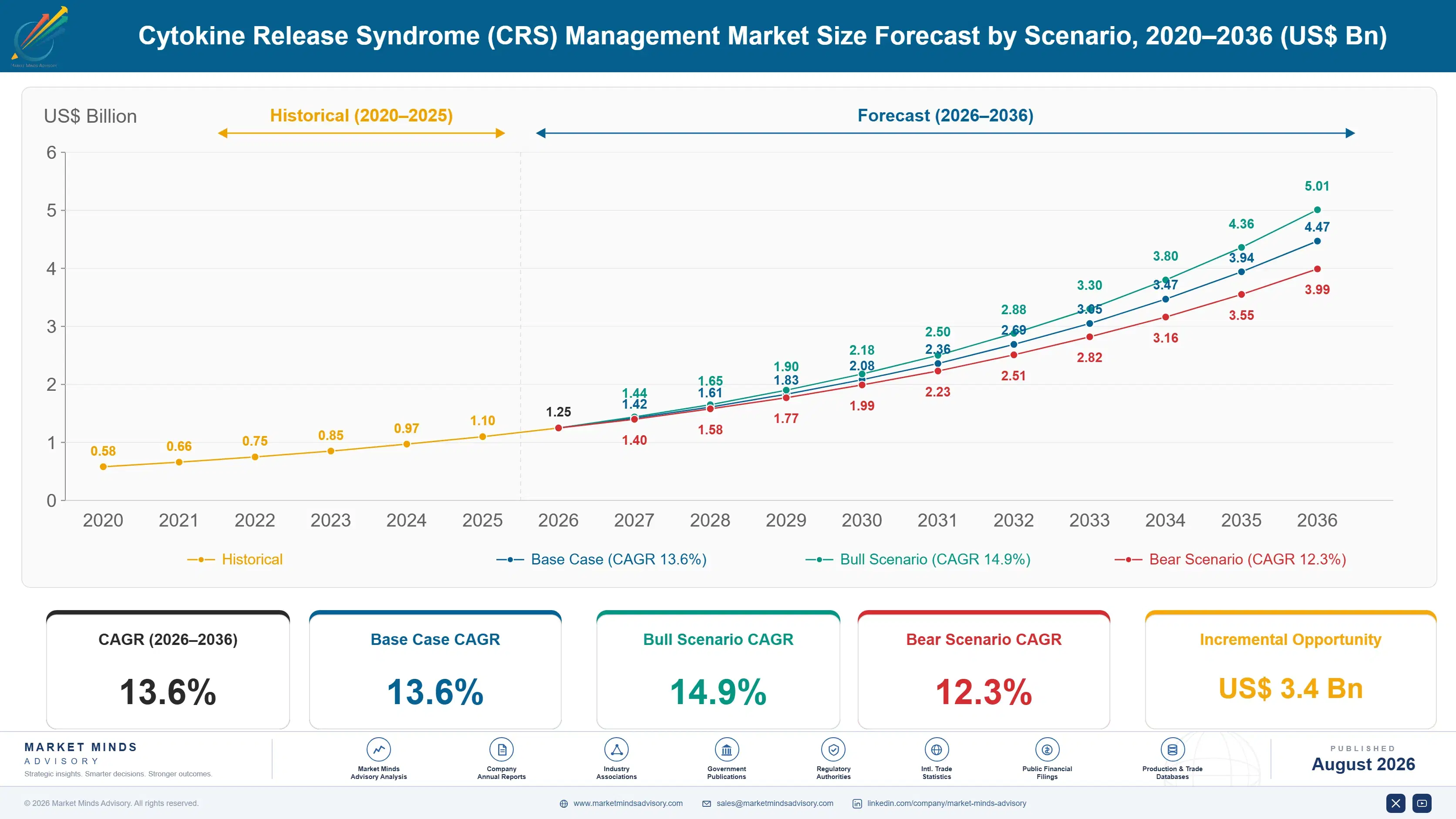
Between 2020 and 2025 this market simply followed the therapies that create the condition. Commercial cell therapy volumes grew steadily, bispecific antibody approvals arrived from 2022 onward and brought a far larger treated population with them, and prophylaxis protocols matured across the same period. A 12.4% historical CAGR tracks cell therapy and bispecific uptake almost exactly, because nothing here moves independently.
Three mechanisms carry the 13.6% base case. Bispecific antibody expansion is the largest, since these are given repeatedly in community and academic settings rather than once at a specialist centre, and they reach a far larger population. Outpatient administration is the second, removing the bed-day constraint that limits centre throughput. And earlier line approvals are the third, moving these therapies into populations several times larger than the relapsed settings they began in.
The 14.9% bull case rests on bispecific antibodies reaching community oncology at scale, which would multiply the treated population well beyond what qualified centres can handle and put prophylaxis into settings without intensive care backup. The 12.3% bear case is next-generation constructs engineered for lower cytokine release succeeding, since a therapy that does not provoke severe syndrome removes the need for most of this market.

The Side Effect That Gates Throughput

What limits cell therapy is not manufacturing and it is not demand. It is beds. Patients require around nine days of inpatient monitoring after infusion because severe cytokine release syndrome can develop rapidly and needs intensive care available within minutes. A centre with a fixed number of monitored beds can treat a fixed number of patients, and that arithmetic has capped the field since the first approvals.
TOP FIVE CONCENTRATION58%One approved agent against an entirely off-label competitive field
SEVERE CRS INCIDENCE14%Share of treated patients reaching grade three or higher
PROPHYLAXIS REDUCTION EFFECT60%Fall in severe events where step-up dosing and premedication apply
INPATIENT MONITORING DAYS9 daysObservation period typically required after cell therapy infusion
OFF-LABEL USE SHARE71%Portion of agents given outside any approved indication whatsoever
QUALIFIED TREATMENT CENTRES1,400Sites worldwide authorised to administer cell therapy products
Prophylaxis breaks that constraint, which is why the commercial logic here runs backwards from most therapeutic markets. Step-up dosing and premedication cut severe events by roughly 60%, and severe events are where rescue drugs get used. Less rescue drug per patient, but far more patients treated as administration moves outpatient. Suppliers who model volume from severity rates alone reach exactly the wrong conclusion.
Only one agent is actually approved for this indication. Tocilizumab carries the label; anakinra, siltuximab, emapalumab, and the corticosteroid regimens that do most of the work are all used off-label under consensus grading guidelines rather than under any regulatory authorisation. Roughly 71% of what gets given sits outside an approved indication, which means guidelines and treatment centre protocols govern this market rather than promotion.
"Everybody sizes this off severity rates, which is why everybody gets it wrong. Better prophylaxis means fewer grade three events and far more infusions, and the second number is much larger than the first."
Director, Cell And Immune Therapy Practice · MMA Healthcare Practice &midd

Market Trends

Prophylaxis Displaces Rescue As The Standard Approach

Step-up dosing schedules for bispecific antibodies and premedication with corticosteroids and interleukin-6 blockade have cut severe cytokine release events by roughly 60% where they are used consistently. That reduces rescue drug consumption per patient, which looks like a shrinking market until you account for what it enables. Fewer severe events means shorter monitoring, outpatient administration, and far more patients treated per centre. The volume gained through throughput comfortably exceeds the rescue volume lost, though the revenue shifts between entirely different products in the process. Suppliers positioned only in rescue will feel the change as a decline.
Market Impact: Removes 9 inpatient monitoring days
Bispecific Antibodies Overtake Cell Therapy As The Driver

Chimeric antigen receptor products are given just once at roughly 1,400 qualified centres worldwide, which is a genuinely hard ceiling on treated patient numbers. Bispecific antibodies are given repeatedly, require no manufacturing slot, and are reaching academic and community oncology settings that could never deliver cell therapy. Each treated patient generates prophylaxis demand at every step-up dose rather than a single management episode at infusion. The bispecific treated population will exceed the cell therapy population by roughly five times within this forecast period, and it needs no authorised centre at all.
Market Impact: Eligible population expands 4 times

Market Opportunities and Growth Drivers

Outpatient Administration Removes The Bed-Day Constraint

Around nine days of inpatient monitoring after cell therapy infusion is what caps centre throughput, not manufacturing capacity or patient demand. Reliable prophylaxis and structured outpatient monitoring protocols let centres infuse and observe without occupying a monitored bed for over a week. That multiplies annual treated patients at a given site without any capital investment in beds whatsoever, which is why centres pursue it so hard. Every additional patient treated generates prophylaxis and monitoring drug demand, which is exactly why throughput matters far more in this market than severity rates ever will.
Market Impact: 71% of use is off-label

Earlier Line Approvals Multiply The Treated Population

Cell therapies and bispecific antibodies that were first approved for heavily pretreated relapsed disease are now moving steadily into second line and earlier settings, where the eligible patient population is several times larger than before. Each successive approval decision expands the number of patients exposed to cytokine release syndrome proportionally, since the underlying mechanism causing the syndrome does not change at all with line of therapy. Earlier line patients also tolerate the syndrome considerably better, which supports outpatient administration and further increases how many a given centre can treat each year.
Market Impact: Severe rates fall below 5%

Market Restraints and Challenges

Nearly Everything Used Here Is Off-Label

Tocilizumab holds the only approved indication, while anakinra, siltuximab, emapalumab, and most corticosteroid regimens are given entirely off-label under consensus grading guidelines. The root cause is that trials in a syndrome arising unpredictably in small treated populations are extremely difficult to run conventionally. Commercially this prevents promotion entirely, complicates reimbursement in several markets, and leaves usage governed by treatment centre protocols rather than by anything a company does. Participants are mitigating through investigator-led studies, through registry evidence built with transplant and cell therapy societies, and through label expansion filings wherever the accumulated data supports one.
Market Impact: Severe events fall 60 percent

Lower-Cytokine Constructs Could Remove The Need Entirely

Next-generation cell therapy designs and bispecific formats engineered to reduce cytokine release are in development specifically because the syndrome limits where these therapies can be given. The root cause is that severe cytokine release is a design consequence rather than an inherent requirement of T-cell engagement. Commercially, a construct causing minimal syndrome removes most of this market's reason to exist. Mitigation runs toward prophylaxis products that remain useful at lower severity, toward neurotoxicity management which is proving harder to engineer away, and toward monitoring and outpatient support services that remain necessary regardless.
Market Impact: Only 1,400 centres worldwide exist
3 additional market trends, 4 additional growth drivers, and 2 additional restraints and challenges are covered in the full report. Contact sales@marketmindsadvisory.com to access the complete intelligence.

Segment CAGR and Growth Architecture

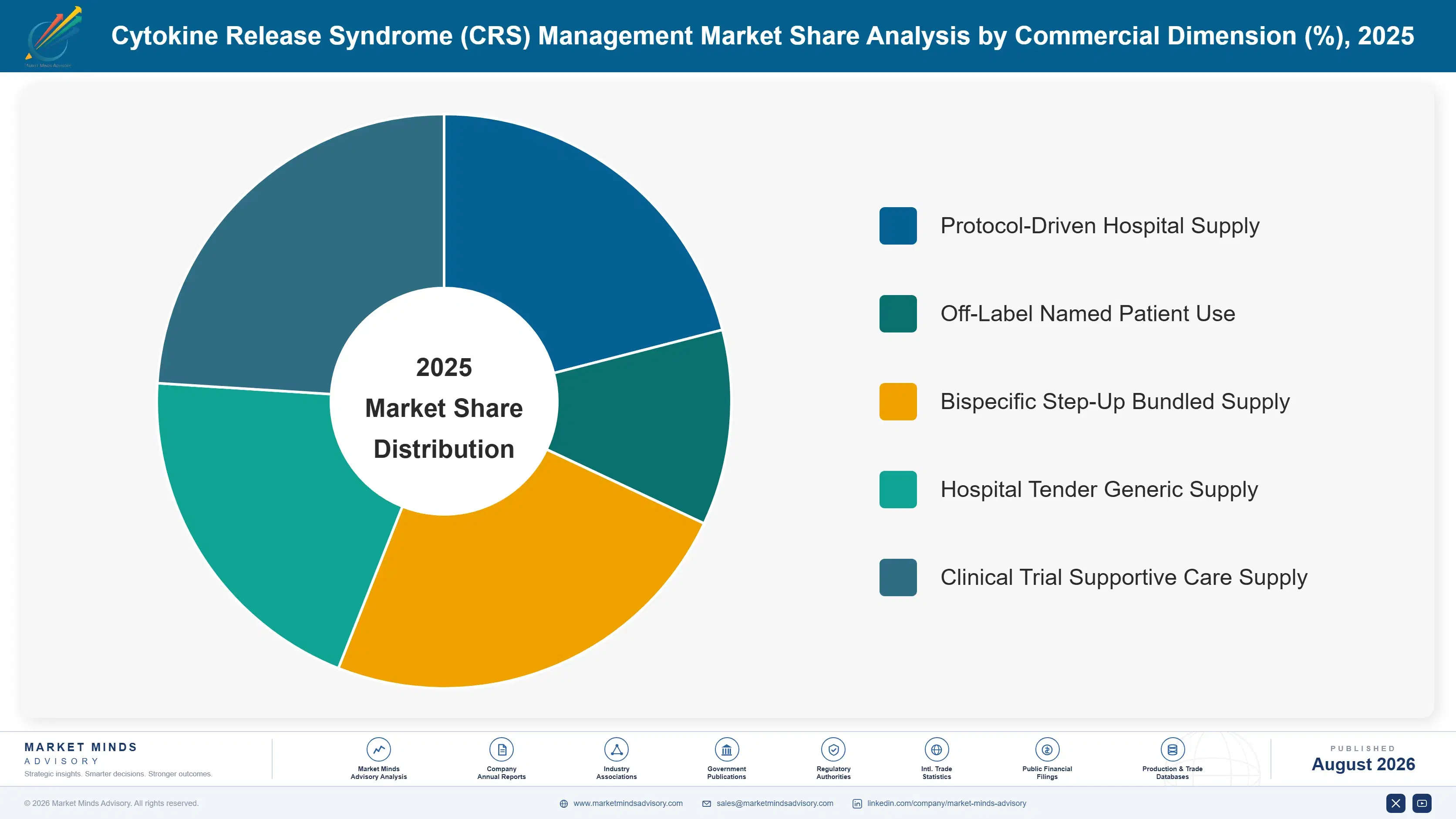
Segmentation follows the pharmacological class of the intervention, because the pathway an agent blocks determines when in the syndrome it is given, whether it holds any approved indication, what a treatment centre protocol says about it, and which company can sell it at all. Therapy type, severity grade, and care setting sit in the framework instead.
cytokine-release-syndrome-crs-management-market-market-share-analysis-1787298443572

Interleukin-1 Pathway Inhibitors

Interleukin-1 blockade grows fastest at 20.4%, exactly 1.50 times the market rate, used almost entirely off-label in cases proving refractory to interleukin-6 blockade and corticosteroid therapy. Anakinra dominates this segment and has become the default third-line option written into treatment centre protocols despite holding no approved indication whatsoever anywhere for this particular use. Its role in immune effector cell-associated neurotoxicity, where interleukin-6 blockade performs poorly because tocilizumab crosses the blood-brain barrier badly, is what has really driven the adoption. Growth comes from protocol inclusion at more centres rather than from any regulatory approval or promotional activity, neither of which is available here. Emapalumab occupies an adjacent refractory position on similar terms.
CAGR 20.4%

Prophylactic Corticosteroid Regimens

Prophylactic corticosteroids grow at 17.2%, given ahead of and alongside step-up dosing schedules in order to blunt the cytokine response before it develops rather than treating it afterwards. Dexamethasone and methylprednisolone dominate, both inexpensive and thoroughly generic, so segment value grows through sheer volume alone rather than through any pricing power. What makes this segment commercially significant is not the drug revenue at all but what it enables: prophylaxis cuts severe events by roughly 60% and is the single largest contributor to outpatient administration becoming feasible at all. Bispecific step-up schedules consume it at every single escalation dose, which makes volume grow with somebody else's launch curve rather than with severity.
CAGR 17.2%
Full segment breakdown across 6 segments available in the complete report.

Regional Architecture and Country Demand Map

This market exists only in the places where the therapies causing the syndrome are actually administered, so regional shares track qualified treatment centre density and commercial cell therapy and bispecific volume rather than tracking any measure of underlying disease burden, prevalence, or population size at all.

North America

North America holds 30% of value, the largest share of any region, on qualified treatment centre density and commercial cell therapy volume that nothing elsewhere currently matches. Around a quarter of all authorised cell therapy sites worldwide operate here, and bispecific antibody uptake has moved faster into academic and community oncology than in any other market. Outpatient administration protocols are furthest developed here, which raises throughput per centre quite considerably. Off-label use of anakinra and siltuximab is routine here and unusually well documented. Biosimilar tocilizumab entry is now compressing value per treated patient here as well. Growth at 12.9% trails the global rate on an already substantial installed treatment base.
Share: 30% | CAGR: 12.9% (2026 to 2036)

East Asia

Twenty-six percent of total value sits in East Asia, and China accounts for most of that through both domestically approved cell therapy products and an enormous volume of clinical trial activity that still requires full cytokine release management throughout. Chinese biosimilar tocilizumab is widely available at prices far below originator levels, which caps realised value per treated patient quite considerably. Japanese and Korean centres follow Western protocols closely, though with tighter monitoring conventions and longer inpatient observation periods. Off-label anakinra use is considerably less established here than in Western treatment protocols. Growth at 14.6% exceeds the global rate on treated patient expansion rather than on any pricing improvement across the region.
Share: 26% | CAGR: 14.6% (2026 to 2036)
Regional intelligence for 5 additional markets available in the complete report: Western Europe, South Asia and Pacific, Latin America, Middle East and Africa, Eastern Europe. Contact sales@marketmindsadvisory.com.
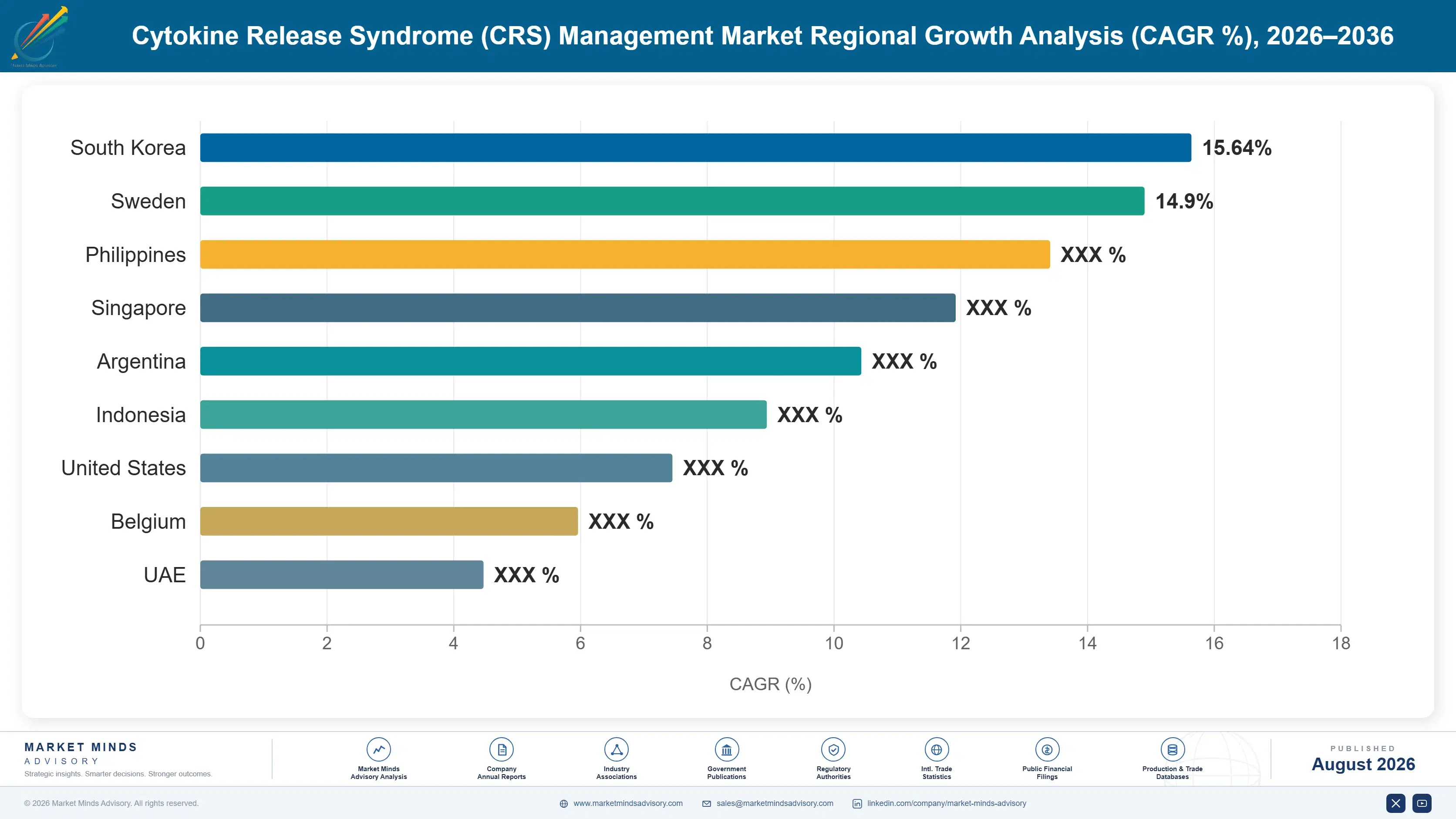
cytokine-release-syndrome-crs-management-market-country-cagr-analysis-1787298444092

Selling Into Protocols, Not Prescriptions

Almost nothing here carries an approved indication, so nobody can promote and prescriptions follow treatment centre protocols instead. Protocol inclusion, throughput enablement, neurotoxicity positioning, and bispecific step-up supply each work inside that constraint. Four follow from that, and every one of them routes through a hospital protocol committee rather than through any individual prescriber.

Get Written Into Treatment Centre Management Protocols

Cell therapy centres run written cytokine release management algorithms specifying which agent is given at which grade, and every prescription follows that document rather than any individual clinical judgement. Inclusion is decided by a protocol committee reviewing consensus guidance and published experience, not by promotion, which is illegal for off-label agents anyway. Funding investigator-led studies and registry contributions at roughly USD 400,000 per programme is the only route in, and protocols typically revise only once every two years or so. Missing a revision cycle costs two years of prescribing at every centre in the network.
Market Impact: Programmes cost around USD 400,000 each to run

Fund Outpatient Monitoring Protocol Development Programmes

Around nine inpatient days per cell therapy patient is what caps centre throughput, and every patient a centre cannot fit in is prophylaxis and monitoring revenue that never happens at all. Supporting outpatient monitoring protocol development, caregiver training, and remote observation infrastructure costs roughly USD 250,000 per centre, and it can raise annual treated patients by around half. That is a far larger revenue effect than anything achievable through better severity management alone, and it positions the supplier as a partner in centre capacity rather than as a vendor of ampoules.
Market Impact: Costs roughly USD 250,000 for each treatment centre

Position Specifically For Neurotoxicity Rather Than Cytokine Release

Interleukin-6 blockade works well on cytokine release syndrome and poorly on the associated neurotoxicity, because tocilizumab crosses the blood-brain barrier badly and can worsen central nervous system exposure. That gap is real, clinically frustrating for treating teams, and considerably harder to engineer away than cytokine release itself has proved. Agents with credible neurotoxicity evidence reach protocol positions worth 2 to 3 times equivalent cytokine release positioning, and next-generation constructs engineered for lower cytokine release are unlikely to close it. That makes neurotoxicity positioning the most durable asset available anywhere in this market.
Market Impact: Worth 2 to 3 times the equivalent positioning

Supply Prophylaxis Bundled Into Bispecific Step-Up Schedules

Every bispecific step-up dose carries its own prophylaxis requirement, and unlike cell therapy this repeats at every escalation and frequently at each cycle afterwards. Working with bispecific developers so that prophylaxis products get named directly in the dosing schedule and supplied alongside it converts an episodic rescue purchase into recurring volume tied directly to the therapy itself. On current trajectories, bispecific treated populations will exceed cell therapy populations by roughly 5 times within this forecast period, and none of that additional volume requires an authorised cell therapy centre at all.
Market Impact: Bispecific population exceeds cell therapy by 5 times

Who Controls the Margin Pool

Concentration at 58% across the top five reflects one company holding the only approved agent while everything else competes off-label. All participants here are compared on measured global revenue attributable to cytokine release syndrome prophylaxis and management, which requires apportioning multi-indication products including tocilizumab, anakinra, and corticosteroids across their uses and is the only basis putting an originator and a generic supplier on comparable terms.
Competition runs through protocol committees rather than through prescribers, since promotion of off-label use is not available to anybody. Roche holds the approved tocilizumab indication and the guideline position that follows from it, now under biosimilar pressure from Fresenius Kabi, Biogen, and Celltrion. Sobi supplies anakinra and emapalumab into refractory and neurotoxicity settings entirely off-label. Recordati holds siltuximab in a narrow but established position.

Pressure is arriving from two directions that pull differently. Biosimilar tocilizumab is compressing value per treated patient across every developed market while treated patient numbers climb. Meanwhile next-generation constructs engineered for lower cytokine release threaten the severity-driven part of the market entirely. Rankings shift on protocol inclusion at major centre networks, since one algorithm revision moves prescribing across every site that follows it.
cytokine-release-syndrome-crs-management-market-company-positioning-matrix-1787298444616

Competitive Moat and Risk Dimensions

ROCHE

Moat: Only Approved Indication Anywhere

Tocilizumab holds the sole regulatory approval for cytokine release syndrome, which places it first in essentially every treatment centre algorithm and consensus guideline published. In a field where nothing else can be promoted at all, being the labelled option carries weight that no amount of off-label evidence replicates.
ROCHE

Risk: Biosimilar Erosion Across Every Market

Multiple tocilizumab biosimilars are now approved and taking share rapidly across developed and Asian markets, which removes the revenue while leaving the guideline position behind. The company has no comparable second agent in this indication. Treated patient numbers keep climbing while realised value per patient falls, and nothing in the current portfolio offsets that trajectory.
SOBI

Moat: Refractory And Neurotoxicity Protocol Position

Anakinra has become the default option in treatment centre protocols for cases refractory to interleukin-6 blockade and, importantly, for neurotoxicity where tocilizumab performs poorly. That position was built through published centre experience rather than promotion, which makes it unusually durable. Emapalumab adds a second refractory option in the same portfolio.
SOBI

Risk: Entirely Off-Label Commercial Exposure

Neither agent holds an approved indication in this setting, which prevents promotion, complicates reimbursement in several markets, and leaves the position dependent on guidelines that could revise without warning. Anakinra also faces its own biosimilar horizon. Building label evidence in a syndrome that arises unpredictably in small populations is genuinely difficult and expensive.

Players Tracked

Prominent Players

Roche
Sobi
Recordati
Fresenius Kabi
Biogen

Other Key Players

Celltrion
Pfizer
Hikma Pharmaceuticals
Teva Pharmaceutical Industries
Sandoz
Dr Reddys Laboratories
Zydus Lifesciences
Baxter International
Amneal Pharmaceuticals
Accord Healthcare
Aurobindo Pharma
Sun Pharmaceutical Industries
Qilu Pharmaceutical
Hetero Labs
Bio-Thera Solutions

Recent Developments

FEBRUARY 2025

Consensus Guidelines Revise Neurotoxicity Management Recommendations

An international cell therapy society revised its consensus guidance on immune effector cell-associated neurotoxicity, adjusting the recommended sequence of corticosteroid and interleukin-1 blockade in refractory cases. The revision is a professional society guideline rather than any regulatory action, and treatment centres update local protocols against it.
Signal: Guideline revisions move prescribing in this market in ways that no promotional activity is permitted to
MAY 2025

Tocilizumab Biosimilars Take Substantial Share Across European Markets

Tocilizumab biosimilars continued taking substantial share across European hospital tenders, with several national procurement bodies switching their supportive care supply purely on price. Clinical protocols were entirely unaffected by the change, because the guideline position attaches to the molecule rather than to any particular brand of it.
Signal: Guideline position protects the molecule itself and does nothing whatsoever for the originator company behind it
SEPTEMBER 2025

Major Centre Network Adopts Outpatient Bispecific Administration Protocol

A large academic cell therapy network adopted outpatient administration for bispecific antibody step-up dosing, supported by structured monitoring, caregiver training, and clearly defined escalation pathways. The change was an internal protocol decision, and it substantially raised the number of patients each site could treat annually.
Signal: Throughput gains from outpatient administration comfortably dwarf any revenue lost to fewer severe events actually occurring

Biologics Manufacture And Cheap Steroids

Monoclonal antibody and recombinant protein manufacture accounts for roughly 14% to 22% of originator biologic revenue and considerably more of biosimilar price, running through mammalian cell culture at a limited number of qualified facilities. Corticosteroid active ingredient runs 30% to 45% of generic injectable price, synthesised largely in India and China. Sterile fill, cold chain distribution, and release testing account for most of the remainder across both.
Biologics manufacturing capacity tightened severely through 2021 and 2022 as pandemic-related products absorbed mammalian cell culture slots across the industry, and several supportive care biologics faced allocation rather than shortage. Lonza described sustained capacity constraint across its biologics network in its 2022 annual report. Corticosteroid injectable supply was separately disrupted by sterile manufacturing quality failures rather than by anything at all to do with ingredient cost.

Exposure separates by product type more than by company size. An originator biologic priced well above manufacturing cost is essentially indifferent to input economics and faces biosimilar competition instead. A biosimilar producer competes directly on cost of goods, where cell culture titre and facility utilisation decide everything. Generic corticosteroid suppliers operate on margins where a single sterile line remediation removes a year of product profit entirely.
cytokine-release-syndrome-crs-management-market-cost-volatility-analysis-1787298444812

Contract Mammalian Cell Culture Capacity On Multi-Year Terms

Biologics manufacturing slots are contested across every therapeutic category, and supportive care products routinely lose allocation to oncology and immunology products with better revenue per litre. Multi-year committed capacity agreements secure availability and pricing that spot arrangements never match, and demand for these products is predictable enough that the volume commitment risk stays modest.

Maintain Segregated Sterile Capacity For Corticosteroid Injectables

Corticosteroid injectables sit at the centre of every prophylaxis protocol and cost almost nothing, which means nobody plans for their absence until a sterile line goes down for remediation. Holding qualified capacity at a second facility carries genuine fixed cost, and it protects a product line whose clinical importance vastly exceeds the revenue it generates.

Improve Cell Culture Titre Ahead Of Biosimilar Entry

Once biosimilars arrive, competition moves entirely to cost of goods and the producer with better titre and facility utilisation wins on price without losing margin. Process improvement work funded before entry rather than in reaction to it typically lifts titre by a third, and that advantage compounds across every subsequent tender the product faces.

Portfolio Architecture for Margin Defence

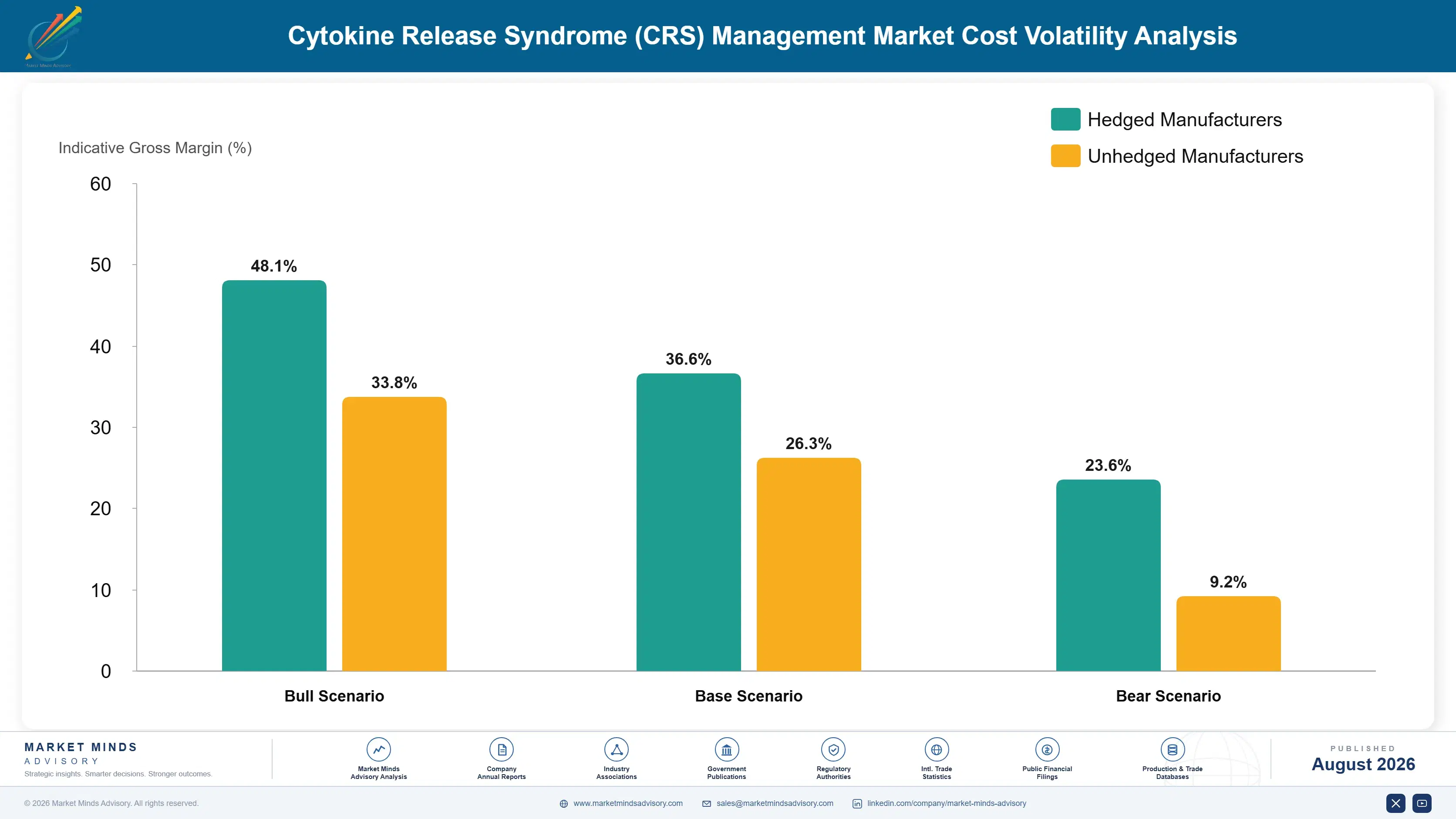
Margin architecture separates by whether an agent holds a label and whether a biosimilar has arrived. Generic corticosteroids and off-patent supportive agents earn 8% to 20% and periodically go negative when a sterile line requires remediation. Originator biologics holding protocol positions earn 66% to 82%, though biosimilar entry has already begun compressing the upper end across developed and Asian markets alike.
The tension is that the cheap tier does most of the clinical work and enables everything else. Prophylactic corticosteroids cut severe events by roughly 60% and make outpatient administration feasible, which is what raises centre throughput and expands the treated population that every other product depends on. The product creating most of the commercial opportunity captures almost none of the value it generates.

High-value pools concentrate in neurotoxicity-positioned agents, refractory-line biologics, and prophylaxis bundled into bispecific step-up schedules. The first two sit where engineering improvements are least likely to help and the third grows with a treated population expanding fast. Neurotoxicity agents carry the widest margin range of anything here, because the evidence base remains thin and protocol positions vary enormously between one centre network and the next.

Volume / Commodity-Adjacent

Generic corticosteroids, vasopressors, and supportive injectables used across prophylaxis and organ support at minimal cost per dose. The twelve-point range separates suppliers holding reliable segregated sterile capacity from those carrying remediation costs across their injectable networks.
Gross Margin: 8% to 20%

Premium / Certified

Originator interleukin-6 and interleukin-1 pathway biologics and interferon gamma directed agents holding established treatment centre protocol positions. The sixteen-point range separates markets where biosimilars have entered from those where originator pricing still holds firm.
Gross Margin: 66% to 82%

Sustainability / Regulatory / Next-Generation

Neurotoxicity-positioned agents, bispecific step-up prophylaxis bundles, outpatient monitoring programme support, and biosimilar supportive biologics. The forty-two point range reflects real divergence between biosimilar price competition and novel neurotoxicity positioning built on thin evidence.
Gross Margin: 44% to 86%
cytokine-release-syndrome-crs-management-market-portfolio-architecture-1787298445305

High-value Sub-segments and Strategic Watch-out

Neurotoxicity-Positioned Agents

Highest value and the most durable position available, because interleukin-6 blockade works poorly on neurotoxicity and construct engineering has proved far less able to reduce it than it has cytokine release. Protocol positions here command two to three times what equivalent cytokine release positioning is worth.
Gross Margin: 70% to 86%

Bispecific Step-Up Prophylaxis

The fastest growing pool in this market, since every escalation dose carries its own prophylaxis requirement and bispecific treated populations will exceed cell therapy populations several times over. Being named in the dosing schedule converts episodic rescue purchasing into recurring volume tied directly to somebody else's therapy.
Gross Margin: 48% to 68%

Originator Interleukin-6 Blockade

The established value core of this market, holding the only approved indication and first position in essentially every treatment protocol written. Biosimilar entry is compressing realised value per patient across developed and Asian markets while treated patient numbers across those same markets continue climbing steadily.
Gross Margin: 66% to 82%

Rescue Corticosteroid Volumes

Strategic watch-out here. Effective prophylaxis cuts severe events by roughly sixty percent, which directly reduces rescue drug consumption per treated patient. Volume holds only because treated populations are expanding faster than severity rates are falling, and that particular balance will not hold indefinitely across the forecast.
Gross Margin: 8% to 20%

Demand Follows Somebody Else's Product

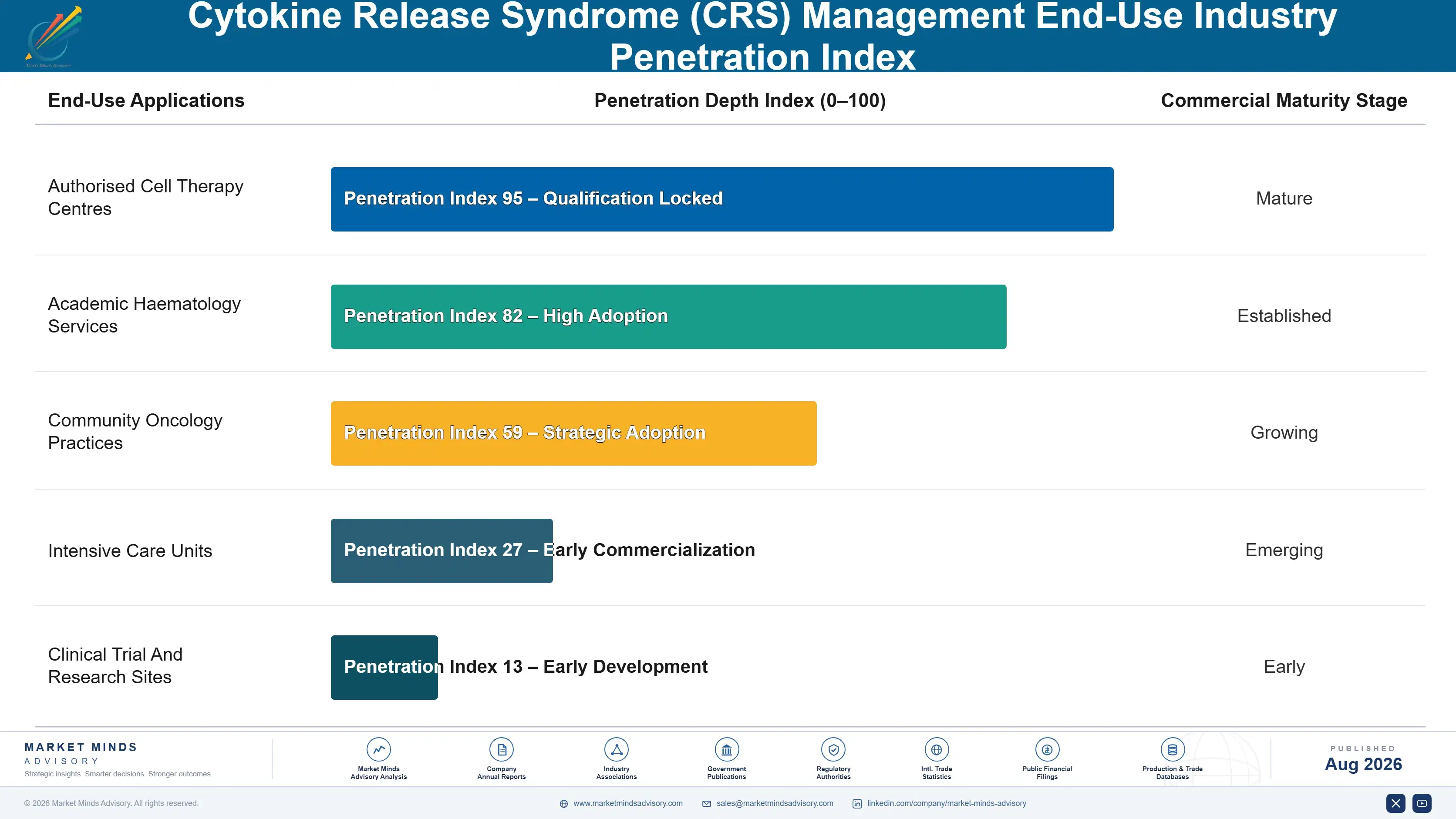
Nothing here generates its own demand. Every dose given follows an infusion of a cell therapy or a bispecific antibody, so the recurring unit is somebody else's treatment decision rather than anything a supplier in this market influences. That makes forecasting unusually tractable and commercial control unusually limited. The one variable participants can affect is throughput, by removing the monitoring constraint that caps how many patients each centre treats annually.
Depth varies by where an agent sits in the protocol. First-line prophylaxis is the stickiest, since it is written into step-up dosing schedules and given to every patient regardless of what happens afterwards. Refractory and neurotoxicity positions are nearly as durable because alternatives are thin and centres are conservative about changing algorithms. Rescue corticosteroids are shallowest, moving on tender price alone with no protocol loyalty whatsoever.

Buyer profiles are unusual and worth understanding properly. There is effectively no prescriber to influence, because treatment centre protocol committees decide what gets given at each grade and clinicians follow the algorithm. Off-label status prevents promotion entirely. Both facts mean evidence generation, society engagement, and registry contribution do the work that a field force would do in any other therapeutic market.
cytokine-release-syndrome-crs-management-market-end-use-penetration-index-1787298445795

Where We Come Out

These are among the four positions where our research anticipates prominent divergence between winners and laggards over the coming forecast period. Each is grounded in the demand model, the regulatory perimeter, and the announced capacity pipeline.
01 / THROUGHPUT ENABLEMENT FOCUS

Beds cap this market, not severity or demand

Around nine inpatient monitoring days per cell therapy patient is what limits how many patients a centre can treat each year, and every patient turned away is prophylaxis and monitoring revenue that never occurs at all. Funding outpatient monitoring protocol development and caregiver training costs roughly two hundred and fifty thousand dollars per centre and can lift annual treated patients by half. That effect dwarfs anything achievable by managing severe events better, and it makes the supplier a partner rather than a vendor.
02 / PROTOCOL COMMITTEE ENGAGEMENT

There is no prescriber here worth calling on

Treatment centres run written algorithms specifying which agent is given at which grade, and clinicians follow the document rather than exercising individual judgement at the bedside. Off-label status makes promotion illegal for most products in this field anyway, so the only route into a protocol at all runs through investigator-led studies, registry contribution, and sustained professional society engagement. Companies deploying conventional promotional field forces into this market are spending money calling on an audience that has no decision left to make.
03 / NEUROTOXICITY POSITION BUILDING

Engineering will fix cytokine release long before neurotoxicity

Next-generation constructs are already demonstrating markedly lower severe cytokine release rates while showing considerably less improvement on associated neurotoxicity, which is a harder problem to design away. Interleukin-6 blockade also performs poorly in that setting, because tocilizumab crosses the blood-brain barrier badly and may worsen central exposure. Agents with credible neurotoxicity evidence hold protocol positions worth two to three times equivalent cytokine release positioning, and those positions look likely to outlast the very constructs that created this market in the first place.
04 / BISPECIFIC SCHEDULE INTEGRATION

Get named in the step-up schedule, not the rescue algorithm

Bispecific antibodies are given repeatedly rather than once, require no manufacturing slot at all, and reach academic and community oncology settings that could never have delivered cell therapy. Their treated population will exceed the cell therapy population roughly fivefold within this forecast period on current trajectories. Prophylaxis named directly in the dosing schedule and supplied alongside the therapy converts episodic rescue purchasing into recurring volume that grows automatically with somebody else's launch curve, without any additional commercial effort at all.

Engagement Snapshot From the Field

A live engagement with an industry participant carrying material or product regulatory and market exposure ahead of a defining policy shift, showing how our research translates into a defensible multi-year portfolio strategy.
MARKET MINDS ADVISORY · CLIENT ENGAGEMENT SUMMARY
Cytokine Release Syndrome (CRS) Management Producer Strategic Portfolio Review and Transition Roadmap 2026·Investment Scenario on Cytokine Release Syndrome (CRS) Management Exposure Evaluation 2025-26
CLIENT PROFILE
A mid-sized biopharmaceutical company marketing an immunomodulatory biologic used off-label in refractory cytokine release syndrome and neurotoxicity, with roughly USD 190 million in annual revenue across all indications (client-reported, unverified by MMA). Cell therapy supportive use had grown organically without any commercial support, and the company had no field presence at treatment centres and no registry participation.
STRATEGIC CHALLENGE
Off-label status prevented promotion entirely, protocol inclusion varied unpredictably between centre networks, and a biosimilar horizon was approaching on the parent molecule. The board needed to establish whether supportive care in cell therapy justified dedicated investment or whether the volume was incidental revenue that would erode alongside the base product.
MMA APPROACH
MMA mapped protocol inclusion across 84 treatment centres against published evidence and society guidance, interviewed thirty-one protocol committee members and cell therapy directors on how algorithms actually get revised, and modelled treated population growth separately for cell therapy and bispecific antibodies. Neurotoxicity positioning was assessed against next-generation construct pipelines to test how durable each use case would prove.
KEY FINDINGS
  1. Protocol inclusion at 84 centres correlated with published centre experience and society guidance, and showed no relationship whatsoever with any commercial contact the client had made.
  2. Twenty-six of thirty-one committee members said neurotoxicity evidence would change their algorithm, against nine who said the same about additional cytokine release data.
  3. Bispecific antibody treated populations were modelled to exceed cell therapy populations by 5.1 times within the forecast period, and the client had no presence in step-up prophylaxis at all.
  4. Next-generation constructs in development showed substantially reduced cytokine release with far smaller improvements in neurotoxicity, which favoured the client's stronger use case.
CLIENT PROFILE
A mid-sized biopharmaceutical company marketing an immunomodulatory biologic used off-label in refractory cytokine release syndrome and neurotoxicity, with roughly USD 190 million in annual revenue across all indications (client-reported, unverified by MMA). Cell therapy supportive use had grown organically without any commercial support, and the company had no field presence at treatment centres and no registry participation.
STRATEGIC CHALLENGE
Off-label status prevented promotion entirely, protocol inclusion varied unpredictably between centre networks, and a biosimilar horizon was approaching on the parent molecule. The board needed to establish whether supportive care in cell therapy justified dedicated investment or whether the volume was incidental revenue that would erode alongside the base product.
MMA APPROACH
MMA mapped protocol inclusion across 84 treatment centres against published evidence and society guidance, interviewed thirty-one protocol committee members and cell therapy directors on how algorithms actually get revised, and modelled treated population growth separately for cell therapy and bispecific antibodies. Neurotoxicity positioning was assessed against next-generation construct pipelines to test how durable each use case would prove.
KEY FINDINGS
  1. Protocol inclusion at 84 centres correlated with published centre experience and society guidance, and showed no relationship whatsoever with any commercial contact the client had made.
  2. Twenty-six of thirty-one committee members said neurotoxicity evidence would change their algorithm, against nine who said the same about additional cytokine release data.
  3. Bispecific antibody treated populations were modelled to exceed cell therapy populations by 5.1 times within the forecast period, and the client had no presence in step-up prophylaxis at all.
  4. Next-generation constructs in development showed substantially reduced cytokine release with far smaller improvements in neurotoxicity, which favoured the client's stronger use case.
RECOMMENDED STRATEGY
Phase 1: Phase one: fund investigator-led neurotoxicity studies and join the international cell therapy registry, positioning explicitly around neurotoxicity rather than cytokine release. Phase 2: Phase two: build a small medical science team engaging protocol committees and society guideline groups, and disband plans for any conventional promotional field force. Phase 3: Phase three: approach bispecific developers about prophylaxis inclusion in step-up dosing schedules, ahead of their launches rather than after them.
OUTCOME
The client redirected its commercial plan within two quarters and joined the registry. Protocol inclusion rose from 41% to 63% of mapped centres over the following eighteen months, and supportive care revenue grew 58% while total commercial spend in the indication fell (client-reported, unverified by MMA).

Frequently Asked Questions

Foundational context covering the market sizes, CAGR, scope, country, region and competition that inform every finding below. This section is provided to cover basics and most often pre-purchase conversations, answered from the MMA Primary Research Dataset.

What is the current size of the Cytokine Release Syndrome (CRS) Management Market?

The global CRS management market reached USD 1.15 billion in 2025, covering prophylaxis and treatment of cytokine release syndrome and associated neurotoxicity from cell and bispecific therapies. The therapies causing the syndrome are excluded.

How large will the Cytokine Release Syndrome (CRS) Management Market be by 2036?

MMA forecasts USD 4.68 billion by 2036, up from USD 1.31 billion in 2026, an increase of USD 3.37 billion. That represents an expansion multiple of 3.58 times across the forecast period.

What is the CAGR for the Cytokine Release Syndrome (CRS) Management Market 2026 to 2036?

The base case CAGR is 13.6%, with a bull case of 14.9% and a bear case of 12.3%. Historical growth between 2020 and 2025 ran at 12.4%, tracking cell therapy and bispecific antibody uptake almost exactly.

Which segment is growing fastest?

Interleukin-1 pathway inhibitors grow fastest at 20.4%, exactly 1.50 times the market rate, on off-label use in refractory cases and neurotoxicity. Prophylactic corticosteroid regimens follow at 17.2% on step-up dosing volume.

Who are the major companies in the Cytokine Release Syndrome (CRS) Management Market?

Roche, Sobi, Recordati, Fresenius Kabi, and Biogen lead, together holding 58% of the market. One approved agent sits against an otherwise entirely off-label competitive field.

Which country is growing fastest?

China grows fastest at 17.4%, driven by domestically approved cell therapy products and enormous trial volume that still requires full management. Biosimilar pricing caps value per treated patient considerably.

Report Segmentation Architecture

The full report scope spans multiple orthogonal segmentation dimensions, with cross-tabulated demand data provided for each dimension pair. Coverage extends further to regional breakdowns, trend trajectories, and the competitive detail needed to support segment-level decision-making.

By Pharmacological Class

  • Interleukin-6 Pathway Inhibitors
  • Interleukin-1 Pathway Inhibitors
  • Interferon Gamma And Other Cytokine-Directed Agents
  • Prophylactic Corticosteroid Regimens
  • Rescue Corticosteroid Regimens
  • Vasopressor And Organ Support Agents

By End-Use Industry

  • Authorised Cell Therapy Centres
  • Academic Haematology Services
  • Community Oncology Practices
  • Intensive Care Units
  • Clinical Trial And Research Sites

By Commercial Dimension

  • Protocol-Driven Hospital Supply
  • Off-Label Named Patient Use
  • Bispecific Step-Up Bundled Supply
  • Hospital Tender Generic Supply
  • Clinical Trial Supportive Care Supply

By Region

  • North America
  • East Asia
  • Western Europe
  • South Asia and Pacific
  • Latin America
  • Middle East and Africa
  • Eastern Europe

Scope, Methodology, and Coverage

Every figure in this report is reproducible from documented input assumptions. The scope below maps the historical period, the forecast horizon, the segmentation dimensions, and the countries covered, alongside the underlying primary and qualitative methodology.
Historical Period
2020 to 2025
Forecast Period
2026 to 2036
Base Year
2025 (USD billions; MMA Primary Research Dataset, August 2026)
Market Definition
The cytokine release syndrome management market covers pharmacological prophylaxis and treatment of cytokine release syndrome and associated immune effector cell-associated neurotoxicity syndrome arising from chimeric antigen receptor cell therapies, T-cell engaging bispecific antibodies, and related immunotherapies, across authorised treatment centres and community settings. Scope spans interleukin-6 and interleukin-1 pathway inhibitors, interferon gamma and other cytokine-directed agents, prophylactic and rescue corticosteroid regimens, and vasopressor and organ support pharmacotherapy. The underlying cell and bispecific therapies, intensive care equipment, apheresis, cytokine diagnostics, and graft versus host disease treatment are excluded.
Quantitative Units
USD billions at manufacturer revenue level; treated patients annually; management cost per infused patient.
Segmentation Dimensions
By pharmacological class; by end-use industry; by commercial dimension; by region.
Regions Covered
North America, East Asia, Western Europe, South Asia and Pacific, Latin America, Middle East and Africa, Eastern Europe
Countries Covered
United States, Canada, United Kingdom, Germany, France, Italy, Spain, Netherlands, Poland, Czech Republic, China, Japan, South Korea, India, Australia, Singapore, Brazil, Mexico, Saudi Arabia, South Africa.
Key Companies Profiled
Roche, Sobi, Recordati, Fresenius Kabi, Biogen, Celltrion, Pfizer, Hikma Pharmaceuticals, Teva Pharmaceutical Industries, Sandoz, Dr Reddys Laboratories, Zydus Lifesciences, Baxter International, Amneal Pharmaceuticals, Accord Healthcare, Aurobindo Pharma, Sun Pharmaceutical Industries, Qilu Pharmaceutical, Hetero Labs, Bio-Thera Solutions.
Quantitative Methodology
Primary survey, n=3,800 respondents, Q4 2025, six countries; demand-side model with trade association cross-validation
Qualitative Methodology
47 expert interviews, Q4 2025; applied to validate demand model assumptions, identify emerging dynamics, and assess competitive positioning
Report Format
PDF and XLSX data workbook (Word format preview document)
Publisher
Market Minds Advisory
Report Code
MMA-2026-HLT-855
Published
August 2026
Contact
sales@marketmindsadvisory.com | www.marketmindsadvisory.com

Purchase the full Cytokine Release Syndrome (CRS) Management Market Report (2026 to 2036).

The full MMA report on cytokine release syndrome management covers pharmacological class, regional, and competitive analysis in detail, with separate treatment of the protocol committee dynamics that decide prescribing where promotion is not available. It includes treatment centre protocol inclusion mapping, throughput and outpatient administration economics by centre type, treated population forecasting split between cell therapy and bispecific antibodies, and next-generation construct impact assessment on severity rates. Regional chapters cover twenty countries with centre authorisation and therapy access assessed individually. Competitive profiling spans twenty companies on a consistent revenue basis.
Twenty country centre authorisation and access chapters
Treatment centre protocol inclusion mapping and analysis
Throughput and outpatient administration economics by centre
Treated population forecasting split by therapy type
Twenty company competitive profiles compared consistently
Next-generation construct impact assessment on severity rates

Built For The People Who Decide

From boardroom strategy to bench-side execution, this report is read cover-to-cover by leaders shaping the next decade of their industry, turning demand scenarios, market dynamics and valuation benchmarks into decisions.
CXOs/ Presidents/ VPs/ Managers
M&A and Corporate Development
Strategy Teams and R&D Heads
Procurement and Product Directors
Regulatory and Compliance Leaders
Investor Relations and Equity Analysts