Market Minds Advisory
Cytocentrifuge Market

Cytocentrifuge Market: Workflow Automation Redefines Slide Preparation

Cytocentrifuge demand is shifting from standalone slide preparation instruments toward automated systems integrated with laboratory information systems, as rising cytology test volume and pathology staffing shortages push labs toward workflow standardization.

Lead Analyst

Alice Ballenger

Published

September 2026

Make Smarter Decisions with Customized Research Insights

Request a free sample report and evaluate market opportunities, growth trends, and competitive dynamics relevant to your business needs.

2025 MARKET VALUE$0.2BMarket Size 2025
2036 FORECAST VALUE$0.4BBase Case , 2026 to 2036
CAGR 2026 TO 20366.2 %Bull 7.5% / Bear 4.9%
INCREMENTAL OPPORTUNITY$0.2BNet 10- year value creation
EXPANSION MULTIPLE1.81x2036 value over 2026 base
Strategic Levers
M&A Pipeline
Regional Outlook
Country Rankings
Competitive Intelligence
Segmental Deep-dive
Call-Us : 91 93563 13602

Executive Snapshot and Market Trajectory

Cytocentrifuge purchasing decisions increasingly hinge on laboratory information system integration rather than spin quality alone, since pathology labs facing chronic staffing shortages now prioritize workflow automation as much as slide preparation consistency across most accredited diagnostic laboratory networks operating today throughout the region, country, and beyond current expectations set previously.
Rising cytology test volume tied to expanding cervical and non-gynecological cancer screening programs, chronic pathology technologist staffing shortages pushing labs toward automated slide preparation, and steady replacement of aging cart-based instruments in mature hospital laboratory networks are together concentrating demand upside in two clear directions: East Asian reference laboratory networks expanding rapidly, and automated systems that integrate directly with laboratory information systems already installed at most accredited pathology departments nationwide and internationally.
Thermo Fisher Scientific, Hettich Instruments, and Beckman Coulter lead a moderately concentrated field where laboratory information system integration depth is becoming as commercially decisive as core mechanical spin reliability, while smaller regional instrument makers compete primarily on price for entry-level single-chamber units serving smaller diagnostic laboratories across price-sensitive emerging markets currently expanding their pathology testing capacity at a genuinely rapid and sustained pace.
Market Definition
The cytocentrifuge market covers benchtop instruments, chambers, and consumables used to concentrate cells from fluid specimens onto slides for cytological examination in pathology and cytology laboratories. General-purpose laboratory centrifuges without cytology-specific slide preparation function are excluded.
Base Year Value
$0.2B in 2025 (MMA Primary Research Dataset, August 2026)
Forecast Period
2026 to 2036, eleven discrete annual values
CAGR
6.2% base case. Bull 7.5%. Bear 4.9%.
Fastest Growth Segment
Automated Cytology Preparation Systems: 9.8% CAGR
Fastest Growth Country
China: 7.2% CAGR
Fastest Growth Region
South Asia and Pacific: 8.5% CAGR
Largest Region
East Asia: 27% of 2025 global value
Market Leaders
Thermo Fisher Scientific, Hettich Instruments, Beckman Coulter, Sakura Finetek, Sysmex Corporation. Source: MMA Analysis, July 2026.
Primary Survey
n=3,800 procurement and R&D decision-makers, Q4 2025, six countries
Methodology
Demand-side build-up, cross-validated against public data, 47 expert interviews

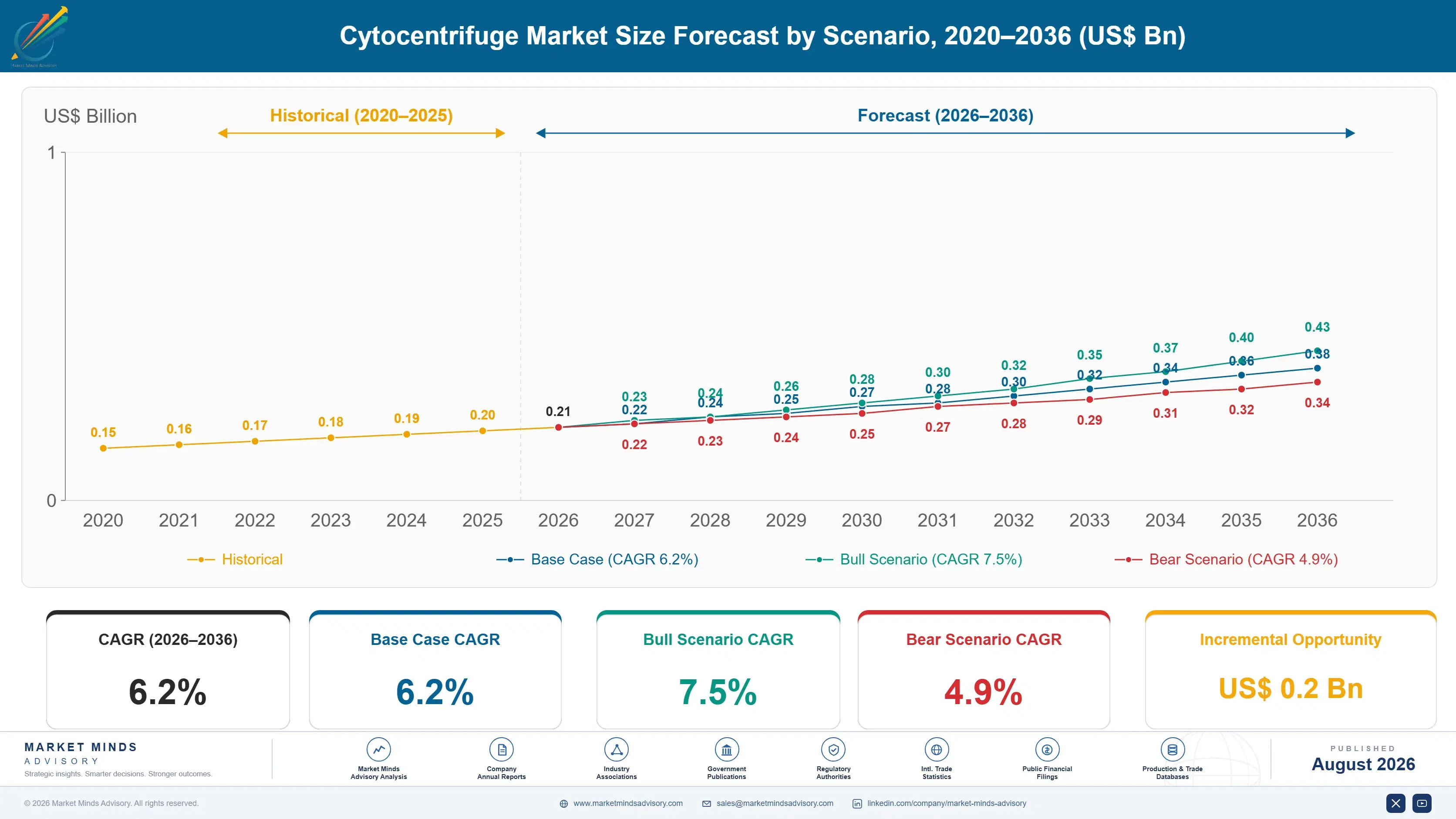
Cytocentrifuge Market Forecast Scenarios

cytocentrifuge-market-size-forecast-scenario-1787304966417
Cytocentrifuge demand grew steadily but modestly between 2020 and 2025, reflecting the category mature and stable nature within pathology laboratory capital equipment budgets. Cervical cancer screening program expansion in several countries provided incremental volume growth during the historical period, while pandemic-related laboratory staffing disruption temporarily slowed instrument replacement cycles before recovering through 2023 and 2024 across most accredited laboratory networks.
The base case assumes 6.2 percent annual growth through 2036, anchored on three commercial mechanisms: expanding cervical and non-gynecological cancer screening programs increasing cytology test volume across both developed and emerging healthcare systems, chronic pathology technologist staffing shortages pushing laboratories toward automated slide preparation that reduces manual handling time, and steady replacement of aging cart-based instruments as laboratory information system integration becomes a standard procurement requirement rather than an optional feature across most accredited pathology departments.
The bull case centers on accelerated national cancer screening program expansion in East Asian and South Asian markets, pulling forward instrument replacement and new laboratory installation demand. The bear case flags laboratory capital budget constraints and molecular diagnostic test substitution for some cytology applications, which could slow instrument volume growth and leave some laboratories extending existing equipment service life longer than currently planned.

Where Slide Preparation Meets Workflow Automation

Cytocentrifuge remains a genuinely mature instrument category, but purchasing criteria have shifted meaningfully as laboratories weigh workflow automation and laboratory information system integration alongside the mechanical spin reliability that has always been table stakes across most laboratory tiers. Multi-chamber automated systems increasingly displace older single-chamber cart-based instruments in higher-volume reference laboratories, though smaller diagnostic labs continue purchasing sim
MARKET CONCENTRATIONCR5 62%Top five manufacturers control roughly two thirds of shipments
AVERAGE SELLING PRICEUSD 8,200Blended average price across single and multi-chamber instrument tiers
TOP PRODUCING COUNTRY SHARE33%Share of global installed base concentrated in leading producing country
ANNUAL REPLACEMENT RATE8%Average annual replacement rate across accredited pathology laboratory networks
TRADE INTENSITY44%Portion of instrument trade crossing borders versus domestically sold
INPUT COST SHARE47%Consumables and service costs as share of total lifetime cost
Demand growth tracks cytology test volume more directly than any pure technology adoption curve, since instrument replacement cycles follow laboratory capital budget timing rather than rapid feature obsolescence common in other diagnostic categories. Cervical cancer screening program expansion remains the single largest demand driver across most markets, a decade-long public health investment cycle that continues extending organized screening access into previously underserved regions and populations.
Pathology technologist staffing shortages are reshaping laboratory purchasing priorities toward automation-capable instruments that reduce manual slide preparation time per specimen. Consumables and service contract revenue increasingly determine vendor profitability more than instrument hardware sales alone, since the installed base replacement cycle runs considerably longer than typical medical device categories, often exceeding a decade per unit across most established laboratory networks.
"Nobody buys a cytocentrifuge for the spin anymore. They buy it because the lab down the hall automated first and their technologists are already looking for a reason to leave."
Director, Laboratory Diagnostics Practice · MMA Medical Devices / Laboratory Dia

Market Trends

Cervical Cancer Screening Programs Expand Test Volume

National cervical cancer screening programs across several countries have expanded eligibility criteria and screening frequency in recent years, directly increasing cytology and liquid-based sample volume flowing steadily through pathology laboratories nationwide and internationally each year. The World Health Organization elimination initiative has pushed multiple national health ministries to fund expanded screening infrastructure, including new laboratory capacity in previously underserved regions. This has translated directly into cytocentrifuge demand, since organized screening programs require standardized, high-throughput slide preparation capacity that manual methods struggle to sustain reliably at scale across large screened populations.
Market Impact: Non-gynecological applications add
Laboratory Information System Integration Becomes Standard Requirement

Pathology laboratories increasingly require cytocentrifuge instruments to integrate directly with laboratory information systems, enabling automated specimen tracking, barcode labeling, and results documentation without manual transcription steps prone to error across busy laboratory workflows. This capability has moved from a premium differentiator to a baseline procurement requirement at most accredited laboratories within the past several years, reflecting broader laboratory digitization trends. Vendors lacking deep integration capability increasingly struggle to win contracts at larger reference laboratories and hospital systems that have already standardized on specific laboratory information system platforms across their networks.
Market Impact: Cytotechnologist vacancy rates exce

Market Opportunities and Growth Drivers

Non-Gynecological Cytology Applications Broaden Demand Base

Cytocentrifuge use has expanded meaningfully beyond traditional cervical cytology into non-gynecological applications including cerebrospinal fluid analysis, urine cytology, and body fluid effusion examination for cancer diagnosis and monitoring. This diversification reduces vendor dependence on any single screening program funding cycle, spreading demand across neurology, urology, and oncology laboratory departments that historically relied on manual specimen preparation methods. Laboratories serving broader diagnostic test menus increasingly view cytocentrifuge capacity as core infrastructure rather than a specialty instrument reserved for dedicated cytology departments alone, expanding the addressable purchasing base considerably across general hospital laboratories.
Market Impact: Substitutes for 10 to 15%

Pathology Technologist Shortage Accelerates Automation Investment

Chronic shortages of trained cytotechnologists and pathology laboratory staff across most developed healthcare systems are pushing laboratories to prioritize instruments that reduce manual specimen handling time per slide prepared across busy shifts. Automated multi-chamber systems that process multiple specimens simultaneously with minimal technologist intervention are increasingly favored over older single-chamber manual instruments requiring closer supervision throughout the preparation process. Laboratory administrators increasingly frame instrument replacement decisions around staffing efficiency gains rather than pure mechanical performance improvement alone, broadening budget justification beyond traditional capital equipment replacement criteria into workforce planning considerations.
Market Impact: Instruments last 10 plus years

Market Restraints and Challenges

Molecular Diagnostic Substitution Pressures Some Applications

Molecular and liquid biopsy diagnostic methods are increasingly substituting for traditional cytology examination in some cancer detection applications, a shift rooted in molecular testing higher sensitivity for certain genetic markers and reduced dependence on morphological interpretation skill. This substitution pressure is most pronounced in well-resourced reference laboratories with capital available for both technology types simultaneously. Cytocentrifuge vendors are mitigating this pressure by emphasizing complementary use cases where cytology and molecular testing work together, positioning cytocentrifuge instruments as sample preparation infrastructure supporting downstream molecular analysis rather than a standalone competing technology.
Market Impact: WHO elimination initiative targets

Long Instrument Replacement Cycles Limit Volume Growth

Cytocentrifuge instruments typically remain in laboratory service for a decade or longer, a durability rooted in relatively simple mechanical design and modest wear relative to more complex diagnostic instrumentation categories. This extended replacement cycle limits annual unit volume growth even as underlying test volume expands steadily, since laboratories can absorb rising specimen throughput on existing equipment before justifying new capital purchases. Vendors are mitigating this restraint through consumables and service contract revenue models that generate steady income across the full instrument lifecycle rather than depending primarily on new unit sales for revenue growth.
Market Impact: Required at over 80% of labs
4 additional market trends, 4 additional growth drivers, and 4 additional restraints and challenges are covered in the full report. Contact sales@marketmindsadvisory.com to access the complete intelligence.

Segment CAGR and Growth Architecture

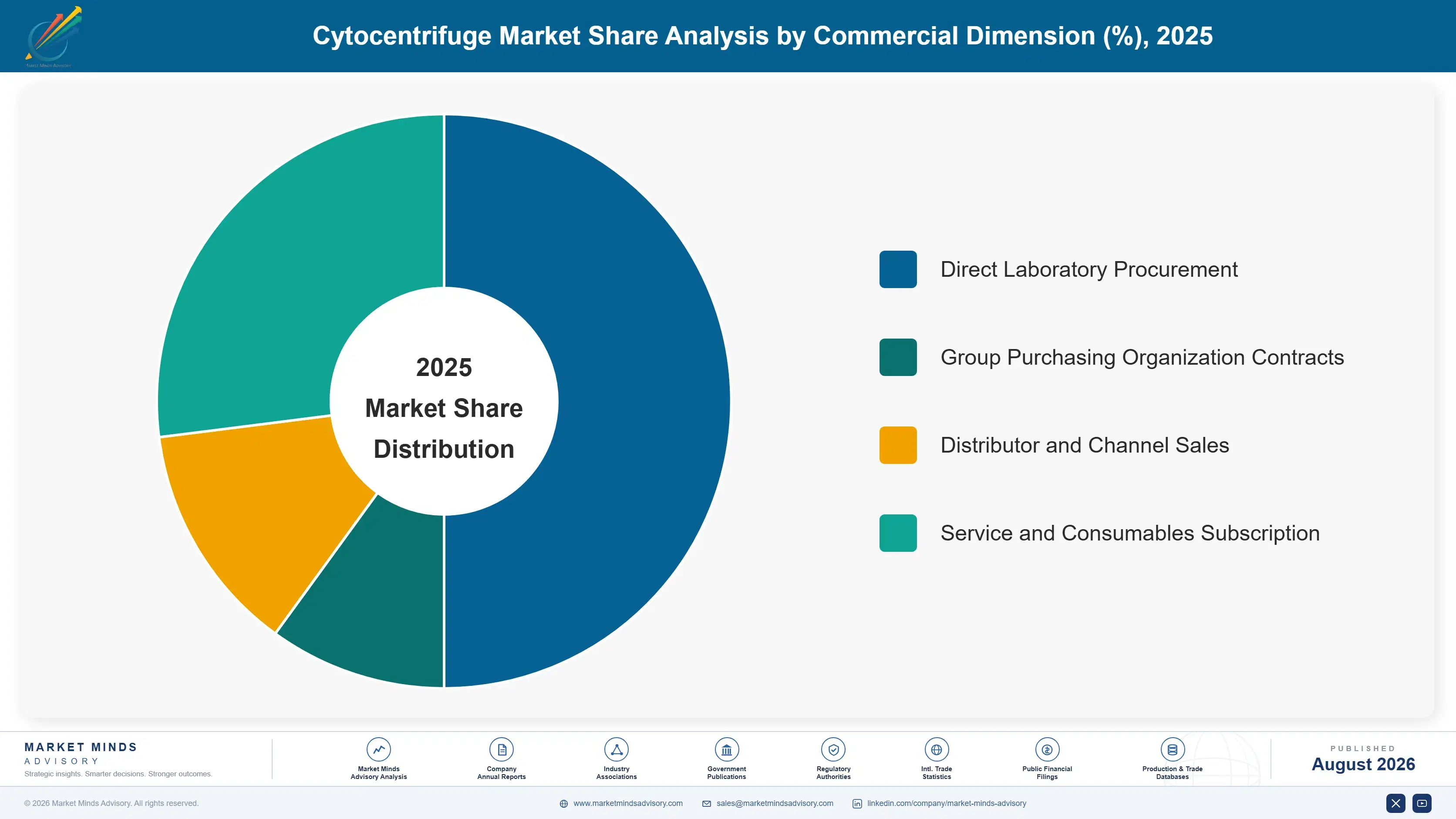
Cytocentrifuge segments by product and technology type across six categories spanning instruments, software, consumables, and services used across pathology laboratories. Automated cytology preparation systems and software and laboratory information system integration modules are the two fastest-growing categories tracked, both expanding well ahead of the broader market as laboratories prioritize workflow automation over manual preparation.
cytocentrifuge-market-market-share-analysis-1787304966945

Automated Cytology Preparation Systems

Automated cytology preparation systems, which process multiple specimens simultaneously with minimal technologist intervention through integrated loading, spinning, and slide staining sequences, are converting the fastest share of new laboratory purchasing budgets as pathology departments address chronic technologist staffing shortages across most accredited facilities. These systems reduce manual handling steps considerably compared to older single-chamber instruments, freeing skilled staff time for higher-value diagnostic interpretation work rather than repetitive specimen preparation tasks. Reference laboratories and hospital networks processing high specimen volumes increasingly view automation capability as essential rather than optional, particularly as organized cancer screening programs continue expanding test volume across most developed and emerging healthcare markets tracked closely by MMA analysts.
CAGR 9.8%

Software and LIS Integration Modules

Software and laboratory information system integration modules, which enable automated specimen tracking, barcode labeling, and results documentation without manual transcription, are expanding rapidly as laboratories standardize digital workflows across their broader diagnostic testing operations and departmental structures nationwide and internationally each year. This category increasingly determines vendor selection even when laboratories are technically purchasing hardware instruments, since integration compatibility with existing laboratory information system platforms has become a baseline procurement requirement at most accredited facilities across the country. Vendors offering open, flexible integration architecture are winning disproportionate share against competitors requiring costly custom interface development for each individual laboratory information system deployment across different facility types and networks operating today.
CAGR 8.5%
Full segment breakdown across 6 segments available in the complete report.

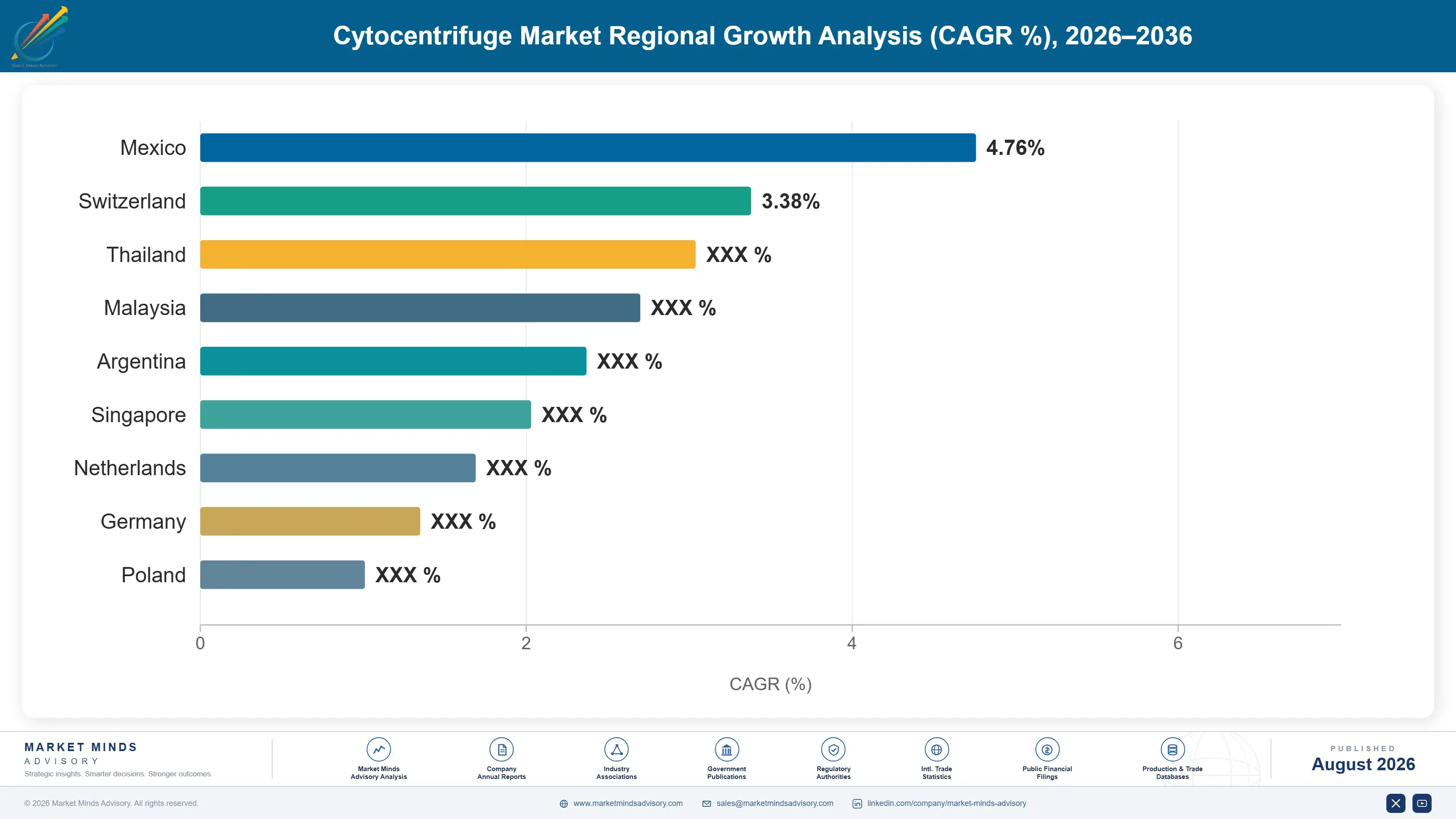
Regional Architecture and Country Demand Map

Cytocentrifuge installation and demand concentrate most heavily in East Asia, where China rapid pathology laboratory network expansion outpaces most other regions on a volume basis. North America and Western Europe follow on value, while South Asia and Pacific markets post the fastest regional growth off a smaller installed base.

North America

North America follows East Asia closely in absolute revenue terms, supported by a dense installed base of accredited reference and hospital pathology laboratories generating steady replacement and consumables demand year over year across most established laboratory networks nationwide and beyond. The United States accounts for the large majority of regional volume, with laboratory information system integration increasingly determining vendor selection among established academic and reference laboratory networks. Canada contributes a smaller but steadily growing share tied to comparable laboratory modernization initiatives. Pathology technologist staffing shortages affect North American laboratory purchasing decisions more directly than in most other regions, pushing steady demand for automated multi-chamber replacement systems across most accredited facilities nationwide.
Share: 26% | CAGR: 6.7% (2026 to 2036)

Western Europe

Western Europe generates a meaningful share of global revenue, anchored by Germany, France, and the United Kingdom, where national health system laboratory networks fund cytology equipment upgrades on multi-year capital cycles and standard procurement schedules. Organized cervical cancer screening programs are well established across most member states, sustaining stable rather than rapidly growing test volume compared to markets still building out screening infrastructure. Germany maintains the largest installed base of laboratory instruments in the region, reflecting its dense hospital and reference laboratory network. Growth trails East Asia and South Asia as the market matures, though public health system modernization investment sustains steady replacement demand across most participating countries and regions.
Share: 22% | CAGR: 4.7% (2026 to 2036)
Regional intelligence for 5 additional markets available in the complete report: East Asia, South Asia and Pacific, Latin America, Middle East and Africa, Eastern Europe. Contact sales@marketmindsadvisory.com.
cytocentrifuge-market-country-cagr-analysis-1787304967453

Consumables Attach and Automation Upgrade Paths

Cytocentrifuge vendors are pursuing several distinct paths to grow revenue beyond initial instrument sale as the category long replacement cycle limits pure hardware volume growth considerably over time. Four levers stand out as commercially significant across the forecast period, spanning consumables attach, laboratory information system integration licensing, automation upgrade retrofits, and service contract expansion strategies.

Consumables and Chamber Kit Recurring Revenue

Cytocentrifuge chambers, filter cards, and specialty slides represent a genuinely recurring revenue stream tied directly to specimen throughput rather than instrument replacement timing, generating steady income across the full decade-plus instrument lifecycle. Vendors report consumables now account for roughly 40 percent of total category revenue, a share expected to climb further as installed base growth outpaces new instrument sales growth meaningfully. This recurring revenue model gives vendors far more predictable cash flow than pure hardware sales alone, supporting sustained investment in specialty consumable formulations that improve slide quality and staining consistency across diverse specimen types.
Market Impact: Consumables now account for 40 perc

Laboratory Information System Integration Licensing Fees

Vendors offering deep laboratory information system integration increasingly charge separate software licensing fees layered on top of core instrument hardware sales, converting a historically bundled feature into distinct recurring revenue that now reaches roughly 30 percent of eligible customer accounts. Laboratories requiring custom integration with less common laboratory information system platforms pay meaningful implementation and ongoing licensing fees, reflecting genuine technical complexity involved. This lever matters most for vendors serving larger reference laboratories and hospital networks that have already standardized on specific enterprise laboratory information system platforms requiring careful custom interface development and ongoing maintenance support across multi-year contract terms.
Market Impact: Integration licensing adds recurrin

Automation Upgrade Retrofit Programs for Installed Base

Vendors offering automation upgrade retrofit kits for existing single-chamber instruments already installed at customer laboratories are capturing incremental revenue without requiring full instrument replacement, extending the commercial relationship considerably across most existing customer accounts and territories nationwide. Retrofit programs report adoption rates approaching 20 percent among eligible installed base instruments within three years of launch, generating meaningful incremental revenue at considerably lower cost than full new unit sales. This approach strengthens customer retention by demonstrating ongoing vendor investment in existing customer relationships rather than solely pursuing new laboratory account acquisition.
Market Impact: Retrofit adoption approaches 20 per

Extended Service and Preventive Maintenance Contract Expansion

Extended service agreements bundling preventive maintenance, calibration verification, and priority repair response have become a meaningful profit pool as instrument hardware pricing faces competitive pressure from lower-cost regional manufacturers across most product tiers, territories, customer segments, and account types served consistently today. Leading vendors now attach multi-year service contracts to more than 55 percent of new instrument placements, generating margin considerably above the hardware sale itself over the contract lifetime. This lever matters most in accredited laboratory accounts where documented calibration compliance carries direct regulatory consequence for continued laboratory certification status.
Market Impact: Service contracts now cover over 55

Who Controls the Margin Pool

Cytocentrifuge carries a CR5 near sixty-two percent, reflecting a genuinely concentrated niche where a handful of established laboratory equipment manufacturers dominate accredited reference laboratory relationships. The gap between Thermo Fisher Scientific, the largest single vendor, and the next tier of challengers is meaningful, since laboratory information system integration depth and installed base trust favor incumbents considerably.
Current competitive activity plays out across three dimensions: automation and multi-chamber system races among established vendors seeking to defend installed base against staffing shortage pressure, laboratory information system integration partnerships targeting larger reference laboratory networks, and price competition from regional Asian manufacturers targeting entry-level single-chamber instrument sales in price-sensitive emerging markets. Larger vendors are also pursuing selective consumables and service business acquisitions.

Emerging pressure comes from regional Asian manufacturers expanding export-oriented capacity at costs established multinational vendors increasingly struggle to match on entry-level instruments, and from molecular diagnostic vendors positioning cytology preparation as complementary sample infrastructure rather than a standalone category. Rankings could shift meaningfully if automation and integration adoption speed diverges significantly between leaders, particularly as reference laboratories increasingly favor vendors demonstrating the clearest path to workflow efficiency gains across their broader diagnostic testing operations.
cytocentrifuge-market-company-positioning-matrix-1787304967971

Competitive Moat and Risk Dimensions

THERMO FISHER SCIENTIFIC

Moat: Installed Base and Integration Depth

Thermo Fisher Scientific holds the largest global installed base of accredited reference laboratory instruments among cytocentrifuge vendors, generating deep laboratory information system integration relationships that smaller competitors struggle to replicate quickly. This installed base advantage compounds through recurring consumables and service revenue, giving Thermo Fisher considerably more predictable cash flow than vendors dependent primarily on new instrument sales.
THERMO FISHER SCIENTIFIC

Risk: Regional Manufacturer Price Pressure

Thermo Fisher faces mounting price pressure from regional Asian manufacturers offering comparable entry-level single-chamber instruments at meaningfully lower cost, particularly in price-sensitive emerging markets expanding laboratory capacity rapidly. Slower response on entry-level pricing could cede volume share in fast-growing regions even as Thermo Fisher retains premium positioning among established reference laboratory accounts.
HETTICH INSTRUMENTS

Moat: European Laboratory Network Depth

Hettich Instruments maintains particularly strong relationships across European hospital and reference laboratory networks, built over decades of centrifuge manufacturing experience that extends naturally into cytocentrifuge applications. This regional depth gives Hettich preferred vendor status in public procurement processes across several major European health systems where established relationships carry meaningful weight.
HETTICH INSTRUMENTS

Risk: Limited North American Market Share

Hettich has historically concentrated commercial strength in Europe, leaving it with comparatively thinner presence in North America where laboratory information system integration expectations and staffing shortage pressures drive some of the strongest replacement demand globally. Building North American distribution and support infrastructure from a smaller base could limit near-term share gains against domestically established competitors.

Players Tracked

Prominent Players

Thermo Fisher Scientific
Hettich Instruments
Beckman Coulter
Sakura Finetek
Sysmex Corporation

Other Key Players

Roche Diagnostics
Danaher Corporation
Agilent Technologies
Leica Biosystems
PerkinElmer
Bio-Rad Laboratories
Cardinal Health
Medline Industries
Grant Instruments
DLAB Scientific
Boeco Germany
Labnet International
Ohaus Corporation
Eppendorf
Kubota Corporation

Recent Developments

JUNE 2025

Thermo Fisher Scientific Launches Automated Multi-Chamber Cytology System

Thermo Fisher Scientific launched a new automated multi-chamber cytocentrifuge system with integrated barcode tracking and direct laboratory information system connectivity, targeting high-volume reference laboratories processing organized cancer screening specimens. The system reduces manual handling steps considerably compared to prior instruments, addressing chronic pathology technologist staffing pressure across laboratory networks.
Signal: Signals accelerating vendor investment in
SEPTEMBER 2024

Hettich Instruments Signs Multi-Facility Supply Agreement With European Hospital Group

Hettich Instruments signed a multi-facility supply agreement with a major European hospital laboratory group to deploy standardized cytocentrifuge instruments across twenty-two facilities, replacing aging fragmented equipment with a unified platform. The agreement includes phased rollout through 2027 and ongoing consumables and calibration service contracts across all participating laboratory sites.
Signal: Signals growing hospital preference for st
FEBRUARY 2025

Beckman Coulter Acquires Laboratory Information System Integration Software Firm

Beckman Coulter completed the acquisition of a laboratory information system integration software firm specializing in pathology workflow connectivity, strengthening its instrument integration capability across diverse hospital and reference laboratory information system platforms. The acquisition accelerates Beckman Coulter internal software roadmap, reducing dependence on third-party integration partnerships for enterprise laboratory accounts.
Signal: Signals continued industry consolidation a

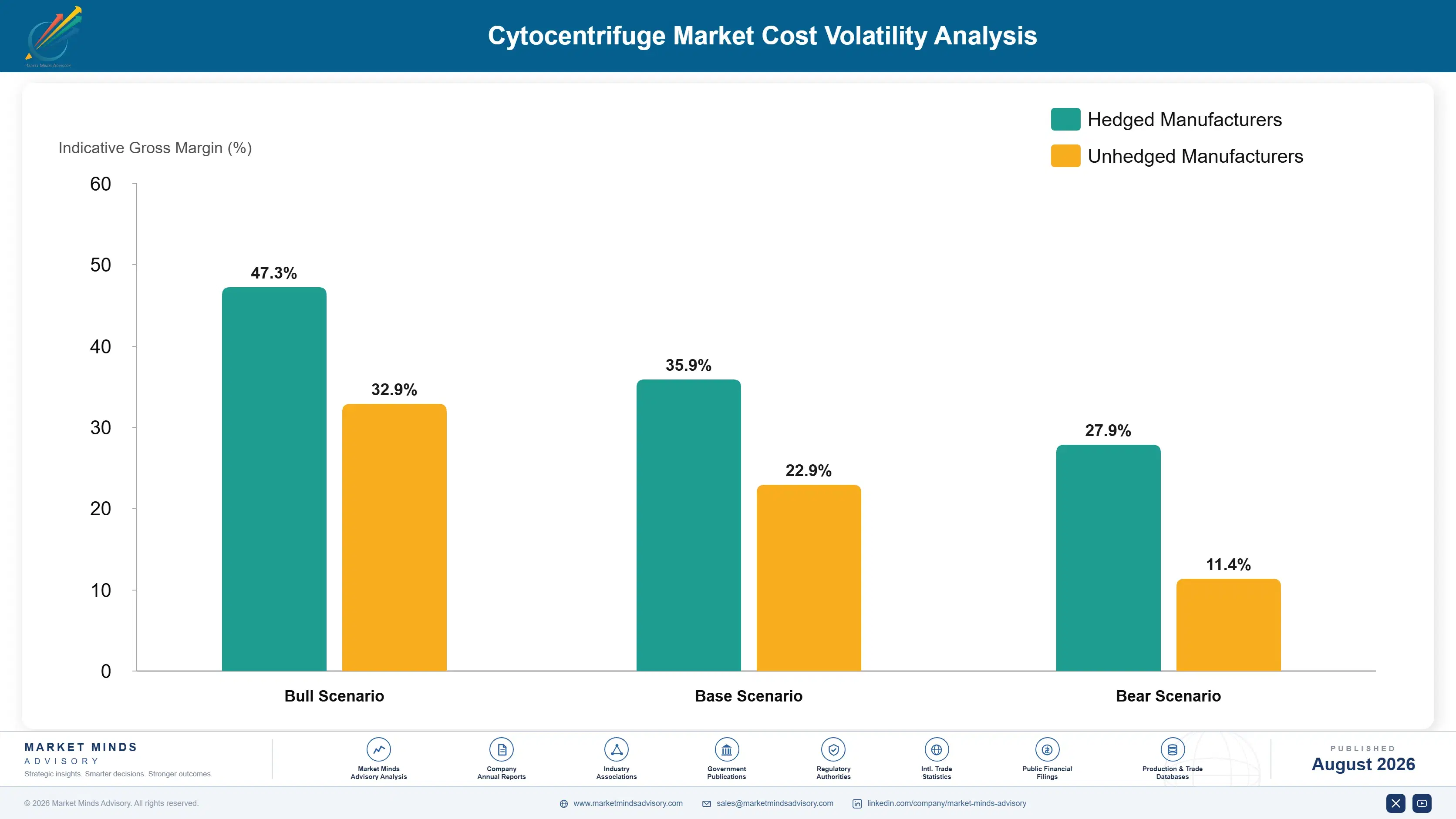
Precision Machined Components and Motor Cost

Precision machined rotor components, specialty motors, and electronic control systems together represent roughly forty-five to fifty percent of cytocentrifuge instrument cost of goods sold, reflecting the category demanding mechanical tolerances required for consistent cell distribution across slide surfaces. These components are sourced from a moderately concentrated supplier base specializing in precision motor and rotor manufacturing for laboratory equipment applications broadly.
Precision motor and electronic component costs rose meaningfully during 2021 and 2022 amid broader global semiconductor and specialty component supply disruption affecting laboratory equipment manufacturers alongside many other industrial categories. Several vendors disclosed in annual reports that component cost inflation compressed instrument margin during this period, prompting some manufacturers toward alternative component qualification and longer-term supplier agreements to stabilize costs through 2023 and into 2024.

Cost exposure varies by vendor manufacturing model and scale. Larger vendors with in-house precision machining capability absorb component cost volatility more easily than smaller competitors purchasing rotors and motors entirely from third-party specialty suppliers. Geographic exposure also differs: vendors sourcing electronic components primarily from East Asian supply chains face different cost and logistics patterns than those relying on domestic North American or European component manufacturing.
cytocentrifuge-market-cost-volatility-analysis-1787304968167

Dual-Source Component Qualification Program

Vendors are qualifying second suppliers for precision motors and rotor components to reduce dependence on any single manufacturer during periods of supply tightness affecting the broader instrument category. This lengthens initial qualification cycles but meaningfully reduces exposure to component shortage disruption, giving procurement teams greater negotiating leverage on pricing during tight supply conditions affecting the broader industry.

In-House Precision Machining Investment

Several larger vendors have expanded in-house precision machining capability to capture margin previously paid to third-party rotor and component suppliers while gaining tighter control over manufacturing quality and delivery timing across product lines and facilities. This shift requires meaningful upfront capital investment but reduces exposure to external supplier cost volatility over multi-year product cycles ahead.

Long-Term Component Supply Agreements

Vendors are negotiating longer-term supply agreements with precision motor and electronic component manufacturers, locking in pricing and delivery commitments rather than relying on shorter-term spot purchasing arrangements across most sourcing categories. This reduces margin volatility during periods of component cost inflation and gives finance teams clearer forward visibility into instrument manufacturing cost trajectory across upcoming quarters.

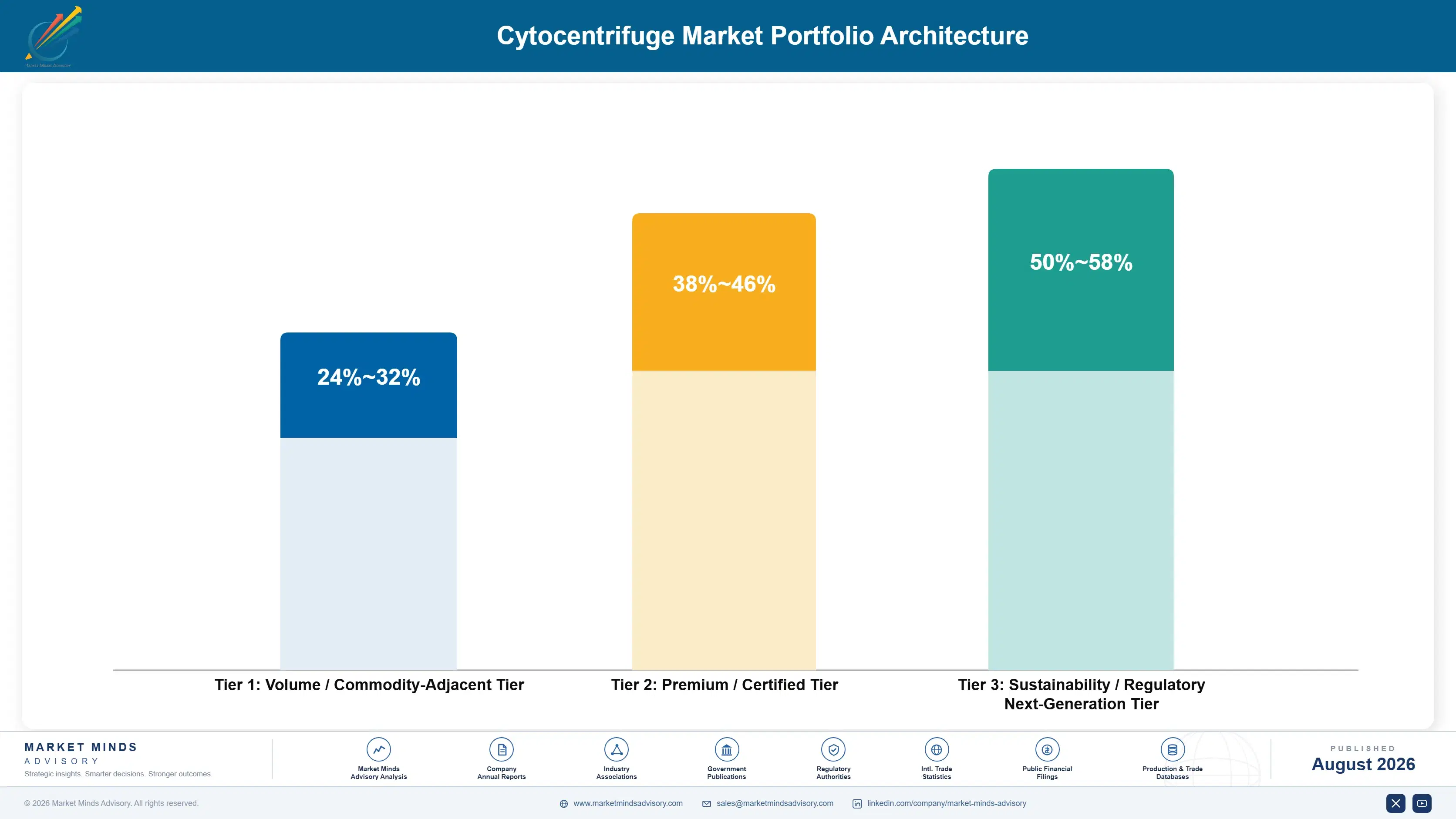
Portfolio Architecture for Margin Defence

Cytocentrifuge portfolios span three margin tiers running from commodity-adjacent single-chamber instruments through certified automated multi-chamber platforms to sustainability-linked next-generation systems bundling laboratory information system integration and advanced automation. Gross margin widens considerably moving up the tier structure, driven primarily by software integration depth and consumables attach rather than mechanical hardware differences alone across most vendor product line
Volume tier competition centers on price and basic mechanical reliability for cost-constrained smaller laboratories, where core spin performance and consumables compatibility determine competitiveness more than automation sophistication or integration depth. Premium tier competition instead centers on laboratory information system integration, automation capability, and service contract depth, an entirely different buying calculus that rewards vendors with dedicated software development capability built over many years of sustained investment.

High-value margin pools concentrate overwhelmingly in the premium and next-generation tiers, where consumables attach and integration licensing generate recurring revenue well above any one-time instrument sale transaction alone across the full lifecycle. Vendors increasingly steer product development and sales incentive structures toward this upper tier as volume-tier margin continues compressing under sustained price competition from lower-cost regional manufacturers entering entry-level segments.

Volume / Commodity-Adjacent Tier

Entry-level single-chamber instruments targeting price-sensitive smaller laboratories and emerging market diagnostic centers where core mechanical spin reliability matters more than advanced automation or laboratory information system integration capability across most facility types.
Gross Margin: 24%-32%

Premium / Certified Tier

Multi-chamber automated instruments with laboratory information system connectivity, typically sold with consumables and service contracts to established reference and hospital laboratories seeking documented workflow efficiency and staffing pressure relief across busy departments.
Gross Margin: 38%-46%

Sustainability / Regulatory / Next-Generation Tier

Fully automated systems bundling advanced software integration, barcode tracking, and predictive maintenance connectivity, targeting leading academic and reference laboratories piloting next-generation pathology workflow automation ahead of broader industry adoption and standardization.
Gross Margin: 50%-58%
cytocentrifuge-market-portfolio-architecture-1787304968659

Long Cycles and Recurring Consumables

Cytocentrifuge demand carries genuine annuity characteristics through consumables and service contracts that generate steady revenue across a decade-plus instrument lifecycle, far longer than most medical device categories, meaning vendors capture far more value from the installed base relationship than from the initial hardware transaction alone. Vendors increasingly structure sales and account management around lifetime consumables value rather than pure instrument placement volume.
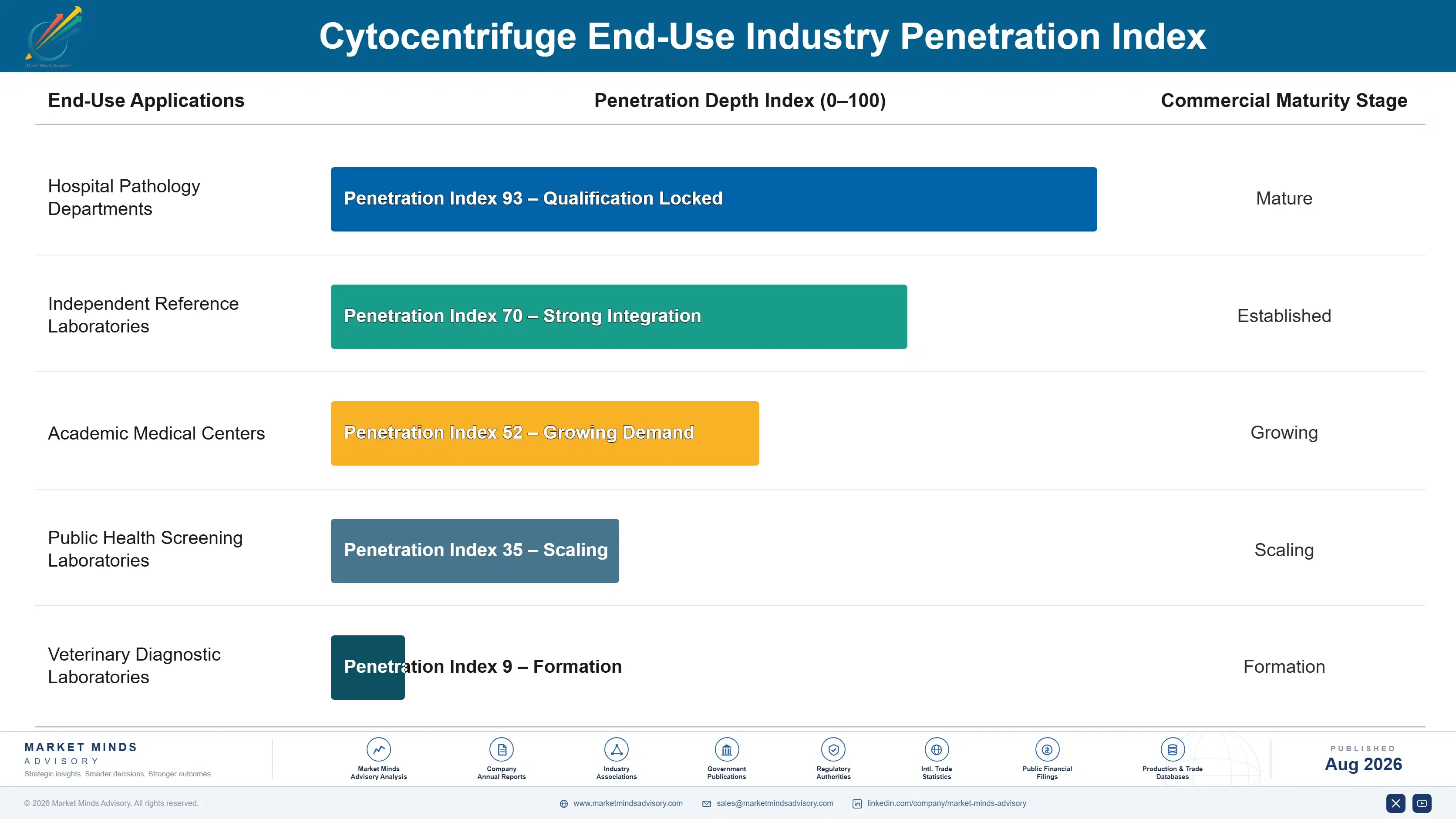
Adoption depth varies by end-use vertical across the market. Reference laboratories and academic medical centers processing highest specimen volume show the deepest automation adoption, layering integration and automation features across nearly their entire instrument fleet. Smaller community hospital laboratories adopt more gradually, with automation still catching up as capital budgets prioritize highest-volume departments first before extending upgrades to lower-throughput facilities.

A generational shift in buyer profile is underway as younger laboratory directors trained on digital pathology workflow optimization reach purchasing influence roles within hospital and reference laboratory administration. This cohort expects laboratory information system integration as a baseline feature rather than a premium add-on, reshaping procurement criteria toward workflow efficiency evidence and away from pure mechanical specifications that dominated purchasing decisions a decade ago.
cytocentrifuge-market-end-use-penetration-index-1787304969154

Where Cytocentrifuge Value Concentrates

These are among the four positions where our research anticipates prominent divergence between winners and laggards over the coming forecast period. Each is grounded in the demand model, the regulatory perimeter, and the announced capacity pipeline.
01 / AUTOMATION INVESTMENT PRIORITY

Prioritize Automation and Integration Over Pure Mechanical Reliability

Vendors that invest in automated multi-chamber systems with deep laboratory information system integration are capturing disproportionate share of new laboratory purchasing decisions across most reference and hospital laboratory networks today and beyond current expectations. Purchasing committees increasingly weigh workflow efficiency evidence alongside core mechanical reliability, a shift that rewards sustained automation investment over incremental hardware refinement alone. Vendors slow to build genuine automation depth risk losing larger reference laboratory accounts within three to five years as this becomes the clear industry default.
02 / EAST ASIAN CAPACITY EXPANSION

Build East Asian Distribution Ahead of Laboratory Network Growth

East Asian markets are adding new pathology laboratory capacity faster than most vendors currently have distribution and support infrastructure to serve profitably at meaningful scale across most affected regions, provinces, and metropolitan laboratory networks today and well beyond. Establishing local distribution partnerships ahead of laboratory network expansion requires patient multi-year investment with limited near-term payback for most vendors entering these markets. Vendors that build this presence early are positioned to capture disproportionate share as regional screening infrastructure continues expanding steadily.
03 / CONSUMABLES REVENUE DEFENSE

Protect Consumables Attach as Instrument Prices Face Pressure

Regional manufacturers offering lower-cost entry-level instruments threaten to compress hardware margin faster than established vendors can offset through pure price competition alone across most standard laboratory procurement decisions and budget cycles worldwide and internationally each year. Vendors need genuine consumables quality and compatibility advantages that regional competitors cannot easily replicate without comparable specialty manufacturing investment of their own. Vendors failing to defend consumables attach risk losing the recurring revenue that sustains profitability across the long instrument lifecycle and customer relationship.
04 / MOLECULAR DIAGNOSTIC POSITIONING

Position Cytology as Complementary to Molecular Testing Growth

Molecular and liquid biopsy diagnostic methods threaten to substitute for cytology in some cancer detection applications, particularly among well-resourced reference laboratories with capital available for both technology types simultaneously across their broader testing operations and clinical departments. Vendors positioning cytocentrifuge instruments as complementary sample preparation infrastructure supporting downstream molecular analysis, rather than a standalone competing technology, are better insulated from this substitution pressure over the coming decade. This framing shift matters most for vendors serving academic and reference laboratory accounts.

Engagement Snapshot From the Field

A live engagement with an industry participant carrying material or product regulatory and market exposure ahead of a defining policy shift, showing how our research translates into a defensible multi-year portfolio strategy.
MARKET MINDS ADVISORY · CLIENT ENGAGEMENT SUMMARY
Cytocentrifuge Producer Strategic Portfolio Review and Transition Roadmap 2026·Investment Scenario on Cytocentrifuge Exposure Evaluation 2025-26
CLIENT PROFILE
The client is a regional reference laboratory network operating six accredited pathology facilities across the southwestern United States, processing a growing mix of cervical cytology, non-gynecological, and body fluid specimens for a large network of referring hospitals and outpatient clinics. The laboratory network relied on a fragmented mix of single-chamber instruments from three different vendors purchased across multiple procurement cycles spanning nearly two decades.
STRATEGIC CHALLENGE
Leadership needed to evaluate whether standardizing on a single automated multi-chamber platform across all six facilities could meaningfully reduce technologist workload amid persistent staffing shortages, without disrupting existing laboratory information system connectivity that took years to establish. The network also needed to justify the capital investment against uncertain near-term reimbursement pressure affecting overall laboratory operating margin.
MMA APPROACH
MMA conducted an independent vendor capability assessment across four automated instrument platforms, benchmarking laboratory information system integration compatibility, consumables cost over a projected ten-year lifecycle, and technologist workflow time savings. The engagement combined primary interviews with laboratory directors and technologists at all six facilities, competitive benchmarking against peer reference laboratory networks, and phased capital deployment planning sequencing replacement by facility volume.
KEY FINDINGS
  1. Two of four candidate platforms offered laboratory information system integration compatible with the existing enterprise system without requiring costly custom middleware development, based on technical assessment findings.
  2. Projected ten-year consumables cost varied by an estimated twenty-two percent between the two finalist vendors (client-reported, unverified by MMA), a meaningful factor given the long instrument lifecycle involved.
  3. Technologist workflow time savings averaged approximately thirty percent per specimen batch across pilot testing at the highest-volume facility, based on time-motion study data collected during the engagement.
  4. Standardizing on a single vendor platform across all six facilities was projected to reduce annual service and training costs by an estimated fifteen percent (client-reported, unverified by MMA).
CLIENT PROFILE
The client is a regional reference laboratory network operating six accredited pathology facilities across the southwestern United States, processing a growing mix of cervical cytology, non-gynecological, and body fluid specimens for a large network of referring hospitals and outpatient clinics. The laboratory network relied on a fragmented mix of single-chamber instruments from three different vendors purchased across multiple procurement cycles spanning nearly two decades.
STRATEGIC CHALLENGE
Leadership needed to evaluate whether standardizing on a single automated multi-chamber platform across all six facilities could meaningfully reduce technologist workload amid persistent staffing shortages, without disrupting existing laboratory information system connectivity that took years to establish. The network also needed to justify the capital investment against uncertain near-term reimbursement pressure affecting overall laboratory operating margin.
MMA APPROACH
MMA conducted an independent vendor capability assessment across four automated instrument platforms, benchmarking laboratory information system integration compatibility, consumables cost over a projected ten-year lifecycle, and technologist workflow time savings. The engagement combined primary interviews with laboratory directors and technologists at all six facilities, competitive benchmarking against peer reference laboratory networks, and phased capital deployment planning sequencing replacement by facility volume.
KEY FINDINGS
  1. Two of four candidate platforms offered laboratory information system integration compatible with the existing enterprise system without requiring costly custom middleware development, based on technical assessment findings.
  2. Projected ten-year consumables cost varied by an estimated twenty-two percent between the two finalist vendors (client-reported, unverified by MMA), a meaningful factor given the long instrument lifecycle involved.
  3. Technologist workflow time savings averaged approximately thirty percent per specimen batch across pilot testing at the highest-volume facility, based on time-motion study data collected during the engagement.
  4. Standardizing on a single vendor platform across all six facilities was projected to reduce annual service and training costs by an estimated fifteen percent (client-reported, unverified by MMA).
RECOMMENDED STRATEGY
Phase 1: Phase 1 (Months 1 to 3): Complete vendor capability assessment and integration compatibility testing across all four candidate automated platforms and facilities. Phase 2: Phase 2 (Months 4 to 7): Finalize vendor selection and deploy pilot instrument at the highest-volume facility, tracking workflow time savings against baseline metrics closely. Phase 3: Phase 3 (Months 8 to 14): Roll out validated platform across remaining five facilities, sequencing deployment by facility specimen volume and staffing pressure level.
OUTCOME
Within fourteen months, the laboratory network completed standardization across all six facilities, reduced technologist workflow time meaningfully at every site, and reported improved staff retention in previously understaffed departments (client-reported, unverified by MMA). Consumables procurement simplified considerably under a single vendor relationship, reducing administrative overhead previously spread across three separate supplier accounts and contracts.

Frequently Asked Questions

Foundational context covering the market sizes, CAGR, scope, country, region and competition that inform every finding below. This section is provided to cover basics and most often pre-purchase conversations, answered from the MMA Primary Research Dataset.

What is the current size of the Cytocentrifuge Market?

The global cytocentrifuge market was valued at 0.2 billion dollars in 2025. This figure covers benchtop instruments, chambers, and consumables used for cytological slide preparation.

How large will the Cytocentrifuge Market be by 2036?

MMA forecasts the market will reach 0.38 billion dollars by 2036, nearly doubling in value. This growth is driven primarily by automation adoption and expanding cancer screening programs.

What is the CAGR for the Cytocentrifuge Market 2026 to 2036?

The base case CAGR is 6.2 percent annually across the forecast period. Bull and bear scenarios range from 7.5 percent to 4.9 percent depending on screening program funding levels.

Which segment is growing fastest?

Automated cytology preparation systems are the fastest-growing segment, expanding at approximately 9.8 percent annually. This is roughly 1.6 times the overall market growth rate, driven by staffing pressure.

Who are the major companies in the Cytocentrifuge Market?

Leading companies include Thermo Fisher Scientific, Hettich Instruments, Beckman Coulter, Sakura Finetek, and Sysmex Corporation. These five vendors hold a combined CR5 near sixty-two percent of the global market.

Which country is growing fastest?

China is the fastest-growing national market, expanding at approximately 7.2 percent annually. This reflects rapid pathology laboratory network expansion tied to national cancer screening rollout.

Report Segmentation Architecture

The full report scope spans multiple orthogonal segmentation dimensions, with cross-tabulated demand data provided for each dimension pair. Coverage extends further to regional breakdowns, trend trajectories, and the competitive detail needed to support segment-level decision-making.

By Product and Technology Type

  • Automated Cytology Preparation Systems
  • Software and LIS Integration Modules
  • Multi-Chamber Cytocentrifuges
  • Cytocentrifuge Consumables
  • Service and Calibration Contracts
  • Single-Chamber Cytocentrifuges

By End-Use Industry

  • Hospital Pathology Departments
  • Independent Reference Laboratories
  • Academic Medical Centers
  • Public Health Screening Laboratories
  • Veterinary Diagnostic Laboratories

By Commercial Dimension

  • Direct Laboratory Procurement
  • Group Purchasing Organization Contracts
  • Distributor and Channel Sales
  • Service and Consumables Subscription

By Region

  • North America
  • Western Europe
  • East Asia
  • South Asia and Pacific
  • Latin America
  • Middle East and Africa
  • Eastern Europe

Scope, Methodology, and Coverage

Every figure in this report is reproducible from documented input assumptions. The scope below maps the historical period, the forecast horizon, the segmentation dimensions, and the countries covered, alongside the underlying primary and qualitative methodology.
Historical Period
2020 to 2025
Forecast Period
2026 to 2036
Base Year
2025 (USD billions; MMA Primary Research Dataset, August 2026)
Market Definition
The cytocentrifuge market covers benchtop instruments, chambers, and consumables used to concentrate cells from fluid specimens onto slides for cytological examination in pathology and cytology laboratories. General-purpose laboratory centrifuges without cytology-specific slide preparation function are excluded.
Quantitative Units
USD billions (current prices); installed instrument units where applicable
Segmentation Dimensions
By Product and Technology Type; By End-Use Industry; By Commercial Dimension; By Region
Regions Covered
North America, Western Europe, East Asia, South Asia and Pacific, Latin America, Middle East and Africa, Eastern Europe
Countries Covered
USA, China, Germany, France, UK, Japan, South Korea, India, Australia, Canada, Brazil, Mexico, Indonesia, Vietnam, Thailand, Malaysia, UAE, Saudi Arabia, South Africa, Nigeria, Turkey, Poland, Netherlands, Italy, Spain, Sweden, Switzerland, Argentina, Colombia, Singapore, and additional markets relevant to this sector
Key Companies Profiled
Thermo Fisher Scientific, Hettich Instruments, Beckman Coulter, Sakura Finetek, Sysmex Corporation, Roche Diagnostics, Danaher Corporation, Agilent Technologies, Leica Biosystems, PerkinElmer, Bio-Rad Laboratories, Cardinal Health, Medline Industries, Grant Instruments, DLAB Scientific, Boeco Germany, Labnet International, Ohaus Corporation, Eppendorf, Kubota Corporation
Quantitative Methodology
Primary survey, n=3,800 respondents, Q4 2025, six countries; demand-side model with trade association cross-validation
Qualitative Methodology
47 expert interviews, Q4 2025; applied to validate demand model assumptions, identify emerging dynamics, and assess competitive positioning
Report Format
PDF and XLSX data workbook (Word format preview document)
Publisher
Market Minds Advisory
Report Code
MMA-2026-MED-522
Published
August 2026
Contact
sales@marketmindsadvisory.com | www.marketmindsadvisory.com

Purchase the full Cytocentrifuge Market Report (2026 to 2036).

The full report delivers detailed segment-level revenue forecasts across all six product categories through 2036. It includes country-level breakdowns for the fourteen markets carrying the deepest primary research coverage, alongside a complete competitive benchmarking module covering all twenty profiled companies. Proprietary MMA survey data drawn from 3,800 respondents across six countries supports the demand analysis, complemented by expert interview findings from 47 industry specialists gathered during the fourth quarter of 2025. Buyers also receive editable data tables and a quarterly market monitor update subscription for twelve months following purchase.
Segment-level revenue forecasts across six product categories
Country-level breakdowns for fourteen deeply researched markets
Competitive benchmarking module covering twenty profiled companies
Proprietary survey data from 3,800 respondents worldwide
Expert interview findings from 47 industry specialists
Twelve months of quarterly market monitor updates

Built For The People Who Decide

From boardroom strategy to bench-side execution, this report is read cover-to-cover by leaders shaping the next decade of their industry, turning demand scenarios, market dynamics and valuation benchmarks into decisions.
CXOs/ Presidents/ VPs/ Managers
M&A and Corporate Development
Strategy Teams and R&D Heads
Procurement and Product Directors
Regulatory and Compliance Leaders
Investor Relations and Equity Analysts