Market Minds Advisory
Cyclic Ketones Market

Cyclic Ketones Market: Nylon Chain Demand and the Shift Toward Specialty Grades

Nylon 6 and caprolactam capacity expansion across East Asia, tightening solvent-emission regulation in Europe, and rising pharmaceutical intermediate demand are reshaping cyclic ketone production economics, pushing producers toward higher-value specialty output.

Lead Analyst

Bilal Shaikh

Published

September 2026

Make Smarter Decisions with Customized Research Insights

Request a free sample report and evaluate market opportunities, growth trends, and competitive dynamics relevant to your business needs.

2025 MARKET VALUE$4.1BMarket Size 2025
2036 FORECAST VALUE$7.5BBase Case , 2026 to 2036
CAGR 2026 TO 20365.6 %Bull 6.8% / Bear 4.4%
INCREMENTAL OPPORTUNITY$3.1BNet 10- year value creation
EXPANSION MULTIPLE1.73x2036 value over 2026 base
Strategic Levers
M&A Pipeline
Regional Outlook
Country Rankings
Competitive Intelligence
Segmental Deep-dive
Call-Us : 91 93563 13602

Executive Snapshot and Market Trajectory

Cyclic ketones remain closely tied to global nylon fiber economics, since cyclohexanone feeds caprolactam and adipic acid production across the world's largest polyamide chains. Chinese capacity expansion is redrawing where value concentrates, while specialty and pharmaceutical-grade output is growing fastest of any segment.
Commercial demand splits between two very different buyer bases: large nylon and polyamide producers who buy cyclohexanone on tonnage contracts tied to caprolactam plant runs, and specialty buyers in pharmaceuticals, fragrance, and agrochemical intermediates who pay meaningfully more for tighter purity grades and documented quality systems. China alone accounts for close to a third of global consumption, while India is emerging as the fastest-growing demand center behind it.
Competition among the top five producers centers on integrated caprolactam-cyclohexanone production economics rather than standalone ketone sales, since most volume moves through captive or long-term contracted channels rather than open spot markets. European solvent emission rules and rising natural gas costs are pushing producers to defend specialty margins as commodity-grade volume growth slows across mature nylon markets, accelerating a broader industry shift toward pharmaceutical and fragrance-grade output streams that command materially higher realized pricing.
Market Definition
This market covers cyclic ketone compounds, including cyclohexanone, cyclopentanone, isophorone, methyl cyclohexanone, and cyclododecanone, produced for use as chemical intermediates, industrial solvents, and specialty fine chemical inputs. It excludes acyclic ketones such as acetone and methyl ethyl ketone, and excludes downstream caprolactam and nylon polymer production itself.
Base Year Value
$4.1B in 2025 (MMA Primary Research Dataset, August 2026)
Forecast Period
2026 to 2036, eleven discrete annual values
CAGR
5.6% base case. Bull 6.8%. Bear 4.4%.
Fastest Growth Segment
Specialty and Fragrance-Grade Cyclic Ketones: 8.0% CAGR
Fastest Growth Country
China: 7.3% CAGR
Fastest Growth Region
South Asia and Pacific: 7.6% CAGR
Largest Region
East Asia: 30% of 2025 global value
Market Leaders
Evonik Industries AG, BASF SE, INEOS Group Holdings S.A., DOMO Chemicals, Ube Corporation. Source: MMA Analysis based on company annual reports.
Primary Survey
n=3,800 procurement and R&D decision-makers, Q4 2025, six countries
Methodology
Demand-side build-up, cross-validated against public data, 47 expert interviews

Cyclic Ketones Market Forecast Scenarios

cyclic-ketones-market-trends-size-forecast-scenario-1787310771241
Cyclic ketone demand tracked nylon fiber production closely through 2020 to 2025, dipping in 2020 as automotive and textile demand contracted, then recovering as Chinese caprolactam capacity additions resumed. The market grew at an estimated 4.9% historical CAGR across the period, with specialty grades already outpacing commodity cyclohexanone by the back half of the window.
The base case assumes 5.6% CAGR through 2036, supported by three mechanisms operating together. First, continued Chinese caprolactam capacity expansion sustains commodity cyclohexanone volume growth even as Western nylon demand plateaus in mature apparel markets. Second, pharmaceutical and agrochemical intermediate demand for cyclopentanone and isophorone keeps expanding faster than the commodity base as generic drug production scales globally. Third, fragrance house reformulation toward cyclic ketone chemistry adds a smaller but higher-margin pool.
The bull case (6.8% CAGR) assumes faster-than-expected Indian and Southeast Asian nylon capacity buildout absorbing additional cyclohexanone volume ahead of current supplier planning assumptions. The bear case (4.4% CAGR) reflects the risk that European producers curtail capacity further under sustained high energy costs, and that synthetic fiber substitution by polyester continues eroding nylon's textile share faster than currently expected across mature Western apparel markets.

Nylon Chain Economics Meet Specialty Chemistry Demand

Cyclic ketone economics are inseparable from caprolactam and nylon fiber cycles, since the large majority of global cyclohexanone output feeds directly into integrated polyamide production rather than merchant markets. This integration means pricing power sits mostly with caprolactam producers rather than standalone ketone sellers, compressing merchant margins during periods of nylon overcapacity and leaving smaller non-integrated producers most exposed when commodity prices soften across major
CR5 CONCENTRATION48%share held by top five integrated producers globally
AVERAGE SELLING PRICE$1.60-4.80/kgrange spanning commodity grade to specialty purity levels
TOP PRODUCING COUNTRY SHAREChina, 27%share of global cyclohexanone production capacity currently online
CAPACITY UTILIZATION78%average operating rate across integrated caprolactam production complexes
TRADE INTENSITY31%of production volume crossing borders before end use
FEEDSTOCK COST SHARE52% of COGSphenol and cyclohexane feedstock inputs combined together today
Specialty grades behave very differently from the commodity base. Pharmaceutical intermediate and fragrance buyers specify tight purity and isomer control that commodity cyclohexanone producers rarely maintain, creating a smaller but distinctly separate high-margin market segment served by a different set of specialty fine chemical producers with dedicated purification and quality documentation capability built over years of customer qualification work.
Over the next decade, Chinese and Indian caprolactam capacity growth will keep setting the commodity price floor, while European producers increasingly pivot toward specialty and fragrance-grade output to defend margins against rising regional energy costs and tightening solvent emission rules that raise the relative cost of commodity production. Pharmaceutical contract manufacturing growth adds a further durable source of demand independent of nylon fiber cycles.
"Cyclohexanone looks like a boring commodity intermediate until you notice that the same molecule feeds a nylon plant and a perfume house at completely different price points. The real strategic question is how fast producers can shift mix toward the second buyer."
Director, Specialty Chemicals and Intermediates Practice · MMA Chemicals and Mat

Market Trends

Fragrance Houses Reformulate Toward Cyclic Ketone Musks

Major fragrance houses including Givaudan and Firmenich have expanded formulations built on cyclopentanone and cyclododecanone derivatives as substitutes for nitro-musk and polycyclic musk compounds facing tightening environmental restriction in the European Union. These cyclic ketone-derived musk intermediates offer comparable olfactory performance with a more favorable environmental persistence profile, supporting steady specialty-grade demand growth even as commodity cyclohexanone volume tracks nylon fiber output more closely. This shift is most pronounced in Europe, where regulatory pressure on legacy musk compounds is furthest advanced, though North American and Asian fragrance formulators are following the same trajectory with a modest lag.
Market Impact: Adds 1.2 million tons Chinese capac

Indian Caprolactam Capacity Additions Accelerate Sharply

Gujarat State Fertilizers and Chemicals and other Indian producers have announced caprolactam capacity expansions targeting domestic nylon fiber and industrial yarn demand that previously relied on imports. These expansions require matched cyclohexanone production capacity, either through captive phenol hydrogenation routes or imported intermediate purchase agreements. India's nylon fiber consumption has grown steadily alongside domestic textile and automotive airbag fabric manufacturing, and capacity planners expect this trend to continue as import substitution policy support and provincial manufacturing incentives keep favoring new domestic capacity investment over continued import dependence over the coming decade.
Market Impact: Adds 6% pharmaceutical-grade demand

Market Opportunities and Growth Drivers

Chinese Nylon 6 Capacity Expansion Sustains Commodity Demand

China's nylon 6 fiber and engineering plastics capacity has continued expanding, with several large caprolactam production complexes commissioned across Jiangsu, Shandong, and Fujian provinces over the past three years. Each new caprolactam line requires matched cyclohexanone production capacity, sustaining commodity-grade demand growth even as Western nylon markets mature. This expansion has made China the largest single national consumer of cyclohexanone globally, and continued growth in Chinese automotive and industrial textile demand for nylon fiber and engineering resin is expected to keep absorbing new capacity through the forecast period. Provincial governments have supported this buildout through infrastructure incentives.
Market Impact: Cuts European output 8% since 2022

Pharmaceutical Intermediate Demand Expands for Cyclopentanone

Cyclopentanone serves as a key intermediate in several active pharmaceutical ingredient synthesis routes, including certain antiviral and cardiovascular drug classes, and pharmaceutical contract manufacturers have increased procurement volumes as generic drug production scales globally. This demand commands meaningfully higher pricing than commodity cyclohexanone given strict purity and documentation requirements, and specialty producers serving pharmaceutical customers typically operate under long-term qualified supplier agreements that are difficult for new entrants to displace once established, similar to the qualification dynamics seen across other specialty fine chemical categories. Contract manufacturers increasingly favor suppliers with consistent batch-to-batch purity records.
Market Impact: Limits nylon growth to 3% annually

Market Restraints and Challenges

European Energy Costs Erode Commodity Margins

European cyclohexanone producers face persistently higher natural gas and electricity costs than Asian and Middle Eastern competitors, since phenol hydrogenation and cyclohexane oxidation routes are both energy-intensive processes. This cost disadvantage has pushed several European producers to curtail commodity-grade output during periods of weak nylon demand rather than sell at a loss, ceding commodity volume share to Asian producers. Some European facilities have responded by shifting product mix toward specialty and pharmaceutical grades where energy cost represents a smaller share of final product value, partially offsetting the volume decline. This shift is gradual given required capital.
Market Impact: Adds 7% specialty segment volume

Polyester Substitution Limits Nylon Fiber Growth

Polyester continues taking textile fiber share from nylon in apparel and home furnishing applications, given its lower production cost and comparable performance in most non-technical end uses, limiting the pace of new nylon fiber capacity additions outside of technical and automotive applications. This substitution pressure caps how quickly commodity cyclohexanone demand can grow even as caprolactam capacity expands in Asia, since some new capacity targets replacement of aging plants rather than net new demand. Producers are responding by emphasizing nylon's superior technical performance in automotive airbag fabric and industrial yarn applications where polyester cannot substitute.
Market Impact: Adds 9% South Asian regional demand
3 additional market trends, 4 additional growth drivers, and 3 additional restraints and challenges are covered in the full report. Contact sales@marketmindsadvisory.com to access the complete intelligence.

Segment CAGR and Growth Architecture

MMA segments this market by product type, the classification producers and buyers use across commodity and specialty cyclic ketone grades. This lens separates cyclohexanone, cyclopentanone, isophorone, methyl cyclohexanone, and cyclododecanone by underlying chemistry rather than end application, reflecting how production routes, purity specification, and pricing structure differ materially between these compounds. This structure keeps commodity and specialty economics analytically separate.
cyclic-ketones-market-trends-market-share-analysis-1787310771777

Specialty and Fragrance-Grade Cyclic Ketones

Specialty and fragrance-grade cyclic ketones are the fastest-growing segment, expanding well ahead of commodity cyclohexanone as fragrance houses and pharmaceutical manufacturers pay substantially higher prices for tight purity and isomer control. Givaudan, Firmenich, and other major fragrance houses have built reformulated musk and woody-note products around cyclopentanone and cyclododecanone derivatives, replacing nitro-musk compounds facing tightening European Union environmental restriction. Pharmaceutical contract manufacturers add further demand for high-purity cyclopentanone used in active ingredient synthesis routes. This segment is served by a distinct set of specialty fine chemical producers rather than the large integrated caprolactam producers that dominate commodity volume, and margins here run several times higher than commodity cyclohexanone. Capacity additions in this segment remain modest relative to commodity lines.
CAGR 8.0%

Cyclopentanone

Cyclopentanone demand is expanding faster than the broader commodity base, driven by its dual role as both a pharmaceutical intermediate and an agrochemical synthesis input, particularly for certain herbicide and fungicide active ingredient classes. Production remains more geographically concentrated than cyclohexanone, since fewer producers operate dedicated cyclopentanone capacity, giving established suppliers meaningful pricing power over this smaller but growing pool. Chinese and Indian agrochemical manufacturers have increased procurement as domestic crop protection product registration expands, while European and American pharmaceutical buyers continue sourcing under long-term qualified supplier agreements favoring incumbents with established regulatory documentation and quality track records built over years of customer audits and repeated batch-quality verification, a track record that new entrants cannot replicate quickly regardless of price.
CAGR 6.8%
Full segment breakdown across 6 segments available in the complete report.

Regional Architecture and Country Demand Map

East Asia dominates cyclic ketone consumption given its heavy concentration of global caprolactam and nylon 6 fiber production capacity, led decisively by China. North America and Western Europe retain meaningful specialty and pharmaceutical-grade demand despite noticeably slower commodity volume growth across both mature nylon-producing regions today.

North America

United States nylon 6,6 fiber and engineering resin production, concentrated among a small number of integrated caprolactam and adipic acid producers, anchors North American cyclohexanone demand alongside a meaningful pharmaceutical intermediate buyer base. INEOS operates significant integrated cyclohexanone and caprolactam capacity domestically, reducing the region's reliance on imported commodity-grade material relative to other consuming regions. Automotive airbag fabric and industrial yarn applications provide steadier demand than apparel textiles, since technical nylon uses face less direct polyester substitution pressure. Pharmaceutical and specialty chemical manufacturers along the Gulf Coast and in the northeastern United States add a smaller but higher-margin demand pool that has grown faster than commodity volume in recent years.
Share: 24% | CAGR: 5.9% (2026 to 2036)

Western Europe

Germany and the Netherlands host the region's largest integrated caprolactam and cyclohexanone production complexes, though European producers face persistently higher energy costs than Asian and Middle Eastern competitors following the 2022 natural gas price spike. DOMO Chemicals and BASF both operate significant regional capacity, increasingly directing output toward specialty and pharmaceutical grades where energy cost represents a smaller share of final product value. Fragrance and flavor industry demand, concentrated in France and Switzerland, supports steady specialty-grade consumption largely independent of nylon fiber cycles. European Union chemical regulation, including REACH restrictions affecting certain musk compounds, is accelerating fragrance industry reformulation toward cyclic ketone-based alternatives. Growth trails the global average as commodity volume faces continued cost pressure relative to expanding Asian capacity.
Share: 19% | CAGR: 3.9% (2026 to 2036)
Regional intelligence for 5 additional markets available in the complete report: East Asia, South Asia and Pacific, Latin America, Middle East and Africa, Eastern Europe. Contact sales@marketmindsadvisory.com.
cyclic-ketones-market-trends-country-cagr-analysis-1787310772289

Where Cyclic Ketone Producers Can Expand Margins

Producers create outsized value not from commodity cyclohexanone volume but from specialty purity grades, integrated caprolactam positioning, and long-term qualified supply relationships with pharmaceutical and fragrance buyers. The levers below identify where margin expands fastest, moving beyond commodity tonnage sales toward specialty grade conversion, feedstock integration, and application-specific technical support. This favors producers investing ahead of visible demand signals.

Specialty Grade Conversion Lifts Realized Pricing

Producers that convert a larger share of production toward pharmaceutical and fragrance-grade purity specifications capture meaningfully higher realized pricing, often 2 to 3 times commodity cyclohexanone price for equivalent volume, because purification and quality documentation costs represent a smaller share of the premium than the value buyers place on qualified, consistent supply. This conversion requires additional purification capacity and quality system investment, but the incremental capital cost is typically recovered within a few years given the pricing differential versus commodity-grade sales into nylon chain customers. Several mid-scale producers have pursued this conversion path successfully in recent years.
Market Impact: Adds 200 to 250 basis points gross

Backward Integration Into Phenol Feedstock Supply

Producers that integrate backward into phenol production, rather than purchasing it as a merchant feedstock, capture the margin that otherwise flows to phenol suppliers and gain more stable input cost exposure during periods of feedstock price volatility. BASF and INEOS both operate integrated phenol-to-cyclohexanone production chains, insulating a meaningful share of their cost base from merchant phenol price swings that can move by 15% or more within a single quarter during periods of benzene feedstock volatility. Smaller merchant cyclohexanone producers without this integration remain more exposed to feedstock cost pass-through timing.
Market Impact: Cuts feedstock cost volatility by r

Long-Term Pharmaceutical Supply Chain Qualification Process

Producers that invest in the documentation, quality system certification, and regulatory support required for pharmaceutical intermediate qualification gain access to a buyer base that pays substantially more and switches suppliers far less frequently than commodity customers. Qualification with a pharmaceutical contract manufacturer typically takes 12 to 18 months but results in supply relationships that commonly persist for the full life of a drug product, since requalifying an alternative supplier requires regulatory filing amendments that most manufacturers prefer to avoid. This makes pharmaceutical qualification one of the more durable margin levers available to specialty producers.
Market Impact: Secures 12 to 18 month qualified re

Long-Term Fragrance House Supply Agreements Secure Volume

Producers supplying fragrance and flavor houses through multi-year agreements, rather than spot sales, secure more stable volume and pricing while giving fragrance customers supply security for products with multi-decade commercial lifecycles. These agreements typically lock in 3 to 5 years of forward volume commitments at negotiated pricing, reducing exposure to commodity nylon chain price cycles that otherwise dominate cyclic ketone pricing dynamics. Producers with established fragrance industry relationships, built over years of technical collaboration on formulation performance, hold a durable advantage over new entrants attempting to break into this specialty buyer base.
Market Impact: Secures 3 to 5 years of forward vol

Who Controls the Margin Pool

CR5 stands at 48%, reflecting a market where the largest integrated caprolactam producers hold meaningful but not dominant share. The gap between these five leaders and smaller merchant cyclohexanone producers is moderate, since backward integration into phenol feedstock provides a durable cost advantage smaller players struggle to match. This dynamic has persisted for years given the capital intensity involved.
Competition currently plays out across three dimensions: capacity expansion timed to Asian caprolactam demand growth, specialty grade conversion as European producers defend margins against energy cost pressure, and backward integration into phenol feedstock among the largest players. Chinese producers compete primarily on commodity volume and price rather than specialty qualification, where pharmaceutical and fragrance relationships remain concentrated among established Western and Japanese suppliers.

Emerging pressure comes from two directions. Indian producers are scaling caprolactam capacity fast enough to eventually challenge China's cost position in commodity cyclohexanone, and specialty fine chemical producers without caprolactam integration are increasingly targeting pharmaceutical and fragrance segments directly, competing on purity and technical service rather than feedstock cost advantage. Neither pressure is likely to reorder the top five rankings within a few years. Both trends are worth monitoring by the top five over the coming decade.
cyclic-ketones-market-trends-company-positioning-matrix-1787310772812

Competitive Moat and Risk Dimensions

EVONIK INDUSTRIES AG

Moat: Deep Specialty Fine Chemical Positions

Evonik holds established qualified supply relationships across pharmaceutical and fragrance intermediate customers, built over years of technical collaboration and regulatory documentation support that smaller specialty producers cannot easily replicate. This positioning allows Evonik to command premium pricing well above commodity cyclohexanone even as nylon chain volumes fluctuate with broader industrial cycles.
EVONIK INDUSTRIES AG

Risk: Limited Commodity Volume Scale

Evonik's specialty focus means it operates less commodity-grade capacity than fully integrated caprolactam producers like BASF or INEOS, limiting its ability to compete on price when commodity demand surges. This positioning trades scale for margin, which works well in stable specialty demand environments but leaves less flexibility to capture upside during commodity nylon chain growth cycles.
BASF SE

Moat: Fully Integrated Phenol Production Chain

BASF operates backward-integrated phenol-to-cyclohexanone-to-caprolactam production chains at several major sites, capturing margin at each production step and insulating a meaningful share of its cost base from merchant feedstock price volatility. This integration depth, built over decades of capital investment, would be prohibitively expensive for a new entrant to replicate.
BASF SE

Risk: European Energy Cost Exposure

BASF's European production base carries higher energy costs than Asian and Middle Eastern competitors, a disadvantage that widened sharply following the 2022 natural gas price spike. This exposure has pressured commodity-grade margins at European facilities more than at BASF's production sites in lower-cost energy regions, pushing the company toward continued specialty grade mix shift.

Players Tracked

Prominent Players

Evonik Industries AG
BASF SE
INEOS Group Holdings S.A.
DOMO Chemicals
Ube Corporation

Other Key Players

Fibrant B.V.
Lanxess AG
Solvay SA
China Petroleum & Chemical Corporation
PetroChina Company Limited
Shandong Haili Chemical Industry Co. Ltd.
Gujarat State Fertilizers and Chemicals Limited
Sumitomo Chemical Co. Ltd.
Mitsubishi Chemical Group Corporation
Merck KGaA
Thermo Fisher Scientific Inc.
Eastman Chemical Company
OXEA GmbH
Jubilant Ingrevia Limited
Toray Industries Inc.

Recent Developments

MAY 2025

Gujarat State Fertilizers and Chemicals Expands Caprolactam Capacity

Gujarat State Fertilizers and Chemicals announced completion of a caprolactam and cyclohexanone capacity expansion at its Vadodara complex, targeting growing domestic nylon fiber and industrial yarn demand that previously relied on imported material. The expansion reflects India's broader push toward nylon chain import substitution supported by domestic manufacturing policy.
Signal: Confirms India is emerging as a meaningful
OCTOBER 2025

Evonik Expands Pharmaceutical-Grade Cyclopentanone Purification Capacity

Evonik announced an investment in additional purification capacity for pharmaceutical-grade cyclopentanone at its German specialty chemicals site, responding to growing contract manufacturing demand tied to generic drug production. The expansion adds documented, qualified supply capacity ahead of anticipated pharmaceutical customer volume growth over the coming years.
Signal: Signals specialty producers are investing
FEBRUARY 2026

BASF and a Major Fragrance House Sign Multi-Year Supply Agreement

BASF signed a multi-year supply agreement with a major European fragrance house covering cyclopentanone and cyclododecanone derivatives used in reformulated musk products, part of the fragrance industry's broader shift away from restricted nitro-musk compounds. The agreement secures forward specialty volume for BASF at negotiated pricing terms.
Signal: Signals integrated commodity producers are

Phenol and Cyclohexane Feedstock Exposure

Phenol and cyclohexane feedstocks together account for roughly 52% of cost of goods sold across cyclohexanone production, with both inputs tied closely to benzene and crude oil derivative pricing rather than cyclic ketone-specific supply dynamics. Producers without backward integration into phenol production face direct pass-through exposure to merchant benzene chain pricing. Producers without backward integration face direct pass-through exposure to merchant chain pricing swings.
Natural gas price spikes across Europe in 2022, documented in IEA's Gas Market Report 2023, sharply raised production costs at European phenol and cyclohexanone facilities, since both cyclohexane oxidation and phenol hydrogenation routes require significant process energy input. Several European producers curtailed commodity-grade output rather than absorb the full cost increase, ceding volume share to Asian producers with access to lower-cost energy and feedstock. Several buyers reported multi-month lead time extensions during the peak of the disruption.

This exposure disadvantages non-integrated European producers relative to backward-integrated competitors like BASF and Asian producers with lower energy costs, widening production cost gaps that are difficult to close through efficiency gains alone. Smaller merchant producers without long-term feedstock contracts absorb volatility directly in margin, while larger integrated players hedge exposure through captive phenol production and diversified geographic footprints.
cyclic-ketones-market-trends-cost-volatility-analysis-1787310773008

Backward Integration Into Phenol Production

Producers integrating backward into phenol manufacturing capture margin otherwise paid to merchant suppliers and gain more stable input cost exposure. BASF and INEOS both operate integrated production chains that insulate a meaningful share of cost base from benzene feedstock price volatility, though this integration requires substantial upfront capital investment and years of lead time.

Long-Term Feedstock Supply Contracts

Several producers are locking in multi-year phenol and benzene supply contracts at fixed or formula-based pricing, trading some upside flexibility for predictable production costs. This approach has become more common since the 2022 European energy crisis exposed the risks of relying on spot feedstock purchasing during volatile periods. Several producers now target covering half of feedstock volume under such contracts.

Specialty Grade Mix Shift Reduces Cost Sensitivity

Shifting production mix toward specialty and pharmaceutical grades reduces sensitivity to feedstock cost swings, since purification and quality documentation represent a larger share of specialty product value than raw feedstock cost. European producers facing the highest energy exposure have pursued this shift most aggressively, and it has proven most effective for producers already holding qualification.

Portfolio Architecture for Margin Defence

MMA organizes this market into three tiers by purity grade and margin profile. The volume tier covers commodity-grade cyclohexanone sold into nylon fiber and caprolactam production, competing primarily on price and feedstock cost position. The premium tier covers pharmaceutical and industrial specialty grades commanding higher margins through purity documentation and qualified supply relationships. The sustainability tier captures fragrance-grade and bio-derived intermediate products still scali
Volume tier producers compete on price and integrated feedstock cost position with thin margins, while premium tier suppliers protect pricing power through qualification barriers that keep new entrants out for years. This creates real tension inside diversified producers, since capital allocated to sustaining commodity capacity competes directly with capital needed to fund specialty purification investment, and most large producers now favor the latter given superior long-term returns.

The highest-value pools concentrate in pharmaceutical-grade cyclopentanone and fragrance-grade cyclic ketone derivatives, where purity requirements, regulatory documentation, and qualified customer relationships combine to support the strongest pricing power in the entire market. Agrochemical intermediate demand is emerging as a further high-value pool as crop protection registration continues expanding across Asia.

Volume / Commodity-Adjacent Tier

Commodity-grade cyclohexanone sold into large-scale nylon fiber and caprolactam production, competing primarily on price and integrated feedstock cost position with limited product differentiation. Feedstock cost position dominates competitiveness across this tier's producers.
Gross Margin: 12-18%

Premium / Certified Tier

Pharmaceutical and industrial specialty-grade cyclic ketones qualified through documented purity and quality systems, commanding higher margins through regulatory barriers and long-term qualified supply relationships. Suppliers here typically hold long-term qualified customer contracts.
Gross Margin: 28-38%

Sustainability / Regulatory / Next-Generation Tier

Fragrance-grade and bio-derived cyclic ketone products positioned ahead of tightening European Union restrictions on legacy musk compounds, commanding premium pricing from early-adopter fragrance customers. Scale remains modest but growth here outpaces the rest of the market.
Gross Margin: 30-40%
cyclic-ketones-market-trends-portfolio-architecture-1787310773512

High-value Sub-segments and Strategic Watch-out

Pharmaceutical-Grade Cyclopentanone

This segment combines strict purity requirements with steady, non-cyclical demand tied to generic drug production growth, giving qualified suppliers durable pricing power over a buyer base that rarely switches once qualification is complete. Established suppliers with documentation history hold a durable advantage over new entrants lacking equivalent track records.
Gross Margin: 32-40%

Fragrance-Grade Cyclic Ketone Derivatives

Reformulation away from restricted nitro-musk compounds is driving steady specialty demand growth, with established fragrance industry relationships providing meaningful competitive protection against new entrants lacking formulation track records. Producers with multi-decade fragrance house relationships continue capturing the bulk of this reformulation-driven demand growth as older musk chemistries phase out.
Gross Margin: 30-38%

Commodity Cyclohexanone for Nylon Chain

The largest volume base by tonnage, this segment covers standard-grade cyclohexanone sold into caprolactam production, where competition is driven mostly by feedstock cost position and integration depth rather than technical differentiation. Integrated producers with lower feedstock cost positions consistently outcompete smaller merchant sellers lacking backward integration into phenol production.
Gross Margin: 10-16%

Indian Caprolactam Chain Capacity

Indian producers are scaling caprolactam and cyclohexanone capacity aggressively to serve import substitution demand, and continued cost improvement could eventually pressure Chinese commodity pricing, a trajectory worth monitoring by established producers. Established Chinese and Western producers are watching Indian cost trajectories closely as capacity scales toward export-relevant volume levels.
Gross Margin: 14-20%

Integrated Chain Economics and Buyer Depth

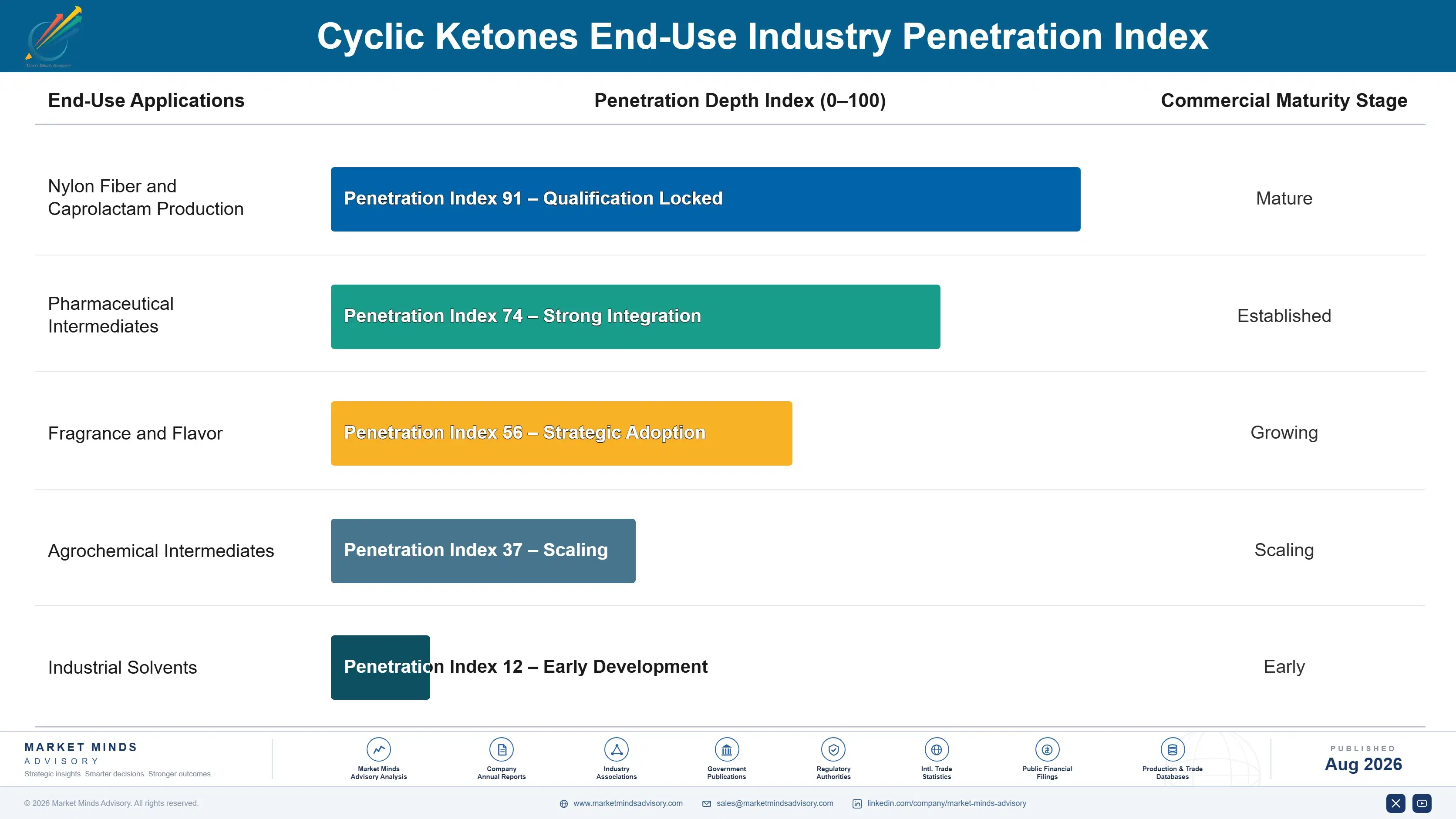
Once a cyclohexanone producer secures a long-term supply position within an integrated caprolactam complex, that relationship typically persists for the operating life of the plant, often twenty years or more, since caprolactam producers rarely re-source captive intermediate supply once a plant is commissioned. This creates durable, low-churn revenue characteristics for integrated commodity supply, distinct from the more transactional merchant market. Merchant relationships without captive integ
Adoption depth varies sharply by vertical. Pharmaceutical customers show the deepest stickiness, since requalifying an alternative cyclopentanone supplier requires regulatory filing amendments that most manufacturers avoid unless forced. Fragrance customers show similarly strong stickiness tied to multi-decade product formulations. Commodity nylon chain customers show the least stickiness, since caprolactam producers will readily switch merchant cyclohexanone suppliers for modest price advantages when not captively integrated.

Buyer profiles are shifting generationally as sustainability and environmental persistence criteria, not just price and purity, become explicit procurement factors. Younger fragrance and pharmaceutical procurement teams increasingly weigh environmental restriction risk alongside cost and performance, a shift that favors producers with credible reformulation track records over legacy commodity suppliers without specialty positioning. This shift is still early but already visible in buyer selection criteria.
cyclic-ketones-market-trends-end-use-penetration-index-1787310773999

Where MMA Sees the Opportunity

These are among the four positions where our research anticipates prominent divergence between winners and laggards over the coming forecast period. Each is grounded in the demand model, the regulatory perimeter, and the announced capacity pipeline.
01 / SPECIALTY GRADE CONVERSION

Shift Production Mix Toward Pharmaceutical and Fragrance Grades

Commodity cyclohexanone margins remain compressed by integrated caprolactam producer pricing power and Asian capacity growth, while specialty pharmaceutical and fragrance grades command two to three times commodity pricing for comparable production volume. Producers that invest in purification capacity and quality documentation systems now position themselves ahead of continued fragrance industry reformulation and pharmaceutical contract manufacturing growth. This shift requires capital investment but typically pays back within a few years given the pricing differential, making it one of the more accessible margin improvements available to mid-scale producers.
02 / BACKWARD FEEDSTOCK INTEGRATION

Integrate Backward Into Phenol Production Where Scale Allows

The 2022 European energy price spike demonstrated how quickly merchant feedstock exposure can compress margins regardless of underlying nylon chain demand strength. Producers with production concentrated in merchant phenol purchasing carry persistent cost exposure that integrated competitors like BASF and INEOS do not face to the same degree. Backward integration requires substantial capital investment and only makes sense at sufficient production scale, but where scale allows, it provides a durable and difficult-to-replicate cost advantage that persists across full commodity price cycles.
03 / PHARMACEUTICAL QUALIFICATION INVESTMENT

Pursue Pharmaceutical Supply Qualification Ahead of Demand Growth

Generic drug production growth is expanding demand for qualified cyclopentanone supply faster than most producers have priced into capacity plans, and pharmaceutical qualification, once achieved, produces relationships that persist for the full commercial life of a drug product. Producers that begin the twelve to eighteen month qualification process now, ahead of anticipated demand growth, will hold qualified positions when contract manufacturers need to add supply. Waiting risks ceding these durable relationships to competitors who moved earlier and absorbed the qualification cost first.
04 / INDIAN CAPACITY POSITIONING

Establish Early Positions in Indian Caprolactam Chain Growth

India's caprolactam and nylon fiber capacity is expanding faster than any other major market as import substitution policy support continues, creating an emerging demand pool still less contested than mature Chinese or Western markets. Producers that establish supply relationships or joint venture positions with Indian caprolactam producers now, while the market remains less consolidated, stand to capture share before competition intensifies. This window will likely narrow as Indian producers scale and domestic supply chains mature further over the coming decade.

Engagement Snapshot From the Field

A live engagement with an industry participant carrying material or product regulatory and market exposure ahead of a defining policy shift, showing how our research translates into a defensible multi-year portfolio strategy.
MARKET MINDS ADVISORY · CLIENT ENGAGEMENT SUMMARY
Cyclic Ketones Producer Strategic Portfolio Review and Transition Roadmap 2026·Investment Scenario on Cyclic Ketones Exposure Evaluation 2025-26
CLIENT PROFILE
The client is a mid-scale European cyclic ketone producer generating approximately $210 million in annual revenue (client-reported, unverified by MMA) from a mix of commodity cyclohexanone and smaller specialty cyclopentanone production. The company operates a single integrated production site in Germany and faced mounting margin pressure from rising natural gas costs and competition from lower-cost Asian commodity producers.
STRATEGIC CHALLENGE
The client needed to decide how aggressively to shift production capacity away from commodity cyclohexanone, which was becoming margin-negative at prevailing European energy costs, toward specialty pharmaceutical and fragrance-grade output requiring new purification investment of approximately $40 million (client-reported, unverified by MMA). The decision carried real risk if specialty demand growth proved slower than anticipated.
MMA APPROACH
MMA's advisory team conducted primary interviews with pharmaceutical contract manufacturers and fragrance house procurement leads to assess realistic specialty demand growth and qualification timelines, cross-referenced against European capacity announcements and energy cost forecasts. The analysis built a phased mix-shift recommendation calibrated to specialty demand visibility rather than a single all-at-once capacity conversion decision.
KEY FINDINGS
  1. Interview data indicated fragrance house demand for cyclopentanone-based musk intermediates would grow at least 9% annually through 2030, exceeding the client's initial planning assumption of 5%.
  2. Pharmaceutical qualification timelines with two target contract manufacturers averaged 14 months, within the client's available capital deployment window for the proposed purification investment.
  3. Commodity cyclohexanone margins at the client's site had turned negative during two of the prior six quarters once fully loaded energy costs were included in the analysis.
  4. A phased conversion approach, shifting 40% of capacity to specialty grades over eighteen months rather than converting all at once, reduced downside risk while preserving upside if specialty demand accelerated.
CLIENT PROFILE
The client is a mid-scale European cyclic ketone producer generating approximately $210 million in annual revenue (client-reported, unverified by MMA) from a mix of commodity cyclohexanone and smaller specialty cyclopentanone production. The company operates a single integrated production site in Germany and faced mounting margin pressure from rising natural gas costs and competition from lower-cost Asian commodity producers.
STRATEGIC CHALLENGE
The client needed to decide how aggressively to shift production capacity away from commodity cyclohexanone, which was becoming margin-negative at prevailing European energy costs, toward specialty pharmaceutical and fragrance-grade output requiring new purification investment of approximately $40 million (client-reported, unverified by MMA). The decision carried real risk if specialty demand growth proved slower than anticipated.
MMA APPROACH
MMA's advisory team conducted primary interviews with pharmaceutical contract manufacturers and fragrance house procurement leads to assess realistic specialty demand growth and qualification timelines, cross-referenced against European capacity announcements and energy cost forecasts. The analysis built a phased mix-shift recommendation calibrated to specialty demand visibility rather than a single all-at-once capacity conversion decision.
KEY FINDINGS
  1. Interview data indicated fragrance house demand for cyclopentanone-based musk intermediates would grow at least 9% annually through 2030, exceeding the client's initial planning assumption of 5%.
  2. Pharmaceutical qualification timelines with two target contract manufacturers averaged 14 months, within the client's available capital deployment window for the proposed purification investment.
  3. Commodity cyclohexanone margins at the client's site had turned negative during two of the prior six quarters once fully loaded energy costs were included in the analysis.
  4. A phased conversion approach, shifting 40% of capacity to specialty grades over eighteen months rather than converting all at once, reduced downside risk while preserving upside if specialty demand accelerated.
RECOMMENDED STRATEGY
Phase 1: Phase 1 (Months 1-6): Commission purification capacity for pharmaceutical-grade cyclopentanone while maintaining existing commodity cyclohexanone production at reduced volume levels. Phase 2: Phase 2 (Months 7-12): Secure qualified supply agreements with two target pharmaceutical contract manufacturers and one major fragrance house customer. Phase 3: Phase 3 (Months 13-18): Convert remaining flexible capacity toward specialty grades based on confirmed customer volume commitments and realized qualification outcomes.
OUTCOME
The client completed the phased conversion and secured qualified supply agreements covering approximately 70% of converted specialty capacity within the eighteen-month window, ahead of the original 50% target. The client reported that blended gross margins improved by an estimated 11 percentage points (client-reported, unverified by MMA) compared to the pre-conversion commodity-heavy product mix.

Frequently Asked Questions

Foundational context covering the market sizes, CAGR, scope, country, region and competition that inform every finding below. This section is provided to cover basics and most often pre-purchase conversations, answered from the MMA Primary Research Dataset.

What is the current size of the Cyclic Ketones Market?

The Cyclic Ketones Market was valued at $4.1 billion in 2025. MMA projects it will reach $4.33 billion in 2026 as nylon chain and specialty demand continue expanding.

How large will the Cyclic Ketones Market be by 2036?

MMA forecasts the market will reach $7.47 billion by 2036, up from $4.33 billion in 2026. That represents a 1.73 times expansion over the ten-year forecast window.

What is the CAGR for the Cyclic Ketones Market 2026 to 2036?

The market is projected to grow at a 5.6% CAGR between 2026 and 2036. MMA's bull and bear scenarios range from 6.8% to 4.4% depending on Asian capacity growth and nylon substitution trends.

Which segment is growing fastest?

Specialty and Fragrance-Grade Cyclic Ketones is the fastest-growing segment, expanding at an 8.0% CAGR, roughly 1.43 times the overall market rate as fragrance houses and pharmaceutical manufacturers increase purity-grade purchasing.

Who are the major companies in the Cyclic Ketones Market?

Evonik, BASF, INEOS, DOMO Chemicals, and Ube Corporation lead the market, together holding an estimated 48% of global production capacity. These five producers compete primarily on integrated feedstock cost position.

Which country is growing fastest?

China is the fastest-growing country market, expanding at an estimated 7.3% CAGR as continued caprolactam and nylon 6 fiber capacity additions absorb rising commodity cyclohexanone volume.

Report Segmentation Architecture

The full report scope spans multiple orthogonal segmentation dimensions, with cross-tabulated demand data provided for each dimension pair. Coverage extends further to regional breakdowns, trend trajectories, and the competitive detail needed to support segment-level decision-making.

By Primary Market Dimension

  • Cyclohexanone
  • Cyclopentanone
  • Isophorone
  • Methyl Cyclohexanone
  • Cyclododecanone
  • Specialty and Fragrance-Grade Cyclic Ketones

By End-Use Industry

  • Nylon Fiber and Caprolactam Production
  • Pharmaceutical Intermediates
  • Fragrance and Flavor
  • Agrochemical Intermediates
  • Industrial Solvents

By Commercial Dimension

  • Captive Integrated Supply
  • Merchant Commodity Sales
  • Qualified Specialty Supply
  • Distribution and Trading

By Region

  • North America
  • Western Europe
  • East Asia
  • South Asia and Pacific
  • Latin America
  • Middle East and Africa
  • Eastern Europe

Scope, Methodology, and Coverage

Every figure in this report is reproducible from documented input assumptions. The scope below maps the historical period, the forecast horizon, the segmentation dimensions, and the countries covered, alongside the underlying primary and qualitative methodology.
Historical Period
2020 to 2025
Forecast Period
2026 to 2036
Base Year
2025 (USD billions; MMA Primary Research Dataset, August 2026)
Market Definition
This report covers cyclic ketone compounds, including cyclohexanone, cyclopentanone, isophorone, methyl cyclohexanone, and cyclododecanone, produced for use as chemical intermediates, industrial solvents, and specialty fine chemical inputs. It excludes acyclic ketones such as acetone and methyl ethyl ketone, and excludes downstream caprolactam and nylon polymer production itself.
Quantitative Units
USD billions (current prices); metric tons of production capacity where applicable
Segmentation Dimensions
By Product Type; By End-Use Industry; By Commercial Dimension; By Region
Regions Covered
North America, Western Europe, East Asia, South Asia and Pacific, Latin America, Middle East and Africa, Eastern Europe
Countries Covered
USA, China, Germany, France, UK, Japan, South Korea, India, Australia, Canada, Brazil, Mexico, Indonesia, Vietnam, Thailand, Malaysia, UAE, Saudi Arabia, South Africa, Nigeria, Turkey, Poland, Netherlands, Italy, Spain, Sweden, Switzerland, Argentina, Colombia, Singapore, and additional markets relevant to this sector
Key Companies Profiled
Evonik Industries AG, BASF SE, INEOS Group Holdings S.A., DOMO Chemicals, Ube Corporation, Fibrant B.V., Lanxess AG, Solvay SA, China Petroleum & Chemical Corporation, PetroChina Company Limited, Shandong Haili Chemical Industry Co. Ltd., Gujarat State Fertilizers and Chemicals Limited, Sumitomo Chemical Co. Ltd., Mitsubishi Chemical Group Corporation, Merck KGaA, Thermo Fisher Scientific Inc., Eastman Chemical Company, OXEA GmbH, Jubilant Ingrevia Limited, Toray Industries Inc.
Quantitative Methodology
Primary survey, n=3,800 respondents, Q4 2025, six countries; demand-side model with trade association cross-validation
Qualitative Methodology
47 expert interviews, Q4 2025; applied to validate demand model assumptions, identify emerging dynamics, and assess competitive positioning
Report Format
PDF and XLSX data workbook (Word format preview document)
Publisher
Market Minds Advisory
Report Code
MMA-2026-CHM-102
Published
August 2026
Contact
sales@marketmindsadvisory.com | www.marketmindsadvisory.com

Purchase the full Cyclic Ketones Market Report (2026 to 2036).

The full Cyclic Ketones Market report delivers ten-year forecasts across all seven regions, six product segments, and the full competitive landscape of twenty profiled producers. It includes detailed analysis of integrated caprolactam chain economics, specialty grade conversion opportunities, and feedstock cost exposure by producer type. Buyers receive segment-level margin benchmarking across the volume, premium, and sustainability tiers identified in this summary. The report also includes primary survey data from 3,800 respondents and 47 expert interviews conducted in the fourth quarter of 2025, supporting every demand and pricing assumption in the forecast.
Ten-year regional and segment-level forecast models
Competitive profiles covering twenty chemical producers
Specialty grade conversion economics and case examples
Feedstock cost and integration risk modeling
Portfolio margin benchmarking across three commercial tiers
Primary survey and expert interview data appendix

Built For The People Who Decide

From boardroom strategy to bench-side execution, this report is read cover-to-cover by leaders shaping the next decade of their industry, turning demand scenarios, market dynamics and valuation benchmarks into decisions.
CXOs/ Presidents/ VPs/ Managers
M&A and Corporate Development
Strategy Teams and R&D Heads
Procurement and Product Directors
Regulatory and Compliance Leaders
Investor Relations and Equity Analysts