Market Minds Advisory
Cyber Security in Robotics Market

Cyber Security in Robotics Market: Cyber Security in Robotics Market. Endpoint Protection, Network Segmentation, and Threat Detection for Industrial and Service Robots, 2026 to 2036

Manufacturers connecting industrial robots to plant networks for real-time analytics are discovering those connections create attack surfaces robot vendors never designed defenses for, forcing a scramble toward purpose-built security software.

Lead Analyst

Published

September 2026

Make Smarter Decisions with Customized Research Insights

Request a free sample report and evaluate market opportunities, growth trends, and competitive dynamics relevant to your business needs.

2025 MARKET VALUE$1.4BMarket Size 2025
2036 FORECAST VALUE$6.2BBase Case , 2026 to 2036
CAGR 2026 TO 203614.5 %Bull 15.8% / Bear 13.2%
INCREMENTAL OPPORTUNITY$4.6BNet 10- year value creation
EXPANSION MULTIPLE3.88x2036 value over 2026 base
Strategic Levers
M&A Pipeline
Regional Outlook
Country Rankings
Competitive Intelligence
Segmental Deep-dive
Call-Us : 91 93563 13602

Executive Snapshot and Market Trajectory.

Industrial robots built on decades-old controller architectures never anticipated network connectivity, and retrofitting real security onto that installed base now consumes far more security budget than protecting newly purchased, connectivity-native robots ever will across most manufacturing facilities operating anywhere in the world today, regardless of sector, scale, or exact geography.
Demand concentrates around endpoint protection for legacy robot controllers and network segmentation solutions that isolate robotic cells from broader plant networks without disrupting real-time production control loops, since manufacturers cannot tolerate the latency general-purpose IT security tools introduce into safety-critical motion control systems governing factory floor operations nationwide. East Asian manufacturers, operating the world's densest industrial robot installed base, drive the largest share of near-term demand.
Competitive intensity is rising as traditional industrial automation vendors bundle basic security features into robot controllers directly, pressuring specialized cybersecurity firms to differentiate through deeper threat detection and firmware integrity verification capability, while insurers increasingly require documented security posture before underwriting robotics-heavy manufacturing facilities nationwide, a requirement virtually unheard of before 2023 and now spreading rapidly across most major industrial insurance markets globally each and every single calendar year now.
Market Definition
The Cyber Security in Robotics Market covers endpoint protection, network segmentation, identity and access management, security monitoring, and firmware integrity verification software designed specifically for industrial and service robots. It excludes general enterprise IT security software, physical robot safety systems, and cybersecurity for non-robotic industrial control systems unless directly integrated with robotic cell operation.
Base Year Value
$1.4B in 2025 (MMA Primary Research Dataset, September 2026)
Forecast Period
2026 to 2036, eleven discrete annual values
CAGR
14.5% base case. Bull 15.8%. Bear 13.2%.
Fastest Growth Segment
Security Monitoring and Threat Detection Platforms: 17.5% CAGR
Fastest Growth Country
South Korea: 18.0% CAGR
Fastest Growth Region
South Asia and Pacific: 16.5% CAGR
Largest Region
East Asia: 30% of 2025 global value
Market Leaders
Fortinet, Claroty, Nozomi Networks, Dragos, and Cisco lead by deployed robotics security endpoint volume. Source: MMA Primary Research Dataset, July 2026.
Primary Survey
n=3,800 procurement and R&D decision-makers, Q4 2025, six countries
Methodology
Demand-side build-up, cross-validated against public data, 47 expert interviews

Cyber Security in Robotics Market Forecast Scenarios

cyber-security-in-robotics-market-size-forecast-scenario-1789989925725
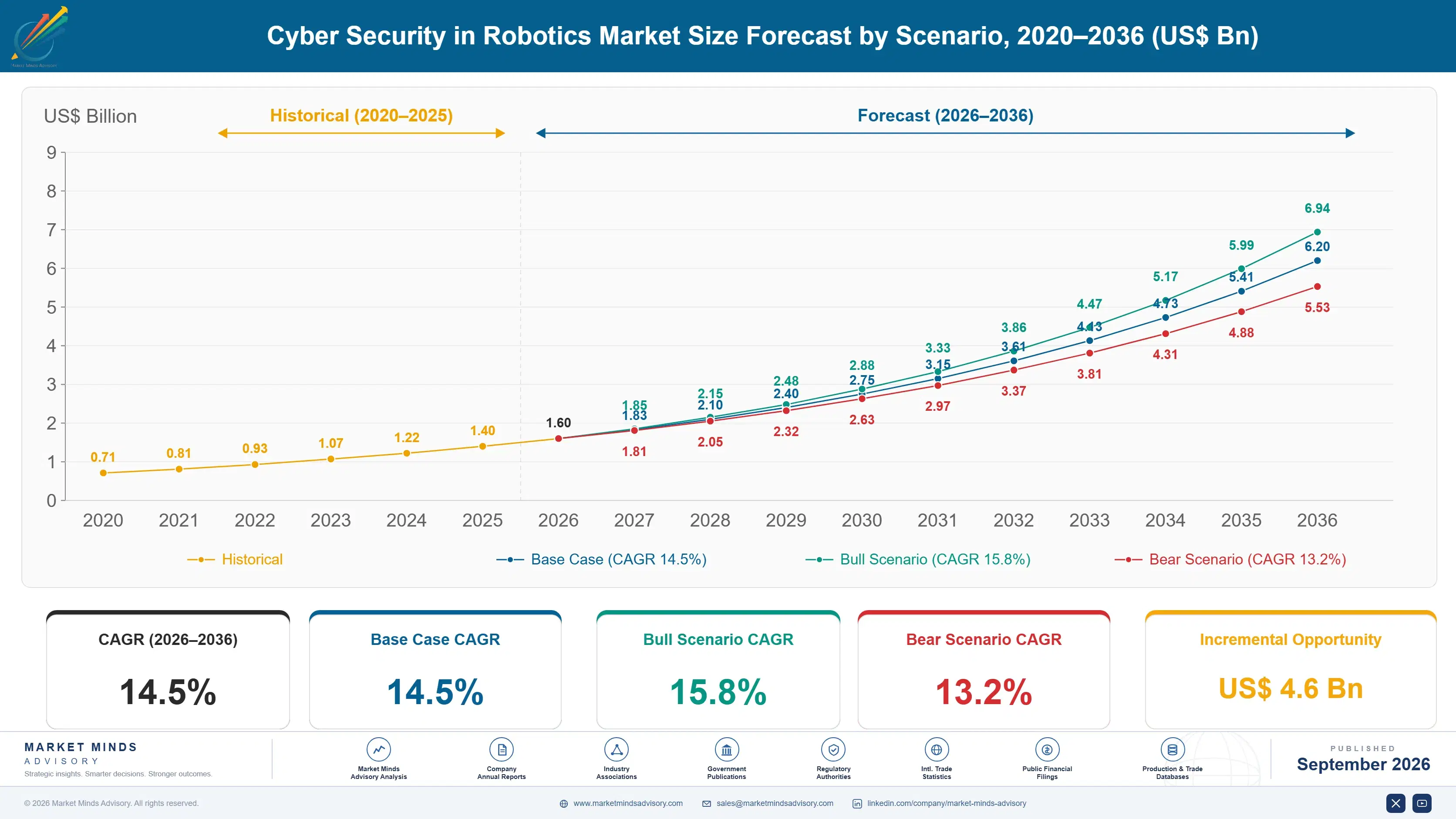
Between 2020 and 2025, robotics cybersecurity emerged from a niche academic and defense concern into a genuine commercial category as several high-profile industrial robot breaches, publicly documented in national cybersecurity agency advisories, demonstrated real production disruption risk that manufacturers could no longer dismiss as purely theoretical, prompting the first dedicated procurement budgets for this category.
The base case assumes continued expansion of network-connected robot deployment requiring dedicated security software, sustained regulatory pressure toward mandatory industrial control system security disclosure, and growing insurer requirements for documented security posture as a precondition for underwriting robotics-heavy facilities across most jurisdictions. Together these three mechanisms sustain strong double-digit growth through 2036, with East Asian manufacturers leading adoption given their concentrated robot density and correspondingly larger attack surface across dense industrial clusters nationwide.
A bull scenario assumes a major publicized robotics breach accelerates mandatory security adoption faster than current regulatory timelines suggest across multiple jurisdictions simultaneously and without much advance warning at all. A bear scenario assumes budget-constrained manufacturers continue treating robotics security as discretionary spending, delaying adoption until regulation forces compliance rather than adopting proactively ahead of formal mandates.

Where Legacy Controllers Define the Attack Surface

Robotics cybersecurity has moved from an afterthought bolted onto general industrial control system security programs to a standalone procurement category with its own dedicated budget line and evaluation criteria of its own, reflecting how differently robot-specific attack vectors behave compared to conventional IT network threats manufacturers have defended against for decades already.
MARKET CONCENTRATION (CR5)35%Top five vendors hold roughly a third of deployed endpoints
COST PER PROTECTED ROBOT$850Typical annual security software cost per connected robot unit
EAST ASIA DENSITY SHARE42%Share of world's installed industrial robots located in this region
DOCUMENTED BREACH GROWTH RATE31%Year-over-year increase in publicly disclosed robotics security incidents
DETECTION SHARE OF COGS28%Portion of software development cost from detection engine research
AVERAGE DEPLOYMENT TIMELINE4 monthsTypical time from contract signing to full facility coverage
East Asian manufacturers, operating the world's densest industrial robot installed base, face the largest aggregate attack surface and consequently drive the largest share of near-term security software demand across the region. Legacy robot controllers deployed before network connectivity became standard represent the hardest and most expensive segment to secure, since retrofitting security onto proprietary, decades-old firmware architectures requires specialized expertise general IT security vendors simply lack.
Documented breach volume has grown considerably faster than overall robot deployment, suggesting attackers are actively targeting robotic systems specifically rather than robots simply appearing more often in general industrial breach statistics by coincidence alone. This has pushed insurers to treat robotics security posture as a genuine underwriting factor, a shift that took most manufacturers by surprise given how recently this requirement appeared in commercial insurance contracts nationwide.
"Robot vendors spent thirty years optimizing for uptime and precision, never for adversarial network traffic. Retrofitting that mindset onto a controller built in 2008 is harder than securing anything built with connectivity in mind from day one."
Director, Operational Technology and Robotics Security Practice · MMA Technology Practice · September 2026

Market Trends

Insurers Now Require Documented Security Posture

Commercial property and business interruption insurers covering robotics-heavy manufacturing facilities have begun requiring documented cybersecurity posture assessments as a precondition for coverage, a requirement that barely existed before 2023 but has spread rapidly across major industrial insurance underwriters since. This shift has created immediate procurement urgency for manufacturers previously treating robotics security as a discretionary investment, since failing an insurer's security assessment now carries direct financial consequences through higher premiums or denied coverage. Security vendors have responded by developing standardized assessment frameworks specifically designed to satisfy insurer documentation requirements, streamlining what was previously an ad hoc compliance process.
Market Impact: Connected robot units grew 45% recently

AI-Driven Anomaly Detection Reaches Commercial Maturity

Security monitoring platforms increasingly use AI-driven anomaly detection trained on normal robot motion and network traffic patterns to flag deviations that signal a compromise, moving beyond signature-based detection methods poorly suited to the highly repetitive, predictable behavior robots normally exhibit during standard production operation each day. Vendors report meaningfully faster threat identification using this approach compared to traditional intrusion detection systems designed for general IT networks rather than the specific rhythms of industrial robot operation. This capability has become a genuine competitive differentiator among the leading security monitoring vendors specifically today.
Market Impact: Compliance deadlines run 2026 to 2028

Market Opportunities and Growth Drivers

Network-Connected Robot Deployment Expands Attack Surface

Manufacturers connecting industrial robots to plant networks for real-time production analytics and predictive maintenance have inadvertently expanded the attack surface available to malicious actors, since these connections often bypass the network segmentation controls originally designed for isolated, standalone robotic cells operating without external connectivity. Security budgets have grown in direct proportion to this connectivity expansion, as manufacturers recognize that the same network links delivering valuable operational data also create pathways attackers can exploit to disrupt production or steal proprietary manufacturing process information. This dynamic shows no sign of slowing as connectivity initiatives continue expanding across most manufacturing sectors.
Market Impact: Retrofitting costs run 3x new deployment

Regulatory Pressure Mandates Industrial Control System Disclosure

Several major regulatory jurisdictions have introduced mandatory industrial control system security disclosure requirements since 2024, compelling manufacturers to document and report security incidents affecting robotic systems in ways previously left entirely voluntary across most affected markets. This regulatory shift has forced manufacturers to formalize security programs that many previously handled informally or not at all, creating structured procurement processes and dedicated budget allocation where none existed before across most affected industrial sectors. Compliance deadlines have accelerated adoption timelines considerably faster than organic market demand alone would have produced without this regulatory push.
Market Impact: Certification testing adds 6 months

Market Restraints and Challenges

Retrofitting Legacy Controllers Remains Prohibitively Costly

Many industrial robots operating today run on proprietary firmware architectures designed a decade or more before network security was a design consideration, and the root cause is these controllers simply lack the processing headroom and software interfaces modern security agents require to function properly. The commercial impact leaves the oldest, often highest-risk robots the hardest and most expensive to secure, creating a persistent gap between where security investment is most needed and where it can actually be deployed. Vendors are mitigating this by developing lightweight network-based monitoring that observes robot behavior externally without requiring software installed on the controller.
Market Impact: Insurer-driven demand grew 31% in 2025

Security Tools Risk Disrupting Safety-Critical Motion Control

General-purpose IT security tools designed for conventional office networks introduce latency and processing overhead that can interfere with the millisecond-level timing precision safety-critical robot motion control systems require to operate correctly, and the root cause is that these tools were never designed with real-time industrial control constraints in mind. The commercial impact makes manufacturers understandably cautious about deploying unproven security software near production-critical robotic cells where any disruption carries direct safety and output consequences. Vendors are mitigating this through extensive real-time performance certification testing before general availability release to manufacturing customers.
Market Impact: Detection speed improved by roughly 60%
4 additional market trends, 3 additional growth drivers, and 4 additional restraints and challenges are covered in the full report. Contact sales@marketmindsadvisory.com to access the complete intelligence.

Segment CAGR and Growth Architecture

Robotics cybersecurity divides into five categories distinguished by security function within the robot's operational stack, from endpoint-level protection through network architecture and behavioral monitoring across the entire deployment. Robot endpoint security, network segmentation, identity and access management, security monitoring and threat detection, and firmware integrity verification each carry distinct deployment models and technical requirements.
cyber-security-in-robotics-market-market-share-analysis-1789989926630

Security Monitoring and Threat Detection Platforms

Security monitoring and threat detection platforms have become the fastest-growing category because they let manufacturers identify compromise without requiring invasive software changes to legacy robot controllers that often cannot support modern endpoint security agents at all given their limited processing capacity and quite outdated architecture. AI-driven behavioral analysis trained on normal robot motion patterns increasingly replaces signature-based detection methods poorly suited to the highly repetitive, predictable operation robots normally exhibit during standard production cycles. Vendors report this category converting the fastest among previously hesitant manufacturers, since monitoring deployment requires no modification to existing robotic hardware or firmware, removing the safety certification concerns that slow adoption of more invasive security approaches.
CAGR 17.5%

Firmware Integrity Verification Solutions

Firmware integrity verification solutions have grown quickly as manufacturers seek assurance that robot controller firmware has not been tampered with, either during the manufacturing supply chain or through unauthorized access after deployment, a concern that has intensified considerably following several documented supply chain compromise incidents affecting industrial equipment broadly across multiple sectors, industries, and geographies worldwide. These solutions cryptographically verify firmware against known-good baselines, flagging any unauthorized modification before it can affect robot behavior in production. Adoption concentrates heavily among defense-adjacent and critical infrastructure manufacturers facing the highest supply chain security scrutiny, though commercial manufacturing adoption is expanding steadily as awareness of firmware-level attack vectors spreads beyond specialized security circles.
CAGR 15.5%
Full segment breakdown across 5 segments available in the complete report.

Regional Architecture and Country Demand Map

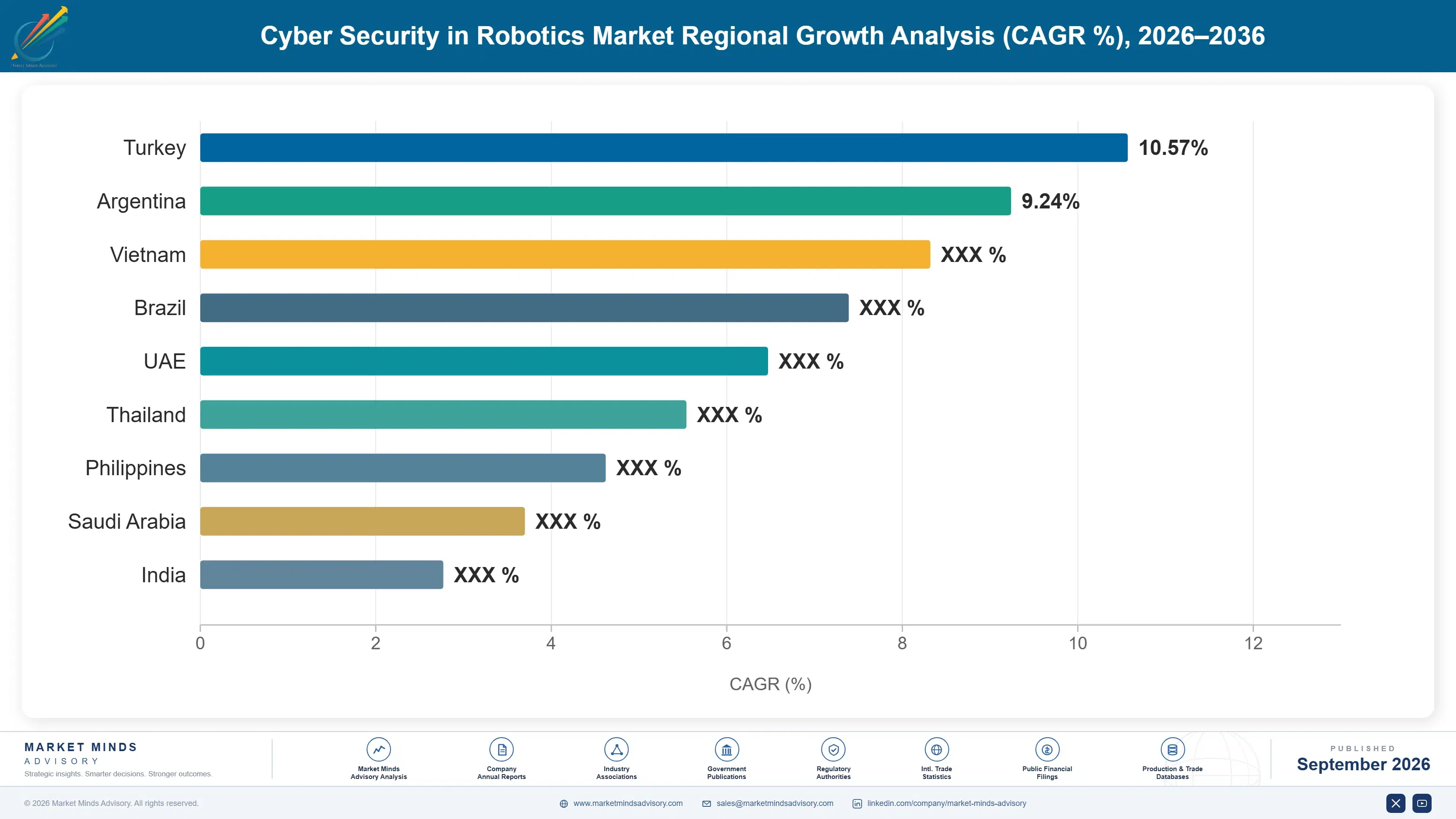
East Asia accounts for the largest share of robotics cybersecurity revenue, reflecting the region's unmatched industrial robot density across Japan, South Korea, and China. South Asia and Pacific posts the fastest regional growth rate as robot deployment accelerates rapidly from a considerably smaller installed base.

North America

North America's robotics cybersecurity revenue reflects a mature industrial base with meaningful legacy robot installed volume requiring retrofit security alongside steady new deployment across automotive, logistics, and warehouse automation applications spread nationwide across the entire region. Regulatory pressure toward mandatory industrial control system security disclosure has intensified considerably since 2024, pushing manufacturers who previously treated robotics security informally toward formal, budgeted security programs with dedicated staff and clear reporting lines. Insurance requirements have become a particularly powerful adoption driver in this region specifically, since commercial property insurers covering large manufacturing facilities increasingly condition coverage on documented security posture assessments that many manufacturers had never previously undergone before this shift began.
Share: 27% | CAGR: 14.0% (2026 to 2036)

Western Europe

Western Europe's robotics cybersecurity revenue reflects strong industrial automation adoption across German, French, and Nordic manufacturing, combined with some of the world's most stringent data protection and industrial cybersecurity regulation actively shaping vendor product requirements across the entire region and its many close neighbors. European Union critical infrastructure security directives introduced since 2024 have extended coverage to robotics-heavy manufacturing facilities specifically, formalizing security obligations that previously existed only as informal industry best practice guidance among manufacturers. German manufacturers, given their globally recognized engineering rigor, have set particularly demanding security certification requirements that vendors serving this market must satisfy before winning meaningful contracts across the broader region and its neighboring countries.
Share: 20% | CAGR: 13.0% (2026 to 2036)
Regional intelligence for 5 additional markets available in the complete report: East Asia, South Asia and Pacific, Latin America, Middle East and Africa, Eastern Europe. Contact sales@marketmindsadvisory.com.
cyber-security-in-robotics-market-country-cagr-analysis-1789989927530

Where Robotics Security Vendors Build Margin

Security vendors are testing new commercial structures to capture more value from a category where hardware-agnostic monitoring increasingly competes against traditional per-endpoint licensing that dominated the category's early years of existence across the industry. The levers below reflect where the industry is actively investing to build recurring, higher-margin revenue beyond basic software licensing fees.

Bundling Insurer-Ready Compliance Reporting Into Subscriptions

Vendors are packaging standardized insurer-compliant security assessment reporting directly into subscription pricing rather than selling it as a separate consulting engagement, commanding a price premium of 20 to 25 percent given the immediate underwriting value this documentation provides manufacturers facing renewal deadlines each year. This bundled approach shortens sales cycles considerably, since manufacturers facing an approaching insurance renewal deadline value the speed of pre-built compliance reporting over building a custom assessment process internally from scratch each time. Vendors without this capability increasingly lose deals to competitors offering it as standard.
Market Impact: Commands a premium of 20 to 25 percent

Selling Managed Detection and Response Services

Vendors are increasingly offering managed detection and response services layered on top of monitoring software licenses, providing round-the-clock human analyst review for manufacturers lacking dedicated internal security operations staff capable of interpreting alerts around the clock each day. This service layer typically adds 30 to 40 percent to total contract value, reflecting the genuine scarcity of specialized robotics security analysts most manufacturers cannot economically hire directly onto their own staff. Adoption has grown fastest among mid-sized manufacturers too small to justify a dedicated internal security team but too exposed to skip monitoring entirely.
Market Impact: Managed services add 30 to 40 percent value

Charging Retrofit Premiums for Legacy Controller Support

Vendors supporting older, proprietary robot controller architectures charge meaningfully more than for modern connectivity-native robots, reflecting the specialized engineering required to build compatible security agents for firmware never designed with third-party software integration in mind at all. This retrofit premium typically runs 35 to 45 percent above standard pricing, and manufacturers generally accept it given the alternative of leaving legacy robots entirely unprotected rather than paying the specialized integration cost required to secure them properly. Vendors with the deepest legacy controller compatibility libraries command the strongest pricing power in this specific segment.
Market Impact: Retrofit premiums run 35 to 45 percent higher

Licensing Threat Intelligence Feeds to Smaller Vendors

Larger vendors with proprietary robotics-specific threat intelligence, built from monitoring a large installed base of deployed endpoints, are increasingly licensing that intelligence feed to smaller regional security vendors lacking comparable scale to develop equivalent threat data independently themselves. This licensing arrangement typically returns 10 to 15 percent of the licensee's resulting security revenue, a meaningful ongoing royalty stream for the intelligence provider that requires minimal incremental cost to sustain once the underlying detection infrastructure already exists at scale. Licensing revenue has grown steadily as more regional vendors enter price-sensitive emerging markets.
Market Impact: Licensing typically returns 10 to 15 percent royalty

Who Controls the Margin Pool

Robotics cybersecurity vendor revenue concentrates moderately at the top, with the five leading providers holding roughly 35 percent combined share, reflecting how recently this category emerged as a standalone procurement line separate from general industrial control system security. Fortinet and Claroty lead by this measure, drawing on established operational technology security platforms extended to cover robotic endpoints. Nozomi Networks trails the two leaders somewhat in pure robotics revenue, though it holds strong positions in the broader industrial monitoring category.
Current competitive activity centers on AI-driven behavioral monitoring development, as vendors race to differentiate detection accuracy for the highly repetitive motion patterns robots exhibit compared to general IT network traffic. Several vendors have announced standardized insurer-compliant reporting frameworks bundled with core monitoring products, while partnership activity between security vendors and robot manufacturers has increased considerably.

Emerging pressure comes from traditional industrial automation vendors bundling basic security features directly into robot controllers, threatening to commoditize the entry-level tier specialized security firms once served exclusively. Rankings among established vendors are likely to shift as legacy controller retrofit capability becomes a genuine differentiator, favoring vendors with the deepest compatibility libraries over those focused primarily on newer, connectivity-native platforms.
cyber-security-in-robotics-market-company-positioning-matrix-1789989928428

Competitive Moat and Risk Dimensions

FORTINET

Moat: Established OT Security Platform Reach

Fortinet's broad operational technology security platform, already deployed across thousands of industrial facilities for general network protection, gives it an existing customer relationship and installed infrastructure base that specialized robotics-only vendors must build from scratch. This positions Fortinet to cross-sell robotics-specific modules into accounts already running its broader security platform.
FORTINET

Risk: Less Robotics-Specific Detection Depth

Fortinet's broad platform approach means its robotics-specific behavioral detection capability generally trails specialized vendors who built their entire product around robot motion pattern analysis from the outset of development. This risks losing the most security-sophisticated robotics-heavy accounts to specialists offering deeper, more robot-tailored detection accuracy.
CLAROTY

Moat: Deep Industrial Protocol Expertise

Claroty's origins in industrial control system security give it deep expertise in the proprietary communication protocols robot controllers use, expertise general IT security vendors typically lack entirely. This protocol-level knowledge lets Claroty detect anomalies that protocol-agnostic competitors simply cannot identify, a genuine technical differentiator among security-sophisticated manufacturing buyers evaluating vendors closely.
CLAROTY

Risk: Premium Pricing Limits Smaller Buyers

Claroty's premium, protocol-depth-focused positioning limits its addressable market among smaller manufacturers who cannot justify its pricing relative to more basic monitoring alternatives, ceding this segment to lower-cost competitors. As robotics security adoption broadens toward smaller manufacturers, Claroty's positioning may constrain its share of the fastest-growing volume segment specifically.

Players Tracked

Prominent Players

Fortinet
Claroty
Nozomi Networks
Dragos
Cisco

Other Key Players

Armis
Tenable
Palo Alto Networks
Check Point Software
Darktrace
Honeywell Forge Cybersecurity
Schneider Electric Cybersecurity
Radiflow
SCADAfence
Xage Security
Cyberbit
Waterfall Security Solutions
Cylus
OTORIO
Forescout

Recent Developments

JANUARY 2026

Fortinet Launches Robotics Security Module

Fortinet launched an expanded robotics security module for its operational technology security platform, adding behavioral monitoring specifically tuned to industrial robot motion patterns rather than general OT network traffic. The module extends Fortinet's existing customer base into dedicated robotics-specific coverage without requiring a separate platform purchase.
Signal: Signals established OT security vendors are extending platforms into robotics-specific coverage rather than ceding it entirely
SEPTEMBER 2025

Claroty Partners on Embedded Firmware Security

Claroty announced a partnership with a major industrial robot manufacturer to embed protocol-level security monitoring directly into new robot controller firmware, rather than requiring a separate retrofit installation after initial purchase and delivery. The partnership targets manufacturers seeking security capability built in from the outset.
Signal: Signals security vendors and robot manufacturers are increasingly embedding protection during manufacturing rather than after deployment
APRIL 2025

Nozomi Expands Firmware Integrity Verification

Nozomi Networks expanded its firmware integrity verification capability following several documented supply chain compromise incidents affecting industrial equipment broadly across multiple sectors, adding cryptographic baseline verification for a considerably wider range of robot controller architectures. The expansion targets defense-adjacent and critical infrastructure manufacturers facing heightened scrutiny.
Signal: Signals firmware integrity verification is moving from a niche defense concern into mainstream commercial manufacturing security

What Drives Robotics Security Development Cost

Security research and detection engineering labor represents the dominant input cost for robotics cybersecurity software, typically running 50 to 60 percent of total development cost, sourced primarily from specialized operational technology security researchers concentrated in North America, Israel, and Western Europe specifically. Threat intelligence licensing and cloud infrastructure round out the remaining major cost categories.
Specialized OT and robotics security research talent compensation rose sharply during 2023 and 2024 as demand for this narrow skill set outpaced the small existing pool of qualified researchers available, a dynamic documented in multiple cybersecurity industry salary surveys covering that period. Vendors competing for the same limited talent pool found themselves bidding up compensation considerably, particularly for researchers with hands-on industrial robot protocol experience.

Smaller vendors without established research teams absorb talent cost increases directly into product pricing, pricing them out of competing for the largest enterprise manufacturing contracts against better-capitalized rivals with deeper research budgets available to draw upon. This dynamic favors vendors like Fortinet and Claroty with substantial existing security research organizations, while smaller specialized firms face considerably thinner margins on comparable detection capability offered to customers.
cyber-security-in-robotics-market-cost-volatility-analysis-1789989928780

Building Research Talent Pipelines With Universities

Vendors are partnering directly with university cybersecurity and robotics programs to build dedicated talent pipelines, addressing the specialized research talent shortage at its source rather than competing purely on compensation after graduation from these partner institutions each year. This approach takes longer to show measurable results but produces more loyal research talent over time.

Sharing Threat Intelligence Through Industry Consortiums

Vendors are participating in shared threat intelligence consortiums specific to industrial robotics, distributing the cost of threat research across multiple member organizations rather than each vendor duplicating equivalent research independently and at considerable ongoing expense each year. This lowers per-vendor research cost meaningfully while improving overall detection accuracy for every participating member vendor involved.

Automating Detection Rule Development With AI Tools

Vendors are using AI-assisted tools to accelerate detection rule development, reducing the number of specialized researcher hours required to build and maintain behavioral detection models for each new robot platform variant entering the market each and every year across the entire industry. This offsets rising research compensation costs without cutting detection quality or accuracy.

Portfolio Architecture for Margin Defence

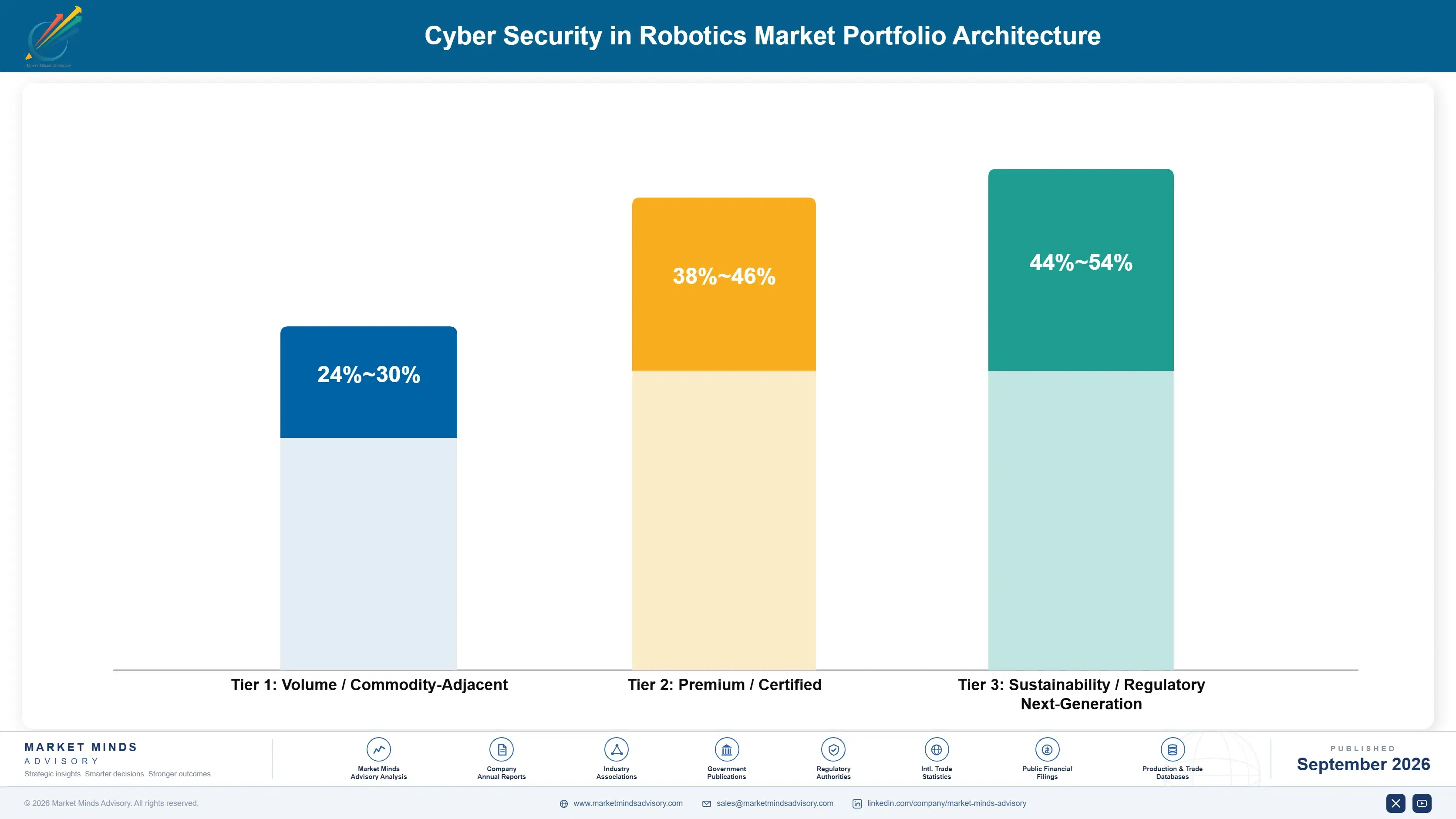
Robotics cybersecurity splits into three margin tiers reflecting detection sophistication and deployment complexity across the industry today and going forward. Standardized network segmentation and basic endpoint protection run on volume economics with thinner per-unit margins, while AI-driven monitoring and firmware integrity verification command materially higher margins given their specialized detection engineering.
Tension between volume and premium tiers shows up in how vendors allocate research investment, since AI-driven behavioral detection and firmware verification require ongoing specialized engineering that standardized segmentation products no longer need at the same intensity as before across most product lines and configurations. Vendors increasingly treat mature segmentation products as a stable volume generator, funding premium detection and verification development from that steadier baseline revenue stream.

High-value margin pools concentrate specifically in AI-driven threat detection, firmware integrity verification, and managed detection response services, all of which combine strong pricing power with meaningful barriers to entry from specialized research expertise across the entire broader industry today. Standardized endpoint and network segmentation products represent the largest volume pool but the thinnest margins, having become increasingly commoditized as automation vendors bundle basic security features directly into controllers.

Volume / Commodity-Adjacent

Standardized network segmentation and basic endpoint protection sold at accessible pricing across high-volume manufacturing deployment programs to maximize protected robot unit volume broadly across the market and its many sectors.
Gross Margin: 24-30%

Premium / Certified

Identity and access management and mid-tier monitoring solutions sold as differentiated products commanding stronger per-unit pricing power than commodity segmentation alternatives available broadly across the wider market and industry today.
Gross Margin: 38-46%

Sustainability / Regulatory / Next-Generation

AI-driven threat detection, firmware integrity verification, and managed detection response services addressing the industry's most sophisticated and highest-value security requirements across most sectors, geographies, and manufacturing types found across the world.
Gross Margin: 44-54%
cyber-security-in-robotics-market-portfolio-architecture-1789989929657

High-value Sub-segments and Strategic Watch-out

AI-Driven Threat Detection and Monitoring

AI-driven threat detection and monitoring platforms combine strong growth with strong margins, driven by manufacturers seeking non-invasive security compatible with legacy controllers that cannot support traditional endpoint agents given their limited processing capacity and considerable age, a growing share of the total installed base today.
Gross Margin: 46-54%

Firmware Integrity Verification Solutions

Firmware integrity verification solutions post healthy margins and strong growth as supply chain compromise concerns intensify across the broader industrial equipment sector, though absolute revenue remains smaller than monitoring categories given the still-developing awareness of firmware-level attack vectors among mainstream manufacturers outside defense-adjacent segments specifically.
Gross Margin: 42-50%

Robot Endpoint Security Software

Standardized network segmentation and endpoint protection remain the volume core of the market, deploying across the vast majority of manufacturing facilities at accessible pricing, and vendors rely heavily on this segment for stable baseline revenue even as margins continue to compress steadily each passing year.
Gross Margin: 24-30%

Identity and Access Management for Robotic Systems

Identity and access management solutions warrant close monitoring as automation vendors increasingly bundle basic access control directly into robot controllers, threatening to displace standalone vendors from a segment that once provided steady, dependable revenue without requiring major product differentiation from competing vendors nationwide or abroad.
Gross Margin: 32-40%

Why Robotics Security Spend Compounds

Robotics cybersecurity behaves like a genuine annuity business once a manufacturer signs an initial monitoring or endpoint protection contract, since securing the first facility typically leads to expansion across every additional facility operating similar robot models within a few years. Repeat manufacturing clients account for a meaningfully larger share of vendor revenue than first-time buyers, and vendors structure pricing specifically to reward multi-facility commitments over single-site purchases.
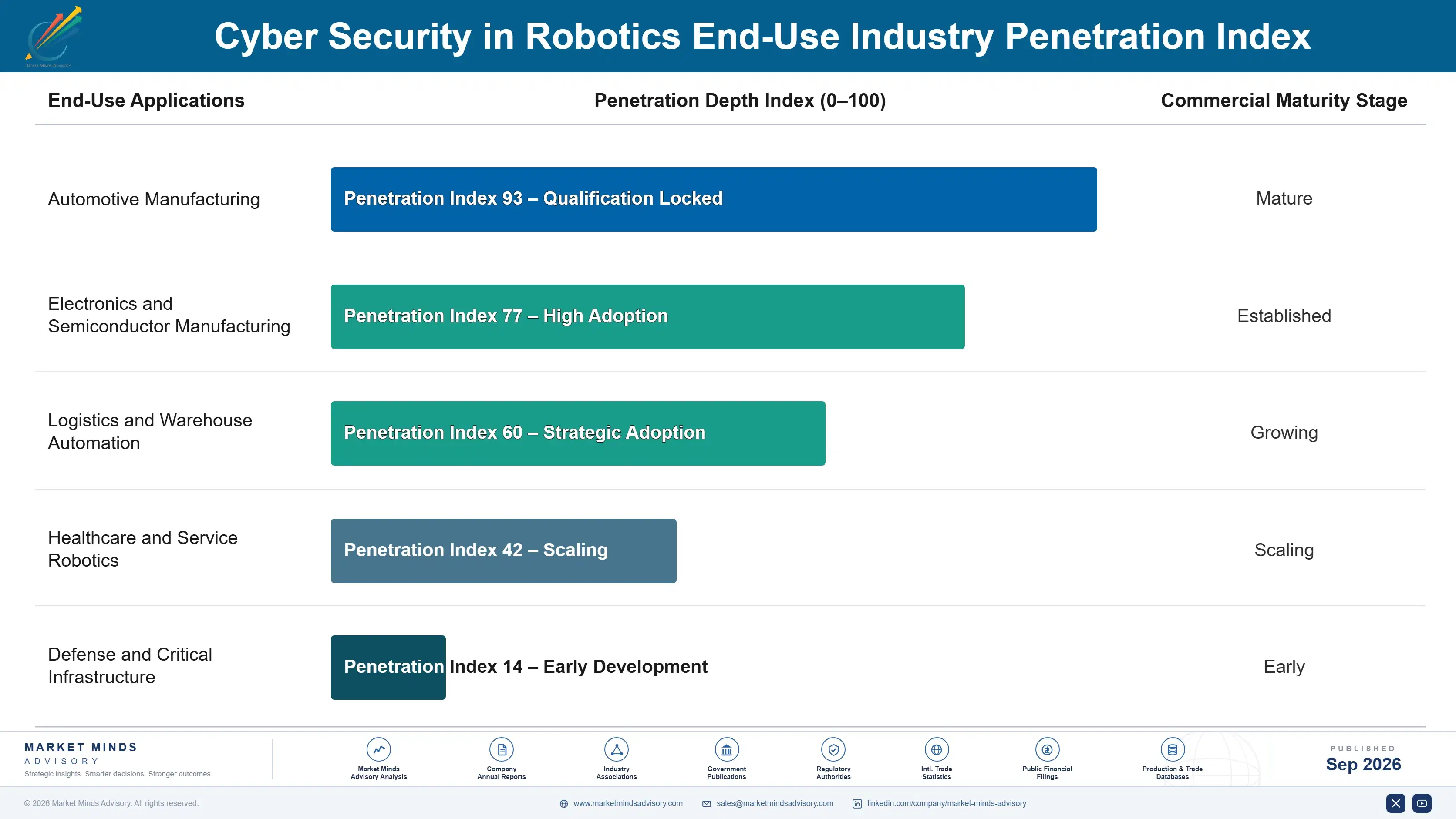
Adoption stickiness varies considerably by end-use vertical: automotive and electronics manufacturers with the densest robot deployments and highest breach exposure adopt security fastest and most completely, while smaller manufacturers with only a handful of robots often delay adoption until insurance or regulatory requirements force the decision. This uneven adoption pattern shapes which vendors compete most aggressively in which customer segment.

Buyer profiles are shifting generationally as manufacturing security procurement increasingly involves dedicated operational technology security specialists rather than relying solely on traditional plant engineering leadership, pushing vendors to demonstrate detection sophistication alongside basic compatibility claims during evaluation. This generational shift favors vendors who can speak credibly to both cybersecurity technical depth and traditional industrial engineering requirements simultaneously and consistently.
cyber-security-in-robotics-market-end-use-penetration-index-1789989930469

Priorities for Robotics Security Vendors

These are among the four positions where our research anticipates prominent divergence between winners and laggards over the coming forecast period. Each is grounded in the demand model, the regulatory perimeter, and the announced capacity pipeline.
01 / LEGACY RETROFIT CAPABILITY INVESTMENT

Build Deep Legacy Controller Compatibility Libraries

The oldest, often highest-risk robots running proprietary firmware architectures represent the hardest and most expensive segment to secure, and vendors without genuine retrofit capability increasingly lose deals to competitors who invested early in legacy controller compatibility. Building this capability requires substantial upfront engineering investment against a large and fragmented universe of legacy controller variants, but the payoff comes through retrofit pricing premiums manufacturers accept given they have no viable alternative. Vendors who skip this investment cede the entire legacy installed base to better-prepared rivals.
02 / INSURER COMPLIANCE DOCUMENTATION PRIORITY

Build Standardized Insurer-Ready Reporting Now

Insurers increasingly require documented security posture before underwriting robotics-heavy manufacturing facilities, and vendors offering standardized, insurer-compliant reporting bundled directly into their core product win deals faster than those requiring a separate consulting engagement to produce equivalent documentation each time. This capability has become a genuine competitive differentiator as insurance requirements spread rapidly across major industrial underwriters, creating urgent procurement pressure many manufacturers previously lacked entirely. Vendors without this capability increasingly lose renewal negotiations to better-prepared competitors offering it as standard.
03 / NON-INVASIVE MONITORING DEVELOPMENT FOCUS

Prioritize Network-Based Monitoring Over Endpoint Agents

Legacy robot controllers frequently lack the processing headroom to support modern endpoint security agents, making non-invasive, network-based monitoring the only viable protection option for a substantial share of the installed base manufacturers still operate today. Vendors who prioritize this capability capture the fastest-growing segment of the market, since monitoring deployment requires no modification to existing robotic hardware or firmware and avoids the safety certification concerns that slow more invasive approaches. This positioning advantage compounds as connected robot deployment continues expanding.
04 / RESEARCH TALENT RETENTION STRATEGY

Invest in University Partnerships Rather Than Bidding Wars

Specialized OT and robotics security research talent compensation has risen sharply as demand for this narrow skill set outpaces the small existing pool of qualified researchers, making pure compensation-based competition for talent an increasingly unsustainable strategy for smaller vendors overall. Vendors who instead build dedicated university partnership pipelines address the talent shortage at its source, producing more loyal researchers over time than those hired purely through aggressive counteroffers. This approach requires patience but delivers considerably better long-term research team stability.

Engagement Snapshot From the Field

A live engagement with an industry participant carrying material or product regulatory and market exposure ahead of a defining policy shift, showing how our research translates into a defensible multi-year portfolio strategy.
MARKET MINDS ADVISORY · CLIENT ENGAGEMENT SUMMARY
Cyber Security in Robotics Producer Strategic Portfolio Review and Transition Roadmap 2026·Investment Scenario on Cyber Security in Robotics Exposure Evaluation 2025-26
CLIENT PROFILE
The client is a mid-size automotive parts manufacturer operating three production facilities with roughly 340 industrial robots, many running proprietary controller architectures installed over the past fifteen years without any dedicated cybersecurity budget or formal security program in place until quite recently, when insurance requirements changed abruptly and finally forced the issue into the open.
STRATEGIC CHALLENGE
The manufacturer faced a renewal deadline from its commercial property insurer requiring documented robotics security posture assessment for the first time, without an internal team capable of evaluating which of its 340 robots represented the highest-priority security risk given a genuinely limited available security budget for the current fiscal year.
MMA APPROACH
MMA conducted a facility-wide robot inventory and risk assessment, categorizing each of the 340 robots by controller age, network connectivity status, and production criticality, then modeled security investment priority against the insurer's specific documentation requirements and the manufacturer's available budget for the current fiscal year and the one following it.
KEY FINDINGS
  1. Roughly 40 percent of the robot fleet ran on legacy controllers requiring specialized retrofit security rather than standard endpoint protection agents available for newer models.
  2. Network-based monitoring, requiring no controller modification, addressed the highest-risk legacy robots at meaningfully lower cost than a full endpoint retrofit program would have required.
  3. The insurer accepted the phased security assessment documentation, avoiding a coverage lapse that would have exposed the manufacturer to significant uninsured production risk.
  4. Total security investment came in under the manufacturer's original budget estimate by prioritizing monitoring over costly endpoint retrofits for the oldest controller generations.
CLIENT PROFILE
The client is a mid-size automotive parts manufacturer operating three production facilities with roughly 340 industrial robots, many running proprietary controller architectures installed over the past fifteen years without any dedicated cybersecurity budget or formal security program in place until quite recently, when insurance requirements changed abruptly and finally forced the issue into the open.
STRATEGIC CHALLENGE
The manufacturer faced a renewal deadline from its commercial property insurer requiring documented robotics security posture assessment for the first time, without an internal team capable of evaluating which of its 340 robots represented the highest-priority security risk given a genuinely limited available security budget for the current fiscal year.
MMA APPROACH
MMA conducted a facility-wide robot inventory and risk assessment, categorizing each of the 340 robots by controller age, network connectivity status, and production criticality, then modeled security investment priority against the insurer's specific documentation requirements and the manufacturer's available budget for the current fiscal year and the one following it.
KEY FINDINGS
  1. Roughly 40 percent of the robot fleet ran on legacy controllers requiring specialized retrofit security rather than standard endpoint protection agents available for newer models.
  2. Network-based monitoring, requiring no controller modification, addressed the highest-risk legacy robots at meaningfully lower cost than a full endpoint retrofit program would have required.
  3. The insurer accepted the phased security assessment documentation, avoiding a coverage lapse that would have exposed the manufacturer to significant uninsured production risk.
  4. Total security investment came in under the manufacturer's original budget estimate by prioritizing monitoring over costly endpoint retrofits for the oldest controller generations.
RECOMMENDED STRATEGY
Phase 1: Phase one: conduct a facility-wide robot inventory and risk categorization by controller age, connectivity, and production criticality across all three sites. Phase 2: Phase two: deploy network-based monitoring across the highest-risk legacy robots first, avoiding costly and disruptive endpoint retrofit installation where possible. Phase 3: Phase three: expand endpoint protection to newer, connectivity-native robots while documenting the full security program for insurer compliance requirements ongoing.
OUTCOME
The manufacturer secured insurance renewal on schedule using the phased security assessment documentation, avoiding a coverage lapse that would have exposed significant production risk across all three facilities (client-reported, unverified by MMA). The manufacturer has since expanded the security program to a fourth facility this year.

Frequently Asked Questions

Foundational context covering the market sizes, CAGR, scope, country, region and competition that inform every finding below. This section is provided to cover basics and most often pre-purchase conversations, answered from the MMA Primary Research Dataset.

What is the current size of the Cyber Security in Robotics Market?

The Cyber Security in Robotics Market was valued at $1.4 billion in 2025. This figure covers endpoint protection, network segmentation, identity management, monitoring, and firmware integrity verification software for industrial and service robots.

How large will the Cyber Security in Robotics Market be by 2036?

MMA projects the market will reach $6.2 billion by 2036, up from $1.6 billion in 2026. This represents a 3.88-times expansion over the forecast decade.

What is the CAGR for the Cyber Security in Robotics Market 2026 to 2036?

The market is projected to grow at a 14.5% compound annual growth rate between 2026 and 2036. This compares to a historical CAGR of roughly 13.5% between 2020 and 2025.

Which segment is growing fastest?

Security monitoring and threat detection platforms lead all segments at a 17.5% CAGR, roughly 1.21 times the overall market rate. Firmware integrity verification follows closely at 15.5%.

Who are the major companies in the Cyber Security in Robotics Market?

Fortinet, Claroty, Nozomi Networks, Dragos, and Cisco lead by deployed robotics security endpoint volume. Armis and Tenable hold strong positions in adjacent industrial monitoring segments.

Which country is growing fastest?

South Korea is the fastest-growing major market at an 18.0% CAGR, driven by the world's highest industrial robot density per worker and concentrated breach exposure. Adoption is accelerating quickly.

Report Segmentation Architecture

The full report scope spans multiple orthogonal segmentation dimensions, with cross-tabulated demand data provided for each dimension pair. Coverage extends further to regional breakdowns, trend trajectories, and the competitive detail needed to support segment-level decision-making.

By Primary Market Dimension

  • Robot Endpoint Security Software
  • Network Segmentation and Firewall Solutions
  • Identity and Access Management for Robotic Systems
  • Security Monitoring and Threat Detection Platforms
  • Firmware and Software Integrity Verification

By End-Use Industry

  • Automotive Manufacturing
  • Electronics and Semiconductor Manufacturing
  • Logistics and Warehouse Automation
  • Healthcare and Service Robotics
  • Defense and Critical Infrastructure

By Commercial Dimension

  • Direct Software Licensing
  • Managed Detection and Response Services
  • Bundled Compliance Reporting Contracts

By Region

  • North America
  • Western Europe
  • East Asia
  • South Asia and Pacific
  • Latin America
  • Middle East and Africa
  • Eastern Europe

Scope, Methodology, and Coverage

Every figure in this report is reproducible from documented input assumptions. The scope below maps the historical period, the forecast horizon, the segmentation dimensions, and the countries covered, alongside the underlying primary and qualitative methodology.
Historical Period
2020 to 2025
Forecast Period
2026 to 2036
Base Year
2025 (USD billions; MMA Primary Research Dataset, September 2026)
Market Definition
The Cyber Security in Robotics Market covers endpoint protection, network segmentation, identity and access management, security monitoring, and firmware integrity verification software designed specifically for industrial and service robots. It excludes general enterprise IT security software, physical robot safety systems, and cybersecurity for non-robotic industrial control systems unless directly integrated with robotic cell operation.
Quantitative Units
USD Billion, Cost Per Protected Robot Unit, CAGR %
Segmentation Dimensions
Security Category, End-Use Industry, Commercial Dimension, Region
Regions Covered
North America, Western Europe, East Asia, South Asia and Pacific, Latin America, Middle East and Africa, Eastern Europe
Countries Covered
United States, Canada, Germany, France, United Kingdom, China, Japan, South Korea, India, Australia, Brazil, Mexico, United Arab Emirates, South Africa, Poland
Key Companies Profiled
Fortinet, Claroty, Nozomi Networks, Dragos, Cisco, Armis, Tenable, Palo Alto Networks, Check Point Software, Darktrace, Honeywell Forge Cybersecurity, Schneider Electric Cybersecurity, Radiflow, SCADAfence, Xage Security, Cyberbit, Waterfall Security Solutions, Cylus, OTORIO, Forescout
Quantitative Methodology
Primary survey, n=3,800 respondents, Q4 2025, six countries; demand-side model with trade association cross-validation
Qualitative Methodology
47 expert interviews, Q4 2025; applied to validate demand model assumptions, identify emerging dynamics, and assess competitive positioning
Report Format
PDF and XLSX data workbook (Word format preview document)
Publisher
Market Minds Advisory
Report Code
MMA-2026-TEC-197
Published
September 2026
Contact
sales@marketmindsadvisory.com | www.marketmindsadvisory.com

Purchase the full Cyber Security in Robotics Market Report (2026 to 2036).

This report examines the Cyber Security in Robotics Market across five security categories and seven demand regions. It analyzes the competitive dynamics reshaping how vendors price and deliver protection for legacy and connectivity-native industrial robots alike. The analysis quantifies market size, growth, and segment-level trends through 2036, drawing on primary survey data covering three thousand eight hundred respondents and forty-seven expert interviews conducted in the fourth quarter of 2025. It also covers input cost pressure and revenue strategies available to vendors navigating this rapidly emerging security category.
Ten-Year Market Sizing and Forecast Model
Five-Segment MECE Security Category Classification Taxonomy
Seven-Region Demand Breakdown and Growth Analysis
Competitive Benchmarking of Twenty Named Vendors
Revenue Lever and Margin Economics Analysis
Anonymized Client Engagement Case Study Review

Built For The People Who Decide

From boardroom strategy to bench-side execution, this report is read cover-to-cover by leaders shaping the next decade of their industry, turning demand scenarios, market dynamics and valuation benchmarks into decisions.
CXOs/ Presidents/ VPs/ Managers
M&A and Corporate Development
Strategy Teams and R&D Heads
Procurement and Product Directors
Regulatory and Compliance Leaders
Investor Relations and Equity Analysts