Market Minds Advisory
CVD Lab-grown Diamond Market

CVD Lab-grown Diamond Market: CVD Lab-grown Diamond Market. Production Scale as Competitive Advantage

Chemical vapor deposition diamond producers race to close the size and clarity gap with mined stones as bridal jewelry buyers embrace lab-grown rings, while price deflation pushes producers toward industrial diamond applications for margin.

Lead Analyst

Published

September 2026

Make Smarter Decisions with Customized Research Insights

Request a free sample report and evaluate market opportunities, growth trends, and competitive dynamics relevant to your business needs.

2025 MARKET VALUE$14.8BMarket Size 2025
2036 FORECAST VALUE$66.3BBase Case , 2026 to 2036
CAGR 2026 TO 203614.6 %Bull 16.0% / Bear 13.2%
INCREMENTAL OPPORTUNITY$49.3BNet 10- year value creation
EXPANSION MULTIPLE3.91x2036 value over 2026 base
Strategic Levers
M&A Pipeline
Regional Outlook
Country Rankings
Competitive Intelligence
Segmental Deep-dive
Call-Us : 91 93563 13602

Executive Snapshot and Market Trajectory.

CVD lab-grown diamonds have moved from a niche alternative to the default choice for a growing share of bridal jewelry buyers, as price transparency and identical chemical composition to mined stones erode the scarcity premium natural diamonds once commanded across most retail channels, price tiers, and buyer demographics worldwide.
Bridal and fashion jewelry applications are pulling the largest revenue share, concentrated among younger North American buyers who increasingly prioritize size and clarity per dollar over mined provenance and resale value expectations. Industrial and technical diamond applications grow steadily as CVD production costs keep falling toward levels that make new semiconductor and cutting-tool applications commercially viable for the first time ever.
Vertically integrated jewelry retailers and pure-play CVD growers compete on distinctly different terms, as production scale and reactor throughput increasingly determine which producers can sustain profitability amid persistent wholesale price deflation across nearly every carat weight category tracked worldwide and across most retail segments and buyer income brackets. Smaller growers lacking reactor scale are exiting the bridal segment entirely, pivoting toward technical diamond applications where price competition is meaningfully less severe than in consumer jewelry.
Market Definition
The CVD lab-grown diamond market covers diamonds grown via chemical vapor deposition for bridal and fashion jewelry, plus industrial and technical applications such as cutting tools and heat-spreading substrates. It excludes HPHT-grown diamonds and diamond simulants such as cubic zirconia and moissanite.
Base Year Value
$14.8B in 2025 (MMA Primary Research Dataset, September 2026)
Forecast Period
2026 to 2036, eleven discrete annual values
CAGR
14.6% base case. Bull 16.0%. Bear 13.2%.
Fastest Growth Segment
Industrial and Technical Diamond Applications: 19.8% CAGR
Fastest Growth Country
India: 17.9% CAGR
Fastest Growth Region
South Asia and Pacific: 16.6% CAGR
Largest Region
North America: 31% of 2025 global value
Market Leaders
De Beers Group (Lightbox), Diamond Foundry, WD Lab Grown Diamonds, Ecoessence, Pure Grown Diamonds. Source: MMA Analysis based on company annual reports.
Primary Survey
n=3,800 procurement and R&D decision-makers, Q4 2025, six countries
Methodology
Demand-side build-up, cross-validated against public data, 47 expert interviews

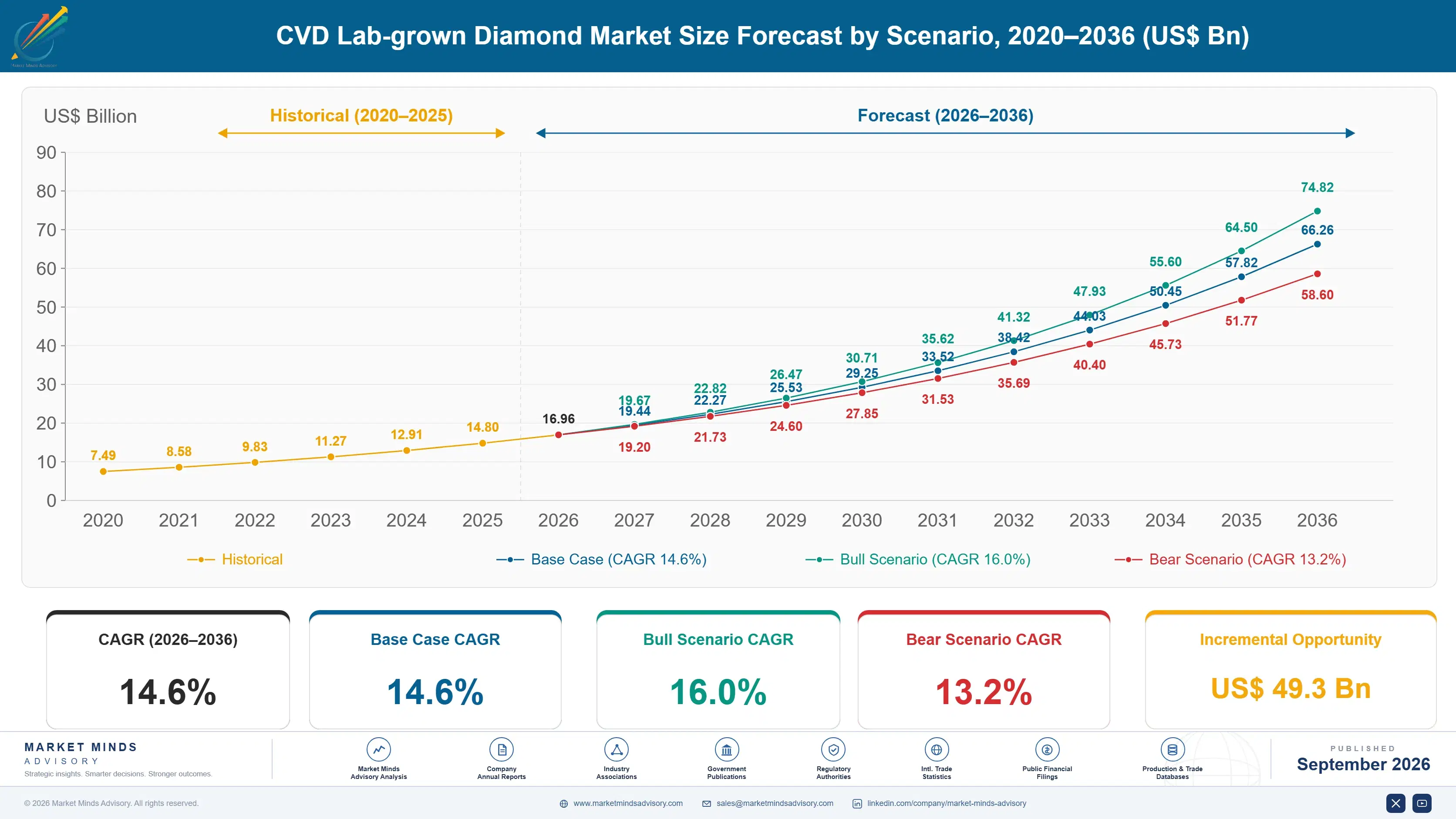
CVD Lab-grown Diamond Market Forecast Scenarios

cvd-lab-grown-diamond-market-size-forecast-scenario-1790015507395
Between 2020 and 2025, CVD diamond production scaled rapidly as reactor technology matured, driving wholesale prices down sharply while bridal jewelry adoption accelerated once major jewelry chains began stocking lab-grown alternatives alongside mined stones at transparently lower price points across most retail formats and price tiers globally, with North America leading early consumer adoption decisively.
The base case rests on three commercial mechanisms operating together: continued reactor throughput gains lowering production cost per carat, bridal jewelry retailers expanding lab-grown assortments to capture price-conscious younger buyers across most income brackets and geographies, and industrial applications opening new demand channels as production costs fall below thresholds viable for semiconductor and cutting-tool use. Together these mechanisms support continued rapid growth even as per-carat wholesale pricing keeps declining year over year.
The bull case rests on industrial and technical diamond applications scaling faster than expected once production costs cross key adoption thresholds across multiple end-use sectors and geographies. The bear case centers on wholesale price deflation outpacing volume growth badly enough that revenue growth stalls even as unit shipments continue rising across most carat categories tracked in this report.

Production Scale Redefines Category Economics

CVD diamond production has scaled from a laboratory curiosity to an industrial process capable of growing gem-quality stones at commercial volume, converging with bridal jewelry retailers finally treating lab-grown diamonds as a mainstream product category rather than a niche alternative reserved for budget-conscious buyers across most retail formats worldwide and price tiers, reshaping decades of established consumer perception and buying habits considerably.
MARKET CONCENTRATIONCR5 26%top five producers hold moderate combined market share
AVERAGE WHOLESALE PRICE$450/caratblended one-carat wholesale price across most producers globally
TOP PRODUCING COUNTRYIndia 62%share of global CVD diamond cutting and polishing output
ANNUAL PRICE DEFLATION12%average yearly decline in wholesale per-carat pricing recently
REACTOR CAPITAL COST SHARE31% COGSreactor equipment depreciation share of total production cost
REACTOR GROWTH CYCLE4 weeksaverage chemical vapor deposition growth time per rough stone
Commercially, production scale increasingly separates profitable growers from those struggling to cover reactor capital costs, as persistent wholesale price deflation compresses margins fastest for smaller operations lacking reactor throughput efficiency and process automation across every carat category and retail price point. Vertically integrated jewelry retailers growing their own stones are capturing margin that pure wholesale suppliers increasingly cannot, reshaping the entire supply chain's economics.
Over the next decade, falling production costs will open industrial and technical diamond applications in semiconductors, cutting tools, and heat-spreading substrates that were previously uneconomical at any meaningful commercial scale, while bridal jewelry pricing continues compressing toward a floor set by production cost rather than the artificial scarcity that once defined the entire natural diamond category for many generations.
"The diamond industry spent a century selling scarcity. CVD growers are now selling the opposite, and the jewelry retailers who figure that out fastest are the ones who will still be profitable in five years."
Director, Advanced Materials and Gemstone Practice · MMA Technology Practice · September 2026

Market Trends

Major Jewelry Chains Formalize Lab-Grown Assortments

Leading US jewelry retailers have expanded dedicated lab-grown diamond assortments to cover roughly 35 percent of engagement ring inventory, up sharply from a marginal share several years ago across most major retail chains. This retailer-driven mainstreaming is normalizing lab-grown as a legitimate bridal category rather than a budget compromise, pulling younger buyers who prioritize size and clarity per dollar toward CVD stones over comparably priced smaller mined diamonds. Retailers report lab-grown assortments now generate meaningfully higher gross margin percentage than mined diamond sales, even as absolute per-stone revenue runs lower across most price categories.
Market Impact: Resolves trust for 100% of stones

Industrial Applications Open as Production Costs Fall

Falling CVD production costs are making previously uneconomical industrial applications commercially viable, with technical diamond demand for semiconductor heat-spreading substrates growing an estimated 22 percent annually as production economics cross key adoption thresholds across multiple end-use sectors worldwide and geographies each calendar year. Semiconductor manufacturers value diamond's thermal conductivity properties for next-generation chip cooling applications, a use case that was cost-prohibitive when CVD diamonds carried bridal-jewelry-era pricing levels historically. Producers with reactor capacity are increasingly diversifying revenue toward these technical applications to reduce dependence on volatile bridal jewelry demand cycles.
Market Impact: Sustains repeat purchases 5+ years later

Market Opportunities and Growth Drivers

Gemological Certification Standardization Builds Buyer Trust

Independent gemological certification for lab-grown diamonds has standardized rapidly across major grading laboratories, resolving buyer trust concerns that previously slowed mainstream adoption in bridal jewelry markets. Every major certification body now grades CVD diamonds on identical criteria to mined stones, with clear laser inscriptions disclosing lab-grown origin permanently etched into each stone. This standardization has removed the single biggest objection retailers cited when initially resisting lab-grown assortment expansion several years ago. Insurance appraisers have also adapted valuation methodology, further normalizing lab-grown diamonds as a legitimate asset class within bridal jewelry.
Market Impact: Cuts wholesale prices roughly 12% yearly

Younger Buyers Prioritize Value Over Mined Provenance

Younger bridal buyers increasingly prioritize size and clarity per dollar over mined provenance, a generational shift that surveys show cuts across income levels rather than being purely budget-driven behavior across most demographics. Social media engagement content increasingly normalizes lab-grown diamonds without the stigma earlier marketing campaigns worried about, as influencers openly discuss carat size achieved within a given budget across most platforms. This shift is proving durable rather than a passing trend, with repeat lab-grown purchases for anniversary and upgrade occasions growing steadily among buyers who made their initial purchase years earlier.
Market Impact: Limits resale value to under 20%

Market Restraints and Challenges

Persistent Wholesale Price Deflation Compresses Producer Margins

Persistent wholesale price deflation is compressing margins across nearly every carat category, since new reactor capacity continues entering the market faster than demand growth can absorb it. The root cause is low barriers to reactor deployment once production expertise diffuses beyond early movers, letting new growers enter with comparable technology at lower relative cost. The commercial impact shows up as shrinking gross margins for producers without scale advantages or proprietary reactor technology. Some producers are mitigating exposure by pivoting revenue mix toward industrial and technical diamond applications where price competition remains less severe.
Market Impact: Covers 35% of engagement ring inventory

Weak Secondary Market Limits Resale Value

Resale value for lab-grown diamonds remains substantially lower than mined stones, since secondary market demand has not developed comparably, creating buyer hesitation for the sizable minority who view diamonds partly as a store of value rather than pure consumption. The root cause is the absence of an established secondary trading infrastructure comparable to mined diamond resale channels built over decades. The commercial impact concentrates among higher-income buyers considering larger stones where resale expectations matter more. Some retailers are addressing this through trade-up and buyback programs that partially substitute for missing secondary market infrastructure.
Market Impact: Grows technical diamond demand by 22%
4 additional market trends, 3 additional growth drivers, and 3 additional restraints and challenges are covered in the full report. Contact sales@marketmindsadvisory.com to access the complete intelligence.

Segment CAGR and Growth Architecture

Segmentation follows end-use application, since bridal jewelry, fashion jewelry, and industrial uses face fundamentally different pricing dynamics and buyer economics across nearly every carat category tracked in this report. Bridal and engagement jewelry, fashion jewelry, industrial and technical applications, diamond powder and abrasives, optical and quantum computing applications, and loose certified diamonds each warrant separate tracking.
cvd-lab-grown-diamond-market-market-share-analysis-1790015507939

Industrial and Technical Diamond Applications

Industrial and technical diamond applications, spanning semiconductor heat-spreading substrates, cutting tool coatings, and high-power laser optics, lead segment growth as falling CVD production costs cross adoption thresholds that were previously uneconomical for these use cases across most manufacturing sectors worldwide. Semiconductor manufacturers value diamond's superior thermal conductivity for next-generation chip cooling, a use case only recently becoming cost-competitive against alternative thermal management materials on the market. Producers with existing reactor capacity are increasingly diversifying revenue toward these technical applications, since bridal jewelry pricing continues compressing while industrial buyers pay based on material performance rather than gemological grading criteria. This diversification reduces producer dependence on volatile bridal jewelry demand cycles considerably.
CAGR 19.8%

Optical and Quantum Computing Applications

Optical and quantum computing applications, an emerging segment built on CVD diamond's unique properties as a substrate for quantum sensors and photonic components, is growing rapidly from a small base as quantum computing research investment accelerates globally across government and private laboratories worldwide and beyond. Diamond's nitrogen-vacancy centers make it uniquely suited for certain quantum sensing applications that alternative materials cannot easily replicate, giving specialized CVD growers a technical moat in this narrow but high-value niche market. Research institutions and technology companies are the primary buyers currently, though commercial quantum computing applications could expand demand meaningfully if the underlying technology matures faster than currently expected within the ten-year forecast period.
CAGR 18.6%
Full segment breakdown across 6 segments available in the complete report.

Regional Architecture and Country Demand Map

North America leads global share on dominant bridal jewelry consumption and early lab-grown retail adoption across most major jewelry chains nationwide, followed by East Asia's manufacturing base. South Asia and Pacific grows fastest as India's cutting and polishing dominance expands into upstream CVD growth capacity.

North America

North America commands the largest regional share, anchored by the United States' dominant position in global bridal jewelry consumption, where lab-grown diamonds have moved rapidly from a niche alternative to a mainstream engagement ring choice across nearly every major metropolitan market. Major US jewelry chains now stock dedicated lab-grown assortments covering a meaningful share of engagement ring inventory, a shift that occurred faster than most retailers initially projected several years ago. Canadian demand mirrors US patterns closely, though at smaller absolute scale across comparable retail channels and price tiers. Younger American buyers, particularly those prioritizing size and clarity per dollar, are driving repeat lab-grown purchases for anniversary upgrades beyond initial engagement ring purchases.
Share: 31% | CAGR: 15.6% (2026 to 2036)

Western Europe

Western Europe combines a more conservative bridal jewelry culture with growing lab-grown acceptance concentrated among younger urban buyers in the UK, Germany, and France, particularly across major metropolitan centers and university cities nationwide and beyond. Traditional European jewelry houses have been slower to embrace lab-grown assortments than American retailers, protecting heritage positioning built around mined diamond provenance and craftsmanship developed over many generations of continuous family ownership. This slower adoption pace is gradually shifting as younger buyers demonstrate similar value-per-dollar preferences seen in North America. Fashion jewelry applications are growing faster than bridal jewelry across the region, as lab-grown stones find easier acceptance in non-engagement contexts and casual social settings.
Share: 19% | CAGR: 13.0% (2026 to 2036)
Regional intelligence for 5 additional markets available in the complete report: East Asia, South Asia and Pacific, Latin America, Middle East and Africa, Eastern Europe. Contact sales@marketmindsadvisory.com.
cvd-lab-grown-diamond-market-country-cagr-analysis-1790015508456

Where CVD Diamond Margin Survives

Four levers separate CVD diamond producers sustaining margin from those caught in pure wholesale price deflation: reactor throughput efficiency, industrial application diversification, vertical integration into retail, and quantum computing niche positioning. Each shifts revenue away from commoditized bridal pricing toward higher-value, less price-competitive demand channels across the value chain and full forecast period ahead.

Maximize Reactor Throughput and Uptime Efficiency

Producers optimizing reactor throughput and minimizing downtime between growth cycles achieve production costs meaningfully below competitors running older or less efficient reactor configurations, since fixed reactor capital costs get spread across substantially more carats grown annually across every product line, reactor generation, and facility. Leading producers report throughput improvements of roughly 25 percent achievable through process optimization alone, without new capital investment or reactor replacement. This efficiency gap increasingly separates profitable growers from those struggling to cover reactor costs amid persistent wholesale price deflation across nearly every carat category tracked.
Market Impact: Cuts per-carat cost by up to 25 percent

Diversify Into Industrial and Technical Diamond Demand

Producers diversifying revenue toward industrial and technical diamond applications, including semiconductor substrates and cutting tool coatings, capture demand growing an estimated 22 percent annually that faces meaningfully less price competition than bridal jewelry supply across most producing regions, price tiers, and buyer segments worldwide and beyond. This diversification reduces dependence on volatile bridal jewelry demand cycles and wholesale price deflation that increasingly compresses jewelry-focused producer margins across the entire category. Producers with existing reactor capacity can redirect production toward technical applications relatively quickly once industrial buyer relationships are firmly established.
Market Impact: Captures technical diamond demand growing 22 percent annually

Integrate Vertically Into Direct Retail Channels

Producers integrating vertically into direct-to-consumer or wholesale retail channels capture margin that pure wholesale suppliers increasingly cannot, as retail markup on lab-grown stones runs substantially higher, often 40 percent or more, than wholesale carat pricing alone across nearly every price category, market segment, and geography tracked worldwide. Vertically integrated players growing their own stones and selling directly to consumers avoid intermediary margin compression entirely, particularly valuable as wholesale prices continue declining across the category. This integration requires meaningful capital investment in retail infrastructure and brand building that pure growers historically have not needed to develop.
Market Impact: Captures retail markup of 40 percent or more

Establish Early Position in Quantum Computing Niches

Producers developing specialized CVD diamond substrates for quantum sensing and photonic applications capture a narrow but high-value niche where alternative materials cannot easily replicate diamond's nitrogen-vacancy center properties across comparable use cases, applications, and adjacent industries broadly and consistently over time. This segment remains small currently, representing under 2 percent of total market revenue, but carries premium pricing well above bridal jewelry per-carat economics, since buyers are research institutions and technology companies valuing material performance over gemological grading criteria. Early positioning here builds technical relationships and specialized production expertise before commercial quantum computing applications potentially expand demand meaningfully.
Market Impact: Commands premium pricing roughly 3 times jewelry-grade carat rates

Who Controls the Margin Pool

Ranked on global revenue from CVD lab-grown diamond sales, the market carries a CR5 near 26 percent, with De Beers Group's Lightbox brand and Diamond Foundry leading over WD Lab Grown Diamonds, Ecoessence, and Pure Grown Diamonds across most tracked geographies and carat categories. The gap between the top players and the long tail reflects reactor scale and vertical integration rather than brand recognition alone.
Current competitive activity centers on reactor capacity expansion, vertical integration into retail channels, and diversification toward industrial applications as wholesale bridal pricing continues declining across nearly every carat category and price tier tracked. Several producers are also entering quantum computing and semiconductor substrate niches to reduce dependence on volatile jewelry demand cycles and pure carat-weight competition across most price tiers and markets.

Emerging pressure comes from Indian and Chinese producers scaling reactor capacity aggressively at lower relative cost, plus retailer private-label lab-grown programs that bypass traditional wholesale suppliers entirely across most major markets. Rankings could shift meaningfully if Asian producers continue converting cost advantages into market share faster than Western incumbents can respond with comparable vertical integration and retail investment.
cvd-lab-grown-diamond-market-company-positioning-matrix-1790015508989

Competitive Moat and Risk Dimensions

DE BEERS GROUP (LIGHTBOX)

Moat: Deep Diamond Industry Trading Relationships

De Beers brings decades of diamond trading and grading relationships to its Lightbox lab-grown brand, giving it distribution and retailer trust that newer pure-play growers lack entirely. This heritage also provides deep technical grading expertise transferable directly to lab-grown stone certification and quality control processes across most markets.
DE BEERS GROUP (LIGHTBOX)

Risk: Conflicted Incentives With Mined Diamonds

De Beers' core mined diamond business creates inherent tension in fully committing to lab-grown expansion, since aggressive lab-grown growth could accelerate cannibalization of its much larger natural diamond trading revenue, a conflict pure-play lab-grown competitors simply do not face at all in their day-to-day operations.
DIAMOND FOUNDRY

Moat: Proprietary Reactor Technology Scale

Diamond Foundry operates proprietary plasma reactor technology at meaningful scale, giving it production cost advantages over smaller competitors using licensed or less advanced reactor designs across most facility types. This technical scale advantage compounds over time as the company reinvests savings into further capacity expansion and reactor upgrades.
DIAMOND FOUNDRY

Risk: Heavy Bridal Jewelry Revenue Concentration

Diamond Foundry's revenue remains heavily concentrated in bridal jewelry applications, leaving it more exposed than diversified competitors to wholesale price deflation specifically affecting bridal-grade stones rather than industrial or technical diamond categories growing considerably faster across most producing regions, price tiers, and buyer segments worldwide.

Players Tracked

Prominent Players

De Beers Group (Lightbox)
Diamond Foundry
WD Lab Grown Diamonds
Ecoessence
Pure Grown Diamonds

Other Key Players

IIa Technologies
New Diamond Technology
Green Rocks Diamonds
Ada Diamonds
Clean Origin
MiaDonna
Grown Brilliance
Swarovski Created Diamonds
Fenix Diamonds
Adamas One
Union Square Diamonds
Kimai
Diam Concept
Brilliant Earth
Bhanderi Lab Grown Diamonds

Recent Developments

NOVEMBER 2025

Diamond Foundry Announces Major Reactor Capacity Expansion

Diamond Foundry announced a major expansion of its plasma reactor capacity, aiming to roughly double annual carat output within two years to serve growing industrial and technical diamond demand alongside continued bridal jewelry supply commitments. The expansion represents the company's largest single capital investment to date.
Signal: Signals leading producers are betting heavily on continued rapid volume growth ahead across most global markets
MARCH 2026

De Beers Group Expands Lightbox Into Industrial Diamond Applications

De Beers Group expanded its Lightbox lab-grown brand beyond bridal jewelry into industrial and technical diamond applications, marking the company's first significant move to diversify revenue away from pure consumer jewelry sales entirely. The expansion follows persistent wholesale bridal pricing pressure across most carat categories.
Signal: Signals even established mined diamond incumbents are now diversifying revenue into faster-growing, higher-margin technical diamond applications
JULY 2025

WD Lab Grown Diamonds Signs Semiconductor Supply Agreement

WD Lab Grown Diamonds signed a multi-year supply agreement with a semiconductor manufacturer to provide CVD diamond substrates for chip cooling applications, its first major industrial contract outside bridal jewelry entirely. The agreement reflects growing semiconductor industry interest in diamond thermal management solutions across multiple chip generations.
Signal: Signals semiconductor manufacturers are increasingly adopting diamond substrates for commercial chip cooling applications across the industry

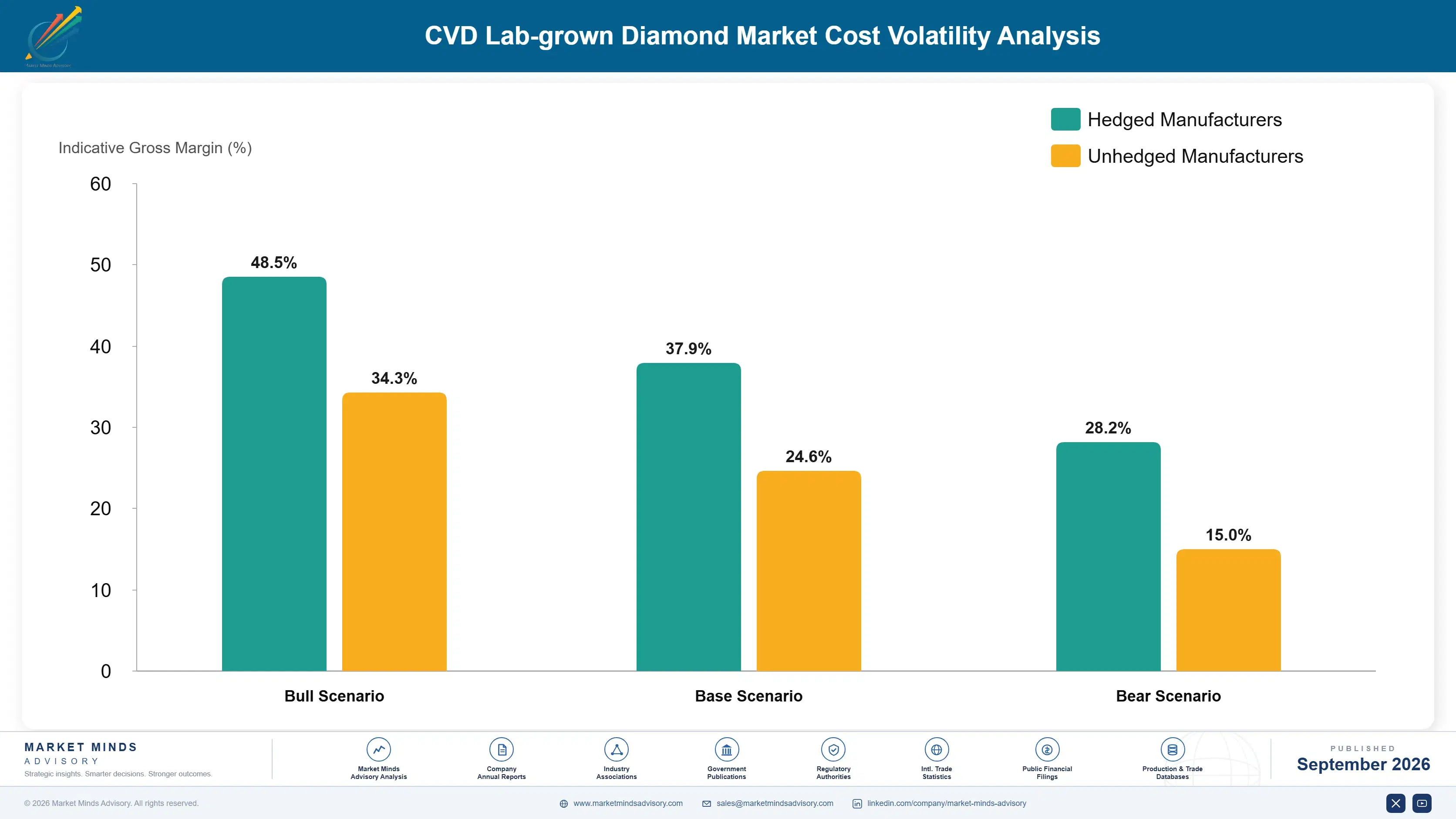
Reactor Power Cost Exposure

Reactor equipment depreciation and electricity consumption together account for roughly 31 percent of production cost of goods sold, with reactor equipment sourced primarily from specialized manufacturers headquartered in the United States, China, and Russia, and electricity representing a meaningful ongoing operating cost across every major producing region tracked in this report and full forecast period ahead.
Electricity prices spiked sharply across parts of India and China during 2024 amid regional power grid constraints, a volatility event documented in China MIIT industrial energy reports, forcing several mid-tier CVD growers to temporarily reduce reactor operating hours or shift production to off-peak electricity pricing windows across multiple facilities and production shifts throughout the affected regions and industrial zones nationwide over several consecutive months and quarters.

Producers with owned power generation or long-term electricity supply contracts absorb this volatility more easily than smaller operations purchasing at spot electricity rates, widening the cost gap between large and small growers considerably across most producing regions and price categories. Geographic exposure also varies considerably, since producers in regions with subsidized or stable electricity pricing hold a durable cost advantage over competitors elsewhere.
cvd-lab-grown-diamond-market-cost-volatility-analysis-1790015509186

Long-Term Electricity Supply Contracts and Own-Generation

Larger producers are securing long-term electricity supply contracts or investing in owned power generation capacity to insulate reactor operations from spot electricity price volatility across most facility locations. This investment locks in predictable per-carat electricity costs years ahead, letting producers plan reactor expansion without exposure to regional grid disruption events or seasonal price spikes.

Off-Peak Reactor Scheduling and Load Shifting

Mid-tier growers are shifting reactor operating schedules toward off-peak electricity pricing windows where grid capacity allows, reducing average electricity cost per carat without requiring new capital investment or facility relocation entirely. This flexibility partially offsets the cost disadvantage smaller operations face relative to producers with owned generation capacity and long-term supply agreements already in place.

Portfolio Architecture for Margin Defence

CVD lab-grown diamonds split into three tiers by margin structure: commodity bridal stones sold increasingly on carat weight alone, branded and certified lines commanding trust and traceability premiums, and next-generation industrial and quantum computing applications built around material performance rather than gemological grading criteria. Volume commodity bridal stones carry gross margins compressed to between 15 and 22 percent across most wholesale channels.
Branded and certified lab-grown lines, backed by traceable supply chains and brand marketing investment, command gross margins of 32 to 42 percent, reflecting trust and provenance transparency buyers pay for beyond raw carat pricing alone. Industrial and quantum computing applications sit at the top of the value pool, often exceeding 55 percent gross margin given specialized production requirements and limited competition worldwide.

The tension between volume and premium tiers shapes capital allocation heavily, since bridal jewelry margins keep compressing while technical applications remain comparatively insulated from wholesale price deflation across nearly every carat category and price tier. High-value pools concentrate in specialized reactor technology producers and vertically integrated retailers, where buyers pay meaningfully more for verified provenance and material performance across most product categories.

Volume / Commodity-Adjacent

Standard bridal jewelry stones sold primarily on carat weight and clarity grade through mass and mid-tier retail channels, competing heavily on price against both mined stones and other lab-grown producers.
Gross Margin: 15-22%

Premium / Certified

Branded, traceable lab-grown lines sold through prestige and direct-to-consumer retail channels, commanding trust and supply chain transparency premiums over undifferentiated commodity wholesale stones sold by pure-play growers lacking retail relationships.
Gross Margin: 32-42%

Sustainability / Regulatory / Next-Generation

Industrial, semiconductor, and quantum computing diamond applications valued for material performance rather than gemological grading, commanding outsized margins given specialized production requirements and limited early-stage competition across most producing regions currently.
Gross Margin: 45-58%
cvd-lab-grown-diamond-market-portfolio-architecture-1790015509691

High-value Sub-segments and Strategic Watch-out

Industrial and Technical Diamond Applications

The fastest-growing and highest-margin segment, driven by falling production costs opening semiconductor and cutting-tool applications previously uneconomical, sustaining premium pricing insulated from bridal wholesale deflation across most major producing regions worldwide and throughout the entire ten-year forecast period ahead, as adoption accelerates across new industrial buyer categories.
Gross Margin: 50-62%

Optical and Quantum Computing Applications

A high-value, emerging segment built on diamond's unique quantum sensing properties, growing rapidly from a small base as research investment accelerates across government and private laboratories globally and across most developed economies, technology sectors, and university research programs pursuing next-generation computing breakthroughs and photonic sensing platforms.
Gross Margin: 40-55%

Bridal and Engagement Jewelry

The volume core of the market, anchoring overall category revenue even as wholesale pricing continues compressing and growth concentrates increasingly in industrial and technical applications instead across most producing and consuming regions, retail formats, and buyer demographics worldwide throughout the entire ten-year forecast period ahead.
Gross Margin: 15-22%

Undifferentiated Wholesale Commodity Stones

A strategic watch-out as reactor capacity additions continue outpacing bridal demand growth, risking further margin compression for producers lacking scale, vertical integration, or technical diversification across most price categories, geographic markets, and distribution channels tracked throughout this report and the entire full forecast window ahead.
Gross Margin: n/a

Bridal Versus Industrial Buyer Economics

CVD diamond purchasing splits sharply between one-time bridal jewelry transactions and recurring industrial supply relationships, since semiconductor and cutting-tool buyers place ongoing repeat orders tied to production schedules rather than single lifetime purchases like most bridal jewelry buyers across nearly every price tier and category tracked in this report and full forecast period ahead through 2036 and well beyond.
Adoption depth varies dramatically by vertical. Industrial buyers integrate CVD diamond substrates into long-term product designs, creating switching costs that favor established suppliers with proven reliability and consistent quality control across multiple production cycles and facility audits, while bridal jewelry buyers show minimal supplier loyalty since retailers and stones are largely interchangeable commodities distinguished mainly by price and certification documentation alone across most retail formats.

Generational buyer shifts favor value transparency over mined provenance in bridal jewelry, while emerging quantum computing and semiconductor buyers represent an entirely new generation of technical customers who evaluate diamonds purely on material specification rather than any gemological or emotional criteria whatsoever, reshaping demand architecture considerably across the category and forecast decade ahead for every major producer and buyer segment tracked.
cvd-lab-grown-diamond-market-end-use-penetration-index-1790015510195

Priority Moves for CVD Producers

These are among the four positions where our research anticipates prominent divergence between winners and laggards over the coming forecast period. Each is grounded in the demand model, the regulatory perimeter, and the announced capacity pipeline.
01 / REACTOR EFFICIENCY INVESTMENT

Maximize Throughput Before Wholesale Prices Fall Further

Persistent wholesale price deflation is compressing margins fastest for producers running older or less efficient reactor configurations across nearly every carat category, and this deflation trend shows no sign of reversing given continued capacity additions industry-wide from producers worldwide. Producers that optimize throughput now achieve meaningfully lower per-carat costs, spreading fixed reactor capital across substantially more output annually and across multiple facility locations. Waiting to invest in efficiency risks falling behind competitors who are already capturing this cost advantage decisively.
02 / INDUSTRIAL DIVERSIFICATION PRIORITY

Diversify Into Industrial Demand Before Rivals Consolidate

Industrial and technical diamond applications are growing considerably faster than bridal jewelry while facing meaningfully less price competition, making this the single most attractive diversification opportunity available to producers with existing reactor capacity and technical expertise across most producing regions. Producers that establish industrial buyer relationships now build switching costs that favor incumbent suppliers over later entrants across most technical application categories and sectors. Remaining concentrated in bridal jewelry alone risks continued margin compression as wholesale deflation persists industry-wide for years ahead.
03 / VERTICAL RETAIL INTEGRATION

Integrate Into Retail Before Margin Compression Accelerates

Vertically integrated producers selling directly to consumers capture retail markup that pure wholesale suppliers increasingly cannot access, a gap that widens further as wholesale prices continue declining across nearly every carat category and price tier tracked worldwide. Building retail capability requires meaningful capital investment, but producers that delay risk permanent margin disadvantage relative to integrated competitors already established in key markets. This integration also builds direct customer relationships that support repeat purchase revenue over time and across multiple product lines.
04 / QUANTUM COMPUTING POSITIONING

Establish Early Quantum Computing Technical Relationships Now

Quantum computing and photonic sensing applications represent a narrow but high-value niche where diamond's unique material properties face little competitive substitution, commanding premium pricing well above bridal jewelry economics across nearly every comparable use case and technical application. Producers establishing technical relationships with research institutions now build specialized expertise before commercial applications potentially scale demand meaningfully across multiple sectors and technology platforms. Waiting until the technology matures risks ceding this emerging niche entirely to faster-moving specialized competitors already investing heavily.

Engagement Snapshot From the Field

A live engagement with an industry participant carrying material or product regulatory and market exposure ahead of a defining policy shift, showing how our research translates into a defensible multi-year portfolio strategy.
MARKET MINDS ADVISORY · CLIENT ENGAGEMENT SUMMARY
CVD Lab-grown Diamond Producer Strategic Portfolio Review and Transition Roadmap 2026·Investment Scenario on CVD Lab-grown Diamond Exposure Evaluation 2025-26
CLIENT PROFILE
The client is a mid-tier CVD diamond producer operating a single reactor facility focused primarily on bridal jewelry wholesale supply, with annual revenue of approximately $62 million (client-reported, unverified by MMA). The company had not yet diversified into industrial or technical diamond applications despite growing wholesale price pressure across nearly every carat category it produced.
STRATEGIC CHALLENGE
The client faced sharply declining wholesale margins as bridal jewelry carat prices continued falling faster than the client's production cost improvements, threatening long-term profitability across the entire business and reactor investment plan. Competitors with larger reactor scale and vertical retail integration were increasingly outcompeting the client on both price and margin resilience.
MMA APPROACH
MMA conducted primary interviews with 25 industrial diamond buyers and benchmarked the client's reactor throughput against four larger competitors to identify diversification opportunities beyond bridal jewelry supply and persistent pricing pressure. The engagement modeled expected margin impact under three revenue diversification scenarios before recommending a phased technical application entry sequence.
KEY FINDINGS
  1. Industrial diamond buyers valued consistent supply reliability more than lowest price when evaluating new CVD diamond substrate suppliers for long-term contracts and partnerships.
  2. The client's existing reactor technology was well suited for semiconductor substrate applications with minimal modification, requiring far less capital investment than initially expected.
  3. Competitors already diversified into industrial applications reported gross margins roughly 20 percentage points above pure bridal jewelry wholesale suppliers across comparable revenue scales.
  4. Semiconductor manufacturers showed strong interest in multi-year supply agreements, offering revenue predictability the client's bridal wholesale business entirely lacked historically and could not replicate.
CLIENT PROFILE
The client is a mid-tier CVD diamond producer operating a single reactor facility focused primarily on bridal jewelry wholesale supply, with annual revenue of approximately $62 million (client-reported, unverified by MMA). The company had not yet diversified into industrial or technical diamond applications despite growing wholesale price pressure across nearly every carat category it produced.
STRATEGIC CHALLENGE
The client faced sharply declining wholesale margins as bridal jewelry carat prices continued falling faster than the client's production cost improvements, threatening long-term profitability across the entire business and reactor investment plan. Competitors with larger reactor scale and vertical retail integration were increasingly outcompeting the client on both price and margin resilience.
MMA APPROACH
MMA conducted primary interviews with 25 industrial diamond buyers and benchmarked the client's reactor throughput against four larger competitors to identify diversification opportunities beyond bridal jewelry supply and persistent pricing pressure. The engagement modeled expected margin impact under three revenue diversification scenarios before recommending a phased technical application entry sequence.
KEY FINDINGS
  1. Industrial diamond buyers valued consistent supply reliability more than lowest price when evaluating new CVD diamond substrate suppliers for long-term contracts and partnerships.
  2. The client's existing reactor technology was well suited for semiconductor substrate applications with minimal modification, requiring far less capital investment than initially expected.
  3. Competitors already diversified into industrial applications reported gross margins roughly 20 percentage points above pure bridal jewelry wholesale suppliers across comparable revenue scales.
  4. Semiconductor manufacturers showed strong interest in multi-year supply agreements, offering revenue predictability the client's bridal wholesale business entirely lacked historically and could not replicate.
RECOMMENDED STRATEGY
Phase 1: Phase 1 (Months 1 to 3): Reallocate 20 percent of reactor capacity toward semiconductor substrate production for pilot customer engagements. Phase 2: Phase 2 (Months 4 to 9): Secure two multi-year industrial supply agreements based on Phase 1 pilot production quality results. Phase 3: Phase 3 (Months 10 to 15): Scale industrial production to 40 percent of total reactor capacity based on demonstrated demand and margin performance.
OUTCOME
Within 15 months, the client reported industrial applications reaching approximately 35 percent of total revenue with gross margins roughly 22 percentage points above the bridal wholesale business (client-reported, unverified by MMA). The client also reported securing two long-term semiconductor supply contracts extending revenue visibility considerably.

Frequently Asked Questions

Foundational context covering the market sizes, CAGR, scope, country, region and competition that inform every finding below. This section is provided to cover basics and most often pre-purchase conversations, answered from the MMA Primary Research Dataset.

What is the current size of the CVD Lab-grown Diamond Market?

The global CVD lab-grown diamond market reached approximately $14.8 billion in 2025. This figure covers diamonds grown via chemical vapor deposition for bridal jewelry, fashion jewelry, and industrial and technical applications.

How large will the CVD Lab-grown Diamond Market be by 2036?

The market is projected to reach approximately $66.26 billion by 2036, roughly 3.91 times its 2026 value. Growth is led by industrial and technical diamond applications expanding fastest as production costs fall.

What is the CAGR for the CVD Lab-grown Diamond Market 2026 to 2036?

The market is forecast to grow at a compound annual growth rate of 14.6 percent between 2026 and 2036. Bull and bear scenarios range from 16.0 percent to 13.2 percent depending on price deflation and adoption factors.

Which segment is growing fastest?

Industrial and technical diamond applications are the fastest-growing segment at a 19.8 percent CAGR, roughly 1.36 times the overall market rate. Optical and quantum computing applications follow closely at 18.6 percent.

Who are the major companies in the CVD Lab-grown Diamond Market?

Leading companies include De Beers Group's Lightbox brand, Diamond Foundry, WD Lab Grown Diamonds, Ecoessence, and Pure Grown Diamonds. Together these five players hold a combined market share of roughly 26 percent.

Which country is growing fastest?

India is the fastest-growing country market at a 17.9 percent CAGR, driven by its dominant cutting and polishing base expanding into upstream CVD growth. This outpaces the broader South Asia and Pacific regional average of 16.6 percent.

Report Segmentation Architecture

The full report scope spans multiple orthogonal segmentation dimensions, with cross-tabulated demand data provided for each dimension pair. Coverage extends further to regional breakdowns, trend trajectories, and the competitive detail needed to support segment-level decision-making.

By End-Use Application

  • Bridal and Engagement Jewelry
  • Fashion and Statement Jewelry
  • Industrial and Technical Diamond Applications
  • Diamond Powder and Abrasives
  • Optical and Quantum Computing Applications
  • Loose Certified Diamonds

By End-Use Industry

  • Jewelry Retail
  • Semiconductor Manufacturing
  • Cutting Tool and Industrial Equipment
  • Research and Quantum Computing
  • Optical Systems

By Commercial Dimension

  • Wholesale Carat Sales
  • Vertically Integrated Retail
  • Branded and Certified Positioning
  • Industrial Contract Supply

By Region

  • North America
  • Western Europe
  • East Asia
  • South Asia and Pacific
  • Latin America
  • Middle East and Africa
  • Eastern Europe

Scope, Methodology, and Coverage

Every figure in this report is reproducible from documented input assumptions. The scope below maps the historical period, the forecast horizon, the segmentation dimensions, and the countries covered, alongside the underlying primary and qualitative methodology.
Historical Period
2020 to 2025
Forecast Period
2026 to 2036
Base Year
2025 (USD billions; MMA Primary Research Dataset, September 2026)
Market Definition
The CVD lab-grown diamond market comprises diamonds grown via chemical vapor deposition for bridal and fashion jewelry, plus industrial and technical applications such as cutting tools and heat-spreading substrates. It excludes HPHT-grown diamonds and diamond simulants such as cubic zirconia and moissanite.
Quantitative Units
USD billions (current prices); unit volume in million carats where applicable
Segmentation Dimensions
By End-Use Application; By End-Use Industry; By Commercial Dimension; By Region
Regions Covered
North America, Western Europe, East Asia, South Asia and Pacific, Latin America, Middle East and Africa, Eastern Europe
Countries Covered
USA, China, Germany, France, UK, Japan, South Korea, India, Australia, Canada, Brazil, Mexico, Indonesia, Vietnam, Thailand, Malaysia, UAE, Saudi Arabia, South Africa, Nigeria, Turkey, Poland, Netherlands, Italy, Spain, Sweden, Switzerland, Argentina, Colombia, Singapore, and additional markets relevant to this sector
Key Companies Profiled
De Beers Group (Lightbox), Diamond Foundry, WD Lab Grown Diamonds, Ecoessence, Pure Grown Diamonds, IIa Technologies, New Diamond Technology, Green Rocks Diamonds, Ada Diamonds, Clean Origin, MiaDonna, Grown Brilliance, Swarovski Created Diamonds, Fenix Diamonds, Adamas One, Union Square Diamonds, Kimai, Diam Concept, Brilliant Earth, Bhanderi Lab Grown Diamonds
Quantitative Methodology
Primary survey, n=3,800 respondents, Q4 2025, six countries; demand-side model with trade association cross-validation
Qualitative Methodology
47 expert interviews, Q4 2025; applied to validate demand model assumptions, identify emerging dynamics, and assess competitive positioning
Report Format
PDF and XLSX data workbook (Word format preview document)
Publisher
Market Minds Advisory
Report Code
MMA-2026-TEC-227
Published
September 2026
Contact
sales@marketmindsadvisory.com | www.marketmindsadvisory.com

Purchase the full CVD Lab-grown Diamond Market Report (2026 to 2036).

The full report delivers a comprehensive analysis of the global CVD lab-grown diamond market, spanning bridal jewelry, fashion jewelry, industrial and technical applications, and emerging quantum computing use cases across all seven world regions. It includes detailed competitive profiling of 20 major players, ten-year forecast modeling through 2036, and country-level demand analysis across major producing and consuming markets. The report examines reactor economics, wholesale price deflation dynamics, and input cost exposure across the production value chain. Buyers receive segmentation data across end-use application, industry vertical, and commercial positioning suitable for strategic planning and competitive benchmarking.
Ten-year market sizing and forecast model
Twenty-company competitive profiling and benchmarking analysis
Seven-region demand and growth trend analysis
Reactor economics and price deflation assessment
Application-based segmentation with detailed margin data
Anonymized client case study and strategy playbook

Built For The People Who Decide

From boardroom strategy to bench-side execution, this report is read cover-to-cover by leaders shaping the next decade of their industry, turning demand scenarios, market dynamics and valuation benchmarks into decisions.
CXOs/ Presidents/ VPs/ Managers
M&A and Corporate Development
Strategy Teams and R&D Heads
Procurement and Product Directors
Regulatory and Compliance Leaders
Investor Relations and Equity Analysts