Market Minds Advisory
Customizable Hair Dye Market

Customizable Hair Dye Market: Customizable Hair Dye Market. Algorithmic Color Matching Meets At-Home Salon Quality

Direct-to-consumer brands push algorithm-matched, individually mixed hair color into mainstream retail as salon-quality claims narrow the gap with professional colorists, while ammonia-free formulation chemistry reshapes which brands serve gray coverage credibly.

Lead Analyst

Published

September 2026

Make Smarter Decisions with Customized Research Insights

Request a free sample report and evaluate market opportunities, growth trends, and competitive dynamics relevant to your business needs.

2025 MARKET VALUE$2.4BMarket Size 2025
2036 FORECAST VALUE$6.6BBase Case , 2026 to 2036
CAGR 2026 TO 20369.6 %Bull 10.9% / Bear 8.3%
INCREMENTAL OPPORTUNITY$4.0BNet 10- year value creation
EXPANSION MULTIPLE2.50x2036 value over 2026 base
Strategic Levers
M&A Pipeline
Regional Outlook
Country Rankings
Competitive Intelligence
Segmental Deep-dive
Call-Us : 91 93563 13602

Executive Snapshot and Market Trajectory.

Customizable hair dye has moved from a niche direct-to-consumer experiment into a mainstream retail category, as algorithm-based color matching and individually mixed formulations close the quality gap with professional salon color across most price tiers, hair types, age groups, and regional markets available today across nearly every major retail format.
AI-matched custom color blends are pulling disproportionate growth as brands finally solve the shade-accuracy problem that limited early at-home color kits, while subscription-based root touch-up programs normalize recurring purchase behavior that traditional single-box dye sales never achieved, particularly among buyers who previously visited salons exclusively for gray coverage maintenance between color appointments spaced several weeks apart across most age groups, income levels, and geographic markets nationwide, reshaping category loyalty patterns considerably.
Direct-to-consumer challengers compete on algorithmic precision and formulation transparency while legacy mass-market brands push ammonia-free reformulations through drugstore and mass retail channels, betting on decades of accumulated brand trust to win skeptical first-time buyers over. Private label retailers increasingly offer basic custom-blend kits at price points specialty brands cannot profitably match, squeezing mid-tier players caught between both competing ends of an increasingly polarized market structure.
Market Definition
The customizable hair dye market covers individually formulated or algorithm-matched permanent and semi-permanent hair color products, sold through direct-to-consumer, mass retail, and salon-professional channels. It excludes standard one-size-fits-all boxed hair dye and in-salon color services performed entirely by a professional colorist.
Base Year Value
$2.4B in 2025 (MMA Primary Research Dataset, September 2026)
Forecast Period
2026 to 2036, eleven discrete annual values
CAGR
9.6% base case. Bull 10.9%. Bear 8.3%.
Fastest Growth Segment
AI-Matched Custom Color Blends: 14.5% CAGR
Fastest Growth Country
United States: 10.2% CAGR
Fastest Growth Region
South Asia and Pacific: 11.6% CAGR
Largest Region
North America: 27% of 2025 global value
Market Leaders
L'Oreal S.A., Madison Reed, eSalon, Coty Inc., Henkel AG. Source: MMA Analysis based on company annual reports.
Primary Survey
n=3,800 procurement and R&D decision-makers, Q4 2025, six countries
Methodology
Demand-side build-up, cross-validated against public data, 47 expert interviews

Customizable Hair Dye Market Forecast Scenarios

customizable-hair-dye-market-size-forecast-scenario-1790024274245
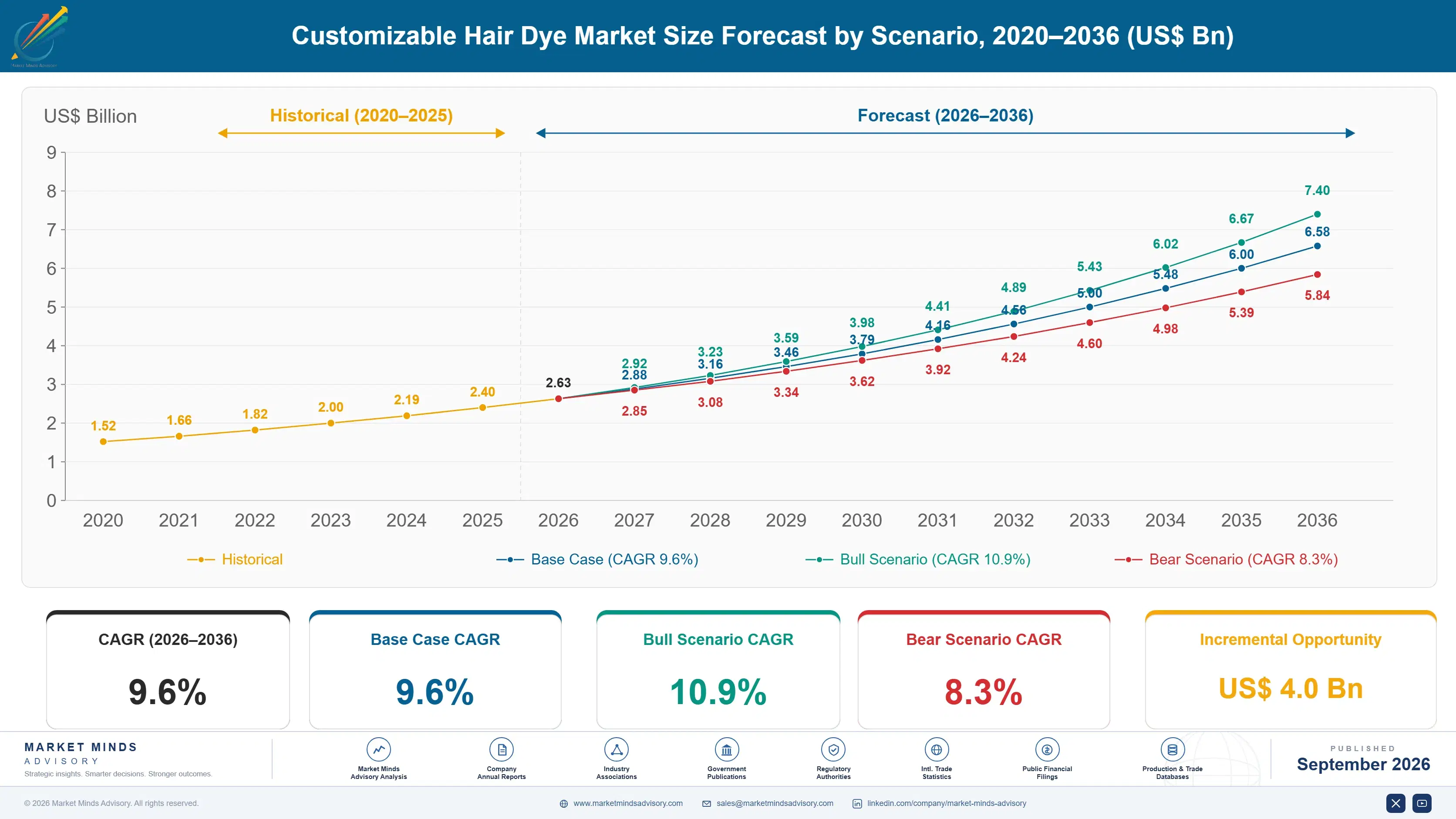
Between 2020 and 2025 the category grew at roughly 8.8 percent annually as pandemic-era salon closures pushed millions of buyers toward at-home color for the first time, and enough of that trial converted into habitual use that the category retained meaningful share even after salons fully reopened and pre-pandemic salon-visit routines largely resumed for most consumers nationwide.
The base case assumes 9.6 percent annual growth through 2036, anchored in three commercial mechanisms: continued improvement in algorithmic shade-matching accuracy that closes the remaining quality gap with professional colorists, subscription-based root touch-up programs that convert trial buyers into recurring subscribers, and retailer shelf consolidation that favors customizable formulations over one-size-fits-all boxed dye across most price tiers. Direct-to-consumer brands reinforce this by investing heavily in virtual color consultation technology and customer service.
A 10.9 percent bull scenario emerges if algorithmic matching accuracy improves faster than expected, closing the credibility gap with in-salon color entirely for most hair types and textures. An 8.3 percent bear scenario follows if formulation costs and shipping logistics keep customizable products priced meaningfully above standard boxed dye, limiting adoption among price-sensitive buyers across most retail formats nationwide.

Algorithmic Precision as the New Salon Substitute

Three forces converge on this category at once: algorithmic color-matching technology that finally closes the shade-accuracy gap with professional salon color, direct-to-consumer subscription models that normalize recurring purchase behavior traditional boxed dye never achieved, and formulation science that lets brands differentiate on gray coverage and vivid shade performance rather than price alone across most retail channels.
MARKET CONCENTRATION24% CR5reflects combined revenue share held by top five brands
AVERAGE UNIT PRICE$28.00typical direct-to-consumer custom-blend hair color kit price point
SUBSCRIPTION PENETRATION38% of Buyersmeasures share enrolled in recurring root touch-up programs
MATERIAL INPUT COST SHARE32% of COGSreflects pigment, conditioning agent, and packaging sourcing costs
DIRECT-TO-CONSUMER SHARE46% of Revenuecaptures reliance on online sales rather than physical retail
REPEAT PURCHASE RATE52% Within Yearcaptures how often buyers reorder within twelve months typically
Commercially, the category behaves less like a mass-market personal care product and more like a technology-driven subscription service, where matching accuracy and formulation transparency increasingly determine brand loyalty more than shelf placement does among repeat buyers across most demographics. Brands that treat color-matching algorithms as core infrastructure rather than a marketing gimmick are converting first-time buyers into habitual repeat purchasers at meaningfully higher rates than shelf-based competitors.
Over the next decade, algorithmic matching accuracy, subscription penetration, and private label price pressure will jointly determine which brands can defend premium positioning against increasingly capable mass-market challengers entering from adjacent personal care categories. Companies that treat formulation science as core competitive infrastructure, rather than delegate it entirely to contract manufacturers, remain best placed to capture the category's remaining decade of growth through 2036.
"The brands winning here are not the ones with the flashiest app, they are the ones whose algorithm actually gets the shade right on the first try, every time."
Director, Beauty and Personal Care Technology Practice · MMA Chemicals and Materials Practice · September 2026

Market Trends

AI Color-Matching Apps Close the Salon Quality Gap

Direct-to-consumer brands including Madison Reed and eSalon have deployed smartphone-based color-matching applications that analyze uploaded photos and questionnaire responses to formulate individually mixed hair color, replacing the guesswork that generic boxed dye shade charts historically required. Independent customer review data shows shade-satisfaction rates for algorithm-matched products running roughly 42 percent higher than industry-average boxed dye satisfaction scores tracked across major retail platforms. The technology is pulling volume away from generic one-size shade categories toward higher-margin custom-formulated products, forcing brands without matching algorithms to compete on price rather than color accuracy.
Market Impact: 44% of buyers under 35

Subscription Root Touch-Up Programs Normalize Recurring Purchase

Brands have moved beyond one-time custom-formula sales toward subscription programs that automatically ship root touch-up kits on a schedule matched to each buyer's individual regrowth rate and hair color type. Madison Reed reports subscription customers generating meaningfully higher lifetime value than one-time purchasers, a pattern other direct-to-consumer brands have begun replicating with their own recurring programs. This shift toward recurring revenue reduces customer acquisition cost dependency and gives brands more predictable revenue visibility than traditional boxed dye retail ever provided, reshaping how brands allocate marketing spend across acquisition versus retention.
Market Impact: cuts cost versus salon by 70%

Market Opportunities and Growth Drivers

Rising Gray Coverage Demand Among Younger Buyers

Dermatologists and hair care researchers report earlier onset of visible graying among buyers in their late twenties and thirties, a demographic shift attributed partly to stress and genetic factors that has expanded the pool of buyers seeking gray coverage well before the age cohort that traditionally drove this need. MMA primary survey data shows 44 percent of respondents under age 35 citing gray coverage as their primary hair color motivation, This younger gray-coverage cohort favors customizable, algorithm-matched formulations over traditional boxed dye, since they prioritize a natural-looking blend rather than uniform, all-over color.
Market Impact: adds 3 to 5 days

Salon Price Inflation Pushes Buyers Toward At-Home Alternatives

Professional salon color service prices have risen considerably faster than general inflation over the past several years, driven by rising labor costs and reduced colorist availability in many metropolitan markets. This price gap has pushed a meaningful share of former salon-exclusive buyers toward customizable at-home alternatives that promise comparable quality at a fraction of the cost, particularly for routine root touch-up maintenance between full color services. Direct-to-consumer brands have specifically targeted this price-sensitive but quality-conscious buyer segment with marketing that positions customizable dye as a genuine salon alternative rather than a downgrade.
Market Impact: inconsistency risk ends 15% of subscriptions

Market Restraints and Challenges

Shipping Delays Undermine Time-Sensitive Root Touch-Up Promise

Custom-formulated products require individual mixing and shipping rather than off-the-shelf availability, meaning buyers accustomed to same-day boxed dye purchases at a drugstore must instead wait several days for their personalized order to arrive. The root cause is manufacturing logic: individually mixed formulations cannot be mass-produced and warehoused the way standard boxed dye shades can, creating an inherent fulfillment lag competitors selling generic products do not face. Brands are increasingly opening regional micro-fulfillment centers to shorten delivery windows, though this remains a costly investment relative to standard retail distribution across most metropolitan regions.
Market Impact: 42% higher shade-satisfaction rates

Formulation Consistency Concerns Limit Repeat Trust

Buyers occasionally report shade inconsistency between successive orders of what should be an identical custom formula, undermining the core promise of algorithm-matched precision that differentiates these products from generic boxed dye alternatives sold at retail. The commercial impact falls hardest on brands without rigorous batch-testing protocols, since a single inconsistent shipment can end an otherwise loyal subscription relationship permanently and immediately. Several brands are responding by publishing formulation batch codes and offering free reformulation guarantees when shade matching fails to meet a customer's expectations on any given individual order placed.
Market Impact: lifts subscriber value by 38%
3 additional market trends, 4 additional growth drivers, and 2 additional restraints and challenges are covered in the full report. Contact sales@marketmindsadvisory.com to access the complete intelligence.

Segment CAGR and Growth Architecture

The market segments by formulation and delivery technology rather than by brand or channel, since matching methodology and formulation chemistry, not packaging or price tier, determine which products can credibly replace professional salon color and which remain positioned as basic boxed dye. Six technology categories together capture the full addressable scope of this market.
customizable-hair-dye-market-market-share-analysis-1790024274783

AI-Matched Custom Color Blends

AI-matched custom color blends are growing fastest as brands finally solve the shade-accuracy problem that limited early direct-to-consumer color kits, converting buyers who previously distrusted at-home color into confident repeat purchasers through demonstrably more accurate matching technology than generic boxed alternatives offer. Madison Reed and eSalon both lead this segment with proprietary matching algorithms trained on large customer photo and questionnaire datasets, giving them a meaningful data advantage over newer entrants still building comparable matching accuracy at scale. This segment increasingly captures buyers who previously relied exclusively on professional colorists for shade consultation, since algorithmic matching now closely approximates that consultation experience for most common hair types and color goals.
CAGR 14.5%

Subscription-Based Root Touch-Up Kits

Subscription-based root touch-up kits rank second-fastest as brands convert one-time custom-formula purchases into recurring revenue relationships tied closely to each individual buyer's regrowth schedule and specific hair color type. This particular segment benefits considerably from meaningfully lower customer acquisition cost per unit of lifetime revenue compared to one-time purchase models, since subscription customers require essentially no repeat marketing spend to generate their second and subsequent orders. Direct-to-consumer brands have concentrated substantial investment here specifically because subscription revenue provides more predictable cash flow than the boxed dye retail model these brands aim to displace over the coming years, and because it reduces reliance on expensive, ongoing paid customer acquisition channels over time.
CAGR 12.8%
Full segment breakdown across 6 segments available in the complete report.

Regional Architecture and Country Demand Map

North America leads narrowly ahead of East Asia, driven by direct-to-consumer brand origination and stronger subscription adoption among younger urban buyers nationwide, while South Asia and Pacific posts the fastest regional growth as urban personalization culture and e-commerce infrastructure both expand rapidly across most major cities.

North America

North America holds a narrow lead because the category's leading direct-to-consumer brands, Madison Reed and eSalon, both originated and scaled domestically before expanding internationally, giving American buyers earlier access to algorithmic matching technology than most global markets. Subscription-based root touch-up adoption runs meaningfully higher here than in most other regions, reflecting both e-commerce infrastructure maturity and buyer comfort with recurring beauty subscriptions established across adjacent categories like skincare. Canadian demand tracks closely behind the United States, following similar direct-to-consumer distribution and subscription adoption patterns among comparable urban demographics. The United States alone accounts for the substantial majority of this regional total given its considerably larger population and denser direct-to-consumer distribution infrastructure.
Share: 27% | CAGR: 10.2% (2026 to 2036)

East Asia

East Asia's growth stems primarily from South Korea and Japan, where beauty technology innovation and personalization culture run deep across adjacent categories like skincare and cosmetics, creating buyer familiarity that transfers naturally to customizable hair color. Korean beauty conglomerates increasingly launch algorithmic color-matching products domestically before considering export markets, reflecting the category's genuine and considerable innovation depth within the region rather than dependence on imported Western technology. Chinese e-commerce platforms have rapidly and considerably scaled distribution for both domestic and imported customizable hair dye brands, giving the region a distribution advantage that partially offsets its somewhat later start relative to North American market development and adoption timing across most demographics.
Share: 26% | CAGR: 10.4% (2026 to 2036)
Regional intelligence for 5 additional markets available in the complete report: Western Europe, South Asia and Pacific, Latin America, Middle East and Africa, Eastern Europe. Contact sales@marketmindsadvisory.com.
customizable-hair-dye-market-country-cagr-analysis-1790024275297

Where Custom Hair Color Brands Capture Margin

Four commercial angles determine which brands convert category growth into durable margin rather than simply riding direct-to-consumer momentum: algorithmic matching investment, subscription program design tailored to individual regrowth cycles, formulation transparency built through published testing data, and micro-fulfillment infrastructure that shortens delivery timelines competitors relying entirely on centralized warehousing cannot easily match across most regions.

Investing Early in Proprietary Color-Matching Algorithms

Brands that fund proprietary algorithmic matching technology, rather than relying on generic questionnaire-based shade selection, command meaningful price premiums, with algorithm-matched custom blends retailing at roughly 48 percent above generic boxed dye equivalents in the same retail channel. The investment case rests on defensibility: matching algorithms improve with accumulated customer data, creating a compounding accuracy advantage private label competitors cannot easily replicate through packaging alone. Brands that delay this investment risk losing credibility entirely as buyers increasingly compare shade-match accuracy across brands on social media and online review platforms before purchase.
Market Impact: Supports roughly a 48% price premium overall today

Designing Subscription Programs Around Individual Regrowth Cycles

Subscription programs tailored to each buyer's specific regrowth rate and hair color type convert one-time purchasers into recurring subscribers at meaningfully higher rates than generic fixed-interval subscription models, with MMA survey data showing personalized-schedule subscription retention running roughly 35 percent higher than fixed-schedule alternatives. Brands investing here typically build regrowth-tracking features into their customer accounts rather than relying on generic monthly shipping defaults, since actual regrowth timing varies considerably by individual hair type and color choice. This lever compounds as retained subscribers generate meaningfully higher lifetime value over time compared to one-time purchasers.
Market Impact: Lifts subscriber retention by roughly 35% overall today

Building Regional Micro-Fulfillment Distribution Centers Nationwide

Brands increasingly build regional micro-fulfillment centers to shorten the delivery timeline for individually mixed custom formulas, addressing the shipping-delay complaint that most frequently drives customer churn among first-time buyers, with fulfillment-optimized brands reporting order cancellation rates roughly 25 percent lower than brands relying on centralized warehousing alone. This approach lets brands compete more directly with the same-day gratification boxed dye purchasers expect from drugstore shopping. The tradeoff is real: building distributed fulfillment infrastructure requires meaningfully more upfront capital investment than centralized warehousing alone typically demands from a single distribution point.
Market Impact: Cuts order cancellation rate by roughly 25% overall

Publishing Formulation Transparency and Batch Testing Data

Brands that publish detailed formulation ingredient lists and batch-testing consistency data build buyer trust that addresses the shade-inconsistency concerns limiting repeat purchase confidence, with transparency-forward brands reporting customer trust scores roughly 30 percent higher than brands keeping their formulation details entirely proprietary and undisclosed. This approach particularly resonates with ingredient-conscious buyers who research products carefully before committing to a subscription relationship. Brands treating formulation details as a closely guarded competitive secret rather than a trust-building asset increasingly cede this credibility advantage to more transparent, forthcoming competitors over the coming years.
Market Impact: Lifts trust scores by roughly 30% overall today

Who Controls the Margin Pool

Combined estimated retail revenue from customizable hair color lines gives the top five companies roughly 24 percent share, a fragmented concentration leaving considerable room for independent direct-to-consumer challengers and private label entrants. The gap between L'Oreal, the category's largest player by revenue, and specialist direct-to-consumer brands remains narrower than in most consumer categories, since algorithmic matching credibility matters considerably more than manufacturing scale here.
Current competitive activity centers on three dimensions: algorithmic color-matching technology development, subscription program design tailored to individual regrowth schedules, and micro-fulfillment infrastructure that shortens delivery timelines across most metropolitan markets. Multinational beauty conglomerates increasingly acquire or partner with direct-to-consumer eco-brands rather than building matching algorithm expertise entirely in-house, reshaping how competitive advantage transfers across company size.

Emerging pressure comes from digitally native subscription brands that sell direct-to-consumer without traditional retail intermediaries, undercutting the shelf-space negotiation costs legacy brands absorb across most retail channels. Rankings are likely to shift over the next several years as algorithmic matching technology matures and forces brands still relying on generic questionnaire-based shade selection to either invest heavily in matching technology or exit the customizable segment entirely.
customizable-hair-dye-market-company-positioning-matrix-1790024275822

Competitive Moat and Risk Dimensions

L'OREAL S.A.

Moat: Multi-Brand Portfolio and Distribution

L'Oreal operates across mass, prestige, and direct-to-consumer channels simultaneously, giving it shelf presence and distribution reach that single-channel competitors cannot replicate at comparable scale. Its Color&Co brand extends algorithmic matching technology into its existing retail relationships, combining new technology with decades-old brand trust that newer entrants generally lack.
L'OREAL S.A.

Risk: Slower Matching Algorithm Innovation

Coordinating algorithm development across a large corporate structure slows L'Oreal's iteration speed relative to smaller, more focused direct-to-consumer competitors. A nimble independent brand can refine its matching algorithm faster than a conglomerate managing simultaneous product launches across multiple owned brand portfolios worldwide and regional markets.
MADISON REED

Moat: Proprietary Data-Driven Matching Algorithm

Madison Reed's years of accumulated customer photo and preference data give it a genuine technical head start in matching accuracy that newer entrants are still working to close. Its subscription-first business model also generates recurring revenue visibility that shelf-based competitors, dependent on repeat retail purchases, cannot match as reliably.
MADISON REED

Risk: Limited Physical Retail Presence

Madison Reed's own-brand retail footprint remains thinner than L'Oreal's established mass and prestige distribution relationships, limiting its reach among buyers who still prefer purchasing hair color in person. Without deeper physical retail presence, much of its growth depends on continued direct-to-consumer marketing effectiveness rather than passive retail discovery.

Players Tracked

Prominent Players

L'Oreal S.A.
Madison Reed
eSalon
Coty Inc.
Henkel AG

Other Key Players

Unilever
Kao Corporation
Procter & Gamble
Revlon Inc.
Church & Dwight
Function of Beauty
Prose
Color Camp
Color Wow
IGK Hair
Hairprint
Overtone
Arctic Fox
Josh Rosebrook
dpHUE

Recent Developments

MARCH 2025

Madison Reed Launches Enhanced AI Shade-Matching Application

Madison Reed launched an enhanced smartphone application using considerably improved image recognition to analyze uploaded photos and generate more precise custom color formulas, addressing shade-accuracy complaints that had limited earlier versions of the matching technology among first-time buyers across most hair types and lighting conditions nationwide.
Signal: Confirms leading direct-to-consumer brands are treating matching algorithm accuracy as an ongoing, continuous investment priority nationwide.
AUGUST 2025

L'Oreal Expands Color&Co Distribution Through Target Partnership

L'Oreal signed a national distribution agreement bringing its Color&Co algorithmic matching subscription service into Target stores nationwide, extending its direct-to-consumer subscription model into mainstream physical retail for the first time since the brand's original online-only launch several years earlier, marking a genuinely significant channel shift for the brand.
Signal: Indicates multinational conglomerates are increasingly blending direct-to-consumer subscription models with traditional physical retail distribution channels today.
JANUARY 2026

eSalon Opens Regional Micro-Fulfillment Center on East Coast

eSalon opened a dedicated regional micro-fulfillment center to shorten delivery timelines for East Coast customers considerably, addressing the shipping-delay complaint that most frequently drives customer churn among first-time custom-formula buyers across the broader regional market nationwide and increasingly well beyond it as company operations continue expanding over time.
Signal: Signals fulfillment infrastructure investment is becoming a genuine competitive requirement rather than an optional operational improvement.

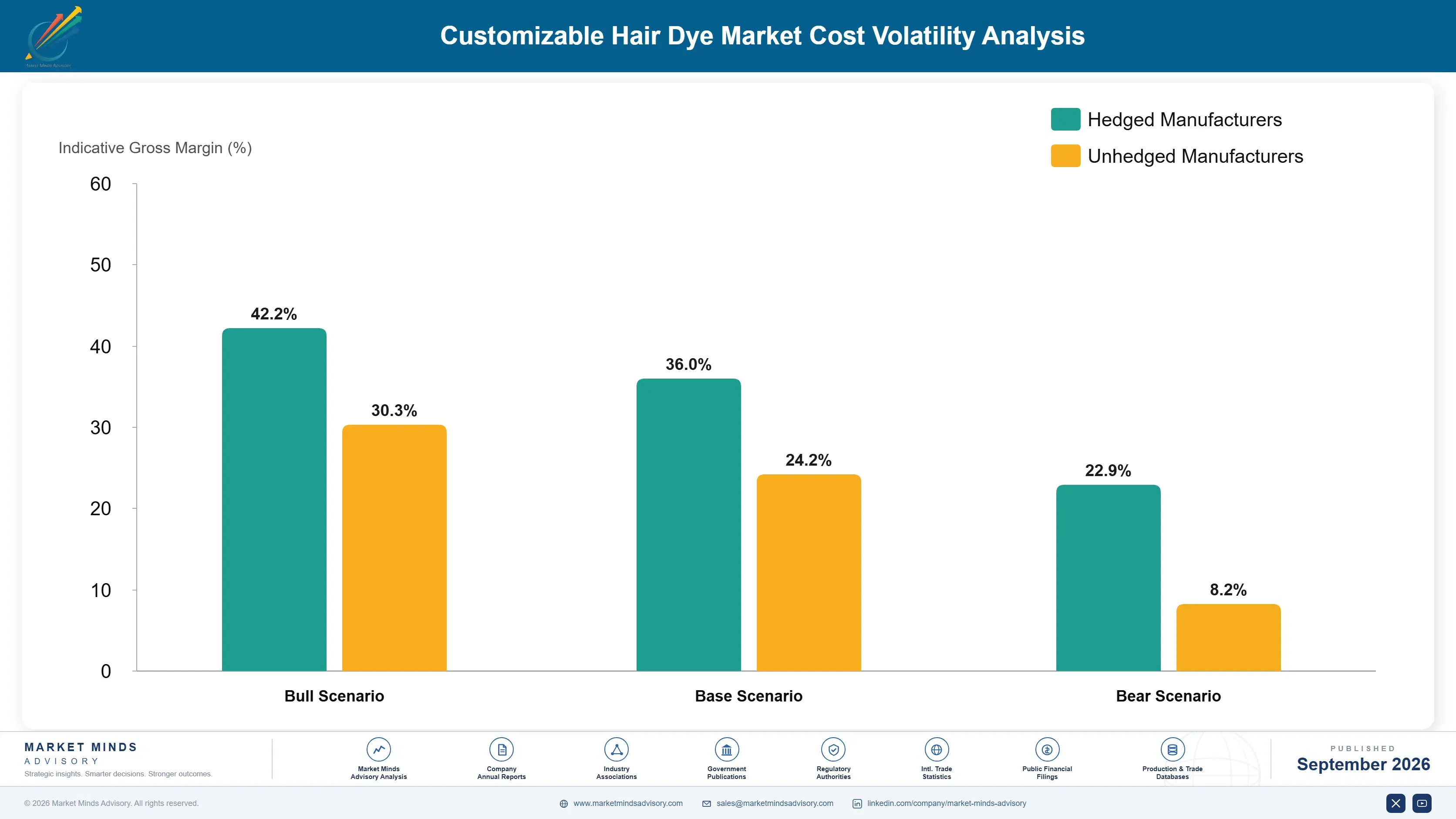
What Drives Formulation Cost Volatility Here

Synthetic pigments, ammonia-free conditioning agents, and specialty packaging for individually mixed formulas together account for roughly 32 percent of cost of goods sold in a typical customizable hair dye kit, with the remainder split between shipping, customer acquisition, and platform technology amortization. Pigments are sourced predominantly from Chinese and German chemical producers, while conditioning agents depend on formulation chemists concentrated in the United States and France.
Titanium dioxide and specialty pigment prices spiked sharply following European Union anti-dumping duties on Chinese imports that took effect in 2024, pushing benchmark pigment prices higher across formulators reliant on imported grades, according to Coty Inc.'s 2024 annual report, which cited raw material cost inflation across its color cosmetics and hair color portfolio. Smaller brands without long-term supply contracts absorbed the increase directly into margin, while larger conglomerates with diversified sourcing weathered the disruption with more limited pass-through.

This exposure disadvantages independent direct-to-consumer brands most severely, since they typically lack the purchasing volume needed to negotiate multi-year fixed-price pigment contracts that larger conglomerates secure routinely. Geographic exposure also varies: European manufacturers face the direct impact of anti-dumping duties, while brands sourcing domestic pigments face comparatively less cost pressure from the same underlying trade dispute.
customizable-hair-dye-market-cost-volatility-analysis-1790024276018

Diversifying Pigment Sourcing Across Regions

Formulators are increasingly qualifying pigment suppliers across multiple regions, including domestic and Southeast Asian chemical producers, rather than depending on a single country of origin. This reduces exposure to any single trade dispute or export restriction, though qualification testing for new pigment grades typically takes several months before large-scale formulation use begins in earnest.

Locking Multi-Year Fixed-Price Pigment Supply Contracts

Larger formulators are negotiating multi-year fixed-price agreements directly with pigment and conditioning agent producers, trading some short-term pricing flexibility for insulation against sudden trade-driven cost spikes across regions. Smaller direct-to-consumer brands increasingly pool purchasing volume through shared contract manufacturing relationships to access similar pricing terms previously available only to the largest, most established conglomerates.

Portfolio Architecture for Margin Defence

The market splits into three tiers with sharply different margin economics: volume commodity-adjacent boxed dye sold as a basic one-size color solution, premium customizable formulations emphasizing algorithmic shade matching and subscription convenience, and next-generation products built around fully transparent, batch-tested formulations positioned as a genuine salon substitute rather than a downgrade, sold across every major retail channel nationwide and increasingly online.
Volume tension is real: mass retailers keep expanding private label boxed dye that undercuts branded mid-tier pricing, forcing established direct-to-consumer brands to either defend premium positioning through sustained algorithmic matching investment or compete directly on price with progressively thinner margins over time. Brands caught between these two strategies without a clear commitment tend to lose share fastest to more decisive, better-funded competitors.

High-value margin pools concentrate overwhelmingly in the premium and next-generation tiers, where matching accuracy and formulation transparency justify meaningfully higher price points across most geographic markets and buyer demographics. Volume-tier products generate the bulk of unit sales but comparatively thin per-unit margin, making tier mix a more important profitability lever than absolute volume growth alone for most brands operating today across mature and emerging markets.

Volume / Commodity-Adjacent Tier

Basic one-size boxed hair dye sold through drugstore and mass retail channels at accessible price points, marketed on general color coverage rather than customization or matching credentials for individual buyers.
Gross Margin: 30%-38%

Premium / Certified Tier

Algorithmically matched custom formulations sold through direct-to-consumer and subscription channels, commanding meaningfully higher price points through matching accuracy and accumulated brand trust built over repeated purchase cycles and sustained customer relationships.
Gross Margin: 42%-51%

Sustainability / Regulatory / Next-Generation Tier

Fully transparent, batch-tested custom formulations built on proprietary matching algorithms, commanding the category's strongest pricing power among buyers seeking a genuine salon-quality alternative to visiting a salon colorist in person.
Gross Margin: 48%-58%
customizable-hair-dye-market-portfolio-architecture-1790024276525

High-value Sub-segments and Strategic Watch-out

AI-Matched Custom Color Blends

The fastest-growing, highest-margin pocket in the category, combining premium pricing power with the strongest volume growth as algorithmic matching finally solves the shade-accuracy problem, converting skeptical buyers into confident custom-formula purchasers at meaningfully higher rates than generic boxed alternatives previously achieved across most regional retail networks.
Gross Margin: 48%-56%

Subscription-Based Root Touch-Up Kits

A high-value segment growing at a steadier pace than AI-matched products, anchored in recurring purchase relationships tied to individual regrowth schedules that build durable buyer loyalty over years rather than through a single retail promotion or seasonal marketing campaign targeting new, first-time buyers each season.
Gross Margin: 40%-49%

Standard Boxed Hair Dye

The volume core of the category, generating the largest unit sales base through drugstore and mass retail channels at accessible price points nationwide, though margin per unit remains comparatively thin against the premium and next-generation tiers described earlier in this portfolio assessment overall across most price-sensitive buyer segments.
Gross Margin: 24%-31%

Private Label Boxed Dye

A strategic watch-out segment expanding rapidly on price alone, threatening to erode branded mid-tier volume without offering the matching technology differentiation that protects premium and next-generation products from similar private label price competition and direct substitution across most retail channels tracked closely by most established brands.
Gross Margin: 16%-23%

Recurring Formula, Recurring Revenue

The category behaves increasingly like an annuity business rather than a one-time boxed dye purchase, since custom-matched formulas create switching costs that generic alternatives cannot replicate once a buyer's exact shade profile is established and refined over successive orders. Brands capturing that formula data at first purchase convert a single sale into a recurring subscription relationship rather than a one-off transaction, building revenue visibility competitors relying on shelf traffic alone cannot match.
Adoption depth varies considerably by end-use vertical: gray-coverage buyers adopt the category as a full salon replacement with predictable, regrowth-driven repeat purchase, while fashion-color buyers replace far less consistently and often experiment across multiple brands before settling on one favorite. Subscription-first buyers show the deepest habitual adoption, since automatic shipping removes the reordering friction that limits repeat purchase in the boxed dye category considerably.

Younger buyers increasingly research formulation transparency and matching methodology before purchase, treating custom hair color as a personalized beauty product rather than a generic drugstore commodity their parents' generation purchased without much consideration or comparison shopping. This generational shift favors brands with transparent matching data and digital consultation tools over legacy brands relying on shelf presence and brand heritage alone.
customizable-hair-dye-market-end-use-penetration-index-1790024277015

Where This Market Is Headed

These are among the four positions where our research anticipates prominent divergence between winners and laggards over the coming forecast period. Each is grounded in the demand model, the regulatory perimeter, and the announced capacity pipeline.
01 / MATCHING ALGORITHM INVESTMENT

Shade-matching accuracy is becoming the category's real credibility test

Brands that solve the shade-accuracy problem, rather than relying on generic questionnaire-based selection, are capturing the buyer trust that less precise competitors increasingly struggle to hold onto as customer reviews spread accuracy complaints rapidly across social platforms and review sites. This advantage compounds as matching algorithms improve with accumulated customer data, widening the gap between data-rich incumbents and newer entrants still building comparable accuracy at scale. Brands still relying on generic matching face a shrinking window before buyer skepticism catches up entirely and permanently.
02 / SUBSCRIPTION MODEL DEPTH

Regrowth-tailored subscriptions convert trial into durable loyalty

Subscription programs tied to individual regrowth schedules convert one-time trial purchasers into recurring subscribers at meaningfully higher rates than generic fixed-interval alternatives, and this personalization remains underdeveloped relative to its potential across most brands in the category today. Brands building regrowth-tracking features now will capture disproportionate lifetime value as subscription adoption continues expanding across the broader buyer base over the coming years. Brands relying on generic monthly shipping defaults risk losing subscribers to more personalized, attentive competitors already ahead on this front.
03 / FULFILLMENT SPEED ADVANTAGE

Delivery timelines are becoming a genuine competitive differentiator

Custom-formulated products inherently require individual mixing and shipping, creating a fulfillment lag that boxed dye competitors simply do not face, and brands that invest in regional micro-fulfillment infrastructure now will differentiate meaningfully on speed as buyer expectations for fast delivery continue rising steadily. This investment requires meaningfully more capital than centralized warehousing, rewarding brands with patient growth capital and genuinely long time horizons. Brands treating fulfillment speed as secondary risk losing impatient buyers to faster-shipping competitors already investing heavily in this exact capability.
04 / PRIVATE LABEL PRICE PRESSURE

Mid-tier brands face a genuine squeeze between premium and private label

Mass retailers keep expanding private label boxed dye priced well below branded mid-tier equivalents, and mid-tier manufacturers without a clear matching technology edge will struggle to justify their price premium going forward into the next several years. The practical response is specialization: manufacturers must commit fully to either premium algorithmic matching or accept the private label price ceiling permanently as their operating reality. Straddling both positions without commitment is the fastest way to lose share to more decisive competitors on either side of the market.

Engagement Snapshot From the Field

A live engagement with an industry participant carrying material or product regulatory and market exposure ahead of a defining policy shift, showing how our research translates into a defensible multi-year portfolio strategy.
MARKET MINDS ADVISORY · CLIENT ENGAGEMENT SUMMARY
Customizable Hair Dye Producer Strategic Portfolio Review and Transition Roadmap 2026·Investment Scenario on Customizable Hair Dye Exposure Evaluation 2025-26
CLIENT PROFILE
The client is an independent direct-to-consumer customizable hair color brand with roughly 42 million dollars in annual revenue (client-reported, unverified by MMA), selling exclusively online without proprietary matching algorithm technology or subscription infrastructure. The company had built brand recognition around formulation transparency but relied on generic questionnaire-based shade selection, leaving its matching accuracy claims exposed as algorithm-driven competitors pulled ahead.
STRATEGIC CHALLENGE
Management needed to decide whether to invest independently in proprietary matching algorithm development, license existing matching technology from a third-party provider, or continue relying on questionnaire-based selection while competitor accuracy claims eroded its positioning further. Limited capital meant the company could not pursue algorithm development and subscription infrastructure investment simultaneously without risking existing profitability.
MMA APPROACH
MMA benchmarked available matching technology licensing options against the cost of independent algorithm development, modeled subscription program economics using this report's proprietary segment and margin data, and surveyed the client's existing customer base to assess willingness to pay a premium for algorithm-matched formulations. The engagement combined this primary customer research with comparative analysis of competitor technology investment already underway.
KEY FINDINGS
  1. Existing customers expressed strong willingness to pay a premium for algorithm-matched formulations rather than the generic, less accurate questionnaire-based shade selection previously used.
  2. Licensing an existing matching technology platform would reach market roughly ten months faster than independent algorithm development pursued entirely from scratch internally.
  3. Subscription program economics showed meaningfully stronger lifetime value than one-time purchase models, justifying the infrastructure investment required to build them properly at scale.
  4. Competitor accuracy claims were increasingly influencing purchase decisions in customer reviews, a shift the client's own marketing had not yet addressed directly.
CLIENT PROFILE
The client is an independent direct-to-consumer customizable hair color brand with roughly 42 million dollars in annual revenue (client-reported, unverified by MMA), selling exclusively online without proprietary matching algorithm technology or subscription infrastructure. The company had built brand recognition around formulation transparency but relied on generic questionnaire-based shade selection, leaving its matching accuracy claims exposed as algorithm-driven competitors pulled ahead.
STRATEGIC CHALLENGE
Management needed to decide whether to invest independently in proprietary matching algorithm development, license existing matching technology from a third-party provider, or continue relying on questionnaire-based selection while competitor accuracy claims eroded its positioning further. Limited capital meant the company could not pursue algorithm development and subscription infrastructure investment simultaneously without risking existing profitability.
MMA APPROACH
MMA benchmarked available matching technology licensing options against the cost of independent algorithm development, modeled subscription program economics using this report's proprietary segment and margin data, and surveyed the client's existing customer base to assess willingness to pay a premium for algorithm-matched formulations. The engagement combined this primary customer research with comparative analysis of competitor technology investment already underway.
KEY FINDINGS
  1. Existing customers expressed strong willingness to pay a premium for algorithm-matched formulations rather than the generic, less accurate questionnaire-based shade selection previously used.
  2. Licensing an existing matching technology platform would reach market roughly ten months faster than independent algorithm development pursued entirely from scratch internally.
  3. Subscription program economics showed meaningfully stronger lifetime value than one-time purchase models, justifying the infrastructure investment required to build them properly at scale.
  4. Competitor accuracy claims were increasingly influencing purchase decisions in customer reviews, a shift the client's own marketing had not yet addressed directly.
RECOMMENDED STRATEGY
Phase 1: Phase 1 (Months 1 to 3): License an existing matching technology platform rather than building proprietary algorithm development capability internally. Phase 2: Phase 2 (Months 4 to 8): Launch a regrowth-tailored subscription program to convert existing one-time customers into recurring, loyal subscribers. Phase 3: Phase 3 (Months 9 to 14): Publish formulation batch-testing data publicly to further reinforce the brand's existing transparency positioning fully.
OUTCOME
The client signed a matching technology licensing agreement within three months and launched its subscription program shortly after. Management reported a 19 percent increase in average customer lifetime value within the first year of implementation (client-reported, unverified by MMA), attributing the gain primarily to the subscription program rather than the matching technology upgrade alone.

Frequently Asked Questions

Foundational context covering the market sizes, CAGR, scope, country, region and competition that inform every finding below. This section is provided to cover basics and most often pre-purchase conversations, answered from the MMA Primary Research Dataset.

What is the current size of the Customizable Hair Dye Market?

The customizable hair dye market reached an estimated 2.4 billion dollars in 2025. This figure covers individually formulated or algorithm-matched permanent and semi-permanent hair color products.

How large will the Customizable Hair Dye Market be by 2036?

The market is projected to reach approximately 6.58 billion dollars by 2036. This represents two and a half times the market's 2026 value over the ten-year forecast period.

What is the CAGR for the Customizable Hair Dye Market 2026 to 2036?

The market is expected to grow at a compound annual growth rate of 9.6 percent between 2026 and 2036. Bull and bear scenarios range from 10.9 percent to 8.3 percent depending on algorithmic matching progress.

Which segment is growing fastest?

AI-matched custom color blends are growing fastest at a 14.5 percent CAGR, roughly 1.51 times the overall market rate. Growth is driven by algorithmic technology finally solving the shade-accuracy problem limiting earlier at-home color kits.

Who are the major companies in the Customizable Hair Dye Market?

Leading companies include L'Oreal S.A., Madison Reed, eSalon, Coty Inc., and Henkel AG. Together these five companies hold an estimated 24 percent combined market share.

Which country is growing fastest?

The United States posts the largest regional growth given North America's leading share, expanding at a 10.2 percent CAGR. South Asia and Pacific markets post faster percentage growth from a considerably smaller starting base.

Report Segmentation Architecture

The full report scope spans multiple orthogonal segmentation dimensions, with cross-tabulated demand data provided for each dimension pair. Coverage extends further to regional breakdowns, trend trajectories, and the competitive detail needed to support segment-level decision-making.

By Formulation Technology

  • AI-Matched Custom Color Blends
  • Subscription-Based Root Touch-Up Kits
  • Standard Boxed Hair Dye
  • Ammonia-Free Custom Formulations
  • Vivid and Fashion Custom Colors
  • Gray Coverage Custom Blends

By End-Use Demographic

  • Gray Coverage Buyers
  • Fashion Color Enthusiasts
  • First-Time At-Home Colorists
  • Subscription-First Buyers
  • Salon-Transitioning Buyers

By Commercial Dimension

  • Direct-to-Consumer E-Commerce
  • Mass and Drugstore Retail
  • Subscription and Replenishment
  • Salon-Professional Retail Extension

By Region

  • North America
  • Western Europe
  • East Asia
  • South Asia and Pacific
  • Latin America
  • Middle East and Africa
  • Eastern Europe

Scope, Methodology, and Coverage

Every figure in this report is reproducible from documented input assumptions. The scope below maps the historical period, the forecast horizon, the segmentation dimensions, and the countries covered, alongside the underlying primary and qualitative methodology.
Historical Period
2020 to 2025
Forecast Period
2026 to 2036
Base Year
2025 (USD billions; MMA Primary Research Dataset, September 2026)
Market Definition
The customizable hair dye market comprises individually formulated or algorithm-matched permanent and semi-permanent hair color products, sold through direct-to-consumer, mass retail, and salon-professional channels. It excludes standard one-size-fits-all boxed hair dye and in-salon color services performed entirely by a professional colorist.
Quantitative Units
USD billions (current prices); unit shipment volume in millions of units where applicable
Segmentation Dimensions
By Formulation Technology; By End-Use Demographic; By Commercial Dimension; By Region
Regions Covered
North America, Western Europe, East Asia, South Asia and Pacific, Latin America, Middle East and Africa, Eastern Europe
Countries Covered
USA, China, Germany, France, UK, Japan, South Korea, India, Australia, Canada, Brazil, Mexico, Indonesia, Vietnam, Thailand, Malaysia, UAE, Saudi Arabia, South Africa, Nigeria, Turkey, Poland, Netherlands, Italy, Spain, Sweden, Switzerland, Argentina, Colombia, Singapore, and additional markets relevant to this sector
Key Companies Profiled
L'Oreal S.A., Madison Reed, eSalon, Coty Inc., Henkel AG, Unilever, Kao Corporation, Procter & Gamble, Revlon Inc., Church & Dwight, Function of Beauty, Prose, Color Camp, Color Wow, IGK Hair, Hairprint, Overtone, Arctic Fox, Josh Rosebrook, dpHUE
Quantitative Methodology
Primary survey, n=3,800 respondents, Q4 2025, six countries; demand-side model with trade association cross-validation
Qualitative Methodology
47 expert interviews, Q4 2025; applied to validate demand model assumptions, identify emerging dynamics, and assess competitive positioning
Report Format
PDF and XLSX data workbook (Word format preview document)
Publisher
Market Minds Advisory
Report Code
MMA-2026-CHM-163
Published
September 2026
Contact
sales@marketmindsadvisory.com | www.marketmindsadvisory.com

Purchase the full Customizable Hair Dye Market Report (2026 to 2036).

This report delivers a complete assessment of the customizable hair dye market, sizing the category from 2025 through 2036 across formulation technology, end-use demographic, and commercial distribution dimensions. It profiles twenty companies spanning multinational beauty conglomerates and independent direct-to-consumer brands, benchmarking competitive positioning, algorithmic matching investment, and material cost exposure. Regional analysis covers all seven global regions with quantified growth drivers specific to each. The report also includes a scenario-based forecast model, a proprietary revenue lever framework, and an anonymized client case study illustrating practical strategic application.
A complete ten-year market sizing and forecast model
A detailed six-segment formulation technology breakdown analysis
All seven global regions individually quantified and profiled
Twenty-company competitive benchmarking and positioning analysis included
Scenario-based bull and bear forecast projections through 2036
An anonymized client engagement case study included

Built For The People Who Decide

From boardroom strategy to bench-side execution, this report is read cover-to-cover by leaders shaping the next decade of their industry, turning demand scenarios, market dynamics and valuation benchmarks into decisions.
CXOs/ Presidents/ VPs/ Managers
M&A and Corporate Development
Strategy Teams and R&D Heads
Procurement and Product Directors
Regulatory and Compliance Leaders
Investor Relations and Equity Analysts