Market Minds Advisory
Currency Counting Machines Market

Currency Counting Machines Market: Counterfeit Detection and Cash Center Automation

Cash-heavy economies across South Asia and Africa are pulling first-time buyers into branded currency counters even as digital payments expand, while central banks and retailers upgrade sensors to catch increasingly convincing counterfeit notes.

Lead Analyst

David Horsley

Published

September 2026

Make Smarter Decisions with Customized Research Insights

Request a free sample report and evaluate market opportunities, growth trends, and competitive dynamics relevant to your business needs.

2025 MARKET VALUE$2.4BMarket Size 2025
2036 FORECAST VALUE$5.4BBase Case , 2026 to 2036
CAGR 2026 TO 20367.6 %Bull 8.8% / Bear 6.3%
INCREMENTAL OPPORTUNITY$2.8BNet 10- year value creation
EXPANSION MULTIPLE2.08x2036 value over 2026 base
Strategic Levers
M&A Pipeline
Regional Outlook
Country Rankings
Competitive Intelligence
Segmental Deep-dive
Call-Us : 91 93563 13602

Executive Snapshot and Market Trajectory

Counterfeit detection sensor upgrades, not raw counting speed, now decide which currency counter a bank or retailer buys, as increasingly convincing fake notes force multi-sensor UV, infrared, and magnetic detection onto machines that used to sell on throughput specifications alone, a full generation ago now.
India anchors the fastest growth in this report, as retailers, banks, and cash-in-transit operators that once counted notes by hand or with basic single-denomination machines upgrade to mixed-denomination counters faster than any other large cash economy tracked here. Mixed denomination counters lead everywhere, but currency sorters used in cash center automation follow closely behind them across most markets. East Asia anchors manufacturing scale even as consumption growth concentrates in South Asia and Africa specifically.
Competitive intensity centers on sensor accuracy certification and central bank relationships rather than headline price, since government cash centers buy on documented counterfeit-catch rates above all else. Regulatory pressure compounds the shift: several central banks now mandate minimum counterfeit detection standards for machines used in regulated cash handling, while manufacturers able to certify compliance fastest are winning government tenders ahead of slower-moving competitors still catching up.
Market Definition
The currency counting machines market covers electronic devices that count, sort, authenticate, or detect counterfeits in banknotes and coins, spanning mixed and single denomination counters, sorters, counterfeit detection scanners, and coin handling equipment sold to banks, retailers, and cash-in-transit operators. It excludes ATM hardware, point-of-sale terminals, and digital payment processing systems that do not physically handle cash.
Base Year Value
$2.4B in 2025 (MMA Primary Research Dataset, August 2026)
Forecast Period
2026 to 2036, eleven discrete annual values
CAGR
7.6% base case. Bull 8.8%. Bear 6.3%.
Fastest Growth Segment
Mixed Denomination Currency Counters: 10.8% CAGR
Fastest Growth Country
India: 12.4% CAGR
Fastest Growth Region
South Asia and Pacific: 9.8% CAGR
Largest Region
East Asia: 30% of 2025 global value
Market Leaders
Glory Ltd., Giesecke+Devrient GmbH, De La Rue plc, Cummins Allison LLC, Kisan Electronics Co., Ltd. Source: MMA Analysis based on company annual reports.
Primary Survey
n=3,800 procurement and R&D decision-makers, Q4 2025, six countries
Methodology
Demand-side build-up, cross-validated against public data, 47 expert interviews

Currency Counting Machines Market Forecast Scenarios

currency-counting-machines-market-size-forecast-scenario-1787301602208
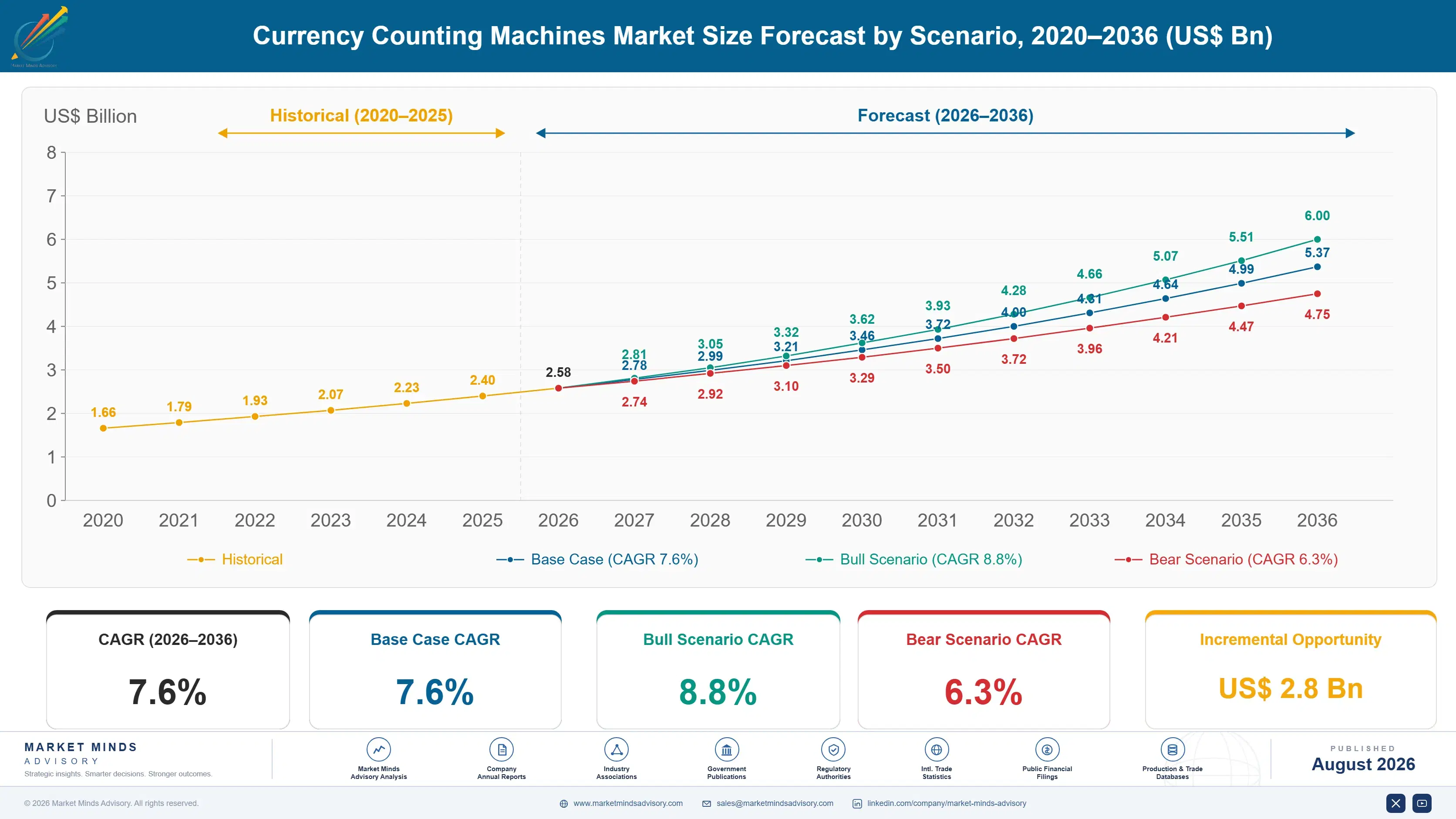
Currency counter demand grew unevenly between 2020 and 2025. Pandemic-era cash handling concerns briefly depressed purchases through 2021, then India's continued formalization of cash-heavy retail and banking drove a sustained rebound from 2022 onward. Growth over the period compounded at an estimated 6.6%, trailing the forecast years because counterfeit detection sensor upgrades, still early, had not yet become a standard replacement driver.
The base case assumes 7.6% annual growth through 2036, anchored on three mechanisms. First, counterfeit note sophistication keeps forcing sensor upgrades across multi-sensor UV, infrared, and magnetic detection platforms industry-wide. Second, India's cash economy and expanding organized retail base pull first-time buyers into branded counters faster than any other large market tracked in this report. Third, central bank cash center automation programs replace manual sorting with high-speed mixed-denomination counters across emerging markets steadily.
A bull case builds if additional central banks mandate minimum counterfeit detection standards, pushing growth toward 8.8%. The bear risk is accelerated digital payment adoption: several fast-growing economies are pushing cashless initiatives hard enough that cash volume growth could slow faster than expected, capping counter replacement demand and growth near 6.3% across the forecast period.

Counterfeit Detection Economics and the Cash Automation Cycle

Currency counting machines sit at the intersection of banking infrastructure and fraud prevention, converting a simple mechanical counting task into an increasingly sophisticated sensor-driven authentication function most branches now depend on daily to operate safely. Counterfeit sophistication has risen enough that basic infrared counters, sufficient a decade ago, no longer satisfy central bank certification requirements in most regulated markets covered in this report.
MARKET CONCENTRATION52% CR5Five global manufacturers control just over half of demand
AVERAGE SELLING PRICE$680 per unitBlended price across mixed, single, and sorter machine types
TOP PRODUCING COUNTRYJapan, 38%Single country supplies well over a third of global output
CAPACITY UTILISATION71%Manufacturing lines run below peak amid sensor line expansion
TRADE INTENSITY56% export shareMore than half of machines cross a border before sale
INPUT COST SHARE29% of COGSOptical sensors and precision feed mechanisms dominate input costs
Vendors compete less on counting speed than on sensor accuracy and central bank certification: banks and cash centers standardize on machines carrying documented counterfeit-catch rates rather than choosing on throughput specifications alone. Manufacturing remains concentrated in Japan and China, with India and South Korea gaining share as manufacturers diversify assembly closer to fast-growing consumption markets and steadily away from single-country dependence.
The next decade will be shaped by two forces pulling in opposite directions: rising digital payment adoption in mature markets and expanding cash economy formalization in South Asia and Africa specifically. Both reshape where replacement demand concentrates even as global cash volume growth slows overall across most mature economies tracked in this report.
"Digital payments were supposed to kill this category a decade ago. Instead the machines just got better at catching fakes, and somehow that's the business now."
Director, Banking and Cash Handling Technology Practice · MMA Banking and Cash H

Market Trends

Multi-Sensor Counterfeit Detection Becomes Standard Specification

Counterfeit notes sophisticated enough to defeat single-sensor infrared detection have pushed manufacturers to standardize multi-sensor platforms combining ultraviolet, infrared, magnetic, and image-recognition detection on machines that once shipped with a single detection method as a premium option. Central banks across South Asia, Africa, and Latin America are updating certification standards to require multi-sensor detection for regulated cash handling, converting what was once a premium feature into a baseline requirement. This compresses the price premium multi-sensor machines once commanded, pushing manufacturers toward new differentiation points including detection speed and machine learning-based note recognition that adapts to newly circulating counterfeit patterns faster than static calibration allows.
Market Impact: Forces 18% of installed base replac
India's Cash Economy Formalization Drives Machine Adoption

India's continued push toward organized retail and formal banking, alongside a cash economy that remains large despite digital payment growth, is pulling retailers and cash-in-transit operators who once counted notes manually into first-time branded machine ownership faster than any other large economy tracked in this report. Godrej & Boyce and Kisan Electronics have built India-specific price points and service networks to capture this conversion, recognizing that documented counterfeit detection now matters as much to Indian retailers as raw counting speed does. This positions India as the single fastest-growing large currency counter market tracked anywhere in this report.
Market Impact: Cuts cash processing time 45%

Market Opportunities and Growth Drivers

Central Bank Certification Mandates Force Replacement Cycles

Central banks across a growing list of countries now mandate that commercial banks and licensed cash handlers use only machines certified against a documented counterfeit-catch rate, forcing a replacement cycle among institutions still running older single-sensor equipment. This certification requirement functions like a compliance deadline rather than a discretionary upgrade decision, compressing sales cycles for manufacturers able to certify quickly across multiple jurisdictions simultaneously. Institutions that delay replacement risk losing their cash handling license entirely in several regulated markets, making certification compliance the single clearest purchasing trigger manufacturers can point to in a sales conversation with a hesitant buyer.
Market Impact: Cuts mature-market cash volume 12%

Cash-in-Transit Automation Expands Sorter Demand Rapidly

Cash-in-transit operators and central bank cash centers are automating note sorting at a pace that is pulling high-speed currency sorters into facilities that historically relied on manual fitness sorting performed by trained staff. Automated sorters process notes at a rate manual sorting cannot match while simultaneously flagging counterfeit and unfit notes for removal, a combination that is shortening cash processing cycle times meaningfully at large-volume facilities. This is expanding sorter demand beyond central banks into large commercial cash centers and retail banking hubs that previously considered automated sorting too costly to justify against manual labor.
Market Impact: Displaces 19% of certified volume

Market Restraints and Challenges

Digital Payment Growth Slows Cash Volume in Mature Markets

Sustained digital payment adoption across several mature and fast-digitizing economies is slowing overall cash volume growth, reducing the urgency of currency counter replacement purchases among banks and retailers who now handle proportionally less physical cash than five years ago. The root cause is a genuine substitution effect: contactless and mobile payment convenience has crossed a threshold where consumers actively prefer it for routine transactions in several major markets. This slows replacement demand in mature markets that historically anchored manufacturer revenue. Manufacturers are mitigating this by pivoting sales focus toward cash-intensive emerging markets where digital substitution remains further behind.
Market Impact: Cuts counterfeit pass-through rate

Counterfeit Machines Undercut Certified Equipment Pricing

Uncertified and counterfeit currency counting machines, particularly prevalent across price-sensitive African and Southeast Asian markets, undercut certified equipment pricing by a wide margin while carrying no documented counterfeit-catch rate or manufacturer warranty. The root cause is weak import enforcement in several fast-growing markets, where customs authorities lack capacity to verify certification documentation on the volume of equipment now entering through informal distribution channels. This slows certified manufacturer share gains precisely in the fastest-growing markets tracked in this report. Manufacturers and central banks are jointly pushing for stricter import certification requirements, a mitigation pathway gaining traction across several African markets specifically.
Market Impact: Adds 2.8 million first-time buyers
3 additional market trends, 3 additional growth drivers, and 3 additional restraints and challenges are covered in the full report. Contact sales@marketmindsadvisory.com to access the complete intelligence.

Segment CAGR and Growth Architecture

MMA segments the market by machine function and detection technology, the classification banks and cash-handling buyers use when specifying equipment and comparing certification compatibility across vendors. This avoids blending downstream application categories, a separate commercial dimension entirely, with the technology types that define how a given machine actually counts and authenticates currency in practice.
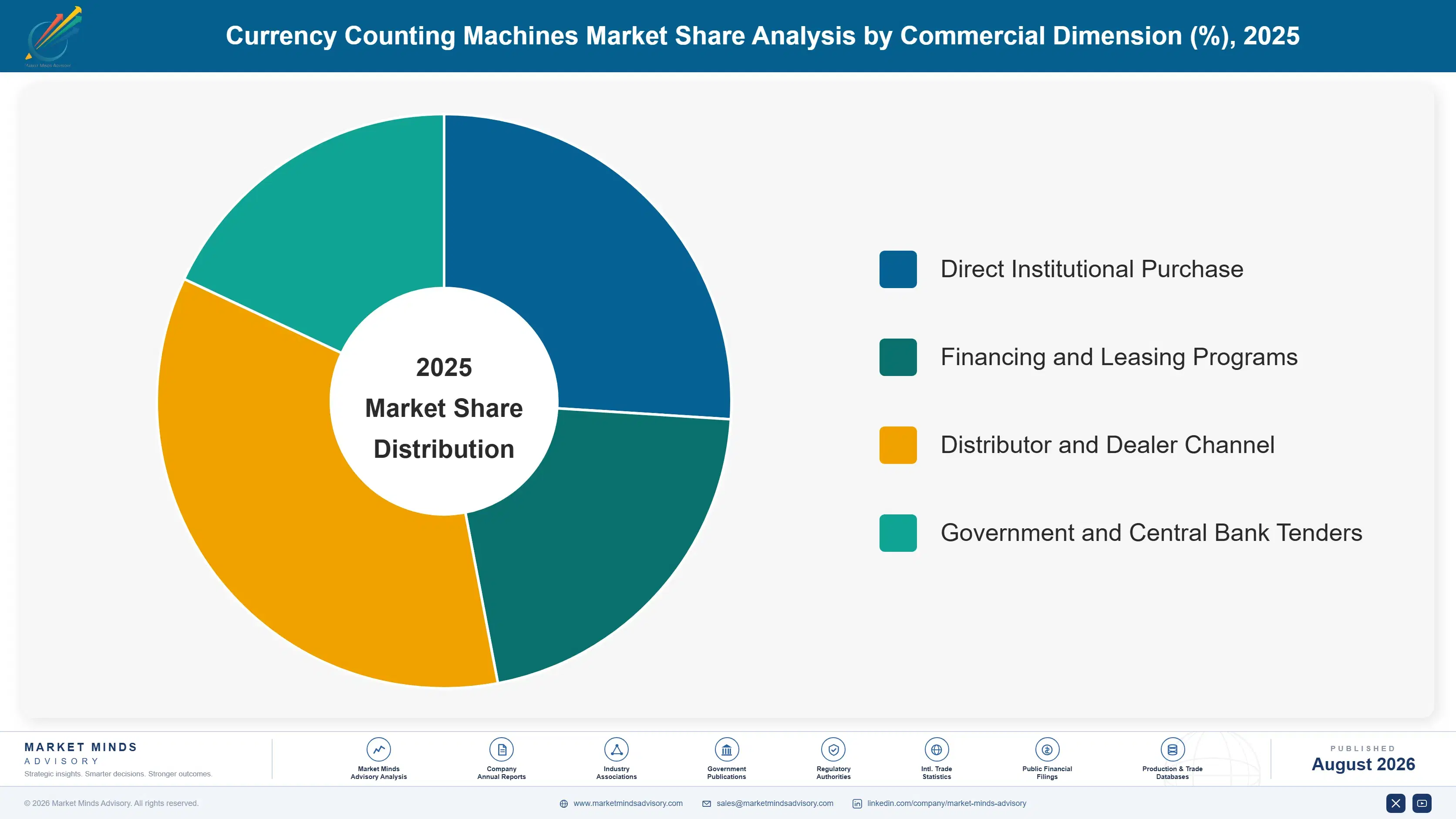
currency-counting-machines-market-market-share-analysis-1787301602889

Mixed Denomination Currency Counters

Mixed denomination counters are converting from a premium category into the default specification, as multi-sensor detection and note-recognition software finally let a single machine count and authenticate notes of varying denominations without manual pre-sorting. Growth concentrates wherever cash economy formalization and counterfeit detection mandates intersect, particularly across India, Africa, and increasingly Southeast Asia's expanding organized retail base. Glory and Giesecke+Devrient have each built dedicated mixed-denomination platforms with expanding sensor arrays, recognizing that manual pre-sorting is the single biggest labor cost machines can now eliminate entirely. At a 10.8% forecast CAGR, roughly 1.4 times the market average, mixed denomination counters are pulling capital investment away from single-denomination product development almost entirely.
CAGR 10.8%

Currency Sorters

High-speed sorters used in cash center automation track central bank and cash-in-transit modernization programs more directly than any other segment, making automation investment cycles a disproportionate growth driver for this category specifically. Glory and De La Rue lead on large-facility specification, while regional manufacturers compete on price for smaller commercial cash center deployments. Demand here is less driven by retail counter replacement than other segments, since sorters serve high-volume centralized facilities rather than individual bank branches or retail counters directly. Growth tracks automation investment cycles and cash center consolidation more closely than general cash volume trends, giving this segment a distinct demand pattern from the rest of the portfolio covered in this report.
CAGR 9.4%
Full segment breakdown across 6 segments available in the complete report.

Regional Architecture and Country Demand Map

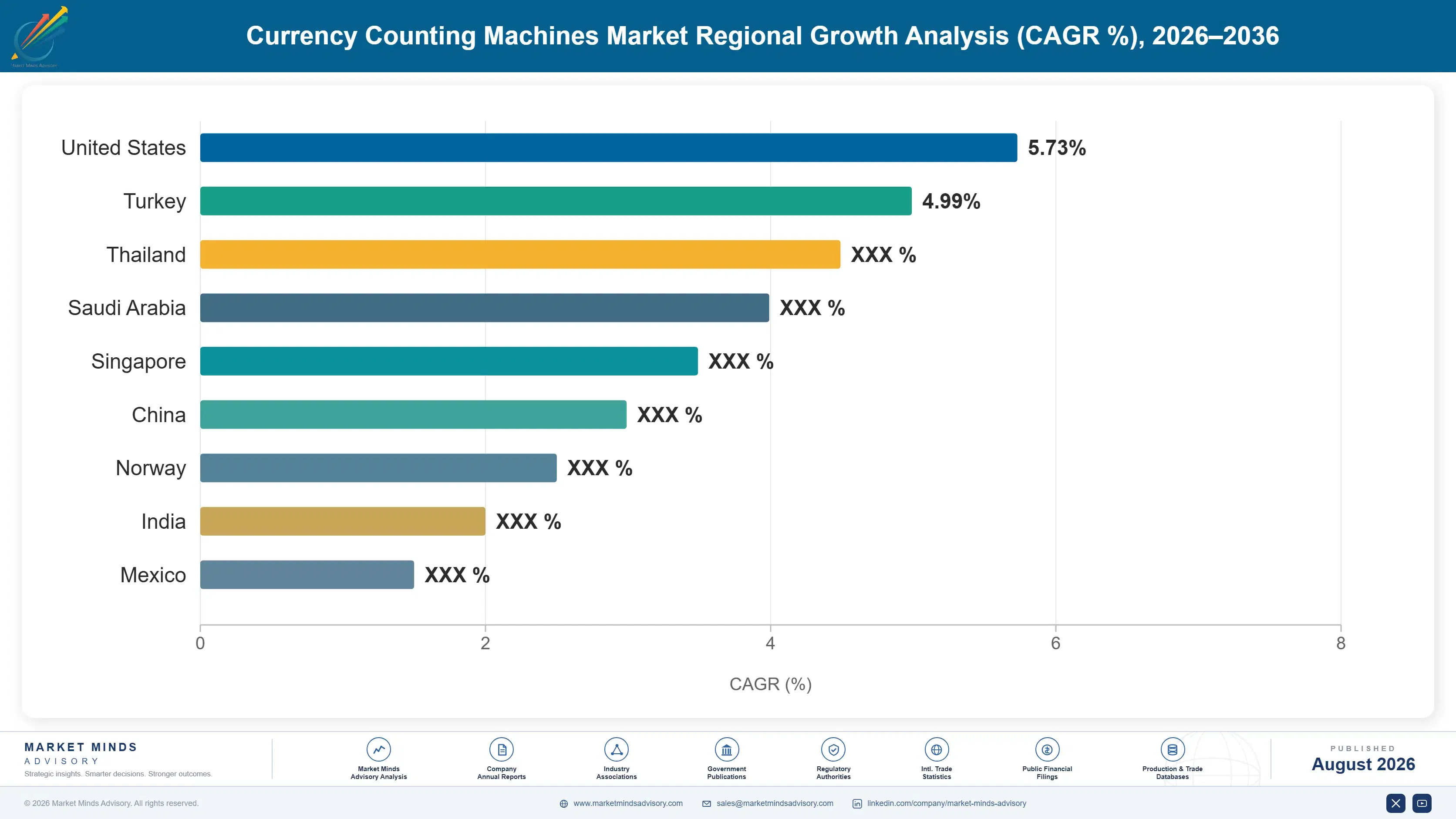
Demand concentrates where cash economy scale, counterfeit detection regulation, and manufacturing capability overlap most tightly. East Asia leads on manufacturing and mature institutional demand, North America and Western Europe follow on replacement-driven certification upgrades, while South Asia and Pacific converts fastest as India's cash economy formalizes.

North America

United States banks and large retailers anchor regional demand, replacing aging single-sensor counters as certification standards tighten and cash-in-transit operators consolidate cash processing into fewer, higher-volume facilities requiring automated sorting equipment. Diebold Nixdorf and NCR Voyix give manufacturers deep banking-channel distribution that smaller regional players cannot easily replicate across thousands of branch locations nationwide, reinforcing an already large distribution gap. Canada follows a similar replacement-driven pattern at smaller scale, tied closely to its own banking consolidation trends and regulatory timelines. Growth stays close to the global base rate because the region's institutional installed base is already largely certified, leaving mostly steady replacement demand rather than first-time adoption opportunity ahead for most vendors active here.
Share: 24% | CAGR: 7.0% (2026 to 2036)

Western Europe

Germany anchors both regional manufacturing, through Giesecke+Devrient, and regional demand, with a banking culture that replaces cash handling equipment on a documented certification and maintenance cycle rather than waiting for failure to force a purchase. France and the United Kingdom follow with steady institutional demand tied to central bank certification updates and retail banking consolidation trends. Regulatory pressure compounds this: the European Central Bank's counterfeit detection standards keep tightening across member states, forcing periodic sensor upgrades even at already well-equipped institutions across the continent. Growth trails East Asia and South Asia because Western Europe's installed base is already thoroughly certified, leaving less first-time conversion opportunity than emerging cash economies offer.
Share: 19% | CAGR: 6.0% (2026 to 2036)
Regional intelligence for 5 additional markets available in the complete report: East Asia, South Asia and Pacific, Latin America, Middle East and Africa, Eastern Europe. Contact sales@marketmindsadvisory.com.
currency-counting-machines-market-country-cagr-analysis-1787301603432

Where Currency Counter Vendors Actually Capture Margin

Hardware unit sales increasingly compete on price as basic counting functions become commoditized, so the vendors protecting margin monetize the parts of the transaction adjacent to the machine itself: certification services, extended sensor warranties, and cash center software integration. The four levers below reflect where MMA's interviews with banking and retail buyers show real willingness to pay.

Certification and Compliance Documentation Support Services

Central bank certification requirements demand extensive documentation, and institutions frequently delay purchases when certification paperwork stretches across months of regulatory review. Manufacturers building in-house teams to handle certification application, testing, and documentation on behalf of buyers are converting what used to be a bank's administrative burden into a vendor-managed service, closing deals faster than competitors leaving buyers to navigate regulatory bureaucracy alone. This is most pronounced in markets with recently updated certification standards, where institutions face compressed compliance deadlines and elevated audit risk. Vendors offering this service report conversion rates from quote to purchase running roughly 18 points higher.
Market Impact: Lifts quote-to-purchase conversion

Extended Sensor Calibration and Replacement Contracts

Multi-year sensor calibration and replacement contracts, covering the components most likely to degrade as counterfeit detection algorithms update, have become a reliable high-margin attachment sale across every major manufacturer's institutional product line. Cash center managers renewing contracts increasingly buy extended coverage upfront rather than per-incident recalibration, giving manufacturers predictable annuity revenue worth roughly 14% of original machine price annually across the installed base. Institutions that cannot risk a certification lapse mid-audit increasingly favor manufacturers offering guaranteed recalibration turnaround over competitors selling service on a reactive, order-as-needed basis, particularly ahead of scheduled regulatory inspections and audits.
Market Impact: Adds recurring service revenue wort

Cash Center Software Integration Packages for Banks

Connecting currency counters and sorters directly into a cash center's inventory and reconciliation software lets manufacturers sell a recurring integration and support subscription on top of the hardware sale, priced per facility or per machine per month. For large banks and cash-in-transit operators managing multiple facilities, the value proposition is faster reconciliation and fewer manual counting errors, both of which carry a real cost when unmanaged across a large branch network. Early adopters report integration attach rates approaching 24% on large institutional orders, still small relative to hardware revenue but growing faster than any other line item manufacturers currently track.
Market Impact: Reaches nearly 24 percent attach ra

Financing Programs for Emerging Market Retailers

Spreading the capital cost of a certified currency counter across a one to three year lease tied to reduced counterfeit exposure converts a difficult one-time capital decision into a manageable operating expense for small and mid-sized retailers in fast-growing cash economies. Manufacturers offering in-house or partnered financing close deals faster than competitors requiring buyers to arrange financing separately, and MMA interviews suggest financed orders now average 26% larger in scope than cash-purchase orders across emerging retail channels. This is becoming a standard requirement in India's organized retail channel specifically, where financing availability increasingly decides which manufacturer wins distribution partnerships.
Market Impact: Grows financed order size by roughl

Who Controls the Margin Pool

CR5 sits at 52%, reflecting a category more consolidated than most electronics-adjacent equipment segments, as certification economics and central bank relationships reward scale and discourage fragmentation. Glory Ltd. and Giesecke+Devrient lead on a revenue basis, with a meaningful gap separating them from the next tier of challengers, including De La Rue and Cummins Allison, each strong in specific regional or institutional niches.
Current activity centers on three dimensions: multi-sensor detection accuracy and certification breadth across jurisdictions, central bank and cash-in-transit distribution relationships, and cash center software integration capability. Vendors lacking broad certification coverage are increasingly partnering with regional certification specialists rather than losing government tenders on compliance-documentation terms alone, since institutional buyers now shortlist based on demonstrated multi-jurisdiction certification depth.

Emerging pressure comes from Chinese manufacturers, particularly GRG Banking and Ribao Technology, expanding aggressively on price and certification breadth into markets historically dominated by Japanese and European brands. If India and African demand growth continues outpacing mature markets, expect rankings among the next five challengers to shift by 2030, as manufacturers with strong South Asian and African distribution convert early positioning into lasting share against slower-moving incumbents.
currency-counting-machines-market-company-positioning-matrix-1787301603980

Competitive Moat and Risk Dimensions

GLORY LTD.

Moat: Global Cash Center Automation Scale

Glory's decades of cash center automation deployment give it engineering depth and installed-base scale few competitors can match, letting it bundle counting, sorting, and cash recycling equipment into single large institutional contracts. That combined footprint makes Glory the default vendor for central banks and large cash-in-transit operators seeking one integrated supplier.
GLORY LTD.

Risk: Exposure to Cash Usage Decline

Glory's revenue remains tied closely to physical cash volume, leaving it exposed to any accelerated shift toward digital payments in its largest mature markets. Expanding aggressively into faster-growing but lower-margin emerging cash economies requires balancing near-term margin against long-term share positioning in markets still building formal banking infrastructure.
GIESECKE+DEVRIENT GMBH

Moat: Central Bank Banknote Relationships

Giesecke+Devrient's position as a major global banknote printer gives it central bank relationships and technical credibility on counterfeit detection that pure equipment manufacturers cannot easily replicate on their own. That reputation lets it command premium pricing on certification-critical institutional equipment where buyer trust matters more than price alone.
GIESECKE+DEVRIENT GMBH

Risk: Long Sales Cycles With Governments

Giesecke+Devrient's reliance on government and central bank contracts means sales cycles run considerably longer than commercial retail channels, exposing revenue timing to procurement delays and political budget cycles outside the company's control. Diversifying further into faster-moving commercial retail channels remains a slower undertaking than for competitors already built around them.

Players Tracked

Prominent Players

Glory Ltd.
Giesecke+Devrient GmbH
De La Rue plc
Cummins Allison LLC
Kisan Electronics Co., Ltd.

Other Key Players

GRG Banking Equipment Co., Ltd.
Laurel Bank Machines Co., Ltd.
Toshiba Corporation
NCR Voyix Corporation
Diebold Nixdorf Incorporated
Godrej & Boyce Manufacturing Company Limited
Ribao Technology (Suzhou) Co., Ltd.
Semacon Corporation
Magner Corporation
Kobotech Co., Ltd.
AccuBanker
Bill One Technology Co., Ltd.
Systec (Suzhou) Electronics Co., Ltd.
Nautilus Hyosung America Inc.
Star Techno Systems Pvt. Ltd.

Recent Developments

MAY 2025

Glory Expands India Service Network and Assembly Capacity

Glory announced an expansion of its India service network and local assembly capacity, adding technician coverage across secondary cities to support growing organized retail demand nationwide. The expansion targets faster installation and certification turnaround for India's fast-growing branded machine segment specifically, ahead of anticipated peak-season order volume.
Signal: Signals Glory prioritizing direct India se
NOVEMBER 2025

Giesecke+Devrient Launches Next-Generation Multi-Sensor Detection Platform

Giesecke+Devrient launched an upgraded multi-sensor detection platform combining image recognition with traditional UV, infrared, and magnetic sensing, targeting central banks updating certification standards nationwide. The platform is designed to adapt to newly circulating counterfeit patterns through periodic software updates rather than costly hardware replacement cycles.
Signal: Signals Giesecke+Devrient positioning soft
FEBRUARY 2026

Cummins Allison Acquires Regional Cash Automation Distributor in Southeast Asia

Cummins Allison completed the acquisition of a Southeast Asian cash automation distributor, gaining direct service and installation capability across Vietnam, Thailand, and the Philippines rather than relying on third-party representatives for regional support. The deal strengthens its ability to bid on regional banking modernization contracts directly.
Signal: Signals Cummins Allison building direct re

Optical Sensors and Precision Feed Mechanism Costs

Optical sensors, magnetic detection heads, and precision feed mechanisms together account for roughly 29% of currency counter cost of goods sold, with optical sensor arrays contributing the larger share on multi-sensor institutional machines specifically. Sensors are sourced from a concentrated group of specialized optical component suppliers, while precision feed mechanisms come from a smaller number of manufacturers concentrated in Japan and China.
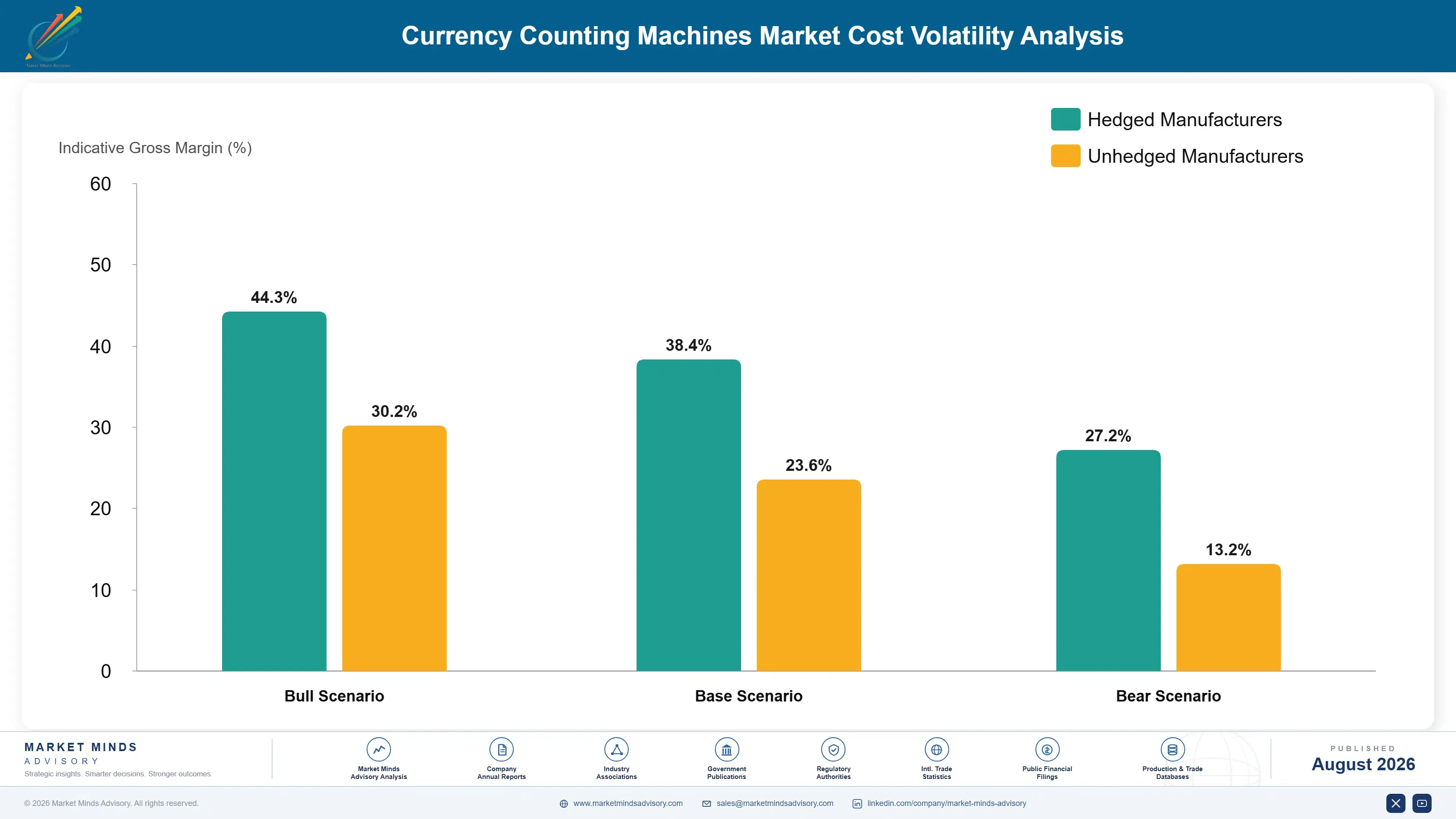
Optical sensor component prices spiked through 2023 as global demand for machine-vision and image-recognition components, driven partly by automotive and industrial automation, competed directly with currency counter manufacturers for the same component supply, according to Japan's METI electronics component tracking. Manufacturers without long-term supply contracts saw sensor costs rise faster than they could pass through to institutional pricing, compressing margins on fixed-price government tenders signed before the spike.

Smaller regional manufacturers without hedging arrangements or long-term sensor supply contracts absorb price volatility directly into thin margins, while larger players like Glory and Giesecke+Devrient use group-level procurement scale to negotiate forward pricing across multiple product lines. Manufacturers without in-house sensor development carry additional exposure compared with vertically integrated competitors who capture more of the detection technology value chain themselves.
currency-counting-machines-market-cost-volatility-analysis-1787301604191

Forward Optical Sensor Purchasing Agreements

Larger manufacturers are locking twelve to eighteen months of optical sensor supply through forward agreements directly with component producers rather than buying spot, smoothing input cost volatility into predictable production budgeting. This reduces exposure to spikes like the 2023 machine-vision-driven surge, though it requires balance-sheet capacity smaller manufacturers typically lack, reinforcing an existing scale advantage.

In-House Sensor Development and Manufacturing

The largest manufacturers are investing directly in optical sensor and detection algorithm development rather than relying entirely on third-party component suppliers, capturing more of the detection technology value chain and reducing exposure to spot-market price swings across the category over time. This requires sustained capital investment that smaller manufacturers cannot easily match today.

Dual-Sourcing Precision Feed Mechanism Components

Vendors are qualifying second feed-mechanism suppliers across different countries rather than depending on a single specialized manufacturing source, reducing single-point-of-failure risk after recent regional supply disruptions affecting precision component delivery timelines industry-wide. This adds qualification cost and lead time up front but protects delivery schedules during localized shortages, a tradeoff most large-volume manufacturers now consider worth accepting.

Portfolio Architecture for Margin Defence

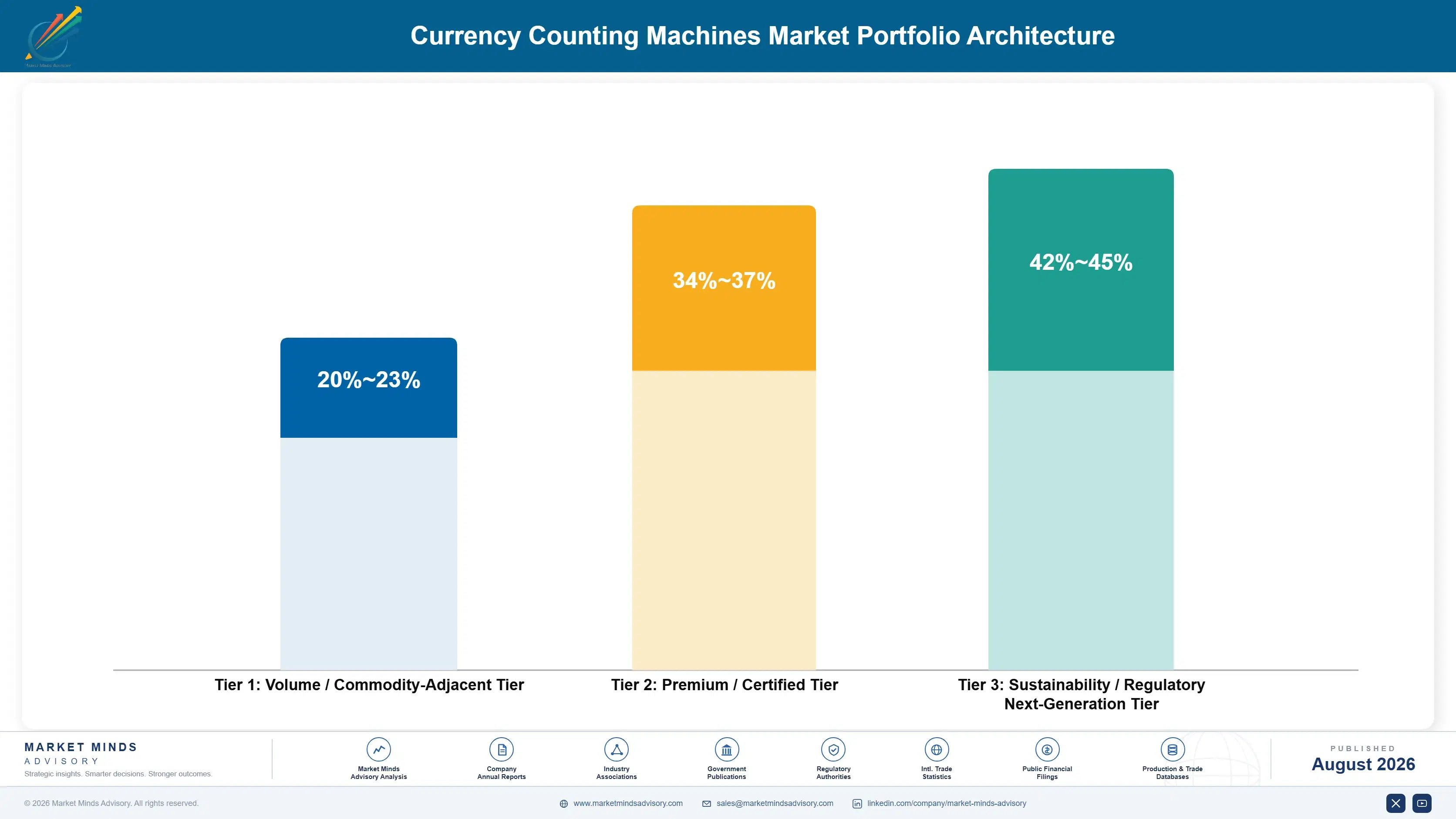
MMA's tier architecture separates the category into three margin bands. Volume and commodity-adjacent single-sensor counters compete on price against uncertified imports and carry thin margin, premium and certified multi-sensor institutional machines carry higher margin on certification depth and service guarantees, and sustainability-linked next-generation lines, including software-updatable detection and cash center integration platforms, command the highest margin as the newest, most differen
The tension between volume and premium plays out most visibly in India's expanding organized retail channel, where first-time buyers want certified counterfeit detection at closer to commodity-counter price, and manufacturers most want to move these buyers up-tier through financing and certification-service bundling over time. Uncertified import competition remains the most price-sensitive segment and the hardest to convert toward branded purchasing habits.

High-value margin pools concentrate in institutional orders bundled with certification services, extended sensor contracts, and cash center software integration, where service and platform-attach revenue increasingly outweighs the margin earned on any individual machine sale alone. That shift is pushing manufacturers to organize sales teams around total account value rather than single transactions.

Volume / Commodity-Adjacent Tier

Basic single-sensor counters sold primarily on price against uncertified imports, serving cost-sensitive small retailers where gross margin stays thin and competition is driven almost entirely by landed unit cost and detection claims.
Gross Margin: 20%-23%

Premium / Certified Tier

Multi-sensor institutional machines specified by banks and cash centers requiring documented certification, service coverage, and financing options, commanding meaningfully higher margin on certification depth and reliability rather than unit price.
Gross Margin: 34%-37%

Sustainability / Regulatory / Next-Generation Tier

Software-updatable detection platforms and cash center integration systems positioned for large institutions chasing certification longevity and reconciliation efficiency, where platform depth and software revenue support the category's highest margin across most major markets today.
Gross Margin: 42%-45%
currency-counting-machines-market-portfolio-architecture-1787301604726

Certification-Driven Replacement Economics

A currency counter sale is rarely a single transaction anymore. Certification services, extended sensor contracts, and cash center software integration convert what used to be a one-time hardware purchase into a recurring revenue relationship that can run the length of a machine's certified service life. Manufacturers that capture the certification and service attachment at time of first sale retain far more lifetime value per customer than those competing purely on unit price.
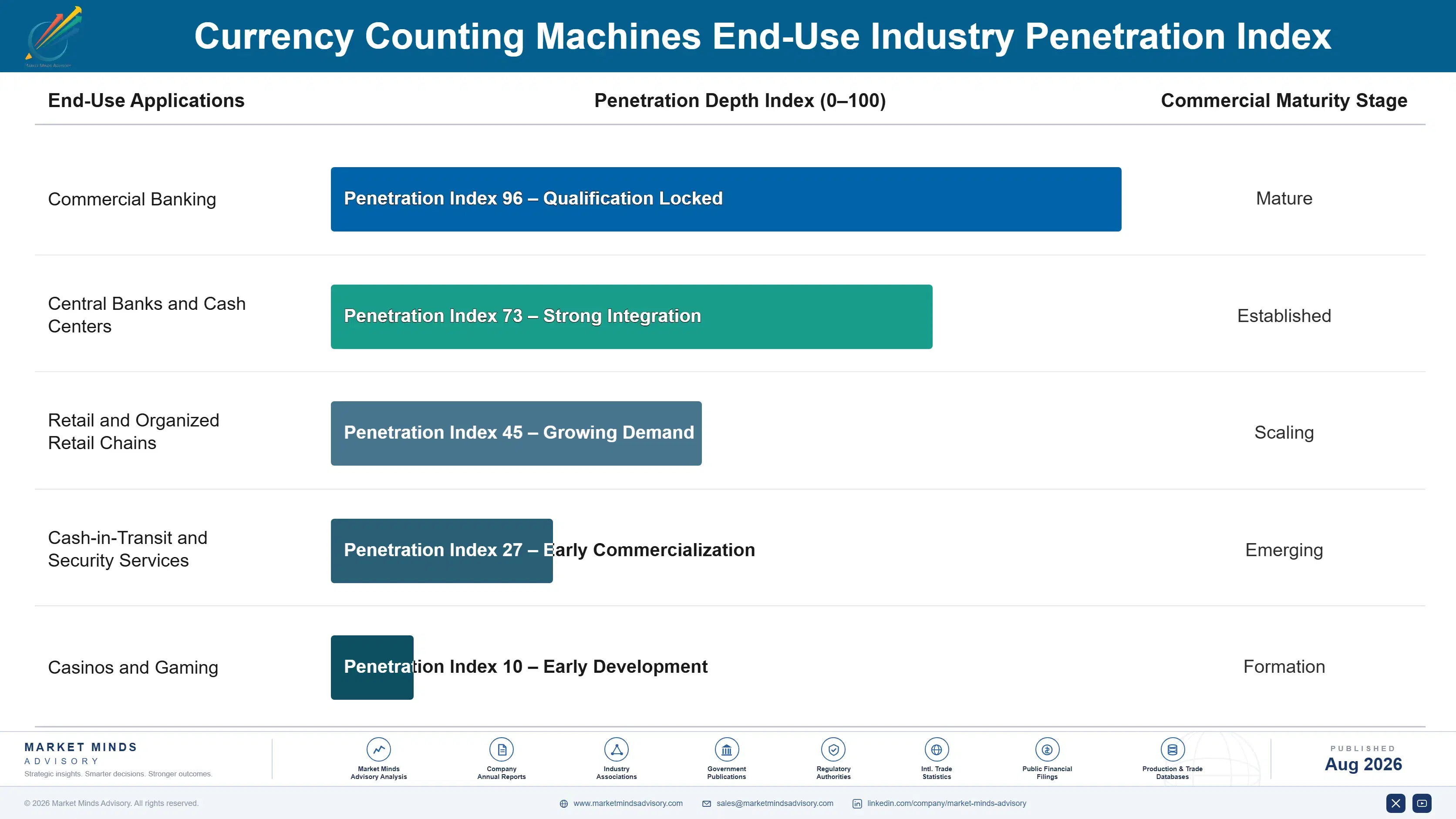
Adoption depth varies sharply by buyer type. Large banks and cash-in-transit operators convert fastest and most completely, standardizing entire branch networks onto one certified platform once a pilot proves out, which makes them the highest-value account type despite competitive institutional-level pricing. Small and mid-sized retailers convert more slowly and partially, often relying on basic counters for years before upgrading to certified multi-sensor equipment.

A generational shift in buyers is compounding the certification-driven shift. Younger bank branch managers entering the role increasingly expect software-updatable detection as standard, a purchasing expectation an older generation of managers, who bought machines individually as needed, rarely held. That shift is accelerating certification-tier adoption even among institutions that have not yet faced a compliance deadline.
currency-counting-machines-market-end-use-penetration-index-1787301605248

What Matters Most Through 2036

These are among the four positions where our research anticipates prominent divergence between winners and laggards over the coming forecast period. Each is grounded in the demand model, the regulatory perimeter, and the announced capacity pipeline.
01 / CERTIFICATION SERVICE CAPABILITY

Build in-house certification teams before competitors do

Certification requirements now decide a majority of institutional purchasing decisions across the markets tracked in this report, and documentation delay remains the single largest reason buyers abandon a purchase decision. Vendors that build dedicated certification facilitation capability convert quote-to-purchase rates meaningfully higher than competitors leaving buyers to navigate regulatory bureaucracy alone, according to MMA's expert interviews with institutional purchasing committees. Continuing to treat certification as the buyer's problem rather than the vendor's opportunity risks ceding the fastest-growing distribution channel to competitors willing to build that capability first.
02 / INDIA MARKET INVESTMENT

Build India-specific service networks ahead of demand

India is growing faster than any other large currency counter market tracked in this report, yet most manufacturers still serve it primarily through distributors designed for other markets and price points. Vendors that build India-specific service networks, financing programs, and certification support now will capture disproportionate share of the organized retail conversion already underway, before competitors with deeper pockets catch up on local presence. Waiting for India's market to fully mature before investing risks losing first-mover advantage in the single fastest-growing large market covered here.
03 / SOFTWARE-UPDATABLE DETECTION STRATEGY

Prioritize update-capable sensor platforms over static hardware refresh

Counterfeit patterns evolve faster than most manufacturers can redesign hardware, making software-updatable detection platforms a durable differentiator against competitors still selling static, hardware-only sensor calibration that requires physical replacement. Manufacturers that build update infrastructure now will extend the useful certified life of installed machines, giving institutional buyers a lower total cost of ownership argument competitors cannot easily match without similar infrastructure investment already in place. This remains underexploited by every manufacturer outside the two largest global vendors currently active in the category.
04 / COUNTERFEIT EQUIPMENT DEFENSE

Lobby jointly for import certification enforcement in fast-growing markets

Uncertified imports displace a meaningful share of certified volume precisely in the fastest-growing markets covered in this report, where weak customs enforcement lets uncertified machines enter through informal distribution channels largely unchecked. Manufacturers acting individually have limited leverage to change import enforcement policy, but joint trade association lobbying for stricter point-of-import certification is gaining traction across several African markets already. It could meaningfully shift certified share within a few years if sustained industry-wide across the manufacturers with the most to gain.

Engagement Snapshot From the Field

A live engagement with an industry participant carrying material or product regulatory and market exposure ahead of a defining policy shift, showing how our research translates into a defensible multi-year portfolio strategy.
MARKET MINDS ADVISORY · CLIENT ENGAGEMENT SUMMARY
Currency Counting Machines Producer Strategic Portfolio Review and Transition Roadmap 2026·Investment Scenario on Currency Counting Machines Exposure Evaluation 2025-26
CLIENT PROFILE
The client is a regional banking group operating several hundred branches across four West African countries, most still relying on manual note counting and basic single-sensor machines nearing end of service life. Facing rising counterfeit incidence and new certification requirements the group could not meet with existing equipment, leadership needed a modernization sequencing plan covering a planned capital outlay of roughly $42 million (client-reported, unverified by MMA).
STRATEGIC CHALLENGE
Group leadership wanted to meet new certification requirements quickly across all four countries, but individual country operations had different regulatory timelines and existing equipment ages, and available capital covered only a fraction of branches needing replacement simultaneously. The group needed a sequencing plan prioritizing which branches and countries to modernize first, balancing regulatory urgency against realistic capital availability across a multi-year rollout.
MMA APPROACH
MMA built a branch-level prioritization model combining country-specific certification deadlines, existing equipment age, and branch cash-handling volume, ranking all branches into three modernization-priority tiers. The analysis drew on MMA's primary survey data and expert interviews with currency counter manufacturers and central bank regulators to benchmark realistic equipment costs and financing terms available to a regional group of this scale.
KEY FINDINGS
  1. The two countries with the nearest certification deadlines accounted for over half of total branch count, making them the clear first-priority modernization tier regardless of existing equipment age elsewhere.
  2. Branch-level counterfeit incidence data correlated more strongly with modernization urgency than existing equipment age alone, since older machines in low-incidence branches still functioned adequately for daily operations.
  3. Vendor-provided certification facilitation services cut documentation turnaround meaningfully, allowing the group to compress its regulatory timeline for early-priority branches by several months versus in-house processing.
  4. Branch managers responded far more positively to modernization framed around counterfeit loss prevention and regulatory compliance than to messaging centered on throughput efficiency alone.
CLIENT PROFILE
The client is a regional banking group operating several hundred branches across four West African countries, most still relying on manual note counting and basic single-sensor machines nearing end of service life. Facing rising counterfeit incidence and new certification requirements the group could not meet with existing equipment, leadership needed a modernization sequencing plan covering a planned capital outlay of roughly $42 million (client-reported, unverified by MMA).
STRATEGIC CHALLENGE
Group leadership wanted to meet new certification requirements quickly across all four countries, but individual country operations had different regulatory timelines and existing equipment ages, and available capital covered only a fraction of branches needing replacement simultaneously. The group needed a sequencing plan prioritizing which branches and countries to modernize first, balancing regulatory urgency against realistic capital availability across a multi-year rollout.
MMA APPROACH
MMA built a branch-level prioritization model combining country-specific certification deadlines, existing equipment age, and branch cash-handling volume, ranking all branches into three modernization-priority tiers. The analysis drew on MMA's primary survey data and expert interviews with currency counter manufacturers and central bank regulators to benchmark realistic equipment costs and financing terms available to a regional group of this scale.
KEY FINDINGS
  1. The two countries with the nearest certification deadlines accounted for over half of total branch count, making them the clear first-priority modernization tier regardless of existing equipment age elsewhere.
  2. Branch-level counterfeit incidence data correlated more strongly with modernization urgency than existing equipment age alone, since older machines in low-incidence branches still functioned adequately for daily operations.
  3. Vendor-provided certification facilitation services cut documentation turnaround meaningfully, allowing the group to compress its regulatory timeline for early-priority branches by several months versus in-house processing.
  4. Branch managers responded far more positively to modernization framed around counterfeit loss prevention and regulatory compliance than to messaging centered on throughput efficiency alone.
RECOMMENDED STRATEGY
Phase 1: Phase 1 (Months 1 to 6): Modernize branches in the two countries with the nearest certification deadlines, using vendor certification facilitation to compress documentation timelines. Phase 2: Phase 2 (Months 7 to 18): Modernize remaining high-counterfeit-incidence branches across all four countries, applying financing terms validated in phase one. Phase 3: Phase 3 (Months 19 to 30): Modernize lower-priority branches opportunistically as capital allows, using vendor relationships built in earlier phases to sustain momentum.
OUTCOME
The banking group modernized its two highest-priority country operations within eight months, ahead of the original twelve-month regulatory deadline, and reported a meaningful reduction in counterfeit note incidence across converted branches within the first two quarters (client-reported, unverified by MMA). Certification facilitation services proved valuable enough that the group extended its vendor contract.

Frequently Asked Questions

Foundational context covering the market sizes, CAGR, scope, country, region and competition that inform every finding below. This section is provided to cover basics and most often pre-purchase conversations, answered from the MMA Primary Research Dataset.

What is the current size of the Currency Counting Machines Market?

MMA estimates the global currency counting machines market at $2.4 billion in 2025. Growth concentrates in South Asia and Africa, driven by cash economy formalization and tightening counterfeit detection certification standards.

How large will the Currency Counting Machines Market be by 2036?

MMA forecasts the market reaching $5.4 billion by 2036, up from $2.6 billion in 2026. That represents roughly a 2.08 times expansion over the ten-year forecast period.

What is the CAGR for the Currency Counting Machines Market 2026 to 2036?

MMA's base case forecasts a 7.6% compound annual growth rate, with a bull case of 8.8% and a bear case of 6.3% depending on digital payment adoption pace.

Which segment is growing fastest?

Mixed denomination currency counters lead at a 10.8% CAGR, roughly 1.4 times the overall market rate, as multi-sensor detection and note-recognition software close the labor-cost gap with manual counting entirely.

Who are the major companies in the Currency Counting Machines Market?

Glory Ltd., Giesecke+Devrient, De La Rue, Cummins Allison, and Kisan Electronics lead the category, together holding an estimated 52% combined share on a revenue basis.

Which country is growing fastest?

India leads at an estimated 12.4% CAGR, outpacing the global average as cash economy formalization and organized retail expansion pull first-time buyers into branded, certified machines.

Report Segmentation Architecture

The full report scope spans multiple orthogonal segmentation dimensions, with cross-tabulated demand data provided for each dimension pair. Coverage extends further to regional breakdowns, trend trajectories, and the competitive detail needed to support segment-level decision-making.

By Machine Function and Technology

  • Mixed Denomination Currency Counters
  • Single Denomination Currency Counters
  • Currency Sorters
  • Counterfeit Detection Scanners
  • Coin Counting and Sorting Machines
  • Portable and Handheld Counting Machines

By End-Use Industry

  • Commercial Banking
  • Central Banks and Cash Centers
  • Retail and Organized Retail Chains
  • Cash-in-Transit and Security Services
  • Casinos and Gaming

By Commercial Dimension

  • Direct Institutional Purchase
  • Financing and Leasing Programs
  • Distributor and Dealer Channel
  • Government and Central Bank Tenders

By Region

  • North America
  • Western Europe
  • East Asia
  • South Asia and Pacific
  • Latin America
  • Middle East and Africa
  • Eastern Europe

Scope, Methodology, and Coverage

Every figure in this report is reproducible from documented input assumptions. The scope below maps the historical period, the forecast horizon, the segmentation dimensions, and the countries covered, alongside the underlying primary and qualitative methodology.
Historical Period
2020 to 2025
Forecast Period
2026 to 2036
Base Year
2025 (USD billions; MMA Primary Research Dataset, August 2026)
Market Definition
This report covers electronic devices that count, sort, authenticate, or detect counterfeits in banknotes and coins, spanning mixed and single denomination counters, sorters, counterfeit detection scanners, and coin handling equipment sold to banks, retailers, and cash-in-transit operators. It excludes ATM hardware, point-of-sale terminals, and digital payment processing systems that do not physically handle cash.
Quantitative Units
USD billions (current prices); unit shipment volumes where cited
Segmentation Dimensions
By Machine Function and Technology; By End-Use Industry; By Commercial Dimension; By Region
Regions Covered
North America, Western Europe, East Asia, South Asia and Pacific, Latin America, Middle East and Africa, Eastern Europe
Countries Covered
USA, China, Germany, France, UK, Japan, South Korea, India, Australia, Canada, Brazil, Mexico, Indonesia, Vietnam, Thailand, Malaysia, UAE, Saudi Arabia, South Africa, Nigeria, Turkey, Poland, Netherlands, Italy, Spain, Sweden, Switzerland, Argentina, Colombia, Singapore, and additional markets relevant to this sector
Key Companies Profiled
Glory Ltd., Giesecke+Devrient GmbH, De La Rue plc, Cummins Allison LLC, Kisan Electronics Co., Ltd., GRG Banking Equipment Co., Ltd., Laurel Bank Machines Co., Ltd., Toshiba Corporation, NCR Voyix Corporation, Diebold Nixdorf Incorporated, Godrej & Boyce Manufacturing Company Limited, Ribao Technology (Suzhou) Co., Ltd., Semacon Corporation, Magner Corporation, Kobotech Co., Ltd., AccuBanker, Bill One Technology Co., Ltd., Systec (Suzhou) Electronics Co., Ltd., Nautilus Hyosung America Inc., Star Techno Systems Pvt. Ltd.
Quantitative Methodology
Primary survey, n=3,800 respondents, Q4 2025, six countries; demand-side model with trade association cross-validation
Qualitative Methodology
47 expert interviews, Q4 2025; applied to validate demand model assumptions, identify emerging dynamics, and assess competitive positioning
Report Format
PDF and XLSX data workbook (Word format preview document)
Publisher
Market Minds Advisory
Report Code
MMA-2026-TEC-301
Published
August 2026
Contact
sales@marketmindsadvisory.com | www.marketmindsadvisory.com

Purchase the full Currency Counting Machines Market Report (2026 to 2036).

The full report provides detailed market sizing and ten-year forecasts for the global currency counting machines market, broken out across all seven regions and six technology segments covered in this summary. It includes complete profiles of the top twenty manufacturers, including capacity, distribution footprint, and recent corporate developments, along with a detailed input-cost and certification-economics model calibrated to primary survey data. Buyers receive a full regional data workbook, segment-level forecast tables through 2036, and a competitive benchmarking matrix built on the same commercially consistent basis used throughout this summary. A dedicated chapter tracks central bank certification standard changes across major markets.
Full regional data workbook across all seven regions
Twenty-vendor competitive profiles with capacity benchmarking
Segment-level forecast tables through 2036 by technology type
Central bank certification tracking chapter across major markets
Input-cost and sensor pricing sensitivity model
Access to MMA analyst inquiry for three months

Built For The People Who Decide

From boardroom strategy to bench-side execution, this report is read cover-to-cover by leaders shaping the next decade of their industry, turning demand scenarios, market dynamics and valuation benchmarks into decisions.
CXOs/ Presidents/ VPs/ Managers
M&A and Corporate Development
Strategy Teams and R&D Heads
Procurement and Product Directors
Regulatory and Compliance Leaders
Investor Relations and Equity Analysts