Market Minds Advisory
Crypto Tax Software Market

Crypto Tax Software Market: Crypto Tax Software Market. Automated Tax Calculation Infrastructure for Digital Asset Transactions

Tax authorities worldwide are tightening digital asset reporting requirements as DeFi and NFT transaction complexity outpaces what manual spreadsheet tracking can reliably reconcile, forcing crypto holders and tax professionals toward automated compliance software.

Lead Analyst

Published

September 2026

Make Smarter Decisions with Customized Research Insights

Request a free sample report and evaluate market opportunities, growth trends, and competitive dynamics relevant to your business needs.

2025 MARKET VALUE$0.7BMarket Size 2025
2036 FORECAST VALUE$3.9BBase Case , 2026 to 2036
CAGR 2026 TO 203616.5 %Bull 17.8% / Bear 15.2%
INCREMENTAL OPPORTUNITY$3.0BNet 10- year value creation
EXPANSION MULTIPLE4.61x2036 value over 2026 base
Strategic Levers
M&A Pipeline
Regional Outlook
Country Rankings
Competitive Intelligence
Segmental Deep-dive
Call-Us : 91 93563 13602

Executive Snapshot and Market Trajectory.

Crypto tax software vendors are rebuilding transaction reconciliation infrastructure around DeFi and NFT activity as tax authorities expand digital asset reporting requirements beyond simple buy-sell trading history worldwide. Buyers increasingly treat crypto tax reconciliation as a mandatory annual compliance step rather than an optional convenience tool across most filer segments.
Retail crypto holders and tax professional practices concentrate the heaviest near-term software spending, with United States and Indian user bases absorbing a disproportionate share of subscription growth as filers race to reconcile increasingly complex multi-exchange and DeFi transaction histories ahead of expanding annual tax filing deadlines. Regional and smaller independent tax practices follow more gradually, constrained by tighter software budgets and thinner internal digital asset expertise compared to well-funded enterprise compliance accounts worldwide.
Competition centers on a handful of established consumer-facing platforms defending existing user relationships against enterprise-focused challengers offering institutional compliance capability, while tightening tax authority enforcement and expanding jurisdictional reporting requirements add further momentum to software investment across the digital asset industry. Vendors investing in DeFi and NFT transaction parsing capability are winning subscriber renewal contracts even as buyers weigh switching costs against measurable filing accuracy improvements each season.
Market Definition
This report covers software platforms calculating capital gains, reconciling multi-exchange transaction histories, and generating tax filing documentation for cryptocurrency and digital asset holders worldwide. It excludes general personal finance and accounting software without dedicated crypto transaction reconciliation capability and blockchain analytics platforms not tax-focused.
Base Year Value
$0.7B in 2025 (MMA Primary Research Dataset, September 2026)
Forecast Period
2026 to 2036, eleven discrete annual values
CAGR
16.5% base case. Bull 17.8%. Bear 15.2%.
Fastest Growth Segment
DeFi and NFT Transaction Tax Calculation Modules: 23.0% CAGR
Fastest Growth Country
India: 19.5% CAGR
Fastest Growth Region
South Asia and Pacific: 18.5% CAGR
Largest Region
North America: 30% of 2025 global value
Market Leaders
CoinTracker, Koinly, TaxBit, CoinLedger, and ZenLedger lead the market. Source: MMA Analysis, July 2026.
Primary Survey
n=3,800 procurement and R&D decision-makers, Q4 2025, six countries
Methodology
Demand-side build-up, cross-validated against public data, 47 expert interviews

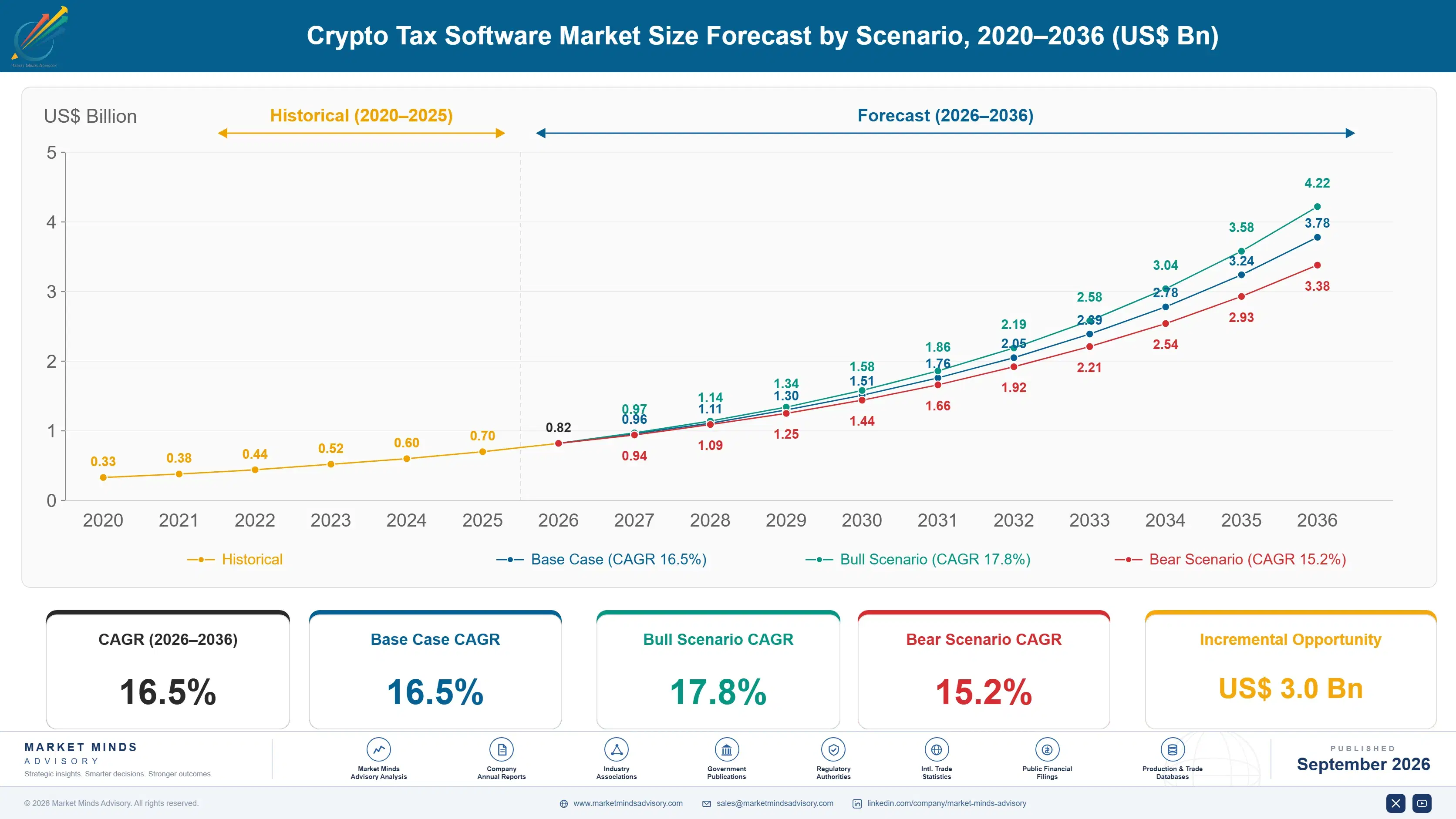
Crypto Tax Software Market Forecast Scenarios

crypto-tax-software-market-size-forecast-scenario-1788455685266
Crypto tax software demand grew unevenly through 2020 to 2025 as cryptocurrency price volatility drove periodic spikes in new user registration, though sustained growth accelerated toward the end of that period as tax authorities formalized digital asset reporting requirements across major jurisdictions. Larger crypto exchanges with dedicated compliance teams pushed adoption fastest among their user bases, while smaller regional exchanges lagged given tighter integration budgets and slower internal partnership development.
The base case assumes continued tax authority enforcement expansion, sustained DeFi and NFT transaction volume growth requiring reconciliation, and gradual enterprise adoption as institutional crypto holdings expand. Cross-jurisdiction reporting complexity increasingly determines which vendors retain long-term subscriber relationships across the forecast window. Vendors without recognized DeFi and NFT transaction parsing capability increasingly struggle to win enterprise accounts as buyers formalize supplier qualification criteria around transaction coverage completeness standards. nationwide today.
A stronger bull case assumes faster tax authority enforcement expansion pulls forward software demand well ahead of current projections across leading digital asset markets. The bear case assumes prolonged cryptocurrency price weakness delays new user adoption, pushing vendor revenue growth out by several additional years worldwide. Tax authority enforcement timing will determine which scenario actually materializes across the coming decade.

Spreadsheets Give Way to Automated Reconciliation

Crypto tax software vendors face a straightforward commercial reality: manual spreadsheet reconciliation cannot keep pace with the transaction complexity that DeFi protocols and NFT marketplaces now generate. This shift accelerates as buyers formalize supplier qualification criteria around documented transaction coverage completeness rather than relying on manual tracking alone across most user categories. Vendors that fail to demonstrate sufficient transaction coverage risk exclusion from enterprise compliance procurement shortlists entirely.
MARKET CONCENTRATIONCR5 58%Top five platforms hold majority subscriber revenue worldwide
AVERAGE ANNUAL SUBSCRIPTION PRICE$180Per active user across mid-tier reconciliation software plans
DEFI TRANSACTION COVERAGE SHARE38%Of users requiring decentralized finance transaction parsing capability
ENTERPRISE CLIENT SHARE22%Of total revenue from institutional and fund tax accounts
PEAK FILING LOAD6-8 weeksTypical duration of concentrated annual usage surge period
PROFESSIONAL REFERRAL ATTACH RATE34%Of new subscribers acquired through tax professional partnerships
Commercial character in this market favors vendors with proven transaction parsing accuracy and established tax professional relationships, since large enterprise and institutional accounts weight reconciliation completeness heavily over marginal subscription price differences. Vendors succeeding here typically maintain dedicated blockchain protocol engineering teams that generalist accounting software competitors have not built out. This dynamic increasingly favors vendors with established regulatory relationships over purely feature-driven competitive positioning alone.
Tax authority enforcement expansion and DeFi transaction complexity will shape vendor positioning over the coming decade, alongside enterprise adoption trends that continue reshaping how institutional accounts evaluate competing compliance platforms worldwide. Vendors positioning early for these dual pressures capture disproportionate share once broader institutional adoption finally accelerates further. Vendors ignoring these pressures risk losing enterprise accounts to faster-moving competitors already building comparable capability.
"The users who used to track everything in a spreadsheet gave up the moment their first DeFi yield farming transaction generated forty taxable events in a single afternoon."
Director, Digital Asset Tax Technology Practice · MMA Digital Asset Tax Compliance and Reporting Software Practice · September 2026

Market Trends

DeFi Transaction Parsing Becomes Baseline Software Requirement

Crypto tax software vendors are moving beyond basic exchange trading history import toward comprehensive DeFi protocol transaction parsing that captures yield farming, liquidity provision, and lending activity generating dozens of taxable events per user interaction. This capability requires substantially more sophisticated blockchain data engineering than earlier exchange-only integration demanded, pushing vendors toward specialized protocol parsing expertise validated against major DeFi platforms. Vendors building parsing capability that measurably captures more transaction types than competitors are capturing disproportionate share of user renewal decisions across leading digital asset markets nationwide, worldwide, and internationally.
Market Impact: 24 percent cite enforcement risk
Tax Authorities Expand Digital Asset Reporting Mandates

Tax authorities across major economies continue expanding mandatory digital asset reporting requirements for exchanges and taxpayers, removing ambiguity that previously allowed inconsistent voluntary compliance approaches among crypto holders. This regulatory expansion is pulling software investment toward platforms offering documentation formats validated against specific jurisdictional filing requirements rather than generic transaction summaries. Vendors offering jurisdiction-specific compliance documentation are capturing disproportionate share of user accounts as tax authorities formalize enforcement mechanisms nationwide. This dynamic rewards vendors with deep regulatory relationships built over successive tax filing seasons across multiple jurisdictions worldwide currently expanding rapidly.
Market Impact: 19 percent prioritize compliance spending

Market Opportunities and Growth Drivers

Tax Authority Enforcement Actions Drive User Adoption

Tax authorities across major markets continue increasing enforcement actions targeting unreported cryptocurrency capital gains, and crypto tax software provides documented compliance evidence that helps taxpayers demonstrate good-faith reporting efforts if audited by revenue agencies. This enforcement pressure is pulling software adoption into user segments that previously assumed cryptocurrency transactions carried limited reporting risk given historically inconsistent enforcement. Vendors offering audit-ready documentation formats validated against specific jurisdictional requirements are capturing disproportionate share of this enforcement-driven volume expansion across the broader digital asset industry worldwide. This enforcement pressure shows no signs of easing given continuing revenue agency policy priorities worldwide.
Market Impact: 18 percent report incomplete transaction coverage

Institutional Crypto Adoption Sustains Enterprise Software Investment

Sustained institutional cryptocurrency adoption across corporate treasuries and investment funds continues supporting enterprise crypto tax software investment, even as broader retail speculative trading interest has moderated significantly from earlier peak enthusiasm periods. Institutional accounts increasingly view compliance documentation as foundational to regulatory relationships rather than a discretionary reporting expense, accelerating adoption timelines relative to smaller individual filers. Vendors serving this institutional-driven buyer segment are capturing design-in relationships with funds still building out their digital asset compliance infrastructure from the ground up worldwide. Vendors that build this positioning early capture disproportionate influence over how these funds structure future compliance roadmaps.
Market Impact: 14 percent maintain multiple filing systems

Market Restraints and Challenges

DeFi Protocol Complexity Limits Transaction Coverage

Newer and smaller DeFi protocols frequently launch without standardized transaction data formats, and crypto tax software vendors cannot instantly support every emerging protocol given the engineering effort required to parse each platform's unique transaction structure accurately. The root cause is that DeFi protocol developers prioritize rapid feature deployment over standardized data formatting that would simplify downstream tax reporting integration for third-party software. Vendors are responding by building modular parsing architecture and prioritizing integration work based on user demand signals, gradually expanding coverage rather than attempting comprehensive support immediately at launch.
Market Impact: 31 percent require DeFi parsing

Jurisdictional Reporting Inconsistency Complicates Global Compliance

Different tax jurisdictions apply inconsistent classification rules to cryptocurrency transactions, and users operating across multiple countries sometimes must manually reconcile conflicting treatment of the same underlying transaction for different national filing requirements. The root cause is that cryptocurrency taxation frameworks evolved somewhat independently across major economies before international coordination efforts began in earnest. Some vendors are mitigating this through multi-jurisdiction reporting modules capable of applying different classification rules simultaneously to serve users filing across multiple countries. This approach lets vendors serve global user bases without maintaining entirely separate software products for each individual jurisdiction.
Market Impact: 26 percent now mandate reporting
3 additional market trends, 4 additional growth drivers, and 3 additional restraints and challenges are covered in the full report. Contact sales@marketmindsadvisory.com to access the complete intelligence.

Segment CAGR and Growth Architecture

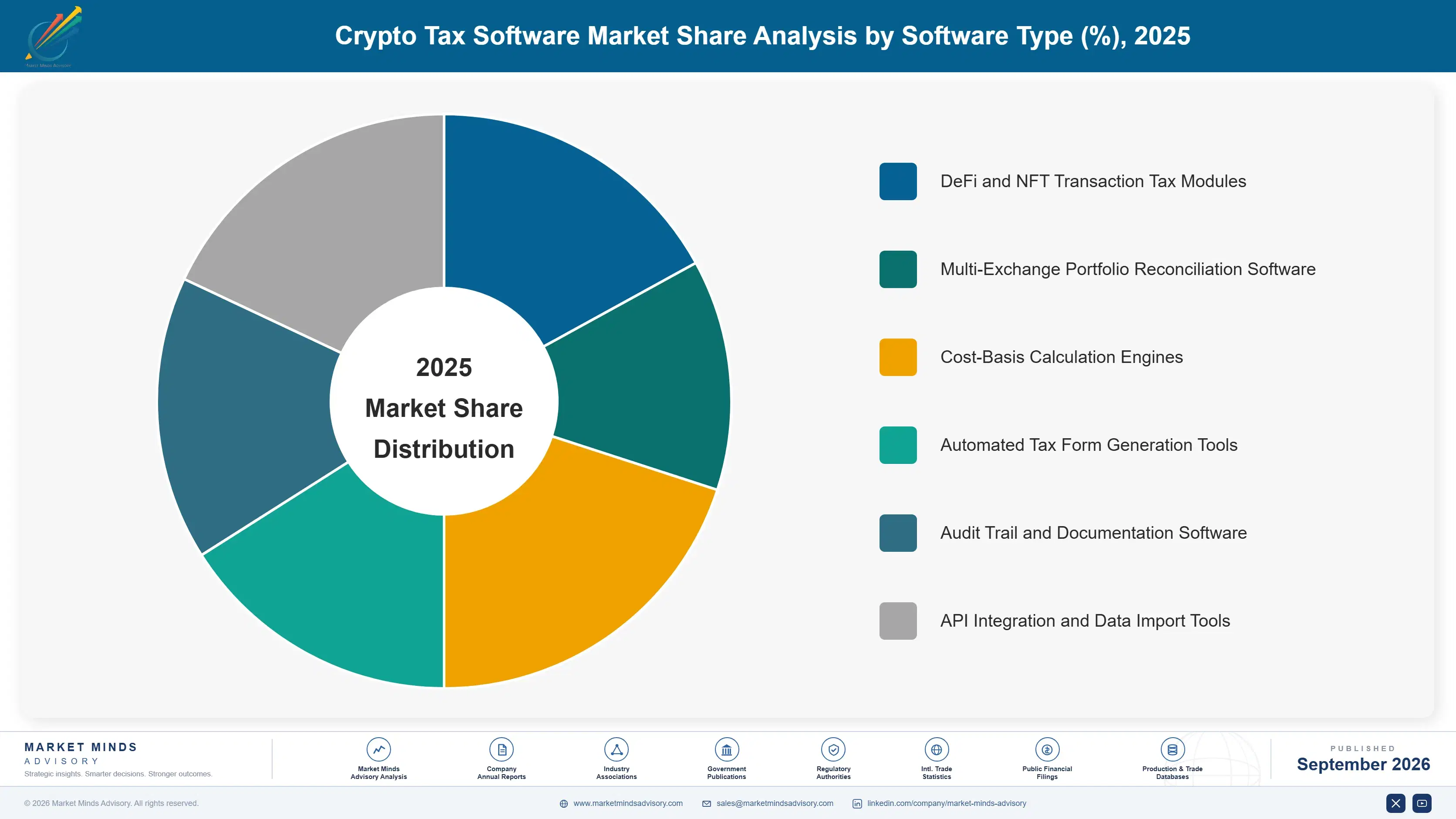
This report segments the market by software module function, the dimension most directly shaping vendor development priorities, user procurement decisions, and transaction reconciliation performance requirements across retail and enterprise buyer segments worldwide. This lens also aligns most directly with how tax software developers structure their own internal engineering roadmap and prioritization frameworks nationwide. today.
crypto-tax-software-market-market-share-analysis-1788455685846

DeFi and NFT Transaction Tax Calculation Modules

DeFi and NFT transaction tax calculation modules are the fastest-growing segment, expanding at 23.0 percent annually as users increasingly engage with yield farming, liquidity provision, and NFT trading that generate transaction volumes and complexity far exceeding simple exchange trading history. This segment benefits from being the primary category where software capability improvements translate directly into measurable transaction coverage completeness across increasingly complex user portfolios. Vendors building parsing capability validated against major DeFi protocols and NFT marketplaces are capturing disproportionate share of user renewal decisions nationwide as blockchain activity complexity continues intensifying. United States and Indian user bases concentrate the heaviest near-term subscription growth as competing vendors race to validate coverage ahead of expanding tax filing season deadlines.
CAGR 23.0%

Multi-Exchange Portfolio Reconciliation Software

Multi-exchange portfolio reconciliation software forms the second-fastest-growing segment, expanding at 19.0 percent annually as users increasingly hold digital assets across multiple centralized and decentralized exchanges requiring unified transaction history consolidation for accurate reporting. This segment benefits from expanding user portfolios that span an increasing number of platforms, making manual reconciliation across multiple sources impractical without dedicated software support. Vendors offering validated multi-exchange integration are capturing disproportionate share of user accounts nationwide as portfolio complexity continues expanding. Standards bodies increasingly reference specific reconciliation accuracy benchmarks during industry guidance updates, giving early movers meaningful influence over how future compliance expectations ultimately take shape nationwide. Vendors slow to build this capability risk losing renewal accounts nationwide currently and consistently.
CAGR 19.0%
Full segment breakdown across 6 segments available in the complete report.

Regional Architecture and Country Demand Map

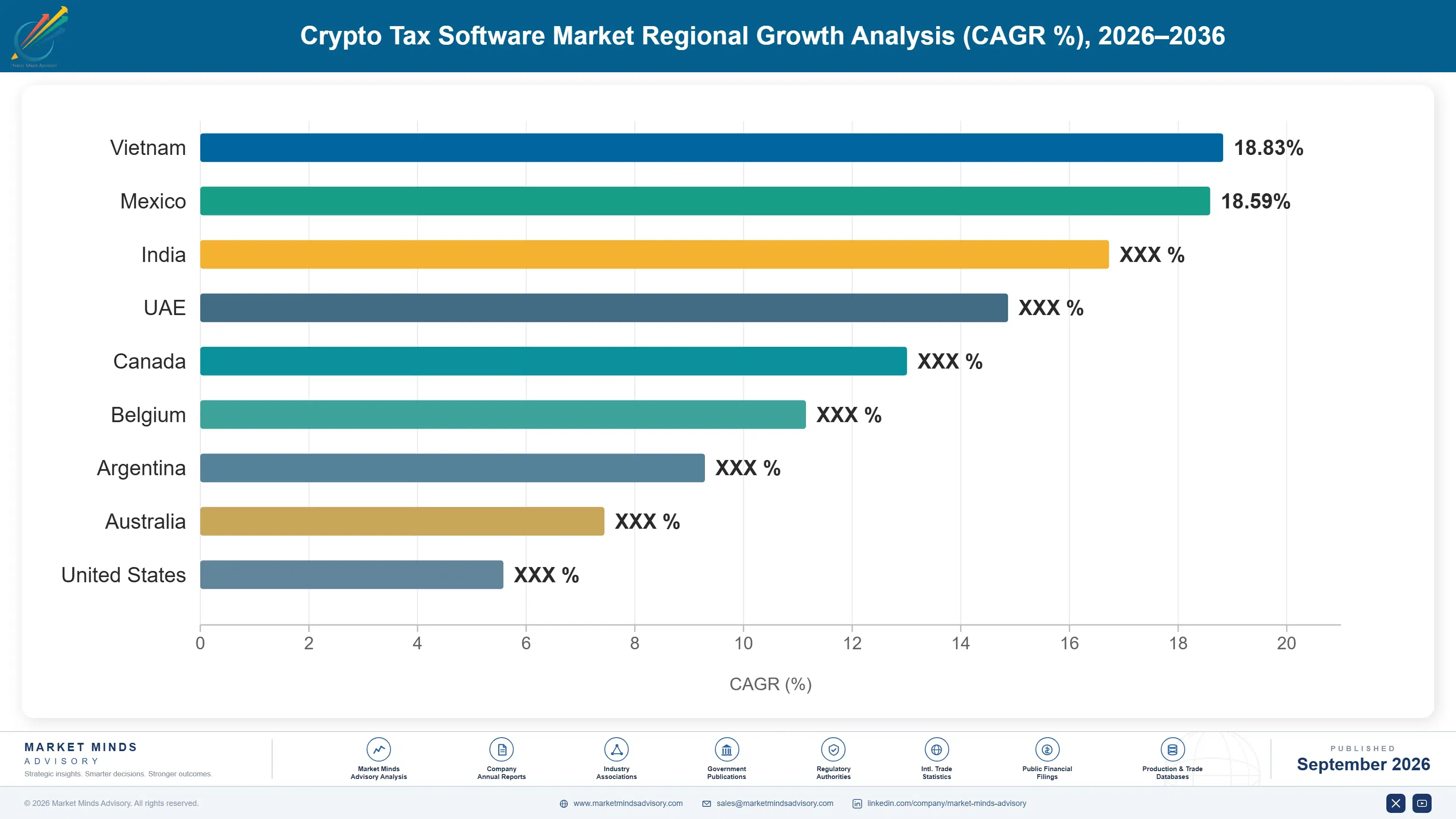
North America leads on the strength of concentrated crypto trading user base and early tax authority enforcement, while East Asia follows given large retail digital asset adoption nationwide. South Asia and Pacific shows the fastest regional growth given formalized crypto tax regimes across several developing markets nationwide.

North America

This region's 30 percent share sits at the top of its standard 22 to 32 percent band, justified because the United States concentrates the largest crypto trading user population combined with the most aggressive tax authority enforcement activity among major economies, driving disproportionate software subscription growth nationwide. IRS reporting requirement expansion continues pushing new user adoption across retail and enterprise segments alike. Canadian crypto holders follow broadly similar compliance-driven purchasing patterns, though at meaningfully smaller absolute volume than their United States counterparts. This advantage compounds further as domestic vendors expand dedicated regulatory compliance teams serving their largest enterprise accounts. Vendors monitoring this dynamic closely adapt sales strategies for the region's premium enforcement environment nationwide currently.
Share: 30% | CAGR: 17.0% (2026 to 2036)

East Asia

South Korean and Japanese crypto traders continue expanding tax software adoption as domestic regulatory formalization accelerates alongside growing retail digital asset participation across the region. Chinese offshore crypto activity among domestic holders also contributes meaningful demand despite formal domestic trading restrictions, sustaining steady regional software adoption through international exchange access. Vendors across the region increasingly build localized regulatory documentation as well as expand core reconciliation capability for growing user bases. These investments increasingly coordinate across national borders as regional trade partnerships expand technical cooperation on digital asset tax standards. Vendors monitoring this trajectory closely adapt product roadmaps for these expanding regional markets currently and continuously. nationwide today. currently. and consistently.
Share: 25% | CAGR: 17.5% (2026 to 2036)
Regional intelligence for 5 additional markets available in the complete report: Western Europe, South Asia and Pacific, Latin America, Middle East and Africa, Eastern Europe. Contact sales@marketmindsadvisory.com.
crypto-tax-software-market-country-cagr-analysis-1788455686358

Monetizing Beyond Standard Subscription Pricing Tiers

Beyond core subscription pricing, vendors can build durable margin through tax professional partnership programs, enterprise compliance consulting, and audit support services that address specific filer pain points during this enforcement-driven adoption period worldwide across leading user segments. Vendors moving early on these fronts build defensible positioning that compounds meaningfully across successive filing seasons. today.

Expand Tax Professional Partnership Referral Programs

Tax professionals increasingly refer clients to crypto tax software rather than manually reconciling complex transaction histories themselves, and vendors building dedicated professional partnership programs capture recurring referral revenue distinct from direct subscription sales. This partnership layer, typically priced at 15 to 20 percent revenue share on referred subscriptions, generates high-margin recurring revenue while deepening the professional relationships that inform future feature development decisions across successive filing seasons worldwide. Vendors that build this capability early rarely lose accounts to competitors lacking comparable partnership depth. This positioning proves especially valuable as competing platforms narrow toward eventual convergence.
Market Impact: Captures a share of the 31 percent DeFi-parsing segment now

Offer Enterprise Compliance Consulting Services Broadly

Institutional accounts navigating complex multi-jurisdiction reporting requirements increasingly pay for dedicated compliance consulting that helps them design defensible tax positions rather than managing regulatory interpretation entirely in-house. This consulting layer, typically commanding 18 to 24 percent premium pricing over standard enterprise subscription contracts, deepens institutional relationships and positions vendors as trusted compliance partners rather than commodity software suppliers competing purely on price. This positioning proves especially valuable as institutions consolidate around fewer preferred compliance partners across their portfolios today. Institutions value this quite considerably overall across most jurisdictions worldwide today.
Market Impact: Captures a share of the 19 percent institutional segment now

Provide Audit Support And Documentation Services

Users facing tax authority audits increasingly pay premium pricing for dedicated audit support services that help them assemble documentation and respond to revenue agency inquiries efficiently. This service layer, typically representing 10 to 15 percent of total contract value, positions vendors as trusted compliance partners rather than commodity software suppliers competing purely on subscription price alone. Vendors offering this expertise win business from users unwilling to face audits entirely alone. This positioning proves especially valuable during the current period of intensifying enforcement activity nationwide. Users value this quite highly and considerably.
Market Impact: Captures a share of the 24 percent enforcement-driven segment now

Build Multi-Jurisdiction Reporting Configuration Bundles Broadly

Users filing across multiple countries increasingly pay premium pricing for multi-jurisdiction reporting bundles capable of applying different classification rules simultaneously rather than maintaining separate dedicated software for each individual filing requirement. This bundled offering, typically adding 16 to 22 percent to total contract value, differentiates vendors capable of delivering complete multi-market compliance solutions from smaller competitors lacking comparable engineering depth. Vendors pursuing this strategy build lasting relationships that persist well beyond any single filing season. This positioning proves especially valuable as users finalize remaining reporting infrastructure decisions. Users value this quite highly.
Market Impact: Captures a share of the 14 percent multi-jurisdiction segment now

Who Controls the Margin Pool

The crypto tax software market carries a CR5 of 58 percent, reflecting a concentration where five established consumer-facing platforms hold most subscriber revenue while a wider field of smaller specialists compete for niche and enterprise accounts. The gap between leading vendors and mid-tier challengers remains meaningful, anchored by years-long user retention relationships. Transaction coverage completeness remains the single biggest differentiator separating leaders from smaller challengers.
Current competitive activity centers on DeFi and NFT transaction parsing expansion, enterprise compliance depth, and expanding tax professional partnership programs that deepen user relationships beyond commodity subscription pricing. Vendors are also racing to build multi-jurisdiction reporting capable of serving users filing across multiple countries. Vendors are also expanding dedicated regulatory affairs teams to capture recurring service revenue ahead of eventual full institutional convergence worldwide.

Emerging pressure comes from enterprise-focused challengers unencumbered by legacy consumer-only product lines, who are winning institutional accounts where compliance depth matters more than installed-base retail familiarity. Rankings could shift meaningfully over the next several years if these challengers successfully convert early wins into larger enterprise fund contracts. Vendors slow to adapt risk permanent share loss as enterprise specialists reshape the field further nationwide.
crypto-tax-software-market-company-positioning-matrix-1788455686881

Competitive Moat and Risk Dimensions

COINTRACKER

Moat: Deep Retail User Base Relationships

CoinTracker benefits from years of embedded relationships across a large retail crypto trading user base, reinforced by established exchange integration partnerships that smaller competitors struggle to replicate quickly. Few rivals can match this depth. This depth of relationship extends well beyond pure feature capability alone.
COINTRACKER

Risk: Limited Enterprise Compliance Depth

CoinTracker's enterprise compliance capability trails specialist vendors building purpose-built institutional platforms, risking gradual share erosion in accounts prioritizing institutional-grade documentation over broad retail feature breadth. This gap could accelerate share loss. Younger institutional buyers increasingly weigh this depth gap during vendor selection decisions. This gap widens over time.
TAXBIT

Moat: Broad Enterprise Regulatory Relationships

TaxBit benefits from deep relationships across enterprise and institutional compliance departments, giving it credibility advantages when large funds already trust its regulatory documentation that retail-focused competitors cannot easily match. This portfolio breadth strengthens further as institutions consolidate around fewer preferred vendors. Few rivals can match this trust.
TAXBIT

Risk: Smaller Retail User Base Presence

TaxBit's retail consumer presence trails platforms focused primarily on individual filers, risking gradual share erosion in the high-volume retail segment where brand recognition carries meaningful subscription weight. This gap widens over time. This gap widens further as retail buyers increasingly prioritize brand familiarity outcomes. over time.

Players Tracked

Prominent Players

CoinTracker
Koinly
TaxBit
CoinLedger
ZenLedger

Other Key Players

Awaken Tax
CoinTracking
TokenTax
Bitcoin.Tax
CryptoTaxCalculator
Blockpit
Ledgible
Coinpanda
Cryptio
SoftLedger
Bitwave
Node40
Crypto.com Tax
Fyn
Coinbase Tax Center

Recent Developments

JANUARY 2026

CoinTracker Launches Enhanced DeFi Parsing Engine

CoinTracker introduced a new DeFi transaction parsing engine covering additional yield farming and liquidity provision protocols, targeting users seeking comprehensive transaction coverage ahead of expanding annual tax filing season deadlines across multiple jurisdictions. nationwide across most retail and enterprise user categories currently underway. nationwide. today.
Signal: Signals accelerating incumbent response to DeFi coverage pressure across the retail user segment nationwide. nationwide currently.
AUGUST 2025

TaxBit Acquires Institutional Custody Compliance Startup

TaxBit acquired a specialist institutional custody compliance startup to strengthen its enterprise documentation capability, extending its differentiation beyond core tax calculation into verified provenance tracking for institutional customers nationwide. Financial terms of the transaction were not publicly disclosed by either organization. Analysts expect similar acquisitions to follow across the industry.
Signal: Signals growing vendor emphasis on institutional compliance beyond retail tax calculation across the industry. nationwide currently.
APRIL 2025

Koinly Signs Partnership Agreement With Major Tax Firm

Koinly signed a multi-year referral partnership agreement with a leading tax professional services firm to provide crypto tax software supporting its expanded client base, strengthening its position in the growing professional referral segment nationwide. Financial terms of the agreement were not publicly disclosed by either participating organization.
Signal: Signals established vendors successfully defending accounts against enterprise-focused challenger pressure nationwide currently, consistently, and quite broadly.

Blockchain Data Infrastructure and Engineering Exposure

Blockchain node infrastructure hosting and specialized protocol parsing engineering staffing together represent roughly 38 percent of cost of goods sold for crypto tax software vendors, with DeFi-heavy deployments commanding the highest cost intensity given the transaction complexity involved. Most infrastructure spending flows through a small group of major cloud and blockchain data providers, concentrating supplier leverage industry wide.
Blockchain data infrastructure pricing rose noticeably during 2024 and 2025 amid rising demand for real-time transaction indexing across a growing number of active blockchain networks, with unit pricing increasing by roughly 16 percent within a single fiscal year according to EIA-adjacent cloud infrastructure cost benchmarking and named provider annual disclosures. Vendors without negotiated enterprise pricing agreements absorbed meaningfully compressed margins during this period, some deferring feature investment as a result.

This cost exposure disadvantages smaller specialist vendors most severely, since they typically lack the purchasing scale and multi-year infrastructure commitments that established incumbents negotiate directly with data providers. Vendors serving high-volume DeFi user accounts face additional exposure given the parsing complexity those deployments require, and geographic concentration in United States hosting capacity adds a further regional cost variable for global filers.
crypto-tax-software-market-cost-volatility-analysis-1788455687076

Negotiate Multi-Year Blockchain Data Commitments

Vendors committing to multi-year blockchain data infrastructure purchasing volumes secure more predictable unit pricing from data providers, insulating margin from short-term pricing volatility that smaller competitors without similar scale cannot avoid as easily, particularly during periods of rising indexing demand across newer protocol networks and expanding chain coverage requirements that most enterprise clients now expect vendors to support.

Build Shared Protocol Parsing Engineering Teams

Vendors consolidating protocol parsing engineering expertise across shared internal teams rather than dedicated per-project staffing reduce per-integration costs as protocol coverage grows, though this model requires careful capacity planning to avoid service bottlenecks during periods of rapid new protocol launch activity, especially across emerging Layer 2 networks gaining meaningful transaction volume and requiring dedicated parsing logic within tight release windows.

Standardize Reusable Parsing Framework Templates

Vendors building standardized, reusable parsing framework templates reduce per-protocol engineering hours considerably, since much of the required transaction logic follows predictable patterns across similar decentralized finance protocol architectures, freeing engineering capacity for higher-value institutional integration work instead of repetitive one-off protocol onboarding tasks that add relatively limited differentiation relative to core platform reliability investment.

Portfolio Architecture for Margin Defence

Crypto tax software margins split sharply along a volume-to-premium axis. Commodity-adjacent retail subscriptions generate thin gross margins under intense freemium competition, while certified professional and enterprise tiers command materially higher margins on the strength of compliance depth and audit-defensible reporting quality that casual single-exchange filers never require or are willing to pay extra for, even during peak filing season pressure.
The volume tier serves single-exchange retail filers with straightforward transaction histories, where price competition compresses margin and switching costs stay low given how easily users migrate between comparable subscription products each annual renewal cycle. Premium tiers serving multi-exchange and DeFi-active users carry meaningfully higher willingness to pay, since transaction complexity there makes manual reconciliation genuinely impractical for most filers facing real enforcement risk today.

High-value margin pools concentrate in enterprise compliance consulting and institutional custody reporting, where regulatory stakes and audit exposure justify premium pricing far above standard subscription tiers, and where vendors with proven enforcement-defensible methodologies increasingly capture disproportionate deal value relative to their overall user base size. Tax authority scrutiny keeps pushing institutional clients toward vendors with demonstrable audit track records and transparent methodology documentation.

Basic Single-Exchange Filing Tools

Single-exchange retail subscriptions serving straightforward transaction histories under intense freemium and low-price competitive pressure, where feature parity across vendors keeps annual contract value modest and renewal decisions driven mainly by filing season convenience.
Gross Margin: 35-45%

Certified Multi-Exchange Reconciliation Platforms

Multi-exchange and DeFi-active filer tiers with certified reconciliation depth commanding meaningfully higher willingness to pay from complex users, whose transaction histories span numerous wallets, protocols, and chains that generic accounting software cannot reliably parse or reconcile.
Gross Margin: 55-65%

Institutional Compliance And Advisory Bundle Systems

Enterprise compliance consulting, institutional custody reporting, and multi-jurisdiction regulatory bundles serving audit-exposed institutional clients directly, where regulatory complexity and enforcement exposure justify premium engagement pricing well beyond standard subscription economics.
Gross Margin: 65-75%
crypto-tax-software-market-portfolio-architecture-1788455687580

High-value Sub-segments and Strategic Watch-out

Institutional Custody Compliance Reporting

High-value, high-growth pool serving institutional custodians and funds facing expanding regulatory disclosure obligations, where enforcement-defensible methodology commands premium engagement pricing well above retail tiers and where deal sizes scale directly with assets under custody, audit complexity, and the number of jurisdictions a given institutional client must report across annually.
Gross Margin: 68-75%

Enterprise Multi-Jurisdiction Filing Bundles

High-value, moderate-growth pool serving multinational corporate clients navigating inconsistent cross-border reporting regimes, where bundled configuration services generate durable recurring engagement revenue over time as regulatory frameworks across jurisdictions continue diverging rather than converging, sustaining demand for specialized configuration expertise that generic accounting platforms cannot replicate.
Gross Margin: 58-66%

Single-Exchange Retail Filing

Volume core segment serving straightforward retail filers with single-exchange transaction histories, where freemium competition keeps pricing power limited despite steady seasonal filing volume that anchors overall subscriber counts and cross-sell opportunity across the broader user base heading into premium tier upgrades during subsequent filing cycles each year.
Gross Margin: 35-42%

DeFi Yield and Staking Reconciliation

Strategic watch-out segment where rapidly evolving protocol mechanics threaten to outpace vendor parsing coverage, creating reputational exposure risk if reconciliation accuracy visibly lags user expectations during a period of continued protocol innovation, expanding chain fragmentation, and growing user reliance on automated staking reward reconciliation across numerous wallets.
Gross Margin: 50-60%

Filing Season Renewal Compounds

Crypto tax software revenue behaves like an annuity anchored to annual filing deadlines rather than a one-time purchase decision. Once a filer imports a full multi-year transaction history into one platform, switching cost rises sharply each subsequent season, since re-importing years of wallet and exchange data into a competing platform is genuinely painful, time-consuming, and error-prone, especially for accounts spanning multiple chains.
Adoption stickiness varies considerably by end-use vertical. Retail single-exchange filers show weaker loyalty and shop annually on price, while active DeFi traders and institutional custodians exhibit deep platform lock-in once their transaction history, cost-basis methodology, and audit trail sit inside one vendor's system that regulators and auditors have already reviewed favorably across multiple prior filing cycles without incident or dispute.

Buyer profiles are shifting generationally as younger, digitally native filers enter the market with materially more complex multi-chain and DeFi transaction histories than the single-exchange retail filers who dominated adoption during the market's earlier years, pushing average per-account transaction complexity, and average revenue per account, steadily upward across the vendor base as this growing cohort ages into higher-value institutional and professional filing categories over time.
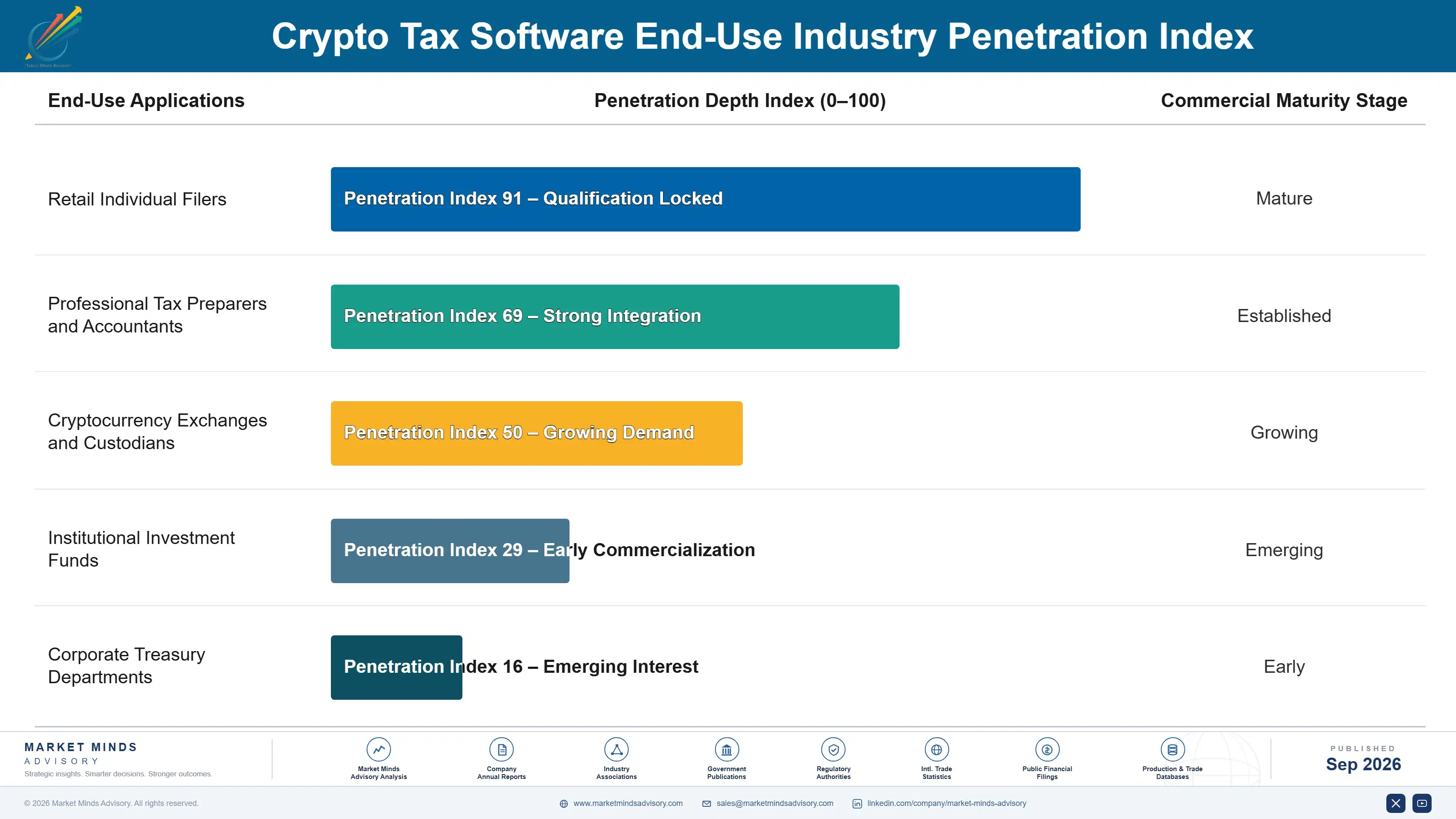
crypto-tax-software-market-end-use-penetration-index-1788455688070

Where MMA Sees the Opportunity

These are among the four positions where our research anticipates prominent divergence between winners and laggards over the coming forecast period. Each is grounded in the demand model, the regulatory perimeter, and the announced capacity pipeline.
01 / DEFI PARSING INVESTMENT

Prioritize DeFi and multi-chain transaction parsing depth now

DeFi and NFT transaction parsing is growing at roughly 23 percent annually against a market-wide 16.5 percent average, making it the single fastest-growing segment vendors can address today. Vendors that under-invest in protocol coverage will lose enterprise and institutional accounts to competitors whose reconciliation accuracy has already been audited favorably across multiple prior filing seasons. MMA views parsing depth as the primary competitive battleground through 2036, ahead of pricing, marketing spend, brand recognition, or raw integration breadth alone, since accuracy failures surface publicly and damage trust quickly.
02 / ENTERPRISE COMPLIANCE EXPANSION

Build enterprise compliance consulting revenue beyond core subscriptions

Institutional custody reporting and multi-jurisdiction filing bundles carry the industry's highest gross margins, well above standard retail subscription tiers available to ordinary filers. Vendors that pair core software with compliance consulting services capture disproportionate deal value as enforcement scrutiny intensifies across major jurisdictions worldwide. MMA expects consulting-attached revenue to outpace standalone subscription growth meaningfully across the coming decade for vendors that execute this transition well and early, ahead of slower-moving established competitors still reliant on standard per-seat subscription pricing models alone.
03 / INDIA MARKET ENTRY

Prioritize India given its fastest national growth trajectory

India is growing at roughly 19.5 percent annually, the fastest of any covered country, driven by rapid crypto adoption alongside tightening national reporting requirements. Vendors without localized filing support risk ceding this expansion to regional specialists building compliant tools from the outset. MMA views early localized product investment there as materially cheaper than later market entry once incumbents establish local partnership networks, regulatory relationships, and user trust that slower-moving latecomers will struggle to replicate quickly once the domestic market consolidates around early movers.
04 / RETENTION INFRASTRUCTURE INVESTMENT

Defend renewal economics through deeper historical data lock-in

Switching cost from re-importing multi-year transaction histories is the strongest retention lever available to incumbents, and it strengthens every additional filing season a user stays with one vendor. Vendors should invest in deeper historical reconciliation accuracy and audit trail documentation rather than competing purely on entry-level pricing alone. MMA expects vendors with the strongest historical data depth to command premium renewal pricing well ahead of price-competitive challengers by 2036, particularly among institutional accounts where switching costs and audit continuity requirements are highest of all filer categories.

Engagement Snapshot From the Field

A live engagement with an industry participant carrying material or product regulatory and market exposure ahead of a defining policy shift, showing how our research translates into a defensible multi-year portfolio strategy.
MARKET MINDS ADVISORY · CLIENT ENGAGEMENT SUMMARY
Crypto Tax Software Producer Strategic Portfolio Review and Transition Roadmap 2026·Investment Scenario on Crypto Tax Software Exposure Evaluation 2025-26
CLIENT PROFILE
The client is a mid-tier digital asset exchange serving retail and professional traders across North America and Western Europe, processing several hundred thousand transactions monthly across spot, staking, and derivatives products. Facing tightening national tax reporting mandates, the exchange sought to embed automated cost-basis and reporting infrastructure directly into its user-facing platform rather than relying on third-party tools.
STRATEGIC CHALLENGE
The exchange's existing internal reporting tooling could not reliably reconcile complex staking reward and multi-chain withdrawal histories, generating support ticket volume that strained compliance staff during peak filing season. Leadership needed an outside assessment of build-versus-partner options before committing further engineering budget to an internal solution of uncertain long-term viability.
MMA APPROACH
MMA conducted structured interviews with the exchange's compliance, product, and engineering leadership alongside a comparative technical assessment of five leading crypto tax software vendors' integration architectures. The engagement benchmarked partner reconciliation accuracy against the exchange's own historical support ticket data to quantify the true cost of continued internal platform development.
KEY FINDINGS
  1. Internal reconciliation error rates ran materially higher than benchmarked third-party vendor accuracy on comparable staking and DeFi transaction categories during peak season testing.
  2. Support ticket volume tied to reconciliation disputes accounted for a meaningful share of total compliance team capacity during the preceding two filing seasons combined.
  3. Partner integration reduced projected engineering headcount requirements substantially compared to continued internal build efforts, per client-reported estimates shared during the engagement period.
  4. User-reported satisfaction with tax reporting accuracy improved measurably in a limited pilot cohort exposed to the recommended partner integration versus the existing internal tool.
CLIENT PROFILE
The client is a mid-tier digital asset exchange serving retail and professional traders across North America and Western Europe, processing several hundred thousand transactions monthly across spot, staking, and derivatives products. Facing tightening national tax reporting mandates, the exchange sought to embed automated cost-basis and reporting infrastructure directly into its user-facing platform rather than relying on third-party tools.
STRATEGIC CHALLENGE
The exchange's existing internal reporting tooling could not reliably reconcile complex staking reward and multi-chain withdrawal histories, generating support ticket volume that strained compliance staff during peak filing season. Leadership needed an outside assessment of build-versus-partner options before committing further engineering budget to an internal solution of uncertain long-term viability.
MMA APPROACH
MMA conducted structured interviews with the exchange's compliance, product, and engineering leadership alongside a comparative technical assessment of five leading crypto tax software vendors' integration architectures. The engagement benchmarked partner reconciliation accuracy against the exchange's own historical support ticket data to quantify the true cost of continued internal platform development.
KEY FINDINGS
  1. Internal reconciliation error rates ran materially higher than benchmarked third-party vendor accuracy on comparable staking and DeFi transaction categories during peak season testing.
  2. Support ticket volume tied to reconciliation disputes accounted for a meaningful share of total compliance team capacity during the preceding two filing seasons combined.
  3. Partner integration reduced projected engineering headcount requirements substantially compared to continued internal build efforts, per client-reported estimates shared during the engagement period.
  4. User-reported satisfaction with tax reporting accuracy improved measurably in a limited pilot cohort exposed to the recommended partner integration versus the existing internal tool.
RECOMMENDED STRATEGY
Phase 1: Phase one: pilot a single vendor integration across a limited user cohort spanning three months, tracking reconciliation accuracy and ticket volume closely. Phase 2: Phase two: expand the partner integration platform-wide while sunsetting internal reconciliation tooling incrementally across the following two additional filing quarters. Phase 3: Phase three: formalize a multi-year vendor partnership agreement with negotiated data pricing terms and clearly defined accuracy service-level commitments in writing.
OUTCOME
The exchange adopted the recommended phased partner integration approach, reporting a substantial reduction in reconciliation-related support ticket volume within two filing seasons of full rollout (client-reported, unverified by MMA). Compliance team capacity previously consumed by dispute resolution was redirected toward proactive regulatory monitoring work instead.

Frequently Asked Questions

Foundational context covering the market sizes, CAGR, scope, country, region and competition that inform every finding below. This section is provided to cover basics and most often pre-purchase conversations, answered from the MMA Primary Research Dataset.

What is the current size of the Crypto Tax Software Market?

The Crypto Tax Software Market reached an estimated 0.72 billion dollars in 2025. Growth is driven by tightening tax authority enforcement and expanding institutional digital asset adoption worldwide.

How large will the Crypto Tax Software Market be by 2036?

MMA projects the market will reach approximately 3.87 billion dollars by 2036. This reflects sustained enforcement pressure and rising transaction complexity across DeFi and multi-chain user accounts.

What is the CAGR for the Crypto Tax Software Market 2026 to 2036?

The market is projected to grow at a 16.5 percent compound annual growth rate between 2026 and 2036. Bull and bear scenarios range from 15.2 to 17.8 percent.

Which segment is growing fastest?

DeFi and NFT Transaction Tax Calculation Modules is the fastest-growing segment, expanding at roughly 23.0 percent annually. This outpaces the overall market by nearly 1.4 times.

Who are the major companies in the Crypto Tax Software Market?

Leading vendors include CoinTracker, Koinly, TaxBit, CoinLedger, and ZenLedger. Together these five vendors hold an estimated 58 percent combined share on a market participation basis.

Which country is growing fastest?

India is the fastest-growing country, expanding at roughly 19.5 percent annually. Rapid crypto adoption alongside tightening national reporting requirements is driving this accelerated growth trajectory.

Report Segmentation Architecture

The full report scope spans multiple orthogonal segmentation dimensions, with cross-tabulated demand data provided for each dimension pair. Coverage extends further to regional breakdowns, trend trajectories, and the competitive detail needed to support segment-level decision-making.

By Software Type

  • DeFi and NFT Transaction Tax Modules
  • Multi-Exchange Portfolio Reconciliation Software
  • Cost-Basis Calculation Engines
  • Automated Tax Form Generation Tools
  • Audit Trail and Documentation Software
  • API Integration and Data Import Tools

By End-Use Industry

  • Retail Individual Filers
  • Professional Tax Preparers and Accountants
  • Cryptocurrency Exchanges and Custodians
  • Institutional Investment Funds
  • Corporate Treasury Departments

By Customer Type

  • Individual Retail Users
  • Small and Mid-Size Businesses
  • Enterprise and Institutional Clients
  • Tax Professional and Accounting Firms

By Region

  • North America
  • Western Europe
  • East Asia
  • South Asia and Pacific
  • Latin America
  • Middle East and Africa
  • Eastern Europe

Scope, Methodology, and Coverage

Every figure in this report is reproducible from documented input assumptions. The scope below maps the historical period, the forecast horizon, the segmentation dimensions, and the countries covered, alongside the underlying primary and qualitative methodology.
Historical Period
2020 to 2025
Forecast Period
2026 to 2036
Base Year
2025 (USD billions; MMA Primary Research Dataset, September 2026)
Market Definition
The Crypto Tax Software Market covers software platforms that calculate, reconcile, and generate tax reporting documentation for digital asset transactions, including exchange trading, staking rewards, and DeFi activity. It excludes general accounting software, blockchain analytics platforms without tax-specific reporting outputs, and manual tax preparation services.
Quantitative Units
USD billions, market share percent, CAGR percent
Segmentation Dimensions
Software type, end-use industry, customer type, region
Regions Covered
North America, Western Europe, East Asia, South Asia and Pacific, Latin America, Middle East and Africa, Eastern Europe
Countries Covered
United States, United Kingdom, Germany, India, China, Japan, Brazil, and 13 additional countries across seven regions
Key Companies Profiled
CoinTracker, Koinly, TaxBit, CoinLedger, ZenLedger, and 15 additional participants
Quantitative Methodology
Primary survey, n=3,800 respondents, Q4 2025, six countries; demand-side model with trade association cross-validation
Qualitative Methodology
47 expert interviews, Q4 2025; applied to validate demand model assumptions, identify emerging dynamics, and assess competitive positioning
Report Format
PDF and XLSX data workbook (Word format preview document)
Publisher
Market Minds Advisory
Report Code
MMA-2026-TEC-894
Published
September 2026
Contact
sales@marketmindsadvisory.com | www.marketmindsadvisory.com

Purchase the full Crypto Tax Software Market Report (2026 to 2036).

This report delivers a complete assessment of the Crypto Tax Software Market spanning sizing, segmentation, regional dynamics, and competitive positioning through 2036. It combines primary survey data from 3,800 respondents across six countries with 47 expert interviews conducted in the fourth quarter of 2025. Analysts detail segment-level growth drivers, regional demand mechanisms, and competitive moats among leading vendors, alongside forward-looking scenario analysis. The report also profiles pricing strategy, input cost exposure, and portfolio economics across subscription tiers, supported by an anonymized client engagement case study.
Segment-level CAGR and market share breakdowns
Seven-region demand analysis with quantified drivers
Competitive landscape with moat and risk profiles
Input cost exposure and mitigation strategies
Portfolio tier economics and margin benchmarks
Anonymized client engagement case study analysis

Built For The People Who Decide

From boardroom strategy to bench-side execution, this report is read cover-to-cover by leaders shaping the next decade of their industry, turning demand scenarios, market dynamics and valuation benchmarks into decisions.
CXOs/ Presidents/ VPs/ Managers
M&A and Corporate Development
Strategy Teams and R&D Heads
Procurement and Product Directors
Regulatory and Compliance Leaders
Investor Relations and Equity Analysts