Market Minds Advisory
Cryo Facial Tools Market

Cryo Facial Tools Market: Cryo Facial Tools: Visible Effects, Absent Repeat Purchase And The Regulatory Line Between Wellness And Treatment

A stainless steel cryo globe delivers a visible result, costs very little to make and never wears out, which is a wonderful product and an extremely poor business to be built on.

Lead Analyst

Published

September 2026

Make Smarter Decisions with Customized Research Insights

Request a free sample report and evaluate market opportunities, growth trends, and competitive dynamics relevant to your business needs.

2025 MARKET VALUE$0.9BMarket Size 2025
2036 FORECAST VALUE$3.0BBase Case , 2026 to 2036
CAGR 2026 TO 203611.6 %Bull 12.9% / Bear 10.3%
INCREMENTAL OPPORTUNITY$2.0BNet 10- year value creation
EXPANSION MULTIPLE3.00x2036 value over 2026 base
Strategic Levers
M&A Pipeline
Regional Outlook
Country Rankings
Competitive Intelligence
Segmental Deep-dive
Call-Us : 91 93563 13602

Executive Snapshot and Market Trajectory.

The product works and the business model does not. A cooled metal tool produces visible reduction in facial puffiness within minutes, costs very little to manufacture, and then lasts indefinitely. Repeat purchase runs at 14%. Nobody in this category has yet solved that arithmetic properly.
Professional clinic cryotherapy systems grow fastest at 17.4%, because a clinic sells a session rather than an object and the customer returns. At around USD 95 per treatment against a USD 34 handheld tool bought once, the revenue arithmetic is not close. Everything commercially interesting in this category is an attempt to escape the durable-goods problem sitting underneath it. A clinic customer books another session and a tool buyer simply never needs anything again.
Concentration is low at 31% and the barrier to entry is close to nothing. Anyone can source a cryo globe. What separates participants is regulatory positioning, because a device claiming a treatment effect falls under a medical device regime while an identical object claiming general wellness does not. Claim language rather than any technology decides which side of that line a product ends up sitting on.
Market Definition
Revenue from tools and devices applying controlled cooling to the face for aesthetic and wellness purposes, covering professional clinic cryotherapy facial systems, cartridge-based consumable cryo devices, powered handheld cooling devices, cryo globes and wands, ice rollers and moulds, and cryo masks and wearable cooling devices. Excludes cryolipolysis body contouring equipment, medical cryosurgery instruments, general skincare formulations sold without a device, and cold therapy products for injury recovery rather than facial application.
Base Year Value
$0.9B in 2025 (MMA Primary Research Dataset, August 2026)
Forecast Period
2026 to 2036, eleven discrete annual values
CAGR
11.6% base case. Bull 12.9%. Bear 10.3%.
Fastest Growth Segment
Professional Clinic Cryotherapy Facial Systems: 17.4% CAGR
Fastest Growth Country
India: 13.8% CAGR
Fastest Growth Region
South Asia and Pacific: 13.8% CAGR
Largest Region
East Asia: 30% of 2025 global value
Market Leaders
FOREO, Therabody, Zimmer MedizinSysteme, Solawave and Skin Gym lead on cryo facial device revenue across consumer and professional channels. Source: company annual reports and MMA Primary Research Dataset, July 2026.
Primary Survey
n=3,800 procurement and R&D decision-makers, Q4 2025, six countries
Methodology
Demand-side build-up, cross-validated against public data, 47 expert interviews

Cryo Facial Tools Market Forecast Scenarios

cryo-facial-tools-market-size-forecast-scenario-1788165765451
The 2020 to 2025 period built the category and then exposed its commercial weakness. Social platforms drove extraordinary consumer awareness of facial cooling, and handheld tools sold in enormous volume to buyers who never returned for a second one. Professional clinic offerings expanded on a quite different revenue model. Revenue compounded near 10.2%, on unit volumes that grew considerably faster than the value did.
Three mechanisms carry the base case. Professional clinic treatment continues converting a one-off object purchase into a repeating service transaction. Cartridge and consumable device designs are building a replacement cycle into products that previously had none. And regulatory clarification in several jurisdictions is separating credible participants from the very large number of undifferentiated entrants currently sharing this category. None of the three depends on any further growth in category awareness at all anywhere.
The bull catalyst is a major regulator formally recognising a wellness classification with defined claim limits, which would give credible brands a defensible position against undifferentiated imports. The bear risk is the opposite: a jurisdiction reclassifying home cooling devices as regulated medical products would impose registration costs that most participants in this category could not possibly absorb.

A Product Nobody Buys Twice

Start with what actually happens. Applying a chilled surface to the face constricts blood vessels, reduces visible puffiness and produces a result the buyer can see in a mirror within minutes. That is unusual in skincare, where most claims require weeks and faith. It is also why the category grew so quickly on social platforms, and why almost nobody bothered to ask what happens commercially after the first purchase.
MARKET CONCENTRATION CR531%Share of category revenue held by the leading brands
REPEAT PURCHASE RATE14%Buyers acquiring a second device within three years
AVERAGE SELLING PRICEUSD 34Typical consumer handheld tool price across major retail channels
PROFESSIONAL SESSION PRICEUSD 95Typical clinic charge for a single facial treatment session
ONLINE RETURN RATE11%Share of online device purchases returned by the buyer
CONSUMABLE ATTACH RATE22%Devices sold with a recurring cartridge or gel arrangement
What happens is nothing. A stainless steel globe at around USD 34 has no consumable, no wearing part and no reason to be replaced, and repeat purchase runs at 14% across three years. Compare that with a clinic charging roughly USD 95 for a session the customer books again. The professional model is not a premium version of the consumer one. It is a different business.
The regulatory line is where credible participants separate themselves. A device claiming to treat a condition falls under a medical device regime with registration, evidence and post-market obligations attached. An identical object claiming general wellness does not. Several jurisdictions have moved that boundary recently, and brands that positioned deliberately have found the shifts less alarming than those that never thought about it.
"This is the only consumer category I follow where the product genuinely works and that is the commercial problem. It works, it is cheap, it lasts forever, and the customer has no reason to ever speak to the brand again."
Director, Beauty and Wellness Devices Practice · MMA Beauty Devices and Aesthetic Equipment Practice · August 2026

Market Trends

The Category Discovered It Has No Repeat Purchase

Handheld cooling tools sold in extraordinary volume to buyers who then had no reason to return, and repeat purchase across three years runs at 14%. Brands built on that model have found acquisition cost rising against a customer worth one transaction. Every commercially serious move in this category now addresses the same problem: consumables, subscriptions, professional treatment or adjacent product ranges. The tool itself is no longer the business anybody is trying to build. Acquisition machinery with no retention mechanism behind it is an expensive thing to have built at all.
Market Impact: Charges USD 95 per session

Regulators Are Redrawing The Wellness And Treatment Boundary

Jurisdictions have begun reclassifying home beauty devices according to the claims made rather than the technology inside, and several have moved specific categories into medical device registration regimes with evidence and post-market obligations attached. Registration costs are trivial for a large participant and prohibitive for the many small entrants sharing this category. Brands that positioned deliberately against a claim boundary have found the changes manageable rather than existential. Nobody in this category chose a claim position deliberately when the category began, which is why the reclassifications have caught so many participants unprepared.
Market Impact: Shows results within 5 minutes

Market Opportunities and Growth Drivers

Professional Treatment Converts Objects Into Recurring Sessions

A clinic charging around USD 95 for a facial cryotherapy session sells something the customer books again, which is a fundamentally different revenue structure from a USD 34 tool bought once and kept forever. Professional systems grow at 17.4% against a market rate of 11.6% for that reason alone. Treatment providers also generate device replacement demand on commercial usage cycles, which no consumer purchase pattern comes close to producing. The professional end is a different business rather than a premium version of the consumer one, and the participants who understand that distinction are behaving very differently.
Market Impact: Limits repeat purchase to 14%

Visible Immediate Results Drive Unusually Efficient Acquisition

Facial cooling produces a change the buyer sees in a mirror within minutes, which is rare in skincare and enormously effective in short-form video where the demonstration is the advertisement. Acquisition cost per first purchase in this category runs well below comparable beauty products. The difficulty is entirely on the other side of the transaction, since the same demonstration that sells the device also explains why nobody needs another one. Cheap acquisition against a customer who never returns is a trap the category walked into cheerfully and has not yet walked back out of.
Market Impact: Holds concentration at only 31%

Market Restraints and Challenges

Durable Goods Economics Cap What Any Brand Can Build

A tool with no consumable, no wearing part and no failure mode produces 14% repeat purchase, which means brands must acquire a new customer for essentially every sale they make. The root cause is that the product does exactly what it should and does it indefinitely. Commercially it caps lifetime value regardless of marketing quality. Mitigation runs through consumable cartridge designs, subscription gel and serum pairings, professional treatment channels, and adjacent ranges sold to an existing buyer. None of those mitigations changes the fact that the object itself never fails.
Market Impact: Repeats at only 14% rate

Almost No Barrier Protects Any Participant Here

A cryo globe can be sourced, branded and listed within weeks by anybody, which is why concentration sits at 31% and why the category carries an unusually large number of interchangeable entrants. The root cause is that the product is a shaped piece of metal or plastic with no protectable technology inside it. Commercially it compresses price and margin continuously. Mitigation runs through regulatory positioning, clinical evidence, professional channel access, and brand assets that a listing cannot replicate. Every one of those routes builds something outside the product rather than inside it.
Market Impact: Moves 1 category into registration
4 additional market trends, 3 additional growth drivers, and 2 additional restraints and challenges are covered in the full report. Contact sales@marketmindsadvisory.com to access the complete intelligence.

Segment CAGR and Growth Architecture

Segmentation follows device type, because each carries a different price point, a different repeat purchase pattern and a different regulatory exposure despite delivering broadly the same physical effect. Six types describe the market completely, from ice moulds that cost almost nothing through to professional clinic systems where the treatment rather than the object is what actually gets sold.
cryo-facial-tools-market-market-share-analysis-1788165766022

Professional Clinic Cryotherapy Facial Systems

The fastest category grows at 17.4%, half again the market rate of 11.6%, and it grows because it escapes the problem that constrains everything else here. A clinic charging around USD 95 for a session sells a treatment the customer books again rather than an object kept forever, which converts a single transaction into a relationship. Equipment is replaced on commercial usage cycles rather than never. Regulatory obligations are heavier, since professional aesthetic systems face registration and evidence requirements that consumer tools avoid, and that burden is precisely what keeps the undifferentiated entrants crowding the consumer end out of this one. The obligations here are the moat rather than the burden.
CAGR 17.4%

Cartridge-Based Consumable Cryo Devices

Consumable devices grow at 15.1% on a design decision rather than any technical advance. Building a replaceable cartridge, gel pod or cooling element into the device creates the replacement cycle that a solid metal globe simply cannot offer, and consumable attach rates around 22% turn a one-off buyer into a recurring one. The engineering is straightforward and the commercial reasoning is obvious in retrospect, which raises the question of why so few participants did it earlier. Brands that added consumables late are now competing for customers who already bought a device that never needs anything from them again. A device that needs nothing is a device the brand never hears about again.
CAGR 15.1%
Full segment breakdown across 6 segments available in the complete report.

Regional Architecture and Country Demand Map

Demand follows beauty device culture and manufacturing capability together rather than income alone. East Asia leads on both consumption and supply, with South Asia and Pacific growing fastest and Western markets absorbing product designed and made elsewhere. Manufacture and consumption sit in the same place.

East Asia

The largest share at 30% reflects a region that both created this category and manufactures almost all of it. Korean skincare routines established facial cooling as an ordinary step rather than an occasional treatment, and the practice travelled outward from there through social platforms. Chinese manufacture supplies the overwhelming majority of global product across every price point. Regulatory reclassification of home beauty devices has moved further here than anywhere, which has removed a considerable number of smaller domestic participants from the market. Manufacturing and consumption sitting in the same region is unusual in beauty devices and gives participants here a cost position that Western brands sourcing from the same factories can never match.
Share: 30% | CAGR: 12.8% (2026 to 2036)

North America

Consumer adoption here was driven almost entirely by short-form video, which produced enormous first-purchase volume and very little repeat business behind it. Professional clinic treatment has developed faster than in most regions, with facial cryotherapy offered alongside broader aesthetic services rather than as a standalone proposition. Wellness classification guidance has given brands a workable boundary to position against, provided they are disciplined about the claims they make. Retail distribution reaches beyond specialist beauty into general merchandise. Acquisition efficiency here was extraordinary while the category was new and has deteriorated sharply as participants multiplied, which is the ordinary pattern for anything that sells well on a video platform for a while.
Share: 24% | CAGR: 11.0% (2026 to 2036)
Regional intelligence for 5 additional markets available in the complete report: Western Europe, South Asia and Pacific, Latin America, Middle East and Africa, Eastern Europe. Contact sales@marketmindsadvisory.com.
cryo-facial-tools-market-country-cagr-analysis-1788165766548

Where Cryo Tool Margin Sits

Four levers work on repeat purchase, channel position and regulatory standing rather than on the device itself, which nobody can meaningfully differentiate. Consumable design, professional channel access, claim positioning and range extension each address the same underlying commercial problem directly. None of the four requires a better device than anybody else already makes and sells today.

Design A Consumable Into Every Device

A solid metal tool produces 14% repeat purchase because it needs nothing from the brand after the sale, and building a cartridge, gel pod or replaceable element into the product creates a cycle where none existed. Consumable attach rates reach 22% where the design supports it. The engineering cost is modest and the commercial effect is transformative, since lifetime value stops being a single transaction. Brands still selling solid objects are competing for new customers indefinitely and paying for every single one. The tooling pays for itself inside 1 year.
Market Impact: Lifts the consumable attach rate toward 22% overall

Sell Into Clinics Rather Than Only To Consumers

A clinic charging around USD 95 per session replaces its equipment on commercial usage cycles rather than never, which makes a professional customer worth many times a consumer one over the same period. Professional systems grow at 17.4% against 11.6% for the market. The channel requires regulatory registration, clinical support material and a sales approach that consumer brands rarely possess. That barrier is precisely why the professional end is not crowded with the entrants filling the consumer one. A clinic is worth perhaps 40 consumers over the same period of time.
Market Impact: Grows at 17.4% against an 11.6% market rate

Position Deliberately Against The Claim Boundary

A device claiming a treatment effect falls under medical device registration while an identical object claiming general wellness does not, and jurisdictions have been moving that line recently. Brands that chose a side deliberately have absorbed the changes; those that drifted across it in their marketing have faced enforcement they did not anticipate. Registration costs run 200,000 dollars or more per market. Positioning is a commercial decision rather than a legal afterthought and very few participants treat it that way. Deciding the boundary costs nothing and discovering it later costs everything.
Market Impact: Avoids 200,000 dollar registrations across each affected market

Extend The Range To The Customer You Have

A buyer who has already purchased once has no reason to buy the same tool again and considerable reason to buy something adjacent, and acquisition cost for that second sale is close to zero. Serums, masks, storage and complementary tools all address a customer the brand already holds. Range extension typically raises revenue per customer by 40 to 60 percent where it is executed properly. Most participants in this category still sell one object and then stop talking to the buyer entirely. That second sale costs almost nothing to make.
Market Impact: Raises revenue per retained customer by roughly 50%

Who Controls the Margin Pool

Concentration is low at around 31% across the five largest participants measured on cryo facial device revenue, and the reason is that almost nothing protects anybody here. A cryo globe can be sourced, branded and listed within weeks, which has produced an unusually large population of interchangeable entrants sharing the consumer end of this category. Nothing about the object protects anybody at all.
Competition runs on brand assets, channel position and regulatory standing rather than on the device. Brand assets decide whether a buyer chooses a name or the cheapest listing. Channel position decides whether a participant reaches professional clinics at all. Regulatory standing decides who survives a reclassification, and it has become considerably more important than anybody in this category expected. That ordering has changed recently.

Pressure is arriving from established skincare brands and from professional equipment makers moving in opposite directions. Skincare brands add a tool to a range and reach an existing customer without paying to acquire one. Professional makers extend downward into premium consumer devices. Rankings will shift toward participants holding consumable designs and professional channel access, since one fixes repeat purchase and the other avoids the problem entirely.
cryo-facial-tools-market-company-positioning-matrix-1788165767076

Competitive Moat and Risk Dimensions

FOREO

Moat: Brand recognition with device breadth

FOREO holds consumer brand recognition across facial device categories that a listing on a marketplace cannot replicate, and it reaches an existing customer base when it adds a product rather than acquiring new buyers each time. Breadth across cleansing, cooling and treatment devices supports range extension that single-product participants cannot attempt. Retail distribution reaches well beyond specialist beauty channels.
FOREO

Risk: Consumer durable purchase economics

Devices sold to consumers who keep them indefinitely produce the same 14% repeat purchase problem that constrains everybody in this category, and brand strength changes the acquisition cost rather than the underlying frequency. Range extension mitigates it without solving it. Professional channel revenue would address it directly and requires capability the consumer organisation does not currently hold.
ZIMMER MEDIZINSYSTEME

Moat: Professional equipment and regulatory standing

Zimmer MedizinSysteme supplies professional cooling equipment into clinical and aesthetic settings with the registration, evidence and support obligations already discharged, which is exactly the barrier that keeps consumer entrants out of the professional channel. Clinic customers replace equipment on commercial usage cycles rather than never. German manufacture and medical device standing carry weight in procurement that consumer branding does not.
ZIMMER MEDIZINSYSTEME

Risk: Limited consumer channel presence

The consumer end is far larger in unit terms and reaches buyers this position does not touch, and premium home devices increasingly claim capability adjacent to professional equipment. Professional volumes are small and depend on clinic investment cycles. Building consumer distribution requires marketing capability that a medical equipment organisation has no particular reason to hold.

Players Tracked

Prominent Players

FOREO
Therabody
Zimmer MedizinSysteme
Solawave
Skin Gym

Other Key Players

Cryomed
Mecotec
CryoAction
Kitsch
Nurse Jamie
BeautyBio
111SKIN
Dr Dennis Gross Skincare
Angela Caglia Skincare
StackedSkincare
Esker Beauty
ZIIP Beauty
NuFACE
Amorepacific
Medicube

Recent Developments

APRIL 2024

Regulator reclassified home beauty devices into medical registration

A national regulator moved a category of home use beauty devices into a medical device registration regime, requiring evidence submission and post-market obligations that smaller participants could not absorb and larger ones could. This was regulatory action rather than any acquisition, merger or commercial arrangement between brands.
Signal: Reclassification removes the small entrants far more effectively than any amount of competitive pressure ever has.
SEPTEMBER 2024

Consumer brand launched a cartridge based cooling device range

A beauty device brand launched a cooling device built around replaceable cartridges, deliberately creating a replacement cycle in a product category that had previously offered buyers no reason to purchase anything ever again. This was a product launch rather than any corporate transaction between participants in the market.
Signal: Building a consumable into a durable object is the only durable answer this category actually has.
FEBRUARY 2025

Professional equipment maker entered premium consumer devices

A professional aesthetic equipment manufacturer launched a premium consumer cooling device, carrying regulatory standing and clinical support material that consumer participants generally lack into a channel it had not previously served. This was organic market entry rather than any acquisition or joint venture arrangement between participants.
Signal: Professional participants moving downward carry evidence that consumer brands cannot easily assemble for themselves at all.

What A Cryo Facial Tool Costs

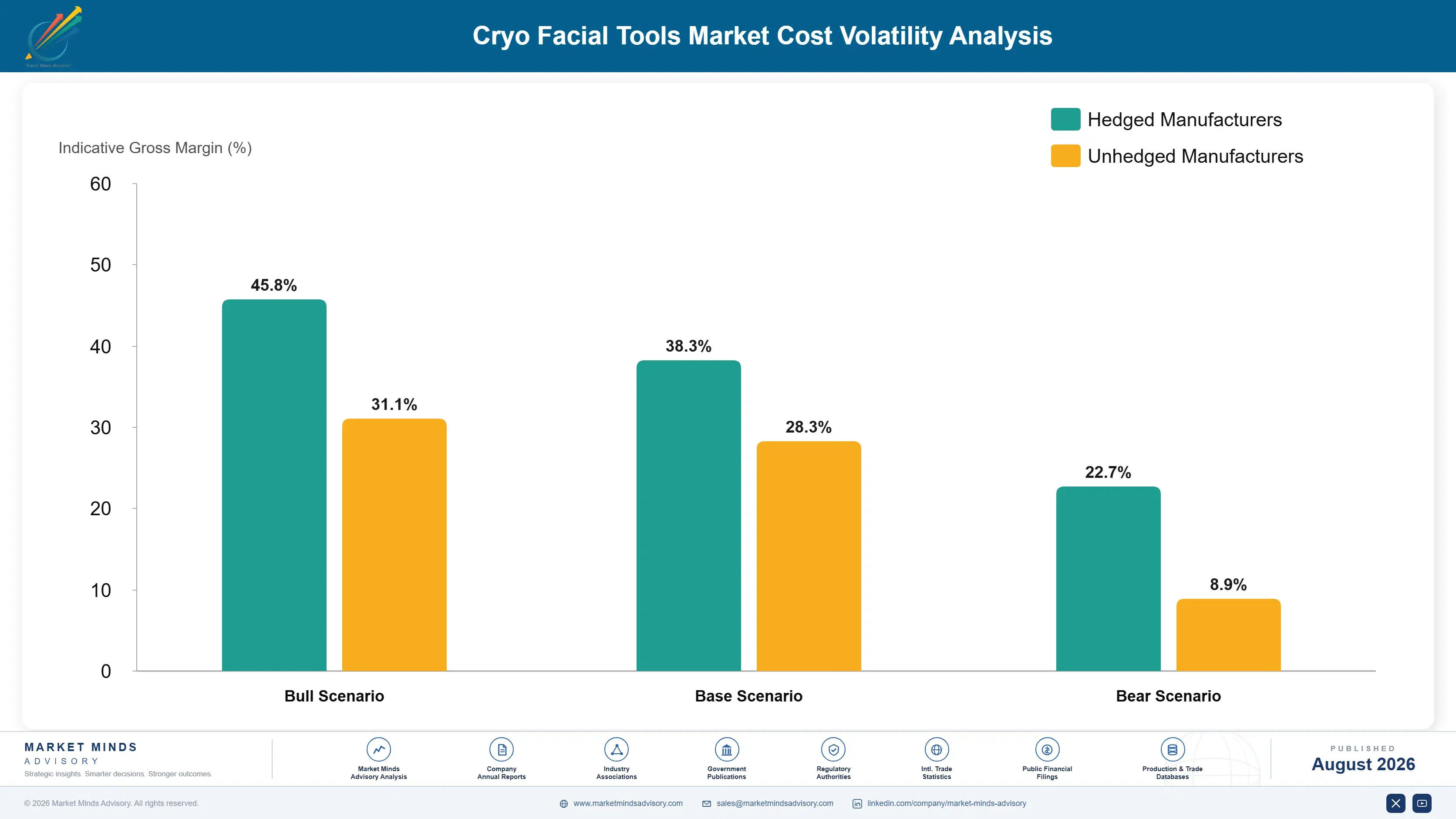
Cost divides four ways and the object is the smallest part. Customer acquisition and marketing absorb roughly 38% of retail price, distribution, retail margin and fulfilment near 27%, product manufacture near 19%, and packaging with returns handling the remaining 16%. A stainless globe costs a few dollars to make and sells for around USD 34, which looks like an excellent margin until acquisition cost is properly allocated to it.
Stainless steel and cosmetic-grade polymer pricing moved across recent years without changing much, since material content is a small share of the total. Marketing cost on social platforms has moved far more damagingly, with acquisition rates rising across the period as the category filled with participants bidding for the same audience. Therabody and Amorepacific have both discussed marketing and channel cost across recent reporting periods.

Exposure varies by business model rather than by geography. Participants selling a single durable object carry full acquisition cost against one transaction and have no recovery available. Those with consumables or ranges spread it across a customer relationship. Professional suppliers carry regulatory and support cost instead, recovered across equipment replacement cycles that recur, which is a considerably more comfortable position to occupy.
cryo-facial-tools-market-cost-volatility-analysis-1788165767277

Consumable attachment spreading acquisition cost properly

Acquisition absorbs roughly 38% of retail price and is recovered against a single transaction where the device needs nothing afterwards. Building a cartridge or gel consumable into the product spreads that cost across a relationship instead. The engineering is straightforward and most participants have simply not done it, which is a commercial oversight rather than any technical obstacle.

Return rate reduction through accurate product expectation

Online returns run above one in ten, and most arise from buyers expecting a lasting change rather than a temporary reduction in puffiness. Describing the effect accurately costs nothing and reduces returns measurably, though it conflicts directly with how the category is generally marketed. Participants who oversell the result pay for it twice, in the return and in the review.

Regulatory positioning decided before marketing is written

Claim language determines regulatory classification, and a marketing team writing without that constraint can move a product into a registration regime nobody budgeted for. Deciding the boundary first costs nothing and prevents an enforcement problem that costs a great deal. Most participants discover the line exists only when somebody points out that they have crossed it.

Portfolio Architecture for Margin Defence

The portfolio separates by whether the customer ever comes back. Solid tools such as globes, wands, rollers and moulds are the volume core: enormous unit sales, negligible manufacturing cost, and a buyer who has no reason to make contact again. Large revenue, thin lifetime value, and no defensible position that a marketplace listing cannot immediately replicate. The customer leaves and never comes back.
Margin concentrates in professional systems and consumable devices, and both concentrate for the same reason. A clinic buys again on commercial usage cycles and a cartridge device buys again by design, which converts a transaction into a relationship. Professional systems also carry regulatory obligations that keep the crowd out, and that burden functions as the only real barrier anywhere in this category. Recurrence is the whole distinction.

The overlooked pool is range extension to an existing buyer. Someone who has bought once will not buy the same tool again and will readily buy something adjacent, at an acquisition cost close to zero. Serums, masks and complementary tools all address a customer already held. Most participants sell one object and then never speak to that person again. Almost nobody bothers with it.

Volume / Commodity-Adjacent

Ice moulds, basic rollers and unbranded cryo globes sold through marketplaces on price alone. Range spans nine points because acquisition efficiency decides outcomes entirely and varies enormously between participants here.
Gross Margin: 18-27%

Premium / Certified

Branded globes, wands and powered handheld cooling devices sold through beauty retail and direct channels. Range spans twelve points because brand strength and return rates differ sharply across this tier.
Gross Margin: 30-42%

Sustainability / Regulatory / Next-Generation

Professional clinic systems, cartridge based consumable devices and registered treatment equipment. Range spans sixteen points because equipment sales and recurring consumable economics are barely comparable businesses inside one tier. Recurrence separates them entirely.
Gross Margin: 42-58%
cryo-facial-tools-market-portfolio-architecture-1788165767785

High-value Sub-segments and Strategic Watch-out

Professional Clinic Cryotherapy Facial Systems

High value and high growth at 17.4%, selling a repeating session rather than a permanent object to the customer. The fourteen point range separates suppliers holding regulatory registration and clinical support from those selling equipment without either behind it. The obligations keep the crowd out.
Gross Margin: 44-58%

Cartridge-Based Consumable Cryo Devices

High value with moderate growth at 15.1%, building a replacement cycle into a product category that otherwise has none. The twelve point range reflects attach rates, since a consumable nobody actually reorders delivers none of the intended commercial benefit. Design rather than technology creates it.
Gross Margin: 38-50%

Cryo Globes, Wands and Rollers

The volume core, sold in enormous quantities to buyers who never return and never need to. Negligible manufacturing cost, full acquisition cost against a single transaction, and no barrier that a marketplace listing cannot replicate within weeks. Everybody starts here and almost nobody stays profitably.
Gross Margin: 18-27%

Regulatory Classification Exposure

The strategic watch-out rather than a growth pool. Claim language rather than technology decides classification, jurisdictions have been redrawing the line, and registration costs are trivial for large participants and fatal for small ones. Nobody in this category chose their position deliberately at the start.
Gross Margin: Variable

Why Customers Never Return

This category has an annuity problem rather than annuity economics, and the distinction organises everything about it. A tool that works indefinitely gives the buyer no occasion to contact the brand again, and repeat purchase at 14% across three years reflects that precisely. Participants who built acquisition machines without any retention mechanism behind them have spent the period discovering what a single-transaction customer is actually worth to them.
Stickiness varies entirely by whether something gets consumed. Professional clinic relationships are genuinely durable, since equipment replaces on usage cycles and consumables reorder continuously. Cartridge device customers return by design at attach rates around 22%. Solid tool buyers have no stickiness whatsoever, because there is nothing to return for. Brand loyalty in the consumer end is close to nonexistent and always was, whatever the marketing budgets assumed.

The buyer has changed in one respect that matters. Early purchasers bought on demonstration and novelty through short-form video. Later ones increasingly arrive already owning a device and asking what else the brand offers, which is a question most participants in this category have no answer to. Those who built a range are talking to that customer, and those who sold one object are not.
cryo-facial-tools-market-end-use-penetration-index-1788165768277

Where Brands Should Commit Now

These are among the four positions where our research anticipates prominent divergence between winners and laggards over the coming forecast period. Each is grounded in the demand model, the regulatory perimeter, and the announced capacity pipeline.
01 / CONSUMABLE DESIGN DISCIPLINE

Build something into the device that runs out

A solid metal tool produces repeat purchase of only 14% across a full three years because the object genuinely needs nothing from the brand after the actual moment of sale, and building a cartridge, gel pod or replaceable element creates a cycle where absolutely none existed before. Consumable attach rates reach 22% wherever the product design properly supports it. The engineering cost is modest and the commercial effect is genuinely transformative, since lifetime value finally stops being one single transaction.
02 / PROFESSIONAL CHANNEL ACCESS

A clinic buys again and a consumer does not

A clinic charging around USD 95 per session replaces all its equipment on commercial usage cycles rather than never, which makes a single professional customer worth many times a consumer one across almost any comparable period of time. Professional systems here accordingly grow at 17.4% against a market rate of only 11.6%. The channel demands regulatory registration, clinical support material and a whole sales approach that consumer brands rarely possess, and that barrier is exactly why it stays uncrowded today.
03 / CLAIM BOUNDARY POSITIONING

Marketing language decides your regulatory classification

A device claiming a treatment effect falls under medical device registration while an identical object claiming general wellness does not, and several jurisdictions have been moving that boundary without a great deal of warning to anybody. Brands that chose a side deliberately have absorbed the changes comfortably; those that drifted across it in their marketing copy faced enforcement they had not anticipated in any way at all. Registration costs run two hundred thousand dollars or more in each and every affected market.
04 / RANGE EXTENSION CAPTURE

The cheapest customer you will ever get is yours

Someone who has already purchased once has no reason whatever to buy the identical tool again and considerable reason to buy something adjacent, at an acquisition cost that is effectively zero to the brand itself. Serums, masks, storage and complementary tools would all address a customer the business already holds and has already paid to acquire once. Range extension of that kind typically raises revenue per customer by forty to sixty percent wherever it is executed with any real discipline behind it.

Engagement Snapshot From the Field

A live engagement with an industry participant carrying material or product regulatory and market exposure ahead of a defining policy shift, showing how our research translates into a defensible multi-year portfolio strategy.
MARKET MINDS ADVISORY · CLIENT ENGAGEMENT SUMMARY
Cryo Facial Tools Producer Strategic Portfolio Review and Transition Roadmap 2026·Investment Scenario on Cryo Facial Tools Exposure Evaluation 2025-26
CLIENT PROFILE
A direct-to-consumer beauty brand selling stainless cryo globes and a powered handheld cooling device through its own site and two marketplaces, with no consumable, no professional channel and no adjacent product range. Revenue had grown for three years while contribution margin declined steadily, and management had attributed the decline to rising platform advertising costs rather than to anything about the product itself.
STRATEGIC CHALLENGE
The board needed to establish whether the margin decline came from acquisition cost inflation or from a customer worth only one transaction, and whether developing a consumable device justified the tooling investment. It also faced a decision on whether to pursue professional clinic distribution, which the marketing organisation regarded as an entirely different business it had no capability to run.
MMA APPROACH
MMA rebuilt contribution by cohort across three years, separating acquisition cost inflation from purchase frequency for the first time. It modelled consumable device economics against continued solid tool sales under several attach rate scenarios. Expert interviews with clinic operators, distributors, regulatory advisers and competing brands established where repeat revenue actually exists in this category.
KEY FINDINGS
  1. Purchase frequency rather than acquisition cost explained most of the margin decline, and the two had never been separated in any reporting the board had seen.
  2. Fewer than one buyer in seven purchased anything at all from the brand again, and those who did overwhelmingly bought a different product rather than a second tool.
  3. Marketing copy on two products had drifted into treatment claims that would attract device registration obligations in at least one significant market.
  4. Clinic operators interviewed would purchase from a consumer brand given clinical support material, and none had ever been approached by the client at all.
CLIENT PROFILE
A direct-to-consumer beauty brand selling stainless cryo globes and a powered handheld cooling device through its own site and two marketplaces, with no consumable, no professional channel and no adjacent product range. Revenue had grown for three years while contribution margin declined steadily, and management had attributed the decline to rising platform advertising costs rather than to anything about the product itself.
STRATEGIC CHALLENGE
The board needed to establish whether the margin decline came from acquisition cost inflation or from a customer worth only one transaction, and whether developing a consumable device justified the tooling investment. It also faced a decision on whether to pursue professional clinic distribution, which the marketing organisation regarded as an entirely different business it had no capability to run.
MMA APPROACH
MMA rebuilt contribution by cohort across three years, separating acquisition cost inflation from purchase frequency for the first time. It modelled consumable device economics against continued solid tool sales under several attach rate scenarios. Expert interviews with clinic operators, distributors, regulatory advisers and competing brands established where repeat revenue actually exists in this category.
KEY FINDINGS
  1. Purchase frequency rather than acquisition cost explained most of the margin decline, and the two had never been separated in any reporting the board had seen.
  2. Fewer than one buyer in seven purchased anything at all from the brand again, and those who did overwhelmingly bought a different product rather than a second tool.
  3. Marketing copy on two products had drifted into treatment claims that would attract device registration obligations in at least one significant market.
  4. Clinic operators interviewed would purchase from a consumer brand given clinical support material, and none had ever been approached by the client at all.
RECOMMENDED STRATEGY
Phase 1: Phase one: develop a cartridge based cooling device and stop launching further products that require nothing from the customer afterwards. Phase 2: Phase two: rewrite all marketing copy against a defined claim boundary before any regulator raises the question independently of the company. Phase 3: Phase three: build a small professional channel with clinical support material, targeting clinics rather than pursuing any further consumer volume growth.
OUTCOME
The client reported contribution margin recovering 6.8 points within four quarters and repeat purchase roughly doubling from a low base (client-reported, unverified by MMA). Claim language was corrected across the range. A professional pilot reached a small number of clinics, and the cartridge device entered tooling.

Frequently Asked Questions

Foundational context covering the market sizes, CAGR, scope, country, region and competition that inform every finding below. This section is provided to cover basics and most often pre-purchase conversations, answered from the MMA Primary Research Dataset.

What is the current size of the Cryo Facial Tools Market?

The market is valued at USD 0.9 billion in 2025, measured as revenue from tools and devices applying controlled cooling to the face for aesthetic purposes.

How large will the Cryo Facial Tools Market be by 2036?

MMA forecasts USD 3.01 billion by 2036, up from USD 1.00 billion in 2026. That represents incremental revenue of USD 2.01 billion and an expansion multiple of 3.00 times.

What is the CAGR for the Cryo Facial Tools Market 2026 to 2036?

The base case CAGR is 11.6%, with a bull case of 12.9% and a bear case of 10.3%. Professional treatment and consumable devices supply most of that growth.

Which segment is growing fastest?

Professional clinic cryotherapy facial systems grow at 17.4%, half again the market rate of 11.6%, because a clinic sells a repeating session rather than a permanent object.

Who are the major companies in the Cryo Facial Tools Market?

FOREO, Therabody, Zimmer MedizinSysteme, Solawave and Skin Gym lead on cryo facial device revenue, holding only around 31% between them across a very fragmented category.

Which country is growing fastest?

India grows fastest at 13.8%, expanding from a very small base as a category established elsewhere arrives with social platform reach already built for it.

Report Segmentation Architecture

The full report scope spans multiple orthogonal segmentation dimensions, with cross-tabulated demand data provided for each dimension pair. Coverage extends further to regional breakdowns, trend trajectories, and the competitive detail needed to support segment-level decision-making.

By Device Type

  • Professional Clinic Cryotherapy Facial Systems
  • Cartridge-Based Consumable Cryo Devices
  • Powered Handheld Cooling Devices
  • Cryo Globes and Wands
  • Ice Rollers and Moulds
  • Cryo Masks and Wearable Cooling Devices

By End-Use Industry

  • Individual Home Users
  • Aesthetic and Skincare Clinics
  • Spa and Wellness Facilities
  • Medical Aesthetic Practices
  • Hotel and Resort Wellness
  • Professional Makeup and Styling

By Commercial Dimension

  • Direct To Consumer Sales
  • Online Marketplace Distribution
  • Specialist Beauty Retail
  • Professional Equipment Supply
  • Consumable Subscription Programmes
  • Private Label Manufacture

By Region

  • East Asia
  • North America
  • Western Europe
  • South Asia and Pacific
  • Latin America
  • Middle East and Africa
  • Eastern Europe

Scope, Methodology, and Coverage

Every figure in this report is reproducible from documented input assumptions. The scope below maps the historical period, the forecast horizon, the segmentation dimensions, and the countries covered, alongside the underlying primary and qualitative methodology.
Historical Period
2020 to 2025
Forecast Period
2026 to 2036
Base Year
2025 (USD billions; MMA Primary Research Dataset, August 2026)
Market Definition
Revenue from tools and devices applying controlled cooling to the face for aesthetic and wellness purposes, spanning professional clinic cryotherapy facial systems, cartridge-based consumable cryo devices, powered handheld cooling devices, cryo globes and wands, ice rollers and moulds, and cryo masks and wearable cooling devices. Direct to consumer sales, online marketplace distribution, specialist beauty retail, professional equipment supply, consumable subscription programmes and private label manufacture are all included. Cryolipolysis body contouring equipment, medical cryosurgery instruments, skincare formulations sold without a device, and cold therapy products for injury recovery are excluded.
Quantitative Units
USD billions, cryo facial device and treatment equipment revenue
Segmentation Dimensions
Device type, user setting, commercial channel, region
Regions Covered
East Asia, North America, Western Europe, South Asia and Pacific, Latin America, Middle East and Africa, Eastern Europe
Countries Covered
China, South Korea, Japan, United States, Canada, United Kingdom, France, Germany, India, Australia, Brazil, Mexico, United Arab Emirates, Poland
Key Companies Profiled
FOREO, Therabody, Zimmer MedizinSysteme, Solawave, Skin Gym, Cryomed, BeautyBio, NuFACE, Medicube, Amorepacific
Quantitative Methodology
Primary survey, n=3,800 respondents, Q4 2025, six countries; demand-side model with trade association cross-validation
Qualitative Methodology
47 expert interviews, Q4 2025; applied to validate demand model assumptions, identify emerging dynamics, and assess competitive positioning
Report Format
PDF and XLSX data workbook (Word format preview document)
Publisher
Market Minds Advisory
Report Code
MMA-2026-MED-111
Published
August 2026
Contact
sales@marketmindsadvisory.com | www.marketmindsadvisory.com

Purchase the full Cryo Facial Tools Market Report (2026 to 2036).

The full report addresses the commercial problem this category has been unwilling to name, which is that the product works permanently and the customer therefore leaves. It quantifies repeat purchase against acquisition cost by business model, separates professional treatment economics from consumer device sales, and assesses regulatory classification as the only meaningful barrier anybody holds. Segment analysis covers all six device types, with particular attention to professional systems and consumable devices where the repeat purchase mechanism actually exists. Competitive assessment ranks twenty participants on cryo facial device revenue.
Six device type segmentation with growth rates
Repeat purchase measured against acquisition cost by model
Twenty participant assessment on cryo facial revenue
Regulatory classification boundaries mapped across major jurisdictions
Professional treatment economics compared against consumer sales
Consumable attach rates assessed across device designs

Built For The People Who Decide

From boardroom strategy to bench-side execution, this report is read cover-to-cover by leaders shaping the next decade of their industry, turning demand scenarios, market dynamics and valuation benchmarks into decisions.
CXOs/ Presidents/ VPs/ Managers
M&A and Corporate Development
Strategy Teams and R&D Heads
Procurement and Product Directors
Regulatory and Compliance Leaders
Investor Relations and Equity Analysts