Market Minds Advisory
Cryo-Emulsification Market

Cryo-Emulsification Market: Cryo-Emulsification Market: The Energy Number Is The Argument, The Ingredient Story Is Not, And Removing The Heat Removes The Kill Step, 2026 to 2036

Skipping the heat and cool cycle saves about 62% of batch energy and 48% of batch time. Only 17% of formulations contain an active that conventional processing actually damages. Preservative load rises about 22%.

Lead Analyst

Published

September 2026

Make Smarter Decisions with Customized Research Insights

Request a free sample report and evaluate market opportunities, growth trends, and competitive dynamics relevant to your business needs.

2025 MARKET VALUE$1.1BMarket Size 2025
2036 FORECAST VALUE$3.2BBase Case , 2026 to 2036
CAGR 2026 TO 203610.4 %Bull 11.7% / Bear 9.1%
INCREMENTAL OPPORTUNITY$2.0BNet 10- year value creation
EXPANSION MULTIPLE2.67x2036 value over 2026 base
Strategic Levers
M&A Pipeline
Regional Outlook
Country Rankings
Competitive Intelligence
Segmental Deep-dive
Call-Us : 91 93563 13602

Executive Snapshot and Market Trajectory.

Cold emulsification saves roughly 62% of batch energy and 48% of batch time against a conventional heat and cool cycle. Those are hard numbers a plant manager can verify in a month. The category markets a heat-sensitive ingredient story instead, which is considerably harder to demonstrate. Operations budgets are larger.
Cold-process emulsifier systems grow at 15.6%, half again the market rate of 10.4%, because the surfactant chemistry is what actually makes cold emulsification work at production scale. Low-temperature stabiliser and rheology packages follow at 13.2%. Process design and validation services grow slowest of the six classes at 7.4%, despite being where most first adopters fail. Cryogenic-assisted homogenisation equipment grows at 8.6%, because most manufacturers already own machinery capable of the shear required.
East Asia holds 41% of demand, with South Korean growth of 16.2% leading every market covered on contract manufacturers that adopted cold process before anybody else at scale. Removing the heat also removes the thermal kill step, which raises typical preservative requirement by about 22% rather than reducing it. Cold-process emulsifiers also cost about 3.4 times conventional equivalents, which stops most trials converting into production.
Market Definition
This market covers cold-process emulsification systems and inputs for cosmetic, personal care, food, and pharmaceutical manufacture, including cold-process emulsifier systems, low-temperature stabiliser and rheology packages, high-shear cold mixing equipment, cryogenic-assisted homogenisation equipment, pre-formed cold-processable bases, and process design and validation services. It excludes conventional hot-process emulsification, freeze drying, cryogenic grinding, frozen food processing, and cryotherapy or body contouring devices.
Base Year Value
$1.1B in 2025 (MMA Primary Research Dataset, September 2026)
Forecast Period
2026 to 2036, eleven discrete annual values
CAGR
10.4% base case. Bull 11.7%. Bear 9.1%.
Fastest Growth Segment
Cold-Process Emulsifier Systems: 15.6% CAGR
Fastest Growth Country
South Korea: 16.2% CAGR
Fastest Growth Region
South Asia and Pacific: 12.4% CAGR
Largest Region
East Asia: 41% of 2025 global value
Market Leaders
Evonik Industries, BASF, Croda International, Seppic, and IKA Werke lead the field. Source: MMA Primary Research Dataset, July 2026.
Primary Survey
n=3,800 procurement and R&D decision-makers, Q4 2025, six countries
Methodology
Demand-side build-up, cross-validated against public data, 47 expert interviews

Cryo-Emulsification Market Forecast Scenarios

cryo-emulsification-market-size-forecast-scenario-1790019217533
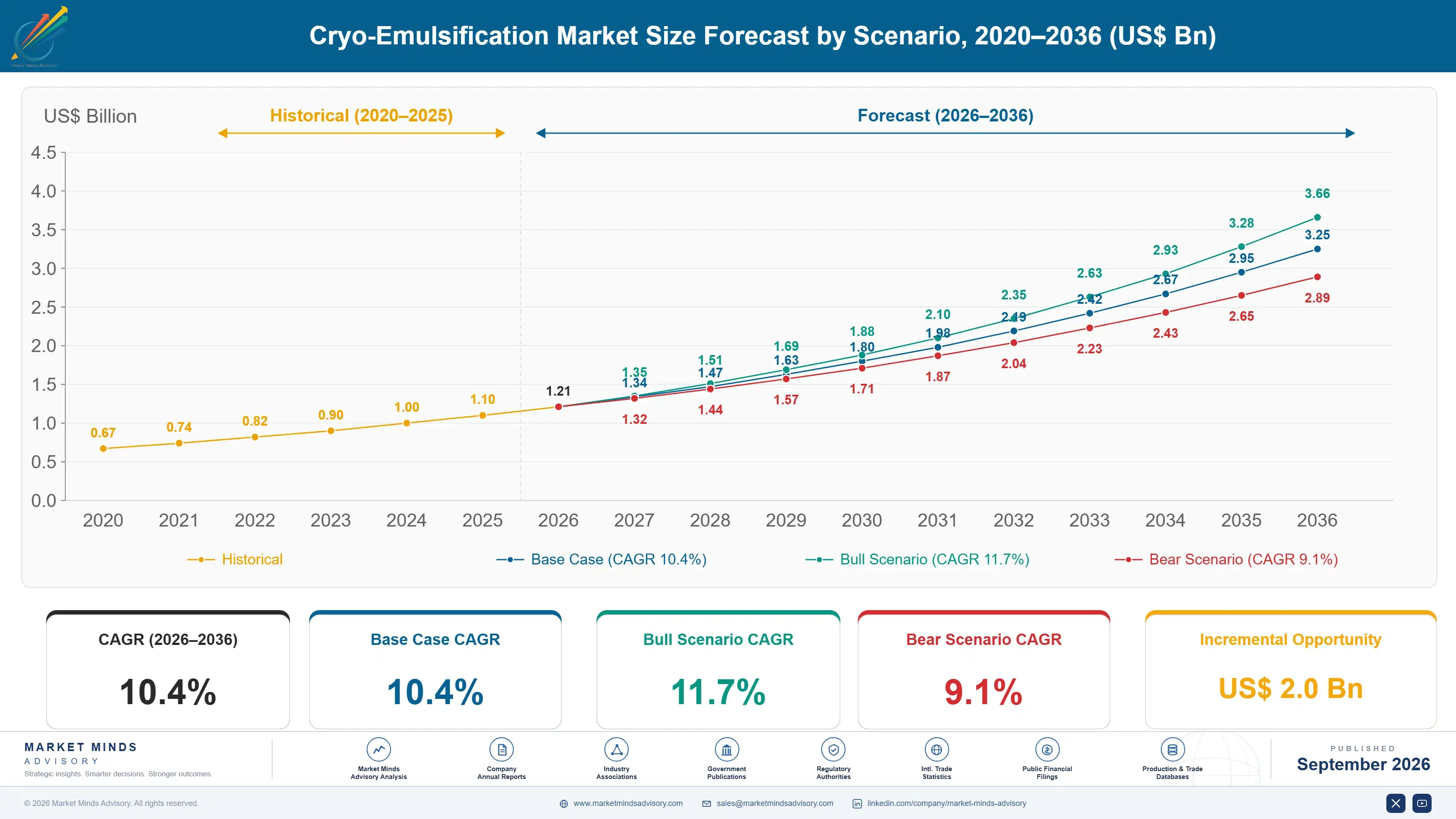
Growth from 2020 to 2025 ran at 9.2% and came from two directions that rarely met. Cosmetic contract manufacturers adopted cold process to cut batch time and turn lines over faster, while brand owners asked for it on ingredient preservation grounds that were frequently overstated. Energy pricing volatility through the middle of the period did more to accelerate adoption than any formulation argument managed.
The base case at 10.4% rests on three mechanisms. Energy and throughput economics keep improving the case as electricity costs stay volatile and contract manufacturers compete on cycle time. Korean and Chinese contract manufacturing capacity keeps expanding, with South Korean growth at 16.2% leading every country covered. And emulsifier chemistry keeps improving, which widens the formulation range cold process can actually handle at scale. None of the three assumes a new emulsifier chemistry class reaches commercial scale.
The bull case at 11.7% depends on cold-process emulsifier cost falling from its current multiple of about 3.4 times conventional equivalents, which would remove the last economic objection. The bear case at 9.1% is microbiological: removing the thermal kill step raises preservative requirement by roughly 22%, and a preservative restriction would make that considerably harder to accommodate.

What Removing The Heat Does

A conventional emulsion is made by heating both phases to around seventy-five degrees, combining them, and cooling under agitation. Cold process skips all of that, which saves about 62% of batch energy and 48% of batch time. Those are measurable, auditable numbers that a production manager can confirm within one month of running the process. They are also the numbers this industry mentions last.
TOP FIVE CONCENTRATION36%Share of category revenue held by the leading suppliers
BATCH ENERGY REDUCTION62%Energy saved against a conventional heat and cool cycle
HEAT-LABILE ACTIVE SHARE17%Formulations containing an active conventional processing genuinely damages
PRESERVATIVE LOAD INCREASE22%Typical rise in preservative requirement without a thermal kill step
EMULSIFIER COST MULTIPLE3.4 timesCold-process emulsifier cost against conventional equivalents at equal function
BATCH CYCLE TIME REDUCTION48%Time saved per batch against conventional heated processing
The ingredient argument is weaker than it sounds. Around 17% of cosmetic formulations contain an active that conventional processing genuinely damages: certain peptides, probiotic materials, some retinoid and ascorbate derivatives. The rest survive twenty minutes at seventy-five degrees without measurable loss, and a preservation claim made for them is describing a problem that was not there. Cold process is still worth adopting for those formulations, on entirely different grounds.
Then the part that gets discussed least. A heated batch passes through a temperature that reduces the microbial burden arriving with raw materials; a cold batch does not. Typical preservative requirement rises around 22% as a result, and raw material specifications have to tighten alongside. That sits awkwardly beside the clean label positioning cold process is often sold with.
"The energy and cycle time numbers are real, auditable, and enormous, and this industry buries them under a heat-sensitive ingredient story that applies to about one formulation in six. Meanwhile nobody wants to explain that removing the heat means adding preservative."
Practice Director, Process Technology and Formulation Systems · MMA Chemicals and Materials Practice · September 2026

Market Trends

Emulsifier Chemistry Rather Than Equipment Decides Adoption

Cold-process emulsifier systems grow at 15.6%, fastest of the six classes, while cryogenic-assisted homogenisation equipment grows at 8.6%. The reason is that most manufacturers can already generate sufficient shear with equipment they own, and what stops them making a cold emulsion is surfactant chemistry rather than mechanical energy. Liquid crystal and polymeric emulsifier systems build the interfacial structure that heat would otherwise create. Equipment vendors and emulsifier suppliers sell against each other on this point, and the chemistry argument is winning. Selling equipment into a problem that somebody else's chemistry solves is a weakening position each year.
Market Impact: Country grows at 16.2%
Energy Pricing Moved Adoption More Than Formulation Did

Electricity cost volatility through the middle of the last five years accelerated cold process adoption more effectively than any ingredient preservation argument managed over the same period. A 62% batch energy reduction reads differently on an operations budget when power pricing has doubled. Contract manufacturers competing on cycle time and cost per batch moved first, brand owners followed, and the formulation rationale was frequently attached afterwards. That sequence is worth understanding, because it says who the real buyer is. The real buyer sits in operations rather than in formulation, and most suppliers are still organised to reach the wrong one.
Market Impact: Cuts cycle time 48%

Market Opportunities and Growth Drivers

Korean Contract Manufacturers Adopted It First

South Korea grows at 16.2%, faster than any country covered, and Korean contract manufacturers were the first to run cold process at genuine production scale rather than as a specialist capability. East Asia holds 41% of world demand on that basis. Short product cycles and intense competition on turnaround made a 48% cycle time reduction commercially decisive rather than merely attractive. Chinese contract manufacturing capacity is following that direction quickly, and Western brand owners increasingly encounter cold process through their Asian suppliers. Japanese formulators lead on liquid crystal emulsifier chemistry that the rest of the region increasingly specifies.
Market Impact: Raises preservative load 22%

Cycle Time Converts Directly Into Line Capacity

A 48% reduction in batch cycle time is a capacity increase on existing equipment, which is worth considerably more to a contract manufacturer than any ingredient claim. A plant running near capacity can take additional business without capital investment, and the payback on emulsifier cost is measured in months rather than years. That arithmetic is why adoption is concentrated among contract manufacturers rather than among brand owners with their own smaller plants. A plant with spare capacity gains nothing from the same saving, which is why sequencing by utilisation matters.
Market Impact: Costs 3.4 times conventional

Market Restraints and Challenges

Removing Heat Removes The Microbiological Kill Step

Typical preservative requirement rises around 22% under cold process, and the root cause is that a heated batch passes through a temperature reducing the microbial burden arriving with raw materials while a cold one does not. Commercially this sits badly beside the clean label positioning cold process is often sold with. Suppliers respond by tightening raw material microbiological specifications, by offering validated preservation systems designed for cold batches, and by stating the consequence plainly rather than leaving it to be discovered. Raw material microbiological specifications need tightening at the same time, and few first adopters anticipate that.
Market Impact: Emulsifiers grow at 15.6%

Cold Emulsifier Cost Remains The Binding Objection

Cold-process emulsifier systems cost roughly 3.4 times conventional equivalents at equal function, and the root cause is smaller production volumes and more complex molecules rather than any inherent scarcity. Commercially this is the objection that stops trials converting, particularly for brand owners without the throughput to monetise cycle time savings. Suppliers respond by pricing against total batch cost rather than kilogram cost, by building volume to bring unit prices down, and by targeting throughput-constrained plants first. Bringing the multiple down requires volume the category has not yet generated, which is a chicken and egg problem.
Market Impact: Cuts batch energy 62%
3 additional market trends, 4 additional growth drivers, and 2 additional restraints and challenges are covered in the full report. Contact sales@marketmindsadvisory.com to access the complete intelligence.

Segment CAGR and Growth Architecture

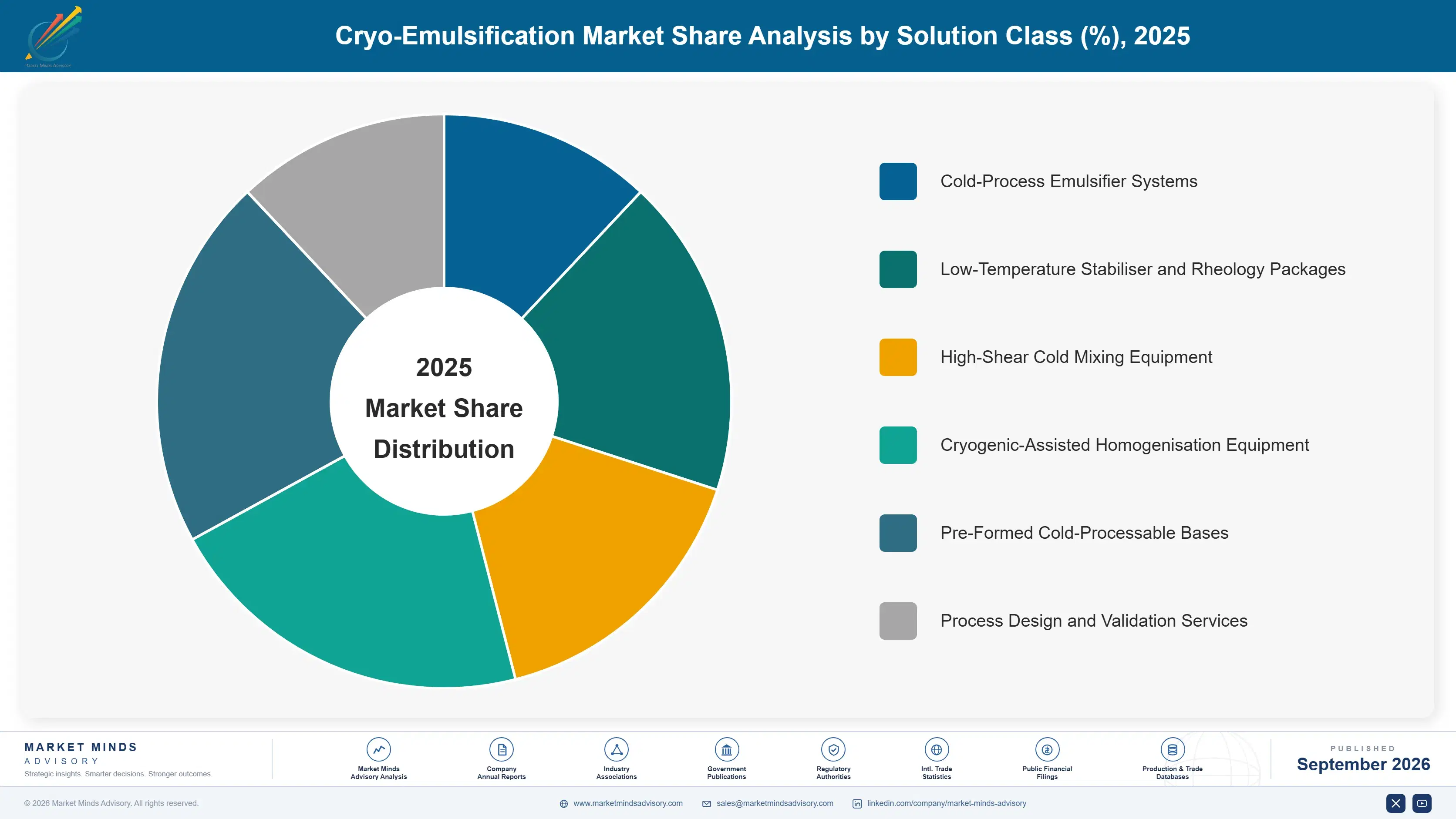
Segmentation follows solution class across six categories: cold-process emulsifier systems, low-temperature stabiliser and rheology packages, high-shear cold mixing equipment, cryogenic-assisted homogenisation equipment, pre-formed cold-processable bases, and process design and validation services. End-use industry, plant scale, and adoption stage are treated as separate dimensions entirely. Freeze drying, cryogenic grinding, and body contouring devices fall outside the defined scope entirely.
cryo-emulsification-market-market-share-analysis-1790019218092

Cold-Process Emulsifier Systems

Cold-process emulsifier systems grow at 15.6%, half again the market rate of 10.4%, because surfactant chemistry rather than mechanical energy is what actually decides whether a cold emulsion forms and holds. Liquid crystal, polymeric, and natural emulsifier systems build the interfacial structure that heating would otherwise create, and most manufacturers already own equipment capable of the shear required. Cost is the binding constraint at roughly 3.4 times conventional equivalents at equal function, which is a volume problem rather than a chemistry one. Suppliers pricing against total batch cost rather than cost per kilogram convert trials at considerably higher rates than those quoting materials alone. Volume is what would bring the multiple down.
CAGR 15.6%

Low-Temperature Stabiliser And Rheology Packages

Low-temperature stabiliser and rheology packages grow at 13.2% by addressing what happens after the emulsion forms rather than during formation. Cold-process emulsions are frequently less tolerant of temperature extremes in distribution, and a product shipped through a hot climate without a suitable rheology package separates in ways a heated equivalent would not. That is the failure mode first adopters encounter most often and design for least. Polymeric thickeners and structured systems built for cold incorporation address it directly. Suppliers offering accelerated distribution stability data alongside the package separate themselves considerably from those supplying the material alone. Hot climate markets are also the fastest growing ones in this category, which makes the omission commercially expensive rather than merely technical.
CAGR 13.2%
Full segment breakdown across 6 segments available in the complete report.

Regional Architecture and Country Demand Map

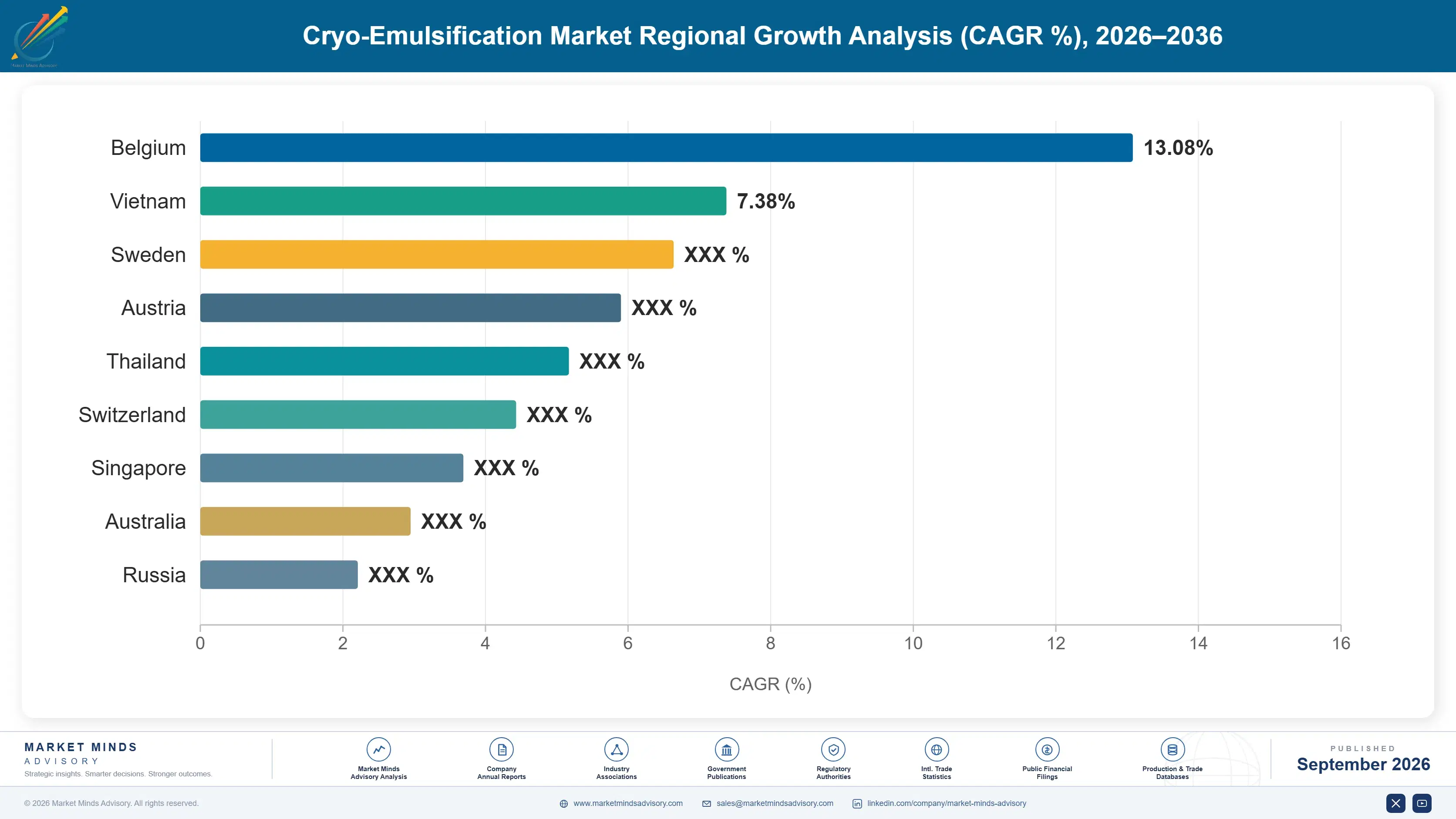
Regional shares reflect where cold-process emulsification is deployed in manufacture rather than where the inputs are produced. Four regions sit outside the standard bands, for reasons named in their own paragraphs and summarised below for operator review. Plant utilisation and distribution temperature vary sharply between them.

East Asia

At 41% this sits far above the standard band, and the justification is that Korean and Chinese contract manufacturers run more cosmetic emulsion volume than the rest of the world combined and adopted cold process before anybody else at scale. South Korean growth of 16.2% leads every country covered. Short product cycles make a 48% cycle time reduction commercially decisive rather than merely attractive. Japanese formulators lead on liquid crystal emulsifier chemistry. Chinese capacity is following Korean direction quickly. Western brand owners increasingly meet cold process through their Asian manufacturing partners rather than through their own plants. Regional plant utilisation is high, which makes cycle time savings convert directly into billable capacity.
Share: 41% | CAGR: 11.4% (2026 to 2036)

Western Europe

European cosmetic regulation and preservation restrictions make the microbiological consequence of removing a thermal step a more consequential design question here than anywhere else covered. Growth of 8.9% is the slowest of the seven regions. German and French suppliers hold the deepest positions in cold-process emulsifier chemistry and in the validation work that regulated manufacture requires. Energy pricing volatility through recent years accelerated adoption on operations grounds rather than formulation ones. Equipment manufacturers here compete against emulsifier suppliers for the same adoption budget across most accounts. Preservative restrictions here make the 22% load increase a genuine formulation constraint rather than an inconvenience, and suppliers offering validated systems designed for cold batches convert trials at considerably higher rates.
Share: 20% | CAGR: 8.9% (2026 to 2036)
Regional intelligence for 5 additional markets available in the complete report: North America, South Asia and Pacific, Latin America, Middle East and Africa, Eastern Europe. Contact sales@marketmindsadvisory.com.
cryo-emulsification-market-country-cagr-analysis-1790019218613

Where Suppliers Actually Convert Trials

Four commercial moves matter in a category whose strongest argument goes unmentioned, whose headline claim applies to a sixth of formulations, and whose main consequence nobody wants to explain. Each moves the conversation toward numbers a production manager can audit within a month of running the process. None of the four requires new chemistry to be invented.

Lead With Energy And Cycle Time Numbers

Cold process saves roughly 62% of batch energy and 48% of batch time, and both are auditable within a month of running the process. Suppliers leading with operations economics rather than ingredient preservation report trial conversion 2.9 times higher, because a production manager can verify the claim and a formulator cannot verify the other one. The ingredient story reaches the wrong person inside the customer entirely. Operations budgets are also considerably larger than formulation ones. Sequencing accounts by plant utilisation rather than by size builds volume faster than any pricing move.
Market Impact: Raises trial conversion rates to 2.9 times higher

Price Against Batch Cost Not Kilogram Cost

Cold-process emulsifiers cost about 3.4 times conventional equivalents per kilogram, which is the objection that stops most trials converting into production. Suppliers quoting total cost per batch, including energy, cycle time, and line capacity released, report win rates 2.5 times higher than those quoting materials alone. The arithmetic favours cold process comfortably in throughput-constrained plants and does not in plants with spare capacity. Knowing which one you are talking to decides the conversation. Released line capacity is the largest term in that calculation and the one most suppliers omit entirely from their quotations.
Market Impact: Raises quotation win rates to 2.5 times higher

State The Preservation Consequence Before Trials Begin

Preservative requirement rises around 22% without a thermal kill step, and a customer discovering that during stability testing loses confidence in everything else that was said. Suppliers stating it upfront and supplying validated preservation systems alongside report project completion rates 3.2 times higher than those leaving it to be found. Raw material microbiological specifications need tightening at the same time. Naming the consequence early costs a conversation and prevents an abandoned trial. It also positions the supplier as the party that understands the process rather than the one selling into it, which changes how the next conversation starts.
Market Impact: Raises project completion rates 3.2 times higher overall

Supply Distribution Stability Data With Every Package

Cold-process emulsions are frequently less tolerant of temperature extremes in distribution, and separation in a hot supply chain is the failure mode first adopters meet most often. Suppliers providing accelerated distribution stability data with their rheology packages report reformulation requests 2.6 times lower across the following year. In hot climate markets this is the difference between adoption and quiet abandonment, and very few suppliers currently generate the data at all. Generating the data costs a stability programme rather than a research project, and it is the difference between adoption and quiet abandonment in the fastest growing markets.
Market Impact: Cuts reformulation requests to 2.6 times lower overall

Who Controls the Margin Pool

Concentration is low. Five suppliers hold 36% of category revenue, measured consistently on that basis across all participants, and the field divides between specialty surfactant houses selling emulsifier chemistry, process equipment manufacturers selling mixing and homogenisation systems, and a smaller group of consultancies selling process design and validation to first adopters. The leader to challenger gap is wide in emulsifier chemistry and narrow in equipment.
Competition currently turns on three dimensions: emulsifier chemistry depth, which decides whether a cold emulsion forms and holds at production scale; distribution stability capability, where the rheology package determines whether the product survives a hot supply chain; and validated preservation design, which addresses the consequence of removing the thermal step. Price decides wherever a customer compares emulsifier cost per kilogram against an incumbent, which describes most trials that never convert.

Pressure builds from two directions at once. Equipment vendors and emulsifier suppliers compete for the same adoption budget and tell customers different stories. Emulsifier cost multiples remain the binding objection. Rankings will shift toward suppliers selling total batch economics rather than either chemistry or hardware in isolation. Suppliers holding only equipment face the most exposed position in the field.
cryo-emulsification-market-company-positioning-matrix-1790019219143

Competitive Moat and Risk Dimensions

EVONIK INDUSTRIES

Moat: Emulsifier Chemistry And Validation

Depth in liquid crystal and polymeric emulsifier systems combined with the validation support regulated manufacture requires lets a single supplier answer both the formation question and the compliance one. That combination is difficult to assemble and it addresses where first adopters actually fail, which is validation rather than emulsification.
EVONIK INDUSTRIES

Risk: Cost Multiple Blocks Conversion

Cold-process emulsifiers priced at roughly 3.4 times conventional equivalents stop trials converting in plants without the throughput to monetise cycle time savings. Bringing that multiple down requires volume the category has not yet generated, which is a chicken and egg problem the leader carries most directly.
IKA WERKE

Moat: Shear Equipment And Installed Base

An installed base of high-shear mixing and homogenisation equipment across cosmetic and pharmaceutical manufacture gives direct access to the production managers who make cold-process adoption decisions. Equipment relationships also survive formulation changes, which chemistry supply relationships frequently do not. Production managers make the adoption decision and equipment suppliers already know them.
IKA WERKE

Risk: Chemistry Argument Is Winning

Most manufacturers can already generate sufficient shear with equipment they own, which means the binding constraint is surfactant chemistry rather than mechanical energy. Selling new equipment into a problem that a different supplier's chemistry solves is a weakening position as emulsifier systems continue improving. Emulsifier systems keep reducing the mechanical requirement further each year.

Players Tracked

Prominent Players

Evonik Industries
BASF
Croda International
Seppic
IKA Werke

Other Key Players

Clariant
Lubrizol
Gattefosse
Nouryon
Stepan Company
Kao Corporation
Nikko Chemicals
Silverson Machines
Charles Ross and Son
Fryma Koruma
Netzsch
GEA Group
Sonic Corporation
Ashland
Innospec

Recent Developments

MARCH 2026

Evonik Publishes Total Batch Cost Modelling For Cold Process

Evonik Industries released batch cost modelling covering energy, cycle time, and released line capacity alongside emulsifier cost. The model puts total production economics where per kilogram material pricing has driven most of the category's sales conversations. Site-level worked examples were published alongside the model itself.
Signal: Total batch cost is the arithmetic that converts a trial into production. Operations budgets decide this, not formulation ones.
OCTOBER 2025

Croda Launches Validated Cold-Process Preservation Systems

Croda International introduced preservation systems validated specifically for batches produced without a thermal step, addressing the roughly 22% rise in preservative requirement that cold process creates. Raw material specification guidance was published alongside. Validation protocols were supplied with the systems rather than being sold separately.
Signal: Naming the consequence early prevents trials abandoned at stability testing. Stating the consequence early keeps the trial alive to completion.
JUNE 2025

Seppic Acquires Cold-Process Rheology Specialist Business

Seppic completed an acquisition of a business developing polymeric rheology packages for cold-incorporated emulsions. The transaction was an outright acquisition rather than a joint venture or minority stake, with hot climate distribution stability cited as the rationale. Accelerated stability testing capability transferred with the business.
Signal: Distribution stability decides adoption in exactly the hottest growing markets. The hottest markets are also the fastest growing ones here.

What Cold Process Costs

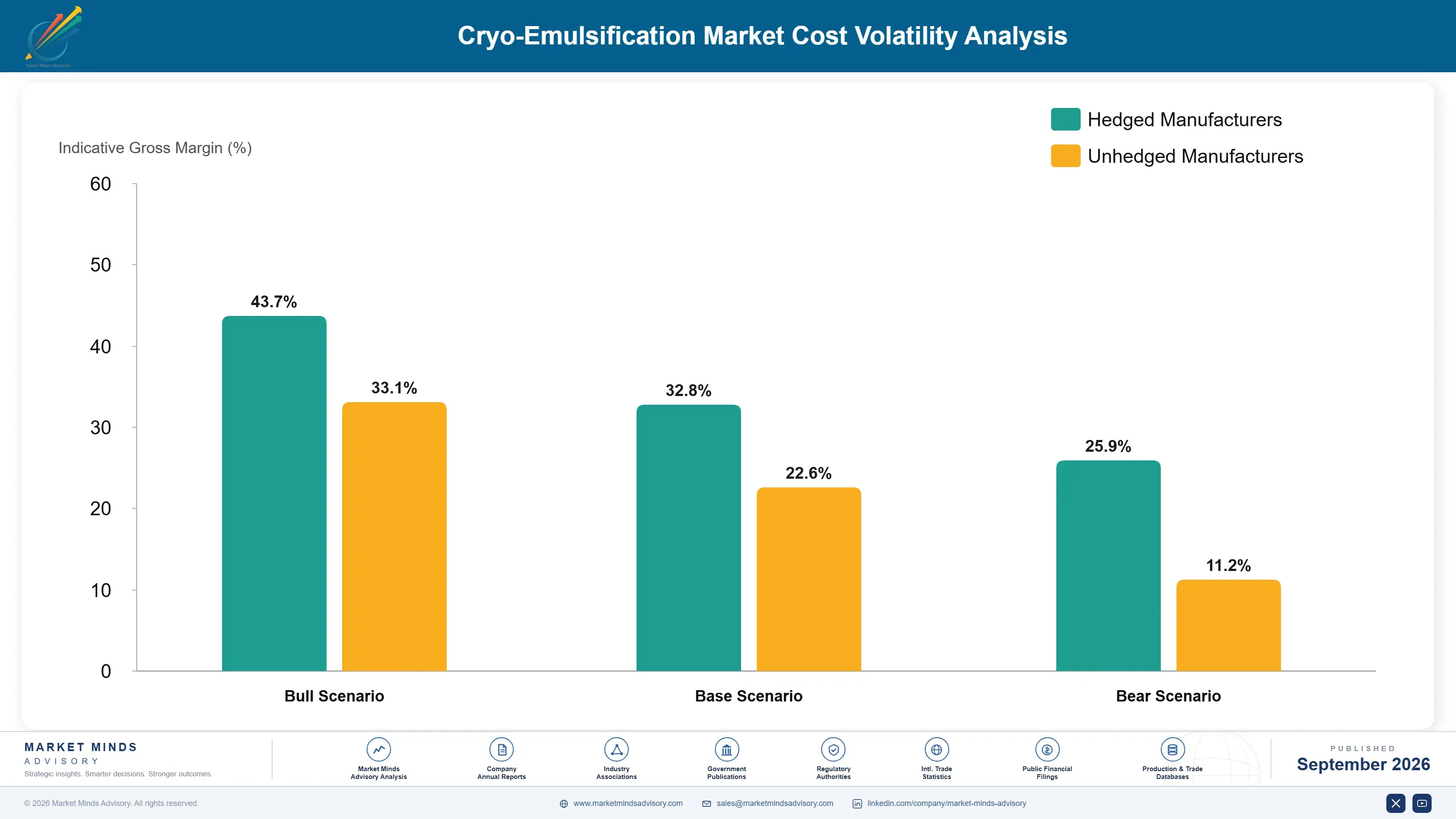
Three cost groups dominate on the chemistry side of this market. Specialty surfactant and polymer raw materials run 34% to 42% of cost of goods sold, and the eight-point range separates established chemistries from newer liquid crystal systems produced at low volume. Equipment manufacture and assembly take 26% to 34% for the hardware participants. Technical service, process design, and validation account for 18% to 26% across both groups.
Specialty surfactant feedstock pricing moved through 2024 and 2025 on petrochemical and oleochemical cycles together, and American Chemistry Council statistics documented the underlying movements across the period. Industrial electricity pricing moved separately and more sharply on regional generation mix, with Energy Information Administration series recording that divergence. That second movement improved the customer case for cold process while raising supplier production costs. The two moved in opposite directions.

The competitive disadvantage mechanism runs through production volume rather than through chemistry capability. A supplier producing cold-process emulsifiers at low volume carries unit costs that keep the multiple near 3.4 times conventional equivalents, which is the objection stopping conversion. Exposure therefore varies by installed customer base rather than by technical depth, and suppliers without volume cannot reduce the price that would generate it.
cryo-emulsification-market-cost-volatility-analysis-1790019219342

Target Throughput-Constrained Plants Before Others

A plant running near capacity converts cycle time savings directly into additional business without capital investment, which makes the emulsifier cost multiple irrelevant to the decision. A plant with spare capacity gains nothing from the same saving. Sequencing adoption by plant utilisation rather than by account size builds volume faster than any pricing move.

Contract Surfactant Feedstock Against Petrochemical Cycles

Specialty surfactant feedstock follows petrochemical and oleochemical cycles at volumes this category cannot influence in any direction whatever. Contracting against those cycles rather than reacting to them removes most of the exposure and secures allocation through the tighter periods when larger consumers compete for the same output streams. Allocation matters more than price at the tightest points of the cycle.

Bundle Validation Service Into Chemistry Supply

First adopters fail at validation considerably more often than at emulsification, and validation service carries better margin than materials while creating switching cost that materials alone never do. Bundling the two converts a transactional chemistry sale into a process relationship that survives the next formulation review intact. Validation also survives the next formulation review intact.

Portfolio Architecture for Margin Defence

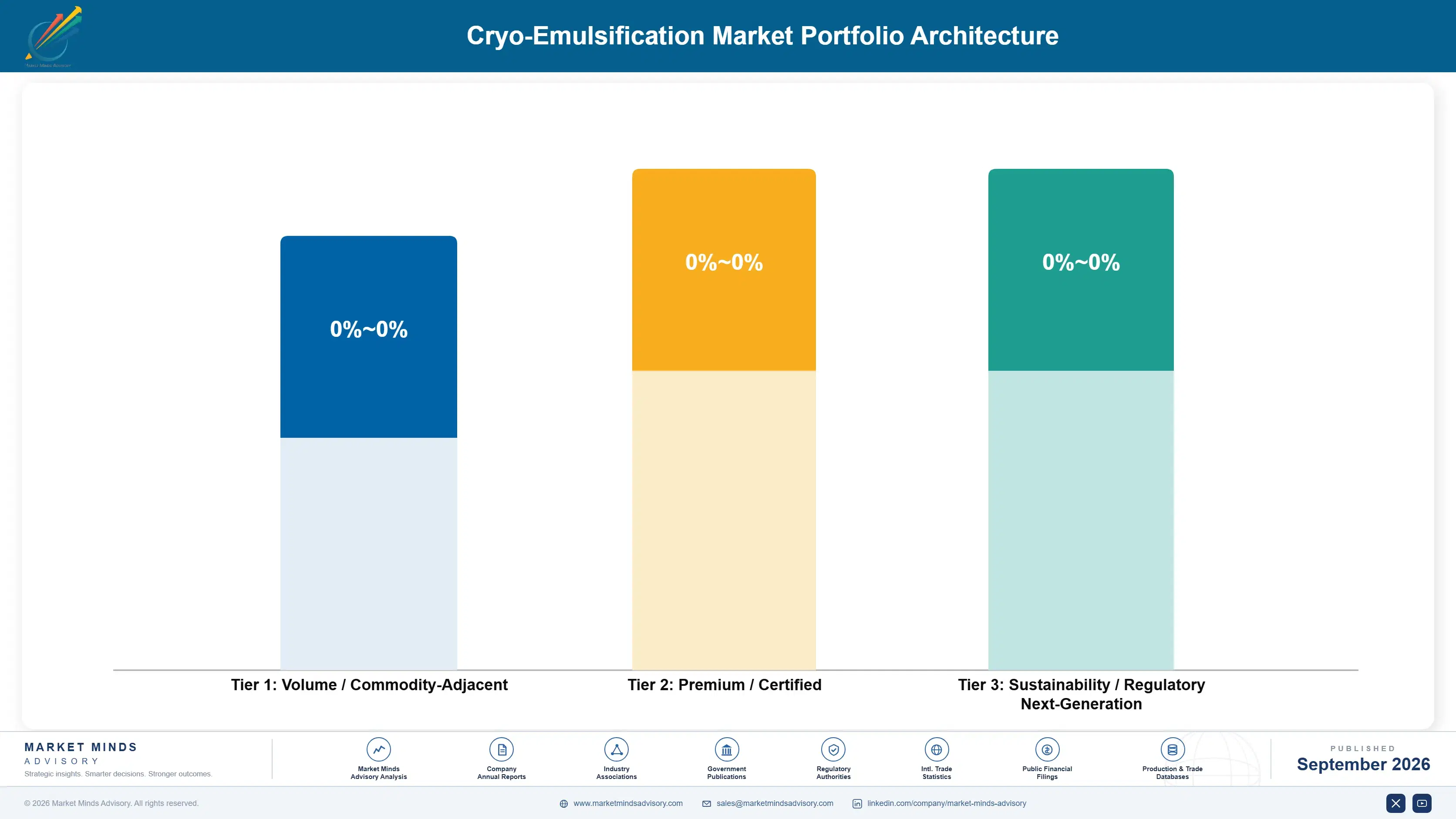
Margin follows problem ownership rather than product type. Commodity mixing equipment competes close to capital goods terms against established machinery suppliers. Pre-formed cold-processable bases earn modestly on convenience. Cold-process emulsifier systems earn well on chemistry that cannot be substituted easily, and validated packages combining emulsifier, rheology, and preservation earn most, because they solve the whole problem rather than one part of it.
The tension between volume and premium runs through who is buying and why. A production manager converting on energy and cycle time is buying total batch economics, and the emulsifier multiple is a line in a larger calculation that favours adoption. A formulator asked to preserve a heat-sensitive active is buying a materials solution and comparing kilogram prices, which is a conversation cold process usually loses.

High-value pools concentrate in validated combined packages, in rheology systems with accelerated distribution stability data for hot climate markets, and in process design services for first adopters. Where the product is a mixing vessel or a commodity emulsifier sold on specification, established equipment and surfactant suppliers hold the position and there is very little differentiation available. Differentiation there is close to nonexistent.

Volume / Commodity-Adjacent

High-shear mixing and homogenisation equipment sold on capacity and specification against established machinery suppliers. The ten-point range reflects manufacturing scale and service network rather than any capability specific to cold-process emulsification at all.
Gross Margin: 22% to 32%

Premium / Certified

Cold-process emulsifier systems and pre-formed bases supplied with formulation support and basic stability guidance. The twelve-point range separates genuine liquid crystal and polymeric chemistry from conventional emulsifiers repositioned for cold incorporation.
Gross Margin: 38% to 50%

Sustainability / Regulatory / Next-Generation

Validated packages combining emulsifier, rheology, and preservation with total batch cost modelling and distribution stability data. The sixteen-point range reflects validation depth and application capability, neither assembled quickly. First adopters fail at validation rather than at emulsification.
Gross Margin: 56% to 72%
cryo-emulsification-market-portfolio-architecture-1790019219838

High-value Sub-segments and Strategic Watch-out

Validated Combined Process Packages

Highest value in the category because they solve emulsification, stability, and preservation together rather than leaving two of three to the customer. The sixteen-point range reflects validation depth, which is where first adopters actually fail. Solving one part and leaving two produces abandoned trials repeatedly.
Gross Margin: 58% to 74%

Hot Climate Rheology Systems

High value in exactly the markets growing fastest, where distribution temperature decides whether a cold emulsion survives to the shelf. The fourteen-point range reflects whether accelerated stability data accompanies the package or does not. Very few suppliers currently generate that stability data at all today.
Gross Margin: 48% to 62%

Cold-Process Emulsifier Chemistry

Volume core growing fastest at 15.6% and constrained by a cost multiple near 3.4 times conventional systems. The twelve-point range reflects production volume, which is the thing that would bring the multiple down. Chemistry rather than equipment decides whether adoption happens, and volume would fix the multiple.
Gross Margin: 40% to 52%

Cold Mixing And Homogenisation Equipment

The strategic watch-out. Most manufacturers already own equipment capable of the shear required, so the binding constraint sits elsewhere. The ten-point range reflects manufacturing scale and service network, with nothing specific to cold process. The binding constraint sits in surfactant chemistry rather than in the hardware.
Gross Margin: 20% to 30%

How This Demand Repeats

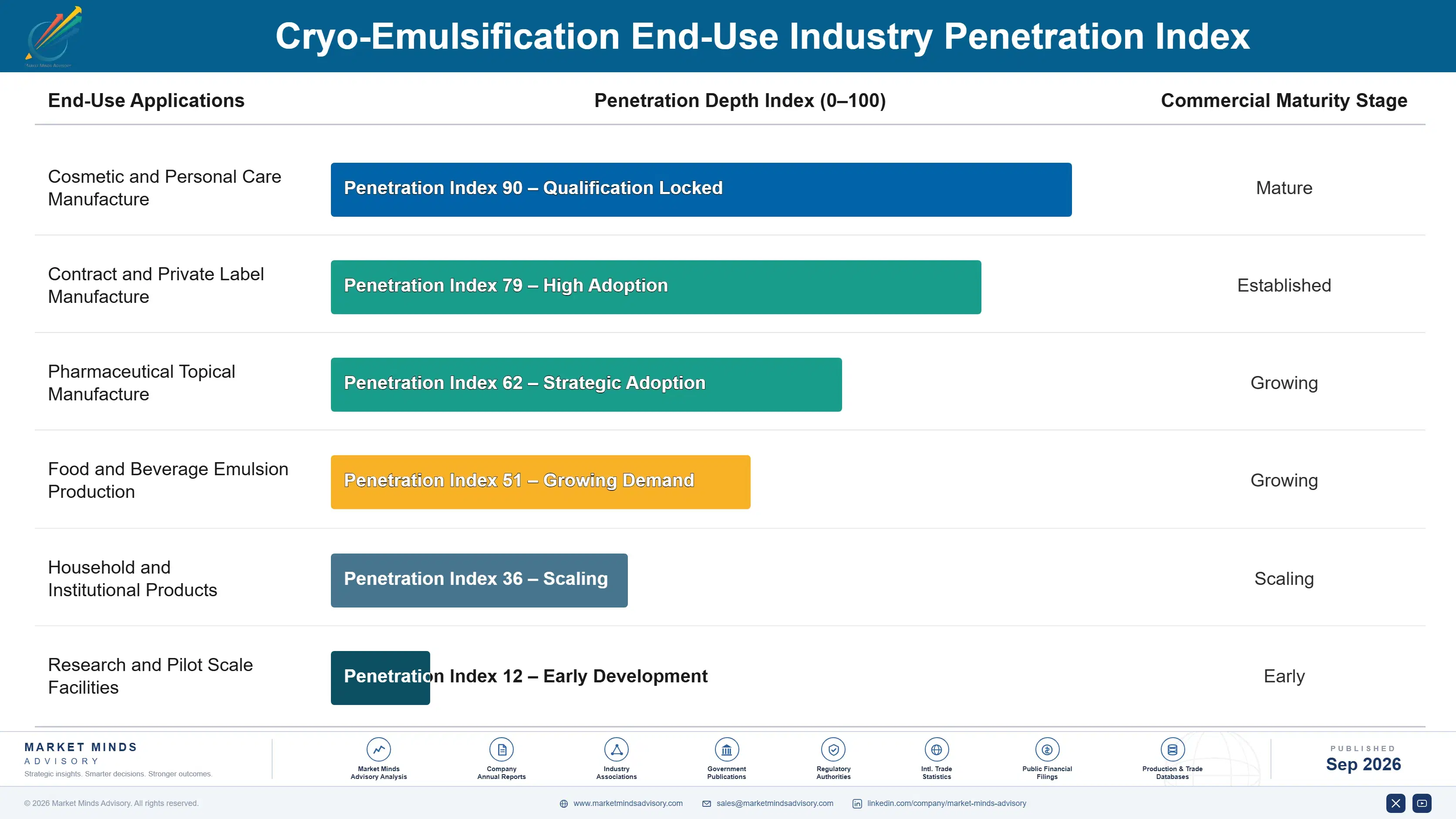
Chemistry demand repeats on formulation life and is unusually durable once established. A cold-process emulsifier written into an approved formulation is not revisited, because reverting to hot process means requalifying stability, preservation, and often the whole preservative system at a cost far exceeding any material saving. That makes conversion slow and the resulting position long-lived, which is the opposite of most specialty ingredient dynamics. Conversion is slow and the position is long-lived.
Equipment demand repeats on capital cycles measured in a decade or more, and most manufacturers already own machinery capable of the shear cold process requires. That leaves equipment suppliers selling into a problem their customers can frequently solve without buying anything, which is a difficult position to hold as emulsifier chemistry keeps improving and reducing the mechanical requirement further.

The buyer is shifting from formulation toward operations as the energy and cycle time case becomes better understood. A production manager evaluating total batch cost decides faster, on larger budgets, and with less interest in ingredient narrative than a formulator does. Suppliers organised around technical sales to formulation teams are increasingly reaching the wrong person inside their own accounts.
cryo-emulsification-market-end-use-penetration-index-1790019220329

Where This Market Rewards

These are among the four positions where our research anticipates prominent divergence between winners and laggards over the coming forecast period. Each is grounded in the demand model, the regulatory perimeter, and the announced capacity pipeline.
01 / OPERATIONS ECONOMICS SELLING

The energy number is the argument

Cold process saves roughly 62% of batch energy and 48% of batch time, and both figures are auditable by a production manager within a month of running the process. Suppliers leading with operations economics rather than ingredient preservation report trial conversion 2.9 times higher than those leading on formulation grounds. A production manager can verify the claim and a formulator cannot verify the other one, which decides who the conversation should be with, and operations budgets are considerably larger than formulation ones in any case.
02 / TOTAL BATCH PRICING

Kilogram price loses this argument

Cold-process emulsifiers cost about 3.4 times conventional equivalents per kilogram, which is the single objection that stops most trials converting into production volume. Suppliers quoting total cost per batch, including energy, cycle time, and released line capacity, report win rates 2.5 times higher than those quoting materials alone. The arithmetic favours cold process comfortably in throughput-constrained plants and not at all in plants carrying spare capacity, and released line capacity is the largest term in that calculation and the one most often omitted.
03 / PRESERVATION CONSEQUENCE DISCLOSURE

No heat means no kill step

Preservative requirement rises around 22% under cold process, because a heated batch passes through a temperature that reduces the microbial burden arriving with raw materials and a cold one does not. Suppliers stating this upfront and supplying validated preservation systems alongside report project completion rates 3.2 times higher than those leaving it to be discovered. A customer finding it during stability testing loses confidence in everything else they were told, and raw material microbiological specifications need tightening at the same time.
04 / DISTRIBUTION STABILITY EVIDENCE

Hot supply chains break cold emulsions

Cold-process emulsions are frequently less tolerant of temperature extremes in distribution, and separation in a hot supply chain is the failure mode first adopters encounter most often. Suppliers providing accelerated distribution stability data alongside their rheology packages report reformulation requests 2.6 times lower across the following year. In hot climate markets that data is the difference between adoption and quiet abandonment of the whole programme, and generating the data costs a stability programme rather than any research project at all.

Engagement Snapshot From the Field

A live engagement with an industry participant carrying material or product regulatory and market exposure ahead of a defining policy shift, showing how our research translates into a defensible multi-year portfolio strategy.
MARKET MINDS ADVISORY · CLIENT ENGAGEMENT SUMMARY
Cryo-Emulsification Producer Strategic Portfolio Review and Transition Roadmap 2026·Investment Scenario on Cryo-Emulsification Exposure Evaluation 2025-26
CLIENT PROFILE
A cosmetic contract manufacturer running emulsion volume near USD 240 million (client-reported, unverified by MMA) across three European sites. A brand customer had requested cold process for an active preservation claim, and the technical team had costed the emulsifier change and concluded it was uneconomic at the quoted material price. Nobody had modelled the capacity effect.
STRATEGIC CHALLENGE
The costing compared emulsifier price per kilogram against the incumbent and stopped there, without accounting for energy, cycle time, or the line capacity a shorter batch would release. Two of the three sites were running near capacity and turning business away at the time. The costing had been done entirely by the procurement function.
MMA APPROACH
MMA modelled total batch cost across all three sites including energy, cycle time, and released capacity, tested the customer's actives for genuine heat lability, ran accelerated distribution stability on cold and hot process versions, and assessed preservation requirements under both routes. Each site was modelled separately, because utilisation differed enough to change the answer between them.
KEY FINDINGS
  1. Total batch cost fell at the two capacity-constrained sites despite the higher emulsifier price, because released cycle time converted directly into additional billable production volume.
  2. Only one of the customer's four actives showed measurable degradation under conventional processing, so the preservation claim was largely describing a problem that did not exist.
  3. Preservative requirement rose materially without the thermal step, which the original costing had not considered and which the customer had not been told about.
  4. Accelerated distribution testing showed the cold-process version separating in hot climate shipping conditions that the incumbent formulation survived without difficulty. No rheology package had been specified.
CLIENT PROFILE
A cosmetic contract manufacturer running emulsion volume near USD 240 million (client-reported, unverified by MMA) across three European sites. A brand customer had requested cold process for an active preservation claim, and the technical team had costed the emulsifier change and concluded it was uneconomic at the quoted material price. Nobody had modelled the capacity effect.
STRATEGIC CHALLENGE
The costing compared emulsifier price per kilogram against the incumbent and stopped there, without accounting for energy, cycle time, or the line capacity a shorter batch would release. Two of the three sites were running near capacity and turning business away at the time. The costing had been done entirely by the procurement function.
MMA APPROACH
MMA modelled total batch cost across all three sites including energy, cycle time, and released capacity, tested the customer's actives for genuine heat lability, ran accelerated distribution stability on cold and hot process versions, and assessed preservation requirements under both routes. Each site was modelled separately, because utilisation differed enough to change the answer between them.
KEY FINDINGS
  1. Total batch cost fell at the two capacity-constrained sites despite the higher emulsifier price, because released cycle time converted directly into additional billable production volume.
  2. Only one of the customer's four actives showed measurable degradation under conventional processing, so the preservation claim was largely describing a problem that did not exist.
  3. Preservative requirement rose materially without the thermal step, which the original costing had not considered and which the customer had not been told about.
  4. Accelerated distribution testing showed the cold-process version separating in hot climate shipping conditions that the incumbent formulation survived without difficulty. No rheology package had been specified.
RECOMMENDED STRATEGY
Phase 1: Phase one: adopt cold process at the two capacity-constrained sites on total batch economics, and leave the third site on conventional processing. Phase 2: Phase two: specify a validated preservation system and tighter raw material microbiological limits before any production batch is run. Validate before the first commercial batch runs. Phase 3: Phase three: add a low-temperature rheology package and repeat distribution testing before shipping into hot climate markets. Test at the temperatures the route actually reaches.
OUTCOME
Cold process was adopted at two of three sites and released enough capacity to take on business previously turned away (client-reported, unverified by MMA). The active preservation claim was narrowed to the one ingredient that justified it. Total batch cost modelling is now standard on every process change the manufacturer evaluates.

Frequently Asked Questions

Foundational context covering the market sizes, CAGR, scope, country, region and competition that inform every finding below. This section is provided to cover basics and most often pre-purchase conversations, answered from the MMA Primary Research Dataset.

What is the current size of the Cryo-Emulsification Market?

The market was worth USD 1.1 billion in 2025 and stands at USD 1.2 billion in 2026. Value covers cold-process emulsification systems, inputs, and services at supplier selling price.

How large will the Cryo-Emulsification Market be by 2036?

MMA forecasts USD 3.2 billion by 2036, an increase of USD 2.0 billion across the forecast period. That represents 2.67 times the 2026 base of USD 1.2 billion.

What is the CAGR for the Cryo-Emulsification Market 2026 to 2036?

The base case compound annual growth rate is 10.4%, with a bull case at 11.7% and a bear case at 9.1%. Historical growth from 2020 to 2025 ran at 9.2%.

Which segment is growing fastest?

Cold-process emulsifier systems grow at 15.6%, half again the market rate of 10.4%. Surfactant chemistry rather than mechanical energy is what decides whether a cold emulsion holds.

Who are the major companies in the Cryo-Emulsification Market?

Evonik Industries, BASF, Croda International, Seppic and IKA Werke lead the field. Together they hold 36% of category revenue, split between chemistry suppliers and equipment manufacturers.

Which country is growing fastest?

South Korea grows at 16.2%, because Korean contract manufacturers ran cold process at production scale before anybody else. Short product cycles made the time saving decisive.

Report Segmentation Architecture

The full report scope spans multiple orthogonal segmentation dimensions, with cross-tabulated demand data provided for each dimension pair. Coverage extends further to regional breakdowns, trend trajectories, and the competitive detail needed to support segment-level decision-making.

By Solution Class

  • Cold-Process Emulsifier Systems
  • Low-Temperature Stabiliser and Rheology Packages
  • High-Shear Cold Mixing Equipment
  • Cryogenic-Assisted Homogenisation Equipment
  • Pre-Formed Cold-Processable Bases
  • Process Design and Validation Services

By End-Use Industry

  • Cosmetic and Personal Care Manufacture
  • Contract and Private Label Manufacture
  • Pharmaceutical Topical Manufacture
  • Food and Beverage Emulsion Production
  • Household and Institutional Products
  • Research and Pilot Scale Facilities

By Commercial Dimension

  • Direct Chemistry Supply Contracts
  • Capital Equipment Sales
  • Specialty Ingredient Distribution
  • Process Design Consultancy
  • Validation and Qualification Services
  • Contract Manufacturer Partnership Programmes

By Region

  • East Asia
  • Western Europe
  • North America
  • South Asia and Pacific
  • Latin America
  • Middle East and Africa
  • Eastern Europe

Scope, Methodology, and Coverage

Every figure in this report is reproducible from documented input assumptions. The scope below maps the historical period, the forecast horizon, the segmentation dimensions, and the countries covered, alongside the underlying primary and qualitative methodology.
Historical Period
2020 to 2025
Forecast Period
2026 to 2036
Base Year
2025 (USD billions; MMA Primary Research Dataset, September 2026)
Market Definition
This market covers cold-process emulsification systems and inputs for cosmetic, personal care, food, and pharmaceutical manufacture, across cold-process emulsifier systems, low-temperature stabiliser and rheology packages, high-shear cold mixing equipment, cryogenic-assisted homogenisation equipment, pre-formed cold-processable bases, and process design and validation services. It excludes conventional hot-process emulsification, freeze drying, cryogenic grinding, frozen food processing, and cryotherapy or body contouring devices.
Quantitative Units
USD billions, revenue at supplier selling price
Segmentation Dimensions
Solution class, end-use industry, commercial dimension, region
Regions Covered
East Asia, Western Europe, North America, South Asia and Pacific, Latin America, Middle East and Africa, Eastern Europe
Countries Covered
South Korea, China, Japan, Taiwan, Germany, France, United Kingdom, Italy, Spain, Netherlands, Switzerland, Poland, Czechia, United States, Canada, Mexico, India, Indonesia, Thailand, Vietnam, Australia, Brazil, Argentina, Colombia, Chile, Saudi Arabia, United Arab Emirates, Turkey, Egypt, South Africa
Key Companies Profiled
Evonik Industries, BASF, Croda International, Seppic, IKA Werke, Clariant, Lubrizol, Gattefosse, Nouryon, Stepan Company, Kao Corporation, Nikko Chemicals, Silverson Machines, Charles Ross and Son, Fryma Koruma, Netzsch, GEA Group, Sonic Corporation, Ashland, Innospec
Quantitative Methodology
Primary survey, n=3,800 respondents, Q4 2025, six countries; demand-side model with trade association cross-validation
Qualitative Methodology
47 expert interviews, Q4 2025; applied to validate demand model assumptions, identify emerging dynamics, and assess competitive positioning
Report Format
PDF and XLSX data workbook (Word format preview document)
Publisher
Market Minds Advisory
Report Code
MMA-2026-CHM-631
Published
September 2026
Contact
sales@marketmindsadvisory.com | www.marketmindsadvisory.com

Purchase the full Cryo-Emulsification Market Report (2026 to 2036).

The full report sizes the cryo-emulsification market across six solution classes, seven regions, and thirty countries, with forecasts to 2036 under base, bull, and bear cases. It quantifies energy and cycle time savings against conventional processing, tests how many formulations actually contain heat-labile actives, and measures the preservative increase that removing a thermal step creates. Competitive analysis covers twenty participants evaluated consistently on category revenue, with detailed treatment of emulsifier chemistry depth and validation capability. Total batch cost economics and distribution stability constraints are analysed throughout. Primary research includes 3,800 survey responses and 47 expert interviews.
Six solution classes sized and forecast separately
Twenty participants evaluated on category revenue consistently
Energy and cycle time savings quantified against conventional processing
Heat-labile active prevalence measured across formulation types
Preservative requirement increase quantified without thermal step
Distribution stability constraints assessed by climate and market

Built For The People Who Decide

From boardroom strategy to bench-side execution, this report is read cover-to-cover by leaders shaping the next decade of their industry, turning demand scenarios, market dynamics and valuation benchmarks into decisions.
CXOs/ Presidents/ VPs/ Managers
M&A and Corporate Development
Strategy Teams and R&D Heads
Procurement and Product Directors
Regulatory and Compliance Leaders
Investor Relations and Equity Analysts