Market Minds Advisory
Cruelty-Free Cosmetics Market

Cruelty-Free Cosmetics Market: Cruelty-Free Cosmetics Market. Third-Party Certification Becomes the Price of Entry for Retail Shelf Space

Retailers increasingly demand documented third-party cruelty-free certification before granting shelf space, leaving brands with only self-declared ethical claims struggling to secure placement across major national beauty retail channels this decade.

Lead Analyst

Published

September 2026

Make Smarter Decisions with Customized Research Insights

Request a free sample report and evaluate market opportunities, growth trends, and competitive dynamics relevant to your business needs.

2025 MARKET VALUE$9.6BMarket Size 2025
2036 FORECAST VALUE$22.2BBase Case , 2026 to 2036
CAGR 2026 TO 20367.9 %Bull 9.2% / Bear 6.6%
INCREMENTAL OPPORTUNITY$11.8BNet 10- year value creation
EXPANSION MULTIPLE2.14x2036 value over 2026 base
Strategic Levers
M&A Pipeline
Regional Outlook
Country Rankings
Competitive Intelligence
Segmental Deep-dive
Call-Us : 91 93563 13602

Executive Snapshot and Market Trajectory.

Retailers increasingly demand third-party cruelty-free certification before granting shelf space, leaving brands with only self-declared ethical claims struggling to secure placement in major beauty retail channels across most developed markets, a shift that is reshaping which brands can still win long-term retail partnerships with national chains.
Skincare remains the largest certified category by revenue, but men's grooming products and color cosmetics are growing far faster as certification spreads into categories that historically lagged behind facial skincare adoption. North America commands the deepest consumer demand anywhere in the category, concentrated around a dense cluster of indie brands built entirely around Leaping Bunny and PETA certification from launch. Legacy brands retrofit more slowly, ceding ground to challengers built for this from day one.
Competition concentrates among a fragmented mix of indie brands built around certification from launch and legacy brands retrofitting existing product lines to meet certification standards. Certification credibility, supply chain traceability, and retailer partnership depth are together reshaping which brands can convert consumer ethical intent into durable shelf presence across the coming decade of tightening retail certification requirements. Brands without a pipeline risk losing placement. That gap keeps widening.
Market Definition
The cruelty-free cosmetics market covers skincare, color cosmetics, haircare, fragrance, personal care and bath and body products, and men's grooming products formulated and manufactured without animal testing at any stage of development. It excludes products carrying only unverified marketing claims without recognized third-party certification.
Base Year Value
$9.6B in 2025 (MMA Primary Research Dataset, August 2026)
Forecast Period
2026 to 2036, eleven discrete annual values
CAGR
7.9% base case. Bull 9.2%. Bear 6.6%.
Fastest Growth Segment
Men's Grooming Products: 13.0% CAGR
Fastest Growth Country
India: 11.5% CAGR
Fastest Growth Region
South Asia and Pacific: 9.9% CAGR
Largest Region
North America: 30% of 2025 global value
Market Leaders
e.l.f. Beauty Inc., The Body Shop International Limited, Too Faced Cosmetics, Tarte Cosmetics Inc., Pacifica Beauty LLC. Source: MMA Analysis based on company annual reports.
Primary Survey
n=3,800 procurement and R&D decision-makers, Q4 2025, six countries
Methodology
Demand-side build-up, cross-validated against public data, 47 expert interviews

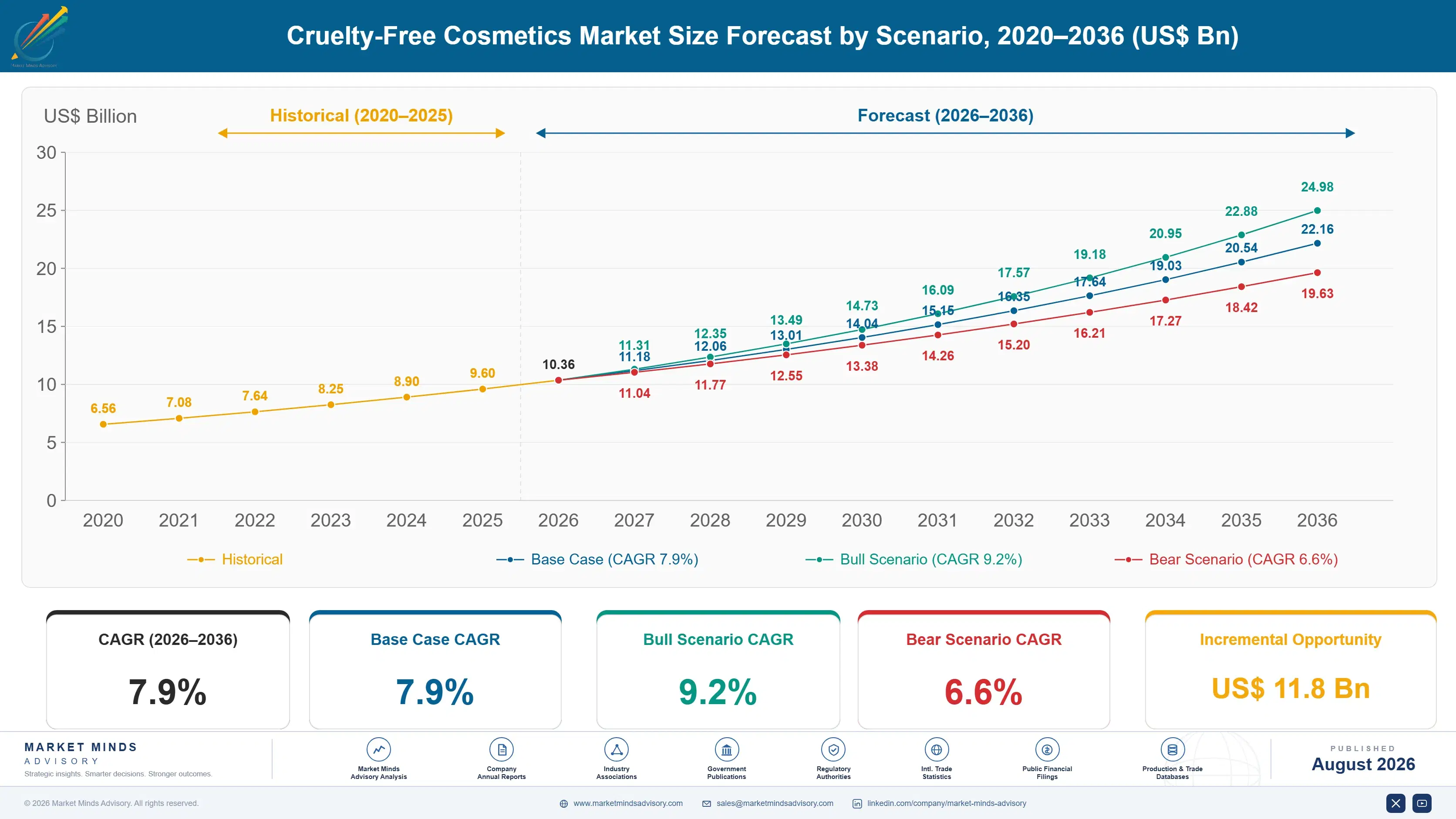
Cruelty-Free Cosmetics Market Forecast Scenarios

cruelty-free-cosmetics-market-size-forecast-scenario-1788165519212
Between 2020 and 2025 the category grew near a 6.9% annual pace as consumer ethical awareness steadily widened beyond skincare into adjacent categories, before retailer certification mandates accelerated adoption sharply from 2023 onward as major beauty retailers began requiring documented certification before granting new brand placement across multiple national retail chains simultaneously. today. nationwide already.
The base case carries the market to a 7.9% CAGR on three commercial mechanisms: men's grooming products scaling as certification spreads into a historically underserved category, color cosmetics growing as indie vegan makeup brands capture younger consumer spending, and skincare demand holding steady as established certified brands continue expanding into adjacent formulation lines. That combination is expected to persist through most of the forecast window barring a major shift in retailer certification policy.
The bull case at 9.2% assumes retailer certification mandates spread faster than currently modelled across multiple major beauty retail channels simultaneously. The bear case at 6.6% assumes certification costs deter smaller brands longer than expected, holding category growth closer to existing certified brand volume. Both scenarios assume no major disruption to existing certification standards governing recognized cruelty-free credentials across major markets.

Retailer Certification Mandates Reshape Category Access

Three forces converge on this category at once. Major retailers need documented certification before granting shelf space they can defend to increasingly ethical-minded consumers, indie brands need affordable certification pathways that do not consume their entire early-stage marketing budget, and legacy brands need supply chain traceability systems that many were never built to support.
TOP PRODUCER SHAREUSA, 27%Share of global output manufactured in United States facilities today
AVERAGE PRODUCT PRICEUSD 18 per unitBlended average retail price across certified product categories
CERTIFICATION COST SHARE9% of COGSThird-party certification share of total product formulation cost
SKINCARE SEGMENT SHARE38% of volumeTotal unit volume sold into certified skincare applications
CERTIFICATION RENEWAL CYCLE12 to 18 monthsTypical time required to renew a brand's certification status
MARKET CONCENTRATIONCR5: 32%Combined share held by the five largest certified beauty brands
Commercially, the category rewards brands who can pair genuine formulation ethics with documented supply chain traceability rather than relying on marketing claims alone. Brands that can guarantee both certification credibility and retailer partnership depth command shelf placement that unverified competitors cannot access, which is why major beauty retailers increasingly default to a narrow pool of certified brands rather than stocking whichever product claims the lowest price point. That preference has hardened as several high-profile greenwashing controversies drew sustained consumer backlash across the industry.
Over the next decade, certification credibility, supply chain traceability, and retailer partnership depth will decide which brands convert consumer ethical intent into durable shelf presence. Brands without recognized third-party certification risk losing retail placement entirely as certification requirements continue tightening across major beauty retail channels. Brands must act now to build both capabilities before competitors close the gap entirely.
"Cruelty-free used to be a sticker on the box. Now retailers want the paperwork behind it, and brands that cannot produce it are getting quietly delisted."
Director, Ethical Beauty and Personal Care Practice · MMA Ethically Certified Beauty and Personal Care Practice · August 2026

Market Trends

Retailers Mandate Third-Party Certification Before Brand Placement

Major beauty retailers increasingly require documented Leaping Bunny or PETA certification before granting new brand placement, following several high-profile controversies involving unsubstantiated cruelty-free marketing claims. Sephora and Ulta Beauty have both expanded certification verification requirements specifically to address this demand, since retailer legal exposure now extends to carrying brands whose ethical claims cannot withstand scrutiny. This shift is pulling brand sourcing toward suppliers who can guarantee both formulation ethics and defensible certification documentation simultaneously across every product line. Retailers now treat this documentation as a baseline requirement on every new brand evaluation.
Market Impact: Adds 12% to certified brand spending
Men's Grooming Category Adopts Certification at Rising Pace

Men's grooming brands are adopting cruelty-free certification at a rising pace as male consumer ethical awareness catches up with categories that historically led certification adoption. Multiple established grooming brands have launched certified product lines specifically to capture this demand, since certification increasingly differentiates premium grooming positioning from commodity mass-market alternatives. This shift is pulling formulation investment toward men's grooming categories that previously lagged well behind skincare and color cosmetics in certification adoption rates. Established grooming manufacturers now treat certification as a baseline requirement rather than an optional consideration. That shift extends well beyond razors into fragrance and skincare-adjacent grooming lines.
Market Impact: Adds 11% to Indian category volume

Market Opportunities and Growth Drivers

Younger Consumers Demand Verified Ethical Sourcing Claims

Younger consumers increasingly demand verified ethical sourcing claims before purchasing beauty products, driven by heightened social media scrutiny of brand sustainability and animal welfare practices. Multiple indie brands have built entire marketing strategies around certification transparency, giving brands with documented credentials a direct competitive advantage in capturing younger consumer spending. That consumer-driven demand has proven durable across multiple product cycles rather than a passing trend tied to any single viral marketing campaign. Brands without this documented transparency increasingly struggle to win younger consumer trust at all. Retailers increasingly favour brands that document this transparency clearly across their entire product catalog.
Market Impact: Certification can consume 9% of budget

India's Expanding Vegan Beauty Consumer Base Sustains Growth

India's rapidly expanding vegan and ethically conscious consumer base, driven by rising urban disposable income and social media beauty influencer culture, sustains substantial category growth as domestic and international certified brands compete for market share. Domestic brands have launched certified product lines specifically to serve this demand, since Indian consumers increasingly research certification credentials before purchase decisions. That consumer-driven growth has proven durable across multiple product cycles rather than a temporary surge tied to any single brand launch. International brands without a local certified presence increasingly struggle to win Indian retail placement at all.
Market Impact: Certification delays can span 18 months

Market Restraints and Challenges

Certification Costs Burden Smaller Independent Brand Budgets

Third-party certification costs consume a disproportionate share of smaller independent brands' marketing budgets relative to larger established competitors, since certification fees and supply chain audit costs do not scale down proportionally with brand revenue. The root cause is a fixed-cost certification structure rather than any certifying body's pricing strategy targeting smaller brands specifically, meaning the constraint affects the entire indie brand segment simultaneously. Brands are mitigating this through shared certification cooperatives and staged certification across product lines rather than certifying an entire portfolio at once. Brands with cooperative membership are recovering faster than those pursuing solo certification alone.
Market Impact: Certified placement demand grows 16% yearly

Supply Chain Complexity Delays Certification for Legacy Brands

Legacy brands with complex, multi-tier global supply chains face certification cycles spanning twelve to eighteen months as they trace every ingredient and testing decision back through supplier networks that were never built with certification documentation in mind. The root cause is genuine supply chain opacity rather than any brand-side delay tactic, since ingredient sourcing documentation often does not exist retroactively for older formulations. Brands are mitigating this by pursuing phased certification and by reformulating problematic ingredients rather than tracing their origin indefinitely. That phased approach lets legacy brands deploy partial certification years before full traceability completes.
Market Impact: Men's grooming certification grows 19% yearly
3 additional market trends, 4 additional growth drivers, and 3 additional restraints and challenges are covered in the full report. Contact sales@marketmindsadvisory.com to access the complete intelligence.

Segment CAGR and Growth Architecture

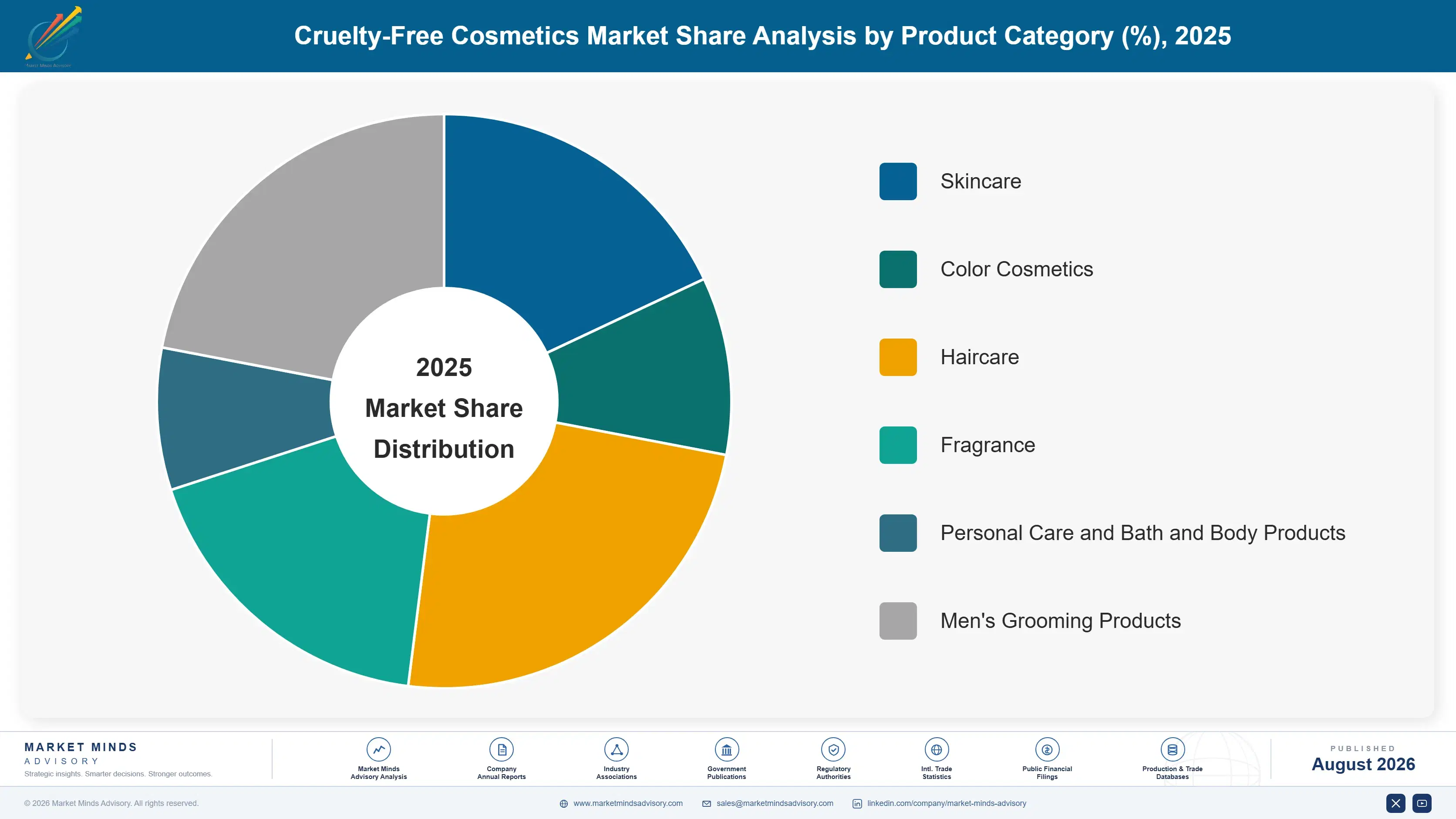
Segmentation follows product category, a single classification logic, since skincare, color cosmetics, haircare, fragrance, personal care, and men's grooming products each require distinct formulation science and certification pathways rather than differing by price tier or distribution channel across the value chain. That single dimension keeps comparisons across categories consistent and auditable for every regional buyer.
cruelty-free-cosmetics-market-market-share-analysis-1788165519767

Men's Grooming Products

Men's grooming products grow fastest at 13.0%, about 1.65 times the overall 7.9% rate, as male consumer ethical awareness catches up with categories that historically led certification adoption from a much smaller existing base. This segment demands formulation reformulation that many established grooming brands are only beginning to invest in after years of certification lag behind skincare and color cosmetics. e.l.f. Beauty and Pacifica lead qualified certified grooming supply, competing on documented certification credentials and formulation performance rather than price alone. Growth concentrates around premium shaving, skincare-adjacent grooming, and fragrance products, where certification increasingly differentiates positioning from mass-market alternatives. Investors and retail partners increasingly track certification milestones as a leading indicator of near-term category readiness.
CAGR 13.0%

Color Cosmetics

Color cosmetics grow at 9.5%, the second-fastest segment, as indie vegan makeup brands capture younger consumer spending away from legacy mass-market cosmetics lines. Tarte and Too Faced lead qualified certified color cosmetics supply, competing on documented formulation ethics and shade range performance rather than raw volume alone. Unlike skincare, this segment sells substantially through direct-to-consumer and social commerce channels rather than traditional retail shelf placement alone, so influencer partnership depth and certification credibility matter as much as formulation quality itself to a purchase decision. Retail buyers increasingly treat influencer partnership depth as a prerequisite before evaluating any new brand relationship for a flagship line. That heightened scrutiny lengthens vetting timelines but rewards brands with existing social commerce relationships already established.
CAGR 9.5%
Full segment breakdown across 6 segments available in the complete report.

Regional Architecture and Country Demand Map

North America leads on indie certified brand density and consumer demand depth, while South Asia and Pacific posts the fastest growth as vegan beauty adoption accelerates across expanding urban consumer bases. North America holds 30% of global value, well ahead of the smallest region's modest contribution to worldwide demand.

North America

United States consumers' vocal ethical purchasing preferences, reinforced by California's statewide ban on cosmetic animal testing, give North America 30% of global value, the largest regional share in the category by a clear margin over every other region. e.l.f. Beauty and Pacifica's domestic manufacturing operations supply both mass-market and premium indie brand customers from established production facilities. United States retailers increasingly require documented certification before granting new brand placement nationwide. Growth of 7.2% tracks certification mandate demand more directly than any broader volume trend on its own, reflecting the region's dense concentration of indie certified beauty brands. Continued indie brand formation across major metro markets keeps that lead intact even as prestige competitors expand.
Share: 30% | CAGR: 7.2% (2026 to 2036)

Western Europe

The European Union's regulatory ban on cosmetic animal testing, in place since 2013, gives Western Europe 24% of global value as an effectively certification-friendly baseline across the entire regional market. The Body Shop, headquartered within the region, holds deep formulation heritage built around cruelty-free positioning since its founding decades ago. French and German retailers increasingly specify documented third-party certification even beyond the regulatory minimum already required. Growth of 6.4%, the slowest major region, reflects an already mature certified beauty market rather than any underlying demand weakness. That regulatory baseline is expected to keep the region a reliable certified export source for years to come. Regulatory scrutiny across the bloc keeps that pricing power intact for well-documented brands.
Share: 24% | CAGR: 6.4% (2026 to 2036)
Regional intelligence for 5 additional markets available in the complete report: East Asia, South Asia and Pacific, Latin America, Middle East and Africa, Eastern Europe. Contact sales@marketmindsadvisory.com.
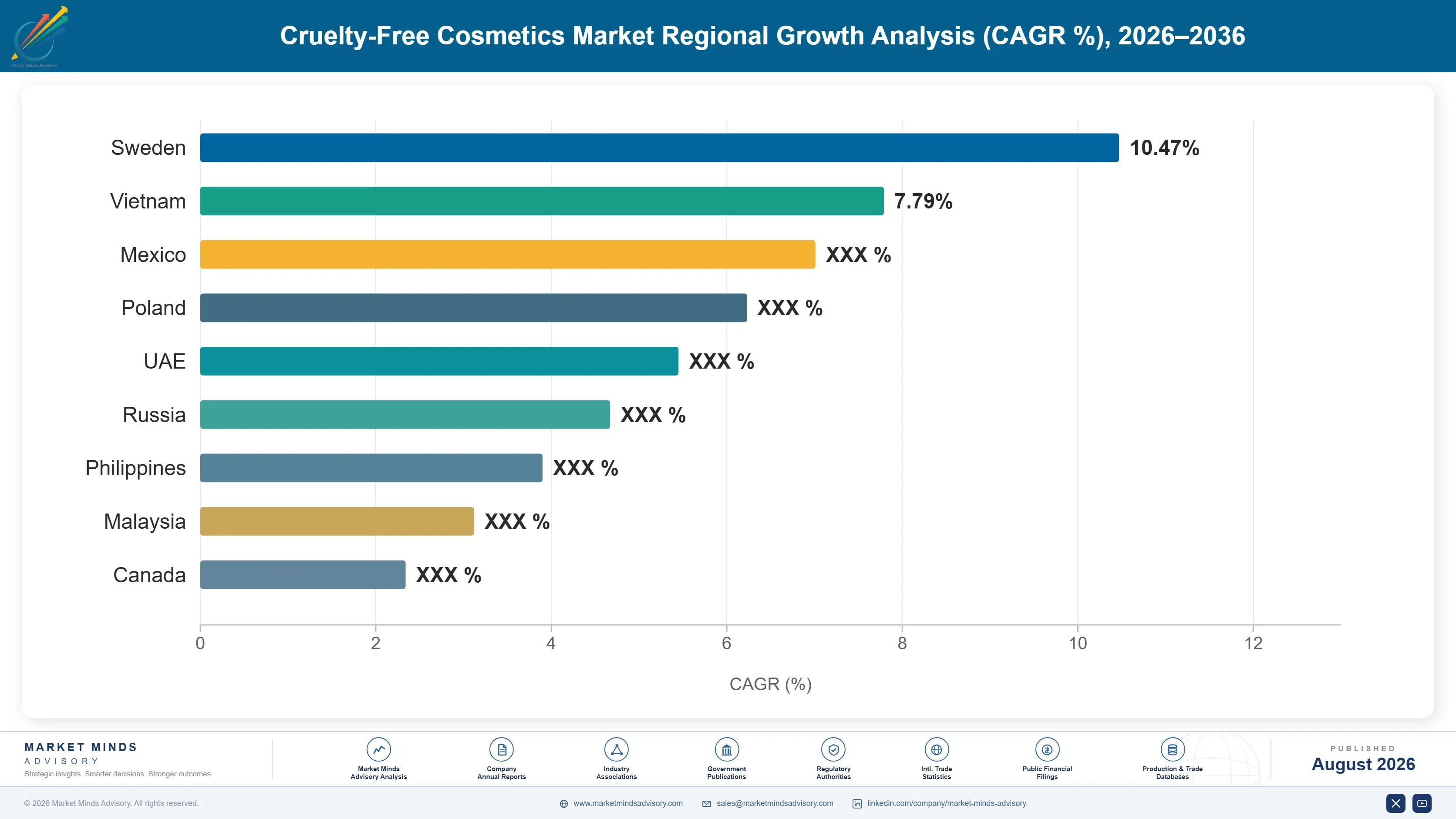
cruelty-free-cosmetics-market-country-cagr-analysis-1788165520285

Where Certification Depth Creates Retail Margin

Margin in this category increasingly sits in certification credibility and supply chain traceability rather than in raw formulation cost alone. Brands converting that capability into premium certified and retailer-preferred contracts are pulling well ahead of competitors still selling unverified ethical claims into a skeptical consumer market. That gap increasingly decides which brands earn premium contracts.

Secure Recognized Certification Well Before Mandates

Brands that secure documented Leaping Bunny or PETA certification ahead of confirmed retailer mandates can access shelf placement that unverified competitors cannot obtain regardless of the price they offer. Pacifica's early certification strategy illustrates how credential investment made years before mandates tightened converts directly into preferred-vendor status once major retailers need guaranteed documentation across an entire product category. That investment typically takes 10 to 16 months but opens the broadest possible retail customer base available industry-wide. Competitors lacking this credential are increasingly locked out of first-round retail evaluation regardless of price offered.
Market Impact: Early certification opens roughly 45% of retail slots

Build Supply Chain Traceability Documentation Systems

Brands that build documented supply chain traceability systems ahead of confirmed audit demand capture retailer trust that competitors relying on manual documentation cannot match once retailers require guaranteed ingredient-level verification across every product line. e.l.f. Beauty's traceability investment shows how systems built before audit requirements tightened convert directly into preferred-vendor status once retailers need proven sourcing documentation. That investment typically takes 12 to 20 months but lifts blended retail margin by roughly 14% once fully achieved. Competitors lacking traceability increasingly lose renewal bids entirely once retailers require documented sourcing assurance.
Market Impact: Traceability systems lift blended margin nearly 14% overall

Diversify Certification Bodies Across Regions Early

Brands that diversify certification across multiple recognized bodies capture broader retail acceptance that single-certification competitors cannot match when any one certifying body's standard falls out of favor with a particular retail channel. That diversification typically adds 5% to 9% to certification cost but secures the retail placement flexibility that expanding into new geographic markets increasingly requires as a standing condition of entry. Brands without diversified certification increasingly lose large retail contracts entirely once buyers require documented flexibility. Retailers increasingly require documented evidence of this flexibility before awarding any large, multi-year certified supply contract of meaningful scale.
Market Impact: Diversified certification adds roughly 5% to 9% cost

Pursue Shared Certification Cooperative Membership Early

Smaller brands that pursue shared certification cooperative membership capture faster and more affordable certification timelines that competitors relying on solo certification cannot match once cash-strapped brands need documented credentials quickly. This approach typically adds 4% to 8% to certification cost relative to full independent certification, but lets smaller brands reach retail shelves years faster than competitors constrained by limited standalone certification budgets. Competitors without a cooperative pathway increasingly lose first-mover advantage entirely once faster-certified rivals reach retail commitments ahead of them. That gap widens each cycle as more indie brands adopt the faster cooperative certification pathway across their portfolios.
Market Impact: Cooperative membership adds roughly 4% to 8% cost

Who Controls the Margin Pool

Concentration sits at a moderate CR5 of 32%, reflecting a category where certification credibility and consumer trust, not raw manufacturing scale alone, separate a small group of established certified brands from a long tail of smaller indie competitors. e.l.f. Beauty leads on documented certification breadth and retail partnership depth, and the gap to mid-tier challengers is measured in certification investment rather than in manufacturing capacity alone.
All participants are assessed on unit shipment volume across certified retail and direct-to-consumer channels, a consistent basis given how widely certification depth varies by brand across the category. Current competitive activity concentrates on three fronts: third-party certification credential expansion, supply chain traceability system development, and certification cooperative participation. That pattern spans every major brand competing in the category. Multiple brands have publicly disclosed investment commitments tied to each of these three fronts over the coming years.

Emerging pressure comes from indie direct-to-consumer brands scaling certified formulation faster than legacy competitors expected, backed by social media marketing reach and lower overhead cost structures. Rankings are likely to shift toward brands combining certification credibility with retailer partnership depth, since neither formulation heritage nor manufacturing scale alone decides shelf placement decisions anymore in this category.
cruelty-free-cosmetics-market-company-positioning-matrix-1788165520812

Competitive Moat and Risk Dimensions

E.L.F. BEAUTY INC.

Moat: Deepest retail partnership breadth

e.l.f. Beauty's established retail partnership network and documented certification history give it shelf placement access that newer entrants cannot replicate without years of retailer trust-building. That scale lets it serve multiple mass-market and premium retail channels simultaneously with proven certification documentation across a broad product range. That trust extends across both value and premium retail formats simultaneously.
E.L.F. BEAUTY INC.

Risk: Mass-Market Price Pressure Risk

e.l.f. Beauty's mass-market pricing strategy leaves it exposed to margin compression from private-label retailer brands entering the certified category in a way that premium indie competitors positioned above the price-sensitive segment are not. Diversifying into premium indie sub-brands would help offset this exposure over time.
THE BODY SHOP INTERNATIONAL LIMITED

Moat: Strong founding brand heritage

The Body Shop's decades-long founding heritage built entirely around cruelty-free positioning gives it consumer trust that newer entrants must build from scratch through sustained marketing investment. That heritage also feeds long-standing supplier relationships back into formulation development ahead of competitors lacking comparable brand history. That heritage remains one of the strongest brand assets in the entire category.
THE BODY SHOP INTERNATIONAL LIMITED

Risk: Ownership Transition Uncertainty Risk

The Body Shop's recent ownership changes have introduced uncertainty around long-term brand investment and store footprint decisions in a way that more stably owned competitors are not currently navigating, particularly regarding retail expansion commitments. That uncertainty could slow reinvestment in store expansion relative to more stably financed competitors.

Players Tracked

Prominent Players

e.l.f. Beauty Inc.
The Body Shop International Limited
Too Faced Cosmetics
Tarte Cosmetics Inc.
Pacifica Beauty LLC

Other Key Players

Milk Makeup
ILIA Beauty
Kjaer Weis
RMS Beauty
Beautycounter
Fenty Beauty
Anastasia Beverly Hills
Urban Decay
Lush Cosmetics Limited
Physicians Formula
Wet n Wild
NYX Professional Makeup
Bite Beauty
KVD Beauty
Hourglass Cosmetics

Recent Developments

MARCH 2025

e.l.f. Beauty Expands Supply Chain Traceability Platform

e.l.f. Beauty completed an organic expansion of its supply chain traceability platform to meet growing retailer audit demand across multiple certified product lines. The expansion was an organic capacity build, not an acquisition or joint venture, adding dedicated documentation infrastructure ahead of anticipated demand. Full deployment completes by mid-2026.
Signal: An organic expansion, not a transaction, shows brands investing well ahead of confirmed retailer demand growth.
JULY 2025

Tarte Signs Certification Cooperative Supply Agreement

Tarte signed a multi-year certification cooperative supply agreement with a shared industry consortium to provide documented credentials across an expanded product line. The arrangement was a supply agreement, not an acquisition or joint venture, securing guaranteed certification capacity directly ahead of the brand's expansion schedule.
Signal: A supply agreement, not a merger, shows certification demand now drives multi-year sourcing decisions ahead of schedule.
NOVEMBER 2025

Pacifica Acquires Minority Stake in Sustainable Packaging Startup

Pacifica acquired a minority equity stake in a sustainable packaging startup developing biodegradable cosmetic containers for certified beauty brands. The transaction was an equity investment rather than a full acquisition or merger, giving Pacifica early technology access without full development risk. The stake gives Pacifica early insight into packaging roadmaps.
Signal: A minority stake, not a full acquisition, shows brands hedging sustainable packaging technology bets rather carefully.

Certification and Ethical Sourcing Exposure

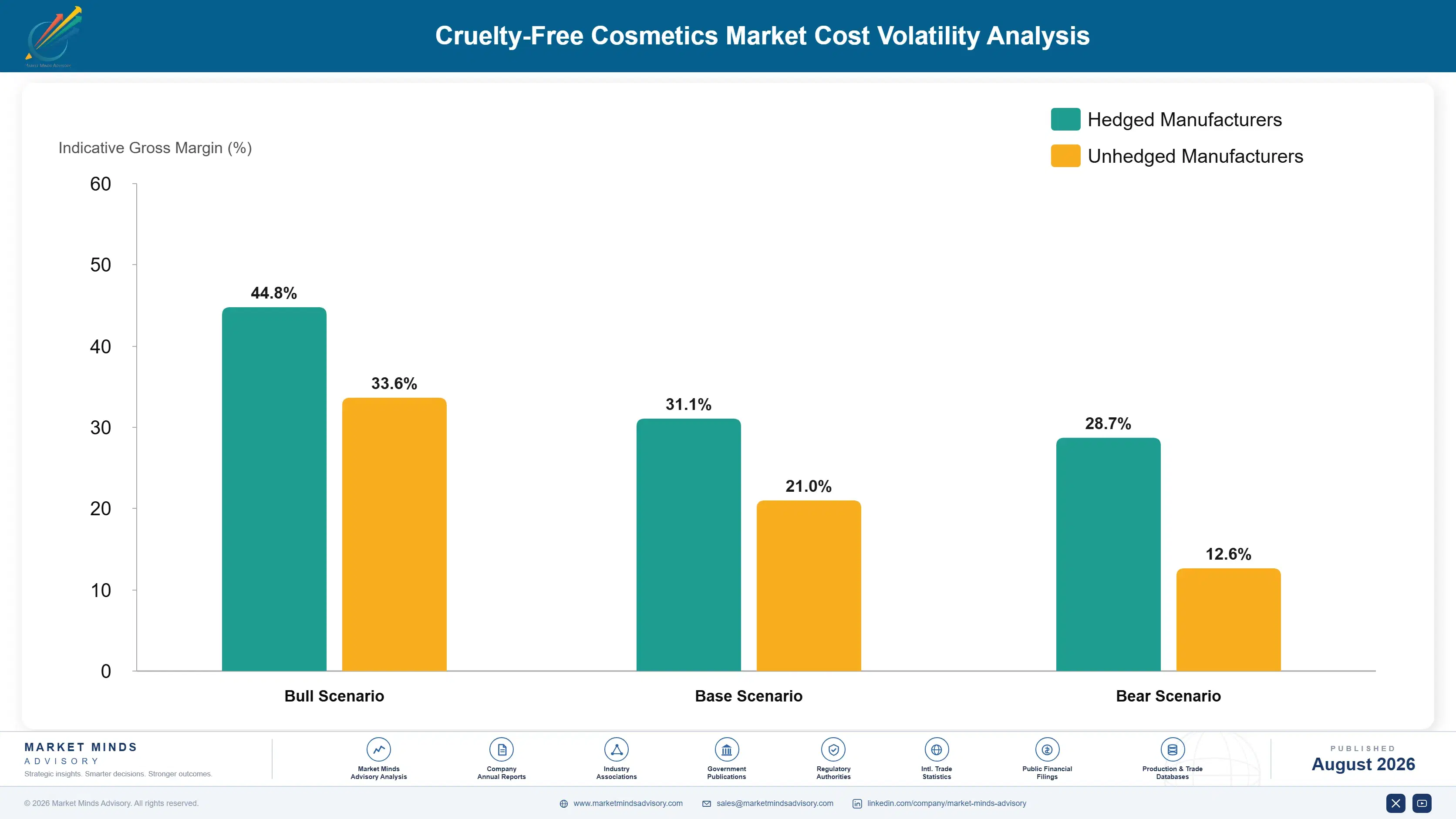
Third-party certification fees and ethical ingredient sourcing account for roughly 9% of unit cost, sourced from established certifying bodies and specialty ingredient suppliers across the United States, France, and the United Kingdom, with supply chain audit and traceability documentation adding a further 4% to 7% depending on product category and certification depth required for the specific formulation involved.
Certification and audit costs climbed noticeably through 2022 and 2023 as retailer verification requirements tightened following several high-profile greenwashing controversies across the beauty industry. The European Commission has documented increased cosmetic supply chain scrutiny as a persistent industry compliance concern given the limited number of internationally recognized certifying bodies, and brands without established certification relationships absorbed the cost increase directly into margin during the worst months of that period.

Exposure varies considerably by brand scale and certification relationship depth across the industry. Larger established brands like e.l.f. Beauty hedge certification exposure through long-term certifying body relationships, while smaller indie brands pursuing certification for the first time absorb full audit and documentation costs immediately with no negotiated discount available. That gap leaves smaller brands at a cost disadvantage when certification requirements tighten.
cruelty-free-cosmetics-market-cost-volatility-analysis-1788165521010

Secure long-term certifying body relationships early

Locking in long-term certifying body relationships protects renewal timelines from unexpected fee increases during periods of tightening retailer verification demand across the industry. This trades some negotiating flexibility for renewal certainty that major retail contracts increasingly require as a standing condition of doing business at all. Brands without such relationships risk fee spikes whenever verification standards tighten unexpectedly.

Invest in in-house supply chain traceability systems

Brands shipping sufficient volume can justify investing in in-house supply chain traceability systems, capturing efficiency currently paid to third-party audit firms while gaining direct control over documentation timing over the medium to long term horizon that large retail contracts typically demand from any qualified certified brand. That investment typically pays back within three to five years for larger brands.

Diversify certification across producing regions

Qualifying certification relationships across multiple recognized bodies simultaneously reduces exposure to any single certifying body's fee increase or standard change event. Brands with diversified certification recovered from the 2022 to 2023 scrutiny increase measurably faster than single-certification brands did, protecting margin through the worst of that period. Diversification also shortens vetting time when a certifying body changes standards.

Portfolio Architecture for Margin Defence

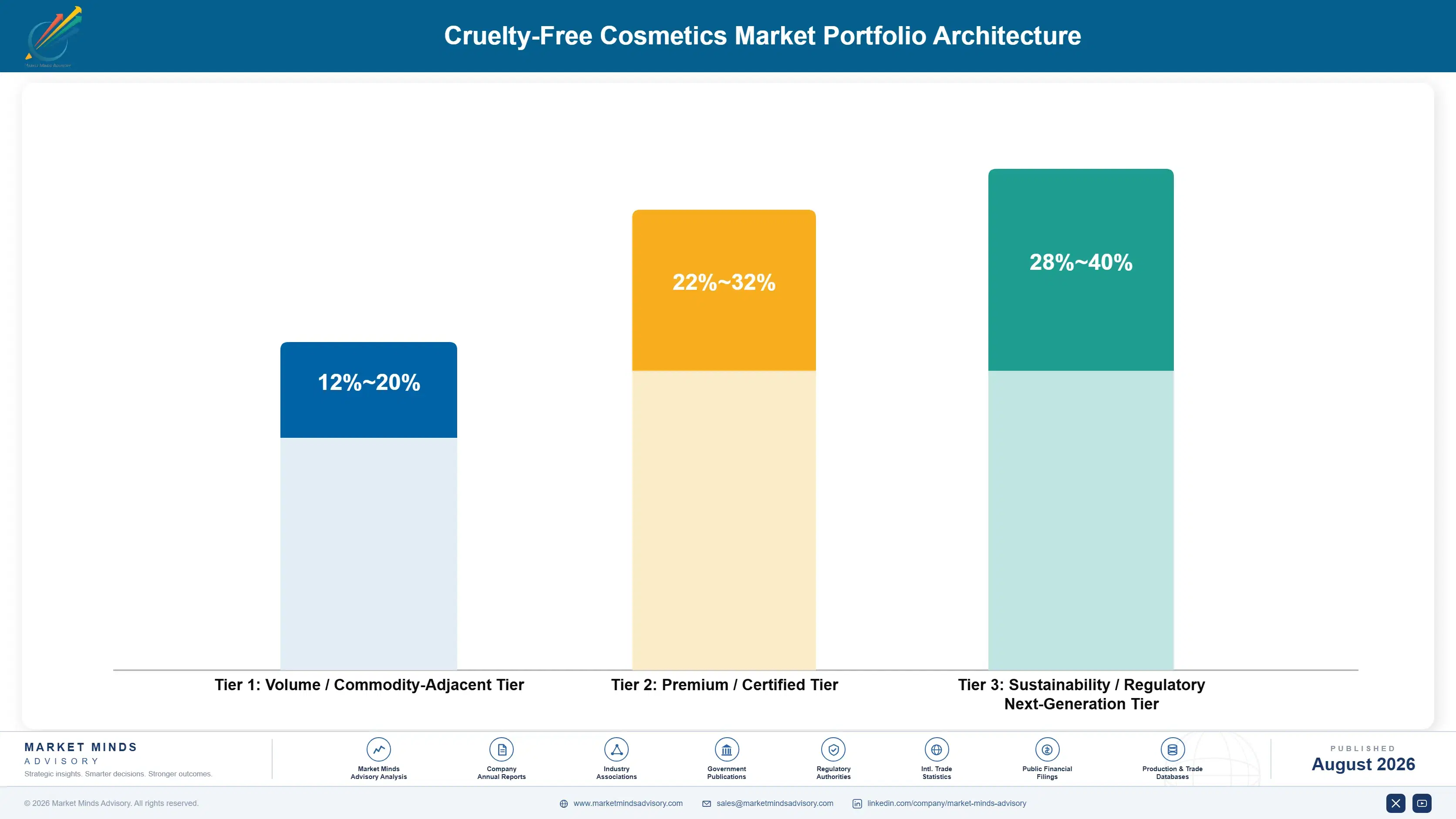
The portfolio splits into three tiers with clear margin separation tied to certification depth and product category served. Commodity-grade mass-market certified products compete on price and earn thin margins, certified premium skincare and color cosmetics earn considerably more, and next-generation sustainably packaged and fully traceable formulations carry the highest margin given their certification barriers and documentation depth protecting that position from new entrants.
The tension between volume and premium reflects category directly: premium retailers investing in certified positioning reward documented traceability and credential depth over price, pulling brands toward sustained certification investment year after year, while much of the commodity mass-market segment still buys on price and shelf availability alone with distribution scale mattering more than certification depth. Brands running multiple product lines must manage genuinely distinct formulation, certification, and retail relations organisations without letting either investment starve the other of resources.

High-value margin pools concentrate in fully traceable and sustainably packaged contracts, where documented credential depth and packaging innovation both reward proven brand capability directly and consistently. The volume core of commodity certified product sale remains necessary for distribution scale but contributes comparatively little to blended margin across the portfolio as a whole.

Volume / Commodity-Adjacent Tier

Commodity-grade mass-market certified products sold into basic drugstore and value retail applications, competing primarily on price with limited certification investment beyond baseline compliance. Order volume typically substitutes for certification differentiation in most purchase decisions here.
Gross Margin: 12-20%

Premium / Certified Tier

Certified premium skincare and color cosmetics sold under documented credential performance into mainstream prestige retail contracts across multiple brand tiers worldwide. Retail reliability matters as much as price to most placement decisions.
Gross Margin: 22-32%

Sustainability / Regulatory / Next-Generation Tier

Fully traceable and sustainably packaged formulations engineered specifically for the most demanding certification and documentation requirements available in the category today. Brands here typically hold exclusive multi-year formulation relationships with premium retail partners.
Gross Margin: 28-40%
cruelty-free-cosmetics-market-portfolio-architecture-1788165521507

High-value Sub-segments and Strategic Watch-out

Men's Grooming Products

High value and the fastest-growing category at 13.0% CAGR, carrying both an emerging-category premium and genuine certification barriers to entry that protect early movers from new entrants over the coming decade. Brands already certified here hold a durable multi-year advantage over prospective new entrants. Managers rarely switch suppliers once qualified.
Gross Margin: 22-32%

Color Cosmetics

High value with strong growth, sustained by indie brands specifying documented formulation ethics across multiple direct-to-consumer channels. Margin varies with the certification depth a brand holds with its retail partners. That relationship depth compounds across successive product launches over a brand's full commercial life. Certified brands earn repeat business.
Gross Margin: 22-32%

Skincare

The volume core, competing on price and shelf availability across most mainstream retail applications worldwide. Margin stays thin because distribution scale, not certification depth, dominates most decisions in this segment. Brands here compete mainly on distribution reach and unit cost rather than certification depth. Scale advantages compound over time.
Gross Margin: 12-20%

Fragrance

The strategic watch-out, where buyer willingness to pay a certification premium remains largely unproven across niche scent applications today. Margin range is wide because pricing power varies sharply by individual brand relationship. Brands that misjudge this segment risk overinvesting in certification buyers ultimately will not pay for.
Gross Margin: 14-24%

Retail Trust and Certification Lock-In

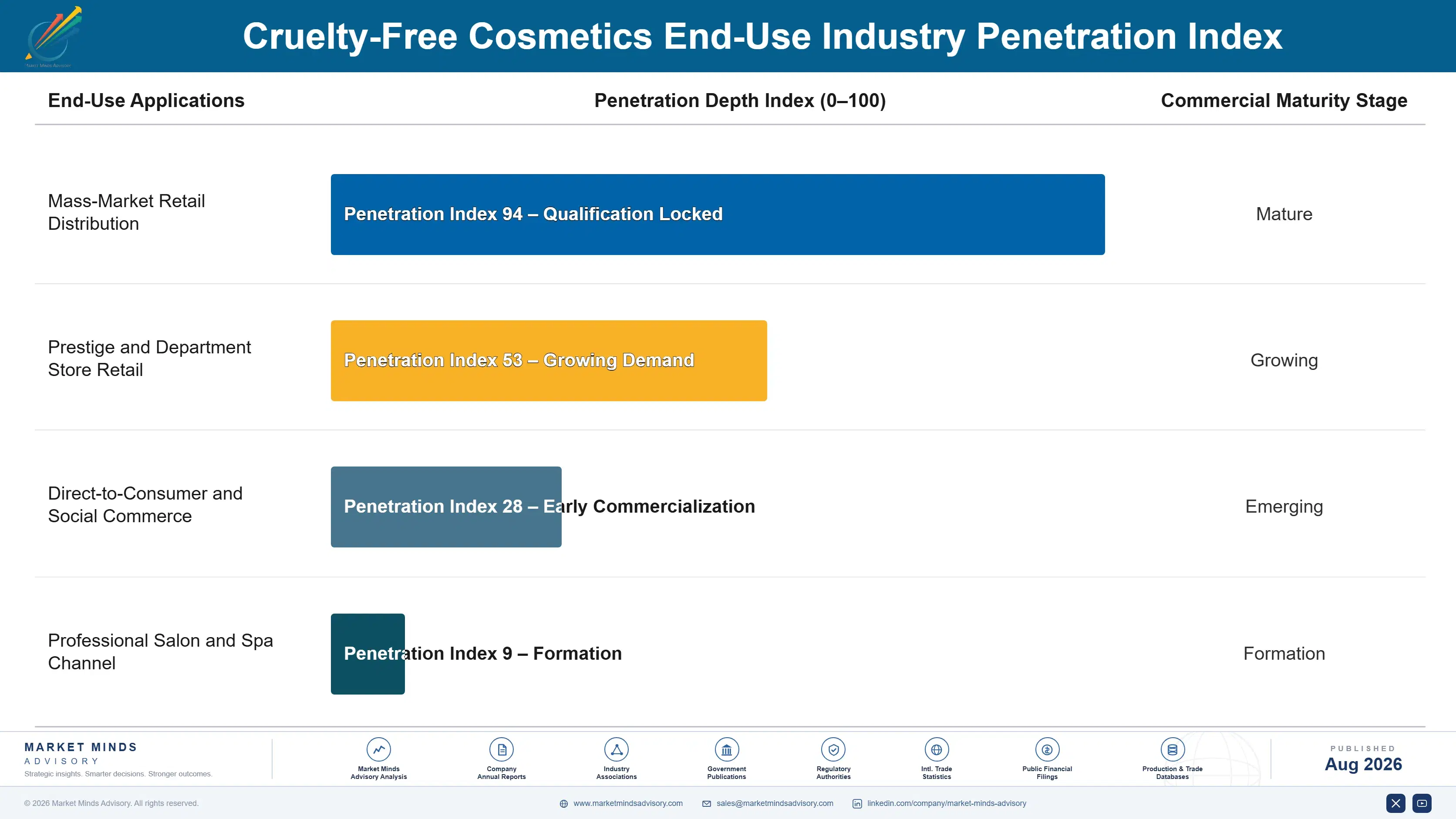
Demand behaves like an annuity once a brand secures certified shelf placement with a major retailer: retail buyers rarely delist certified brands once stocked, since replacing a qualified certified product means repeating months of vendor onboarding against a brand that already has proven sales performance. That repeat-purchase pattern gives incumbent certified brands a durable revenue base that newer competitors cannot easily displace once retail placement is established across a brand's commercial relationship.
Adoption depth varies sharply by product category. Skincare and color cosmetics have converted deepest, since consumer scrutiny and certification requirements make certified sourcing close to mandatory for responsible retail buying teams. Haircare and personal care buyers adopt more selectively, weighing certification cost against category margin on a product-by-product basis, while fragrance buyers remain the shallowest adopters, often defaulting to whatever scent profile is available that budget cycle.

Buyer profiles are shifting generationally. Younger retail buying teams increasingly default to documented certified brands without evaluating unverified alternatives as heavily, treating third-party credentials as a baseline requirement rather than an optional consideration. That default is spreading faster among new-format retail channels than among legacy department store buyers, which weighs established brand relationships most heavily at decision time.
cruelty-free-cosmetics-market-end-use-penetration-index-1788165522000

Certification Credibility Beats Legacy Brand Scale

These are among the four positions where our research anticipates prominent divergence between winners and laggards over the coming forecast period. Each is grounded in the demand model, the regulatory perimeter, and the announced capacity pipeline.
01 / CERTIFICATION CREDIBILITY STRATEGY

Brands without recognized certification will lose retail placement by 2029

Major retailers increasingly default to brands holding documented Leaping Bunny or PETA certification, since unverified brands cannot supply the defensible documentation that retail legal teams now require before approving shelf placement. Pacifica's certification strategy shows how addressable retail access follows directly from credential investment completed years earlier rather than from any late certification attempt. That gap will keep compounding as retailer verification requirements continue tightening across every major beauty retail channel worldwide, rewarding brands that invested in certification well before mandates tightened.
02 / SUPPLY CHAIN TRACEABILITY TIMING

Early traceability investment will decide long-term retail contract share

Retailers increasingly require documented supply chain traceability before approving any major placement expansion, and brands without that capability cannot bid for premium shelf space regardless of the price they offer during negotiation. Tarte's traceability investment shows how systems built years before audit requirements tightened convert directly into preferred-vendor status that competitors cannot quickly replicate. That advantage keeps compounding as more retailers require documented sourcing verification across their entire beauty assortment, leaving unverified competitors further behind with each passing product cycle.
03 / CERTIFICATION DIVERSIFICATION APPROACH

Diversified certification will separate resilient brands from exposed rivals

Certification body concentration is exposing brands with single-credential dependency to recurring retail access risk that diversified competitors largely avoid through multi-body qualification. Brands who invest in certification diversification now will capture premium shelf placement that increasingly demands documented flexibility from every vendor under consideration. That resilience gap will only widen as retailer verification requirements continue evolving across the broader beauty retail sector worldwide, rewarding brands that diversified early rather than reacting only after scrutiny had already intensified sharply across the market.
04 / COOPERATIVE CERTIFICATION INNOVATION

Shared certification cooperatives will determine which brands reach shelves fastest

Smaller indie brands increasingly favour shared certification cooperative membership over solo certification funding, since certification speed increasingly decides which brands secure retail placement ahead of competitor product launches. Brands without this cooperative approach cannot match certification speed regardless of any formulation quality advantage they might otherwise offer to a prospective retail partner. That gap is already reshaping how retail placement decisions are made across the industry today and into the next decade, favouring brands that committed to cooperative participation early.

Engagement Snapshot From the Field

A live engagement with an industry participant carrying material or product regulatory and market exposure ahead of a defining policy shift, showing how our research translates into a defensible multi-year portfolio strategy.
MARKET MINDS ADVISORY · CLIENT ENGAGEMENT SUMMARY
Cruelty-Free Cosmetics Producer Strategic Portfolio Review and Transition Roadmap 2026·Investment Scenario on Cruelty-Free Cosmetics Exposure Evaluation 2025-26
CLIENT PROFILE
An indie color cosmetics brand approached MMA while evaluating certification pathways ahead of a planned expansion into major national retail chains. The client reported annual revenue surpassing USD 22 million and a certification budget of USD 400,000 tied to a twelve-month retail launch timeline (client-reported, unverified by MMA). The client also flagged limited internal supply chain documentation as a complicating factor.
STRATEGIC CHALLENGE
Management wanted to secure certification ahead of a competitor's expected national launch but had not benchmarked certification timelines and cooperative membership options across available pathways, nor evaluated whether solo certification could realistically complete within the planned window. Retail partnerships wanted proof of credibility; finance wanted cost certainty. Retail partnerships also needed reassurance that credentials would hold up under audit.
MMA APPROACH
MMA benchmarked certification timelines, cooperative membership costs, and retailer documentation requirements across the three certification pathways the client was evaluating. We modelled certification completion against the launch deadline and quantified realistic phasing scenarios using comparable indie brand retail expansion benchmarks. We also interviewed the client's supply chain team to confirm realistic documentation timelines against actual supplier records.
KEY FINDINGS
  1. Solo certification would have required fourteen months, exceeding the client's twelve-month retail launch deadline by a meaningful margin (client-reported, unverified by MMA). That gap forced an immediate reassessment of the original solo certification plan.
  2. Joining a certification cooperative reduced the timeline to nine months while adding roughly 5% to total certification cost relative to solo pursuit. That figure was factored directly into the final budget approval.
  3. Two of three target retail chains required certification documentation beyond the baseline Leaping Bunny standard the client had originally planned for. That mismatch had not been identified during the client's initial internal planning phase.
  4. Brands with existing supply chain documentation completed certification measurably faster than those requiring documentation reconstruction from scratch. That gap shaped the final certification pathway decision directly.
CLIENT PROFILE
An indie color cosmetics brand approached MMA while evaluating certification pathways ahead of a planned expansion into major national retail chains. The client reported annual revenue surpassing USD 22 million and a certification budget of USD 400,000 tied to a twelve-month retail launch timeline (client-reported, unverified by MMA). The client also flagged limited internal supply chain documentation as a complicating factor.
STRATEGIC CHALLENGE
Management wanted to secure certification ahead of a competitor's expected national launch but had not benchmarked certification timelines and cooperative membership options across available pathways, nor evaluated whether solo certification could realistically complete within the planned window. Retail partnerships wanted proof of credibility; finance wanted cost certainty. Retail partnerships also needed reassurance that credentials would hold up under audit.
MMA APPROACH
MMA benchmarked certification timelines, cooperative membership costs, and retailer documentation requirements across the three certification pathways the client was evaluating. We modelled certification completion against the launch deadline and quantified realistic phasing scenarios using comparable indie brand retail expansion benchmarks. We also interviewed the client's supply chain team to confirm realistic documentation timelines against actual supplier records.
KEY FINDINGS
  1. Solo certification would have required fourteen months, exceeding the client's twelve-month retail launch deadline by a meaningful margin (client-reported, unverified by MMA). That gap forced an immediate reassessment of the original solo certification plan.
  2. Joining a certification cooperative reduced the timeline to nine months while adding roughly 5% to total certification cost relative to solo pursuit. That figure was factored directly into the final budget approval.
  3. Two of three target retail chains required certification documentation beyond the baseline Leaping Bunny standard the client had originally planned for. That mismatch had not been identified during the client's initial internal planning phase.
  4. Brands with existing supply chain documentation completed certification measurably faster than those requiring documentation reconstruction from scratch. That gap shaped the final certification pathway decision directly.
RECOMMENDED STRATEGY
Phase 1: Phase 1 (0 to 4 months): Join a certification cooperative and begin supply chain documentation reconstruction immediately. while assigning a dedicated internal owner to the documentation effort. Phase 2: Phase 2 (4 to 9 months): Complete cooperative certification while pursuing supplementary documentation for the two stricter retail chains. while briefing retail partners on the revised documentation timeline. Phase 3: Phase 3 (9 to 12 months): Launch across all three target retail chains with certification fully documented and verified. while monitoring post-launch retailer feedback closely.
OUTCOME
The client proceeded with the cooperative certification pathway, launching across all three target retail chains within its twelve-month deadline. The client reported avoiding an estimated five-month launch delay it had modelled under a solo certification scenario (client-reported, unverified by MMA). Management credited the cooperative pathway with materially reducing both cost and schedule risk.

Frequently Asked Questions

Foundational context covering the market sizes, CAGR, scope, country, region and competition that inform every finding below. This section is provided to cover basics and most often pre-purchase conversations, answered from the MMA Primary Research Dataset.

What is the current size of the Cruelty-Free Cosmetics Market?

The Cruelty-Free Cosmetics Market stood at USD 9.6 billion in 2025, based on MMA Primary Research Dataset estimates. Retailer certification mandates are the primary near-term growth driver.

How large will the Cruelty-Free Cosmetics Market be by 2036?

MMA projects the market reaching USD 22.16 billion by 2036 under the base case scenario. That represents a 2.14 times expansion over the 2026 base value.

What is the CAGR for the Cruelty-Free Cosmetics Market 2026 to 2036?

The base case CAGR is 7.9% annually. The bull case reaches 9.2% and the bear case falls to 6.6%, depending on retailer mandate pace and certification cost trends.

Which segment is growing fastest?

Men's grooming products grow fastest at 13.0% CAGR, about 1.65 times the overall market rate. Rising male ethical awareness and certification adoption drive that sustained pace across the category.

Who are the major companies in the Cruelty-Free Cosmetics Market?

ELF Beauty, The Body Shop, Too Faced, Tarte, and Pacifica lead the category today. Combined, the top five hold a CR5 of 32% across a fragmented, indie-heavy competitive field.

Which country is growing fastest?

India grows fastest at 11.5% CAGR, driven by its expanding vegan and ethically conscious consumer base. Rising social media influence is reinforcing that pace further each year.

Report Segmentation Architecture

The full report scope spans multiple orthogonal segmentation dimensions, with cross-tabulated demand data provided for each dimension pair. Coverage extends further to regional breakdowns, trend trajectories, and the competitive detail needed to support segment-level decision-making.

By Product Category

  • Skincare
  • Color Cosmetics
  • Haircare
  • Fragrance
  • Personal Care and Bath and Body Products
  • Men's Grooming Products

By End-Use Industry

  • Mass-Market Retail Distribution
  • Prestige and Department Store Retail
  • Direct-to-Consumer and Social Commerce
  • Professional Salon and Spa Channel

By Commercial Dimension

  • Wholesale Retail Supply Agreement
  • Direct-to-Consumer Online Sales
  • Private Label Formulation Licensing
  • Distributor and Regional Agent Sales

By Region

  • North America
  • Western Europe
  • East Asia
  • South Asia and Pacific
  • Latin America
  • Middle East and Africa
  • Eastern Europe

Scope, Methodology, and Coverage

Every figure in this report is reproducible from documented input assumptions. The scope below maps the historical period, the forecast horizon, the segmentation dimensions, and the countries covered, alongside the underlying primary and qualitative methodology.
Historical Period
2020 to 2025
Forecast Period
2026 to 2036
Base Year
2025 (USD billions; MMA Primary Research Dataset, August 2026)
Market Definition
The cruelty-free cosmetics market comprises skincare, color cosmetics, haircare, fragrance, personal care and bath and body products, and men's grooming products formulated and manufactured without animal testing at any stage of development. Products carrying only unverified marketing claims without recognized third-party certification are excluded.
Quantitative Units
USD billions (current prices); unit retail volume where applicable
Segmentation Dimensions
By Product Category; By End-Use Industry; By Commercial Dimension; By Region
Regions Covered
North America, Western Europe, East Asia, South Asia and Pacific, Latin America, Middle East and Africa, Eastern Europe
Countries Covered
USA, Canada, Germany, France, UK, Italy, Spain, China, Japan, South Korea, India, Australia, Brazil, Mexico, Argentina, UAE, Saudi Arabia, South Africa, Turkey, Poland, Czech Republic, Romania, Netherlands, Sweden, and additional markets relevant to this sector
Key Companies Profiled
e.l.f. Beauty Inc., The Body Shop International Limited, Too Faced Cosmetics, Tarte Cosmetics Inc., Pacifica Beauty LLC, Milk Makeup, ILIA Beauty, Kjaer Weis, RMS Beauty, Beautycounter, Fenty Beauty, Anastasia Beverly Hills, Urban Decay, Lush Cosmetics Limited, Physicians Formula, Wet n Wild, NYX Professional Makeup, Bite Beauty, KVD Beauty, Hourglass Cosmetics
Quantitative Methodology
Primary survey, n=3,800 respondents, Q4 2025, six countries; demand-side model with trade association cross-validation
Qualitative Methodology
47 expert interviews, Q4 2025; applied to validate demand model assumptions, identify emerging dynamics, and assess competitive positioning
Report Format
PDF and XLSX data workbook (Word format preview document)
Publisher
Market Minds Advisory
Report Code
MMA-2026-CHM-158
Published
August 2026
Contact
sales@marketmindsadvisory.com | www.marketmindsadvisory.com

Purchase the full Cruelty-Free Cosmetics Market Report (2026 to 2036).

The full MMA Cruelty-Free Cosmetics report sizes the market across six product categories, four end-use industries, four commercial dimensions, and seven regions through 2036. It profiles twenty brands on a consistent unit shipment volume basis, scoring each on certification credibility, supply chain traceability, and retailer partnership depth. Scenario models quantify how retailer certification mandates, consumer ethical awareness, and certification cost cycles shift both volume and realised price across brand tiers. The report also includes delivered-cost modelling by product category, a certification exposure screen, and retail placement analysis built for brand strategy, retail partnership, and investment teams.
Six-category segmentation with cross-tabulated regional demand
Twenty-brand competitive benchmarking on shipment volume
Certification credibility tracking by brand and region
Supply chain traceability and adoption analysis
Certification cost scenario modelling through 2036
Country-level regulatory and certification requirement tracking

Built For The People Who Decide

From boardroom strategy to bench-side execution, this report is read cover-to-cover by leaders shaping the next decade of their industry, turning demand scenarios, market dynamics and valuation benchmarks into decisions.
CXOs/ Presidents/ VPs/ Managers
M&A and Corporate Development
Strategy Teams and R&D Heads
Procurement and Product Directors
Regulatory and Compliance Leaders
Investor Relations and Equity Analysts