Market Minds Advisory
Crotonic Acid Market

Crotonic Acid Market: Copolymer and Intermediate Grades Across Coatings, Pharmaceutical and Agrochemical Use, 2026 to 2036

A monomer whose largest single application is hairspray resin now finds all of its growth in pharmaceutical synthesis, and the two customer sets want almost nothing in common from it.

Lead Analyst

Bilal Shaikh

Published

September 2026

Make Smarter Decisions with Customized Research Insights

Request a free sample report and evaluate market opportunities, growth trends, and competitive dynamics relevant to your business needs.

2025 MARKET VALUE$0.2BMarket Size 2025
2036 FORECAST VALUE$0.4BBase Case , 2026 to 2036
CAGR 2026 TO 20366.0 %Bull 7.2% / Bear 4.9%
INCREMENTAL OPPORTUNITY$0.2BNet 10- year value creation
EXPANSION MULTIPLE1.79x2036 value over 2026 base
Strategic Levers
M&A Pipeline
Regional Outlook
Country Rankings
Competitive Intelligence
Segmental Deep-dive
Call-Us : 91 93563 13602

Executive Snapshot and Market Trajectory

Crotonic acid earns most of its living inside vinyl acetate copolymers that nobody thinks about, principally hair fixative resins and coating binders, where it contributes 54% of total consumption. The growth, however, is coming from somewhere else entirely, and the two customer groups want quite different things.
Growth concentrates in pharmaceutical and high-purity grade, expanding at 9.0%, where the compact unsaturated acid structure serves as a building block in active ingredient synthesis and where geometric purity above 99.0% trans isomer matters in a way copolymer customers never demand. East Asia holds 36% of value, above the band this report applies elsewhere, because Chinese producers supply most of the world's crotonaldehyde and the acid derived from it at costs nobody else contests.
The producer base is moderately concentrated at 49% for the top five, and it splits between integrated Western specialty chemical companies and Chinese producers competing on feedstock position. Competition runs on isomer purity and oxidation yield rather than on synthesis novelty, since the route is settled. Crotonaldehyde availability, rather than anything a producer does inside its own plant, governs cost in any given year.
Market Definition
The market comprises crotonic acid supplied as a monomer, intermediate and reagent, spanning pharmaceutical and high-purity grade, copolymer and resin grade, agrochemical intermediate grade, plasticiser and coating grade, and technical grade. Sizing captures product revenue at realised delivered price across vinyl acetate copolymer and hair fixative resin manufacture, coating and adhesive binders, pharmaceutical synthesis, agrochemical active ingredient production, and plasticiser and specialty applications. Crotonaldehyde and acetaldehyde sold as feedstock, isocrotonic acid and other geometric isomers, finished copolymer resins and formulated coatings fall outside scope.
Base Year Value
$0.2B in 2025 (MMA Primary Research Dataset, August 2026)
Forecast Period
2026 to 2036, eleven discrete annual values
CAGR
6.0% base case. Bull 7.2%. Bear 4.9%.
Fastest Growth Segment
Pharmaceutical and High-Purity Grade: 9.0% CAGR
Fastest Growth Country
India: 8.6% CAGR
Fastest Growth Region
South Asia and Pacific: 8.1% CAGR
Largest Region
East Asia: 36% of 2025 global value
Market Leaders
Eastman Chemical, Anhui Wotu Chemical, Shandong Kaisheng New Materials, Jiangsu Yida Chemical, Merck KGaA. Source: MMA Analysis based on company annual reports.
Primary Survey
n=3,800 procurement and R&D decision-makers, Q4 2025, six countries
Methodology
Demand-side build-up, cross-validated against public data, 47 expert interviews

Crotonic Acid Market Forecast Scenarios

crotonic-acid-market-trends-size-forecast-scenario-1787310639457
Growth of 4.7% across 2020 to 2025 reflected a mature copolymer business that barely moved alongside a smaller pharmaceutical business that grew steadily. Hair fixative and coating resin demand tracked personal care and construction consumption without surprise. What did move was cost, as Chinese power rationing constrained crotonaldehyde output during 2021 and European energy pricing through 2022 made Western production marginal for several quarters.
The base case at 6.0% rests on three mechanisms. Pharmaceutical synthesis demand keeps growing as the compound appears in more active ingredient routes, and those customers pay for purity rather than negotiating on tonnage. Coating and adhesive resin consumption tracks construction and industrial activity at modest but reliable rates. And agrochemical intermediate demand expands across Asian and Latin American markets where crop protection manufacture has been relocating for a decade.
The bull case at 7.2% turns on pharmaceutical adoption broadening faster than currently modelled, since high-purity grade realises several times copolymer pricing and a single successful active ingredient can move the whole segment. The bear case at 4.9% turns on personal care reformulation. Hair fixative chemistry has been migrating toward alternative film formers for years, and an acceleration there removes the largest application this market has.

What Actually Determines Crotonic Acid Value

Two things determine whether anybody makes money here, and neither is the synthesis. Crotonaldehyde accounts for 46% of production cost and comes from a supply base concentrated heavily in China, so feedstock position sets the floor. Oxidation yield near 84% decides how much of that expensive aldehyde ends up as saleable acid rather than as over-oxidised by-product, and the difference between a good plant and an average one runs to several points.
TOP FIVE SHARE49%Concentration of crotonic acid volume across the largest producers
FEEDSTOCK COST SHARE46%Crotonaldehyde share of finished crotonic acid production cost
TRANS ISOMER PURITY99.0%Geometric purity required before copolymer customers will accept material
COPOLYMER DEMAND SHARE54%Resin and copolymer share of total crotonic acid consumption
OXIDATION PROCESS YIELD84%Molar yield achieved converting crotonaldehyde into finished acid
FREIGHT COST SHARE12%Transport share of delivered cost for crystalline solid product
Geometric purity is the specification that matters commercially. Copolymer customers require trans isomer content above 99.0%, because the cis form behaves differently during polymerisation and shows up as inconsistent molecular weight in the finished resin. Producers who cannot hold that consistently find themselves selling technical grade into applications that pay considerably less.
The market divides between two customer sets that share nothing beyond the molecule. Copolymer and resin buyers take 54% of volume, purchase on annual contracts and negotiate hard on price per tonne. Pharmaceutical buyers take small quantities at high specification, qualify suppliers over months, and price the material against what a synthesis failure would cost them rather than against a commodity benchmark.
"This is a molecule with a personal care business that pays the bills and a pharmaceutical business that pays properly, and most producers still organise themselves entirely around the first one. The commercial teams selling into resin manufacturers have never spoken to a process chemist, which is where the growth actually is."
Director, Specialty Organic Chemicals Practice · MMA Chemicals and Materials / S

Market Trends

Pharmaceutical Synthesis Demand Displaces Copolymer Growth

Crotonic acid appears increasingly in active pharmaceutical ingredient routes as a compact unsaturated acid building block, particularly where conjugate addition or ring-forming chemistry needs a short four-carbon unit with defined geometry. Roughly 19% of volume now goes to pharmaceutical and high-purity applications against a considerably smaller share five years ago. Those customers buy on specification rather than price, qualify suppliers formally over months, and stay once qualified, which changes the commercial character of a business that was built entirely around resin manufacture. Volumes remain small and the pricing is several times better.
Market Impact: Covers 2.9 million tonnes resin
Hair Fixative Reformulation Threatens The Largest Application

Vinyl acetate crotonic acid copolymers have been the standard hair fixative resin for decades, and formulators have been steadily testing alternatives on solubility, feel and environmental profile grounds. Around 27% of new fixative formulations now specify alternative film formers rather than the incumbent chemistry. The shift is gradual rather than abrupt, since reformulating a personal care product means repeating stability and sensory testing, but the direction is entirely consistent and it points away from the single application that still carries most of this market. Nobody has reversed a switch once made.
Market Impact: Reaches 63% Asian production

Market Opportunities and Growth Drivers

Coating And Adhesive Resins Track Industrial Activity

Vinyl acetate copolymers containing crotonic acid serve as binders in overprint varnishes, wood coatings, adhesives and specialty films, where the carboxyl functionality delivers adhesion and alkali solubility that plain vinyl acetate cannot provide. Roughly 2.9 million tonnes of vinyl acetate copolymer resin is produced annually across those applications. Demand grows with construction, packaging and industrial output rather than with anything specific to this chemistry, which makes this demand dependable and unexciting in roughly equal measure. Carboxyl functionality is what the copolymer actually needs from this molecule, and no cheaper monomer supplies it as cleanly.
Market Impact: Feedstock is 46% of cost

Agrochemical Manufacture Relocates Toward Asian Producers

Crop protection active ingredient synthesis has been migrating quite steadily toward Indian and Chinese contract manufacturers, and several established routes use crotonic acid or its derivatives as intermediates in constructing the heterocyclic ring systems involved. Around 63% of all global agrochemical active ingredient volume is now produced somewhere in Asia. That migration pulls intermediate demand along behind it, and it distinctly favours producers holding regional technical presence alongside the documentation standards that agrochemical registration now requires from every supplier in the chain. Indian intermediate manufacture has grown fastest of all.
Market Impact: Copolymer holds 54% of volume

Market Restraints and Challenges

Crotonaldehyde Supply Concentration Sets Everybody's Cost Floor

Crotonaldehyde represents 46% of production cost and comes overwhelmingly from Chinese producers operating aldol condensation capacity at scale, with very limited Western production remaining. The root cause is that acetaldehyde chemistry migrated east decades ago along with the ethylene derivatives feeding it. Commercially this means a Western producer buys its feedstock from a region where its own direct competitors also operate finished acid capacity. Participants are responding with multi-year feedstock agreements, backward integration where acetaldehyde access permits, and oxidation yield improvement that reduces the aldehyde consumed per tonne of acid shipped.
Market Impact: Reaches 19% of total volume

Fixative Reformulation Erodes The Anchor Application

Hair fixative resin is the single largest application and personal care formulators keep testing alternatives, which leaves this market exposed to a reformulation cycle it cannot influence. The root cause is that the incumbent chemistry works well and newer film formers work well too, so the switching decision turns on marketing and sustainability positioning rather than on performance. Commercially it caps growth in more than half the volume. Mitigation runs through pharmaceutical and agrochemical development, coating resin applications less exposed to consumer reformulation, and technical support that makes the incumbent chemistry harder to displace.
Market Impact: Affects 27% of new formulations
3 additional market trends, 4 additional growth drivers, and 2 additional restraints and challenges are covered in the full report. Contact sales@marketmindsadvisory.com to access the complete intelligence.

Segment CAGR and Growth Architecture

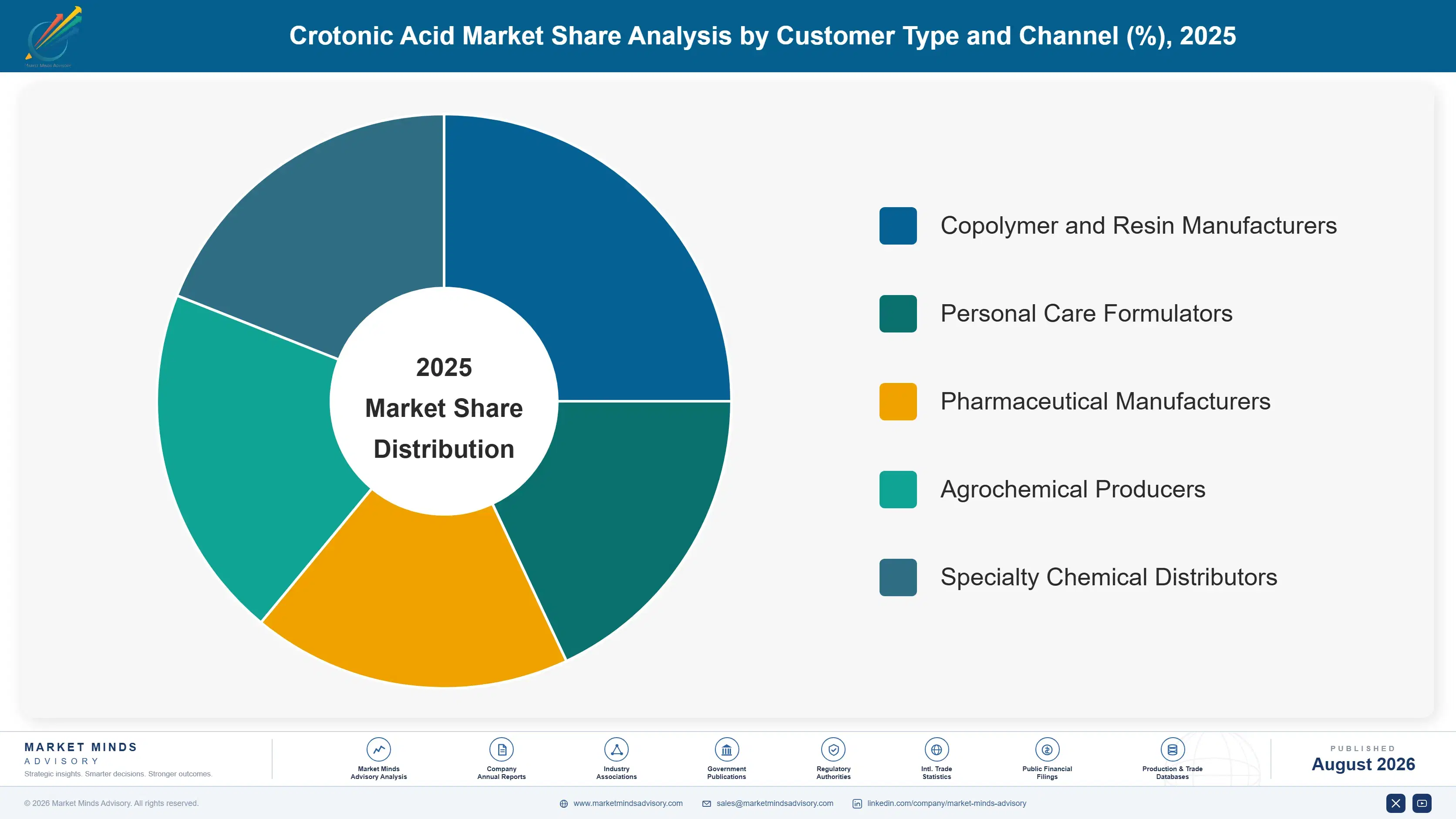
Segmentation follows grade and purity class, which is the dimension determining isomer specification, documentation burden, qualification requirement and ultimately realised price together. End-use application maps closely onto grade class rather than cutting across it, and the oxidation route is effectively uniform across producers, so neither of those belongs anywhere in this primary segmentation hierarchy.
crotonic-acid-market-trends-market-share-analysis-1787310640056

Pharmaceutical and High-Purity Grade

Growing at 9.0%, which is exactly 1.50 times the market rate, and the only grade anywhere here where producers earn on specification rather than on a feedstock pass-through margin. Active ingredient synthesis reaches for this compact unsaturated acid wherever conjugate addition or ring construction requires a short four-carbon unit with defined geometry, and those routes demand isomer purity, residual solvent control and impurity documentation that ordinary resin customers never once request. Qualification takes months and results in the supplier appearing in regulatory documentation, which makes these positions unusually durable once established. Volumes are small enough that a single successful active ingredient reaching commercial manufacture materially changes the whole segment's trajectory for years.
CAGR 9.0%

Copolymer and Resin Grade

Expanding at 7.4% across coating binders, overprint varnishes, adhesives and specialty film applications, where copolymerisation with vinyl acetate delivers the carboxyl functionality that provides adhesion and alkali solubility which plain vinyl acetate simply cannot. Trans isomer purity above 99.0% is the binding specification here, since the cis form polymerises differently and shows up as molecular weight inconsistency in the finished resin. This particular grade is bought on annual contracts by resin manufacturers who negotiate very firmly on tonnage price, and it grows steadily with construction and packaging activity rather than with anything at all happening inside the chemistry itself. Resin makers requalify their suppliers very reluctantly once satisfied with one.
CAGR 7.4%
Full segment breakdown across 5 segments available in the complete report.

Regional Architecture and Country Demand Map

Regional value follows resin manufacture and feedstock access together, which increasingly point toward exactly the same place. Crotonaldehyde production migrated east decades ago, and copolymer resin manufacture has steadily followed it, which leaves Western producers holding specification positions rather than any cost advantage at all.

East Asia

Thirty-six percent of value sits here, above the band this report applies to global markets. Note: the deviation is genuine, since Chinese producers supply most of the world's crotonaldehyde and the crotonic acid derived from it at cost positions that Western producers stopped contesting some years ago. Chinese capacity serves domestic resin manufacture, a substantial agrochemical intermediate business and export demand reaching into every other region. Japanese producers hold quite different positions across high-purity and pharmaceutical grades, where specification rather than price decides who supplies. Korean demand comes principally from coating and adhesive resin manufacture. Growth of 6.9% runs above the global rate, driven by agrochemical and resin volume together rather than by pricing.
Share: 36% | CAGR: 6.9% (2026 to 2036)

North America

Twenty percent of value, marginally below the band applied elsewhere in this report, because production and resin manufacture have both concentrated in Asia. Note: the deviation reflects genuine manufacturing geography rather than analytical judgement. What the region does retain is personal care formulation, where hair fixative resin demand remains genuinely substantial in absolute terms, alongside pharmaceutical synthesis demand that buys high-purity grade at prices well above any commodity level. Eastman holds a long-established position across specialty acids and cellulose ester chemistry that connects naturally to this particular molecule. Growth of 5.4% reflects pharmaceutical demand growing steadily against a personal care application that faces continuous reformulation pressure across the whole market.
Share: 20% | CAGR: 5.4% (2026 to 2036)
Regional intelligence for 5 additional markets available in the complete report: Western Europe, South Asia and Pacific, Latin America, Middle East and Africa, Eastern Europe. Contact sales@marketmindsadvisory.com.
crotonic-acid-market-trends-country-cagr-analysis-1787310640578

Where Crotonic Acid Producers Earn More

Selling resin grade in competition against Chinese producers who own the feedstock is a position that most Western capacity has already very largely conceded. The margin genuinely available sits in oxidation yield, in pharmaceutical qualification, in agrochemical documentation, and in the application support that makes incumbent chemistry harder for a formulator to abandon casually.

Push Oxidation Yield Above The Industry Standard

Crotonaldehyde is 46% of production cost and typical oxidation yield sits near 84%, which means roughly a sixth of the dominant input becomes over-oxidised by-product rather than saleable acid. Catalyst selection, oxygen staging and reaction control together lift yield by 5 to 7 points at producers who have invested properly, and each point falls almost entirely through to margin. The engineering is well understood and the payback short at current feedstock pricing. Most producers still treat yield as something fixed by the process rather than as a genuinely improvable variable.
Market Impact: Lifts oxidation yield by 5 to 7 poi

Qualify Into Pharmaceutical Synthesis Routes Deliberately

High-purity grade requires isomer specification, residual solvent control and impurity documentation that ordinary resin customers never ask for, and qualification runs over many months before a supplier finally appears in regulatory documentation. That barrier is precisely why the grade realises roughly 5 times copolymer pricing and holds through feedstock cycles. The analytical and documentation investment required is bounded and modest against the price differential involved. Producers whose commercial teams only ever call resin manufacturers are competing entirely inside the part of this market that Chinese feedstock position has already decided.
Market Impact: Realises roughly 5 times copolymer

Support Formulators Defending Incumbent Fixative Chemistry

Roughly 27% of new hair fixative formulations now specify alternative film formers, and much of that switching is driven by positioning rather than by any performance shortfall in the incumbent chemistry. Producers supplying formulation support, comparative performance data and sustainability documentation help formulators justify staying, which protects roughly 20% of the copolymer volume otherwise at risk. The work costs laboratory time and technical attention rather than capital. Almost nobody in this market currently does it, because suppliers sell to resin manufacturers rather than to the formulators who actually take the decision.
Market Impact: Protects roughly 20% of copolymer v

Follow Agrochemical Manufacture Into Asian Markets

Roughly 63% of all global agrochemical active ingredient volume is now produced somewhere in Asia, and several established synthesis routes use crotonic acid or its derivatives as intermediates in ring construction. Producers holding regional presence and registration-grade documentation capture roughly 3 times the share of that demand which distant suppliers manage to win, because agrochemical registration increasingly requires full supply chain documentation from every intermediate supplier involved. The commercial requirement is local technical presence rather than local manufacturing capacity, which makes it achievable without any real capital investment at all.
Market Impact: Captures roughly 3 times distant su

Who Controls the Margin Pool

Concentration is moderate and the participant base splits along feedstock access. The top five hold 49% of crotonic acid volume supplied, the basis used throughout this section, and the gap between them reflects two quite different businesses. Chinese producers operate on domestic crotonaldehyde at costs that effectively decide the entire resin grade market, while Eastman and the Japanese producers hold specification and documentation positions in pharmaceutical, high-purity and demanding coatin
Competition currently runs on three dimensions and synthesis route is not among them, since the oxidation chemistry is settled and universal. Feedstock cost position decides who can supply resin grade profitably. Isomer purity consistency decides who holds onto copolymer customers when a batch eventually disappoints somebody. Qualification and documentation decide access to pharmaceutical and agrochemical demand entirely.

Pressure is building from two directions. Chinese producers keep extending upward from resin grade into higher specification material as their analytical capability steadily improves. Personal care reformulation slowly erodes the largest application anybody serves. Rankings shift first across resin grade supply, where feedstock position rather than anything a Western producer can influence determines the outcome entirely.
crotonic-acid-market-trends-company-positioning-matrix-1787310641107

Competitive Moat and Risk Dimensions

EASTMAN CHEMICAL

Moat: Specialty acid and ester breadth

Deep capability across specialty organic acids and cellulose ester chemistry places crotonic acid within a portfolio rather than as a standalone product, spreading analytical, regulatory and commercial investment across many molecules. Long-standing relationships with coating and personal care formulators give visibility of reformulation intentions that a merchant supplier never obtains in time to respond.
EASTMAN CHEMICAL

Risk: Feedstock position and cost

Crotonaldehyde comes from a supply base concentrated in Asia, which caps cost position permanently in resin grade regardless of manufacturing efficiency. Defending the business requires migrating toward specification-led grades where feedstock cost matters less, and that migration limits how much volume the asset base can profitably carry over time.
ANHUI WOTU CHEMICAL

Moat: Feedstock proximity and scale

Operating close to domestic crotonaldehyde production removes the largest cost disadvantage any Western competitor carries, and scale in a market this small confers unusual pricing influence over resin grade supply worldwide. Proximity to Chinese resin and agrochemical manufacture removes freight and lead time friction that distant suppliers cannot avoid.
ANHUI WOTU CHEMICAL

Risk: Specification and documentation depth

Pharmaceutical and regulated agrochemical demand requires impurity documentation, analytical depth and inspection-ready records that cost advantage alone does not provide, and those are precisely the segments growing fastest. Building that capability takes years, and the customers involved qualify suppliers slowly and change them reluctantly once they have.

Players Tracked

Prominent Players

Eastman Chemical
Anhui Wotu Chemical
Shandong Kaisheng New Materials
Jiangsu Yida Chemical
Merck KGaA

Other Key Players

Hairui Chemical
Zhengzhou Alfa Chemical
Hangzhou Dayangchem
Shandong Yanggu Huatai Chemical
Wuhan Youji Industries
TCI Chemicals
Thermo Fisher Scientific
Otto Chemie
Loba Chemie
Central Drug House
Apollo Scientific
Combi-Blocks
Shanghai Aladdin Biochemical
FUJIFILM Wako Pure Chemical
Kanto Chemical

Recent Developments

APRIL 2025

High-purity grade qualified for pharmaceutical intermediate synthesis

A pharmaceutical manufacturer completed full qualification of a high-purity crotonic acid grade for use in an active ingredient synthesis route, reviewing the isomer specification, residual solvent profiles and the full manufacturing documentation before formally naming that supplier in registration filings for a development stage programme.
Signal: Pharmaceutical qualification remains the o
AUGUST 2025

Personal care formulator adopts alternative fixative film former

A major personal care manufacturer reformulated an entire hair fixative product range away from its vinyl acetate crotonic acid copolymer toward an entirely alternative film former chemistry, citing sustainability positioning and consumer ingredient transparency rather than any measurable performance shortfall in the incumbent chemistry itself.
Signal: Reformulation driven by positioning rather
DECEMBER 2025

Oxidation yield improvement commissioned at producer site

A crotonic acid producer commissioned a substantial package of catalyst and reaction control improvements targeting an oxidation yield materially above prevailing industry levels, thereby reducing the crotonaldehyde consumed per tonne of finished acid, after several successive years of elevated feedstock pricing across the whole market.
Signal: Yield improvement is the only cost lever a

What Sits Inside Crotonic Acid Cost

Crotonaldehyde accounts for roughly 46% of production cost, derived from acetaldehyde through aldol condensation and supplied overwhelmingly from Chinese producers with very limited Western capacity remaining. Oxidant, catalyst and process chemicals add around 9%. Reaction and distillation energy contributes about 13%, purification and crystallisation to isomer specification a further 14%, packaging 6%, and outbound freight the remaining 12% of delivered cost.
Feedstock and energy both moved sharply across 2021 and 2022. Chinese provincial power rationing during late 2021 constrained acetaldehyde and crotonaldehyde output across several producing regions, and European industrial energy prices through 2022 reached levels the IEA documented as unprecedented for the sector. Eastman Chemical Annual Report 2022 recorded elevated raw material and energy costs across its specialty intermediates operations, and several Western producers ran below capacity through the period.

The competitive disadvantage mechanism runs through feedstock geography rather than through process capability. A Western producer buys crotonaldehyde from a region where its own competitors manufacture the finished acid, which caps cost position permanently in resin grade whatever the plant achieves. Yield compounds it, since a producer at 84% consumes measurably more aldehyde per tonne than one at 90%. Small Western producers typically carry both disadvantages at once.
crotonic-acid-market-trends-cost-volatility-analysis-1787310641309

Contract crotonaldehyde supply on multi-year indexed terms

Spot feedstock purchasing offers no protection when Chinese production is constrained by power rationing or export policy, both of which have occurred within the past five years. Multi-year agreements indexed to a published acetaldehyde or ethylene benchmark secure volume and share price movement rather than concentrating all of it on the derivative producer downstream.

Improve oxidation yield rather than accepting process norms

Typical yield near 84% means roughly a sixth of the dominant cost input ends up as by-product requiring disposal rather than as saleable acid. Catalyst selection, oxygen staging and closer reaction control together lift that yield materially, and at current feedstock pricing that engineering pays back quickly on a plant of any reasonable scale.

Migrate portfolio toward specification-led grades

Where feedstock cost cannot be matched, the answer is competing where feedstock cost is not the deciding factor, which means pharmaceutical, high-purity and documented agrochemical grades. The migration takes years and needs analytical investment that resin grade margins will not fund, so the migration has to begin well before the resin business becomes untenable.

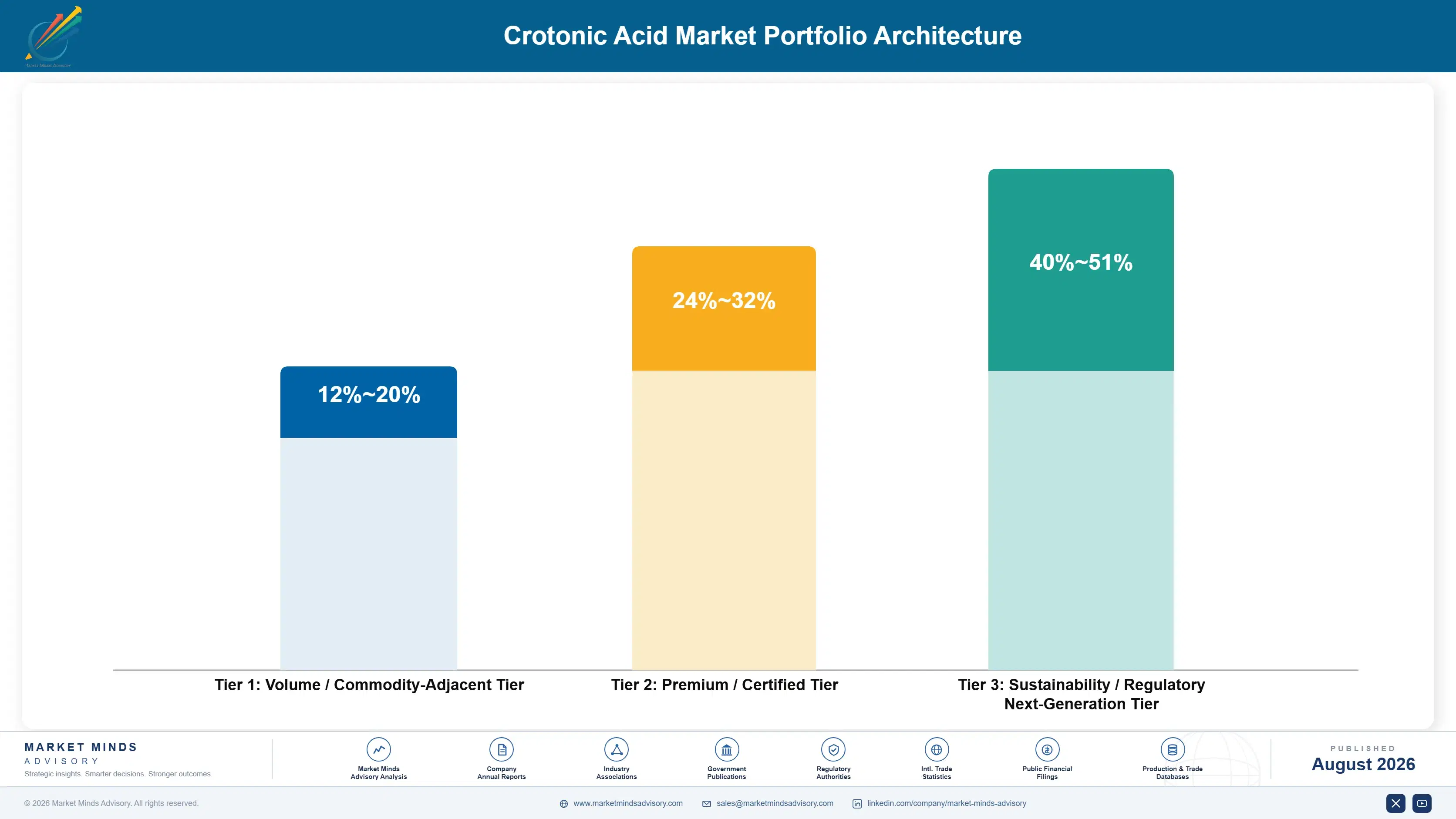
Portfolio Architecture for Margin Defence

Margin architecture separates by documentation rather than by chemistry, since the oxidation route is identical everywhere and the molecule is unremarkable. Technical and resin grade earns whatever feedstock position permits, which for a producer buying Chinese crotonaldehyde is not much and for a Chinese producer is respectable. Value rises steeply with isomer consistency, analytical documentation and qualification, none of which the synthesis route itself provides to anybody.
The volume versus premium tension runs between two customer sets that behave nothing alike. Copolymer and resin grade carries 54% of volume on annual contracts negotiated firmly on tonnage price. Pharmaceutical and high-purity grade takes small quantities at several times the price and qualifies suppliers over months. A producer organised entirely around resin customers has scale in the part of the market that feedstock position already decided against it.

High-value pools concentrate in three places. Pharmaceutical grade commands price because qualification is slow and the supplier appears in registration documentation. Documented agrochemical intermediate grade earns on registration requirements that keep tightening. And formulation support for personal care customers earns on defending volume that reformulation would otherwise remove entirely.

Volume / Commodity-Adjacent Tier

Technical grade alongside standard plasticiser and coating grade material supplied against basic specification only, where feedstock position alone determines the outcome and where buyers compare delivered quotations directly on price alone.
Gross Margin: 12-20%

Premium / Certified Tier

Copolymer and resin grade holding trans isomer purity above the specification that polymerisation consistency requires. Batch consistency and technical support defend pricing here. The eight-point range reflects contracted against spot resin supply economics.
Gross Margin: 24-32%

Sustainability / Regulatory / Next-Generation Tier

Pharmaceutical, high-purity and documented agrochemical intermediate grades with impurity characterisation and registration-ready records. Qualification barriers defend pricing strongly. Analytical depth reinforces both. The eleven-point range reflects agrochemical against pharmaceutical grade economics.
Gross Margin: 40-51%
crotonic-acid-market-trends-portfolio-architecture-1787310641829

High-value Sub-segments and Strategic Watch-out

Pharmaceutical and high-purity qualified supply

High value and high growth together here, because qualification runs over many months and the supplier then appears in registration documentation that nobody ever amends without good cause. Realised pricing has held at roughly 5 times copolymer grade through every feedstock cycle observed so far.
Gross Margin: 40-51%

Documented agrochemical intermediate grade

Strong realised value on solid growth, because roughly 63% of active ingredient volume is now made in Asia and registration increasingly demands supply chain documentation from every intermediate supplier in the chain. Regional technical presence matters considerably more than where the material is actually manufactured.
Gross Margin: 30-40%

Copolymer and resin grade contract volume

The volume core here, carrying 54% of total consumption on annual contracts negotiated firmly on tonnage price by resin manufacturers who keep several qualified suppliers available at all times. Necessary for basic plant loading, but feedstock position rather than anything else decides who actually profits.
Gross Margin: 24-32%

Personal care fixative resin exposure

The strategic watch-out, given that roughly 27% of all new hair fixative formulations already specify alternative film formers, on positioning rather than on any performance grounds at all. This is the largest single application anywhere in the market, and it is quietly being reformulated away.
Gross Margin: 20-30%

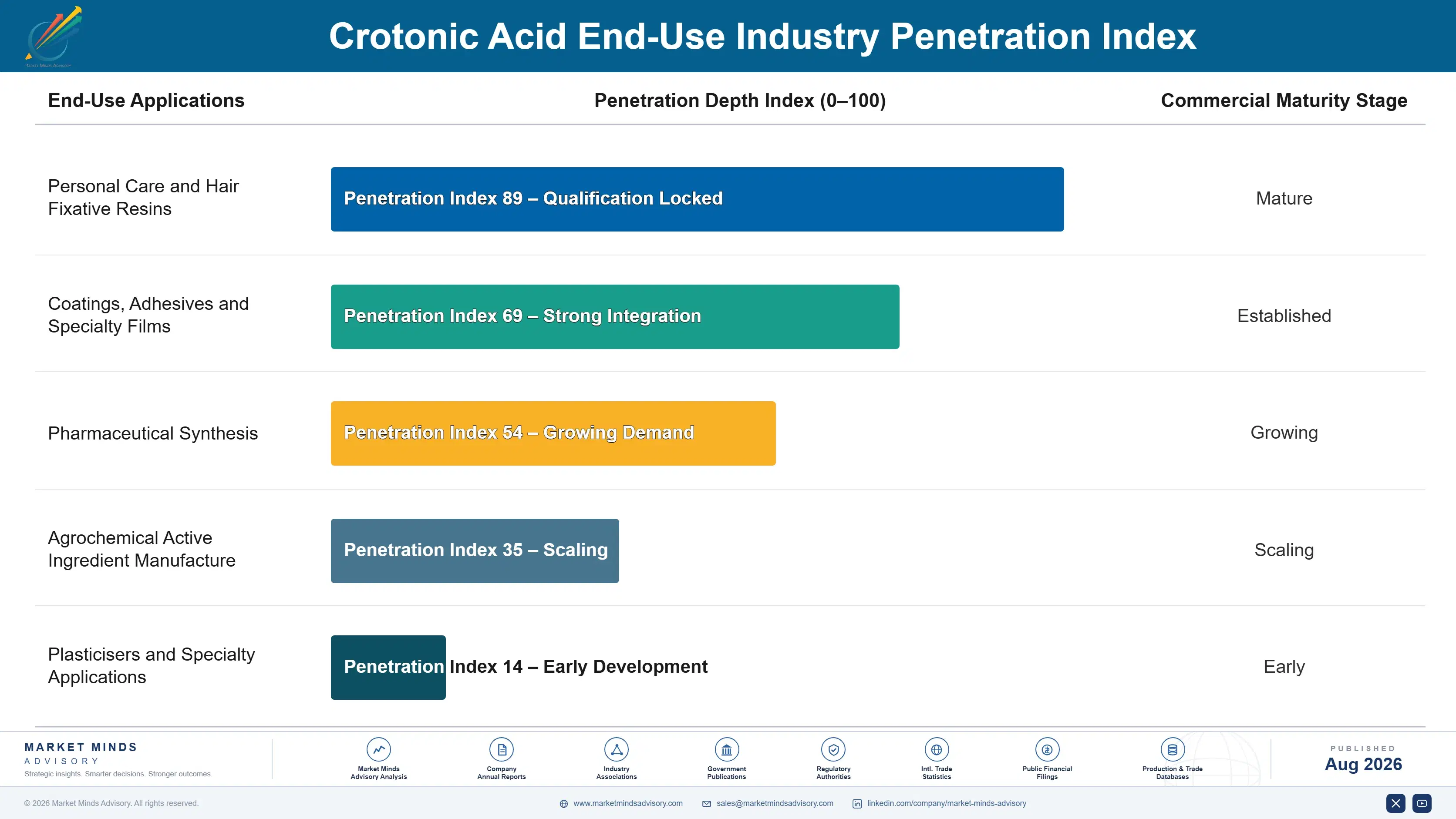
How Crotonic Acid Demand Behaves

Demand is formulation-locked rather than transactional, and the lock varies enormously in strength. A copolymer resin recipe consumes crotonic acid at a fixed ratio for as long as the resin is made, and resin grades change rarely. A pharmaceutical route consumes it at a ratio fixed by the synthesis for the life of the product, and changing the supplier means amending a registration. Revenue therefore tracks downstream production volumes rather than any purchasing cycle, which makes forecasting s
Stickiness varies sharply with what sits downstream. Technical grade supply is loosest, bought on delivered price with nothing preventing substitution. Resin grade sits tighter, since isomer consistency affects polymerisation behaviour and resin makers requalify reluctantly. Pharmaceutical grade is stickiest by a wide margin, where the supplier appears in registration documentation and a change requires regulatory amendment nobody undertakes without a documented operational reason.

The buyer profile is slowly bifurcating rather than shifting. Resin manufacturers continue buying through procurement on annual tonnage contracts, exactly as they have for decades. Pharmaceutical and agrochemical customers buy through process chemistry and regulatory affairs, evaluating documentation and impurity profiles long before price enters the conversation, which requires an entirely different commercial approach.
crotonic-acid-market-trends-end-use-penetration-index-1787310642321

Where We Land On This

These are among the four positions where our research anticipates prominent divergence between winners and laggards over the coming forecast period. Each is grounded in the demand model, the regulatory perimeter, and the announced capacity pipeline.
01 / OXIDATION YIELD IMPROVEMENT

Treat process yield as the only controllable cost lever

Crotonaldehyde represents 46% of production cost and typical oxidation yield sits near 84%, which means roughly a sixth of the dominant input ends up as over-oxidised by-product requiring disposal rather than saleable acid. Catalyst selection, oxygen staging and closer reaction control lift yield by 5 to 7 points wherever producers have genuinely invested, and each point falls almost entirely through to margin. For any producer without a feedstock advantage this is the only genuine cost lever that actually exists at all.
02 / PHARMACEUTICAL ROUTE QUALIFICATION

Qualify into synthesis routes rather than selling resin grade

High-purity grade demands isomer specification, residual solvent control and impurity documentation that ordinary resin customers never once request, and qualification runs over many months before the supplier finally appears in registration filings. That barrier is exactly why this grade realises roughly 5 times copolymer pricing, and why it has held that through successive feedstock cycles. Producers whose commercial teams only ever call resin manufacturers are competing entirely inside the part of the market that Chinese feedstock position decided long ago.
03 / FORMULATOR RELATIONSHIP BUILDING

Defend fixative volume by talking to formulators directly

Roughly 27% of all new hair fixative formulations now specify alternative film formers, and much of that switching reflects sustainability positioning rather than any measurable performance shortfall in the incumbent chemistry itself. Producers supplying comparative performance data and formulation support help formulators justify staying, which protects roughly 20% of the copolymer volume that would otherwise be at risk. Almost nobody in this market does it, because suppliers sell to resin manufacturers rather than to the formulators who actually make the decision.
04 / AGROCHEMICAL DOCUMENTATION CAPABILITY

Follow crop protection manufacture into Asian markets

Roughly 63% of global agrochemical active ingredient volume is now produced in Asia, and several established synthesis routes use crotonic acid or its derivatives as intermediates in ring construction work. Producers holding regional technical presence and registration-grade documentation capture roughly 3 times the share that distant suppliers manage to win, because registration increasingly requires full documentation from every intermediate supplier in the chain. The requirement is local technical presence rather than local manufacturing capacity, which makes it achievable without capital investment.

Engagement Snapshot From the Field

A live engagement with an industry participant carrying material or product regulatory and market exposure ahead of a defining policy shift, showing how our research translates into a defensible multi-year portfolio strategy.
MARKET MINDS ADVISORY · CLIENT ENGAGEMENT SUMMARY
Crotonic Acid Producer Strategic Portfolio Review and Transition Roadmap 2026·Investment Scenario on Crotonic Acid Exposure Evaluation 2025-26
CLIENT PROFILE
A specialty organic acid producer operating oxidation and crystallisation capacity in Western Europe, supplying crotonic acid and related short-chain acids to resin manufacturers, personal care formulators and a small pharmaceutical customer base. Crotonic acid revenue approached EUR 34 million annually (client-reported, unverified by MMA), roughly three quarters of it in copolymer and resin grade sold on annual tonnage contracts.
STRATEGIC CHALLENGE
Margins had declined for four consecutive years and management attributed the fall to Chinese competition, responding with cost reduction at the single production site. Personal care volume had begun eroding without anybody establishing why. A proposed debottlenecking investment assumed resin grade volume would hold at historical levels once pricing stabilised.
MMA APPROACH
MMA interviewed forty-seven resin manufacturers, personal care formulators, pharmaceutical process chemists and agrochemical producers across five markets, establishing how grade selection and supplier substitution actually happen. We separated feedstock cost movement from realised margin across four years, benchmarked the client's oxidation yield against competitors, and traced every lost personal care volume back to the formulation decision behind it.
KEY FINDINGS
  1. Oxidation yield ran at 81% against a competitor benchmark near 90%, and the gap alone accounted for more than the entire margin decline being investigated across the period.
  2. Every unit of lost personal care volume traced to formulators switching film former for sustainability positioning, and the client had never spoken to a single formulator directly.
  3. Pharmaceutical grade earned several times resin grade margin on under a tenth of volume (client-reported, unverified by MMA), and had received no commercial investment or analytical development in years.
  4. Indian agrochemical producers interviewed wanted registration-grade documentation from intermediate suppliers, and none had ever been approached by the client or by any European competitor.
CLIENT PROFILE
A specialty organic acid producer operating oxidation and crystallisation capacity in Western Europe, supplying crotonic acid and related short-chain acids to resin manufacturers, personal care formulators and a small pharmaceutical customer base. Crotonic acid revenue approached EUR 34 million annually (client-reported, unverified by MMA), roughly three quarters of it in copolymer and resin grade sold on annual tonnage contracts.
STRATEGIC CHALLENGE
Margins had declined for four consecutive years and management attributed the fall to Chinese competition, responding with cost reduction at the single production site. Personal care volume had begun eroding without anybody establishing why. A proposed debottlenecking investment assumed resin grade volume would hold at historical levels once pricing stabilised.
MMA APPROACH
MMA interviewed forty-seven resin manufacturers, personal care formulators, pharmaceutical process chemists and agrochemical producers across five markets, establishing how grade selection and supplier substitution actually happen. We separated feedstock cost movement from realised margin across four years, benchmarked the client's oxidation yield against competitors, and traced every lost personal care volume back to the formulation decision behind it.
KEY FINDINGS
  1. Oxidation yield ran at 81% against a competitor benchmark near 90%, and the gap alone accounted for more than the entire margin decline being investigated across the period.
  2. Every unit of lost personal care volume traced to formulators switching film former for sustainability positioning, and the client had never spoken to a single formulator directly.
  3. Pharmaceutical grade earned several times resin grade margin on under a tenth of volume (client-reported, unverified by MMA), and had received no commercial investment or analytical development in years.
  4. Indian agrochemical producers interviewed wanted registration-grade documentation from intermediate suppliers, and none had ever been approached by the client or by any European competitor.
RECOMMENDED STRATEGY
Phase 1: Phase 1 (0 to 9 months): Halt the debottlenecking investment and fund oxidation yield improvement through catalyst and reaction control work. Phase 2: Phase 2 (9 to 24 months): Build direct formulator relationships across personal care and complete the pharmaceutical grade analytical development programme. Phase 3: Phase 3 (24 to 42 months): Establish an Indian technical presence targeting agrochemical intermediate demand with full registration-grade documentation support.
OUTCOME
The client deferred roughly EUR 11 million of debottlenecking capital (client-reported, unverified by MMA) and lifted oxidation yield toward benchmark within a year. Two personal care formulators were engaged directly and one reformulation was reversed, pharmaceutical grade development completed, and an Indian technical representative was appointed before the engagement closed.

Frequently Asked Questions

Foundational context covering the market sizes, CAGR, scope, country, region and competition that inform every finding below. This section is provided to cover basics and most often pre-purchase conversations, answered from the MMA Primary Research Dataset.

What is the current size of the Crotonic Acid Market?

The market reached USD 0.2 billion in 2025, measured as product revenue at realised delivered price across all grades. Copolymer and resin applications account for 54% of total consumption.

How large will the Crotonic Acid Market be by 2036?

MMA forecasts USD 0.38 billion by 2036, an expansion of 1.79 times the 2026 level. Incremental value across the forecast period reaches USD 0.17 billion.

What is the CAGR for the Crotonic Acid Market 2026 to 2036?

The base case compound annual growth rate is 6.0%, with a bull case of 7.2% and a bear case of 4.9%. Pharmaceutical adoption and hair fixative reformulation separate those two scenarios.

Which segment is growing fastest?

Pharmaceutical and high-purity grade grows fastest at 9.0%, exactly 1.50 times the overall market rate. Qualification into registration filings is what makes that segment genuinely defensible.

Who are the major companies in the Crotonic Acid Market?

Eastman Chemical, Anhui Wotu Chemical, Shandong Kaisheng New Materials, Jiangsu Yida Chemical and Merck KGaA lead, holding 49% of volume between them. Feedstock access rather than synthesis capability explains that split.

Which country is growing fastest?

India grows fastest at 8.6%, driven by agrochemical active ingredient manufacture that relocated from Western producers and by pharmaceutical intermediate synthesis. Crotonaldehyde is imported rather than made domestically at scale.

Report Segmentation Architecture

The full report scope spans multiple orthogonal segmentation dimensions, with cross-tabulated demand data provided for each dimension pair. Coverage extends further to regional breakdowns, trend trajectories, and the competitive detail needed to support segment-level decision-making.

By Grade and Purity Class

  • Pharmaceutical and High-Purity Grade
  • Copolymer and Resin Grade
  • Agrochemical Intermediate Grade
  • Plasticiser and Coating Grade
  • Technical Grade

By End-Use Industry

  • Personal Care and Hair Fixative Resins
  • Coatings, Adhesives and Specialty Films
  • Pharmaceutical Synthesis
  • Agrochemical Active Ingredient Manufacture
  • Plasticisers and Specialty Applications

By Customer Type and Channel

  • Copolymer and Resin Manufacturers
  • Personal Care Formulators
  • Pharmaceutical Manufacturers
  • Agrochemical Producers
  • Specialty Chemical Distributors

By Region

  • North America
  • Western Europe
  • East Asia
  • South Asia and Pacific
  • Latin America
  • Middle East and Africa
  • Eastern Europe

Scope, Methodology, and Coverage

Every figure in this report is reproducible from documented input assumptions. The scope below maps the historical period, the forecast horizon, the segmentation dimensions, and the countries covered, alongside the underlying primary and qualitative methodology.
Historical Period
2020 to 2025
Forecast Period
2026 to 2036
Base Year
2025 (USD billions; MMA Primary Research Dataset, August 2026)
Market Definition
The market comprises crotonic acid supplied as a monomer, intermediate and reagent, spanning pharmaceutical and high-purity grade, copolymer and resin grade, agrochemical intermediate grade, plasticiser and coating grade, and technical grade. Sizing captures product revenue at realised delivered price across personal care and hair fixative resin manufacture, coatings, adhesives and specialty films, pharmaceutical synthesis, agrochemical active ingredient production, and plasticiser and specialty applications, including material supplied under contract manufacturing arrangements. Crotonaldehyde and acetaldehyde sold as feedstock, isocrotonic acid and other geometric isomers, finished copolymer resins, formulated coatings and personal care products fall outside scope.
Quantitative Units
USD billions (current prices); product tonnes supplied annually; USD per tonne at realised delivered price by grade class
Segmentation Dimensions
By Grade and Purity Class; By End-Use Industry; By Customer Type and Channel; By Region
Regions Covered
North America, Western Europe, East Asia, South Asia and Pacific, Latin America, Middle East and Africa, Eastern Europe
Countries Covered
USA, Canada, Mexico, Germany, France, UK, Italy, Spain, Netherlands, Switzerland, Poland, Czech Republic, Hungary, Romania, Turkey, China, Japan, South Korea, Taiwan, India, Vietnam, Thailand, Indonesia, Australia, Brazil, Argentina, Chile, Israel, Saudi Arabia, UAE, South Africa, and additional markets relevant to this sector
Key Companies Profiled
Eastman Chemical, Anhui Wotu Chemical, Shandong Kaisheng New Materials, Jiangsu Yida Chemical, Merck KGaA, Hairui Chemical, Zhengzhou Alfa Chemical, Hangzhou Dayangchem, Shandong Yanggu Huatai Chemical, Wuhan Youji Industries, TCI Chemicals, Thermo Fisher Scientific, Otto Chemie, Loba Chemie, Central Drug House, Apollo Scientific, Combi-Blocks, Shanghai Aladdin Biochemical, FUJIFILM Wako Pure Chemical, Kanto Chemical.
Quantitative Methodology
Primary survey, n=3,800 respondents, Q4 2025, six countries; demand-side model with trade association cross-validation
Qualitative Methodology
47 expert interviews, Q4 2025; applied to validate demand model assumptions, identify emerging dynamics, and assess competitive positioning
Report Format
PDF and XLSX data workbook (Word format preview document)
Publisher
Market Minds Advisory
Report Code
MMA-2026-CHM-522
Published
August 2026
Contact
sales@marketmindsadvisory.com | www.marketmindsadvisory.com

Purchase the full Crotonic Acid Market Report (2026 to 2036).

The full report sizes the crotonic acid market across five grade classes, five end-use industries, five customer channels and seven regions, with annual forecasts to 2036 in revenue and tonnes supplied. It separates crotonaldehyde feedstock cost movement from realised producer margin across the forecast history, which is the analysis that establishes what has genuinely happened to profitability. Twenty participants are assessed on a consistent product volume supplied basis, with feedstock access and oxidation yield mapped separately from nameplate capacity. Hair fixative reformulation is tracked formulation by formulation across major personal care manufacturers.
Five grade classes sized and forecast annually
Feedstock cost movement separated from realised producer margin
Twenty participants on consistent product volume supplied basis
Feedstock access and oxidation yield mapped separately from capacity
Hair fixative reformulation tracked across personal care manufacturers
Agrochemical intermediate demand forecast by producing region

Built For The People Who Decide

From boardroom strategy to bench-side execution, this report is read cover-to-cover by leaders shaping the next decade of their industry, turning demand scenarios, market dynamics and valuation benchmarks into decisions.
CXOs/ Presidents/ VPs/ Managers
M&A and Corporate Development
Strategy Teams and R&D Heads
Procurement and Product Directors
Regulatory and Compliance Leaders
Investor Relations and Equity Analysts