Market Minds Advisory
Crimp Neck Serum Bottles Market

Crimp Neck Serum Bottles Market: Borrowed Pharmaceutical Finishes and the Glass Chemistry Underneath

Beauty borrowed the injectable vial finish because it looks clinical, then discovered that cheap glass raises the pH of an acid serum and quietly destroys the active it was chosen to protect.

Lead Analyst

Bilal Shaikh

Published

September 2026

Make Smarter Decisions with Customized Research Insights

Request a free sample report and evaluate market opportunities, growth trends, and competitive dynamics relevant to your business needs.

2025 MARKET VALUE$0.6BMarket Size 2025
2036 FORECAST VALUE$1.3BBase Case , 2026 to 2036
CAGR 2026 TO 20367.2 %Bull 8.4% / Bear 6.0%
INCREMENTAL OPPORTUNITY$0.7BNet 10- year value creation
EXPANSION MULTIPLE2.02x2036 value over 2026 base
Strategic Levers
M&A Pipeline
Regional Outlook
Country Rankings
Competitive Intelligence
Segmental Deep-dive
Call-Us : 91 93563 13602

Executive Snapshot and Market Trajectory

The crimp neck came out of injectable pharmacy, and beauty took it because it looks clinical and cannot be tampered with. What came with it was a set of glass specifications most cosmetic brands have never had to think about at all.
Growth follows the ampoule and single-dose serum format rather than skincare generally. Type I borosilicate tubing bottles grow fastest at 10.8%, exactly 1.50 times the market rate, because soda-lime glass leaches alkali into low-pH serums and shifts formulation pH enough to destroy ascorbic acid. Internally treated soda-lime follows at 8.9%, capturing most of the benefit far more cheaply. East Asia holds the largest share, well above its framework band, on Korean and Chinese ampoule formats.
Concentration reaches 46% across the top five measured on annual unit production capacity, and the leaders are pharmaceutical glass converters rather than cosmetic packaging houses. Only about 34% of contract fillers hold crimping equipment at all, which constrains brand supplier choice more tightly than the glass specification does. Borosilicate tubing supply remains genuinely concentrated among very few producers worldwide. Cosmetic customers rank behind injectable programmes in every allocation decision made.
Market Definition
This market covers primary glass bottles and vials with crimp neck finishes supplied for cosmetic serum, ampoule, and concentrate products, spanning moulded and tubing construction across soda-lime, internally treated, and borosilicate glass types. Scope includes single-dose sealed ampoules and applied decoration, measured at glass converter realised prices. Aluminium ferrules and crimp closures, dropper and pipette assemblies, screw-neck bottles, formulation, contract filling services, and pharmaceutical parenteral containers are excluded.
Base Year Value
$0.6B in 2025 (MMA Primary Research Dataset, August 2026)
Forecast Period
2026 to 2036, eleven discrete annual values
CAGR
7.2% base case. Bull 8.4%. Bear 6.0%.
Fastest Growth Segment
Type I Borosilicate Tubing Bottles: 10.8% CAGR
Fastest Growth Country
South Korea: 12.2% CAGR
Fastest Growth Region
South Asia and Pacific: 9.3% CAGR
Largest Region
East Asia: 34% of 2025 global value
Market Leaders
Schott. Gerresheimer. Nipro. SGD Pharma. Stevanato Group. Source: MMA Analysis based on company annual reports.
Primary Survey
n=3,800 procurement and R&D decision-makers, Q4 2025, six countries
Methodology
Demand-side build-up, cross-validated against public data, 47 expert interviews

Crimp Neck Serum Bottles Market Forecast Scenarios

crimp-neck-serum-bottles-market-size-forecast-scenario-1787298938980
The 2020 to 2025 period was distorted by an unrelated industry. Vaccine demand consumed borosilicate tubing and pharmaceutical glass capacity globally through 2020 and 2021, and cosmetic customers found themselves at the back of every allocation queue behind injectable programmes. Ampoule serum formats grew strongly across Asian skincare throughout. A 5.9% historical rate averages genuine format growth against two years of supply rationing that had nothing to do with beauty.
Three mechanisms carry the 7.2% base case. Formulation stability requirements are the largest, moving brands from cheap soda-lime toward treated and borosilicate glass as active concentrations climb. Single-dose ampoule format adoption is the second, spreading outward from Korean skincare into Chinese. Southeast Asian, and increasingly European ranges. And tubing conversion is the third, replacing moulded bottles for weight, wall thinness, and dimensional consistency. None of the three depends on serum volume accelerating.
The 8.4% bull case rests on ampoule and single-dose formats entering Western mass skincare rather than remaining an Asian prestige convention, which would multiply unit volumes at accessible price points. The 6.0% bear case is another pharmaceutical demand event consuming borosilicate tubing capacity, since cosmetic customers rank below injectable programmes in every allocation decision converters make.

What the Glass Does to the Formula

Glass is not inert and cosmetic brands routinely assume it is. Type III soda-lime releases sodium and calcium into an acidic aqueous formulation over months on a shelf, and a shift of around 0.4 pH is enough to degrade ascorbic acid past its claimed concentration. Borosilicate resists that; internally treated soda-lime resists most of it; ordinary moulded glass does not resist it at all.
TOP FIVE CONCENTRATION46%Pharmaceutical glass converters hold most crimp neck capacity
BOROSILICATE SHARE OF UNITS23%Bottles specified in the higher chemical durability glass type
ALKALINITY SHIFT THRESHOLD0.4 pHMovement that destabilises ascorbic acid formulations during shelf life
CRIMP LINE REJECT RATE1.9%Units lost at sealing because a crimped bottle cannot reopen
FILLER CRIMPING CAPABILITY34%Contract fillers holding equipment to seal this neck finish
AVERAGE BOTTLE COSTUSD 0.34Per unit across moulded and tubing construction routes combined
The second thing brands underestimate is the seal. A crimp is permanent, so a bottle mis-sealed on the filling line is scrap with the formulation already inside it, and reject rates run about 1.9%. Only around 34% of contract fillers hold crimping equipment, which narrows the filler pool sharply and often decides where a product can be made at all.
Two forces shape the next decade. Active concentration escalation keeps pushing specification up the glass durability ladder toward treated and borosilicate types. And tubing conversion continues replacing moulded bottles, giving thinner walls, lower weight, and the dimensional consistency that automated crimping actually requires. Neither force is about how the container looks on a shelf, which is what most specifications still start from.
"A brand will spend eighteen months formulating a vitamin C serum and then buy the cheapest glass on the quote sheet. Eight months later the colour has turned and everyone blames the antioxidant system. It was the bottle, and it usually is."
Director. Primary Packaging and Container Chemistry Practice · MMA Packaging and

Market Trends

Glass Durability Specification Moves Up The Formulation Ladder

As serum active concentrations climb and pH falls, the container stops being neutral. Soda-lime glass leaches alkali into acidic aqueous formulations, and a shift of roughly 0.4 pH across shelf life is sufficient to degrade ascorbic acid below its label claim. Brands that discovered this the expensive way now specify internally treated or borosilicate glass at the formulation stage rather than the packaging stage. Borosilicate currently accounts for around 23% of units and rises steadily. The cost step is real, running several times moulded soda-lime, which is why adoption tracks active concentration rather than brand tier.
Market Impact: South Korea grows at 12.2%
Tubing Construction Displaces Moulded Glass For Crimp Formats

Moulded glass is cheaper and dimensionally looser, which matters more with a crimp finish than with a screw thread because automated crimping needs consistent neck geometry to seal reliably. Tubing-drawn bottles deliver tighter tolerance, thinner walls, lower weight, and a clearer appearance that suits the clinical positioning these formats are chosen for. Conversion has accelerated as crimping automation spread beyond pharmaceutical fillers. The trade is cost and supply: tubing draws from a concentrated global base, and cosmetic customers rank behind injectable programmes whenever allocation tightens. Very few producers draw tubing at pharmaceutical tolerance worldwide.
Market Impact: Removes 2 secondary tamper components

Market Opportunities and Growth Drivers

Korean Ampoule Formats Propagate Across Asian And European Ranges

The single-dose sealed ampoule established itself in Korean skincare as an intensive treatment format, and the convention has spread outward through Chinese. Southeast Asian, and now European ranges. Each ampoule is one crimped glass container rather than one bottle serving thirty applications, which multiplies unit demand enormously relative to the product volume sold. South Korea contributes the fastest national growth rate in this forecast at 12.2%. The format also suits high-value unstable actives, since a sealed single dose never sees air twice and needs no preservative system at all. Preservative-free formulation is a further benefit brands value.
Market Impact: Excludes 66% of contract fillers

Tamper Evidence Requirements Favour Permanent Crimped Seals

A crimped aluminium ferrule cannot be removed and replaced without visible damage, which is exactly what a tamper evidence requirement asks for and what a screw cap struggles to deliver without an additional band or shrink sleeve. Marketplace platforms and prestige retailers have tightened authentication and tamper requirements as counterfeiting of high-value serums increased. Crimp finishes answer that in the container itself rather than through added components. The permanence that helps here is the same permanence that makes filling line rejects total losses. Counterfeiting of high-value serums has risen sharply in recent years.
Market Impact: Rationed 24 months during shortage

Market Restraints and Challenges

Only A Third Of Fillers Hold Crimping Equipment

Crimping needs a capping head, tooling matched to the specific ferrule and neck finish, and setup expertise that screw capping does not require, and roughly 34% of cosmetic contract fillers have any of it. The root cause is that crimping arrived from pharmaceutical filling rather than from cosmetic filling, and the two supply bases barely overlap. Commercial impact is that a brand choosing a crimp format immediately loses two thirds of its potential manufacturing partners. Glass suppliers are responding by qualifying filler networks, supplying tooling, and in some cases offering crimping as a service themselves.
Market Impact: Borosilicate reaches 23% of units

Borosilicate Tubing Supply Sits With Very Few Producers

Pharmaceutical grade borosilicate tubing is drawn by a small number of producers worldwide, and converters buy from them rather than making it. The root cause is that tubing drawing at pharmaceutical dimensional tolerance is capital intensive and technically demanding, which has kept the producer count low for decades. Commercial impact appeared clearly during vaccine demand, when cosmetic customers were rationed behind injectable programmes for two years. Mitigation runs through multi-year tubing agreements, qualifying a second tubing source, and specifying internally treated soda-lime where formulation chemistry genuinely permits it. Qualifying a second tubing source takes many months.
Market Impact: Cuts reject rate below 1.9%
2 additional market trends, 4 additional growth drivers, and 3 additional restraints and challenges are covered in the full report. Contact sales@marketmindsadvisory.com to access the complete intelligence.

Segment CAGR and Growth Architecture

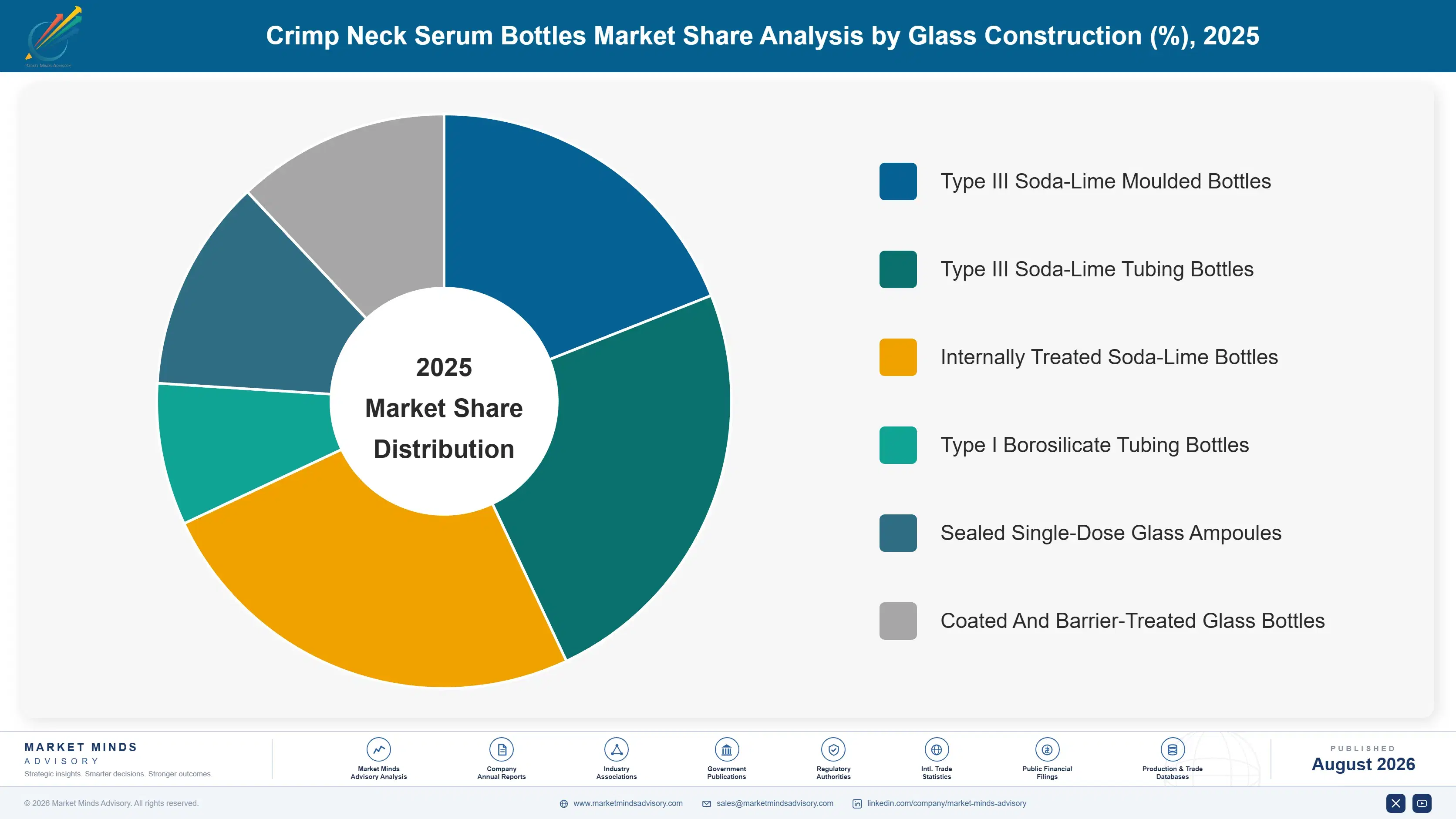
Segmentation follows glass construction and surface treatment, because that combination determines chemical durability against the formulation, dimensional consistency at the crimp, unit cost, and supply chain exposure. Bottle size and brand tier both cut across every construction rather than separating them cleanly, so neither serves as a workable primary dimension here. Six constructions result, and their durability differs enormously.
crimp-neck-serum-bottles-market-market-share-analysis-1787298939511

Type I Borosilicate Tubing Bottles

The fastest construction at 10.8%, exactly 1.50 times the market rate, and the only one that removes container chemistry from the formulation stability equation entirely. Borosilicate resists alkali extraction, so an acidic vitamin C serum holds its pH and its active concentration across shelf life rather than drifting. Tubing drawing also delivers the dimensional consistency that automated crimping needs and the thin clear wall that suits clinical positioning. Cost runs several times moulded soda-lime, so adoption tracks active concentration rather than brand tier. The genuine risk is supply, since tubing comes from very few global producers and cosmetic customers rank behind injectable programmes in every allocation decision. Cost tracks active concentration rather than brand positioning.
CAGR 10.8%

Internally Treated Soda-Lime Bottles

Second fastest at 8.9%, and commercially the most interesting position because it captures most of the benefit at a fraction of the cost. Treating the internal surface of ordinary soda-lime glass with ammonium sulphate during annealing converts the surface layer and sharply reduces alkali extraction into the contents. The result sits between untreated soda-lime and borosilicate on chemical durability and much closer to soda-lime on price. For serums at moderate rather than extreme pH it is entirely sufficient, which covers a large share of the category. Brands only discover the distinction after a stability failure, which means the specification conversation usually happens too late to help them. No tubing dependency attaches to this route at all.
CAGR 8.9%
Full segment breakdown across 6 segments available in the complete report.

Regional Architecture and Country Demand Map

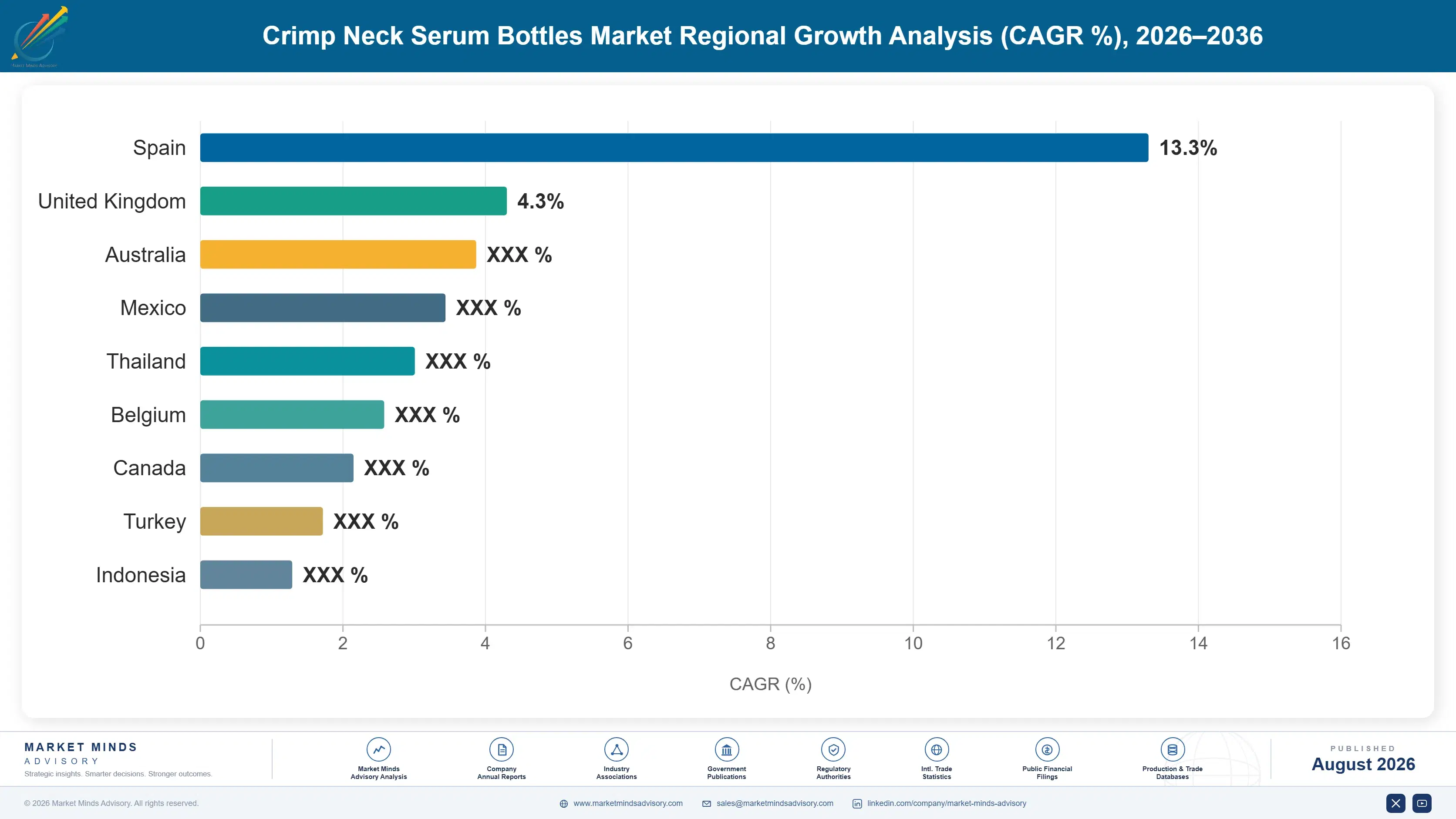
This category concentrates where the ampoule format originated and where pharmaceutical glass conversion capacity sits. East Asia leads well above its framework band on both counts, while North America falls below band because reclosable screw-neck droppers remain the convention there. Format convention rather than serum demand explains that gap.

East Asia

Thirty-four percent, above the framework band, and the justification is that the format was invented here and the conversion capacity sits here too. Korean skincare established the single-dose sealed ampoule as an intensive treatment convention, and South Korea contributes the fastest national growth rate in this forecast at 12.2%. Chinese domestic brands adopted the format wholesale and consume enormous unit volumes, supported by a large pharmaceutical glass conversion base serving both medical and cosmetic customers. Japanese demand is smaller and technically exacting on cosmetic defect standards. Growth at 8.3% runs above the global rate on ampoule format expansion rather than on serum volume itself. Pharmaceutical conversion lines run cosmetic finishes readily here.
Share: 34% | CAGR: 8.3% (2026 to 2036)

South Asia and Pacific

Twelve percent, at the top of its band, and India carries most of it through a rapidly formalising premium skincare market that has adopted ampoule and crimped serum formats as efficacy signals. Domestic pharmaceutical glass converters supply the volume, which gives India an unusual advantage since the same plants already run injectable vial finishes to tighter standards than cosmetics require. Filler crimping capability is better here than in most regions for the same reason. Growth at 9.3% is the highest of any region, driven by premium skincare penetration and by domestic glass capacity that can absorb the demand without imports. Filler crimping capability is better here than most regions, for the same pharmaceutical reason.
Share: 12% | CAGR: 9.3% (2026 to 2036)
Regional intelligence for 5 additional markets available in the complete report: Western Europe, North America, Latin America, Middle East and Africa, Eastern Europe. Contact sales@marketmindsadvisory.com.
crimp-neck-serum-bottles-market-country-cagr-analysis-1787298940036

Where Glass Converters Earn Their Margin

Sand and soda ash are cheap and every converter buys them at similar prices, so nobody wins on raw material. Value comes from specifying glass against formulation chemistry, from converting customers to tubing, from solving the filler crimping problem, and from securing borosilicate tubing before the next allocation event. Four levers follow, and two of them are about supply.

Sell Glass Type Against Formulation pH. Not Against Price

Brands quote container specifications on unit cost because nobody has shown them what soda-lime does to an acidic serum across shelf life. Presenting extraction data alongside the quote, showing the 0.4 pH shift that degrades ascorbic acid below label claim, moves the conversation to formulation stability where a converter can defend several times the price. Converters who run and publish extraction testing win specification at the formulation stage rather than bidding at the procurement stage. Testing capability costs around 800,000 dollars to establish and reframes every subsequent tender. Procurement never sees the argument at all.
Market Impact: Extraction testing capability costs roughly 800,000 dollars total

Convert Moulded Customers To Tubing Construction Deliberately

Tubing bottles carry higher realised price, better margin, and tighter dimensional tolerance that reduces crimp line rejects below the 1.9% industry norm. The argument that lands with a brand is not appearance but scrap, because a mis-crimped bottle is lost glass plus lost formulation plus lost fill time. Quantifying that against a customer's own reject data typically justifies a price step of 20 to 30% over moulded equivalents. Converters treating tubing as a premium aesthetic option rather than as a yield improvement are leaving most of the argument unmade. The customer's own scrap data settles the argument.
Market Impact: Justifies a 20 to 30% price step upward

Solve The Filler Crimping Gap For Your Own Customers

Roughly 34% of cosmetic contract fillers can crimp, which means a brand adopting the format loses two thirds of its manufacturing options and frequently abandons the format entirely at that point. A glass converter that qualifies filler networks, supplies matched tooling, or offers crimping as a service removes the obstacle standing directly in front of its own sale. Building a qualified filler network across three regions costs perhaps 1.2 million dollars in tooling and technical support, and it converts prospects who would otherwise never reach a purchase order. Brands abandon the format entirely at this point otherwise.
Market Impact: A qualified filler network costs 1.2 million dollars

Contract Borosilicate Tubing Across Multi-Year Terms

Pharmaceutical grade tubing is drawn by very few producers and cosmetic customers were rationed for roughly 24 months behind injectable programmes during the last demand event. Multi-year tubing agreements secure allocation position rather than merely price, and allocation is what actually matters when supply tightens. Converters who signed after the shortage began got nothing at all. Qualifying a second tubing source in parallel costs testing time and inventory complexity but removes dependence on a producer with better customers than cosmetics in a crisis. Allocation position matters far more than negotiated price, which several converters learned late.
Market Impact: Rationing lasted 24 months in the last shortage

Who Controls the Margin Pool

Concentration reaches 46% across the top five measured on annual unit production capacity, and the leaders are pharmaceutical glass converters serving cosmetics as an adjacent category rather than cosmetic packaging houses that learned glass chemistry. That origin matters commercially, because it means the strongest suppliers already work to injectable standards that cosmetic requirements sit comfortably inside. The gap to challengers is widest on borosilicate tubing conversion capability.
Competition runs on three fronts. Glass chemistry documentation is the first, and it decides work at brands whose formulation teams are involved early. Tubing conversion capability is the second, requiring both allocation access and drawing expertise. Filler network qualification is the third and least contested, which is odd given how directly it gates adoption. Nobody is competing seriously on the filler qualification front.

Pressure comes from two directions. Chinese pharmaceutical glass converters have improved dimensional consistency substantially and now compete credibly on treated soda-lime. And any renewed pharmaceutical demand event would ration cosmetic customers again, which advantages converters holding multi-year tubing agreements over those buying opportunistically. Both pressures reward preparation rather than any technical advance, which is unusual for a glass category.
crimp-neck-serum-bottles-market-company-positioning-matrix-1787298940558

Competitive Moat and Risk Dimensions

SCHOTT

Moat: Draws its own borosilicate tubing

Manufacturing borosilicate tubing rather than buying it removes the allocation exposure that constrains every converter downstream of a tubing producer. During the last pharmaceutical demand event that difference decided who could supply cosmetic customers at all. Tubing drawing at pharmaceutical tolerance is capital intensive and technically demanding, which is why so few producers exist.
SCHOTT

Risk: Cosmetics ranks behind pharmaceutical demand

Integration protects supply overall but the same company allocates that supply, and injectable programmes outrank cosmetic serum customers on both margin and contractual obligation whenever capacity tightens. Cosmetic customers learned this during the last shortage and some diversified afterwards. Being supplied by a company whose priority customers are elsewhere is a structural exposure that no contract fully removes.
GERRESHEIMER

Moat: Breadth across glass and polymer

Supplying moulded glass, tubing glass, and polymer containers across both pharmaceutical and cosmetic customers lets one supplier follow a brand as its specification moves up the durability ladder rather than losing it to a specialist. Brands consolidating packaging suppliers value that reach. The pharmaceutical side also funds quality systems and testing capability that cosmetic volumes alone would never justify building.
GERRESHEIMER

Risk: Breadth against focused tubing specialists

A wide portfolio means borosilicate tubing conversion competes internally for capital against moulded glass, polymer, and medical device systems with different return profiles. Specialists concentrating on tubing move faster on capacity and on drawing partnerships. In the fastest-growing construction in this category, internal capital competition is a genuine commercial cost rather than an abstract one.

Players Tracked

Prominent Players

Schott
Gerresheimer
Nipro
SGD Pharma
Stevanato Group

Other Key Players

Corning
Nippon Electric Glass
Shandong Pharmaceutical Glass
Linuo Group
Bormioli Pharma
Piramal Glass
Stoelzle Glass Group
Baralan
Heinz-Glas
Ritter Pharma
Chongqing Zhengchuan Pharmaceutical Packaging
Nihon Yamamura Glass
Vetroelite
Sisecam
Duran Group

Recent Developments

MARCH 2025

European converter publishes alkali extraction data for cosmetic serums

A pharmaceutical glass converter released comparative alkali extraction testing across soda-lime, internally treated, and borosilicate containers, using representative acidic cosmetic formulations at commercial pH. The publication was a commercial marketing decision rather than any regulatory requirement, and it targets brand formulation teams rather than procurement.
Signal: Glass chemistry is being sold to formulators rather than to buyers, which is where the specification decision actually gets made
JUNE 2025

Korean brand extends single-dose ampoule range into European distribution

A Korean skincare house launched its sealed single-dose ampoule treatment range across European prestige retail, using crimped borosilicate containers rather than the reclosable formats European consumers expect. The launch was organic international expansion rather than any distribution partnership with a European group. Retail listings cover several European markets.
Signal: Asian format conventions are arriving in European retail directly, which will pull crimping capability requirements along behind them
SEPTEMBER 2025

Indian converter qualifies cosmetic crimp finishes on pharmaceutical lines

An Indian pharmaceutical glass manufacturer qualified cosmetic crimp neck finishes on existing injectable vial conversion lines, targeting domestic premium skincare brands adopting ampoule formats. The work was internal qualification and capacity reallocation rather than any new plant investment or joint venture arrangement. Capacity figures were not disclosed publicly.
Signal: Pharmaceutical conversion lines running cosmetic finishes gives India cost and quality positions few regions can match

Sand. Boron, and Furnace Energy

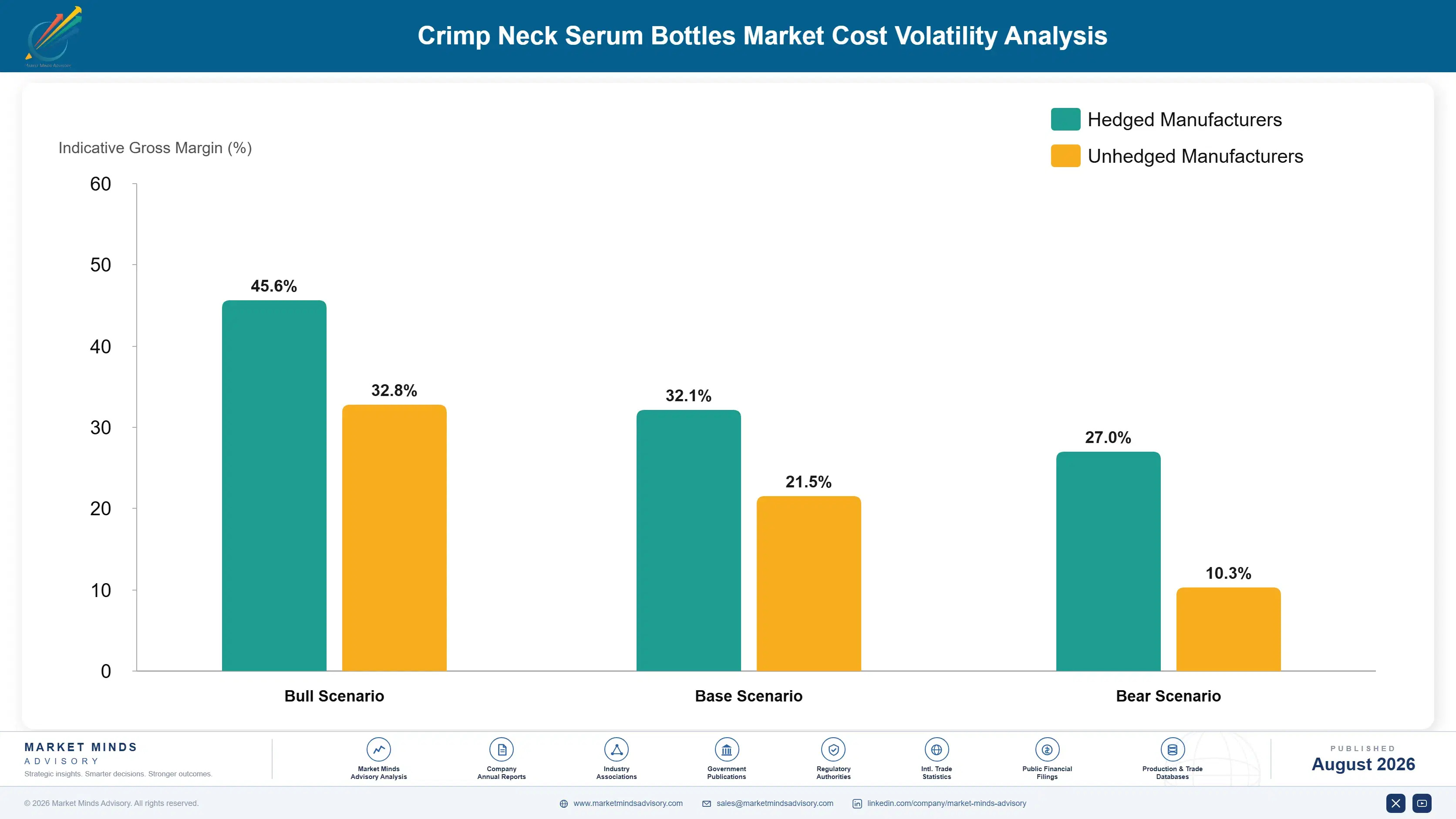
Cost structure differs sharply by construction route. For moulded soda-lime bottles, batch materials run about 18% and furnace melting energy roughly 26% of conversion cost. For tubing bottles the picture inverts, because the converter buys drawn tubing as a purchased input at close to 44% of cost and performs only forming, annealing, and inspection itself.
Borosilicate tubing was the exposure that mattered. Availability collapsed during pharmaceutical demand and cosmetic customers were rationed for roughly 24 months behind injectable programmes, with pricing rising sharply for whatever volume converters could obtain. Company annual reports across pharmaceutical packaging describe the allocation dynamics consistently. Boron feedstock and the energy intensity of borosilicate melting both contribute to a cost base that sits well above soda-lime and moves less predictably.

The competitive disadvantage mechanism is positional rather than operational. A converter that draws its own tubing controls supply and cost; one that buys tubing depends on a producer whose pharmaceutical customers outrank cosmetics whenever capacity tightens. Moulded glass producers avoid the exposure entirely but cannot serve the fastest-growing construction. Small converters buying tubing on spot during an allocation event are the worst placed of anyone in the chain.
crimp-neck-serum-bottles-market-cost-volatility-analysis-1787298940754

Contract tubing allocation rather than tubing price alone

During the last shortage the price mattered far less than whether a converter appeared on the allocation list at all, and several who had negotiated hardest on price found themselves excluded from it entirely. Multi-year agreements specifying volume commitment in both directions secure that position. Converters who tried contracting afterwards found nothing left uncommitted.

Qualify internally treated soda-lime as a substitution route

Ammonium sulphate surface treatment delivers much of borosilicate's chemical durability at a fraction of the cost and without any tubing dependency at all. For serums at moderate rather than extreme pH it is entirely adequate. Holding a qualified treated grade gives a converter something to offer when borosilicate is unavailable, rather than losing the order to a competitor who prepared.

Recover furnace heat on moulded soda-lime production lines

Melting energy runs about 26% of moulded conversion cost and much of it leaves as hot exhaust. Regenerative and recuperative heat recovery cuts a meaningful share of that, and the payback works wherever energy is expensive. The engineering is well understood and consistently deferred in favour of capacity projects that show up more visibly in a board presentation.

Portfolio Architecture for Margin Defence

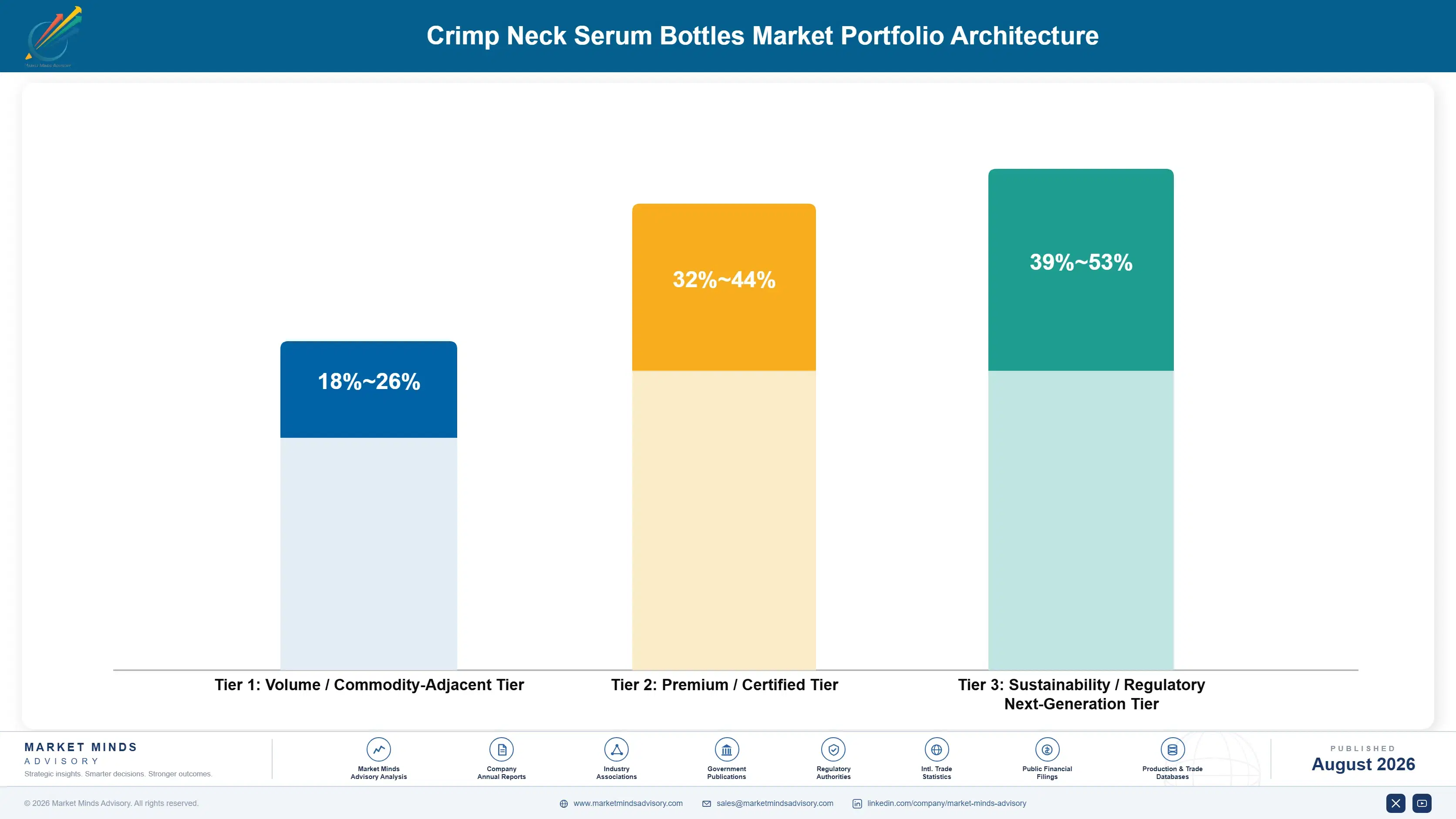
Three tiers describe this market and the margin spread reflects chemical durability rather than manufacturing complexity. Moulded soda-lime bottles at commodity glass economics sit at the bottom, competing on price against converters everywhere. Certified treated soda-lime and standard tubing bottles with documented extraction performance sit considerably higher. And borosilicate tubing containers with full stability documentation occupy a third tier where the converter is selling formulation pr
The tension is that moulded volume keeps furnaces loaded and tubing conversion does not. A converter melting its own soda-lime needs campaign volume to justify furnace economics, while tubing forming lines are far more flexible. Several converters chased the tubing mix shift and discovered their moulded furnace running below efficient loading, with unit cost rising across everything else they made. Furnace campaign volume is the constraint nobody models properly.

High-value pools concentrate where the container prevents a formulation failure that the brand can quantify. Extraction performance documentation and reject rate improvement both do exactly that. Both are failures the brand can put a number against, which makes the sale considerably easier.

Volume / Commodity-Adjacent Tier

Moulded soda-lime crimp neck bottles supplied to mass and mid-tier serum brands on price. Thin margin, high volume, and the furnace loading that makes melting economics work for everything produced above it on the same asset.
Gross Margin: 18-26%

Premium / Certified Tier

Internally treated soda-lime and standard tubing bottles with documented extraction performance and tighter neck tolerance for automated crimping. Margin reflects treatment capability and testing documentation rather than any material cost difference.
Gross Margin: 32-44%

Sustainability / Regulatory / Next-Generation Tier

Type I borosilicate tubing containers and sealed single-dose ampoules with full stability and extraction documentation. Best margin in the category because the converter is selling formulation protection and supply security rather than a glass container.
Gross Margin: 39-53%
crimp-neck-serum-bottles-market-portfolio-architecture-1787298941251

High-value Sub-segments and Strategic Watch-out

Type I Borosilicate Tubing Containers

Best margin and fastest growth at 10.8%, removing container chemistry from the stability equation for high-concentration acidic serums. Supply rather than demand is the constraint, since tubing comes from very few producers and cosmetics ranks behind injectable programmes in allocation. Multi-year tubing agreements are the only real defence.
Gross Margin: 39-53%

Internally Treated Soda-Lime Bottles

Strong margin capturing most of borosilicate's durability benefit at a fraction of the cost and with no tubing dependency at all. Growth depends entirely on brands learning the distinction exists, which most do only after a stability failure has already happened. Ammonium sulphate treatment is well understood and cheap.
Gross Margin: 32-44%

Moulded Soda-Lime Crimp Bottles

The volume core at commodity margin, and the furnace loading that makes melting economics viable for the treated grades produced alongside it. Converters chasing tubing mix found moulded campaigns running below efficient volume and unit costs rising everywhere. Melting economics do not care about product mix.
Gross Margin: 18-26%

Sealed Single-Dose Glass Ampoules

The strategic watch-out, growing quickly on Korean format propagation while depending on filling capability that only about 34% of cosmetic contract manufacturers hold. Adoption stalls at the filler rather than at the brand, which converters consistently fail to address. Single-dose formats need no preservative system at all.
Gross Margin: 36-49%

How Container Programmes Persist

A crimp neck container programme runs for the commercial life of the product, and what holds it is stability data rather than any commercial relationship. A brand that has completed shelf life testing against a specific glass type and surface treatment will not change supplier without repeating that work, because the container is part of the stability claim. Contracts run three to five years and renew routinely. Filling line tooling matched to a specific neck finish adds a second layer of switch
Depth of adoption varies by brand type more than by geography. Clinical and dermatologist-led brands involve formulation teams in glass selection and specify properly. Prestige houses specify on appearance and discover chemistry later. Mass brands buy moulded soda-lime on price and accept the shorter effective shelf life without ever attributing it correctly. Professional and medical spa channels behave like clinical brands, since their customers ask technical questions.

Buyer profiles are changing as stability and regulatory functions take over a decision packaging procurement used to own alone. Extraction data now gets requested at the quotation stage rather than after a failure.
crimp-neck-serum-bottles-market-end-use-penetration-index-1787298941742

What We Would Tell a Board

These are among the four positions where our research anticipates prominent divergence between winners and laggards over the coming forecast period. Each is grounded in the demand model, the regulatory perimeter, and the announced capacity pipeline.
01 / CHEMISTRY LED SPECIFICATION

Sell extraction data to formulators, not price to buyers

Soda-lime glass leaches alkali into acidic serums and a shift of roughly 0.4 pH degrades ascorbic acid below its label claim, yet brands routinely buy container glass on unit cost alone because nobody has shown them the data. Establishing extraction testing capability costs around 800,000 dollars and moves the conversation from procurement to formulation, where several times the price is defensible. Converters who commission and publish this data win the specification before a tender is ever written, which is a fundamentally better position than bidding into one.
02 / TUBING CONVERSION ARGUMENT

Sell tubing on scrap rate, not on appearance

A crimped bottle cannot be reopened, so a sealing failure destroys the glass, the formulation, and the fill time together, and reject rates run around 1.9% on loose moulded neck tolerances. Tubing construction tightens that geometry and reduces the loss measurably, which justifies a price step of 20 to 30% on yield grounds alone. Converters positioning tubing as a premium aesthetic option are making the weaker half of an argument that the customer's own scrap data would settle for them immediately.
03 / FILLING CAPABILITY GATE

Two thirds of fillers cannot seal what you sell

Only about 34% of cosmetic contract fillers hold crimping equipment, so a brand adopting the format immediately loses most of its manufacturing options and frequently abandons the format at that point rather than solving it. Qualifying a filler network with matched crimping tooling and technical support across three regions costs roughly 1.2 million dollars in total. That spend converts prospects who currently never reach a purchase order at all, which makes it comfortably the highest-return commercial investment available anywhere in this category.
04 / TUBING ALLOCATION SECURITY

Contract the allocation position, not just the price

Borosilicate tubing is drawn by very few producers worldwide, and cosmetic customers were rationed for roughly 24 months behind injectable programmes during the last pharmaceutical demand event. What mattered then was appearing on the allocation list at all, and several converters who had negotiated hardest on price discovered they were not on it. Multi-year agreements specifying volume commitment in both directions are what secure that position, and they simply cannot be arranged once a shortage has already started to bite.

Engagement Snapshot From the Field

A live engagement with an industry participant carrying material or product regulatory and market exposure ahead of a defining policy shift, showing how our research translates into a defensible multi-year portfolio strategy.
MARKET MINDS ADVISORY · CLIENT ENGAGEMENT SUMMARY
Crimp Neck Serum Bottles Producer Strategic Portfolio Review and Transition Roadmap 2026·Investment Scenario on Crimp Neck Serum Bottles Exposure Evaluation 2025-26
CLIENT PROFILE
A European pharmaceutical glass converter with approximately 340 million dollars in annual revenue (client-reported, unverified by MMA), supplying injectable vials and increasingly cosmetic crimp neck serum bottles across Europe and Asia. The cosmetic business had grown quickly but quoted on unit price against cosmetic packaging competitors, bought all borosilicate tubing on annual terms, and had never engaged brand formulation teams directly.
STRATEGIC CHALLENGE
Cosmetic segment revenue was growing while its margin ran well below the pharmaceutical business on comparable products, and the company had lost several prospects late in the process for reasons nobody had documented. Management proposed price reductions to defend share. The board wanted an independent read before approving margin dilution.
MMA APPROACH
We reviewed twelve lost cosmetic opportunities against the reasons recorded and the eventual outcomes, interviewed brand formulation and packaging functions across nine customers on how glass is actually specified, and modelled achievable pricing under chemistry-led versus price-led positioning. Filler crimping capability was mapped across the client's three main regional markets.
KEY FINDINGS
  1. Seven of twelve lost opportunities failed at the filling stage rather than on price, with the brand unable to find a contract filler holding crimping capability in its region.
  2. Formulation teams held decisive influence at six of nine customers interviewed, and the client had never presented extraction or stability data to any of them at quotation stage.
  3. Cosmetic pricing ran roughly 26% below what comparable containers achieved when sold against documented stability performance rather than against packaging competitors on unit cost.
  4. Annual tubing contracting had left the client without allocation priority, and one supplier confirmed cosmetic volumes would be cut first in any renewed pharmaceutical demand event.
CLIENT PROFILE
A European pharmaceutical glass converter with approximately 340 million dollars in annual revenue (client-reported, unverified by MMA), supplying injectable vials and increasingly cosmetic crimp neck serum bottles across Europe and Asia. The cosmetic business had grown quickly but quoted on unit price against cosmetic packaging competitors, bought all borosilicate tubing on annual terms, and had never engaged brand formulation teams directly.
STRATEGIC CHALLENGE
Cosmetic segment revenue was growing while its margin ran well below the pharmaceutical business on comparable products, and the company had lost several prospects late in the process for reasons nobody had documented. Management proposed price reductions to defend share. The board wanted an independent read before approving margin dilution.
MMA APPROACH
We reviewed twelve lost cosmetic opportunities against the reasons recorded and the eventual outcomes, interviewed brand formulation and packaging functions across nine customers on how glass is actually specified, and modelled achievable pricing under chemistry-led versus price-led positioning. Filler crimping capability was mapped across the client's three main regional markets.
KEY FINDINGS
  1. Seven of twelve lost opportunities failed at the filling stage rather than on price, with the brand unable to find a contract filler holding crimping capability in its region.
  2. Formulation teams held decisive influence at six of nine customers interviewed, and the client had never presented extraction or stability data to any of them at quotation stage.
  3. Cosmetic pricing ran roughly 26% below what comparable containers achieved when sold against documented stability performance rather than against packaging competitors on unit cost.
  4. Annual tubing contracting had left the client without allocation priority, and one supplier confirmed cosmetic volumes would be cut first in any renewed pharmaceutical demand event.
RECOMMENDED STRATEGY
Phase 1: Phase 1 (months one to six): commission comparative alkali extraction testing against representative serum formulations and take the results directly to formulation teams. Phase 2: Phase 2 (months six to twenty-one): qualify a cosmetic filler network with matched crimping tooling across the three principal regional markets served. Phase 3: Phase 3 (months twenty-one to thirty-six): renegotiate borosilicate tubing supply onto multi-year committed terms and qualify a second tubing source.
OUTCOME
The client abandoned the price reduction proposal and commissioned extraction testing instead. Cosmetic segment realised pricing rose materially within three quarters as specification conversations moved to formulation teams (client-reported, unverified by MMA), and the qualified filler network converted several prospects that had previously stalled, with no change to the underlying product range.

Frequently Asked Questions

Foundational context covering the market sizes, CAGR, scope, country, region and competition that inform every finding below. This section is provided to cover basics and most often pre-purchase conversations, answered from the MMA Primary Research Dataset.

What is the current size of the Crimp Neck Serum Bottles Market?

The market is valued at USD 0.62 billion in 2025, rising to USD 0.66 billion in 2026. Borosilicate accounts for roughly 23% of units shipped.

How large will the Crimp Neck Serum Bottles Market be by 2036?

MMA forecasts USD 1.33 billion by 2036, an increase of USD 0.67 billion over the 2026 base. That represents an expansion multiple of 2.02 times.

What is the CAGR for the Crimp Neck Serum Bottles Market 2026 to 2036?

The base case CAGR is 7.2%, with a bull case of 8.4% and a bear case of 6.0%. The historical rate from 2020 to 2025 was 5.9%.

Which segment is growing fastest?

Type I borosilicate tubing bottles at 10.8%, exactly 1.50 times the market rate. Borosilicate resists the alkali extraction that shifts serum pH and degrades ascorbic acid.

Who are the major companies in the Crimp Neck Serum Bottles Market?

Schott, Gerresheimer, Nipro, SGD Pharma, and Stevanato Group lead on annual unit production capacity, together holding 46% of the market. All five are pharmaceutical glass converters serving cosmetics as an adjacent category.

Which country is growing fastest?

South Korea at 12.2%, driven by the single-dose sealed ampoule format that Korean skincare established and is now exporting into European and Chinese ranges. Each ampoule is one crimped container.

Report Segmentation Architecture

The full report scope spans multiple orthogonal segmentation dimensions, with cross-tabulated demand data provided for each dimension pair. Coverage extends further to regional breakdowns, trend trajectories, and the competitive detail needed to support segment-level decision-making.

By Glass Construction

  • Type III Soda-Lime Moulded Bottles
  • Type III Soda-Lime Tubing Bottles
  • Internally Treated Soda-Lime Bottles
  • Type I Borosilicate Tubing Bottles
  • Sealed Single-Dose Glass Ampoules
  • Coated And Barrier-Treated Glass Bottles

By End-Use Industry

  • Clinical And Dermatologist-Led Skincare
  • Prestige And Luxury Treatment Ranges
  • Professional And Medical Spa Channels
  • Mass And Pharmacy Serum Brands
  • Direct Selling And Contract Manufacturing

By Commercial Model

  • Bulk Container Supply To Brand Fillers
  • Supply With Qualified Filler Referral
  • Bespoke Tooled Development Programmes
  • Stock Catalogue Container Supply

By Region

  • East Asia
  • South Asia and Pacific
  • Western Europe
  • North America
  • Latin America
  • Middle East and Africa
  • Eastern Europe

Scope, Methodology, and Coverage

Every figure in this report is reproducible from documented input assumptions. The scope below maps the historical period, the forecast horizon, the segmentation dimensions, and the countries covered, alongside the underlying primary and qualitative methodology.
Historical Period
2020 to 2025
Forecast Period
2026 to 2036
Base Year
2025 (USD billions; MMA Primary Research Dataset, August 2026)
Market Definition
This market comprises primary glass bottles, vials, and ampoules manufactured with crimp neck finishes for cosmetic serum, concentrate, and single-dose treatment products, measured at glass converter realised prices inclusive of applied decoration and surface treatment. Construction coverage spans moulded and tubing routes across Type III soda-lime, internally treated soda-lime, and Type I borosilicate glass, together with sealed single-dose ampoules and barrier-coated containers. Aluminium ferrules and crimp closures, dropper and pipette assemblies, screw-neck containers, formulation, contract filling services, and glass supplied into pharmaceutical parenteral applications fall outside scope.
Quantitative Units
USD billions (current prices); million containers shipped; average bottle cost per unit
Segmentation Dimensions
By Glass Construction; By End-Use Industry; By Commercial Model; By Region
Regions Covered
East Asia, South Asia and Pacific, Western Europe, North America, Latin America, Middle East and Africa, Eastern Europe
Countries Covered
South Korea, China, Japan, Taiwan, India, Indonesia, Thailand, Vietnam, Australia, Germany, France, Italy, Switzerland, Spain, UK, Netherlands, Poland, Turkey, USA, Canada, Mexico, Brazil, Colombia, Argentina, UAE, Saudi Arabia, Egypt, South Africa, Israel, and additional markets relevant to this sector
Key Companies Profiled
Schott, Gerresheimer, Nipro, SGD Pharma, Stevanato Group, Corning, Nippon Electric Glass, Shandong Pharmaceutical Glass, Linuo Group, Bormioli Pharma, Piramal Glass, Stoelzle Glass Group, Baralan, Heinz-Glas, Ritter Pharma, Chongqing Zhengchuan Pharmaceutical Packaging, Nihon Yamamura Glass, Vetroelite, Sisecam, Duran Group
Quantitative Methodology
Primary survey, n=3,800 respondents, Q4 2025, six countries; demand-side model with trade association cross-validation
Qualitative Methodology
47 expert interviews, Q4 2025; applied to validate demand model assumptions, identify emerging dynamics, and assess competitive positioning
Report Format
PDF and XLSX data workbook (Word format preview document)
Publisher
Market Minds Advisory
Report Code
MMA-2026-PAC-259
Published
August 2026
Contact
sales@marketmindsadvisory.com | www.marketmindsadvisory.com

Purchase the full Crimp Neck Serum Bottles Market Report (2026 to 2036).

The full report sizes crimp neck serum containers across six glass constructions, five end-use brand types, four commercial models, and seven regions, with country detail for the twenty largest national markets. Alkali extraction performance is documented by glass type and surface treatment against representative acidic serum formulations at commercial pH. Contract filler crimping capability is mapped by region, since that constraint gates adoption more tightly than any specification decision. Competitive profiling covers twenty converters on annual unit production capacity. Borosilicate tubing supply and allocation exposure is assessed producer by producer.
Alkali extraction performance by glass type and treatment
Contract filler crimping capability mapped by region
Borosilicate tubing allocation exposure assessed by producer
Crimp line reject rates compared across construction routes
Single-dose ampoule format adoption tracked by market
Moulded and tubing conversion cost structures modelled separately

Built For The People Who Decide

From boardroom strategy to bench-side execution, this report is read cover-to-cover by leaders shaping the next decade of their industry, turning demand scenarios, market dynamics and valuation benchmarks into decisions.
CXOs/ Presidents/ VPs/ Managers
M&A and Corporate Development
Strategy Teams and R&D Heads
Procurement and Product Directors
Regulatory and Compliance Leaders
Investor Relations and Equity Analysts